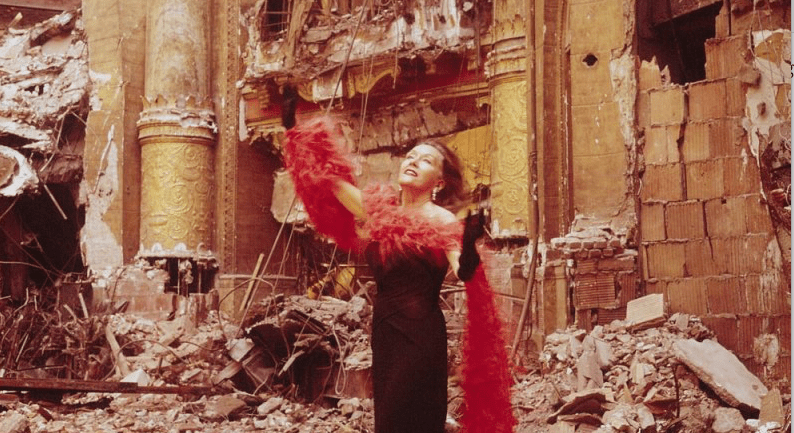
Above: Actress Gloria Swanson amid the ruins of the Roxy, 1960. The famed theater opened with Swanson's silent film, "The Love of Sunya."(Time Inc.)
Jazz Age New York City was all about the big and grand, and nothing was bigger and grander than the new Roxy Theatre near Times Square.
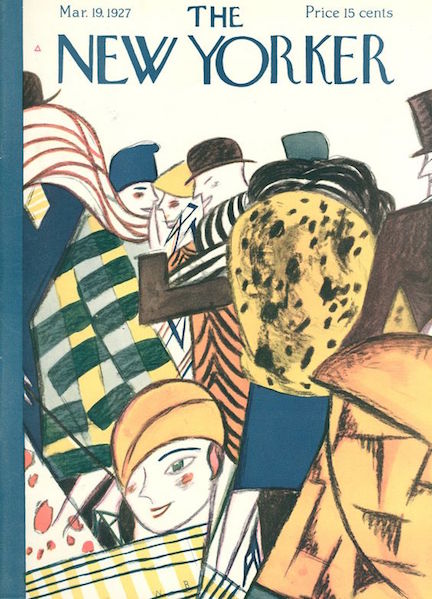
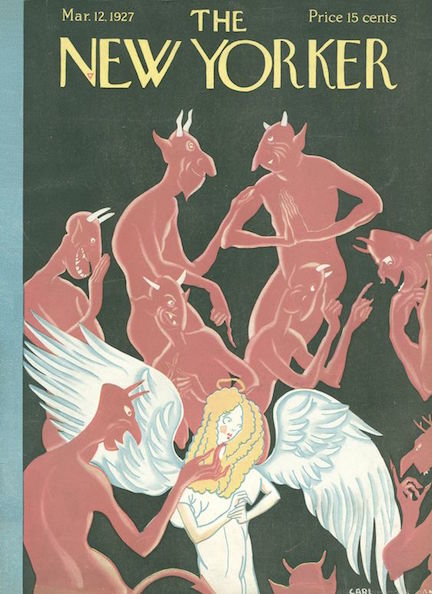
March 19, 1927 cover by W. Boethling.
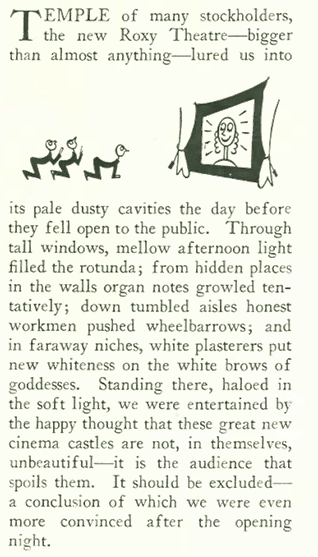
The nearly 6,000-seat theatre was such big news that the March 19, 1927 edition of The New Yorker heralded its arrival in three separate columns.
OPENING NIGHT at the Roxy Theatre. (elixinhollywood.blogspot.com)
The Roxy opened with the silent film The Love of Sunya, produced by and starring Gloria Swanson. The film, naturally, was panned by the magazine. Perhaps the critic’s distaste for the film also prompted a certain aloofness about the theatre itself:
NOT EXACTLY YOUR LOCAL CINEPLEX…The Roxy Theatre lobby featuring the “world’s largest oval rug” manufactured by Mohawk Carpets. The theatre was torn down in 1960 and replaced by an office building. A TGI Friday’s restaurant is now located in the space that once housed this grand lobby. (screensonhigh.wordpress.com)NOT ANOTHER BAD NEW YORKER REVIEW?…Gloria Swanson consults a crystal ball to learn her future with three different men in The Love of Sunya. (gswanson.weebly.com)
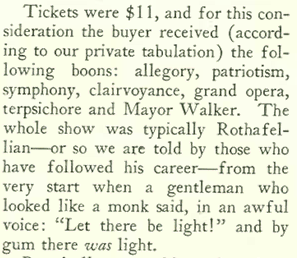
“The Talk of the Town” described the Roxy in similar dispassionate terms, tossing a wet blanket not on the film but rather on the rude, gawking masses who shelled out eleven bucks apiece (equivalent to $150 today) for a seat on opening night:
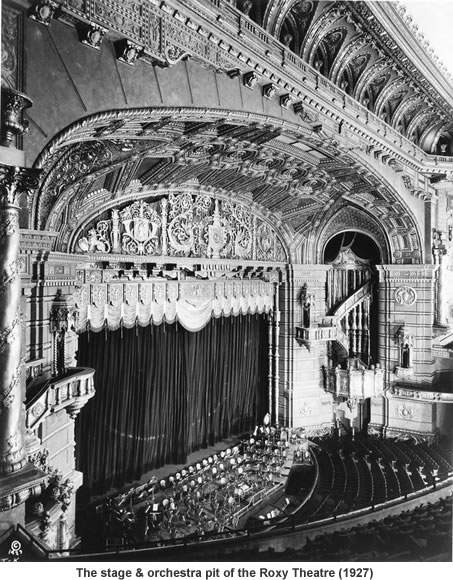
THEY WERE AWESTRUCK…The stage and orchestra pit of the Roxy Theatre (elixinhollywood.blogspot.com)
New Yorker architecture critic George S. Chappell (aka “T-Square”) was a bit more generous in his column, “The Sky Line.”
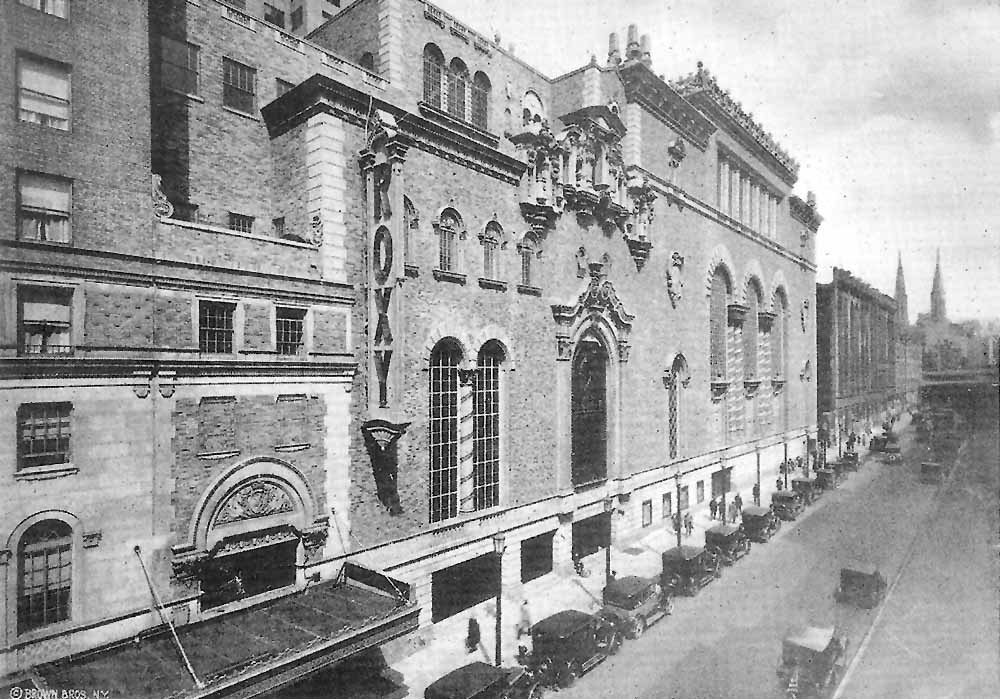
DUBBED ‘THE CATHEDRAL OF THE MOTION PICTURE’ by creator and namesake Samuel ‘Roxy’ Rothafel, the Roxy was located at 153 West 50th Street between 6th and 7th Avenues. It was torn down in 1960. (nycago.com)COMING FULL CIRCLE…Gloria Swanson was photographed by Eliot Elisofon in the ruins of the Roxy Theatre on October 14, 1960 for Life Magazine. (Time Inc.)
* * *
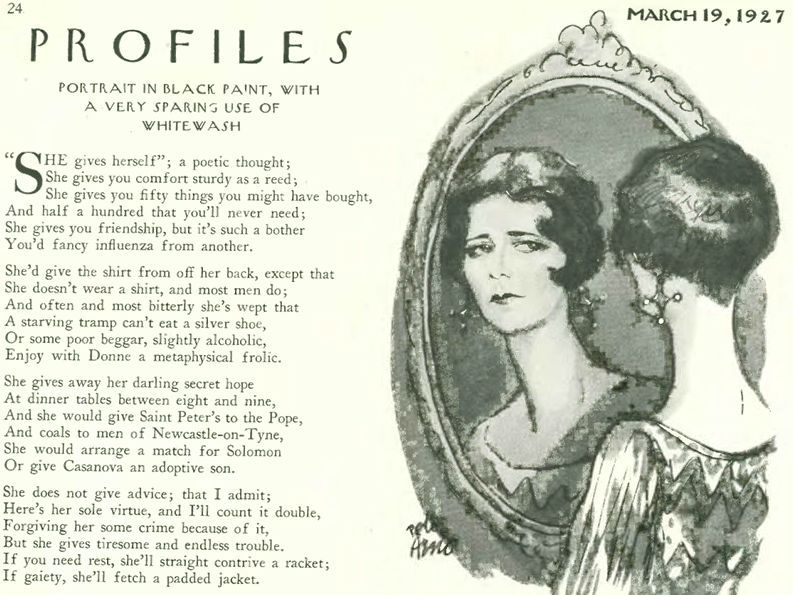
The magazine took an unusual approach to its “Profile” section by featuring an autobiographical profile of poet Elinor Wylie in verse, a portion of which is shown below with an illustration by Peter Arno:
* * *
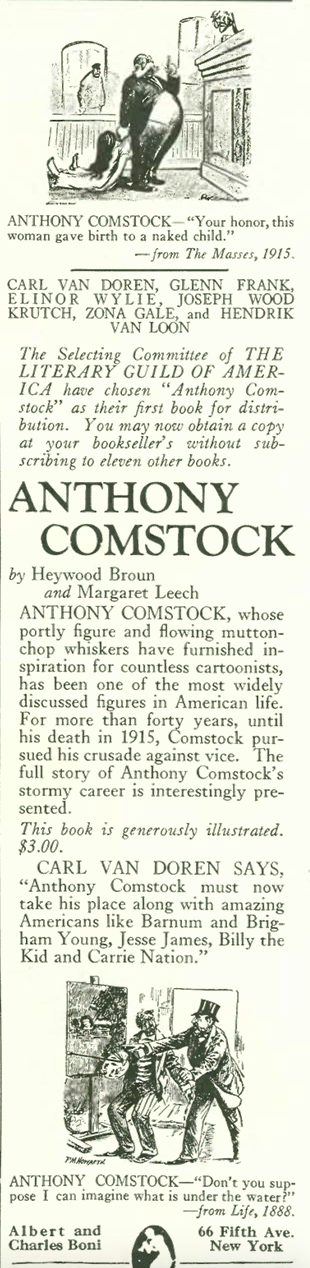
Morality-themed books got the attention of New Yorker book reviewer Ernest Boyd (pen name “Alceste), who devoted considerable ink to Anthony Comstock: Roundsman of the Lord by Heywood Broun and Margaret Leech (both of Algonquin Round Table fame). Comstock was a United States Postal Inspector and politician known for the “Comstock Law,” which sought to censor materials he considered indecent and obscene. That included birth control information, which led to famous clashes between Comstock and family planning advocate Margaret Sanger.
An advertisement for the book appeared in the back pages of the magazine:
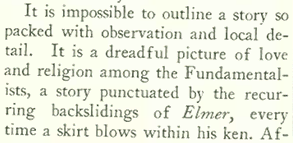
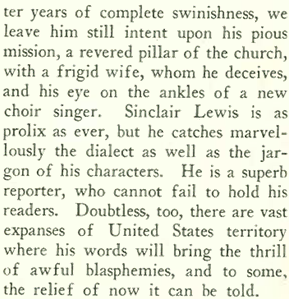
Boyd also reviewed Sinclair Lewis’sElmer Gantry, a controversial novel that exposed the hypocrisy of some 1920s evangelical preachers:
* * *
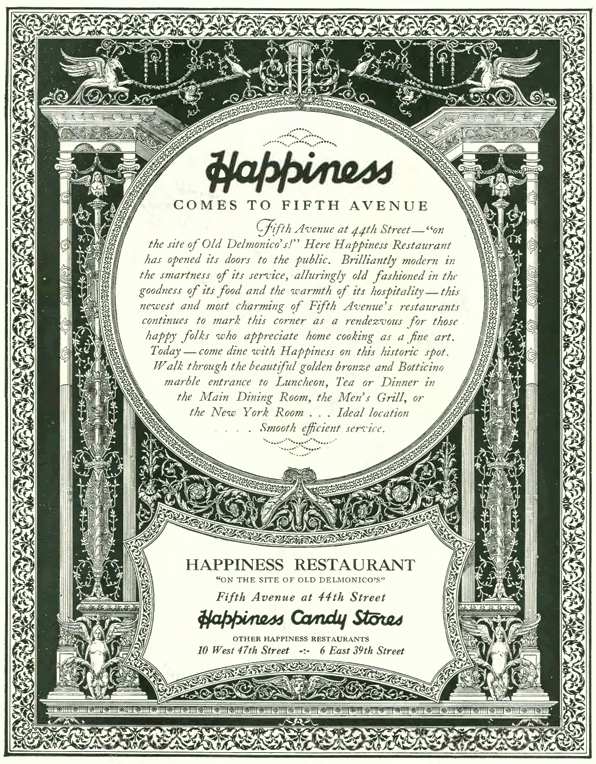
This advertisement began to appear in the pages of the New Yorker for a new restaurant that claimed to replace the beloved Delmonico’s. Despite its status as a New York institution, Delmonico’s had fallen victim to the changing dining habits of Prohibition New York and had closed its doors in 1923:
The restaurant was operated by the Happiness Candy Stores chain, which according to the ad also operated restaurants in two other locations in the city. The restaurants must have been short-lived, as I could find no record of them apart from the ads.
The breathtaking changes along Manhattan’s streets and across its skyline in 1927 were reflected in the New Yorker’s frequent accounts of venerable landmarks giving way to new skyscrapers.
The Feb. 26, 1927 cover (left) is by an unknown artist. The March 5, 1927 cover is by Ilonka Karasz.
We’ll skip ahead for a moment to the March 5 issue in which the “Talk of the Town” editors reflected on the upcoming demolition of the William A. Clark house on Fifth Avenue and 77th Street, just 16 years after its completion in 1911. The editors noted that the empty house received many curious visitors in its last days, including the silent film star Charlie Chaplin:
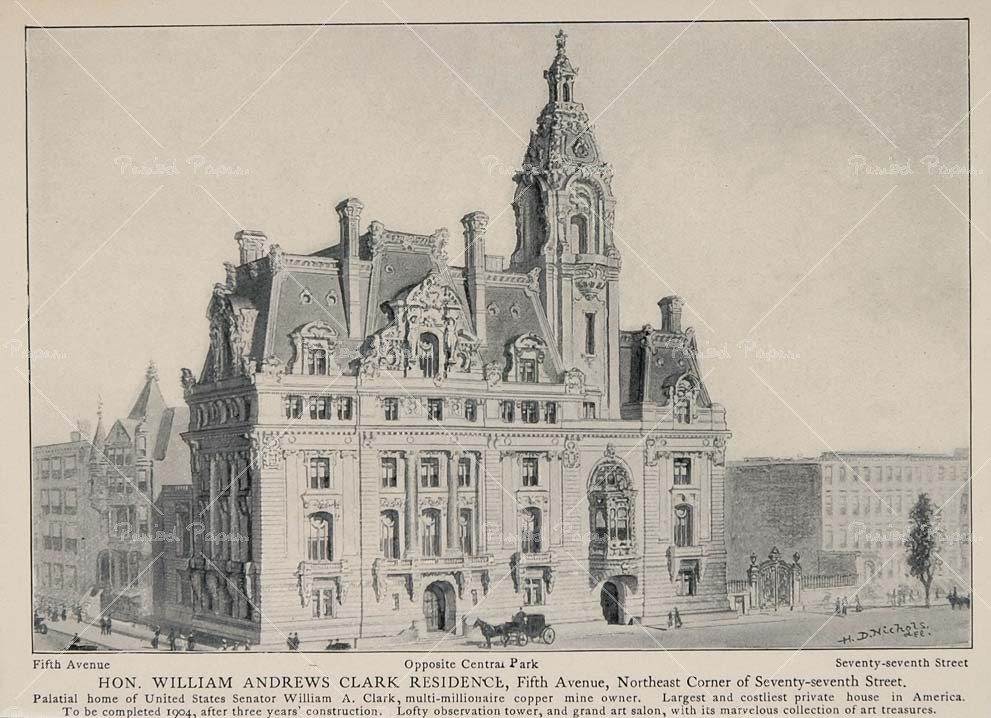
CURB APPEAL…This newspaper account of Clark’s planned mansion noted that it would be the largest and costliest house in America, and would take three years to complete. In fact, it took 13 years to finish the job, in 1911. Just 16 years later it would be demolished. (1889victorianrestoration.blogspot.com)
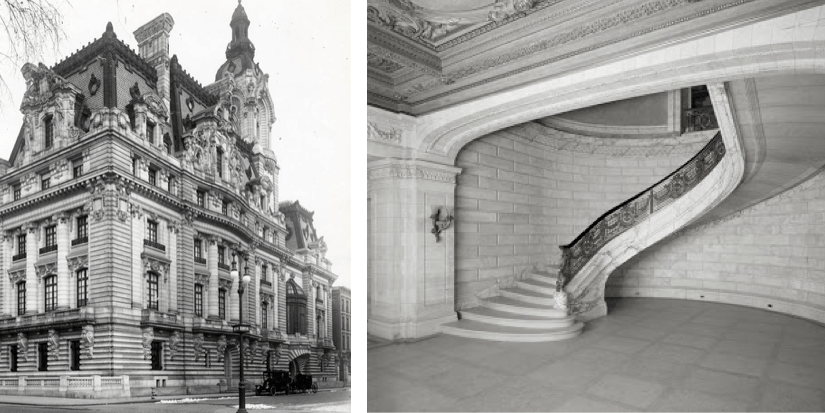
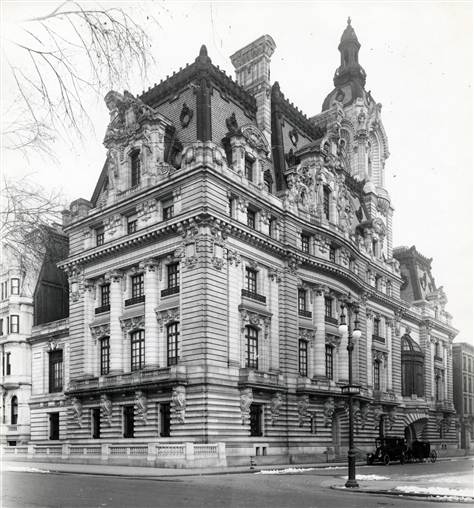
Clark was an enormously wealthy Montana entrepreneur (copper and railroads) and politician. His New York mansion, dubbed “Clark’s Folly,” took almost as long to complete—13 years—as its actual lifespan—16 years. In today’s dollars the house would cost nearly $200 million. It included imported marble from Italy, oak from England’s Sherwood Forest, and sections of whole rooms from old French Châteaus.
The William A. Clark mansion on Fifth Avenue and 77th Street. (Museum of the City of New York)
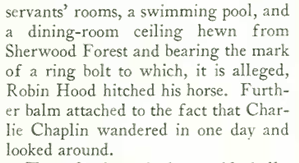
According to Wikipedia, the second floor featured a 36-foot-high rotunda, used as the statuary room. This opened onto a conservatory of solid brass and glass, 30 ft. high and 22 ft. wide. Across the rotunda was the marble-paneled main picture gallery that was 95 ft. long and two stories high. An organ loft housed the largest chamber organ in America.
The nine-story house contained 121 rooms, 31 bathrooms, four art galleries, a swimming pool and Turkish baths. High-tech for its times, with electricity and central air conditioning, it required seven tons of coal per day, brought in by a private subway line.
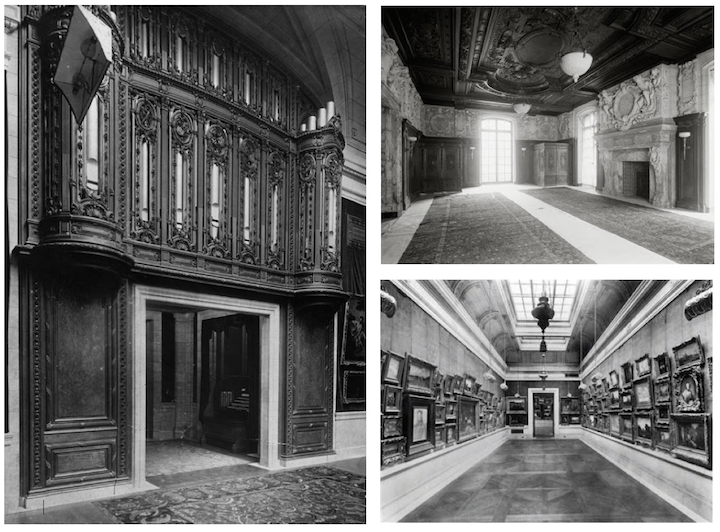
PARTING SHOTS…Interiors of Clark’s “Folly” included the largest chamber organ in America (left), an immense dining room (upper right) and a two-story art gallery, a section shown below, right. The photos were taken just prior to demolition. Although some interior appointments were saved, the organ was apparently torn apart and dumped into a swamp in Queens. (Wikipedia)
After Clark died in 1925, his daughter, Huguette, and her mother, Anna, moved to 907 Fifth Avenue and the mansion was sold to developer Anthony Compagana for $3 million (more than $40 million today). Compagana had it torn down, replacing it with a luxury apartment building.
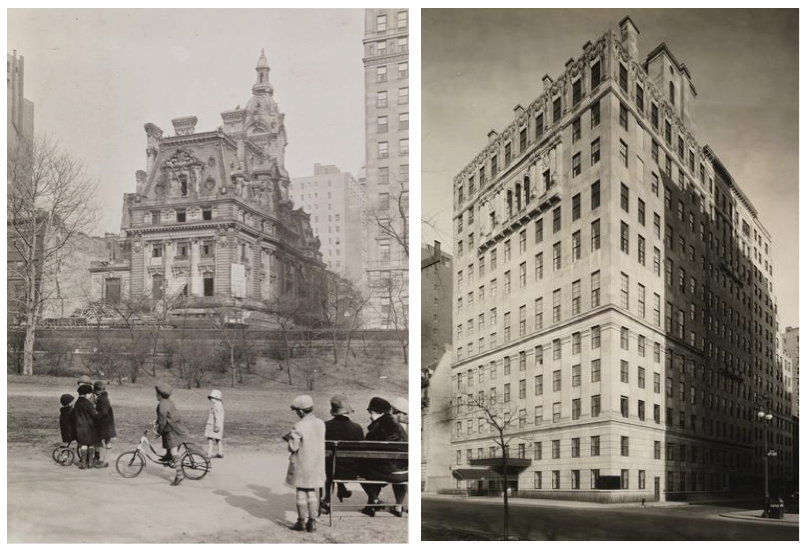
The demolition of “Clark’s Folly” (left) in 1927. A large sign on the mansion advertises modern apartments to come. (New York Historical Society). At right, the building that replaced it, 960 Fifth Avenue. (Museum of the City of New York).
A footnote: Clark’s daughter and heiress, Huguette, would go on to own a $24 million Connecticut country estate and a $100 million estate in Santa Barbara, but would keep them uninhabited. Briefly married from 1928 to 1930, she became reclusive, holed up in her apartments at 907 Fifth Avenue until she moved to a series of hospital rooms beginning in the 1980s.
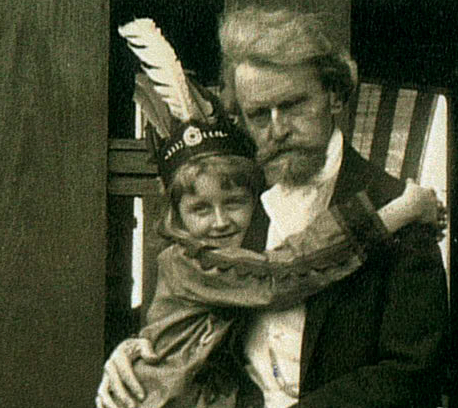
HAPPIER TIMES…Huguette Clark with her father, William A. Clark, circa 1912. (EmptyMansionsBook.com)
Continuing the theme of the changing skyline, the Feb. 26 New Yorker featured this advertisement for the new Drake Hotel at Park Avenue and 56th Street:
The hotel was built in 1926 by the real estate organization of Bing and Bing, 21 stories with 495 rooms. Like Clark’s Folly, it was innovative for its time, with automatic refrigeration and spacious rooms and suites.
It saw plenty of famous guests, from silent star Lillian Gish (she lived there for three years) to ’60s and ’70s rock bands like Led Zeppelin and The Who.
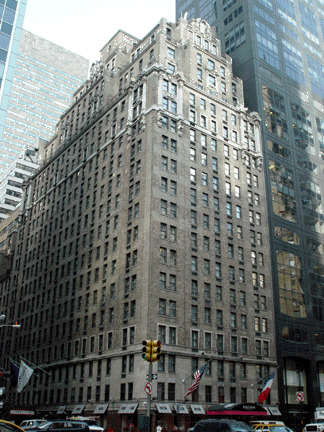
The Drake Hotel, demolished in 2007. (skyscrapercity)
Razed in 2007, the Drake Hotel was replaced by 432 Park Avenue. At 96 stories and 1,400 feet, 432 Park it is the tallest residential tower in the Western Hemisphere (as of August 2016).
432 Park Avenue (Wikipedia)
Completed in 2015, the supertall 432 Park was designed for the superrich. The building has been maligned by many who find it not only ugly but also a stark representation of the city’s increasing cost of living and conspicuous displays of wealth. One blogger suggested that the building was giving the city “the finger.”
Even Fortune magazine’s Joshua Brown (“Meet the house that inequality built: 432 Park Avenue,” Nov. 24, 2014) noted “in a building so tall and imposing, with over 400,000 square feet of usable interior space, there are only 104 units for people to live in. 432 Park Avenue is, in short, a monument to the epic rise of the global super-wealthy. It is the house that historic inequality built.”
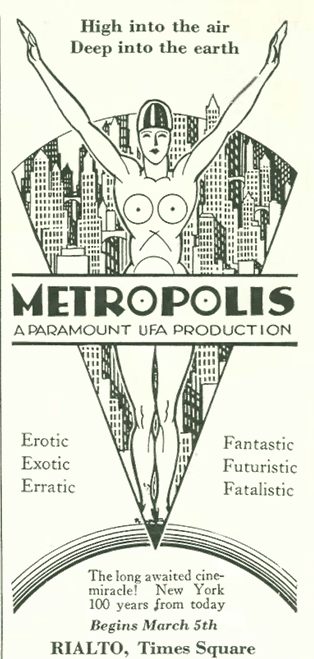
After reading about 432 Park, it seems appropriate that I spotted this advertisement in the New Yorker’s March 5, 1927 issue:
Fritz Lang’s film Metropolis was set in a futuristic urban dystopia where the upper classes lived high above the toiling masses. Hmmm.
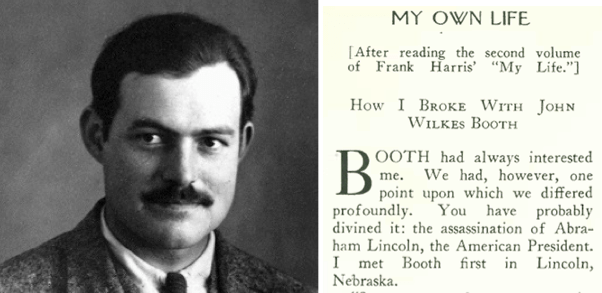
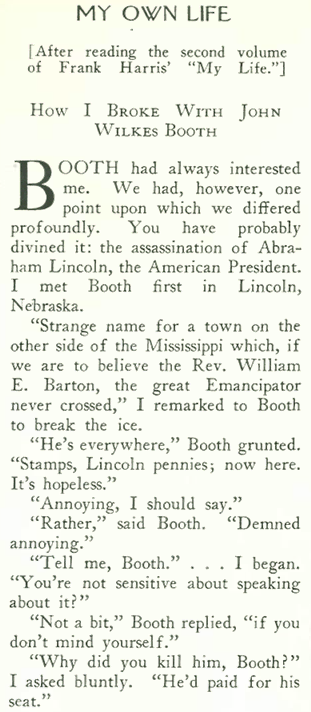
Ernest Hemingway wrote his lone New Yorker piece for the Feb. 5, 1927 issue. Titled “My Own Life,” it was a short parody of the 3-volume My Life and Loves by Irish writer Frank Harris.
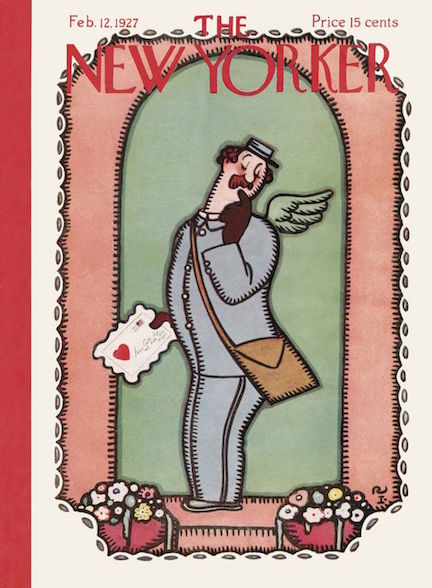
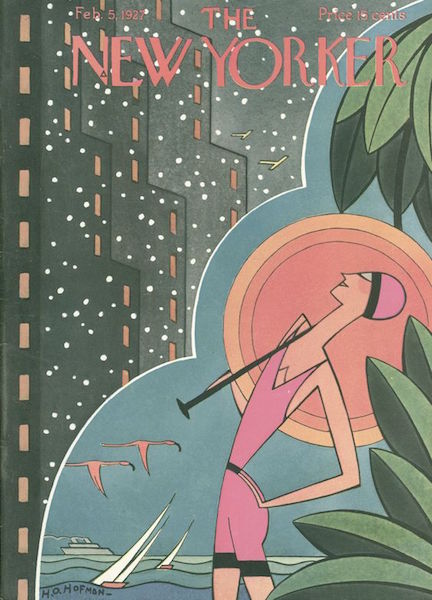
February 12, 1927 cover by Rea Irvin.
Writing for The Hemingway Review (Fall 2001), Francis Bosha notes in “The Harold Ross Files” that Hemingway’s sole contribution to the New Yorker is striking given that the magazine was such a major influence on fiction in the 20th century.
Money, or the shortage thereof, appears to be the main reason why Hemingway was not a regular contributor. Although the young magazine was doing well, Bosha writes that it was not yet ready to compete financially with more established mass market magazines. Indeed, Hemingway’s “My Own Life” landed in the New Yorker because it had already been rejected by both Scribner’s and The New Republic.
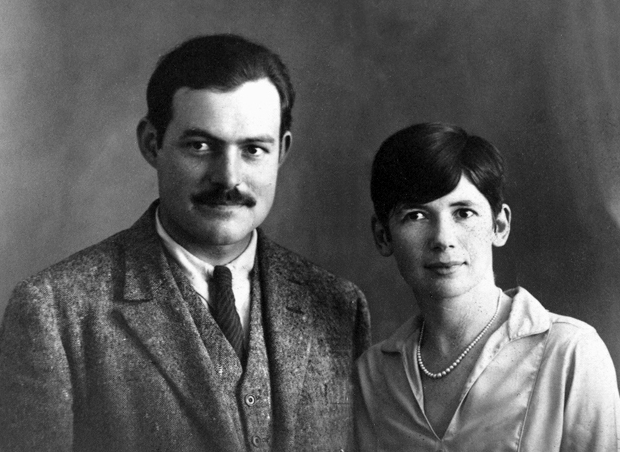
Ernest Hemingway and his second wife, Pauline Pfeiffer, in Paris, 1927. (Wikipedia)
If you read the piece you can see why it was rejected. The famed fiction writer, hot off the success of The Sun Also Rises, was not a great parodist. An excerpt:
And so on. Hemingway wisely stuck with serious fiction, which might explain his fleeting association with TheNew Yorker, which in its first years was bent toward humor in the Punch or Judge vein and not toward serious writing.
Nevertheless, the New Yorker’s founding editor, Harold Ross, maintained a friendship and a regular correspondence with Hemingway during the writer’s years in Cuba in the 1940s. On several occasions Ross invited Hemingway to submit something to the magazine, but nothing came of it. It didn’t help that Hemingway publicly stated in 1942 that he “was out of business as a writer,” and was suffering from depression, weight gain, and bouts of heavy drinking.
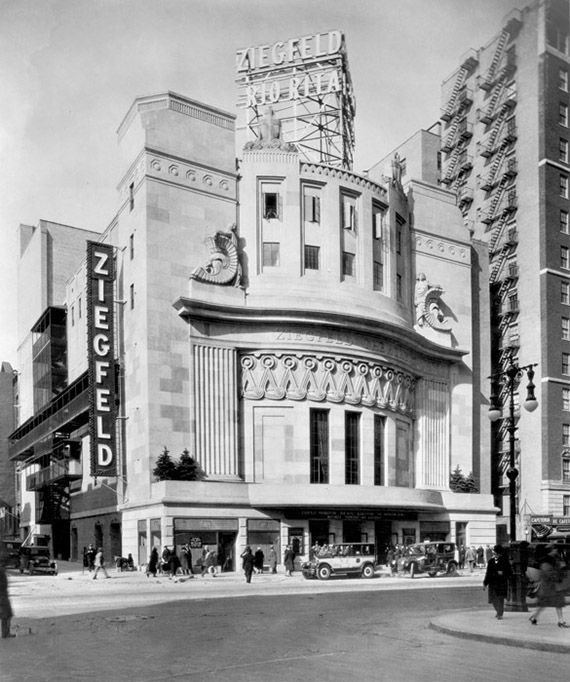
The Great Ziegfeld Finally Opens His New Theatre
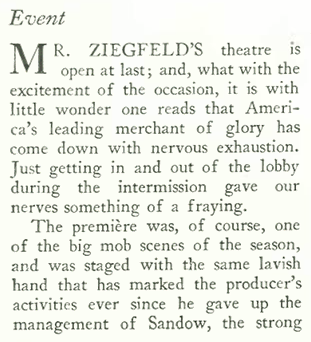
“The Talk of the Town” reported the premiere of Florenz Ziegfeld’s new art deco theatre was “one of the big mob scenes of the season,” attracting celebrities and celebrity-gawkers alike:
Opening Night…
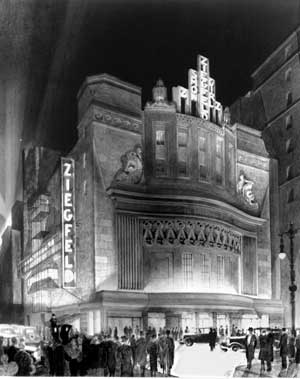
DECKED IN DECO…The Ziegfeld Theatre at Sixth Avenue and 54th Street, 1927. Joseph Urban’s design of the facade suggests open curtains flanking a stage. (nyc-architecture.com)HELLO DOLLY…On the Ziegfeld Theatre’s opening night Ada May played Dolly in Rio Rita (Museum of the City of New York)
The opening drew the likes of Charlie Chaplin and polar explorer Roald Amundsen, who perhaps found a line of chorus girls a welcome sight after years of trekking through frozen landscapes.
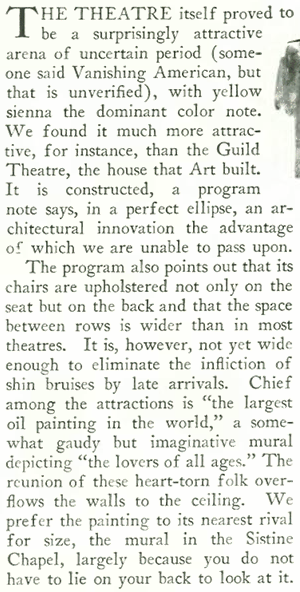
Among the attractions of the new theatre was what was claimed to be the largest oil painting in the world:
AN EYEFUL…A section of the interior wall of the Ziegfeld Theatre, decorated with “the largest oil painting in the world.” (nyc-architecture.com)
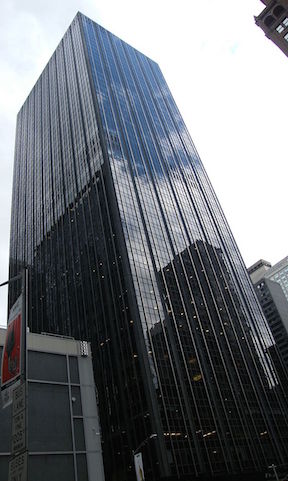
Sadly, despite public protests, the theatre was razed in 1966, bulldozed into rubble. The Burlington House stands on the site today:
Burlington House. (Wikipedia)
But we will end on a happier note, a cartoon by Barbara Shermund:
The New Yorker’s “Talk of the Town” editors were always in search of something to amuse, and in the Jan. 29, 1927 issue they found it in one Maurine Watkins, who wrote the Broadway hit musical Chicago (yes, THAT one) while still enrolled in her drama class at Yale:
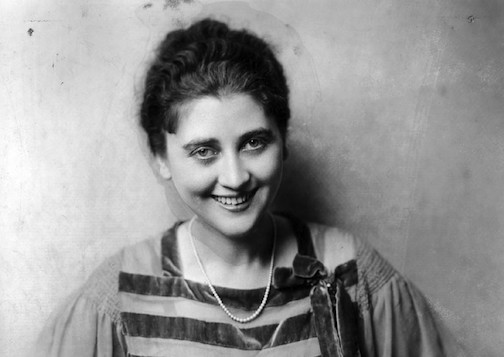
Maurine Watkins(Chicago Tribune)
Watkins transformed a brief career as a Chicago Tribune crime reporter into her Broadway success, thanks to her fondness for writing about murderers:
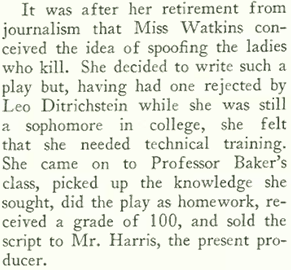
Chicago opened on Broadway in late December 1926 at the Sam Harris Theatre, where it ran for 172 performances. Watkins wrote the play as “homework” for her Yale drama class:
It didn’t take long for Hollywood to come calling, with Cecil B. DeMille producing a silent film version (directed by Frank Urson) in 1927.
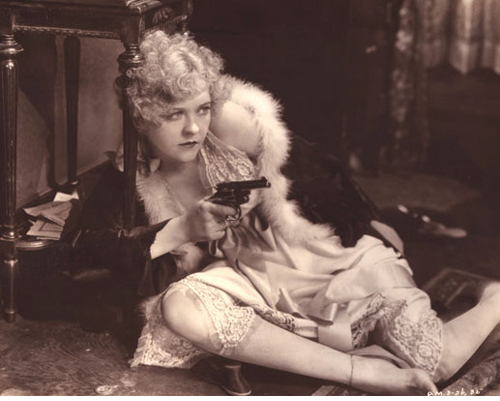
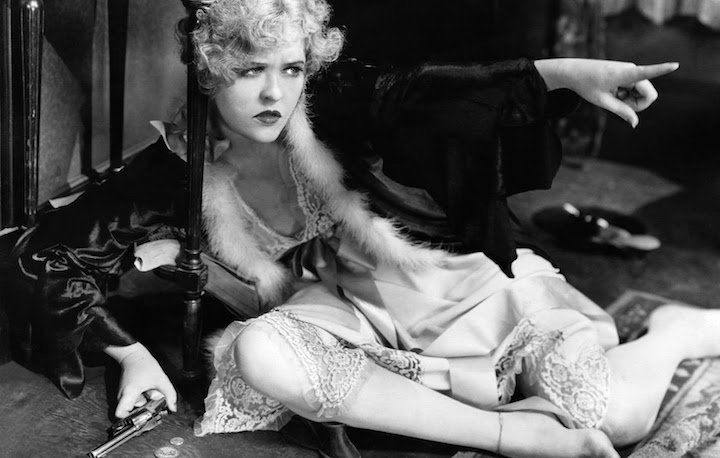
Phyllis Haver as Roxie Hart from the 1927 film, Chicago. Ginger Rogers would play the role in the 1942 movie Roxie Hart, and Renée Zellweger would play the part in the 2002 film, Chicago. (chicagology)
Watkins would go on to write about twenty plays, moving on to Hollywood to write screenplays including the 1936 comedy Libeled Lady. She left Hollywood in the 1940s to be close to her parents in Florida. A lifelong Christian, Watkins spent much of her fortune funding the study of Greek and the Bible at some twenty universities, including Princeton. Following her death in 1969, her estate sold the rights to Chicago to famed choreographer and director Bob Fosse. Fosse would go on to develop Chicago: A Musical Vaudeville in 1975, which was revived in 1997 and turned into an Academy Award-winning film in 2002.
* * *
Winter doldrums had set into city, which was digging out of the latest snowstorm and leaving the“Talk” editors pining for spring.
January 29, 1927 cover by Ilonka Karasz.
So it was unwelcome news that the green lawns along Cottage Row were to become the latest casualties of the booming city:
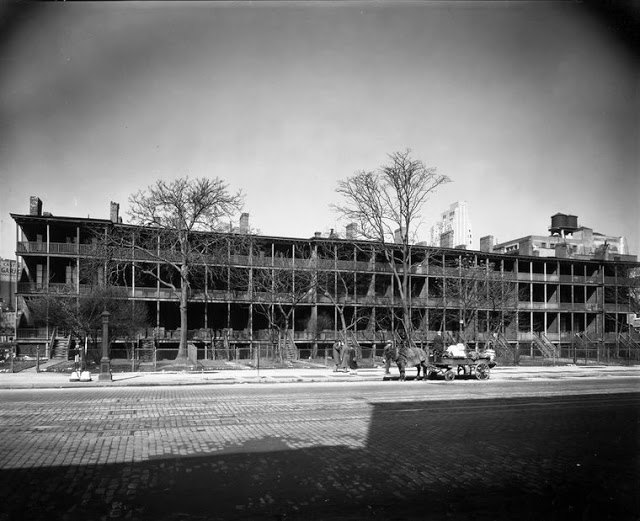
According to the excellent blog Daytonian in Manhattan, around 1848 William Rhinelander filled the 7th Avenue block between 12th and 13th Streets with eleven three-story homes above “English basements.” The simple residences were intended for middle-class families and sat more than twenty feet back from the street, providing grassy lawns and garden space. During summer weather each floor had a deep veranda that provided shade and caught cooling breezes.
This 1936 photograph by Berenice Abbott shows the abandoned “Cottage Row.” (Library of Congress)
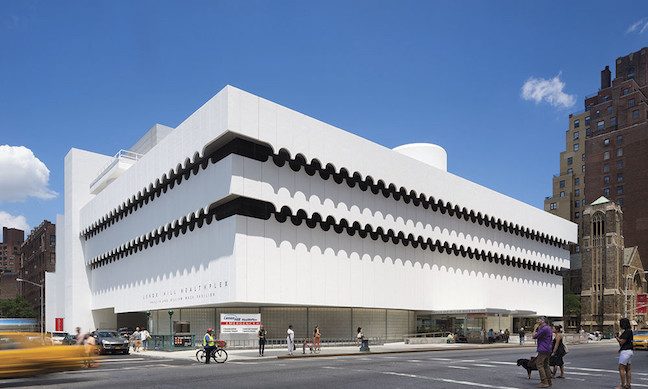
As it turned out, the green lawns won a brief reprieve: By the time developers got around to building an apartment on the site, the Depression hit and left Cottage Row standing for another ten years. It was demolished in 1937, replaced not by an apartment building but rather by a gas station and used car lot, which were replaced in 1964 by the Joseph Curran Building (now the Lenox Hill Healthplex):
Today the Cottage Row site is occupied by the 1964 Joseph Curran Building (now the Lenox Hill Healthplex). Albert C. Ledner, a New Orleans architect, fancifully evoked seafaring themes in his design of the Curran Building, which originally housed the headquarters of the National Maritime Union. (MCD Magazine)
* * *
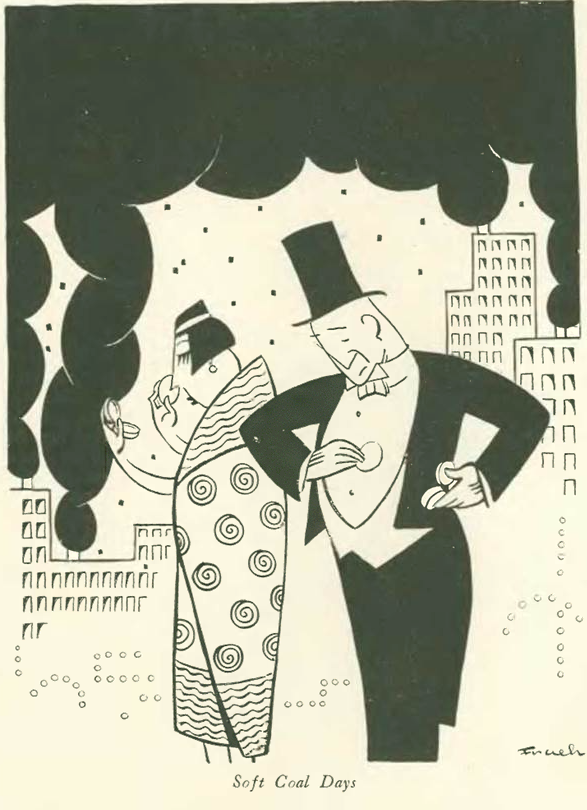
The winter drear was further compounded by the sooty smog that lingered over the city, fed by so many coal-fired furnaces. The “Talk” editors noted:
A PERENNIAL NUISANCE…This Al Frueh drawing originally appeared in the Feb. 27, 1926 issue of the magazine.
To read more about “soft coal days,” see my previous post, “A Fine Mess.”
* * *
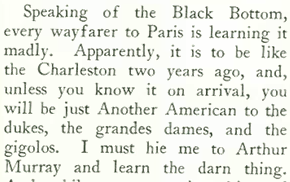
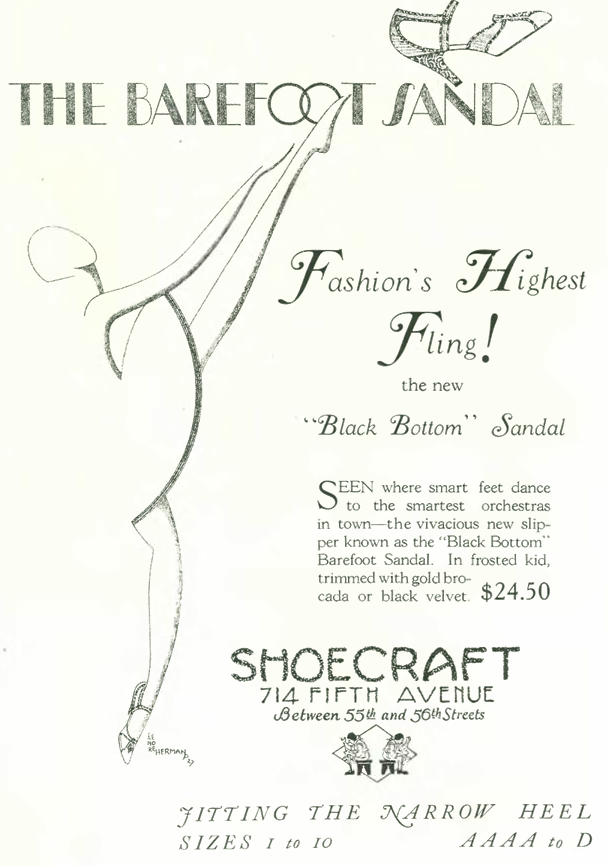
Columnist Lois Long (“Tables for Two”) was contemplating dance lessons to learn the “Black Bottom,” the dance craze that supplanted “The Charleston” in 1926.
Apparently the dance called for special shoes, per this advertisement from the same issue:
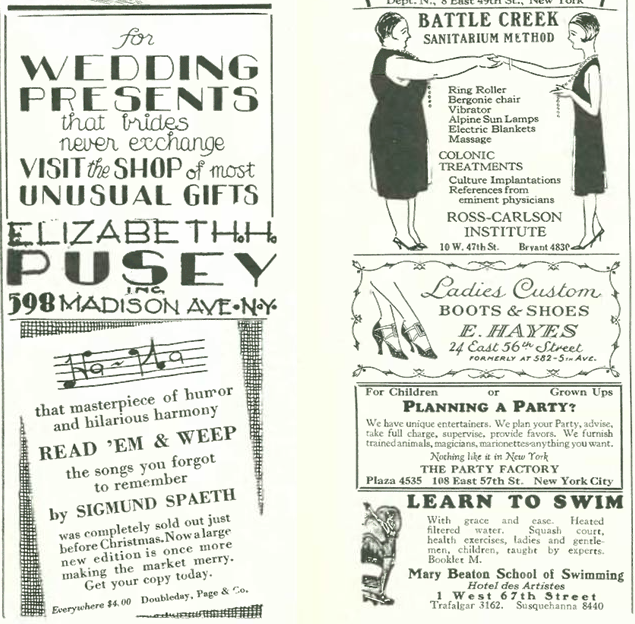
Up to now I’ve been posting images of often lavish ads featured mostly in the first sections of the magazine and on the front and back inside covers, but there were other, less expensive (and less artful) ads sprinkled in the back pages of the magazine, a tradition that continues to this day:
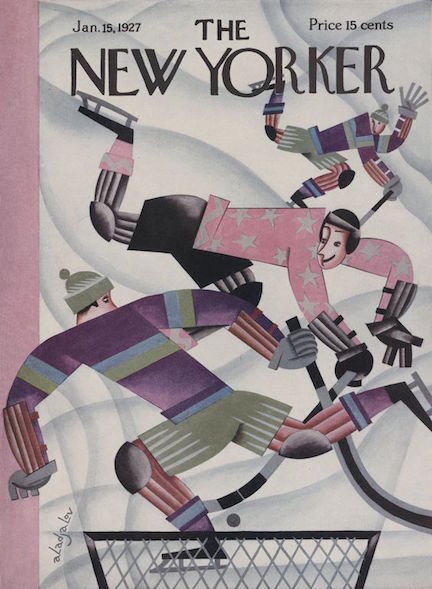
Despite Prohibition, perhaps a few champagne corks were popped for the January 15, 1927, edition of the New Yorker. This is Issue # 100.
January 15, 1927–Issue # 100. The cover art by Constantin Alajalov.
Prohibition was on the minds of the editors of the issue, which featured a highly critical piece by Morris Markey (“A Reporter at Large”) on the hysteria surrounding the government’s attempt to poison supplies of bootleg alcohol. The editors of “The Talk of the Town” also made this observation:
Before we get more into Markey’s piece, a little background is in order. In an article for Time magazine (Jan. 14, 2015) Lily Rothman writes that for years prior to Prohibition industrial alcohol had been “denatured” by adding toxic or unappetizing chemicals to it. This was done so folks couldn’t escape beverage taxes by drinking commercial-use alcohol instead — but it was still possible to re-purify the liquid so that it could be consumed.
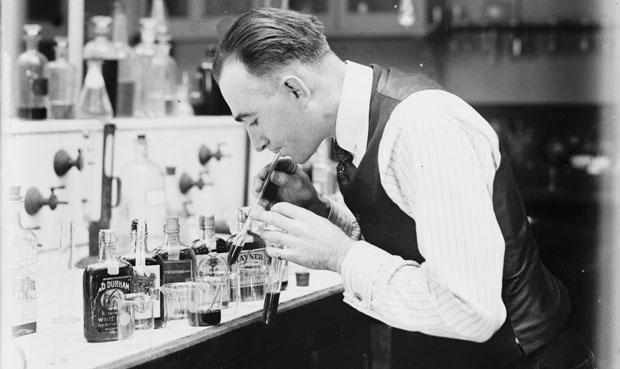
HOME CHEMISTRY KIT…A bootlegger at work in the 1920s. (oldmagazinearticles.com)
Rothman cites a Time article from Jan. 10, 1927, which reported that Prohibition forces in the government were introducing a new formula that year for denaturing industrial-grade alcohol that doubled the poisonous content: “4 parts methanol (wood alcohol), 2.25 parts pyridine bases, 0.5 parts benzene to 100 parts ethyl alcohol.” The article noted that “Three ordinary drinks of this may cause blindness.”
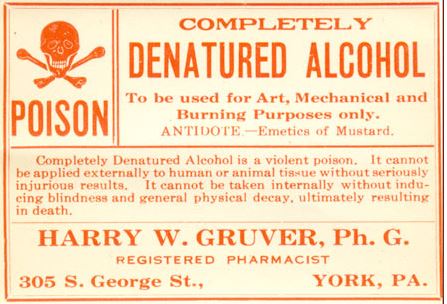
Warning label from the 1920s (vickyloebel.com)
Although some opposed the practice as legalized murder, Rothman cites Seymour M. Lowman, who as Assistant Secretary of the Treasury (1927-33) was in charge of Prohibition enforcement. Lowman told citizens that those on the fringes of society who continued to drink were “dying off fast from poison ‘hooch’” and that if the result was a sober America, “a good job will have been done.”
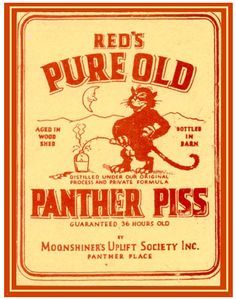
DRINK AT YOUR OWN RISK…1920s label for bootleg moonshine. (googleuk)
Thousands died from consuming poisoned alcohol. Rothman writes that 33 people died in Manhattan alone in a three-day period in 1928, mostly from drinking wood alcohol.
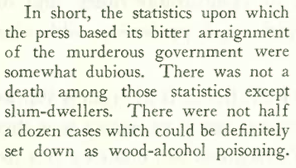
Markey’s stance in his New Yorker article is somewhat unique, if not cold-hearted. Instead of taking the government to task for the practice, he assured his well-heeled readers that they had nothing to fear as long as they procured their alcohol from reputable bootleggers at top prices. Markey seemed to care not at all for the poor “slum-dwellers” who died from consuming the cheap stuff:
If anything, Markey’s sympathies seemed to lie with those who had to drink the safe, albeit diluted hootch. He explained how four bottles of bootleg Scotch could be fashioned from a single bottle of the real deal:
And if you had money, there was no need to fear death from drink…
…that is, unless you were careless:
* * *
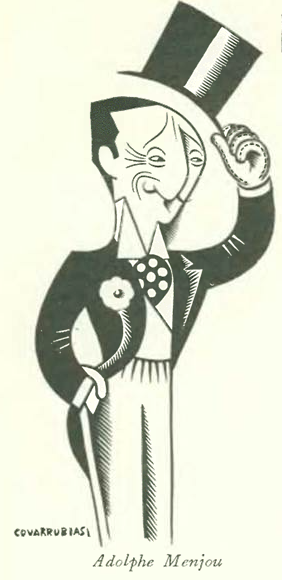
Helena Huntington Smith wrote a profile on the actor Adolphe Menjou, described by IMDB as Hollywood’s epitome of suave and debonair style: “Known for his knavish, continental charm and sartorial opulence, Menjou, complete with trademark waxy black mustache, evolved into one of Hollywood’s most distinguished of artists and fashion plates, a tailor-made scene-stealer.” Interestingly, Menjou was born in Pittsburgh, and not in France as many a fan assumed (his father, however, was a French émigré).
Glass lantern advertising slide for Adolphe Menjou’s 1927 silent film A Gentleman of Paris.
In other items, New Yorker architecture critic George S. Chappell (aka T-Square) once again set his sights on the city’s changing skyline. He began with the new General Motors building at Columbus Circle:
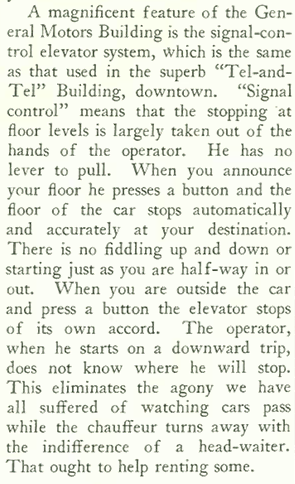
He was thrilled by the push-button automation of the building’s elevators:
The General Motors building, left, as it originally appeared on Columbus Circle. It was designed by Shreve & Lamb, who would soon go on to design the Empire State Building. At right, the building became known as the Newsweek Building. (Drawing by J. W. Golinkin in Towers of Manhattan, 1928, and photo by David W. Dunlap/The New York Times)
If Chappell thought the General Motors building had some issues in 1927, he should see it today, wrapped in tacky reflecting glass and renamed 3 Columbus Circle:
WHY? WHY ON EARTH? (nyc-architecture.com)
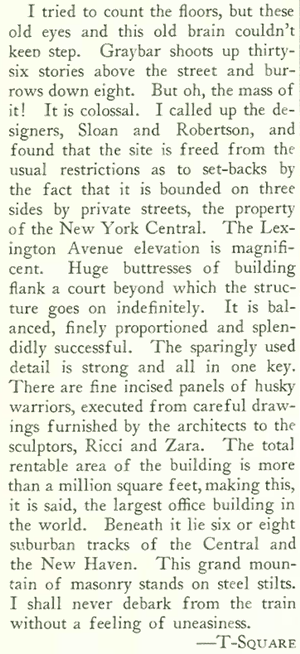
Elsewhere, Chappell was agog at Sloan & Robertson’s massive Graybar Building:
Sloan & Robertson’s Graybar Building at 420 Lexington. (history.graybar.com)
And to close, this ad on the back page for Chesterfield cigarettes, featuring the company’s famous Atlantic City sign. Note the point of pride: “There are 13,000 lamps” in the sign, but four times that many Chesterfields are smoked every minute…koff…koff…
One of the strangest things about the fall 1926 issues of The New Yorker is the almost complete absence of baseball coverage, even though the 1926 Yankees had turned things around from an abysmal 1925 season and found themselves in the 1926 World Series against the St. Louis Cardinals.
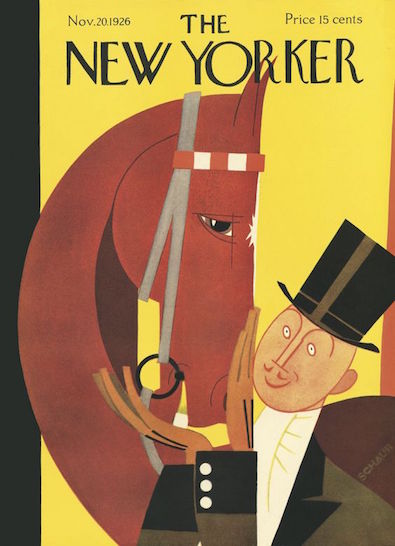
November 20, 1926 cover by Andre De Schaub.
The Yankee’s star Babe Ruth had recovered his health from the previous season and played exceptional all-around baseball in 1926, even setting a World Series record of three homers in the fourth game. According to (now disputed) newspaper reports at the time, Ruth had promised a sickly boy named Johnny Sylvester that he would hit a home run for him in Game 4. The papers reported that after Ruth’s three-homers, the boy’s condition miraculously improved.
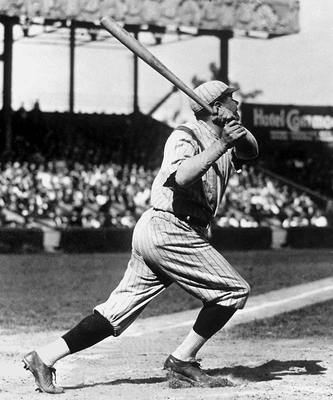
SNUBBED…Babe Ruth knocked in three homers during Game 4 of the exciting 1926 World Series, an event completely ignored by the football-crazed New Yorker. (Bronx Banter)
The Yankees would lose the series in seven games (it would be the first of the Cardinals’ 11 WS championships), but nevertheless the season represented a dramatic turnaround for the team.
But The New Yorker was obsessed with college football, mostly Ivy League contests and the exploits of Knute Rockne and his Notre Dame Fighting Irish.
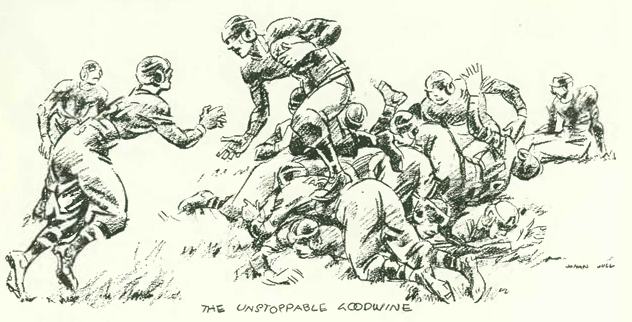
Johan Bull provided lively illustrations for John Tunis’s columns.
Sportswriter John Tunis cranked out lengthy accounts of football games, including the Princeton-Yale contest covered in the Nov. 20, 1926 issue.
The same issue also included an article by Herbert Reed, who wrote about Notre Dame’s victory over Army at Yankee Stadium and proclaimed the Fighting Irish to be the greatest team in the country.
The New Yorker caught the Notre Dame bug the previous season. When attendance dropped at Yankee Stadium due to an ailing Babe Ruth and his team’s losing record, college football took center stage at the stadium that fall, with the fiercely competitive Notre Dame–Army game the marquee match-up (the rivals would continue their annual meeting at Yankee Stadium until 1947).
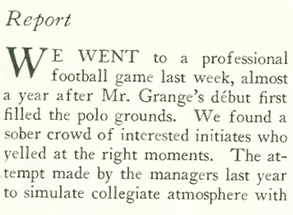
The “other” game–professional football–was still in its infancy, and the editors of “The Talk of Town” made it clear that the college atmosphere was more to their liking. It is interesting that even today when fans compare college to pro football, the same observations are made:
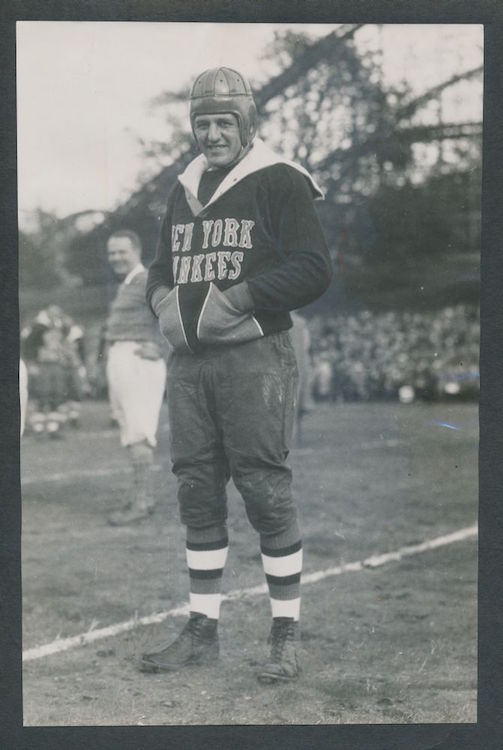
STAR ATTRACTION…After playing his first professional season with the Chicago Bears, in 1926 Red Grange joined the short-lived New York Yankees professional football team. (ourgame.mlb)
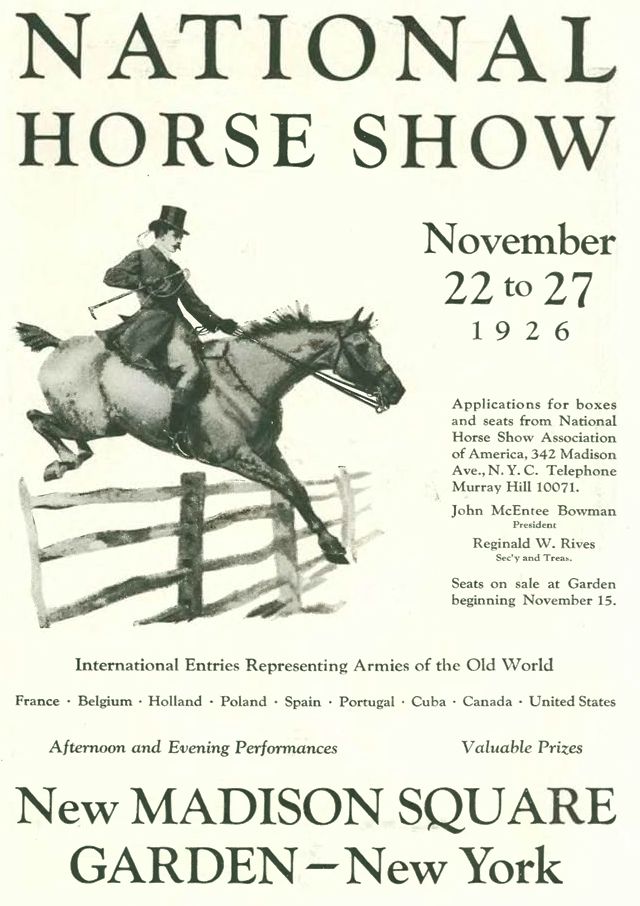
As for other sports, The New Yorker also offered extensive coverage of tennis, golf, and polo in its issues. And there would also be rowing, boat and auto racing, and steeplechase events such as National Horse Show at Madison Square Garden. An advertisement promoting that event appeared on the inside back cover:
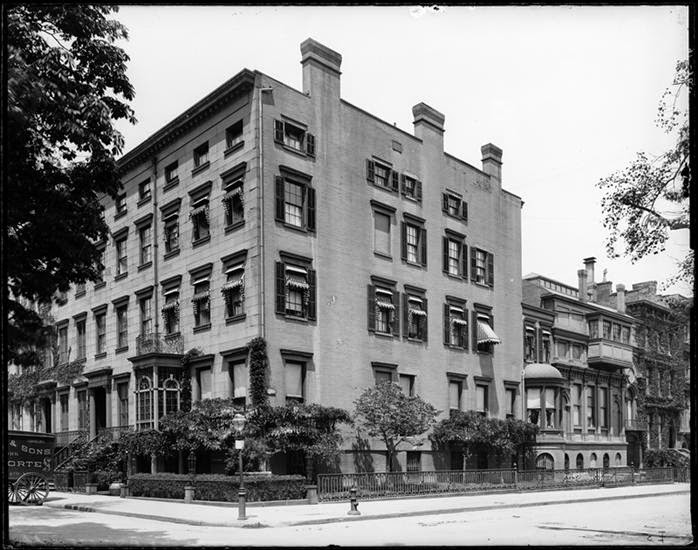
The editors of “Talk of the Town” continued their sad refrain on the city’s changing landscape, the wrecking ball this visiting Gramercy Park:
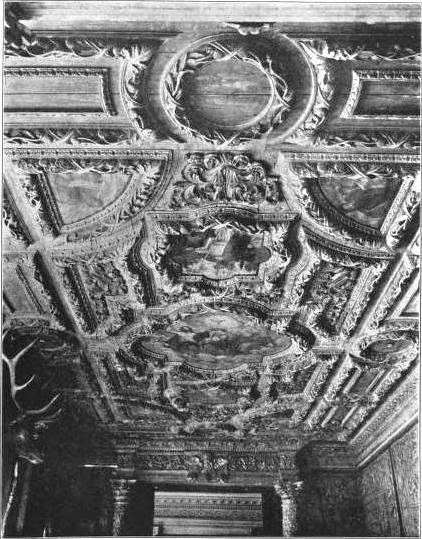
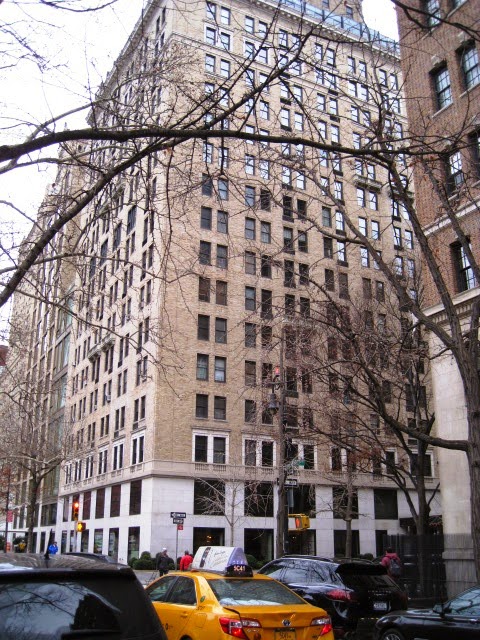
The Stanford White house referred to in “The Talk of the Town.” ( Museum of the City of New York)The Dining Room ceiling in the Stanford White House came from a 16th century chapel in Florence. (From the Illustrated Catalogue of the Artistic Furnishings and Interior Decorations of the Residence at No. 121 East Twenty-first Street, New York City, April 1907 (copyright expired)Gramercy Park Hotel on the site today. (A Daytonian in Manhattan)
And to close, this terrific advertisment for the Greenwich Village Inn, illustrated by Hans Flato:
Of all the nightclubs made famous in the Roaring Twenties, none were quite so famous as Harlem’s Cotton Club. Frequented by many celebrities, the club was a whites-only establishment even though it featured many of the most popular black entertainers of the day including Fletcher Henderson, Duke Ellington and Cab Calloway.
November 13, 1926, Issue # 91, cover by Julian de Miskey.
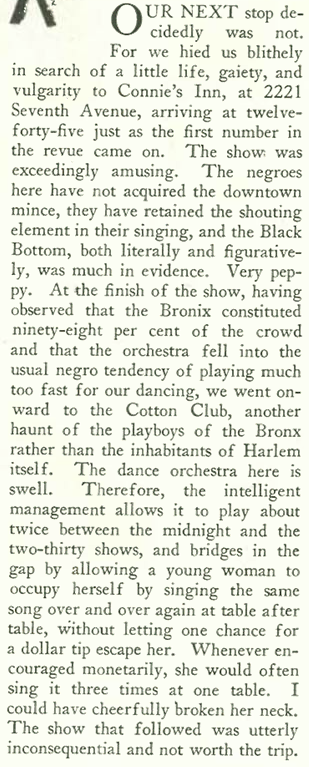
So leave it to The New Yorker, and specifically its nightlife correspondent, Lois Long, to take a blasé view of the famed hot spot. Perhaps she was just tired, having already visited three other nightclubs that evening—the Montmartre, the Yacht Club, and Connie’s Inn—before seeking out the Cotton Club:
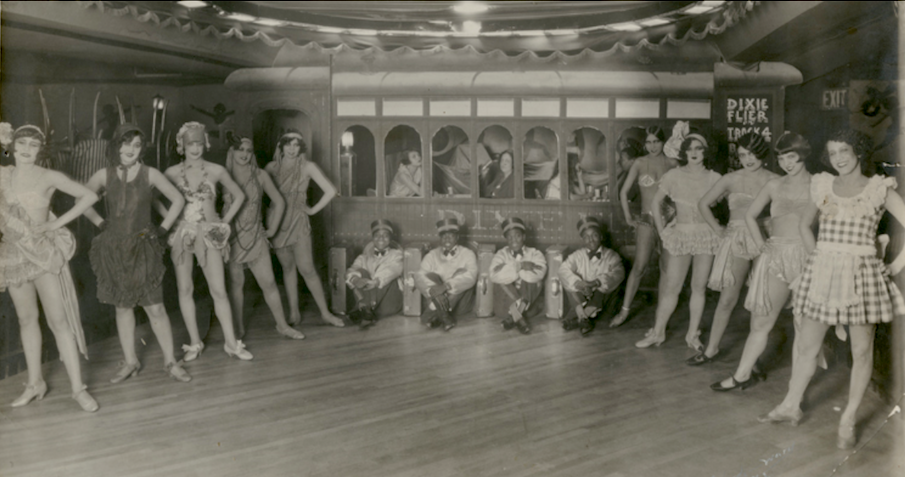
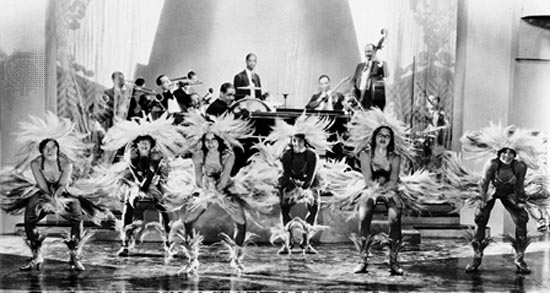
Performers on stage at Connie’s Inn, Harlem, 1920s. (New York Public Library)Duke Ellington and dancers at the Cotton Club in the late 1920s. (Untapped-Cities)Program from the 1920s designed to attract white patrons to the Cotton Club. (Women of the Harlem Renaissance)
* * *
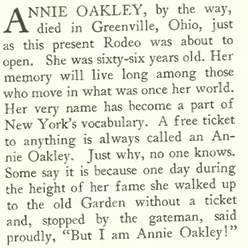
“The Talk of the Town” noted the passing of rodeo star and sharp-shooter Annie Oakley (next time you get a free ticket with a hole punched in it, you’ll know what to call it):
If nightclubs weren’t your thing, there were plenty of movie houses screening the latest offerings from Tinseltown. The opening pages of the magazine featured this advertisement for the new 3,664-seat Paramount Theatre, located at 43rd Street and Broadway in the Times Square.
It’s a reminder that Paramount, a venerable old Hollywood studio (which these days is owned by Viacom) had its origins in New York as the Famous Players-Lasky Corporation. Founded in 1916, Famous Players-Lasky was primarily located at the Kaufman Astoria Studios in Queens (after 1920). It would eventually become Paramount Pictures and relocate to Hollywood in 1932.
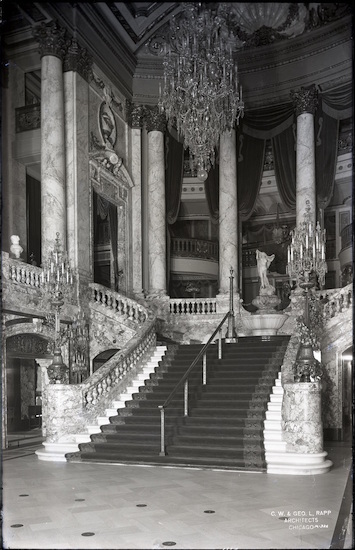
The Paramount Theatre was closed in 1964. Sadly, the interior was gutted and converted to office and retail use. Here are a couple of interior shots of the theatre’s Grand Hall as it appeared following its opening:
NOT YOUR LOCAL CINEPLEX…Grand Hall of the Paramount Theatre, featuring imported Italian marble columns. (American Theatre Architecture Archive)
The theatre’s huge pipe organ, one of the largest and most admired theatre organs ever built by the Wurlitzer company, was removed and later installed in a convention hall in Wichita, Kansas.
Keyboard array of the Paramount Theatre’s huge pipe organ, one of the largest theatre organs ever built by the Wurlitzer company. (nycago)
Paramount would open theatres around the country (in the chain of Publix Theatres), and a number of them survive today. The original Paramount Building in New York is still there, but all that’s left of the theatre is the marquee.
Although architectural criticism was practiced by a rare few in 1926 (and even fewer today), it was prominent in the pages of The New Yorker. Lewis Mumford famously served as the magazine’s critic from the 1930s to the 1950s, and longtime critic Paul Goldberger took over the magazine’s “Sky Line” column from the mid-90s to 2011.
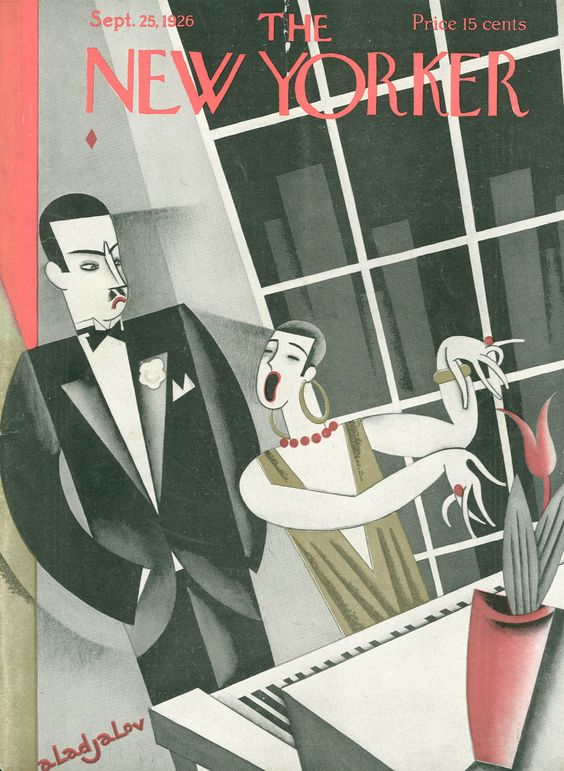
October 16, 1926 cover by Constantin Alajalov.
In 1926 George S. Chappell served the magazine as architecture critic under the pseudonym “T-Square.” A rare combination of architect, parodist, and journalist, he was perhaps best known for his travel series parody published under the pseudonym “Walter E. Traprock.”
In the Oct. 16, 1926 issue, Chappell took critical aim at the “cheap architecture” sprouting amidst the clamor of a rapidly changing landscape…
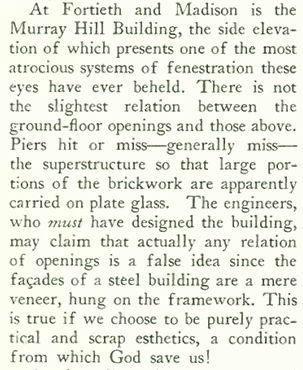
…and referred to the fenestration (the arrangement of windows and doors) of the Murray Hill Building as “atrocious.”
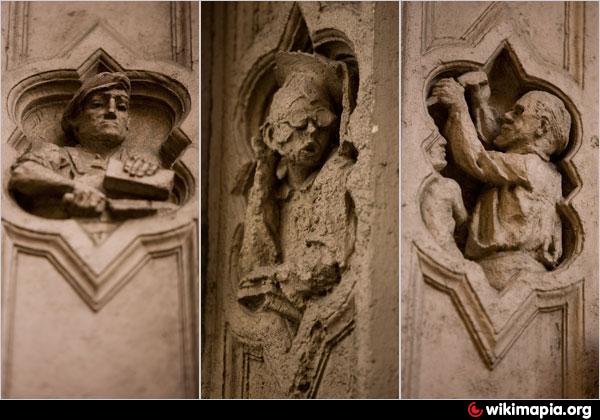
The Murray Hill Building. (Museum of the City of New York)The ground-floor show windows of Murray Hill feature free-hand carvings depicting people in various trades. (Wikimapia)
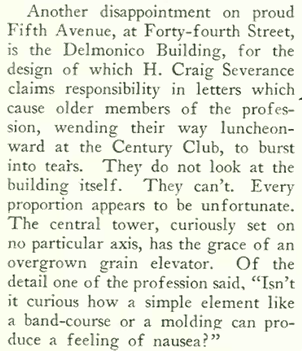
Chappell then set his sights on “another disappointment,” the Delmonico Building, which he said possessed “the grace of an overgrown grain elevator…”
Part of Chappell’s disgust is no doubt attributable to the fact that the beloved old Delmonico Building at Fifth Avenue and 44th Street (left, photo from The Brickbuilder, 1899), was razed in 1925 and replaced by the “overgrown grain elevator” at right. (Google Maps screen image)
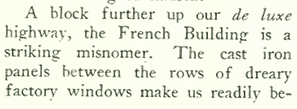
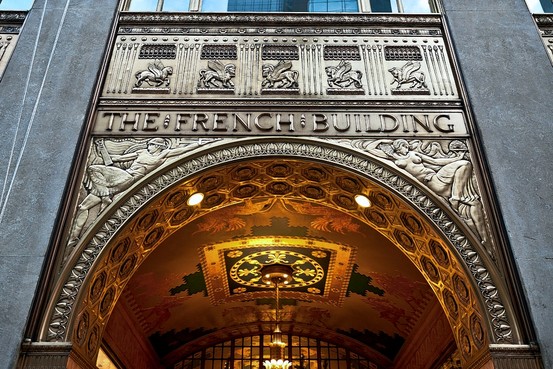
He then moves on to the landmark French Building with its “dreary factory windows”…
The French Building. (Google Maps)The 5th Avenue entrance to the French Building. (omnidisc)
So what did Chappell prefer? Read on…
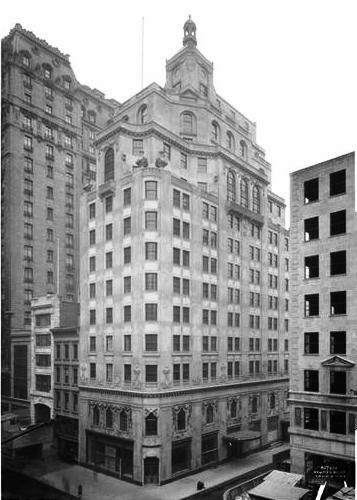
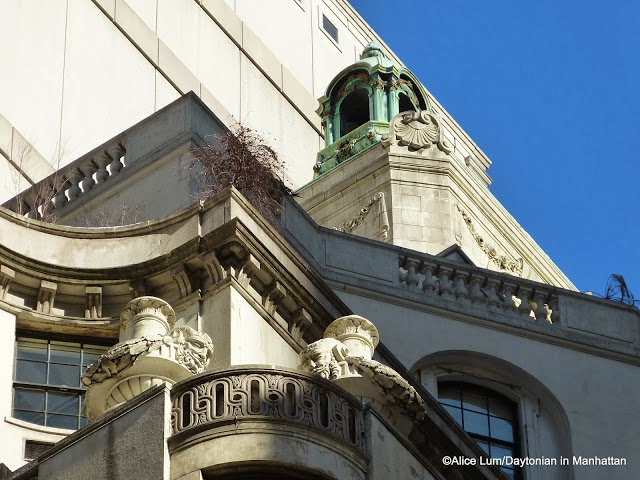
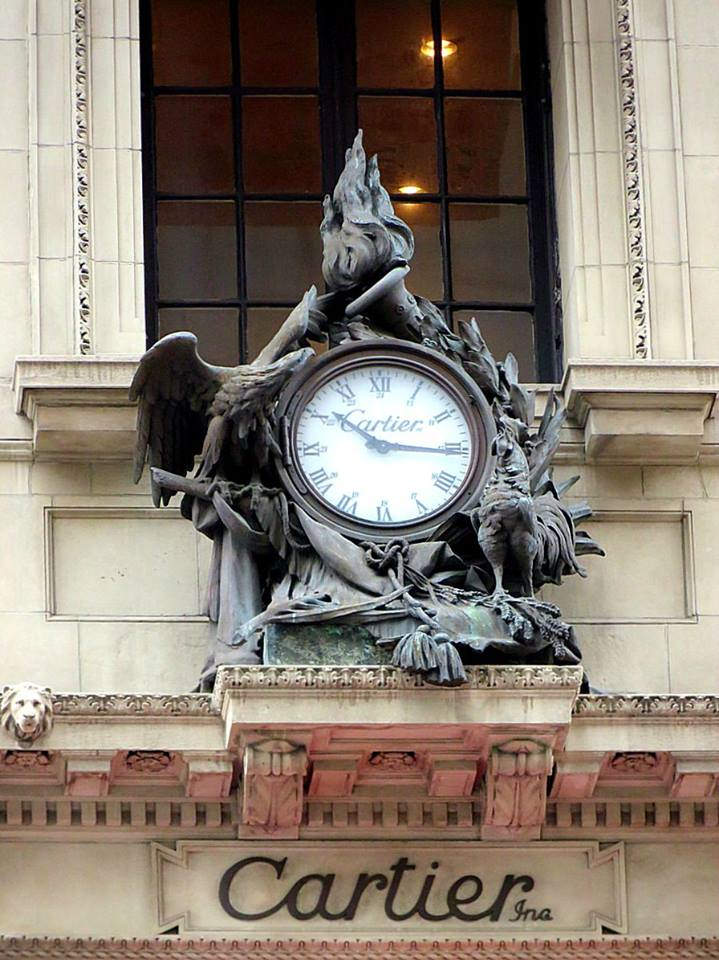
Aeolian Hall on Fifth Avenue, constructed on a site formerly occupied by the William Rockefeller mansion. (Museum of the City of New York)Detail of the upper stories of Aeolian Hall. (Daytonian in Manhattan)Cartier’s clock on Fifth Avenue (Pinterest)
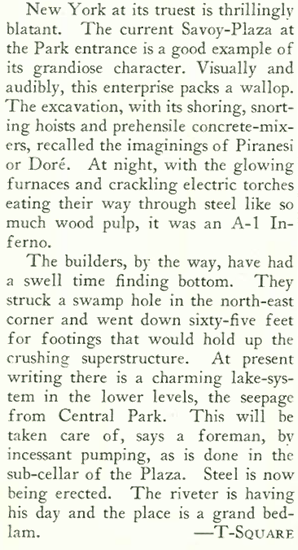
Despite Chappell’s oft disapproving gaze, in the end he (along with other editors and writers at The New Yorker) could not help but be caught up in the thrill of one of the city’s grandest building booms…
Other items of note in the Oct. 16 issue, this ad promoting the first-ever “New Yorker book,” a collection of “Profiles” by Waldo Frank, who wrote under the pen name “Search-light”…
And finally this picturesque ad for Marmon automobiles. The company was defunct by 1933.
As much as they affected a refined disinterest in the latest fads, The New Yorker editors were nevertheless impressed by the many electronic innovations in the 1920s consumer market. Although electricity in cities had been around for awhile, inventions to exploit this new resource would come into their own in the Jazz Age with the advent of mass-produced electrical appliances (refrigerators, toasters etc.).
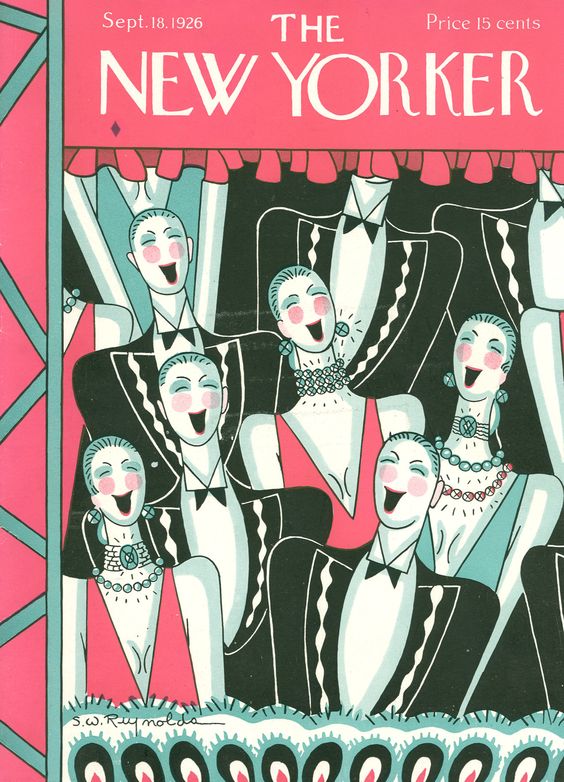
Sept. 18, 1926 cover by Stanley W. Reynolds.
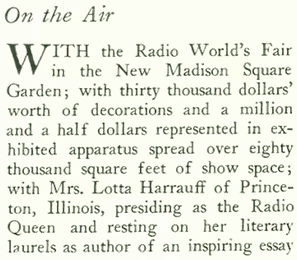
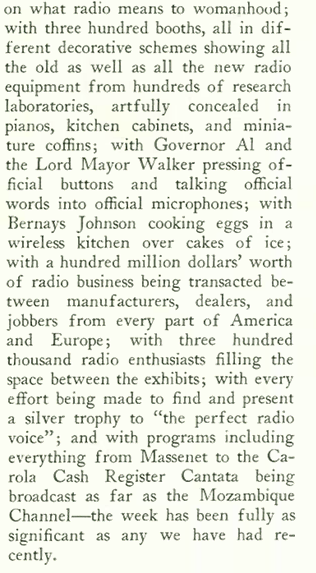
So when the 1926 Radio World’s Fair opened at Madison Square Garden, the magazine was there to report on its many marvels in the Sept. 18 issue:
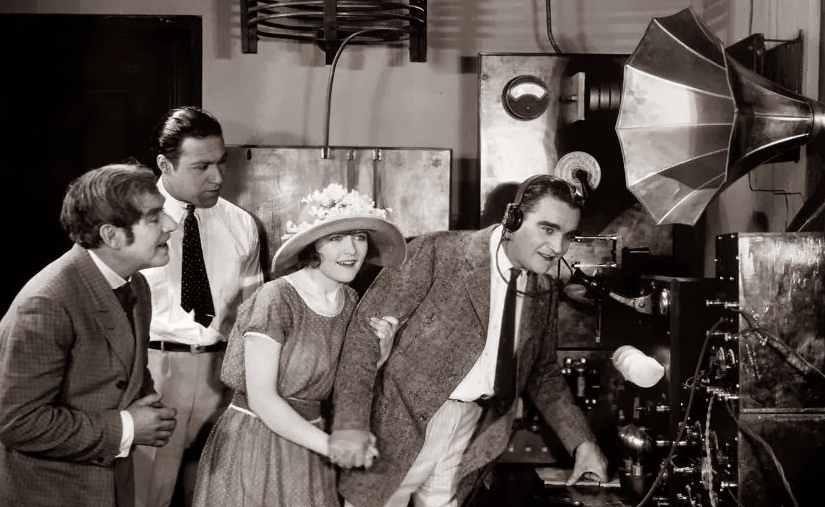
IF ONLY THEY HAD SPOTIFY…Teens tuning in, mid 1920s. (hancockhistoricalmuseum.org)
Although New York’s radio fair was doubtless the largest (akin to today’s annual Consumer Electronics Show), similar fairs were held in other major cities where broadcast radio was taking hold.
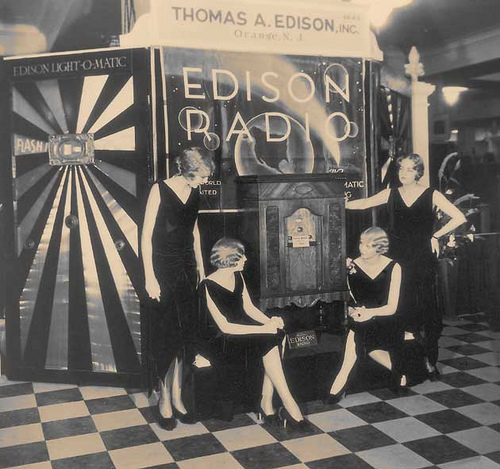
Promotional image for Edison Radio from the 1926 New York Radio World’s Fair. (artdecoblog.com)
…and for comparison, an image from the 2016 Consumer Electronics Show in Las Vegas:
(CES)
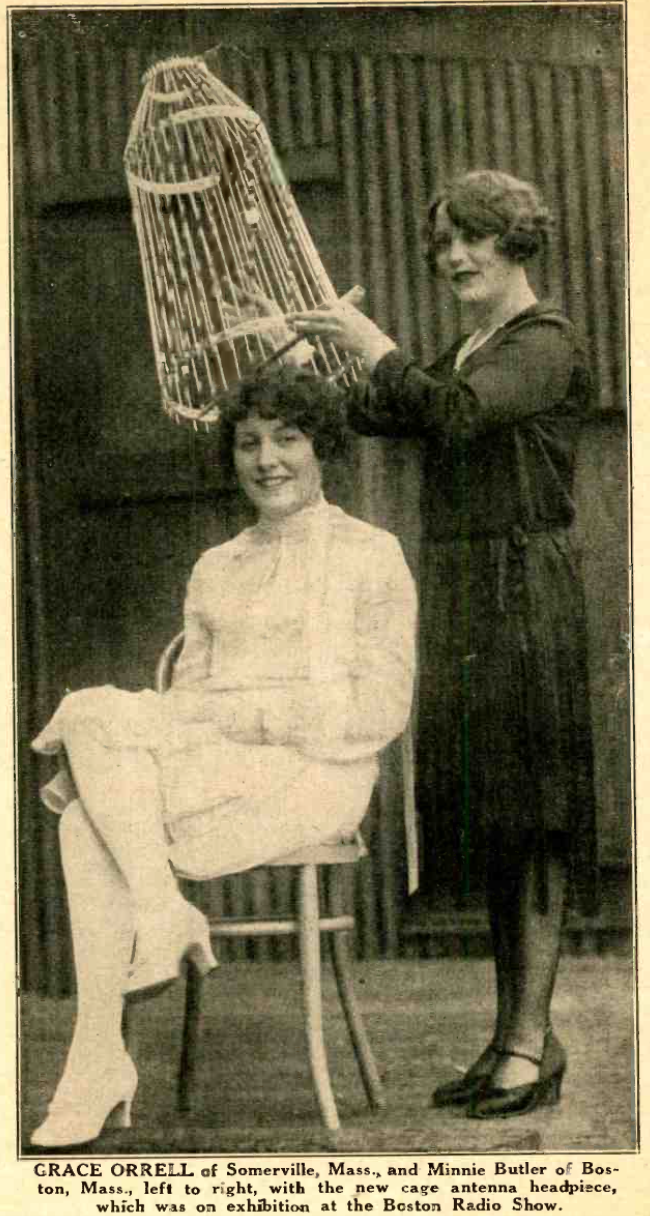
To give you an idea of some of the stranger innovations in the world of 1920s radio, here is an image scanned from the Oct. 16, 1926 issue of Radio World magazine demonstrating the wonders of a wearable cage antenna, apparently through which the wearer could make or receive wireless broadcasts…
…and a detail of an advertisement from the same issue depicting a typical household radio for the time:
Before tuning in for the first time, the radio’s owner needed to string a 100-foot outside aerial. Until 1927, when owners could plug their radios into electric sockets, radios required two types of batteries—a storage battery that required recharging every two weeks and a set of dry-cell batteries that needed to be replaced about every three weeks.
If all this looks crude, remember that in September 1926 broadcast radio was less than six years old. But it was big year for radio, with the National Broadcasting Company (NBC) establishing a network of stations that distributed daily programs. Columbia Broadcasting System (CBS) would establish a rival network in 1928.
In other items, the magazine offered a lengthy profile on tennis legend Bill Tilden, and later in the sports section described his Davis Cup loss to Frenchman René Lacoste.
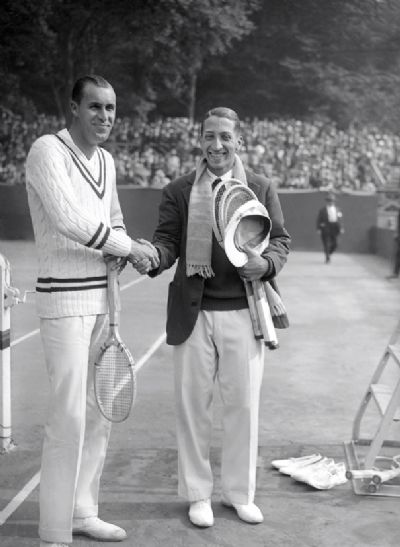
Tennis rivals Bill Tilden and René Lacoste meet in Philadelphia, 1927. (greensleevestoaground.)
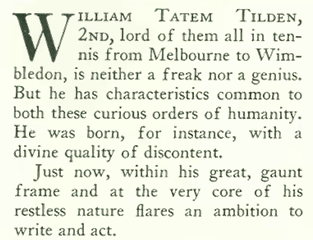
Tilden is often considered one of the greatest tennis players of all time. However, The New Yorker “Profile” described him as a reluctant star with artistic ambitions…
…who distained the life of a sports hero…
Samuel Merwin, referred to above, was a playwright and novelist.
Tilden was the world’s number one player for six years (1920-1925). He won 14 Major singles titles including ten Grand Slams. He also won a record seven US Open titles.
There is a sad footnote to Tilden’s career, however. Twenty years after The New Yorker profile, Tilden would be arrested for soliciting sex from an underage male, an offense he would arrested for again three years later, in 1949. He was subsequently shunned by the tennis and Hollywood world, although old friend Charlie Chaplin allowed Tilden to use his private court for lessons, which helped him financially as he dealt with legal and financial problems.
* * *
Going Going Gone
The magazine editors continued to watch the rapidly changing skyline of the city, as beloved old buildings were demolished to make way for new skyscrapers. This time it was the old Park Avenue Hotel:
The editors of “Talk of the Town” fondly recalled the time when the hotel, with its spacious courtyard of flowers and fountains, attracted “almost every dinner party of consequence in New York.”
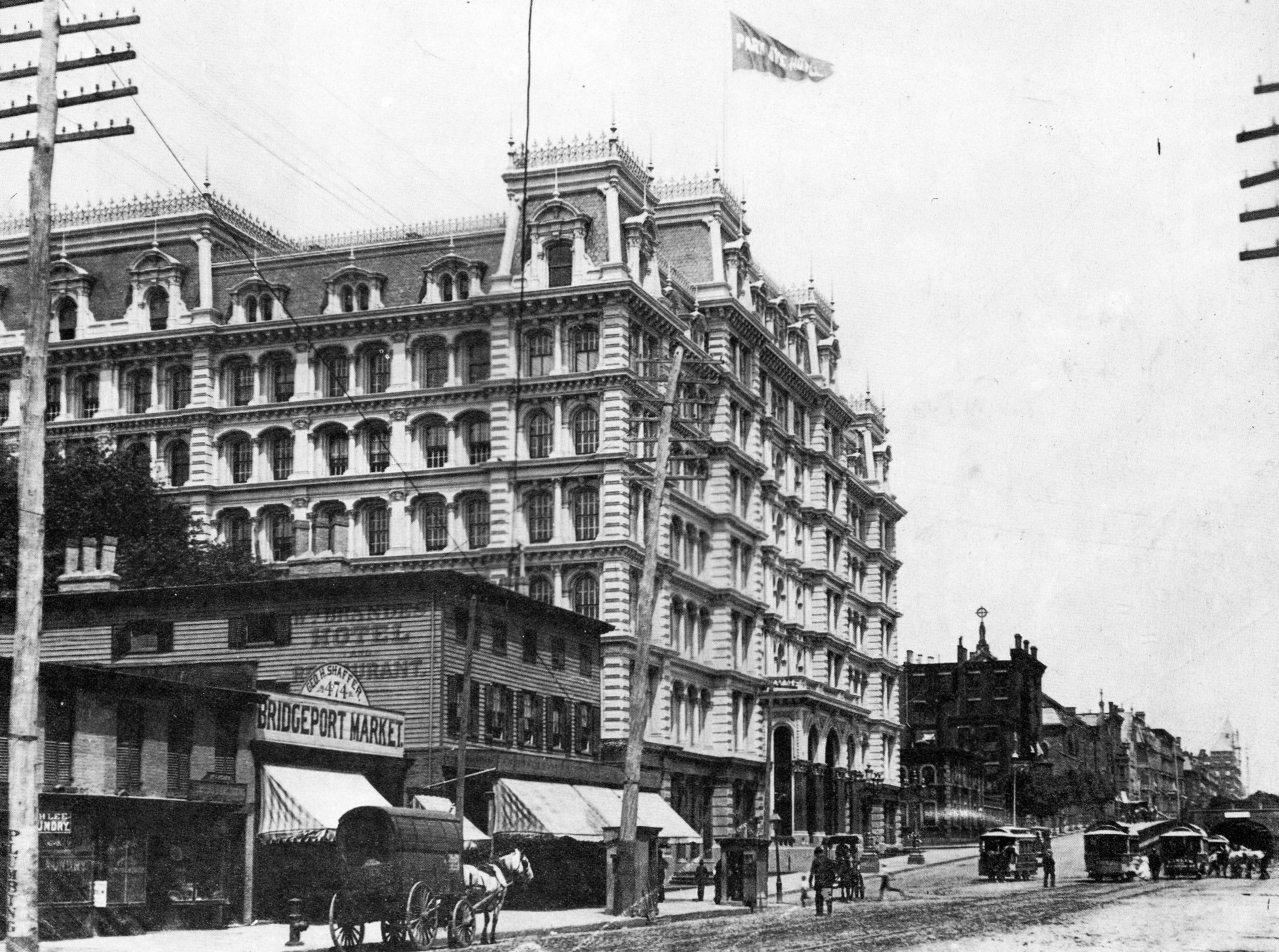
This photo of the old Park Avenue Hotel was taken in 1890, only two years after Fourth Avenue was renamed Park Avenue. Constructed in 1877, the hotel was originally called Stewart’s Hotel for Working Women, designed to provide safe housing for the influx of single working women pouring into New York City. The name didn’t last long: the hotel was opened in April 1878, closed in May and reopened in June as the Park Avenue Hotel. It was razed in 1927. (Ephemeral New York)
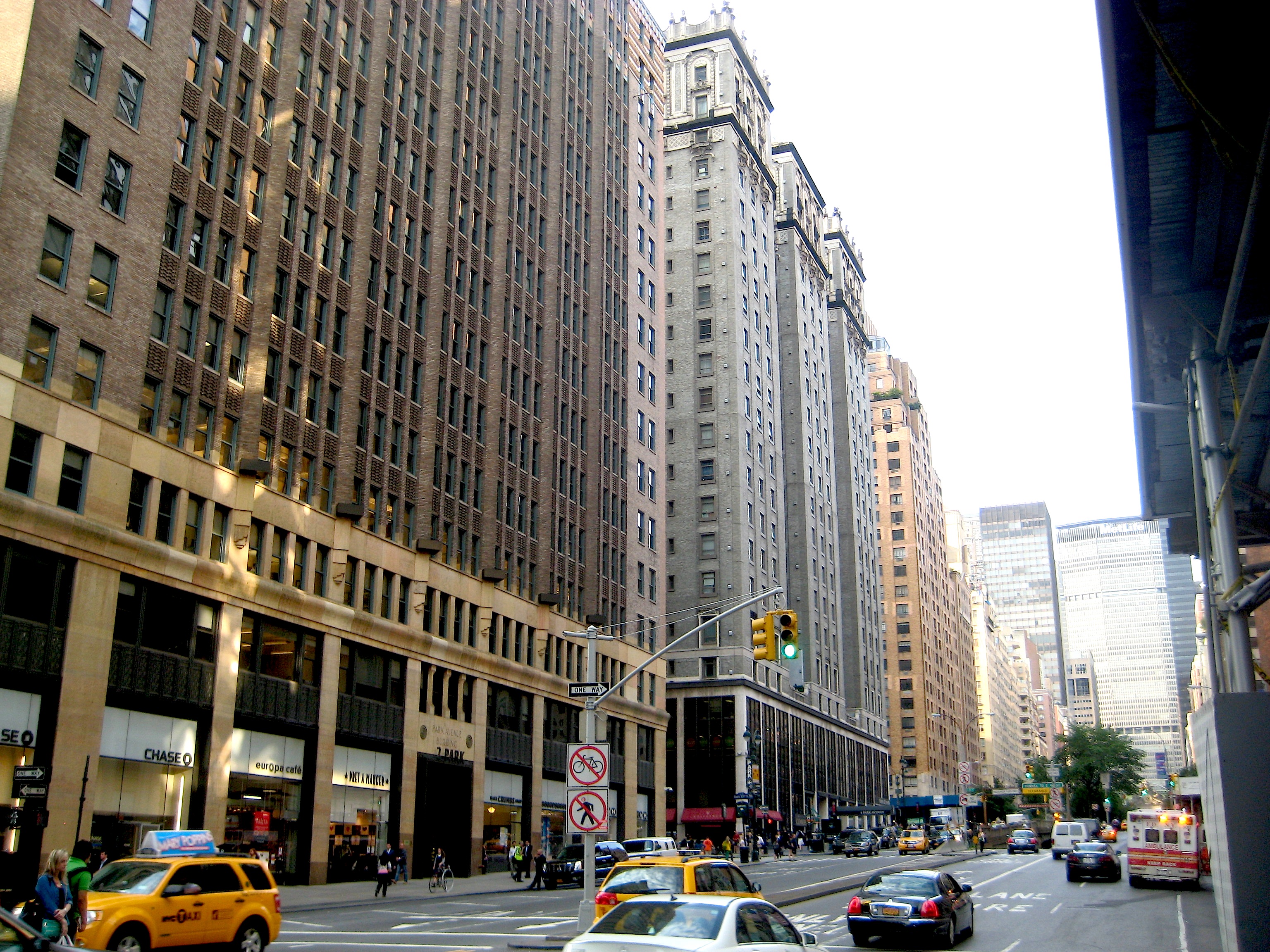
The same site today:
(Ephemeral New York)
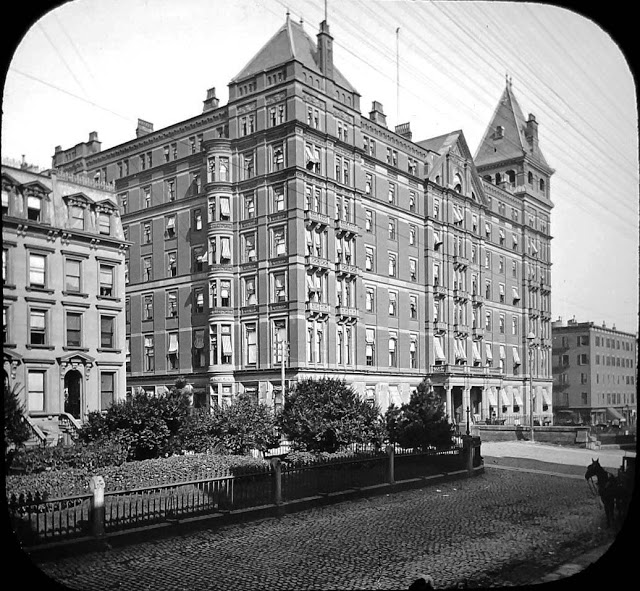
The nearby Murray Hill Hotel mentioned in the article would last another 20 years, falling to the wrecking ball in 1947:
The Murray Hill Hotel, built in 1884, would outlive the Park Avenue Hotel by 20 years, falling to a wrecking ball in 1947. (Library of Congress)
The sad world of “taxi dancers” was explored by Maxwell Bodenheim in the June 12, 1926 edition of The New Yorker.
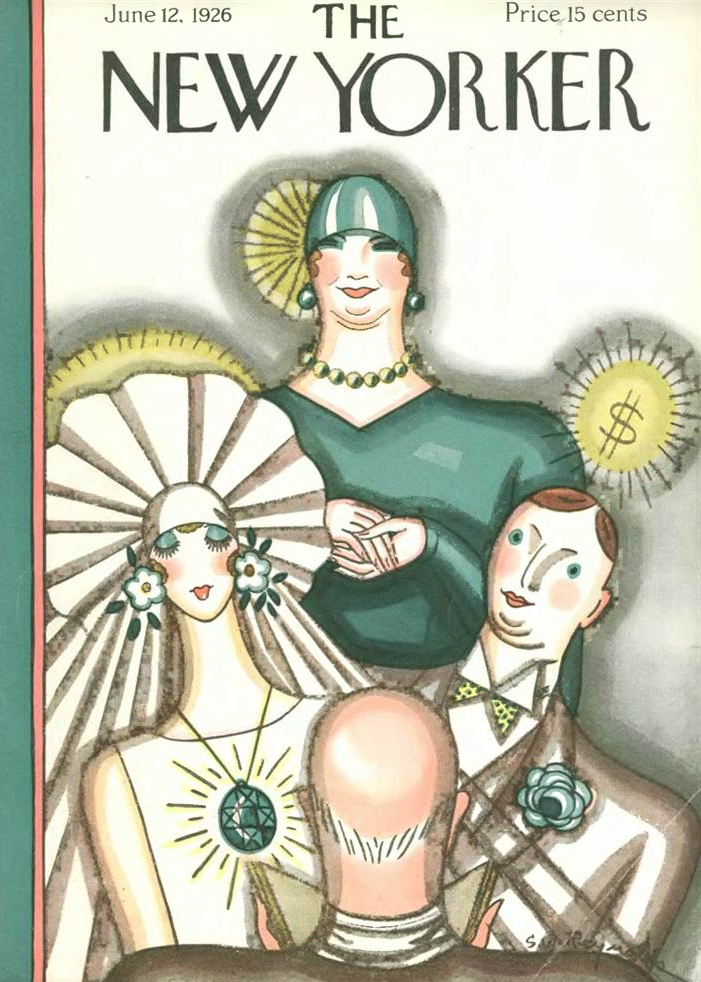
June 12, 1926 cover by S.W. Reynolds.
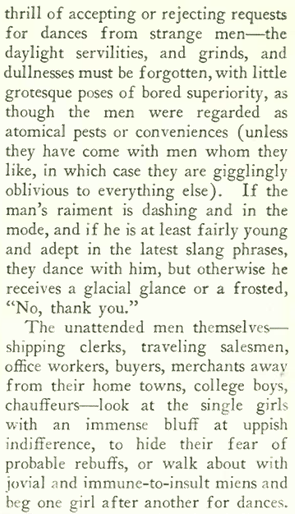
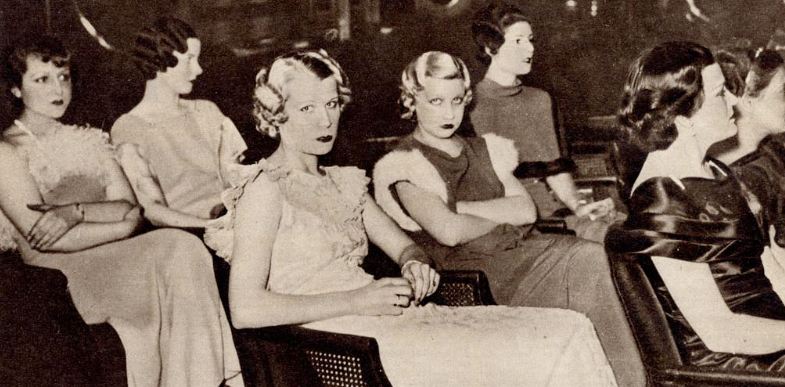
Bodenheim visited a “cheap Broadway dance hall” populated by taxi-dancers and their patrons. It worked something like this: A male patron would buy dance tickets for ten cents apiece, and for each ticket a chosen “hostess-partner” would dance with him for the length of a single song.
He also described the pathetic strutting and preening rituals of both dancers and patrons:
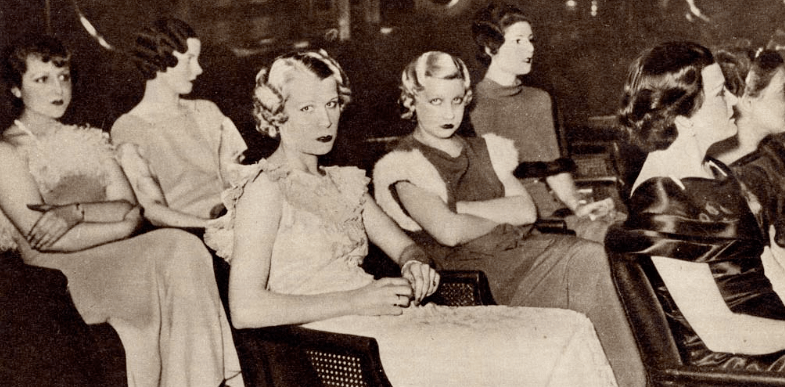
“TAXI-DANCERS” waiting for customers at a Broadway dance hall in the early 1930s. The image was scanned from an article in Weekly Illustrated (Oct. 6, 1934) that described new regulations banning the vocation.
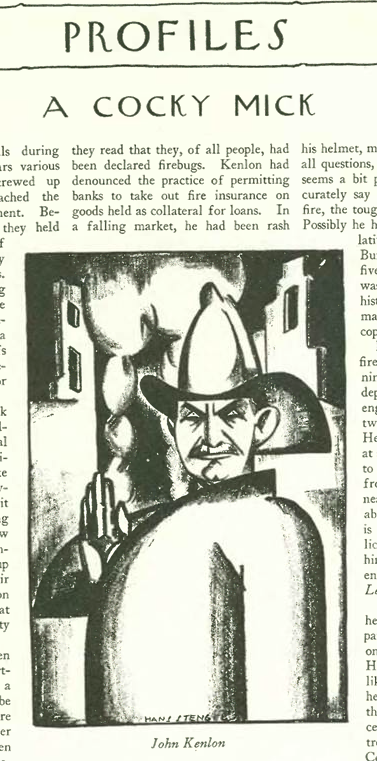
A couple of other bits from the issue: An interesting headline for the profile of NYC Fire Chief John Kenlon…
…and this advertisement for apartments at 1035 Fifth Avenue. I thought the ad was interesting because children are rarely featured in The New Yorker. In case you are wondering about their social class, these are children living on posh Fifth Avenue, and that’s a nurse-maid, not mother, chasing behind them in nearby Central Park.
On to the June 19th issue, and a couple more items of interest…
June 19, 1926 cover by Carl Rose.
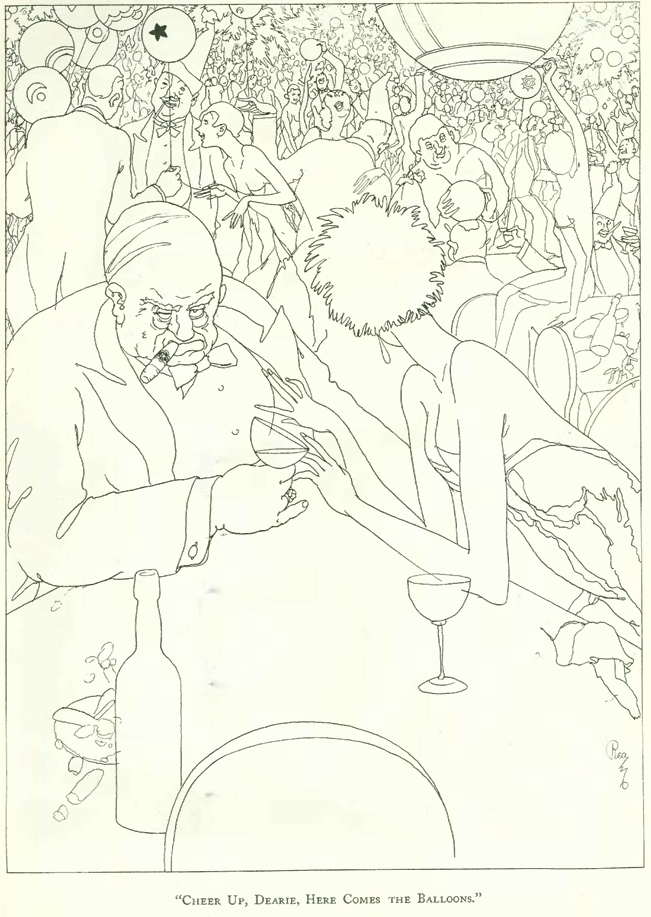
As noted previously, a common theme of the early New Yorker’s cartoons was the comic imbalance of rich old men and their young mistresses. This time Rea Irvin explores the subject with this terrific illustration:
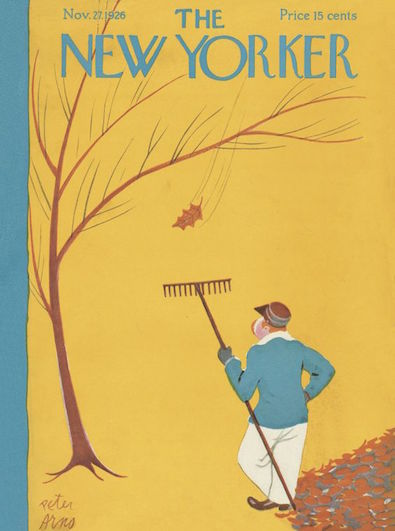
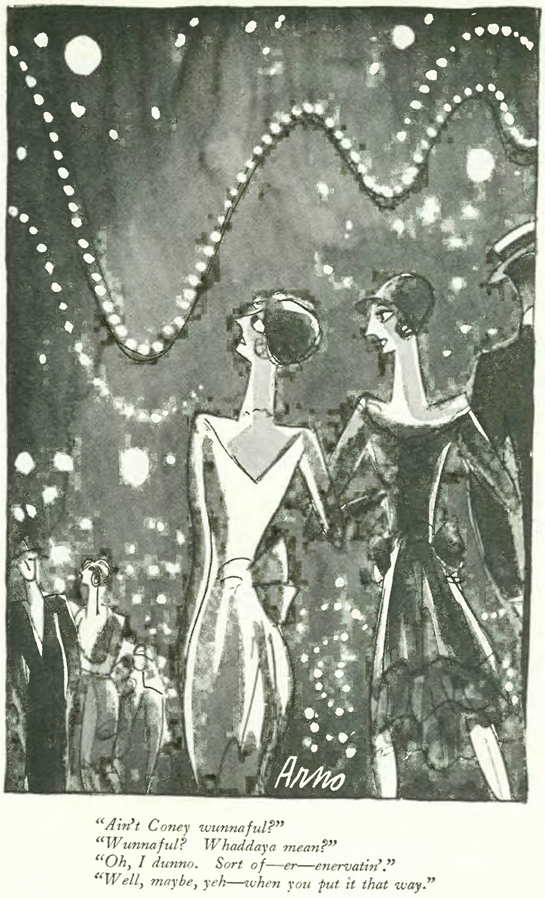
And we close with Peter Arno, and his observations of Coney Island.






















































 A New Yorker State of Mind