Having a Ball

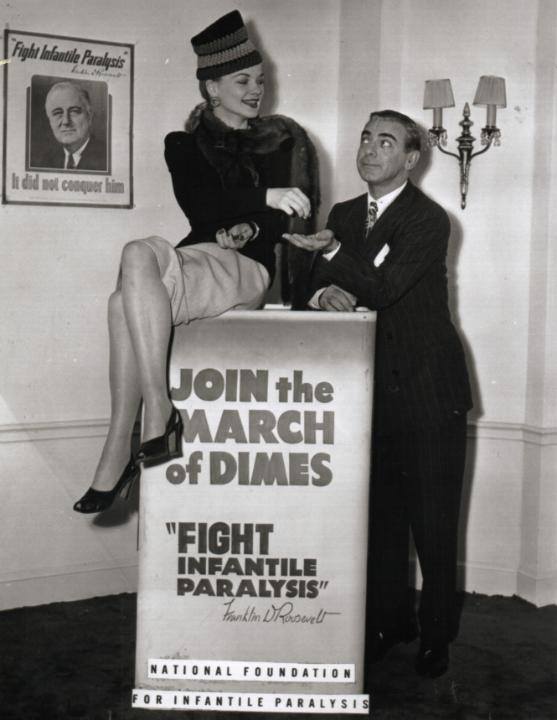
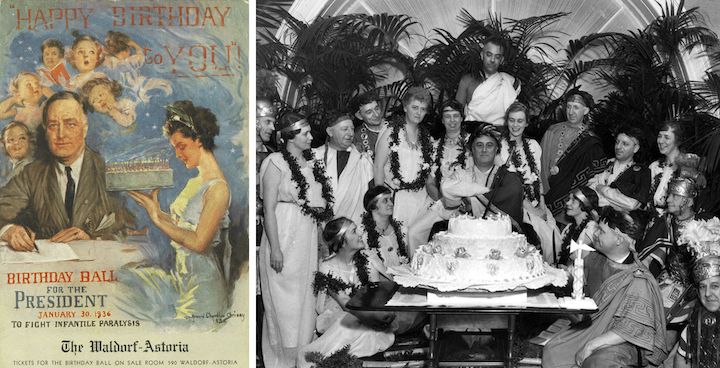
 Above: Beginning in 1934, the President’s Birthday Balls became annual fundraisers for polio research. The Waldorf-Astoria's 1936 event (left) featured dance bands, celebrities, and formal dress. At right, a 1934 "Toga Party" birthday with FDR's Cuff Link Gang, Washington D.C. (fdrlibrary.org)

President Franklin D. Roosevelt’s birthday was a cause for annual celebration throughout the country, where cities and towns both large and small used the occasion to raise money for polio research.

February 1, 1936 cover by Roger Duvoisin.

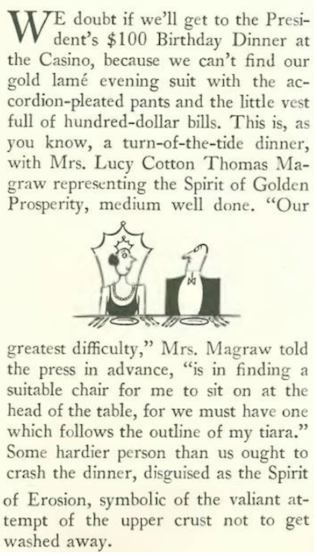
The Jan. 30, 1936 President’s Birthday Ball marked FDR’s 54th year, featuring celebrities, dances, and a national radio address. The Waldorf-Astoria hosted an event, as did the Central Park Casino, where E.B. White found the one-hundred-dollar price tag and the dress code a bit too rich for his tastes, but not too rich for Lucy Cotton Thomas Magraw, a Manhattan social climber who represented the “Spirit of Golden Prosperity” at the Casino event.
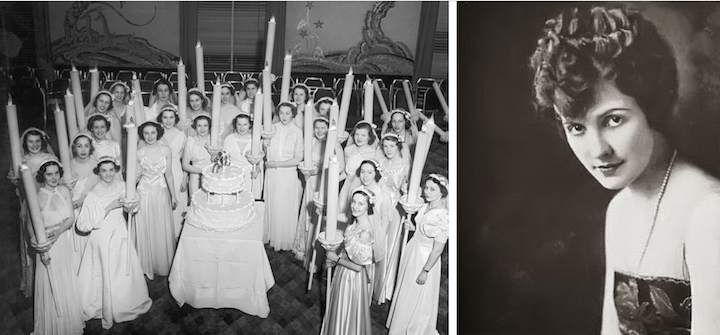
LIKE MOTHS TO FLAME…At left, debutantes mark FDR’s birthday fundraiser at the Waldorf-Astoria in the 1930s; at right, Lucy Cotton Thomas Magraw (1891–1948) was a chorus girl from Houston who appeared in several silent films, but was best known as a Manhattan social climber and for her marriages to a series of prominent men. (wwd.com/davidkfrasier.com)

FDR himself was diagnosed with polio in 1921, which left him paralyzed from the waist down. To counter the effects of the disease, Roosevelt explored the potential benefits of hydrotherapy, establishing a rehabilitation center at Warm Springs, Georgia. Proceeds from the charity balls went to Warm Springs until Roosevelt founded the National Foundation for Infantile Paralysis in 1938. Funds raised by the foundation supported the development of a vaccine by the 1950s.
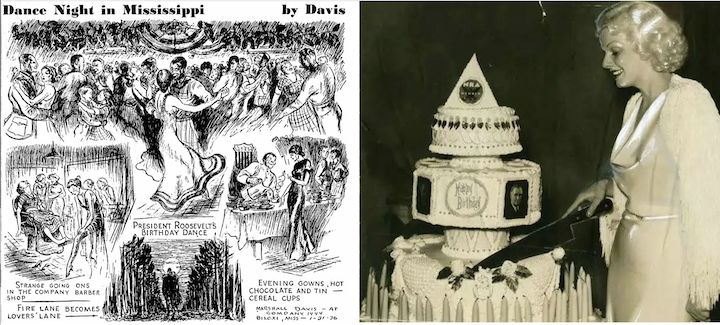
A NIGHT OF MERRIMENT…Celebrations in CCC camps in honor of FDR’s birthday became annual events, such as the one at left (illustrated by Marshall Davis) that depicted various happenings at the 1936 President’s Birthday Dance in Biloxi, Mississippi; at right, actress Jean Harlow cutting FDR’s birthday cake at the Eastbay Birthday Ball in Oakland, CA, in 1934. (newdealstories.com/facebook.com)

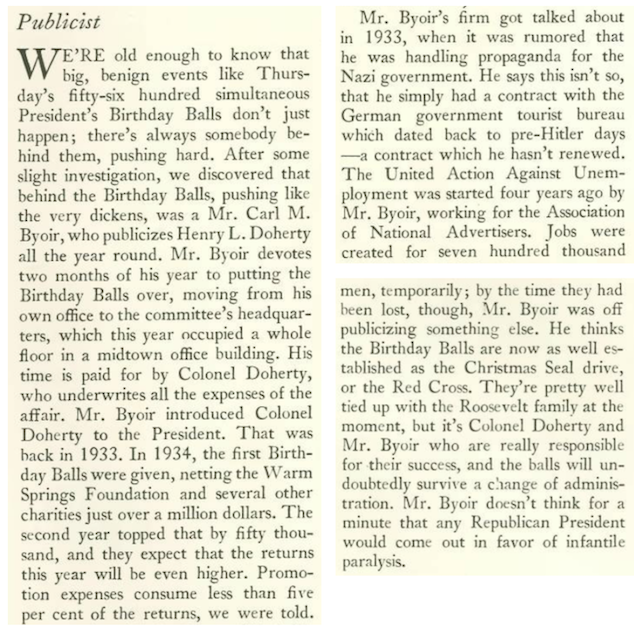
“The Talk of the Town” noted the role of Carl M. Byoir, a pioneering publicist, in creating the buzz around the yearly birthday balls.
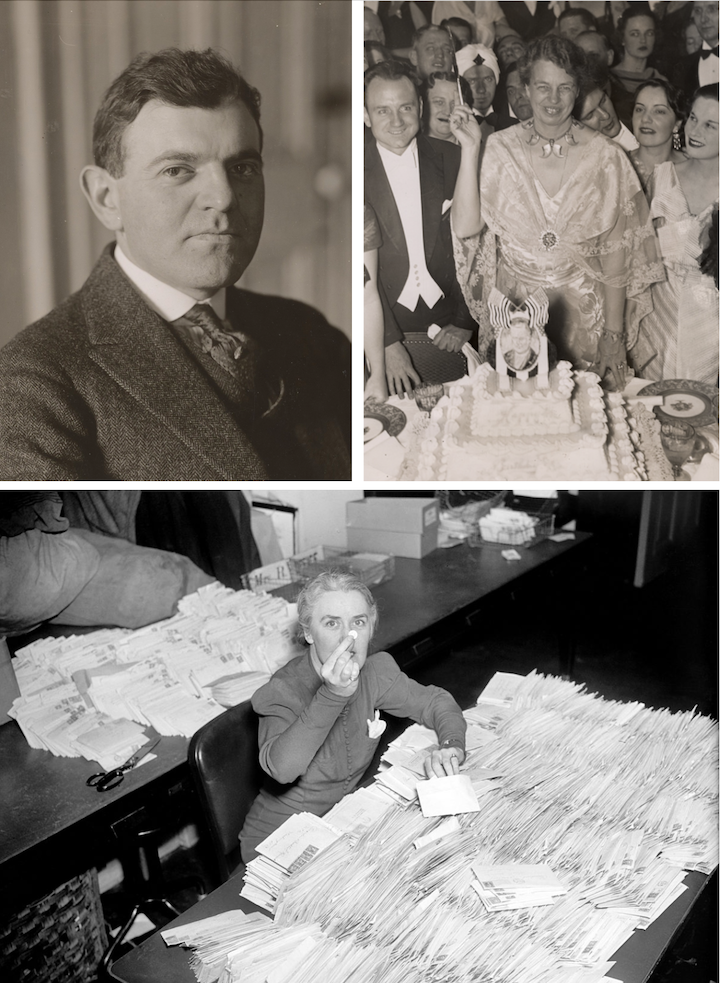
CAN YOU SPARE A DIME?…Clockwise, from top left, Carl Byoir created and organized one of the world’s largest public relations firms in 1930, and was a force behind making the FDR Birthday Balls a major national event; Eleanor Roosevelt cuts the cake at a Birthday Ball, Washington, D.C., Jan. 30, 1936; Margaret Lehand, personal secretary to President Roosevelt, holds up one of the 30,000 dimes received on the morning of Jan. 28, 1938 for FDR’s National Foundation for Infantile Paralysis, which would later become the March of Dimes. (Wikipedia)
COIN FOR A CAUSE…As we saw in the previous post, it was comedian Eddie Cantor who coined the phrase “March of Dimes” for the annual fundraiser for polio research. The phrase later became the official name of the National Foundation for Infantile Paralysis. (Facebook)

The Roosevelt Dime went into circulation in 1946, commemorating FDR’s role in inspiring the March of Dimes.

 * * *

Rap on Scrap

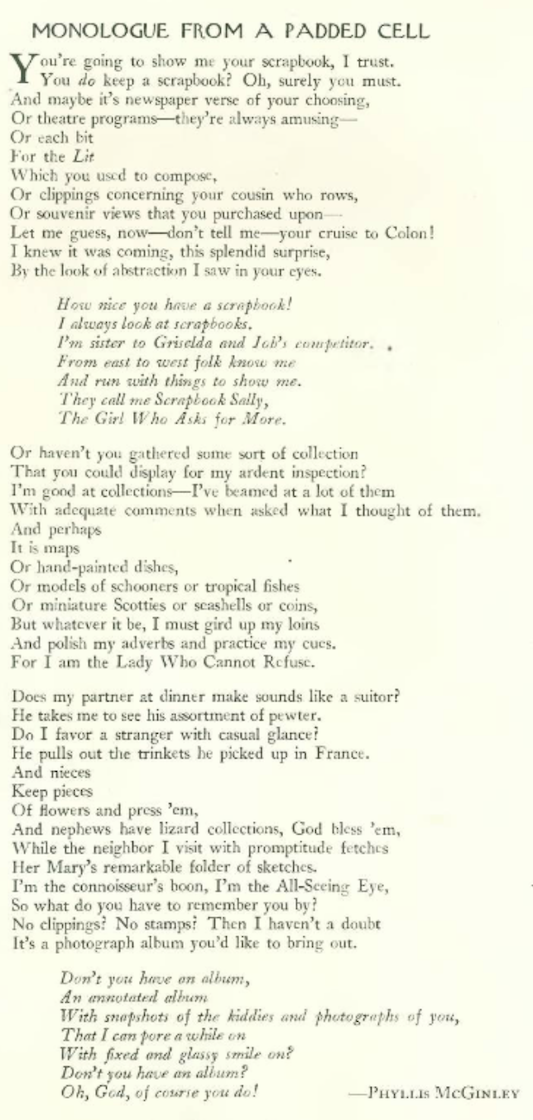
Poet and author Phyllis McGinley apparently had her fill of social occasions that included interminable, tedious viewings of the hosts’ scrapbooks, photo albums, and various tchotchkes.
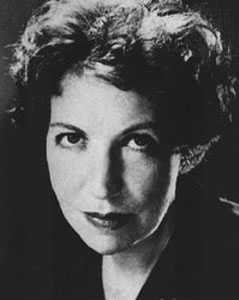
SPARE ME YOUR VACATION SLIDES…Phyllis McKinley would have hated Facebook. (Wikipedia)

 * * *

Wise Guy

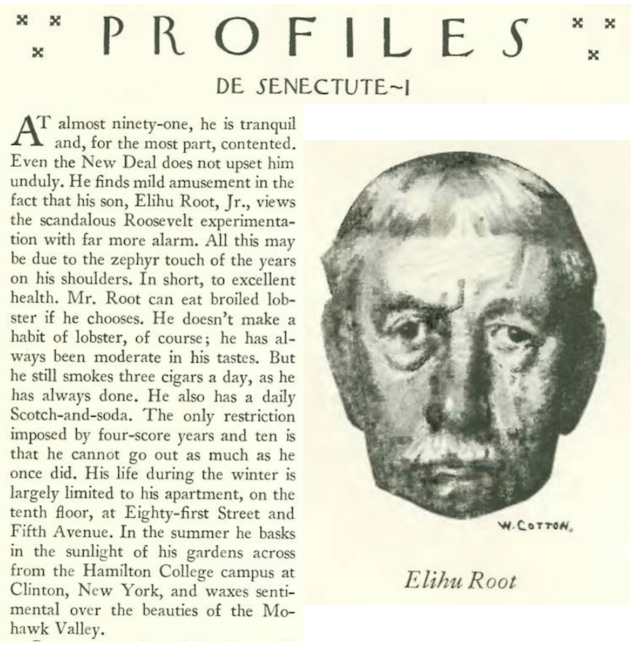
Henry F. Pringle published the first part of a three-part profile on Elihu Root, making much of the fact that Root (1845–1937) was still kicking at ninety after a lifetime of public service including two stints as Secretary of War and serving as Secretary of State under President Theodore Roosevelt. Unofficially, he advised a number of presidents and other leaders on foreign and domestic issues, giving him the imprimatur of a political “wise man.” A brief excerpt (with caricature by William Cotton):
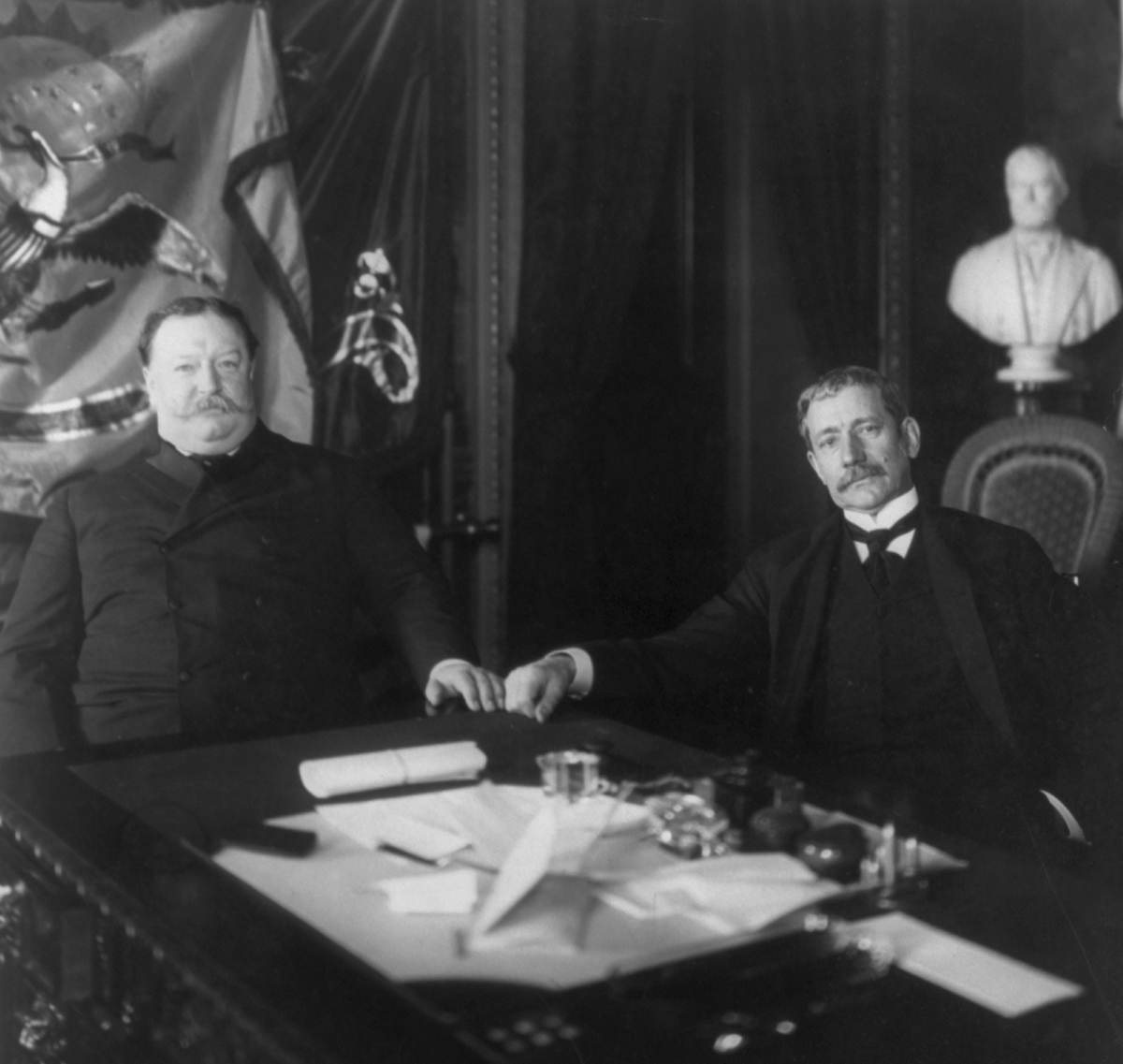
WAR BUDDIES…U.S. Secretary of War Elihu Root (right) and his successor, William Howard Taft, c. 1904. Taft was elected U.S. President in 1908, and in 1912 Root would receive the Nobel Peace Prize. (Wikipedia)

 * * *

Devastating Irony

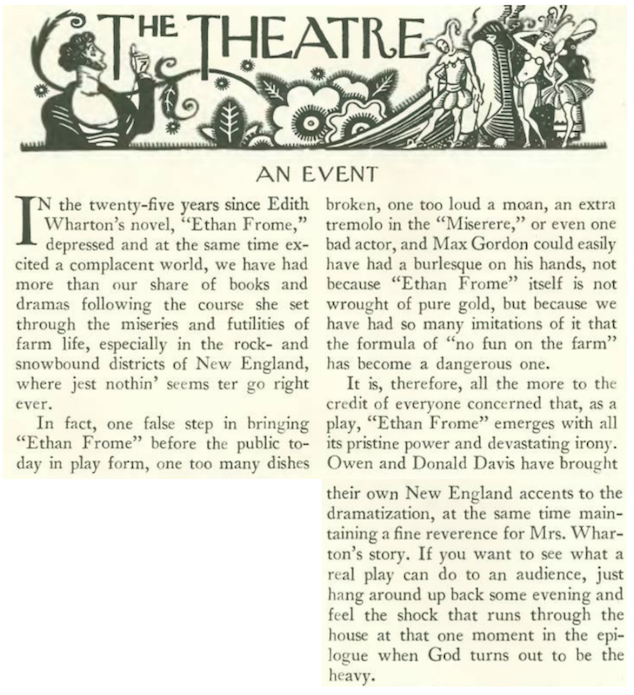
According to critic Robert Benchley, the adaptation of Edith Wharton’s novel Ethan Frome to the stage required a precise hand, and apparently director Max Gordon delivered when it opened at the National Theatre. Excerpt:
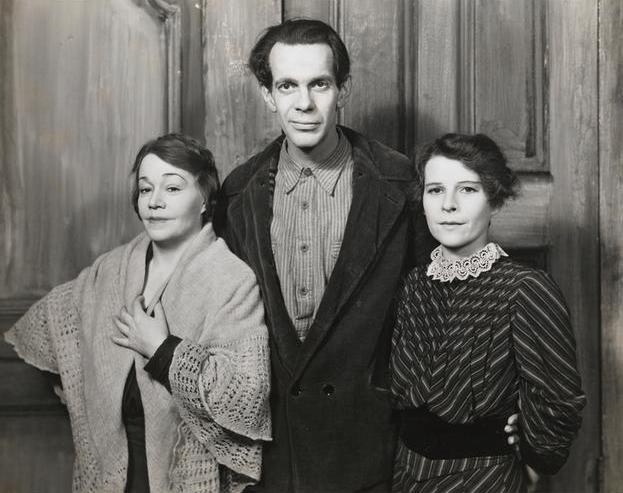
EDITH WHARTON WOULD HAVE BEEN PROUD, according to Robert Benchley, of the stage adaptation of Ethan Frome. The cast, from left, included Pauline Lord, Raymond Massey, and Ruth Gordon. Benchley would have been well acquainted with Gordon, who was a familiar face at the Algonquin Round Table. (Facebook)

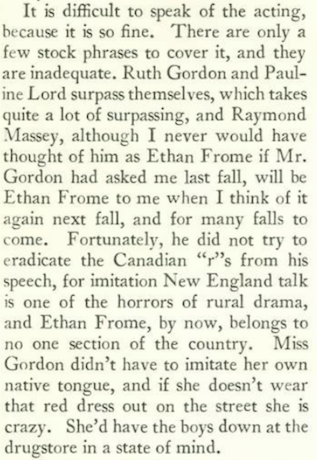
Benchley praised the performances of the principal actors Pauline Lord, Raymond Massey, and Ruth Gordon.
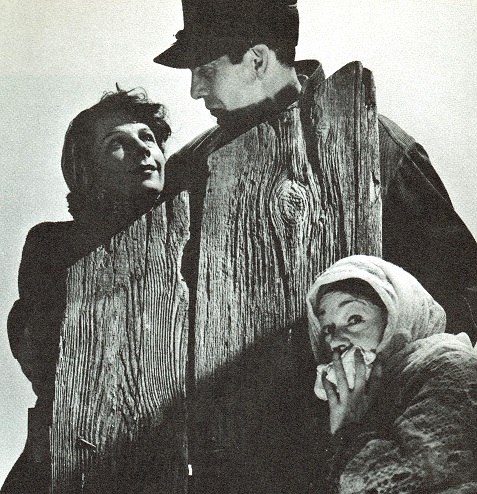
IN FINE FORM…Pauline Lord, Raymond Massey, and Ruth Gordon in a publicity still for Ethan Frome. (witness2fashion.com)

 * * *

At the Movies

We take to the air with Howard Hawks’ Ceiling Zero, which featured an odd mix of screwball dialogue and nerve-wracking flight scenes. Critic John Mosher found the film to be well done, even though most of its action took place on the ground.
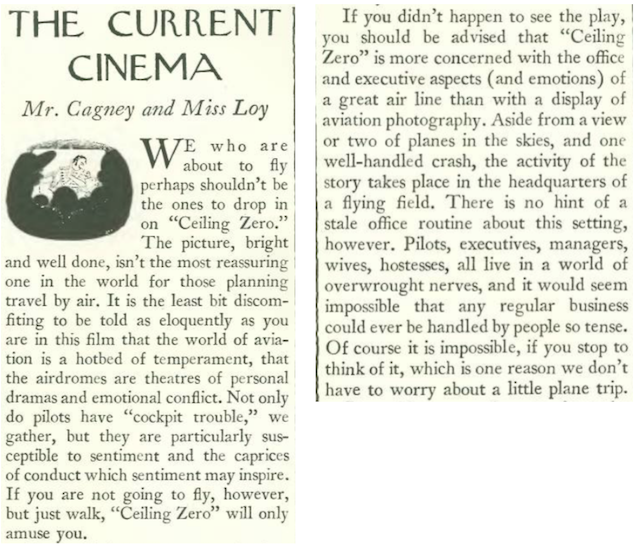
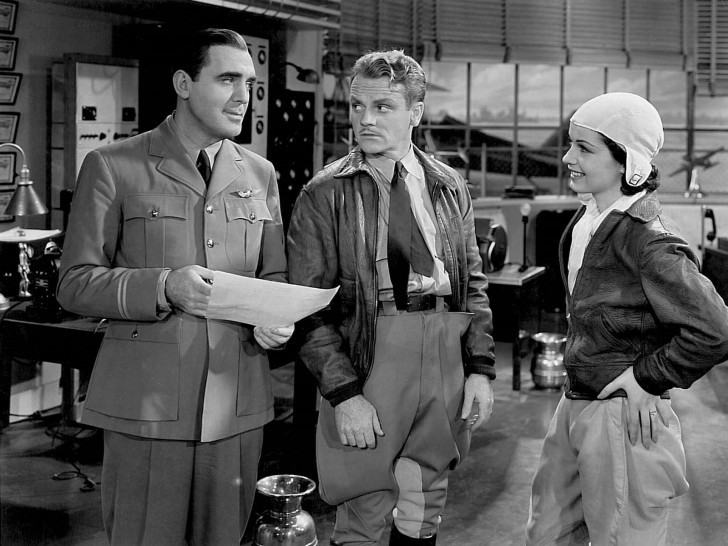
GROUNDED…Shot a shoestring budget, Warner Brothers’ Ceiling Zero, directed by Howard Hawks, staged most of the action at an airline’s headquarters rather than up in the air. From left are Pat O’Brien, James Cagney, and June Travis. (Harvard Film Archive)

Mosher was also happy to welcome Myrna Loy back to the silver screen in the “agreeable” Whipsaw.
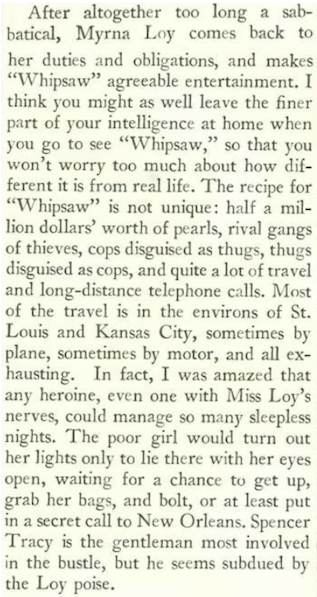
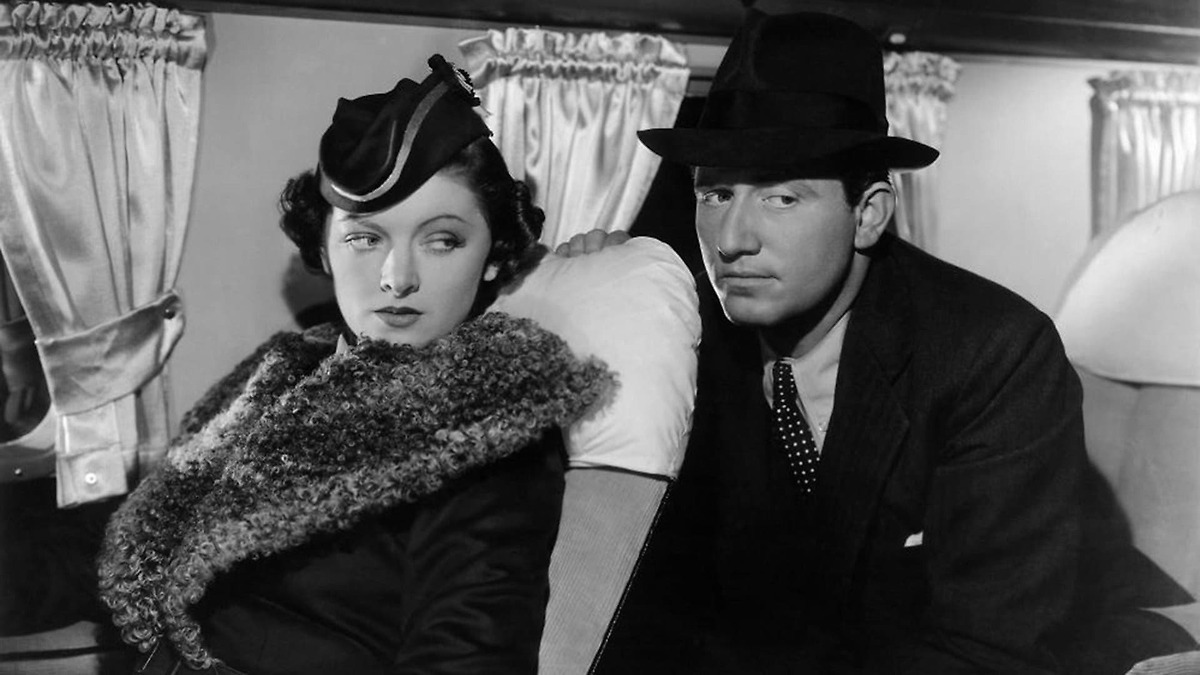
HUSTLE AND BUSTLE…Myrna Loy and Spencer Tracy starred in action-packed crime drama Whipsaw. (Letterboxd.com)

Mosher was at a loss to explain the popularity of comedian Joe Penner, whose presence in the film Collegiate inspired impatient “mobs” to crash the windows and doors of the Paramount Theatre.
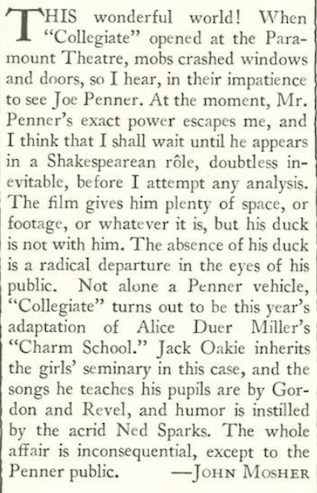
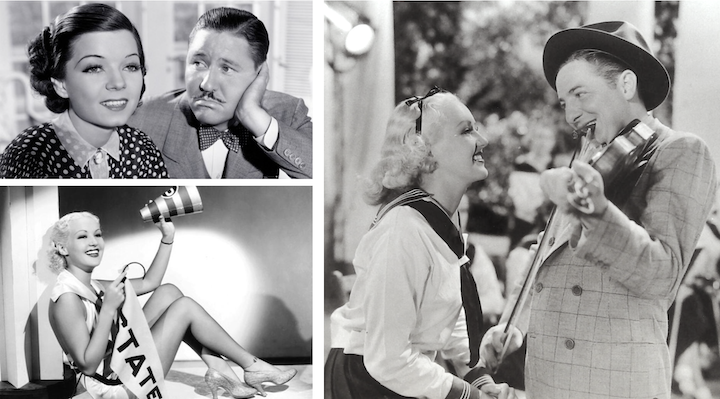
INCONSEQUENTIAL was the word John Mosher used to describe Collegiate. Clockwise, from top left, Frances Langford and Jack Oakie in a scene from Collegiate—Oakie played a man who inherits an all-girls school from his aunt; Betty Grable with Joe Penner; Grable shows off her school spirit and her famous legs in a publicity photo. (rottentomatoes.com/imdb.com)

About Joe Penner (1904–1941): Broadcast historian Elizabeth McLeod sums up Penner’s popularity as “the ultimate Depression-era zany.” Mostly forgotten today, Penner was a national craze in the mid-1930s. “There is no deep social meaning in his comedy, no shades of subtlety,” writes McLeod, “just utter slapstick foolishness, delivered in an endearingly simpering style that’s the closest thing the 1930s had to Pee-wee Herman.”
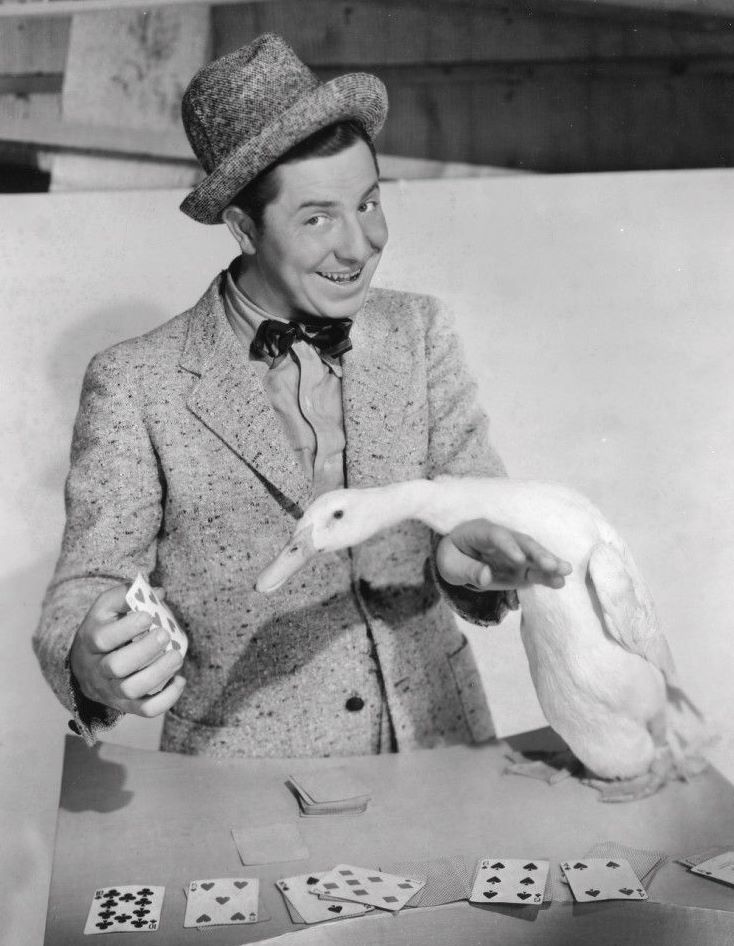
WANNA BUY A DUCK? was Joe Penner’s catchphrase. Born József Pintér in what is now Serbia, he is shown here with his ubiquitous duck, Goo Goo. According to historian Elizabeth McLeod, Penner was doomed to an early decline by the sheer repetitiveness of his format. He died in his sleep, of a heart attack, at age 36. (imdb.com)

 * * *

Something Completely Different

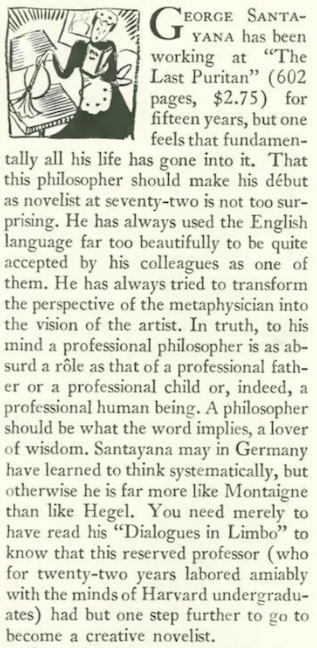
We go from Joe Penner to George Santayana, who finished the six-hundred-page The Last Puritan after laboring on the novel for fifteen years. A brief excerpt from a Clifton Fadiman review:
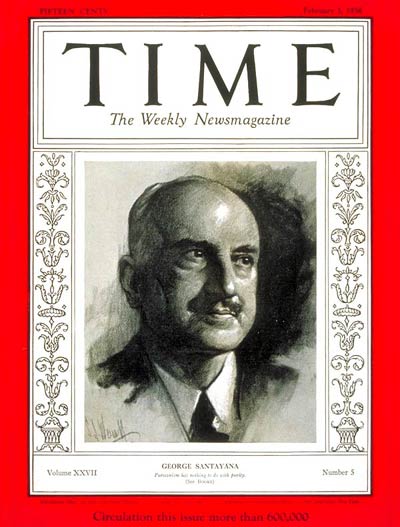
WHEN WRITERS MADE THE COVER…George Santayana on the cover of Time, Feb. 3, 1936. (Time.com)

* * *

From Our Advertisers

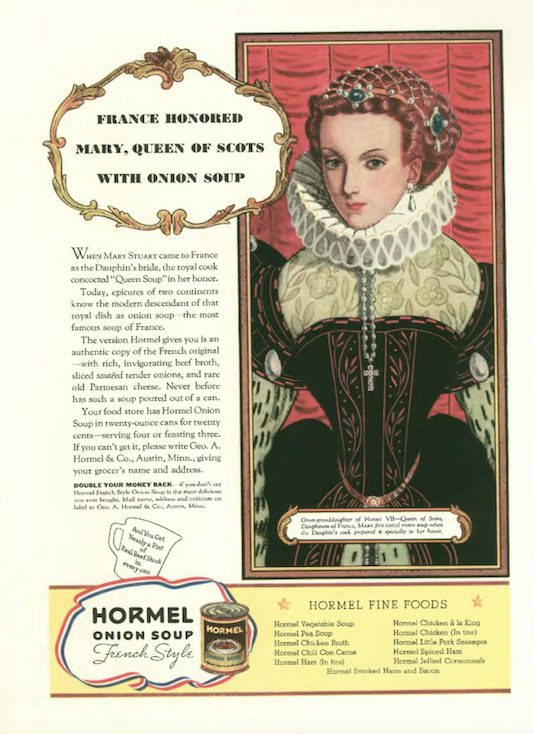
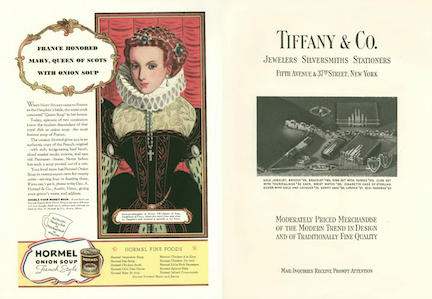
The folks at Hormel continued their ad series pairing Hormel French Style onion soup with notable historic figures…apparently Mary, Queen of Scots was honored with some onion soup when she married the Dauphin in 1558…nearly three decades later she would lose her head under the reign of Elizabeth I

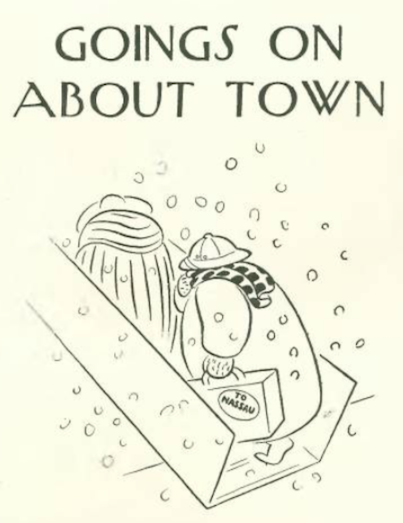
…the opening spread of the magazine sometimes offered odd juxtapositions…
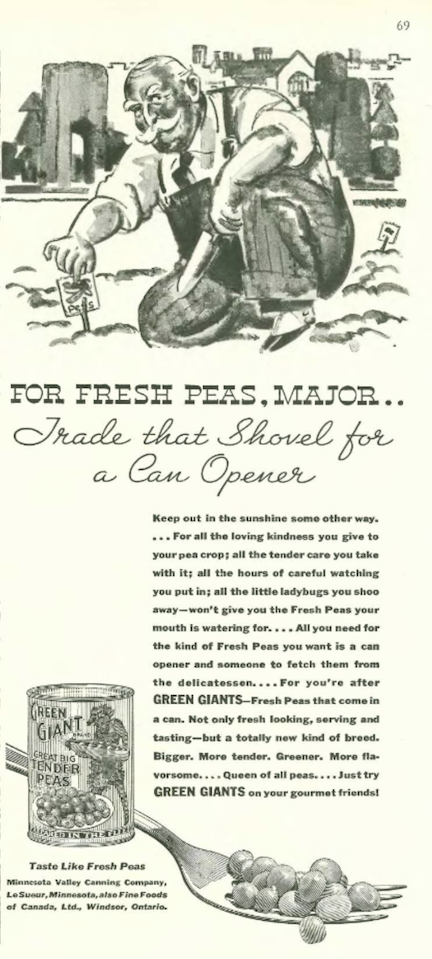
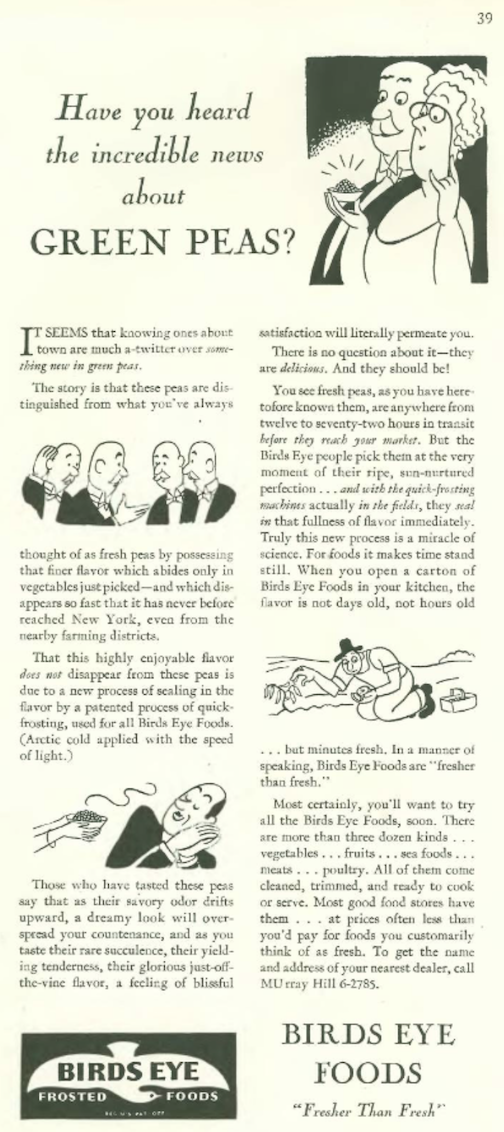
…and what was this obsession with peas?…last week (and previous weeks) the makers of Green Giant canned foods featured a “Major” obsessed with fresh peas…
…in this issue, the folks at Birds Eye presented frozen peas as a fresher alternative to canned…the ad featured their own version of a “Major,” here sharing the wonderful news about frozen peas with his cronies…
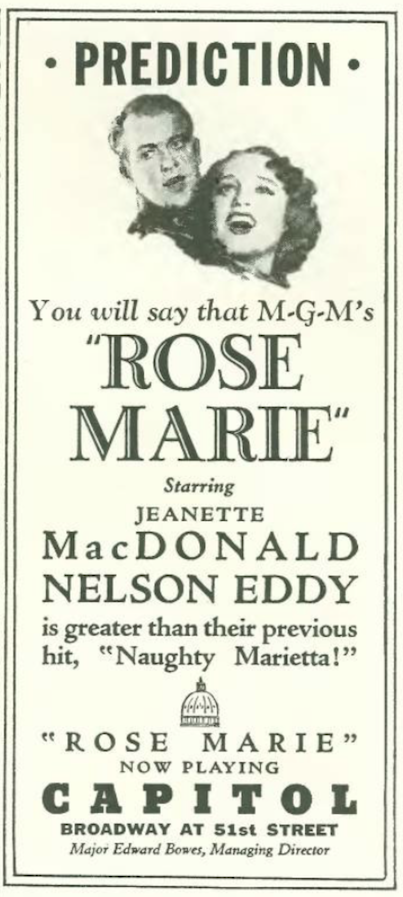
…Capitol Theatre predicted that their latest feature, Rose Marie, would be even better than Naughty Marietta

…and apparently it was…

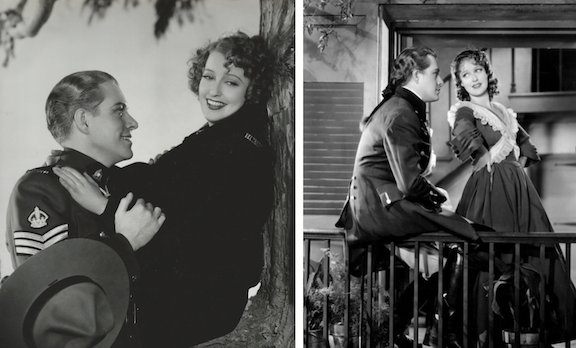
WHEN I’M CALLING YOOOOUUUU…The Capitol Theatre’s prediction came true—Rose Marie was a big hit, as was the duet “Indian Love Call” (it remained a signature song for both actors); at left, Nelson Eddy and Jeanette MacDonald in Rose Marie; at right, Eddy and MacDonald in 1935’s Naughty Marietta. “America’s Singing Sweethearts” made eight films together. (MGM)

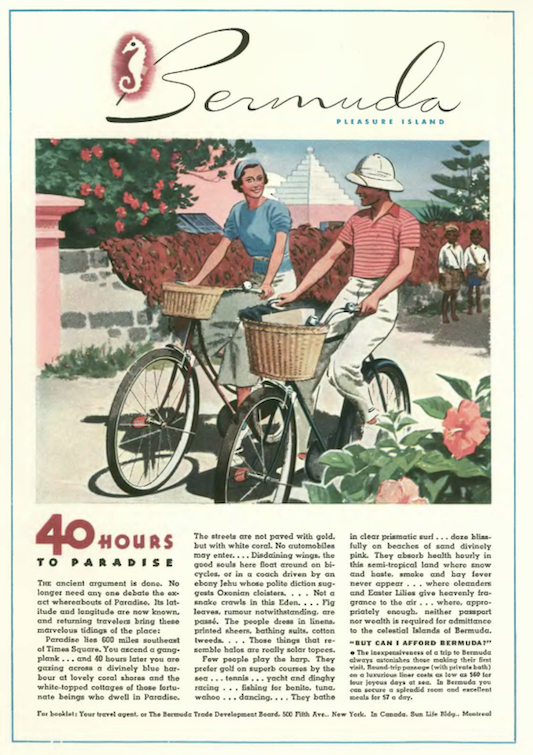
…only forty hours to paradise, claimed this ad on the inside back cover…
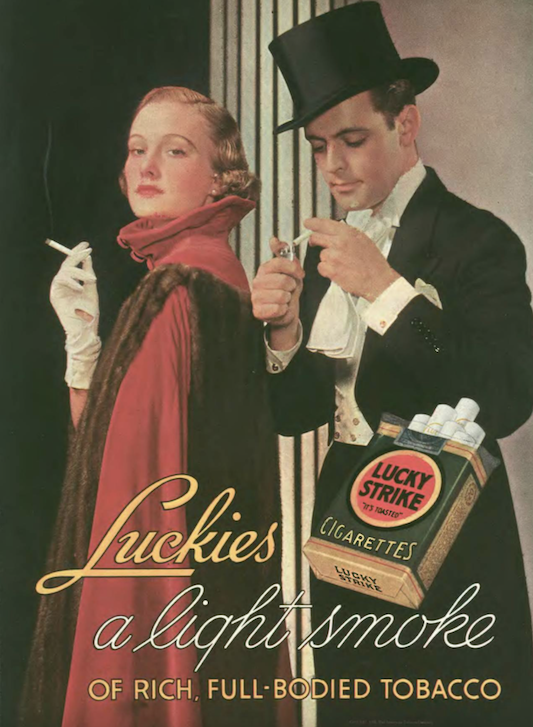
…and on the back cover, readers were greeted by a smug, almost withering look—a fashionable woman striking a pose, one that was doubtless imitated by many in the smart set who would soon realize they were hopelessly addicted to nicotine…
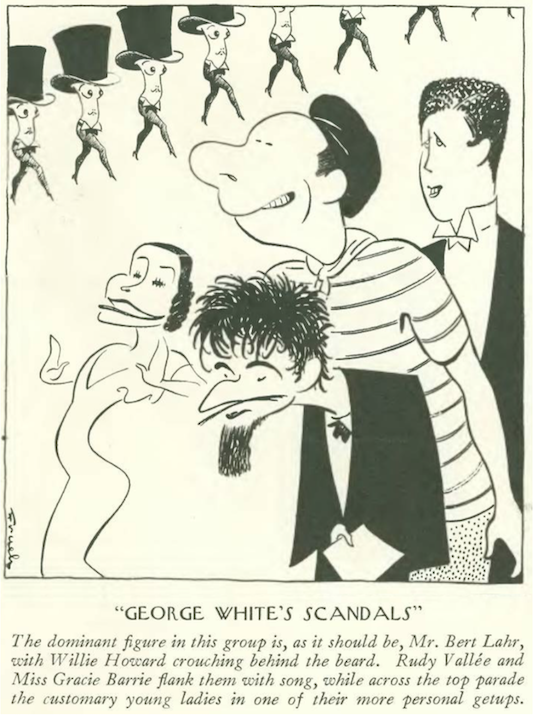
…on to our cartoonists, we begin with Al Frueh and his topless tribute to George White’s Scandals

Gregory d’Alessio drew up this trio—endomorph, mesomorph, ectomorph—for the opening pages…
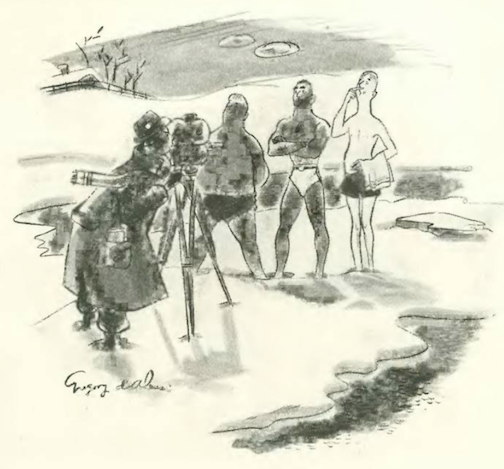
…here’s a spot by Robert Day, dreaming of warmer climes…
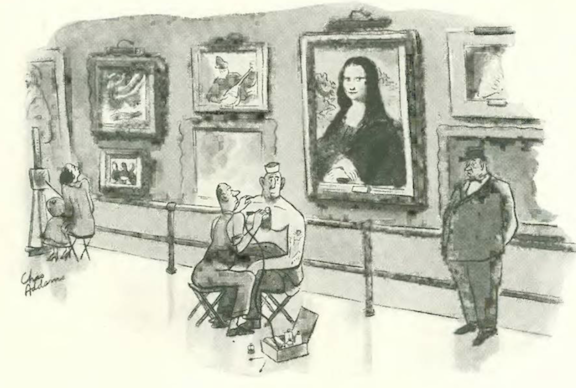
…we join Charles Addams at the Louvre…
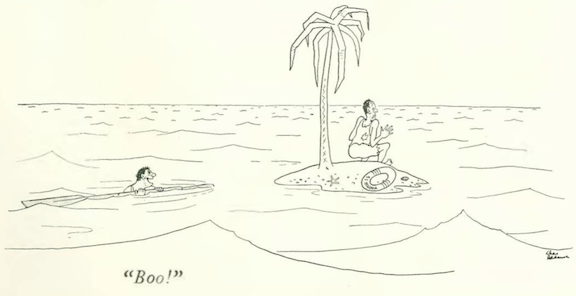
…and on a desert island…
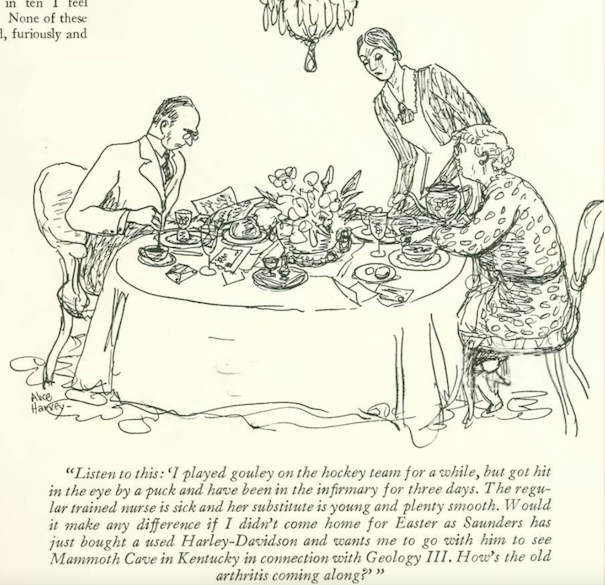
…a rather strange entry by Alice Harvey, with the longest caption I’ve come across so far…
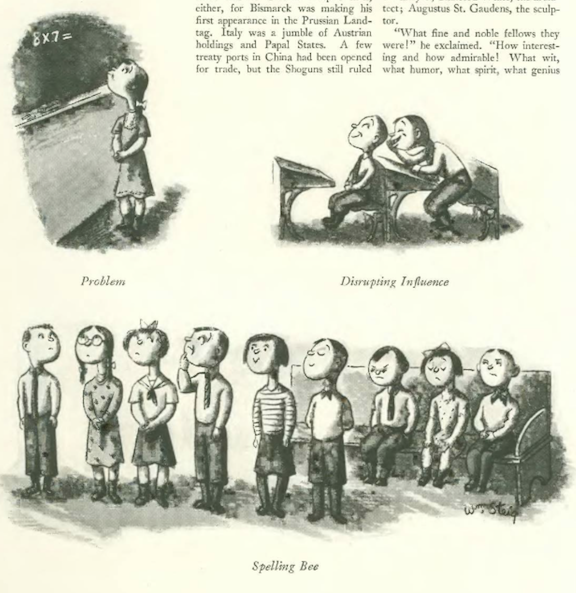
…we join William Steig’s “Small Fry” during a school day, beginning on page 24…
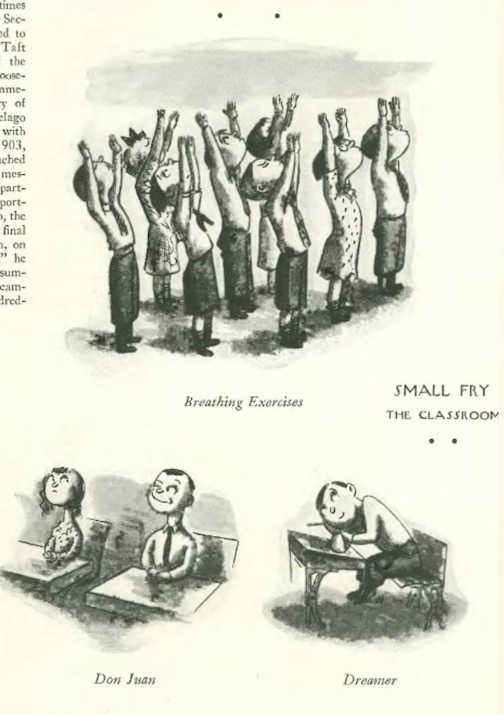
…and continuing onto page 25…
…here is how it originally appeared…
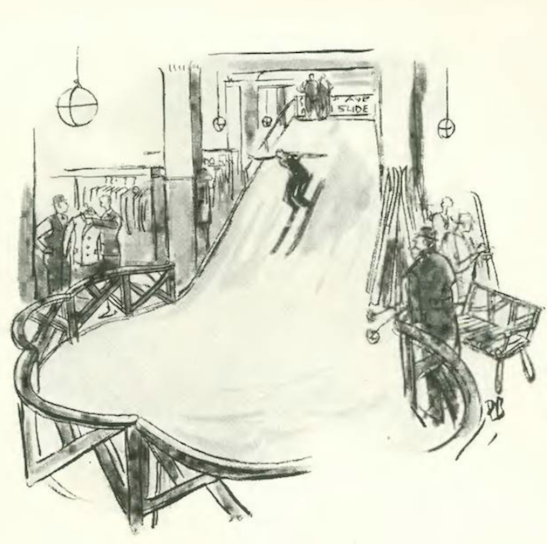
…In 1935, Saks Fifth Avenue installed an indoor ski slope on the men’s floor of its New York City flagship store, here illustrated by Perry Barlow

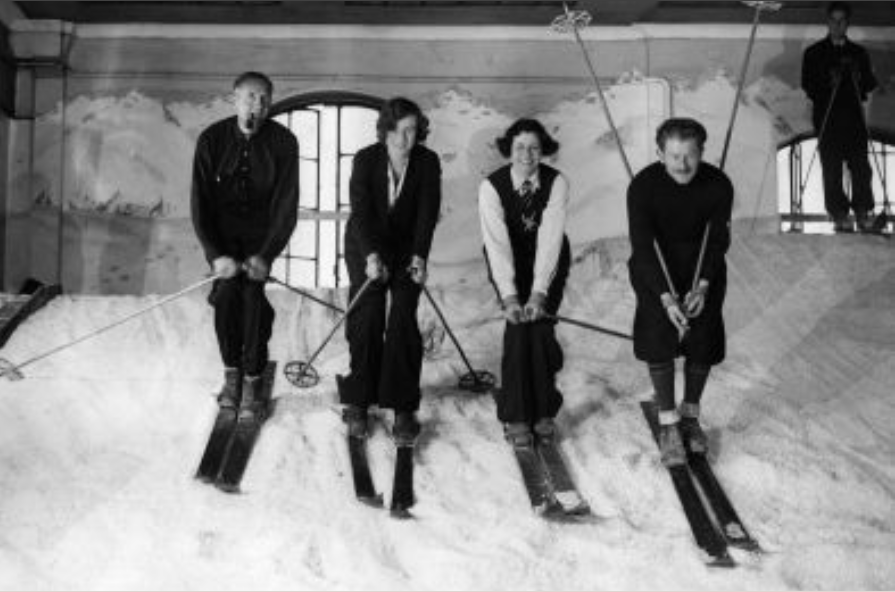
IT WAS A THING…Ski slope inside Saks Fifth Avenue, New York, 1935. (CNN.com)

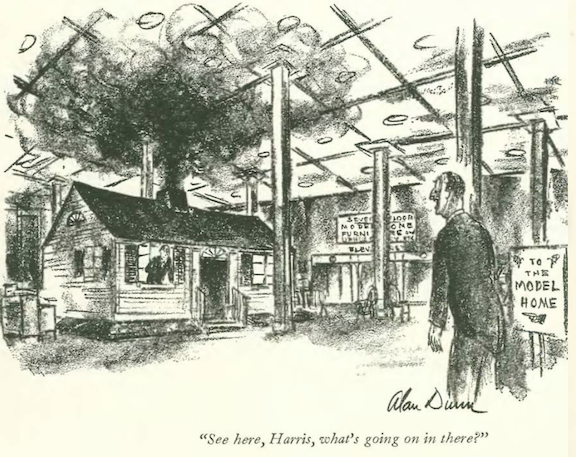
…department stores such as Macy’s often featured model homes in their household departments…Alan Dunn added a bit of color, or rather, soot, to this one…
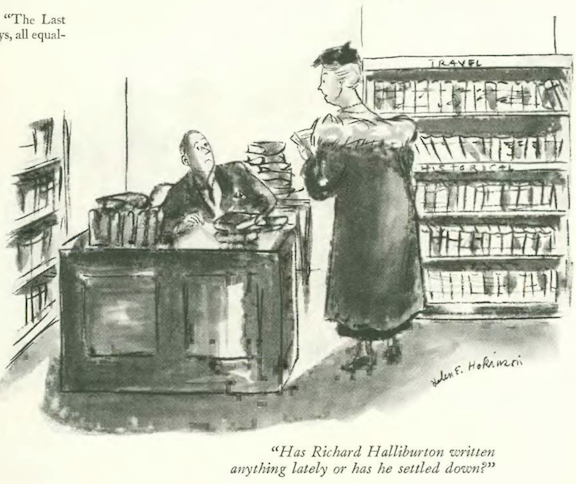
Helen Hokinson looked for answers at a book shop…
and Hokinson again, doing a bit of home decorating…
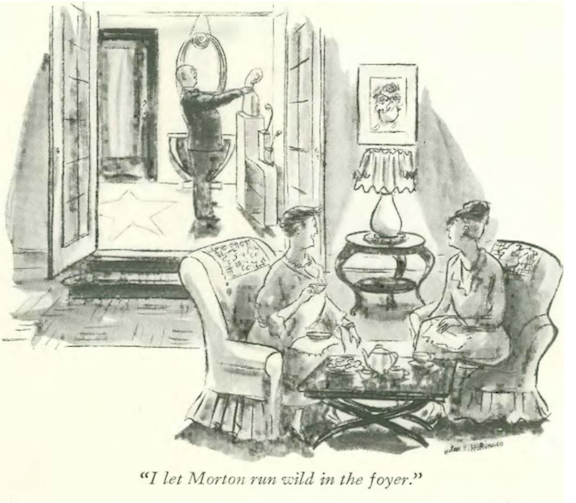
…it appears Morton was displaying a copy of Constantin Brancusi’s Princess X…

(sheldonartmuseum.org)

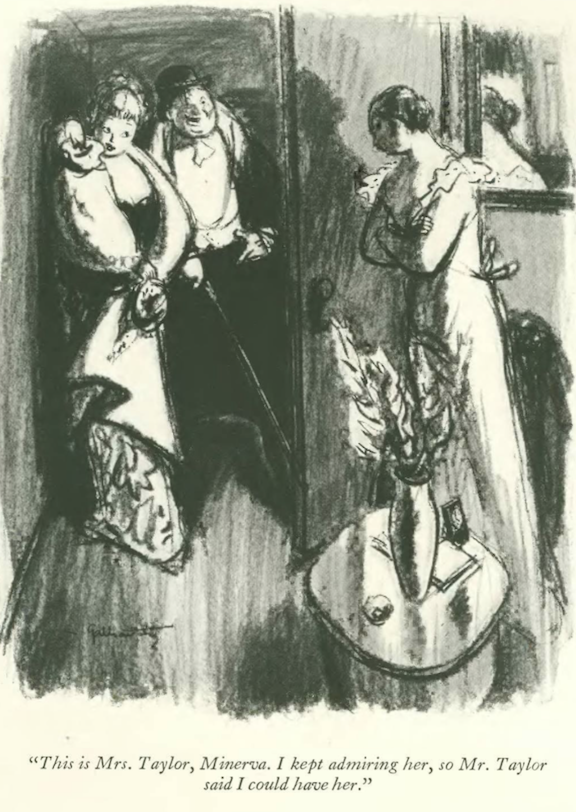
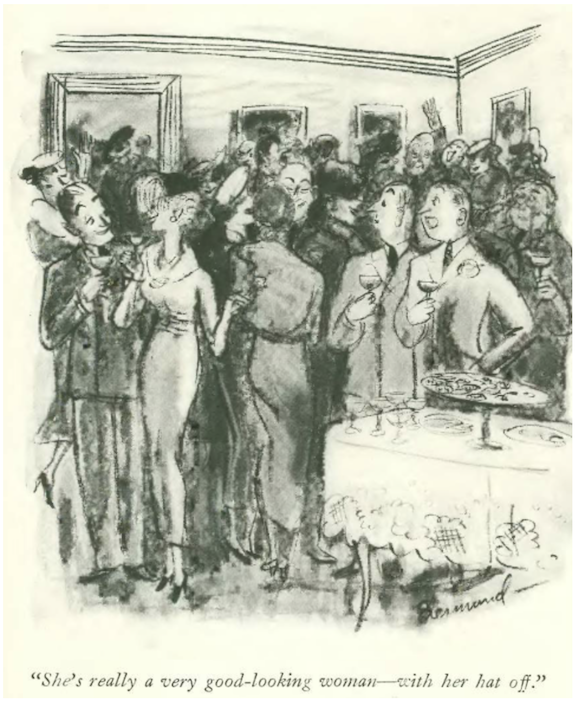
Barbara Shermund engaged in some light banter at a cocktail party…
…and we close with a surprise visit from William Crawford Galbraith

Next Time: The New Ziegfeld…
 

It Can’t Happen Here

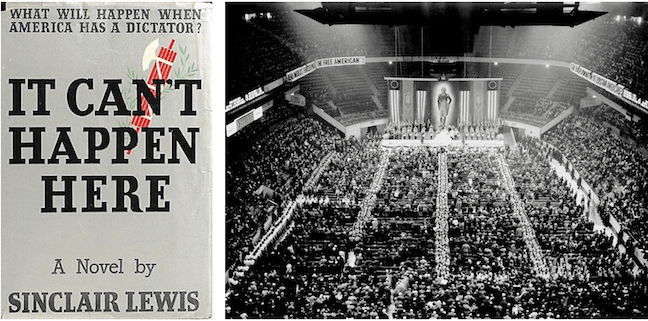
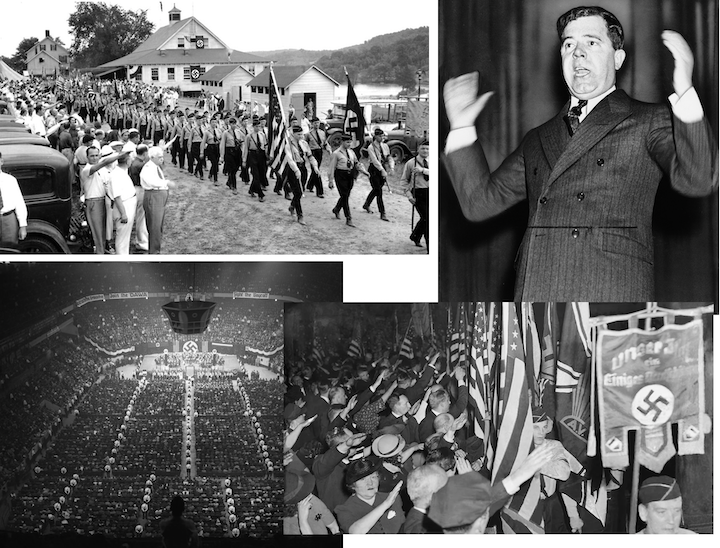
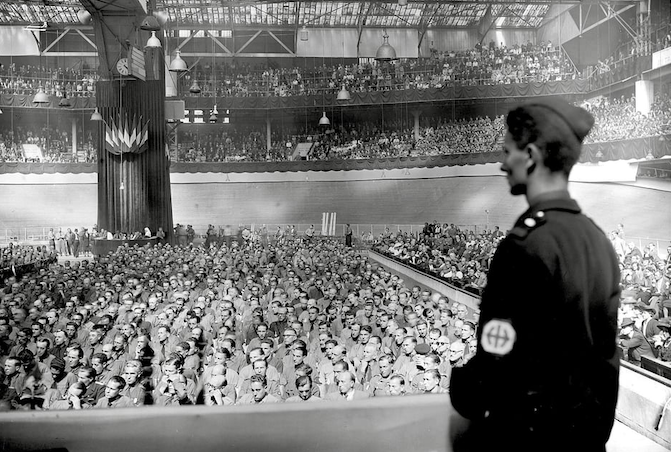
Above: Cover of Sinclair Lewis's 1935 novel about a fascist takeover of America, It Can't Happen Here. At right, 22,000 people attended a Nazi rally at Madison Square Garden on February 20, 1939. (Wikipedia/Reddit)

Ninety years ago Sinclair Lewis published It Can’t Happen Here, a dystopian novel that responded to the rise of fascism in Europe as well as to American demagogues like Louisiana Senator Huey Long.

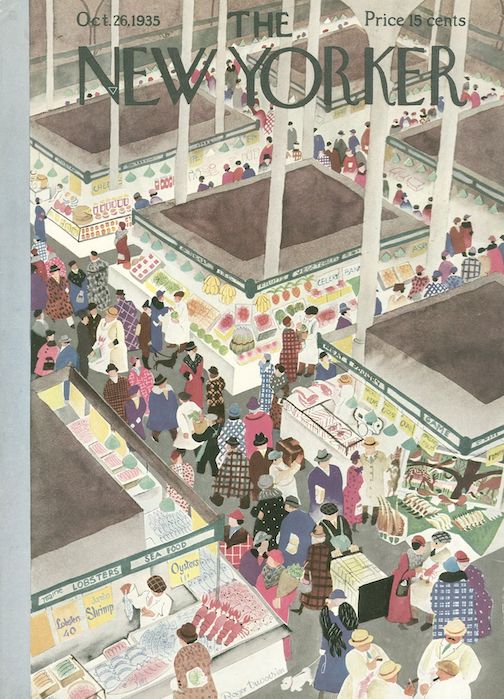
October 26, 1935 cover by Roger Duvoisin. Duvoisin (1900–1980) was a Swiss-born American writer and illustrator best known for children’s picture books. He illustrated 32 covers for The New Yorker, along with five cartoons. Duvoisin won the Caldecott Medal in 1948 (along with author Alvin Tresselt) for White Snow, Bright Snow.

In his 2016 New Yorker article, “Getting Close to Fascism with Sinclair Lewis’s ‘It Can’t Happen Here,'” journalist Alexander Nazaryan notes how Lewis was arguing for journalism and civic education as essential pillars of democracy. The title of Lewis’s book, Nazaryan observes, suggests that ‘It’ was something more subtle: “a collective apathy, born of ignorance, and a populace that can no longer make the kind of judgments that participatory democracy requires.”

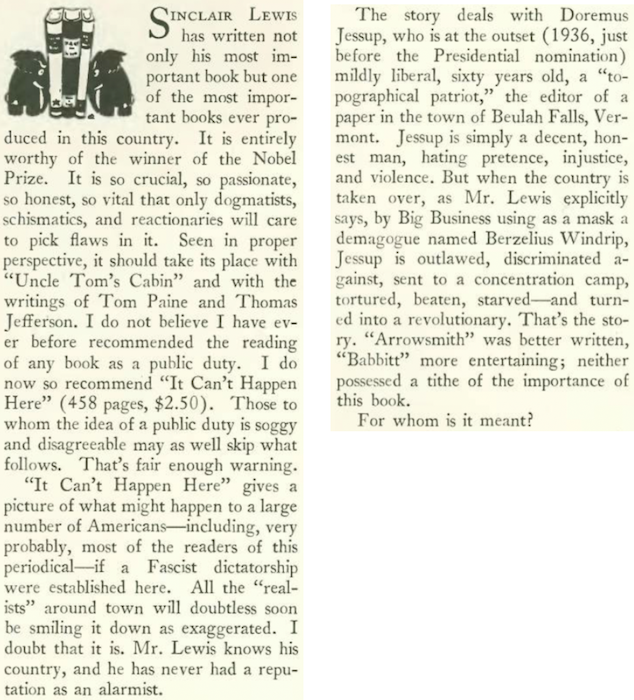
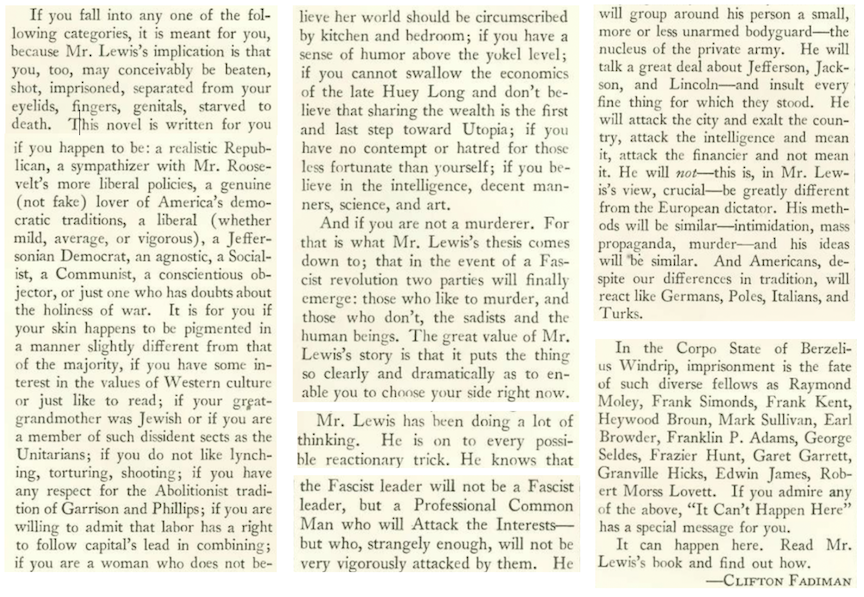
Lewis’s novel also made book critic Clifton Fadiman sit up and take notice. Here are excerpts from the first part of his review:

HOME-GROWN…American fascism was represented by organizations such as the German American Bund, the Silver Legion of America, and radio host Charles Coughlin, who opposed the New Deal and promoted conspiracy theories and antisemitic views. Clockwise, from top left: Nearly a thousand uniformed men wearing swastika arm bands and carrying Nazi banners parade past a reviewing stand in New Jersey on July 18, 1937. The New Jersey division of the German-American Bund had opened the 100-acre Camp Nordland at Sussex Hills; Huey Long in 1935, the same year he was assassinated; Nazi rally at Madison Square Garden in 1939. (AP/Wikipedia)

If you zoom in on the photo at bottom right, you can’t help but notice the woman in the black hat, who seems a little unsure about what she is doing, especially in front of a camera…the woman to her right appears to be hiding her face.

Here is more of Fadiman’s review (click to enlarge). It’s worth a read.

WE’VE BEEN WARNED…Published nearly seventy years apart, Sinclair Lewis’s It Can’t Happen Here (1935) and Philip Roth’s The Plot Against America (2004) both explored the dangers of fascism in the United States. (pulitzer.org/Wikipedia/Nancy Crampton via stanford.edu)

 * * *

It Was Happening There

In her “Letter from Paris,” Janet Flanner was noting “increasing Fascist sentiment and  sympathy” in her adopted city:

OVER THERE…The French Popular Party (Parti populaire français, PPF) was a French fascist and anti-semitic political party led by Jacques Doriot before and during World War II. Formed in June 1936, with an estimated 120,000 members by 1937, it is generally regarded as the most collaborationist party of France. (thefrenchhistorypodcast.com)

 * * *

All Talk

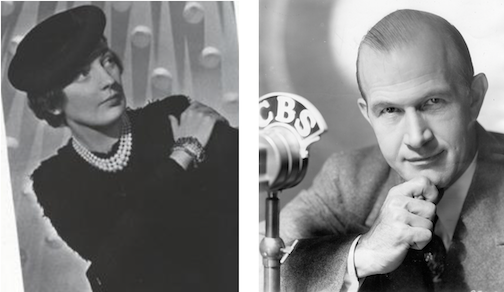
Marion Sayle Taylor (1889–1942) was the popular host of a radio advice show, The Voice of Experience. Margaret Case Harriman (1901–1966) penned a two-part profile of Taylor titled “The Voice.” I’ve included the opening lines to Part One here:

IF ONLY SHE KNEW…Margaret Case Harriman, left, circa 1936, profiled Marion Sayle Taylor before his misdeeds were revealed. (Vogue Archive/eleanorbritton.blogspot.com/Oregon Encyclopedia)

After reading both parts of Harriman’s profile piece, it appears she wasn’t yet aware that Taylor was more than a radio personality; he was also dishonest, manipulative, and opportunistic, according to a biography by Dick and Judy Wagner featured in the Oregon Encyclopedia. For example, Harriman reported (likely from Taylor’s official bio) that Taylor’s first wife, Pauline, had died in childbirth, when in fact she was quite alive and suing him for divorce that same year. Taylor also divorced his second wife, Jessie, who sued him in 1936 after he deceived her about another woman. Not surprisingly, his radio image as a reliable marriage counselor was damaged irretrievably.

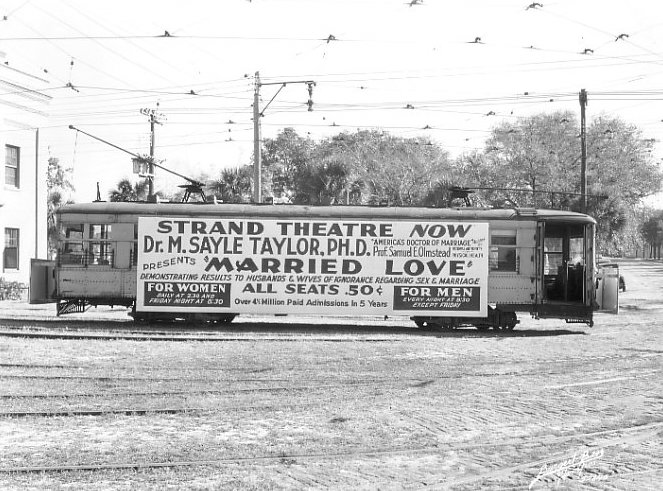
FALSE ADVERTISING…A streetcar, possibly in Newark, N.J., advertising a lecture by Taylor, circa 1931. In addition to hiding a previous prison record, Taylor also falsely reported that he had studied at several universities (he did not earn a Ph.D, as the redundant title claims in the above photo). It appears Taylor also kept much of the money he solicited for charitable causes. (Oregon Encyclopedia)

 * * *

Selling Pooh

Commercial cross-marketing of children’s books with toys and other products had its origins in the late nineteenth century with Alice’s Adventures in Wonderland, and in the first years of the 20th century Beatrix Potter’s Peter Rabbit series inspired everything from dishes and wallpaper to board games and dolls—in 1903 Peter Rabbit was the first fictional character to be made into a patented stuffed toy.

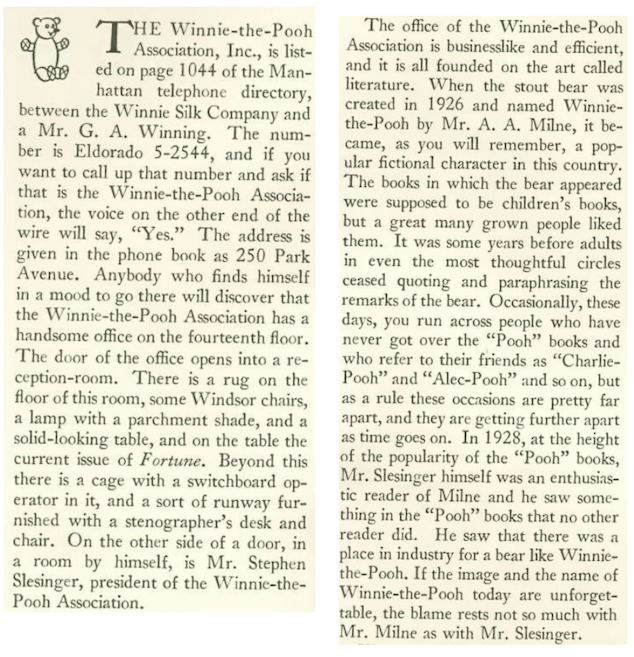
Then came another character from British children’s literature, A.A. Milne’s Winnie-the-Pooh. In January 1930, Stephen Slesinger (1901–1953) purchased U.S. and Canadian merchandising, television, recording, and other trade rights to the Winnie-the-Pooh works from Milne (for $1,000, plus royalties), marketing a wide range of products. For the column “Onward & Upward With the Arts,” St. Clair McKelway paid a visit to Slesinger at the Park Avenue offices of Winnie-the-Pooh Association, Inc. Excerpts:

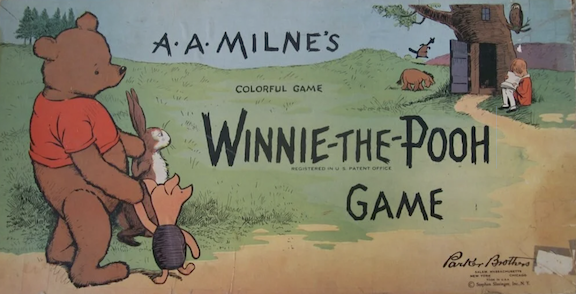
KEEP YER SHIRT ON…The Parker Brothers were the first to feature Winnie-the-Pooh in color for a 1932 board game. Stephan Slesinger added the iconic red t-shirt to Pooh for the game and a children’s record, a look that was later adopted by the Disney Corporation when it acquired the rights from Slesinger’s widow and daughter in 1961. (thedisneyclassics.com)
FUNNIES MAN…At left, Stephan Slesinger in an undated photo. Slesinger was a radio, television and film producer, and a curator of comic strip characters including Alley Cop, Captain Easy, Buck Rogers and Blondie, among others; at center, a record of “Winnie-the-Pooh Songs,” 1932; an ad for the Red Ryder BB gun—in 1938 Slesinger created the comic strip Red Ryder along with artist Fred Harmon. (alchetron/yesterdaysgallery.com/Port Isabel Press)

In another excerpt, McKelway gave us an idea of the scope of Slesinger’s Pooh empire:

 * * *

At the Movies

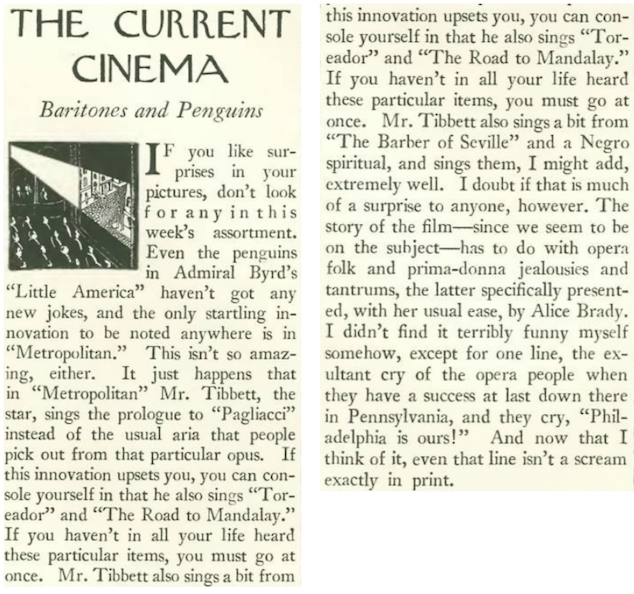
Critic John Mosher found few thrills in the latest fare from Hollywood, offering his views of Admiral Richard Byrd’s Into Little America and the musical Metropolitan, featuring famed baritone Lawrence Tibbett. 

FOR THE BYRDS…At left, lobby card for Into Little America; at right, Alice Brady and Lawrence Tibbett in Metropolitan. (eBay.uk/rottentomatoes.com)

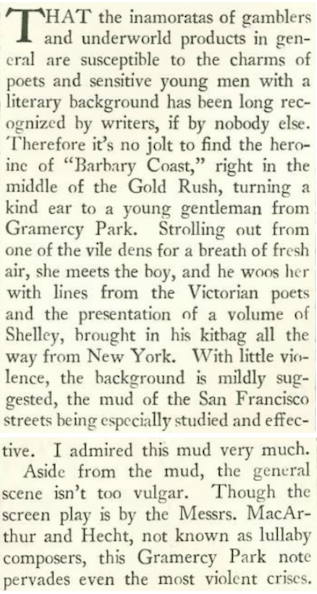
With a screenplay by Ben Hecht and Charles MacArthur and direction by Howard Hawks, one would hope for some rough and tumble in a film about Gold Rush San Francisco. Instead, Mosher found the trappings of Barbary Coast rather mild. This was doubtless due in part to the Hays Code that curtailed the sex and violence portrayed in films of the 1920s and early 1930s.

TAKING A SPIN…Miriam Hopkins runs the roulette wheel as Edward G. Robinson looks on in Barbary Coast. A brief 2019 review in the Harvard Film Archive praised the film’s Gothic feel created by the “evocative portrayal of early San Francisco as a foggy labyrinth of rickety boardwalks and ominous, sky-high ship masts…” (harvardfimarchive.org)

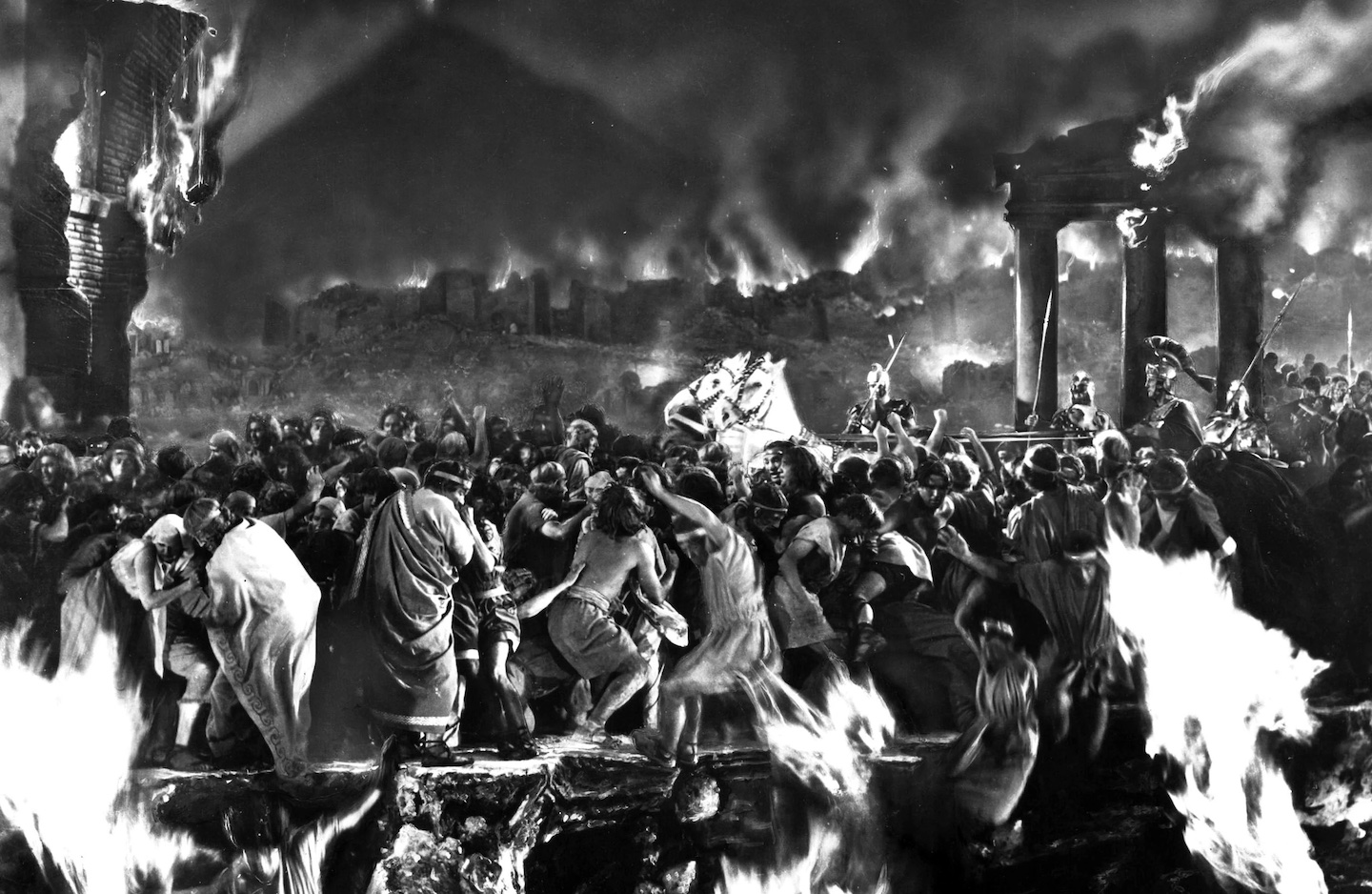
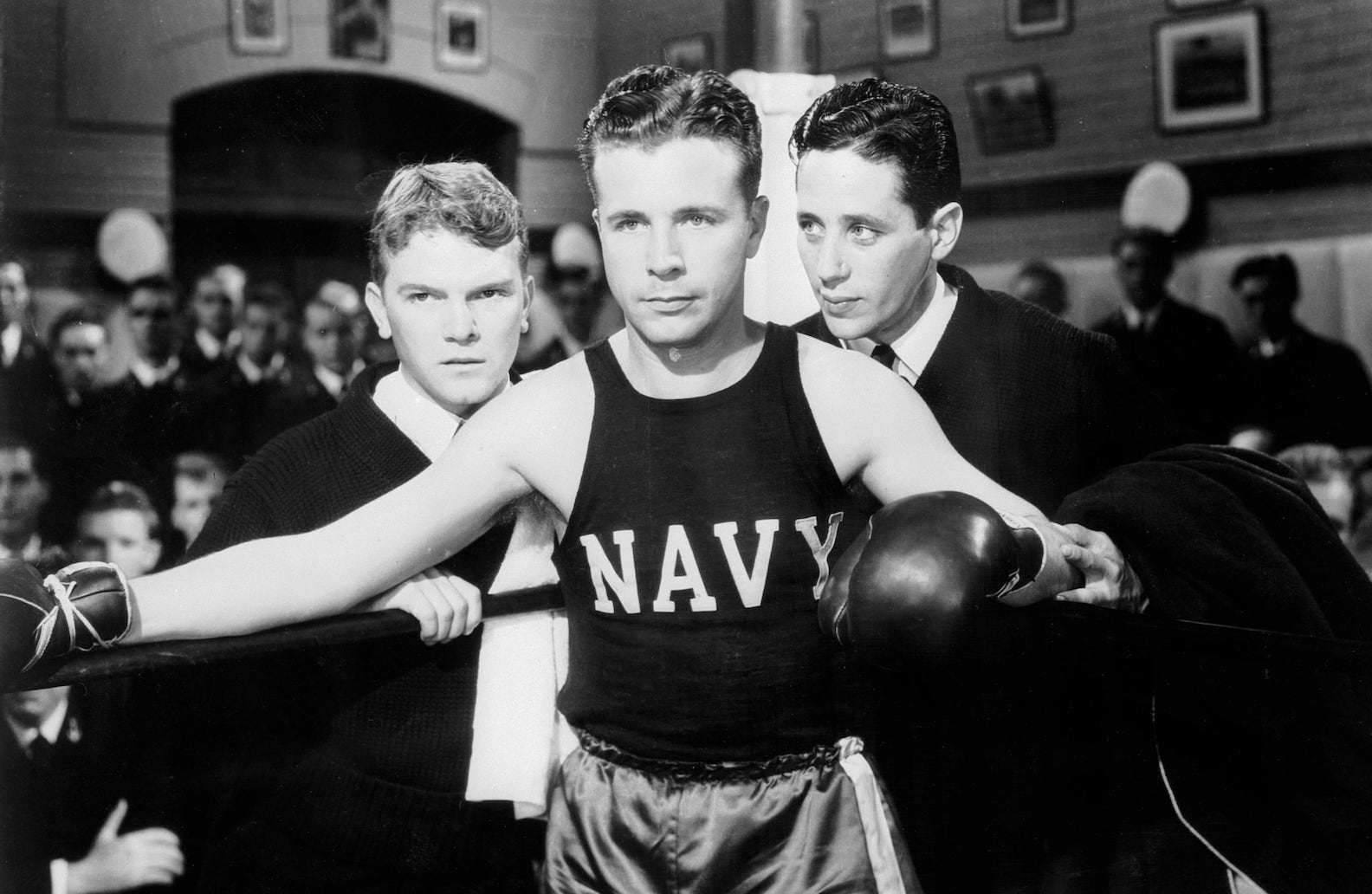
One might think that a film featuring the destruction of Pompeii would have some thrills, however RKO’s The Last Days of Pompeii proved to be a “temperate affair” in Mosher’s eyes, “one of the great bores of the moment.” The Dick Powell/U.S. Navy vehicle Shipmates Forever didn’t prove to be any better.

HOT TIMES IN POMPEII?…John Mosher called The Last Days of Pompeii “one of the great bores of the moment,” including the “drearily enacted” eruption of Vesuvius in which “Paper temples fall and there is a bit of bustle, and that is all there is to that.” Mosher did single out Basil Rathbone’s performance as an urbane Pontius Pilate, “a Pontius Pilate with a Long Island manner.” (tcm.com)
GO GET ‘EM DICK…The U.S. Naval Academy provided the setting for the musical Shipmates Forever, featuring Dick Powell as a crooner who ultimately chooses the Navy over a singing career. (tcm.com)

* * *

From Our Advertisers

We begin with the inside front cover, where the folks at Fisher touted their innovative “Turret Top” design…Body by Fisher began as a separate company in 1908, specializing as an automobile coach builder…although acquired by General Motors in 1926, the Fisher brand was promoted until the 1980s…

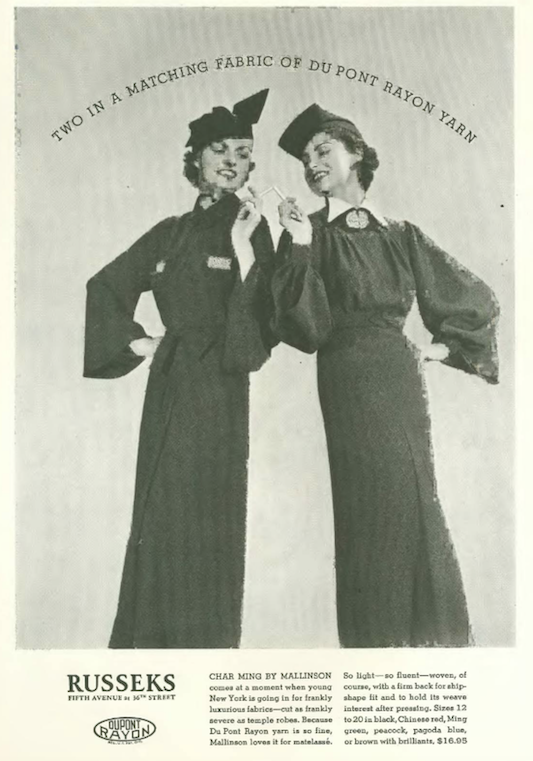
…there were many fall and winter fashion ads in this issue, including this continuing series by Russeks promoting Rayon fabrics…and women smoking, no doubt considered a sign of sophistication…

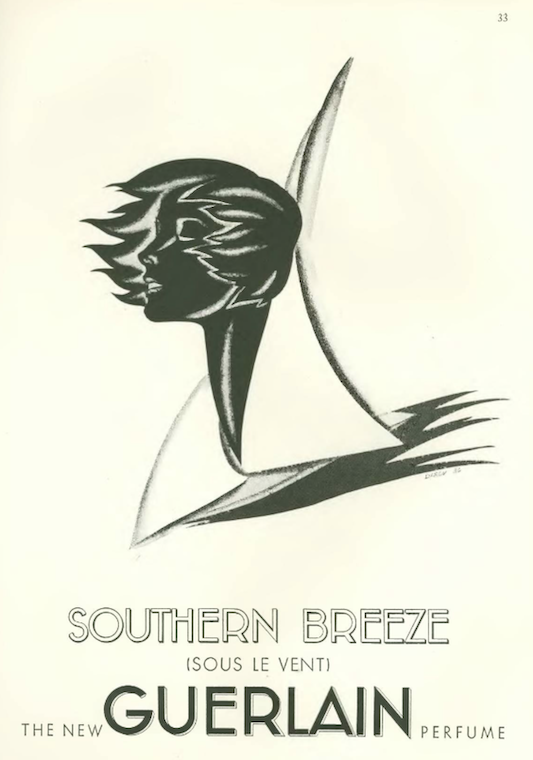
…Guerlain perfume ads featured the unmistakable style of illustrator Lyse Darcy

…the Heyward/Gershwin production of Porgy and Bess made a splash in this ad for Stage magazine…

…World Peaceways often used terrifying imagery to promote their anti-war messages…this ad was on the inside back cover…

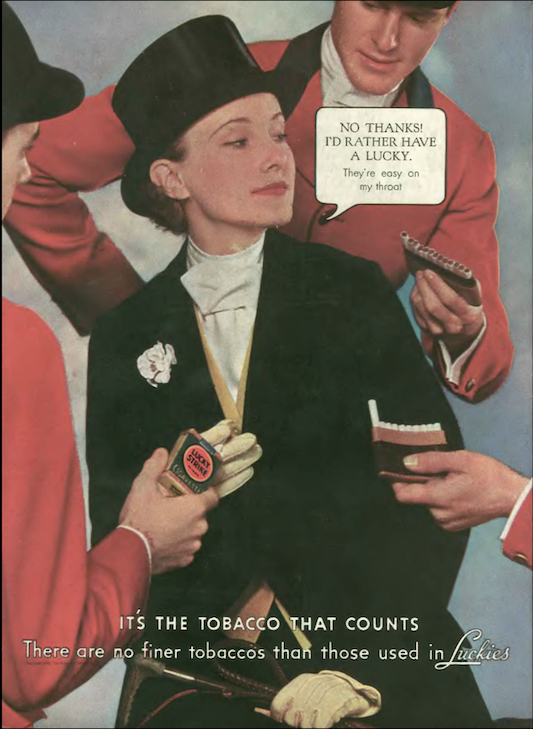
…and as you closed the magazine, the back cover greeted you with this stylish appeal to smoke Luckies…

…on to our cartoonists, starting with Al Frueh in the Theatre section…

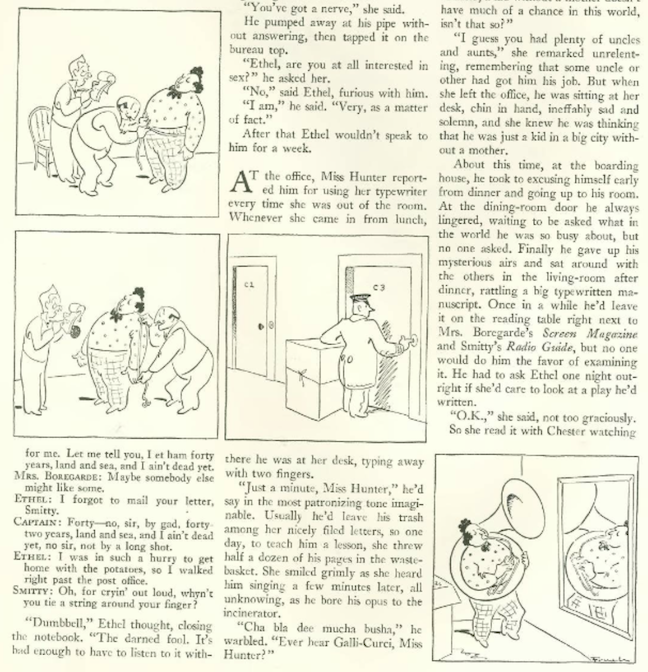
…and Frueh again, in this interesting arrangement…

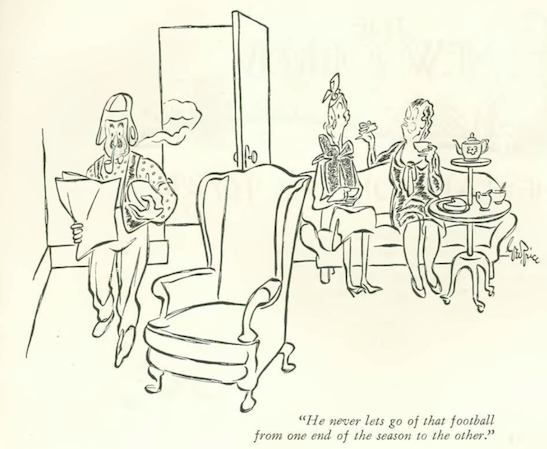
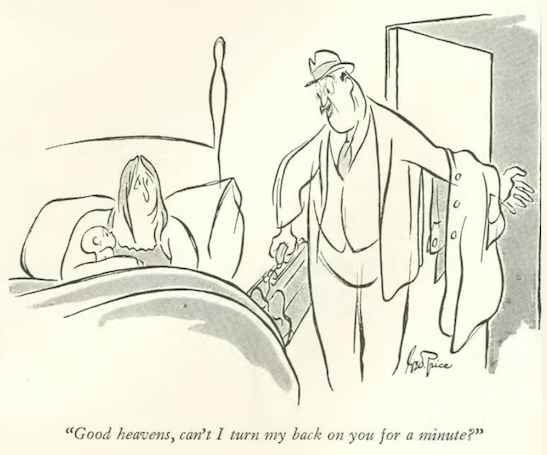
George Price was featured twice…

…with scenes of domestic life as only Price could render…

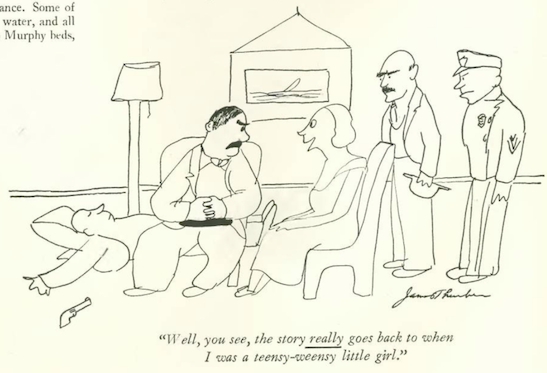
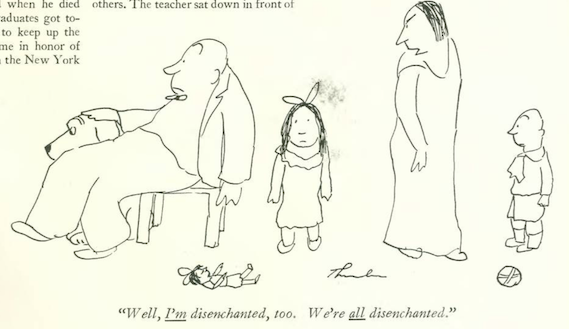
…and speaking of distinctive, no one did it quite like the great James Thurber

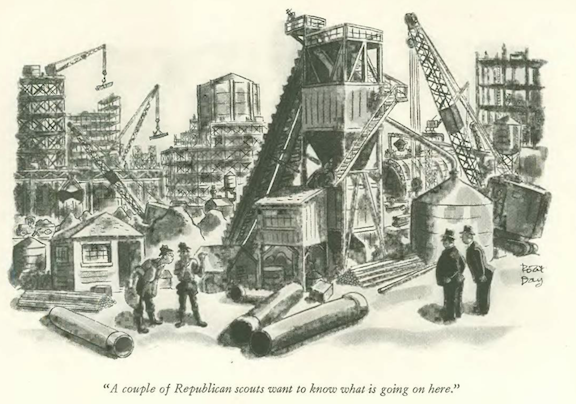
Robert Day gave us two Republicans looking in on the progress of the New Deal…

Carl Rose bid farewell to a writer sick of his peace and quiet…

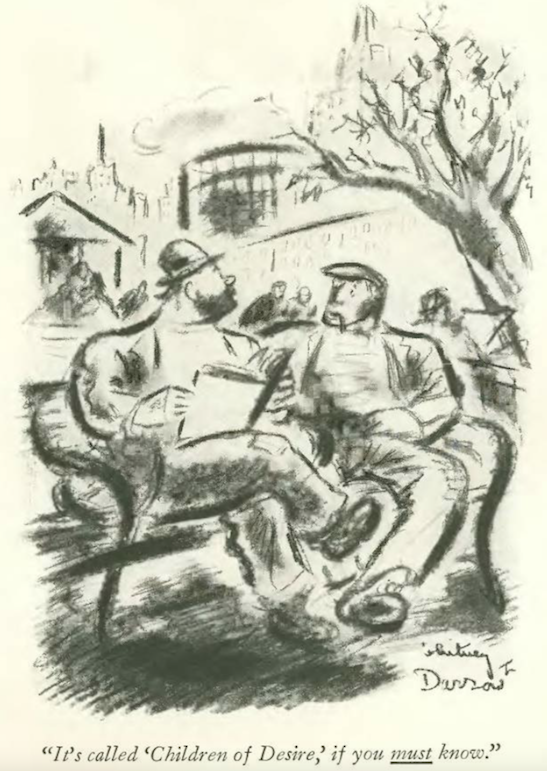
Whitney Darrow Jr illustrated a literary exchange on a park bench…

…and I close with today’s New Yorker cover artist, Roger Duvoisin—here is his cover for White Snow, Bright Snow, which won the Caldecott Medal in 1948.

Next Time: Planes, Trains and Automobiles…

Legitimate Nonchalance

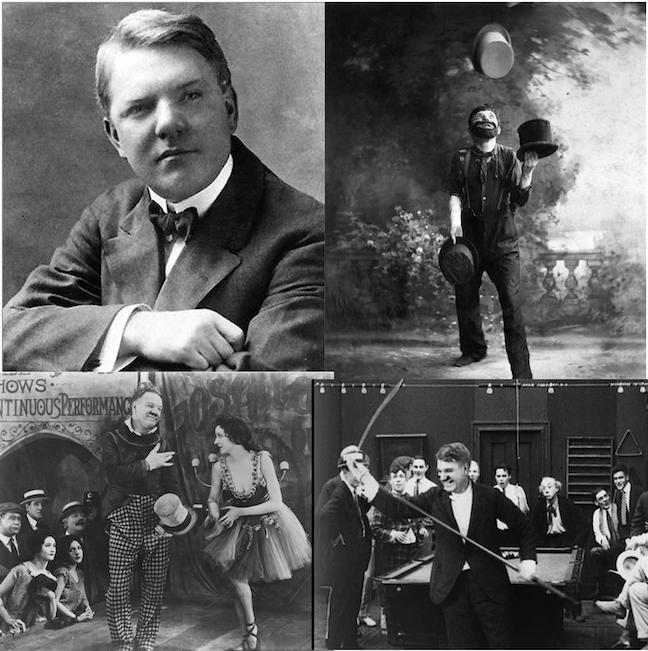
Above: W.C. Fields was a well-known juggler and vaudeville performer decades before he became even more famous in the movies of the 1930s.

William Claude Dukenfield was a vaudeville juggler who distinguished himself from other “tramp acts” by adding sarcastic asides to his routines. Internationally known for his juggling skills, by the turn of the century the man who billed himself as “The Eccentric Juggler” would become much better known by another name: W.C. Fields.

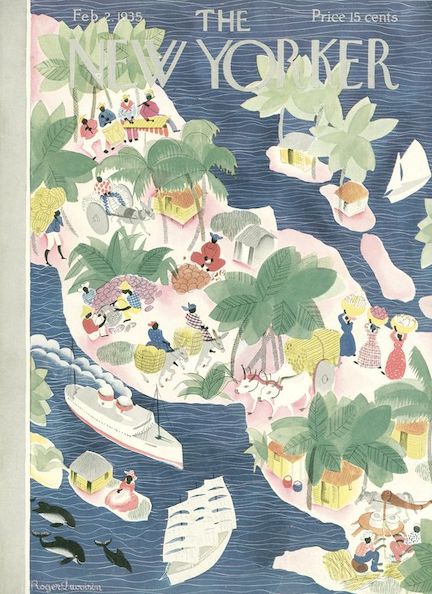
Feb. 2, 1935 cover by Roger Duvoisin.

In the first of a three-part profile, Alva Johnston pondered the secret behind Fields’ genius, an “inborn nonchalance” that he considered “the rarest of gifts.” Johnston surmised that some of that genius derived from the volatile relationship Fields had with his father, and the street-smarts he gained as a runaway at age eleven. It is no surprise, however, that these childhood stories of hardship were significantly embellished by the great wit himself.

A STAR IS FORMED…Clockwise, from top left, W.C. Fields in his youth; Fields was an internationally known juggler, seen here in his vaudeville days in the early 1900s; Fields made his screen debut in 1915, seen here in his second film, Pool Sharks (1915); Fields with Carol Dempster in Sally of the Sawdust, a 1925 silent comedy film directed by D. W. Griffith. (Pinterest/YouTube)

Johnston also described Fields’ acting style and demeanor, noting that the actor’s asides were likely inspired by his mother, Kate Spangler Felton, who was known for her doorstep witticisms.

NINETEEN THIRTY-FIVE WAS A GOOD YEAR for W.C. Fields, who starred in It’s a Gift (right), released the previous December, and in the 1935 screen adaptation of Charles Dickens’s David Copperfield, as the character Wilkins Micawber. (MGM/IMDB)

 * * *

Macabre Diversions

In the days before television and the internet, folks got their dose of the sensational and macabre from the tabloids, or, on occasion, in real life. Before crime or accident scene investigations became more sophisticated, it was not uncommon for crowds to mob grisly death scenes, including the car containing the bullet-riddled bodies of notorious bank robbers Bonnie Parker and Clyde Barrow. Their Ford automobile, pocked with 112 bullet holes, became a popular traveling attraction at fairs, amusement parks, and, in February 1935, at a car dealer’s showroom in Missouri. E.B. White explained:

BEFORE THE INTERNET, folks got their ghoulish thrills by rubbernecking at famous crime scenes. At left, a crowd gathers around the bullet-riddled car belonging to Bonnie and Clyde. According to one account, at the scene of the police ambush on Louisiana State Highway 154, nearly everyone collected souvenirs including shell casings and bloody pieces of clothing from Bonnie and Clyde. One man even tried to collect Clyde’s left ear with a pocket knife; at right, unidentified man standing next to the “death car.” (KXAN/unt.edu)

 * * *

Saar Kraut

Janet Flanner mused on the recent plebiscite in the Saarland, which following World War I was seized from Germany and placed under the governance of a League of Nations commission. Much to the dismay of the French, the majority German population voted to return the Saar region to Germany, and its Nazi leadership.

 * * *

Over the Rainbow

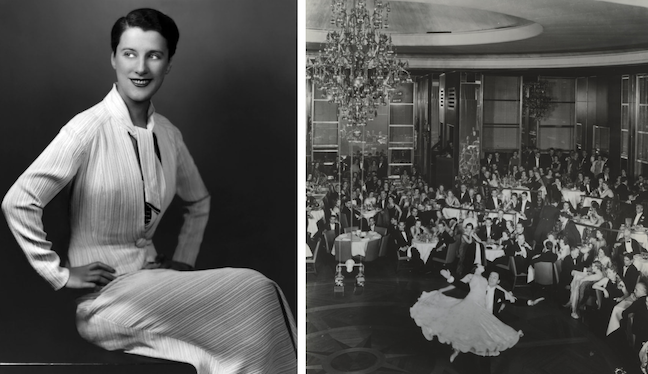
In a previous column, Lois Long took aim at the Rockefeller Center’s new Rainbow Room, dismissing it as a tourist trap filled with interminable strains of organ music. In her latest column, Long retracted some of that vitriol, finding the entertainment (and, one supposes, the food) more to her liking.

THE ‘INCORRIGIBLE’ Beatrice Lillie (left) delighted Lois Long and audiences in the Rainbow Room on the 65th floor of Rockefeller Center; at right, ballroom dancers Lydia and Joresco take to the floor in the then newly opened Rainbow Room, 1934. (Pinterest/#rainbowroomnyc)

 * * *

From Our Advertisers

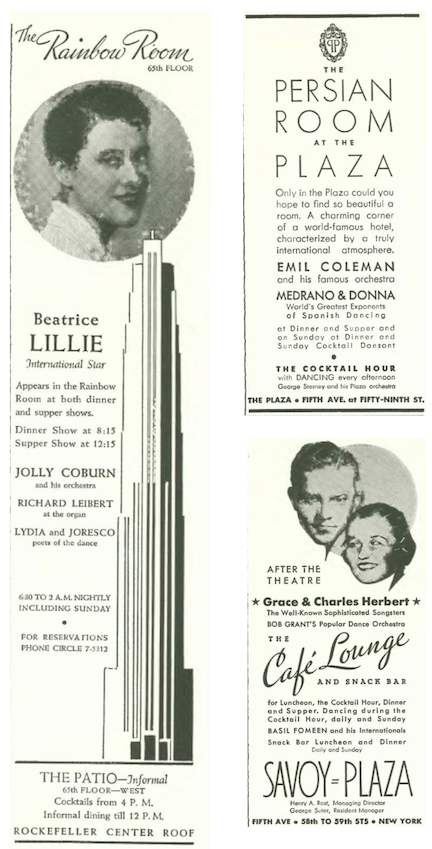
As Lois Long mentioned in “Tables for Two,” British actress and singer Beatrice Lillie was appearing at in the Rainbow Room on the 65th floor of Rockefeller Center; according to the ad below, also featured were ballroom dancers Lydia and Joresco and bandleader Jolly Corburn

…at first I though this was Alfred Lunt and Lynn Fontanne shilling for Luckies, but the resemblance isn’t quite there, plus I’m not aware of the Broadway legends ever endorsing any product, let alone cigarettes…

…the folks at Hormel continued to feature notable Frenchmen who were known to enjoy French onion soup, although this particular image doesn’t do much for one’s appetite…

…the Bermuda Trade Development Board continued to feature colorful ads that enticed New Yorkers away from the late winter blahs…

…this ad for Schaefer is a bit odd…I guess the artist wanted to suggest a handbill, and therefore tilted the image it at an angle, unsuccessfully, one might add…
…The Theatre Guild once again called upon the talents of James Thurber to advertise their latest production…

…which segues into our cartoons, with Thurber once more…

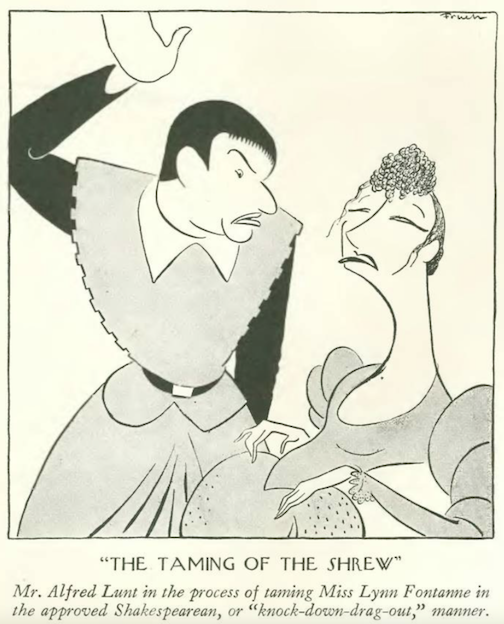
Al Frueh did his part to promote the stage with this illustration for the theatre section…

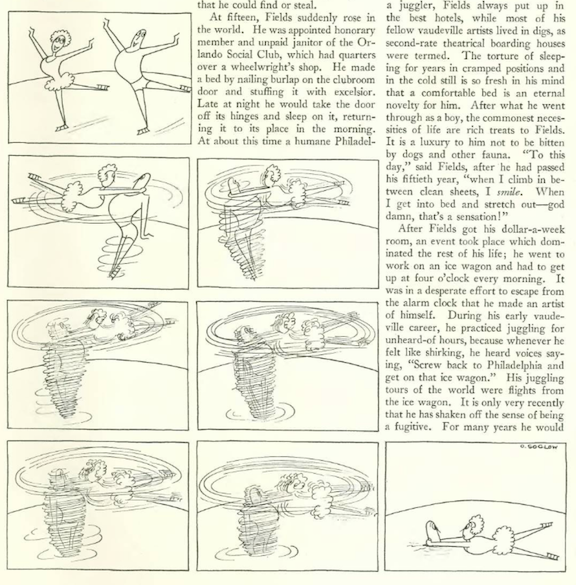
Otto Soglow offered his spin on pairs figure skating…

Gardner Rea explored the world of art appreciation…

Helen Hokinson aptly supplied this cartoon for Lois Long’s fashion column…

Whitney Darrow Jr. showed us the consequences of classified advertising…

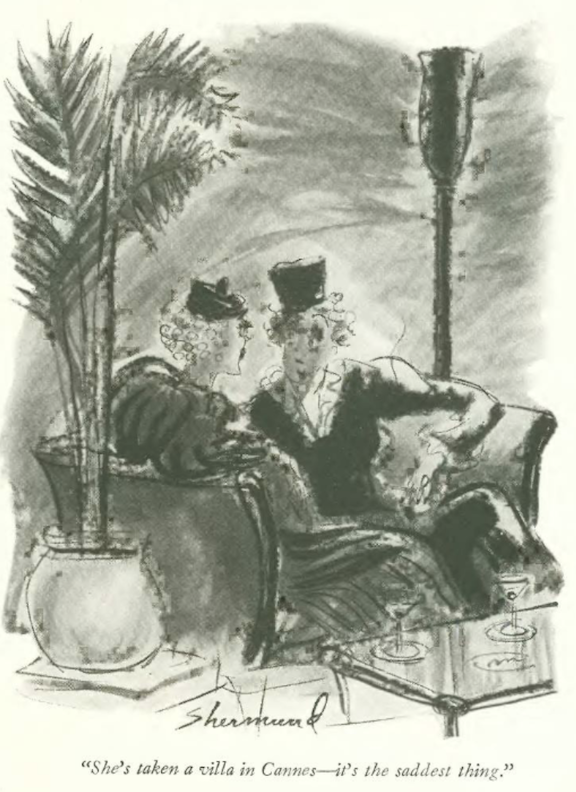
Barbara Shermund clued us in on the latest gossip…

…and we close with Peter Arno, and one butcher’s cold greeting…

Next Time: A Decade of Delights…