Some Pitiful Melodies

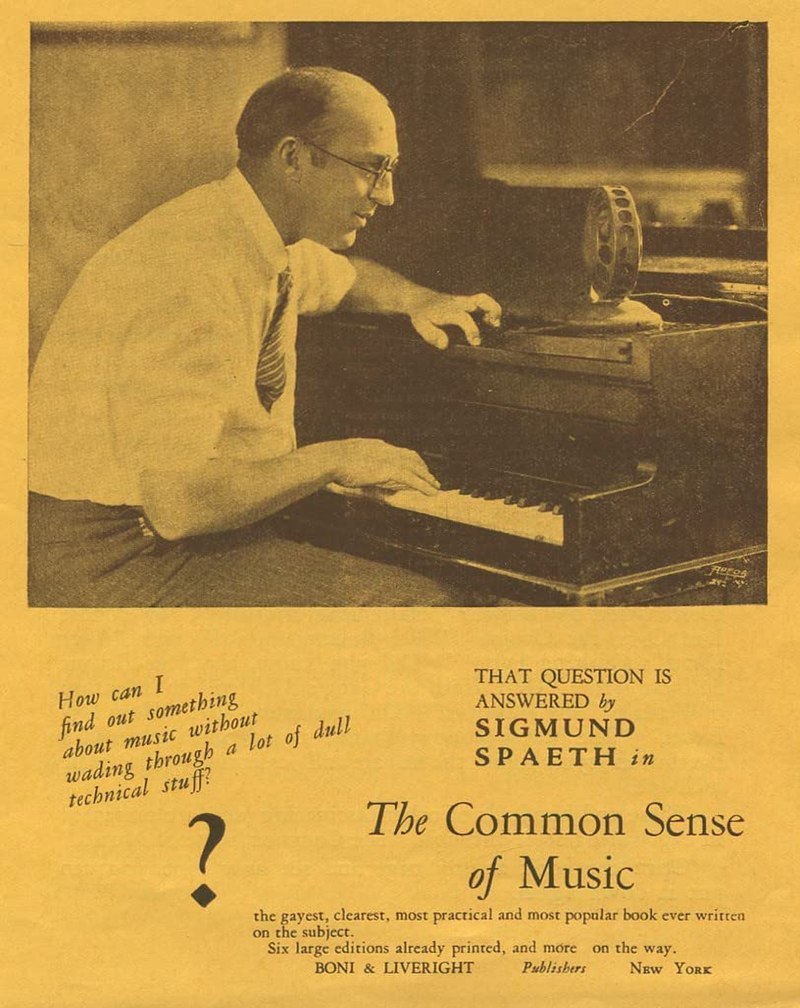
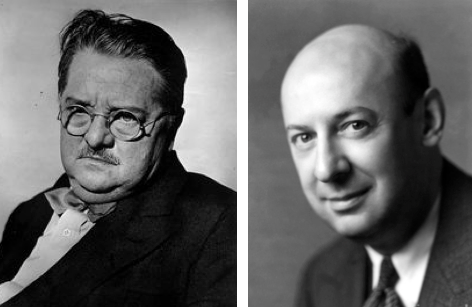
Sigmund Gottfried Spaeth (1885–1965) sought to popularize classical music and improve the musical tastes of the masses by meeting the public wherever he could find them, from vaudeville halls to national radio broadcasts.

September 1, 1934 cover by William Steig.

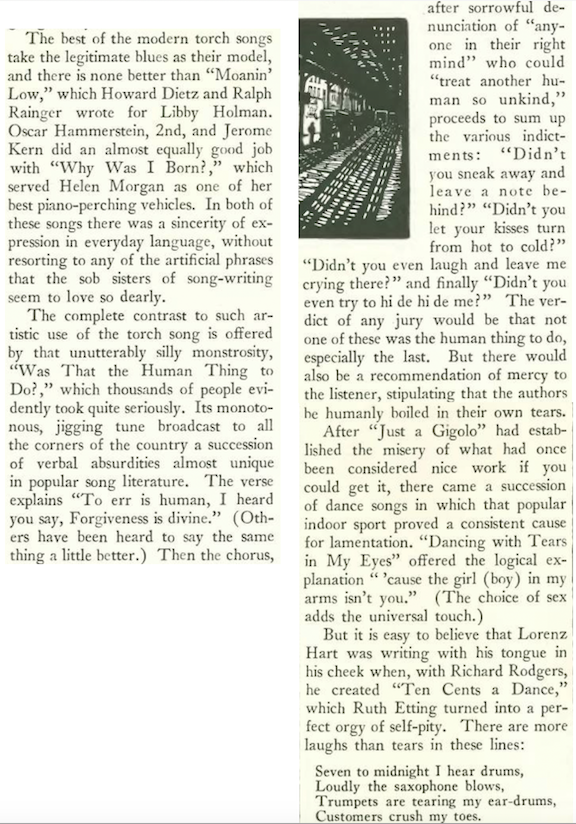
Born in a line of three generations of Lutheran clergymen, Spaeth chose a different path and became a musicologist who sought to de-mystify classical music, often demonstrating how popular melodies had origins in earlier music. He also had strong opinions about lyrics in popular music, demonstrating his distaste for “the lyric school of self-pity” in this “Onward and Upward” column. Excerpts:

BRINGING MUSIC AND LIGHT…Sigmund Spaeth found much to dislike in the world of popular music, but he was never stuffy in his approach to music appreciation. At right, Spaeth appeared in vaudeville-style shows (and for many years on the radio) as “The Tune Detective,” wearing a deerstalker cap, cape, and checked tweeds in imitation of Sherlock Holmes. He hoped to demonstrate to a wide audience that all music was essentially based on a set of simple principles. (sinfonia.org/wnyc.org)
HAVE NO FEAR…Spaeth wrote a popular syndicated newspaper column, “Music for Everybody,” and contributed articles to many periodicals during his career. With his first book in 1925, The Common Sense of Music, and others that followed, Spaeth sought to de-mystify music for a general audience. (Wikimedia Commons)
OH LIGHTEN UP…Spaeth detected a cynical note in Bing Crosby’s (left) sob song, “I Cried for You,” and noted Irving Berlin’s latest contribution to the “sob symposium,” “I Never Had a Chance.” (Wikipedia/digitalcommons.library.umaine.edu/britannica.com)

Spaeth noted that not all sad songs were dripping in artificial self-pity, citing Helen Morgan’s “Why Was I Born?” as an example of a song modeled on “the legitimate blues,” marked by “a sincerity of expression in everyday language”…
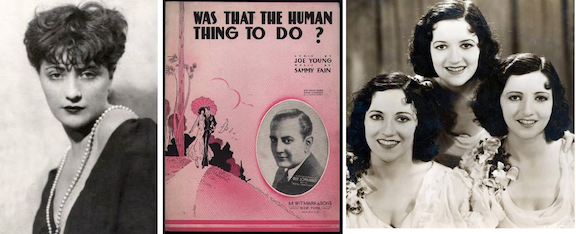
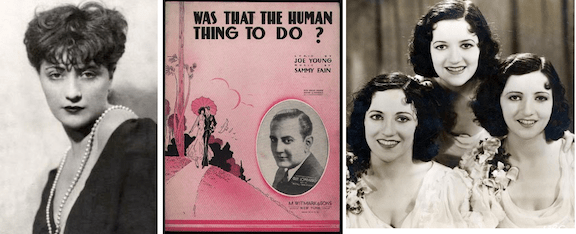
RIGHT AND WRONG…Spaeth acknowledged the “sincerity of expression” in Helen Morgan’s (left) torch songs, while at the other extreme he suggested that the authors of “Was That the Human Thing to Do?” (Sammy Fain and Joe Young) be boiled alive in their own tears. The song was popularized by The Boswell Sisters, a beloved New Orleans trio in the early 1930s. (findagrave.com/amazon.com/genius.com)

 * * *

Off to the Races

In his column, “Of All Things,” Howard Brubaker commented on the apparent competition and contrast between Alexander Woollcott’s book, While Rome Burns, and another with a rosier title, The Coming of the American Boom. It appears Woollcott’s book won out, at least in the long run, as I can find no trace of the Boom book, or its author.*

* One of our kind readers has identified the author: “The Coming American Boom” was written by Lawrence Lee Bazley Angas and published by Simon and Schuster in 1934. In 1939, Time noted that “Major Lawrence Lee Bazley (‘Boom’) Angas is a pink & white Britisher with a reputation for making daring predictions which have sometimes come true…. He won his nickname with a much-publicized booklet, The Coming American Boom, which heralded his arrival in the U.S. in 1934.”

Speaking of rosy outlooks, E.B. White offered some parting thoughts on Chicago’s World’s Fair, called “A Century of Progress.” Rather than focus on the grandiose exhibits, White wryly noted other signs of progress at the fair, as recounted from a letter he received from his nephew.

The Chicago World’s Fair featured all sorts of modern wonders “dedicated to the ideal of scientific advance”…
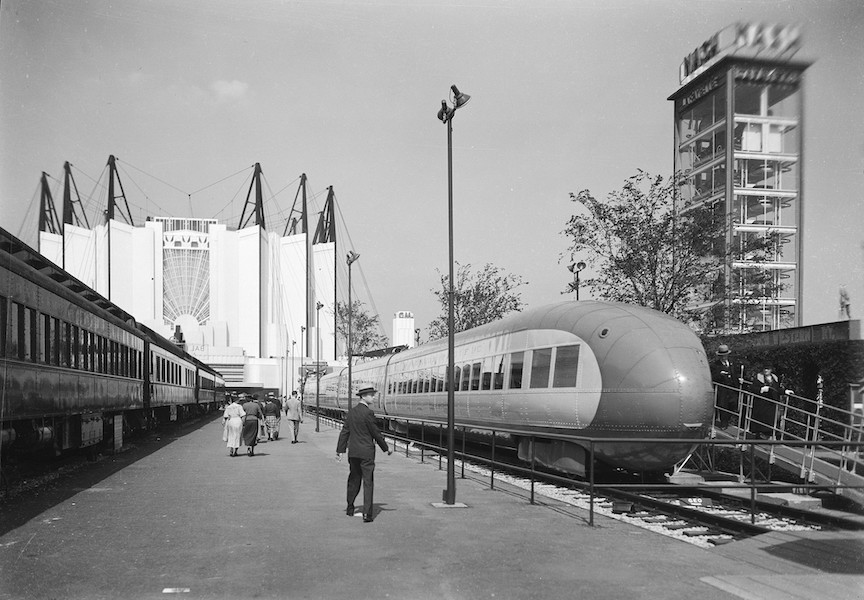
…but as with any World’s Fair, it also catered to the baser interests of the masses, with attractions such as Robert Ripley’s Believe It Or Not “Odditorium,” which was essentially a P.T. Barnum-style freak show…
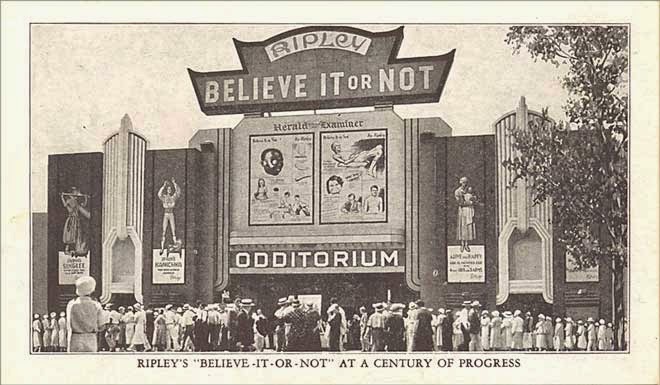
…Ripley’s syndicated newspaper feature included these Odditorium attractions…
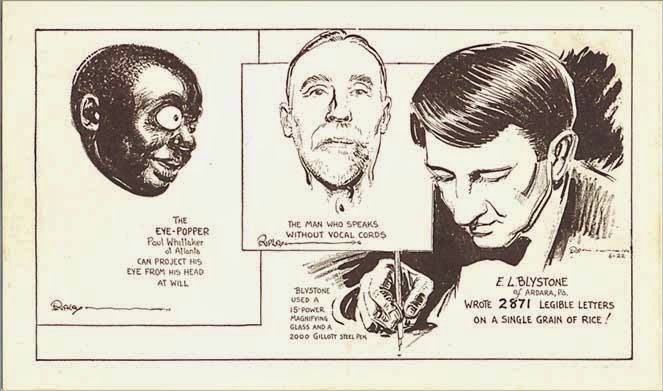
…White made light of exhibitions displaying such signs of progress as how to brush your teeth, and more examples of human freakdom…

…White’s nephew wrote of a man who could pull a wagon (containing his wife) with his eyelids, an apparently arthritic fellow who was “turning to stone,” and a man who could support heavy weights with his pierced breasts…
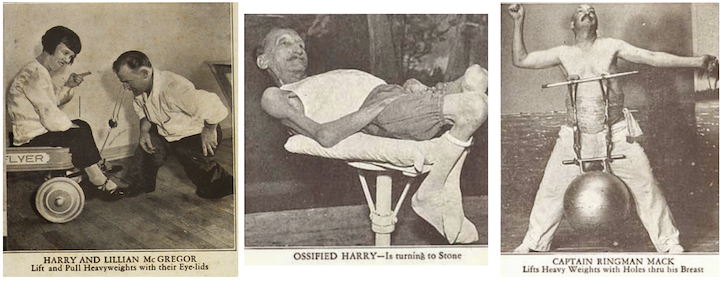
(all images courtesy postcardy.blogspot.com)

 * * *

Letter From Paris

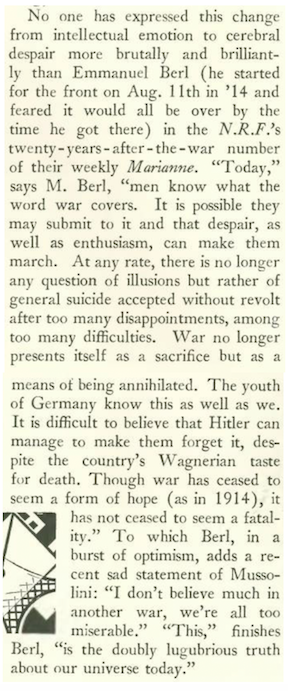
Paris correspondent Janet Flanner wrote that August 1934 was a “month of memories” as it marked the twentieth anniversary of the outbreak of the Great War, which we now call World War I. Flanner wrote about a new attitude that had arisen in those two decades, “a new attitude not only toward the last war but toward the next (which, ironically enough, seems increasingly inevitable to France since the death of the enemy warrior, von Hindenburg).” She continued with these observations made by French journalist and historian Emmanuel Berl (1892–1976), who wrote that as a result of the Great War, the youth in both France and Germany held few heroic illusions about war, seeing it not as a sacrifice but rather “as a means of being annihilated.”
SO MUCH FOR THE HEROICS…A refugee family returning to Amiens, France, looking at the ruins of a house on Sept. 17, 1918. Top right, Janet Flanner in 1940; below, Emmanuel Berl. (iwm.org.uk/Flanner photo copyright Estate of George Platt Lynes/Berl photo courtesy Joël Chirol)

 * * *

From Our Advertisers

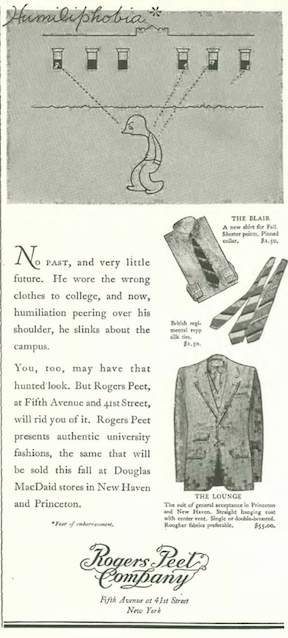
Clothing company Rogers Peet used the threat of humiliation to encourage young men to stock up on “authentic university fashions” before returning to campus…
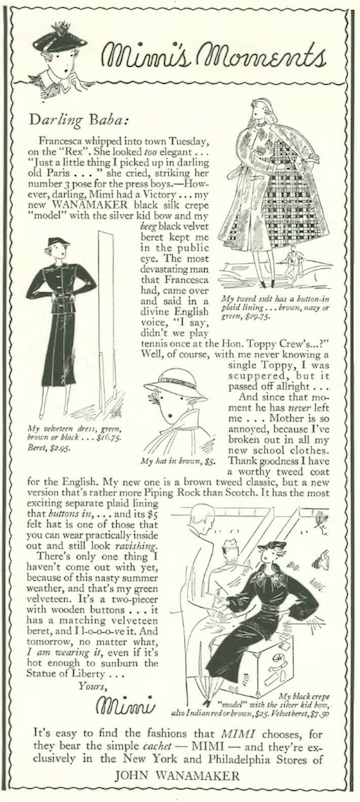
…the Wanamaker department store took a different approach, offering up new styles with a heavy English accent (I say, didn’t we play tennis once at the Hon. Toppy Crew’s?)…
…the makers of Goodyear tires offered up this disturbing image to boost sales…

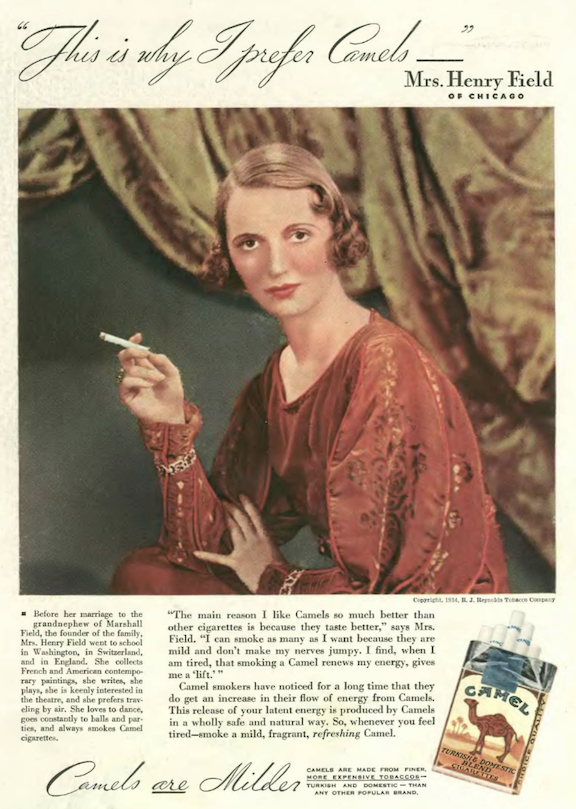
…this ad told us that “Mrs. Henry Field” collected fine art, loved to go to parties, and “always smoked Camel cigarettes”…I am unaware of the fate of Mrs. Henry Field, married to the grandnephew of Marshall Field, but this unseemly image suggests she was replaced by a wax figure before the photo was taken…
…on to our cartoons, we begin with spot illustrations from (clockwise, from top) Victor De Pauw, Abe Birnbaum, and an unidentified illustrator who offered this suggestion for beating the late summer heat…

…we move along to Alan Dunn and a record-seeking pooch…

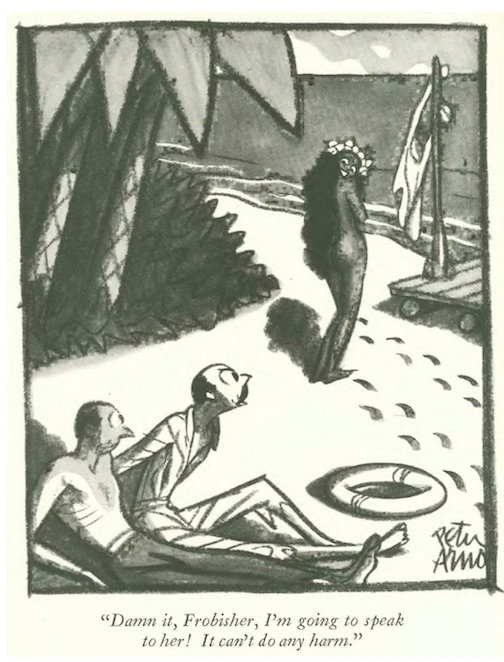
Peter Arno with a very Arno-esque take on the stranded island trope…
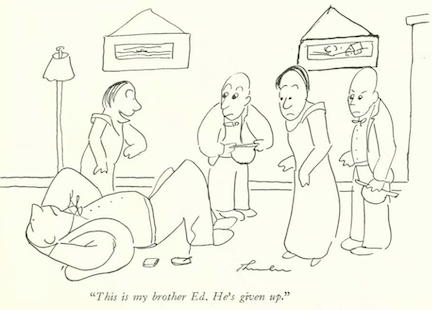
James Thurber gave us a man who was done making decisions…
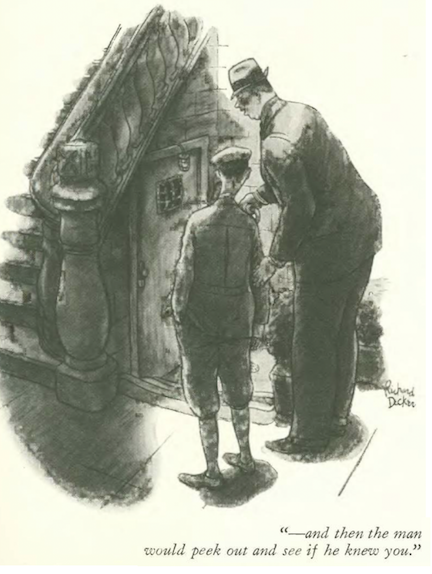
Richard Decker offered up this living history demonstration…
George Price gave us two tropes for the price of one…

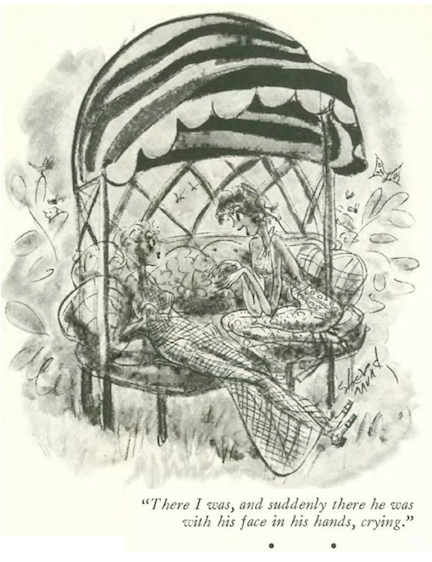
Barbara Shermund gave us another glimpse into the lives of modern women…
Rea Irvin continued his exploration of Manhattan’s fauna…

…our next cartoon is by Henry Steig, who used the pseudonym Henry Anton to avoid being confused with his brother, William Steig (featured on this issue’s cover)…unlike his brother, Henry was also a jazz musician, a sculptor and painter, a photographer, and a novelist…that is before he became a noted jeweler…

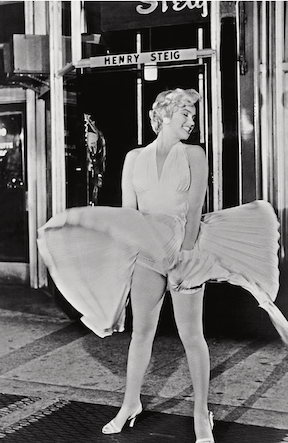
…Henry Steig’s jewelry shop at 590 Lexington Avenue can be glimpsed in the background of the famous subway vent scene from 1955’s The Seven Year Itch featuring Marilyn Monroe

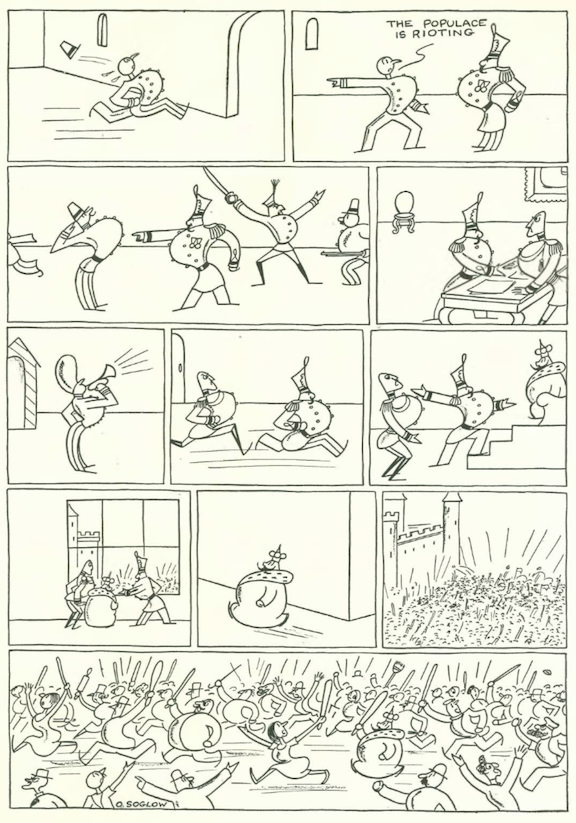
…and we close with Otto Soglow, and the last appearance his “Little King” in The New Yorker...William Randolph Hearst had lured Soglow away for his King Features Syndicate, debuting The Little King in his newspapers on September 9, 1934, where it would run until Soglow’s death in 1975…Soglow, however, would continue contributing cartoons of other themes to The New Yorker until 1974…
Next Time: Lunch at the Dog Wagon…
Hot Jazz in Stone and Steel

With the Chrysler Building nearing completion and the Empire State Building beginning to rise from the old Waldorf-Astoria site, the New York City skyline was taking on the iconic form most of us now associate with the city.

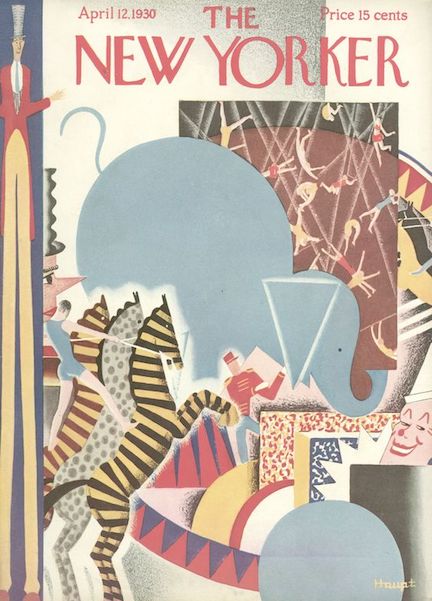
April 12, 1930 cover by Theodore Haupt.

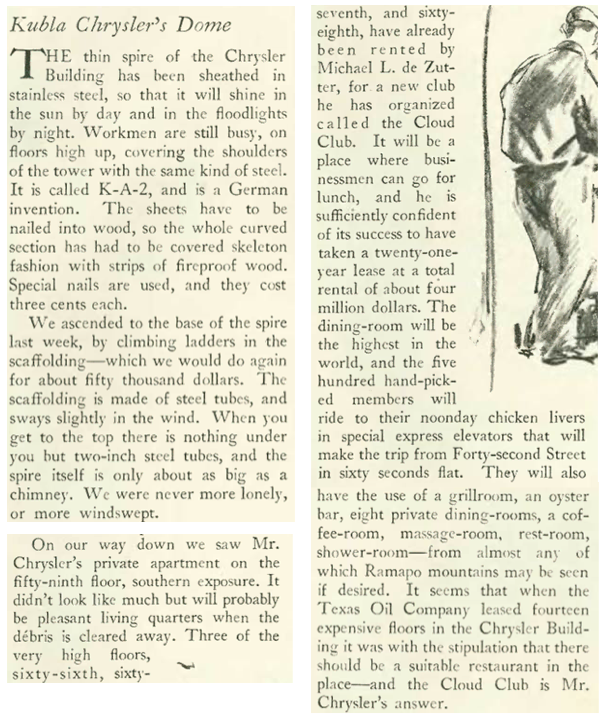
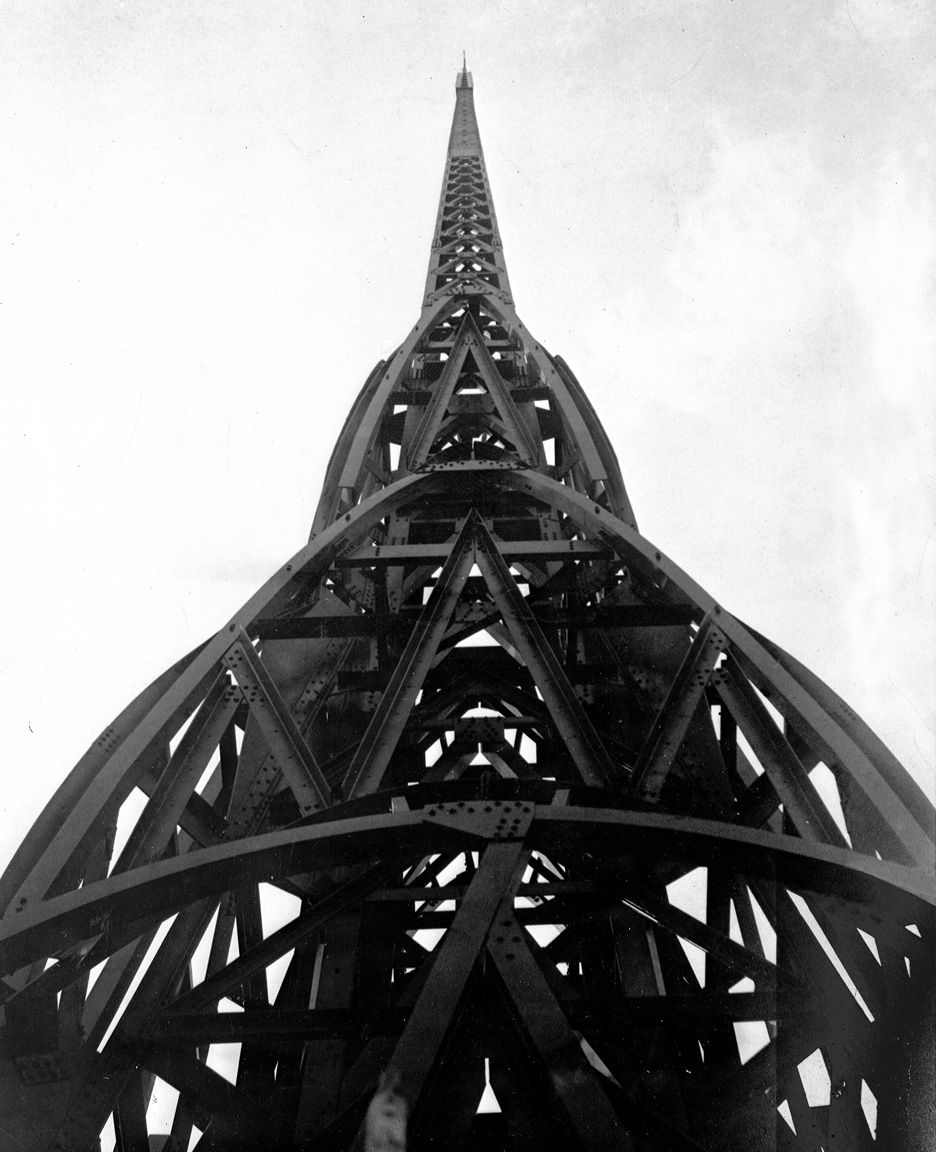
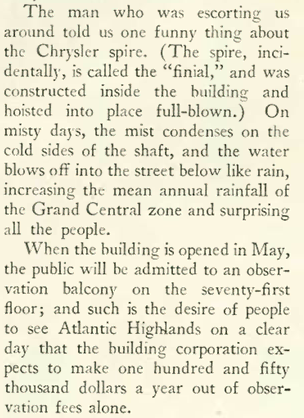
Dubbed “hot jazz in stone and steel” by modernist architect Le Corbusier, the Chrysler Building’s gleaming spire beckoned The New Yorker’s E.B. White and real estate journalist David G. Bareuther (New York Sun) to its summit for a closer look…

BARE BONES…The spire in place atop the Chrysler building, the dome awaiting its metal skin. (skyscraper.org)
WHAT LIES BENEATH…The stainless steel spire still gleams atop the Chrysler Building; beneath the spire, a maze of scaffolding — navigated by E.B. White and David G. Bareuther for their “Talk of the Town” piece, supports the upper portions of the building’s dome. (yahoo.com/nygeschichte.blogspot.com)
THE HIGH LIFE…The Chrysler Building’s exclusive Cloud Club was located on the 66th, 67th, and 68th floors. At one time it was the highest lunch club in the world. It closed in 1979. (decopix.com)

If you want to get a sense of what E.B. White and David Bareuther experienced during their climb through the Chrysler’s dome, take a look at this video featuring American radio personality “Opie” (Gregg Hughes) and Hidden Cities author Moses Gates…

The article also noted that an “observation balcony” would be available for visitors to the 71st floor (actually an enclosed room inside the dome), but I’m sure the expectations for revenue fell quite short, given the competition it would soon receive from the much larger, higher, open air observation deck of the Empire State Building…

REACHING FOR THE STARS…When the Chrysler Building officially opened in 1931, visitors could go up to the 71st-floor observatory (in the dome) and view the city through its triangular windows. The observatory closed in 1945. (nygeschichte.blogspot.com)

…a bit of a digression, but I couldn’t help but notice the observatory’s resemblance to this set from the 1920 silent film The Cabinet of Dr. Caligari

(silent-volume.blogspot.com)

…and here is a terrific graphic from Popular Science (August 1930) demonstrating how the spire, which was assembled inside the dome, was raised into its final position…
…and finally, some great archival footage documenting the achievement…

 *  *  *

Tragic Theater

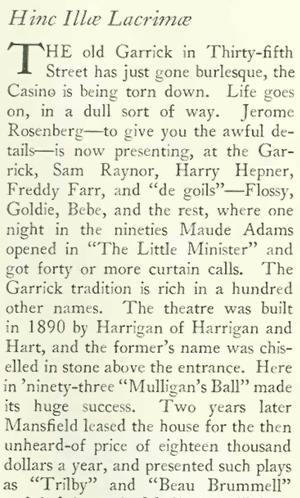
We continue our forays into the built environment of 1930 New York by looking at what was lost, including two beloved Broadway theaters. “The Talk of the Town” lamented the decline of the Garrick…

FINAL CURTAIN…Built in 1890 and originally named Harrigan’s Theatre, The Garrick closed as a playhouse in 1929. After a short run of burlesque, the building was demolished in 1932.

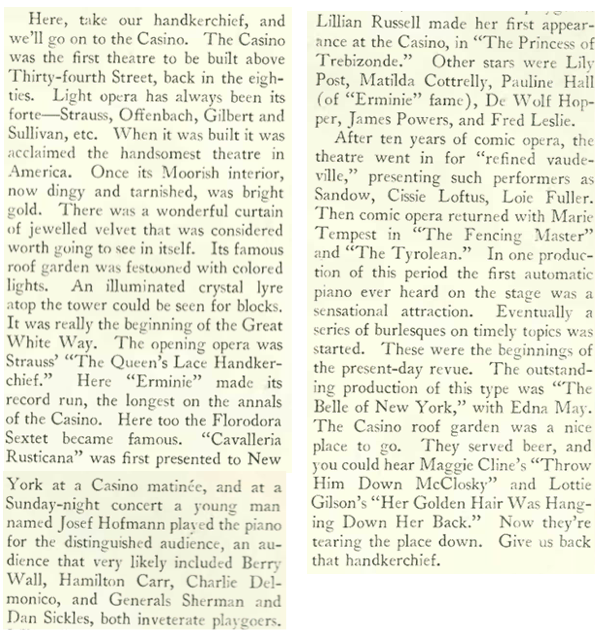
…and the Casino…

You can read more about the Casino at one of my favorite blogs, Daytonian in Manhattan.

HEYDAY…Clockwise, from top left, circa 1910 postcard image of The Casino Theatre at Broadway & 39th; an audience on the Casino’s roof garden glimpses the performance below; interior of the Casino; the British musical comedy Floradora would become one of Broadway’s greatest hits — the New York production opened in 1900 and ran for 552 performances. (Museum of the City of New York )

*  *  *

From Jazz to Gothic

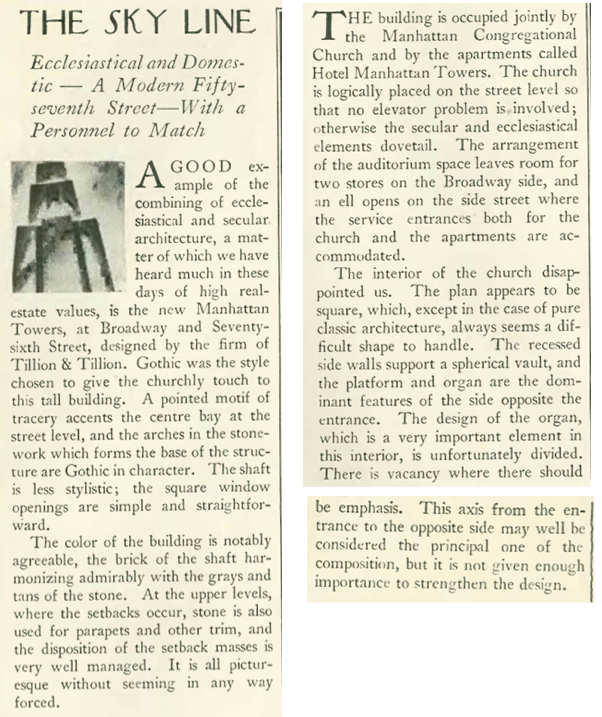
We return our gaze to the skies with three more new buildings reviewed by architecture critic George S. Chappell in his “Sky Line” column. He began with the Manhattan Towers Hotel, which thanks to the Depression would soon fall on hard times, going into foreclosure by October of 1931 and becoming a favorite gangster hideout (read more about the hotel at Daytonian in Manhattan)…

GOD AND MAMMON…Clockwise, from top left, the Manhattan Congregational Church in 1927. The church was torn down in 1928 and replaced by the Manhattan Towers Hotel at Broadway and 76th; the completed hotel, designed to wrap around the three-story Jones Speedometer Building, seen in the lower right of the photo; the first five floors of the building were dedicated to church use; after falling into disrepair, in 1980-83 the 626-room hotel was converted into 113 cooperative apartments. Note that the Speedometer Building still stands, sadly shorn of its ornamentation. (New York Public Library/Daytonian in Manhattan)

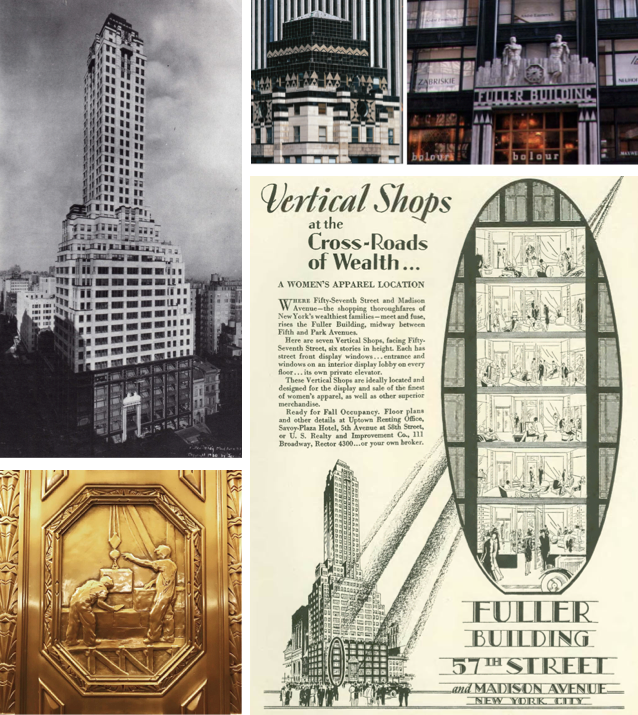
…Chappell also found much to admire in the new Fuller and Squibb buildings…

FULLER HOUSE…Clockwise, from top left, the 1929 Fuller Building was the third home of the George A. Fuller Company (its second home was the 1903 Flatiron Building); detailed views of the building’s tiled pinnacle and unique glass display windows that distinguish the building’s first six stories; an advertisement from the March 2, 1929 New Yorker that touted these gallery spaces for “superior merchandise”; detail of a coffered panel on an elevator door. (deskgram.net/nyc-architecture.com)
Clockwise, from top left, entrance to the Squibb Building, now known as 745 Fifth Avenue; the cool white marble of the building’s base so admired by critic George Chappell; today, the building at dusk, the slender profile of 432 Park Avenue rising in the background. (OzBibliophile/paramount-group.com/landmarkbranding.com)

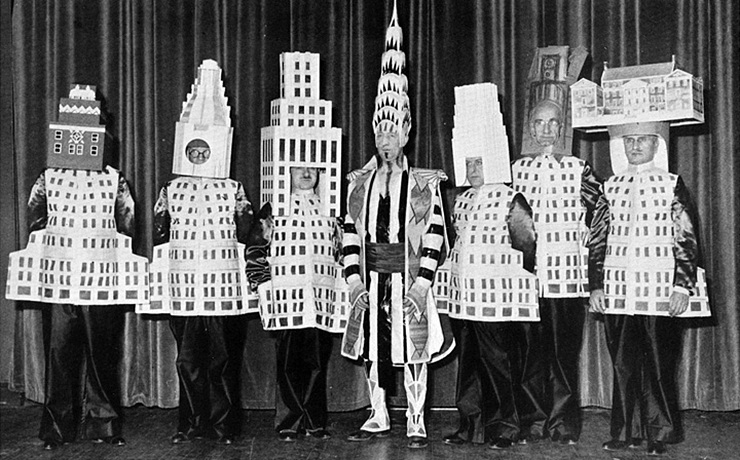
…From the Chrysler Building to the Fuller and Squibb, these new buildings, their architects, and the city’s ever-changing skyline were famously celebrated at the January 1931 Beaux Arts Ball…

HEADS IN THE CLOUDS…the Chrysler Building’s architect, William Van Alen (center), flanked by, from left to right, Stewart Walker (The Fuller Building), Leonard Schultze (The Waldorf-Astoria), Ely Jacques Kahn (The Squibb Building), Ralph Walker (1 Wall Street), D.E. Ward (The Metropolitan Tower), and Joseph H. Freelander (Museum of the City of New York). The New York Times referred to the group as “a tableau vivant of the New York Skyline.” (Van Alen Institute)

 *  *  *

Quiet on the Set

The early days of sound movies created numerous challenges for directors who not only had to adjust the action to accommodate cumbersome microphones, but also to keep out unwanted noises or bad enunciation. “The Talk of the Town” explained…

CLOSETED…In the early days of the talkies, cameras had to be soundproofed in cabinets so their noisy motors would not be picked up by primitive sound equipment. (coloradocollege.edu/Library of Congress)

Peter Arno illustrated the predicament of filming in nature in this cartoon from the April 5, 1930 issue…(caption: “Well, we can’t start till we get that robin out of there.”)…

 *  *  *

One of Ours

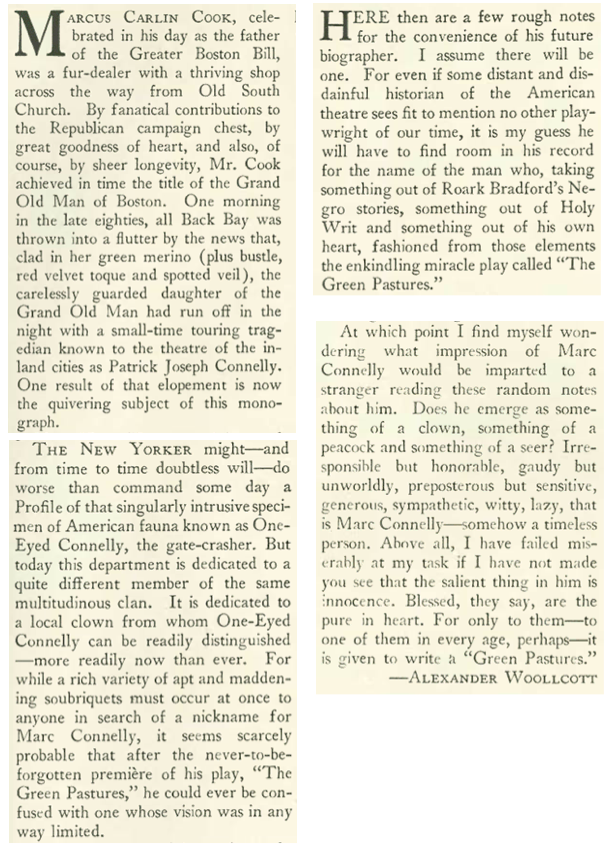
In the story of The New Yorker, Alexander Woollcott and Marc Connelly were there at the beginning as founding members of the Algonquin Round Table and advisory editors to the first issues of the magazine. Basking in the success of his latest play, The Green Pastures (for which he would receive a 1930 Pulitzer Prize for Drama), Connelly was the subject of a April 12, 1930 profile titled “Two-Eyed Connelly,” which was written by Woollcott. Some excerpts, and a caricature by Al Frueh

FAMILIAR WITH THE SUBJECT…Alexander Woollcott, left, explored the life of his old friend Marc Connelly in the April 12 profile. (goodreads.com/Fine Art America)

 *  *  *

The Party is Really Over

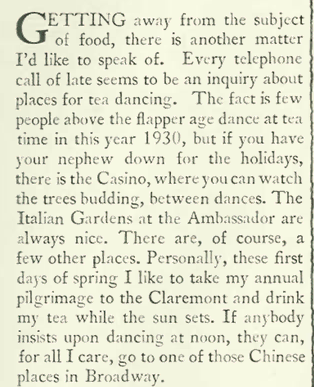
Lois Long’s column “Tables for Two,” which in the 1920s was a must-read for those interested in Jazz Age night life, appeared intermittently in its last year, and its April 12 installment was not even written by Long, but by a writer who signed the column “F.D.” — I assume this is Fairfax Downey, who tried his best to capture Long’s style…

 *  *  *

From Our Advertisers

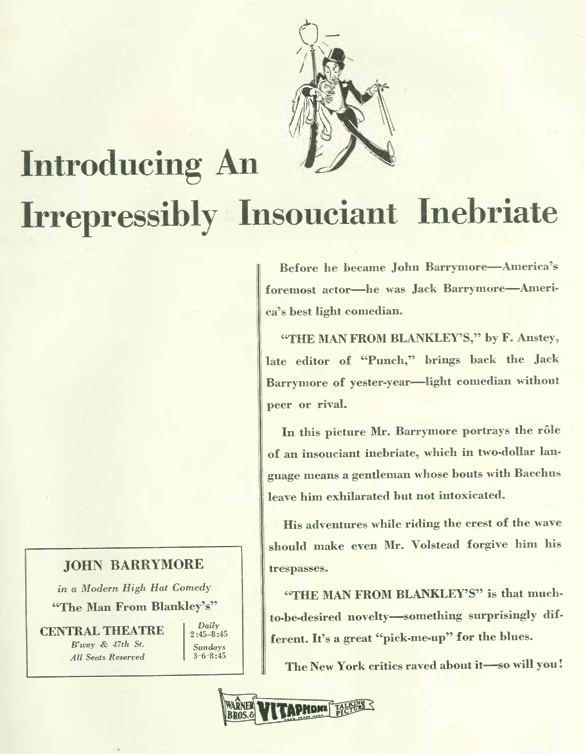
Warner Brothers opened their pocketbooks to publicize John Barrymore’s latest film, The Man From Blankey’s, which the studio described as a “Modern High Hat Comedy”…

WHEN ALCOHOLISM WAS FUNNY…Loretta Young, John Barrymore and Angella Mawby in The Man from Blankley’s. (IMDB)

…Thanks to William Randolph Hearst and his King Features Syndicate, Robert Ripley, the P.T. Barnum of the funny pages, soared to fame in the 1930s with his “Believe It or Not” panel…here he begins his 14-year run on the radio…

HELLO SUCKERS…Robert Ripley in 1930 with a drawing of “the Horned Man of South Africa.” (RIPLEY ENTERTAINMENT INC.)

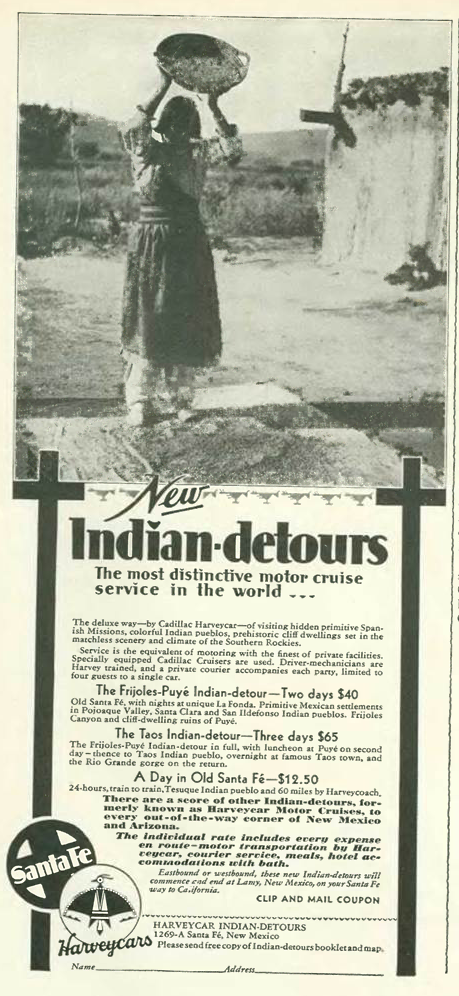
…and here’s an ad for another questionable but very American diversion — Fred Harvey’s “Indian Detours”…

WE’RE NOT IN KANSAS ANYMORE…The Fred Harvey Company was renowned for its chain of eating houses hosted by the famed “Harvey Girls” along the Atchison, Topeka & Santa Fe Railroad between 1876 and 1968. To encourage train travel (and Harvey business) in the Southwest, the Harvey company developed “Indian Detours.” The photo at left is of an “Indian Building” in Albuquerque, which featured displays of art and “live exhibits” that included Native Americans from many tribes around New Mexico. (santafeselection.com)
EASY RIDER…1929 Cadillac Harvey Indian Detour Car outside La Fonda, Santa Fe. (Palace of the Governors photo archive)

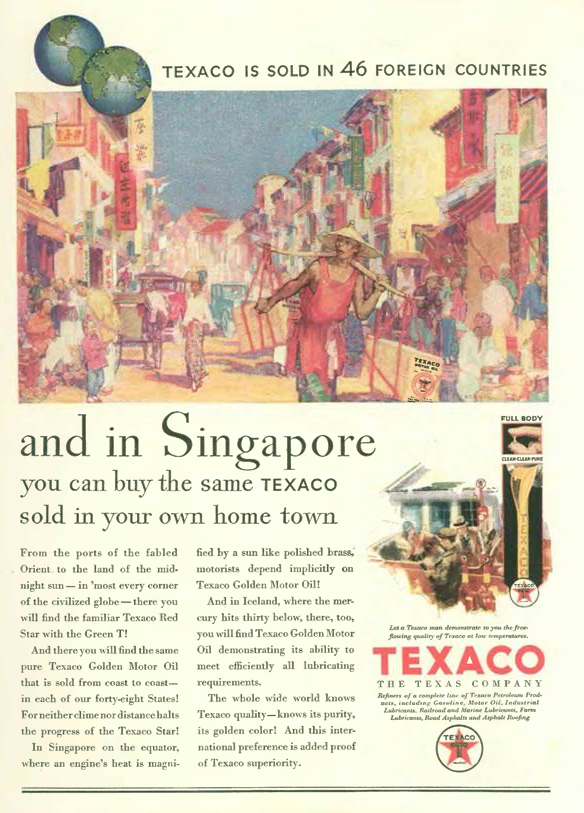
…if you preferred to travel abroad, Texaco wanted you to know that you could still gas up with their product, even in distant Singapore…

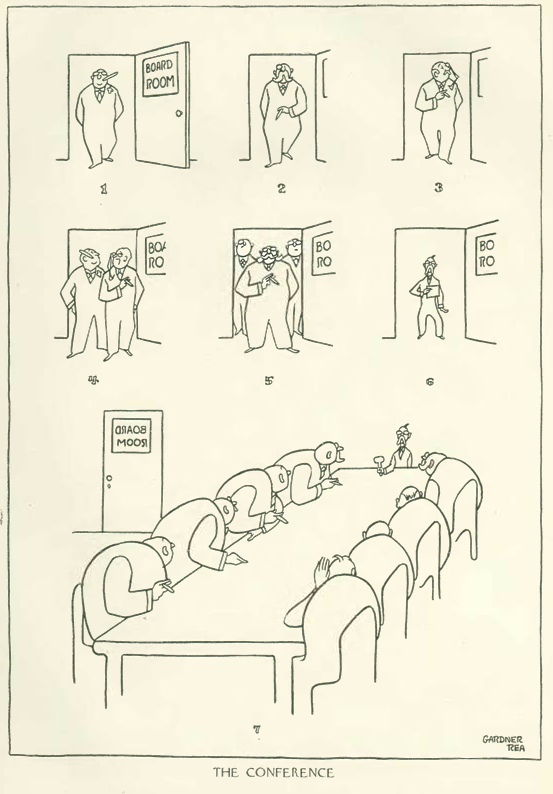
…we begin our cartoons with the spare stylings of Gardner Rea

…and Otto Soglow

…we find one of Helen Hokinson’s ladies on her way to fitness…

William Crawford Galbraith showed us an enterprising young man…

Art Young illustrated the challenges of the lecture circuit…

…and one of my all-time favorite Peter Arno cartoons…

Next Time: The Circus Comes to Town…