Broadacre City

Above: Detail from Spanish architect David Romero's computer-generated model of Frank Lloyd Wright's Broadacre City, complete with an "aerotor" flying car.

To be sure, architect Frank Lloyd Wright was a visionary, creating a uniquely American vernacular that influences architecture and design to this day. That might also true for his Broadacre City concept, which demonstrated how four square miles (10.3 km2) of countryside might be settled by 1,400 families. Wright unveiled this escape to the countryside in the middle of Manhattan.
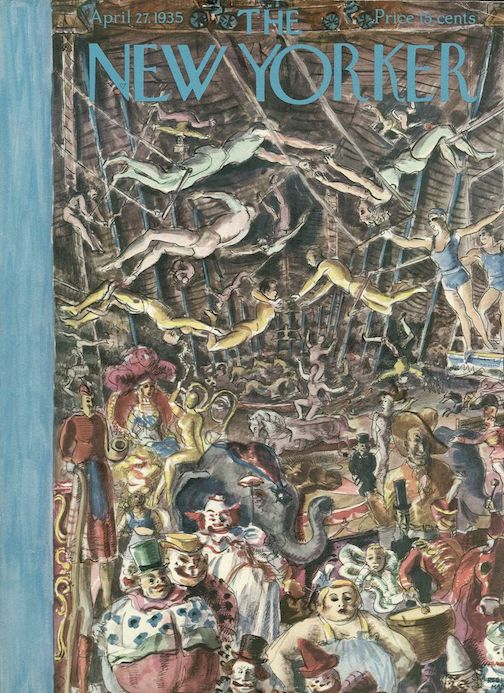
April 27, 1930 cover by Reginald Marsh.

On April 15, 1935, the Industrial Arts Exposition opened at Rockefeller Center, and Wright (1867-1959) was front and center with his audacious proposal to resettle the entire population of the United States onto individual homesteads. Critic Lewis Mumford observed that Wright “carries the tradition of romantic isolation and reunion with the soil” by putting every American family on a minimum of five acres of land.

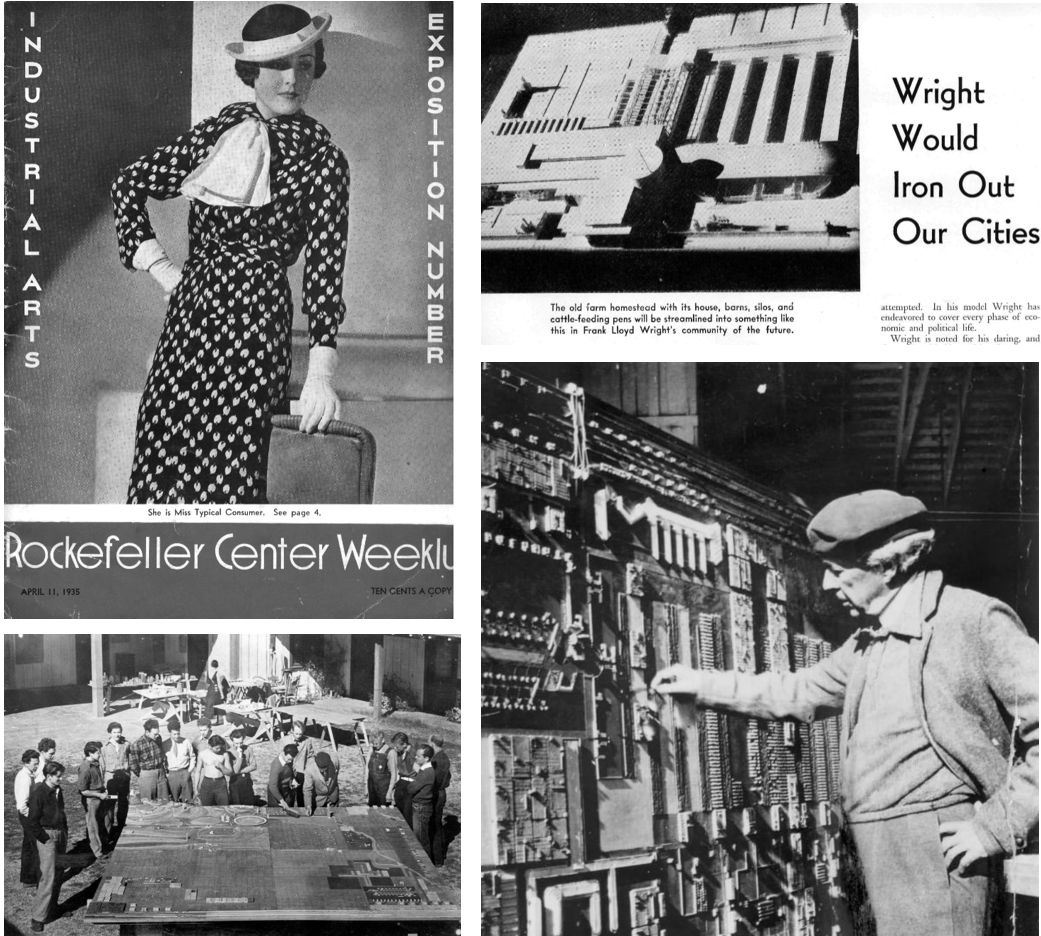
FLAT EARTH…Clockwise, from top left, cover of Rockefeller Center Weekly featuring the Industrial Arts Exposition—the model on the cover is identified as “Miss Typical Consumer”; detail from the magazine depicting a “streamlined farmstead” in Broadacre City; Frank Lloyd Wright examining the Broadacre City model, circa 1935; Wright students who crafted the 12×12-foot model, circa 1935. (digital.hagley.org/franklloydwright.org)

Wright first presented the idea of Broadacre City in his book The Disappearing City in 1932…
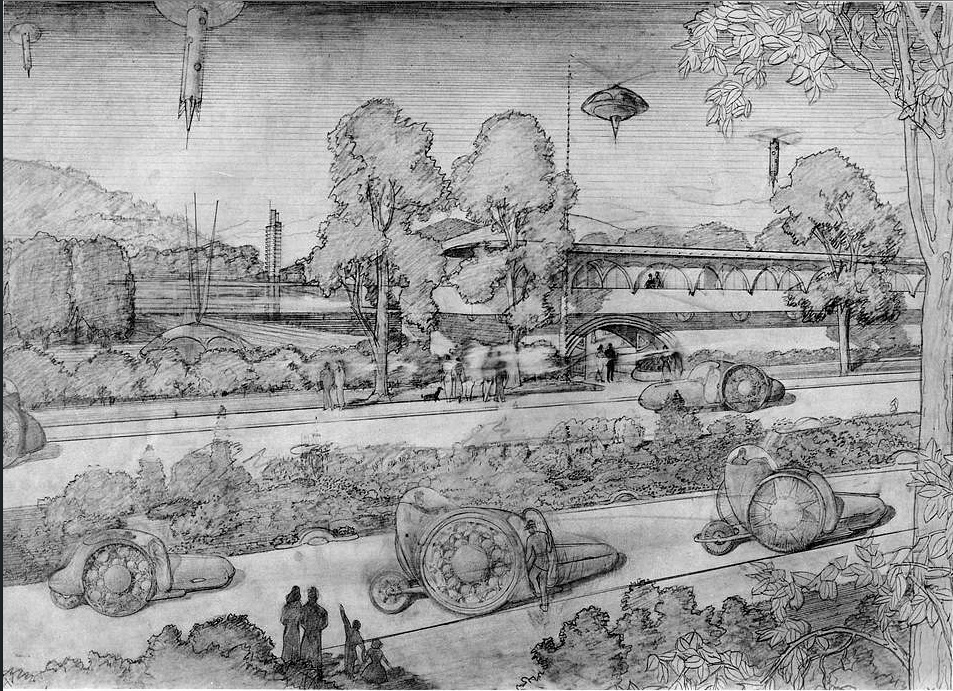
ROMANTIC ISOLATION…Broadacre City as depicted in Wright’s 1932 book The Disappearing City. (Wikipedia)

…note how the above drawing is reflected in one of Wright’s last designs, the Marin County Civic Center:

(visitmarin.org)

A detailed 12×12-foot scale model of Broadacre City—crafted by Wright’s student interns at Taliesin, was unveiled at the Industrial Arts Exposition:
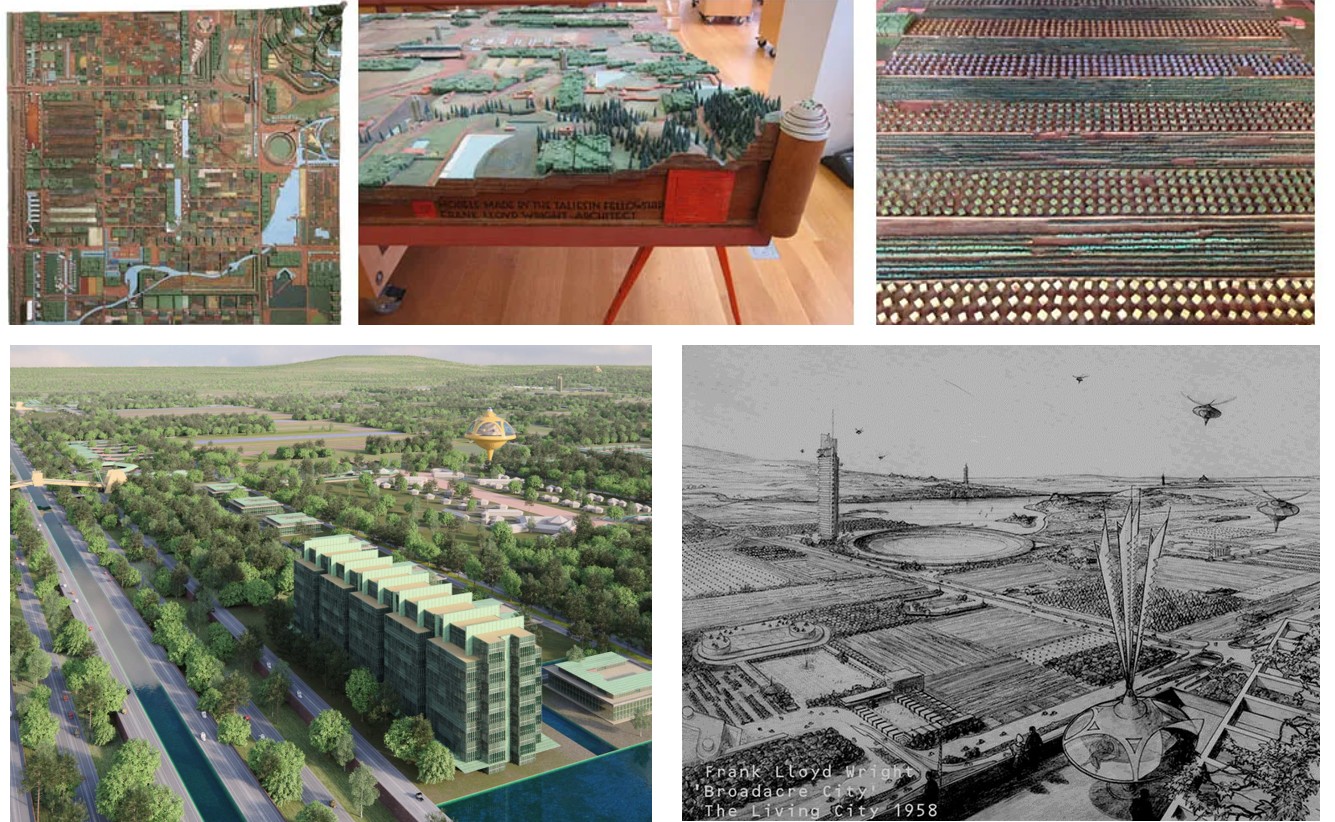
GREEN ACRES…The 12×12-foot model (top images) crafted by student interns who worked for Wright at Taliesin is now housed at the Museum of Modern Art (MoMA); bottom right, Wright’s rendering of Broadacre City, and at left, detail from Spanish architect David Romero’s computer-generated model of Broadacre City (more images below). (MoMA/David Romero via Smithsonian)

For the most part Mumford reacted favorably to Wright’s vision, which is no surprise considering that Mumford derided the dehumanizing skyscrapers popping up all over his city (including Rockefeller Center).

Despite his patrician demeanor, Wright envisioned an egalitarian Broadacre City, with every family having access to cars, telephones and other appliances. Power would come from solar and electric energy, and any technological advances would be applied at a local level toward the common good.

VIRTUAL REALITY…In 2018 Spanish architect David Romero created computer-generated models to see what Wright’s unrealized structures might have looked like. At left, cars (based on Wright concepts) in Broadacre City, and an aerial view featuring a tower that bears a strong resemblance to Wright’s 1956 Price Tower in Bartlesville, Oklahoma. Modeling Broadacre took Romero more than eight months to complete—it contains more than one hundred detailed buildings, one hundred ships, two hundred “aerotors” (based on the autogyros of the day), 5,800 cars, and more than 250,000 trees. (David Romero via Smithsonian and openculture.com)

What Mumford (and perhaps Wright) didn’t fully anticipate was the urban sprawl such a vision would help inspire, the suburban and exurban landscape that would lead to a car-dominated world of congested, multi-lane highways and housing developments that continue to encroach on our woodlands and wetlands. And we didn’t get those groovy aerotors either.

(Christoph Gielen, webcolby.edu)

 * * *

Little House on the Avenue

E.B. White, in his “Notes and Comment,” also offered some observations on housing trends, noting the manufactured “Motohome” displayed at Wanamaker’s as well as “America’s Little House,” plopped down at the corner of 39th and Park Avenue.
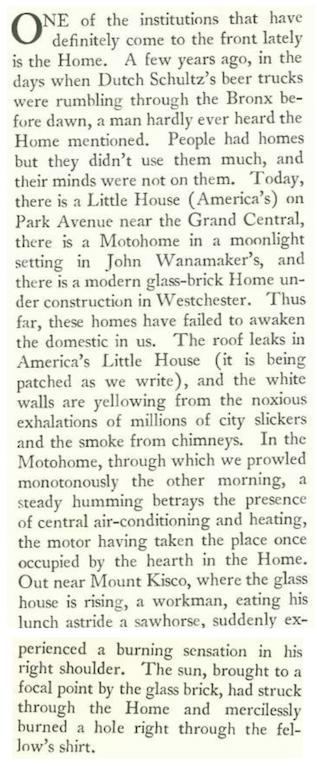
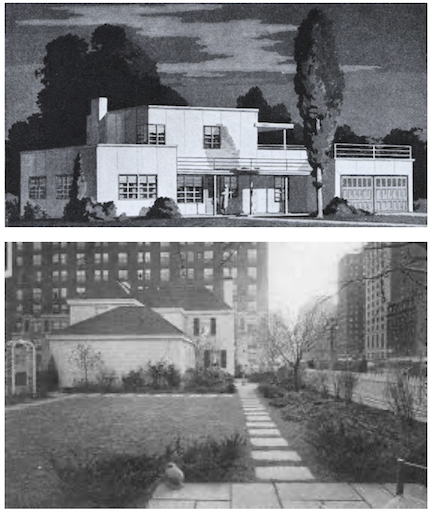
SETTING A STANDARD…Above, the factory-manufactured Motohome (above) was touted as the solution to the nation’s housing shortage. The federal Better Homes in America organization built a model house (“America’s Little House,” below) at 39th and Park Avenue to illustrate how standardized components and methods could make home improvement easier. (Google Books/Johns Hopkins)

* * *

Horsing Around

Although known for their nonchalance, New Yorkers could still find some enthusiasm when the circus came to town. “The Talk of the Town” looked in on the star of the circus, Dorothy Herbert (1910-1994), a trick rider with the Ringling Bros. and Barnum & Bailey Circus.
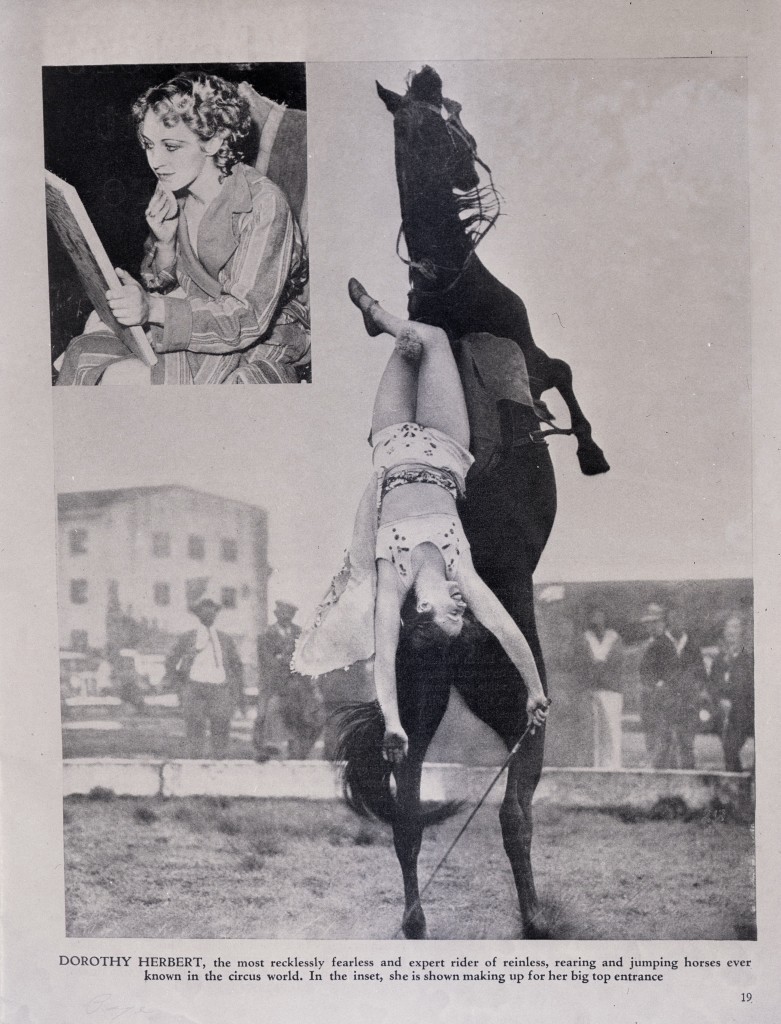
WHOA NELLY…One of Dorothy Herbert’s signature moves was her layback on a rearing horse. Here she demonstrates the move in 1939. (equineink.com)
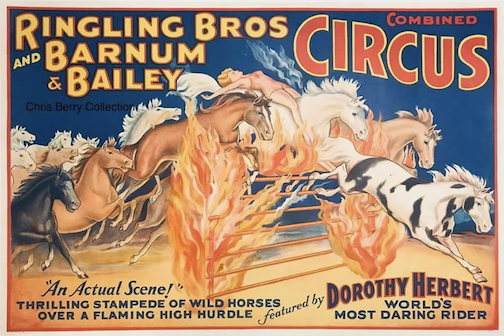
HOT STUFF…Circus poster touts Herbert’s ride over flaming hurdles in the company of twelve riderless horses. (circushistory.org)

 * * *

Don’t Call Him ‘Tiny’

He was known as “The Little Napoleon of Showmanship,” but there was nothing small about Billy Rose’s accomplishments as an impresario, theatrical showman, composer, lyricist and columnist. Here are excerpts from Alva Johnston’s profile:

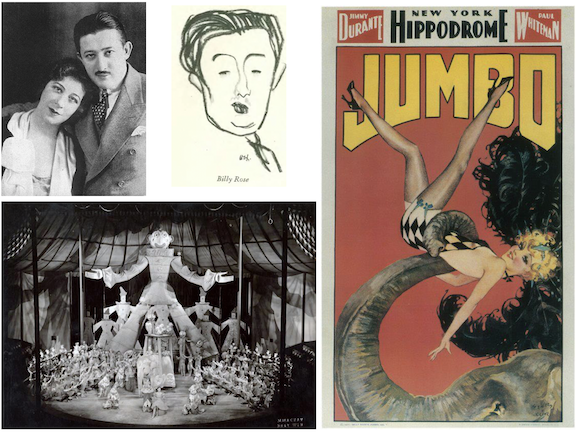
JUMBO-SIZED ENTERTAINMENT…Clockwise, from top left, Billy Rose and his first wife, comedian-actress Fanny Brice; illustration of Rose for the profile; poster announcing Rose’s 1935 stage spectacle Jumbo at the Hippodrome; described as more circus than musical comedy, Jumbo was one of the most expensive theatrical events of the first half of the 20th century. (jacksonupperco.com)

 * * *

On Guard

We shift gears and turn to more sobering events of the 1930s, namely the rise of fascism in Europe. In his column “Of All Things,” Howard Brubaker pondered the possibilities of fascism in his own country…

…meanwhile, Paris correspondent Janet Flanner was finding nothing funny about the uneasy calm among Parisians as war with Germany seemed likely.
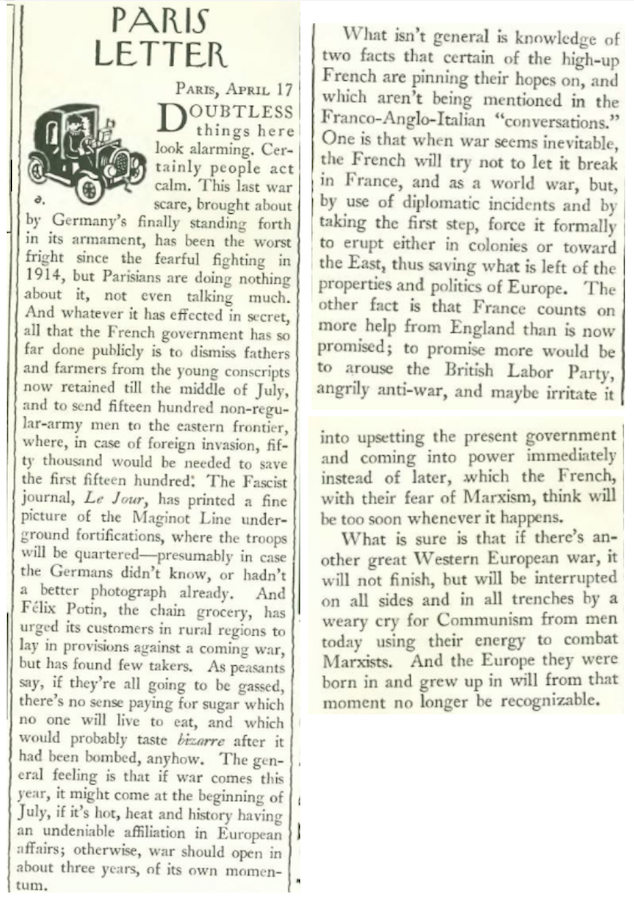
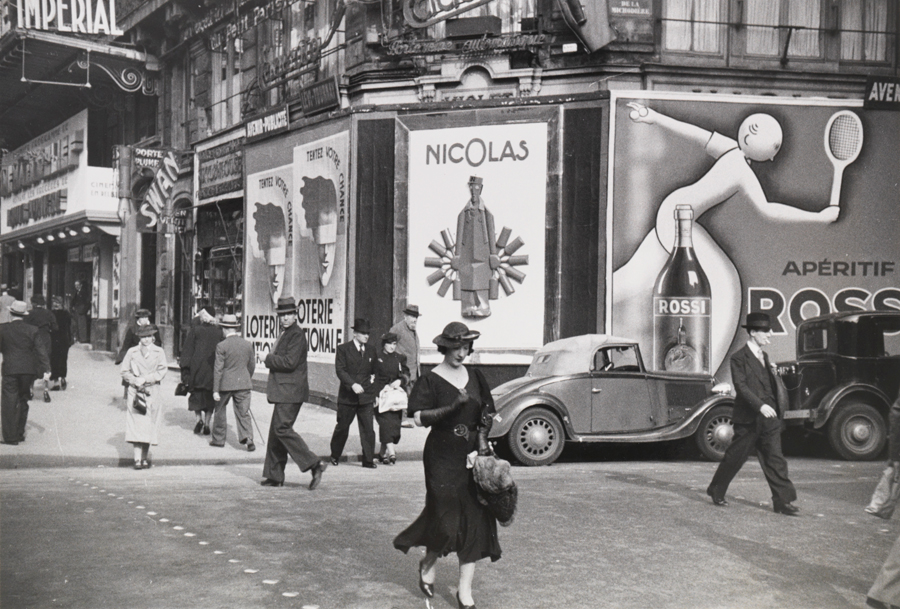
C’EST LA VIE…Janet Flanner found Parisians resigned to whatever fate awaited them in 1935. (unjourdeplusaparis.com)

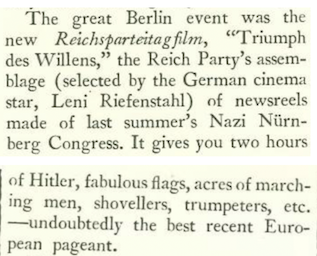
Flanner also remarked on Leni Riefenstahl’s Nazi propaganda film Triumph des Willens (Triumph of the Will). Flanner’s assessment of this “best recent European pageant” wryly underscored the horrors the film portends.
 * * *

News From An Old Friend

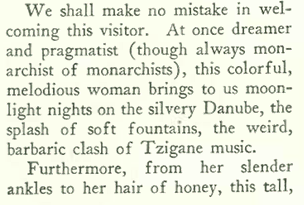
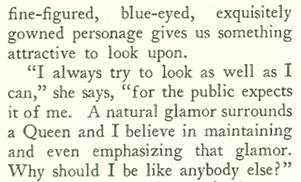
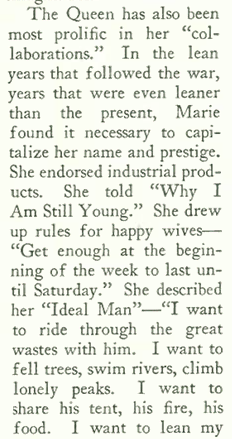
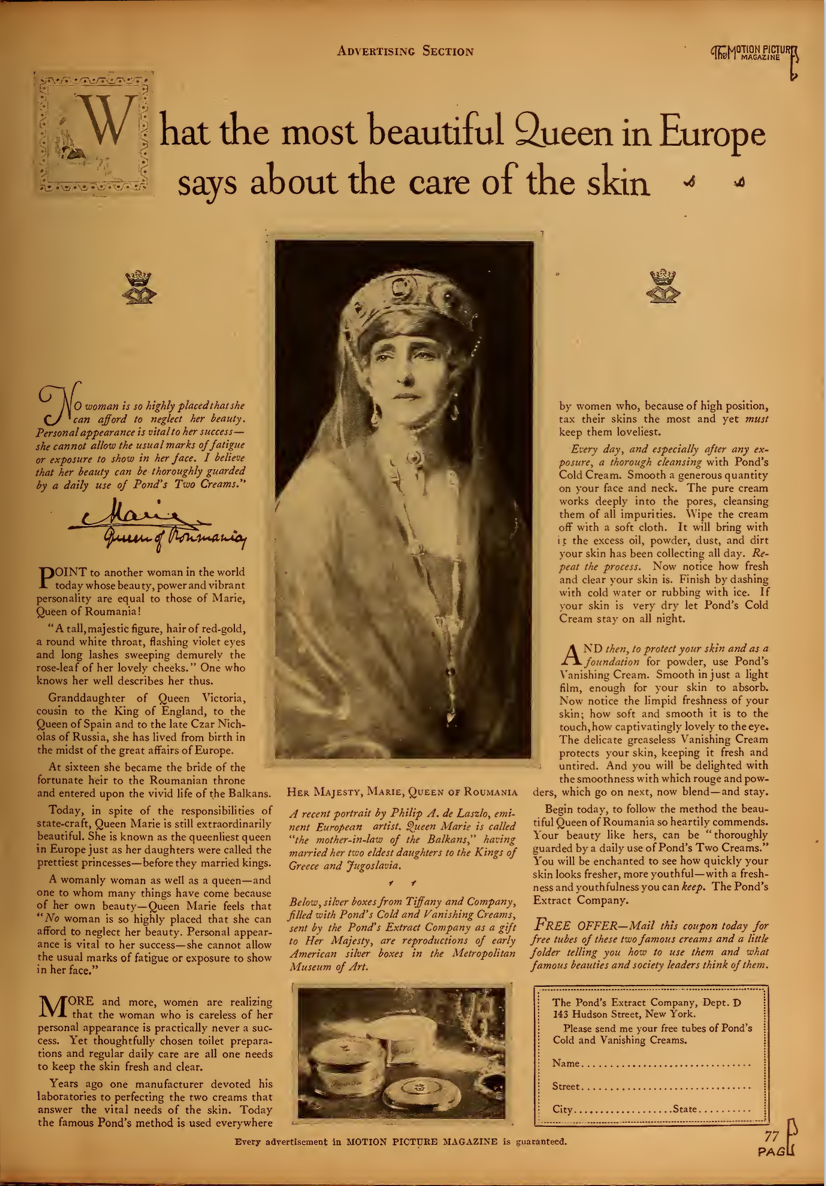
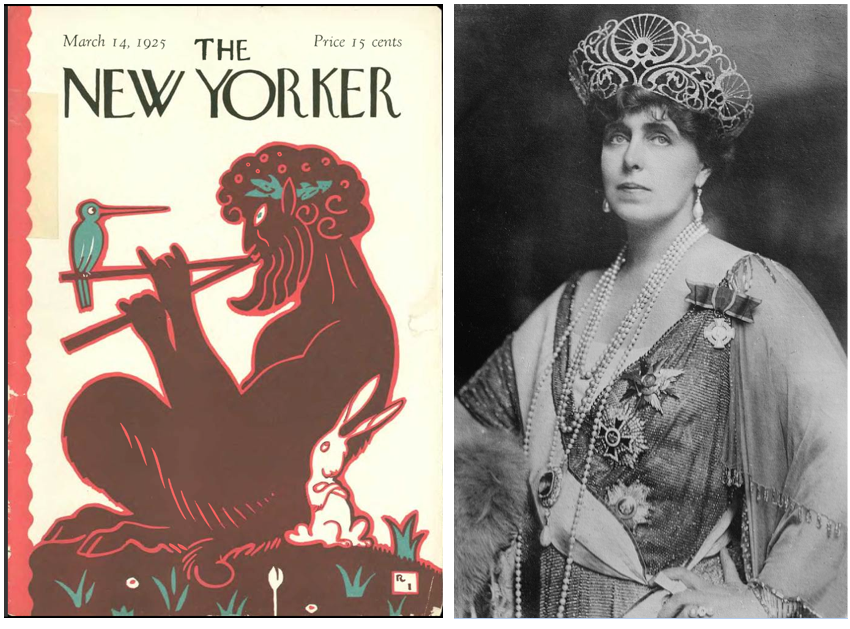
Longtime readers may recall one of my earliest entries on Queen Marie of Romania (1875-1938); the March 14, 1925 edition of The New Yorker (issue #4) found New Yorkers “agog” over her planned 1926 visit to the city. Her comings and goings were followed for a time (she also appeared in a Pond’s Cold Cream ad in the June 6, 1925 issue), but then she abruptly disappeared. Here she is again, courtesy of a glowing book review by Clifton Fadiman. An excerpt:
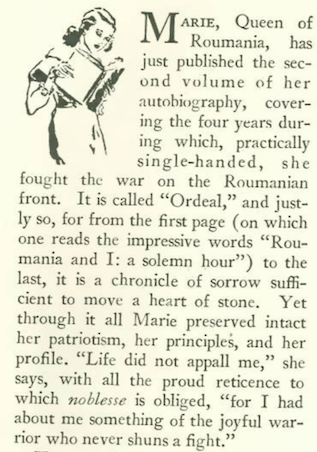
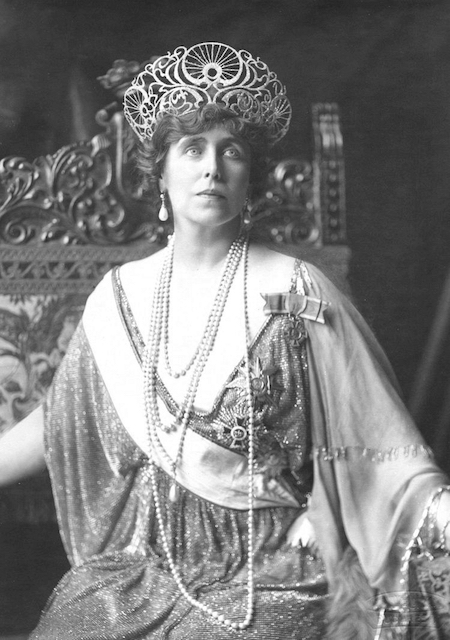
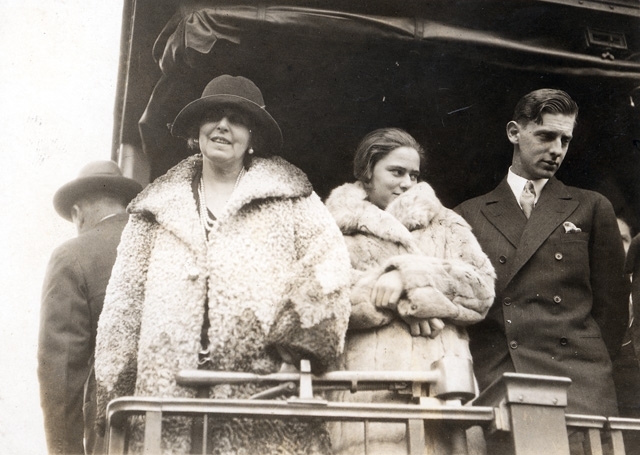
A PROGRESSIVE THINKER for her time, Marie of Romania was immensely popular in America. Born into the British royal family, she was the last queen of Romania from 1914 to 1927. At left, portrait from 1920; at right, during her 1926 visit to the States, Marie received a headdress from two American Indian tribes. They named her “Morning Star” and “Winyan Kipanpi Win”—“The Woman Who Was Waited For.” (Wikipedia/brilliantstarmagazine.org)

 * * *

From Our Advertisers

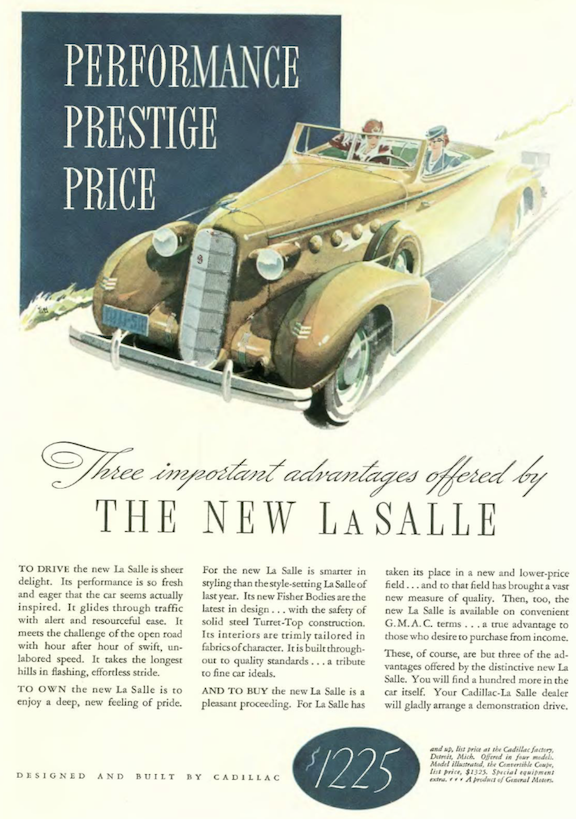
Although we’ve seen plenty of ads from prestige automakers such as Packard, it was clear that companies found their sweet spot in lower-priced models that still suggested “prestige”…here’s an example from Cadillac’s budget line LaSalle…
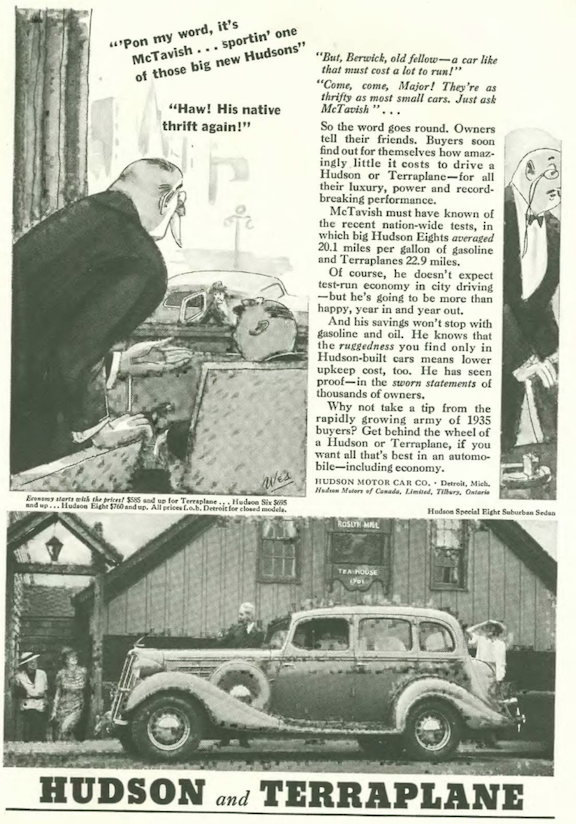
…for less than half the price of a LaSalle you could get behind the wheel of Hudson, its makers suggesting that prestige doesn’t preclude thrift…this ad seems to have been hastily produced–note the right side of ad, with just a slice of some toff squeezed next to the copy…
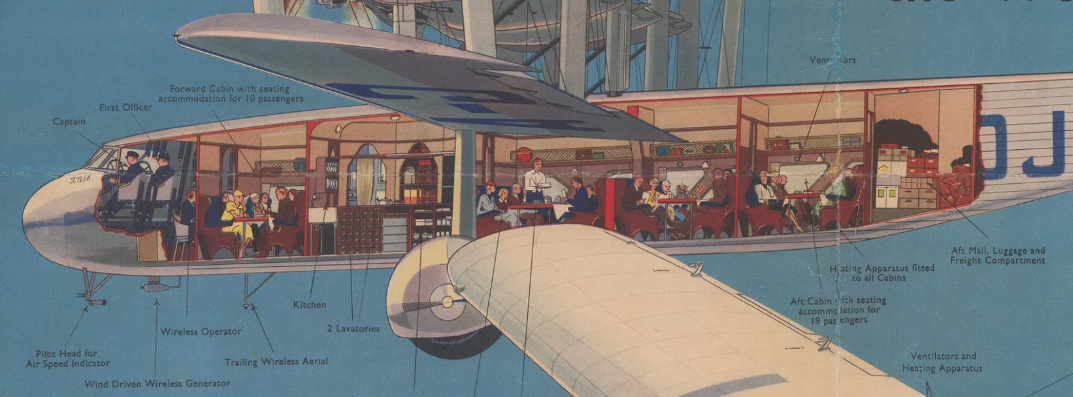
…this advertisement would only appeal to those who were among the tiny minority who could afford to fly…from 1924 to 1939 this early long-range airline served British Empire routes to South Africa, India, Australia and the Far East…

…for reference, detail below of a Scylla-class airliner used by Imperial Airways…
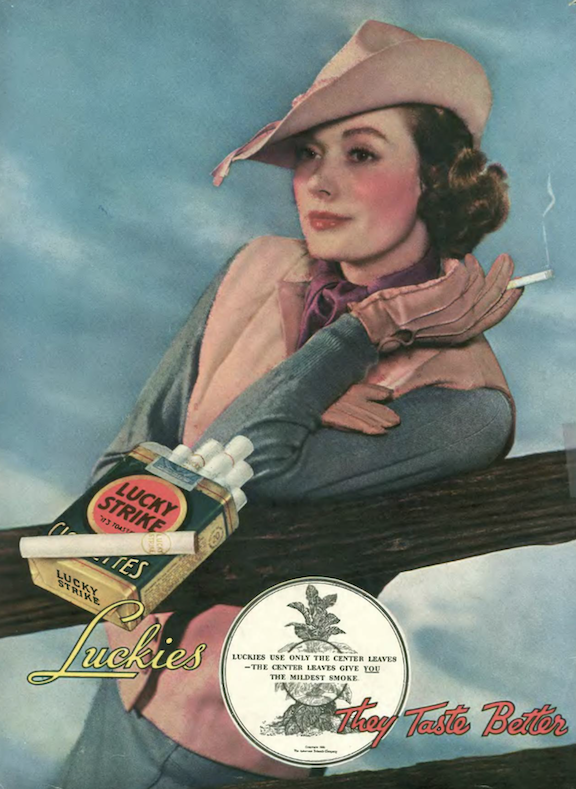
…and what would the back cover be without a photo of a stylish woman having a smoke?…
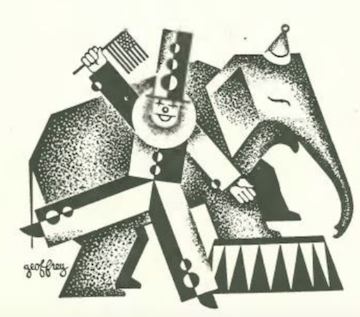
…a few advertisers referenced the circus in town to drum up business…

…and we segue to our cartoonists and illustrators, and this circus-themed spot from an illustrator signed “Geoffrey”…
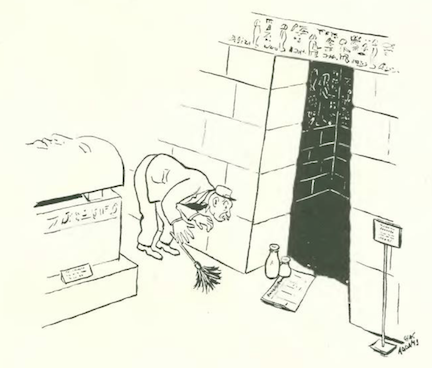
…a more familiar name is found at the bottom of page 4…namely Charles Addams…the milk order outside the tomb hints at things to come…
…Addams again, going from Bacchus to beige…

George Price, and well, you know…

Robert Day was aloft with a speculative builder…

William Steig typecast his Small Fry…

Leonard Dove made a sudden exit…

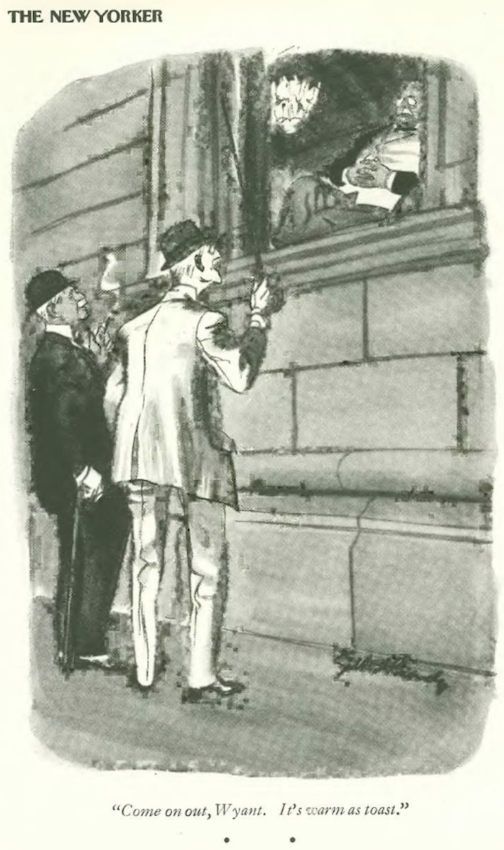
Gilbert Bundy found one old boy unaffected by spring fever…
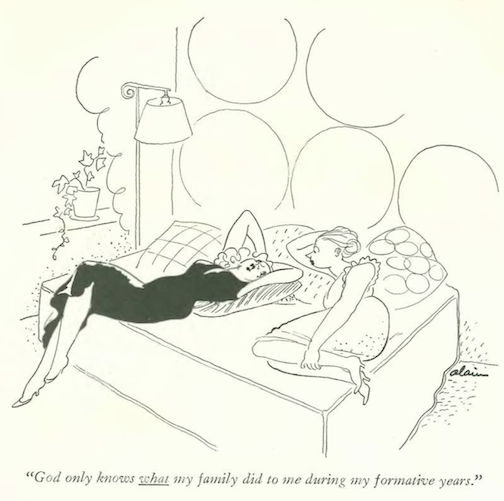
Alain channeled Barbara Shermund to give us this gem…
…and we close with a typical day in James Thurber’s world…

Next Time: The Royal Treatment…


A Royal Flush

Perhaps because they’ve never had a monarchy, Americans have always been a little nuts over European royalty, even the lesser kings and queens.

Screen Shot 2016-03-31 at 9.58.22 AM
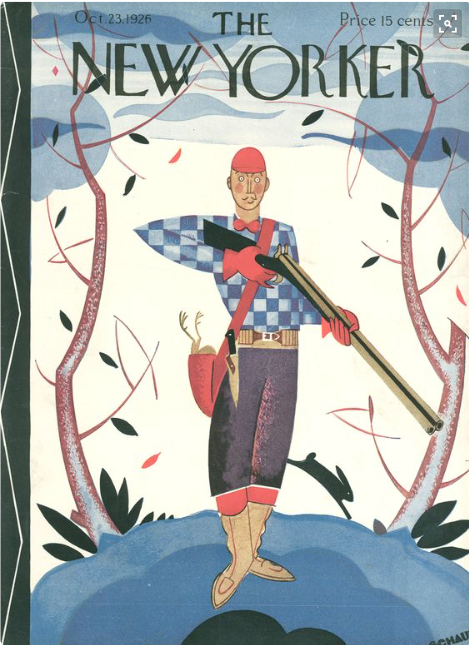
October 23, 1926 cover by Andre De Schaub.

In the lesser category was the Queen Marie of Romania, whose name and exploits appeared frequently in the pages of the early New Yorker. As early as Issue #4 (March 14, 1925), the magazine was reporting that New Yorkers were “agog” about a possible visit from Her Majesty, and that the North American Newspaper Alliance had offered her a contract to write her impressions of the United States.

queen-marie-of-romania-photo-232
Queen Marie of Romania (Library of Congress)

The Queen filled the pages of both the Oct. 23 and Oct. 30 issues as she finally made her way to the American shores. “Of All Things” observed…

1
“Trudy” referred to above was New Yorker Gertrude Ederley, still basking in her fame as the first woman to swim the English Channel.

Now some background on The Queen: She born into the British royal family, titled Princess Marie of Edinburgh at birth. After refusing a proposal from her cousin (the future King George V), she was chosen as the future wife of Crown Prince Ferdinand of Romania, the heir apparent of King Carol I, in 1892. She was the last Queen consort of Romania, and her trip to the U.S. would prove to be the last months of her reign (her husband, Crown Prince Ferdinand, would die shortly after her return). Her 5-year-old grandson, Michael, the son of Prince Carol, would ascend to the throne, only to be usurped by his father in 1930 (at this writing Michael is still living. He is currently 94 years old).

Things seemed fairly rosy in October 1926, as Americans awaited the queen and two of her children, Prince Nicholas and Princess Ileana, who were said to be seeking matrimonial matches in the States.

1926-1
Queen Marie, Princess Ileana, and Prince Nicholas of Romania on their American tour, 1926. (Henley Hamilton)

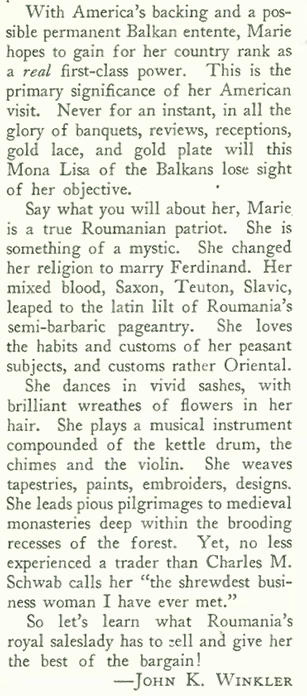
The issue’s “Profile” by John Winkler featured a mostly glowing account of Queen Marie…

2

3

…although it was noted that Queen has to stoop to writing articles and endorsing products for a little extra cash…

4

5

Screenshot 2015-04-21 13.18.41
The “Queen of Roumania” and her Pond’s Cold Cream endorsement were featured in this April 1925 ad in Motion Picture magazine. (Image scan)

And the Queen would also be seeking a few bucks from Uncle Sam…

6

The Queen’s visit was even on the mind of one cartoonist (still trying ID):

Screen Shot 2016-04-01 at 1.27.00 PM

The following week, in the Oct. 30, 1926 issue…

a3dbcac2108e4dce47a2ca56e55b1e62
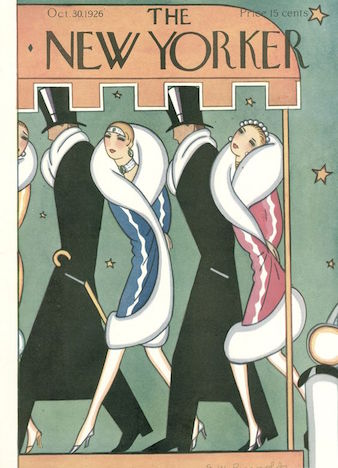
October 30, 1926 cover by Stanley W. Reynolds.

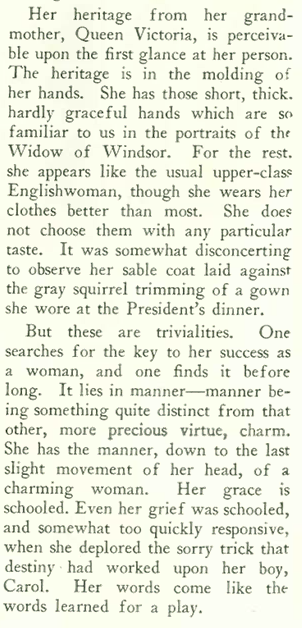
…the magazine offered an account of the Queen’s arrival, courtesy of writer Morris Markey:

1

Note the observation about the “sorry trick” played on the Queen’s son, Carol. Markey is referring the fact that Carol had waived his rights to succession. Little did anyone know that “her boy” would one day seize the throne and work to discredit her name.

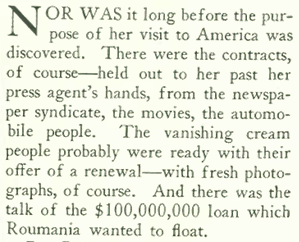
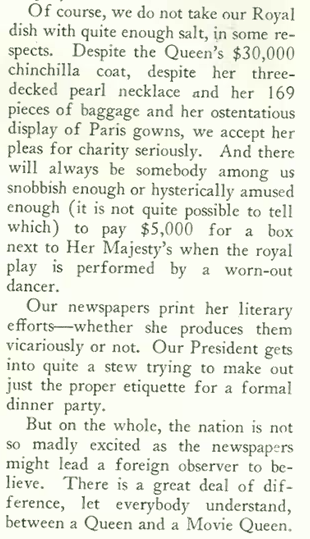
Markey also wryly noted the Queen’s objective to gain financial support from the U.S., even if her outstretched hand was covered in jewels:

S2

3

No Movie Queen, but she did have a flair for theatrics…

qmf20
(Kent State University)

Next Time: Fun With Harold…

Screen Shot 2016-04-01 at 3.03.49 PM

The Queen of Romania

Issue #4, March 14, 1925 opened with “The Talk of the Town,” the lead item noting that  New York was “agog about the possible visit of Queen Marie of Rumania,” and that the queen was supposedly offered a contract by a newspaper to write her impressions of the United States.

Screenshot 2015-03-13 11.20.57
The New Yorker, Issue #4, (cover by Rea Irvin) March 14, 1925 / Queen Marie of Romania (left, New Yorker Digital Archive; right, Wikipedia)

Born into the British royal family, Queen Marie was titled Princess Marie of Edinburgh at birth. After refusing a proposal from her cousin, the future King George V, she was chosen as the future wife of Crown Prince Ferdinand of Romania, the heir apparent of King Carol I, in 1892 (she was the last Queen consort of Romania, and her trip to the U.S. would prove to be the last months of her reign).

An account in the Frontier Times in 1968 describes the visit this way:

When Queen Marie first announced her intention of making a trip to America, she stated that her general purpose was a sort of educational good will tour; but that her specific purpose was to dedicate a museum at Maryhill, Washington…She sailed from Cherbourg (France) on October 12, 1926, on the Leviathan, accompanied by her son, Nicholas, and her daughter, Ileana; her special aide, Major Stanley Washburn; her close friend, Loie Fuller, the ballet dancer; six personal attendants; several European dignitaries; about one hundred pieces of baggage—and her dog.

For publicity, the timing was perfect. Front page news was scarce, and the Queen’s visit was “manna from heaven” for the newspapers, and a field day for the reporters—who played up the trip in great style.

Queen Marie had contracted with the North American Newspaper Alliance to write a series of articles ranging from “Why I Came to America” to “My Impressions of America.” About six of such articles were published; and as they ran 2,000 words each, one suspects she must have had a ghost writer—and there was one such in her party.

page04
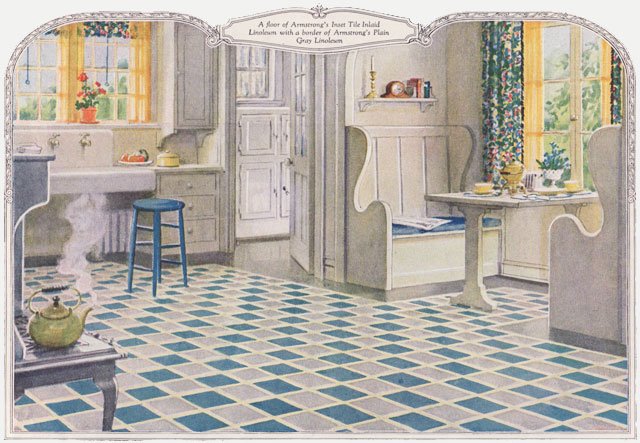
FIT FOR A QUEEN…Perhaps the Queen of Romania saw this 1924 advertisement for Armstrong linoleum. (Antique Home Style)

In her syndicated articles she gave a variety of reasons why she came to America—which might have been condensed into a desire to see the country first-hand, and find out how its people lived. She wanted to see almost every object of interest—Pikes Peak, the Everglades, farmers, Indians, washing machines and rodeos; and wanted to ride a horse. She spoke of steel mills, skyscrapers, big trees and tombs of famous men. Particularly she wanted to see American kitchens, and find out if the occupants were as good looking as they appeared to be in linoleum advertisements…

However, the reasons advanced by some who clearly were not in sympathy with the Queen’s visit, were not so altruistic. One newspaper was of the opinion that the real purpose of the trip was to find a rich American husband for Ileana…

“The Talk of the Town” also featured a brief item on “vaudeville headliner” Harry Houdini and his “denunciations of Marjorie.”

This is in reference to a rivalry between a Bostonian, Mina Crandon (known as “Margery the Medium”) and Houdini, who called himself “the scourge of spirit mediums.”

Screenshot 2015-03-13 11.35.54
Harry Houdini and Mina (Margery) Crandon (left image, PBS; right, FORTEAN PICTURE LIBRARY)

The 1920’s marked the height of America’s obsession with the paranormal—the “spirit world”–and Margery was a rock star among the many competing spiritualists of the day. The most famous of her followers was Sir Arthur Conan Doyle, author of Sherlock Holmes mysteries. Doyle was so convinced of her powers that he recommended her to the editors of Scientific American. The magazine was offering a $2,500 prize to the first medium who could verifiably demonstrate (to an investigative committee) a “visual psychic manifestation.”

When the committee reported it found no trickery in Margery’s methods, the outraged Houdini cancelled his upcoming shows and headed to Boston with the aim of personally debunking the medium at a seance.

In an article by Robert Love posted on Mental Floss, he relates what happened next when Houdini arrived at her Lime Street apartment:

Margery greeted the panel and took her seat within a three-sided Chinese screen, the lights dimmed. Soon enough, an eerie whistling filled the room. On cue, the spirit of Walter (Margery’s dead brother) whispered his arrival, even touching Houdini on the inside of his right leg. After a break, he ordered an electric bell enclosed in a wooden box brought to Houdini’s feet. Then Walter levitated a megaphone and boomed: “Have Houdini tell me where to throw it.”

“Toward me,” Houdini said, and the megaphone flew through the air and crashed in front of him. That was just the beginning. Throughout the evening, Walter produced a sequence of metaphysical spectacles, ringing the bell box on command and tipping over the wooden screen.

Houdini had done his homework. He knew that Dr. Le Roi Crandon, Margery’s husband, always sat on her right. (A Harvard-educated surgeon, Crandon was her greatest promoter, often showing visitors nude photographs of his wife in séance delicté). Houdini also guessed correctly that he would be seated at her left in the circle, with hands joined, feet and legs touching. In preparation for the evening, Houdini wore a tight bandage under his right knee all day; it was so painful it made his skin tender to even the slightest touch. The heightened sensitivity paid off. He could feel Margery twist and flex in the dark as she moved her left ankle slightly to get to the bell box under the table. Later, he felt her shift again to tip the Chinese screen with her foot. The flying megaphone stumped Houdini for a few hours, but he eventually figured out that Margery had placed it on her head, dunce-cap-style, with a momentarily free hand. She then jerked her head in his direction to send it crashing to the floor.

“I’ve got her,” he said when the evening was over. “All fraud. Every bit of it. One more sitting and I will be ready to expose everything.”

A second séance at a Boston hotel featured a levitating table. Houdini reached out in the dark and found Margery’s head lifting the table from beneath. He again felt her legs move as she reached to ring the bell box. “The slickest ruse I ever detected,” Houdini said later, in something close to admiration.

Read Love’s full account here.

Other celebrities of the time are found in the issue’s pages. The section “In Our Midst” tells of F. Scott Fitzgerald and Zelda Fitzgerald visiting Rome, and that the author was nearly finished with a novel called “The Great Braxton” (which would actually be titled “The Great Gatsby”). Another item noted that Eugene O’Neill was vacationing in Bermuda.

tumblr_mzdi2d2KG71rp8uyqo1_1280
Zelda, Scottie and F. Scott Fitzgerald in Rome, 1925 (London Times)

The “Profile” featured boxer Jack Dempsey, and “Books” announced the publication of A. A. Milne’s When We Were Very Young.

The “Hourglass” mentions the antics of Gutzon Borglum, who had been sculpting a tribute to the Confederacy on Georgia’s Stone Mountain.

68552424
This is as far as Borglum got when he began feuding with his backers and abandoned the Stone Mountain project. It wasn’t completed until 1972. (Detail from postcard image depicting the monument in progress)

The “antics,” specifically, concerned Borglum’s famed temper and his penchant for smashing completed sculptures in fits of rage. He would later go on to sculpt the monument at Mt. Rushmore.

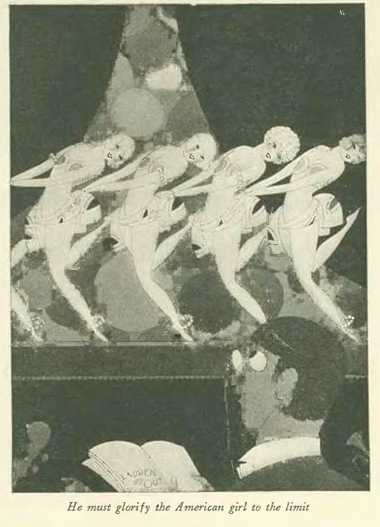
Then there’s an article by “The Professor” on the Ziegfeld Follies that features this illustration by Ralph Barton:

Screenshot 2015-03-13 14.04.16

The author concludes, “I forget whether it was a good show or not, but as a barometer of New York, it can’t be excelled.”

The “Motion Pictures” section featured a brief mention of “Mr. Hay’s” moral crusade against plays and movies. Hays would later lend his name to the The Production Code of 1930, known to most as the “Hays Code.”

Finally, if you really want to get a sense of how times have changed, check out the issue’s back page ad, and the suggested look for a “University man:”

Screenshot 2015-03-13 14.18.41