It Can’t Happen Here

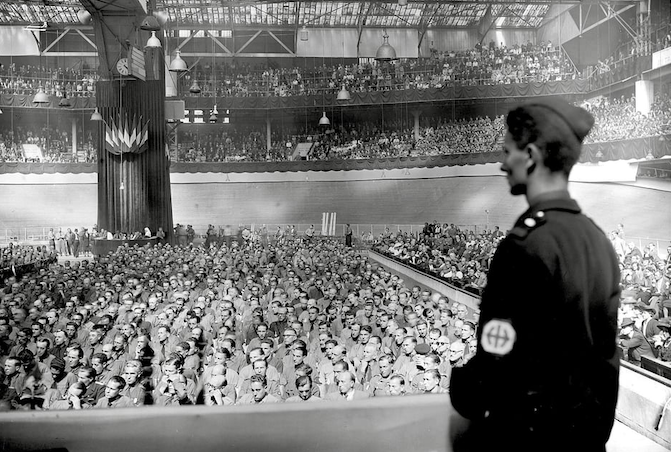
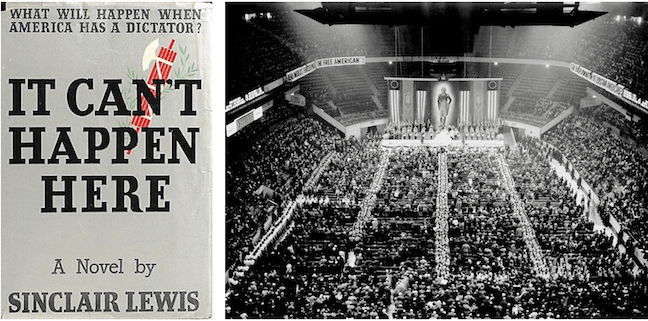
Above: Cover of Sinclair Lewis's 1935 novel about a fascist takeover of America, It Can't Happen Here. At right, 22,000 people attended a Nazi rally at Madison Square Garden on February 20, 1939. (Wikipedia/Reddit)

Ninety years ago Sinclair Lewis published It Can’t Happen Here, a dystopian novel that responded to the rise of fascism in Europe as well as to American demagogues like Louisiana Senator Huey Long.
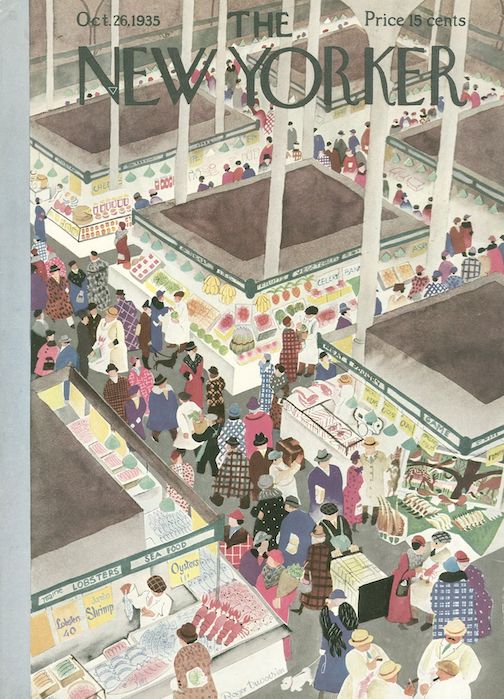
October 26, 1935 cover by Roger Duvoisin. Duvoisin (1900–1980) was a Swiss-born American writer and illustrator best known for children’s picture books. He illustrated 32 covers for The New Yorker, along with five cartoons. Duvoisin won the Caldecott Medal in 1948 (along with author Alvin Tresselt) for White Snow, Bright Snow.

In his 2016 New Yorker article, “Getting Close to Fascism with Sinclair Lewis’s ‘It Can’t Happen Here,'” journalist Alexander Nazaryan notes how Lewis was arguing for journalism and civic education as essential pillars of democracy. The title of Lewis’s book, Nazaryan observes, suggests that ‘It’ was something more subtle: “a collective apathy, born of ignorance, and a populace that can no longer make the kind of judgments that participatory democracy requires.”

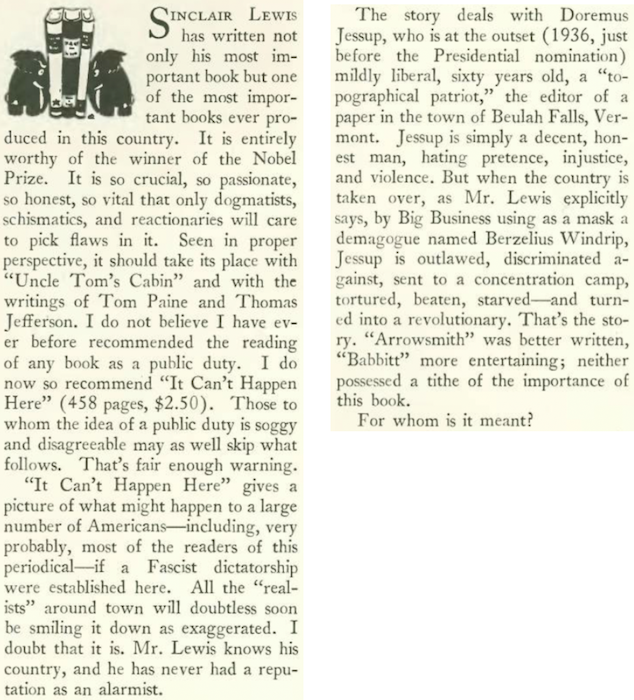
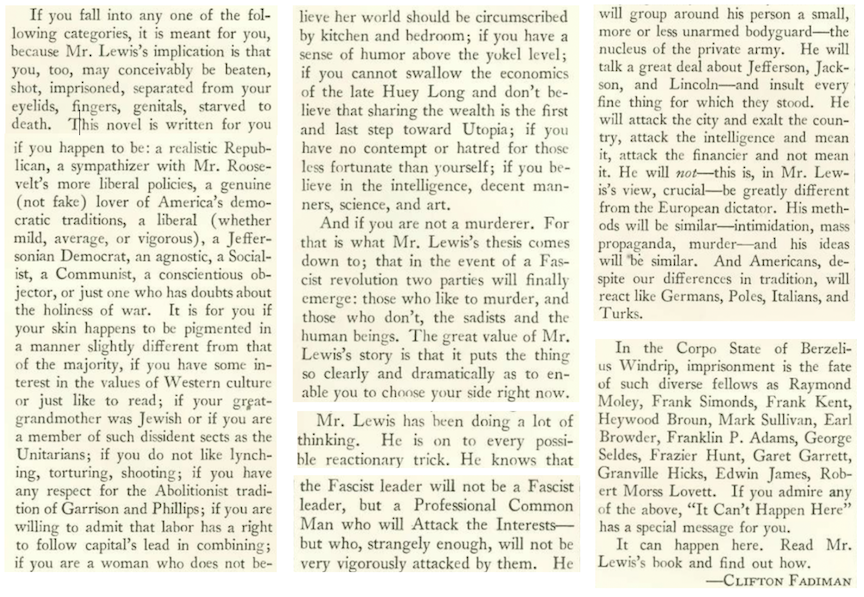
Lewis’s novel also made book critic Clifton Fadiman sit up and take notice. Here are excerpts from the first part of his review:
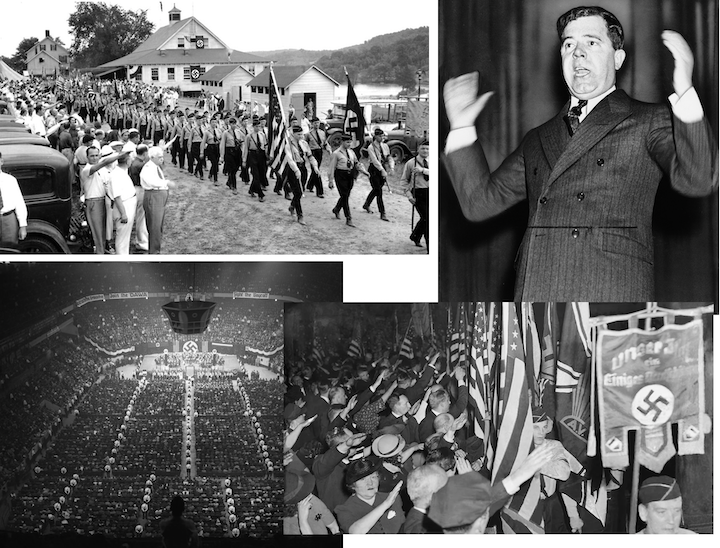
HOME-GROWN…American fascism was represented by organizations such as the German American Bund, the Silver Legion of America, and radio host Charles Coughlin, who opposed the New Deal and promoted conspiracy theories and antisemitic views. Clockwise, from top left: Nearly a thousand uniformed men wearing swastika arm bands and carrying Nazi banners parade past a reviewing stand in New Jersey on July 18, 1937. The New Jersey division of the German-American Bund had opened the 100-acre Camp Nordland at Sussex Hills; Huey Long in 1935, the same year he was assassinated; Nazi rally at Madison Square Garden in 1939. (AP/Wikipedia)

If you zoom in on the photo at bottom right, you can’t help but notice the woman in the black hat, who seems a little unsure about what she is doing, especially in front of a camera…the woman to her right appears to be hiding her face.

Here is more of Fadiman’s review (click to enlarge). It’s worth a read.
WE’VE BEEN WARNED…Published nearly seventy years apart, Sinclair Lewis’s It Can’t Happen Here (1935) and Philip Roth’s The Plot Against America (2004) both explored the dangers of fascism in the United States. (pulitzer.org/Wikipedia/Nancy Crampton via stanford.edu)

 * * *

It Was Happening There

In her “Letter from Paris,” Janet Flanner was noting “increasing Fascist sentiment and  sympathy” in her adopted city:

OVER THERE…The French Popular Party (Parti populaire français, PPF) was a French fascist and anti-semitic political party led by Jacques Doriot before and during World War II. Formed in June 1936, with an estimated 120,000 members by 1937, it is generally regarded as the most collaborationist party of France. (thefrenchhistorypodcast.com)

 * * *

All Talk

Marion Sayle Taylor (1889–1942) was the popular host of a radio advice show, The Voice of Experience. Margaret Case Harriman (1901–1966) penned a two-part profile of Taylor titled “The Voice.” I’ve included the opening lines to Part One here:

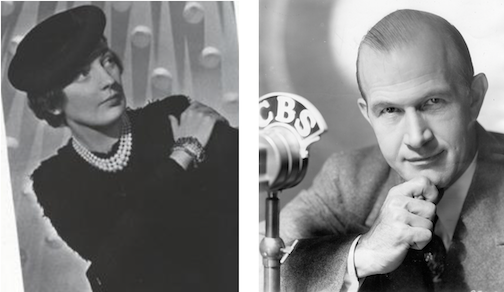
IF ONLY SHE KNEW…Margaret Case Harriman, left, circa 1936, profiled Marion Sayle Taylor before his misdeeds were revealed. (Vogue Archive/eleanorbritton.blogspot.com/Oregon Encyclopedia)

After reading both parts of Harriman’s profile piece, it appears she wasn’t yet aware that Taylor was more than a radio personality; he was also dishonest, manipulative, and opportunistic, according to a biography by Dick and Judy Wagner featured in the Oregon Encyclopedia. For example, Harriman reported (likely from Taylor’s official bio) that Taylor’s first wife, Pauline, had died in childbirth, when in fact she was quite alive and suing him for divorce that same year. Taylor also divorced his second wife, Jessie, who sued him in 1936 after he deceived her about another woman. Not surprisingly, his radio image as a reliable marriage counselor was damaged irretrievably.
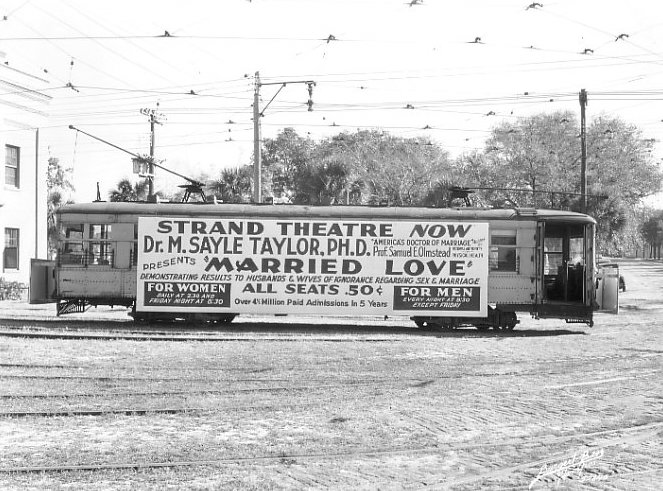
FALSE ADVERTISING…A streetcar, possibly in Newark, N.J., advertising a lecture by Taylor, circa 1931. In addition to hiding a previous prison record, Taylor also falsely reported that he had studied at several universities (he did not earn a Ph.D, as the redundant title claims in the above photo). It appears Taylor also kept much of the money he solicited for charitable causes. (Oregon Encyclopedia)

 * * *

Selling Pooh

Commercial cross-marketing of children’s books with toys and other products had its origins in the late nineteenth century with Alice’s Adventures in Wonderland, and in the first years of the 20th century Beatrix Potter’s Peter Rabbit series inspired everything from dishes and wallpaper to board games and dolls—in 1903 Peter Rabbit was the first fictional character to be made into a patented stuffed toy.

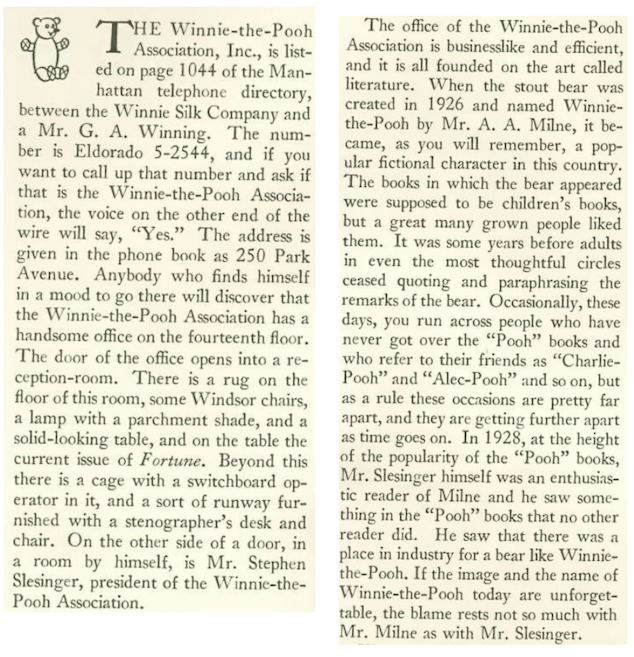
Then came another character from British children’s literature, A.A. Milne’s Winnie-the-Pooh. In January 1930, Stephen Slesinger (1901–1953) purchased U.S. and Canadian merchandising, television, recording, and other trade rights to the Winnie-the-Pooh works from Milne (for $1,000, plus royalties), marketing a wide range of products. For the column “Onward & Upward With the Arts,” St. Clair McKelway paid a visit to Slesinger at the Park Avenue offices of Winnie-the-Pooh Association, Inc. Excerpts:
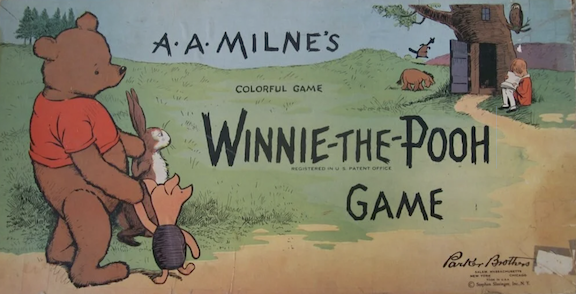
KEEP YER SHIRT ON…The Parker Brothers were the first to feature Winnie-the-Pooh in color for a 1932 board game. Stephan Slesinger added the iconic red t-shirt to Pooh for the game and a children’s record, a look that was later adopted by the Disney Corporation when it acquired the rights from Slesinger’s widow and daughter in 1961. (thedisneyclassics.com)
FUNNIES MAN…At left, Stephan Slesinger in an undated photo. Slesinger was a radio, television and film producer, and a curator of comic strip characters including Alley Cop, Captain Easy, Buck Rogers and Blondie, among others; at center, a record of “Winnie-the-Pooh Songs,” 1932; an ad for the Red Ryder BB gun—in 1938 Slesinger created the comic strip Red Ryder along with artist Fred Harmon. (alchetron/yesterdaysgallery.com/Port Isabel Press)

In another excerpt, McKelway gave us an idea of the scope of Slesinger’s Pooh empire:

 * * *

At the Movies

Critic John Mosher found few thrills in the latest fare from Hollywood, offering his views of Admiral Richard Byrd’s Into Little America and the musical Metropolitan, featuring famed baritone Lawrence Tibbett. 
FOR THE BYRDS…At left, lobby card for Into Little America; at right, Alice Brady and Lawrence Tibbett in Metropolitan. (eBay.uk/rottentomatoes.com)

With a screenplay by Ben Hecht and Charles MacArthur and direction by Howard Hawks, one would hope for some rough and tumble in a film about Gold Rush San Francisco. Instead, Mosher found the trappings of Barbary Coast rather mild. This was doubtless due in part to the Hays Code that curtailed the sex and violence portrayed in films of the 1920s and early 1930s.
TAKING A SPIN…Miriam Hopkins runs the roulette wheel as Edward G. Robinson looks on in Barbary Coast. A brief 2019 review in the Harvard Film Archive praised the film’s Gothic feel created by the “evocative portrayal of early San Francisco as a foggy labyrinth of rickety boardwalks and ominous, sky-high ship masts…” (harvardfimarchive.org)

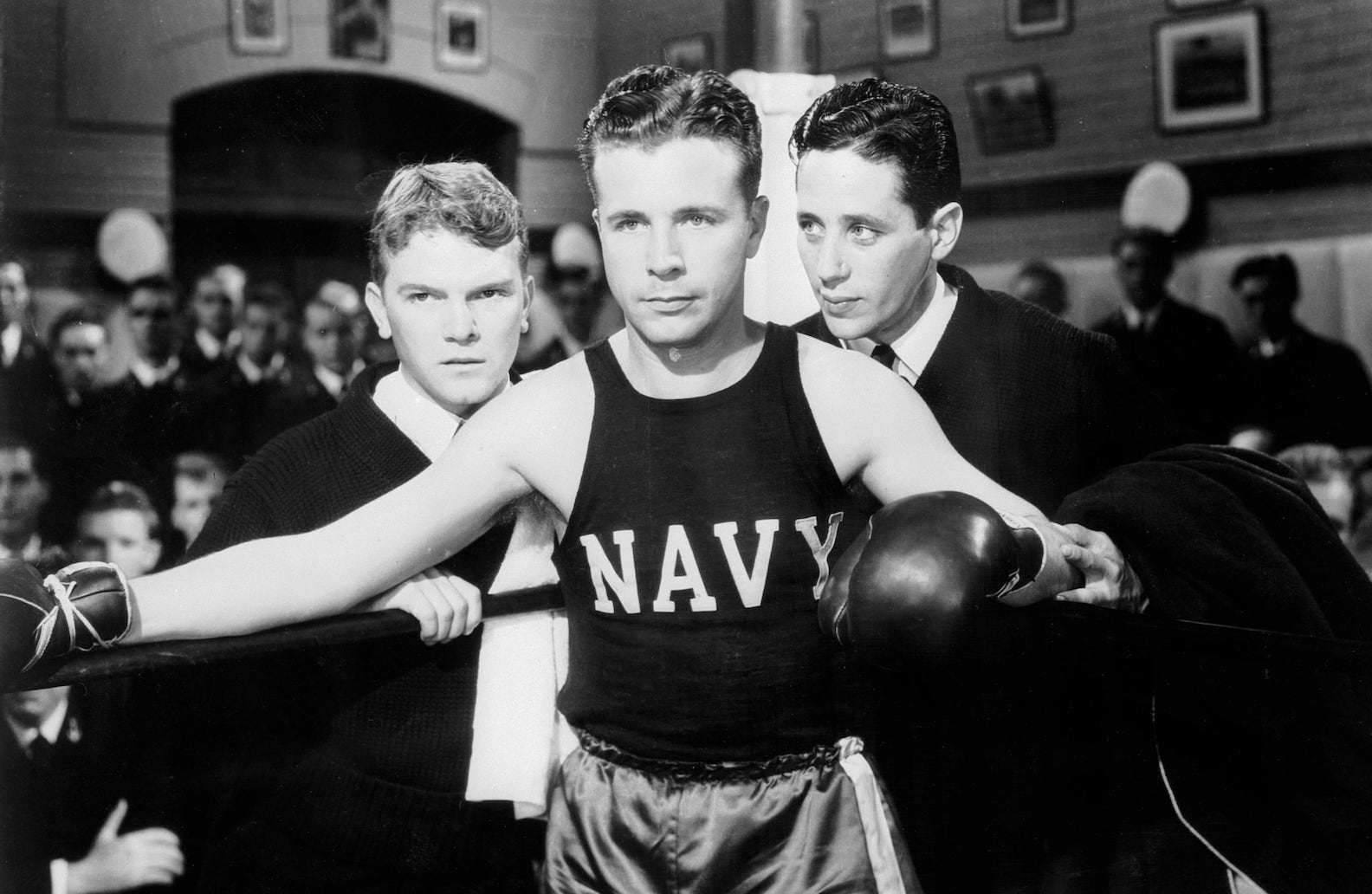
One might think that a film featuring the destruction of Pompeii would have some thrills, however RKO’s The Last Days of Pompeii proved to be a “temperate affair” in Mosher’s eyes, “one of the great bores of the moment.” The Dick Powell/U.S. Navy vehicle Shipmates Forever didn’t prove to be any better.

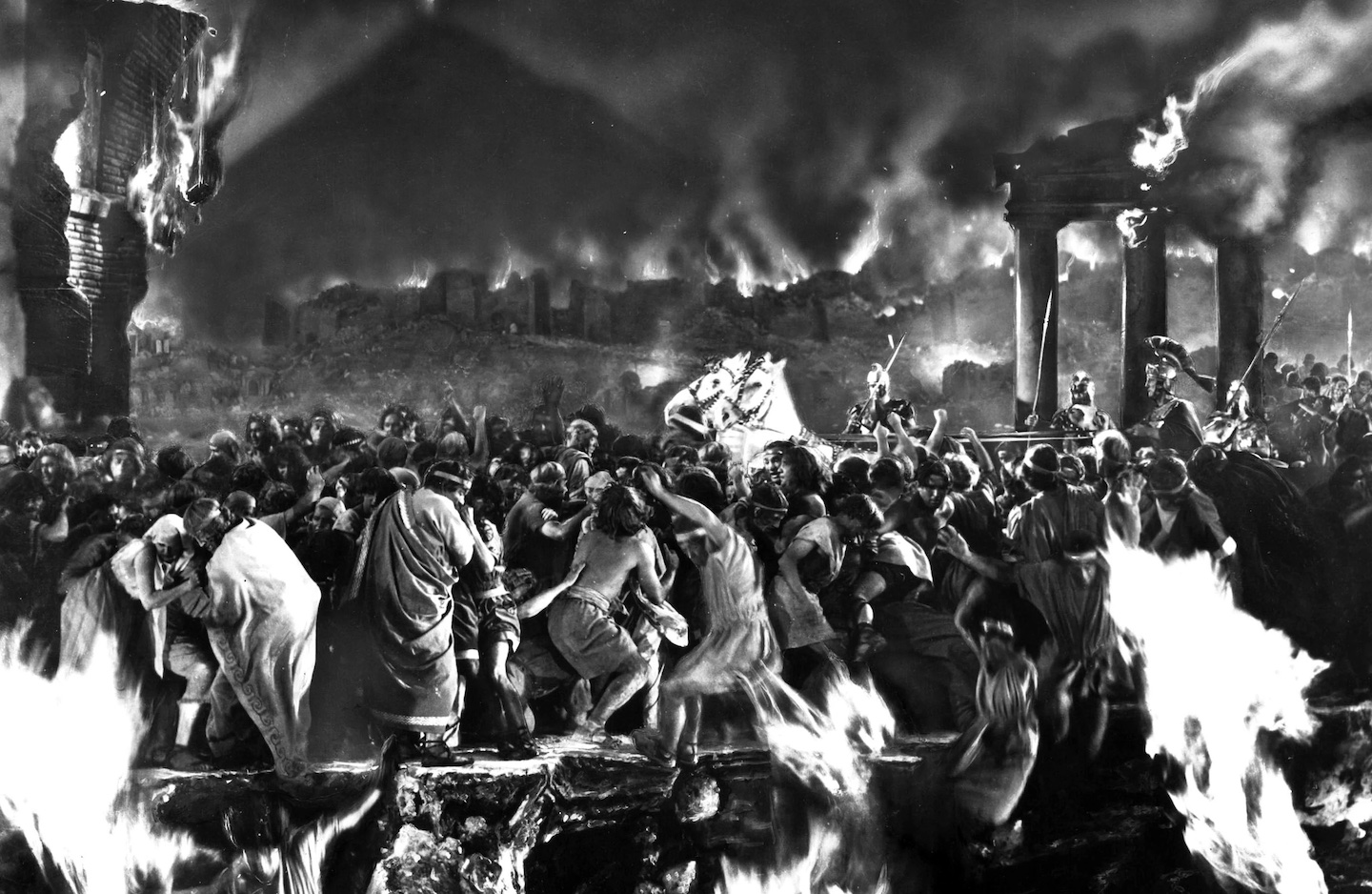
HOT TIMES IN POMPEII?…John Mosher called The Last Days of Pompeii “one of the great bores of the moment,” including the “drearily enacted” eruption of Vesuvius in which “Paper temples fall and there is a bit of bustle, and that is all there is to that.” Mosher did single out Basil Rathbone’s performance as an urbane Pontius Pilate, “a Pontius Pilate with a Long Island manner.” (tcm.com)
GO GET ‘EM DICK…The U.S. Naval Academy provided the setting for the musical Shipmates Forever, featuring Dick Powell as a crooner who ultimately chooses the Navy over a singing career. (tcm.com)

* * *

From Our Advertisers

We begin with the inside front cover, where the folks at Fisher touted their innovative “Turret Top” design…Body by Fisher began as a separate company in 1908, specializing as an automobile coach builder…although acquired by General Motors in 1926, the Fisher brand was promoted until the 1980s…

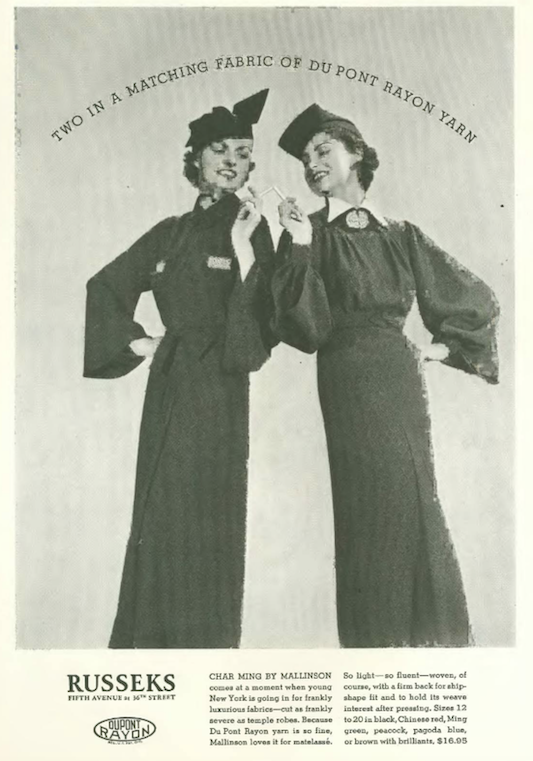
…there were many fall and winter fashion ads in this issue, including this continuing series by Russeks promoting Rayon fabrics…and women smoking, no doubt considered a sign of sophistication…
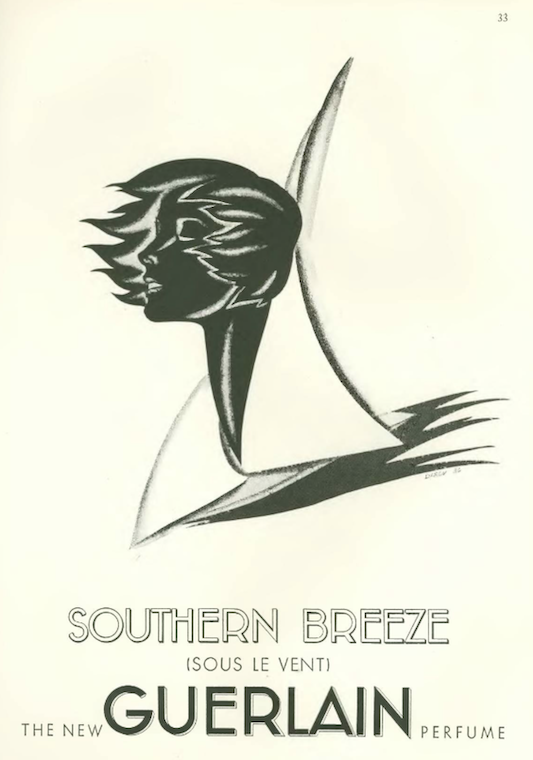
…Guerlain perfume ads featured the unmistakable style of illustrator Lyse Darcy

…the Heyward/Gershwin production of Porgy and Bess made a splash in this ad for Stage magazine…

…World Peaceways often used terrifying imagery to promote their anti-war messages…this ad was on the inside back cover…

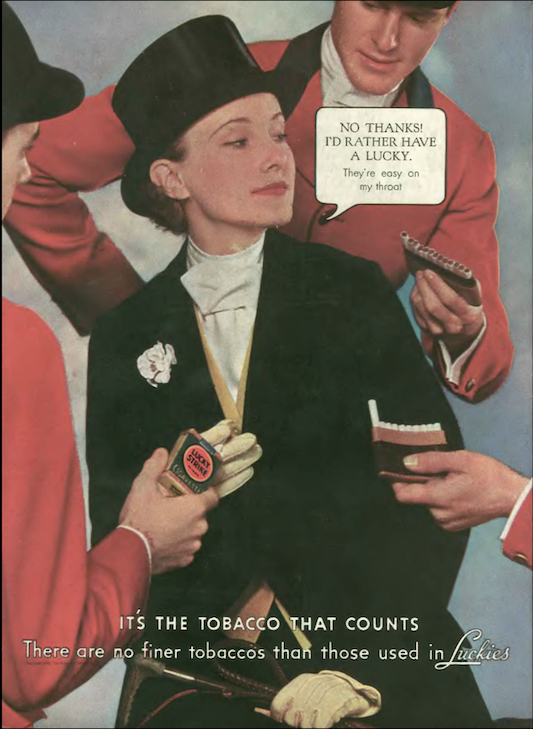
…and as you closed the magazine, the back cover greeted you with this stylish appeal to smoke Luckies…
…on to our cartoonists, starting with Al Frueh in the Theatre section…
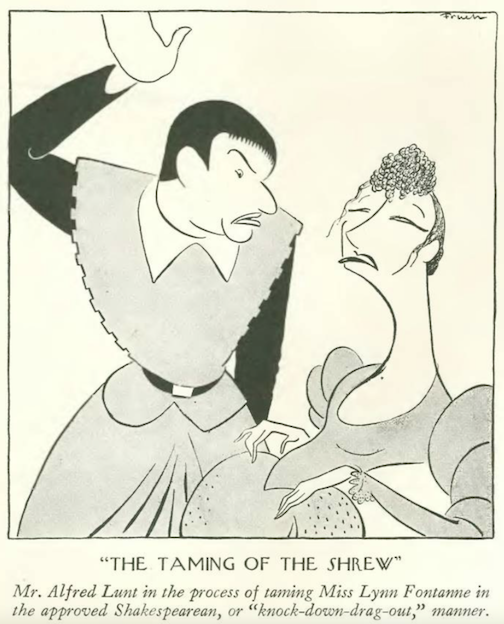
…and Frueh again, in this interesting arrangement…
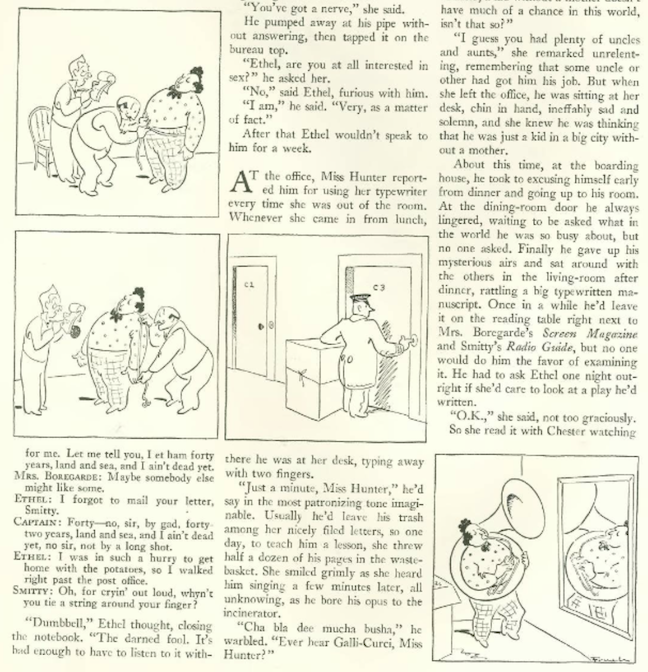
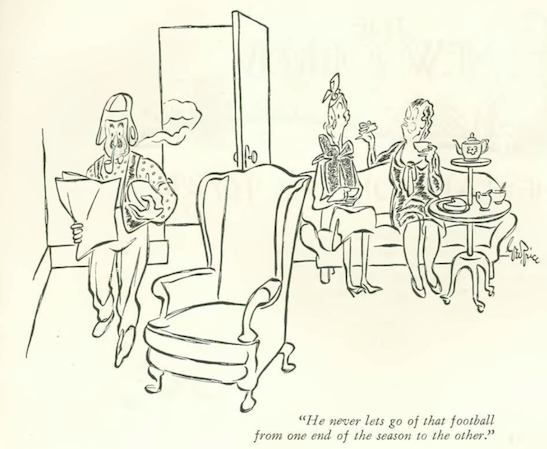
George Price was featured twice…

…with scenes of domestic life as only Price could render…
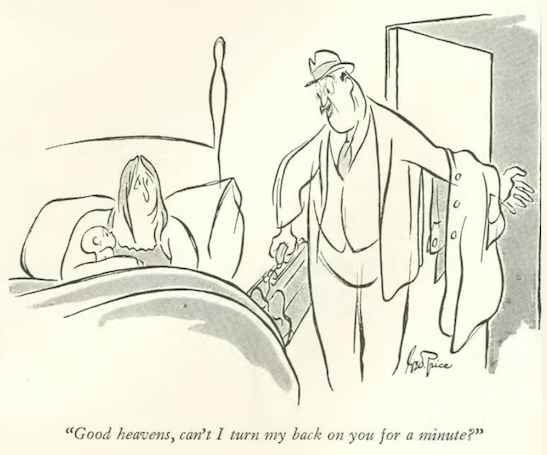
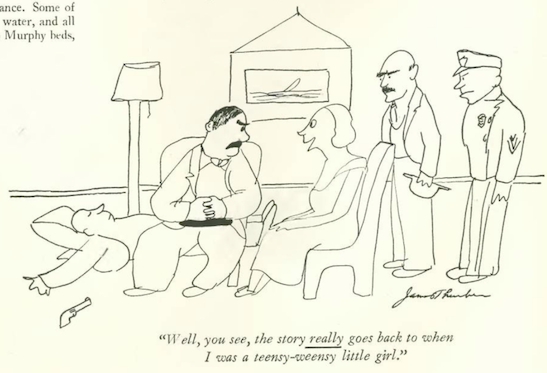
…and speaking of distinctive, no one did it quite like the great James Thurber

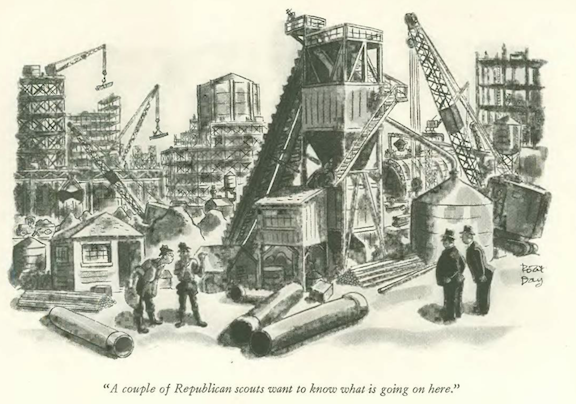
Robert Day gave us two Republicans looking in on the progress of the New Deal…
Carl Rose bid farewell to a writer sick of his peace and quiet…

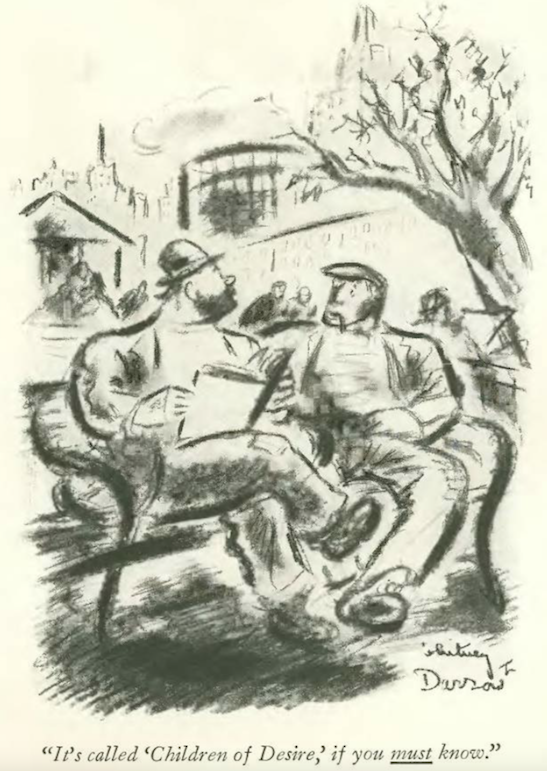
Whitney Darrow Jr illustrated a literary exchange on a park bench…
…and I close with today’s New Yorker cover artist, Roger Duvoisin—here is his cover for White Snow, Bright Snow, which won the Caldecott Medal in 1948.

Next Time: Planes, Trains and Automobiles…


Up In The Air

The 1930s saw steady improvements in the fledging airline industry, which catered mostly to major businesses or well-heeled (and somewhat brave) folks who were interested in getting to places relatively quickly. Margaret Case Harriman reported on the many ways one could criss-cross the country by heading to the Newark Airport, the first major airport to serve the New York metro.

August 11, 1934 cover by Constantin Alajalov.

Writing for the “Out of Town” column, Harriman described how someone in 1934 could make their way to Los Angeles by boarding a 9 a.m. American Airlines flight in Newark and then changing over to a “sleeper plane” in Fort Worth around 10 p.m. that same day (top speed of the fastest plane was about 190 mph or 306 kph. The trip also required stops for refueling). The night flight from Fort Worth would deliver the traveler to Los Angeles the following day, at 7:55 a.m.—the trip totaled about 23 hours.

NIGHTY NIGHT…In 1934 American Airlines was the only airline offering “sleeper planes,” as the ad at left claimed. The head of American Airlines, C.R. Smith, was obsessed with customer service and the amenities offered on his Curtiss Condors—roomy airplanes with sleeping berths that Margaret Case Harriman likened to beds in a Pullman railroad car. Passengers loved the Curtiss Condor, although the planes tended to catch fire and pilots found them difficult to fly. (archbridgeinstitute.org/American Airlines)
SKYTRAIN…Top, the passenger section of an American Airlines Curtiss Condor, circa 1930s; below, interior of a Boeing 247—note the steps in the aisle used to cross over the support beams that reinforced the 247’s wings. Also note the female attendant—the profession was dominated by male stewards in the first years of passenger service, but in the 1930s women took over the profession. (American Airlines/bethelgrapevine.com)
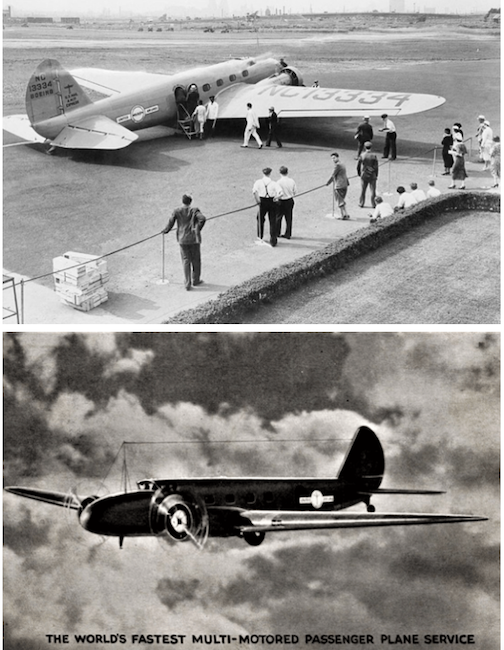
TWENTY-TWO HOURS and change on a United Airlines Boeing 247 would get you from Newark to San Francisco in 1934. Top, Passengers are shown boarding a United Airlines Boeing 247 at the Newark Airport circa 1934; United boasted the fastest multi-motored plane service with the 247, but TWA apparently offered the fastest service between coasts with its sleek new DC-2, seen in photo below. (bethelgrapevine.com)
HARD TO BEAT…A TWA Douglas DC-2 could get you to California faster than either United or American—fifteen hours from Newark to Los Angeles. (wahsonline.com)

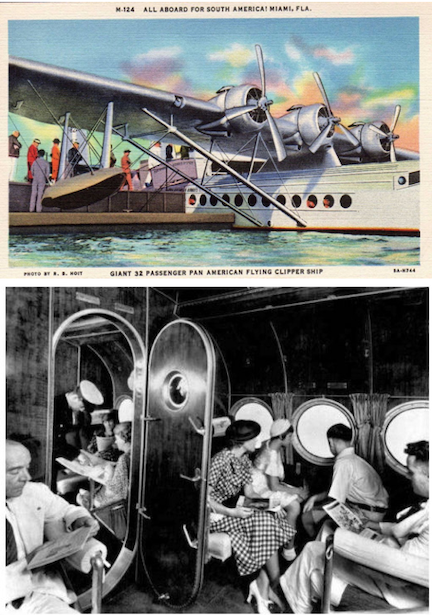
When we think of flying in the 1930s many of us recall the great travel posters featuring Pan American’s Clipper Ships—flying boats that took passengers to exotic locations in the Caribbean and in Central and South America. Harriman wrote:

FLYING BOAT…Boasting nautical appointments including porthole windows, Pan Am’s Sikorsky S-42 offered roomy seats to its 32 passengers. Top, a postcard image of a Sikorsky S-42 in Miami in the 1930s; below, passenger cabin of the Sikorsky S-42. (clipperflyingboats.com/seawings.com.uk)

Harriman closed with some advice to readers unfamiliar with flying, including putting drops of Argyrol (a silver-protein antiseptic) into ones eyes to “prevent that ticking sensation in the temples.”

 * * *

No Offense Taken

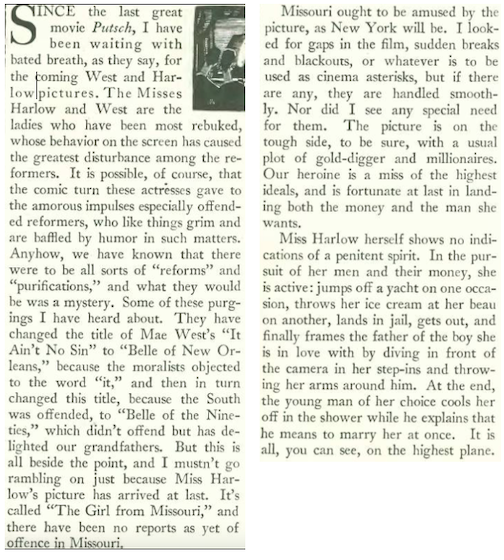
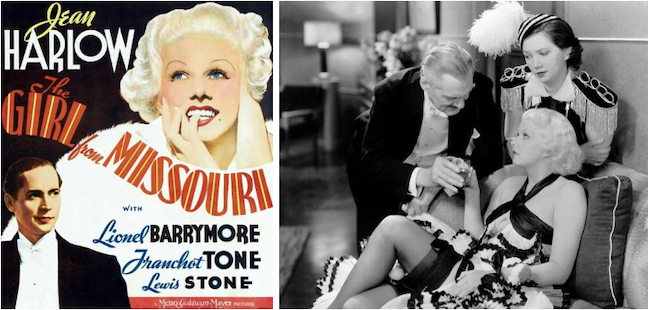
Critic John Mosher was no fan of Jean Harlow’s, but he did acknowledge her box office appeal, and that fans eagerly awaited the Blonde Bombshell’s next picture, The Girl from Missouri…with its “usual plot of a gold-digger and millionaries.” Mosher also noted that Harlow, along with Mae West, was a prime target of reformers (see Hays Code) who wanted to ban “immorality” from the pictures, and he was eager to see how the Puritans had wielded their new censoring shears on the film.

GOING FOR THE GOLD…At right, Lionel Barrymore, Jean Harlow, and Patsy Kelly in The Girl from Missouri. (IMDB)

 * * *

From Our Advertisers

We begin with another ad from the makers of Spud menthol cigarettes, who deployed what seemed like every known visual metaphor to suggest that smoking their cigarettes “all day” would leave one feeling cool, clean and fresh, in this case as a blanket of newly fallen snow (an appealing sight in that hot summer of 1934)…

…R.J. Reynolds deployed any number of tricks to sell their Camels, from ads promoting their health benefits to endorsements by wealthy socialites, in this case Sarah Lippincott (“Mrs. Nicholas Biddle”) of Philadelphia…

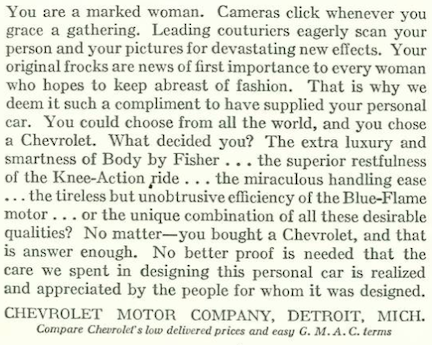
…snob appeal was not limited to cigarette ads, as this full page from the folks at Chevrolet attests…

…zooming in on the copy that accompanied the above ad, we find that this fictive Chevy owner was a “marked woman” sought out by paparazzi and admired by couturiers…

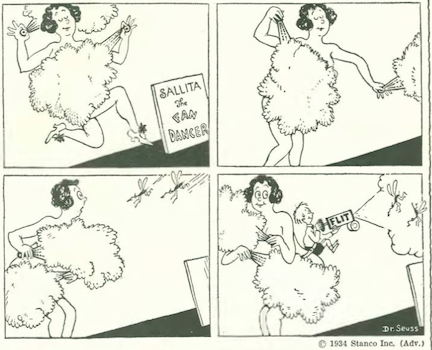
Dr. Seuss continued his series of weird ads for Flit insecticide…

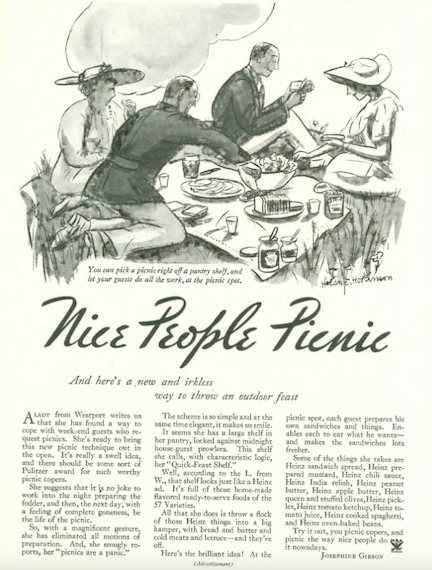
Helen Hokinson illustrated this patrician picnic scene to promote Heinz’s line of sandwich spreads…

…and we kick off our cartoons with Helen again, observing a proud moment…

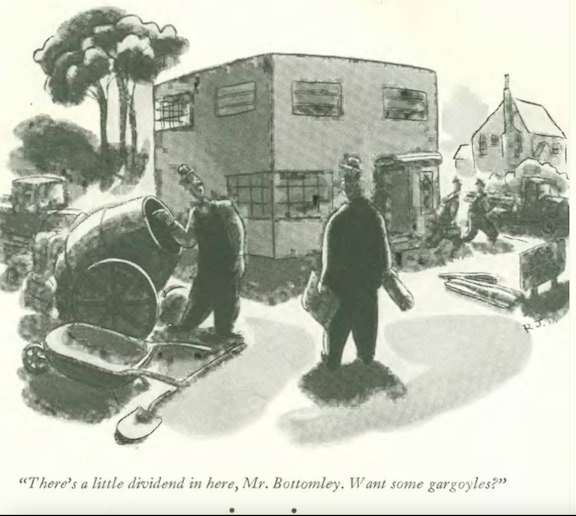
Robert Day offered this observation on modern architecture…

Rea Irvin skewered the puritan set with his latest bird illustration…

William Steig’s precocious “Small Fry” visited Coney Island…

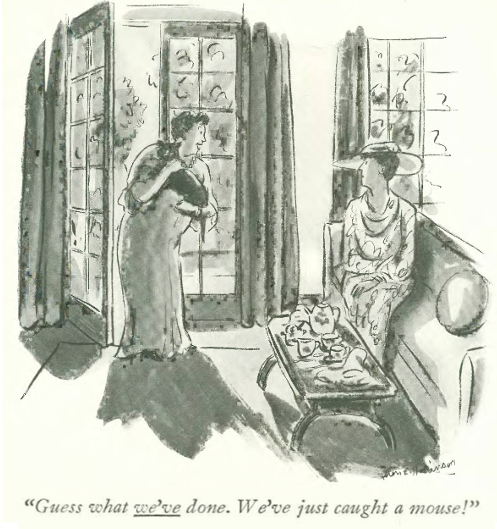
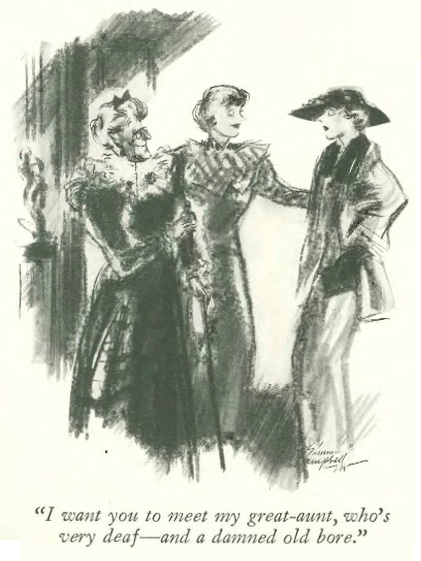
…and we close with E. Simms Campbell, and a sly introduction…

Next Time: Dizzy Drinks…

America’s Sweetheart

Above: A scene from Mary Pickford’s 1922 film Tess of the Storm Country. (Library of Congress)

In today’s celebrity-saturated culture it is difficult to find a parallel to silent film star Mary Pickford, who was dubbed Queen of the Movies more than a century ago. Indeed, during the 1910s and 1920s Pickford was regarded as the most famous woman in the world.

April 7, 1934 cover by Rea Irvin.

Pickford was also known as “America’s Sweet” for her portrayal of gutsy but tenderhearted heroines. In real life she was also a gutsy and shrewd businesswoman who co-founded United Artists in 1919 with Charlie Chaplin, Douglas Fairbanks, and director D. W. Griffith. Commanding a salary only rivaled by Chaplin, her stardom only grew when she married Fairbanks in 1920, forming the first celebrity supercouple; together they ruled Hollywood from their Beverly Hills mansion, Pickfair (apparently staging dull affairs, per the “Profile” excerpt below).

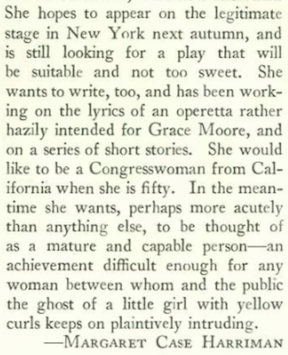
The end of the silent era also put an end to Pickford’s stardom, as well as to her fairytale marriage to Fairbanks. Margaret Case Harriman’s profile of Pickford, simply titled “Sweetheart,” gave readers a glimpse into the decline of a silent superstar. Excerpts:

SINGULAR STAR…Clockwise, from top left, Mary Pickford in a publicity photo, circa 1910; Pickford visits close friend and screenwriter Frances Marion during filming of Straight is the Way (1921); Douglas Fairbanks and Pickford in the early 1920s; Pickford with a movie camera in 1916—in addition to being a shrewd businesswoman, she was also skilled behind the camera. (thehollywoodtimes.today/Time/Library of Congress)

Harriman concluded her profile with some thoughts on Pickford’s future:

THE SOUND BARRIER…With the advent of sound movies Mary Pickford turned to writing books and serving various charities. From left, sharing ice cream with rising star Bing Crosby in 1934; center, Al Frueh’s caricature of Pickford for the profile; Pickford in a 1934 promotional picture supporting The Salvation Army. (Pinterest/Library of Congress)

A note on the profile’s writer, Margaret Case Harriman (1904-1966), who doubtless sharpened her people-watching skills at the Hotel Algonquin (famed birthing ground of the New Yorker), which was owned by her father, Frank Case. Douglas Fairbanks was one of Case’s best friends, and Harriman knew both Fairbanks and Pickford well, since they often stayed at the hotel.

HOME SWEET HOME…Margaret Case Harriman, photographed May 31, 1937 by Carl Van Vechten. Harriman was born in 1904 in room 1206 of the Hotel Algonquin, which was owned by her father, Frank Case. (Philadelphia Museum of Art)

 * * *

Master of Masters

The founder of perhaps the world’s most prestigious golf tournament was an amateur and a working lawyer by profession. When Bobby Jones (1902–1971) co-founded the Masters Tournament in 1934 with investment dealer Clifford Robert, it was called the Augusta National Invitation Tournament (it was Robert’s idea to call it The Masters, a name Jones thought immodest). Jones dominated top-level amateur competition from the early 1920s through 1930—the year he achieved a Grand Slam by winning golf ’s four major tournaments in the same year. However, by the 1934 Jones’s skills began to wane. The New Yorker had little to say about the first Masters (it wasn’t a big deal yet), other than Howard Brubaker making this observation in “Of All Things”…

A SWING INTO HISTORY…Bobby Jones (center) drives during the first-ever Masters Tournament in Augusta, Georgia on March 22, 1934. (augusta.com)

 * * *

From Our Advertisers

Wanna get away? This colorful advertisement beckoned New Yorker readers to take the next boat to sunny Bermuda…

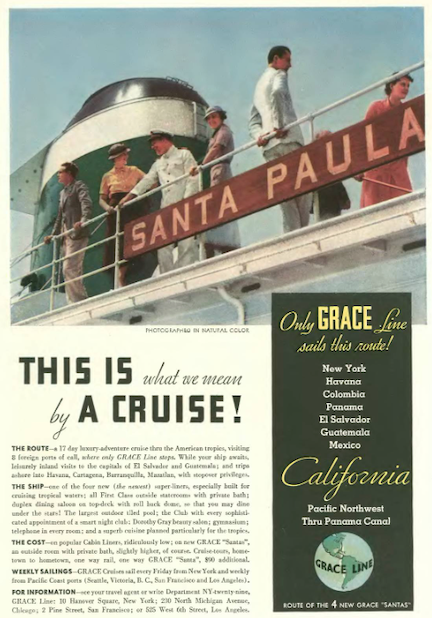
…while the Grace Line offered a southern cruise through the Panama Canal…

…but who needed to travel when you could enjoy a beer that was beloved the world over?…

Mrs. Potter d’Orsay Palmer nee Maria Eugenia Martinez de Hoz was content to stay home in Chicago and smoke a few Camels, apparently…

…we’ve encountered her before—she appeared in a Ponds ad (below) in the Aug. 8, 1931 issue of the New Yorker, where we learned she was wife No. 2 of Potter d’Orsay Palmer, son of the wealthy family of Chicago Palmer House fame…they would divorce in 1937, and the playboy Potter would marry two more times before dying of a cerebral hemorrhage in May 1939—following a drunken brawl in Sarasota, Florida with a meat cutter called Kenneth Nosworthy. Maria Eugenia would remarry and return to her homeland of Argentina to raise a family…

…this ad from Nash looks like a scene from Attack of the 50 Foot Woman, if she had a car to match, that is…

…the Cadillac V-16 was a truly massive automobile, but in contrast to the Nash ad, you can barely see the car as it approaches from the vanishing distance…

E. Simms Campbell got in on the advertising game with this spot that features contrasting images of storm and calm…

James Thurber offered this cartoon on behalf of Heinz soups…

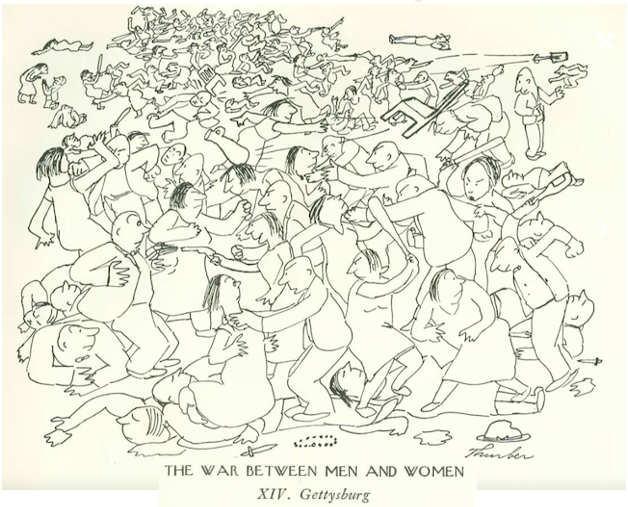
…and Thurber again, as we kick off the cartoons with the ongoing battle…

Adolph Schus made a rare appearance in the New Yorker…according to Ink Spill, he also contributed a cartoon on March 19, 1938, and was editor of Pageant Magazine in 1945… 

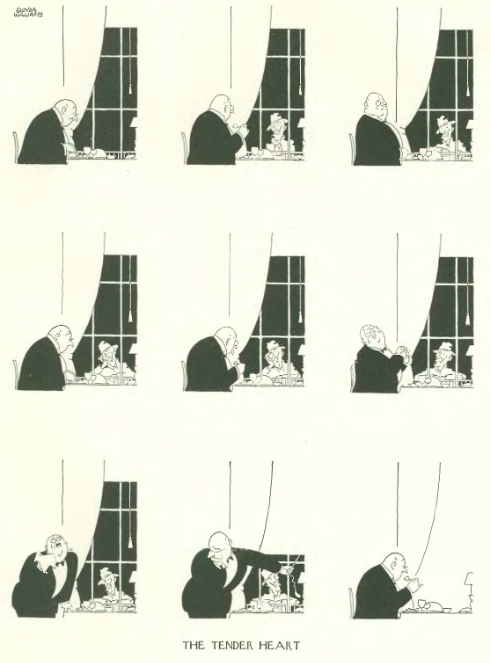
Gluyas Williams looked in on the sorrows of moneyed classes…
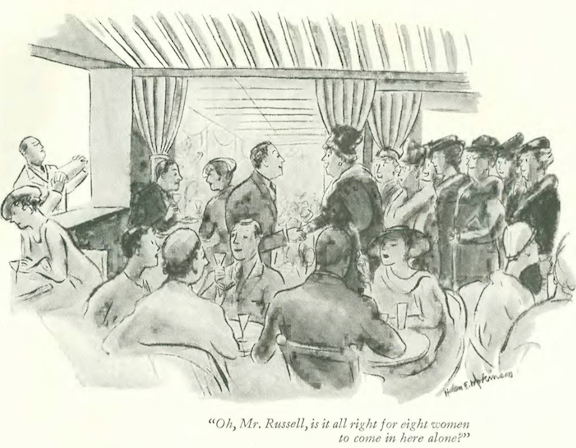
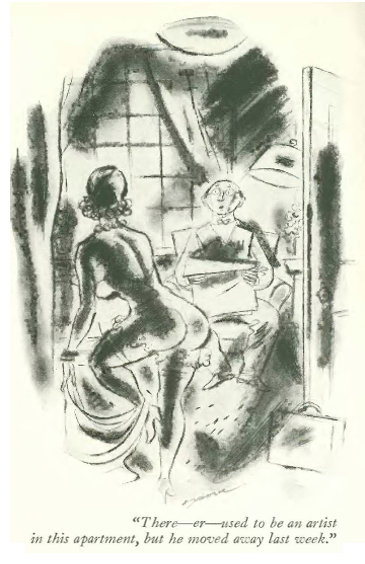
Helen Hokinson’s “girls” were in search of lunch, and propriety…

…and Leonard Dove gave us a renter surprised by something not included in his lease…

…on to April 14, 1934…

April 14, 1934 cover by Harry Brown.

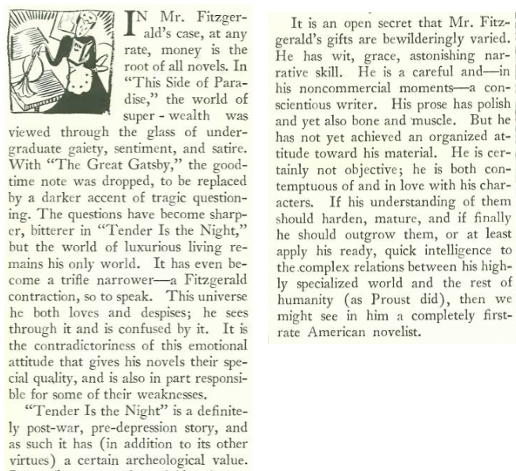
…and book reviewer Clifton Fadiman, who found F. Scott Fitzgerald’s literary gifts “bewilderingly varied”…

A NOT-SO-TENDER RECEPTION…F. Scott Fitzgerald’s status as a symbol of Jazz Age excess hurt his career during the Depression years. Tender Is the Night received mixed reviews, which didn’t help his alcoholism and deteriorating health. When Carl Van Vechten took this photo of Fitzgerald in June 1937, the author had a little over three years to live. (Wikipedia)

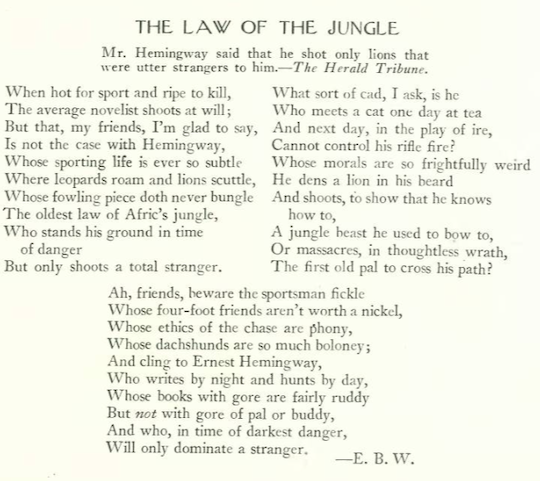
…speaking of F. Scott Fitzgerald, fellow author Ernest Hemingway defended Fitzgerald’s writing, arguing that criticism of his Jazz Age settings stemmed from superficial readings. One then wonders what Hemingway thought of E.B. White’s poetic “tribute” to his big game hunting excursions…

I ONLY SHOOT STRANGERS…Author Ernest Hemingway poses with a lion shot during a safari in Africa in 1934. (MPR News)

 * * *

From History’s Ash Heap

Various reference sources cite “freak shows” as a normal part of American culture in the late 19th to the early 20th centuries, but I have to admit I saw exhibits at state fairs of half-ton humans and conjoined twins when I was a kid in the 1970s (not to mention things in jars at a carnival in St. Louis that should have been given a decent burial).

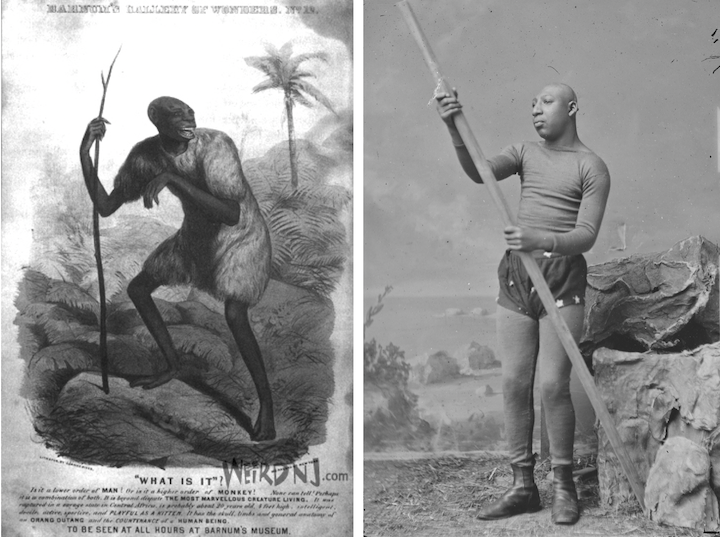
When Alva Johnston penned the first installment of a three-part profile series titled “Sideshow People,” such attractions could be found across the U.S. and Europe—Coney Island featured “Zip the Pinhead,” who was actually William Henry Johnson (1842–1926), one of six children born to former slaves living in New Jersey. His desperately poor parents agreed to allow P.T. Barnum to display him at a museum and at circus performances billed as a missing link, a “What-Is-It” supposedly caught in Africa.

FOR THE SUCKERS…P.T. Barnum exhibited William Henry Johnson as a “wild man”, a “What-Is-It” that subsisted on raw meat, nuts, and fruit, but was learning to eat more civilized fare such as bread and cake. Note the difference between the poster depiction at left and the actual man. Civil War-era photo at right by Mathew Brady’s photography studio in New York City. (National Portrait Gallery)

 * * *

Floating and Sinking

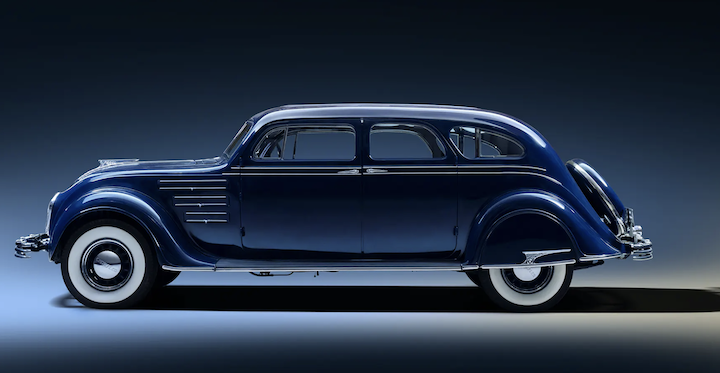
As much as New Yorker cartoonists (and E.B. White) liked to take pokes at Chrysler’s futuristic Airflow, there was much to be admired by the innovations the car represented. Unfortunately, the car’s design was too advanced for the buying public, and despite a big manufacturing and sales push by Chrysler the car was shelved by late 1936.

Writing for Time, Dan Neil noted the Airflow’s spectacularly bad timing. “Twenty years later, the car’s many design and engineering innovations — the aerodynamic singlet-style fuselage, steel-spaceframe construction, near 50-50 front-rear weight distribution and light weight—would have been celebrated. As it was, in 1934, the car’s dramatic streamliner styling antagonized Americans on some deep level, almost as if it were designed by Bolsheviks.”

SEEMED LIKE A GOOD IDEA. A restored 1934 Airflow. (Hagerty Media)

* * *

More From Our Advertisers

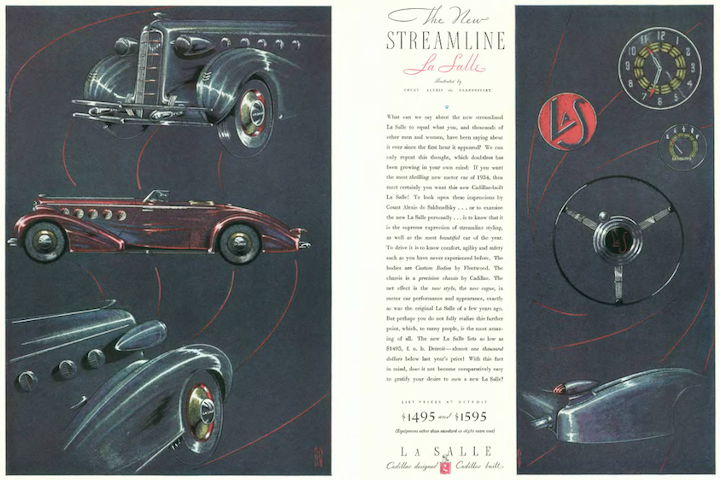
Maybe the buying public wasn’t ready for a car with a sloping hood and embedded headlights, but the folks at Cadillac were eager to unveil concepts for the new streamlined La Salle, which retained the familiar bullet headlights so as not to alarm consumers too much…

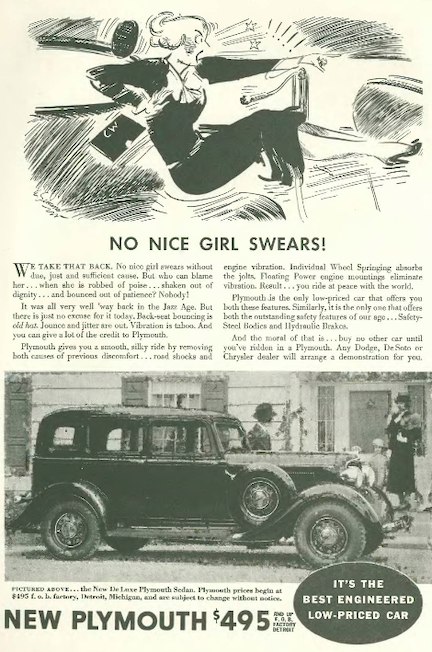
…and here’s a lovely image from Goodyear…I assume this woman is merely resting in a rumble seat, since this pose would not be possible above 25 mph…

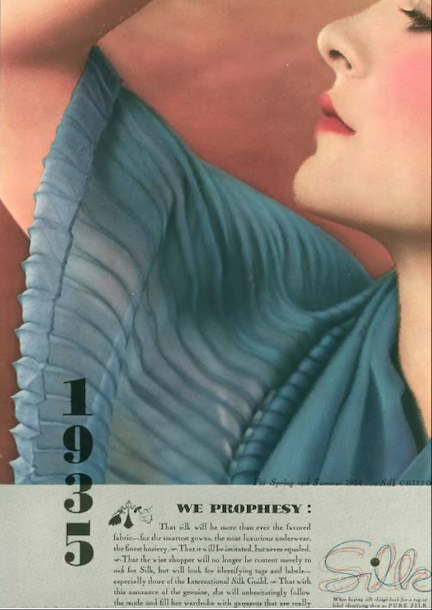
…full-bleed color ads were coming into their own, as demonstrated by this stylish entry from the purveyors of silk garments…

…on the other hand, our well-heeled friends at Ponds stuck with the tried and true copy-heavy approach…here they offer the flawless features of Anne Gould (1913–1962), granddaughter of Gilded Age robber baron Jay Gould

…R.J. Reynolds continued their campaign to convince us that Camels bring success to the average Joe and the champion athlete…

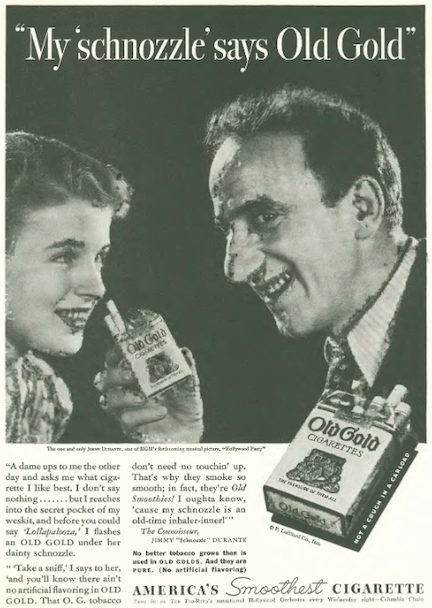
…the makers of Old Gold opted for the super creepy approach, asking entertainer Jimmy Durante to shove a pack of smokes into the face of what appears to be a teenager…

…here’s another ad from World Peaceways, reminding us of the futility of war…

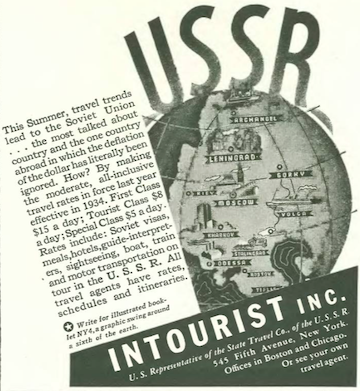
…speaking of futility, you could visit the USSR, which doubtless took great pains to steer tourists away from mass starvation in Ukraine and mass executions of Stalin’s many “enemies”…

…while folks in the USSR were worshiping Lenin and Stalin, Americans were rightly transfixed by the miracle of Kellogg’s Corn Flakes…a producer of industrial and advertising films, Castle Films would become a subsidiary of Universal and would go on to make a line of science-fiction and horror films including The Wolf Man, The Mummy, and Creature from the Black Lagoon.

…on to our cartoons, Alain took on the recent MoMA exhibition of “Machine Art”…

…and speaking of machine art, George Price was to latest cartoonist to take a crack at the Airflow…

James Thurber offered this bit of spot art for the opening pages…

…and returned to a somber scene on the battlefield of the sexes…

Next Time: Model Citizens…