Home Sweet Motohome

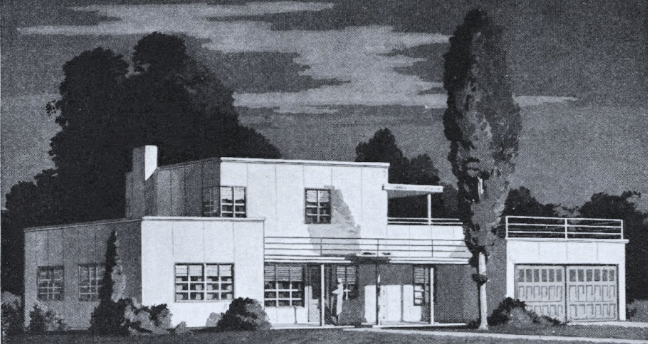
Morris Markey thought he was getting a glimpse of the future when he attended an exhibit of “machines to live in” at New York’s Grand Central Palace.

March 16, 1935 cover by Constantin Alajalov.

The Great Depression created a housing shortfall in the U.S. of nearly two million units, so many idled architects and builders turned to industrialized housing as a way to boost the building industry. In “A Reporter At Large,” Markey described his encounter with one type of “machine to live in”––the Motohome.
The idea of pre-fab living wasn’t exactly new in 1935, originating in the 1920s with the German Bauhaus school and with notables such as Swiss architect Le Corbusier.

NOT THRILLED WITH FRILLS…Charles-Édouard Jeanneret (1887-1965), better known as Le Corbusier, stated in 1923 that “a house is a living machine.” He believed the world had evolved beyond the need for decorative frills, and that homes and furnishings should reflect their functions. Top left, Corbu’s 1929 Villa Savoye in Poissy, France; at right, his 1947-52 Unité d’habitation de Marseille. (Fondation Le Corbusier/Architectural Digest/Le Corbusier World Heritage)

Markey correctly surmised that the American twist on Le Corbusier’s vision was largely driven by big corporations, and in the case of the Motohome, by General Electric.
GET YOUR MOTO RUNNING…Clockwise, from bottom left, New York’s Grand Central Palace; the Eggiman House in Madison, Wisconsin, a 1936 Motohome listed in the National Register of Historic Places; Long Island Motohome featured on a brochure; Popular Mechanics article on the Motohome. A common wall “core” was prefabricated with all kitchen and bath fixtures, as well as the HVAC system. (Wikipedia/makeitmidcentury.com/books.google.com)

 * * *

Strange and Wonderful

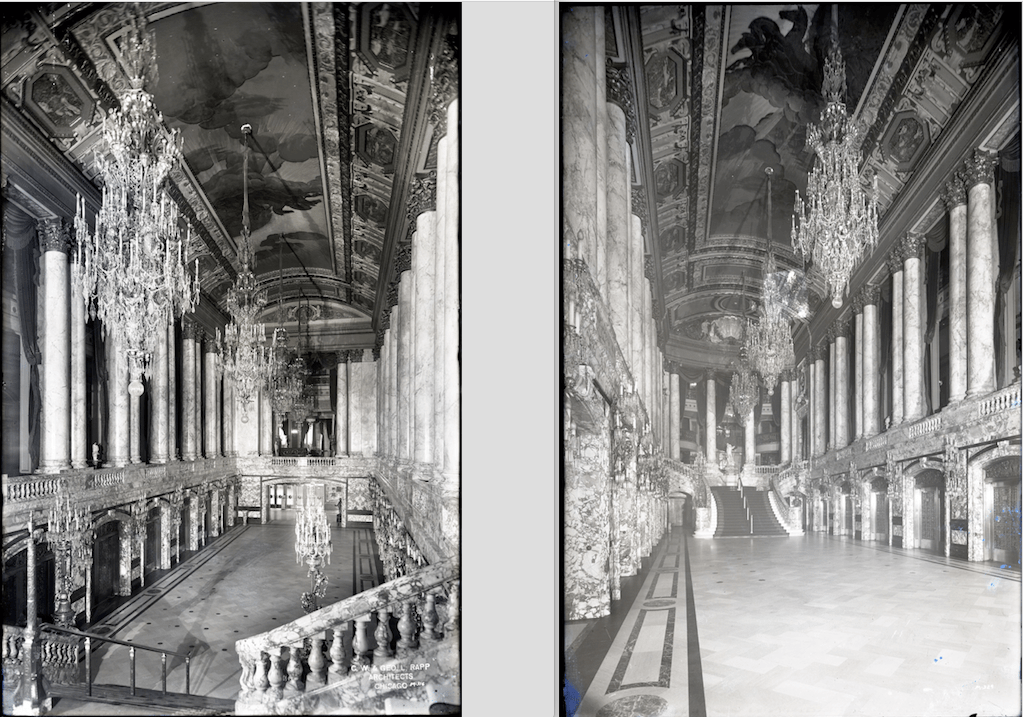
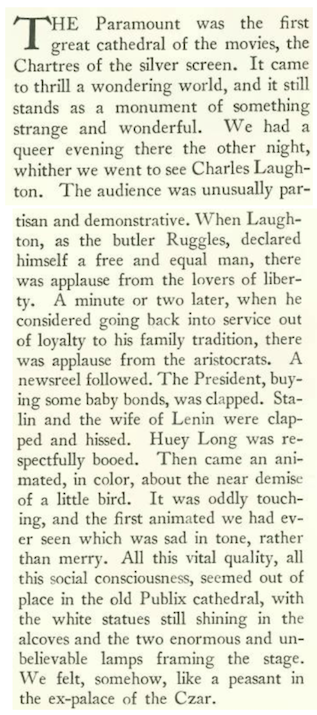
That is how E.B. White described the 3,664-seat Paramount Theatre, which opened on 43rd and Broadway in 1926. After nine years White was still in awe of its palatial trappings. In his “Notes and Comment,” White offered some thoughts after an evening at the movies.
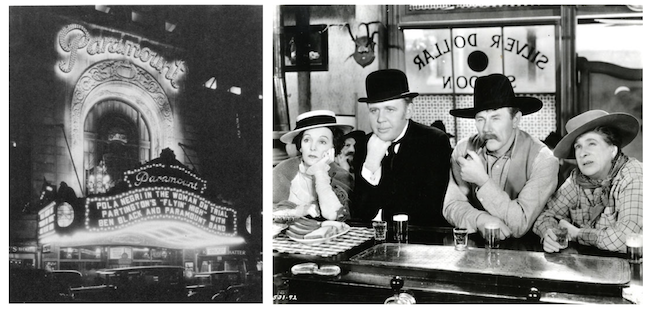
CINEMA GLORY DAYS…E.B. White visited the Paramount Theatre to take in Charles Laughton’s hit film, Ruggles of Red Gap. From left, Zasu Pitts, Laughton, Charles Ruggles and Maude Eburne in Ruggles. (nyc.gov/TCM)
PALACE FOR THE PICTURES…The Paramount Theatre’s Grande Hall featured a 75-foot-long ceiling mural by artist Louis Grell above the Italian marble-lined entrance. In 1966, after a run of the James Bond film Thunderball, the Paramount was closed for good and later gutted and turned into retail and office space. (Louis Grell Foundation)

 * * *

Bad Guys

Andrew Mellon’s tax fraud troubles were sandwiched between the woes of a fascist bromance in Howard Brubaker’s “Of All Things”…Mellon would soon be dead, Adolf Hitler would lie his way around the Brits, and Benito Mussolini would struggle to inspire Italian women to produce his “army of tots”…
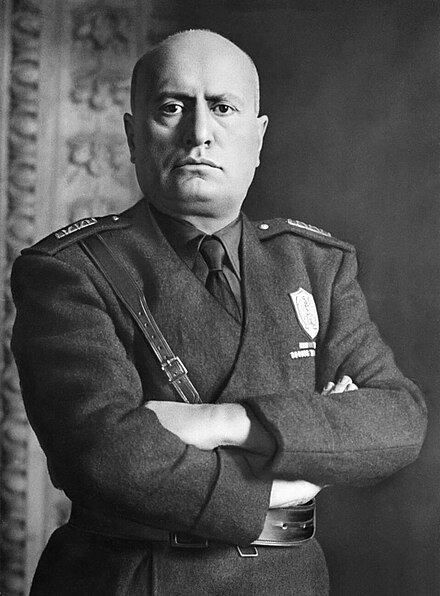
NOT TONIGHT, WE HAVE A HEADACHE…Little wonder fascist dictator Benito Mussolini couldn’t inspire a baby boom. (Wikipedia)

 * * *

Zoom Zoom

In his “Motors” column, writer “Speed” looked in on Sir Malcolm Campbell (1885-1948), who was attempting to break the 300-mph mark at Daytona in his 2,500-horsepower Blue Bird.
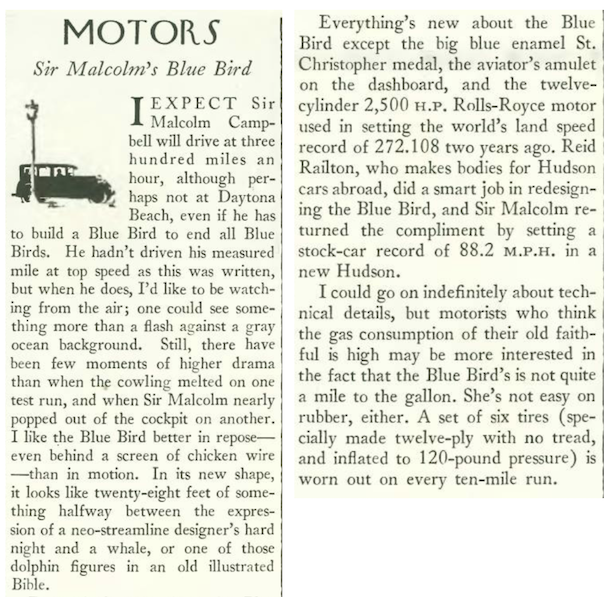
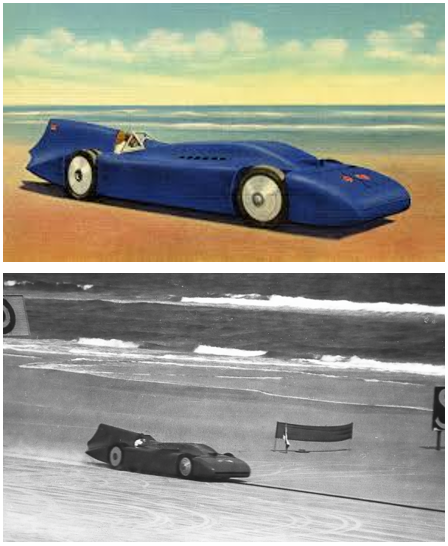
BLUE STREAK…Sir Malcolm Campbell’s bid for a land speed record surpassing 300 mph began at Daytona Beach in March 1935 in his Campbell-Railton Blue Bird, powered by a 2,500 hp supercharged Rolls-Royce V-12. He managed to hit 276 mph (combined runs in each direction), but conditions at the beach (bottom photo) left him short of his goal. He found a smoother, longer run at Utah’s Bonneville Salt Flats in September, where he would average 301.337 mph (484.955 km/h) in two passes to set the new record. (floridamemory.com/oldmachinepress.com)
ONCE IS NOT ENOUGH…Sir Malcolm Campbell MBE was a British racing motorist and motoring journalist. He gained the world speed record on land and on water several times. He was also one of the few land speed record holders of his era to die of natural causes. (Wikipedia)

 * * *

From Our Advertisers

For ninety bucks you could get this swell pajama suit and matching robe (plus headdress) at Henri Bendel, the perfect ensemble for having a leisurely smoke after a day facing the world…For more than 100 years, Henri Bendel’s flagship and only store was located at 10 West 57th Street…it closed in 2018…
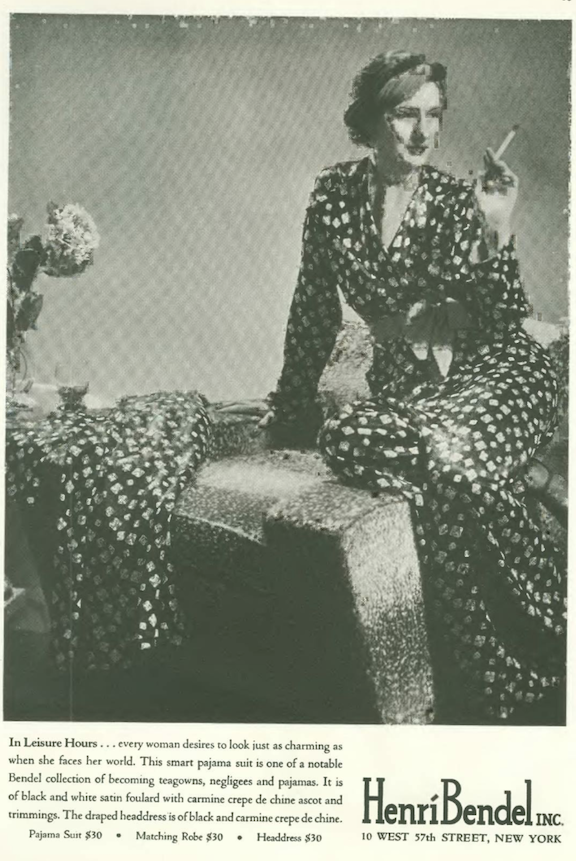
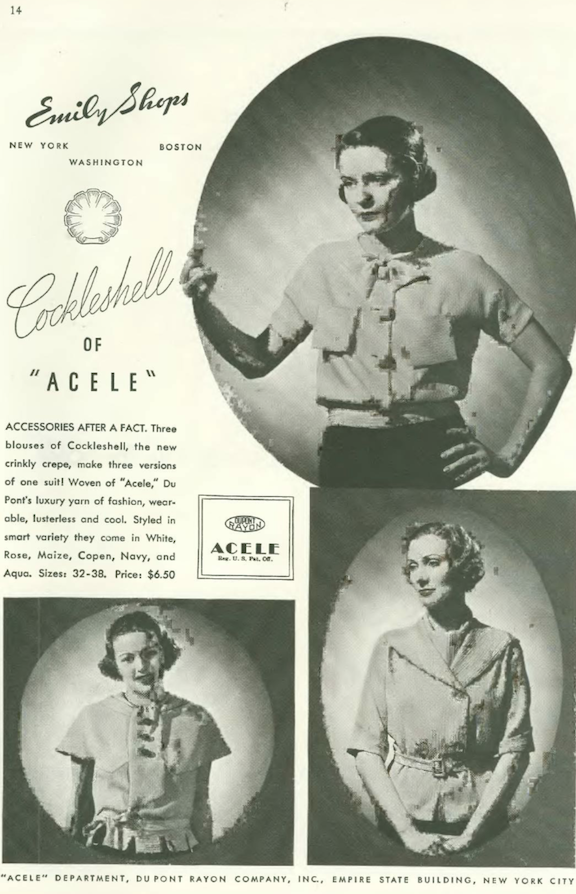
…I doubt the woman in the Bendel ad would have been interested in clothes made with Acele…it was without question that the uppers only wore clothes derived from living things…
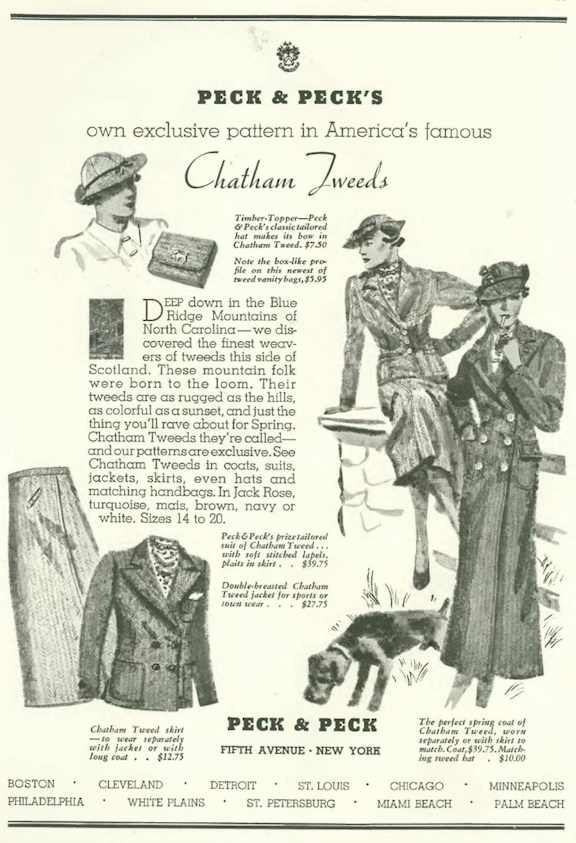
…this Anglophilic Peck & Peck ad is notable for its condescending reference to the “mountain folk” in Appalachia who “were born to loom”…
…while we are on the subject, check out this ad for Grace Cruises…this was a common theme in mid-century travel advertising, Westerners dressed in their Sunday best while having a gander at the colorful natives…
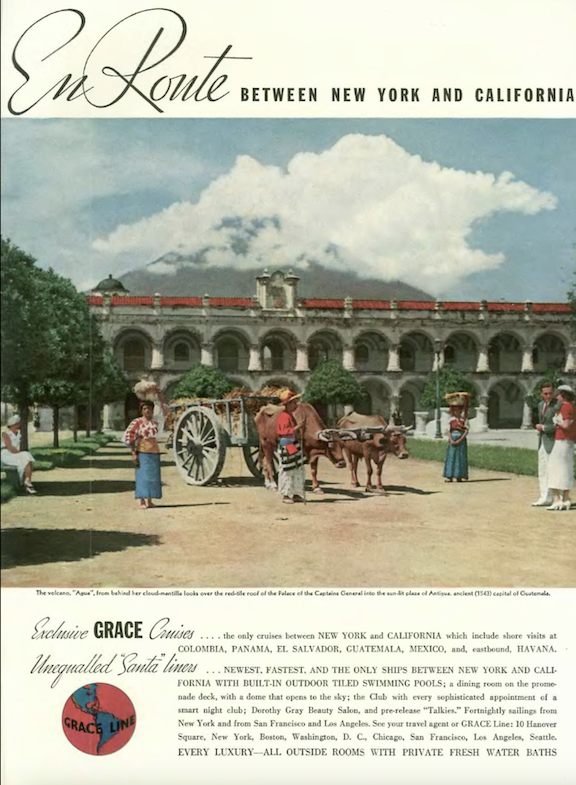
…who are just part of the scenery…

…all four of the automobile ads in this issue come from long-gone companies…the luxury carmaker Packard made beautiful, quality cars that outsold Cadillacs up until 1950, but competition from the Big Three (GM, Ford, Chrysler) plus Packard’s decision in 1954 to buy failing Studebaker led to Packard’s demise four years later…

…a more successful merger took place in 1954 between Nash…
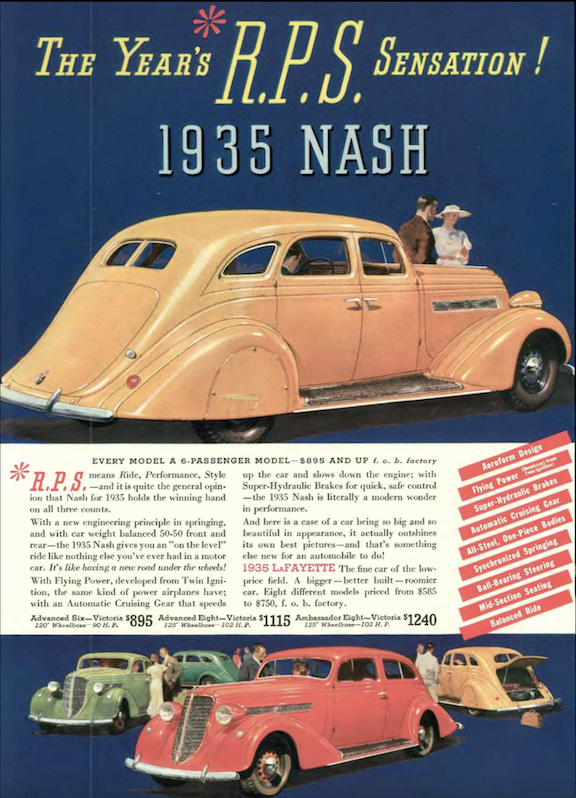
…and Hudson, the two forming the new American Motors Corporation…
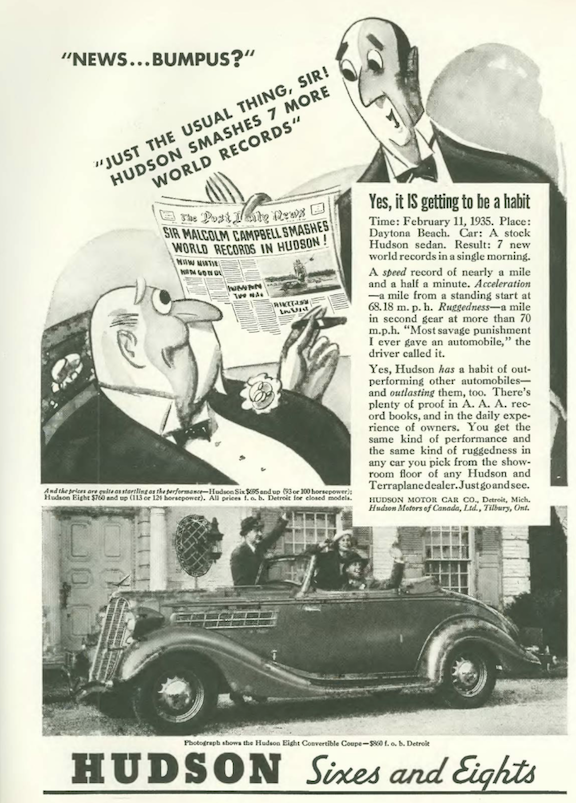
…contrary to this ad’s tagline, everything was actually going down for Hupmobile, which would go out of business in 1939…
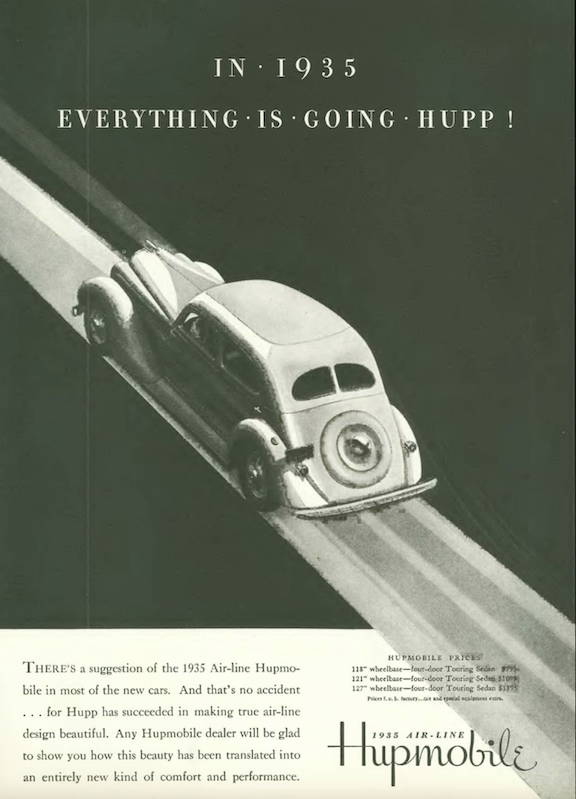
…the makers of College Inn Tomato Juice Cocktail apparently thought an angry old “Duchess” would boost sales…she first appeared in the Feb. 23 issue…
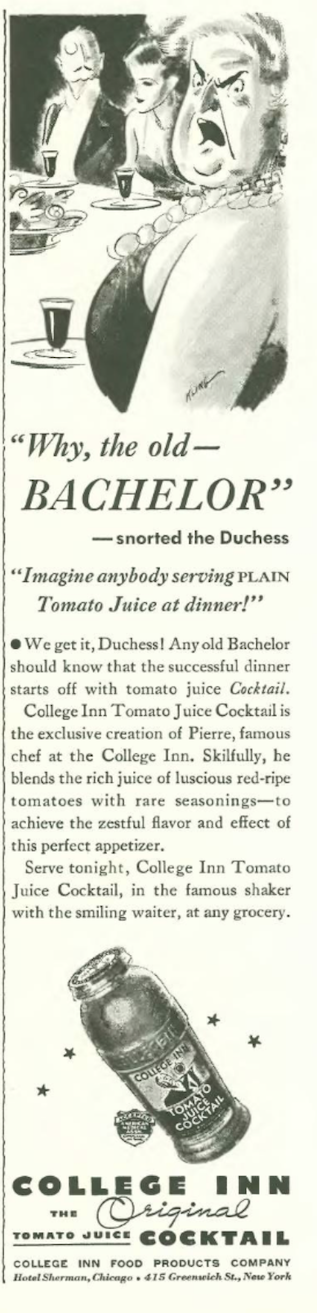
…in the March 16 issue she appears to be psychotic, threatening, “I’ll teach her not to serve PLAIN tomato juice before dinner!” Will she break the glass on the table and lunge at her host (the old WITCH) with a glass shard?…Stay tuned…

…better to calm down and have a Guinness, which, by Jove, was affordable and good for you!…

New Yorker cartoons are also good for you, and we begin with Al Frueh and this taxing illustration at the bottom of page 4…
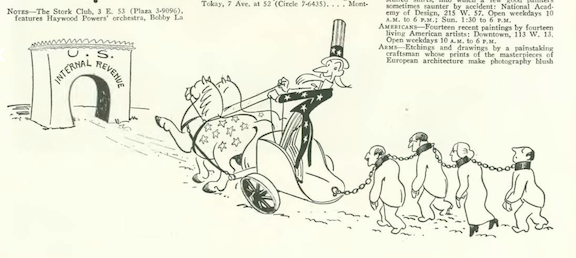
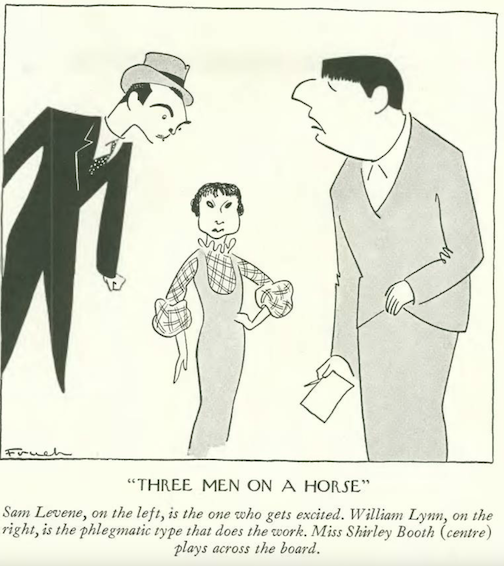
…Frueh again, for the theater review section…in the center is Shirley Booth, known to Baby Boomers as the star of the old TV series Hazel (1961-66)…
…Booth was much more than a sitcom star, achieving the Triple Crown of Acting––an Academy Award, two Primetime Emmy Awards and three Tony Awards…
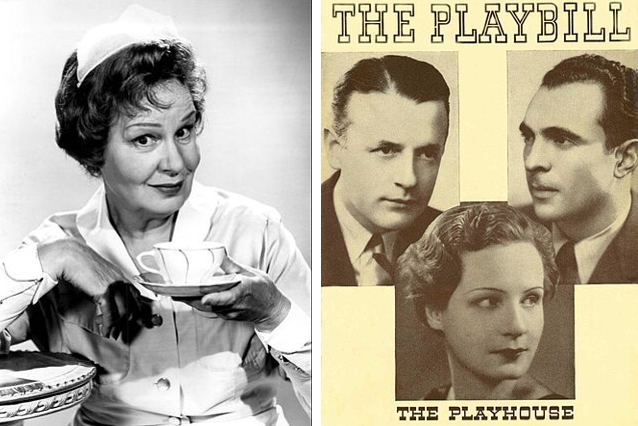
ACTING CHOPS…Shirley Booth (1898-1992) as Hazel in 1962; on the cover of the 1935 Playbill featuring Three Men on a Horse. (Wikipedia)

…we continue with Daniel ‘Alain’ Brustlein, and a term of endearment from someone well known to the police…

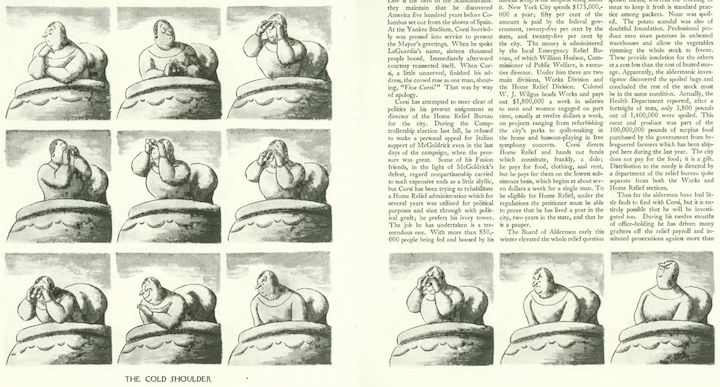
William Steig took up two pages to give one opera patron the cold shoulder…
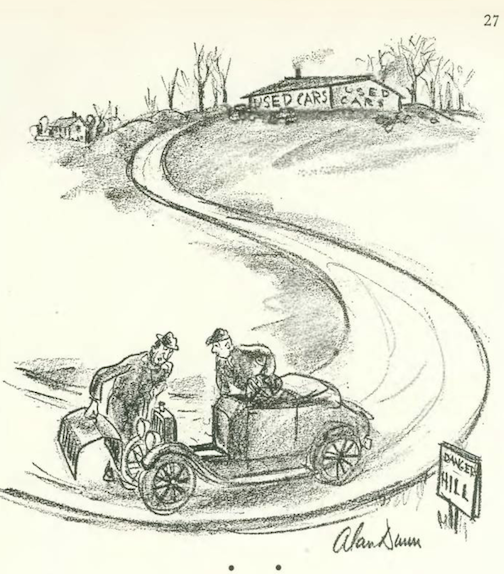
Alan Dunn cautioned against car dealers perched on high hills…
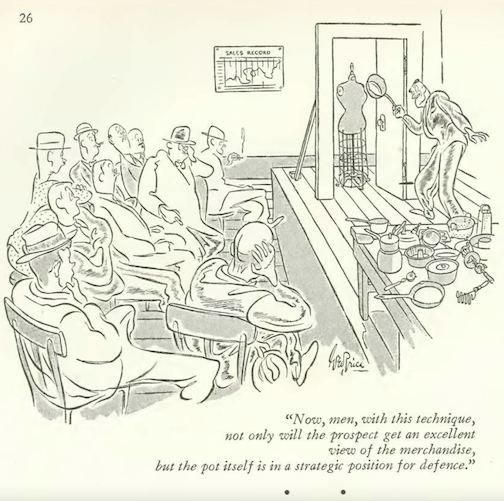
George Price examined the finer points of salesmanship…
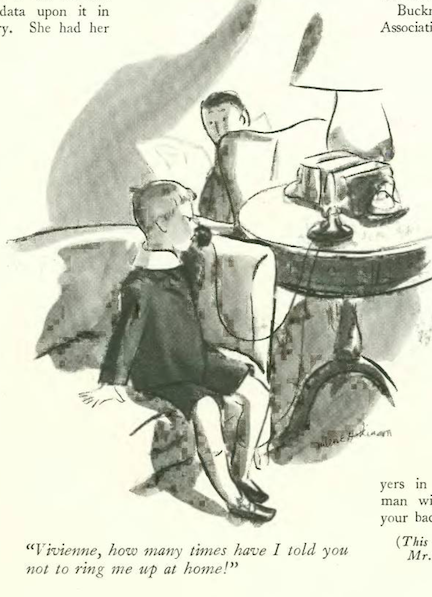
Helen Hokinson headed for the high seas…

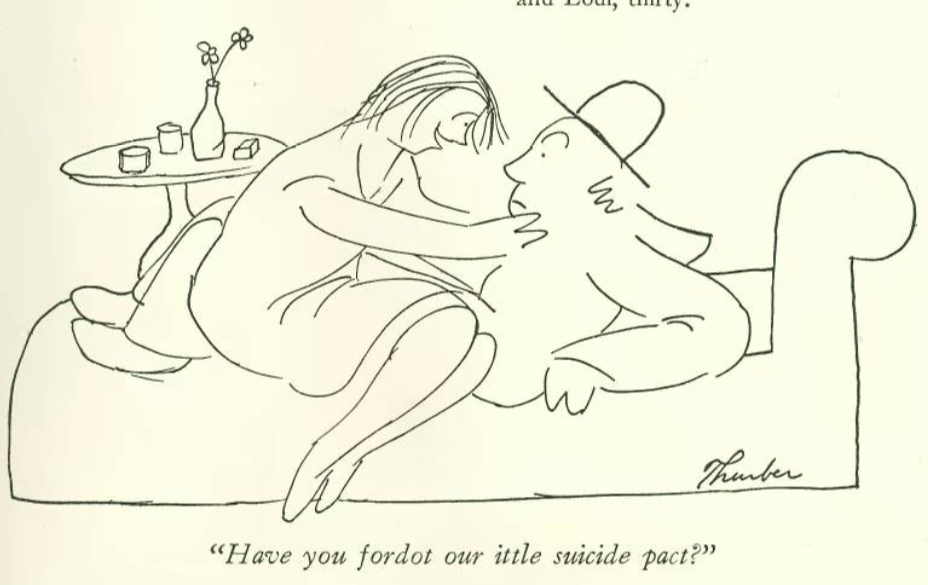
…and we close with an all-time classic from James Thurber

Next Time: Something Frivolous…
The Milne Menace

Dorothy Parker was no fan of A. A. Milne of “Winnie-the-Pooh” fame, and neither was her dear friend Robert Benchley, the latter having had the misfortune of reviewing Milne’s latest Broadway play, They Don’t Mean Any Harm, which opened on Feb. 23, 1932, and closed (mercifully, one gathers) after one week.

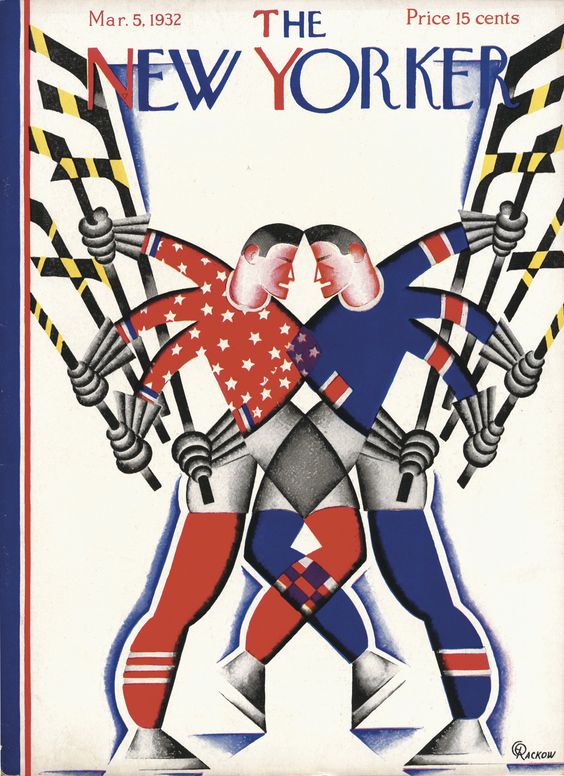
March 5, 1932 cover by Leo Rachow commemorated the US Vs. Canada hockey match at the 1932 Winter Olympics at Lake Placid, NY. Canada won its fourth consecutive Olympic gold by narrowly edging the US (silver) in total points.

Parker, as readers may recall, famously ridiculed Milne’s The House at Pooh Corner in The New Yorker, beginning with a quote from the book: “‘Well, you’ll see, Piglet, when you listen. Because this is how it begins. The more it snows, tiddely-pom’ – ‘Tiddely what’ said Piglet. ‘Pom,’ said Pooh. ‘I put that to make it more hummy.’ And it is that word ‘hummy’, my darlings, that marks the first place in The House at Pooh Corner at which Tonstant Weader Fwowed up” (Parker wrote her book reviews under the pseudonym “Constant Reader”).

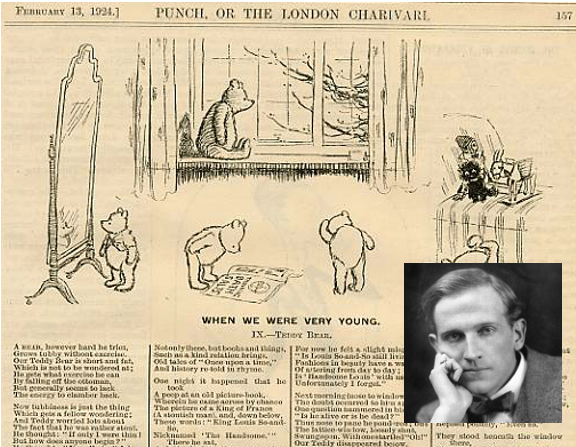
As for Benchley, he fondly recalled Milne’s earlier work, when he wrote silly verse and essays in the British humor magazine Punch, but apparently Milne’s downfall began when he published some “Pooh” poetry in the Feb. 13, 1924 issue…

WELL, DISNEY LIKED IT…A. A. Milne (1882–1956) pictured in his younger days (inset) joined the humor magazine Punch in 1906 and served as its assistant editor. After his son was born in 1920, he compiled a collection of poems for children, When We Were Very Young, illustrated by Punch cartoonist E. H. Shepard. An excerpt from the Feb. 13, 1924 issue appears above.  (Pinterest)

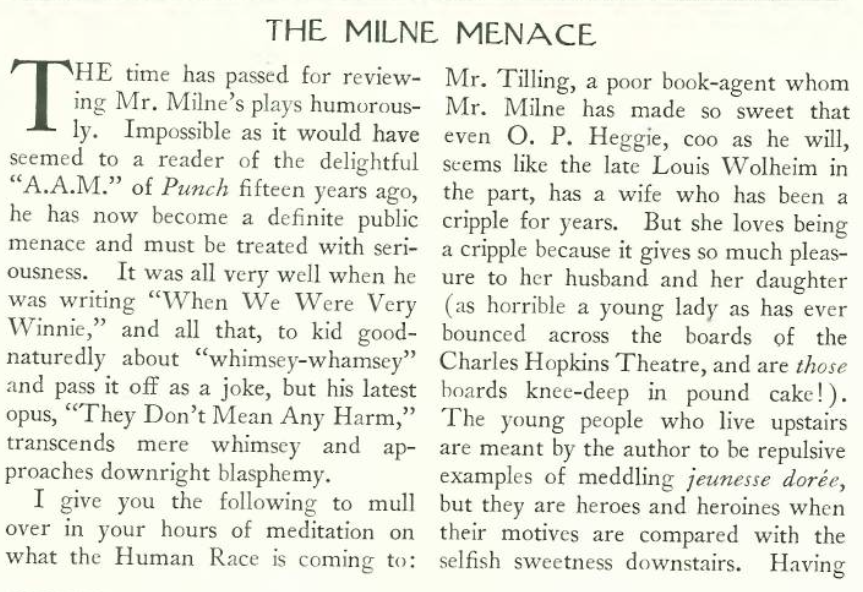
Parker, of course, did not think much of Milne as a children’s author, and Benchley also found him wanting (more than once) as a playwright. Here is the first part of Benchley’s scathing review of They Don’t Mean Any Harm, which was presented at the Charles Hopkins Theatre on 49th Street.

…Benchley’s evisceration continues on the left column…

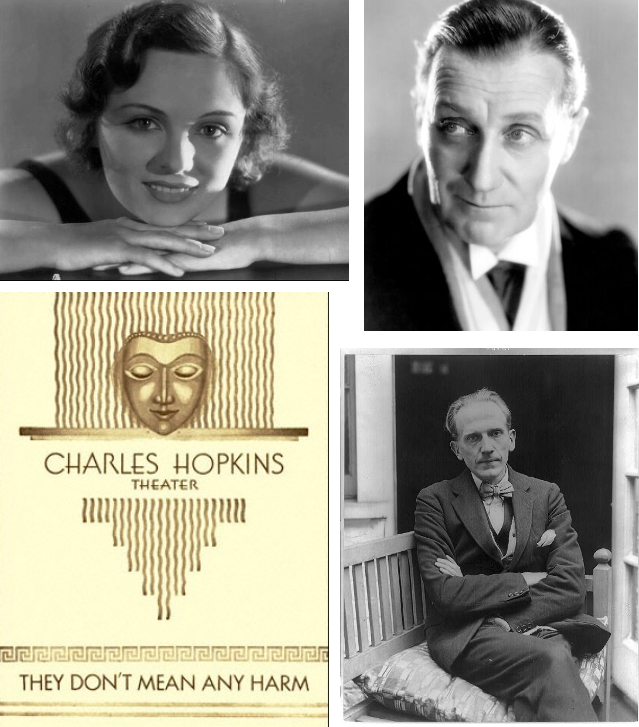
NO ACTORS WERE HARMED IN THE MAKING OF THIS PLAY…They Don’t Mean Any Harm closed after just a week (15 performances), but it would give rising young star Marion Burns (top left) her debut on a New York stage. Also appearing was veteran actor O.P. Heggie, who had to dial up the schmaltz to play a character so sweet (the role of Mr. Tilling, a humble, poor book agent) that it achieved just the opposite effect for critic Robert Benchley, who wrote he had never seen “a fouler character than Mr. Tilling”; pictured at bottom, A. A. Milne circa 1920s, and the cover of the program. (imdv.com/RKO Radio Pictures/Wikipedia/Playbill)

 *  *  *

Meanwhile, Beneath the City…

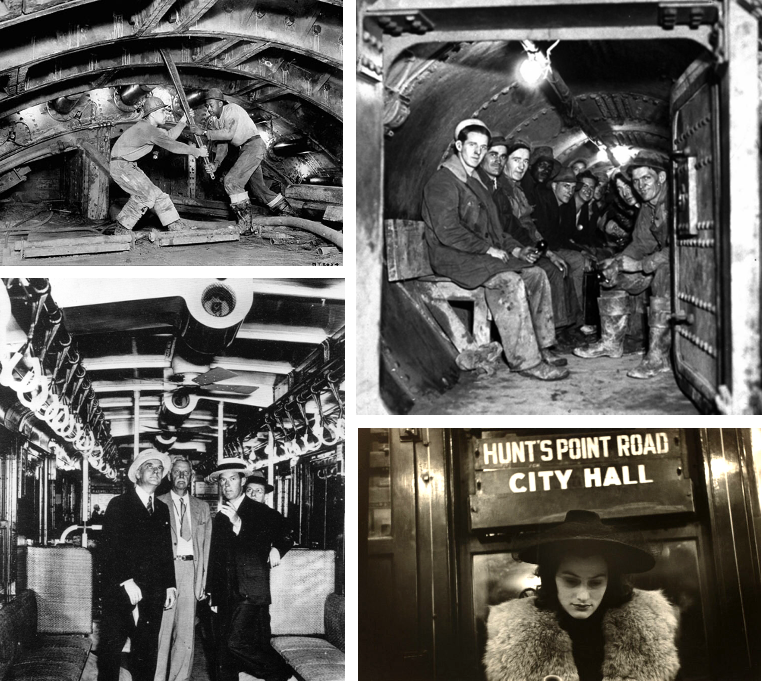
Eric Hodgins (author of the popular novel Mr. Blandings Builds His Dream House) filed a two-part feature on the New York subway system, marveling at the complexities of a transportation network that daily served millions while under constant development. Excerpts:

IN THE NAME OF PROGRESS…Today’s sandhogs (tunnel diggers) work in much safer conditions than in the 1930s, but some of the technology described in Eric Hodgin’s article was still around in 2015 (see below). Top photos, left, sandhogs tightening a bolt on a tunnel connection; right, subway tunnelers who worked under the East River are shown in a decompression chamber. Bottom photos, left, city officials in 1933 showing off a ventilation system installed to cool down trains (but air-conditioning was still decades away); and right, a 1938 Walker Evans photo from his subway series. (Daily News/public delivery.org/ephemeralnewyork.wordpress.com)

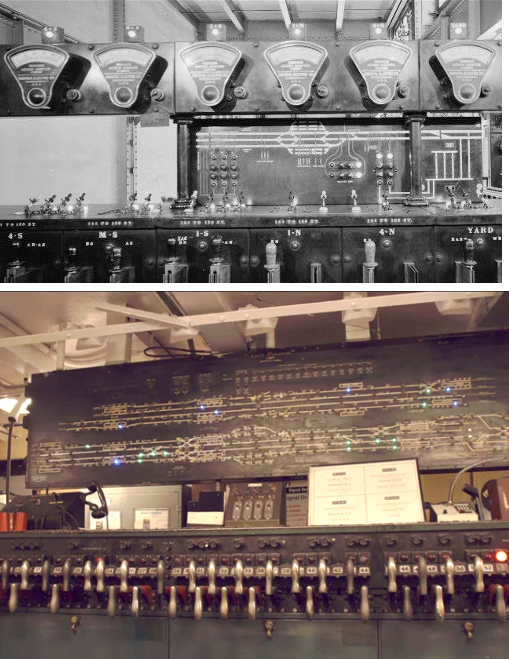
Six years ago Business Insider described the “100-year-old technology” still used by the Metropolitan Transportation Authority (MTA), and you can see that in 2015 (bottom photo) the switches and control panels were similar to ones in the 1930s (top photo). Also note the old handset (possibly bakelite) at left center of the 2015 photo.

(businessinsider.com)

I am not including these images to ridicule the MTA, but rather to admire the hard work, technological prowess and creativity of our forebears. Improving these vast, complex systems takes time and money, and especially money, lots of it.

 *  *  *

Coming Up For Air

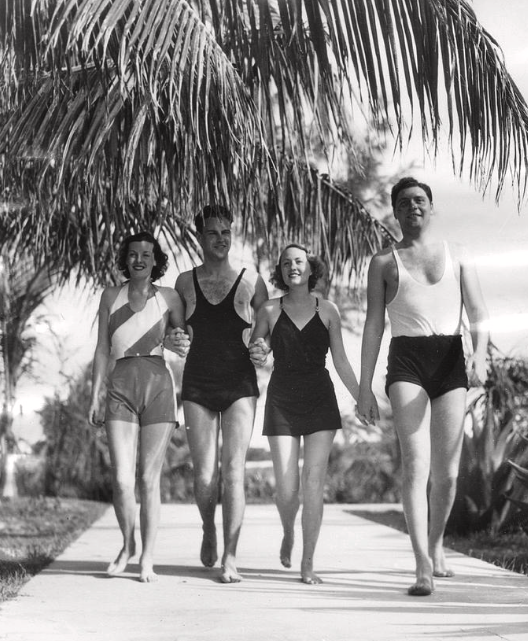
Stuffy, crowded subway cars were largely unknown to those New Yorkers who still had means in the 1930s, and who could escape the city’s late winter doldrums and flee to sunny Bermuda. The “Out of Town” column offered some travel tips:

WISH YOU WEREN’T HERE…These fortunate New Yorkers enjoyed Bermuda’s sunny climes in 1932. (New York Historical Society)

*  *  *

From Our Advertisers

We begin with advertisement for the lovely Hotel Pierre, still a landmark of luxury in Manhattan. In 1932, however, the Depression forced the new hotel (opened in 1930) into bankruptcy. And so, we read this ad with tinge of sadness for Charles Pierre and his short-lived dream…

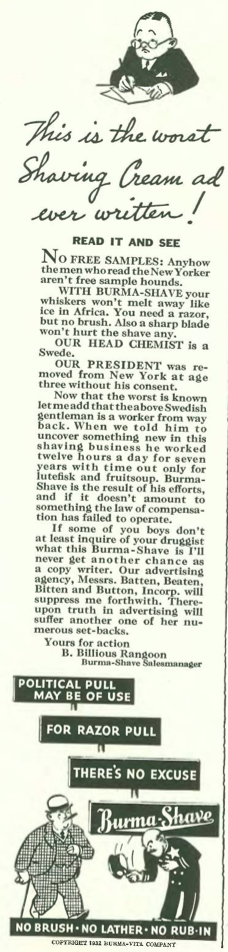
…one thing the Depression didn’t destroy was the need to shave one’s whiskers, and this is the first time (at least that I have noticed) that Burma Shave referenced its famous roadside jingles in a New Yorker ad…

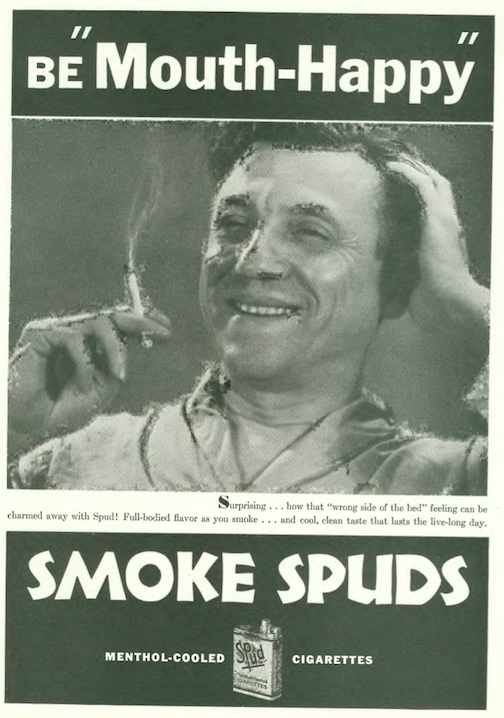
…the concept of being “mouth-happy” was the tagline used by the makers of Spud menthol cigarettes, who encouraged smokers to light up even before they got out of their PJs…
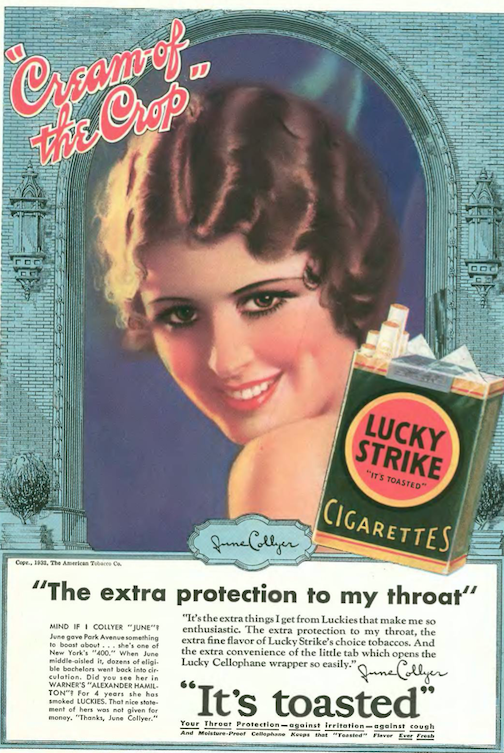
…Lucky Strike, meanwhile, stuck with their “toasted” claims, and to images of fame, youth and beauty to suggest that your looks as well as your throat would benefit from their product…
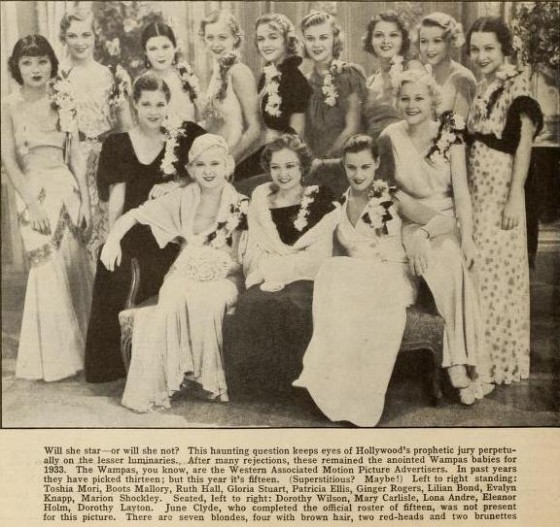
…the woman in the Lucky ad, June Collyer (1906-1968), was one of 13 women selected as “WAMPAS Baby Stars” in 1928. During the 1920s and early 30s, the Western Association of Motion Picture Advertisers (WAMPAS) honored 13 or so young actresses each year whom they believed to be on the threshold of movie stardom (In the 1940s Collyer’s brother “Bud” Collyer provided the voice of Superman on the radio). While I digress, here is a photo of the WAMPAS Baby Stars of 1932:

WAMPAS Baby Stars of 1932. Back row: Toshia Mori, Boots Mallory, Ruth Hall, Gloria Stuart, Patricia Ellis, Ginger Rogers, Lilian Bond, Evalyn Knapp, Marian Shockley. Seated in front row: Dorothy Wilson, Mary Carlisle, Lona Andre, Eleanor Holm and Dorothy Layton (June Clyde is not pictured).

…on to our cartoons, we go from the glamorous to the everyday with William Steig

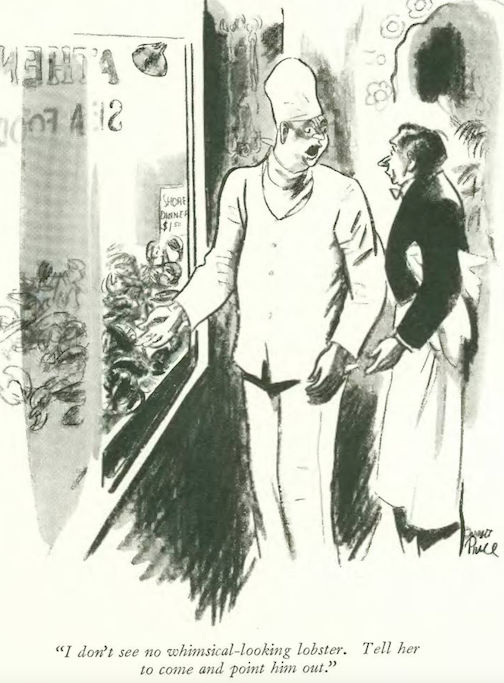
…and Garrett Price

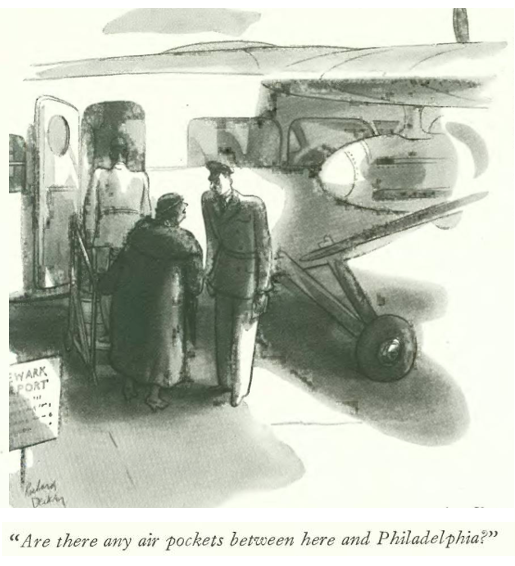
Richard Decker suggested someone might be in for a bumpy ride…

…and Decker again, illustrating the perils of another form of transportation…

Barbara Shermund gave us a wealthy matron eager for show and tell…

…and Peter Arno looked in on one of his ancient walruses, pining for the olden days…

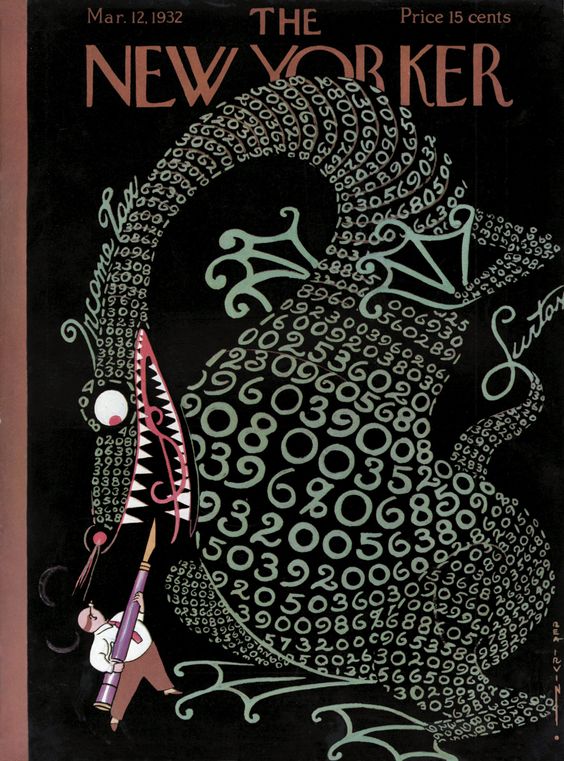
…on to the March 12, 1932 issue…

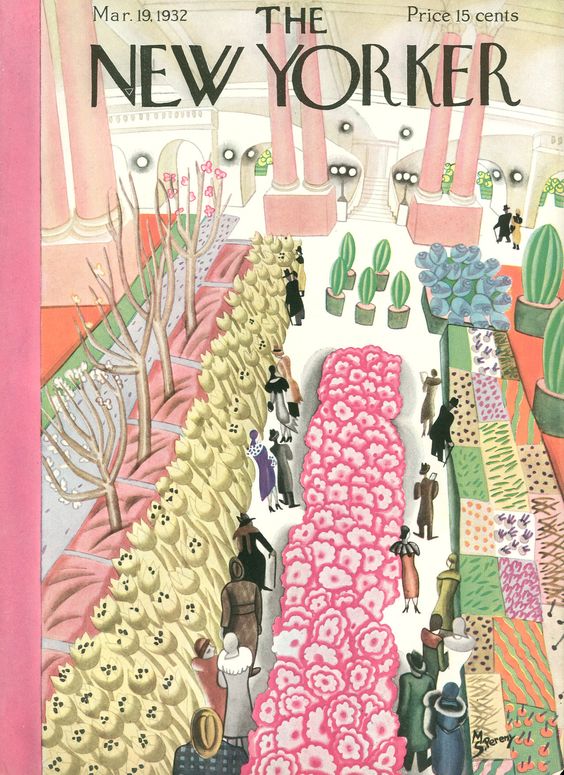
March 12, 1932 cover by Rea Irvin.

…and some insights into a variety of world events, large and small, by E.B. White:

GR-R-ATE was the word used by one newsreel announcer to describe Malcolm Campbell’s land speed record of 253.96 miles per hour, achieved on the sands of Florida’s Daytona Beach on Feb. 24, 1932. E.B. White wanted to know why this achievement was so gr-r-ate. (floridamemory.com)

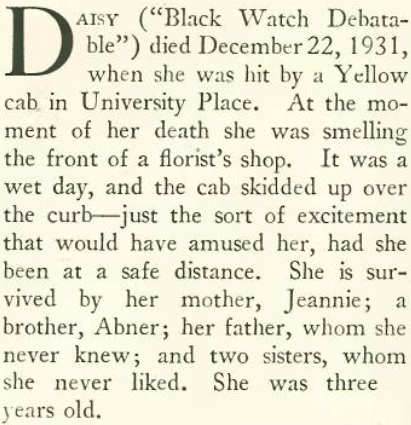
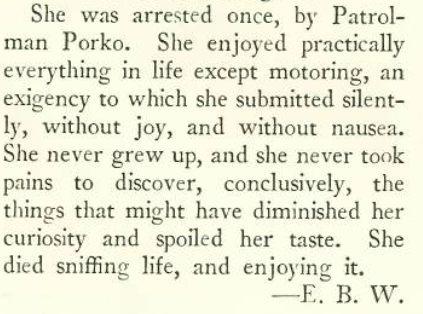
And we have White again, who we all know loved dogs, and especially Daisy, his beloved Scotty. When she was killed by a swerving taxicab, he wrote a beautiful remembrance in the New Yorker. Here are the first and last paragraphs.

TRAVELING COMPANION…Katharine White with Daisy on a leash in New York City, 1931. In the pram is baby Joel. (brainpickings.org)

One more by White, this time admiring the heavenly beauty of a GE refrigerator in the window of a Rex Cole store on East 21st Street:

KING OF COLD…The Eagle Building (right) on East 21st held the Rex Cole showroom admired by E.B. White. To get some idea of Rex Cole’s theatrical fridge displays, the image at left is of a Bronx storefront. (MCNY/Daytonian in Manhattan)

 *  *  *

From Our Advertisers

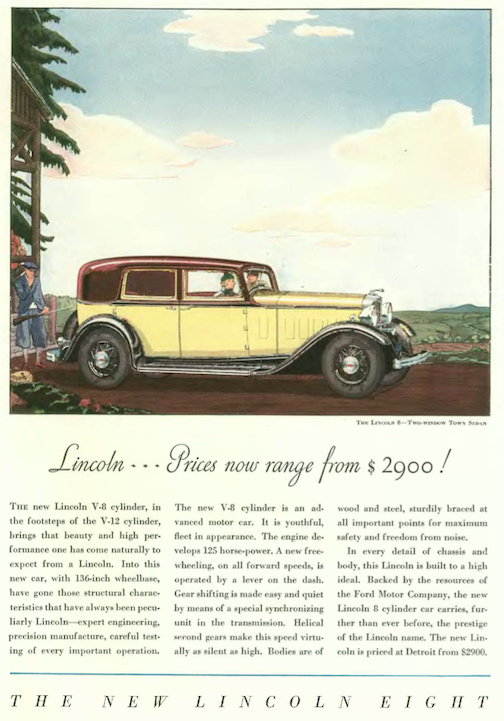
With the Depression still deepening, even the rich needed a break, so Lincoln rolled out an eight-cylinder model, at $2,900 still too steep for most folks…

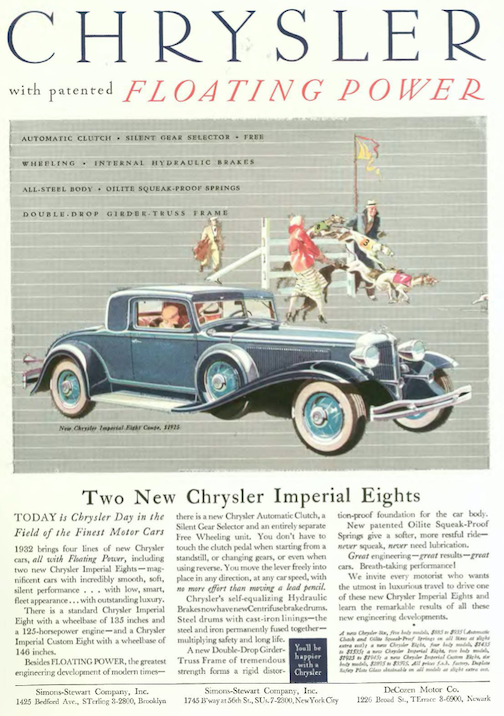
…and priced competitively with the Lincoln, the Chrysler Imperial Eight looked a lot more fun…

…and we have another stylish and very modern Coty advertisement by American fashion illustrator Ruth Sigrid Grafstrom…

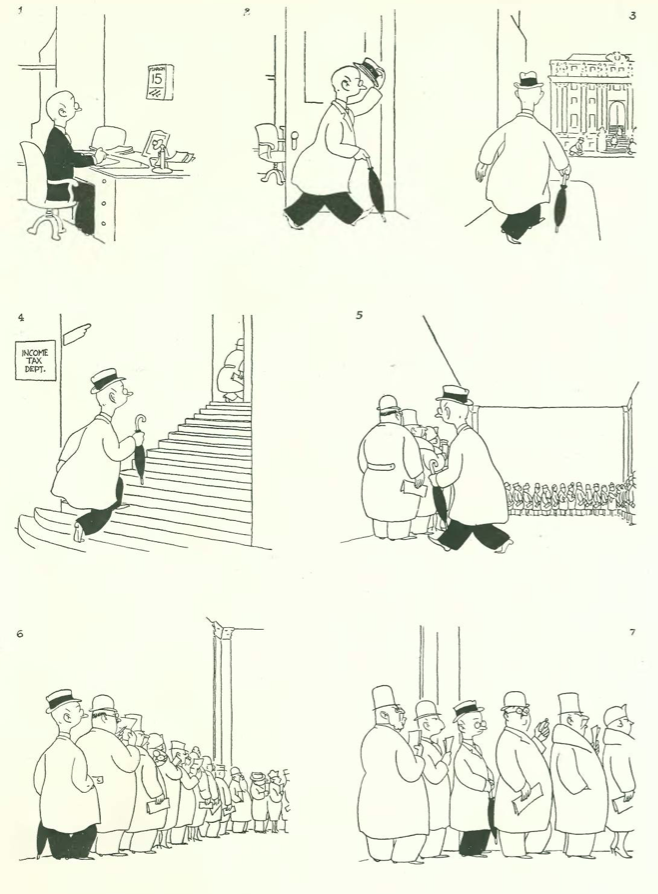
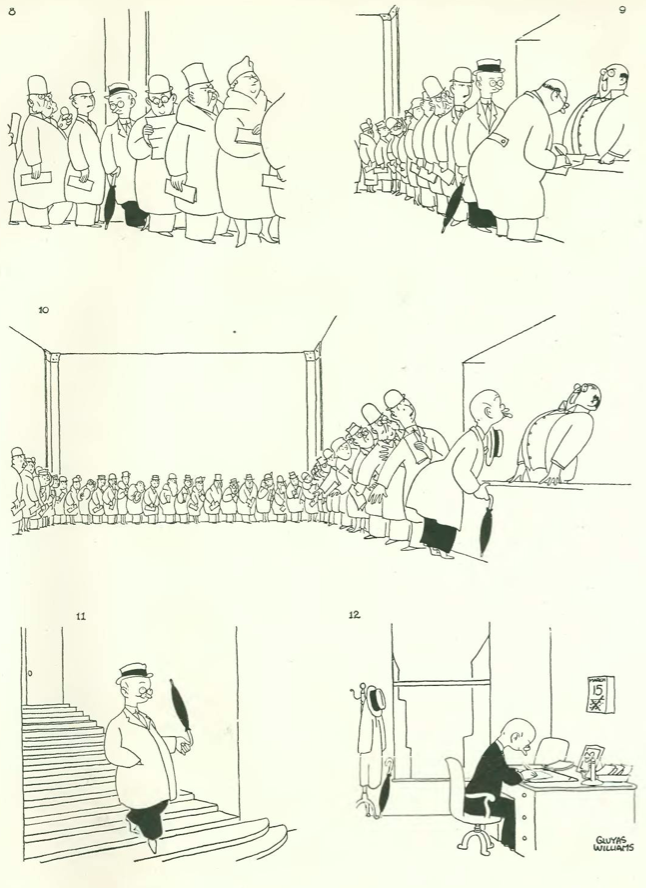
…on to cartoons, Gluyas Williams demonstrated that sometimes words alone don’t have the same effect as a simple gesture…

dd

Garrett Price found a hapless fellow on a train to nowhere…

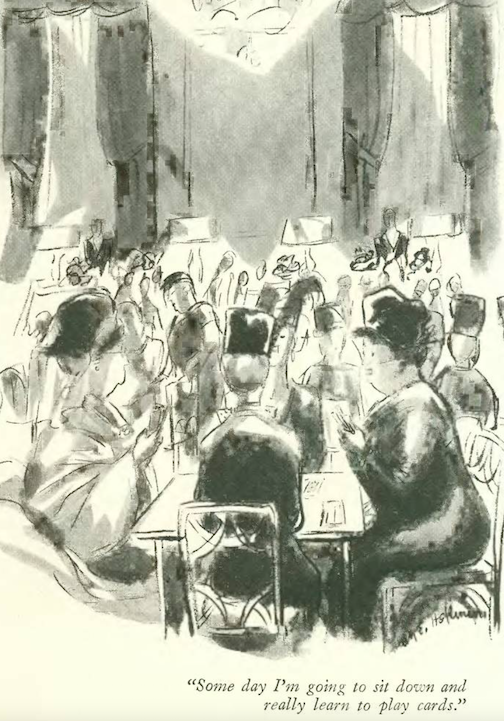
Helen Hokinson’s “girls” were going through the motions at a bridge tournament…

…and Helen again with the lives and loves of our youth…

…and we close with James Thurber, his war between the sexes taking a new twist…

Next Time: The Final Curtain…