The Wahoo Boy

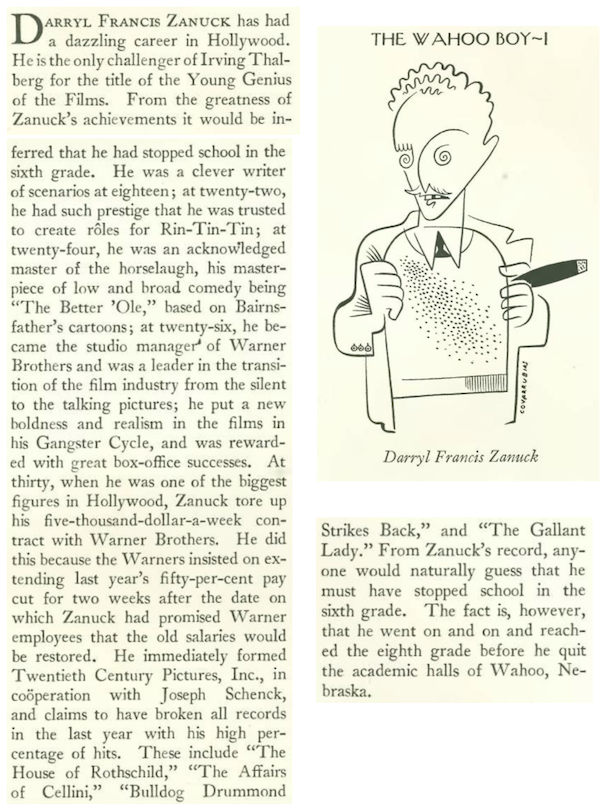
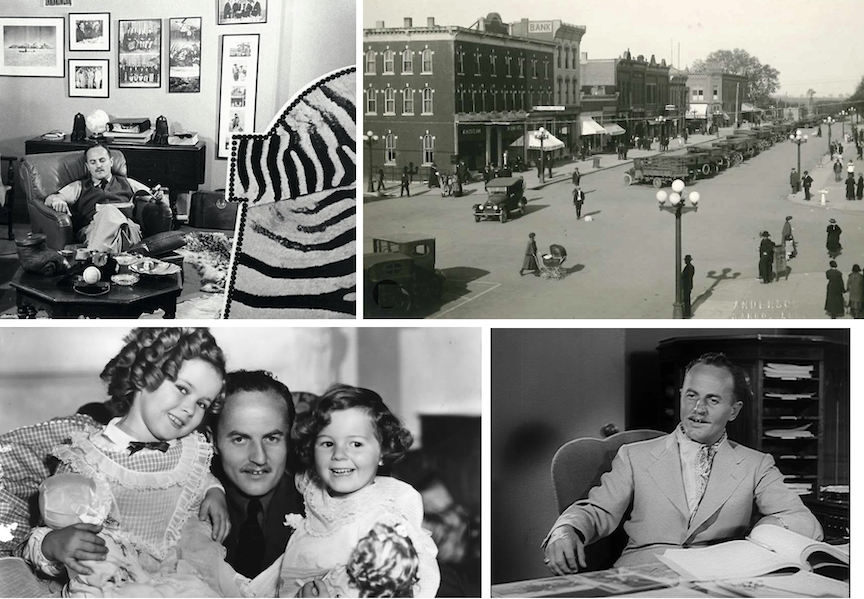
Darryl F. Zanuck (1902–1979) was an unlikely Hollywood mogul. Born in a small Nebraska town with an unusual name (both his and the town), Zanuck dropped out of school in the eighth grade, apparently bitten by the acting bug during a brief childhood sojourn in Los Angeles.

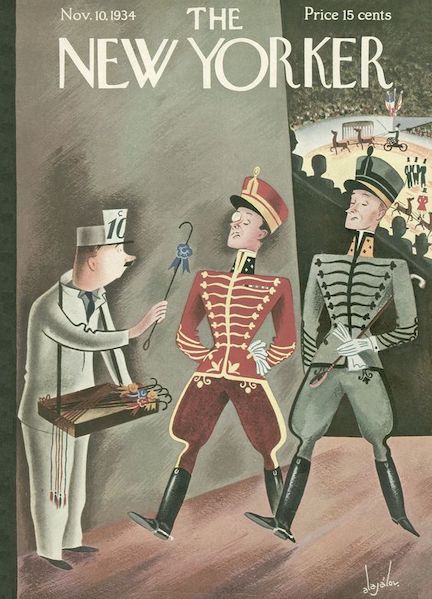
Nov. 10, 1934 cover by Constantin Alajalov.

In the first part of a two-part profile, Alva Johnston began to probe the mystery of the boy from Wahoo who would rise to become one of Hollywood’s most powerful studio executives.

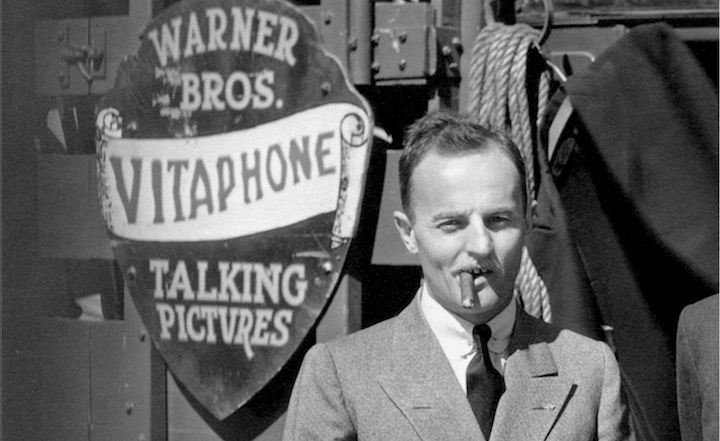
MAKING OF A MOGUL…Clockwise, from top left: Darryl F. Zanuck relaxing with trophies from his hunting excursions, circa 1940 (detail from a Margaret Bourke-White photo); Zanuck’s home town, Wahoo, Nebraska, 1920s; screenshot from a trailer for The Grapes of Wrath, 1940; Zanuck with child star Shirley Temple (left) and his first-born daughter Darrylin (mother was silent-screen actress Virginia Fox) in the 1930s. (Robin Pineda Zanuck via The Hollywood Reporter/Saunders County Historical Society/Wikipedia)

Johnston took a quick look at Zanuck’s humble origins, including his first encounter with the film industry at age eight. There must have been something in the water at Wahoo, a town of just 2,100 residents when Zanuck was born. Other Wahoo notables contemporary to Zanuck included Nobel Prize laureate and geneticist George Beadle, Pulitzer Prize–winning composer Howard Hanson, and Hall of Fame baseball player Sam Crawford, among others.

After writing dozens of scripts for Warner Brothers (including many for their popular canine star, Rin Tin Tin), in 1933 Zanuck would leave Warner and form 20th Century Pictures with Joseph Schenck. By the time Johnston penned the New Yorker profile, 20th Century had risen to be the most successful independent movie studio of its time.

 * * *

One-Way Street

It goes without saying that the interwar years of the 20th century were a time of extreme foment; Bolsheviks, communists, anarchists, fascists and other political agitators seemed to be constantly at each other’s throats as Europe prepared for its second act of self-annihilation. In the middle of it all was the Balkans, its many feuds always simmering near the boiling point.

After the assassination of Archduke Franz Ferdinand in 1914 (which, along with other factors, triggered World War I), you would have thought Europeans would have abandoned the practice of parading dignitaries through crowded streets. In 1934 they were reminded of its risks.

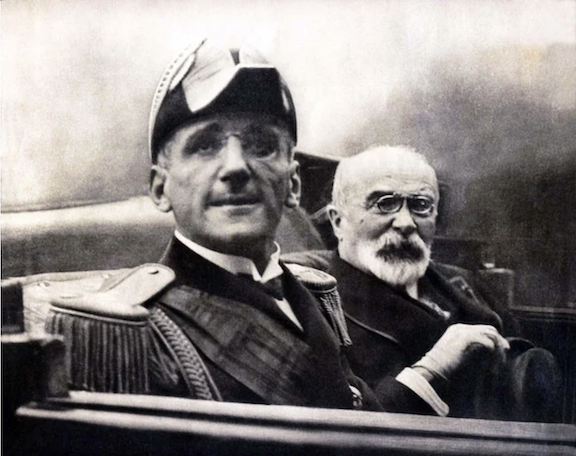
That year was King Alexander I of Yugoslavia’s thirteenth on the throne, but his time was running short in a country constantly beset by civil war. Fearing that the German Nazis and Italian Fascists would take advantage of the instability, on Oct. 9, 1934 French Foreign Minister Louis Barthou invited Alexander I to Marseille to sign a Franco-Yugoslav solidarity agreement. While Alexander and Barthou were being slowly driven in an open car through the city’s streets, a Bulgarian gunman, Vlado Chernozemski, stepped from the crowd, hopped onto the car’s running board, and shot Alexander along with his chauffeur. Barthou also died in the melee, killed by a stray bullet fired by French police (three women and a boy in the crowd were also fatally wounded by stray police bullets). Struck down by a policeman’s sword, Chernozemski was subsequently beaten to death by the enraged crowd. It was one of the first assassinations to be captured on film.

Paris correspondent Janet Flanner offered some thoughts about the incident in her “Paris Letter.” Excerpt:

WHAT A DIFFERENCE A DAY MAKES…King Alexander I of Yugoslavia (left) and French Foreign Minister Louis Barthou just moments before an assassin fired two fatal shots into the king. Barthou would die an hour later from a stray police bullet that would enter his arm and sever an artery. (Still image from YouTube video)

 * * *

The Traffic Machine

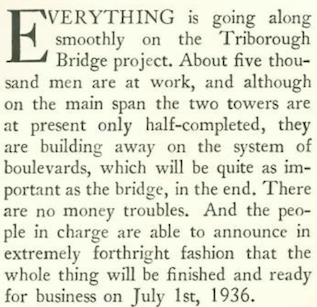
In his “A Reporter at Large” column, Morris Markey sang praises for the Triborough Bridge project, which was making visible progress on the massive public work that commenced in 1930. City officials had dreamed for years about a project that would at once connect Manhattan, Queens and the Bronx, but it wasn’t until the power broker Robert Moses got involved as the Triborough Bridge and Tunnel Authority chairman that things really started to move. Moses biographer Robert Caro wrote that “Triborough was not a bridge so much as a traffic machine, the largest ever built.” A brief excerpt:

As noted by Markey, the “people in charge” were forthright about the bridge’s completion date of July 1, 1936. And they kept their word. The bridge was substantially complete by June 1936, and would be dedicated on July 11, with Moses serving as master of ceremonies.

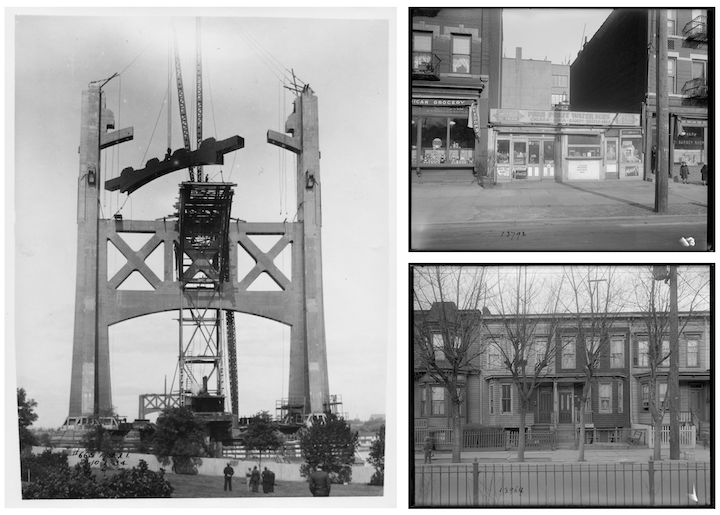
MAKE WAY FOR THE GIANTS…City engineers had been kicking around plans since 1916 to build bridges to connect Manhattan, Queens and the Bronx, but the massive Triborough Bridge project finally got off the ground in 1930. By 1934 the bridge’s Queens tower (left) would loom over Ward’s Island, visible in the background; at right, views of buildings in Astoria (Hoyt Ave.) that were slated for demolition to make way for the bridge, photographed by Eugene de Salignac in early 1931. (MTA Bridges and Tunnels Special Archives/NYC Municipal Archives)

 * * *

From Our Advertisers

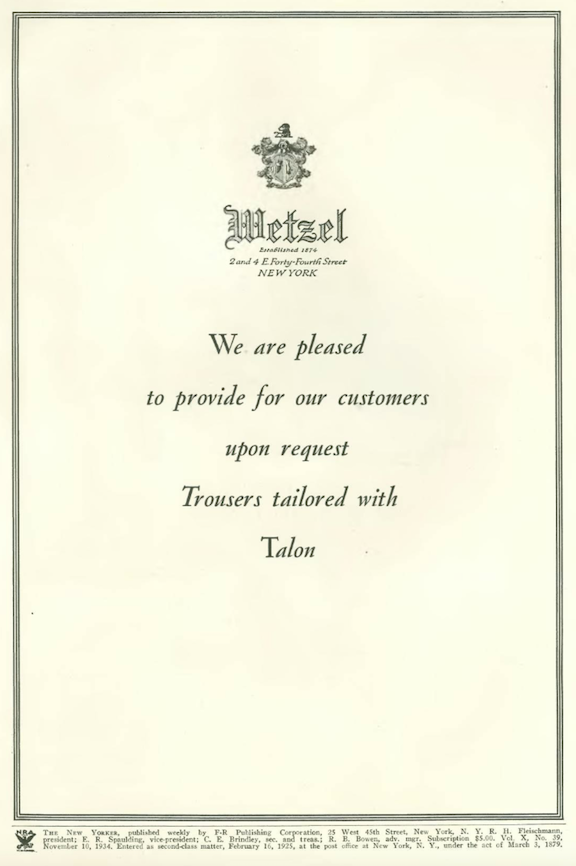
The common zipper was a relatively new invention in 1934. It had been more or less perfected by 1920, and in 1923 the B. F. Goodrich Company would coin the onomatopoetic word to describe the newfangled fastener on its galoshes, but it would take a while for the fashion industry to adopt the zipper as a replacement for buttons on garments, including men’s trousers. And so we get this staid-looking ad from Wetzel that signaled its entry into the brave new world of zippers (Talon was the dominant U.S. producer of zippers for many years)…

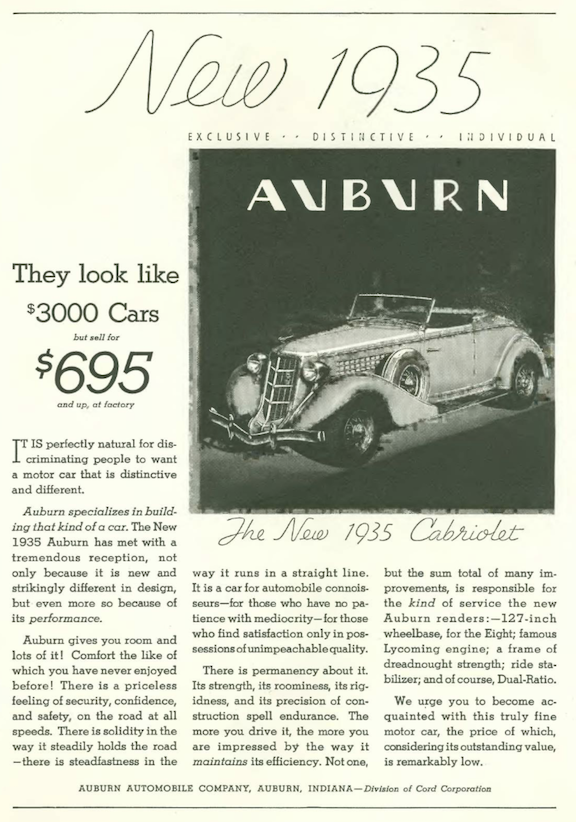
…this next ad is kind of amazing, a 1935 Auburn for only $695, which roughly translates to $15,000 or so today—still a bargain…known for cars that were fast, good-looking and expensive (and favored by Hollywood elite), Auburn struggled mightily during the Depression…along with its sister marques Duesenberg and Cord, the company would fold in 1937…

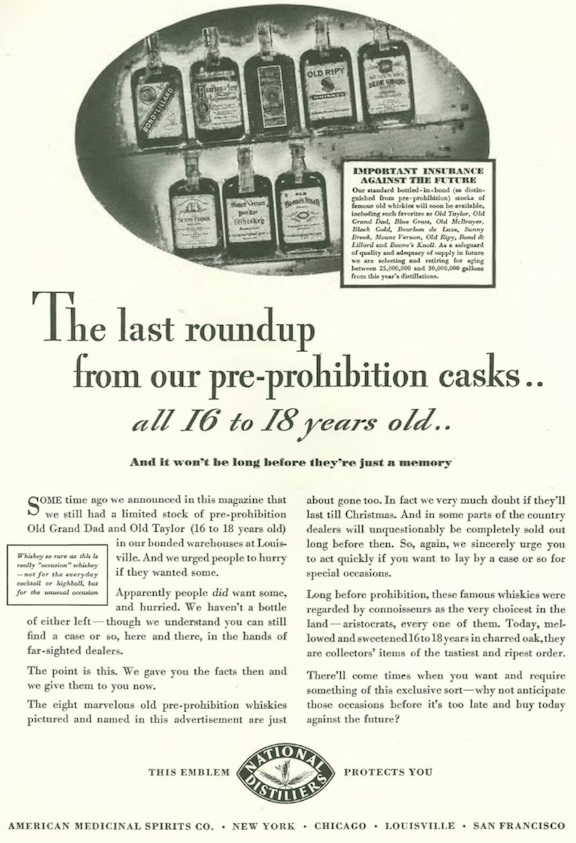
…during Prohibition distillers were allowed to keep stocks of whiskies produced before the 18th Amendment went into force…some of these were distributed through pharmacies during Prohibition for “medicinal purposes”…what was left over was sold after repeal, a stock of “pre-prohibition casks” that would be exhausted before Christmas, or so the ad rather alarmingly suggested…

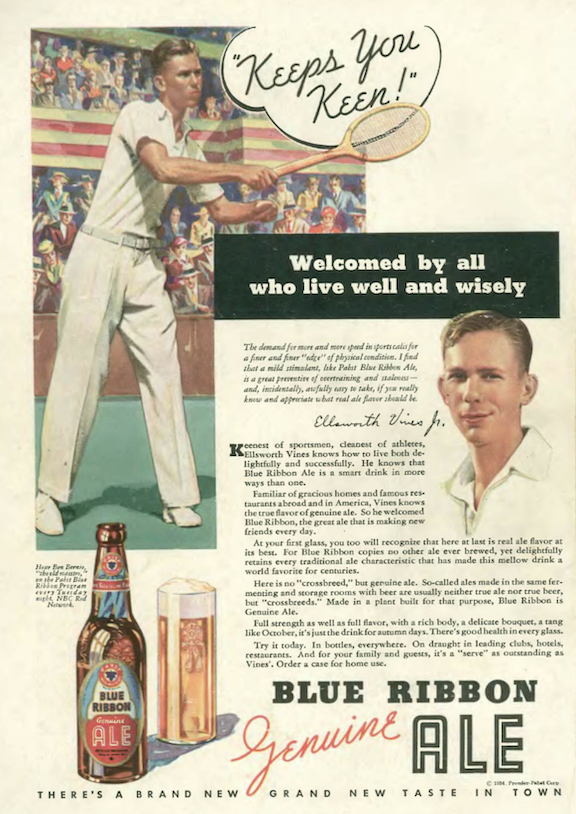
…we first met tennis star Ellsworth Vines Jr a few issues ago when he was touting the health and energy benefits of Camel cigarettes…here he promotes an unlikely “stimulant”—Pabst Blue Ribbon ale…Vines testified that “the demand for more and more speed in sports calls for a finer and finer ‘edge’ of physical condition” and observed that PBR was “a great preventive of overtraining and staleness”…yep, after a few brewskies who feels like doing anything, let alone play tennis?…

…on to our cartoonists we open with a couple of spots by George Shellhase

…and Gregory d’Alessio

William Crawford Galbraith gave us a fish out of water (the caption reads: You New Yorkers didn’t know we were so sophisticated in Detroit, did you?)…

George Price still hadn’t come back to earth in his latest installment…

Gardner Rea illustrated the results of charitable acts by the Junior League…

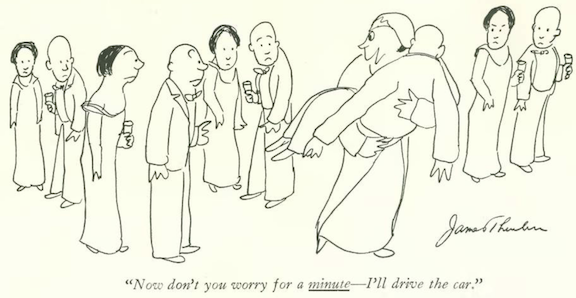
…and we close with James Thurber, and kindness from a stranger…

Next Time: Portraits and Prayers…

Art of the Machine

Above, at left, self-aligning ball bearing from SKF Industries, featured in MoMA's 1934 Exhibition of Machine Art; at right, judges for the exhibit were aviator Amelia Earhart and professors John Dewey and Charles R. Richards, holding first, second and third prizes, respectively. (MoMA)

The notion that machine-made objects have aesthetic value has been with us for some time, dating back to avant-garde movements of the early 20th century such as Futurism, which influenced other schools, including the Bauhaus and De Stijl. However, the idea that a museum would display a propeller or a vacuum cleaner as a work of art was startling to many in 1934.

March 17, 1934 cover by Rea Irvin.

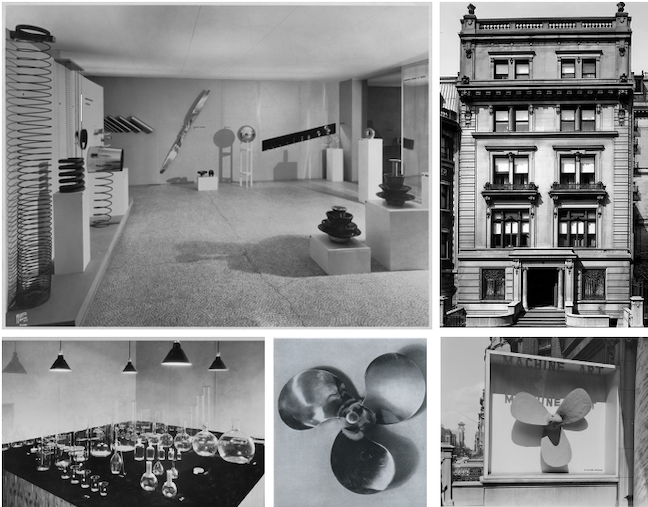
It had been a little over twenty years since New York art patrons experienced their first shock of the new at the 1913 Armory Show. By 1929 the city had established the Museum of Modern Art, which opened the exhibition Machine Art on March 5, 1934, at MoMA’s second location—the old Barbour mansion at 11 West 53rd Street (razed in the late 1930s and replaced by today’s museum).

Novelist and art critic Robert M. Coates (1897–1973) paid a visit to the Machine Art exhibition and wrote of the experience in “The Talk of the Town.” Coates was no stranger to the avant garde, having himself embraced literary innovation and experimentation as a novelist. James Thurber is credited with bringing Coates to The New Yorker in 1927—the two became close friends—and Coates would stay forty years with the magazine. Excerpts:

EXTRAORDINARY ORDINARY…Clockwise, from top left: According to MoMA director Alfred H. Barr, Jr, the 1934 Machine Art exhibition celebrated the machine’s abstract and geometric beauty; MoMA found its second home—the Barbour mansion at 11 West 53rd Street—in 1932; sign on West 53rd advertising the exhibition; outboard propeller by Aluminum Company of America (Alcoa); collection of scientific beakers and flasks from Corning Glass Works. (MoMA)
KA-CHING!…Machine Art featured Model 1934 from National Cash Register; at right, Electrochef range, model B-2, designed by Emil Piron for Electromaster Inc. Objects featured in the exhibition were selected by noted architect Phillip Johnson, who was the founding chairman (1932-34) of the museum’s Department of Architecture. (MoMA)
IN A NEW LIGHT…Springs and wires took on new perspectives at the Machine Art exhibition. From left, the apparent first-prize winner (based on the photo of Earhart at the top of this entry)—a section of a large spring; cross-section of wire rope; and typewriter carriage and motor springs, all produced by American Steel & Wire Company, a subsidiary of US Steel. (MoMA)

* * *

Salad Days

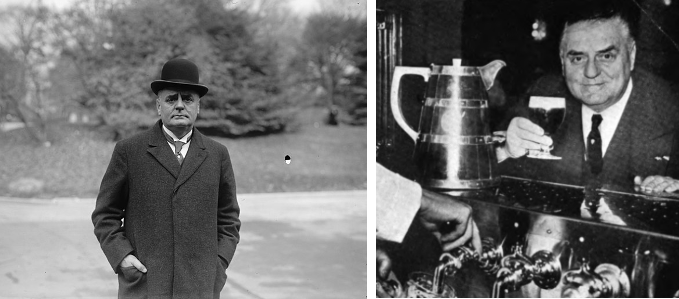
Swiss-American restaurateur Oscar Tschirky (1866-1943), who was known throughout the world as Oscar of the Waldorf, worked as maître d’hôtel of the Waldorf Astoria in New York City from 1893 to 1943. He is credited with having created the Waldorf salad, along with any number of cocktail recipes. “The Talk of the Town” noted his latest concoction:

WINNING OSCAR…From 1893 to 1943 Oscar Tschirky was the Waldorf-Astoria’s public face and a gracious host who made both the great and the not-so-great feel welcome. At left, in 1923; at right, Tschirky samples the first shipment of beer to arrive at the Waldorf-Astoria when the brew became legal again in April 1933. (Library of Congress/Karl Schriftgiesser)

 * * *

Unburdened

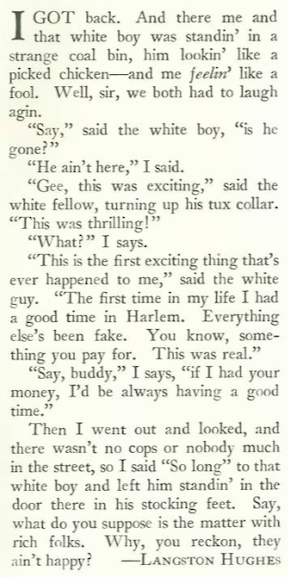
In the March 17 issue, writer and poet Langston Hughes (1901–1967) published the first of three fiction pieces that would appear in The New Yorker (one posthumously in 2016). In the short story “Why, You Reckon,” Hughes tells the tale of two hungry Black men who rob a rich white man by pushing him into a basement coal bin—one of the Black men takes the white man’s money, jewelry, shoes and overcoat, then rushes off, leaving his companion without any of the loot. To the companion’s surprise and befuddlement, the white man is left excited by the incident, because it is the first real thing that has happened to him. Here are the final lines of the story:

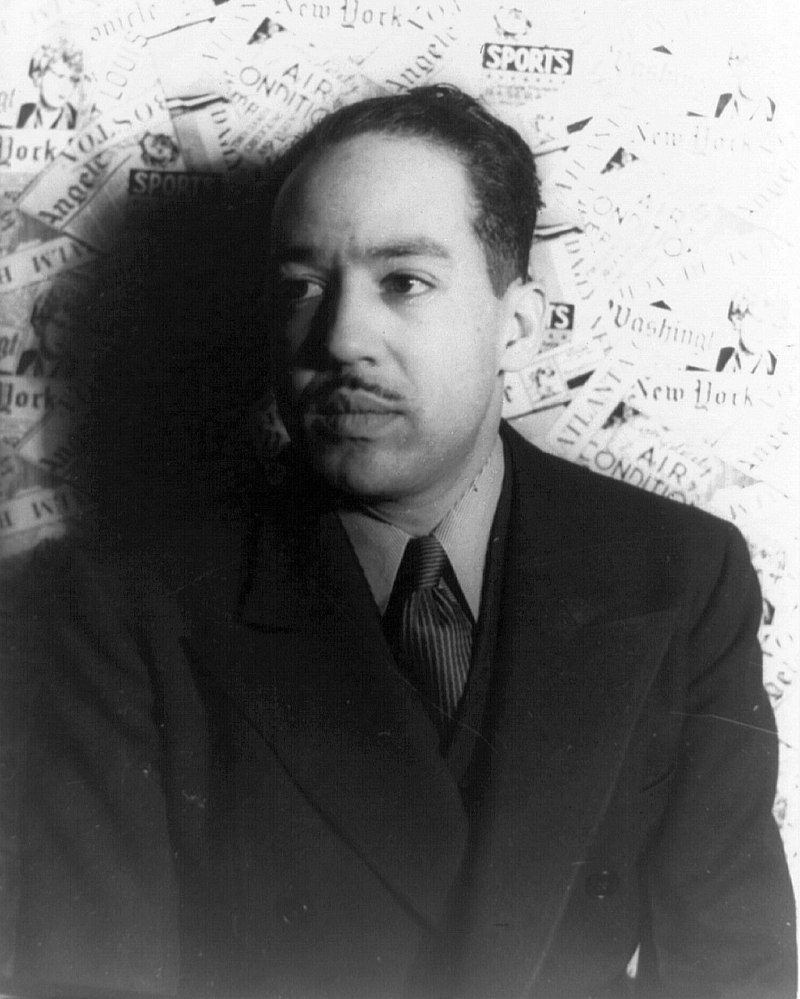
HARLEM RENAISSANCE LEADER Langston Hughes in a 1936 photo by Carl Van Vechten. A prolific writer and poet, Hughes published three short stories and three poems in The New Yorker.  (Wikipedia)

 * * *

From Our Advertisers

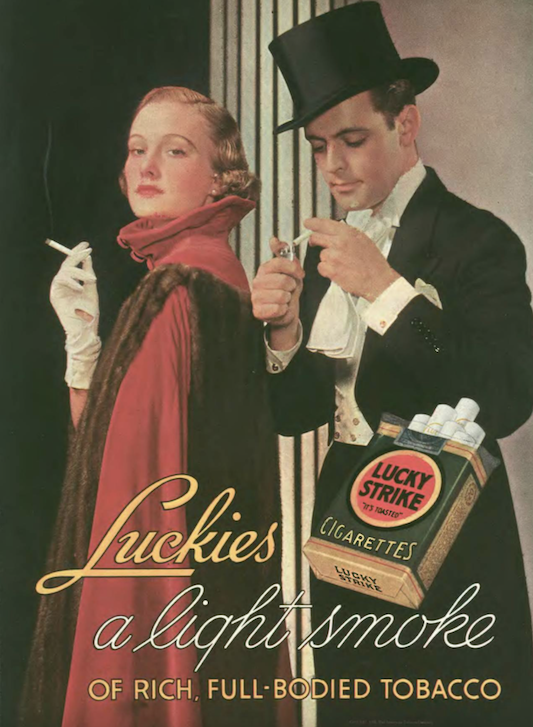
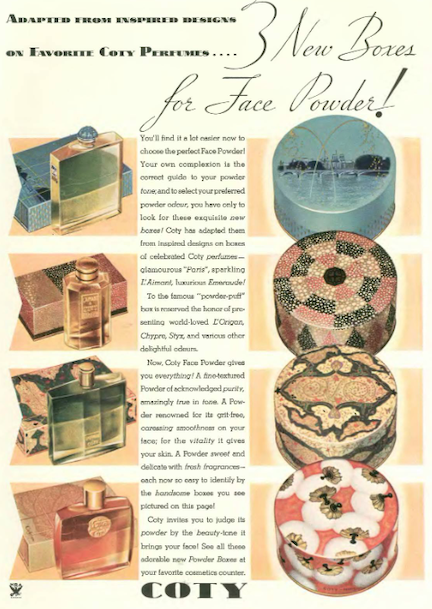
New Yorker ad sales were booming, and blooming with color…we kick it off with this ad from Coty touting “3 New Boxes for Face Powder!”…so why are there four boxes in the ad?…

…the obvious answer to the question posed below would be “wealth and privilege…and youth”…the “Eleanor Roosevelt” featured in this Pond’s ad is obviously not the wife of FDR, but rather Eleanor Katherine Roosevelt, the teenaged daughter of Assistant Secretary of the Navy Henry Latrobe Roosevelt

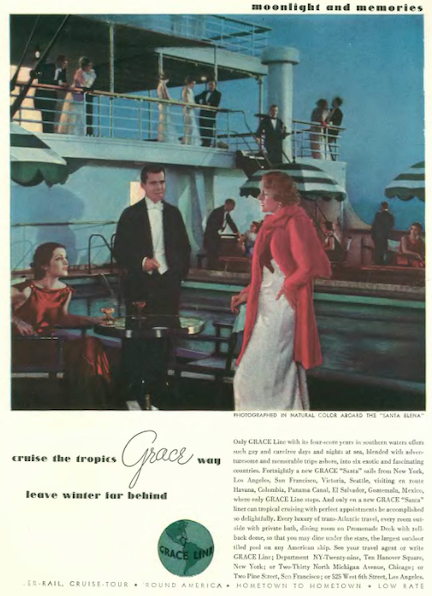
…speaking of the high seas, I have to admit I sigh a little when I see ads like this, obviously staged, but suggest a style of travel that is as extinct as the T. Rex…

…perhaps those folks on the boat were enjoying a splash of Perrier in their evening cocktails…

…or maybe the domestic White Rock was on ice…why is the rich old coot so much shorter than his wife?…I guess it emphasizes her relative youthfulness and her maternal obligations to a child-like older man…

…their proportions are similar to Jiggs and Maggie, but that’s another story…

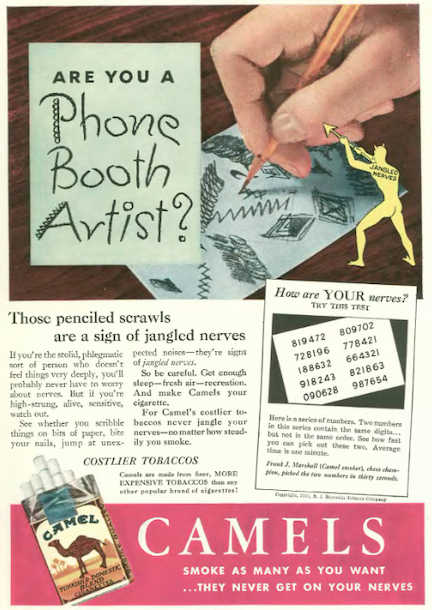
…R.J. Reynolds was back with their “jangled nerves” theme on behalf of Camel cigarettes…

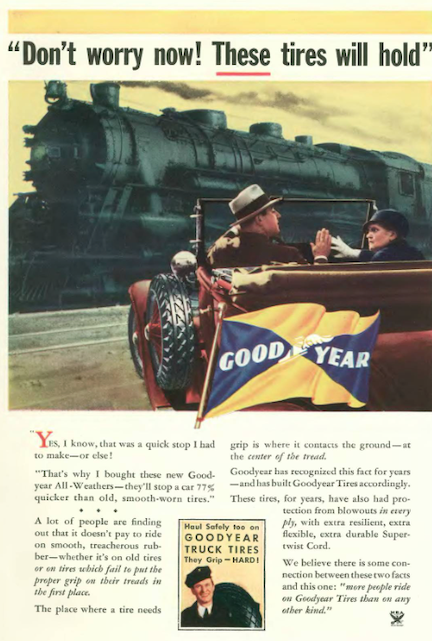
…maybe your tires will hold, but have you checked your brakes lately?…

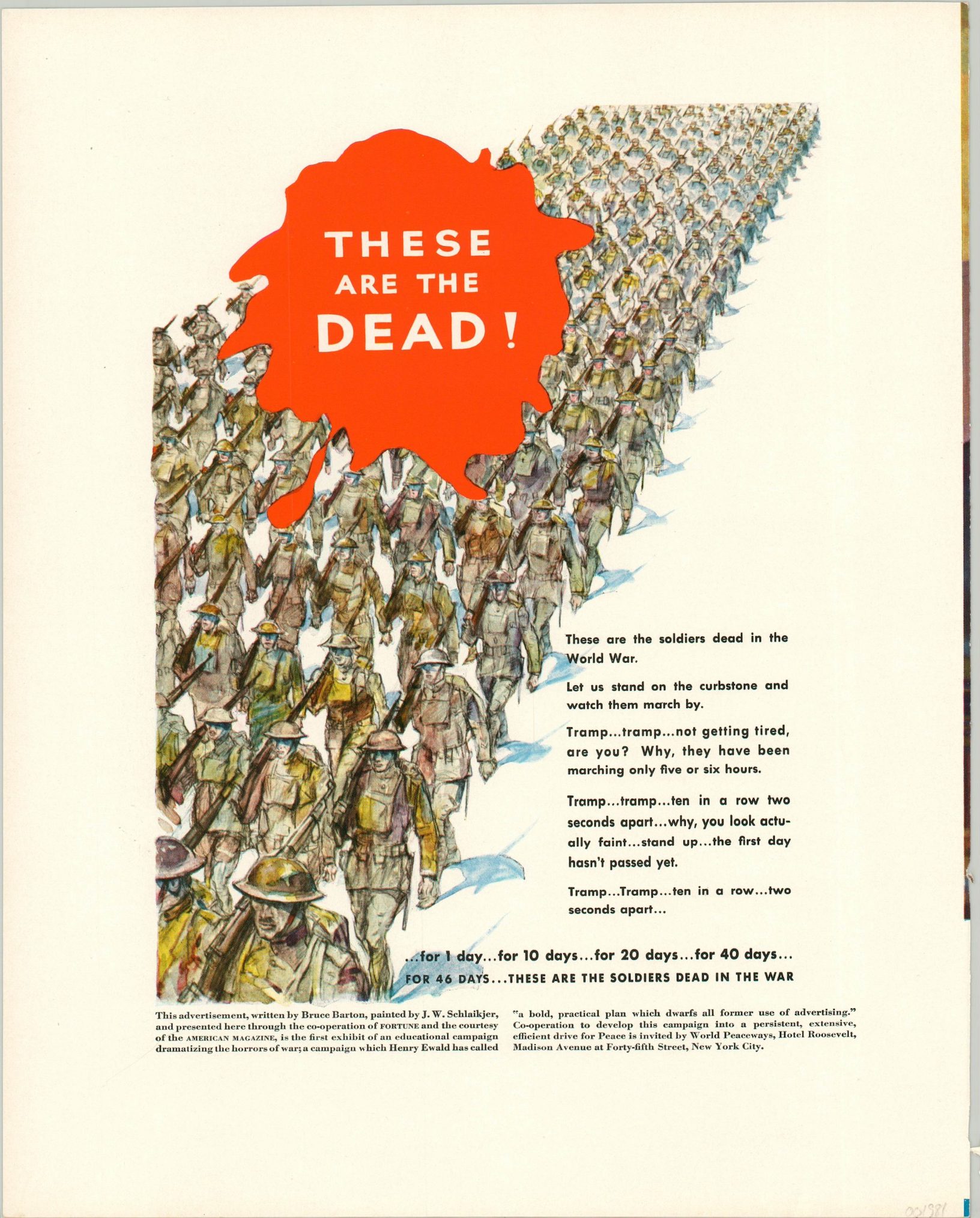
…in the 1930s the anti-war organization World Peaceways ran a series of provoking ads on the artificial glories of war…some magazines, including The New Yorker, ran these ads free of charge or at reduced rates…

…a closer view of the explanatory copy at the bottom of the ad…

…speaking of war, James Thurber opens our cartoons on a Connecticut battlefield…
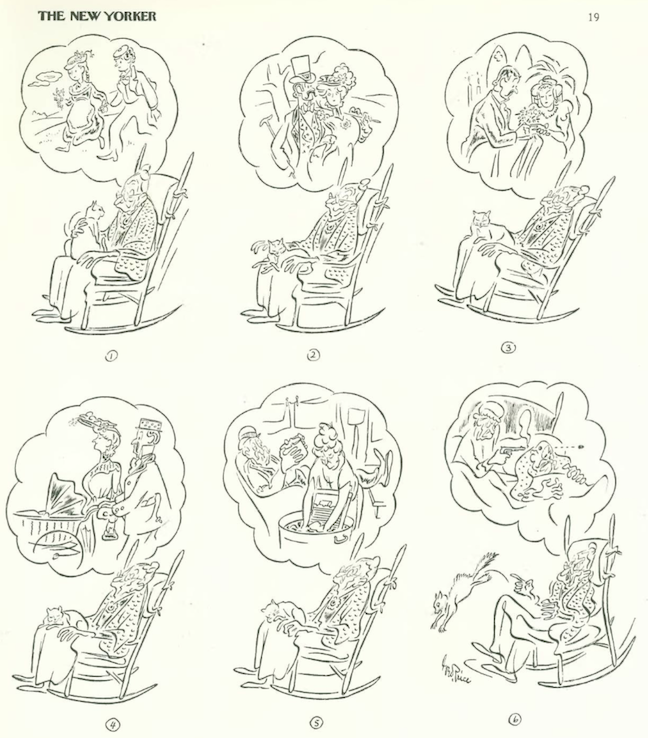
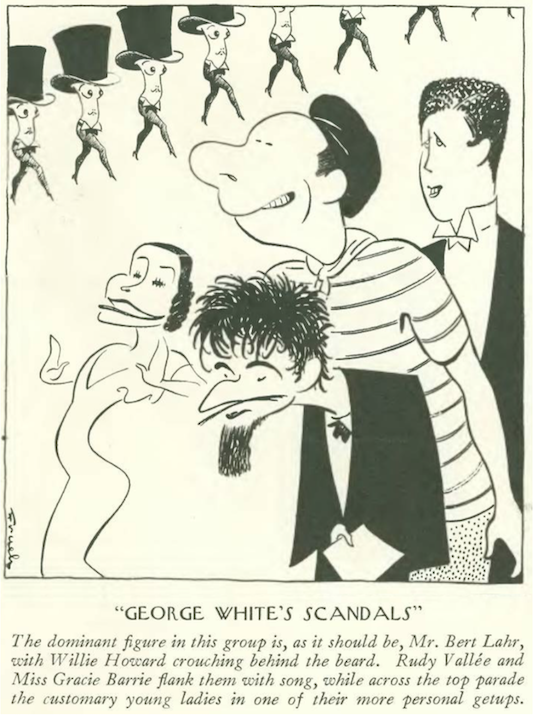
Al Frueh contributed this illustration for a two-part profile of entertainer and theatrical producer George M. Cohan

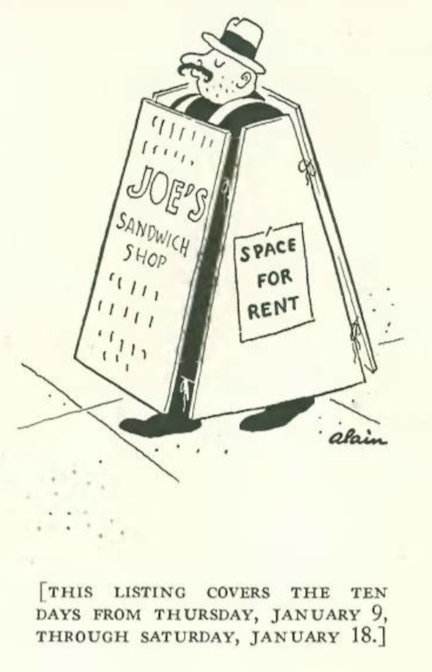
Alain (Daniel Brustlein) offered this spot art for the opening calendar section…
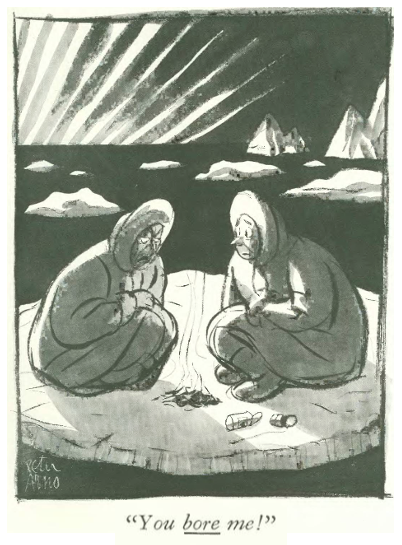
Peter Arno gave us two fellows on thin ice…

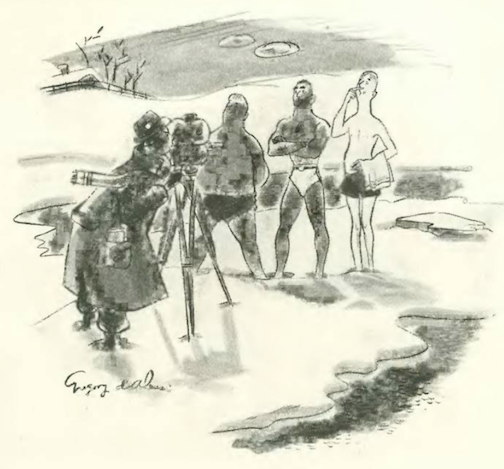
…cartoonist Gregory d’Alessio made his first appearance in The New Yorker

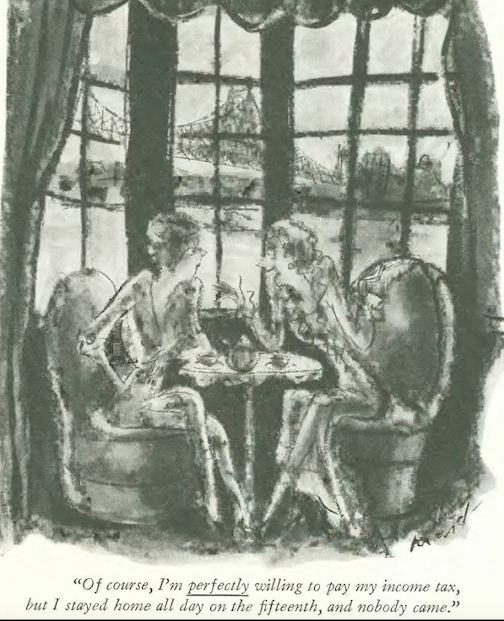
Barbara Shermund was back with some tax advice…

…which this gentleman (by Alain) might have found useful…

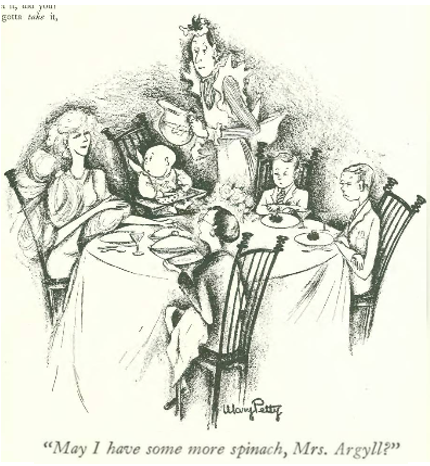
…and we close with Mary Petty, and a little brown-noser with a taste for greens…

Next Time: Through the Looking Glass…