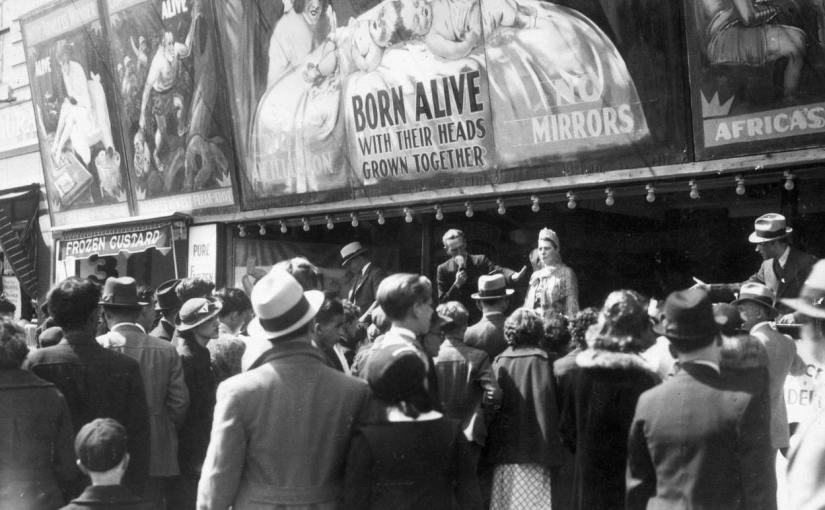
A Return to Coney

Above: Coney Island "freak" show, summer of 1935. (seeoldnyc.com)

It has been about a year since we’ve visited Coney Island, and with summer upon us (and upon 1935 New York) let’s have a look at “The Talk of the Town” and see the latest attractions.

June 15, 1935 cover by Garrett Price. Price (1897–1979) illustrated 100 covers for the magazine.
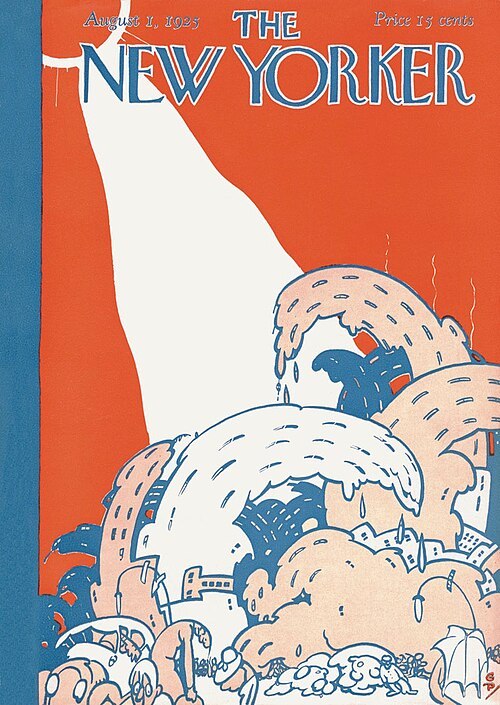
Garrett Price’s first New Yorker cover, “Heat Wave,” Aug. 1, 1925.

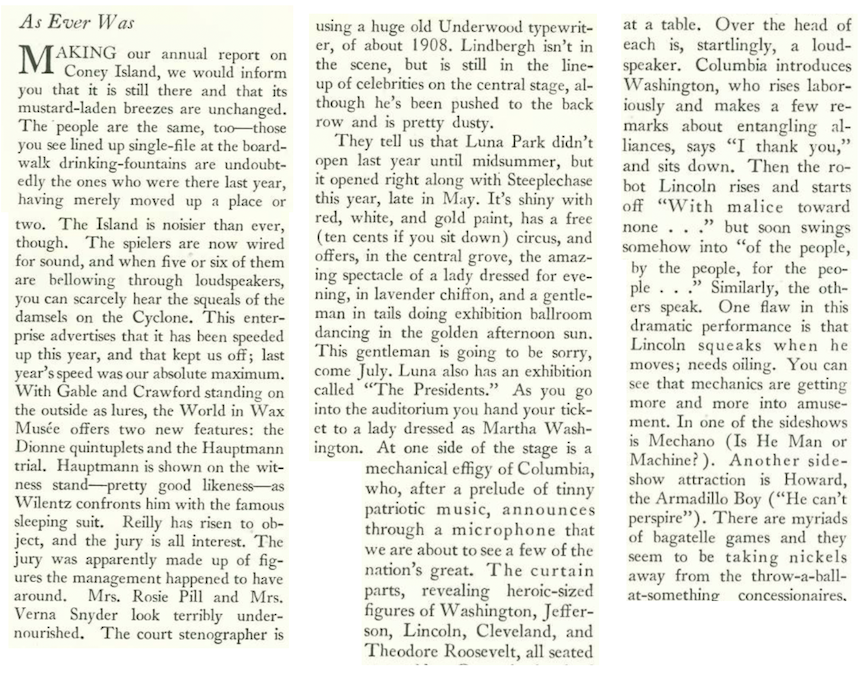
This lengthy “Talk” entry (excerpted), attributed to Clifford Orr, noted that much was unchanged, including the “mustard-laden breezes.” The place was noisier, however, with carnival barkers increasing their range through loudspeakers.
THE HIGH AND LOWS of society were on display in various attractions at Coney Island. Clockwise from top left, gawkers gather at Coney Island freak show, which included the “Armadillo Boy,” August 5, 1935; strollers near the Virginia Reel and Wonder Wheel, circa 1935; Borden’s frozen custard stand, 1930s; couple have a nap on the beach, circa 1935. (seeoldnyc.com)
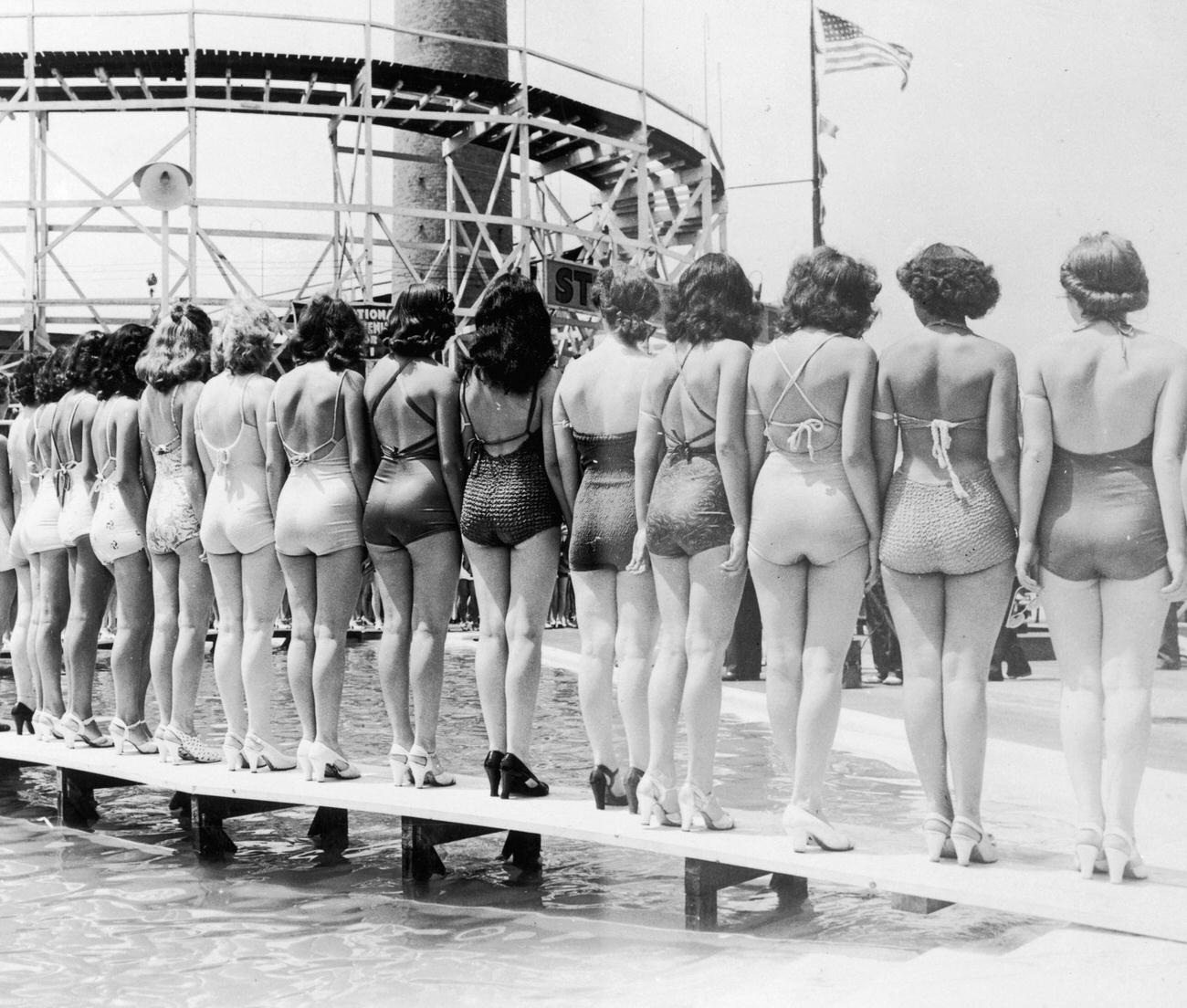
LINEUP…Beauty contests near the Steeplechase, like this one in 1935, were a common sight at Coney Island. (seeoldnyc.com)
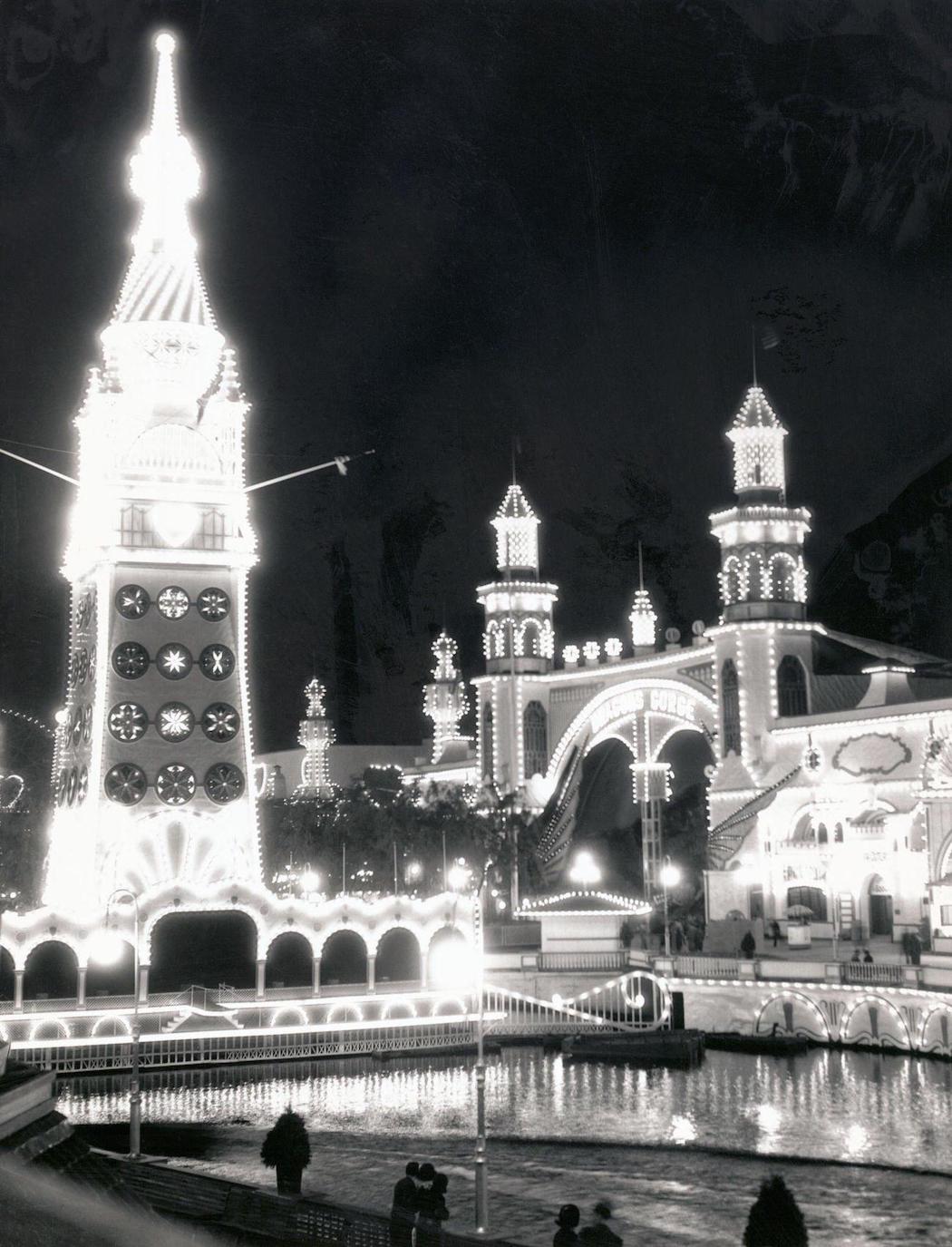
LIKE MOTHS TO THE FLAME, the dazzling lights drew thousands to Coney Island’s Luna Park in the 1930s. (seeoldnyc.com)
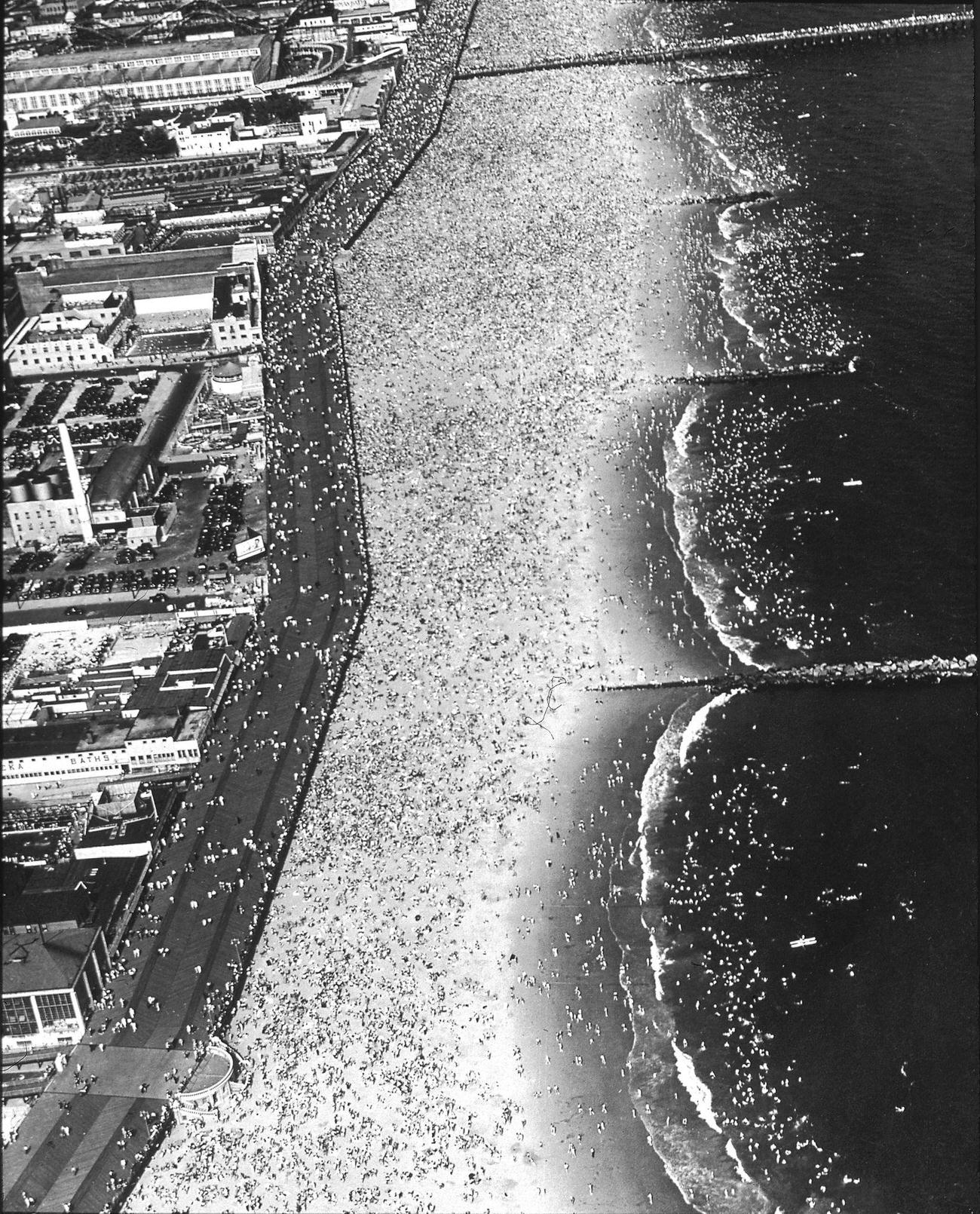
THEY LOOK LIKE…ANTS…Aerial view of the beach in 1935. The Steeplechase ride is at the top left. (seeoldnyc.com)

 * * *

Ship Ahoy

E.B. White (in “Notes and Comment”) mentioned that he danced aboard the newly arrived S.S. Normandie (presumably with Katharine White) while it was docked at Pier 88.

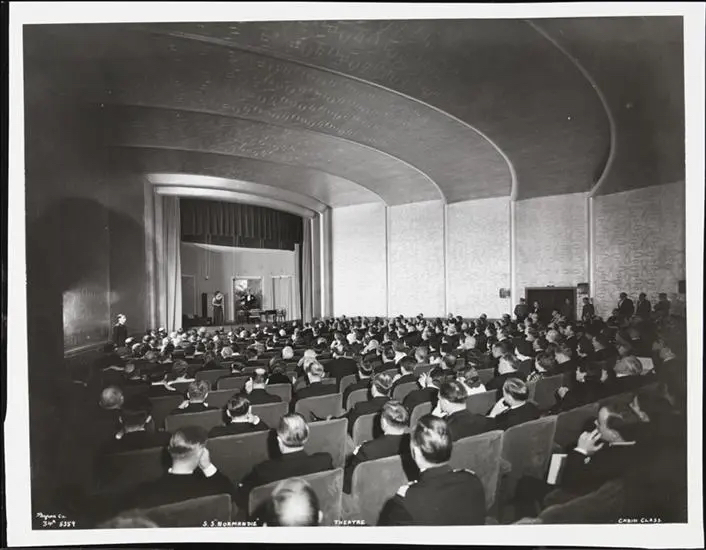
GROOVY…E.B. White noted the “luminous grooves” of the S.S. Normandie’s theatre. (drivingfordeco.com)
JUGGERNAUT…The S.S. Normandie docked at New York’s Pier 88 after completing her maiden voyage on June 3, 1935. Note the paint chipped from the hull, the result of the ship’s record-breaking speed. (yesterdaystrails.wordpress.com)

 * * *

Another Freak Show

Theatre critic Wolcott Gibbs found Earl Carroll’s latest stage production to be nothing more than a “vulgar assortment of comedians, jugglers, and performing dogs,” accompanied by “very lovely and disarming” young ladies who chanted their lines “in high childish voices.” One skit apparently featured Abe Lincoln with “fifty-six young ladies in cellophane hoopskirts.” Too bad no one filmed that performance.

HOLDING IT TOGETHER…Gibbs noted that comedian Ken Murray carried most of the show’s comedy (Murray had found success on the New York stage after appearing in Carroll’s Vanities on Broadway in 1935); Sibyl Bowen was known for her impersonations of famous women. In Sketchbook she portrayed Martha Washington, among others. (eBay/entertainment.ie)

 * * *

Weathering the Field

Like the recent 2025 U.S. Open at Oakmont (won by J.J. Spaun), ninety years ago Oakmont was also plagued by bad weather, and it also featured a tournament winner who outplayed the top golfers in the field. Excerpt:
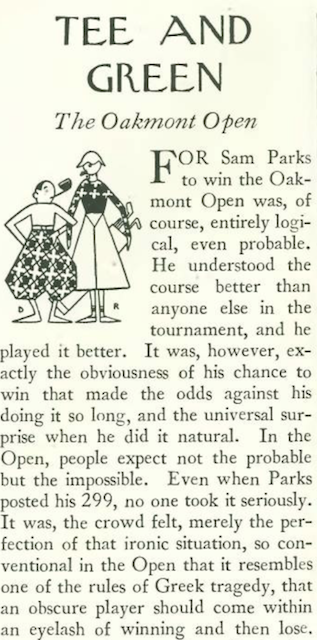
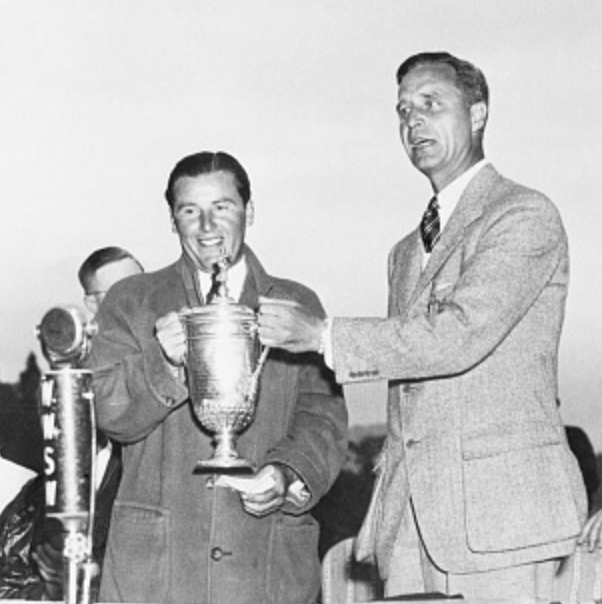
WHY NOT ME?…Sam Parks Jr. (left) was considered an unlikely winner of the 1935 U.S. Open after competing with Hall of Famers at Oakmont. A 25-year-old club pro from Pittsburgh who played on the winter tour without ever winning, he bested a field that included Walter Hagen, Gene Sarazen, Denny Shute and Horton Smith. His secret? For months leading up to the U.S. Open, Parks played nine holes at Oakmont every morning before going to work at nearby South Hills Country Club. He knew the course like the back of his hand. (progolfweekly.com)

* * *

Straight From the Headlines

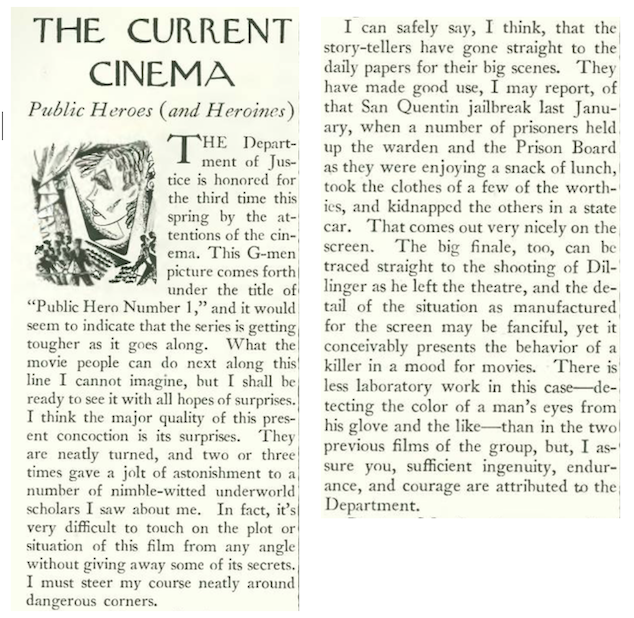
Film critic John Mosher noted how the storylines in latest “G-men” pictures seemed to be taken directly from the daily papers. Public Hero Number 1 was no exception.
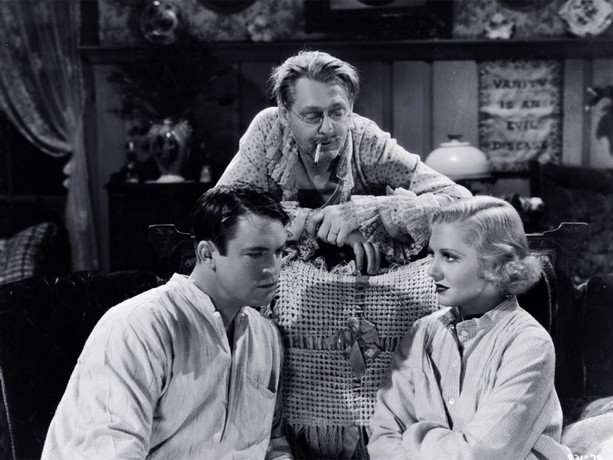
THE GOOD GUYS…from left, Chester Morris, Lionel Barrymore and Jean Arthur in Public Hero Number 1. One effect of the Hays Code was to replace gangster films—which some believed glorified criminals—with films that depicted the dedication and courage of law enforcement officers. (Rotten Tomatoes)

Mosher suggested moviegoers would get more pleasure out of Public Hero Number 1 than from Our Little Girl, which seems an unfair comparison since gunplay was rare in a Shirley Temple flick.

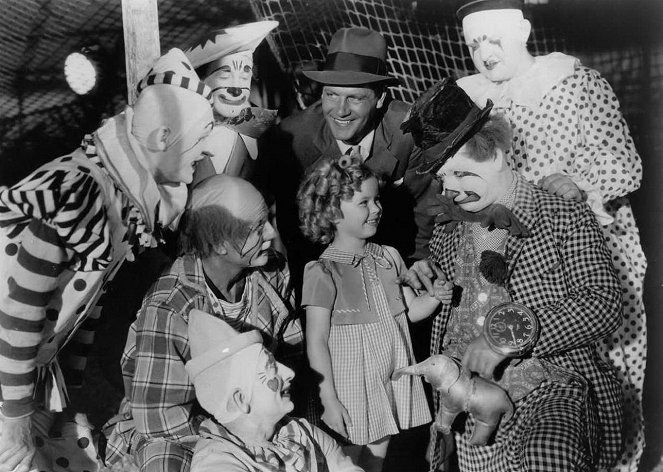
NO GUNS, JUST SOME SCARY CLOWNS…Joel McCrea and Shirley Temple in Our Little Girl. (csfd.sk/film)

 * * *

Speaking Brooklynese

The June 15 issue featured Thomas Wolfe’s classic short story, “Only the Dead Know Brooklyn.” Written entirely in “Brooklynese” dialect, the simple plot features four men standing on a subway platform arguing about how to get to “Bensonhoist.” The story (seemingly told to the author himself) recalls the existential themes of Wolfe’s contemporary, the Irish writer Samuel Beckett. Here is an excerpt, the second paragraph of the story:

So like I say, I’m waitin’ for my train t’ come when I sees dis big guy standin’ deh—dis is duh foist I eveh see of him. Well, he’s lookin’ wild, y’know, an’ I can see dat he’s had plenty, but still he’s holdin’ it; he talks good an’ is walkin’ straight enough. So den, dis big guy steps up to a little guy dat’s standin’ deh, an’ says, “How d’yuh get t’ Eighteent’ Avenoo an’ Sixty-sevent’ Street?” he says.
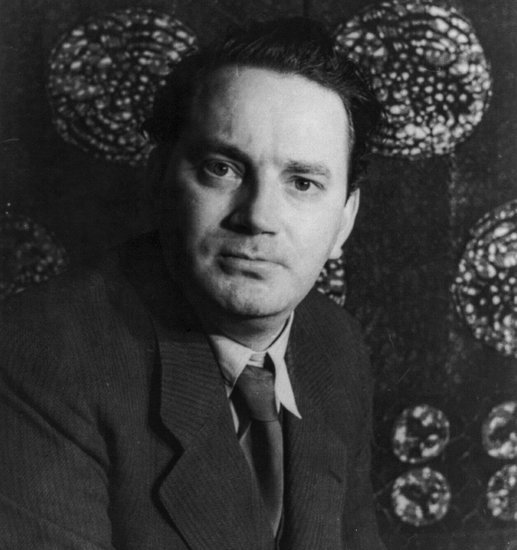
GONE TOO SOON…Portrait of Thomas Wolfe taken by Carl Van Vechten in 1937. He died the next year, eighteen days before his 38th birthday. (Library of Congress)

 * * *

From Our Advertisers

We begin with this two-page spread—what readers of the June 15 issue would have seen after turning the cover page…
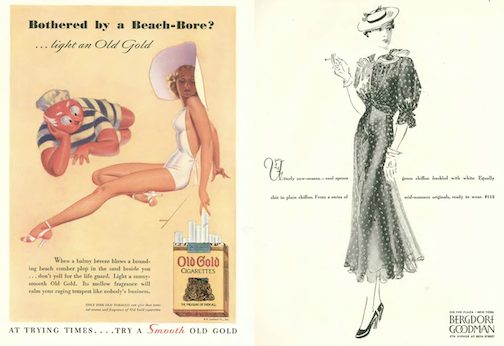
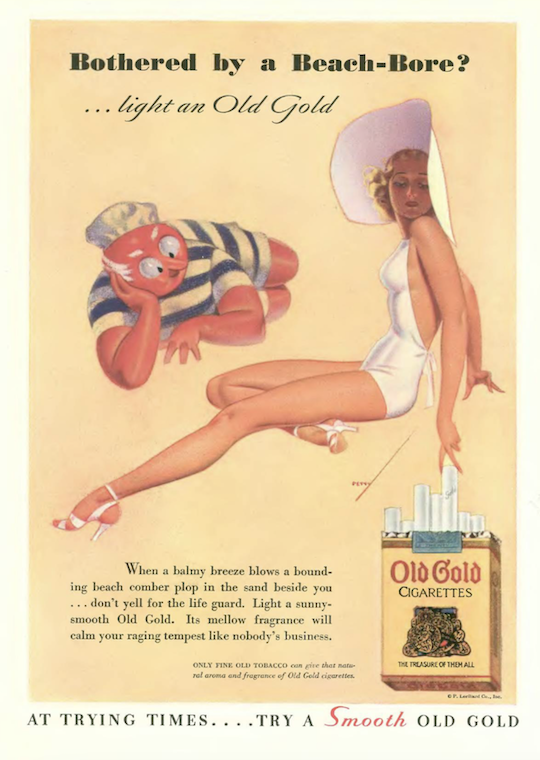
…the inside cover ad was part of an ongoing series of spots for Old Gold cigarettes illustrated by pin-up artist George Petty…almost all of the ads featured a fat, homely man (possibly a sugar daddy) mooning over a leggy blonde who relieves the tedium by reaching for an oversized cigarette…
…the ad on the facing page couldn’t be more different, except for the fact the woman is smoking, suggesting, of course, sophistication when paired with the latest fashions from Bergdorf Goodman…

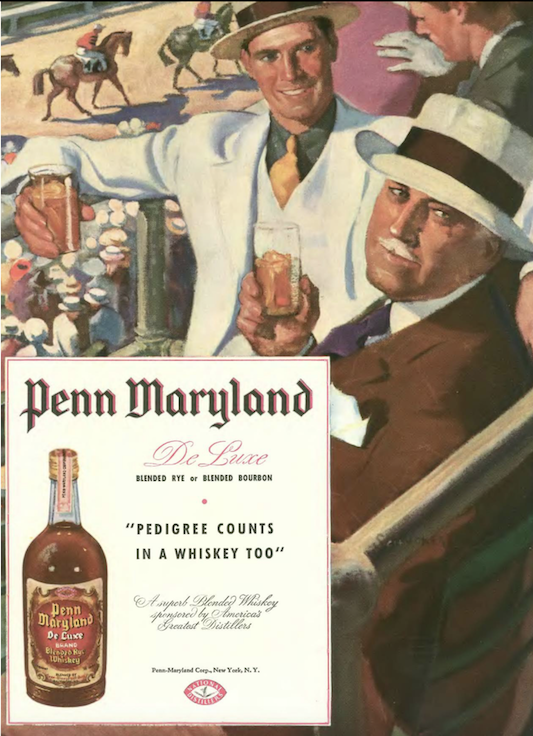
…on the back cover we find these swells enjoying a belt at the horse races…
…while on the back cover, Camel gathered together all of its recent society endorsers for another round of shilling for R. J. Reynolds…

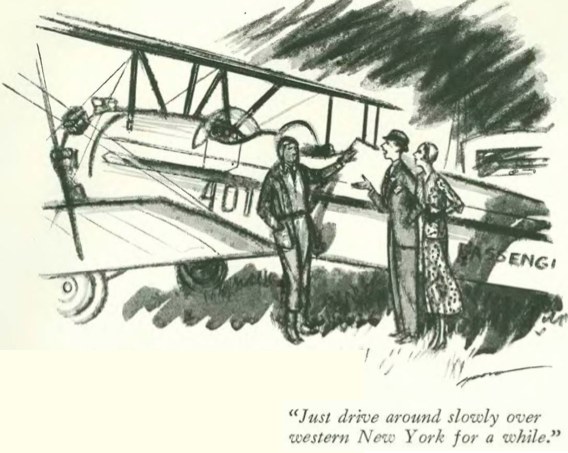
…swells and society women were the only persons (along with celebrities) who could afford to take this early version of a “red eye” to L.A. or San Francisco…it was not all that cushy, however…airliners were loud, cold, and not pressurized, so they flew at low altitudes and were often bounced about by the weather. The Boeing 247 also required several stops for refueling…
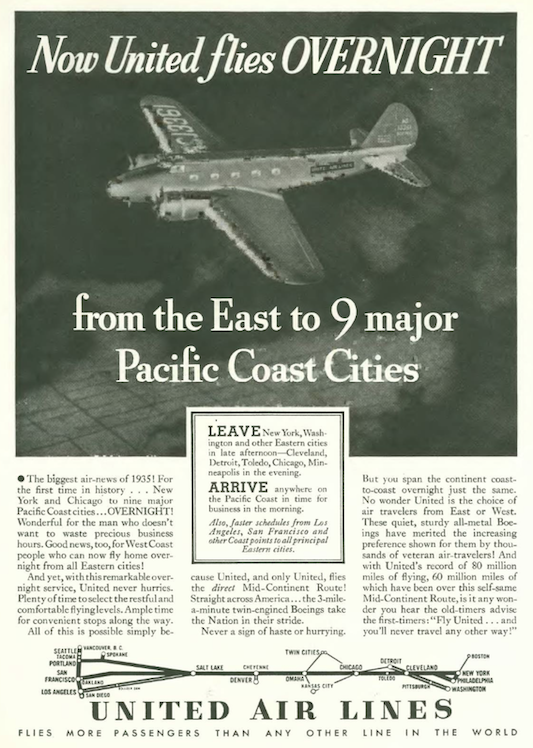
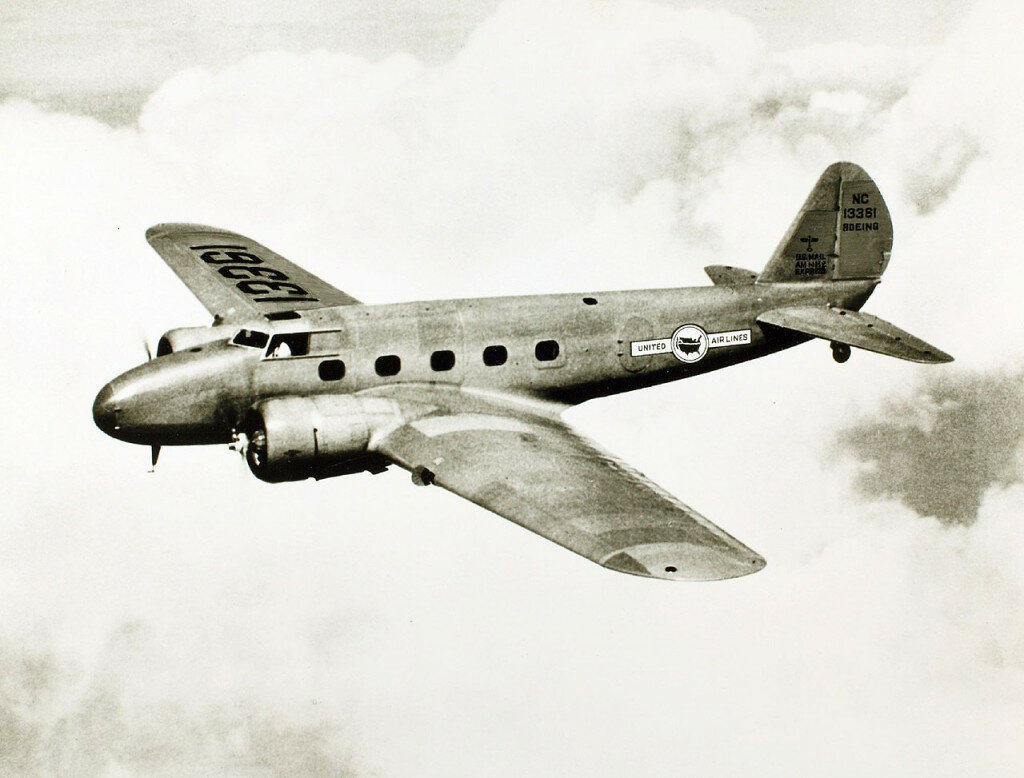
‘OL SPEEDY…This Boeing 247 was featured in the above ad. One of the first all-metal airliners, the 247 was considered revolutionary when introduced in 1933—United Airlines boasted that it cruised at speeds of three miles per minute and carried ten passengers across the country in twenty hours, cutting eight hours from previous travel times. Seven refueling stops included Cleveland, Chicago, Omaha, Cheyenne and Salt Lake City.  (Wikipedia)
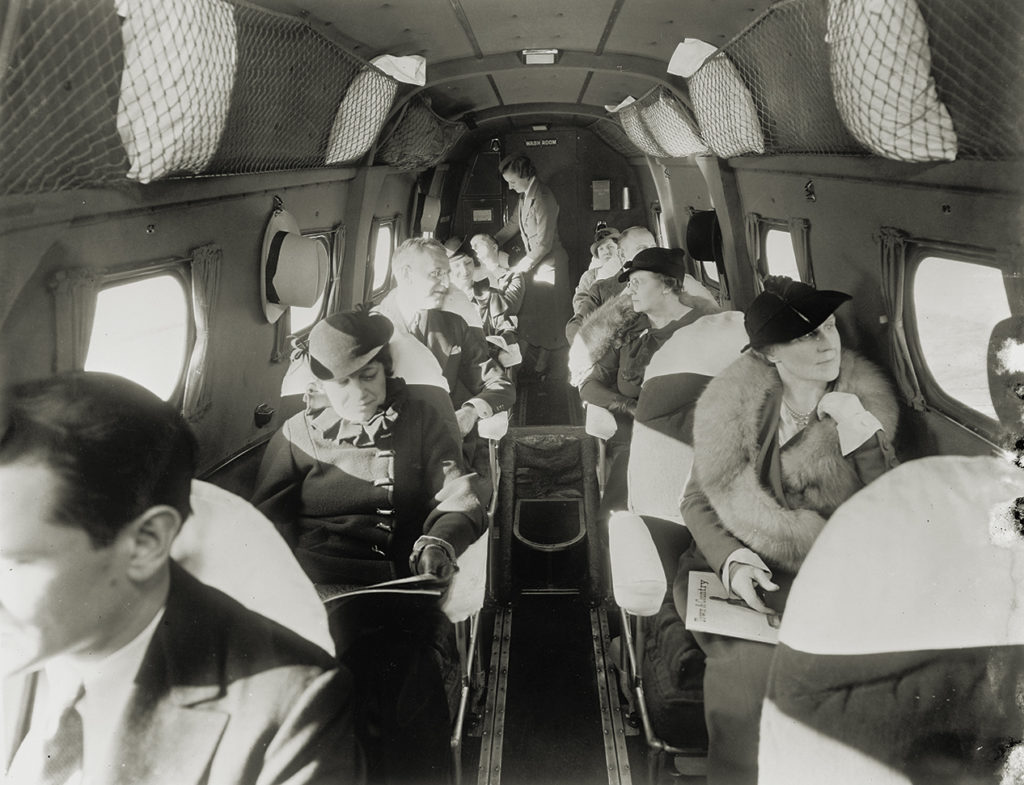
WATCH YOUR STEP…Interior of the Boeing 247. Note that the main wing ran through the cabin, so persons moving down the aisle had to step over it. (Library of Congress)

…we learn a lot about a 1930s New Yorker reader by looking at the advertisements…it doubtful the magazine had many truly upper-class readers—the barbarians were content to flip through a copy of Town & Country or similar undemanding fare…what we do have are striving “smart set” readers, some with the means to buy a luxury automobile, fly cross-country, or cruise on the Normandie, all things one would desire as a member of upper-middle class or even the educated bourgeoisie in the middle…this Campbell’s soup ad is for the latter…the upper-middles would sniff at canned soup, while the barbarians would probably eat whatever was set in front of them, since talking about food would be considered vulgar…

…Pabst Blue Ribbon beer has been around since 1844…in the 20th century it was increasingly associated with the working class and rednecks until the brand caught on with urban hipsters in the early 2000s…

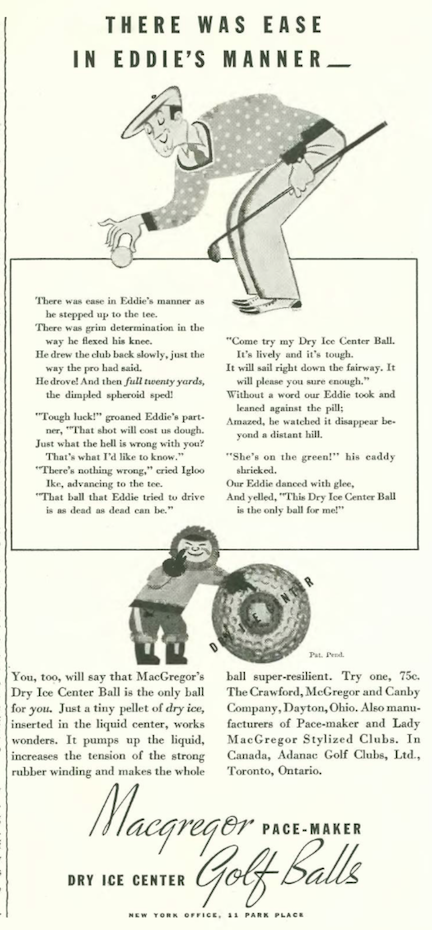
…in the May 25, 1935 issue we saw an ad promoting Walter Hagen’s “Honey Boy” golf balls, which contained real honey in their cores…the folks at MacGregor’s had a different idea—they inserted a pellet of dry ice into the center of their golf balls…what will they think of next?…
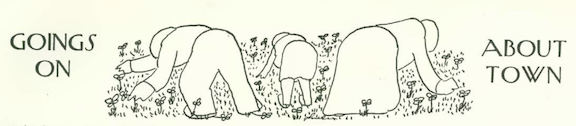
…we move on to our cartoonists, beginning with a James Thurber spot…
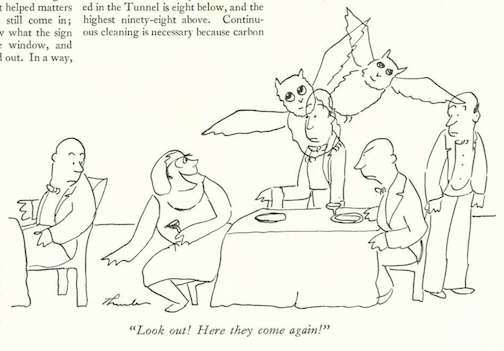
…and continuing with another Thurber classic…
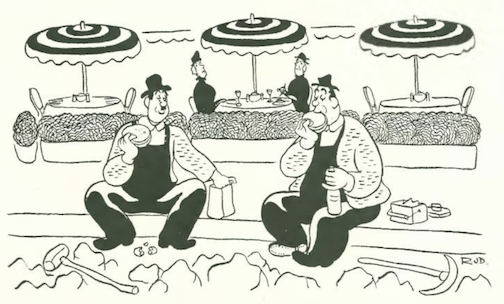
Robert Day took a lunch break in the opening pages…
Alan Dunn felt charitable while relaxing in Westchester…

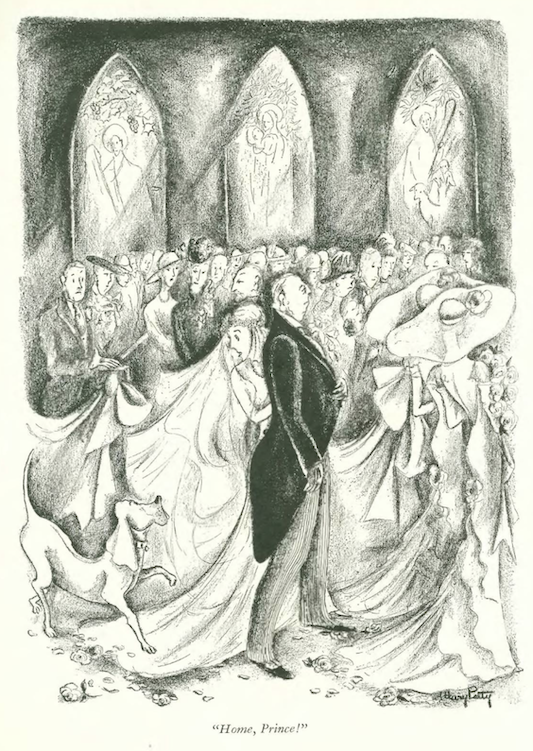
Mary Petty gave us a wedding guest that would not be out of place today…the caption reads, “Home, Prince!”…
Helen Hokinson went hog-wild in the garden…

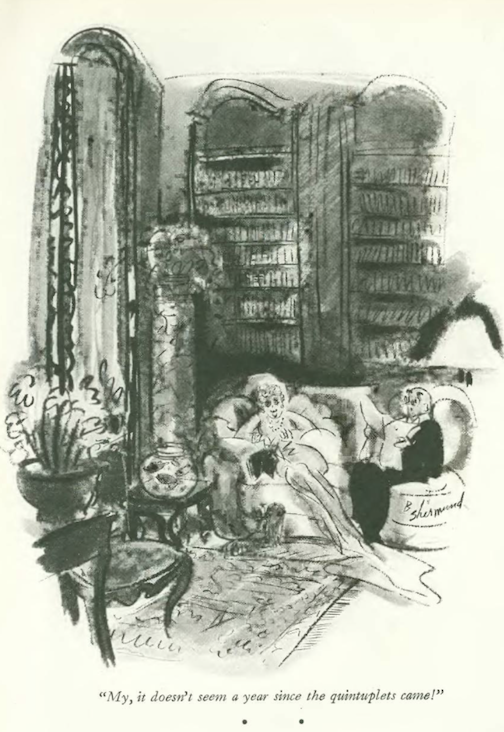
Barbara Shermund looked in on the idle thoughts of the idle rich…
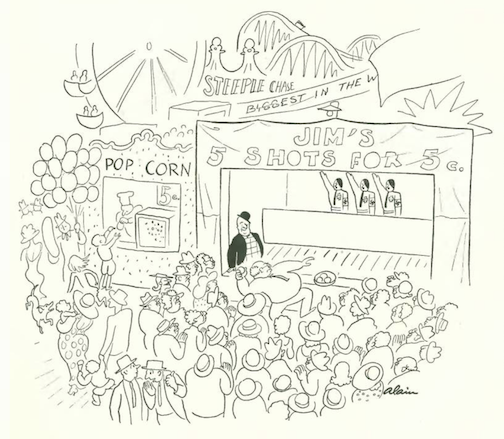
…and we close where we began, with Daniel Brustlein aka Alain at Coney Island…
Next Time: Thackeray, In Color…

Bonfire of the Vanities

When Earl Carroll’s Vanities hit the Broadway revue scene in 1923, it faced strong competition from George White’s Scandals and the long-running Ziegfeld Follies. Carroll’s answer: More of everything.

Sept. 5, 1931 cover by Theodore Haupt.

That included more nudity than the other revues. Critics, including the New Yorker’s Robert Benchley, found the nudity gratuitous, a titillating distraction from what was otherwise a mess of a show. It also landed Carroll in court from time to time on charges of public indecency. All of this, of course, was just more publicity to drive audiences to his theatre at 753 Seventh Avenue, which he built in 1922 and then partially tore down just nine years later to replace it with an even grander venue. This is where Benchley found himself on the evening of August 27 — at the grand opening of the Earl Carroll Theatre and the 1931 edition of the Vanities. Benchley found nothing grand about it:

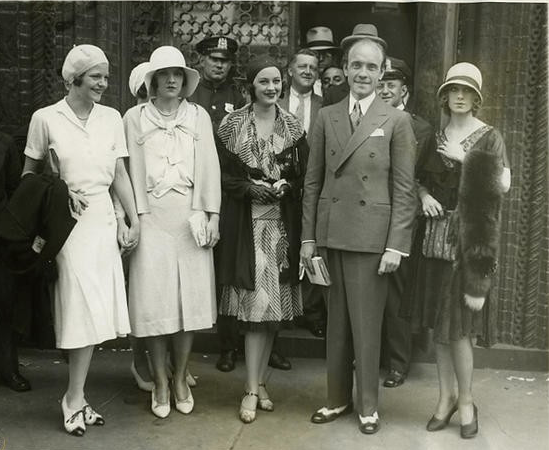
AUTOGRAPHS, ANYONE?…Accompanied by his Vanities showgirls, Earl Carroll leaves the Essex Market Police Court on July 20,1930, after appearing to answer charges of public indecency. Police raided a Vanities matinee on July 9, arresting eleven including famed burlesque dancer Faith Bacon, who performed in nothing but fans made of ostrich feathers. No doubt police were tipped off by critics who called the 1930 edition the “nudest” cast in American theatre history. From the looks on their faces, it seems even the police enjoyed the spectacle. (Worthpoint)
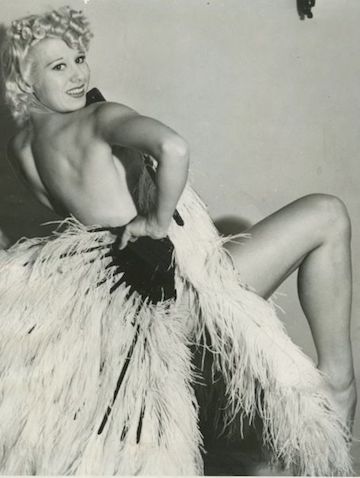
IS THERE A PROBLEM, OFFICER?…Faith Bacon in a less-revealing pose with the ostrich-feather fans that brought the police ‘a calling. (fanpix.net)

Carroll’s ambitions were always big, whether it was the size or lavishness of his stage shows or the Art Deco theatre (designed by George W. Keister) he erected in 1931 in answer to Flo Ziegfeld’s 1927 Joseph Urban-designed theatre on Sixth Avenue. With 3,000 seats, Carroll’s theatre was nearly twice the size of Ziegfeld’s.

THEY DON’T COME FOR THE SCRIPTWRITING…Earl Carroll made it clear what audiences could expect in his 1931 Art Deco-style theatre, which featured black velvet-covered walls relieved with gold and silver-colored highlights. Its 3,000 seats made it one of the largest theatres in the world. Clockwise, from top left, portrait of Carroll (a gift from the 1930 Vanities showgirls) flanked by busts of Vanities girls Doris Andrese and Beryl Wallace in the theatre lobby; sign above theatre entrance; a two-page spread from the theatre’s “Beauty Souvenir” booklet; cover of the booklet, featuring singer Lillian Roth. (New York Historical Society).
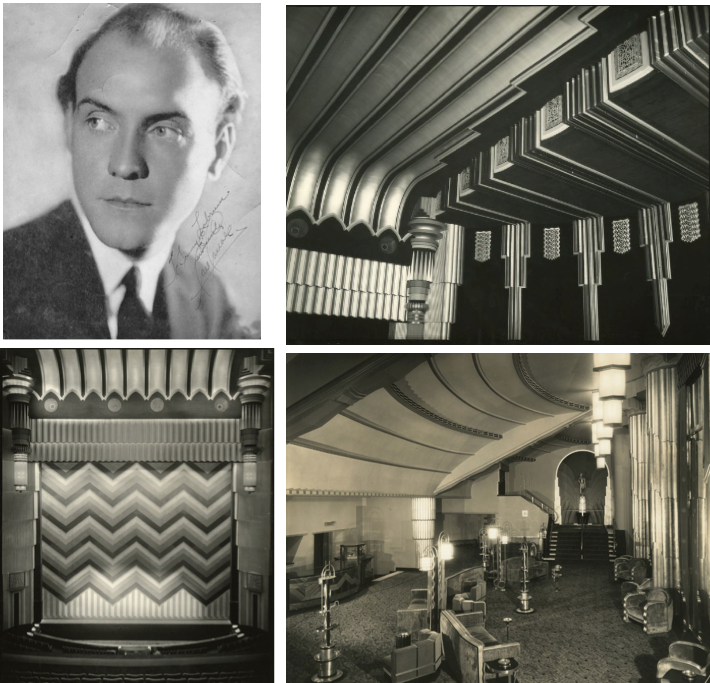
DECO DRAMA…Clockwise, from top left, Earl Carroll circa 1925; ceiling detail inside the Earl Carroll Theatre; mezzanine lounge; the stage. (New York Historical Society).

The show itself left Benchley baffled, a mishmash of lights, colors, and effects including a drooling dinosaur that dropped a naked woman on stage for a dance number…

LAUNCH SITE….The Vanities stage helped launch the careers of many entertainers. Clockwise, from top left, undated photo of a Vanities production — some shows would feature more than 100 women on stage at one time; singer Lillian Roth was a star attraction; Vanities alumni included William Demarest (Uncle Charlie!), Jack Benny and Vincente Minnelli. (assumption.edu/flickr.com/classicmoviehub.com/amazon.com/sensesofcinema.com)

This wasn’t last word from The New Yorker on the new theatre; the Sept. 12 issue featured these observations by Creighton Peet:

In the end, Carroll’s ambitions were too big for the deepening Depression, and just six months after his theatre’s opening he would lose it to creditors. The property would be snapped up by rival Florenz Ziegfeld and renamed the Casino, but the Ziegfeld connection would be short-lived; Ziegfeld would die a few months later in July 1932. Later that year another rival, George White, would take over the venue to stage his Music Hall Varieties, which ended in 1933 with middling results. The theatre would go through several more tenants—including Billy Rose—until 1940 when the discount “dime store” Woolworth’s would move in, demolishing the lobby and walling off the remaining ceiling and walls. Woolworth’s would close the location in the late 1980s—the store, and the last remnants of the Earl Carroll Theatre, would be demolished in 1990.

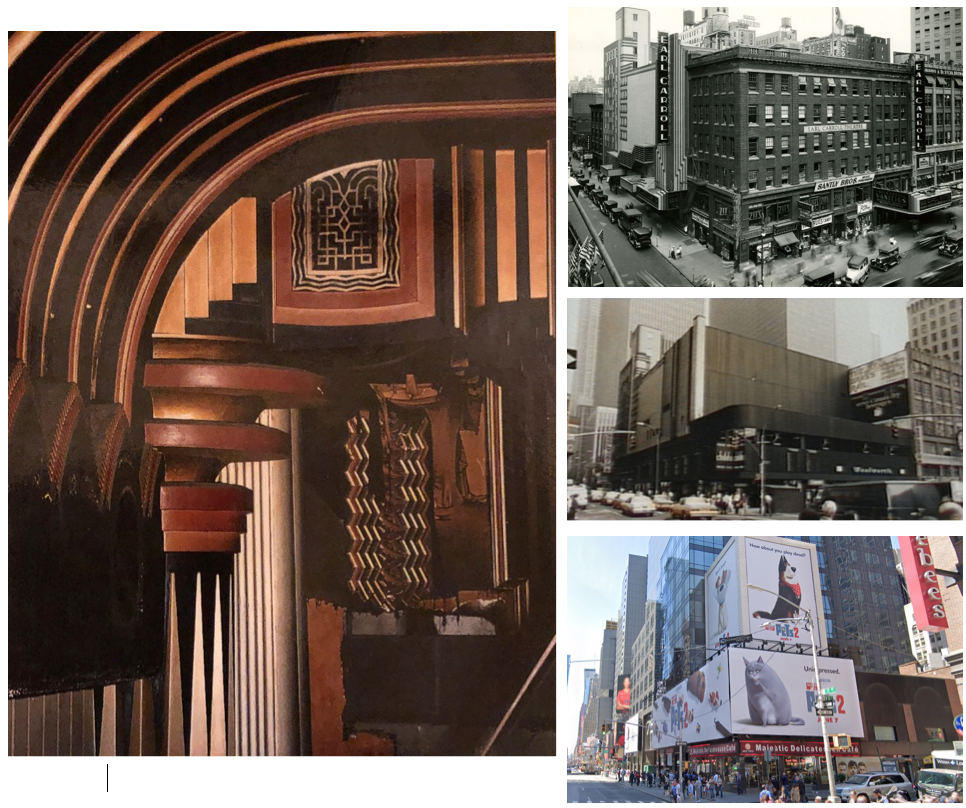
CLOSING NUMBER…At left, a sneak peek behind the false walls of Woolworth’s in 1988 shows a detail of the theatre’s proscenium, ceiling and sidewall. At right, top to bottom, the second Earl Carroll Theatre at 7th Avenue & 50th Street; the Woolworth’s store that replaced it, circa 1980; the site today. (Large image from the book Lost Broadway Theatres, via drivingfordeco.com/Google Maps)

*  *  *

From Our Advertisers

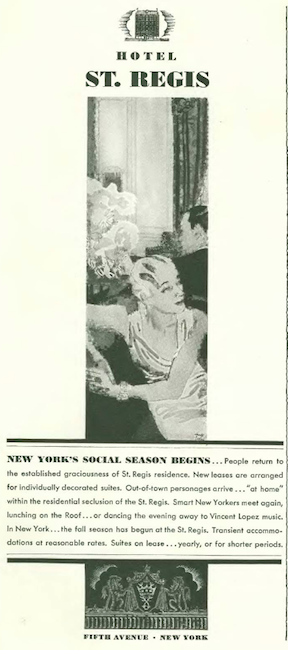
Fall is upon us, and so the social season begins, according to the Hotel St. Regis…

…and what better way to prepare for the season than to acquire a new mink coat…

…maybe politics and world affairs were more your bag, in which case you probably wanted to get a subscription to the Herald Tribune and read the latest from commentator Walter Lippmann

…the makers of Marlboro cigarettes, an upstart brand that initially targeted women, continued with their prize contests, but now they began courting men as well…

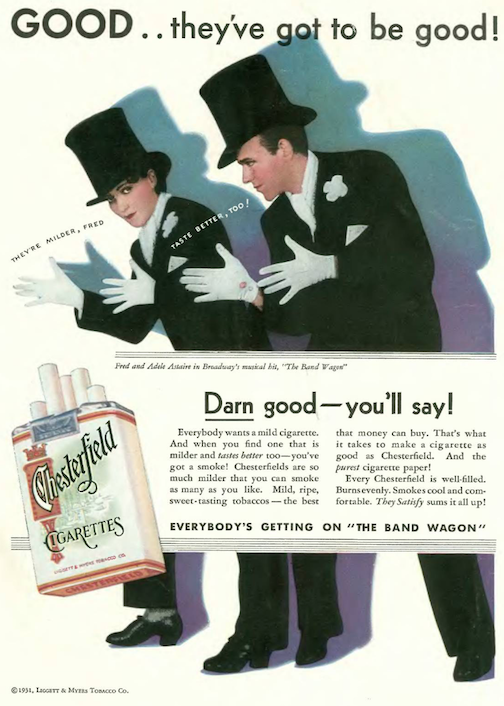
…on the other hand, the more established brand Chesterfield had the resources to run a color back-cover ad with endorsements from the brother-sister dance team Fred and Adele Astaire

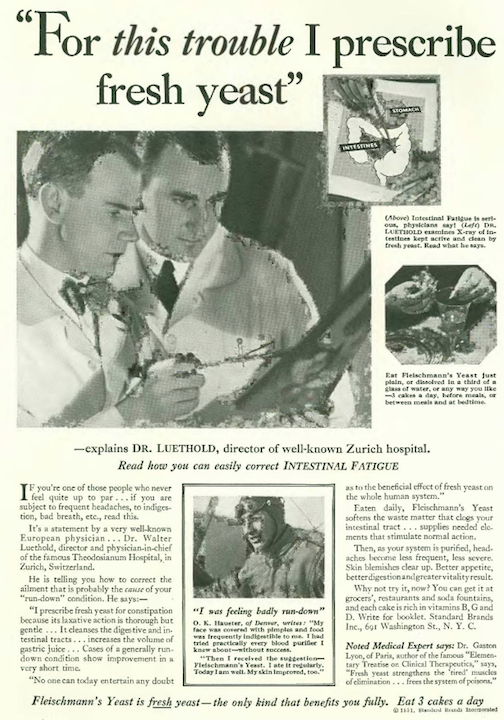
…Fleishmann’s continued to run their full-page ads touting the wonders of daily yeast consumption (“Eat three cakes a day”). The ads were there because Raoul Fleishmann used his wealth from the family baking business to keep the New Yorker afloat during its fledgling years…

…Farrar and Rinehart announced the arrival of Otto Soglow’s first book, Pretty Pictures

…here is the cover of the book…

…and we move on to the cartoons with the character that would make Soglow rich and famous…The Little King

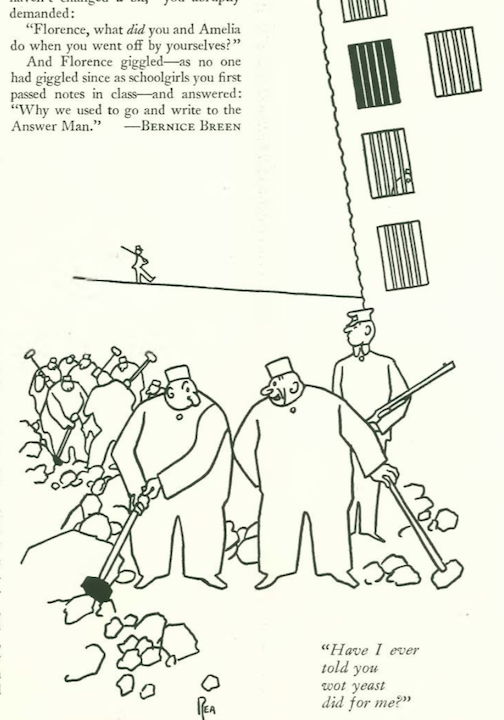
…although Fleischmann likely saved The New Yorker with large infusions of cash, its cartoonists, including Gardner Rea, still took an occasional poke at the company’s health claims…

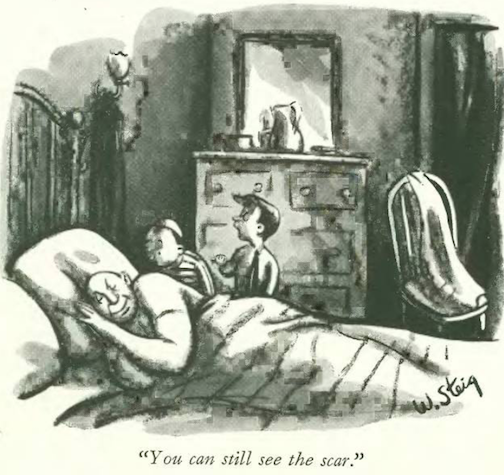
…anticipating his “Small Fry” cartoons, William Steig finds two of them examining the wonders of human physiology…

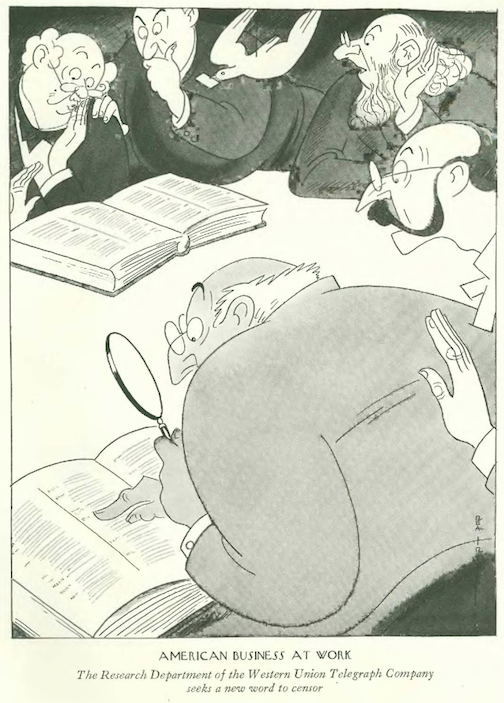
Rea Irvin looked in on some stuffy Western Union censors…

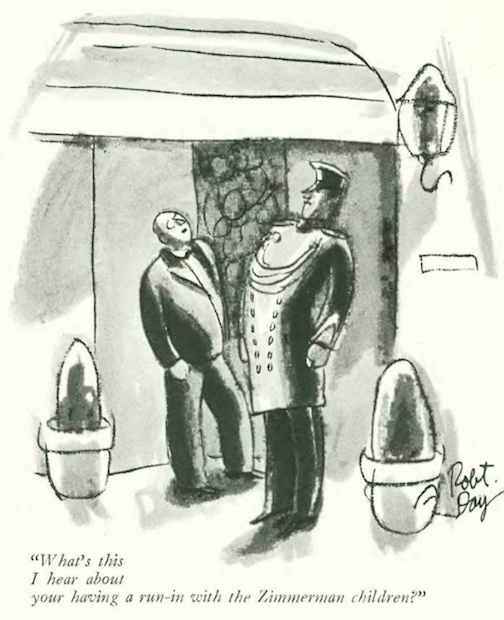
…newcomer Robert Day illustrated the challenges of a doorman (Day would be a longtime contributor)…

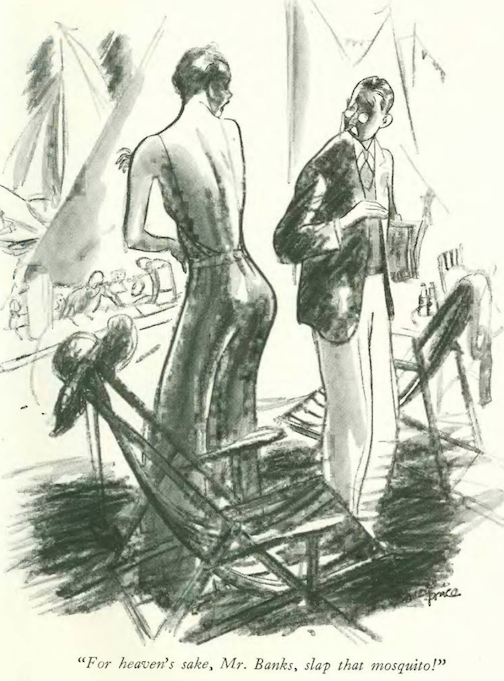
Garrett Price found humor abuzz between the bold and the meek…

Alan Dunn tracked down a clueless hunter…

…and we end with Leonard Dove, who takes flight and anticipates our next installment…

Next Time: A Big Bird…