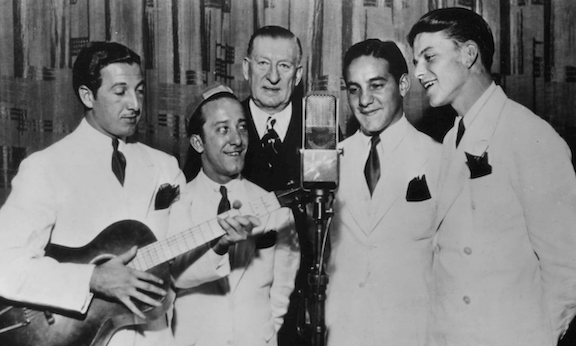
The Major’s Amateur Hour

Above: Photo of the Hoboken Four as they appeared on the "Amateur Hour with Major Bowes" in 1935. At center is "Major" Edward Bowes, and at right is Frank Sinatra. The other three members of the Hoboken Four were Frank Tamburro, Patty Prince and Jimmy Petro. (knkx.org)

Nearly seventy years before American Idol appeared on our TV screens, a hugely successful and influential talent show filled the airwaves from NBC’s radio studios at Rockefeller Center.
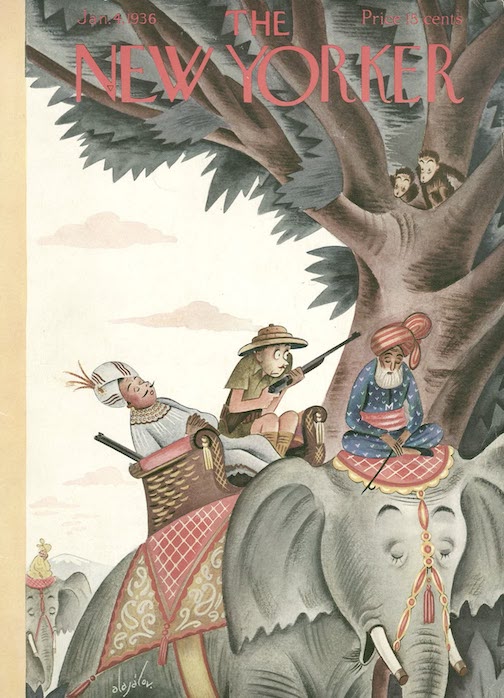
January 4, 1936 cover by Constantin Alajalov.

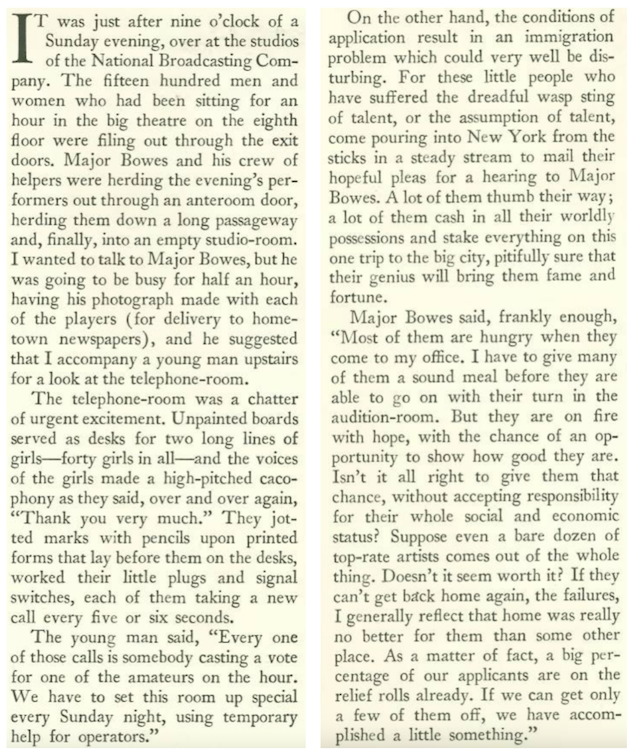
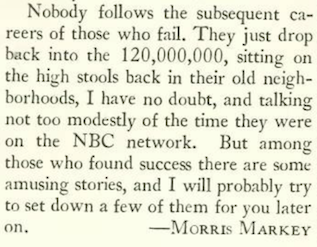
Millions tuned in each week to the Major Bowes Amateur Hour, which got its start in 1934 at radio station WHN before moving to NBC the following year. Created and hosted by “Major” Edward Bowes (1874–1946), Bowes would chat with contestants before listening to their performances, which could be cut short by the Major’s gong (see below). For his “A Reporter at Large” column, Morris Markey paid a visit to Bowes during evening auditions at the NBC studios. Excerpts:
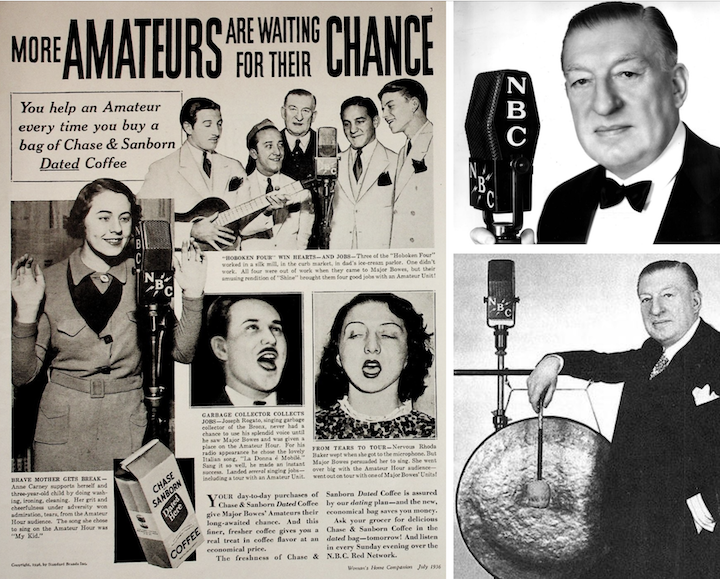
THE GONG SHOW…At bottom right, Edward Bowes with the gong he used to abruptly end acts he deemed poor or inept—he abandoned the prop in 1936 after receiving thousands of letters from listeners who objected to the premature termination of acts (apparently the concept was a direct inspiration for Chuck Barris’s 1970s TV program, The Gong Show). At left, a July 1936 Women’s Home Companion advertisement from the show’s sponsor, Chase & Sanborn. The ads highlighted the rags-to-riches stories of the more successful contestants. (eBay.com/Wikipedia)

Markey ended his piece noting the reality of the many contestants who, unlike Frank Sinatra, would not go on to successful entertainment careers.
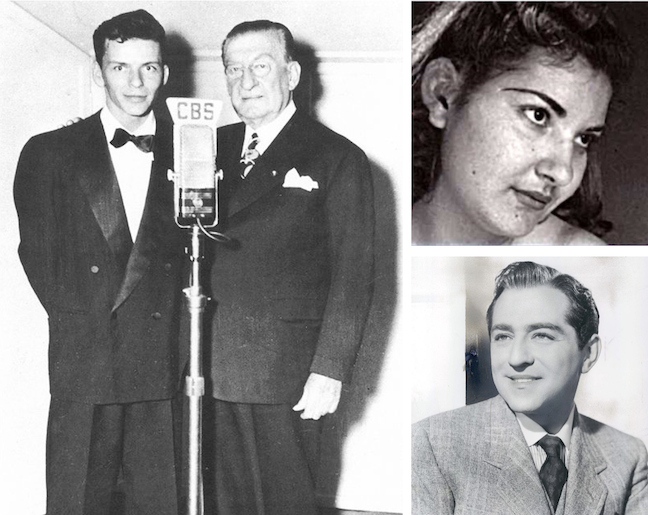
STARMAKER…Clockwise, from left: Major Edward Bowes and returning Amateur Hour performer Frank Sinatra in 1943; in 1935 eleven-year-old Maria Callas performed the Madama Butterfly aria “Un bel dì vedremo,” on the Amateur Hour; actor/baritone Robert Merrill performed on the show in 1936. (winnetoba.com/mariacallasestate.com/Wikipedia)

 * * *

Fleeing the Limelight

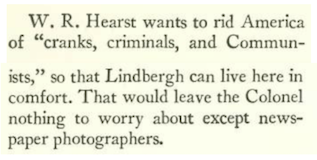
In December 1935 Charles and Anne Morrow Lindbergh secretly boarded a ship in New York and headed to England, seeking to escape the media frenzy that followed their son’s kidnapping and the subsequent trial. Thanks to connections through Anne’s family, they were able to move into a secluded estate in the Kent countryside. In his “Notes and Comment,” E.B. White explained:
HIDEOUT…From 1936 to 1938 Charles and Anne Morrow Lindbergh lived in a secluded English estate called “Long Barn.” The estate in County Kent was owned by a friend of Anne’s family. (waverlyhs.weebly.com)
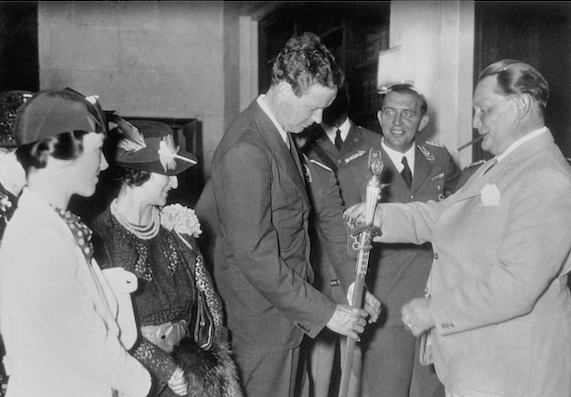
NOT HIS FINEST HOUR…In July 1936 Luftwaffe commander Hermann Goering (right) presented the Sword of Honor of the German Air Force to Charles Lindbergh during a visit to Berlin. Anne Morrow Lindbergh is to the far left. Goering would also present Lindbergh with a high-ranking Nazi-era civilian medal, the Service Cross of the German Eagle, during a 1938 visit. Anne presciently referred to the medal as “the albatross.” (Library of Congress)

According to White, Mayor Fiorello La Guardia cited lax police control of the media in the case of the fleeing Lindberghs. In turn, White attempted to explain the unique temperaments of Irish police officers.

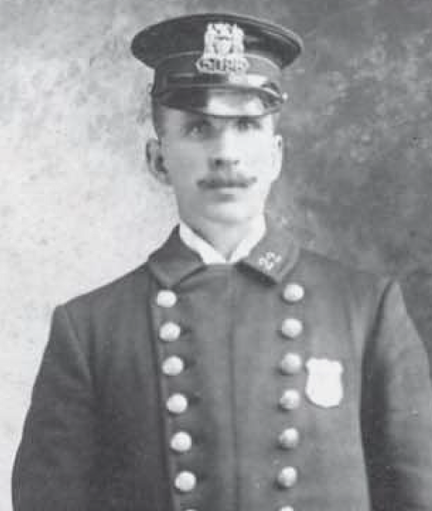
GIVE US A BREAK…E.B. White noted the courage and wisdom of Irish cops, but also found their lassitude “almost theatrical.” Pictured above is Irish immigrant Patrick Leddy, who joined the NYPD in 1910 and remained on the force for more than thirty-five years. (Courtesy of Margaret Fitzpatrick Leddy via nyirishhistory.us)

A final note on the Lindberghs from Howard Brubaker, a snippet from his “Of All Things” column.
 * * *

Italian Swashbuckler

The Italian fencer Aldo Naldi (1899-1965) won three gold medals and one silver at the 1920 Olympics before turning professional. According to West Coast Fencing, Aldo traveled Europe like a prizefighter, “competing in well-attended matches for cash purses…in a world of travel, glamour, drinking, womanizing, gambling and fencing, Aldo Nadi reigned supreme, going nearly eight years without a defeat.” “The Talk of the Town” was on hand for his American debut. Excerpts:
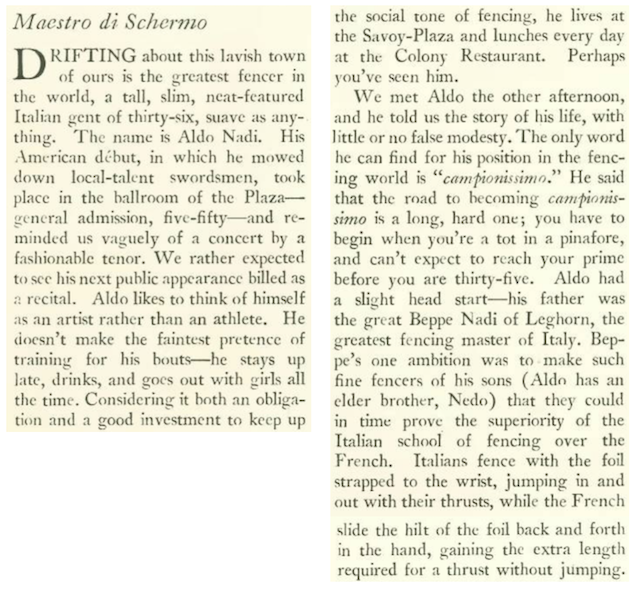
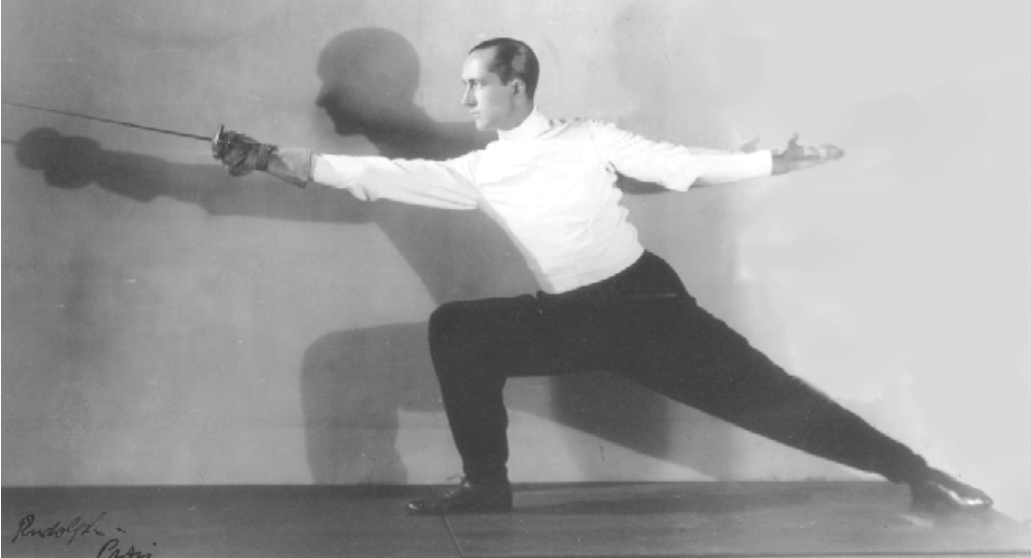
EN GARDE!…During the interwar years Aldo Nadi reigned supreme, going nearly eight years without a defeat. (dennishollingsworth.us)

“Talk” also examined the fuss being made over the Great Chalice of Antioch, which was on display at the Brooklyn Museum. Excerpts:
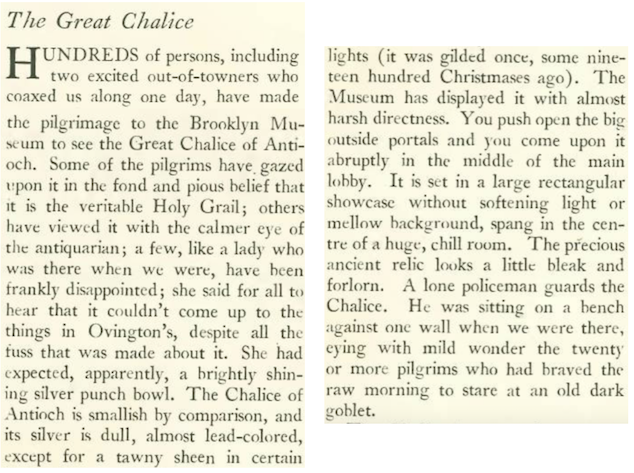
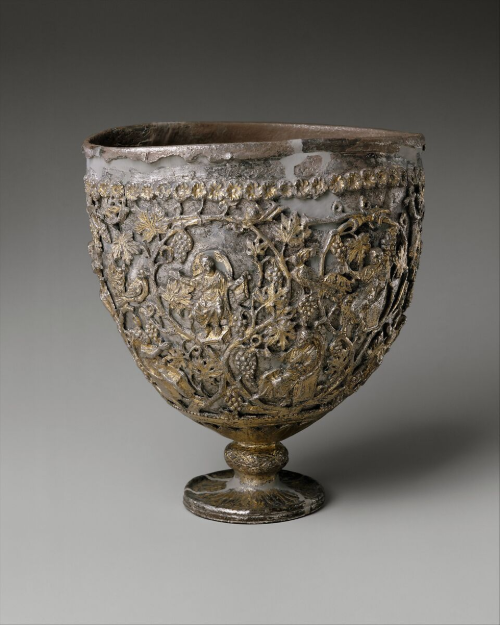
COULD IT BE?…Claimed to have been found in Antioch around 1900, this chalice’s plain silver bowl was ambitiously identified by some as the Holy Grail, the cup used by Christ at the Last Supper. It is displayed with the Metropolitan Museum’s Byzantium collection. (metmuseum.org)

* * *

Year, Schmear

To mark the New Year, Arthur Guiterman offered up one his humorous poems…
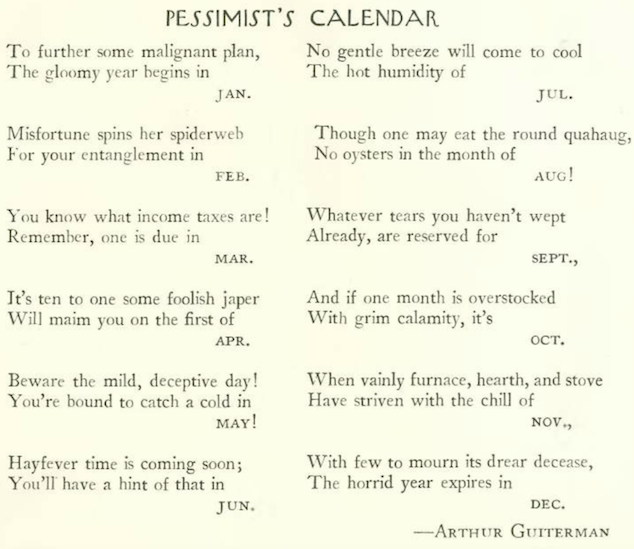
…Guiterman (1871–1943) was an early contributor to The New Yorker—the magazine’s very first issue, Feb. 21, 1925, featured the first installment of Guiterman’s recurring “Lyrics from the Pekinese,” which ran through the first eleven issues.
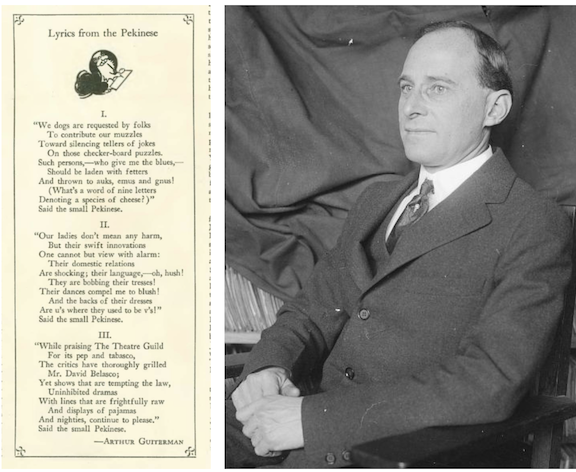
MEOW…Arthur Guiterman’s “Lyrics from the Pekinese,” featured in the first issue of The New Yorker. At right, Guiterman in an undated photo. (Library of Congress)

 * * *

Before He Was Spooky

Robert Benchley’s review of the stage began on a bright note with Victoria Regina, which starred Vincent Price as Prince Albert and Helen Hayes as Queen Victoria. Benchley praised the realism Price and Hayes lent to the production. Excerpts:
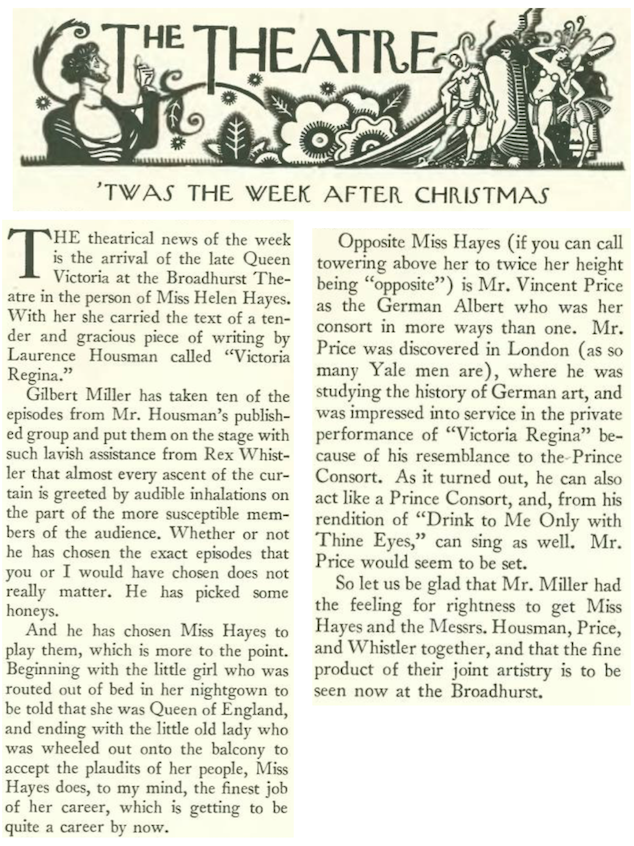
A MATCH MADE ON BROADWAY…The 24-year-old Vincent Price and the 35-year-old Helen Hayes portrayed Prince Albert and Queen Victoria in Victoria Regina, which ran for 203 performances at the Broadhurst Theatre. Robert Benchley thought their casting was ideal. (Pinterest)

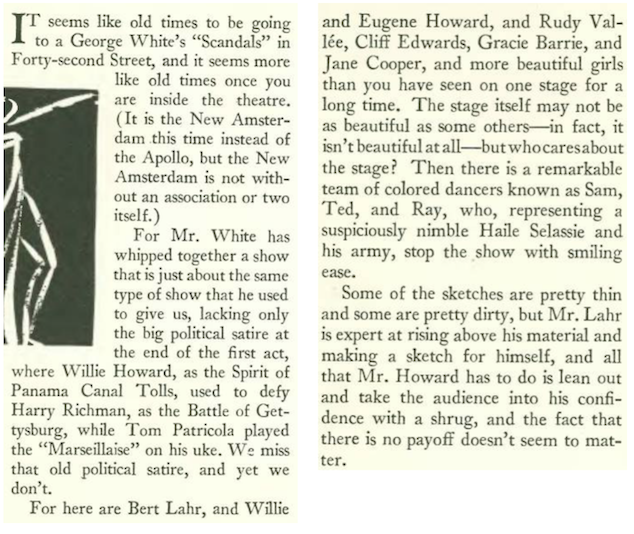
Benchley also sat through George White’s latest Scandals revue, finding it similar to White’s older shows—beautiful showgirls, various singers and dancers, and assorted comedians—with Bert Lahr shining above it all.
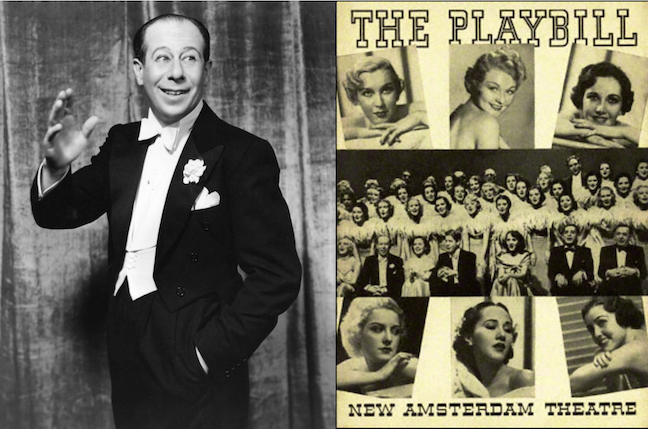
IT SEEMED LIKE OLD TIMES to Robert Benchley as he took in the latest edition of George White’s Scandals. Bert Lahr (left) was among the headliners for the 1936 revue, which ran for 110 performances at the New Amsterdam Theatre before taking to the road. (Wikipedia/Playbill.com)

 * * *

At the Movies

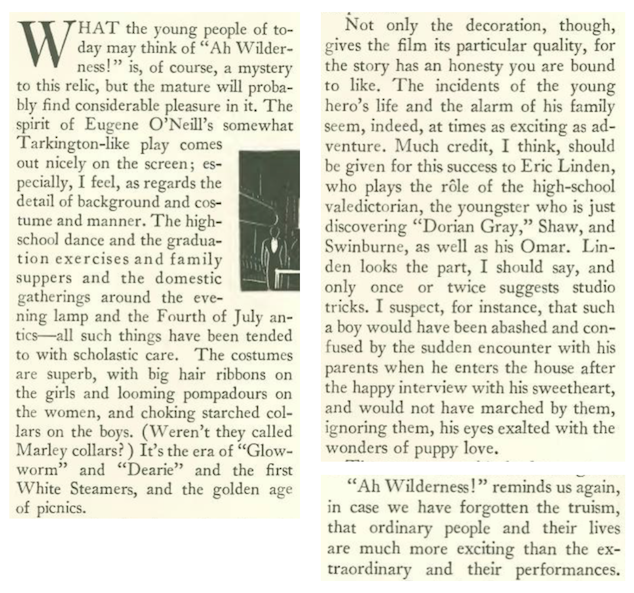
John Mosher had a busy week at the movies, finding “considerable pleasure” in the screen adaptation of Eugene O’Neill’s Ah Wilderness!…
MILLER TIME…The Miller family attends a commencement ceremony that helps kick off the action in Ah Wilderness! From left, Aline MacMahon, Mickey Rooney, Spring Byington, and Bonita Granville. (IMDB)

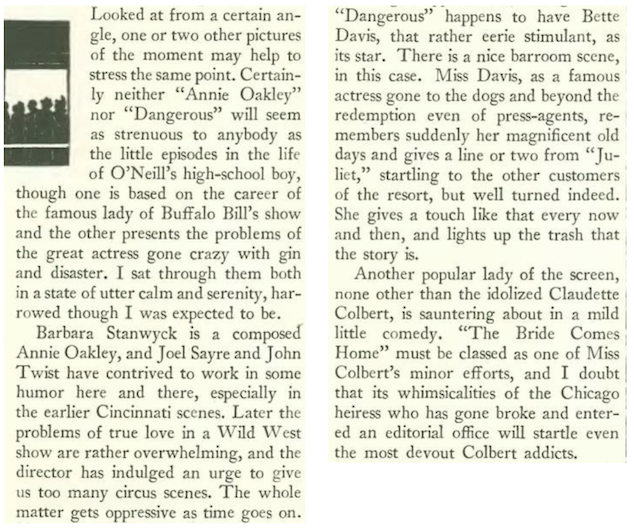
Mosher also looked at films featuring leading actresses of the day—Barbara Stanwyck in Annie Oakley, Bette Davis in Dangerous, and Claudette Colbert in The Bride Comes Home.
A TRIO OF TALENTS…Clockwise, from top left, Claudette Colbert had her hands full with Robert Young and Fred MacMurray in The Bride Comes Home; Barbara Stanwyck took aim in Annie Oakley; and Bette Davis portrayed a down-and-out actress with trouble on her mind in Dangerous. For her performance, Davis won the Academy Award for Best Actress. (laurasmiscmusings.blogspot.com/girlswithguns.org/vanguardofhollywood.com )

 * * *

Gaming the Games

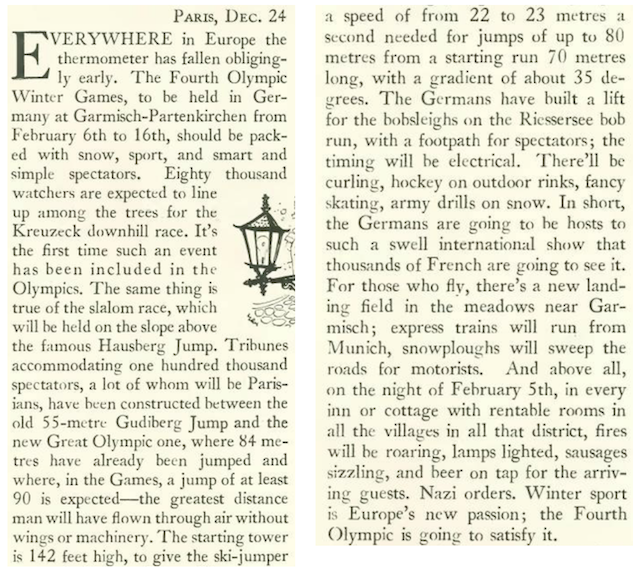
In her “Paris Letter,” Janet Flanner noted the preparations for the Fourth Olympic Winter games to be held in Garmisch-Partenkirchen, Germany.
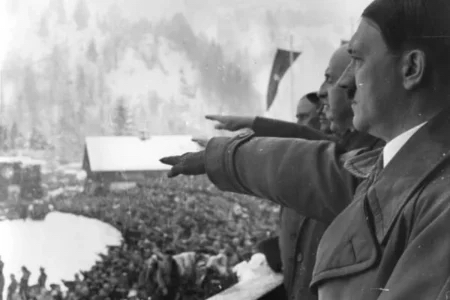
WINTER HAS ARRIVED…Adolf Hitler and his fellow Nazi thugs brought a certain chill to the 1936 Winter Games in Garmisch-Partenkirchen. Garmisch and Partenkirchen were separate communities until Hitler forced them to merge in anticipation of the games. (arolsen-archives.org)

 * * *

From Our Advertisers

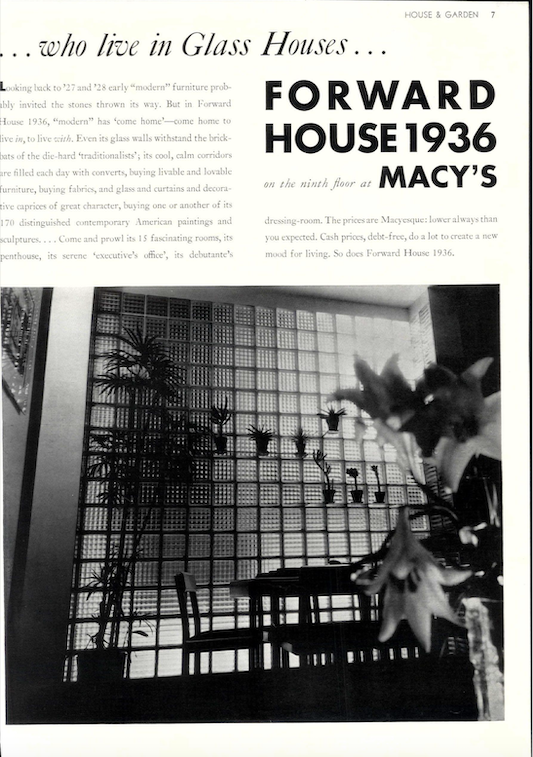
From 1933 to 1939, Macy’s hosted a series of unique design exhibitions under the title “Forward House” that showcased contemporary furniture, decor, and architectural ideas…

…for reference, here is another “Forward House” advertisement from the February 1936 House & Garden magazine…
…the folks at Robbins Island Oysters employed the legend of Giacomo Casanova to market their tasty little rocks…apparently Casanova claimed that he consumed more than fifty oysters each morning to sustain his amorous adventures…

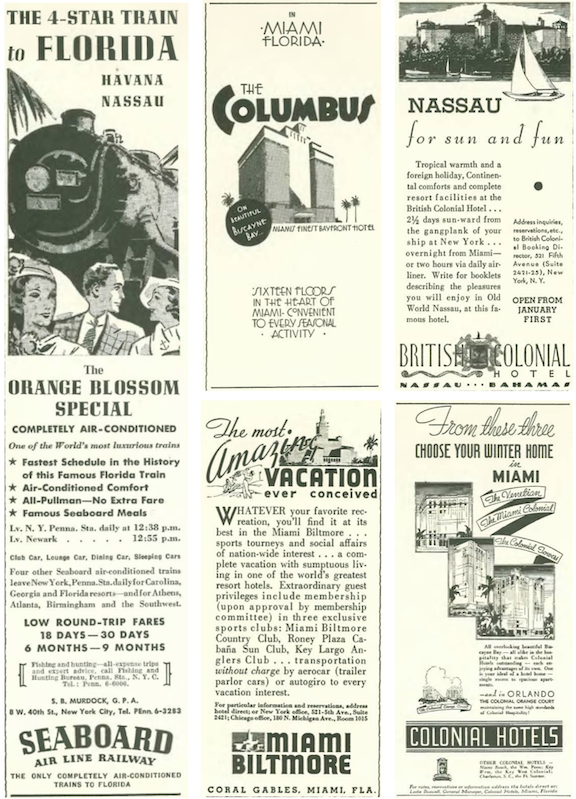
…with the holidays over, the number of ads decreased significantly, leaving readers with a mere sixty pages—less than the half the length of the fat pre-Christmas editions…the theme in the Jan. 4 issue was travel to warmer climes, these examples culled from several back of the book pages…
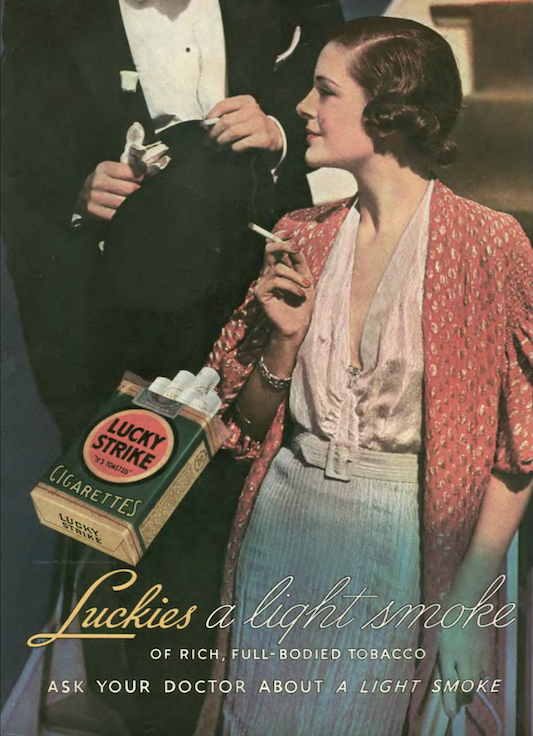
…the end of the holiday season did not stop tobacco companies from taking out lavish full-page advertisements targeting women smokers, this one gracing the back cover…note the implied medical endorsement at the bottom…
…we clear the air and move on to our cartoonists, beginning with spot drawings by D. Krán

…and Christina Malman

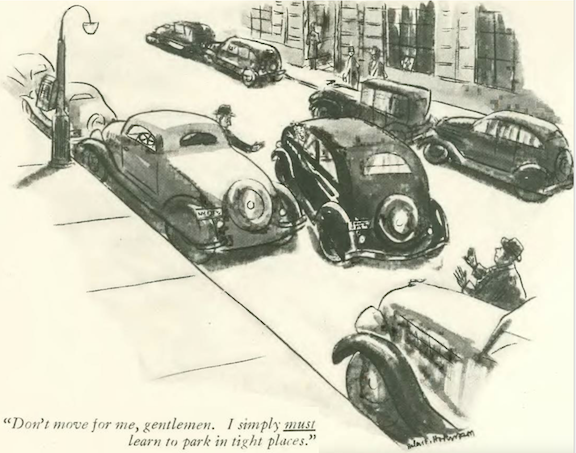
…one of Helen Hokinson’s girls sought an impromptu parking lesson…
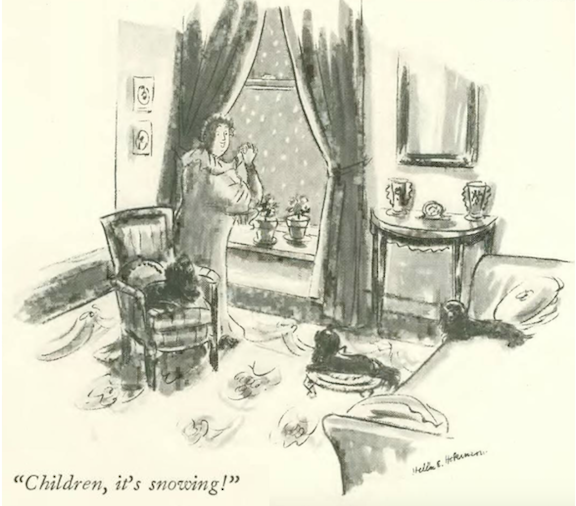
…while another welcomed winter with her furry charges…
Whitney Darrow Jr gave us a full-service information booth…

Mary Petty illustrated a dowager with simple tastes…

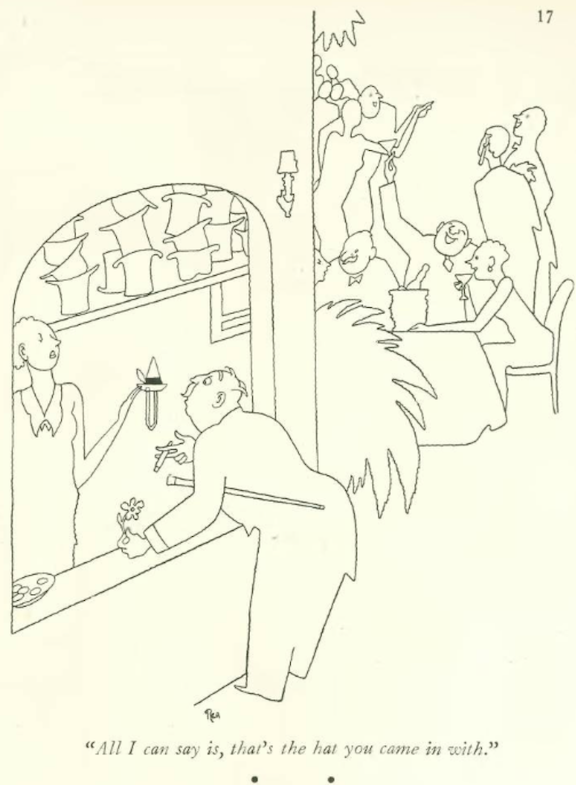
Gardner Rea was confounded at the hat check…
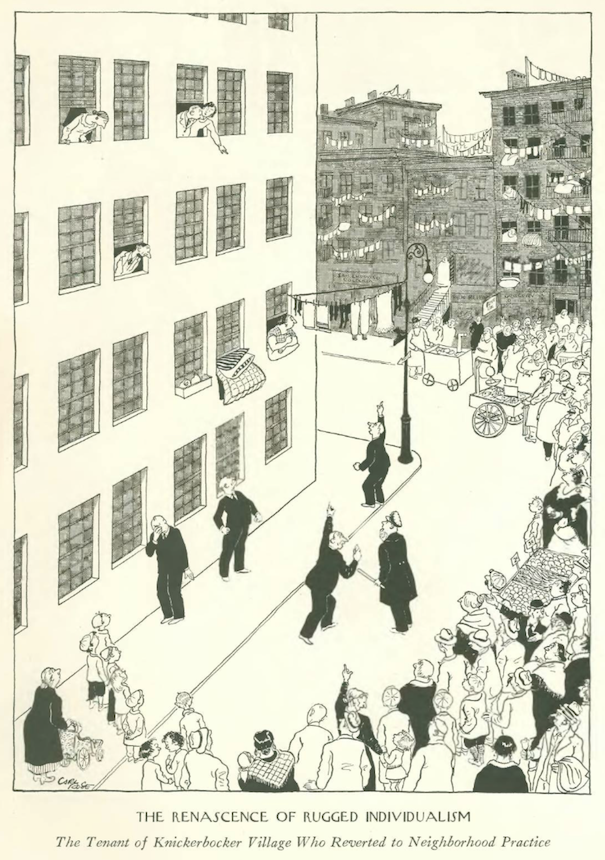
Carl Rose offered up another example of rugged individualism…
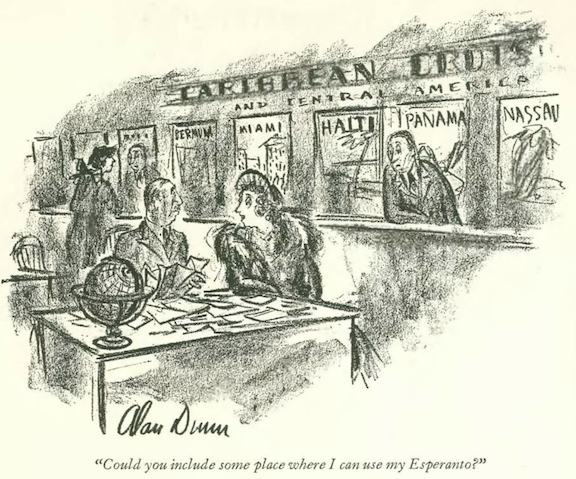
Alan Dunn served up a unique language challenge…
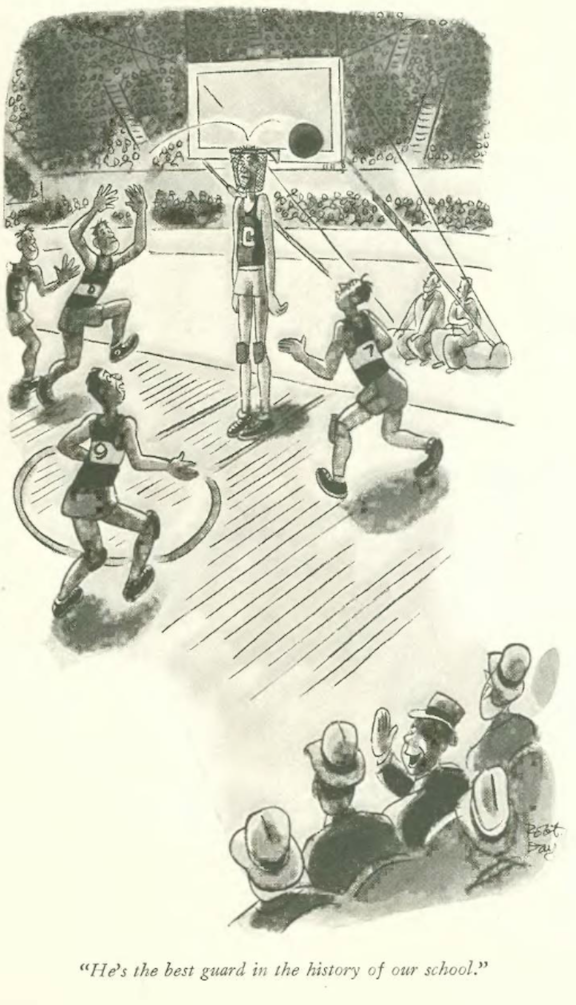
Robert Day stood tall at a basketball game…
William Crawford Galbraith was horsing around…

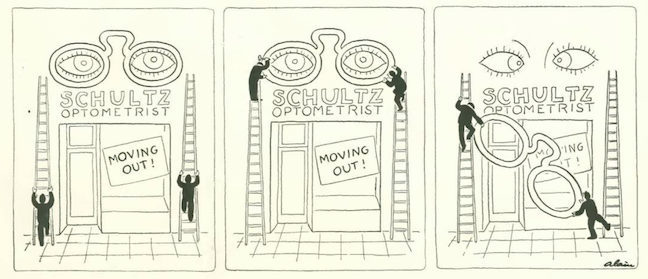
Alain looked crosseyed at a store closing…
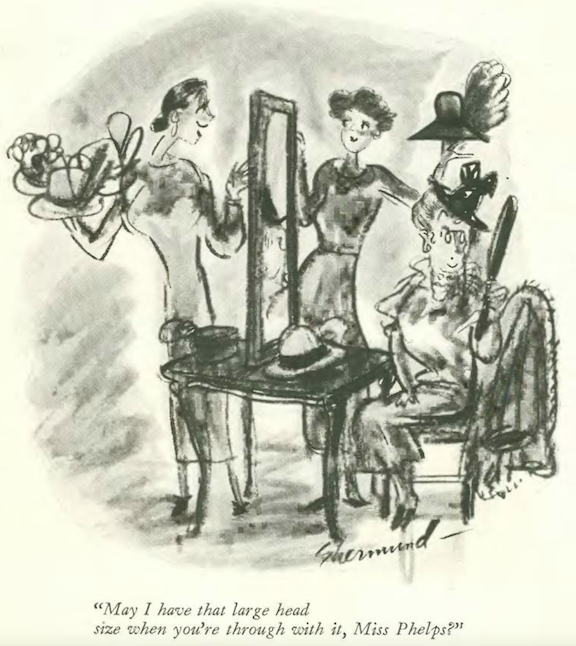
…and we close with Barbara Shermund, who sized up things at a hat shop…
Next Time: Obsessed at the Movies…

The Final Curtain

Nearly a century after his passing, many still regard Florenz Ziegfeld Jr as the most important and influential producer of Broadway musicals. His theatrical revues, filled with leggy chorines and wisecracking comics, set a standard for everything from Busby Berkeley productions to the Fats Waller stage celebration Ain’t Misbehavin’.

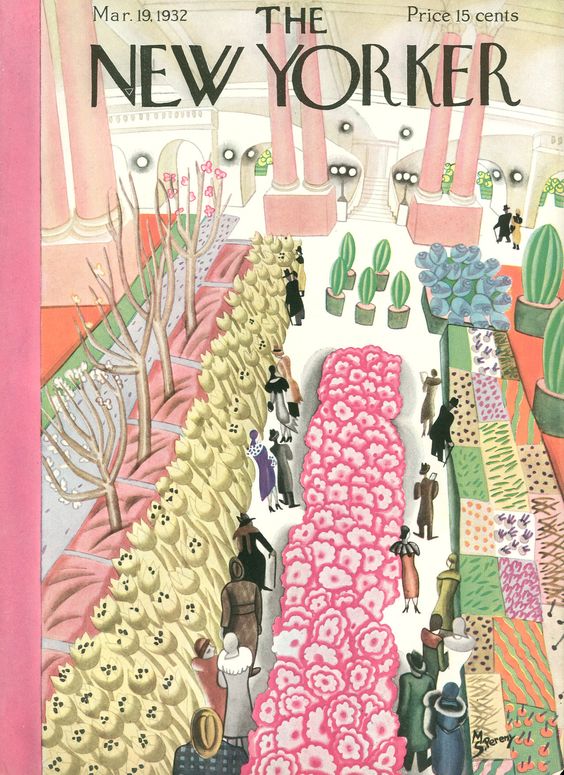
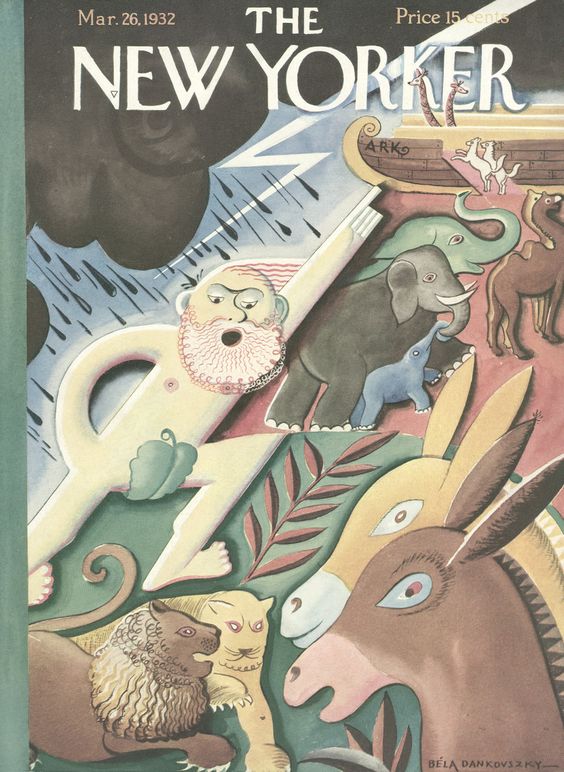
March 19, 1932 cover by Madeline S. Pereny, who gave us a glimpse of the annual International Flower Show at Grand Central Palace.

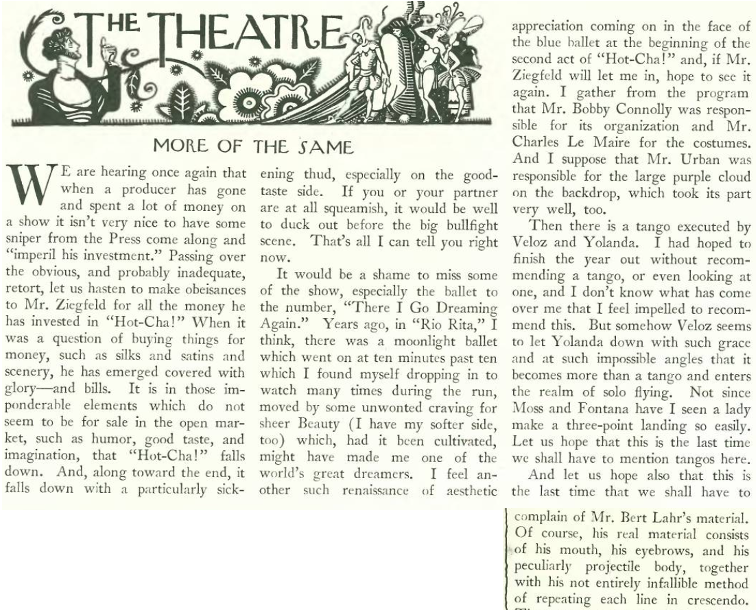
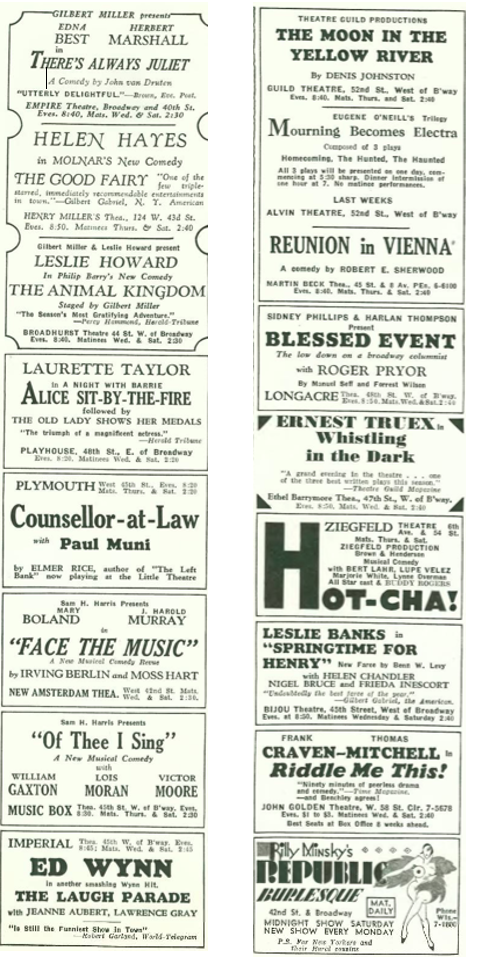
But when Robert Benchley checked out Ziegfeld’s latest revue, Hot-Cha, which opened at the Ziegfeld Theatre on March 8, 1932, he found it tiresome, and no amount of expensive scenery could keep the show from ending on a “particularly sickening thud.” What Benchley couldn’t know, however, was that Hot-Cha would be the last original musical-comedy produced by Ziegfeld, who in just four months would punch his final ticket.

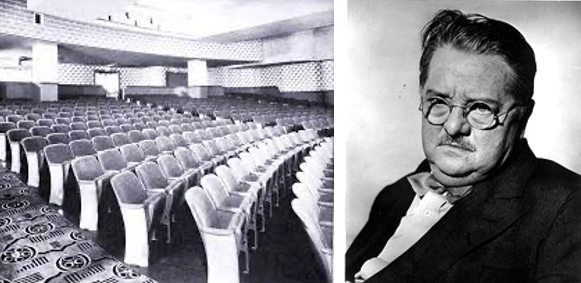
NOT SO HOT-CHA!…Florenz Ziegfeld’s final revue brought out the stars, but it wasn’t enough to dazzle drama critic Robert Benchley. Clockwise, from top left, program for the revue; Lupe Velez, Charles “Buddy” Rogers, and June Knight in Hot-Cha; Benchley was more critical of Bert Lahr’s material than of the comedian himself — many years later Lahr’s son, John Lahr, would follow in Benchley’s footsteps and serve as the New Yorker’s drama critic; Frank Veloz and Yolanda Casazza were among the highest-paid dance acts in the 1930s and 40s, but Benchley had simply lost his appetite for yet another tango. (playbill.com/Pinterest/Smithsonian/Wikimedia)

Selections from the Ziegfeld Theatre program promised a stageful of talents, including 75 “Glorified Girls”…

…and Ziegfeld (1867–1932) would be back in May for a revival of Show Boat, which once again proved to be a hit, but a bout of pleurisy would claim his life on July 22, 1932. As Benchley alluded in his review, these lavish shows led to equally lavish expenses, and Ziegfeld, having lost much of his money in the stock market crash, would leave his actress wife Billy Burke with substantial debts. The plucky Burke, however, marched on with a successful acting career that included her appearance as Glinda the Good Witch in 1939’s Wizard of Oz.

SECOND ACT…Florenz Ziegfeld Jr. and his wife, actress Billie Burke, pose for an Edward Steichen photo, 1927. At right, Burke as Glinda the Good Witch in 1939’s Wizard of Oz. (Condé Nast/IMDB)

 *  *  *

Everyone’s a Critic

The March 19 issue also featured drama criticism from Alexander Woollcott in his “Shouts and Murmurs” column. In this case, Woollcott had a bone to pick with the famed playwright Eugene O’Neill, as well as with Guild Theatre’s coughing patrons, who called to mind a chorus of frogs:

SHSSS!…Alexander Woollcott would have preferred an empty Guild Theatre to one filled with “bronchial” patrons. (goodreads.com)

 *  *  *

Down in Old Mexico

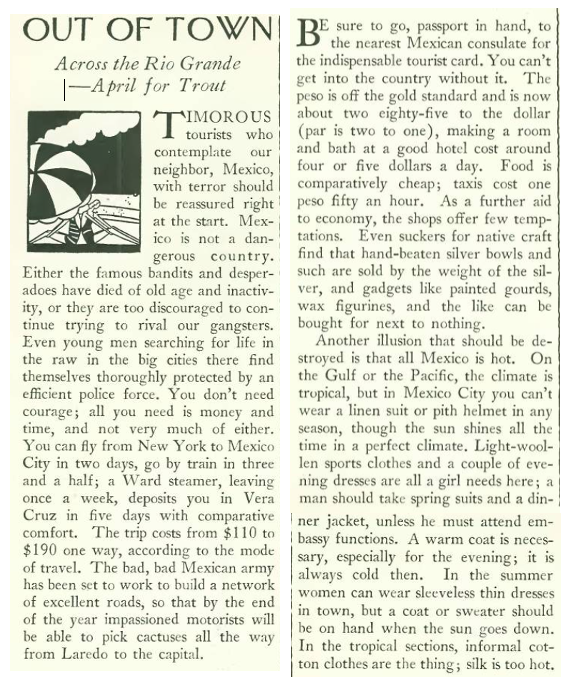
The New Yorker’s latest “Out of Town” feature assured travelers that Mexico was a safe destination, and advised men to pack “spring suits and a dinner jacket” if they planned to visit Mexico City. The author of this piece (signed “P.L.”) cautioned travelers “to get insulated against liquid lightning before getting flip with the national drinks: pulque and tequila. Bootleg liquor is no preparation for the havoc these work even on the sternest drinker.”

 *  *  *

Sweating With the Stars

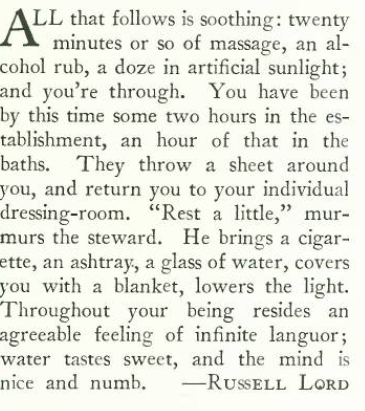
The March 19 “A Reporter at Large” column carried the simple title “Exercise.” Written by journalist Russell Lord* (1895-1964), this excerpt revealed some high-powered clients of one of the world’s first celebrity trainers:

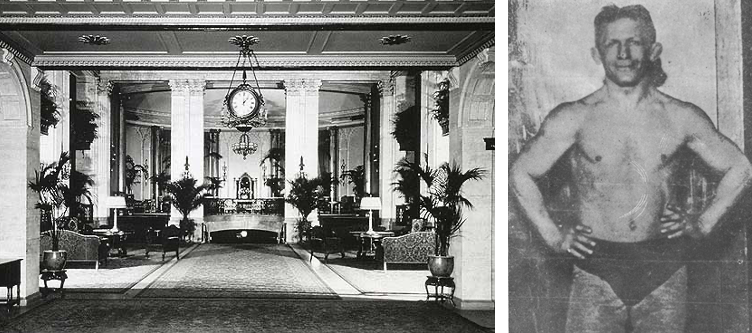
GUY LOMBARDO’S DOOR IS ON THE LEFT…Izzy Winter’s health and exercise “institute” was tucked away on the second floor of the Roosevelt Hotel. Patrons passed through the hotel’s lobby to access an “honest sweat.” Izzy is pictured at right. (Roosevelt Hotel/Yale University)

In Lord’s conclusion, he noted that after a workout patrons were treated to a doze under a sunlamp…and a cigarette…

* In his day, Russell Lord was a noted agricultural writer and editor of the agricultural literary journal The Land, which promoted ecologically responsible agricultural practices.

 *  *  *

Fame and Infamy

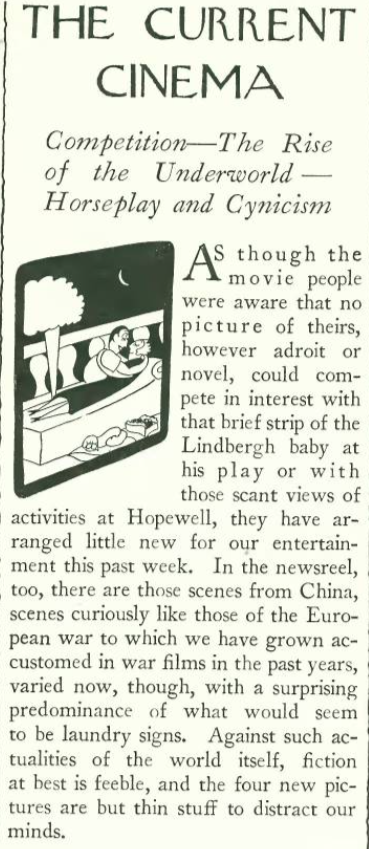
I include this snippet from John Mosher’s film column to note the first reference in The New Yorker to the March 1, 1932 kidnapping of the baby of Charles and Anne Morrow Lindbergh…the lives and various doings of the Lindberghs were frequent subjects in the early days of the magazine…

  *  *  *

From Our Advertisers

We’ll start by sampling some of the wares in the back pages…looks like Ziegfeld got a big bang for his small investment with his Hot-Cha ad…

…while Ziegfeld ran a cheap ad for his lavish production, the R.F. Simmons Company decided to go big with this ad for…drum roll please…watch chains…

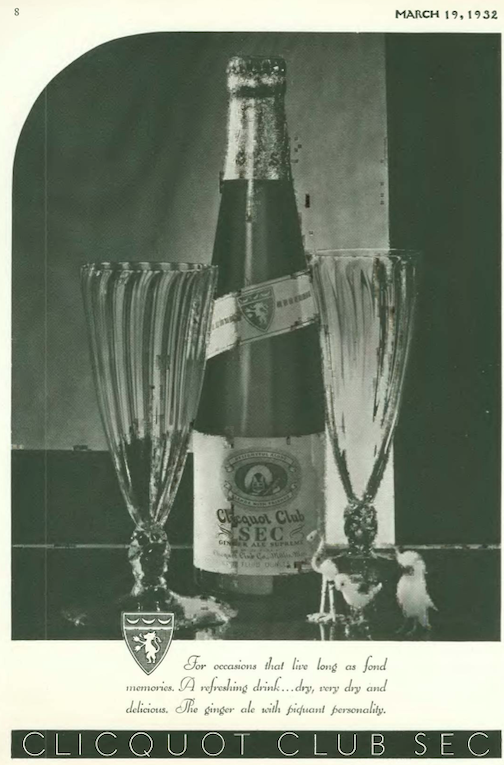
…the makers of Cliquot Club Ginger Ale also did their best to promote a mundane product, claiming their beverage had a “piquant personality”…yeah, especially with a splash or two of some bootleg whisky…

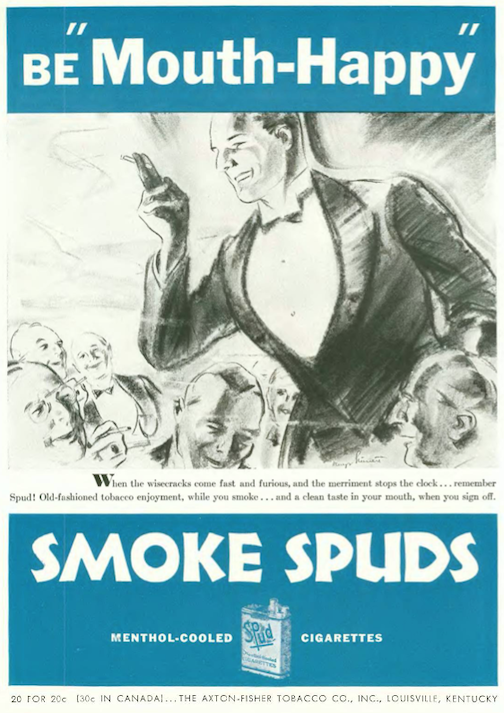
…the makers of Spuds were staying with their stupid “Mouth-Happy” theme, assuring menthol cigarette smokers they will be the life the party…a party filled with old gasbags, that is…

…R.J. Reynolds continued to push their Camels on the growing market of women smokers, demonstrating the effects of a fresh cigarette with this image of a rosy-cheeked nurse…

…DeSoto (a division of Chrysler) gave Depression-era readers something to smile about with this full-color, two-page advertisement featuring a sunny beach scene and an affordable automobile…

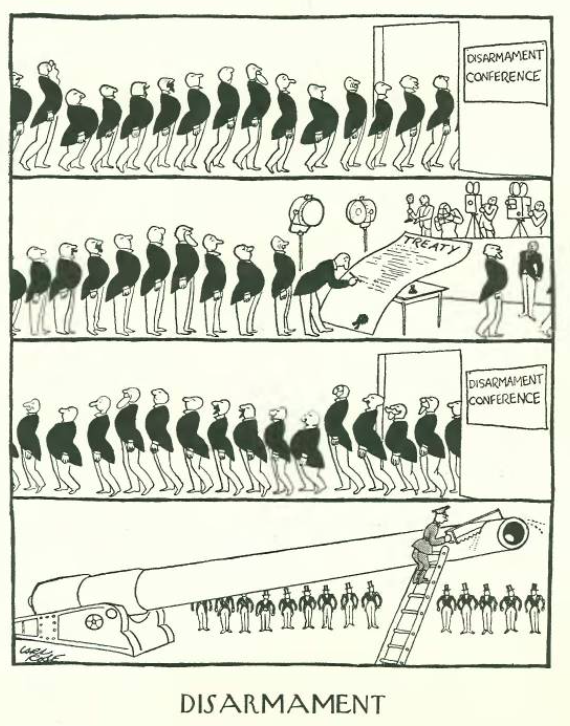
…on to our cartoons, here’s Carl Rose’s perspective on the Disarmament Conference taking place in Geneva, Switzerland…

…while the Otto Soglow’s Little King had his own way of projecting power…

…on the domestic scene, Barbara Shermund’s modern women were channeling  René Descartes

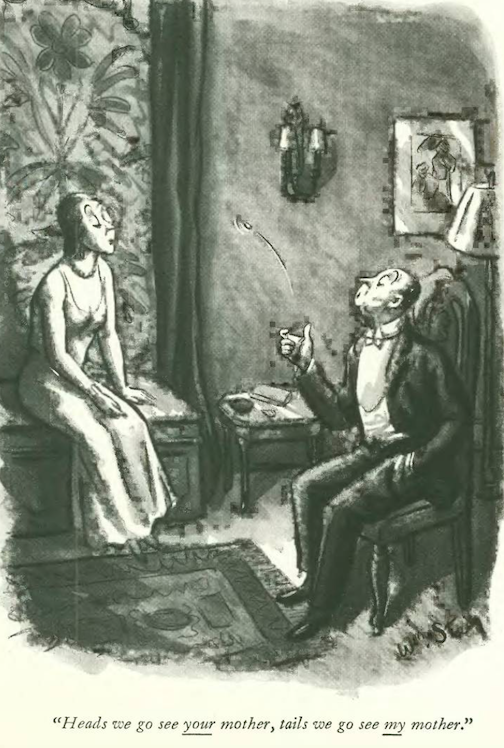
…and William Steig showed us a couple debating an equally weighty matter…

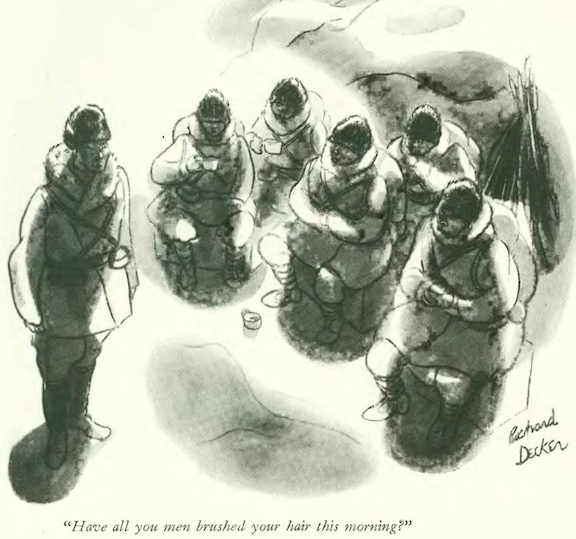
…and via Richard Decker, some well-groomed polar explorers…

…two of Helen Hokinson’s “girls” stopped by the International Flower Show at Grand Central Palace…

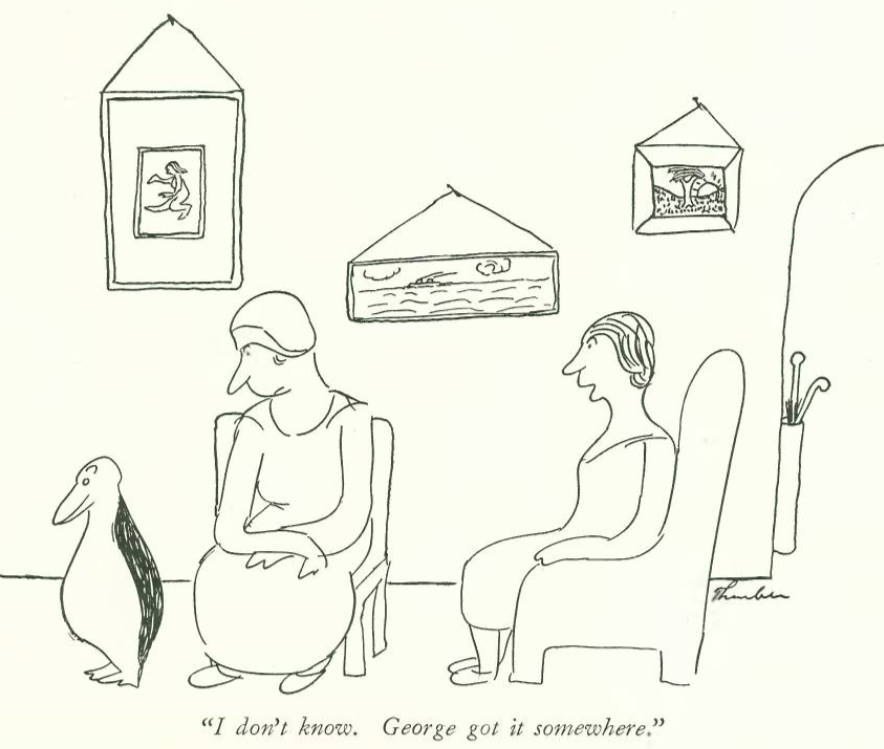
…and we end with another classic from James Thurber

Next Time: Dirge for a Dirigible…

The Lion Roars

It’s easy to get into the weeds while digging through The New Yorker archives, as it is filled with a richly interconnected cast of characters whose lives and work still resonate with us today.

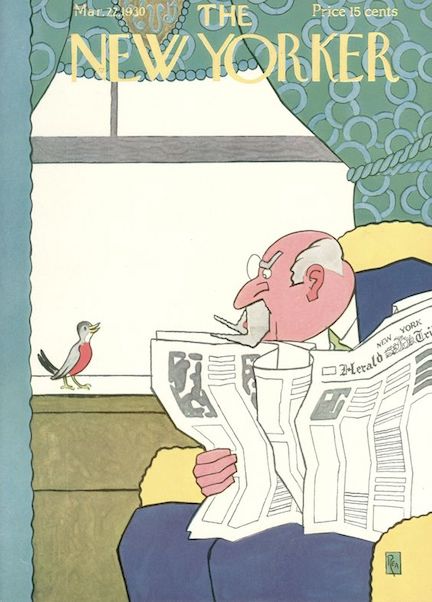
March 15, 1930 cover by Rose Silver. (Please see note on this artist at the end of this blog entry)

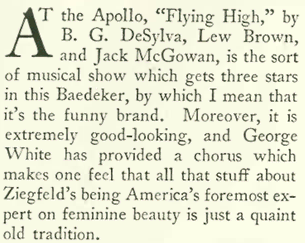
A case in point is Bert Lahr (1895-1967), who at age 15 dropped out of high school and joined the vaudeville circuit, working his way up to top billing in Broadway musical comedies including 1930’s Flying High, which received an enthusiastic welcome from New Yorker critic Charles Brackett

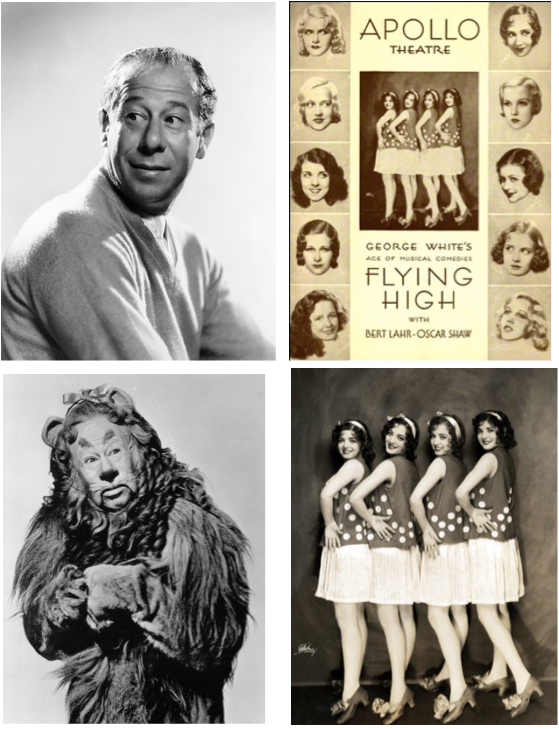
…Brackett enjoyed the “feminine beauty” offered by a George White chorus that included the “Gale Quadruplets,” described in the Playbill as “The only Quadruplets in the world appearing on the stage”…

…although in fact the Gale Quadruplets were actually two sets of twins: June and Jane, and Jean and Joan (real names were Doris, Lenore, Helen and Lorraine Gilmartin). But I digress.

What really caught Brackett’s eye were the antics of Bert Lahr:

ONLY ONE BERT…Clockwise, from top left, publicity photo of Bert Lahr from the 1931 film version of Flying High; cover of the Apollo Theatre Playbill; the Gale Quadruplets, circa 1930; Lahr as the Cowardly Lion in the 1939 film The Wizard of Oz. (Everett/Playbill/Pinterest/Wikiwand)

The Gale Quadruplets are long forgotten, but the work of Bert Lahr still lives on thanks to his role as the Cowardly Lion in The Wizard of Oz (a film, incidentally, that was panned in 1939 by New Yorker critic Russell Maloney, who called it “a stinkeroo” that showed “no trace of imagination, good taste, or ingenuity”).

Lahr also connects us to today’s New Yorker magazine, where his son, John Lahr, has been a staff writer and critic since 1992. Lahr has written a number of stage adaptions (he won a Tony award in 2002, the first drama critic to do so) as well as nearly twenty books, including a 2017 biography of his father, Notes on a Cowardly Lion: The Biography of Bert Lahr.

DRAMATIC DUO…John Lahr with his father, Bert, backstage at the Belasco Theatre in the late 1940s; John Lahr today. (NY Times/Amazon)

 *  *  *

Greener Pastures

We remain on Broadway with another writer who was deeply connected to The New Yorker’s origins. Marc Connelly (1890-1980) was a playwright, director, producer and performer who collaborated with George S. Kaufman on five Broadway comedies in the 1920s. Connelly was also a founding member of the Algonquin Round Table, around which orbited a number of writers, critics and assorted wits who would help bring The New Yorker to life in 1925. Connelly was listed as an advisory editor on the masthead of the very first issue:

Connelly’s play, The Green Pastures (based on stories from the Old Testament), had just opened on Broadway, drawing much acclaim for both Connelly and actor Richard B. Harrison (1864-1935). “The Talk of the Town” looked in on the playwright and the actor:

DID YOU HEAR SOMETHING?...Richard B. Harrison (left) and unidentified actor in 1930’s The Green Pastures. At right, Wesley Hill as the Angel Gabriel. (blackarchives.org/ngv.vic.gov.au)
FINAL BOW…Richard B. Harrison in a 1930 publicity photo for the Broadway play, The Green Pastures. At right, Harrison on the cover of the March 4, 1935, Time magazine. He died of heart failure ten days after appearing on the cover. (Henrietta Alice Metcalf Collection/Time)

Connelly would receive the 1930 Pulitzer Prize for Drama for The Green Pastures. And nearly 60 years later he would be featured in a 1987 documentary about the Algonquin Round Table (The Ten-Year Lunch) as the Table’s last survivor. It would win an Academy Award for Best Documentary Feature. During his long career Connelly would act in 21 movies, including the 1960 romantic comedy Tall Story with Jane Fonda and Anthony Perkins. He also did some TV, included a stint from 1962 to 1964 as Judge Rampell in The Defenders.

HE COULD ACT TOO…Clockwise, from top left, Marc Connelly in a 1937 photo by Carl Van Vechten; a page from the Playbill for The Green Pastures; college student June Ryder (Jane Fonda) collides on campus with Professor Charles Osmond (Marc Connelly) in the 1960 romantic comedy Tall Story. (Wikipedia/Playbill/ridesabike.com)

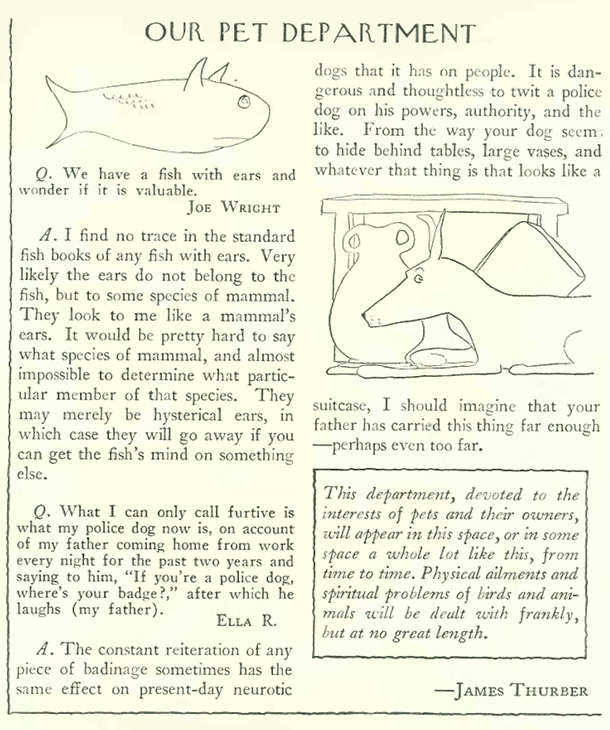
Also in the “Talk of the Town” section of the March 15 issue was James Thurber’s latest installment of pet advice:

 *  *  *

Lipstick’s Lamentations

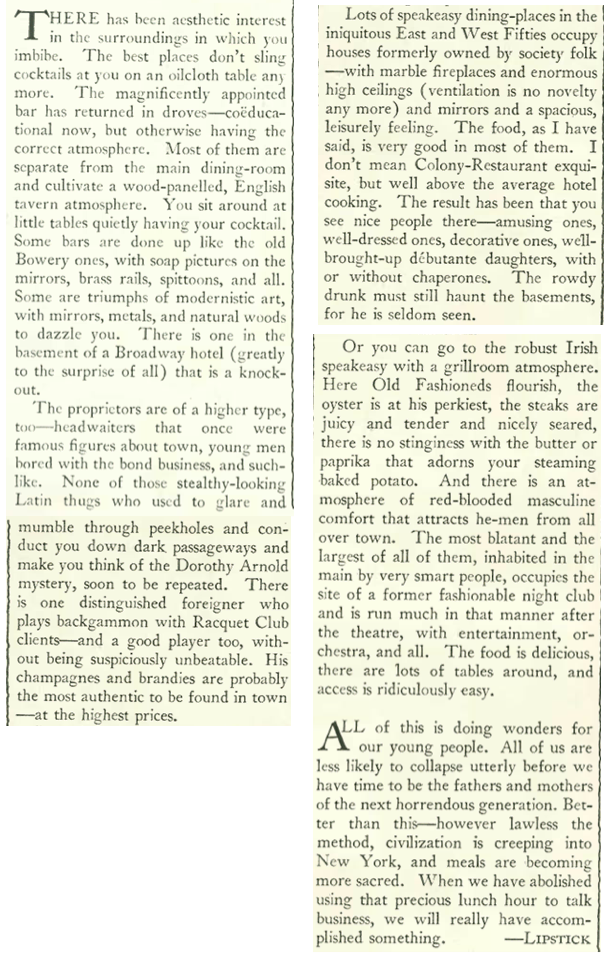
Once the place to read about wild speakeasies and other nighttime diversions of the Roaring Twenties, Lois Long’s “Tables for Two” column had quickly become anachronistic in the Depression years. Although the decade was still young, Long reminisced about her column’s “golden days” as if they had existed in some distant time, and lamented the state of the speakeasy; once a place for cheap and sordid frivolity, it had become staid and even snobbish…

THAT WAS THEN…Lois Long lamented the state of the speakeasy in 1930. Once sordid and given to frivolity, it had become a rather staid institution. (prohibition.themobmuseum.org/Time-Life)

…and Long described some of these new upscale speakeasies, where the oilcloth had been replaced with fine linen…

 *  *  *

Ozark Oeuvre

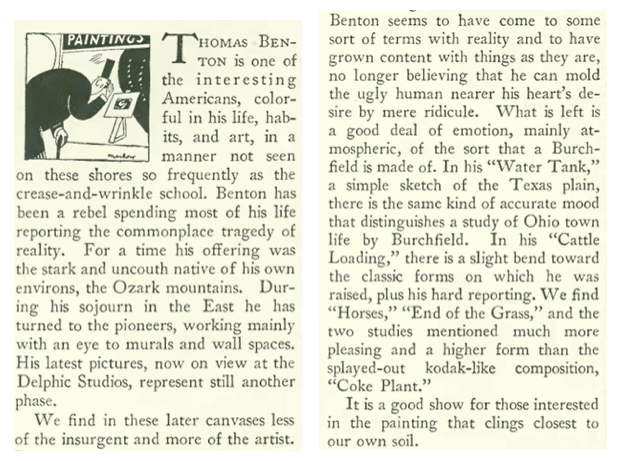
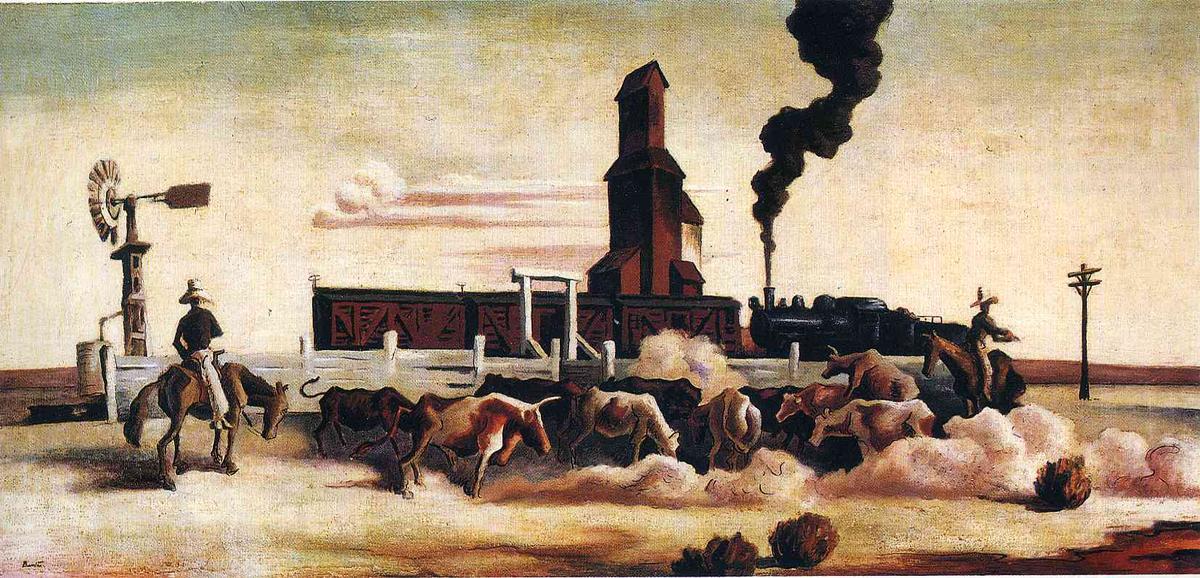
New Yorker art critic Murdock Pemberton, in his ongoing search for America’s best artists, took another look at that once “uncouth native” from the Ozarks, Thomas Hart Benton

PAINTING FROM THE SOIL…Cattle Loading, oil on canvas, by Thomas Hart Benton, 1930. It was one of the works viewed by critic Murdock Pemberton at the Delphic Studios in New York. (wahooart.com)

*  *  *

From Our Advertisers

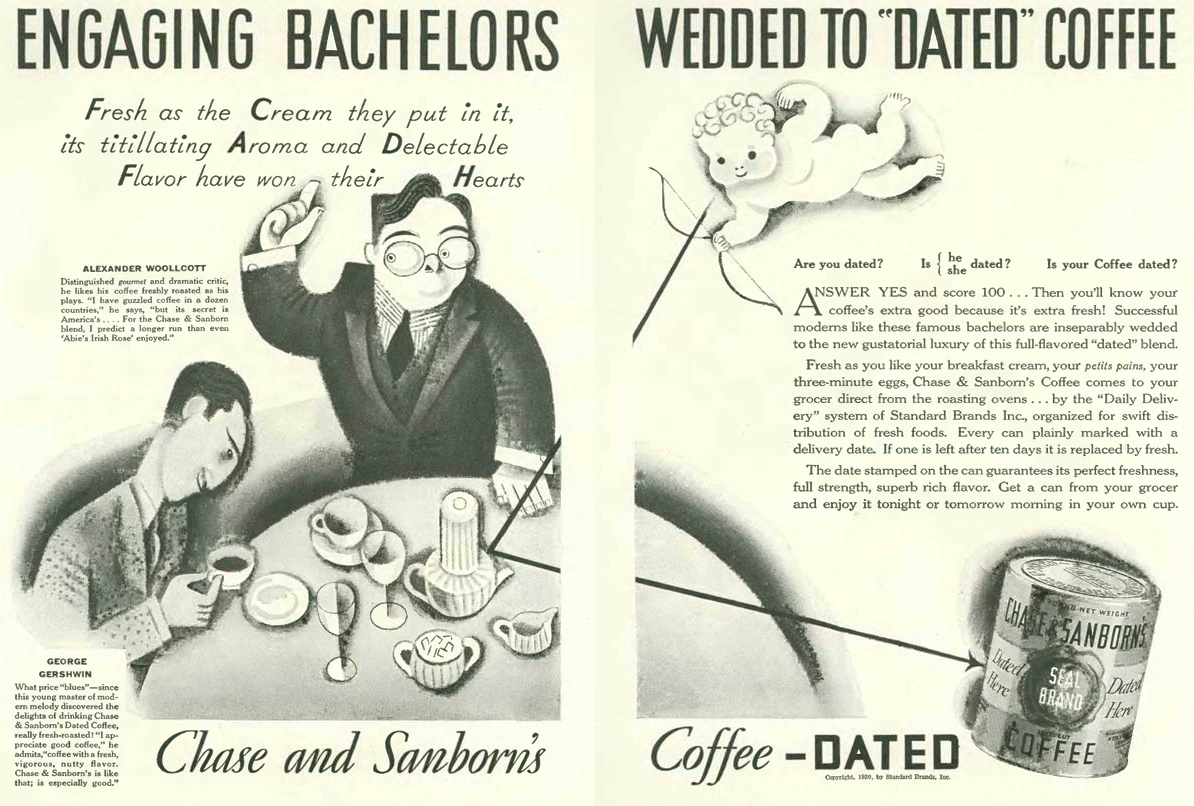
We start off with a couple of two-page ads, the first featuring caricatures of George Gershwin and Alexander Woollcott as rendered by the great Miguel Covarrubias

click image to enlarge

…and then we have this ad from the makers of Lux Toilet Soap, who must have had a bottomless advertising budget given all the splashy ads and celebrity endorsements…

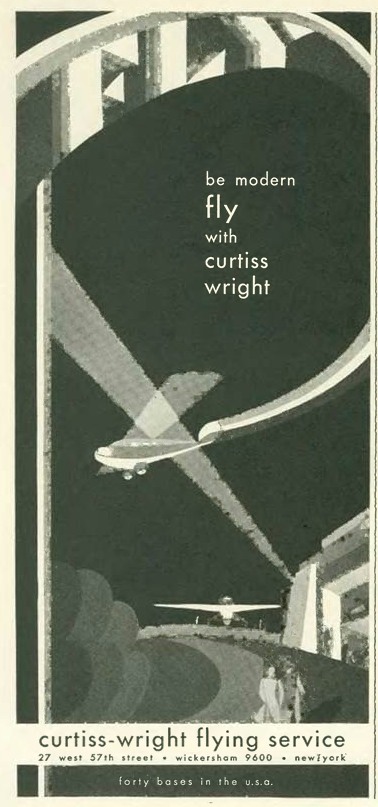
…in the ads we also find clashes between the old and new…the new being this art deco-styled appeal for the newest form of transportation…

…and the old, the makers of the luxury car Pierce-Arrow, still harking back to its patrician origins (“The Tyranny of Tradition”)…the firm would not survive the lean years of the 1930s…

…and once again a colorful ad from Church using snob appeal to sell something as pedestrian as a toilet seat…”Toilet Seats For Better Bathrooms”…

…on to our cartoons, we have a voyeur’s perspective courtesy Helen Hokinson

…an exploration of the generation gap by Alice Harvey

…and this terrifically quaint encounter, rendered by Perry Barlow

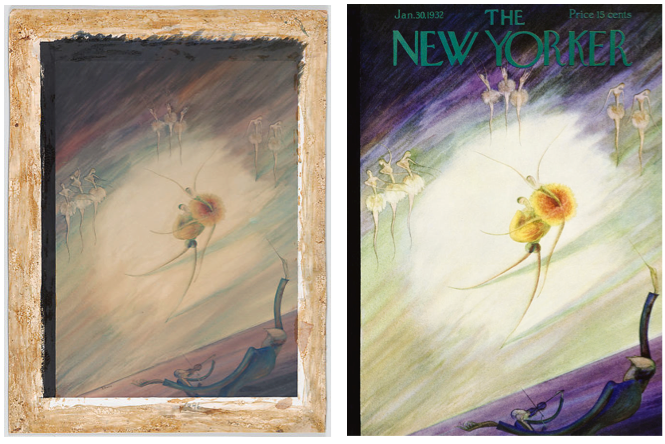
…and before we go, a note about this week’s cover artist, Lisa Rhana, a.k.a. Rose Silver (1902-1985) who illustrated several New Yorker covers in the 1920s and early 30s. Her work is included in the permanent collections at the Whitney Museum, the Museum of the City of New York, and The Metropolitan Museum of Art, which holds this watercolor (left) that graced the cover of the Jan. 30, 1932 issue:

Next Time: Garbo Speaks…