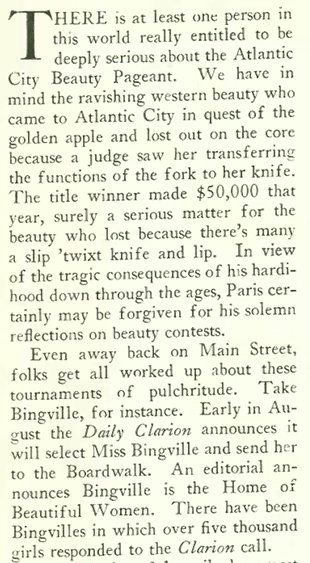
“The Very Golden Apple” was the title of an essay by E. A. Tosbell in the Sept. 3, 1927 issue that examined the transformation of the Miss America pageant–just seven years old–into a big money concern.
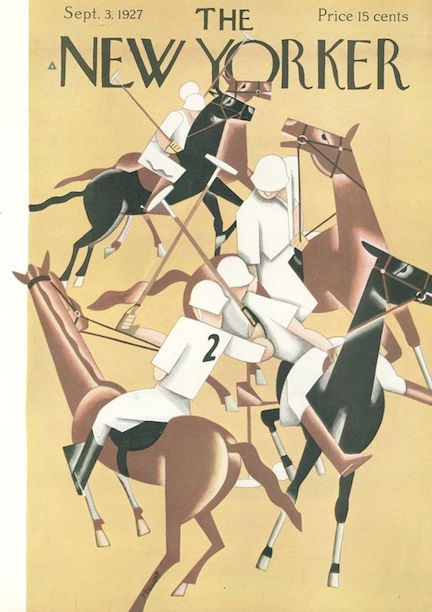
September 3, 1927 cover by Theodore G. Haupt.
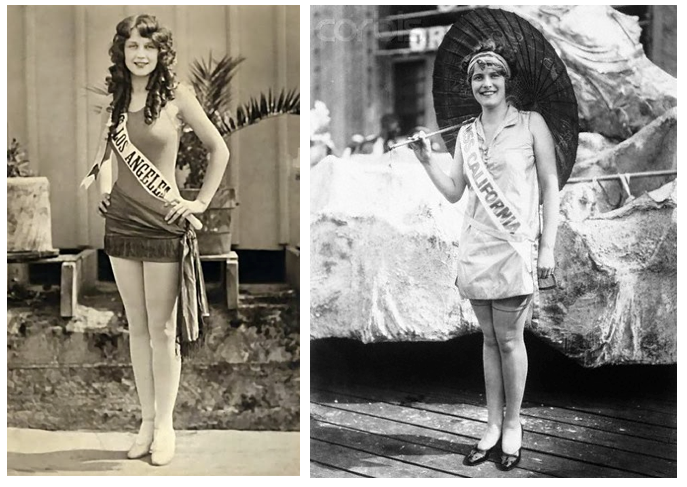
Tosbell opened with the lament that Miss Los Angeles, Adrienne Dore, should have won the 1925 contest save for a lapse in table manners…
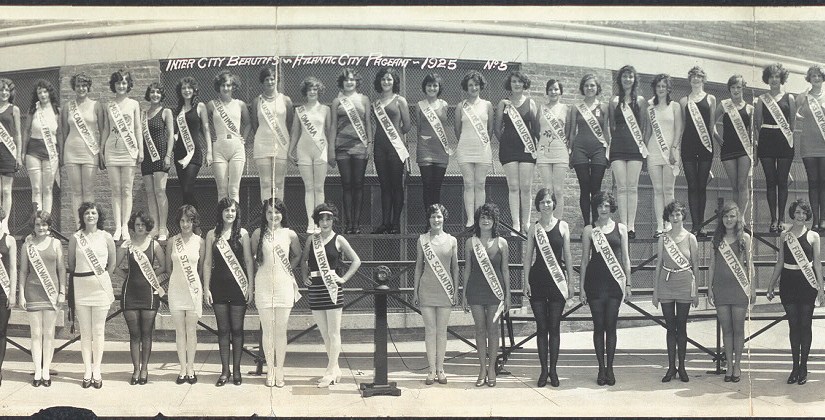
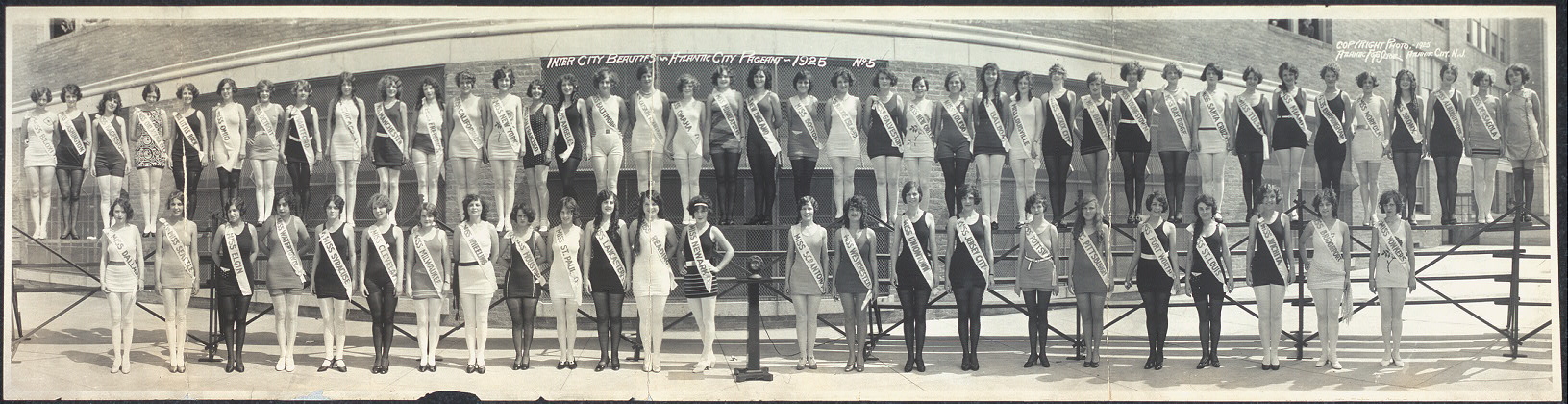
PASS THE SALT, PLEASE…Adrienne Dore, left, was runner-up to fellow Californian Fay Lanphier, who was crowned Miss America in 1925. Dore would go on to a modest movie career through the mid 1930s. (Allure/travsd.wordpress.com)ALL-AMERICAN LINE-UP…Contestants from a hodge podge of states, cities and towns vied for the Miss America crown in 1925. (Wikipedia) Click to Enlarge
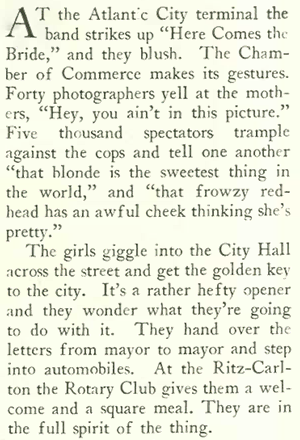
Tosbell offered us a taste of what contestants could expect upon their arrival in Atlantic City…
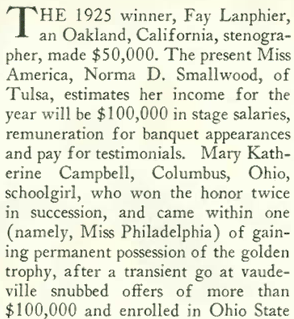
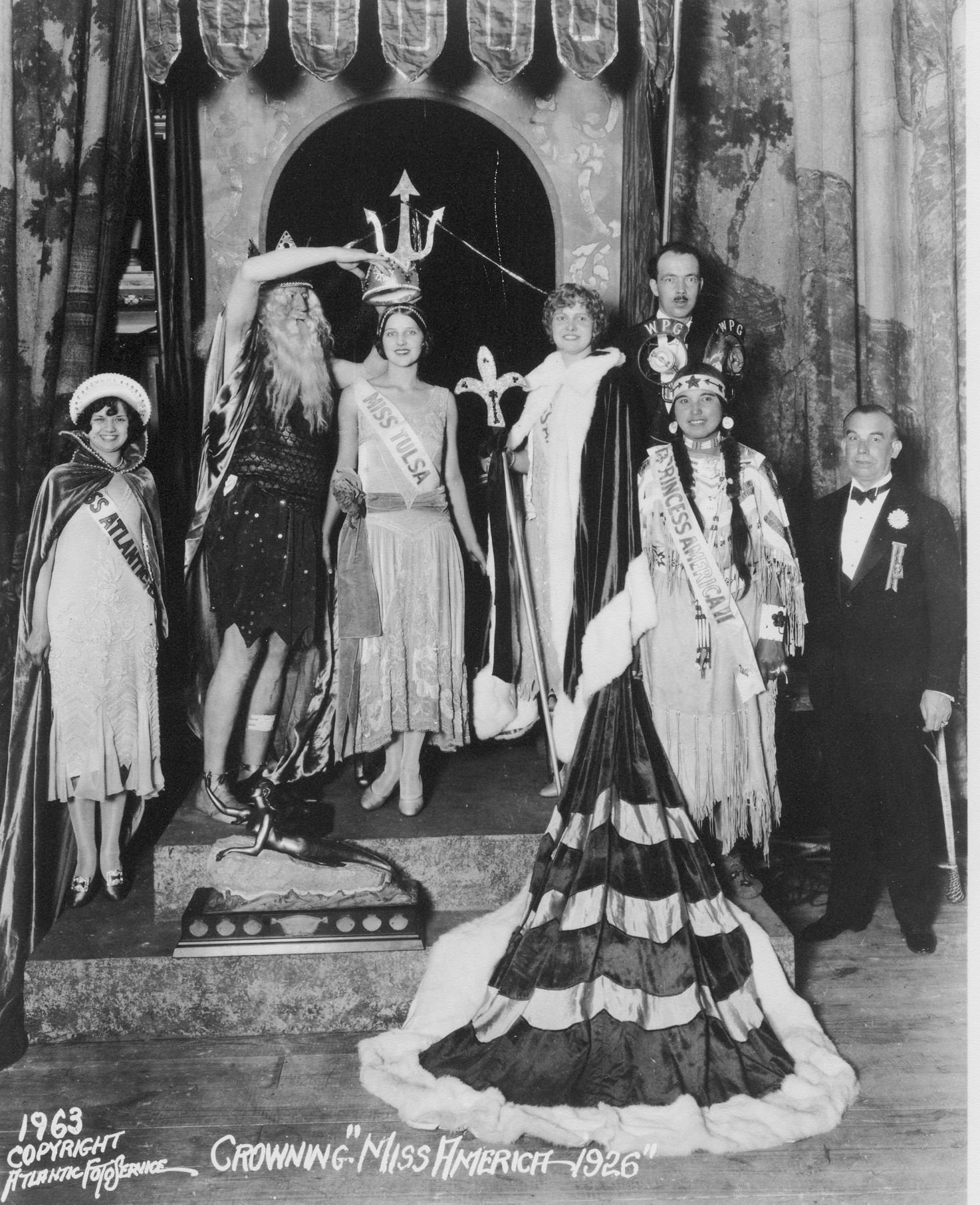
Norma Smallwood from Tulsa, Oklahoma was crowned Miss America 1926, the first Native American to capture the title. Smallwood was highly criticized in the press for her business savvy as she went on to earn $100,000 through personal appearance fees and product endorsements. Tosbell noted:
THERE SHE GOES…Norma Smallwood of Tulsa, Oklahoma was crowned Miss America 1926 by “King Neptune” as Miss America 1925 Fay Lanphier (right) held her scepter. (missamerica.org)
In 1927 Smallwood would again draw criticism when she requested $600 from the pageant for her appearance in crowning the new winner, Lois Delander. Delander was a high school student who won her local contest in Joliet, Illinois by reciting Bible verses. Unlike her predecessors, Delander turned down lucrative offers in show business and returned home to continue her school studies.
IT’S NICE, BUT…Lois Delander of Joliet, Illinois was a most unassuming Miss America of 1927. (Time.com)
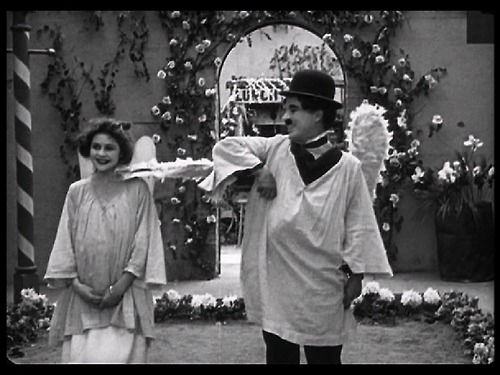
In the case of a 1922 Miss America contestant, Georgia Hale, you didn’t have to win the pageant to make it to the Big Time. Hale was chosen by Charlie Chaplin to be his “leading lady” in 1925’s The Gold Rush, and in the following year she would play Myrtle Wilson in the first filmed version of The Great Gatsby. A savvy businesswoman, Hale would become wealthy through real estate investments in Southern California.
SHE STRUCK GOLD…Georgia Hale and Charlie Chaplin in The Gold Rush, 1925. (Wikimedia Commons)
* * *
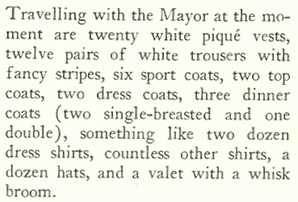
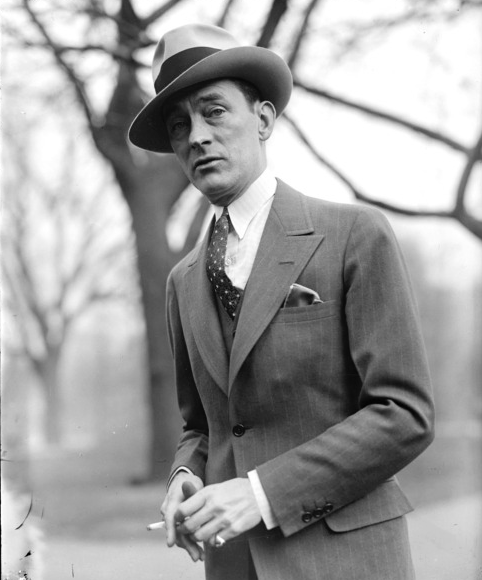
The September 3 “Talk of the Town” offered some insights into the dressing habits (and tardiness) of New York’s dandified mayor, Jimmy Walker, who was preparing for an overseas journey. Excerpts:
GOTHAM’S CLOTHES HORSE…New York City Mayor Jimmy Walker during a visit to Boston in the late 1920s. (c. Leslie Jones, digitalcommonwealth.org)
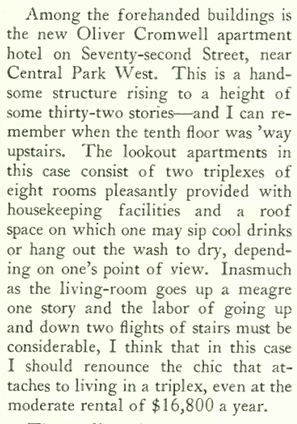
The New Yorker continued its commentary on the changing city skyline as urban residences continued their skyward climb, including the oddly named Oliver Cromwell apartment hotel:
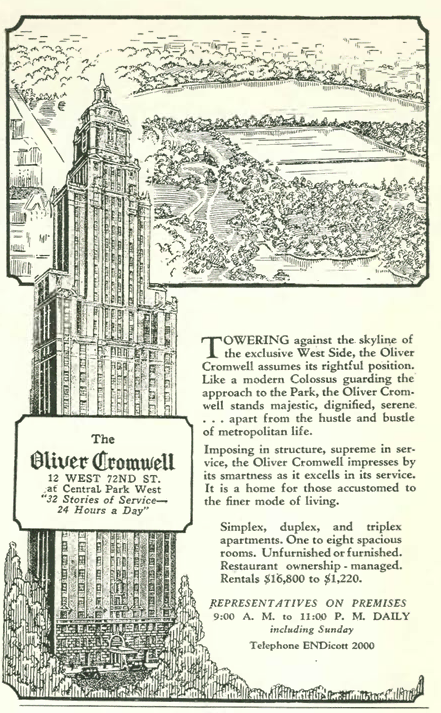
An advertisement in the same issue touted the Cromwell’s serene, park-like setting:
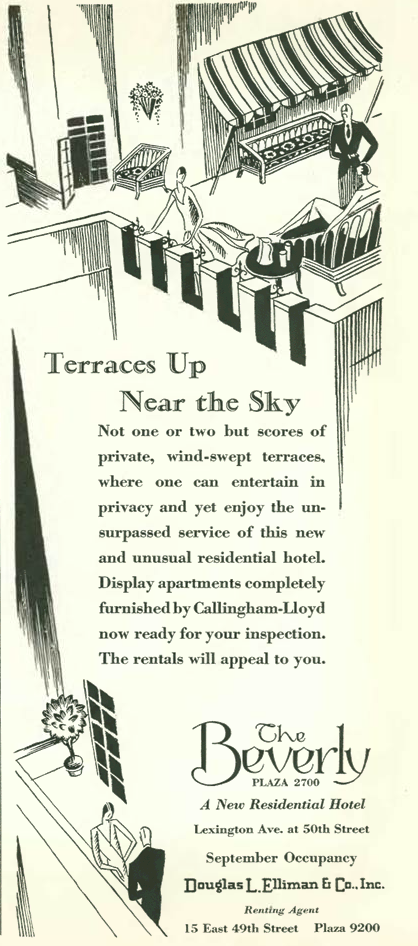
There were numerous advertisements like these in The New Yorker. Another promoted the Beverly’s sky-high “wind-swept terraces…”
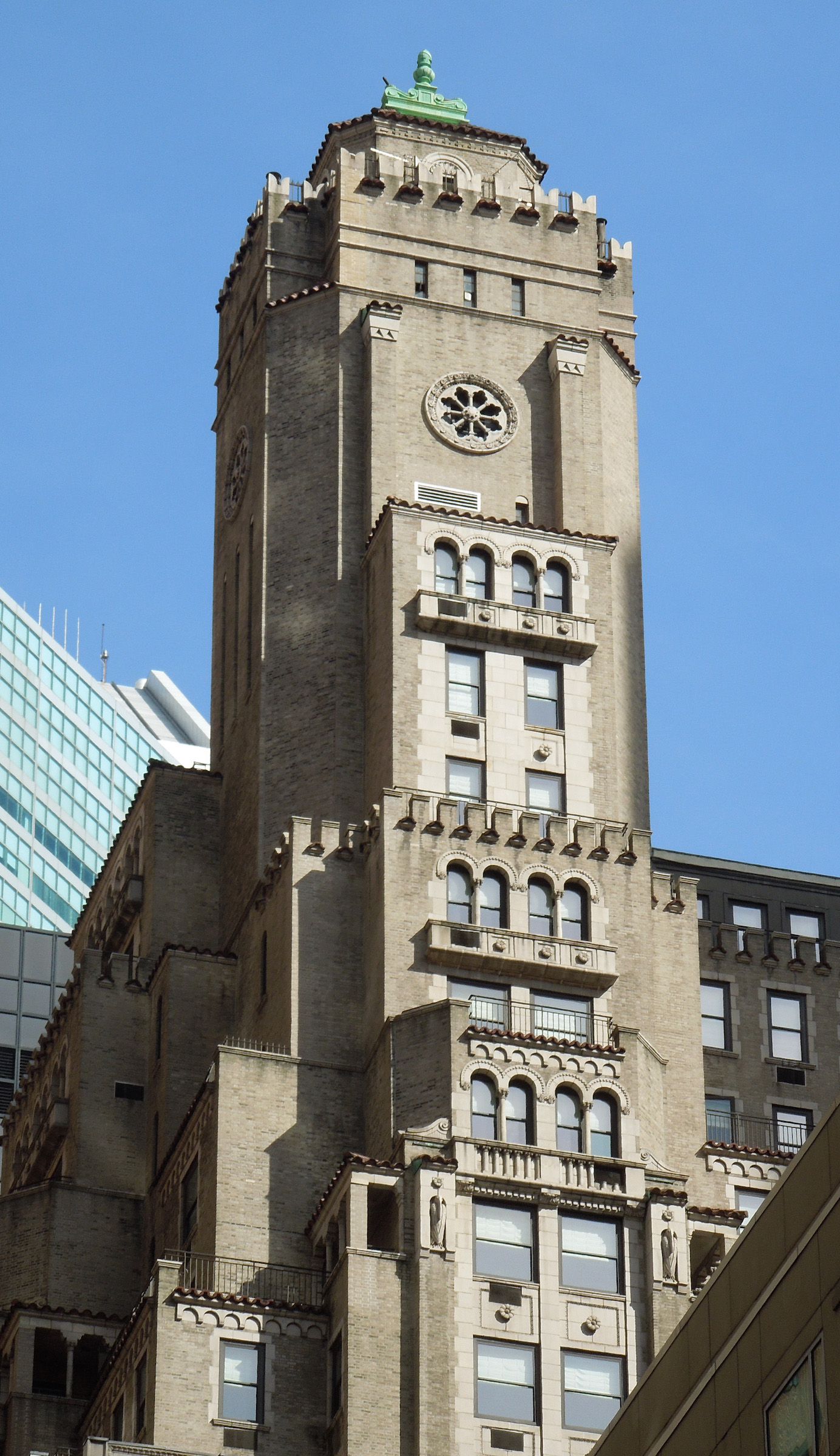
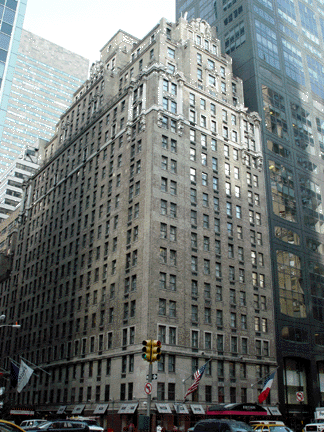
The Beverly today (now the Benjamin Hotel). The 30-story building was designed by Emery Roth with Sylvan Bien and built in 1926-27. Commissioned by Moses Ginsberg to host middle-income visitors to New York City, it was recently submitted for landmark designation as an important fixture in Grand Central Terminal’s “Hotel Alley.” (Historic Districts Council)
* * *
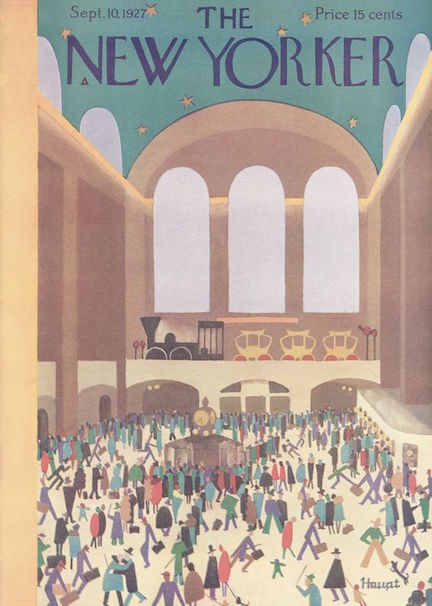
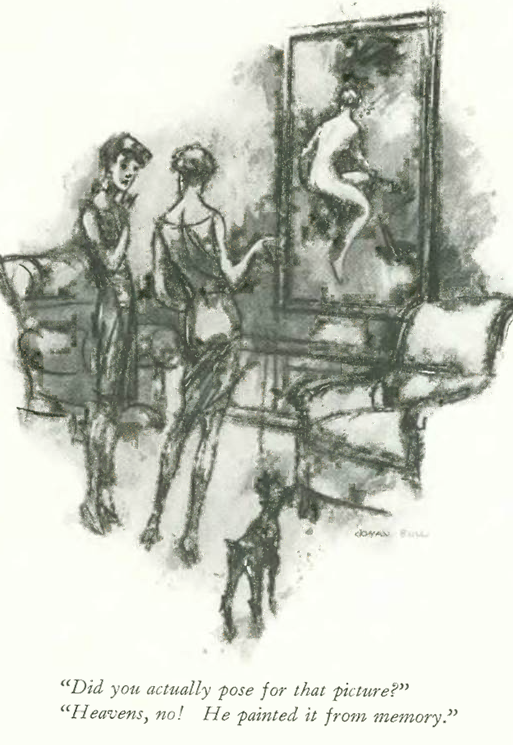
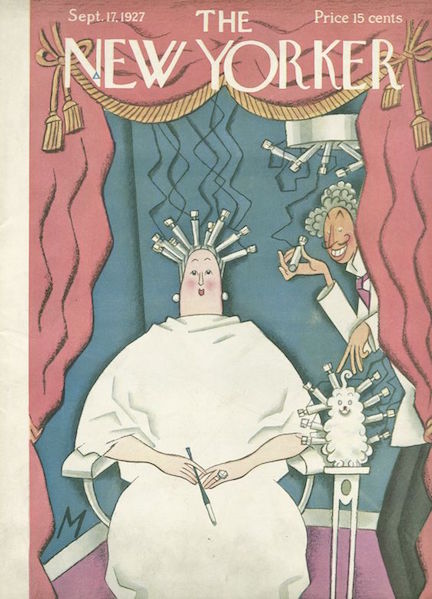
On to the Sept. 10, 1927 issue, and a couple of cartoons that aptly represented the spirit of Roaring Twenties…
Sept. 10, 1927 cover by Theodore G. Haupt.
…Johan Bull offered a glimpse of the new rich in the realm of culture…
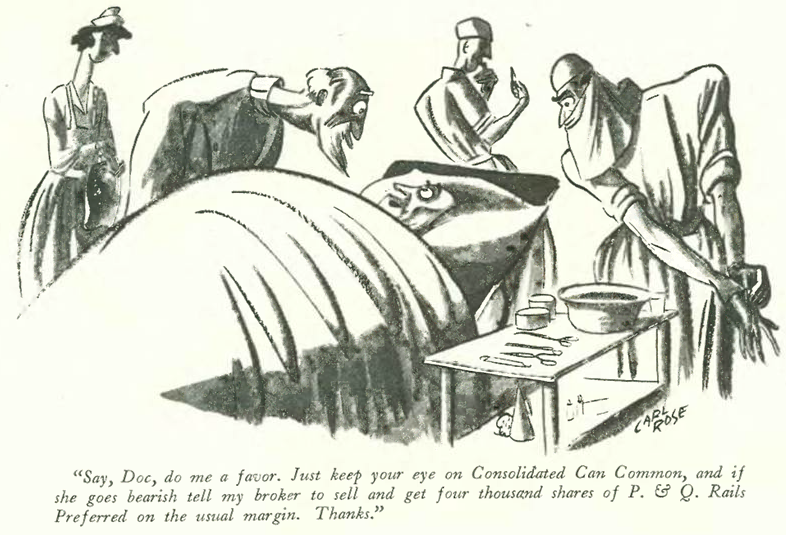
…while Carl Rose captured the spirit of investors during the waning days of the red hot 1920s stock market…
In 1927 silent film star Charlie Chaplin was working on his latest film, The Circus, when his second wife, Lita Grey, filed for divorce, accusing her husband of infidelity, abuse, and of harbouring “perverted sexual desires.” Life imitated art, and Charlie’s own life became a circus.
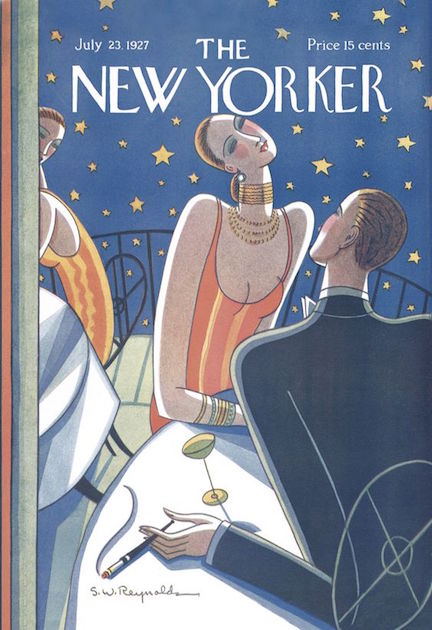
July 23, 1927 cover by Stanley W. Reynolds.
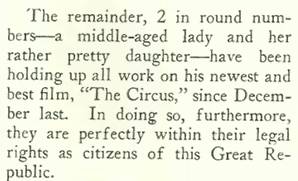
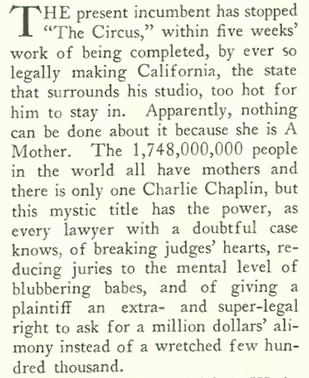
TheNew Yorker’s Ralph Barton, who contributed countless illustrations for the magazine (and was a close friend of Chaplin’s), wrote about Chaplin’s latest travails in a column titled “Picking on Charlie Chaplin.”
LIFE ON THE HIGH WIRE…Charlie Chaplin in The Circus (1928). (MoMA)
The “2” Barton mentioned were teenaged actress Lita Grey and her mother, Lillian Parker.
In 1924 the 35-year-old Chaplin married the 16-year-old Grey in a discreet ceremony in Mexico — because Grey was pregnant, Chaplin could have been charged with statutory rape under California law (it was Chaplin’s second marriage, and his second to a teenaged actress). Chaplin and Grey had two sons from their brief union–Charles Spencer Chaplin, Jr., was born in 1925, followed by Sydney Earl Chaplin in 1926.
The divorce made headline news as Chaplin was reported to be in a state of nervous breakdown. Filming for The Circus was suspended for ten months while he dealt with the mess:
Chaplin’s lawyers agreed to a cash settlement of $600,000—the largest awarded by American courts at that time (Roughly equivalent to more than $8 million today). Groups formed across America calling for his films to be banned (no doubt the same groups that had earlier protested his marriage to a pregnant, teenaged minor). Barton mused that the protests might cause Chaplin to abandon America for the more permissive atmosphere in Europe:
HERE’S LOOKING AT YOU…Charlie Chaplin first became acquainted with the 12-year-old Lillita McMurray (later Lita Grey) during the filming of The Kid (1921).PRATFALL…Charlie Chaplin and Lita Grey during their brief, tumultuous marriage. (The Artifice)
The Circus was released in January 1928 to positive reviews, and during the first-ever Academy Awards Chaplin received a special trophy, “For versatility and genius in acting, writing, directing and producing The Circus. Despite the film’s success, he rarely spoke of it again. For Charlie, it was a time best forgotten.
* * *
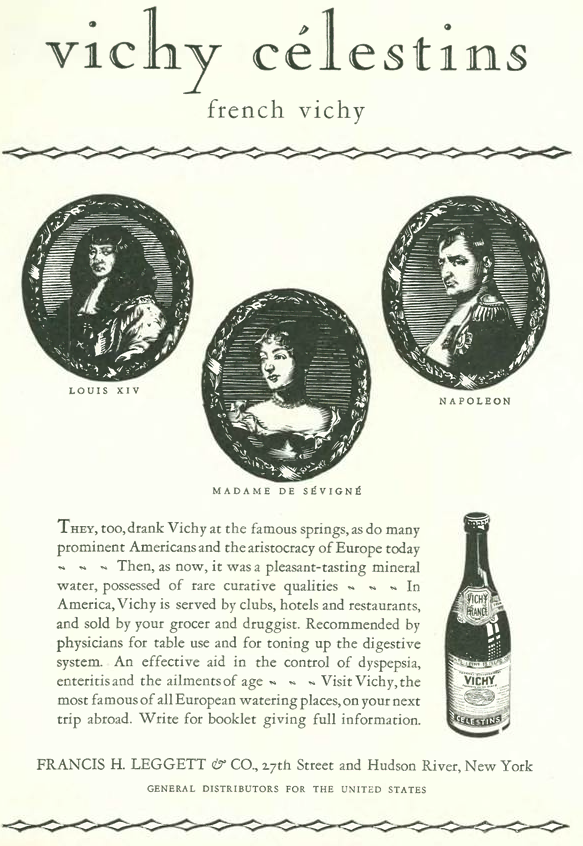
And now, an advertisement from the July 23 issue urging readers to buy the 1920s equivalent of “Smart Water” endorsed by the Sun King himself…
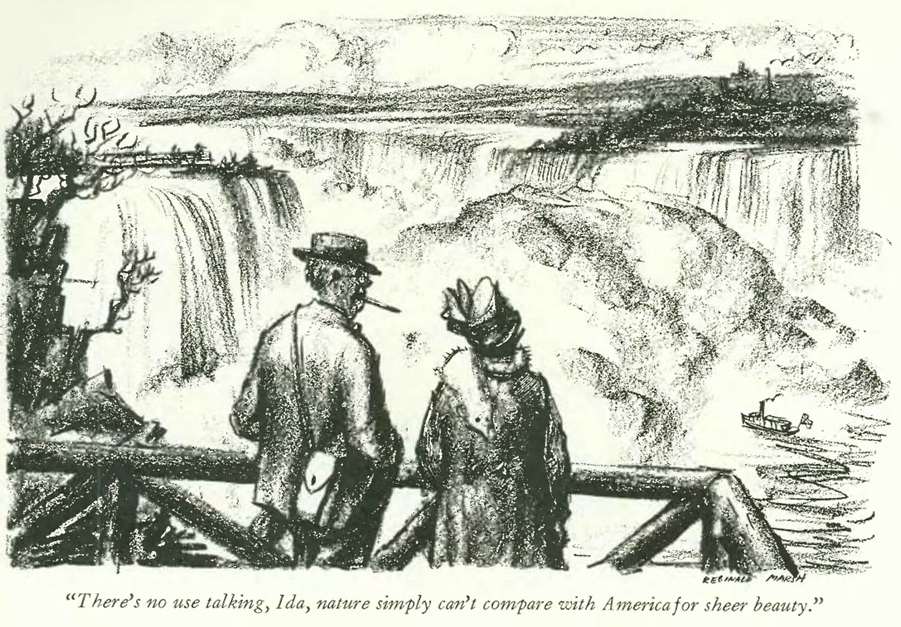
…and a cartoon by Reginald Marsh, portraying a distinctly American view of the grandeur of Niagara Falls…
* * *
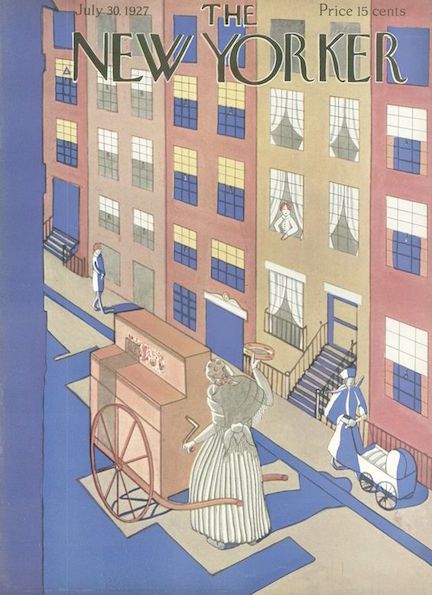
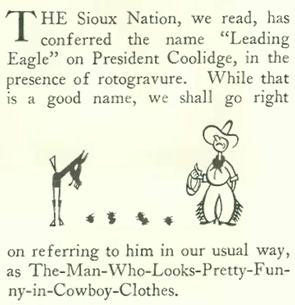
On to July 30, 1927 issue, in which The New Yorker once again takes a poke at our 30th President…
July 30, 1927 cover by Ilonka Karasz.
…and his latest adventures in the wilds of South Dakota’s Black Hills:
BIG CHIEF…President Calvin Coolidge donned a headdress while being named an honorary Sioux chief (“Leading Eagle”) in Deadwood, South Dakota. His advisers cautioned that the headdress would make him look funny, but he apparently replied, “Well it’s good for people to laugh, isn’t it?” (AP)
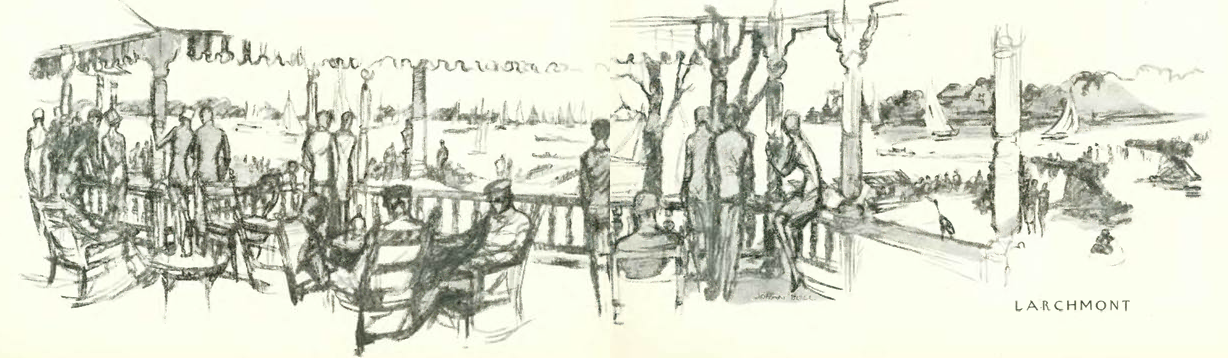
Safely back in the environs of the big city, The New Yorker continued to take stock of summer sports such as tennis, polo, and the yacht races at Larchmont (but still no mention of the legendary ’27 Yankees). This illustration of the races (unsigned, but I guess it is Reginald Marsh) graced a double-spread below “The Talk of the Town”…
(click to enlarge)
…and if you were attending the races, or wanted to look stylish on your yacht (or if you just wanted to dress this way to appear that you owned one), you could check out the selections at B. Altman’s…
…looking smart was everywhere in the issue, from multiple ads for fall furs, to this come-on from Buick, which suggests that even though it is no Cadillac, and certainly not a Rolls, its smartness will prevail “on any boulevard”…
The Buick ad is somewhat revolutionary for an early automobile ad in that it doesn’t actually show the product advertised.
As for those not among the smart set, and not enjoying the races at Larchmont, there were other summer diversions, as rendered here by J.H. Fyfe:
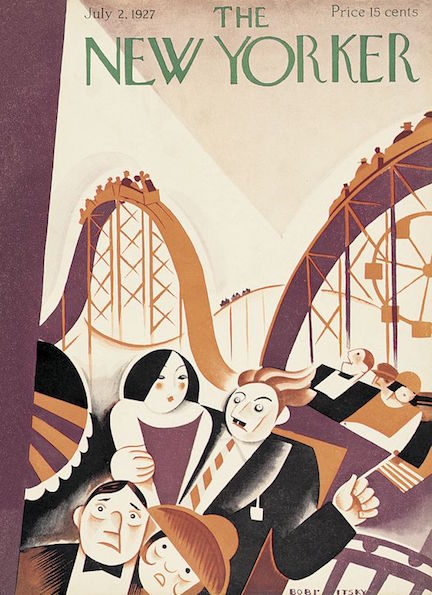
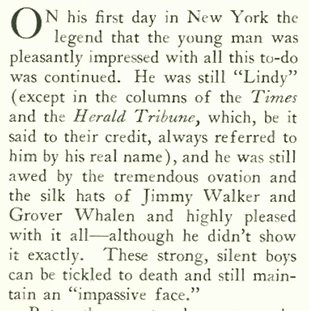
Charles Lindbergh was all over the July 2, 1927 issue of The New Yorker, which reported that Lindy was a better a flier than a writer, and as a celebrity the press had to be inventive with a subject who would rather be alone in a cockpit with a ham sandwich than be feted at countless banquets.
July 2, 1927 cover by Victor Bobritsky.
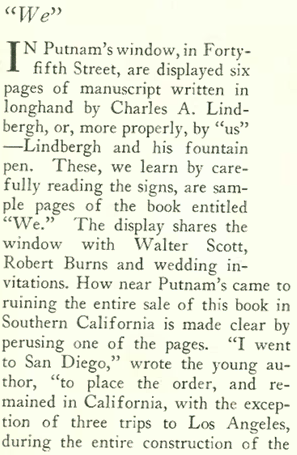
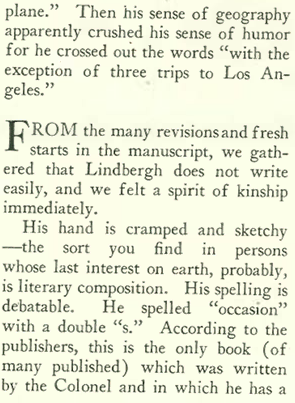
“The Talk of the Town” commented on the display at Putnam Publishing of a few manuscript pages penned by Lindbergh himself for his upcoming book, WE.
A draft of the autobiography had already been ghostwritten by New YorkTimes reporter Carlyle MacDonald, but Lindbergh disliked MacDonald’s “false, fawning tone” and completely rewrote the manuscript himself–in longhand–using MacDonald’s manuscript as a template. Those early results were displayed in Putnam’s 45th Street window to whet the appetites of eager readers:
FLYING THE ATLANTIC WAS EASIER…The dust jacket (left) for Charles Lindbergh’sWE. The ghostwritten first draft was disliked by Lindbergh, who in less than three weeks re-wrote the book in longhand. About a week later the book was published (July 27, 1927) and quickly became a bestseller. (Wikipedia)YEAH WHATEVER…Lindbergh appears less than thrilled during his ticker-tape parade in Manhattan on June 13, 1927. (Science Photo Library )
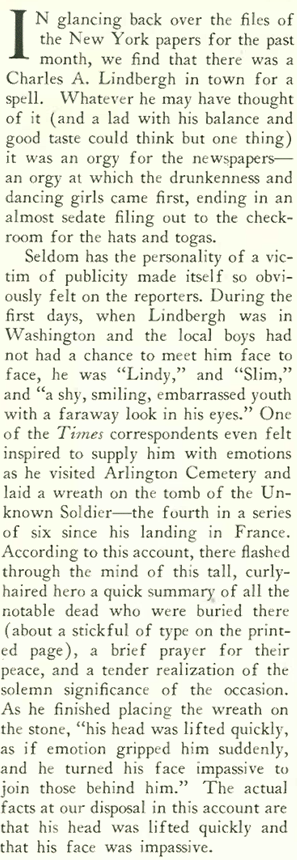
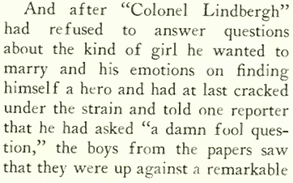
Nonplussed and often annoyed by all of the attention, Lindbergh was less than a colorful subject for the media. Philip Wylie (writing under the pseudonym “Horace Greeley Jr.”) in The New Yorker’s “Press in Review” column observed that reporters, seeking a more conventional image of a sentimental hero, decided to “supply him with emotions” he apparently lacked:
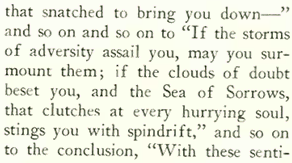
Other reporters resorted to treacly tributes…
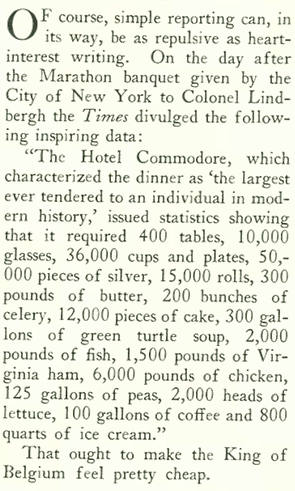
…and if the subject himself wasn’t very interesting, you could always resort to listing quantities of food and drink as a measure of the spectacle…
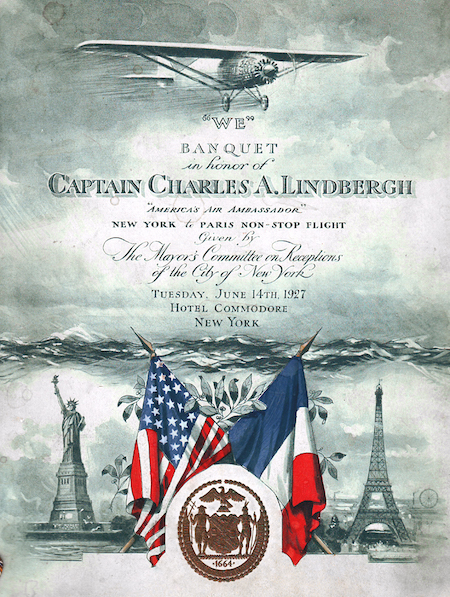
WHERE’S MY HAM SAMMICH?…Invitation to the WE banquet at the Hotel Commodore (Wikipedia).
And if the reception at the Hotel Commodore wasn’t to your liking, you could go to the new Roxy Theatre and put in a bid for 300 pounds of home-made candy:
* * *
We’ll give Lindy a break and move on to excerpts from Upton Sinclair’s “How to be Obscene,” in which he tweaks the Boston bluenoses:
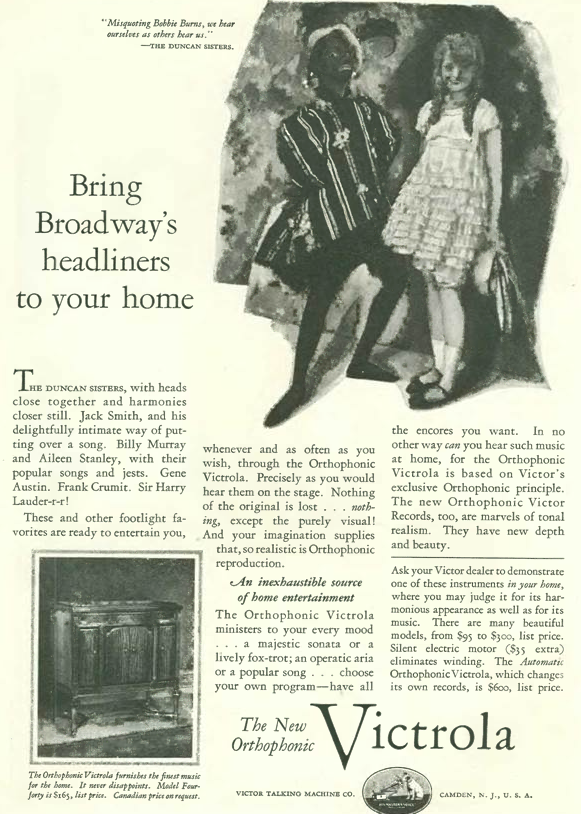
And then we have this advertisement for the Orthophonic Victrola, promising to bring the clear tones of racism into your home courtesy of the Duncan Sisters:
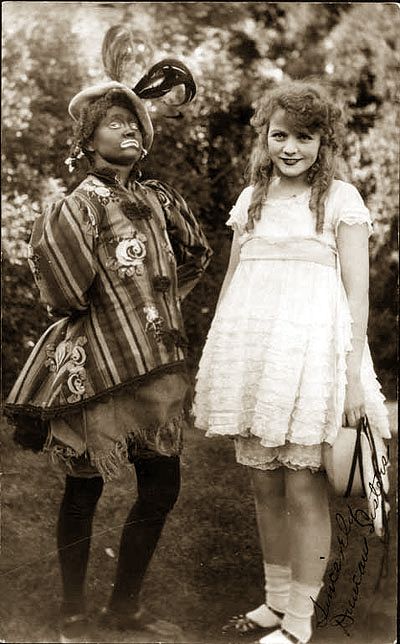
The Duncan Sisters were a vaudeville duo who created their stage identities in the 1923 musical comedy Topsy and Eva, derived from the novel Uncle Tom’s Cabin by Harriet Beecher Stowe. The musical was a big hit.
THAT WAS ENTERTAINMENT…Sisters Rosetta (left) and Vivian Duncan as Topsy and Eva. (silenceisplatinum.blogspot.com)Rosetta and Vivian Duncan in a promo photo. (silenceisplatinum.blogspot.com)
After a brief foray into movies in the early 1930s, the duo mostly entertained at night clubs and for many years continued to perform their Topsy and Eva routine even though appearing in blackface was considered impolite or offensive by later audiences. One of their final performances was on Liberace’s television show in 1956. The act ended in 1959 when Rosetta died in a car accident.
STILL TOGETHER…Vivian (left) and Rose Duncan on Liberace’s television show in 1956. They performed their Topsy and Eva routine, without the blackface. (YouTube)
* * *
And to close, a cartoon from the July 2 issue, courtesy of Julian de Miskey:
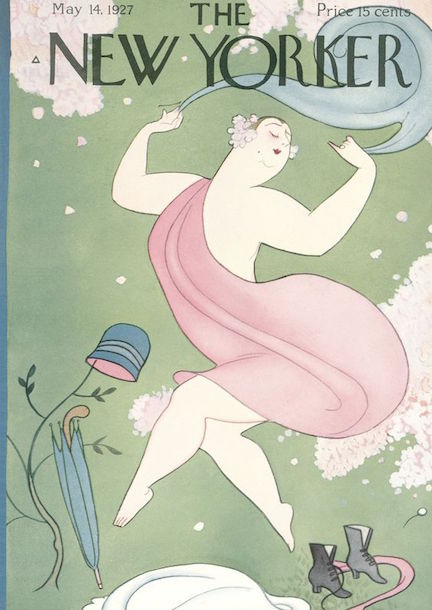
We cross the pond for the May 14, 1927 issue, for a look at all things French. As I’ve previously noted, New Yorker readers of the 1920s had a decidedly Francophile bent when it came to food, fashion and general joie de vivre.
May 14, 1927 cover by Rea Irvin.
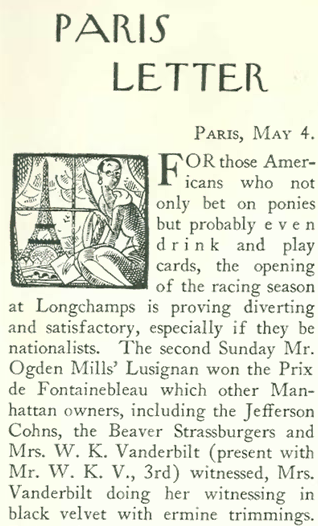
In fact, readers were so enamored with France that the country merited its own New Yorker correspondent, Janet Flanner, who wrote under the nom de plume “Genêt.”
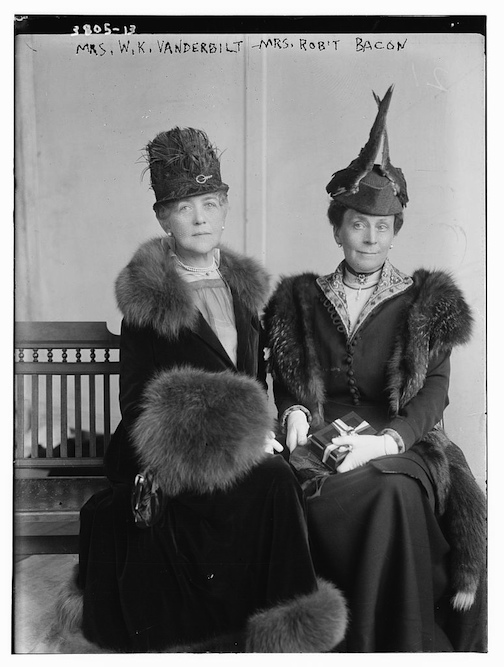
In the May 14 issue Flanner casually mused about the racing season at Longchamps, which attracted the likes of Anne Harriman Vanderbilt (identified here as Mrs. W. K. Vanderbilt), who was well-known in France for her philanthropic work during World War I, including her founding of an ambulance service and a hospital at Neuilly. Vanderbilt received the class of the Legion of Honor in 1919 in recognition of her war work, and in 1931 she was made an officer of the legion.
BLUE BLOODS…Anne HarrimanVanderbilt (left) with Martha Waldron Cowdin Bacon, circa 1915-1920. Bacon served as chairman of the American Ambulance Committee. (Library of Congress)
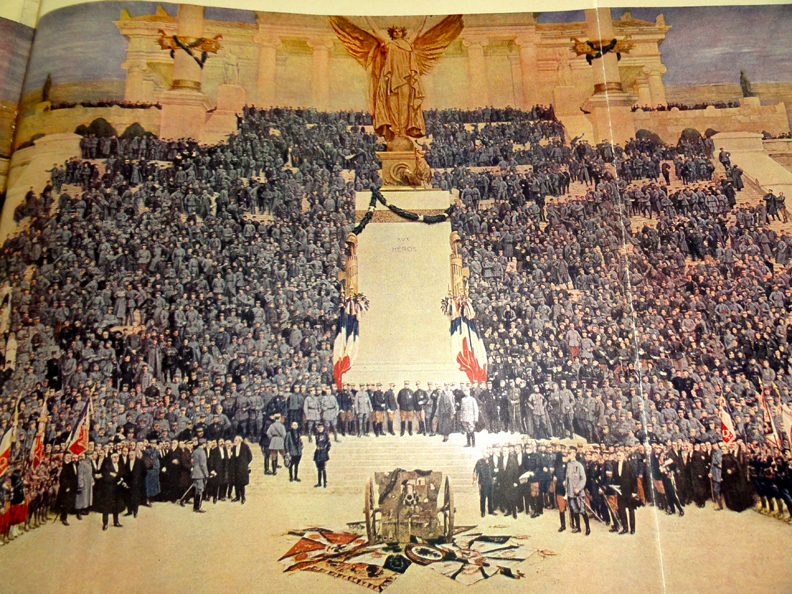
In “Talk of the Town,” the editors suggested that readers go to Madison Square Garden and check out the world’s largest canvas painting, Panthéon de la Guerre, more for the spectacle than for any artistic merit:
Section of Panthéon de la Guerre showing allies of World War I, now in Memory Hall, Liberty Memorial, Kansas City, Missouri. (theworldwar.com) Click to enlarge
Panthéon de la Guerre was painted during World War I as a circular panorama—402 feet in circumference and 45 feet high—displayed in Paris in a specially built building next to the Hôtel des Invalides. It was visited by an estimated eight million people between 1918 and 1927.
The painting was acquired by American businessmen in 1927 and exported to New York, where it was displayed at Madison Square Garden. Some changes were made to the painting for the benefit of an American audience, including the addition of an African-American soldier. The work later toured the U.S.—from 1932 to 1940 it went to Washington DC, Chicago, Cleveland, and San Francisco. It was then acquired by restaurant entrepreneur William Haussner for $3,400.
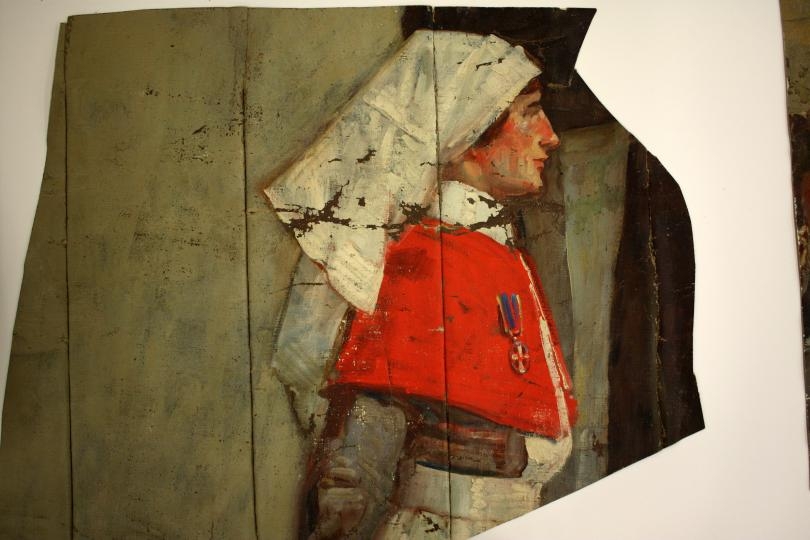
In 1956 Haussner donated the work to Leroy MacMorris to be adapted for display at the Liberty Memorial in Kansas City. MacMorris drastically reduced the size of the work and modified it to emphasize America’s contribution to WWI: Only seven percent of the original work was retained, and large French sections were left out. MacMorris likened it to “whittling down a novel to Reader’s Digest condensation.” And he didn’t stop there. He also modified some figures to represent post-WWI figures such as Presidents Franklin Roosevelt and Harry Truman.
A BIT OF THIS, A DASH OF THAT…Figure of Victory from the Temple to Glory cut to fit above a doorway at Memory Hall, Liberty Memorial, Kansas City, Missouri, with the staircase of heroes to either side. Compare to original below:(trenchartcollection.com)
To reduce and reconfigure the painting, MacMorris first photographed it in detail, then cut out the figures in the photos and used them like puzzle pieces to work out his new condensed version, which was dedicated on Nov. 11, 1959.
As for the unused portions, what MacMorris did not use he threw away, sending several of the larger excised passages back to Haussner for display in his Baltimore restaurant. MacMorris also gave pieces to the art students who helped him reconfigure the painting and to a number of prominent Kansas Citians.
Fragment from Panthéon de la Guerre depicting a British nursing sister. (theworldwar.org)
The National World War I Museum and Memorial in Kansas City recently held an exhibition on the painting and its recovered fragments.
* * *
Lois Long had returned from Paris and advised readers on where to shop in the City of Light. Her fashion column, “On and Off the Avenue,” featured recommendations for many stores and bargains. It began with a brief note from “Parisite,” aka Elizabeth Hawes, who occasionally contributed to Long’s column with cables sent from Paris).
And now for the advertisements, all from the May 14 issue, featuring various French themes, such as this one for Krasny makeup that evokes the glamour of Paris and the intrigue of Russian women…
…or exotic perfumes for only the most exclusive set…
…or the chic look of Revillon Freres spring coats and wraps…
…or fake vermouth…this odd little illustration in the back pages for non-alcoholic vermouth, served by a dutiful French maid to what appears to be a giant. You have to feel sorry for the writers of such ads during Prohibition, trying so hard to make this sad libation appealing to thirsty New Yorkers…
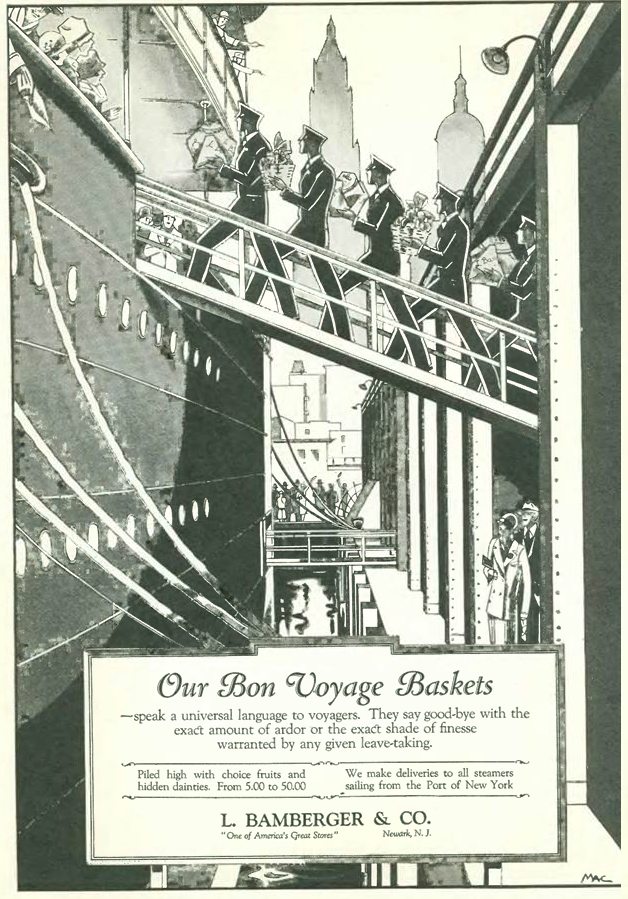
…but there were those lucky few who could actually travel to France and drink the real stuff, you could get a really swell send-off with a “Bon Voyage Basket” from L. Bamberger & Co…
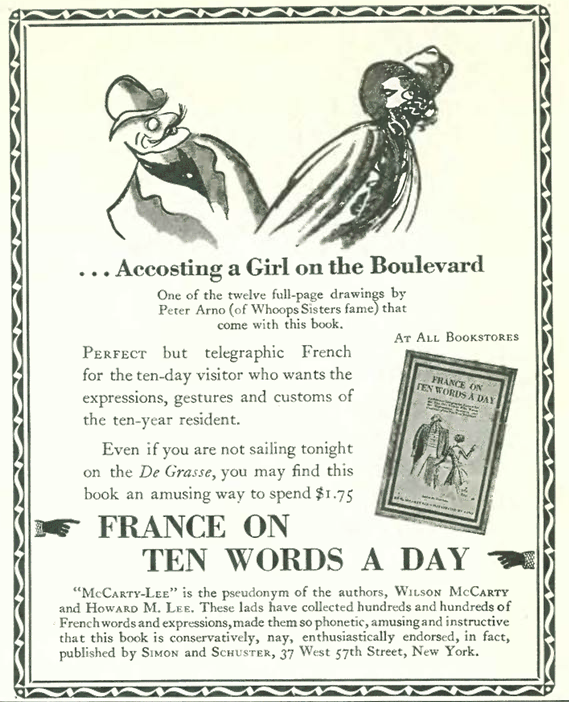
…and while you were in France (at least for the men), Peter Arno could show you how to give the glad eye to the mesdemoiselles…
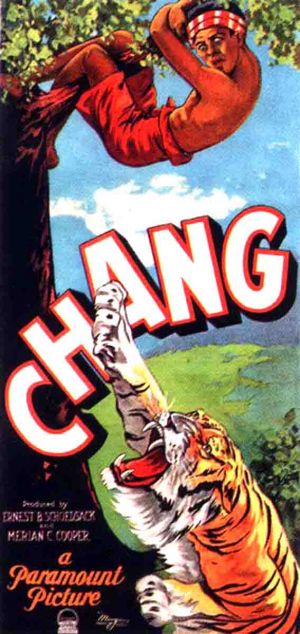
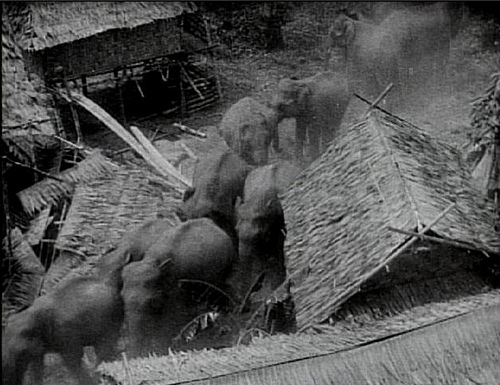
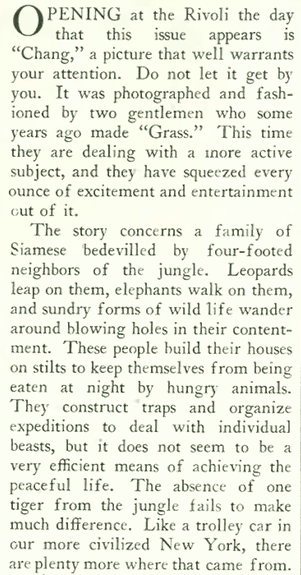
The evolution of filmmaking in the 1920s included the development of “docudramas.” Nanook of the North (1922), which captured the struggles of an Inuit hunter and his family, was received with great acclaim. A few years later Grass (1925),directed by Merian C. Cooper andErnest B. Schoedsack, followed a tribe in Iran as they guided herds to greener pastures. So when Chang: A Drama of the Wilderness opened at the Rivoli, TheNew Yorker was there (May 7, 1927) to share in the adventure.
May 7, 1927 cover by Ilonka Karasz.
Chang, also directed by Cooper and Schoedsack, told the story of a poor farmer and his family (native, nonprofessional actors) in Issan—now northeastern Thailand—and their constant struggle for survival in the jungle. Cooper and Schoedsack attempted to depict real life but often re-staged events. The danger, however, was real to all involved, as was the slaughter of animals in the film.
(Wikipedia)
According to Ray Young, writing for Viennale, the website for the Vienna International Film Festival (which is screening a retrospective of Chang this fall) Cooper and Schoedsack “open with scenes of domestic bliss and, offsetting title card warnings of the dangers of the jungle, a bucolic Eden ripe for development. But the tone soon shifts as tigers and leopards attack, and the picture evolves into a succession of episodes concerning their survival.”
The perils in Changoften feel rigged, notes Young, “most conspicuously in places where animals appear to have been killed simply for the benefit of the camera. By most accounts, Schoedsack did most of the filming while Cooper covered him with a rifle.”
I’D BE WARY OF THOSE GUYS TOO…Image from the filming of Chang. (criticsroundup.com)JUST PASSING THROUGH…Elephants stampede a village in the film’s finale. (image capture from film)
Chang was nominated for the Academy Award for Unique and Artistic Production at the first Academy Awards in 1929. It was the only year when that award was presented (It lost to F.W. Murnau’s Sunrise: A Song of Two Humans).
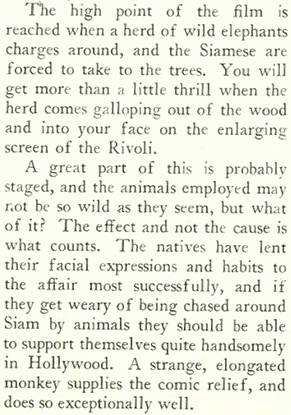
However appalled as we are today by the film’s exploitation of humans and animals alike, those were different times, even for the usually discerning eye of TheNew Yorker:
In 1927 most people had a very limited view of the non-Western world, which was perceived as both savage and exotic, populated by child-like “natives” who in this case “lent their facial expressions and habits to the affair most successfully…”
And so in 1927 we also encounter cartoons like this one by Alan Dunn that at once dismisses out-of-town conventioneers (here: an Elks Lodge) as a bunch of ignorant racists, yet the early New Yorker’s own depictions of Blacks were usually minstrel-era stereotypes.
* * *
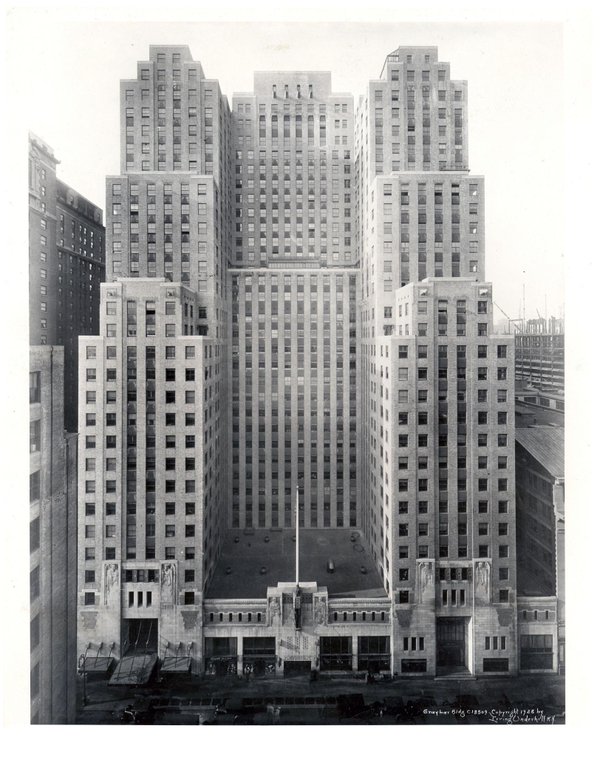
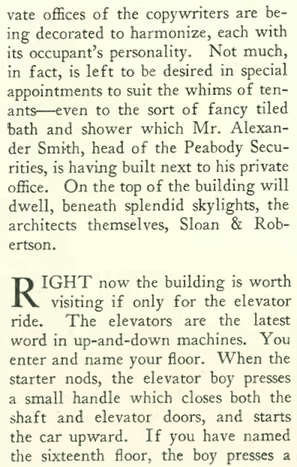
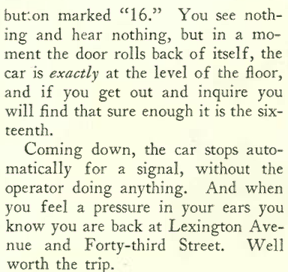
The massive Graybar Building made its debut at420 Lexington Avenue, the multi-tiered edifice impressing the “Talk of the Town” editors with the latest technology, including push-button elevators:
The Graybar Building (history.graybar.com)
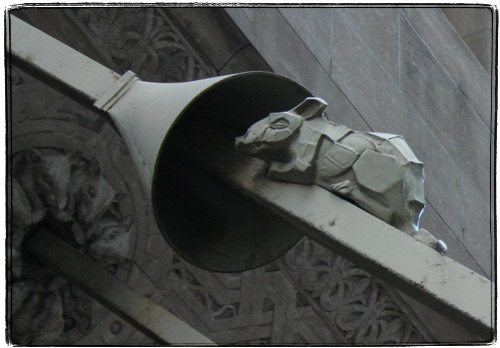
PERMANENT INFESTATION…The Graybar’s rain canopy cables include anti-rat devices (cones) decorated with rats. If you look carefully, the rosettes anchoring the cables are also decorated with rat heads. (deadprogrammer.com)
* * *
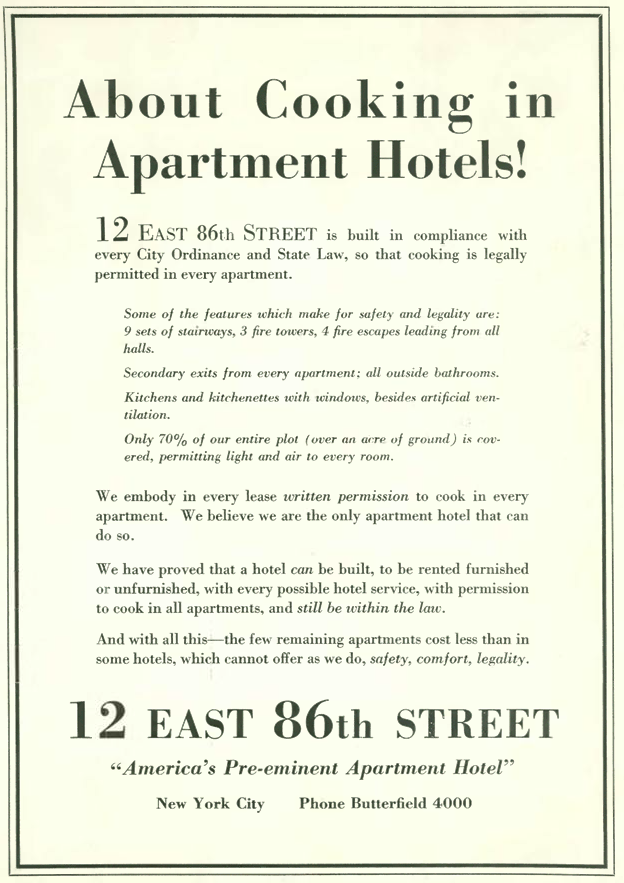
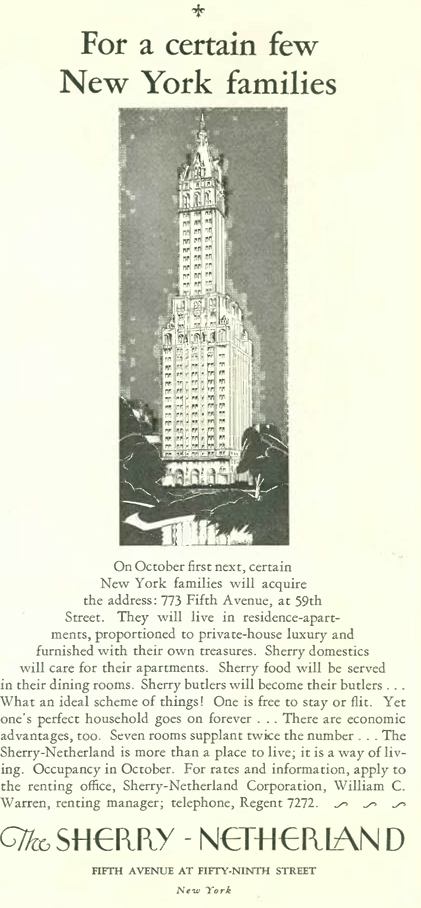
The following advertisement needs some explanation: The 1867 Tenement House Act imposed constraints on height and lot coverage that large apartment buildings routinely violated.
According to an article in the Observer by Stephen Jacob Smith (April 30, 2013), “Some developers got out of these requirements by building co-operative buildings, without rental units, but others wanted to retain the revenue and control that came with rentals, while at the same time building larger structures than the tenement laws allowed. And thus was born the ‘apartment hotel.'”
The New York Times’s columnist Christopher Gray wrote (Oct. 4, 1992) that Apartment Hotels were a “widespread fiction of the period,” and “tenants in fact usually set up full kitchens in the serving pantries.” Smith adds that “one of the reasons apartment hotels were allowed to be built more densely than their fully residential counterparts was that there would be no cooking—a fire hazard in those days—in the units.” An so the ad:
Smith writes that by calling their buildings ‘apartment-hotels,’ builders could claim that as hotels they were outside of the rules of tenement legislation. He notes that “some of Manhattan’s most illustrious buildings were constructed using this legal sleight of hand,” including the Sherry-Netherland on Park Avenue.
The famous scaffolding fire at the Sherry-Netherland, which I featured in my last post, no doubt prompted developers to run the following ad in hopes that people would soon forget about the giant roman candle that burned bright near Central Park on the evening of April 12, 1927.
If you are ever in New York, check out the Sherry Netherland. It is a beautiful building.
And finally, this ad from the makers of Wildroot hair care products. I love the flapper artwork by John Held Jr., and even better the words “CRUDE-OIL SHAMPOO” displayed prominently as a selling point.
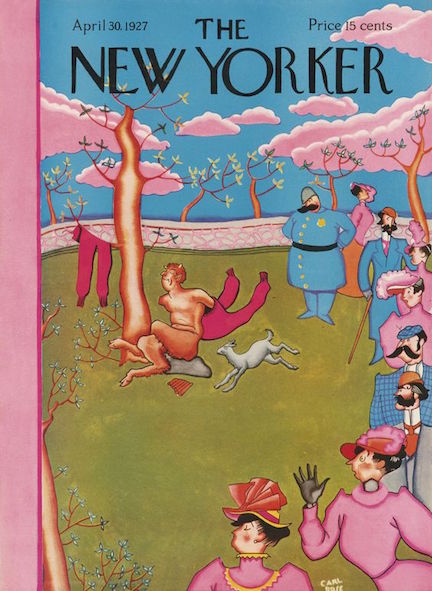
The journalist and screenwriter Ben Hecht wrote the “Reporter at Large” column for the early New Yorker, and for the April 30, 1927 issue took aim at the shoddy coverage of the Ruth Snyder murder trial at the Long Island City Courthouse.
April 30, 1927 cover by Carl Rose.
Hecht was appalled by the media’s use of celebrity “experts” to cover the trial, which only served to sensationalize and trivialize the proceedings:
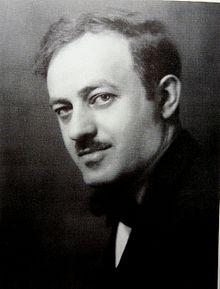
Ben Hecht (Wikipedia)
The Ruth Snyder trial dominated headlines in 1927. A housewife from Queens, Snyder began an affair in 1925 with Henry Judd Gray, a married corset salesman. After she persuaded her husband, Albert Snyder, to purchase life insurance, she enlisted Gray’s help to murder him. On March 20, 1927 the couple garrotted Albert (after bludgeoning him with a sash weight) and then staged the murder scene to look like a burglary.
The trial was covered by such figures as former Ziegfeld Follies showgirl Peggy Hopkins Joyce, the radio evangelist Aimee Semple McPherson, movie director D. W. Griffith, author Damon Runyon, popular philosopher Will Durant, and James M. Cain, a crime reporter who went on to write Double Indemnity, which was later made into a major Hollywood movie. Hecht (who would go on to co-write a hugely successful play about newspaper reporters, The Front Page) would have none of this celebrity circus. Some excerpts:
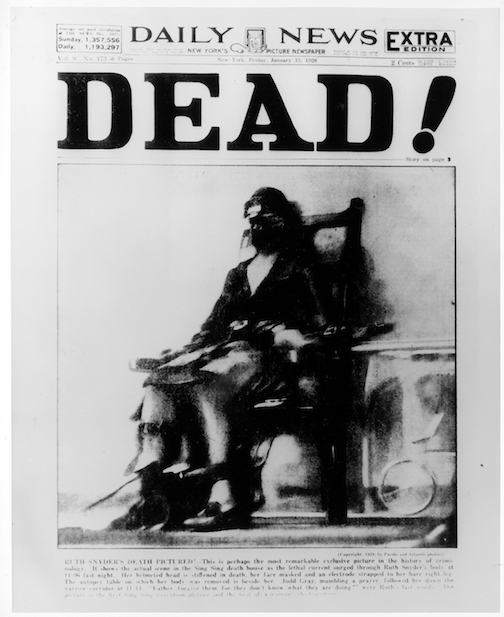
Ruth Snyder would not be acquitted (or live to write reviews), but instead would go to Sing Sing’s electric chair on Jan. 12, 1928. The 32-year-old Snyder would go to the chair first, followed shortly thereafter by her former lover and accomplice, 35-year-old Henry Judd Gray. The pair had sealed each other’s fate: During the trial, Snyder and Gray had turned on each other, contending the other was responsible for killing Albert Snyder.
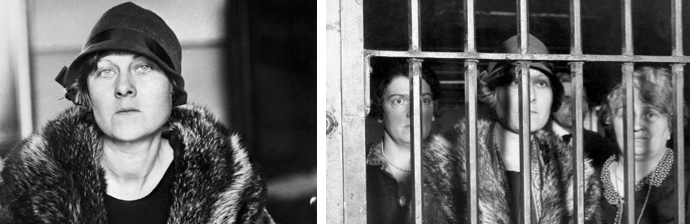
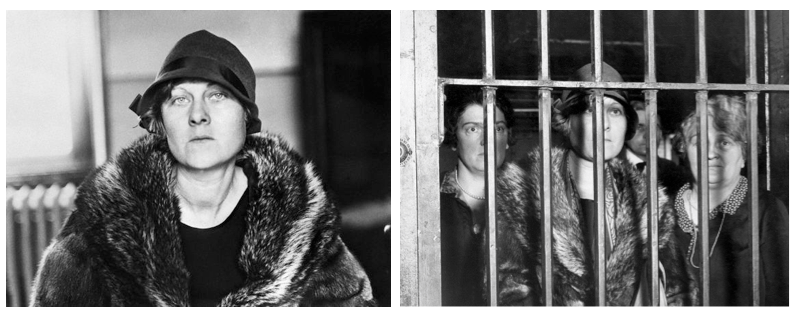
BUSTED…Ruth Snyder in custody and behind bars at the Queens County Jail. (Criminal Encyclopedia/NY Daily News)END OF THE LINE…Mugshots of Ruth Snyder and Henry Judd Gray taken at Sing Sing Prison following their conviction. (Lloyd Sealy Library, CUNY)NATIONAL SENSATION…The cover of Jan. 13, 1928, issue of the New York Daily News. Although photographs of the execution were not allowed, photographer Tom Howard took this now-famous photo of Snyder at the moment of her execution with the aid of a miniature camera strapped to his ankle. (newseum.org)
* * *
On to a lighter topic…The Sherry-Netherland Hotel has graced the corner of Fifth Avenue and East 59th Street since 1927, and when it was built it was the tallest apartment-hotel in New York City.
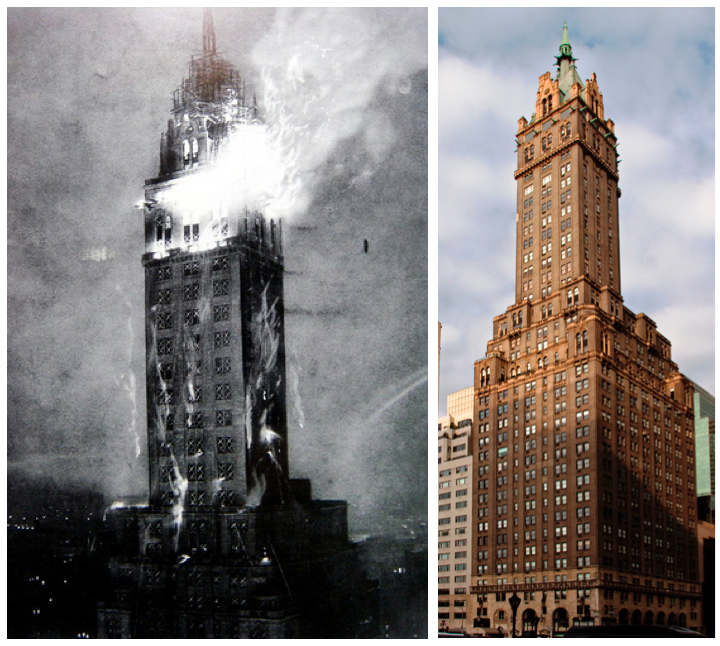
The building was nearing completion when around 8 pm on April 12, 1927, fire broke out on wood plank scaffolding surrounding the top floors. Firefighters responded only to find they lacked water pressure to fight the blaze.
According to the New York Times (“The Night a Hotel Turned Into a Torch,” Nov. 15, 2012), the fire was watched by hundreds of thousands, and “the windows of the Plaza Hotel across the street were ‘black with people’; every front room was engaged, either by news organizations or for spontaneous parties to watch the fire.”
Planks tumbled to the street for hours, and The Times said one “sailed in a crazy parabola” and crashed against the Savoy-Plaza, also nearly finished; occasionally minor collapses of the scaffolding turned the picturesque top into a “lofty Roman candle.” The crowds on the street could feel the heat on their faces, and the roar and crackle of the fire could be heard for blocks around. The fire burned itself out around midnight.
Oddly, the New Yorker had little to say about the fire, mentioning it only in passing in this “Talk of the Town” item:
HOT TIME IN THE CITY…In 1927 the Sherry-Netherland caught on fire, creating what The New York Times called “the best show of the season.” The newspaper ran this photo (left), retouching it for contrast (New York Times). At right, the hotel as it appears today (Wikipedia)
An interesting side note…at the time of the Sherry-Netherland’s construction, the nearby Vanderbilt mansion was being demolished. Carved limestone panels from the mansion’s porte-cochere as well as ornamental frieze roundels were salvaged and installed in the Sherry-Netherland’s lobby.
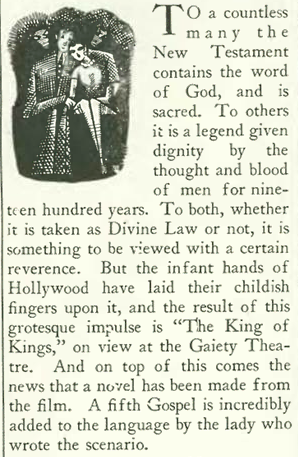
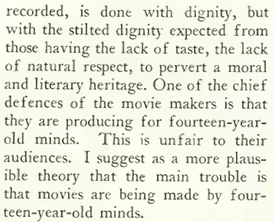
Hollywood movies continued to disappoint New Yorker critics, including Cecil B. DeMille’s silent epic The King of Kings.
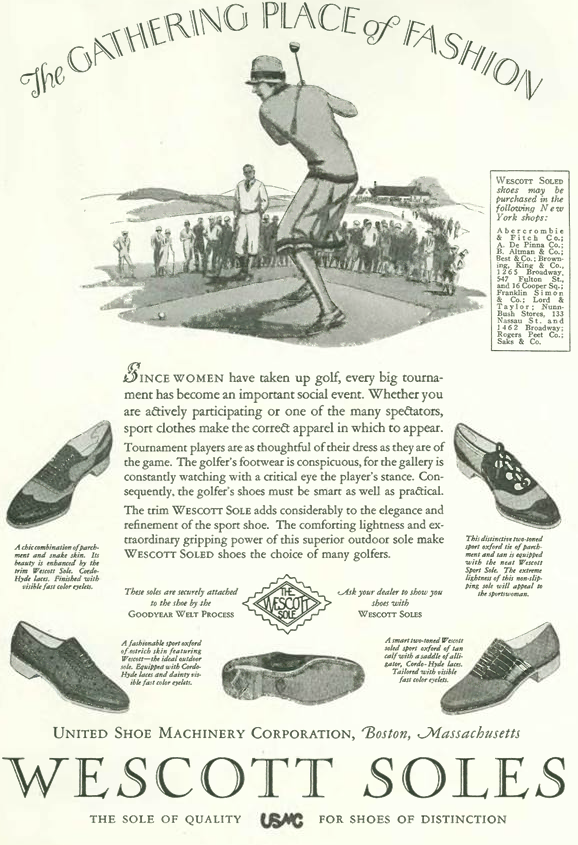
Finally, a couple of advertisements from the April 30 issue. It was spring, and time to hit the links…
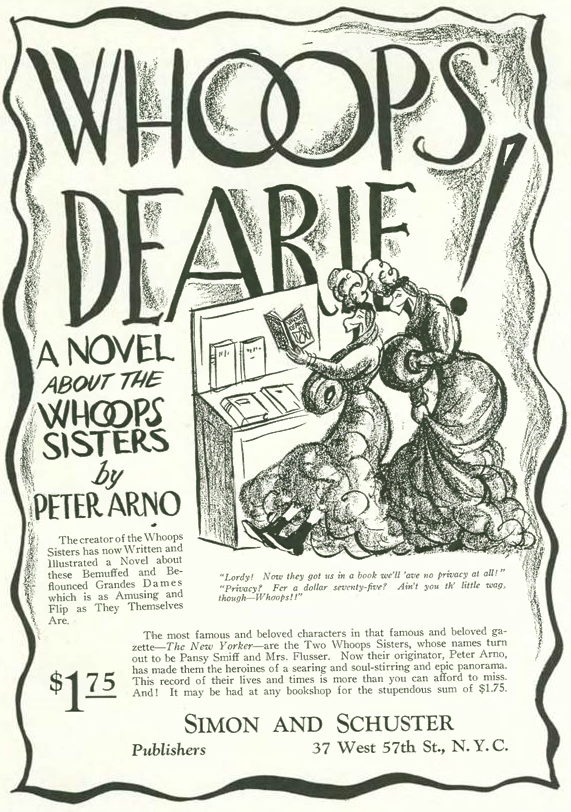
…and New Yorker cartoonist Peter Arno plugged his new book featuring the Whoops Sisters:
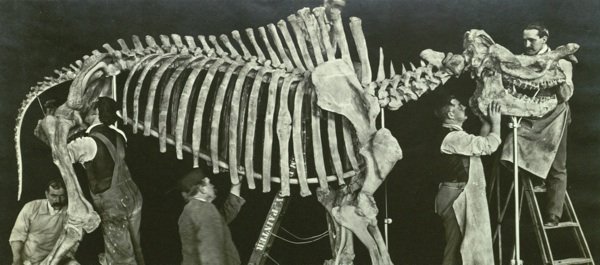
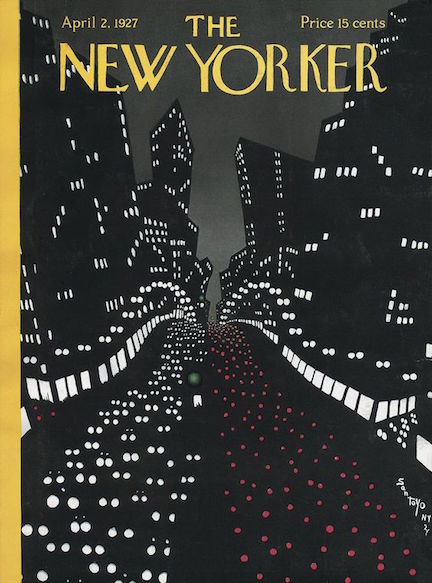
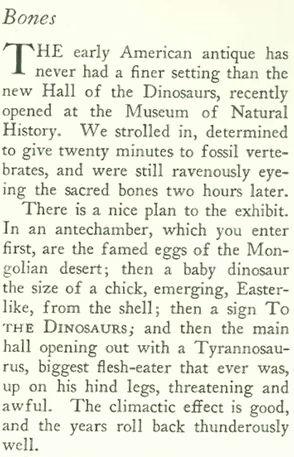
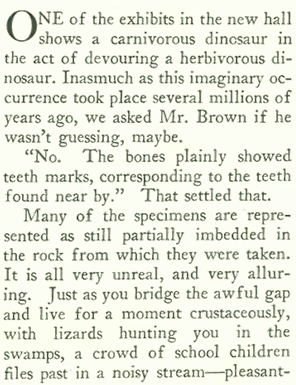
New York’s American Museum of National History unveiled its new Hall of Dinosaurs, and it was so impressive that even The New Yorker set aside its usual blasé tone toward popular attractions…
April 2, 1927 cover by Toyo San.
…and found its “Talk of the Town” editors to be quite taken with “sacred bones:”
NEW DIGS…Children studying a Brontosaurus skeleton in the American Museum of National History’s Hall of Dinosaurs, 1927. (AMNH Research Library)
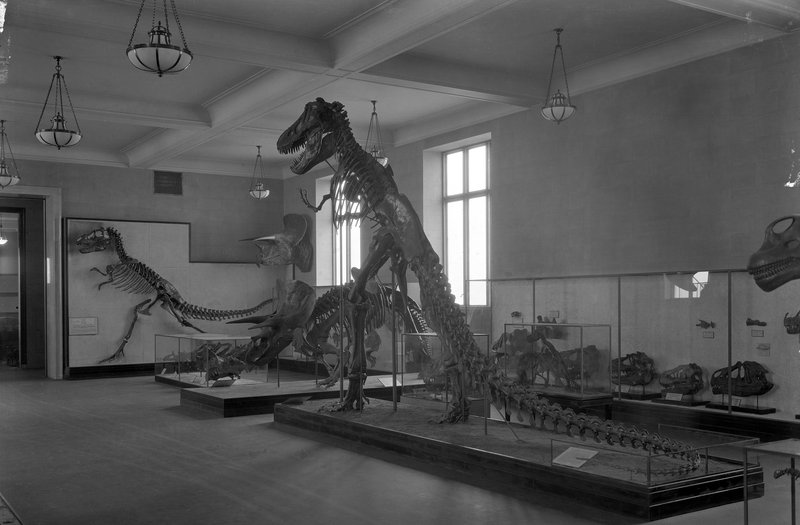
Tyrannosaurus and Triceratops in the Hall of Dinosaurs, 1927. (AMNH Research Library)
* * *
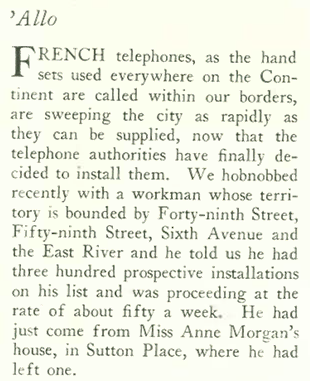
The April 2, 1927 issue also found New Yorkers to be agog over “French-style” telephones:
FRANCOPHONE…Trendy New Yorkers were switching from their old reliable candlestick telephones (left) to “French-style” phones (center) that were common throughout Europe. Western Electric answered their call with a sleek American version in 1928, right.
* * *
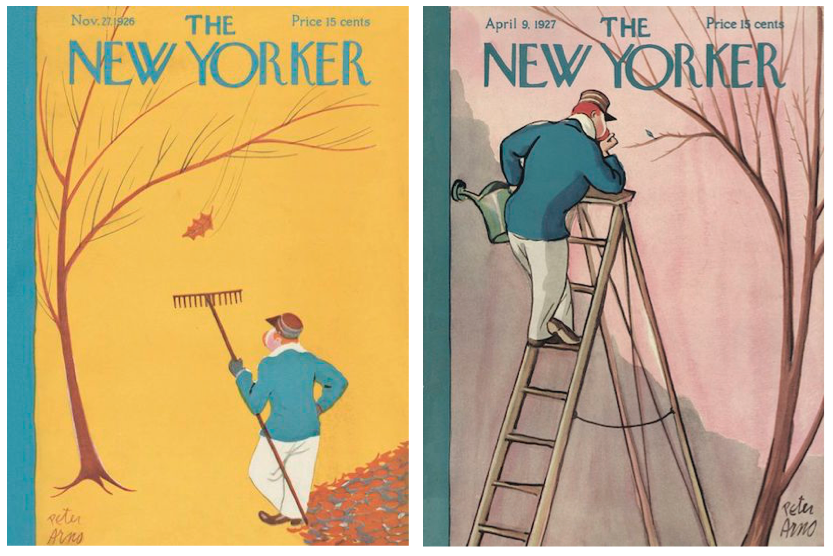
The April 9, 1927 issue featured the second of Peter Arno’s 99 covers for the New Yorker. His first cover appeared eighteen issues earlier (Nov. 22, 1926) and featured the same gardener, but this time he was inspecting a newly budded leaf rather than the last one to fall:
Note the difference in style between the two covers–the April 9 cover is rendered with more detail, depth and texture. These would be Arno’s only covers with rather sedate subjects. Subsequent covers would have more action and humor, such as this one from 1954, one of my favorites:
* * *
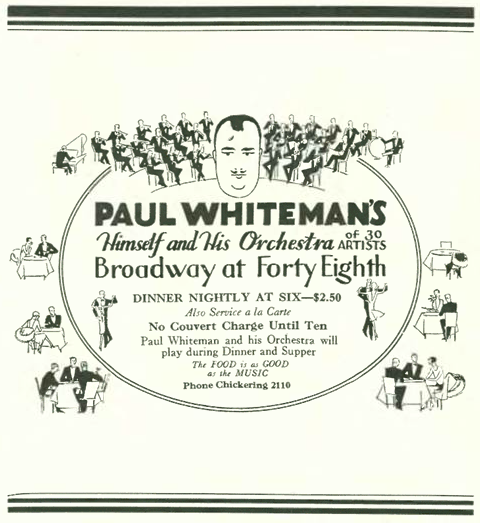
And now for a note about Paul Whiteman. One cannot write about the Jazz Age without mentioning the Paul Whiteman Orchestra. It was Whiteman who in 1924 commissioned George Gershwin’sRhapsody in Blue, which premiered with Whiteman’s orchestra (and with Gershwin himself at the piano).
This ad in the Feb. 26, 1927 New Yorker announced the much-anticipated return of Paul Whiteman and his orchestra. The caricature of Whiteman was his trademark.
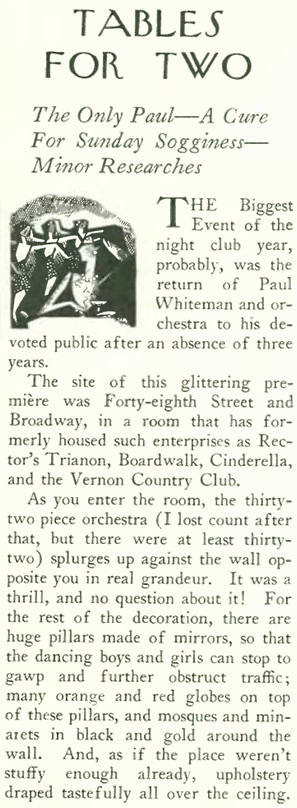
Even Lois Long, who seemed to be growing bored with New York nightlife, found reason to celebrate Whiteman in this column that appeared alongside the ad:
Whiteman had 28 number one records during the 1920s and dominated sheet music sales. He provided music for six Broadway shows and produced more than 600 recordings. Dubbed “King of Jazz” his style was actually a blending of jazz and symphonic music.
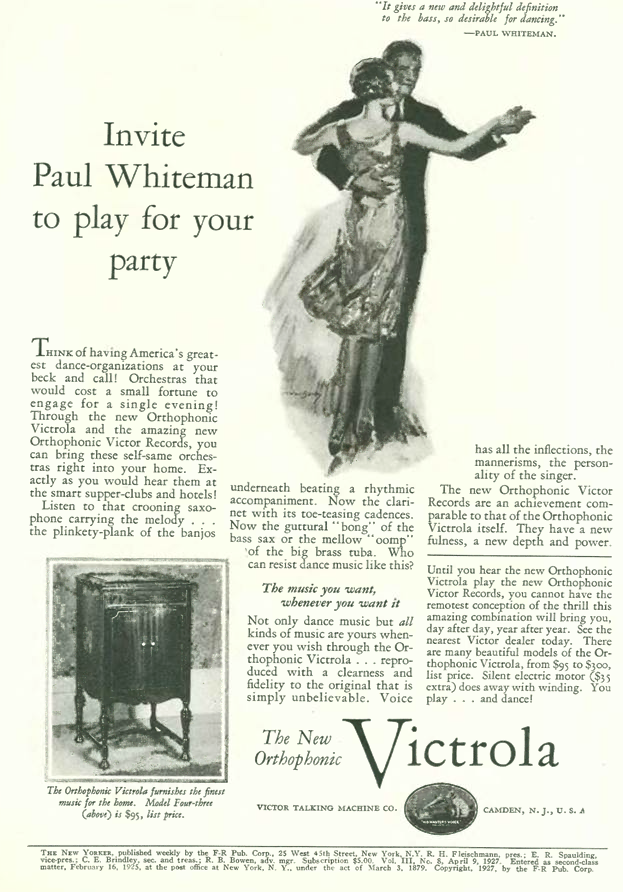
The folks at Victor Talking Machines played on Whiteman’s fame with this advertisement for their latest “Orthophonic” Victrola. Although it was the first consumer phonograph designed specifically to play “electrically” recorded discs and was recognized as a major step forward in sound reproduction, the claim that the machine would reproduce sounds “exactly as you would hear them at the smart supper clubs” seemed a little far-fetched.
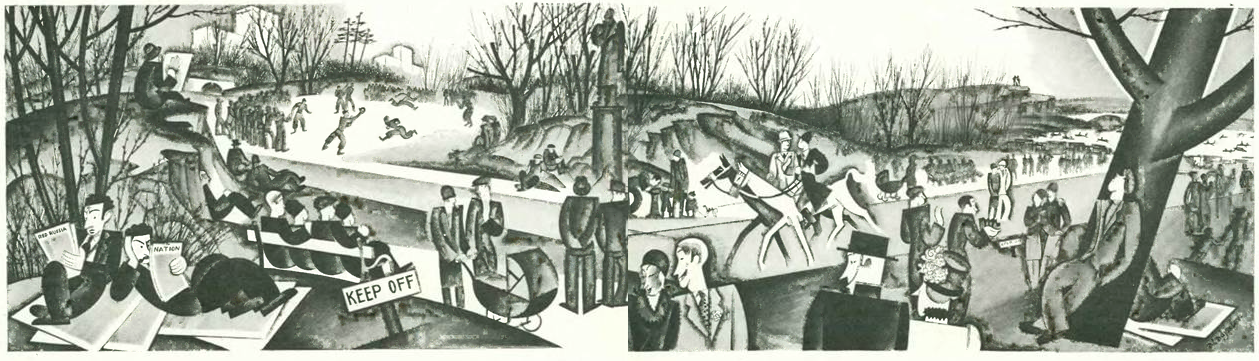
And finally, in celebration of spring, Constantin Alajalov illustrated an April day in Central Park, which was featured in a two-page spread in “Talk of the Town.”
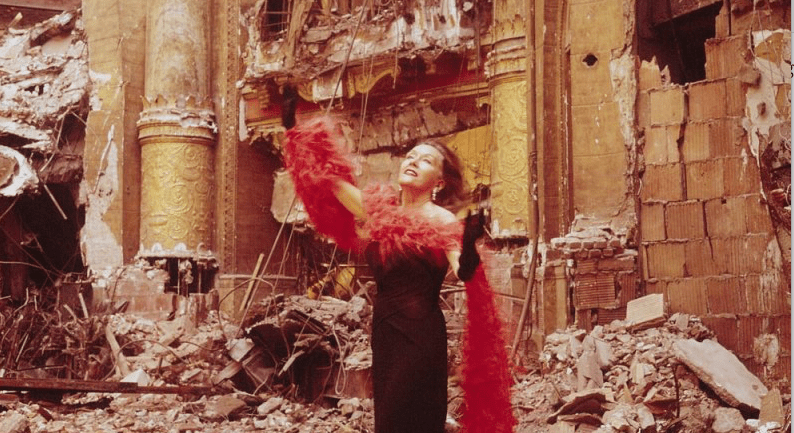
Above: Actress Gloria Swanson amid the ruins of the Roxy, 1960. The famed theater opened with Swanson's silent film, "The Love of Sunya."(Time Inc.)
Jazz Age New York City was all about the big and grand, and nothing was bigger and grander than the new Roxy Theatre near Times Square.
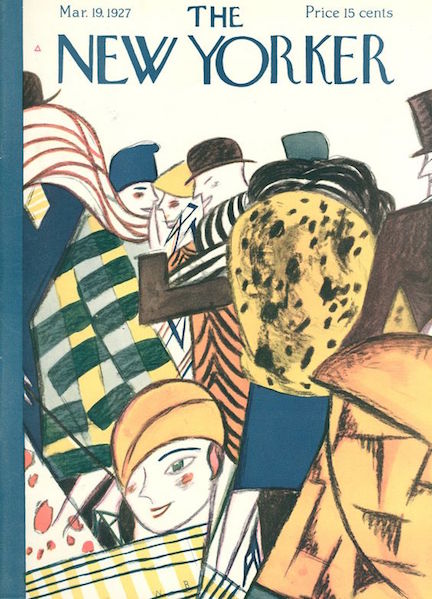
March 19, 1927 cover by W. Boethling.
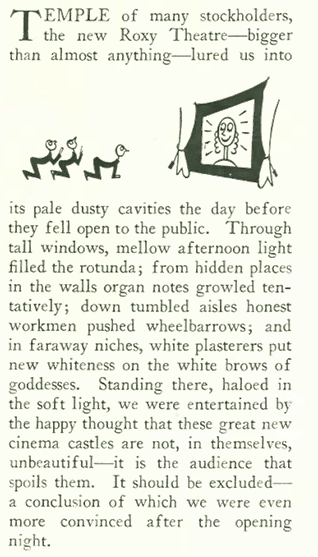
The nearly 6,000-seat theatre was such big news that the March 19, 1927 edition of The New Yorker heralded its arrival in three separate columns.
OPENING NIGHT at the Roxy Theatre. (elixinhollywood.blogspot.com)
The Roxy opened with the silent film The Love of Sunya, produced by and starring Gloria Swanson. The film, naturally, was panned by the magazine. Perhaps the critic’s distaste for the film also prompted a certain aloofness about the theatre itself:
NOT EXACTLY YOUR LOCAL CINEPLEX…The Roxy Theatre lobby featuring the “world’s largest oval rug” manufactured by Mohawk Carpets. The theatre was torn down in 1960 and replaced by an office building. A TGI Friday’s restaurant is now located in the space that once housed this grand lobby. (screensonhigh.wordpress.com)NOT ANOTHER BAD NEW YORKER REVIEW?…Gloria Swanson consults a crystal ball to learn her future with three different men in The Love of Sunya. (gswanson.weebly.com)
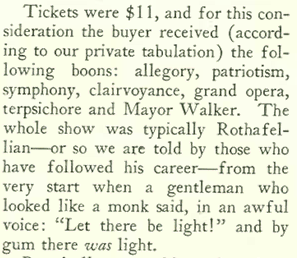
“The Talk of the Town” described the Roxy in similar dispassionate terms, tossing a wet blanket not on the film but rather on the rude, gawking masses who shelled out eleven bucks apiece (equivalent to $150 today) for a seat on opening night:
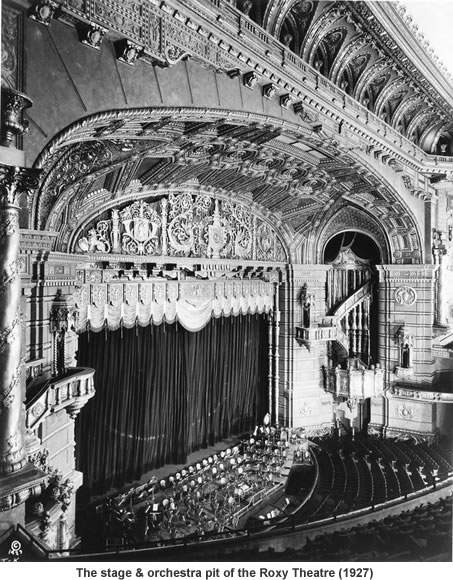
THEY WERE AWESTRUCK…The stage and orchestra pit of the Roxy Theatre (elixinhollywood.blogspot.com)
New Yorker architecture critic George S. Chappell (aka “T-Square”) was a bit more generous in his column, “The Sky Line.”
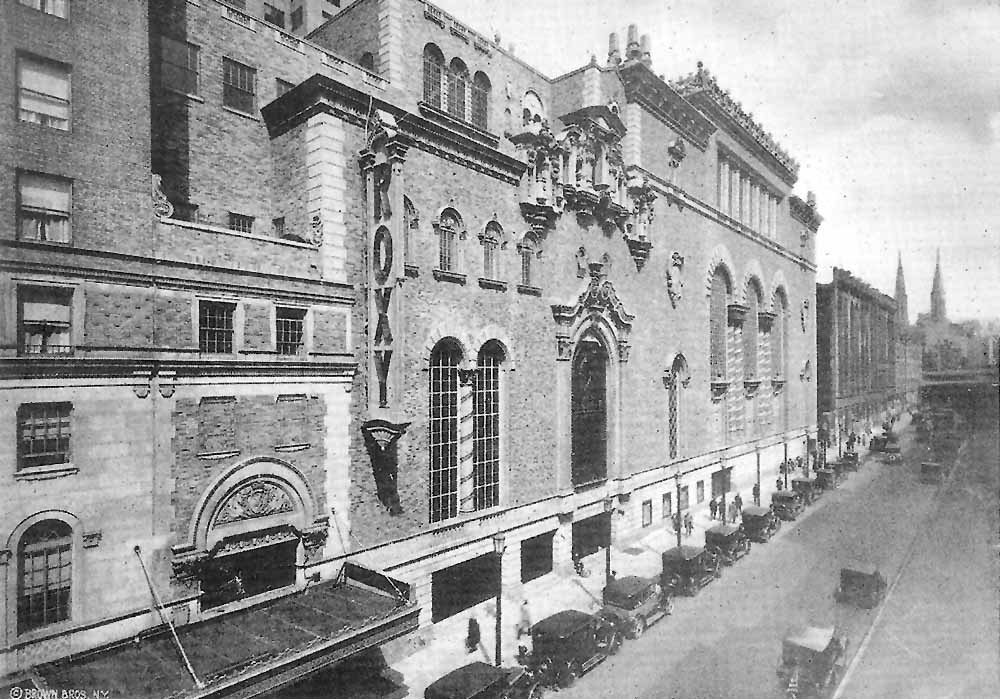
DUBBED ‘THE CATHEDRAL OF THE MOTION PICTURE’ by creator and namesake Samuel ‘Roxy’ Rothafel, the Roxy was located at 153 West 50th Street between 6th and 7th Avenues. It was torn down in 1960. (nycago.com)COMING FULL CIRCLE…Gloria Swanson was photographed by Eliot Elisofon in the ruins of the Roxy Theatre on October 14, 1960 for Life Magazine. (Time Inc.)
* * *
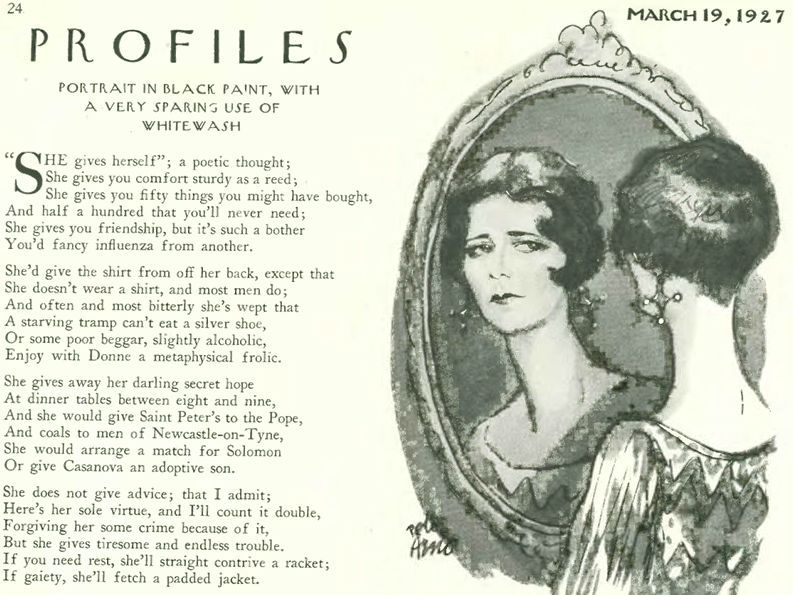
The magazine took an unusual approach to its “Profile” section by featuring an autobiographical profile of poet Elinor Wylie in verse, a portion of which is shown below with an illustration by Peter Arno:
* * *
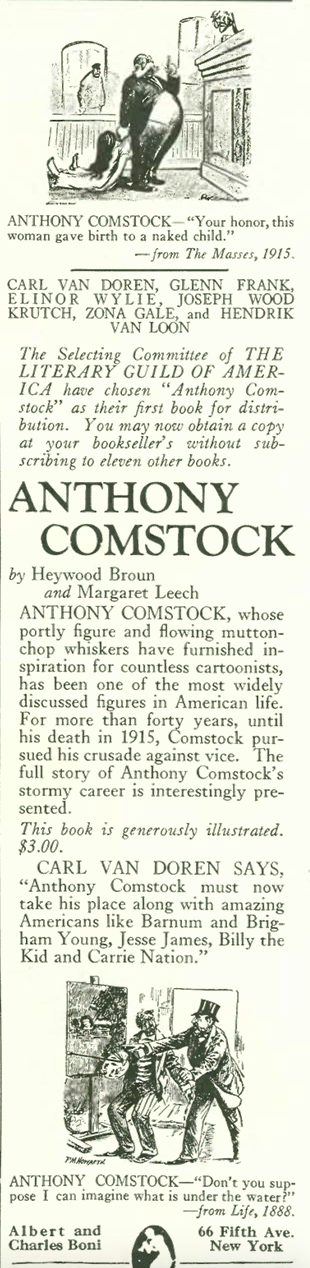
Morality-themed books got the attention of New Yorker book reviewer Ernest Boyd (pen name “Alceste), who devoted considerable ink to Anthony Comstock: Roundsman of the Lord by Heywood Broun and Margaret Leech (both of Algonquin Round Table fame). Comstock was a United States Postal Inspector and politician known for the “Comstock Law,” which sought to censor materials he considered indecent and obscene. That included birth control information, which led to famous clashes between Comstock and family planning advocate Margaret Sanger.
An advertisement for the book appeared in the back pages of the magazine:
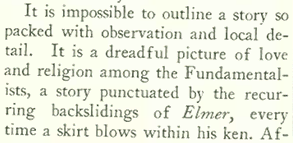
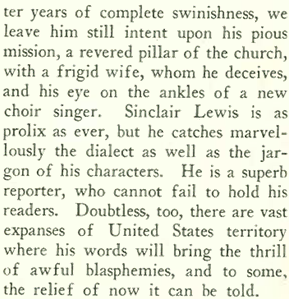
Boyd also reviewed Sinclair Lewis’sElmer Gantry, a controversial novel that exposed the hypocrisy of some 1920s evangelical preachers:
* * *
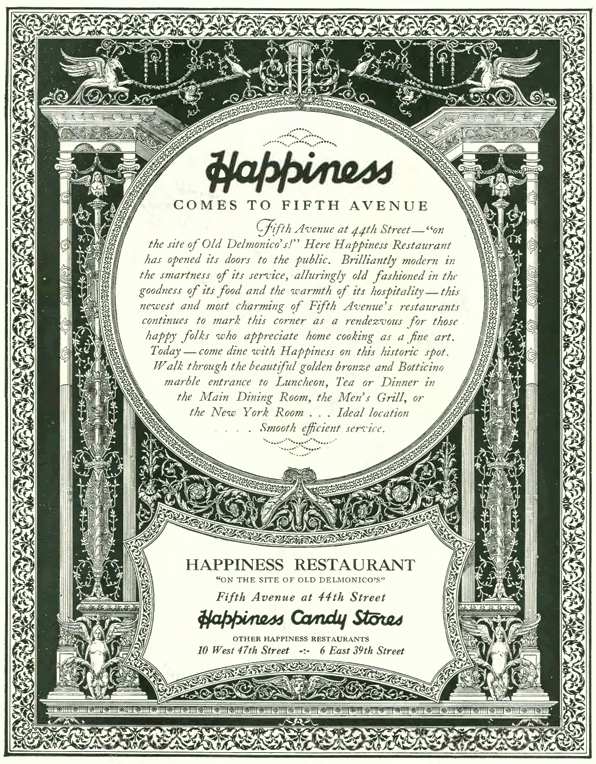
This advertisement began to appear in the pages of the New Yorker for a new restaurant that claimed to replace the beloved Delmonico’s. Despite its status as a New York institution, Delmonico’s had fallen victim to the changing dining habits of Prohibition New York and had closed its doors in 1923:
The restaurant was operated by the Happiness Candy Stores chain, which according to the ad also operated restaurants in two other locations in the city. The restaurants must have been short-lived, as I could find no record of them apart from the ads.
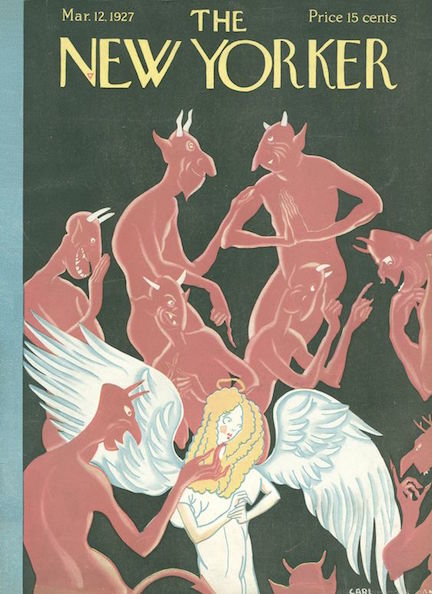
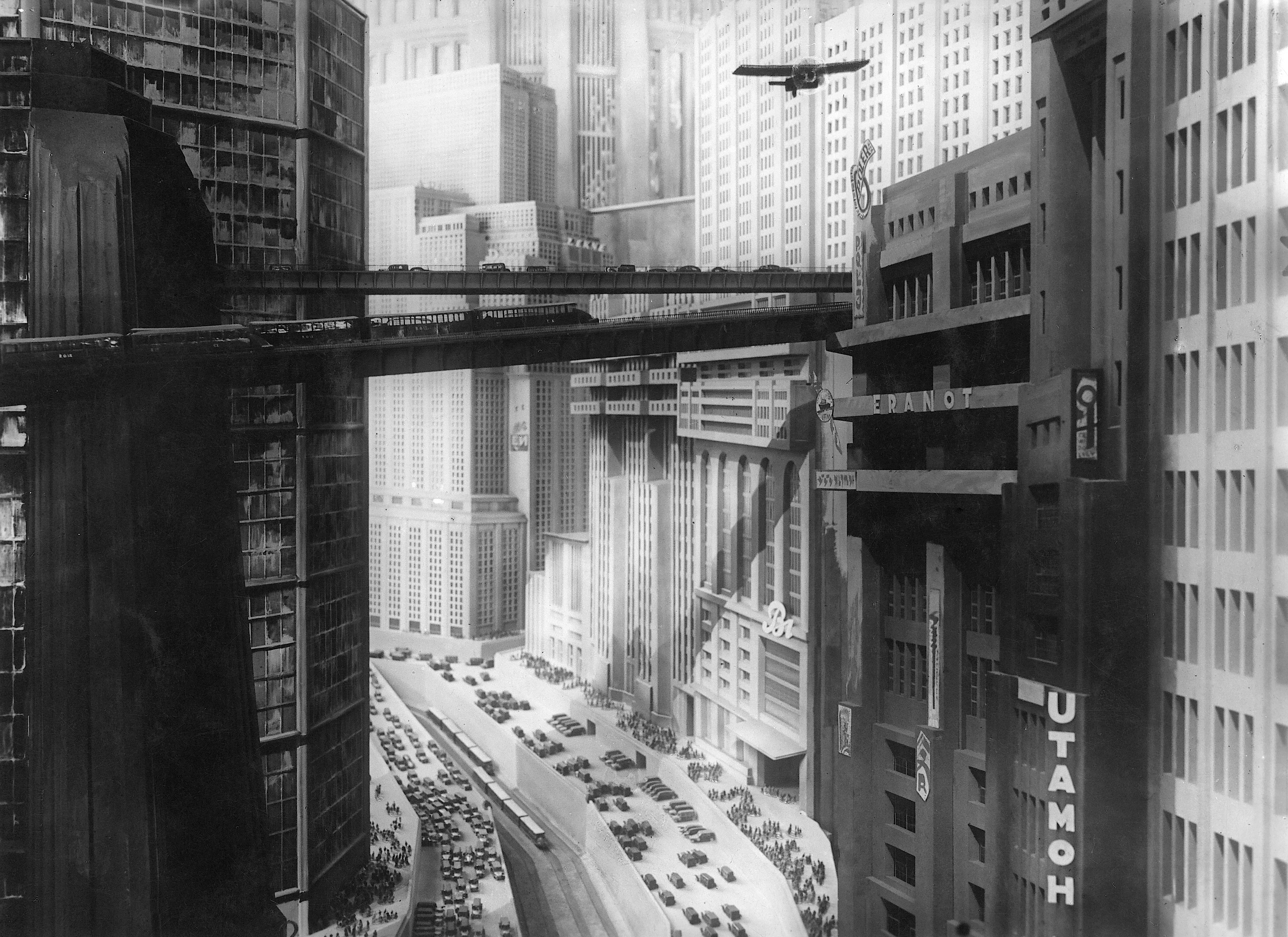
The much-anticipated German expressionist film, Metropolis, opened at Manhattan’s Rialto Theatre. Although considered today to be a classic of the silent era, the March 12, 1927 New Yorker found Fritz Lang’s film to be overlong and preachy despite its fantastic setting and complex special effects.
March 12, 1927 cover by Carl Rose.
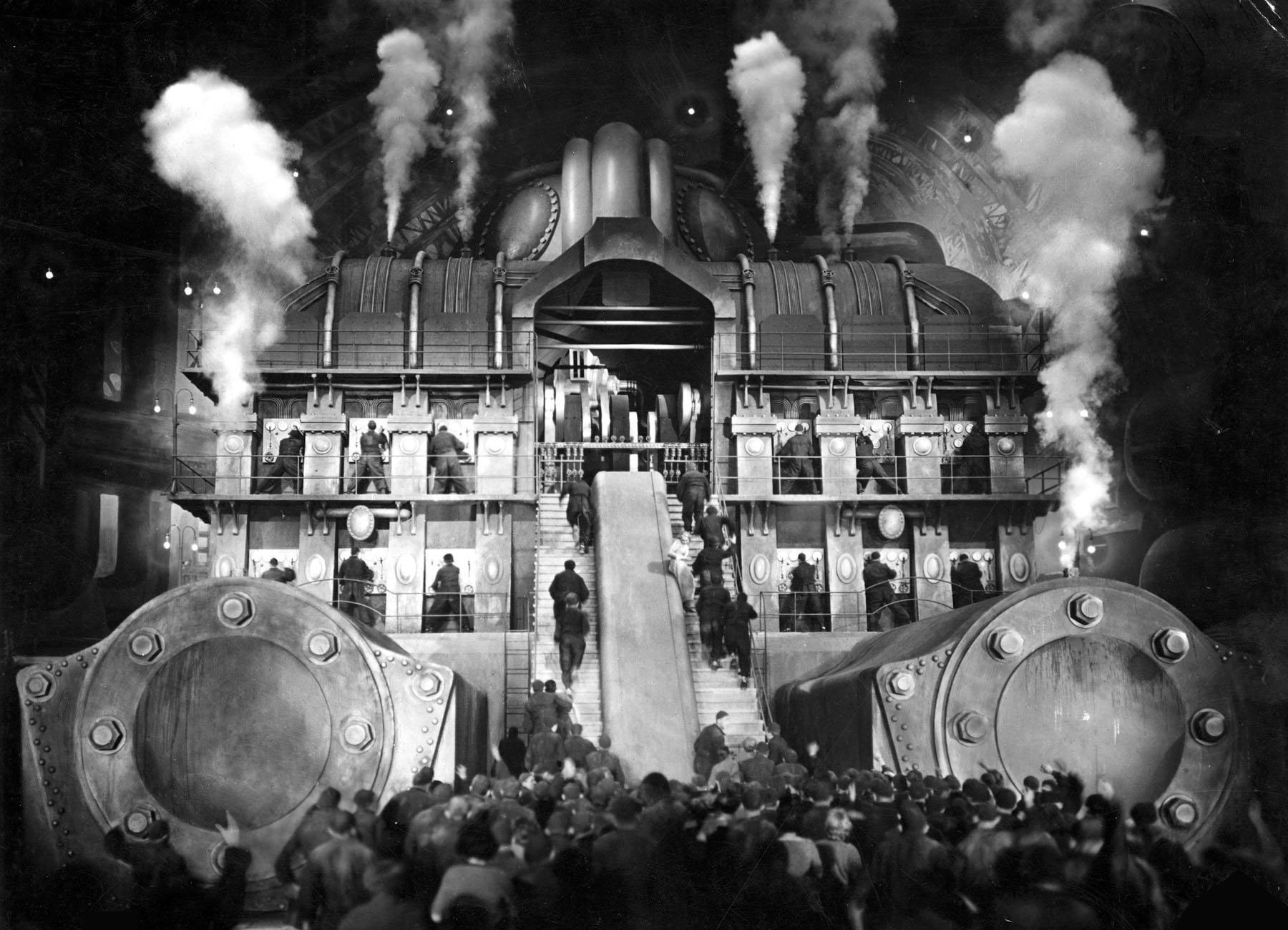
Set in a futuristic dystopia in which the wealthy ruling classes lived high above the toiling masses, the film followed the attempts of a wealthy son of the city’s ruler and a poor working woman named Mary to overcome the city’s gaping class divisions.
The city of tomorrow as portrayed in the opening scenes of Fritz Lang’sMetropolis. The New Yorker encouraged readers to see the film mostly for the special effects, but lamented its “Teutonic heaviness” and uninspired acting. (archhistdaily)
An excerpt from the New Yorker review:
The working masses toil in the dank world beneath the city in Metropolis. (myfilmviews.com)Brigette Helm’s duo portrayal of the noble Mary and her robotic double (here being created through cinematic magic) in Metropolis was praised by The New Yorker, which otherwise found the film’s acting subpar. (cinemagraphe.com)
Considered one of the most expensive movies of its time, Metropolis cost $5 million to film in 1925 (roughly about $70 million today).
* * *
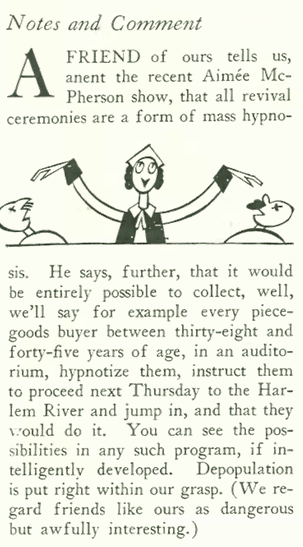
The famous 1920s evangelist Aimee Semple McPherson had been holding a series of revival meetings in New York, which were often (and derisively) noted by the New Yorker editors. In the previous issue “Talk of the Town” observed:
And in the March 12 issue they offered this parting note in “Of All Things”….
Aimee Semple McPherson (left) leading a service at her Angelus Temple in Los Angeles in the 1920s. (Los Angeles Public Library Photo Collection)
A pioneer in the use of modern media, McPherson was in New York on a “vindication tour,” taking advantage of the publicity from her alleged kidnapping a year earlier that led to investigations that she had staged her disappearance to bolster her flagging ministry.
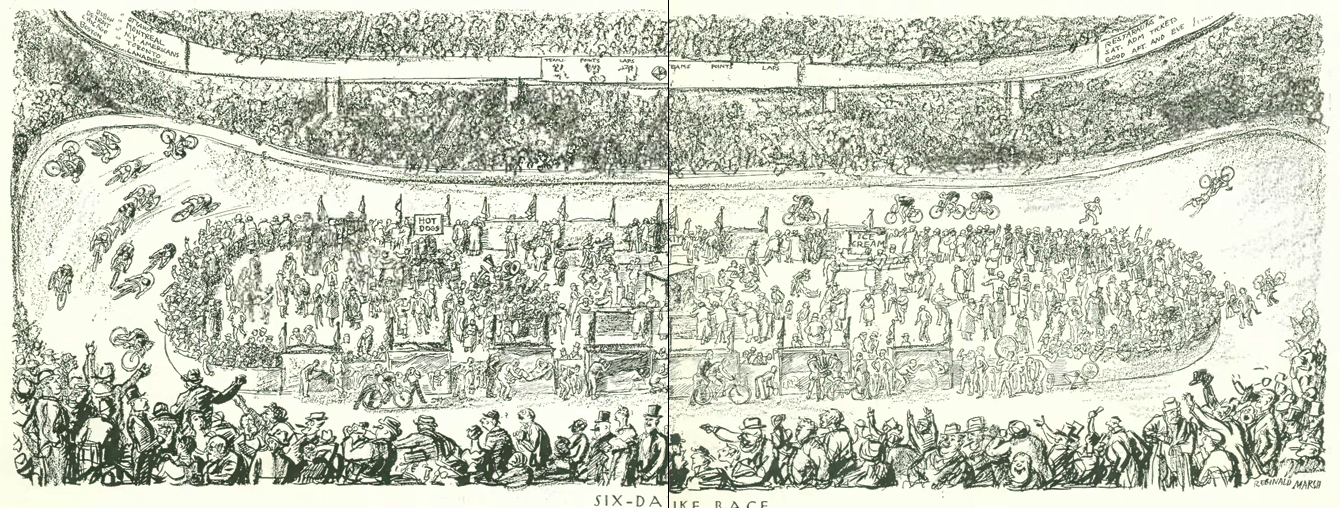
In other diversions, bicycle racing had come to Madison Square Garden, as noted in “Talk of the Town” with an illustration by Reginald Marsh:
click to enlarge
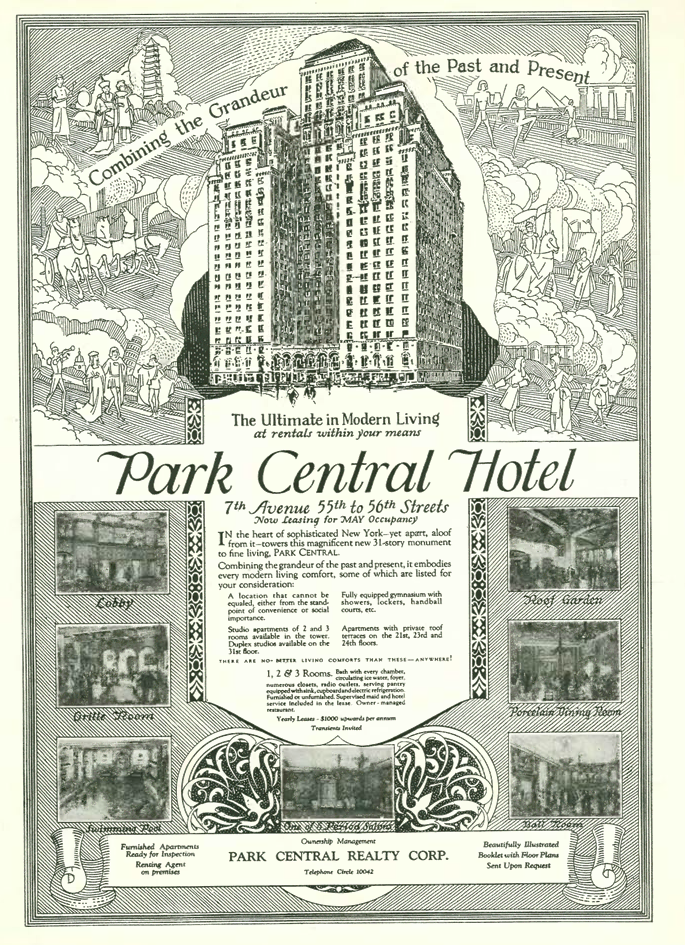
Advertisements in this issue included this announcement for the opening of the Park Central Hotel, still a grand landmark on 7th Avenue…
…and this ad from Nestle touting the latest method for achieving success in the latest hair style…
The breathtaking changes along Manhattan’s streets and across its skyline in 1927 were reflected in the New Yorker’s frequent accounts of venerable landmarks giving way to new skyscrapers.
The Feb. 26, 1927 cover (left) is by an unknown artist. The March 5, 1927 cover is by Ilonka Karasz.
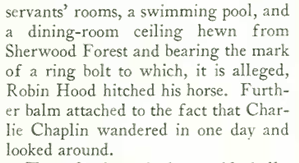
We’ll skip ahead for a moment to the March 5 issue in which the “Talk of the Town” editors reflected on the upcoming demolition of the William A. Clark house on Fifth Avenue and 77th Street, just 16 years after its completion in 1911. The editors noted that the empty house received many curious visitors in its last days, including the silent film star Charlie Chaplin:
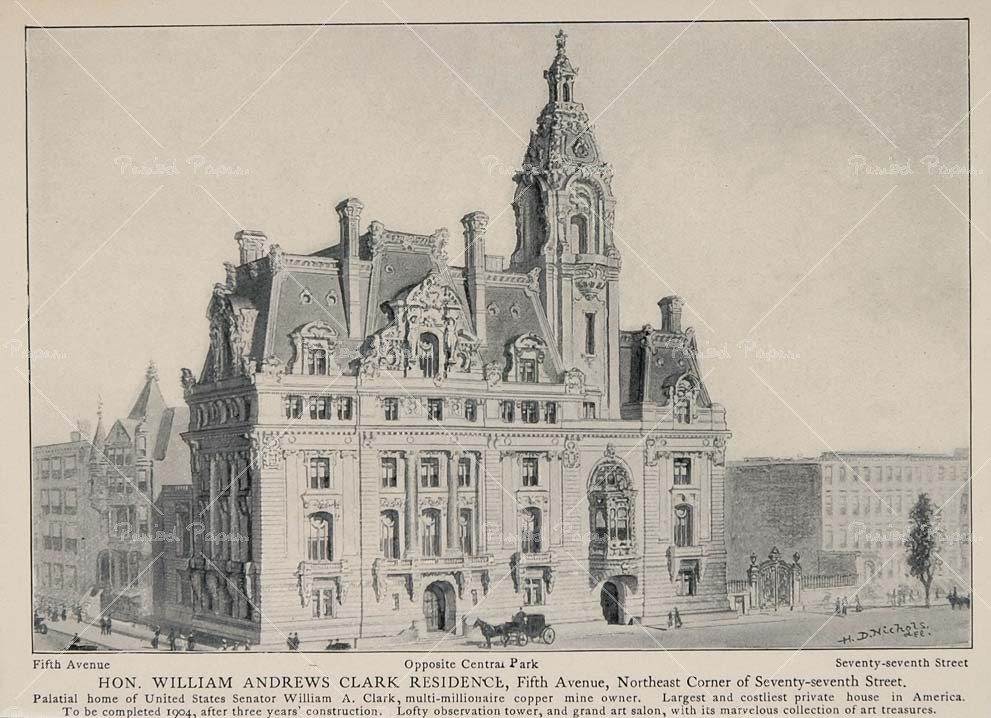
CURB APPEAL…This newspaper account of Clark’s planned mansion noted that it would be the largest and costliest house in America, and would take three years to complete. In fact, it took 13 years to finish the job, in 1911. Just 16 years later it would be demolished. (1889victorianrestoration.blogspot.com)
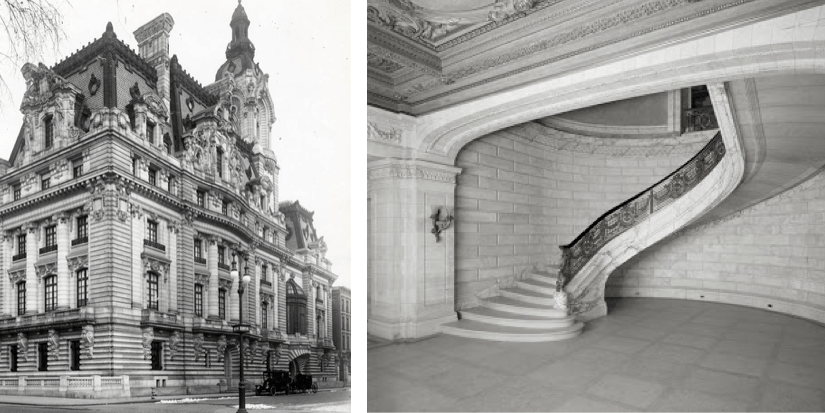
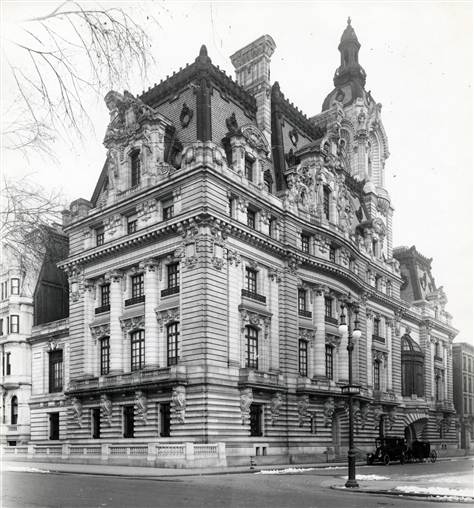
Clark was an enormously wealthy Montana entrepreneur (copper and railroads) and politician. His New York mansion, dubbed “Clark’s Folly,” took almost as long to complete—13 years—as its actual lifespan—16 years. In today’s dollars the house would cost nearly $200 million. It included imported marble from Italy, oak from England’s Sherwood Forest, and sections of whole rooms from old French Châteaus.
The William A. Clark mansion on Fifth Avenue and 77th Street. (Museum of the City of New York)
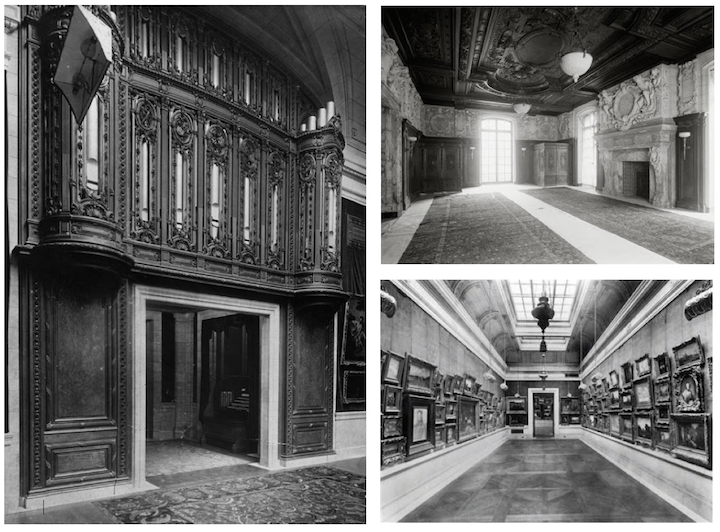
According to Wikipedia, the second floor featured a 36-foot-high rotunda, used as the statuary room. This opened onto a conservatory of solid brass and glass, 30 ft. high and 22 ft. wide. Across the rotunda was the marble-paneled main picture gallery that was 95 ft. long and two stories high. An organ loft housed the largest chamber organ in America.
The nine-story house contained 121 rooms, 31 bathrooms, four art galleries, a swimming pool and Turkish baths. High-tech for its times, with electricity and central air conditioning, it required seven tons of coal per day, brought in by a private subway line.
PARTING SHOTS…Interiors of Clark’s “Folly” included the largest chamber organ in America (left), an immense dining room (upper right) and a two-story art gallery, a section shown below, right. The photos were taken just prior to demolition. Although some interior appointments were saved, the organ was apparently torn apart and dumped into a swamp in Queens. (Wikipedia)
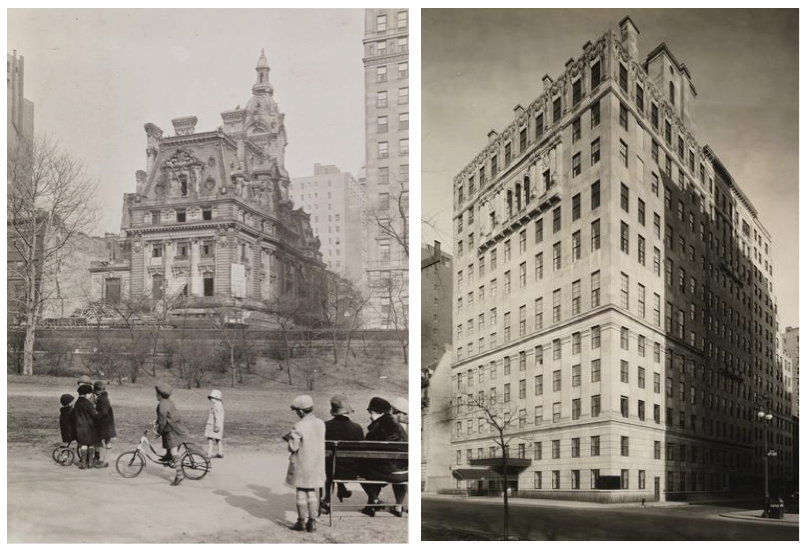
After Clark died in 1925, his daughter, Huguette, and her mother, Anna, moved to 907 Fifth Avenue and the mansion was sold to developer Anthony Compagana for $3 million (more than $40 million today). Compagana had it torn down, replacing it with a luxury apartment building.
The demolition of “Clark’s Folly” (left) in 1927. A large sign on the mansion advertises modern apartments to come. (New York Historical Society). At right, the building that replaced it, 960 Fifth Avenue. (Museum of the City of New York).
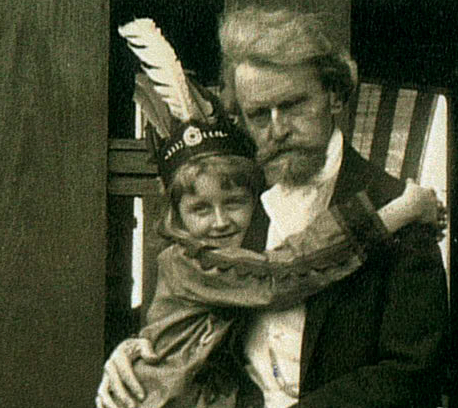
A footnote: Clark’s daughter and heiress, Huguette, would go on to own a $24 million Connecticut country estate and a $100 million estate in Santa Barbara, but would keep them uninhabited. Briefly married from 1928 to 1930, she became reclusive, holed up in her apartments at 907 Fifth Avenue until she moved to a series of hospital rooms beginning in the 1980s.
HAPPIER TIMES…Huguette Clark with her father, William A. Clark, circa 1912. (EmptyMansionsBook.com)
Continuing the theme of the changing skyline, the Feb. 26 New Yorker featured this advertisement for the new Drake Hotel at Park Avenue and 56th Street:
The hotel was built in 1926 by the real estate organization of Bing and Bing, 21 stories with 495 rooms. Like Clark’s Folly, it was innovative for its time, with automatic refrigeration and spacious rooms and suites.
It saw plenty of famous guests, from silent star Lillian Gish (she lived there for three years) to ’60s and ’70s rock bands like Led Zeppelin and The Who.
The Drake Hotel, demolished in 2007. (skyscrapercity)
Razed in 2007, the Drake Hotel was replaced by 432 Park Avenue. At 96 stories and 1,400 feet, 432 Park it is the tallest residential tower in the Western Hemisphere (as of August 2016).
432 Park Avenue (Wikipedia)
Completed in 2015, the supertall 432 Park was designed for the superrich. The building has been maligned by many who find it not only ugly but also a stark representation of the city’s increasing cost of living and conspicuous displays of wealth. One blogger suggested that the building was giving the city “the finger.”
Even Fortune magazine’s Joshua Brown (“Meet the house that inequality built: 432 Park Avenue,” Nov. 24, 2014) noted “in a building so tall and imposing, with over 400,000 square feet of usable interior space, there are only 104 units for people to live in. 432 Park Avenue is, in short, a monument to the epic rise of the global super-wealthy. It is the house that historic inequality built.”
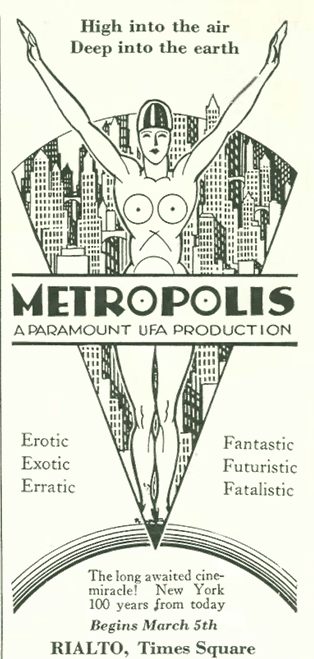
After reading about 432 Park, it seems appropriate that I spotted this advertisement in the New Yorker’s March 5, 1927 issue:
Fritz Lang’s film Metropolis was set in a futuristic urban dystopia where the upper classes lived high above the toiling masses. Hmmm.
























































 A New Yorker State of Mind