Reel News

Above: Newsreel cameramen perch on boards resting on a windowsill to get a birds-eye view of a passing parade, circa 1930. (Public Domain Image)

We marvel at, and sometimes decry, today’s instantaneous news coverage of wars, disasters and the like, but ninety years ago newsreel crews did a remarkable job of filming and delivering the latest news to thousands of theaters across the U.S. and around the world.
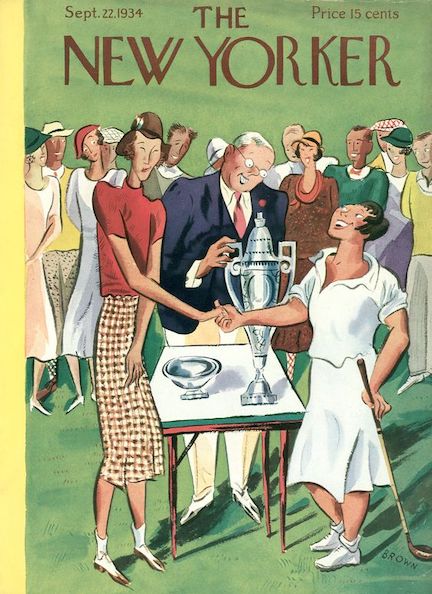
Sept. 22, 1934 cover by Harry Brown.

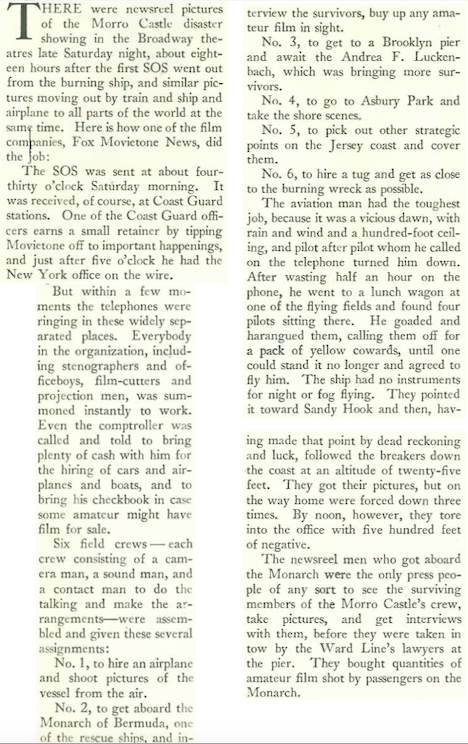
In his “A Reporter at Large” column, Morris Markey penned a lengthy account of Fox Movietone’s coverage of the SS Morro Castle disaster. En route from Havana to New York City on Sept. 8, 1934, the luxury liner caught fire near the New Jersey coast. Due to the ship’s design and the ineptitude of the crew, the blaze claimed 137 lives. Markey described how newsreel crews—with their bulky cameras and sound equipment—went into action, including a cameraman who “goaded” a pilot into taking him aloft through vicious weather conditions.
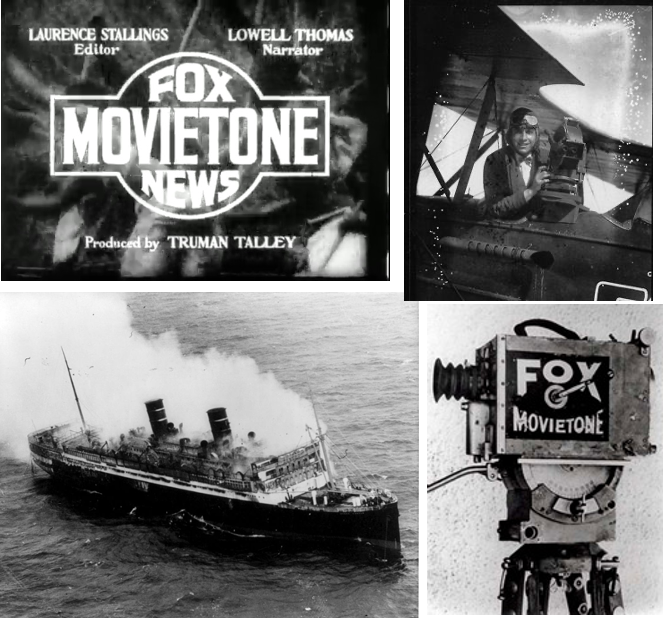
GUTS AND INGENUITY took newsreel reporters to places high and low. Clockwise, from top left, title card from a 1935 Fox Movietone newsreel; Jack Lieb goes aloft to get capture newsreel footage in an undated photo—Lieb was a cameraman for Hearst’s News of the Day; a 1930s Fox Movietone camera; the SS Morro Castle ablaze off the New Jersey Coast on Sept. 8, 1934. (Wikipedia/Lieb photo Courtesy of Bette Marshall via unwritten-record.blogs.archives.gov)

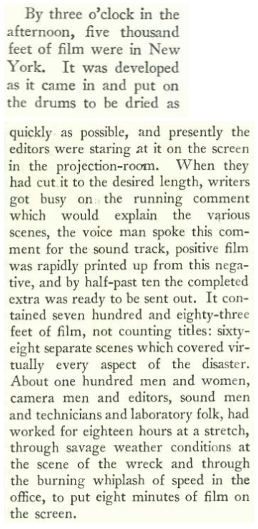
Somehow the cameraman aboard the airplane (which was forced down by weather three times) was able to get his footage to the Movietone office by noon, less than seven hours after the office first received word of the disaster. By three o’clock, five thousand feet of film from all sources was being developed.
UP NORTH AND DOWN UNDER…Movietone news had crews stationed around the world, including field staff in Sydney (top, from 1938), and in Toronto, circa 1930. (Nat’l Library of Australia/City of Toronto Archives)

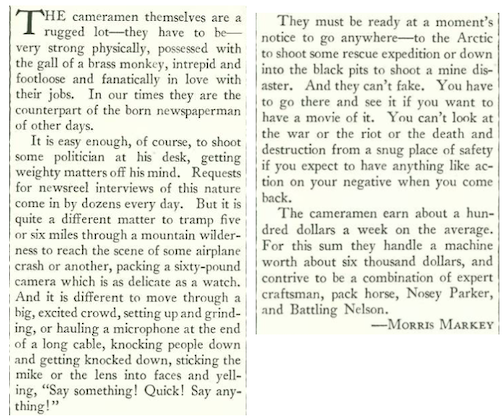
Markey concluded with this observation about the “rugged” and persistent newsreel cameramen:
In the aftermath of the Morro Castle disaster, a scene of enormous tragedy was turned into a tourist attraction…
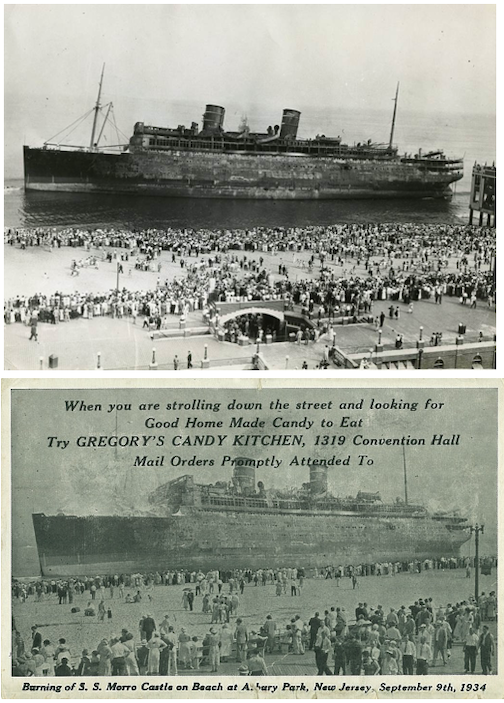
GAWKERS AND HAWKERS…The charred hulk of the SS Morro Castle came to rest on the shore near the Asbury Park boardwalk, which became a popular spot for souvenir salesmen and photo-ops. Tourists flocked to the site from September 1934 to March 1935, when the ship was finally towed away. Note the postcard (bottom) advertising homemade candy over an image of the charred ship. (ripleys.com/side-o-lamb.com)

Fox Movietone News produced sound newsreels from 1928 to 1963, and in the UK as British Movietone News…here is Movietone footage of the Morro Castle disaster, as presented by British Movietone in 1934:

 * * *

Up In The Old Hotels

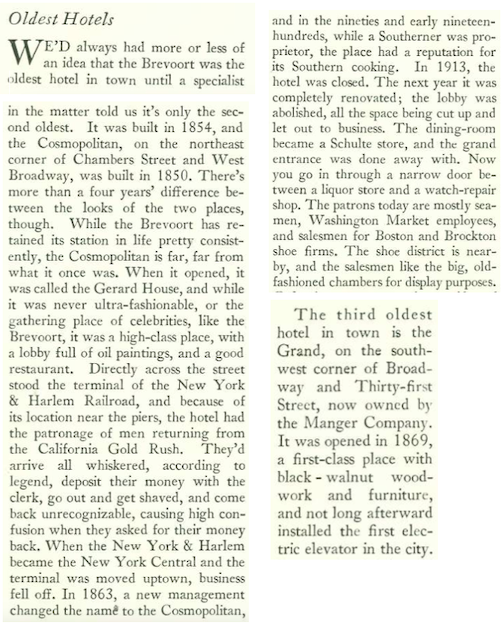
Last week “The Talk of the Town” looked in on one of Manhattan’s oldest saloons, McSorley’s. For the Sept. 22 “Talk” the subject was “Oldest Hotels,” two of which, The Cosmopolitan and The Grand, remarkably survive to this day.
HANGING IN THERE…The 1845 Brevoort House hotel at 15 Fifth Avenue (top left) was torn down in 1952, however the 1868 Grand Hotel (right) at 1232–1238 Broadway and the 1845 Cosmopolitan Hotel (below, left) at Chambers Street and West Broadway still stand today. (Museum of the City of New York / Chester Higgins Jr. for The New York Times)

 * * *

The Six-Million Dollar Road

The first roadway designed exclusively for automobile use was likely the Long Island Motor Parkway, privately built by William Kissam Vanderbilt II because he wanted a road suitable for auto racing. He established the Vanderbilt Cup races on local roads in 1904, but after two spectators were killed and many others injured, in 1908 he began building what would become a 45-mile (72 km) toll road from Queens to Lake Ronkonkoma. After two mechanics were killed in a 1910 race, the New York Legislature banned racing on the road, which the state took over in 1938.
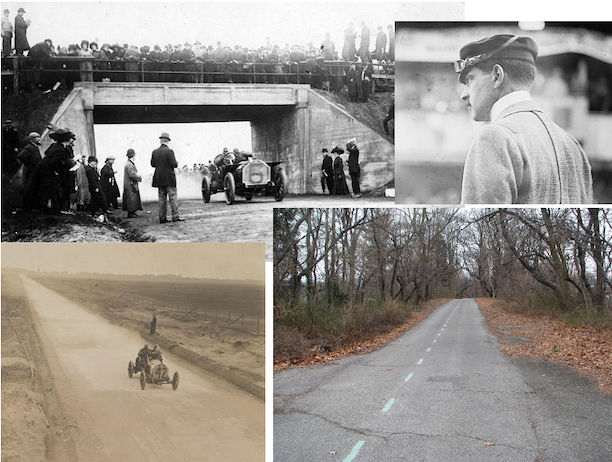
ROAD WARRIOR…William Kissam Vanderbilt II (top right) staged his Vanderbilt Cup Races on his private road until a fatal accident put a stop to the fun in 1910; At bottom right, a surviving section of the road today. Most of the road in Queens is a bicycle trail, and other segments still serve as parts of a county road. (nyheritage.org/Wikipedia-Steve Nowotarski/ny1.com)

 * * *

From Our Advertisers

I have nothing against accordion music, despite years of exposure to Lawrence Welk during my youth, but I find it hard to believe that a Park Avenue socialite (identified here as Mrs. René Du Champ Bellinger) would contemplate tormenting her posh friends with a Hohner squeezebox…

Esquire magazine was barely a year old when it posted this ad in The New Yorker…its appeal to men (and their anxieties) keeps it going today…

…it’s interesting how companies in the 19th century and on through the 1950s featured idealized, bird’s eye images of their factories in advertising, doubtless believing that consumers associated size (and smokestacks) with prosperity, and therefore a quality product…

…White Rock, however, has used the image of the Greek goddess Psyche for more than a century to promote the purity of its spring water…

…purity was also the main point of this ad from Daggett & Ramsdell, who hawked their wares to the Park Avenue set…after more than 130 years D&G is still in the beauty business…

…this next ad is almost unbelievable…single rooms starting at $5, double rooms $7, and a whole suite for $10…at the Plaza…okay, $10 is roughly equivalent to $225 today, but half of that could get you a single…

…and yet another unlikely claim from R.J. Reynolds regarding the energizing qualities of their Camel cigarettes…it seems the last thing you would need while climbing a mountain is smoke in your already over-taxed lungs…

…however, let’s give proper due to Georgia Engelhard (1906–1986), who scandalized the mountaineering world by ditching the Victorian climbing skirt in favor of a pair of climbing pants. Engelhard was the first female climber to ascend many of the peaks in the Rockies…

Georgia Engelhard in a 1922 photo attributed to her friend Alfred Stieglitz. (nga.gov)

…it seemed like nearly everyone smoked in the 1930s, even in ads that had nothing to do with tobacco companies (detail)…
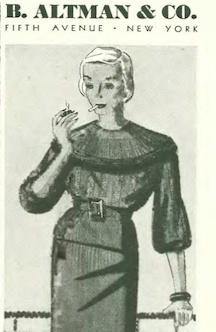
…on to our cartoons, we begin with Richard Decker and some retail competition…

George Price drew up a curiosity even Robert Ripley couldn’t believe…

Robert Day examined advances in evolutionary science…

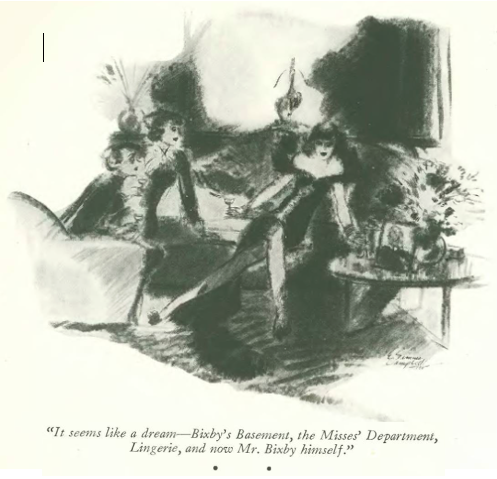
E. Simms Campbell offered up this abbreviated love story…
Peter Arno gave us a director with a god complex…

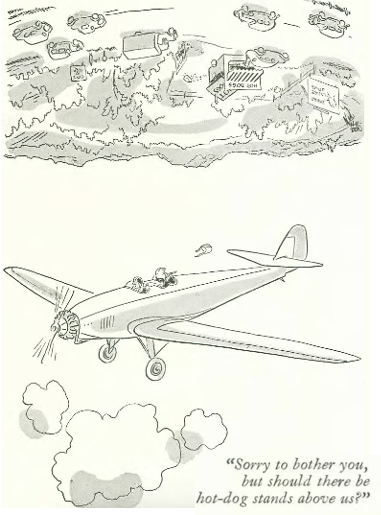
…and one from Ned Hilton, and a new perspective on flying…
…on to Sept. 29, 1934, with a cover by Arnold Hall, who produced at least twelve covers for The New Yorker between 1933 and 1939…
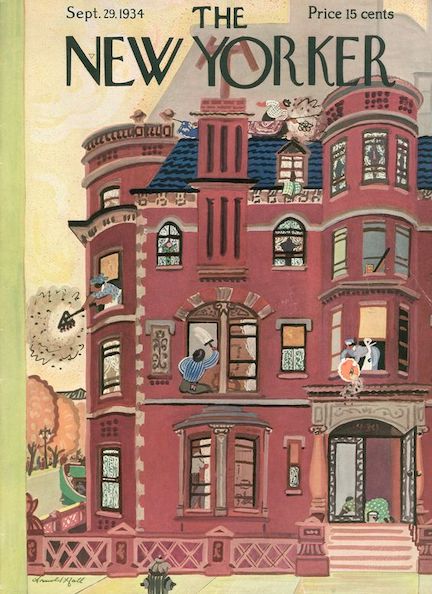
Sept. 29, 1934 cover by Arnold Hall.

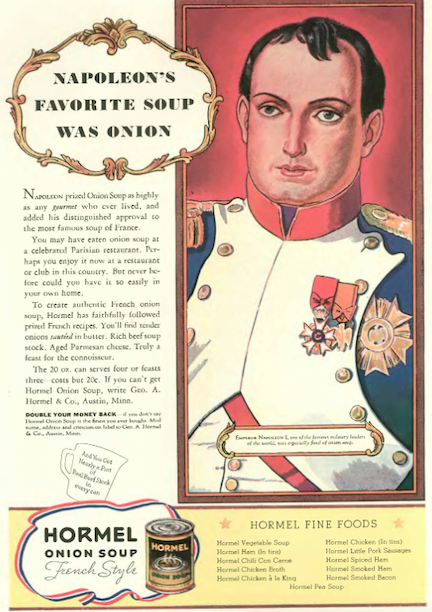
…and we go straight to ads, beginning with this alarming image that greeted readers on the inside cover…why would this prompt anyone to purchase a can of onion soup?…
…the Rainbow Room on the 65th floor of Rockefeller Center opened in 1934, and it quickly became a focal point for the city’s elite…
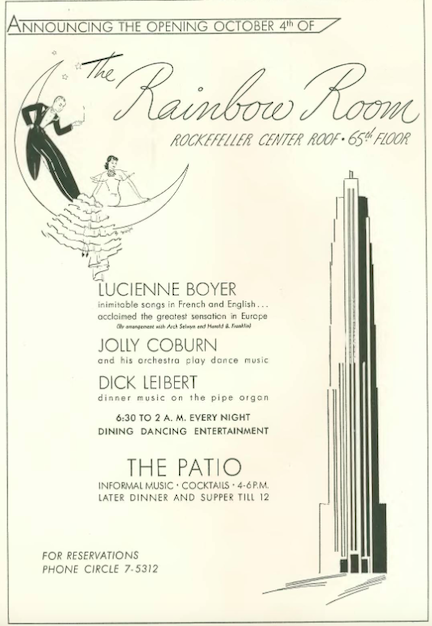
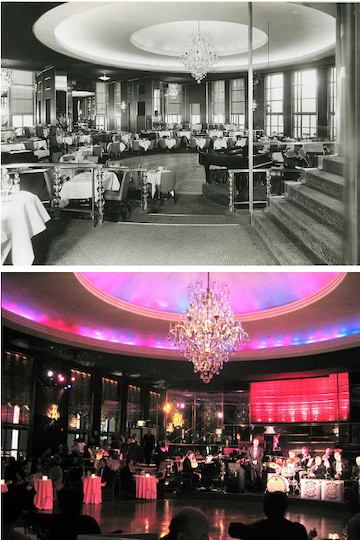
Above, the dining room at the Rainbow Room, 1934, and below, in 2004. (Library of Congress/Wikipedia)

…Lucky Strike continued its series of ads featuring fashionable women looking smart with their product…

…our cartoons include this spot illustration by Otto Soglow, who did spots for The New Yorker for many years…although Soglow’s Little King moved to the Hearst newspapers, he continued to contribute cartoons to The New Yorker until 1974…
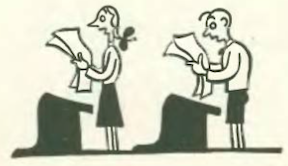
George Price continued to explore life as a levitating man…

…the enforcement of the Hays Code had this teen in a “fix,” per James Thurber

Gluyas Williams continued his exploration of various crises, this time in the music world…

Alan Dunn gave us a glimpse of civilization via the pharaonic sculptures that were emerging on the face of Mt. Rushmore…

…and we close with the wonderful wit of Barbara Shermund

Next Time: Bojangles…

Feeling the Holiday Pinch

The effects of the October stock market crash were finally beginning to show in the pages of the New Yorker in the last month of the 1920s.

Dec. 7, 1929 cover by Julien De Miskey.

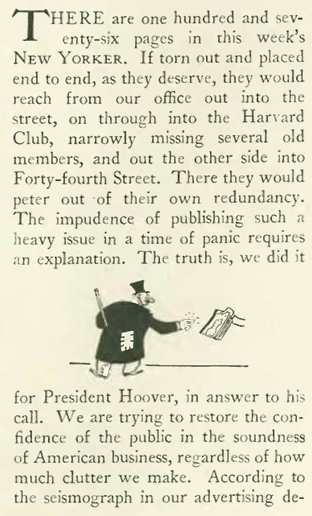
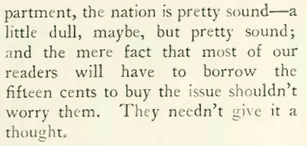
E. B. White was doing his best to keep things light, stating in his “Notes and Comment” column that despite the “time of panic,” the ad-packed Dec. 7 issue contained a whopping 176 pages…
Advertising income for The New Yorker would drop a bit in 1930 (from $1,929,000 to $1,922,000) and would continue to decline through 1932 (down to $1,448,000) before recovering slightly in 1933 and then really taking off again in 1934. And as White noted, even if they had to borrow the 15 cents, folks would still buy the magazine: circulation would top 100,000 in 1930, and except for a dip in 1932 would steadily grow past 150,000 by decade’s end.

KEEP CALM AND CARRY ON…E.B. White in 1946. (National Endowment for the Humanities)

The magazine was stuffed with ads as well as an extended “On and Off the Avenue” —which offered advice to holiday shoppers — and the continued serialization of Elmer Rice’s novel A Voyage to Purilia (installment No. 9).

But not all was sweetness and light. The biggest economic collapse in U.S. history was simply too pervasive to ignore, and even a feeling of hopelessness was creeping into magazine — here’s an observation by Howard Brubaker in his “Of All Things” column…

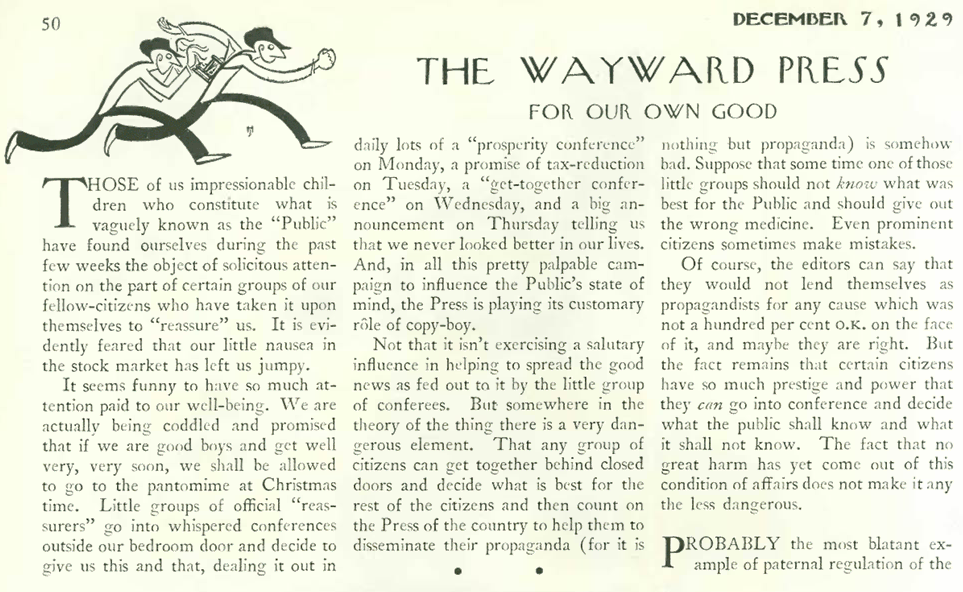
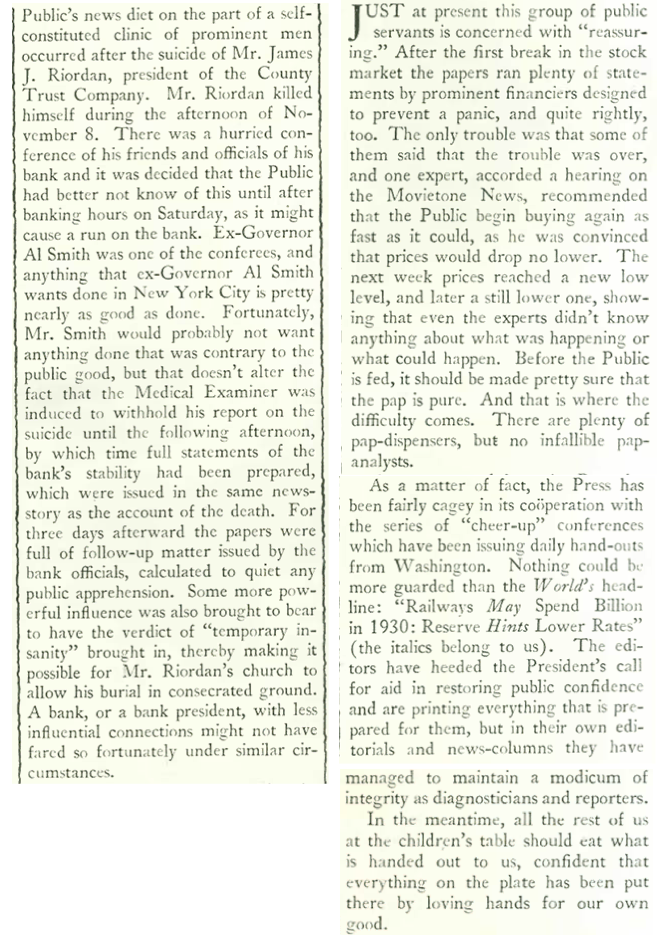
…and writing under the pseudonym “Guy Fawkes,” humorist Robert Benchley found little to laugh about in his “The Wayward Press” column. He chided the media for giving the public false hopes (which he labeled “propaganda”) regarding the state of the economy, and for concealing the suicide of prominent New York banker James J. Riordan, whose death announcement was postponed until Riordan’s bank closed for the weekend…

MARKET CASULTY…News of the suicide of prominent New York banker James J. Riordan (left) was suppressed to avoid a run on his County Trust Company. Robert Benchley (right) criticized the newspapers for working with power brokers to feed positive economic news to the masses. (NY Daily News/amsaw.org)

The following account excerpted from the Nov. 10, 1929 New York Times reveals how a nervous banking community responded to the market crash-related suicide of Riordan:

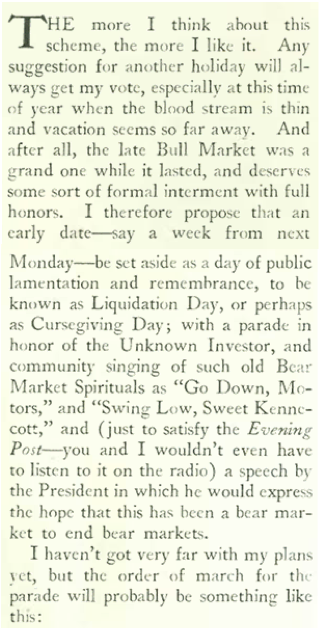
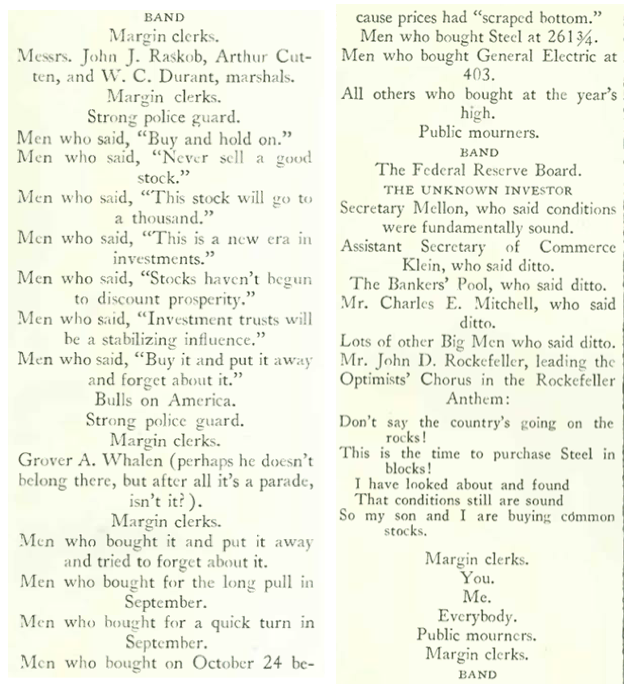
The popular historian Frederick Lewis Allen (1890 – 1954) offered a more lighthearted take on the events surrounding the market crash in his tongue-in-cheek casual, “Liquidation Day Parade,” in which he proposed a holiday to commemorate the end of the Big Bull Market.

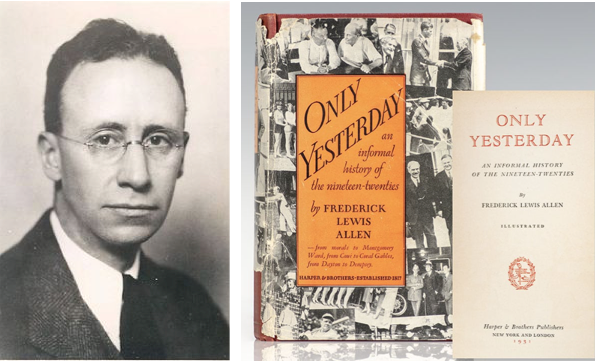
Allen, who also served as editor of Harper’s Magazine, would go on to write Only Yesterday, which chronicled American life in the Roaring Twenties. The 1931 book was a huge bestseller at the dawn of the Depression, and critically acclaimed, both then and now. Writing for the Washington Post (Nov. 28, 2007), book critic Jonathan Yardley observed: “It is testimony to both the popularity and the staying power of Only Yesterday that for more than three-quarters of a century it has remained steadily in print, and to this day enjoys sales that would please plenty of 21st-century writers.”

I CAN SEE CLEARLY NOW…in a little more than year after the Roaring Twenties came to a close, historian Frederick Lewis Allen would chronicle that decade in Only Yesterday, his most famous book. (Wikipedia/raptisrarebooks.com)

 *  *  *

Clipped Wings

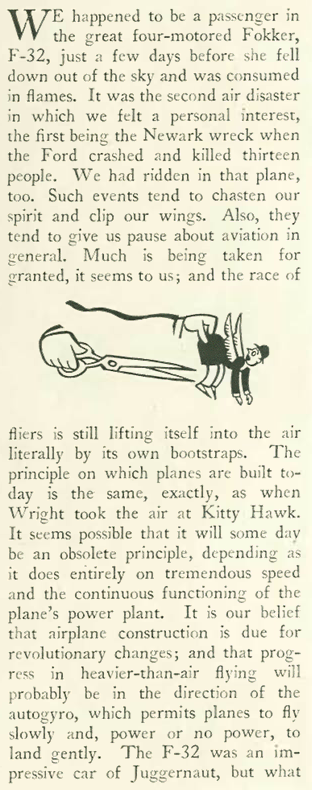
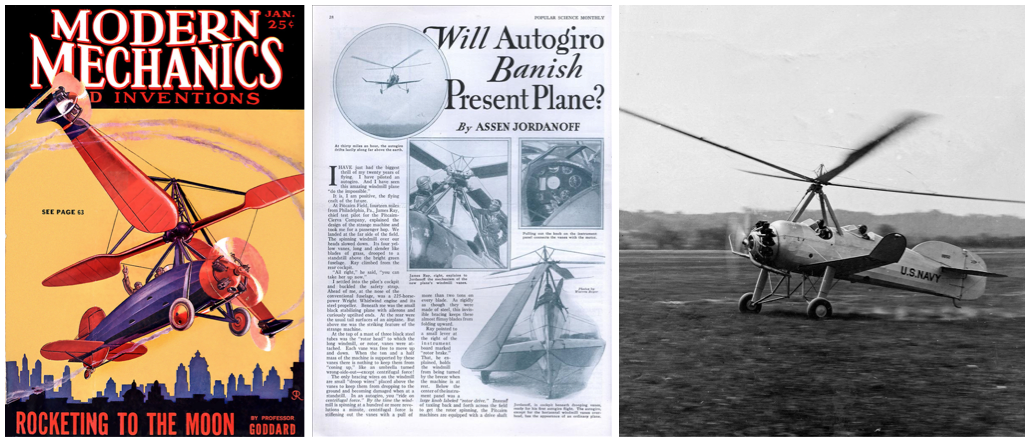
We turn back to E.B. White, The New Yorker’s most enthusiastic proponent of the aviation age. In the previous issue (Nov. 30) White had rhapsodized about a  flight he took on a huge, new Fokker F-32. In the Dec. 7 “Talk of the Town” White reported that the very same plane had crashed and burned (and also noted that another plane on which he had been a passenger, a Ford Trimotor, had crashed earlier that year in Newark). White speculated that aviation would soon head in a different, safer, direction along the lines of the autogyro, a flying contraption that was widely favored by futurists of the day:

IT’S A BIRD, IT’S A PLANE…In the 1920s and 30s the autogyro — part airplane, part helicopter — was seen as the future of air transportation. From left, cover of Modern Mechanics magazine from January 1930; an article on the autogyro from the March 1931 issue of Popular Science; an XOP-1 autogiro at the Naval Air Station Anacostia in Washington D.C., 1931. (modernmechanix.com/navalaviationmuseum.org) Click image to enlarge

 *  *  *

Wonders Never Cease

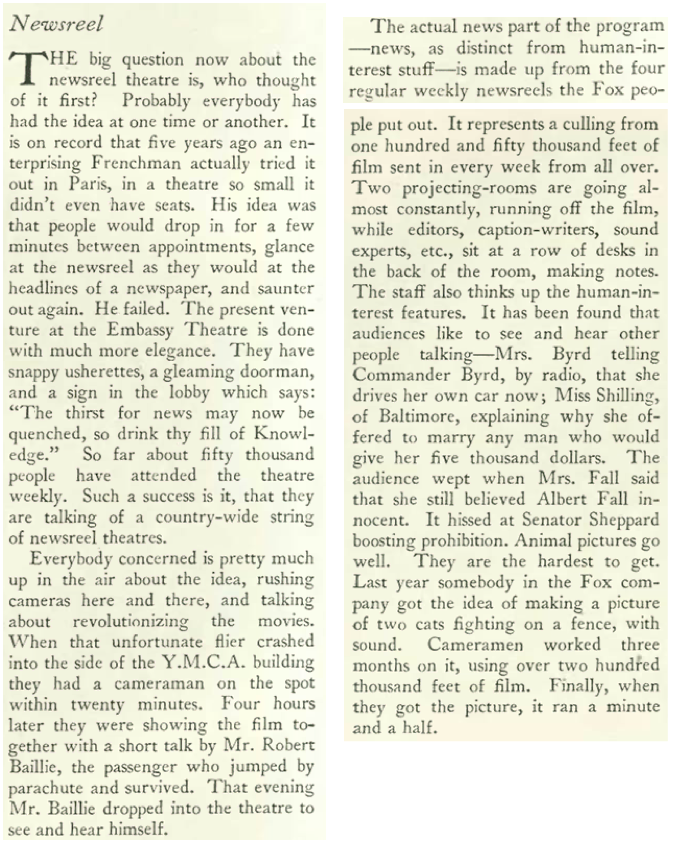
“Talk” also reported the growing popularity of newsreel theaters, and marveled at the speed with which camera crews could deliver their finished product to movie screens. An example was the crash of a small plane onto the side of a YMCA (an incident also noted by White in the previous issue); a newsreel crew was able to go from scene to screen in about four hours:

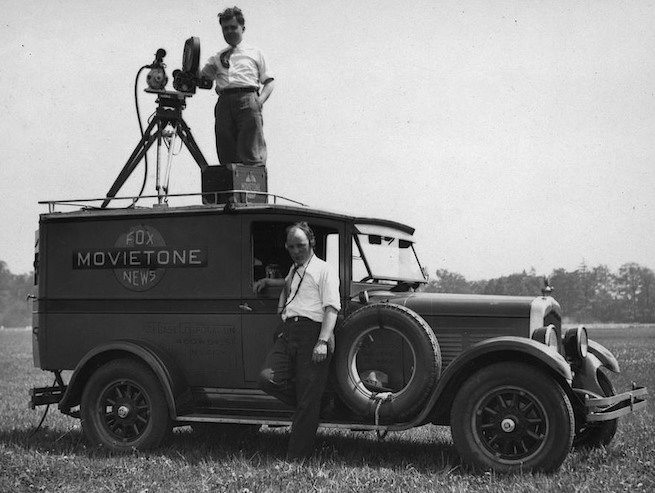
BEFORE GERALDO…Fox Movietone news crew in 1930. (City of Toronto archives)

 *  *  *

High Wire Act

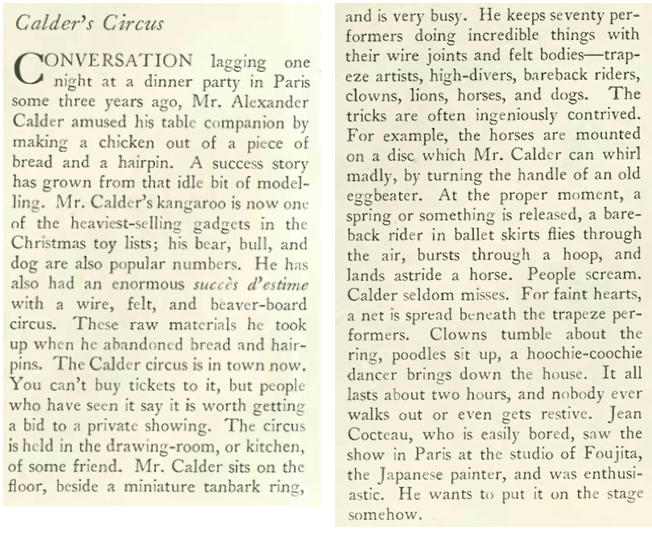
The artist Alexander Calder was already well known for his wire sculptures (his colorful mobiles would come later) when he embarked on his Cirque Calder in Paris in 1926. He brought “the show” to New York in 1929, where he used everything from eggbeaters to balloons to bring his wiry performers to life. Presumably art critic Murdock Pemberton wrote this account for “Talk of the Town”…

UNDER THE TINY TOP…Invitation to a performance of Cirque Calder (1926–31) at the Hawes-Harden apartment, August 28, 1929; Alexander Calder with Cirque Calder (1926–31), 1929; Lion Tamer and Lion from Cirque Calder (1926–31). (calder.org)

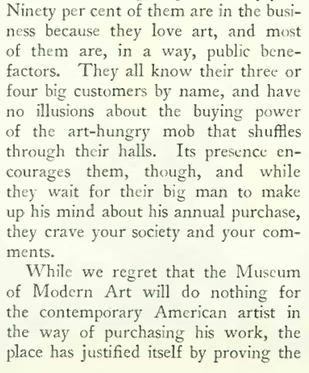
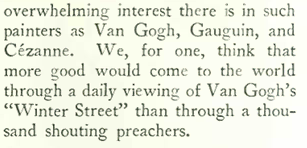
And we also have Pemberton over at his art column, where once again he tried to make sense of the new upstart Museum of Modern Art. He seemed to be surprised by the large crowds drawn to the new museum as he pondered its next show…

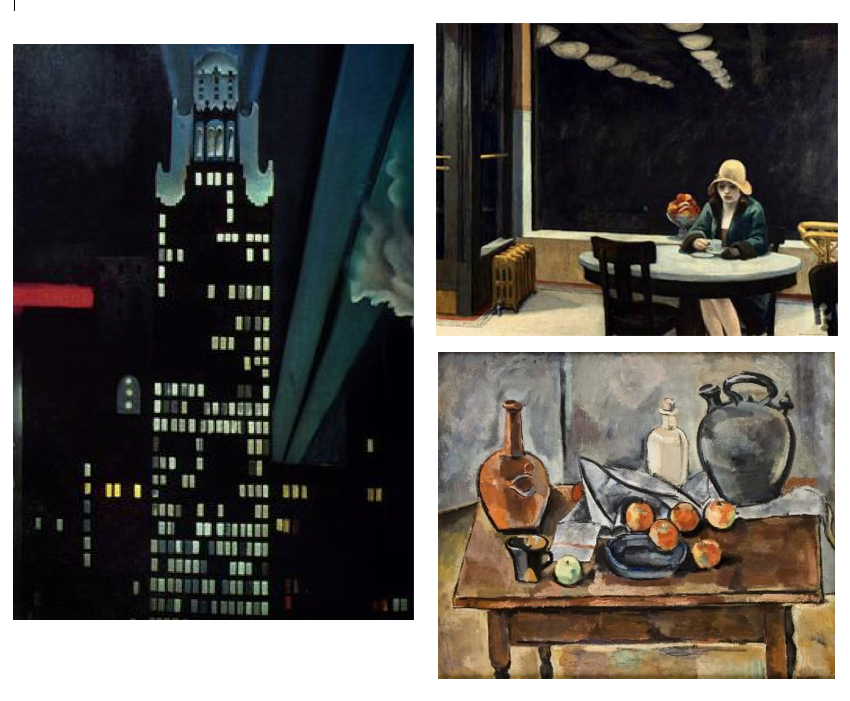
AMERICAN MODERN…Among works featured at MoMA’s second exhibition, Paintings by Nineteen Living Americans, were, at left, Georgia O’Keefe’s Radiator Building (1927); top right, Edward Hopper’s Automat (1927); and Max Weber’s Three Jugs (1929). (Wikipedia/theartstack.com)

Pemberton had yet to see MoMA’s stunning second exhibition, Paintings by Nineteen Living Americans, but had to (grudgingly) conclude that the museum was filling a need…

 *  *  *

The Toy Bazaar

From its beginnings in 1862 until the end of the 19th century, the F.A.O. Schwarz toy store was known to New Yorkers as the “Toy Bazaar,” and by 1929 was something of an institution. As part of a lengthy column featuring ideas for Christmas shoppers, The New Yorker offered some tips on what shoppers might find at the famed toy store:

FUNLAND…Left, the cover the 1929 F.A.O. Schwarz Christmas catalog; at right, the store’s location in 1929, 303 Fifth Avenue. (oldwoodtoys.com)

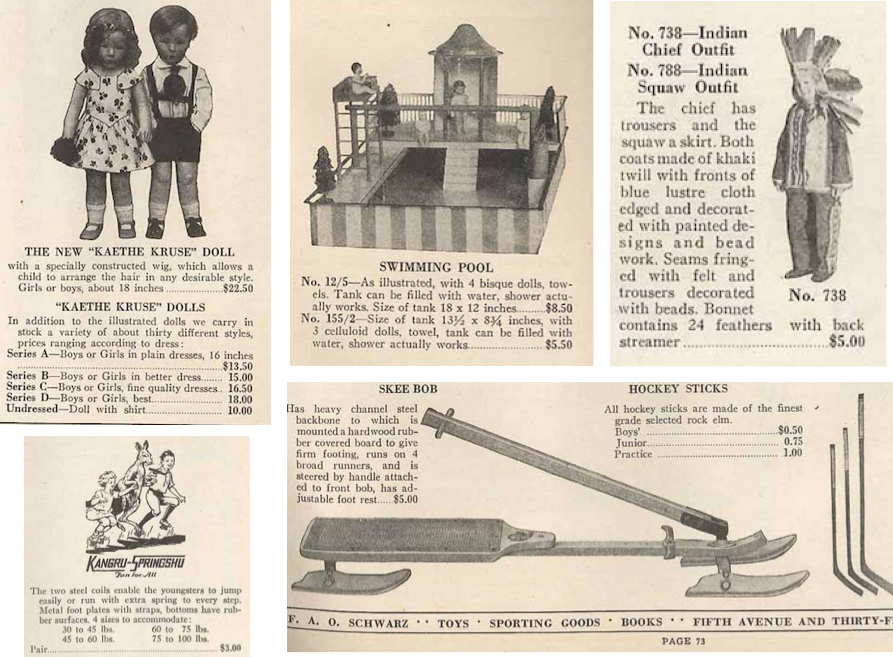
Some of the toys mentioned in The New Yorker article, from the 1929 F.A.O. Schwarz Christmas catalog. There’s nothing plastic here — plastics as we know them, such as polypropylene, would be developed in the 1950s:

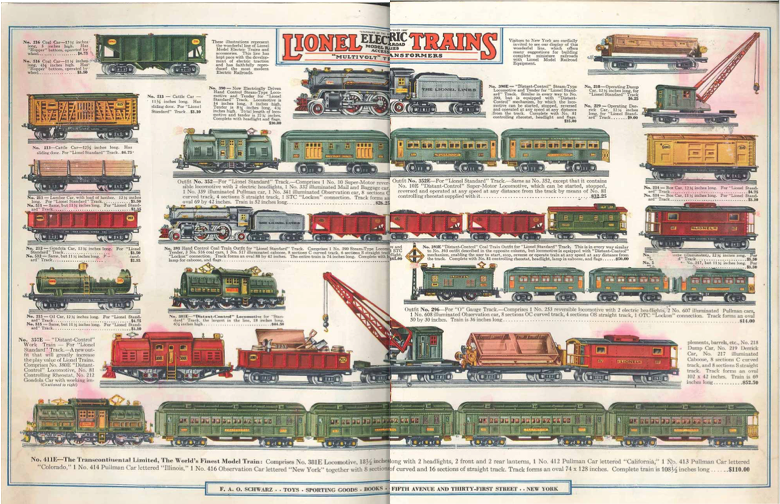
The 1929 F.A.O. Schwarz Christmas catalog also featured a color spread of its stock of Lionel Electric Trains:

If you want to look at the entire 1929 F.A.O. Schwarz Christmas catalog, you can find it at this terrific site.

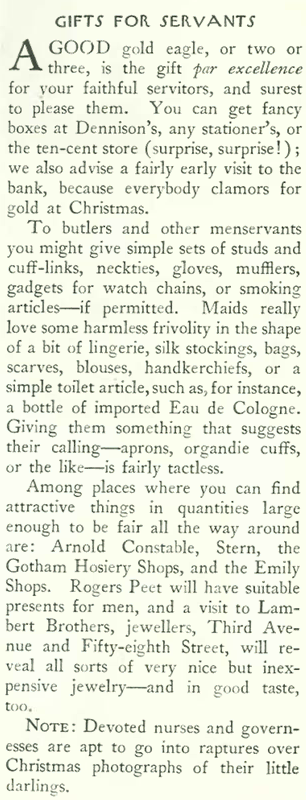
The column also offered advice on “gifts for servants,” at least for those who weren’t getting laid off due to the market crash. Note the somewhat patronizing tone, especially the final paragraph regarding nurses and governesses:

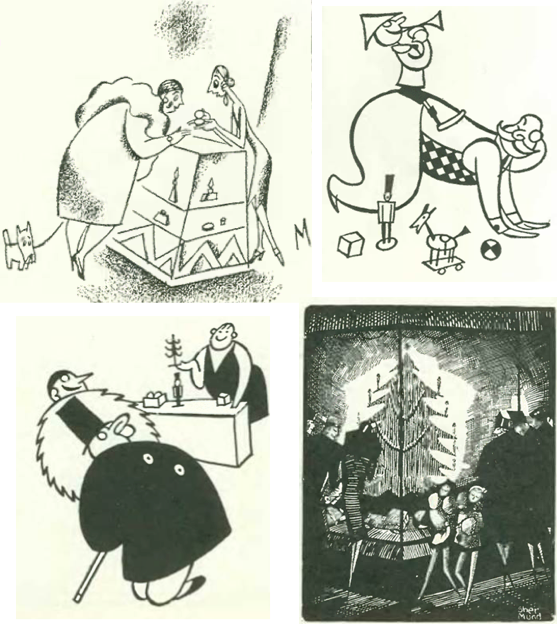
As usual, the shopping column was sprinkled with spot drawings celebrating the season: here are three from Julian De Miskey and one from Barbara Shermund:

*  *  *

The Bard Does the Talkies

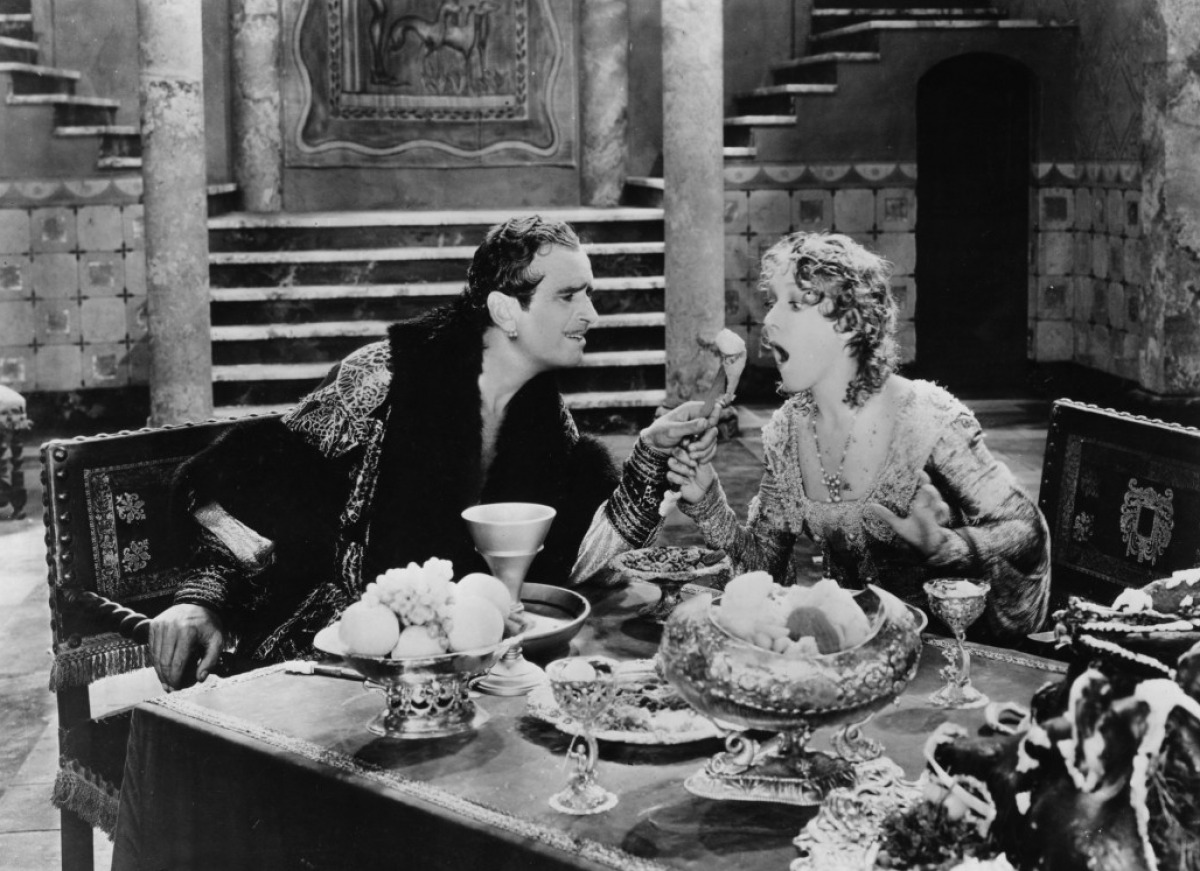
At the movies, critic John Mosher found much to like at the Rivoli, which was screening The Taming of the Shrew featuring the husband/wife team of Douglas Fairbanks and Mary Pickford:

WILD AT HEART…Douglas Fairbanks and Mary Pickford in 1929’s The Taming of the Shrew. (IMDB)

 *  *  *

Somerset Saga

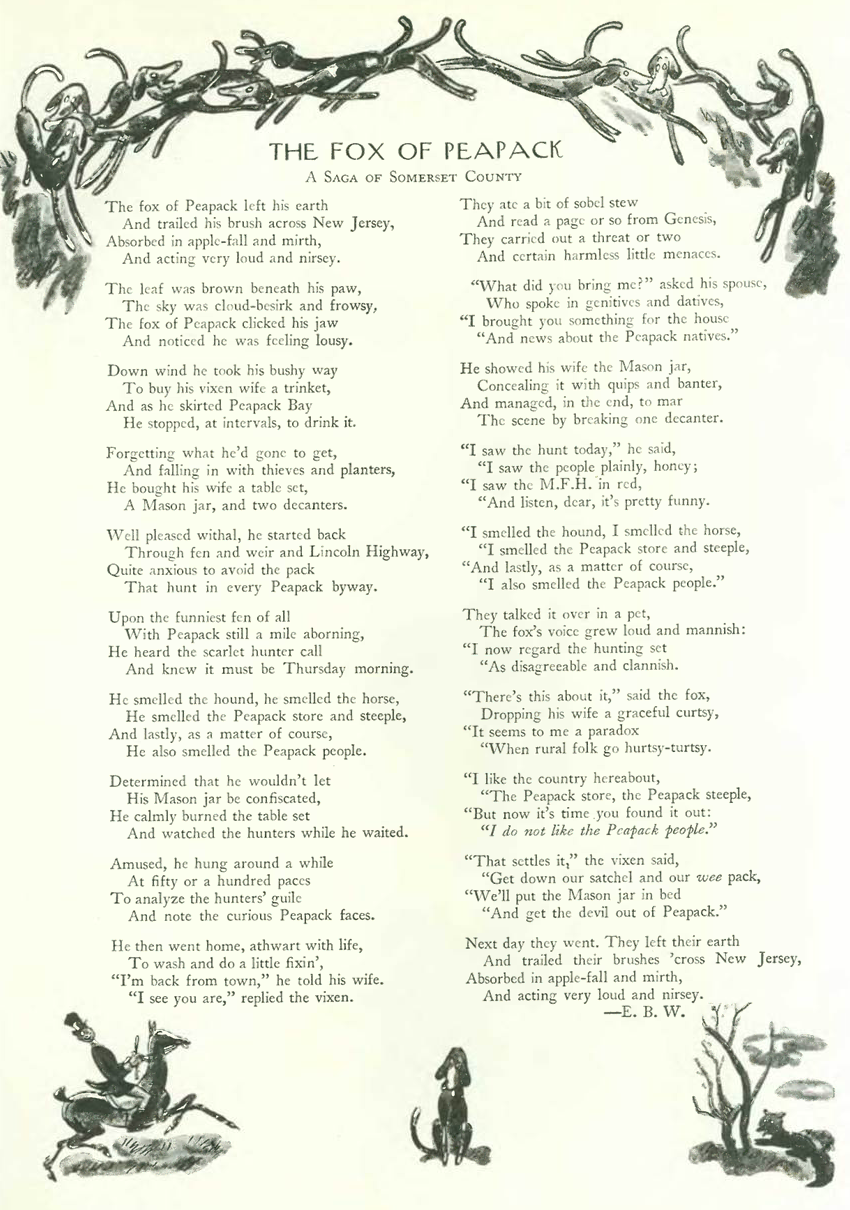
When I first spotted this I thought it was an early edition of The New Yorker’s famed Christmas poem, but those were started by Frank Sullivan in 1932. Nevertheless, here is a clever “Saga of Somerset County” from our dear E.B. White:

 *  *  *

From Our Advertisers

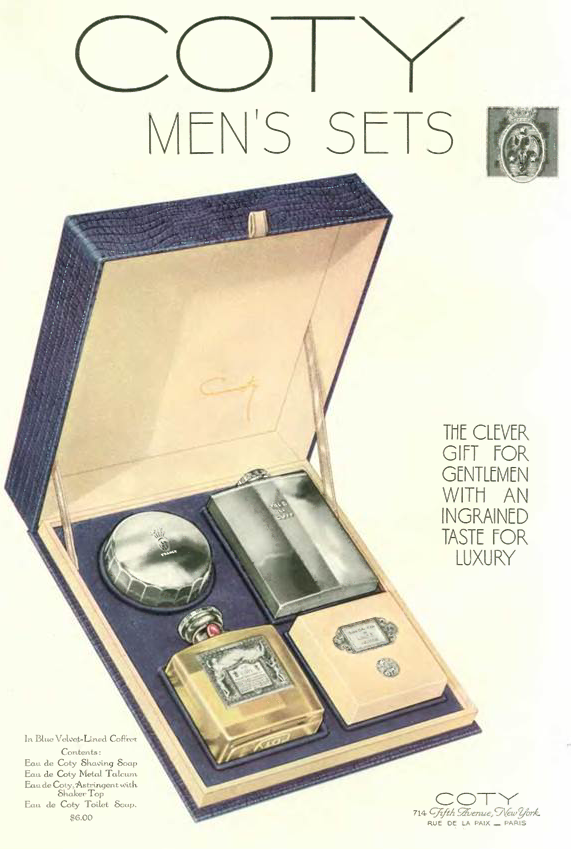
For men who hadn’t lost their shirts and had an “ingrained taste for luxury,” here was a men’s toilet set from Coty featuring a talcum shaker that would have doubled as a fine whiskey flask…

…did the folks at Bergdorf Goodman miss the news of the market crash? Read the fine print about the coming “revolution in fur fashion”…

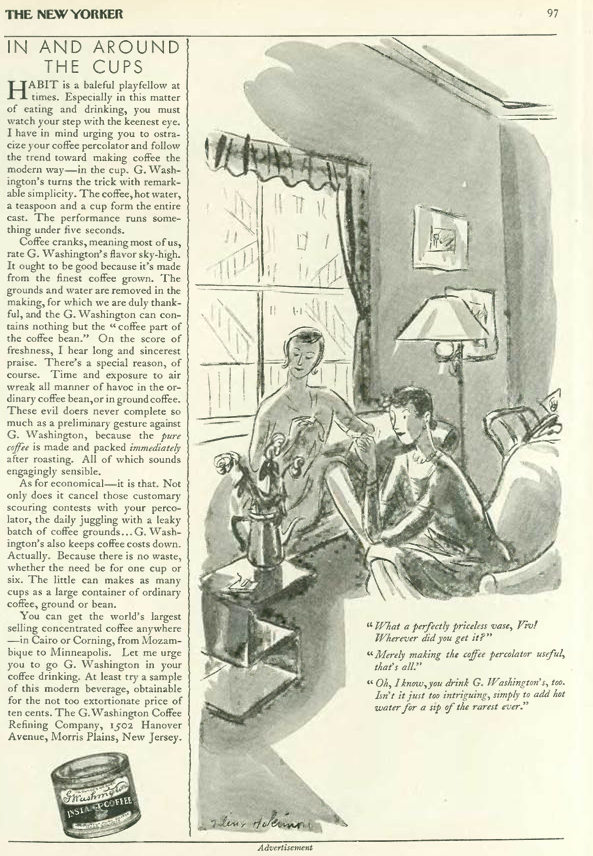
Helen Hokinson illustrated another ad for G. Washington instant coffee…

…Atwater Kent offered up this sumptuous appeal to holiday shoppers…

…at first glance I thought this was an ad for a luxury apartment…the copy is almost identical, save for a couple of words like “death” and “crypt”…
…on to our artists, here is a spot by Constantin Alajalov that ran along the bottom of “Talk of the Town”…

…and a sight that would become more familiar as the Depression deepened, a look at an estate sale, courtesy Helen Hokinson

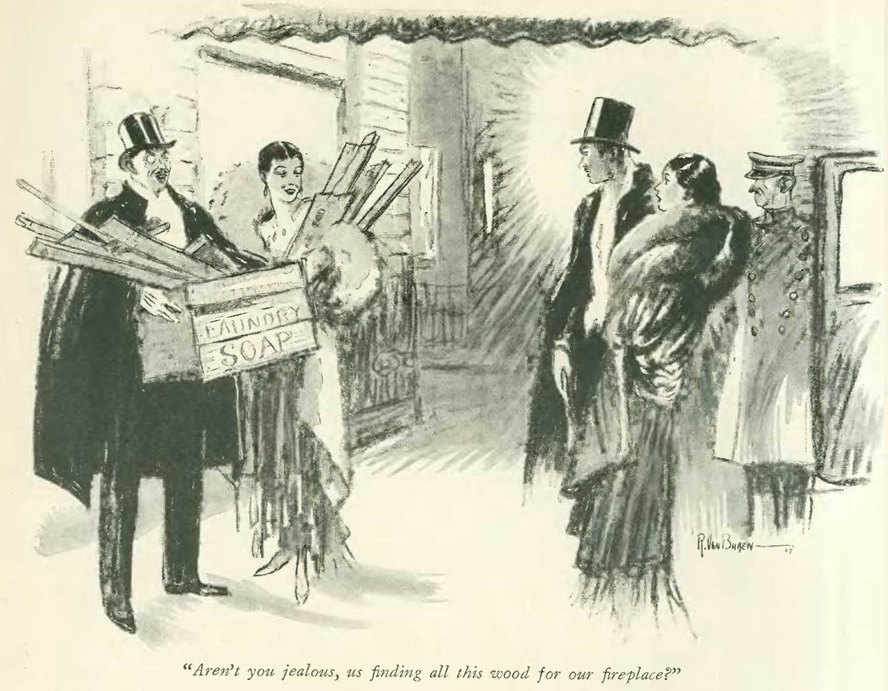
…signs of the economic collapse were starting to creep into the cartoons, including offerings by Raeburn Van Buren

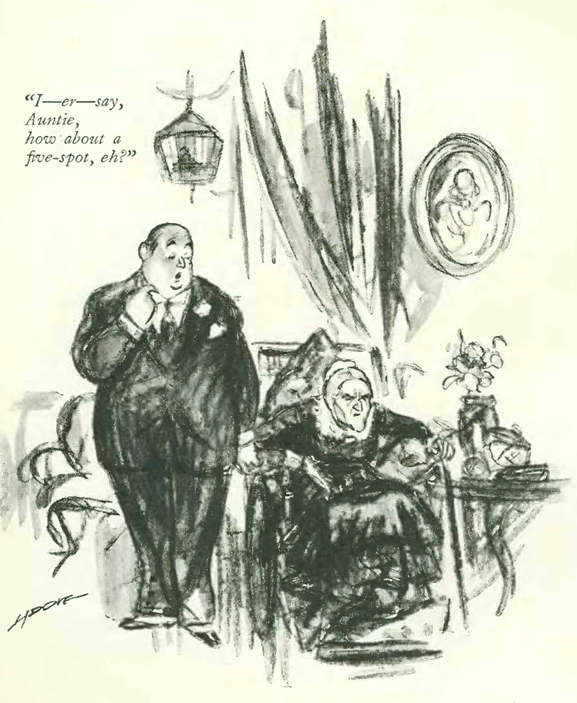
Leonard Dove

…and Paul Webb

…while the economy was headed into the pits, cartoonist Peter Arno saw his fortunes soaring as he headed into a new decade. In his excellent 2016 biography, Peter Arno: The Mad Mad World of The New Yorker’s Greatest Cartoonist, Michael Maslin writes, “By the time The New Yorker’s December 7, 1929 issue hit the newsstands, its readership had, within the year, seen three Arno covers and fifty-seven of his drawings.” Maslin notes that drawing number fifty-eight, which appears below, “ended the 1920s with a bang (so to speak).” The drawing, writes Maslin, “became a lightning rod for two New Yorker camps: the (James) Thurber camp, who chose to believe Harold Ross (the magazine’s founding editor, who forbade sex as a subject) was naive in sexual matters, and the (E.B.) White camp, convinced Ross would never have let the drawing appear in the magazine if he hadn’t understood its meaning.” If you enjoy Arno’s work, or are a fan of The New Yorker, Maslin’s book is a must-read…

Next Time: In Search of Holiday Cheer…