Modern Times

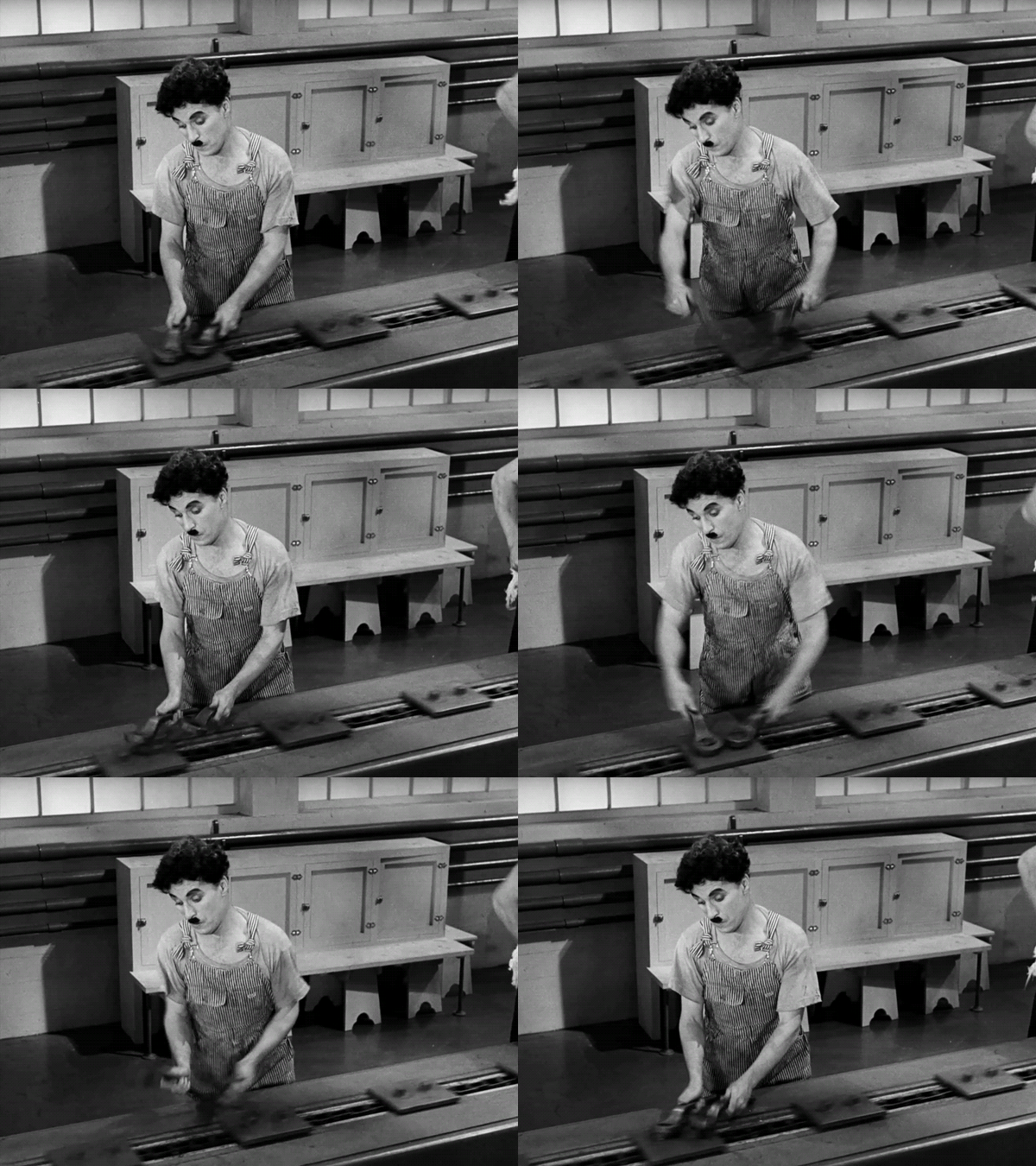
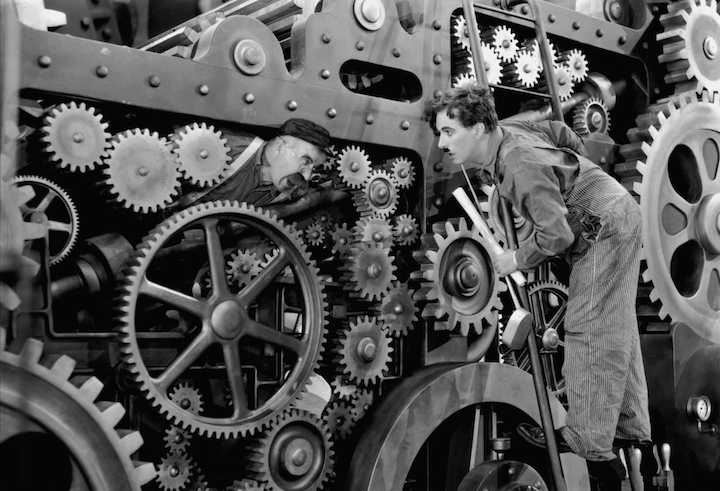
Above: A mechanic (Chester Conklin) gets caught up in his work with the help of the Tramp (Charlie Chaplin) in Modern Times. (festival-entrevues.com)

The film Modern Times was Charlie Chaplin’s last performance as “The Tramp” (or, “The Little Tramp”), a character he created more than twenty years earlier to represent a simple person’s struggle to survive in the modern world. That struggle was no more apparent than in Modern Times, a film in which the Tramp faced the dehumanizing industrial age in all its kooky complexity.
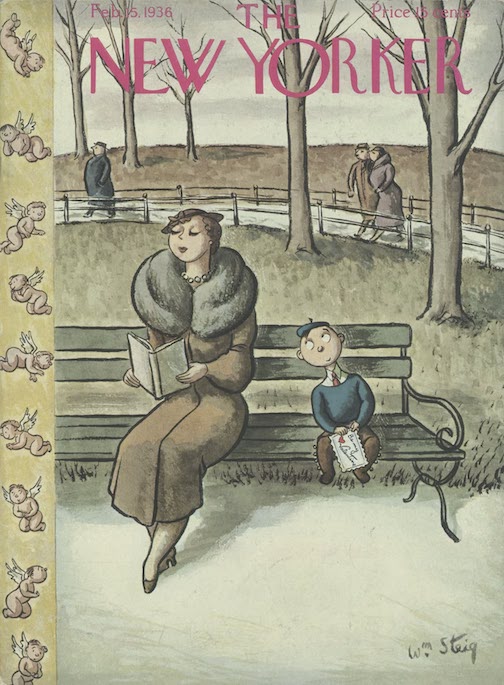
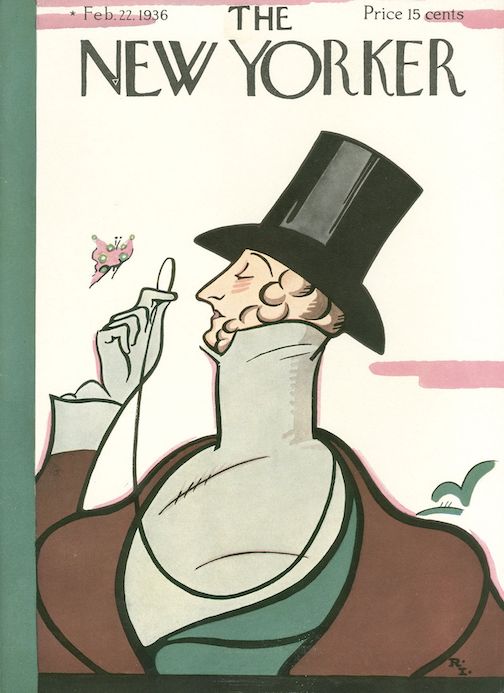
A sweet Valentine’s Day-themed cover by William Steig, February 15, 1936.

The film is notable for being Chaplin’s first picture to feature sound, and the first in which Chaplin’s voice is heard—singing Léo Daniderff’s comical song “Je cherche après Titine” (although Chaplin replaced the lyrics with gibberish). Modern Times was nevertheless filmed as a silent, with synchronized sound effects and a small amount of dialogue. Critic John Mosher appreciated the movie as being “of the old era,” not anticipating that it would become one of cinema’s most iconic and beloved films.
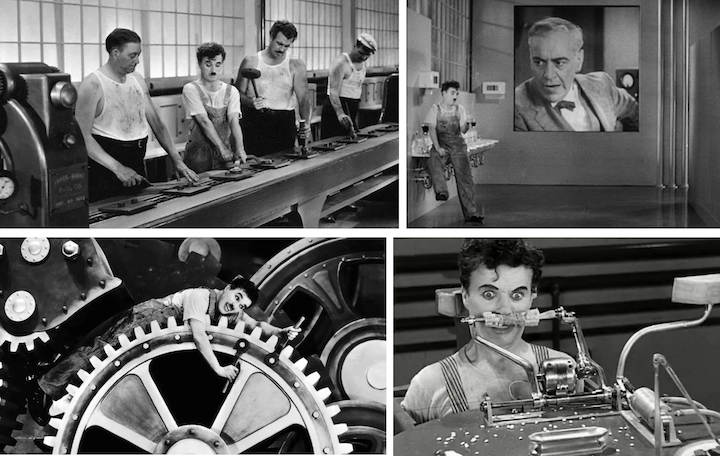
JUST A COG IN THE MACHINE…Clockwise, from top left: Repetitive assembly line work drives the Tramp (Charlie Chaplin) to a nervous breakdown; the steel factory is an Orwellian world where the president (Allan Ernest Garcia) constantly monitors his workers—even in the bathroom where the Tramp is caught taking a break; the company tries out a new lunch efficiency machine on the Tramp, with mixed results; iconic image of the Tramp at work. (medium.com/YouTube.com)
(thetwingeeks.com)

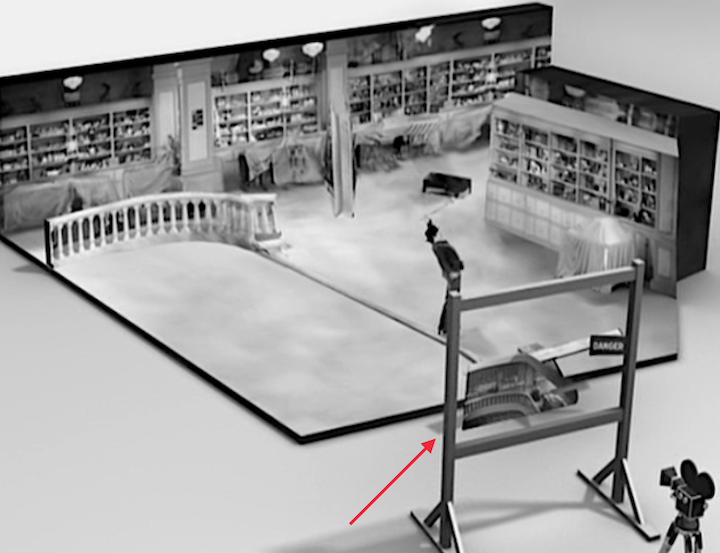
One of the film’s best stunts involved the blindfolded Tramp rollerskating on the fourth floor of an under-construction department store; Chaplin employed a matte painting, perfectly applied on a glass pane in front of a camera, to create the illusion of a sheer drop-off. Even as an illusion, Chaplin’s skating skills were remarkable.
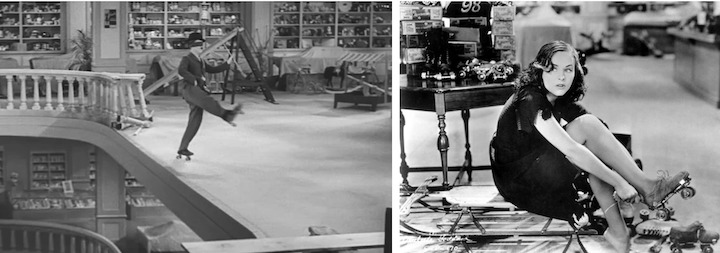
HIGH ANXIETY…The blindfolded Tramp (Charlie Chaplin) skates precariously close to a sheer drop-off on the fourth floor of a department store while his companion, an orphan girl known as “The Gamin” (Paulette Goddard) puts on her skates, unaware of his peril. (YouTube.com)

The model below shows how the effect was achieved, filming next to a glass-mounted matte painting to create the illusion of a sheer drop off…
(reddit.com)

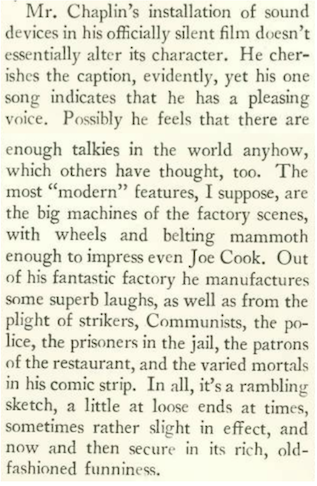
In his conclusion, Mosher found the film to be “secure in its rich, old-fashioned funniness.”
Chaplin gave a happy send-off to the Tramp, who at the end of earlier films walked down the road alone. Modern Times closed with the Tramp and the Gamin walking hand in hand, dreaming of a life together.
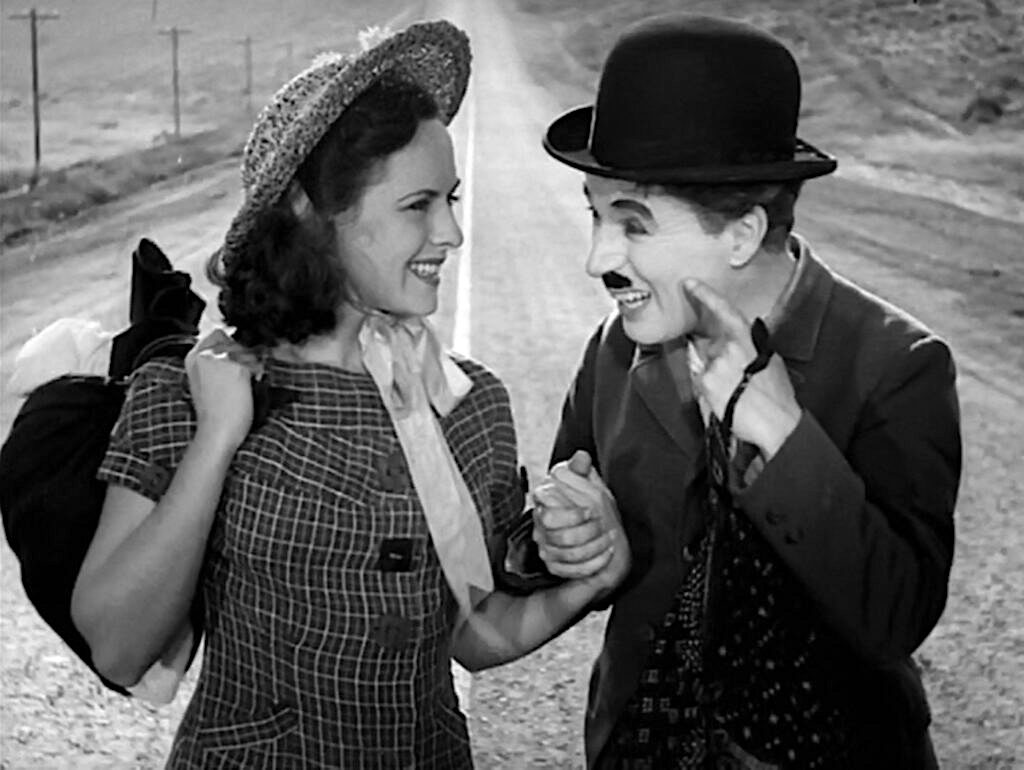
FOND FAREWALL…Paulette Goddard joined Charlie Chaplin on the road at the end of Modern Times. Goddard became Chaplin’s third wife in 1936. (the-cinematograph.com)
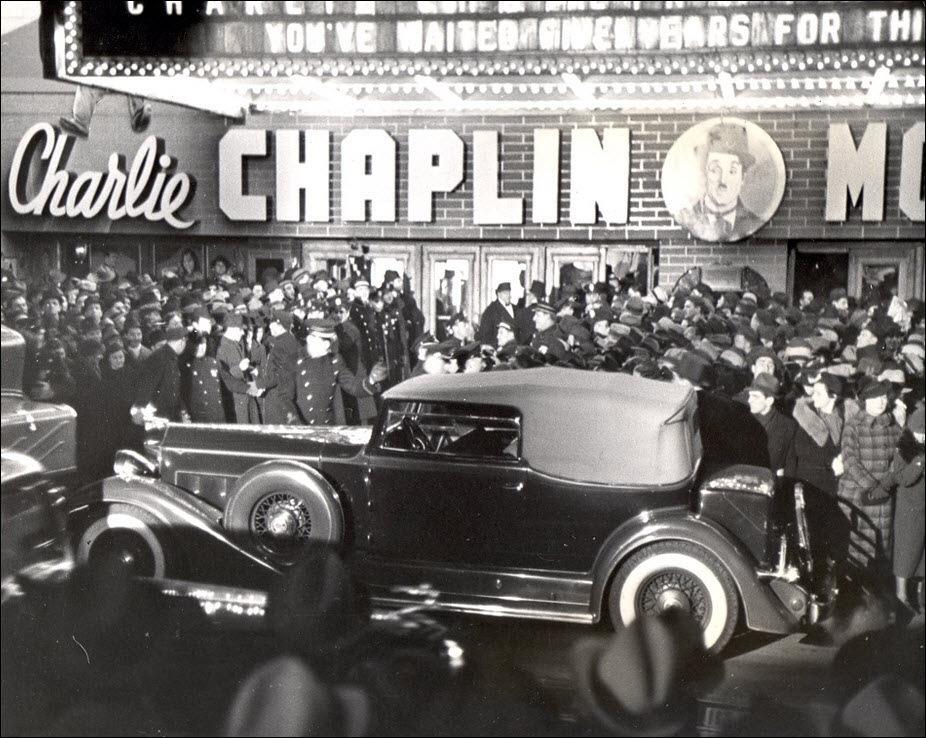
THE TRAMP RETURNS…World premiere of Modern Times, Feb. 5, 1936, at the Rivoli Theatre in New York City. The film was one of the top-grossing films of 1936. (Wikipedia)

A final note: The website The Twin Geeks offers an excellent synopsis and analysis of Modern Times.

 * * *

Bachelor King

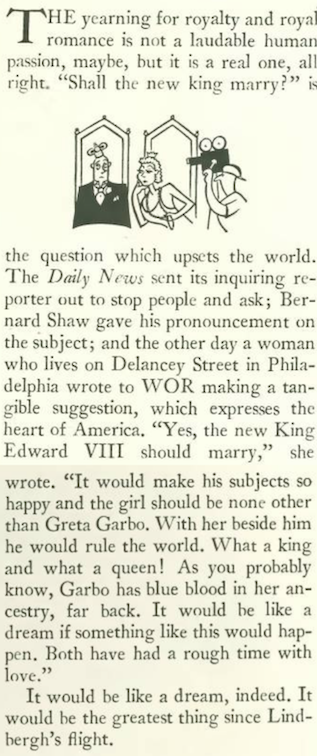
In his “Notes and Comment,” E.B. White wrote about the ascension to the British throne by Edward VIII following the death of his father, George V. In this excerpt, White considered a question raised by the Daily News regarding the king’s plans to marry (a question answered a few months later when Edward announced his plan to wed American divorcee Wallis Simpson, which led to a constitutional crisis and Edward’s subsequent abdication).
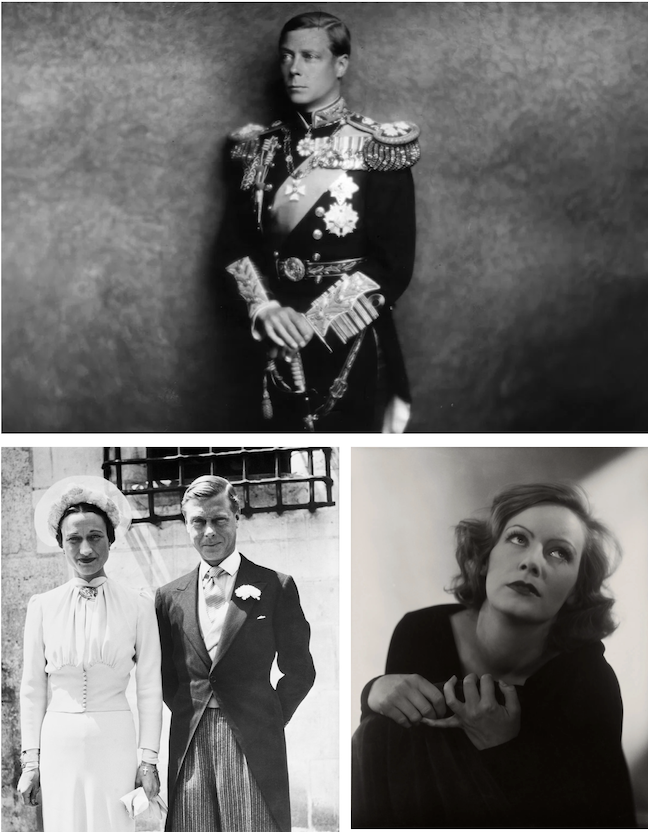
BUT I DON’T WANNA BE KING…The reluctant king Edward VIII would choose love over the crown when he abdicated the throne in December 1936 to marry Wallis Simpson (bottom left); E.B. White noted one woman’s suggestion that the king should marry actress Greta Garbo, since “Both have had a rough time at love.” (highland titles.com/George Eastman Museum)

* * *

By Any Other Name

“The Talk of Town” featured a profile of Arthur J. Burks, a prolific writer of pulp fiction who published everything from detective stories to science fiction under a half-dozen pseudonyms. A brief excerpt:
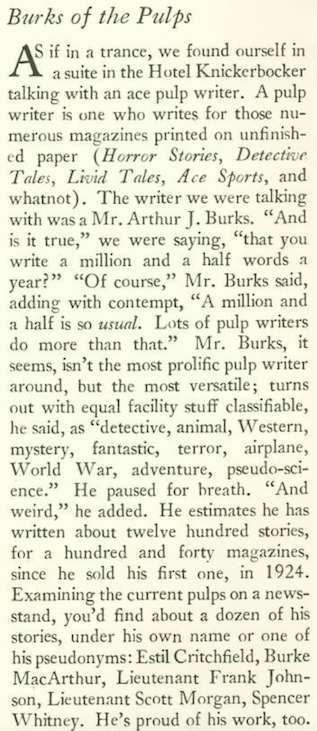
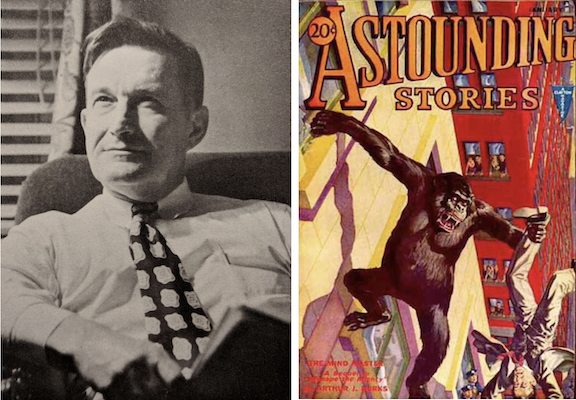
A CURIOUS MIND…Arthur J. Burks (1898–1974) and the cover of Astounding Stories,  January 1932, which featured the first part of his two-part tale, “The Mind Master.” Burks produced around eight hundred stories for the pulps, twenty-nine of which appeared in the magazine Weird Tales. (findagrave.com/gutenberg.org)

* * *

A Day in the Life

From 1935 to 1962 Eleanor Roosevelt published a daily syndicated newspaper column titled “My Day”—through the column millions of Americans learned her views on politics, society, and events of the day as well as details about her private and public life. James Thurber couldn’t resist writing a parody—here’s an excerpt:
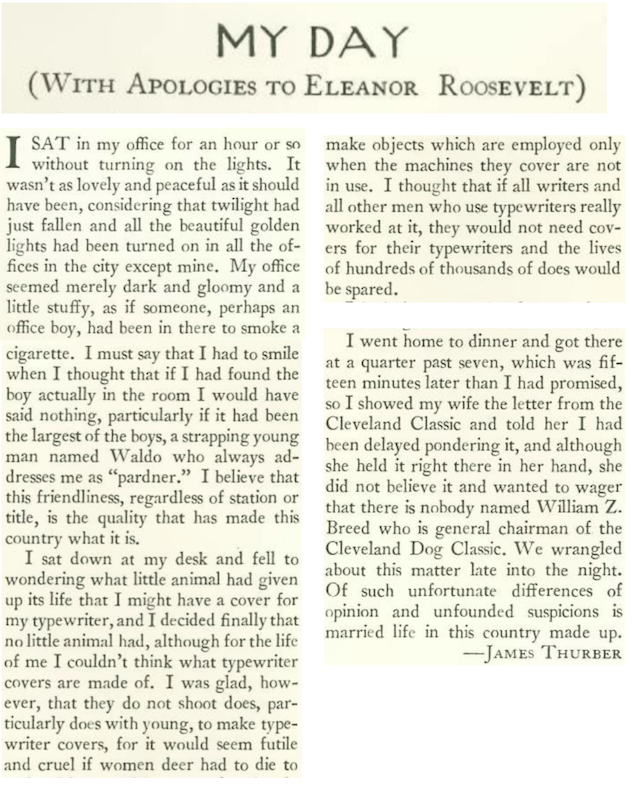
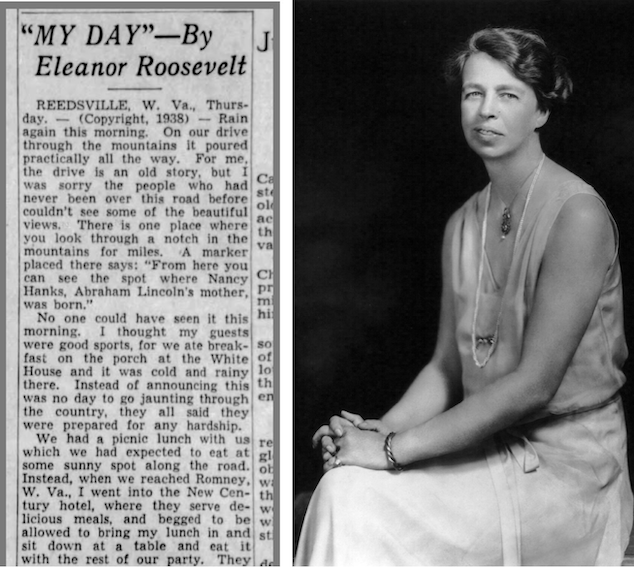
THE REAL DEAL…At left, sample of one of Eleanor Roosevelt’s syndicated “My Day” columns from 1938; photo of the First Lady from 1932. (arthurdaleheritage.org/Library of Congress)

 * * *

At the Movies

Besides Modern Times, there were other movies of note that were given rather scant attention in Mosher’s column, including the film adaptation of The Petrified Forest starring Humphrey Bogart, Bette Davis and Leslie Howard.
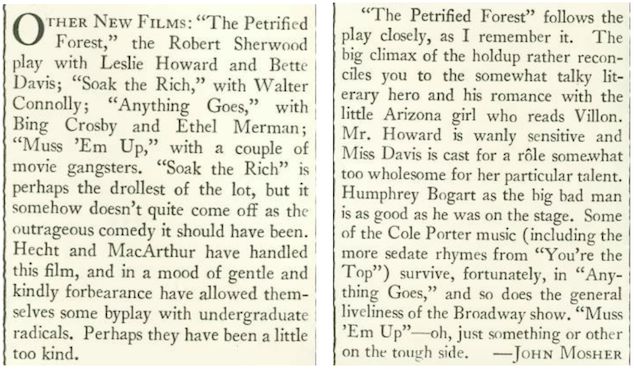
Robert E. Sherwood wrote the 1934 Broadway play of the same name, which was co-produced by Howard and featured both Howard and Bogart. When it was adapted to film, Howard insisted that Bogart appear in the movie, and it made Bogart a star (he remained grateful to Howard for the rest of his life).
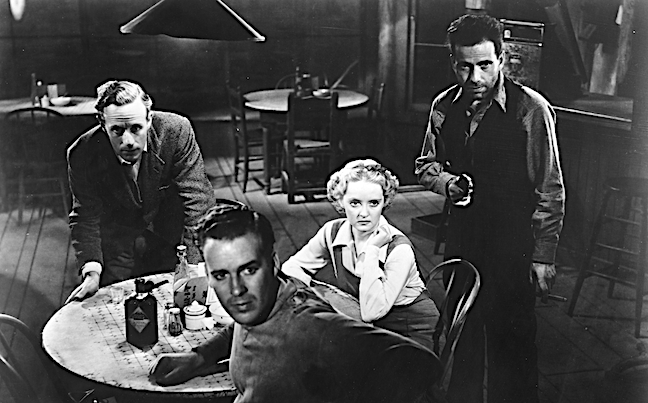
DANGEROUS DINER…An odd mix of patrons at a gas station cafe are taken hostage by desparate criminals in The Petrified Forest. From left are Leslie Howard, Dick Foran, Bette Davis and Humphrey Bogart. Playwright Robert Sherwood based Bogart’s character, Duke Mantee, on the the real-life criminal John Dillinger, the FBI’s first “Public Enemy #1.” (moma.org)

Other cinema diversions included the musical Anything Goes, which included songs by Cole Porter; the comedy Soak the Rich, which featured a radical who falls in love with a rich man’s daughter; and a detective film, Muss ‘Em Up, with the usual movie gangsters.
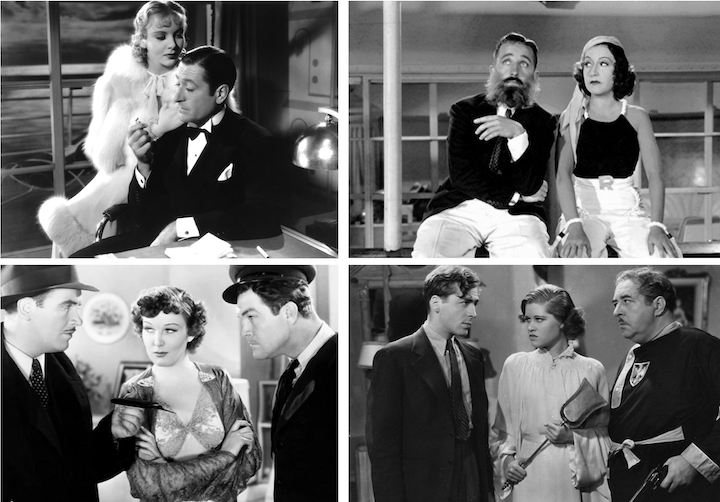
TAKE YOUR PICK…Clockwise, from top left: Ida Lupino and Arthur Treacher in the musical Anything Goes; Bing Crosby (in disguise) and Ethel Merman in Anything Goes; John Howard, Mary Taylor and Walter Connolly in the comedy Soak the Rich; Preston Foster, Maxine Jennings and Guinn “Big Boy” Williams in the detective film Muss ‘Em Up. (imdb.com/torontofilmsociety.com/zeusdvds.com)

 * * *

The Amazing Race

The New Yorker periodically featured “That Was New York,” which took a detailed look at significant events in the city’s history. In this installment, Donald Moffat recalled the 1908 New York to Paris automobile race, which commenced in Times Square on February 12 with six cars representing the U.S., France, Germany and Italy. It was an extraordinary event given that motorcars were a recent invention, and roads were nonexistent in many parts of the world. A brief excerpt:
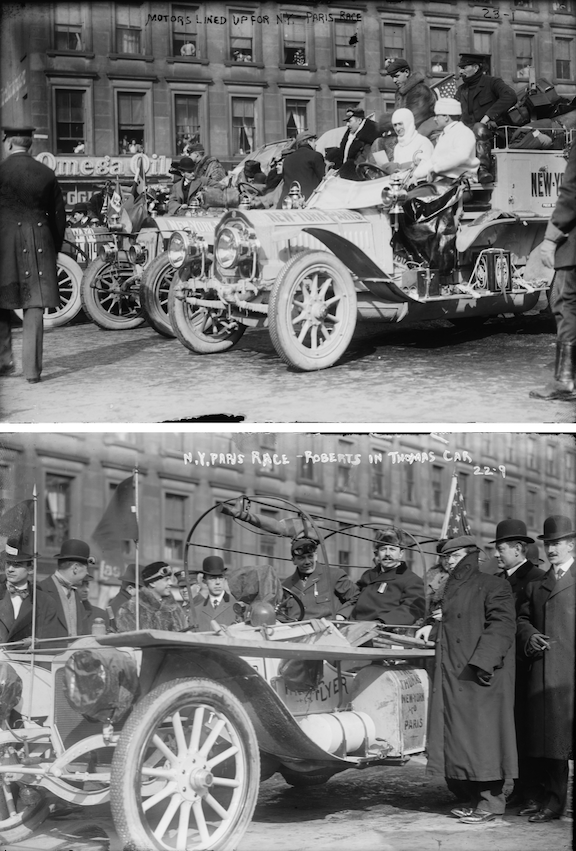
ON YOUR MARK…Cars lined up in Times Square on Feb 12, 1908 for the start of what would become a 169-day race. American George Schuster was declared the winner when he arrived in Paris on July 30, 1908, after covering approximately 10,377 miles (16,700 km). (Library of Congress)

 * * *

Miscellany

Another regular feature in the early New Yorker was coverage of the New York Rangers, a team founded in 1926 by Tex Rickard after he completed construction of the third incarnation of Madison Square Garden. The Rangers were one of the Original Six NHL teams before the 1967 expansion, the others being the Boston Bruins, Chicago Blackhawks, Detroit Red Wings, Montreal Canadiens and Toronto Maple Leafs.

In this excerpt, the writer “K.B.” described the rough play against rival Detroit, which would win back-to-back Stanley Cups in 1936 and 1937.
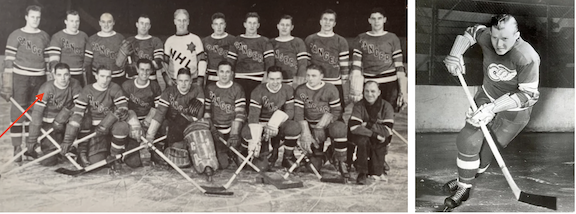
ZESTY…The excerpt above noted that the Rangers’ Phil Watson cuffed the Red Wings’ Syd Howe “with a zest richly appreciated by the balcony.” At left, team photo of the 1935-36 New York Rangers, with star and fight instigator Phil Watson identified with arrow; at right, Syd Howe won three Stanley Cups with Detroit, winning back-to-back in 1936 and 1937, and then again in 1943. (hockeygods.com)

 * * *

From Our Advertisers

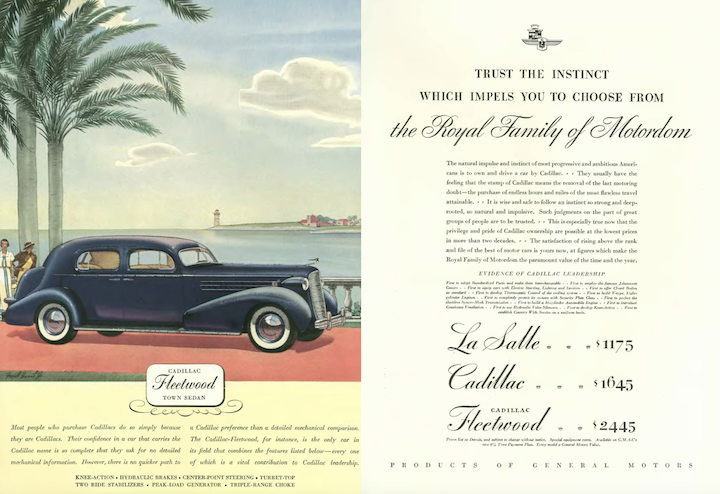
General Motors’ luxury car line offered three price points (and this lovely image) to weather the Depression years, ranging from the relatively affordable La Salle to the Cadillac Fleetwood…
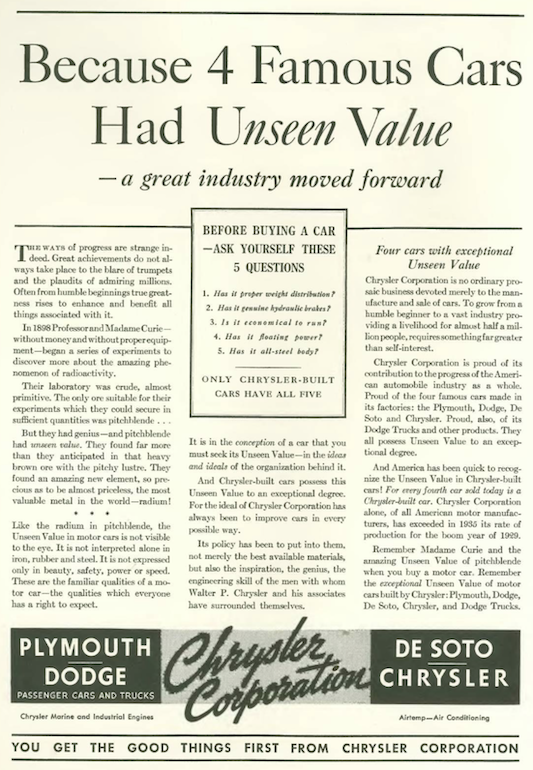
…the Chrysler corporation took a different approach, deploying a very wordy full-page ad that referenced history (a Madame Curie analogy) and something called “Unseen Value” to move its line of autos…
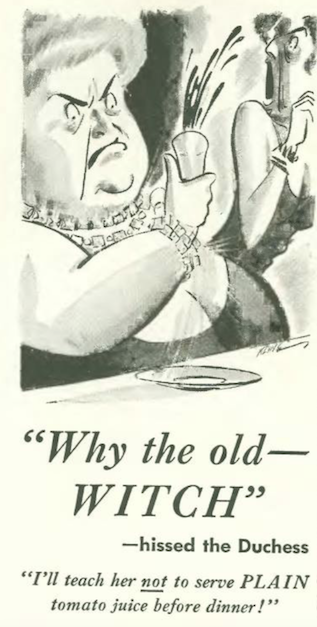
…the makers of College Inn Tomato Juice Cocktail brought back the “Duchess” with this shocking scene at the opera…
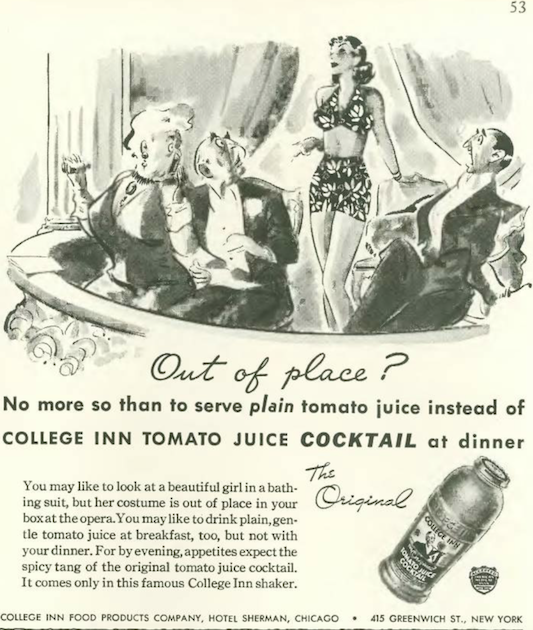
…recall last summer when College Inn featured the Duchess in a series of ads that illustrated her increasing fury over plain tomato juice…one wonders what sort of sadistic torment she had in mind for her hostess, “the old WITCH”…
…on to our cartoonists, beginning with this spot by James Thurber

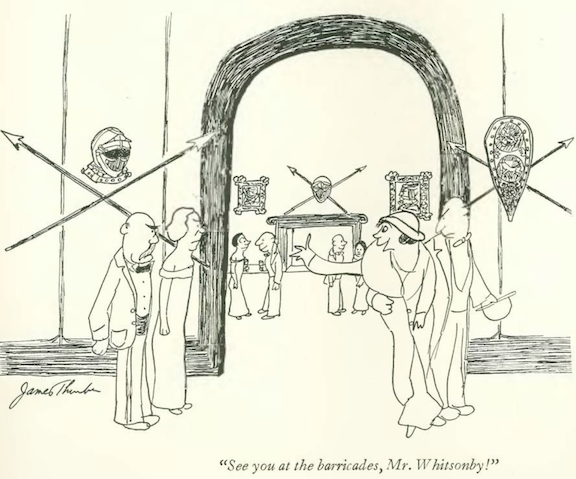
…and Thurber again, with an unwanted call to solidarity…
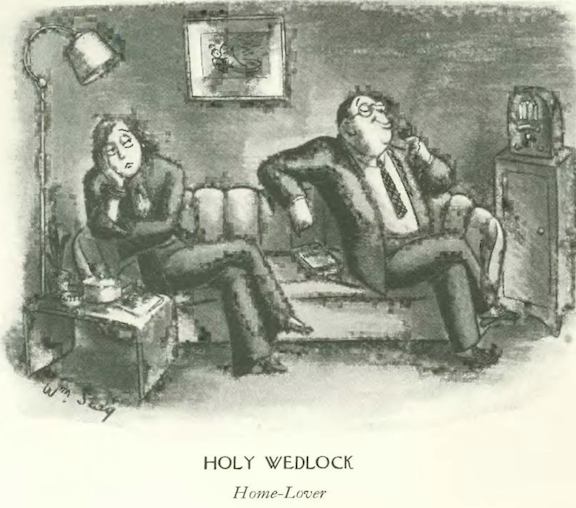
William Steig explored marital bliss…

George Price gave us a Three Stooges moment…
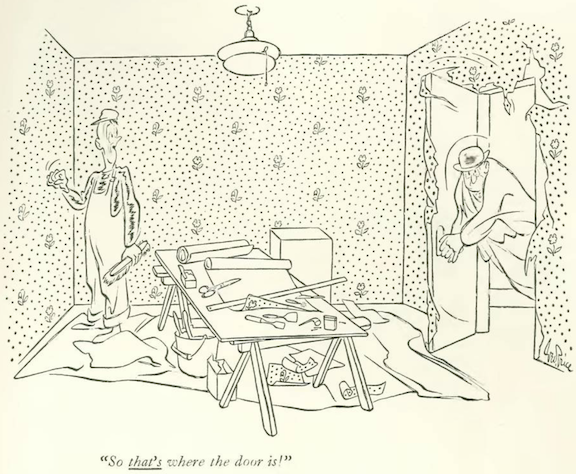
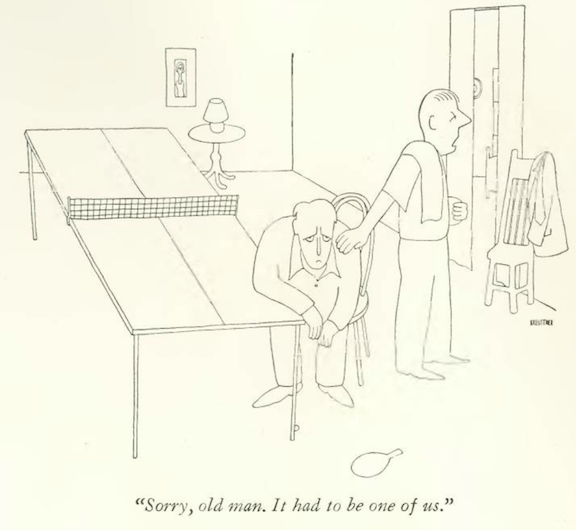
…I do not have the identity of this cartoonist…I will keep looking, but would love suggestions in the meantime…*update*…thanks to Frank Wilhoit for identifying the cartoonist below as John Kreuttner, also confirmed through Michael Maslin’s Ink Spill

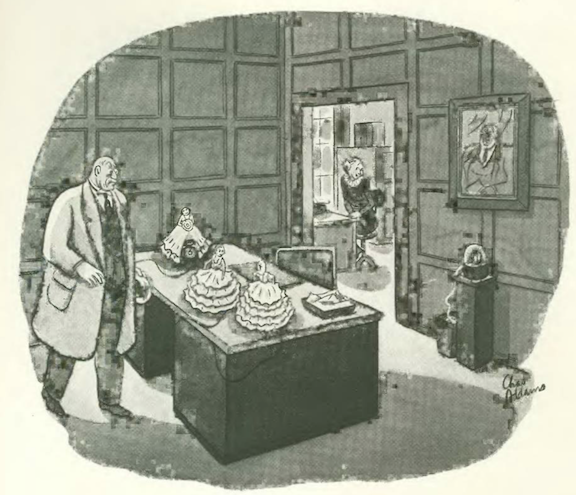
Charles Addams added some frills to an executive suite…
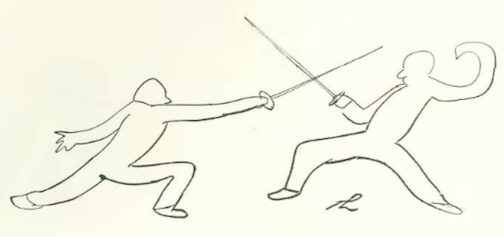
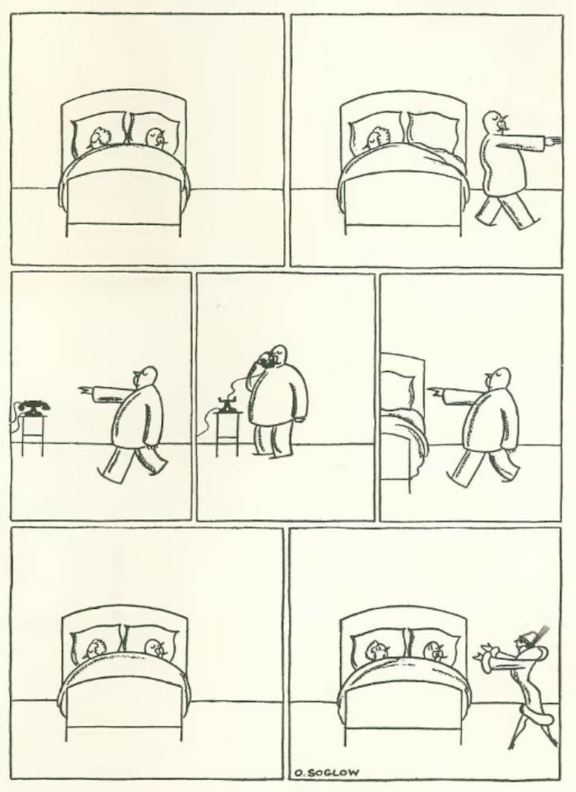
Otto Soglow illustrated the hazards of sleepwalking…
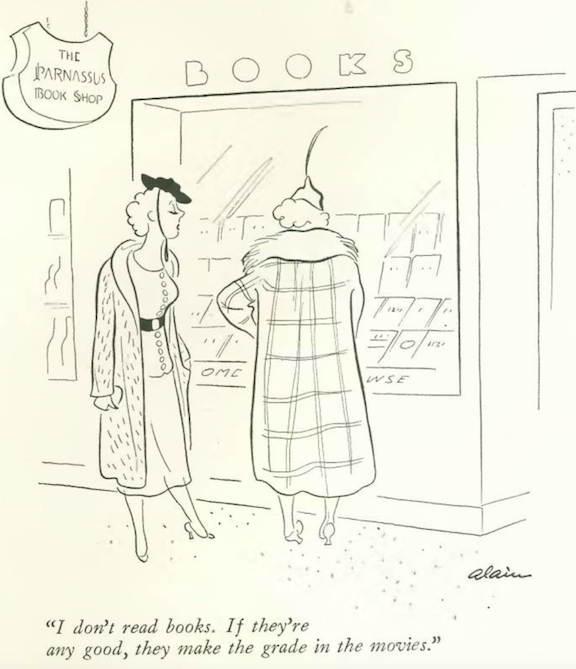
Alain revealed a challenge to the publishing industry…
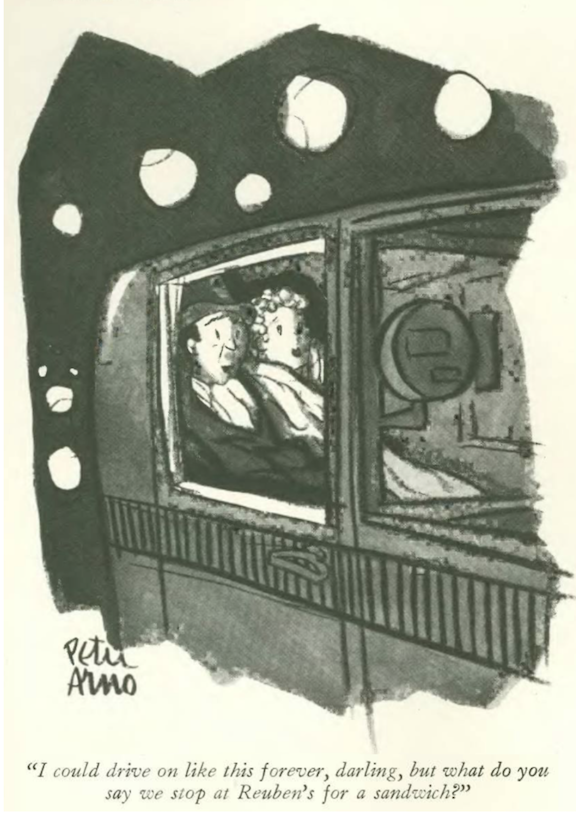
Peter Arno possibly craved some sauerkraut and corned beef…
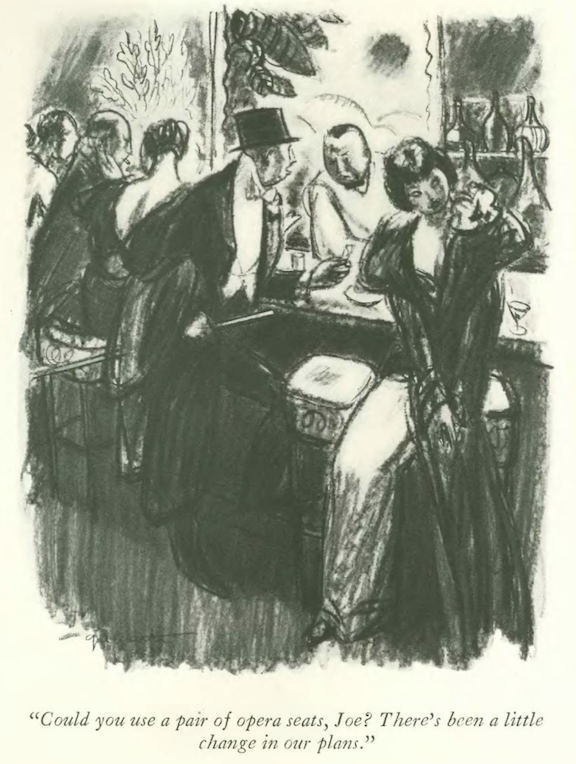
William Crawford Galbraith was in familiar sugar daddy territory…
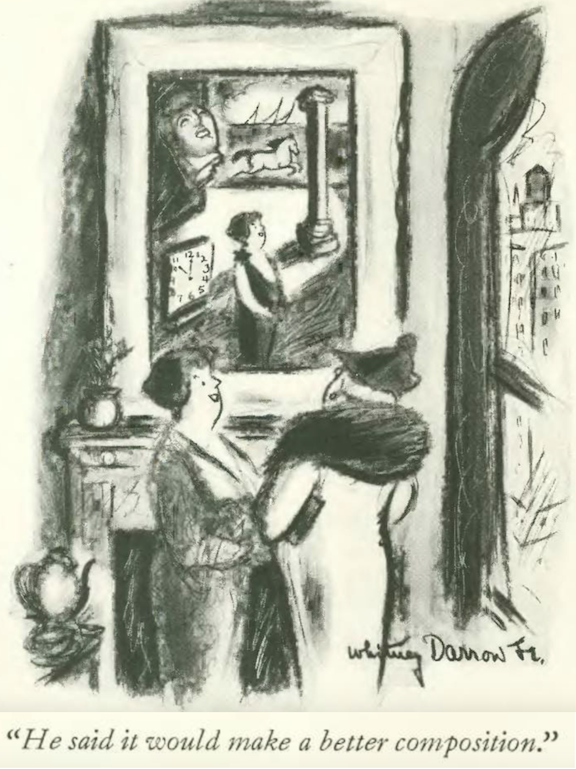
Whitney Darrow Jr gave a nod to some homey surrealism…
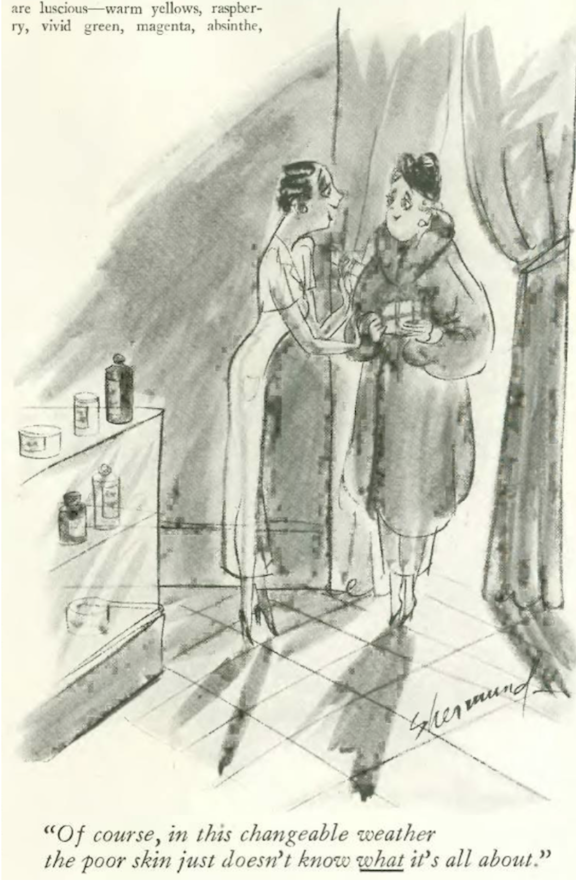
Barbara Shermund offered some well-weathered advice…
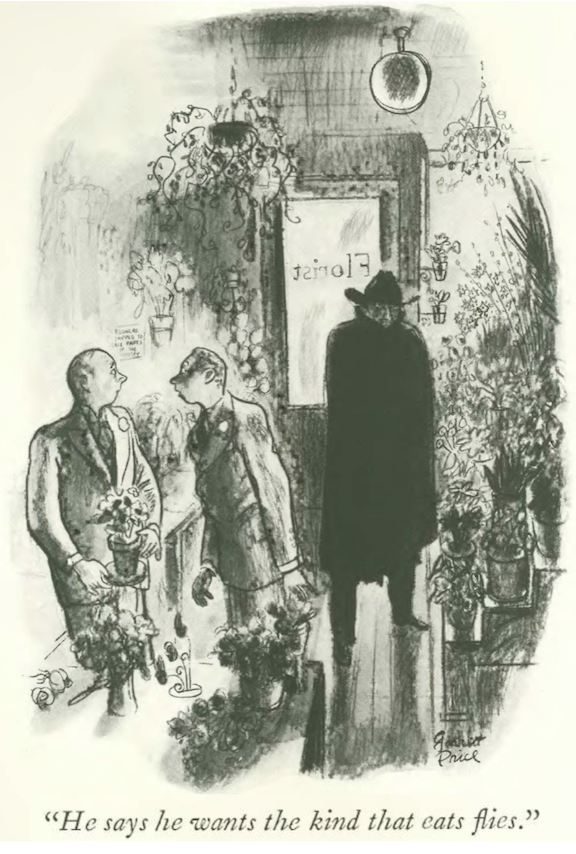
…and we close with Garrett Price, and a visitor more suited to Charles Addams…
Next Time: Eleven Years On…

Noblesse Oblige

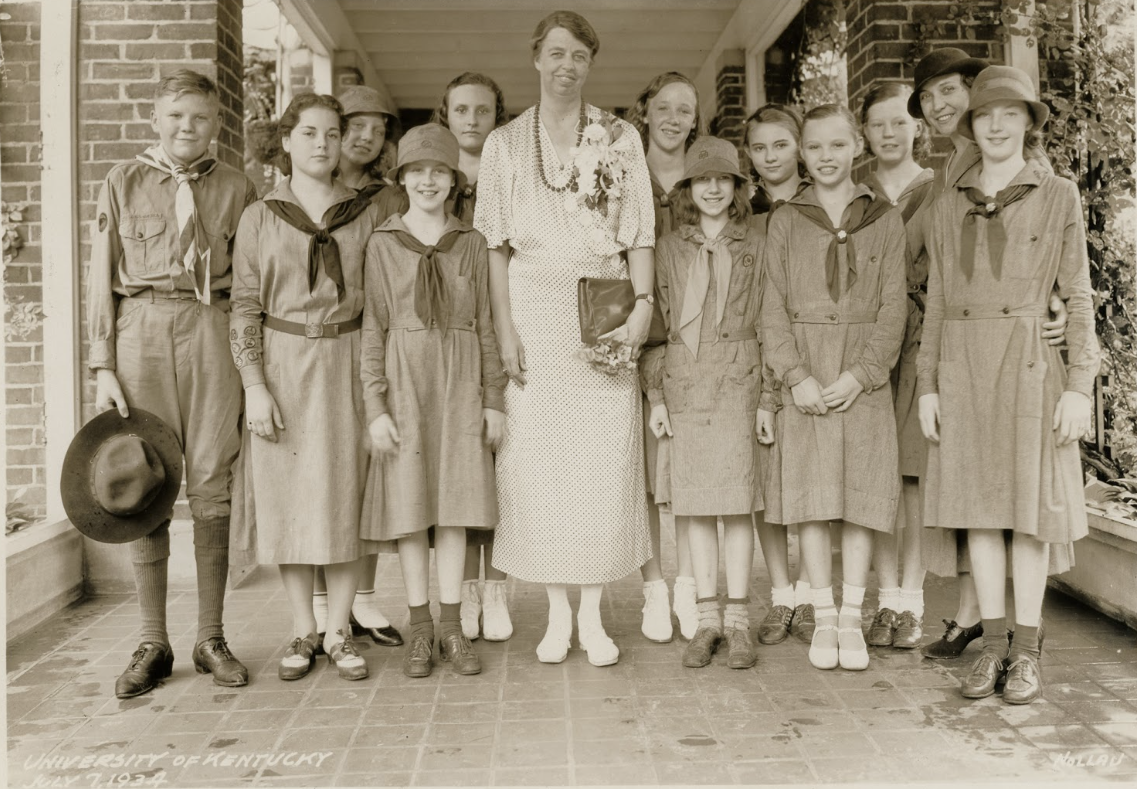
Just three years before she would enter the White House as First Lady, Eleanor Roosevelt was familiar to some New Yorkers for her social work, but was known to most as the wife of the Governor of New York, Franklin D. Roosevelt.

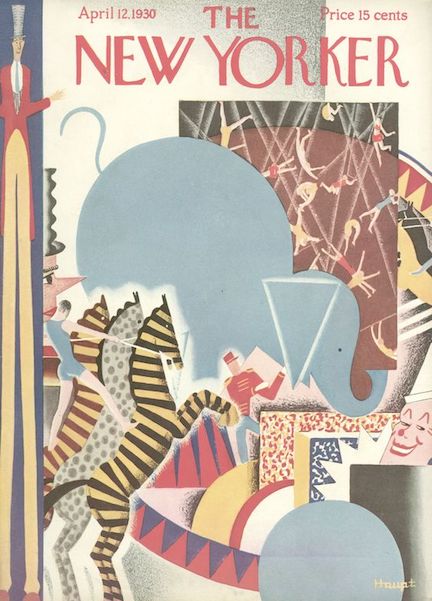
This week we look at two issues, March 29 and April 5, 1930, both with covers by Rea Irvin.

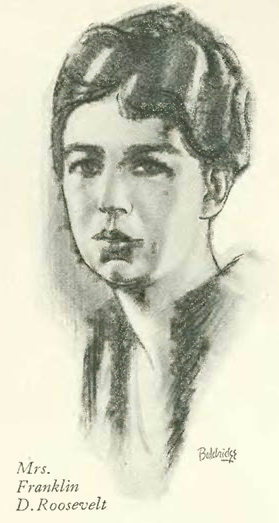
In a profile featured the April 5 New Yorker, Helena Huntington Smith looked at the life of a woman who was a niece to former President Theodore Roosevelt and a fifth cousin (once removed) to her husband Franklin. A somewhat reluctant mother (who nevertheless had six children) in a marriage that was mostly a political arrangement, Eleanor devoted considerable time and energy to social causes. Below is a brief excerpt, accompanied by an illustration of Eleanor by Cyrus Baldridge.

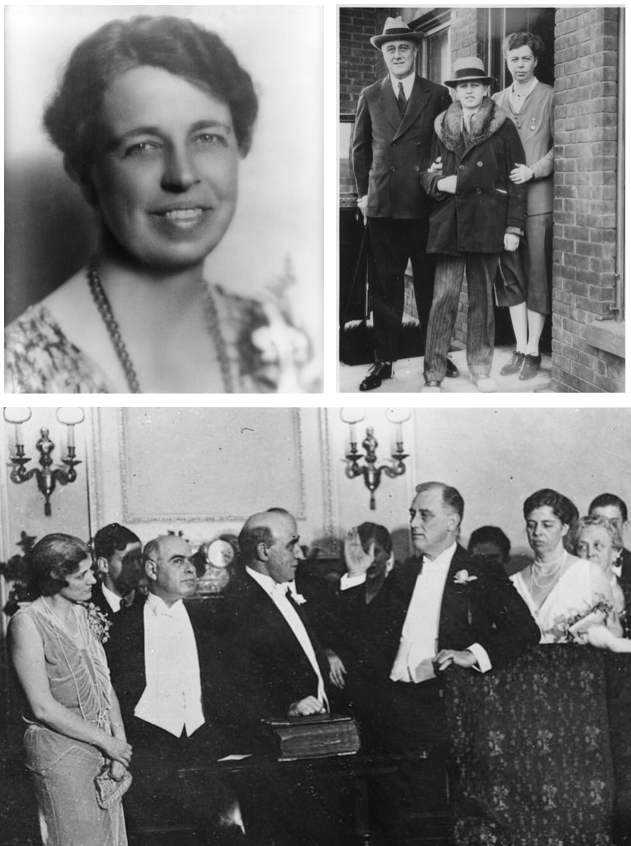
ALBANY DAYS…Clockwise, from top left: Eleanor Roosevelt in 1933; Gov. Franklin Roosevelt, Eleanor, and their youngest son, John, in Albany in 1930; FDR being sworn in as Governor of New York, January 1929. (Wikipedia/Albany Group Archive)
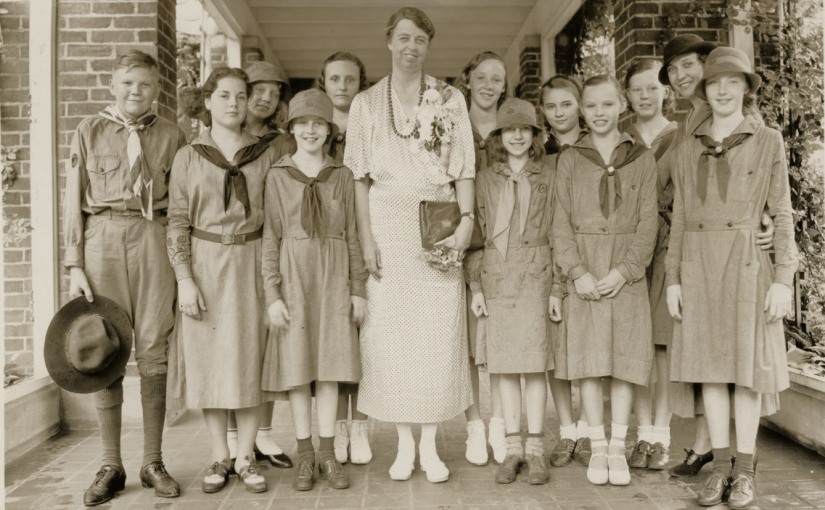
IN HER ELEMENT…Eleanor Roosevelt with boy and girl scout volunteers at the University of Kentucky, July 1934. (eleanorroosevelt.org)

 *  *  *

No Laughing Matter

In a surprising twist, James Thurber took a hand at writing the “A Reporter at Large” column (titled “Cop Into College Man”) in the March 29 issue, visiting a new “Police College” in New York City. In this engaging piece, Thurber seemed thoroughly engrossed in the operation…

…and particularly in the mugshots of some of the city’s most notorious criminals, including gangster Jim Flanagan, “debonair in a Bangkok hat”…

…and in the college’s museum, filled with all manner of deadly implements…

PREPPING FOR PERPS…The April 1930 edition of Popular Science featured the opening of New York’s new Police College. (Modern Mechanix)

 *  *  *

Pluto’s Salad Days

In was something of a sensation in February 1930 when Clyde Tombaugh (1906-1997) discovered the then-planet Pluto at the Lowell Observatory in Arizona. Howard Brubaker in “Of All Things” (March 29) had this to say about the achievement:

JUST A SPECK…Clyde Tombaugh poses with the telescope through which he discovered the planet Pluto at the Lowell Observatory on Observatory Hill in Flagstaff, Ariz., 1931. At right, images of the planet (specks indicated by arrows) were all the proof Tombaugh needed to confirm his discovery. (AP/NASA)

Thanks to a 2015 flyby by NASA’s New Horizons spacecraft, we now have a better idea of what Pluto, now classified as a “dwarf planet,” actually looks like…

 *  *  *

Dandy Doodle Mayor

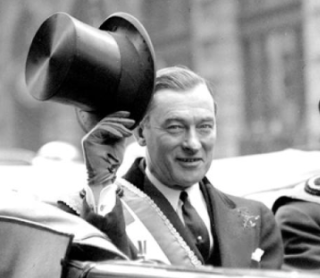
Fillmore Hyde, author (and four-time national amateur squash tennis champion), penned this ditty in the March 29 issue in tribute to New York City’s dandyish mayor…

HAT’S OFF…Mayor Jimmy Walker.

 *  *  *

Back for More

Also for the March 29 issue art critic Murdock Pemberton was back at the Museum of Modern Art — a new institution he met with skepticism when it opened in late 1929, but a place that was definitely growing on him as a destination to revel in the work of some of the world’s top modern artists, including the American Max Weber (1881-1961), whose retrospective was supposed to the big draw of MoMA’s latest show, but Pemberton seemed more impressed by French artist Aristide Maillol (1861-1944) and particularly by the Swiss-German Paul Klee (1879-1940).

AMERICAN CUBIST…Max Weber’s The Cellist, 1917, oil on canvas, was featured in Weber’s 1930 retrospective exhibition at the Museum of Modern Art; at right, Weber seated in front of Interior with Music (1930). (Brooklyn Museum/Smithsonian)
Aristide Maillol’s Crouching Woman, bronze, 1930. (MoMA)

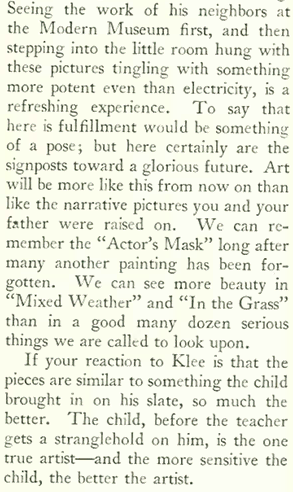
Pemberton wrote that Klee’s show gave you “quite a feeling”…

Catalogs from Max Weber’s retrospective and Paul Klee’s exhibit at the Museum of Modern Art. (MoMA)

…and when he compared Klee’s work to that of the other artists, Pemberton saw something “more potent even than electricity…signposts toward a glorious future”…

A GLIMPSE OF THE FUTURE…From left, Paul Klee’s Actor’s Mask, 1924, oil on canvas mounted on board; Josef Albers’ 1929 photographic portrait of Klee, 1929; Klee’s In the Grass, 1930, oil on canvas. (MoMA/Guggenheim.org)
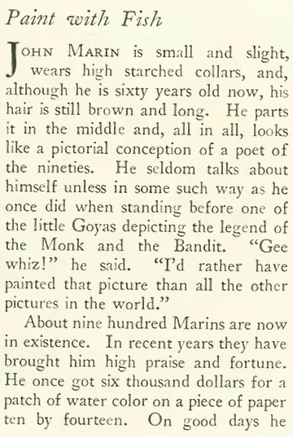
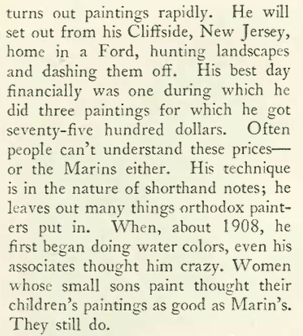
 A week later, writing for the April 5 issue, Pemberton penned this piece for “The Talk of Town” about the work habits of artist John Marin

OLD MAN AND THE SEA…John Marin in 1921, in a photograph by Alfred Stieglitz; Marin’s Bathers, 1932, oil on canvas. (mfa.org/Dallas Museum of Art)

 *  *  *

Who Needs a Vet?

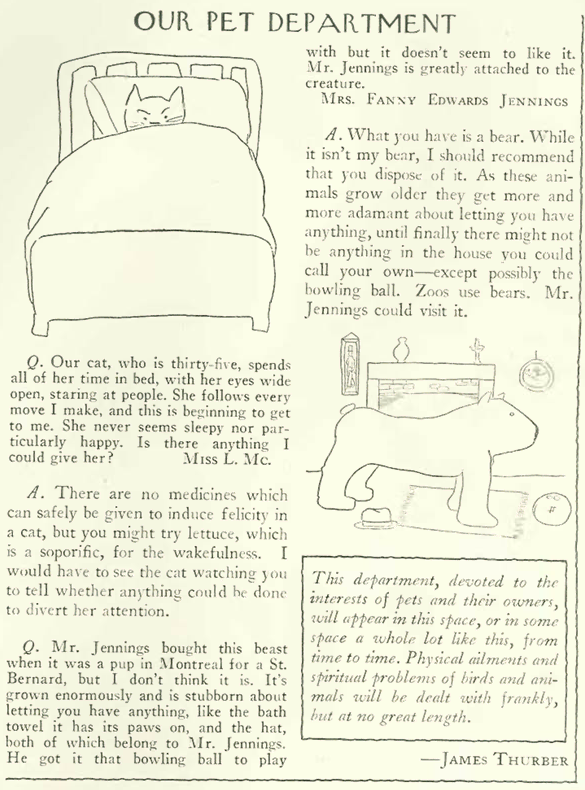
The April 5 issue featured James Thurber’s latest installment of “Our Pet Department…

 *  *  *

Spend It Quickly

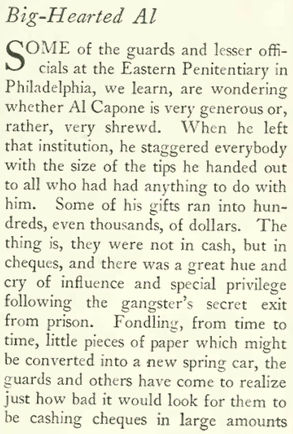
April 5’s “Talk” also featured this item about Al Capone’s release from prison in Philadelphia, lavishing money and gifts on prison employees as he made his exit from Eastern Penitentiary…

…it was no wonder, because officials at the prison didn’t treat Capone like some ordinary prisoner…

SALUTARY CONFINEMENT…Arrested outside a Philadelphia movie theater for carrying a concealed, unlicensed .38 caliber revolver, Al Capone was sentenced to a year in Eastern State Penitentiary. His last seven months were served in a cell (right) with fine furniture, oriental rugs, paintings, and a console radio, among other frills. (easternstate.org)

 *  *  *

This Al Could Sing

Upon the DVD release of Al Jolson’s 1930 film, Mammy, Dave Kehr of The New York Times wrote that Jolson was “Simultaneously one of the most significant and most embarrassing show business figures of the 20th century.”

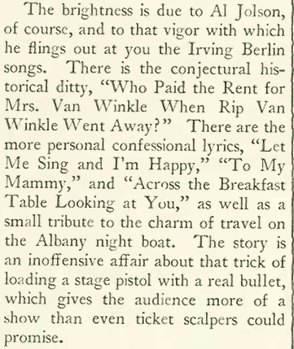
That was not view of most audiences 89 years ago, when Jolson reigned as one of America’s most famous entertainers. In his review of Mammy for the April 5, 1930 issue of The New Yorker, critic John Mosher admitted that he didn’t care for minstrel shows depicted in the film, but not for any of the reasons we would cite today…

UGH…Clockwise from top left, Al Jolson and Lois Moran in Mammy; a studio promotional poster; Jolson as a minstrel performer in the film. (IMDB)

 *  *  *

From Our Advertisers

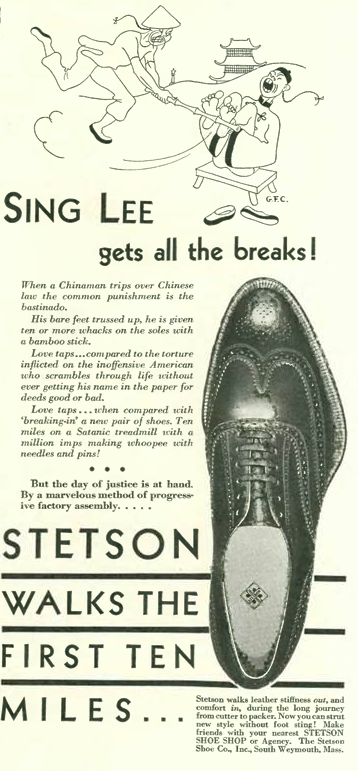
We have more racial stereotypes, this time to sell Stetson shoes…

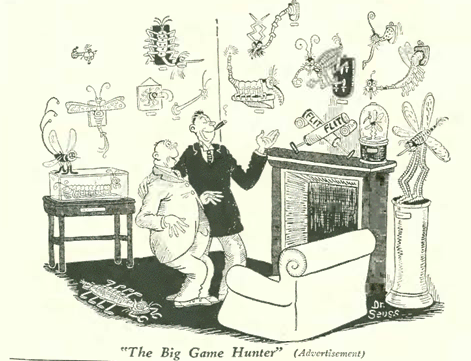
Theodore Geisel (Dr. Seuss) continued to pay the bills by illustrating ads for Flit insecticide…

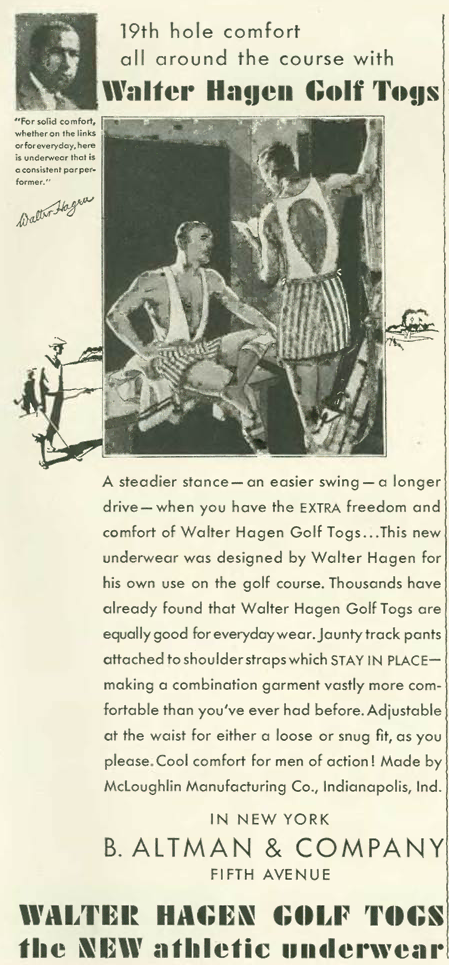
…while professional golfer Walter Hagen picked up some extra cash by launching his own line of golf underwear…

…Walter has been gone for fifty years, but you can still get his branded clothing from Dick’s Sporting Goods…

Julian De Miskey picked up some extra work illustrating this house ad for The New Yorker

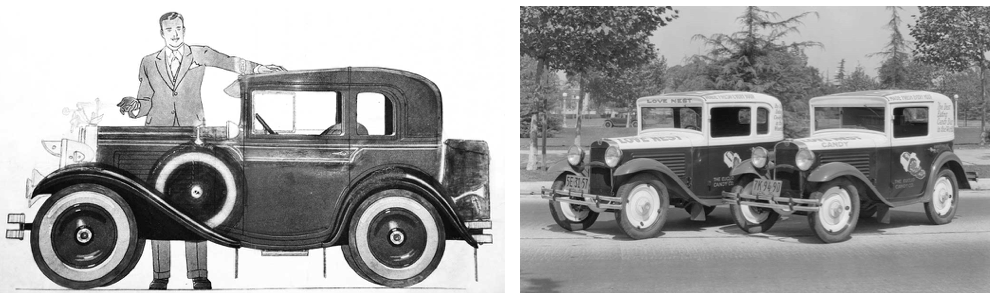
…and then we have this spot from the American Austin Car Company, which produced cars licensed from the British Austin Motor Company from 1930 through 1934…interestingly, the ad doesn’t feature the car itself…

…which looked like this…

(theoldmotor.com)

…on to our cartoons, Alan Dunn looked in on a devoted listener of S. Parkes Cadman’s Sunday radio broadcast…Cadman (1864-1936) was a British-born clergyman whose NBC radio broadcasts reached millions of listeners across America…

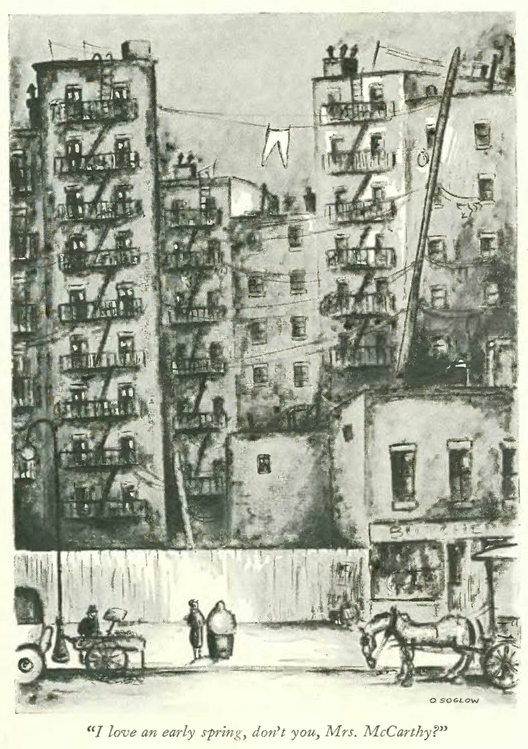
…signs of spring were noted by Otto Soglow

Don Herold shared an observation on stage entertainments…

…William Crawford Galbraith found unrequited love at the circus…

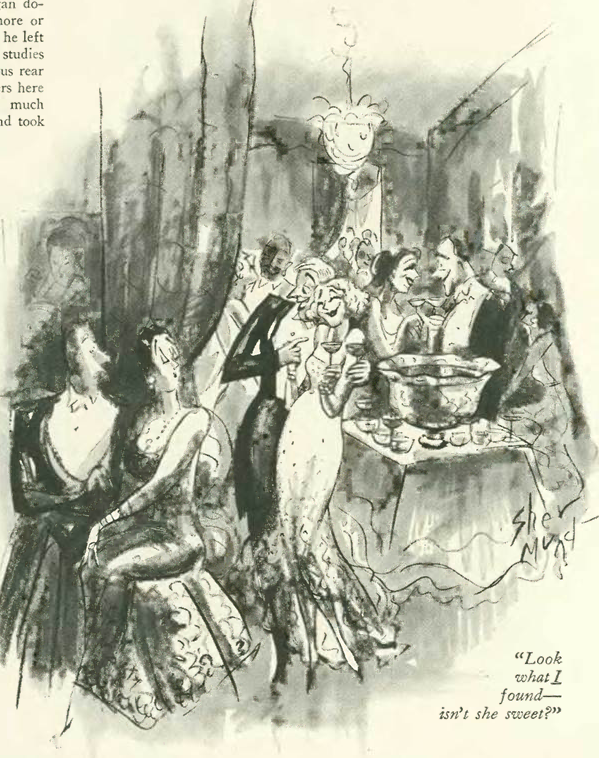
…while Barbara Shermund found a more agreeable pairing at a Manhattan cocktail party…

Garrett Price found humor in the growing numbers of the down and out…

…and Peter Arno turned in this epic two-pager that illustrated the challenges of filming in nature…(caption: “Well, we can’t start till we get that robin out of there.”)

Next Time: Hot Jazz in Stone and Steel…