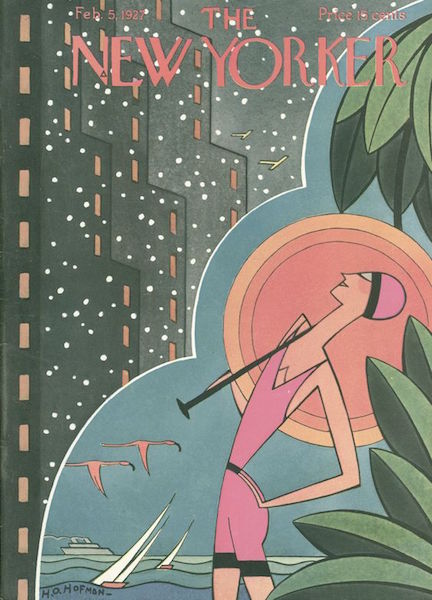
Piles of snow and slushy streets had many New Yorkers dreaming of spring, including H.O. Hofman, who illustrated the cover for the Feb. 5, 1927 issue.
Feb. 5, 1927 cover by H.O. Hofman.
Another New Yorker illustrator and cartoonist, Barbara Shermund, offered a different take on the idea in this drawing for the “On and Off the Avenue” column on page 56:
At least New Yorkers had plenty of activities to take their minds off of the weather, including two important balls:
Inspired by the annual springtime costume ball given by the students of the École nationale supérieure des Beaux-Arts in Paris, American students held an annual ball to raise funds for their Beaux-Arts Institute of Design. The balls featured elaborate costumes and performances that were extensively reported in the city’s society pages.
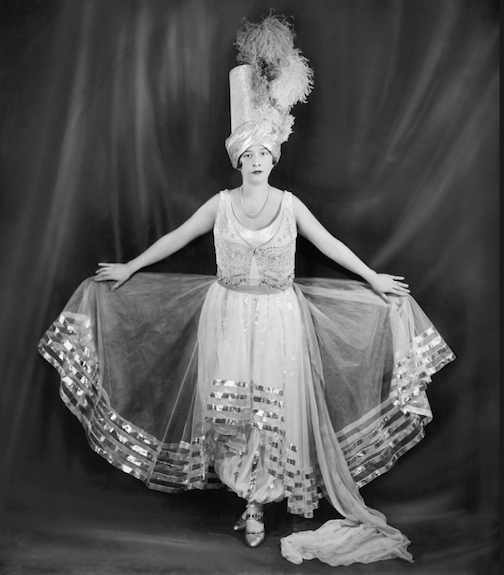
LOOK AT ME…Margaret Thaw dressed as a “White Sultana” for the 1928 Beaux Arts Ball held at the Astor Hotel. The theme was “The French Occupation of Northern Africa — 1847.” A doyenne of international high society perennially named to best-dressed lists, Margaret and her husband, Lawrence Copley Thaw, were world-famous explorers of Africa and Asia and correspondents for National Geographic magazine. (New York Times)
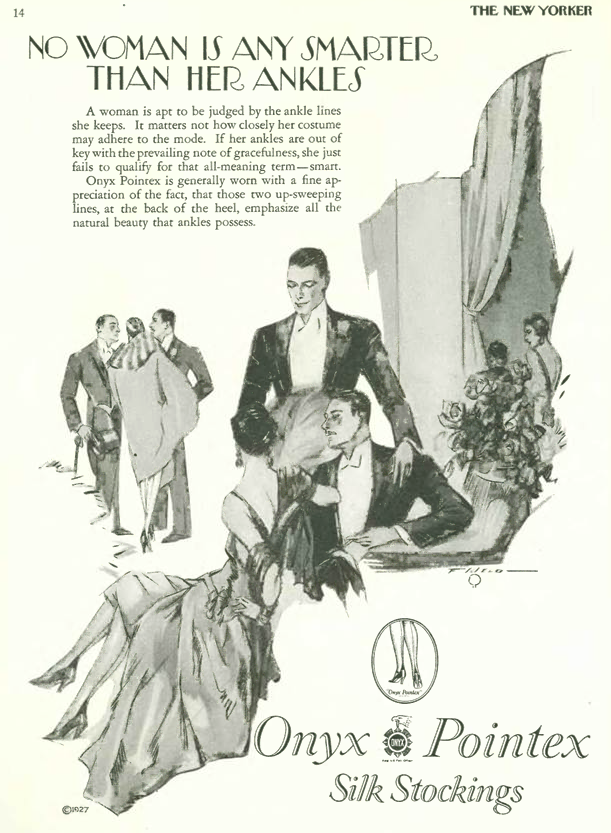
Contrary to the ad pictured below, fashion plate Margaret Thaw was doubtless smarter than her ankles…
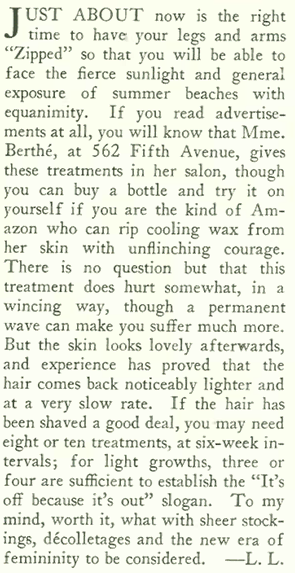
If you were investing in fine Onyx Pointex silk stockings, you probably wanted to get your legs “Zipped” in a new method described by fashion correspondent Lois Long:
If Lois Long were around today she would have to note that both men and women are getting “Zipped,” waxing everything including their nethers.
And these days few of us are washing our hair with bar soap, as depicted in the ad below for Lux. Like so many other ads in the early New Yorker, this one makes a strong appeal to Francophile readers; if it’s French then it must be good (note that every paragraph and headline in the ad mentions either France or French at least once):
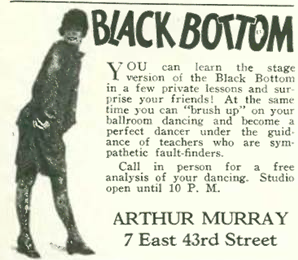
While we are on the topic of advertisements, here is another installment of ads from the back pages of the magazine. Arthur Murray was a frequent advertiser in the magazine, mostly small ads like this that exploited the latest dance craze:
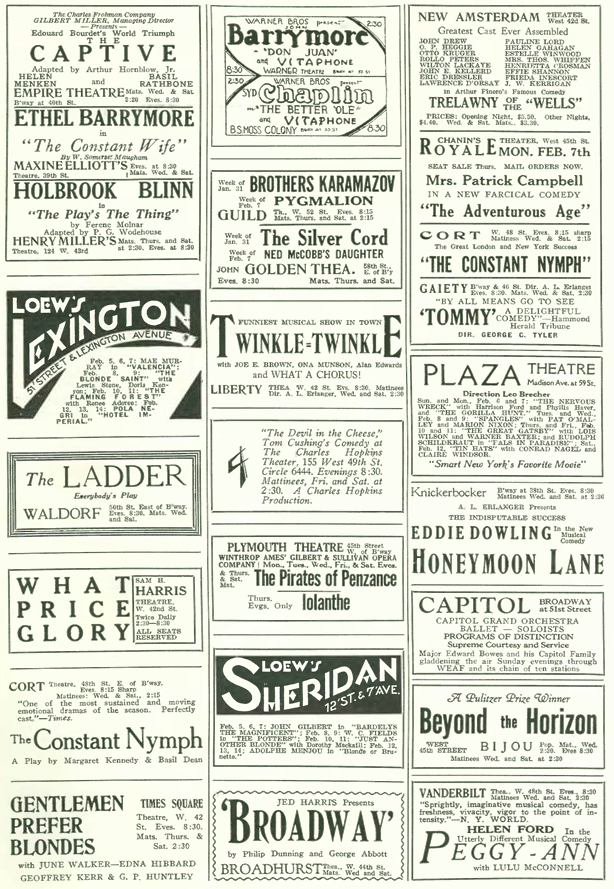
The offerings of the stage and screen were also prominent in the back pages:
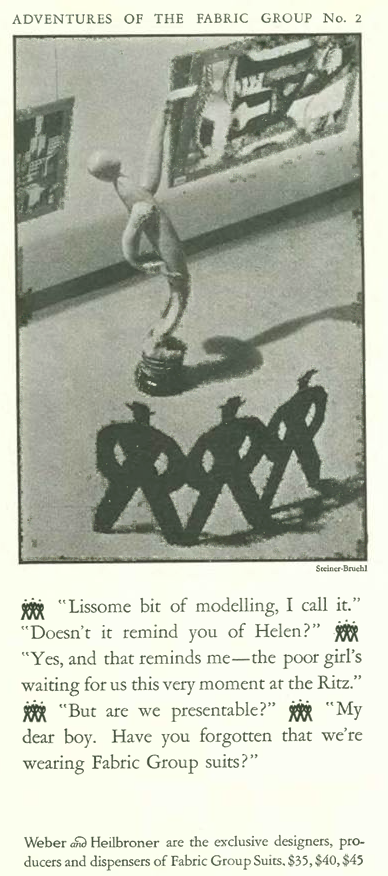
And finally, these strange little ads (run as series) that were designed by photographers Anton Bruehl and Ralph Steiner to promote Weber and Heilbroner suits:
Specializing in elaborately designed and lit tableaux, Bruehl won top advertising awards throughout the late 1920s and early 1930s. He also co-developed the Bruehl-Bourges color process, which gave publisher Condé Nast a monopoly on color magazine reproduction in the early 1930s.
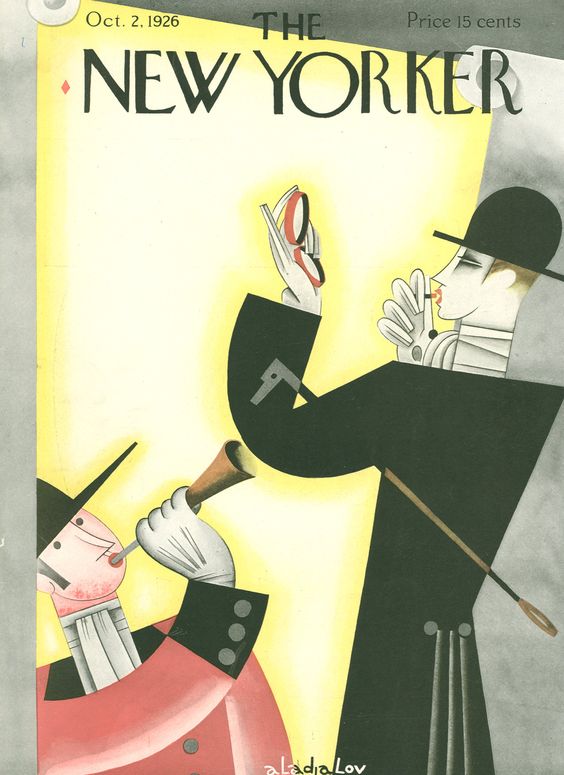
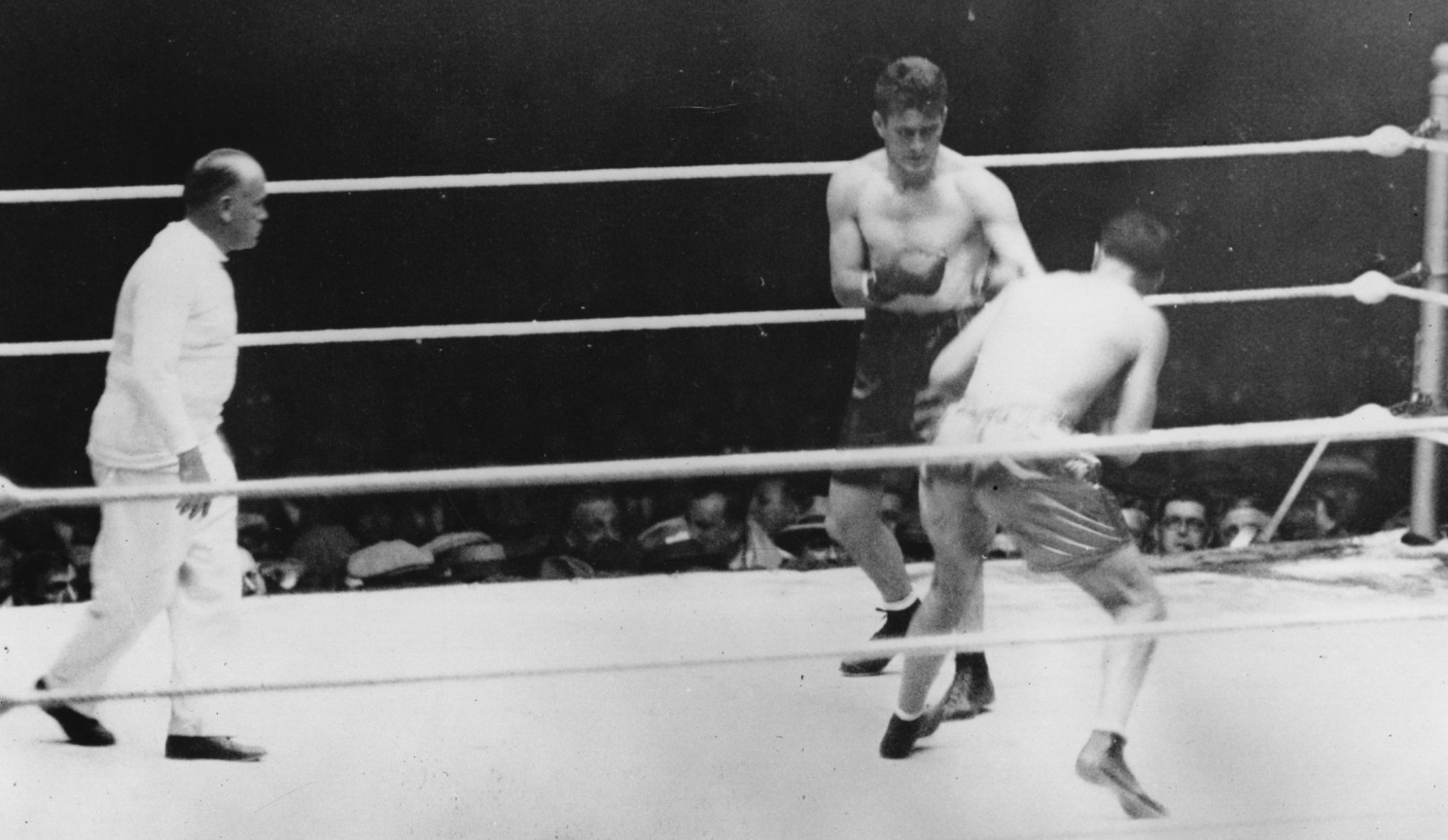
We skip ahead to the Oct. 2, 1926 issue to look at one of the big events of that year–the Dempsey-Tunney heavyweight prize fight (I’m not skipping issues…Sept. 25 appears later in this blog).
Oct. 2, 1926 – Issue # 85 – Cover by Constantin Alajalov. (Once again, note the ongoing comic reference to androgyny in 20’s fashion)
Heavyweight boxing was a big part of the American sports scene in the 1920s, and two giants of the sport, Jack Dempsey and Gene Tunney, dominated the headlines in the late 1920s thanks to much-heralded bouts in Philadelphia in 1926 and a rematch in Chicago the following year (which would include the famous “long count” incident).
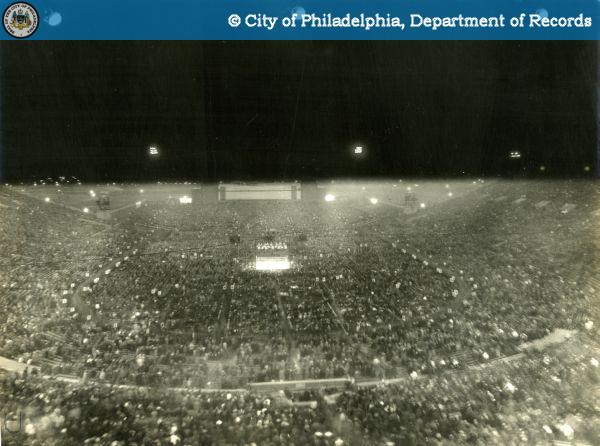
An estimated 135,000 fans packed Sesquicentennial Stadium in Philadelphia for the Dempsey-Tunney bout. (NYTimes)
The New Yorker joined in on the hoopla, publishing a lengthy account of the match by Waldo Frank (aka “Search-light”), who trained his jaded eye on the whole affair:
VIEW FROM THE CHEAP SEATS…a rain-soaked throng at the Dempsey-Tunney fight in Philadelphia. (City of Philadelphia)
According to the New York Times, the crowd included such notables as Charlie Chaplin, cowboy movie star Tom Mix and the English Channel swimmer Gertrude Ederle.
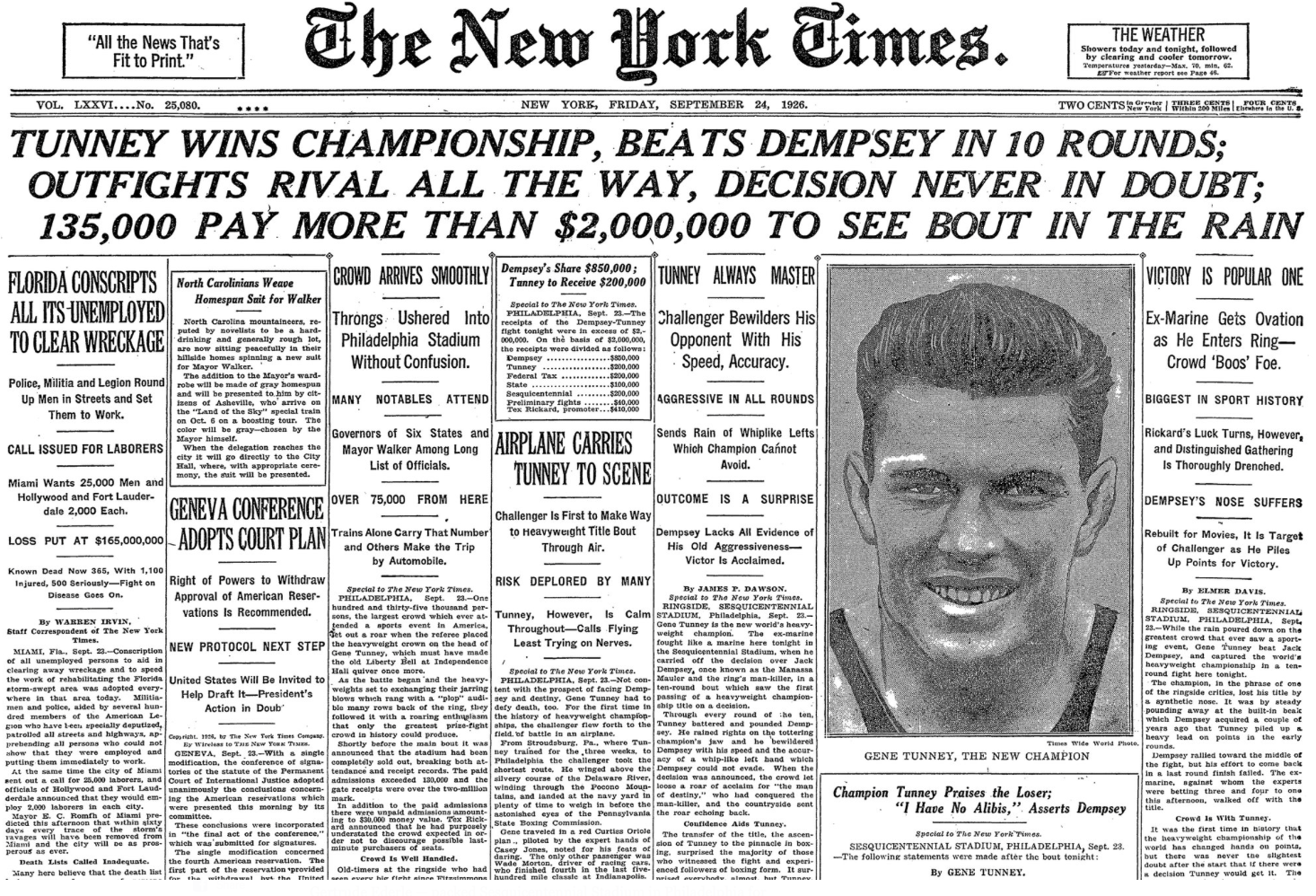
Coverage of Tunney’s victory by unanimous decision took up three-quarters of the front page of The New York Times, and also filled most of pages 2 through 7. (The New York Times)
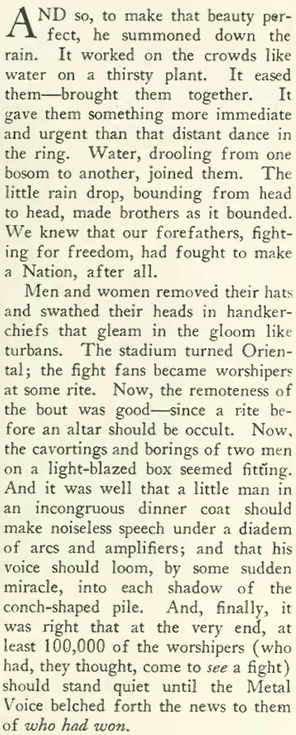
But in typical fashion, Waldo was less than dazzled, finding the rain an apt metaphor for a spectacle mostly unseen by those in attendance:
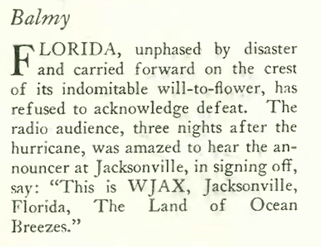
Never one to wallow in tragedy, the magazine made a brief (and oddly droll) reference in “The Talk of the Town” to a hurricane that hit Miami and its environs (it killed 372 people and injured more than 6,000):
Other items of note in the issue included this examination of country vs. city life by cartoonist Barbara Shermund…
…and this cartoon by Al Frueh commenting on the challenges of Manhattan’s rapidly changing cityscape:
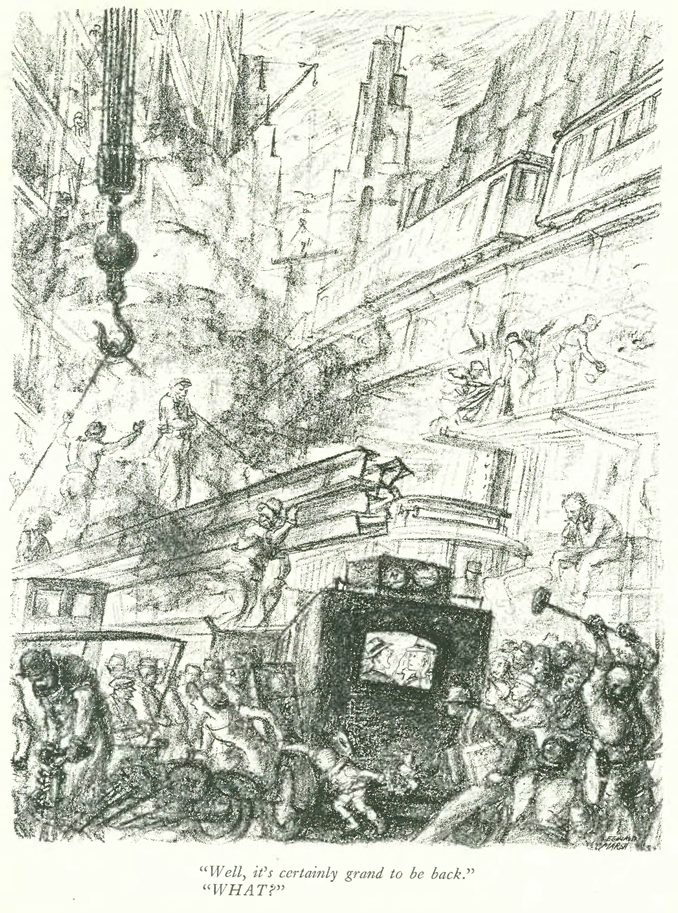
The changing city was also on the mind of Reginald Marsh in this illustration he contributed to the Sept. 25, 1926 issue of the magazine:
Back to the Sept. 25 issue, which featured an update from Paris correspondent Janet Flanner…
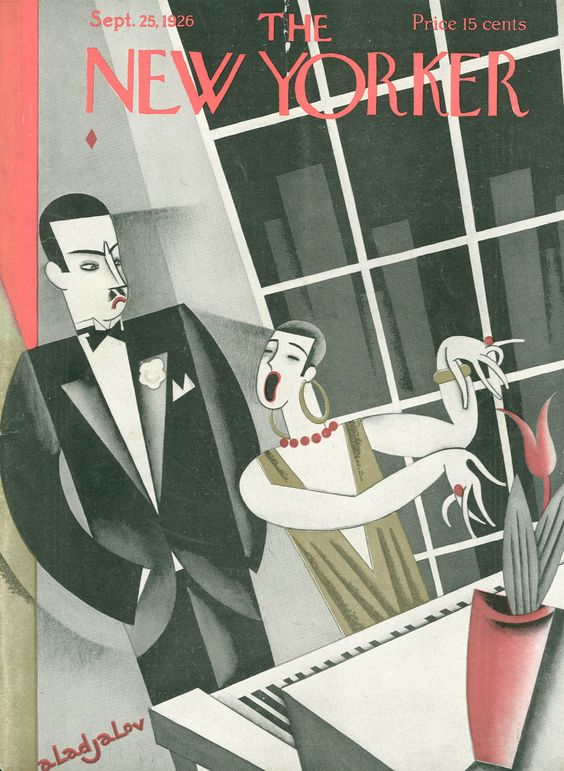
Sept. 25, 1926 – Issue # 84 – Cover by Constantin Alajalov.
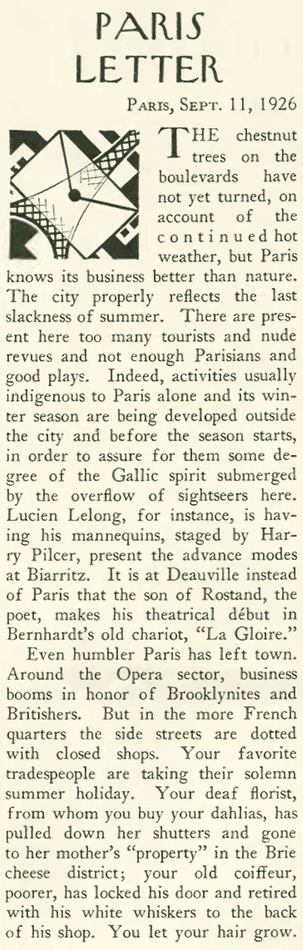
…who commented on the large number of American tourists crowding the city just as the locals were fleeing for their long, late summer holidays:
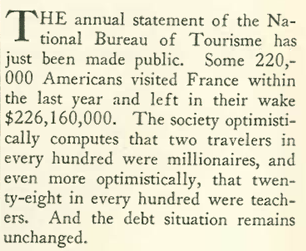
She offered some numbers to back up her observations:
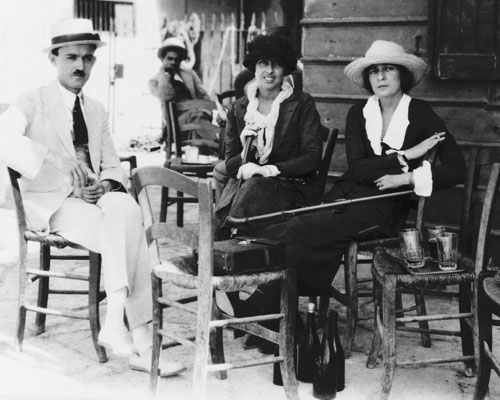
Janet “Genêt” Flanner (right) and longtime companion Solita Solano (center) in Paris, 1921. Solano was a well-known writer and drama critic for the New York Tribune. (Vintage Everyday)
And finally, a cartoon by Rea Irvin exploring the trials of the idle rich:
It’s the dog days of summer, and the editors of The New Yorker are seeking various distractions to take their minds off of the broiling late season heat.
August 21, 1926 cover by H.O. Hofman.
In the Aug. 21, 1926 issue (bearing an appropriate cover image by H.O. Hofman of bathers taking a refreshing dip), “The Talk of the Town” suggested that it was a good time for even the natives to take a boat tour of their beloved island:
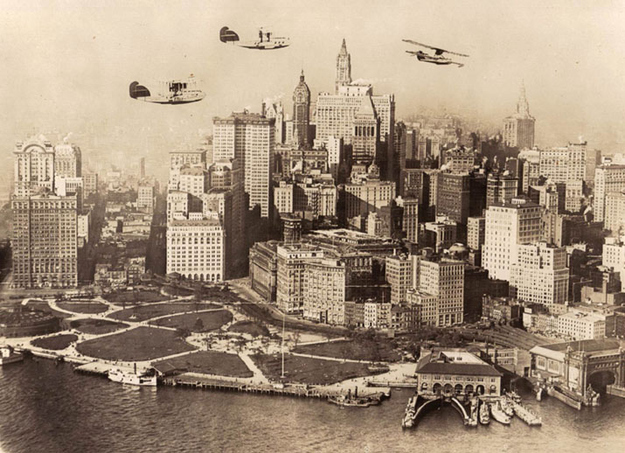
Aerial view of Battery Park Wharf in the early 1920s (Buzzfeed)
In the following Aug. 28 issue, the “Talk” editors ducked out of the sun to visit the American Museum of Natural History.
Aug. 28, 1926 cover by H.O. Hofman.
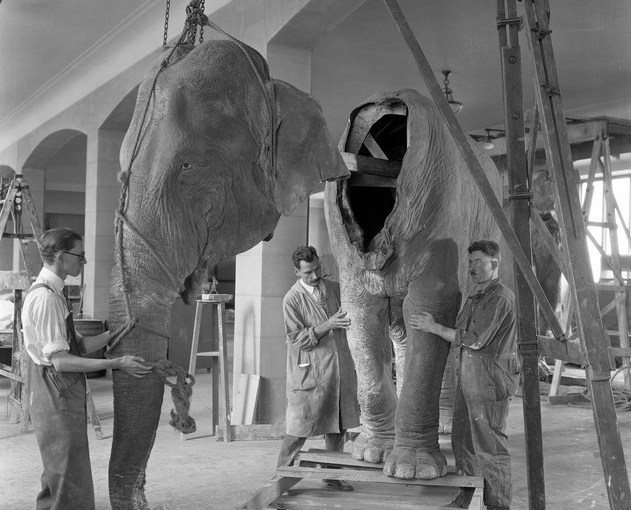
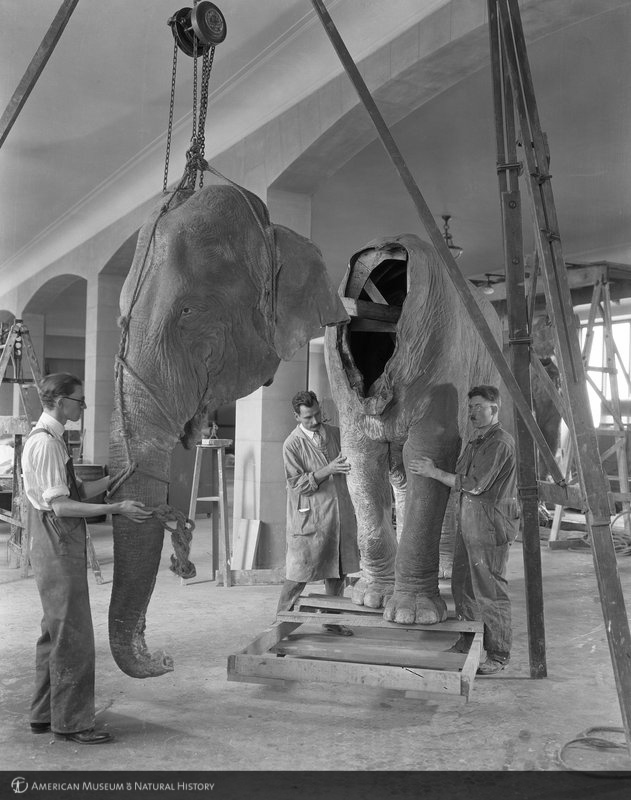
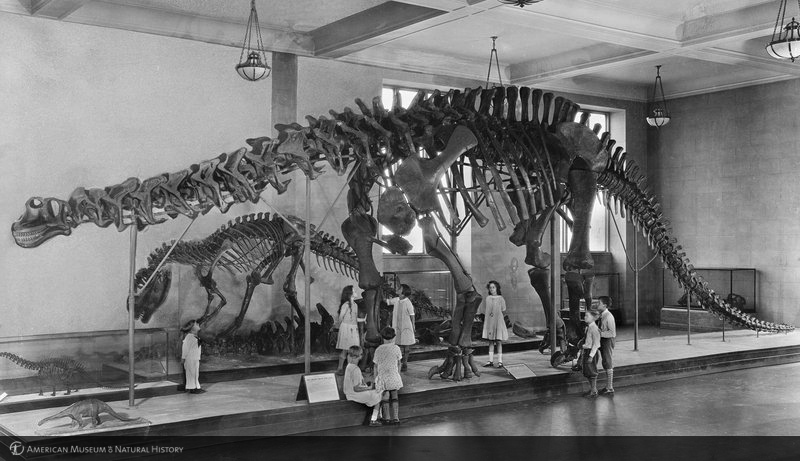
There they found curators busy reorganizing displays of dinosaurs and various stuffed beasts of the wild:
AMNH staff joining head to body of female elephant in Indian Elephant Group, 1926. (AMNH Digital Special Collections)The end result of the 1926 reorganization of displays at the AMNH—children viewing Brontosaurus exhibit in 1927. (AMNH Digital Special Collections)
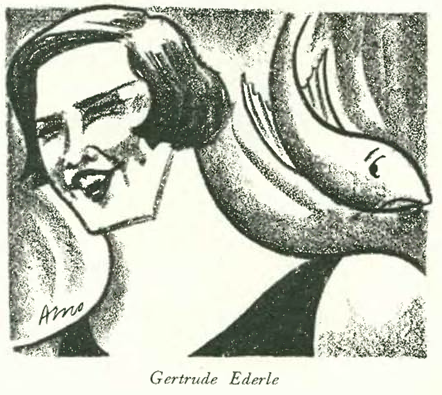
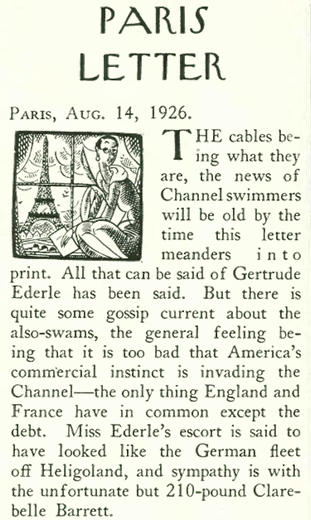
The magazine also profiled New York City native Gertrude Ederle, who became the first woman to swim across the English Channel in August of 1926:
Gertrude Ederle, as rendered by Peter Arno for the “Profile.”
Even Janet Flanner, the magazine’s Paris correspondent, commented on the event, noting Europe’s jealous reaction to an American’s seizing of the record:
Ederle would return home to a ticker tape parade along the Canyon of Heroes in the Financial District, and would also be feted by 5,000 people who turned out on West 65th Street for a block party in her honor.
WHAT FOLKS DID BEFORE TELEVISION…Block party celebrates Gertrude Ederle as “Queen of the Waves.” (Ephemeral New York)
According to the excellent blog Ephemeral New York, Ederle received offers from Hollywood and Broadway and was deluged by marriage proposals. But she returned to a quiet life, moving to Queens and working as a swimming instructor for deaf children–Ederle’s hearing was seriously damaged in the water of the Channel, but otherwise swimming must have been good for her health. She died at age 98 in 2003.
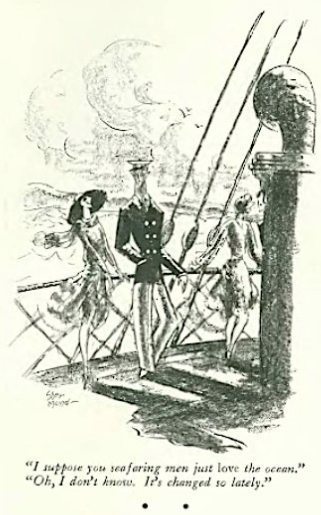
Keeping with the summertime theme, the magazine covered the Gold Cup Regatta, complete with illustrations by Johan Bull:
An early Barbara Shermund cartoon, always a delight…
Lois Long took her “On and Off the Avenue” column to Paris, where she cast a jaded eye at the behavior of American buyers of French fashion:
Coco Chanel’s “Little Black Dress” debuted in 1926. (homeecologist.com)
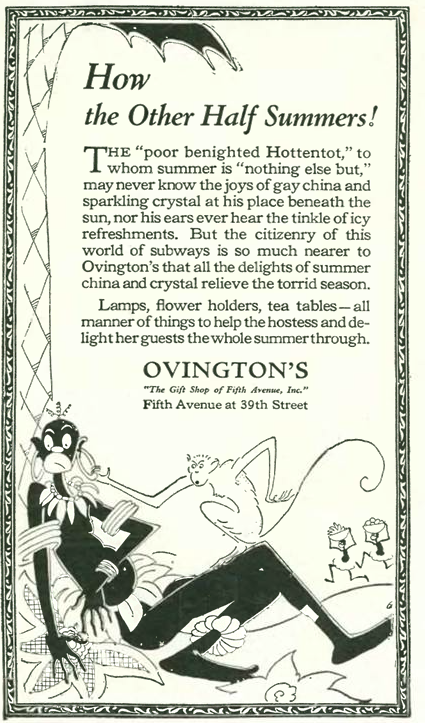
And finally, from the advertising department, this strange ad from Ovington’s, which seemed to be more concerned with promoting racial stereotypes than in selling dinnerware:
Withering under a July heat wave, The New Yorker editors turned their thoughts to the cooling breezes that could be found blowing across the penthouse garden of real estate developer Robert M. Catts.
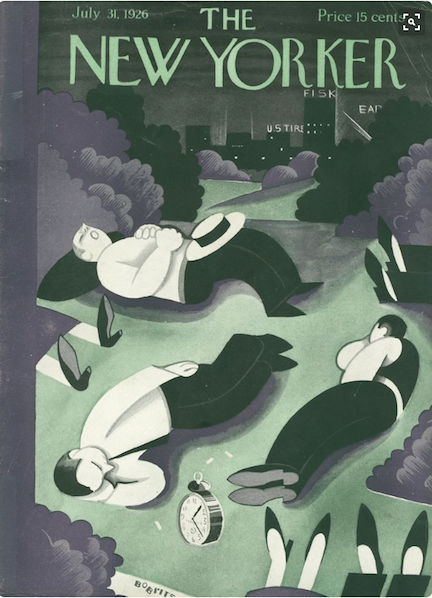
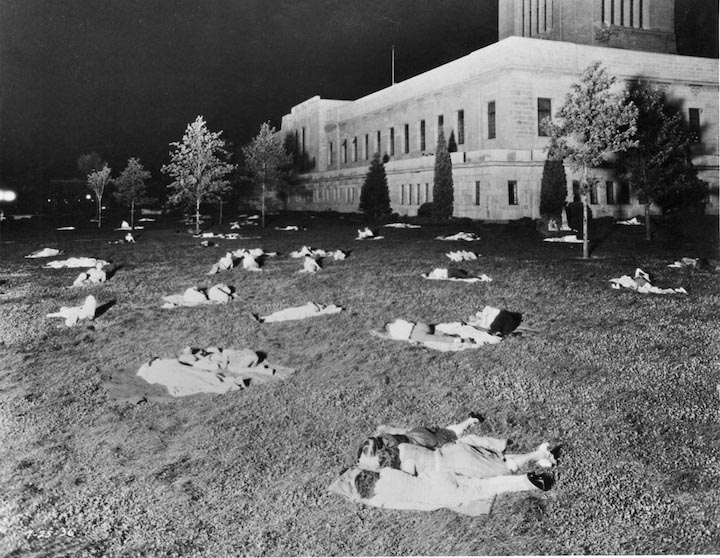
The July 31, 1926 cover by Victor Bobritsky offered its own commentary on the heat wave that gripped the city.In case you were wondering, city folk (especially apartment dwellers) actually did sleep on the ground in the days before air conditioning. This photo was taken on July 25, 1936, on the lawn of the Nebraska State Capitol Building in Lincoln. (Nebraska State Historical Society).
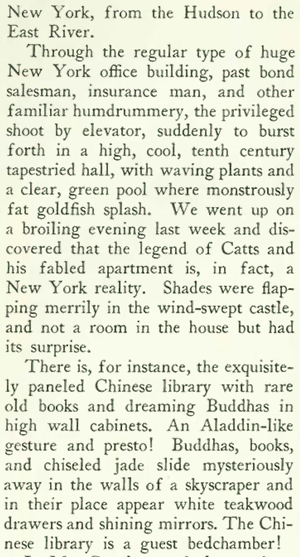
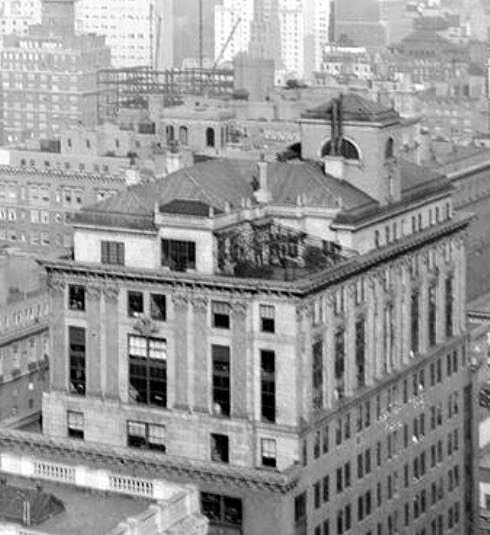
Catts erected the 20-story Park-Lexington office building at 247 Park Avenue in 1922, topping the building with his own penthouse apartment. Located near Grand Central Station, the building was innovative in the way it was built directly over underground railroad tracks leading into the station. The editors of The New Yorker, however, were more impressed by what was on top:
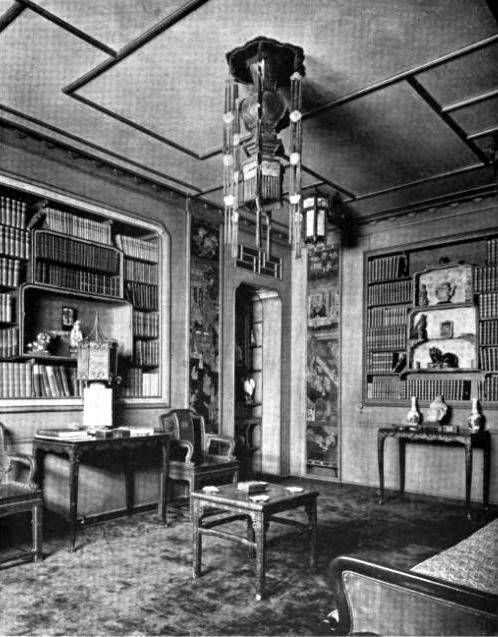
The “Chinese Library” in the apartment of Robert M. Catts atop the Park-Lexington Building. (halfpuddinghalfsauce.blogspot.com)Penthouse apartment of Robert M. Catts atop the Park-Lexington Building. (halfpuddinghalfsauce.blogspot.com)
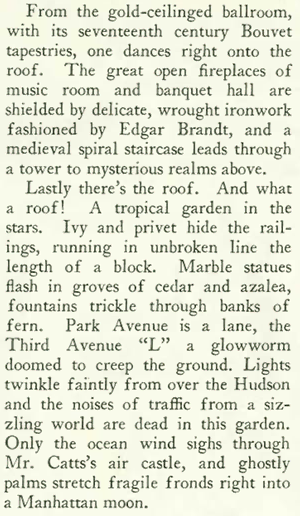
It was the rooftop garden, however, that sent the editors into a swoon:
Before World War II the apartment would have other notable tenants who would succeed Catts, including the violinist Jascha Heifitz. The apartment, and the building beneath it, were demolished in 1963 along with the adjoining Grand Central Palace building, which was replaced in 1967 with 245 Park Avenue:
245 Park Avenue (Wikipedia)
In other news, Arthur Robinson wrote a somewhat sympathetic profile of Babe Ruth, observing that Ruth’s “thousand and one failings are more than offset by his sheer likableness.”
Illustration for the “Profile” by Johan Bull.
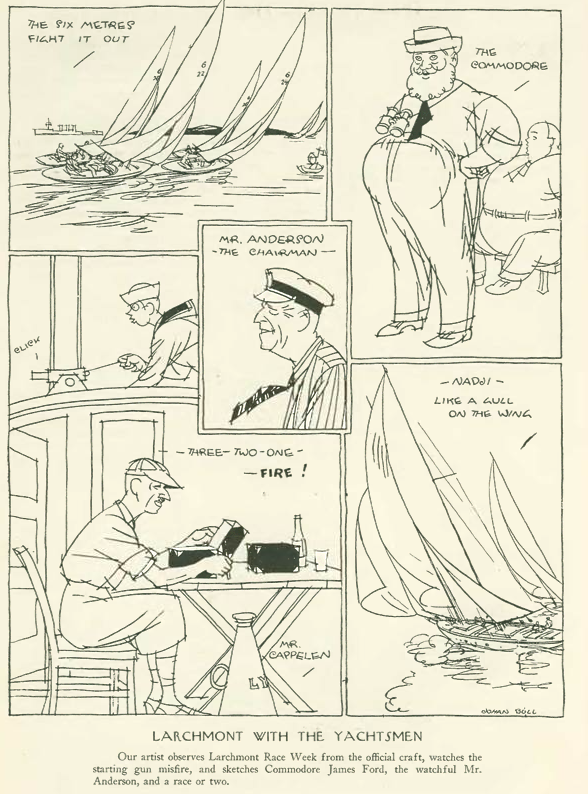
Curiously, the Yankees were having a better year in 1926, but there was scant mention of baseball in the pages of The New Yorker, the magazine preferring to cover classier sports such as golf, polo, tennis and horse racing. Another sport of interest was yacht racing, with Eric Hatch covering the races at Larchmont augmented by Johan Bull’s illustrations:
The magazine continued to have fun with the androgynous fashion trends of the Roaring Twenties. This appears to be an early Barbara Shermund cartoon:
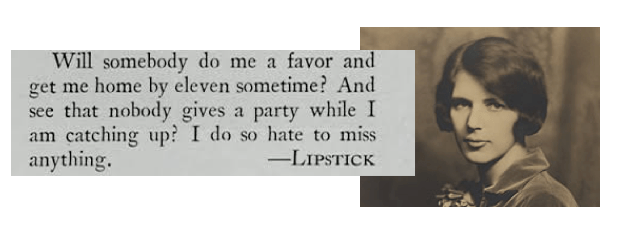
At an age when most students are barely out of college (23), Lois Long was emerging as one of The New Yorker’s most prolific contributors and a prominent voice of Roaring Twenties New York.
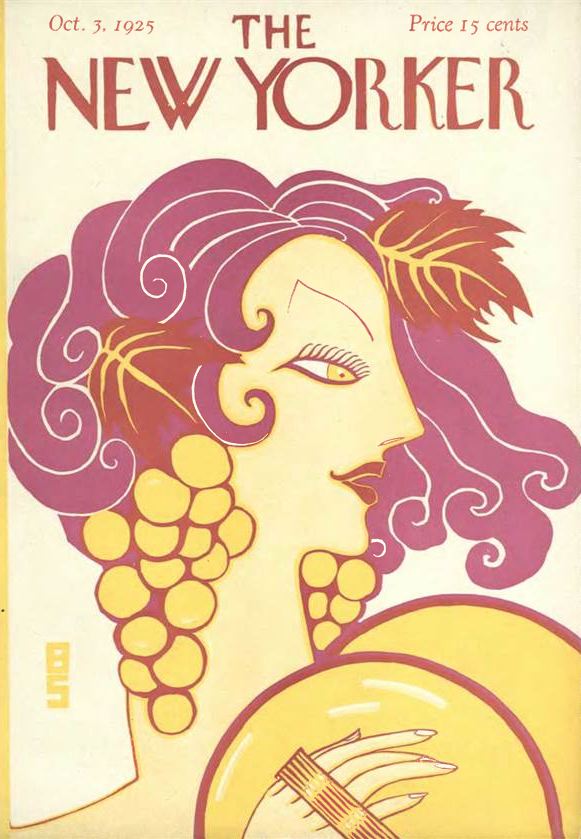
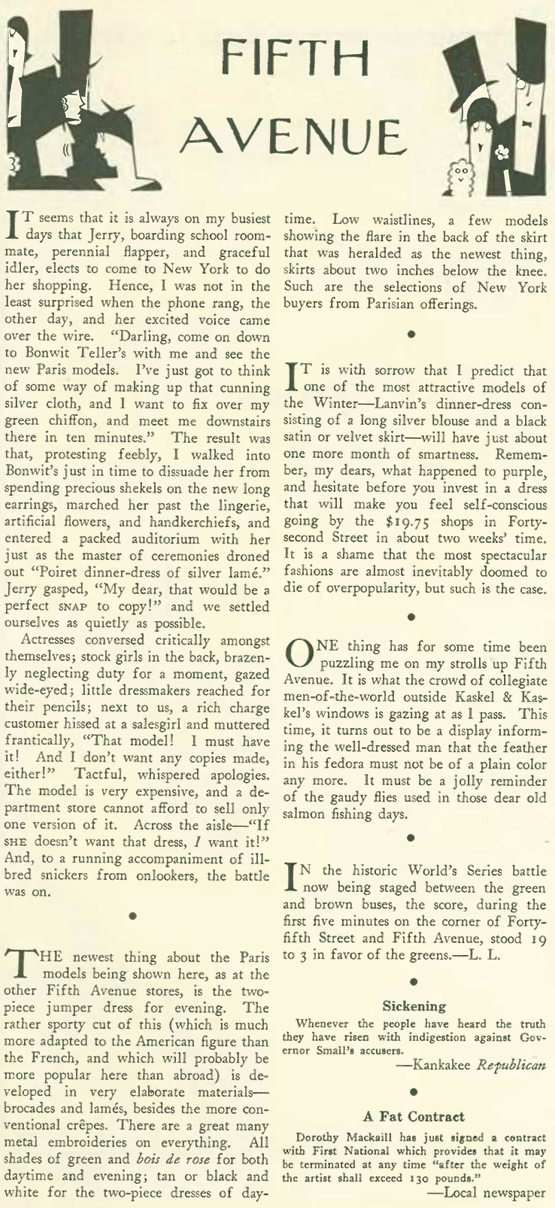
The Oct. 3, 1925 issue not only saw her continuing coverage of night life in “Tables for Two” (which she signed under the pen name “Lipstick”), but also the introduction of her column, “Fifth Avenue” (which she signed L.L.), that would further define her voice at the magazine for years to come.
And The New Yorker wasn’t even her first professional stint as a writer.
Beginning in 1922, Long wrote for both Vanity Fair and Vogue before she caught the eye of New Yorker editor Harold Ross, who hired her to take over the “When Nights Are Bold” column from Charles Baskerville. She later made it her own by changing the name to “Tables for Two.”
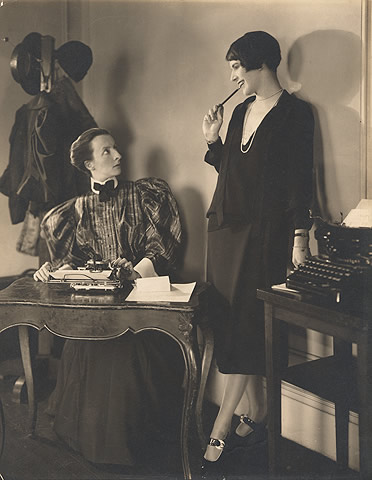
Lois Long in the 1920s. Photo from Andrea Long Bush. (Wikipedia)
With the Oct. 3 issue she doubled her workload as both an observer of night life and the fashion scene.
According to Judith Yaross Lee’sDefining New Yorker Humor, the “Fifth Avenue” column took a very different tack from the magazine’s original “Where to Shop” listings that were merely classified ads.
Yaross writes that Long’s first “Fifth Avenue” column relied on “the conceit of her friend Jerry, ‘boarding school roommate, perennial flapper, and graceful idler’ (evidently the department’s target reader)…”
The column would soon be renamed “On and Off the Avenue,” and Long would officially assume the title of fashion editor in 1927.
Her obituary in The New York Times (p. 36, July 31, 1974) quoted New Yorker editor William Shawn, who declared that “Lois Long invented fashion criticism,” and that Long “was the first American fashion critic to approach fashion as an art and to criticize women’s clothes with independence, intelligence, humor and literary style.” The article noted that her task was particularly challenging since The New Yorker did not publish photographs “and more than other writers she had to turn to words alone to describe clothes in detail.”
You can read Long’s first “Fifth Avenue” column, featuring her friend, “Jerry,” here in its entirety:
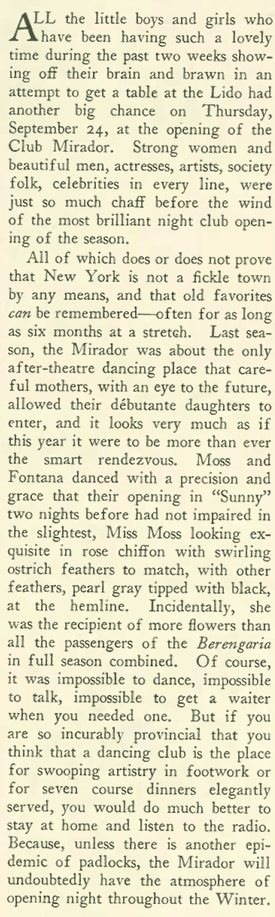
In the same issue, just three pages back, in “Tables for Two,” Long shared these insights on the opening of the Club Mirador:
And she pulled no punches in this erratum item that appeared below this Johan Bull illustration:
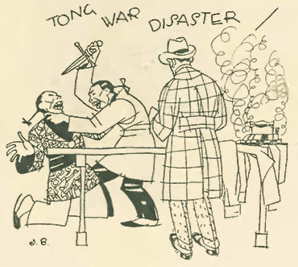
And in “The Talk of the Town,” Bull provided this illustration depicting the flare-up of Tong Wars among New York’s Chinese immigrant population. The main consequence of murderous assault seems to be a patron’s ruined shirt:
“Profiles” featured Reinald Werrenrath, “A New Yorker Who Sings.” Described by writer Clare Peeler as someone who “looks New York,” the baritone opera singer also recorded popular songs and was a regular on early radio broadcasts.
In “Critique” George S. Kaufman’s The Butter and Egg Man received a positive review by Herman J. Mankiewicz, who wrote that the play was “not for the artistically inclined,” but adds:
Gregory Kelly as Peter Jones in The Butter and Egg Man (1925). The Broadway play was a resounding success. Sadly, the beloved Kelly would die of a heart attack in 1927 (at age 36) while on tour with the play. (Museum of the City of New York)
By the way, the queen of New York nightlife, Texas Guinan, has been attributed as the source of the term “Butter and Egg Man” to generally describe generous souls (according to a “Talk” item in the Oct. 31 issue). At the movies, Theodore Shane found little to amuse as he panned The Tower of Lies (“colorless and loose-jointed”). Rather than capturing a Scandanavian setting, Shane wrote that the film “reeks of the studio scenario shops and the pleasant fields of Long Island.”
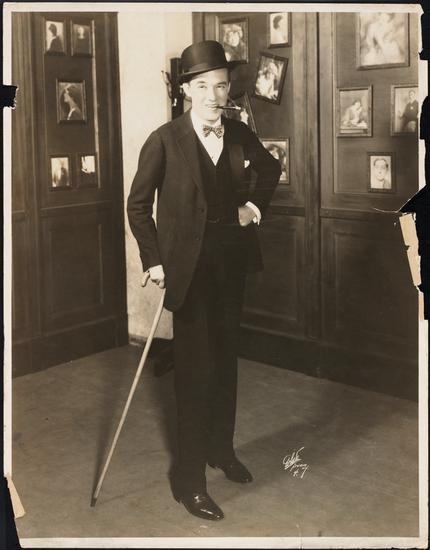
LITTLE TRAMP’S BIG BROTHER Sydney Chaplin performed in 37 films, including The Man on the Box (1925) with actress Alice Calhoun (above). He was Charlie Chaplin’s older brother and business manager. (Ohio State University)
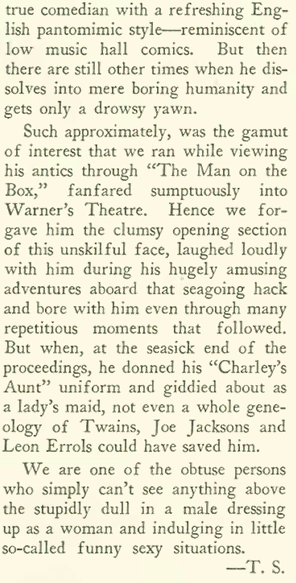
He also took Sydney Chaplin’s attempts at humor to task in the film, The Man on the Box, including his tired “male dressing up as a woman” gag.
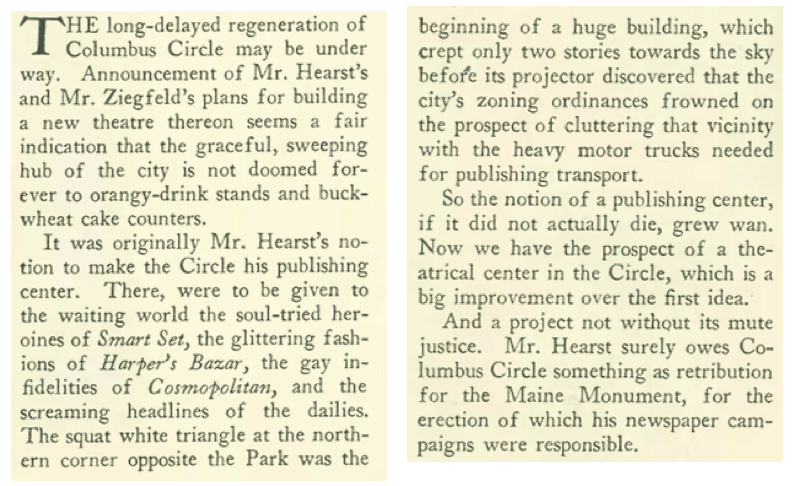
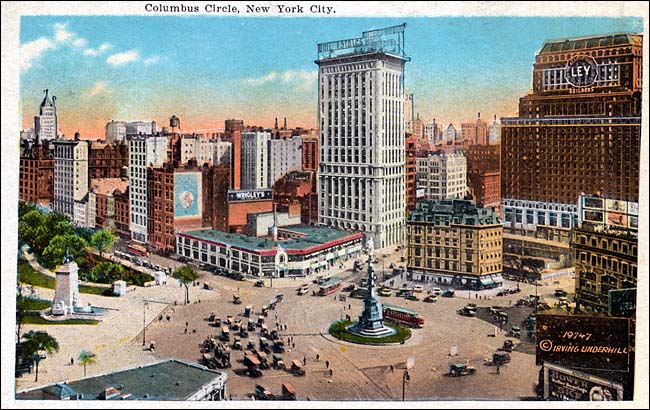
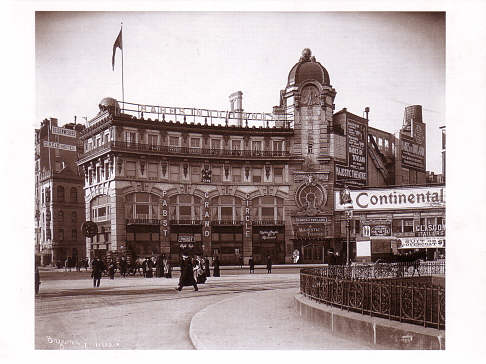
“Talk” also commented on changing face of New York City, including plans for a new Ziegfeld theatre as part of a “regeneration” of Columbus Circle:
According to performingartsarchive.com, Florenz Ziegfeld took over Columbus Circle’s Cosmopolitan theatre in 1925 and updated the interior. The building originally opened in 1903 as the Majestic (where the first musical stage version of The Wizard of Oz and the play Pygmallian debuted). It was briefly a burlesque house in the early 1920s (Minksy’s Park Music Hall) until William Randolph Hearst acquired it as a main venue for his Cosmopolitan Pictures company.
Postcard image of Columbus Circle, circa 1925. The Cosmopolitan is at far lower right. (NYC Architecture)
Under Ziegfeld, the Cosmopolitan returned to “legitimate” theater, but in 1926 he gave it up to focus on the construction of his self-named theatre at Sixth Avenue and 54th Street. The Cosmopolitan (renamed the International in 1944) would continue to serve both as a venue for movies and live performances until 1949, when it was acquired by NBC as a television studio for the TV program Your Show of Shows, featuring Sid Caesar and Imogene Coca. NBC left the International in 1954, and not long afterwards, the former theatre, along with most of its neighbors on Columbus Circle, was razed to make way for the New York Convention Center.
The long-gone Majestic, later Cosmopolitan theatre on Columbus Circle. (performingartsarchive.com)
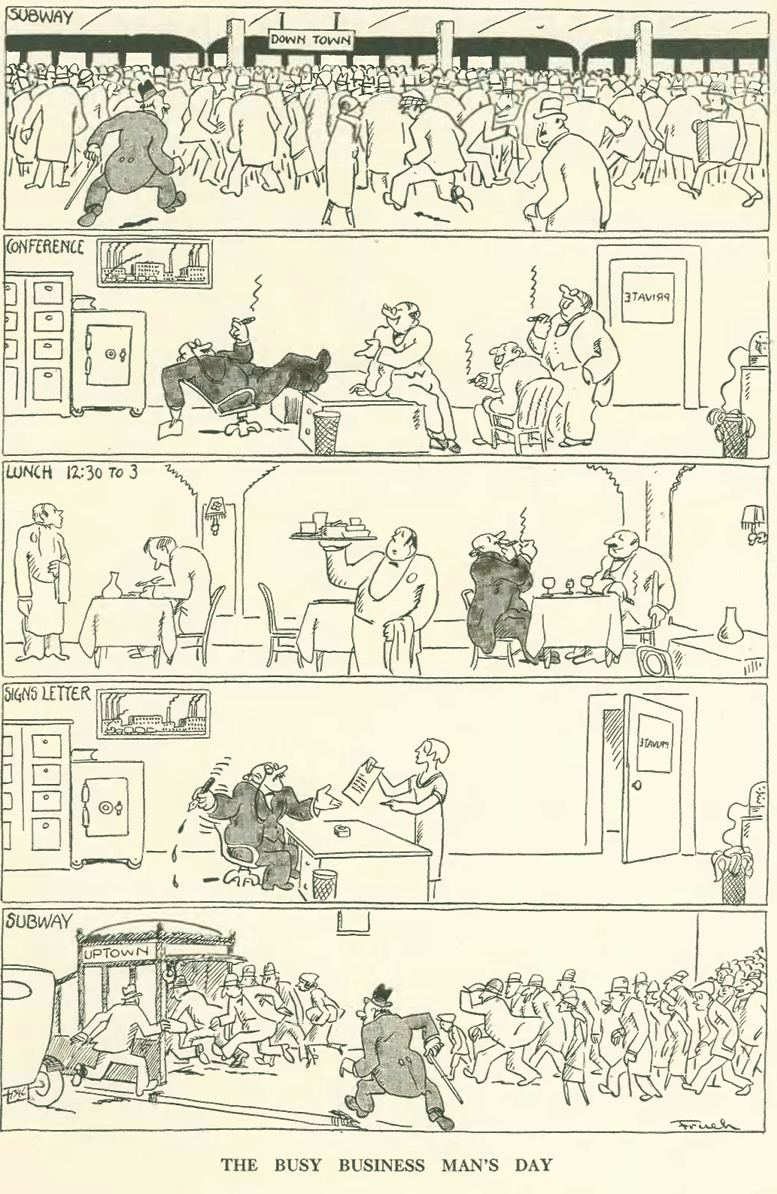
Also from this issue, Al Frueh’s take on a “Busy Business Man’s Day:”
Hans Stengel delivered “Sermons on Sin”…
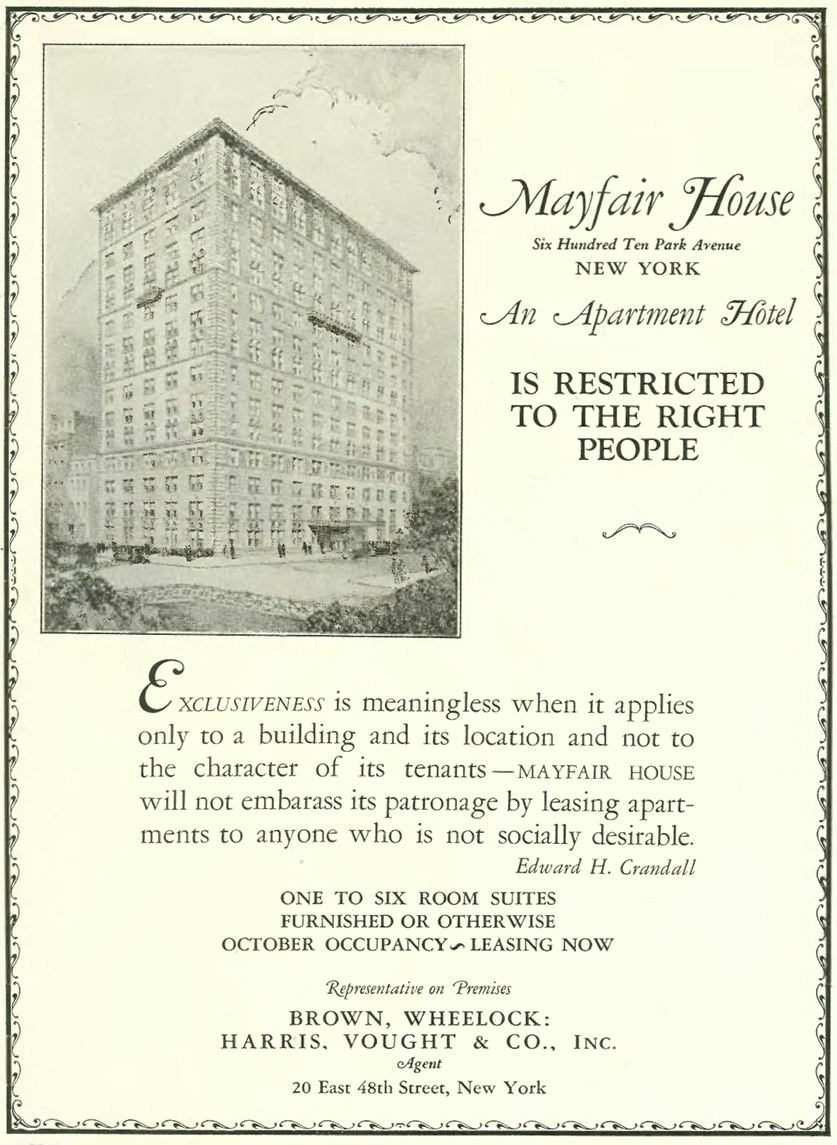
And lest we doubt the snob appeal of our fledgling magazine, check out this advertisement from the Mayfair House assuring that tenants will be kept a safe distance from the proles and other undesirables…
And to close, a back page ad for the Restaurant Crillon, featuring the unmistakable graphic innovation of Winold Reiss:
Leading up to the famous Tennessee “Monkey Trial” of John Scopes, the June 13 issue of The New Yorker continued its jabs at William Jennings Bryan.
June 13, 1925 cover by Barbara Shermund. (New Yorker Digital Archive)
Bryan had agreed to serve as prosecutor in the case against Scopes, who was charged on May 5, 1925, with teaching evolution from a chapter in Civic Biology, a textbook by George William Hunter that among other things described the theory of evolution. For the record, Scopes, who was merely a substitute high school teacher, wasn’t even sure if he’d actually taught evolution in his class, but purposely incriminated himself so the trial would proceed with a defendant. Just in case New Yorker readers needed more evidence that Bryan was an ignorant rube, “Talk of the Town” led off with an item on WJB’s visit to the Metropolitan Museum of Art:
(New Yorker Digital Archive)Bryan as depicted by Rea Irvin in June 7th’s “Talk of the Town”.
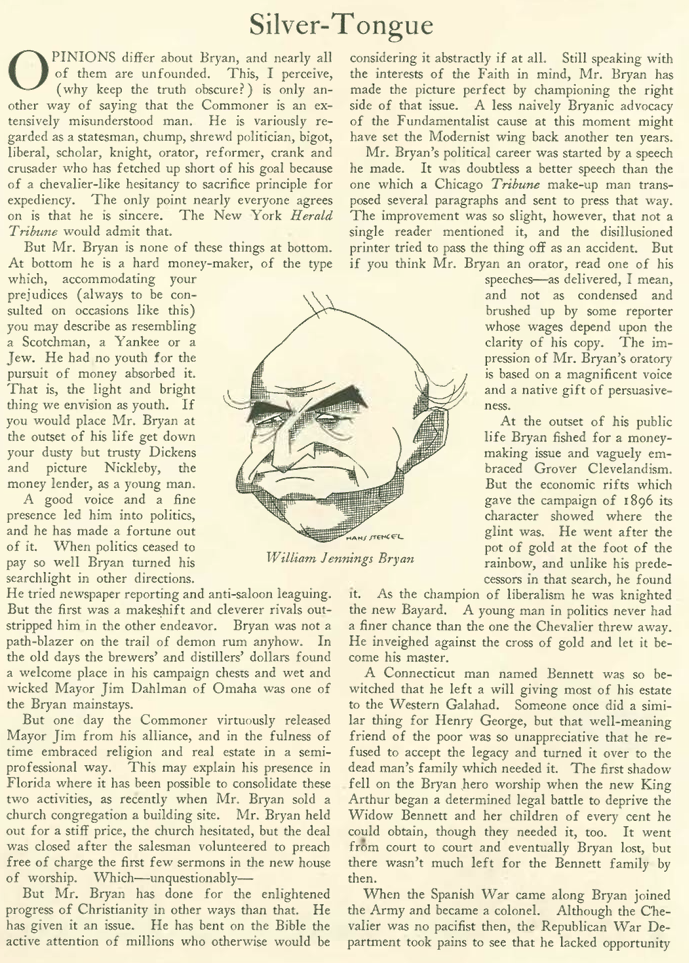
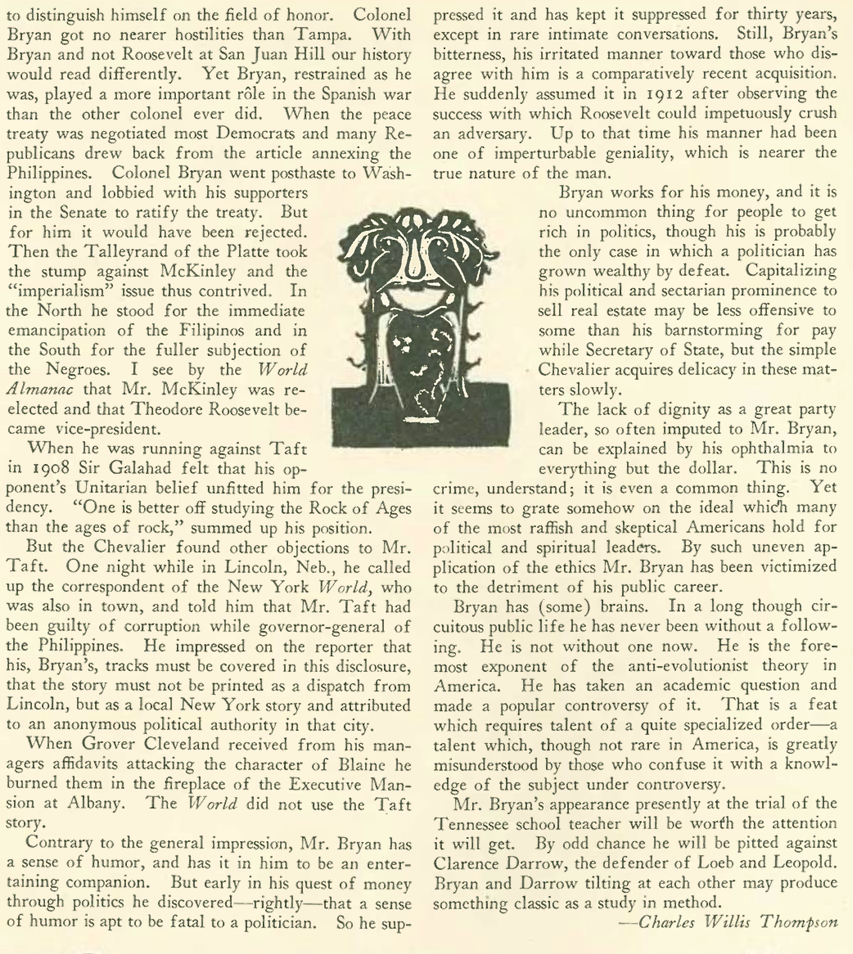
Bryan was also the subject of a “Profile” piece by Charles Willis Thompson, who wrote “the Commoner” is “an extensively misunderstood man.”
Thompson observed that Bryan “is variously regarded as a statesman, chump, shrewd politician, bigot, liberal, scholar, knight, orator, reformer, crank and crusader who has fetched up short of his goal because of a chevalier-like hesitancy to sacrifice principle for expediency.”
Here is the piece in its entirety (caricature by Hans Stengel)
(New Yorker Digital Archive)Macfadden at age 65 in the early 1930s (yousearch)
The New Yorker was barely afloat as it entered its first summer, but that didn’t dampen its wit as it fished for new subscribers through humorous full page ads regularly featured in the first issues.
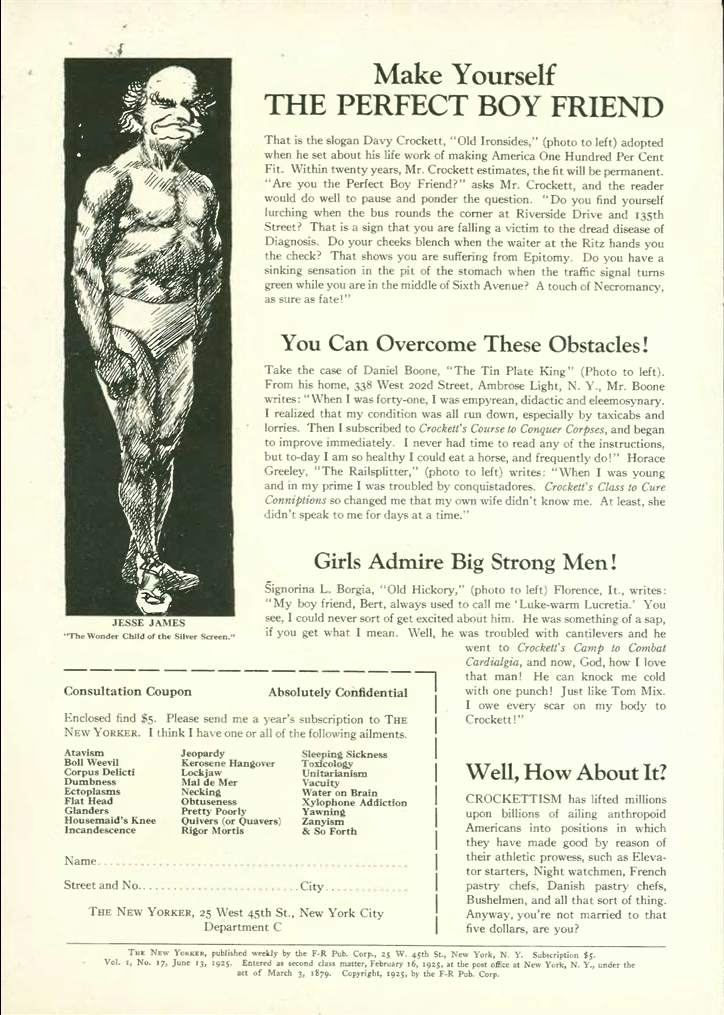
The June 13 issue opened with one such ad that appears to be a parody of a Bernarr Macfadden health and fitness promotion (Macfadden was an influential predecessor to the likes of Charles Atlas and Jack Lalanne). The ad was accompanied by a strange drawing that appears to combine McFadden’s body with–for some reason–William Jennings Bryan’s head:
(New Yorker Digital Archive)
In addition to Mr. Bryan, “Talk of the Town” also offered these observations…Calvin Coolidge’s fondness for his battered felt hat…the modesty of the young golfing star Bobby Jones and his refusal to accept any money beyond barest expenses for an exhibition match at Harvard…an offer by the famed violinist Jascha Heifetz to deliver, upon his return trip from Paris, a Poiret-designed gown for opera singer Cobina Wright for her upcoming Bal Harbor engagement…and a minor money dispute between George Bernard Shaw and the Saturday Evening Post regarding the reprinting of a short story.
Sherwood Anderson (Chicago History Museum)
“Talk” also made hay about “Male Plumage” on display in the city, noting that the last time novelist Sherwood Anderson was in town (he is referred to as “the illustrious revealer of the Middle Western Subconscious”) he wore socks “of a particularly glowing brown bespread with diamond checks of an exceptionally vivid shade of green,” and he sported both brown and red feathers in his brown velour hat. It was noted, however, that this display was outdone by Rudolph Valentino, whose silk house pajamas (worn while receiving visitors at the Plaza in Paris) were of “the most vivid crimson ever accomplished.”
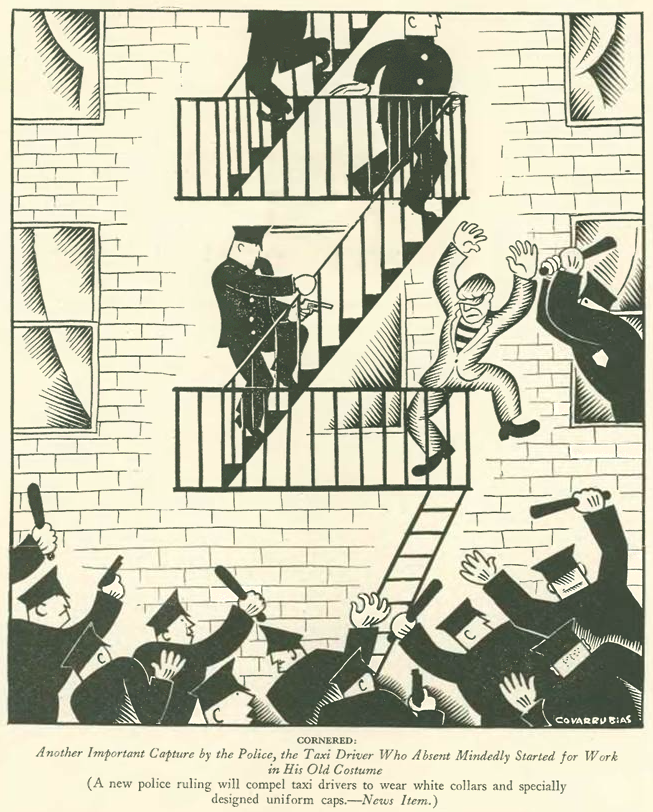
The New Yorker continued its assault on crooked cab drivers with this cartoon by Miguel Covarrubias:
(New Yorker Digital Archive)
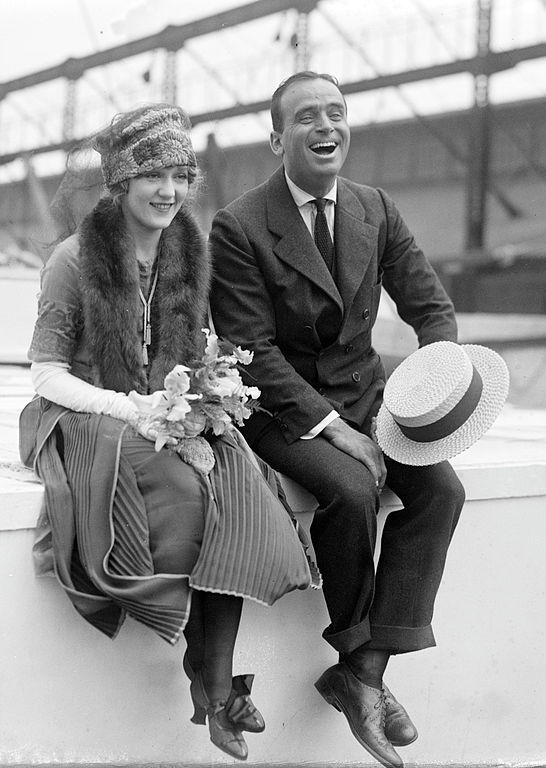
“Of All Things” (written by Howard Brubaker) noted that “The Queen of Rumania and the King of Swat (Babe Ruth) are both writing for the World, but fortunately for us constant readers, low-born newspaper men are still on the job.” It was also noted that silent film idol Mary Pickford “has fallen among bad characters or good press agents.” I have no idea what this refers to. Pickford was married to film star Douglas Fairbanks at the time, and their Hollywood mansion Pickfair was the center of the celebrity universe. The couple played host to heads of state and other dignitaries as well as notables in literature, the arts, and science (Albert Einstein once paid a call).
POWER COUPLE…Douglas Fairbanks and Mary Pickford in the mid 1920s. Pickford, a Canadian-American actress, was one of the 36 founding members of the Academy of Motion Picture Arts and Sciences, and a key figure in shaping today’s Hollywood. The couple formed the independent United Artists along with D.W. Griffith and Charlie Chaplin. (Wikimedia)
German cinema regularly drew favorable reviews in The New Yorker, however Fritz Lang’s Siegfried was called long and arty, “possessing many fine intervals of real beauty…that usually wins the critical adjectives. The average audience will probably be a bit bored at Siegfried’s quest. Tom Mix does this sort of thing with much more verve and snap.”
Colleen Moore in the silent film, The Desert Flower (1925) (IMDB)
And if you think the “Cinderella” story has been made and remade too many times, consider that in 1925 The New Yorker already found the theme wearing thin. A review of the The Desert Flower referred to the film as “just another variation of the Cinderella theme.” It told the story of a waif (Colleen Moore) in a railroad construction in camp who falls in love with the son of the railroad’s president. The reviewer wrote that “probably all of this will be popular. It always has been.”
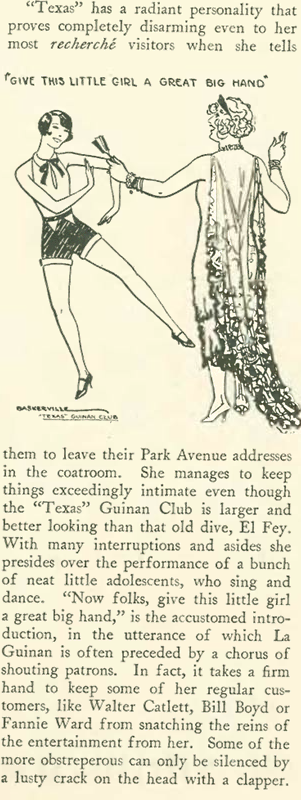
Texas Guinan’s new club proved a be hit, as reported in the feature “When Nights Are Bold.” I last reported on Texas Guinan in my March 18, 2015 post, “A Dry Manhattan,” when prohibition officials put a padlock on her old haunt, the El Fey Club. As we see, things are looking up for the leading lady of New York nightlife…
(New Yorker Digital Archive)
I am guessing this illustration by Covarrubias was an attempt to fill ad space and encourage readership. I guess we will find out soon enough:
(New Yorker Digital Archive)
The issue closes with a satirical piece that appears to poke fun at tenement life, or perhaps at the pretensions of art critics, or both. You be the judge:




































 A New Yorker State of Mind