The Major’s Amateur Hour

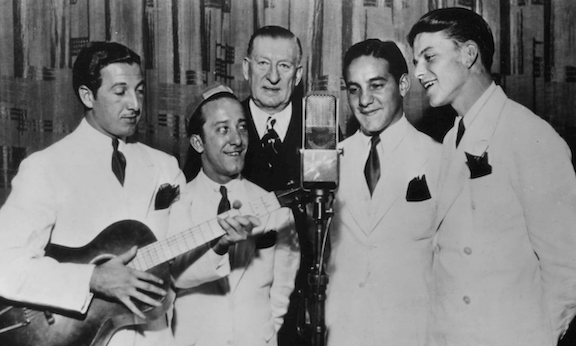
Above: Photo of the Hoboken Four as they appeared on the "Amateur Hour with Major Bowes" in 1935. At center is "Major" Edward Bowes, and at right is Frank Sinatra. The other three members of the Hoboken Four were Frank Tamburro, Patty Prince and Jimmy Petro. (knkx.org)

Nearly seventy years before American Idol appeared on our TV screens, a hugely successful and influential talent show filled the airwaves from NBC’s radio studios at Rockefeller Center.
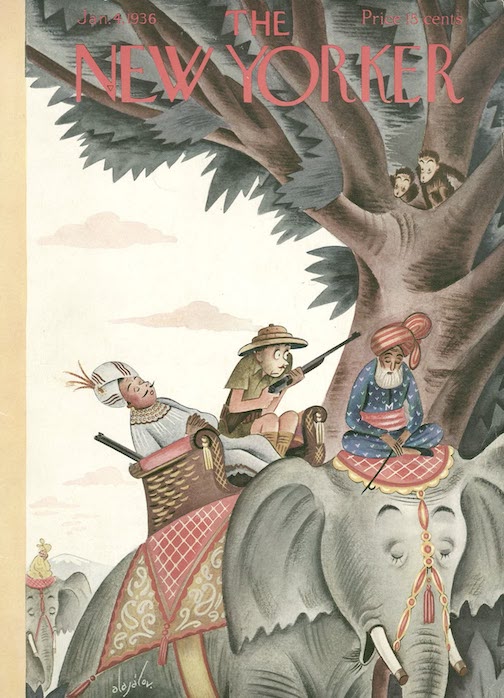
January 4, 1936 cover by Constantin Alajalov.

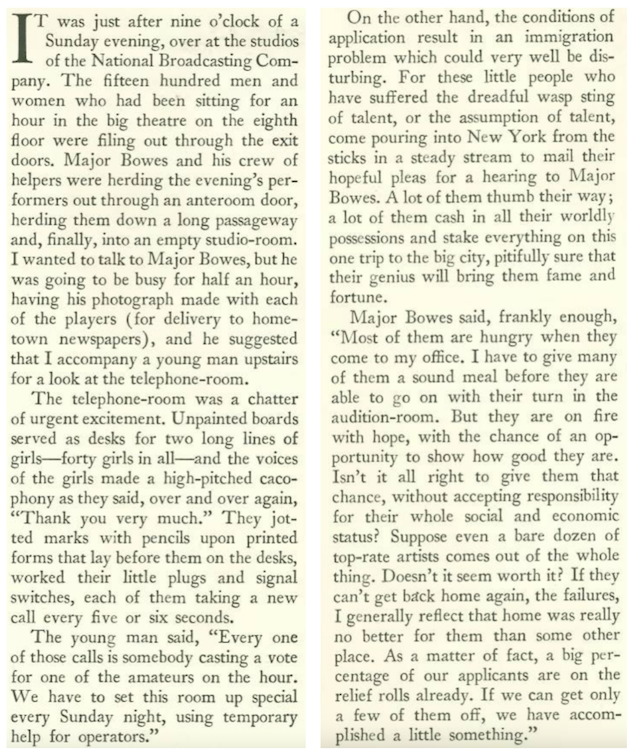
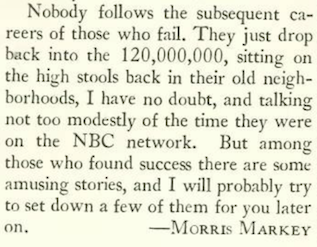
Millions tuned in each week to the Major Bowes Amateur Hour, which got its start in 1934 at radio station WHN before moving to NBC the following year. Created and hosted by “Major” Edward Bowes (1874–1946), Bowes would chat with contestants before listening to their performances, which could be cut short by the Major’s gong (see below). For his “A Reporter at Large” column, Morris Markey paid a visit to Bowes during evening auditions at the NBC studios. Excerpts:
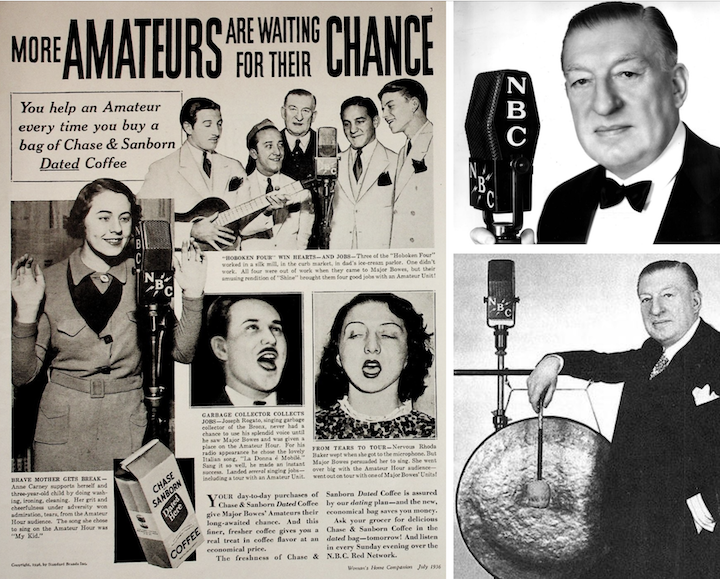
THE GONG SHOW…At bottom right, Edward Bowes with the gong he used to abruptly end acts he deemed poor or inept—he abandoned the prop in 1936 after receiving thousands of letters from listeners who objected to the premature termination of acts (apparently the concept was a direct inspiration for Chuck Barris’s 1970s TV program, The Gong Show). At left, a July 1936 Women’s Home Companion advertisement from the show’s sponsor, Chase & Sanborn. The ads highlighted the rags-to-riches stories of the more successful contestants. (eBay.com/Wikipedia)

Markey ended his piece noting the reality of the many contestants who, unlike Frank Sinatra, would not go on to successful entertainment careers.
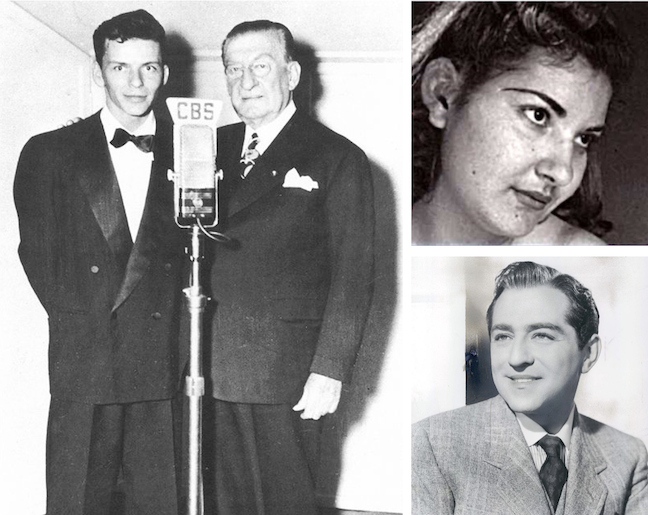
STARMAKER…Clockwise, from left: Major Edward Bowes and returning Amateur Hour performer Frank Sinatra in 1943; in 1935 eleven-year-old Maria Callas performed the Madama Butterfly aria “Un bel dì vedremo,” on the Amateur Hour; actor/baritone Robert Merrill performed on the show in 1936. (winnetoba.com/mariacallasestate.com/Wikipedia)

 * * *

Fleeing the Limelight

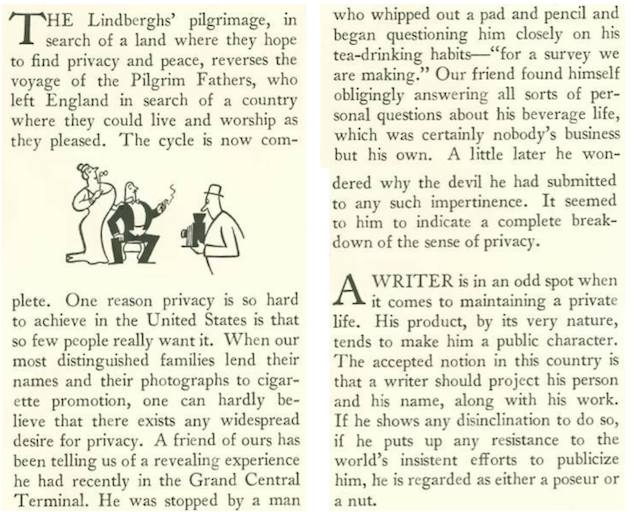
In December 1935 Charles and Anne Morrow Lindbergh secretly boarded a ship in New York and headed to England, seeking to escape the media frenzy that followed their son’s kidnapping and the subsequent trial. Thanks to connections through Anne’s family, they were able to move into a secluded estate in the Kent countryside. In his “Notes and Comment,” E.B. White explained:
HIDEOUT…From 1936 to 1938 Charles and Anne Morrow Lindbergh lived in a secluded English estate called “Long Barn.” The estate in County Kent was owned by a friend of Anne’s family. (waverlyhs.weebly.com)
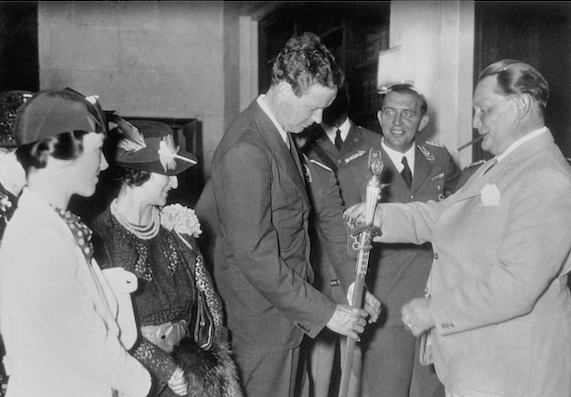
NOT HIS FINEST HOUR…In July 1936 Luftwaffe commander Hermann Goering (right) presented the Sword of Honor of the German Air Force to Charles Lindbergh during a visit to Berlin. Anne Morrow Lindbergh is to the far left. Goering would also present Lindbergh with a high-ranking Nazi-era civilian medal, the Service Cross of the German Eagle, during a 1938 visit. Anne presciently referred to the medal as “the albatross.” (Library of Congress)

According to White, Mayor Fiorello La Guardia cited lax police control of the media in the case of the fleeing Lindberghs. In turn, White attempted to explain the unique temperaments of Irish police officers.

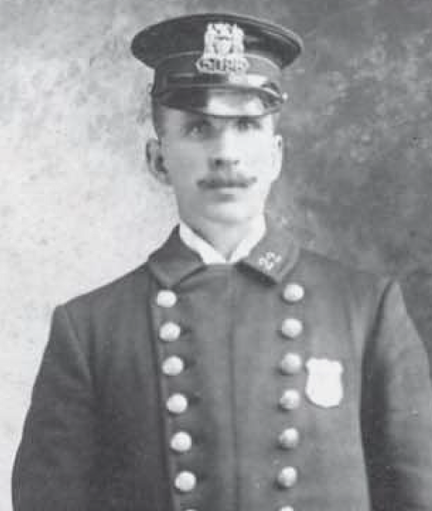
GIVE US A BREAK…E.B. White noted the courage and wisdom of Irish cops, but also found their lassitude “almost theatrical.” Pictured above is Irish immigrant Patrick Leddy, who joined the NYPD in 1910 and remained on the force for more than thirty-five years. (Courtesy of Margaret Fitzpatrick Leddy via nyirishhistory.us)

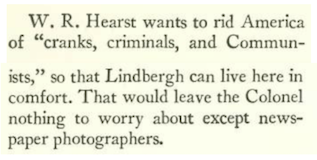
A final note on the Lindberghs from Howard Brubaker, a snippet from his “Of All Things” column.
 * * *

Italian Swashbuckler

The Italian fencer Aldo Naldi (1899-1965) won three gold medals and one silver at the 1920 Olympics before turning professional. According to West Coast Fencing, Aldo traveled Europe like a prizefighter, “competing in well-attended matches for cash purses…in a world of travel, glamour, drinking, womanizing, gambling and fencing, Aldo Nadi reigned supreme, going nearly eight years without a defeat.” “The Talk of the Town” was on hand for his American debut. Excerpts:
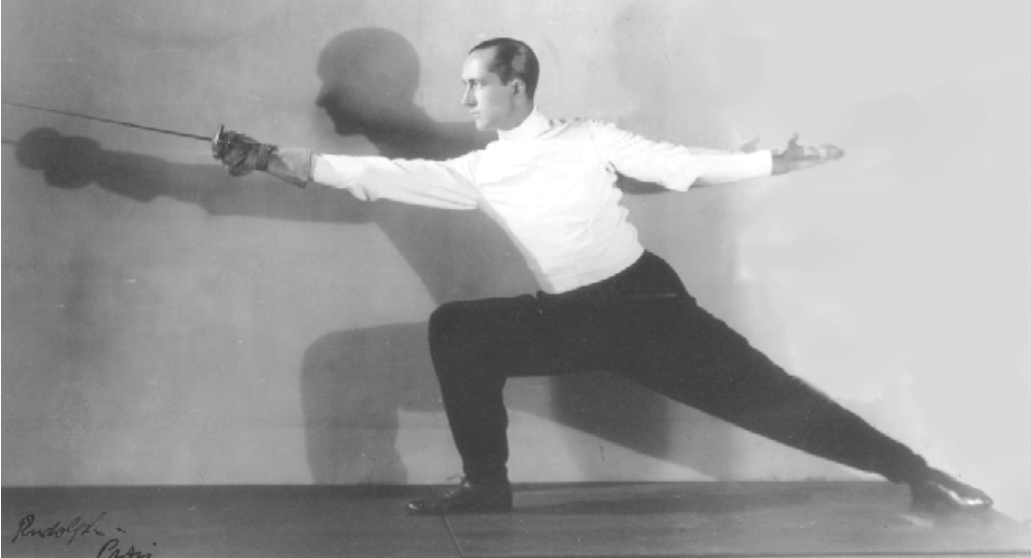
EN GARDE!…During the interwar years Aldo Nadi reigned supreme, going nearly eight years without a defeat. (dennishollingsworth.us)

“Talk” also examined the fuss being made over the Great Chalice of Antioch, which was on display at the Brooklyn Museum. Excerpts:
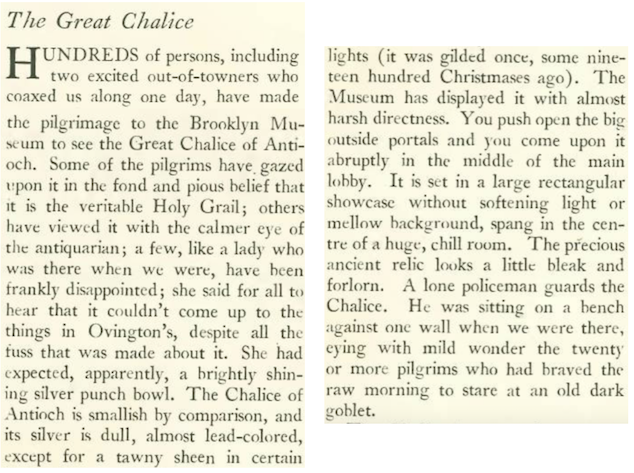
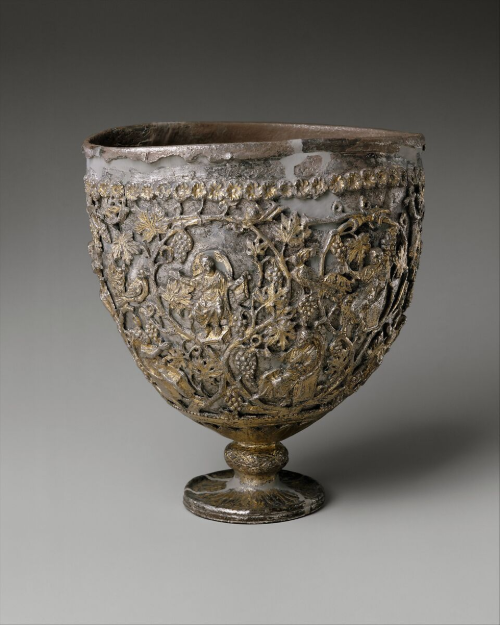
COULD IT BE?…Claimed to have been found in Antioch around 1900, this chalice’s plain silver bowl was ambitiously identified by some as the Holy Grail, the cup used by Christ at the Last Supper. It is displayed with the Metropolitan Museum’s Byzantium collection. (metmuseum.org)

* * *

Year, Schmear

To mark the New Year, Arthur Guiterman offered up one his humorous poems…
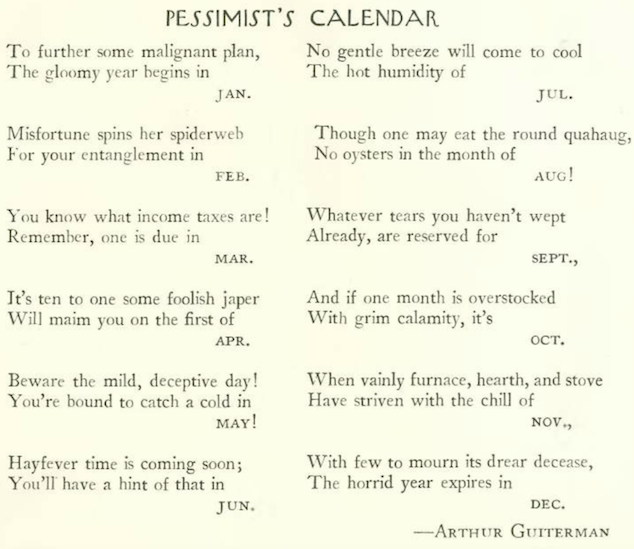
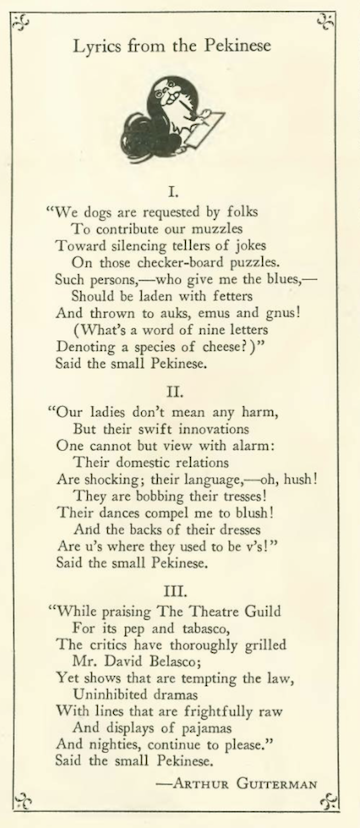
…Guiterman (1871–1943) was an early contributor to The New Yorker—the magazine’s very first issue, Feb. 21, 1925, featured the first installment of Guiterman’s recurring “Lyrics from the Pekinese,” which ran through the first eleven issues.
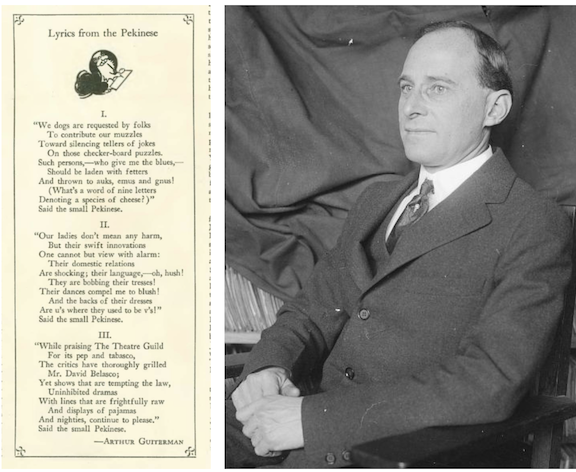
MEOW…Arthur Guiterman’s “Lyrics from the Pekinese,” featured in the first issue of The New Yorker. At right, Guiterman in an undated photo. (Library of Congress)

 * * *

Before He Was Spooky

Robert Benchley’s review of the stage began on a bright note with Victoria Regina, which starred Vincent Price as Prince Albert and Helen Hayes as Queen Victoria. Benchley praised the realism Price and Hayes lent to the production. Excerpts:
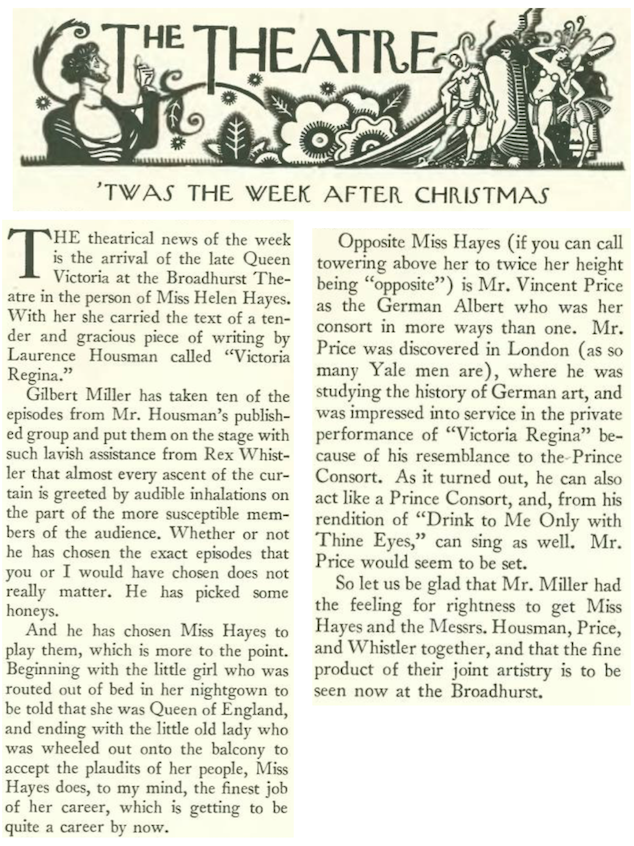
A MATCH MADE ON BROADWAY…The 24-year-old Vincent Price and the 35-year-old Helen Hayes portrayed Prince Albert and Queen Victoria in Victoria Regina, which ran for 203 performances at the Broadhurst Theatre. Robert Benchley thought their casting was ideal. (Pinterest)

Benchley also sat through George White’s latest Scandals revue, finding it similar to White’s older shows—beautiful showgirls, various singers and dancers, and assorted comedians—with Bert Lahr shining above it all.
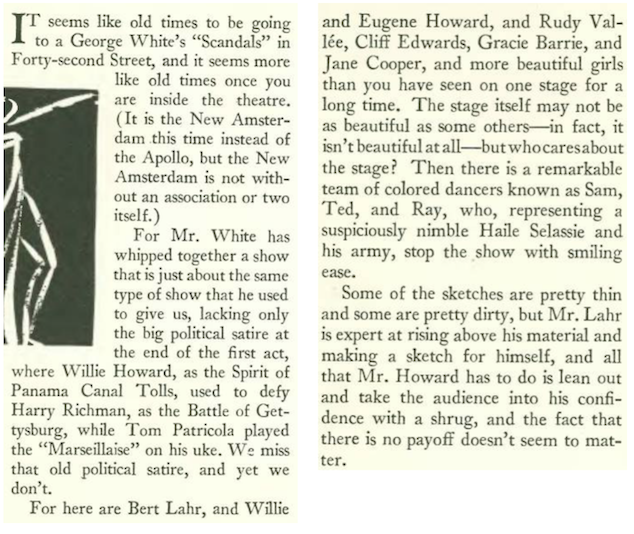
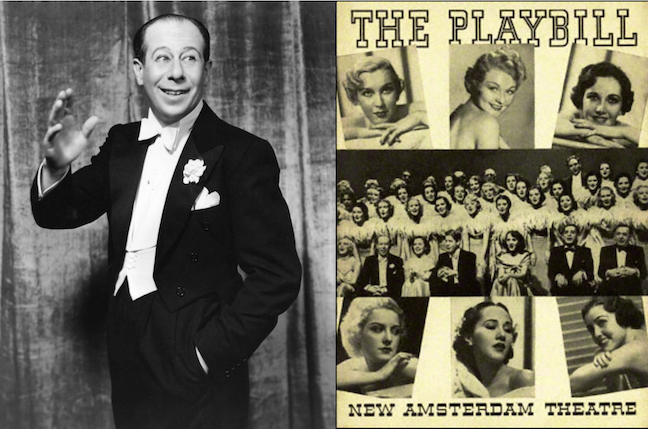
IT SEEMED LIKE OLD TIMES to Robert Benchley as he took in the latest edition of George White’s Scandals. Bert Lahr (left) was among the headliners for the 1936 revue, which ran for 110 performances at the New Amsterdam Theatre before taking to the road. (Wikipedia/Playbill.com)

 * * *

At the Movies

John Mosher had a busy week at the movies, finding “considerable pleasure” in the screen adaptation of Eugene O’Neill’s Ah Wilderness!…
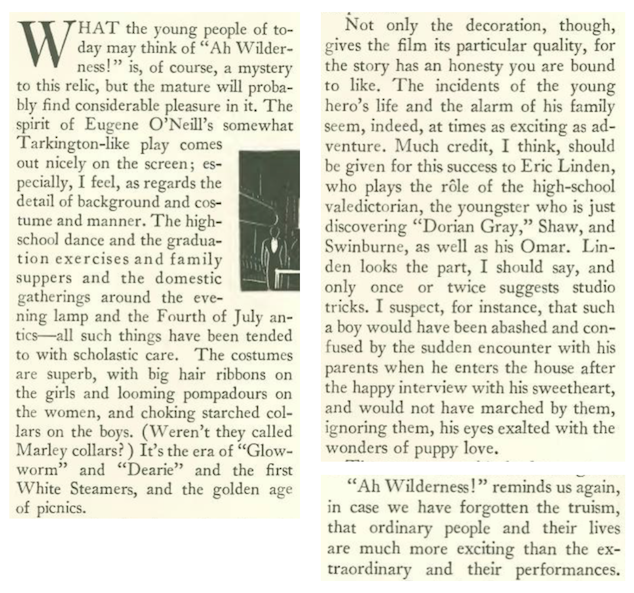
MILLER TIME…The Miller family attends a commencement ceremony that helps kick off the action in Ah Wilderness! From left, Aline MacMahon, Mickey Rooney, Spring Byington, and Bonita Granville. (IMDB)

Mosher also looked at films featuring leading actresses of the day—Barbara Stanwyck in Annie Oakley, Bette Davis in Dangerous, and Claudette Colbert in The Bride Comes Home.
A TRIO OF TALENTS…Clockwise, from top left, Claudette Colbert had her hands full with Robert Young and Fred MacMurray in The Bride Comes Home; Barbara Stanwyck took aim in Annie Oakley; and Bette Davis portrayed a down-and-out actress with trouble on her mind in Dangerous. For her performance, Davis won the Academy Award for Best Actress. (laurasmiscmusings.blogspot.com/girlswithguns.org/vanguardofhollywood.com )

 * * *

Gaming the Games

In her “Paris Letter,” Janet Flanner noted the preparations for the Fourth Olympic Winter games to be held in Garmisch-Partenkirchen, Germany.
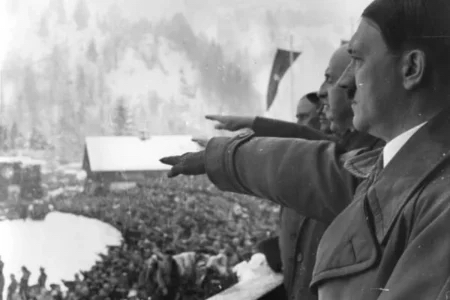
WINTER HAS ARRIVED…Adolf Hitler and his fellow Nazi thugs brought a certain chill to the 1936 Winter Games in Garmisch-Partenkirchen. Garmisch and Partenkirchen were separate communities until Hitler forced them to merge in anticipation of the games. (arolsen-archives.org)

 * * *

From Our Advertisers

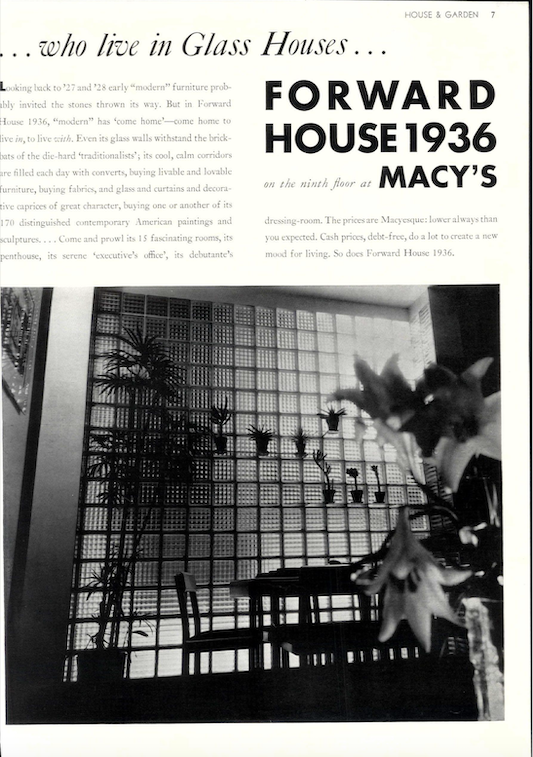
From 1933 to 1939, Macy’s hosted a series of unique design exhibitions under the title “Forward House” that showcased contemporary furniture, decor, and architectural ideas…

…for reference, here is another “Forward House” advertisement from the February 1936 House & Garden magazine…
…the folks at Robbins Island Oysters employed the legend of Giacomo Casanova to market their tasty little rocks…apparently Casanova claimed that he consumed more than fifty oysters each morning to sustain his amorous adventures…

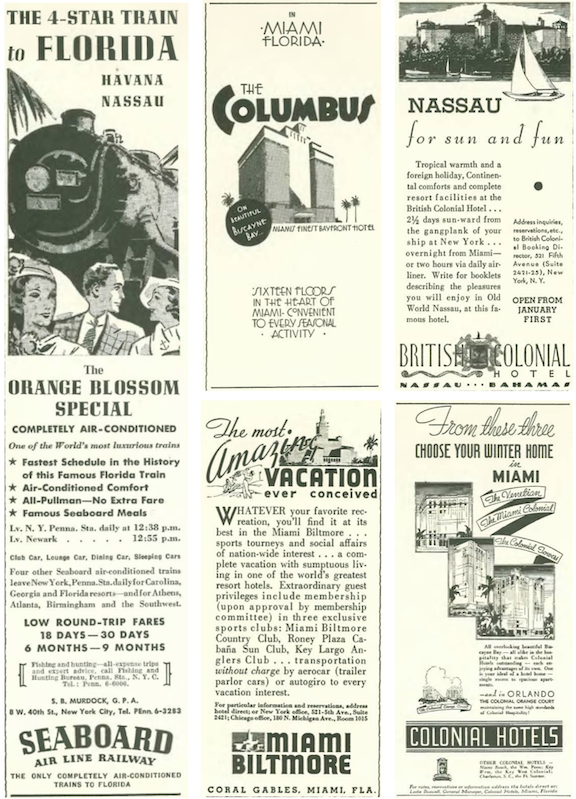
…with the holidays over, the number of ads decreased significantly, leaving readers with a mere sixty pages—less than the half the length of the fat pre-Christmas editions…the theme in the Jan. 4 issue was travel to warmer climes, these examples culled from several back of the book pages…
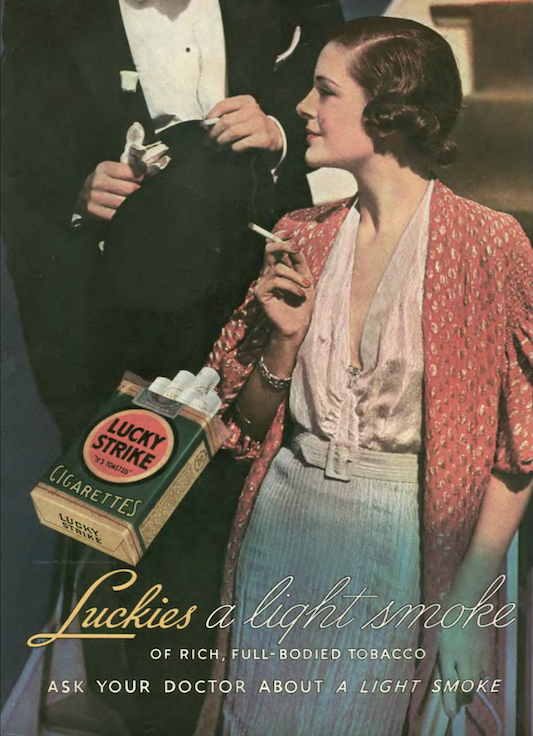
…the end of the holiday season did not stop tobacco companies from taking out lavish full-page advertisements targeting women smokers, this one gracing the back cover…note the implied medical endorsement at the bottom…
…we clear the air and move on to our cartoonists, beginning with spot drawings by D. Krán

…and Christina Malman

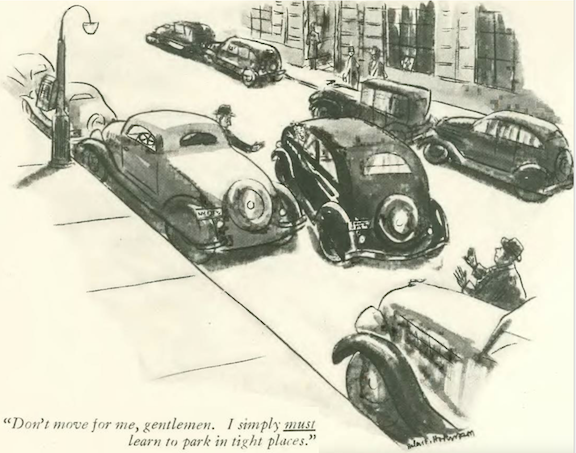
…one of Helen Hokinson’s girls sought an impromptu parking lesson…
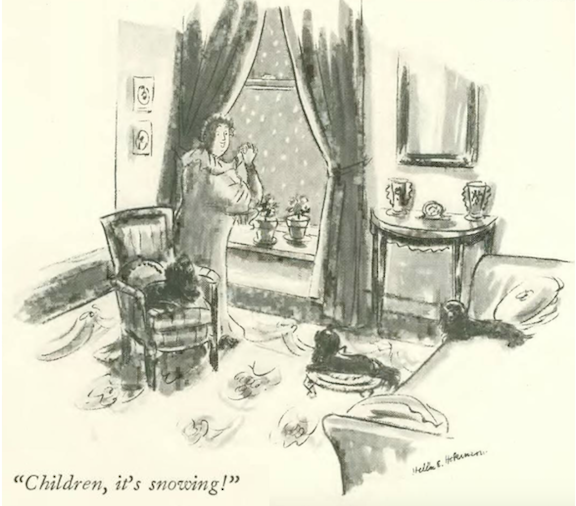
…while another welcomed winter with her furry charges…
Whitney Darrow Jr gave us a full-service information booth…

Mary Petty illustrated a dowager with simple tastes…

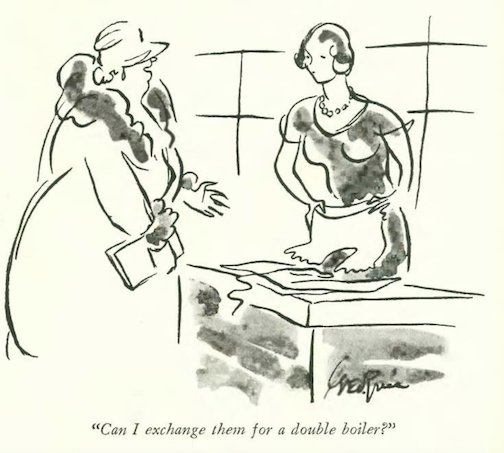
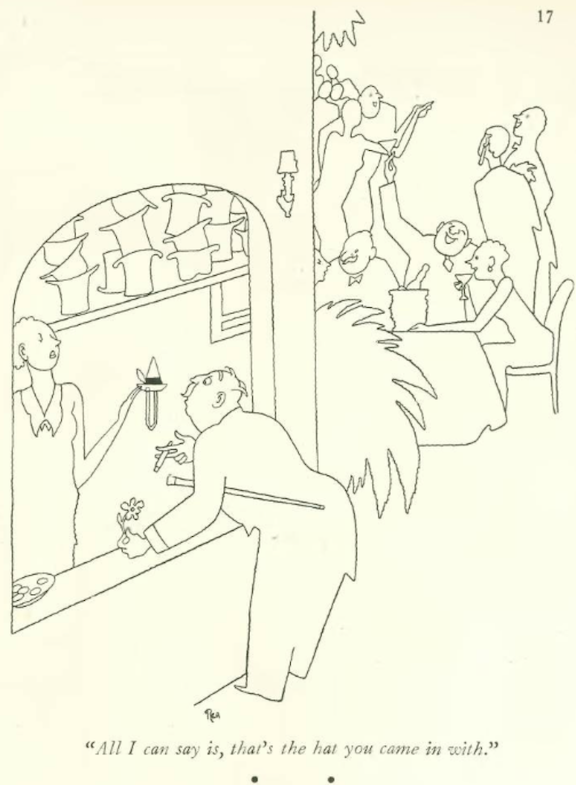
Gardner Rea was confounded at the hat check…
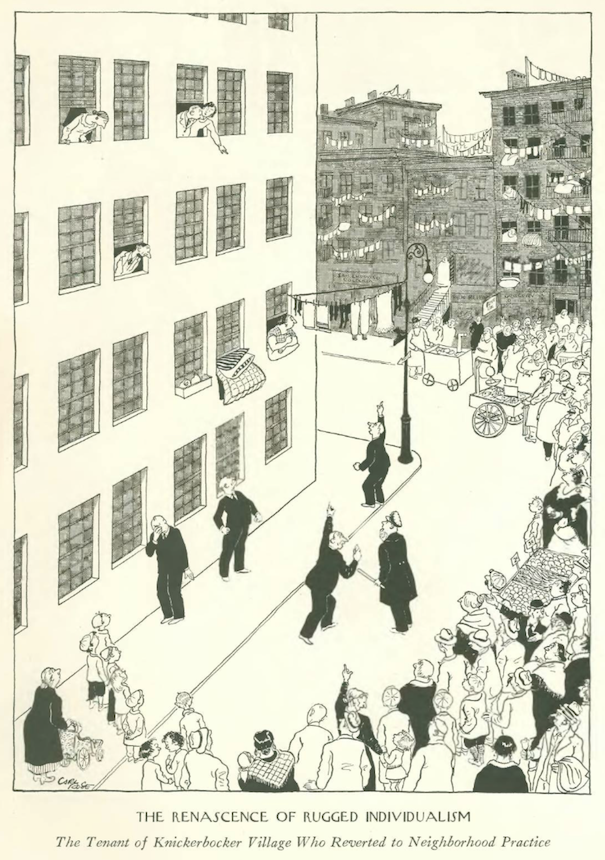
Carl Rose offered up another example of rugged individualism…
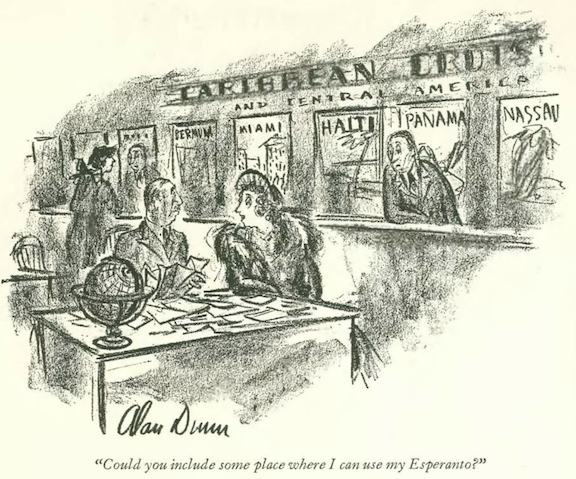
Alan Dunn served up a unique language challenge…
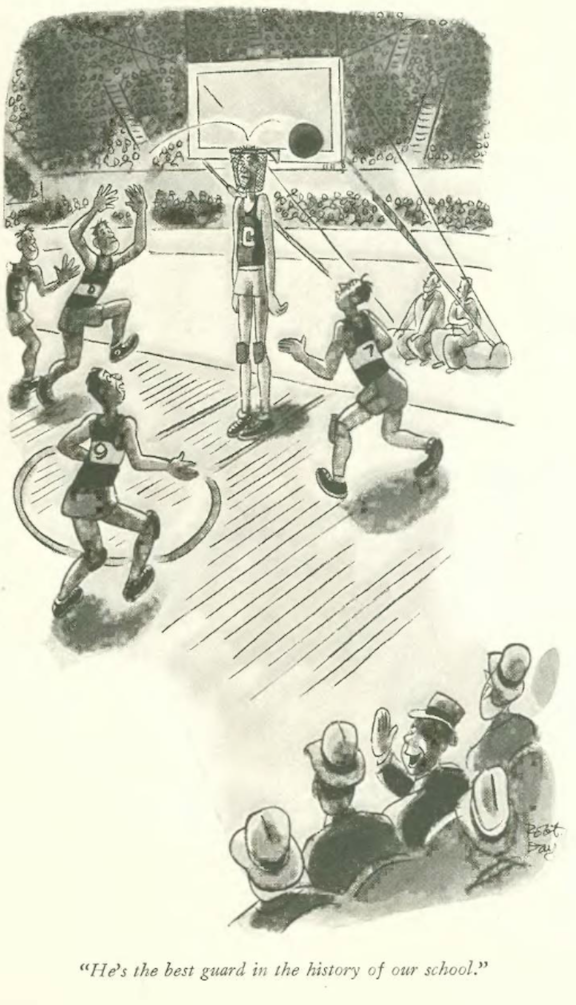
Robert Day stood tall at a basketball game…
William Crawford Galbraith was horsing around…

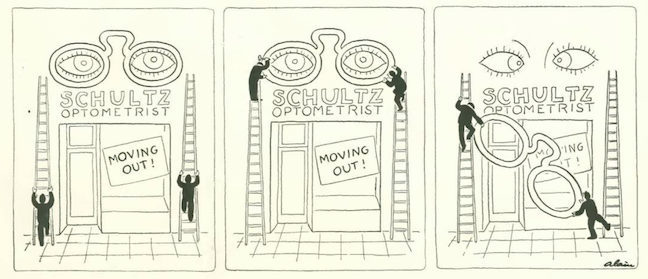
Alain looked crosseyed at a store closing…
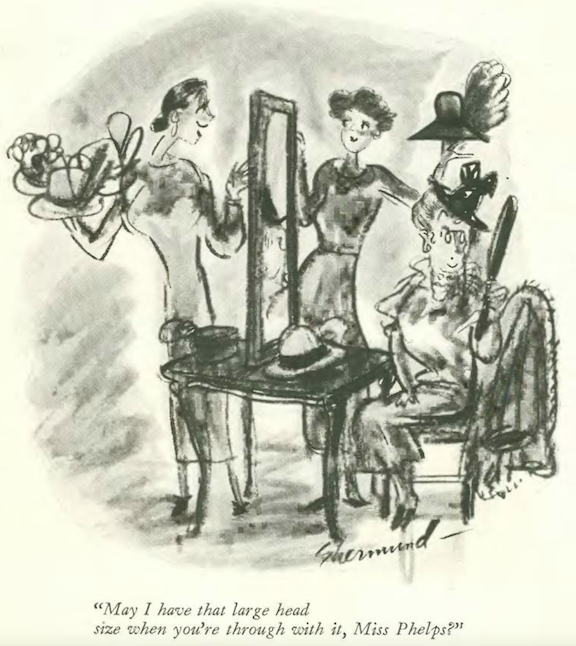
…and we close with Barbara Shermund, who sized up things at a hat shop…
Next Time: Obsessed at the Movies…

A Centennial to Remember

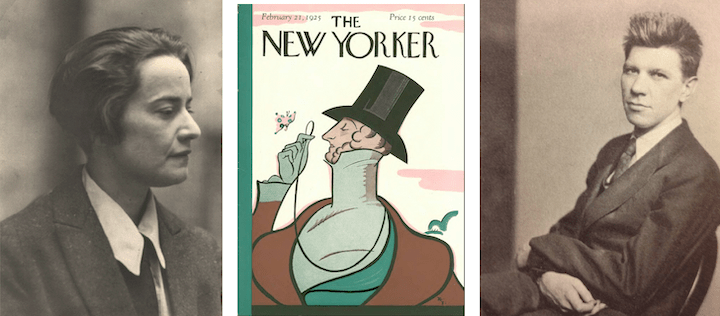
ABOVE: Although Harold Ross looms large in most accounts of the early New Yorker, his wife at the time, Jane Grant, played a major role in its conception and launch.

After a year hiatus, during which I changed jobs (yes, I’m still “hewing the wood and drawing the old wet stuff,” as Bertie Wooster would put it), I am returning to A New Yorker State of Mind, just in time for the 100th anniversary of the greatest magazine in the world.

Issue #1 cover by Rea Irvin, Feb. 21, 1925.

Before I continue where I left off—the tenth anniversary issue, Feb. 15, 1935—let us mark the magazine’s centennial year with a look back at the first issue, Feb. 21, 1925.

It is remarkable that after a century the magazine still retains its character, even if it is more serious these days, and more topical, and, most egregious, still fiddling with Rea Irvin’s original designs (for more on this issue, please consult Michael Maslin’s Ink Spill. In addition to being one of the magazine’s greatest cartoonists, Maslin offers a wealth of New Yorker insight and history, including his longstanding crusade to restore Irvin’s original artwork for “The Talk of the Town,” which was removed and replaced by a contemporary illustrator’s redraw in 2017).

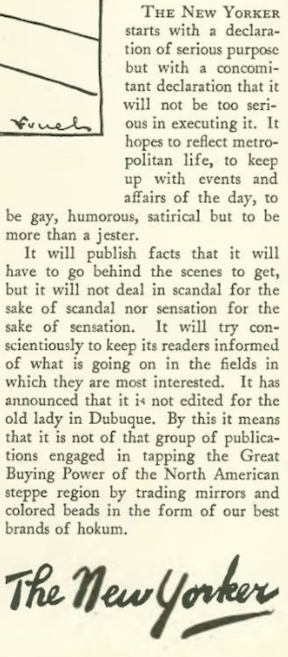
Although founder and editor-in-chief Harold Ross set the tone for the magazine in the first issue, famously proclaiming “that it is not edited for the old lady in Dubuque,” it was Irvin that gave the magazine a signature look that set it apart from other “smart set” periodicals of the day.

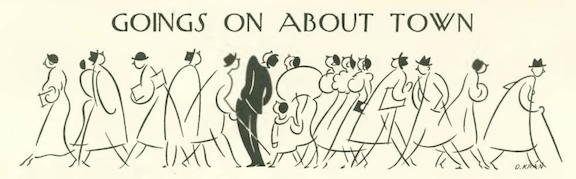
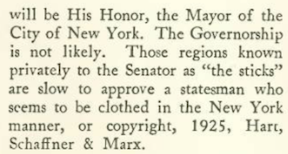
It took a few issues for the editors to sort out regular features and their order of appearance. The opening section of Issue No. 1 featured the Irvin masthead—flanked by Eustace Tilley and the night owl—and Irvin’s distinctive typeface that would introduce “The Talk of Town” for many issues to come. However, in that first issue, “Of All Things” appeared under the masthead, followed by “Talk of the Town” which was (for the first and last time) under this banner:

As for Ross’s manifesto, it appeared at the end of “Of All Things,”…

…and “Talk” ended with this signature…

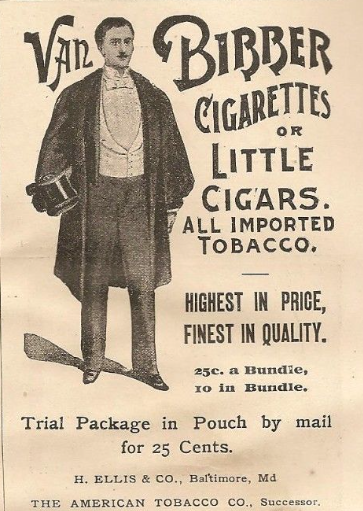
…In Defining New Yorker Humor, Judith Yaross Lee wrote that early readers of The New Yorker would have recognized the Van Bibber III persona “as a joke, a personification of Van Bibber cigarettes, whose ads targeted the devil-may-care, swagger young man about town all dressed up for the opening night. As an insiders view of the urban scene, Van Bibber’s accounts featured casual conversation—that is, talk.”

Van Bibber advertisement in Cosmopolitan, 1896.

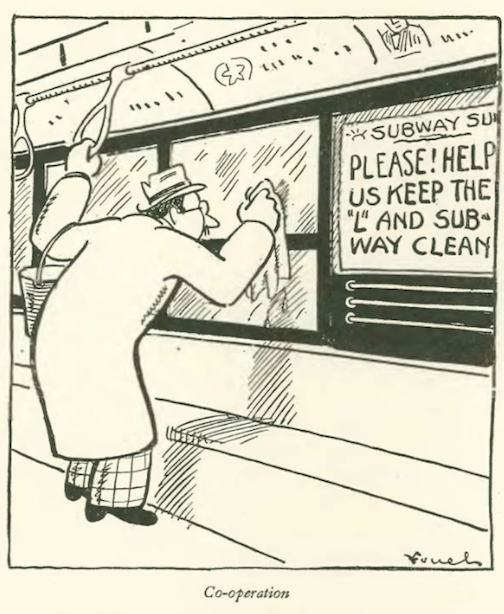
The magazine’s very first cartoon was by Al Frueh

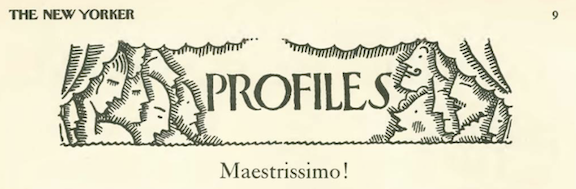
…and among the features that persisted through the years was “Profiles,” the first one featuring Giulio Gatti-Casazza (1869-1940), who served as Metropolitan Opera’s general manager for a record 27 seasons (1908-1935).

The profile featured this illustration by Miguel Covarrubias, the renowned Mexican painter, caricaturist, and illustrator, who was a frequent contributor to the early New Yorker.

“Goings On” also persists, sans the original artwork…

…the same goes for these sections…

…still others disappeared altogether…

…some would hang around for awhile…

…others for just a few issues…”The Hour Glass” featured brief vignettes of local personalities…

…such as the ever-fascinating antics of Jimmy Walker, who would soon be elected mayor…

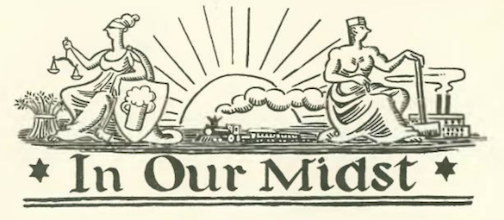
…while “In Our Midst” detailed the comings and goings of other locals…

…including The New Yorker’s own Al Frueh.

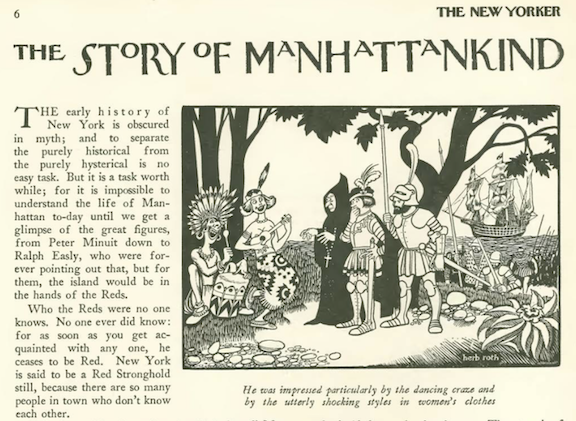
“The Story of Manhattankind” was another short-lived feature. It offered drawings by Herb Roth and tongue-in-cheek accounts of early Manhattan life replete with cartoonish Indians and bumbling settlers. It is here where the magazine took its first of many shots at William Randolph Hearst, the perceived rival and publisher of Cosmopolitan (which was more of a literary magazine in 1925).

…other items that persisted through the early issues included “Lyrics from a Pekinese” by writer Arthur Gutterman, who was known for his silly poems…

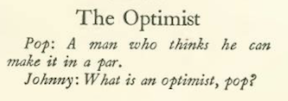
…and this recurring column filler, “The Optimist”…a tired joke featured repeatedly in the first issues until Katharine Angell came on board and put an end to such nonsense…

…in those lean first months there was little advertising, making this back page ad seem out of place…

…since many of the early ads were small, signature ads for theatre and other diversions…

…the magazine also leaned heavily on full-page house ads to fill space…

…the one thing that has persisted to this day is the prominence of cartoonists and illustrators, although in the early issues some of the cartoons resembled those found in Punch, including this one by British graphic artist Alfred Leete, who was a regular contributor to such British magazines including Punch, the Strand Magazine and Tatler.

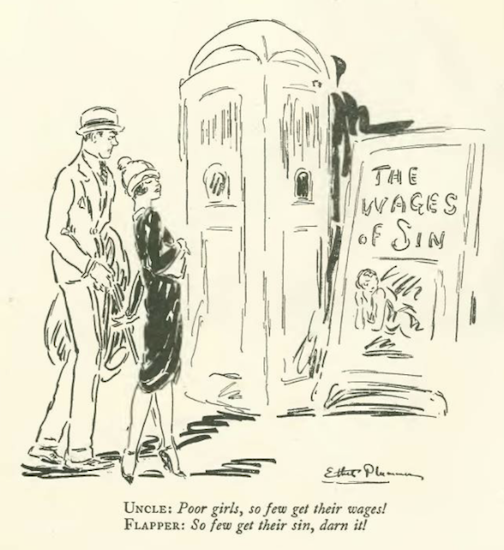
Also in the Punch style there were a number of “He-She” captioned cartoons, such as this Ethel Plummer cartoon of an “uncle” and a “flapper” looking at a theater bill for The Wages of Sin (most notably, Plummer was the first woman artist published in The New Yorker)…

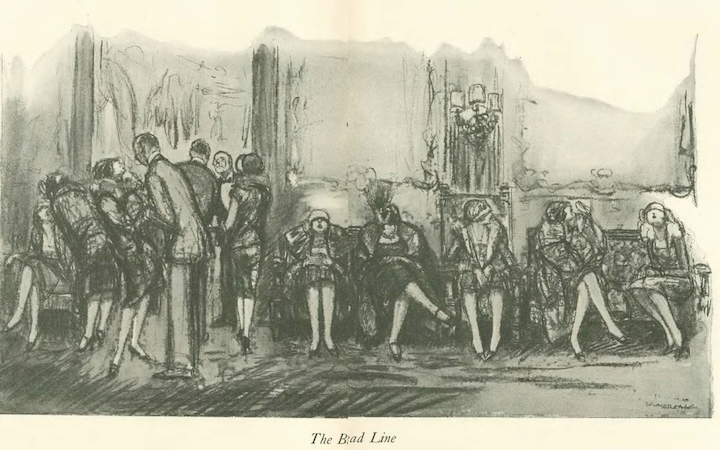
Plummer was a noted artist/illustrator in her day, as was Wallace Morgan, who contributed this two-page spread, “The Bread Line”…

…this illustration by Eldon Kelley is notable for what it lacks…namely, clothing. Early New Yorker lore has it that Ross was somewhat puritanical, and shied away from suggestions of sex or nudity, but here it is in the first issue, what Michael Maslin refers to as “The New Yorker’s First Nipples.” 

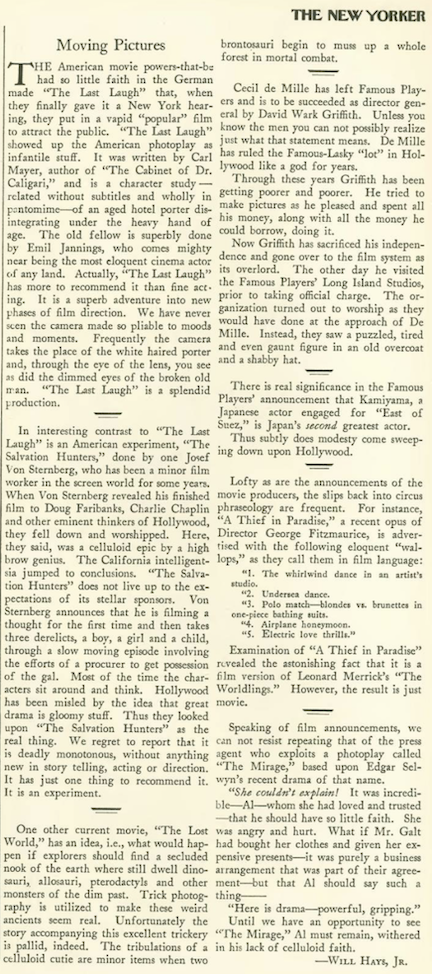
…and before I go, I am wondering about The New Yorker’s first film critic, who signed his review “Will Hays Jr.” Is this the same Hays as in the “Hays Code?” I will investigate.

Next Time: A Century and a Decade…


Comrade Alex

If folks thought things were bad in Depression-era America, they could ponder the famine-ravaged masses in the Soviet Union…

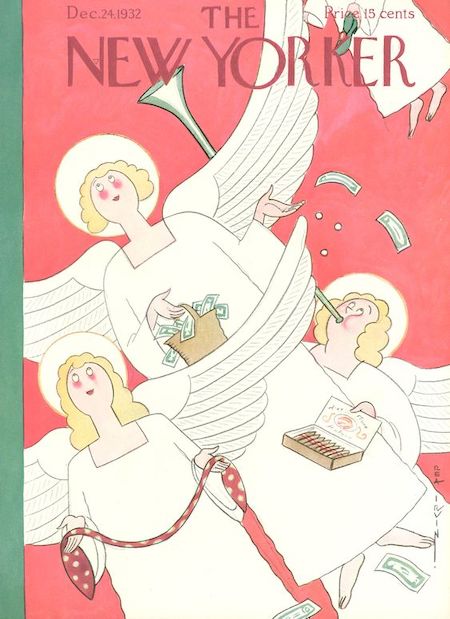
Dec. 24, 1932 cover by Rea Irvin.

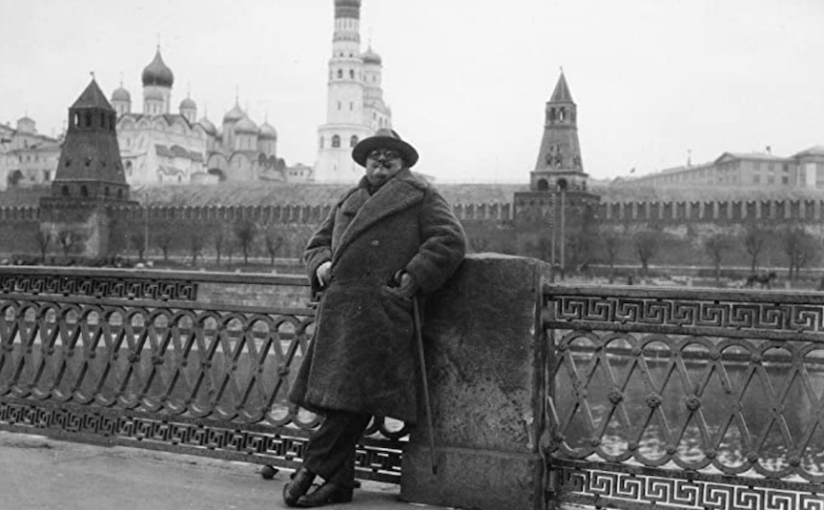
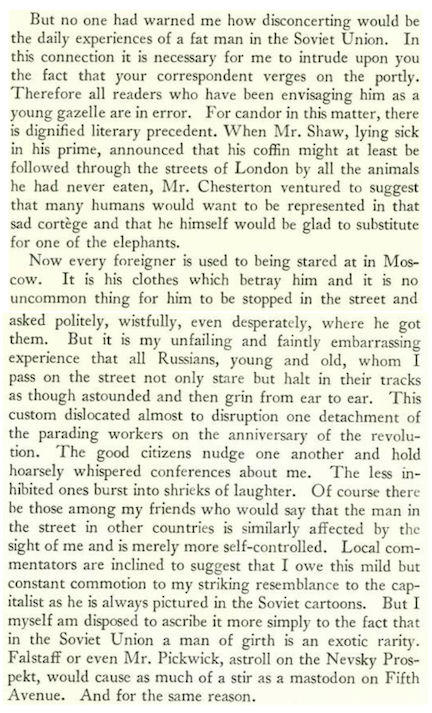
…not that Alexander Woollcott seemed to notice or care all that much. In the autumn of 1932 he traveled to Moscow to check out some Russian theater and enjoy the fine food and drink provided by his friend Walter Duranty, Moscow bureau chief for The New York Times. In his “Shouts and Murmurs” column…

…Woollcott reflected on his Moscow visit, his humor at odds with the stark reality  all around him…

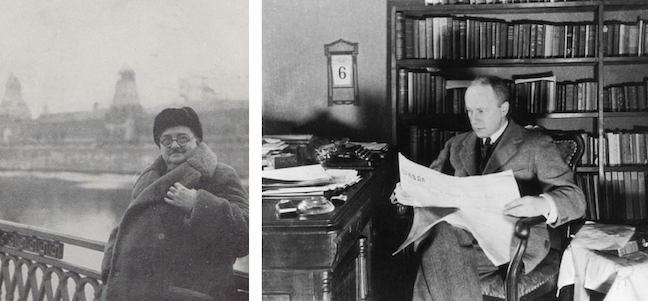
ELEPHANT IN THE ROOM…Alexander Woollcott (left) was amused by the stares of starving Russians he encountered with his substantial bulk on the streets on Moscow; Walter Duranty (1884–1957), Moscow bureau chief for The New York Times, played host to his old friend Woollcott. (Pinterest/Daily Mail)

Woollcott wrote of “spindle-shanked kids” singing cheerless songs about tractor production, recounted a conversation with a hungry moppet at a boot factory, and noted the “appreciative grin” he received from a teenager who both envied and admired his girth:

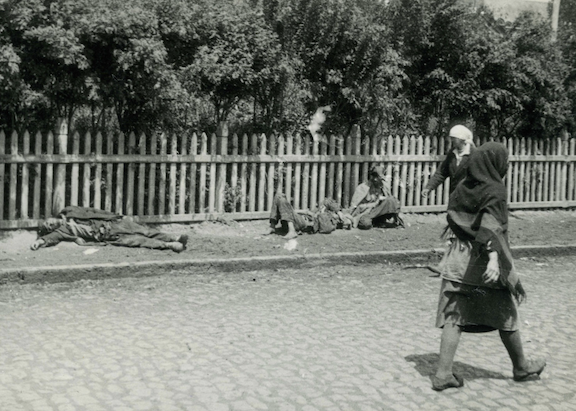
PERHAPS A SIDE TRIP TO UKRAINE?…Starved peasants on a street in Kharkiv, 1933. Millions of Ukrainians died during Stalin’s enforced famine. (Wikipedia) 

*  *  *

Happier Thoughts

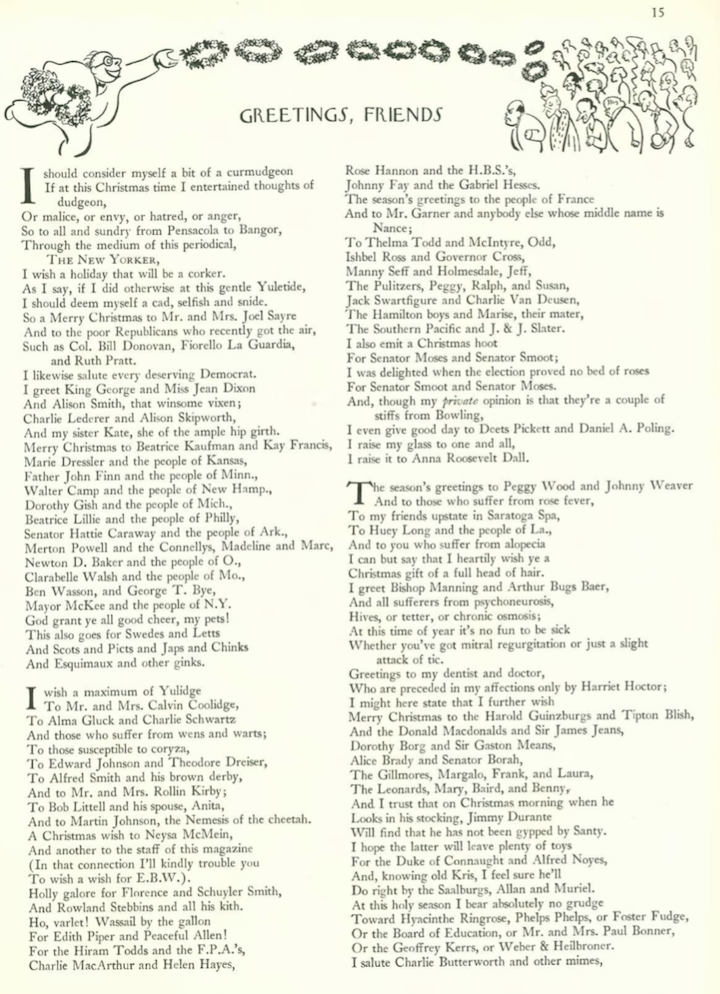
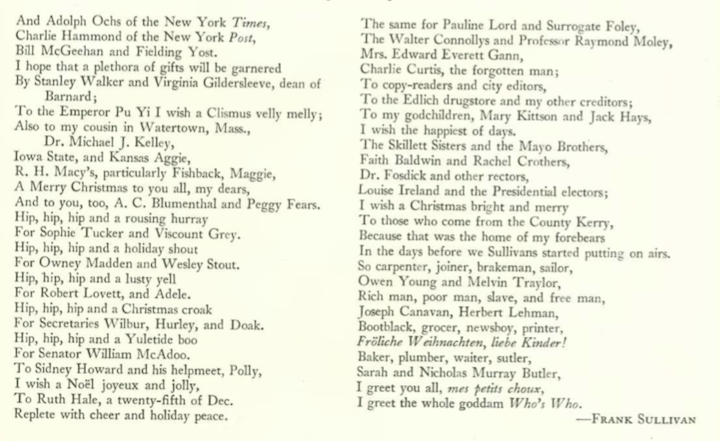
The Dec. 24 issue marked the beginning of a New Yorker tradition: Frank Sullivan’s annual holiday poem, “Greetings, Friends!” Writing for the Dec. 17, 2009 issue of The New Yorker (“Behind the Writing: “Greetings, Friends!”) Jenna Krajeski observes that “as far as holiday poems go, ‘Greetings, Friends!’…is as much an acknowledgment of the season as a noting of the times.” Frank Sullivan faithfully continued the tradition until 1974; after his death in 1976, New Yorker editor William Shawn asked Roger Angell to take over the writing of the poem. In 2012 Angell passed the duty along to Ian Frazier, the magazine’s current Yuletide bard.

CHEERFUL BUNCH…The holiday poem “Greetings, Friends!” has been a New Yorker tradition since 1932. It was originated by Frank Sullivan (left) and carried on by Roger Angell (center) and Ian Frazier. (hillcountryobserver.com/latimes.com/gf.org)

*  *  *

Waxing Poetic, Part II

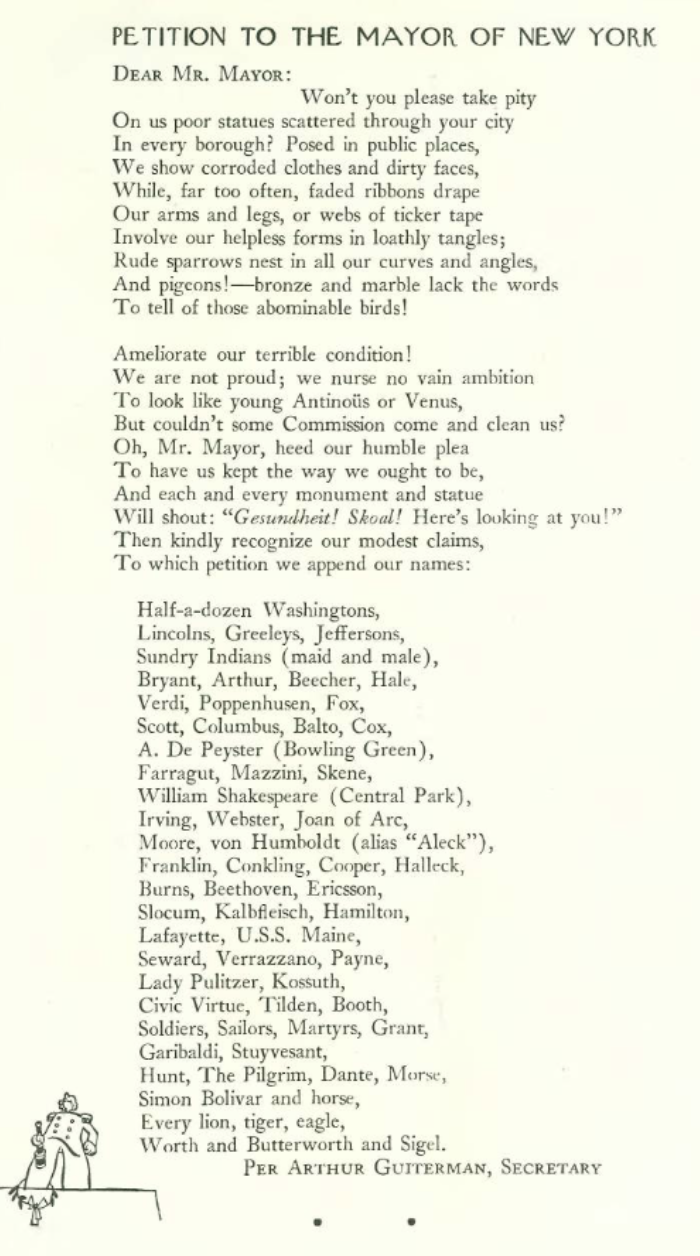
In the Dec. 17, 1932 issue humorist and poet Arthur Guiterman penned this petition to Acting Mayor Joseph McKee on behalf of the city’s statues…

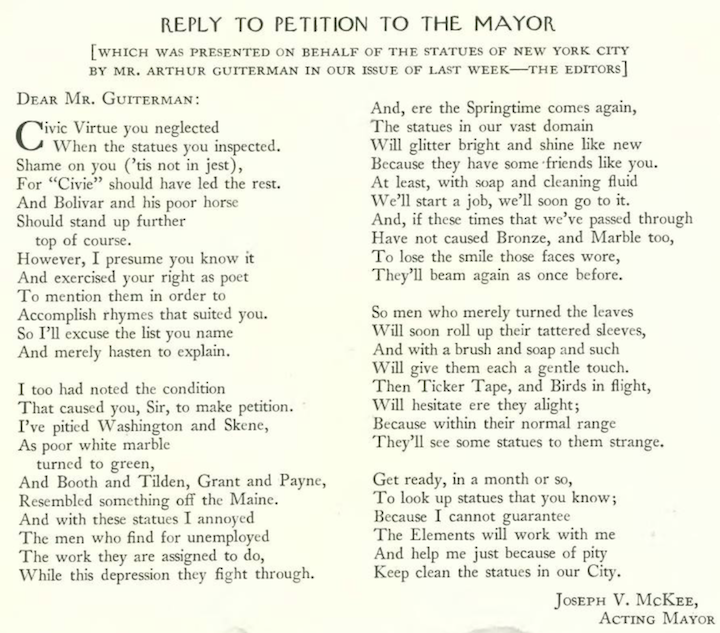
…to which Mayor McKee replied in the Dec. 24 issue:

DUELING POETS…Acting New York Mayor Joseph McKee (left) rarely smiled in photographs, but he seems to have been a person of good humor in his poetic reply to Arthur Guiterman. Both photos are from 1932. (Wikipedia/credo.library.umass.edu)

*  *  *

From Our Advertisers

New York’s fashion merchandisers continued to tout their latest copies of Paris styles such as this “Poppy Dress” from Lord & Taylor (illustration by Mildred “Melisse” Oppenheim)…

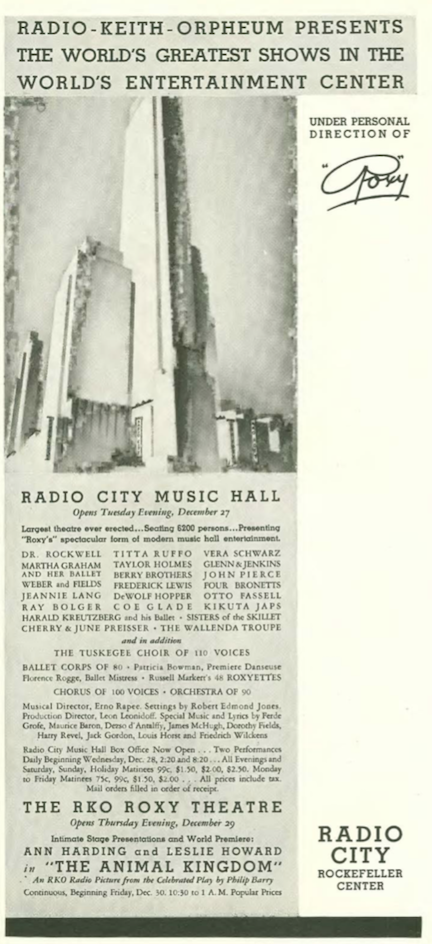
…Radio City Music Hall and the RKO Roxy Theatre announced their grand openings…

…Radio City featuring a cavalcade of stars along with the “Roxyettes” (soon to be renamed “Rockettes”) while the RKO Roxy presented the pre-Code romantic comedy The Animal Kingdom

LIGHT IN THE DARKNESS…It was winter, and the Depression was still on, but there were bright spots to be found on the stage at the opening of Radio City Music Hall and on the screen at the RKO Roxy; at right, Ann Harding, Leslie Howard and Myrna Loy in The Animal Kingdom. (Pinterest/IMDB)

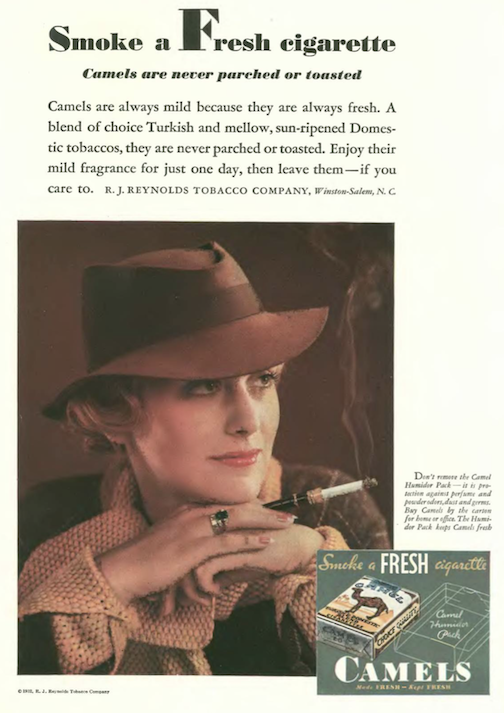
…the folks at R.J. Reynolds challenged smokers to “leave” their product, if they cared to, knowing full well they were hooking new smokers by the thousands every day…

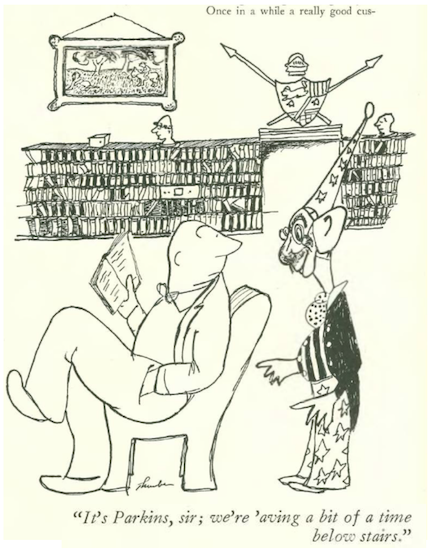
…we ring in the New Year with some hijinks from James Thurber

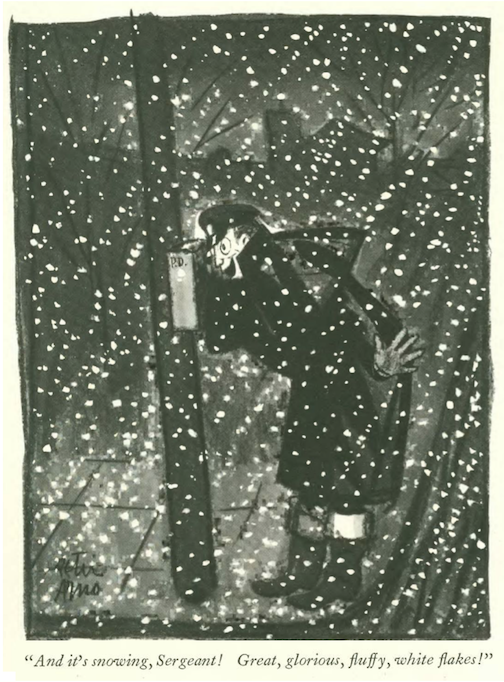
…and this unlikely dispatch from a New York police officer via Peter Arno

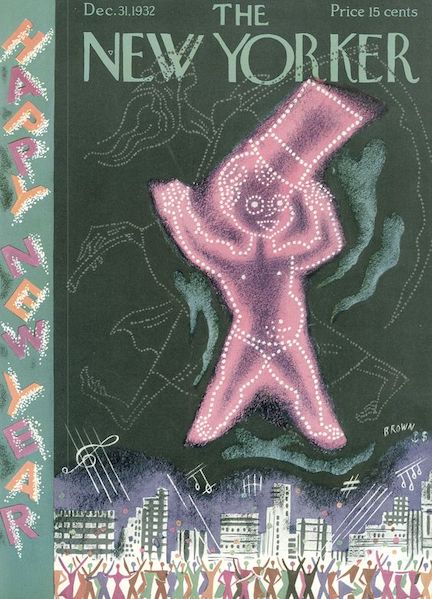
…ringing in the year with Harry Brown’s Dec. 31 cover…

Dec. 31, 1932 cover by Harry Brown.

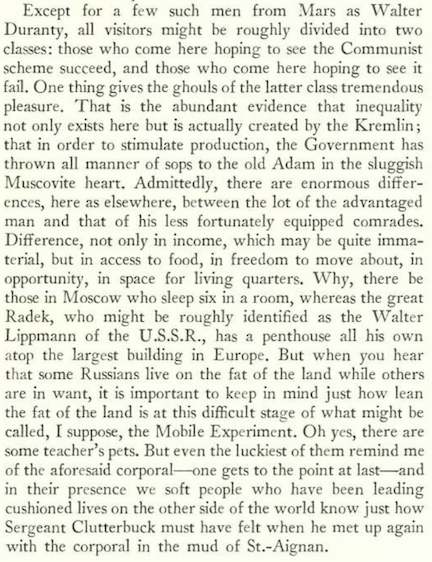
…and Alexander Woollcott’s continuing account of his visit to Moscow, where he was shown the town by his friend Walter Duranty. In this excerpt, Woollcott makes a rare political observation regarding his friend: “Except for a few such men from Mars as Walter Duranty, all visitors might be roughly divided into two classes: those who come here hoping to see the Communist scheme succeed, and those who come here hoping to see it fail.”

For the record, Duranty has been widely criticized, especially since the 1950s, for his failure to report on the 1932-33 famine (which claimed as many as 7 million lives) and for covering up other atrocities of the Stalin regime. In the 1990s there were even calls to revoke Duranty’s 1932 Pulitzer Prize, which was awarded for his reporting on the Soviet Union.

GOOD & PLENTY…Walter Duranty (center, seated) at a dinner party in his Moscow apartment. (spartacus-educational.com)

*  *  *

Rocky Theme

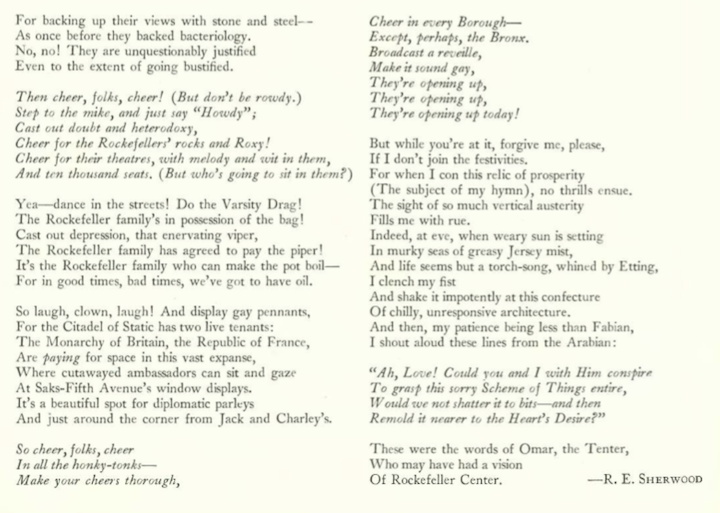
As Rockefeller Center prepared to open its doors to its first buildings (there would be fourteen in all) American playwright and screenwriter Robert E. Sherwood  penned this hymn to the “Citadel of Static”…

STANDING TALL…American playwright and screenwriter Robert E. Sherwood, one of the original members of the Algonquin Round Table, was moved to verse by the opening of Rockefeller Center’s first buildings. At left, Rockefeller Center in 1933. (Wikipedia)

*  *  *

Oh Chute

In 1929 Geoffrey Hellman secured a position with The New Yorker as a writer for “The Talk of Town” and also contributed a number of profiles, including this one about a parachute stunt-jumper named Joe Crane. Here is the opening paragraph and an illustation by Abe Birnbaum:

On Feb. 18, 1932, Joe Crane amazed crowds at Roosevelt Field with double parachute descent, in which he opened a second parachute through the first. If you are wondering, Crane died in 1968…of natural causes. (Pinterest)

 *  *  *

From Our Advertisers

Illustrator Howard Chandler Christy (1872-1952) is best remembered for his patriotic poster designs of World War I, which might explain why this fellow looks a bit outdated…

…Christy also originated the popular “Christy Girl,” the embodiment of the ideal American woman in the early 1900s (note the Christy Girl’s resemblance to the woman in the ad above)…

A “Christy Girl,” from 1906. (Internet Archive)

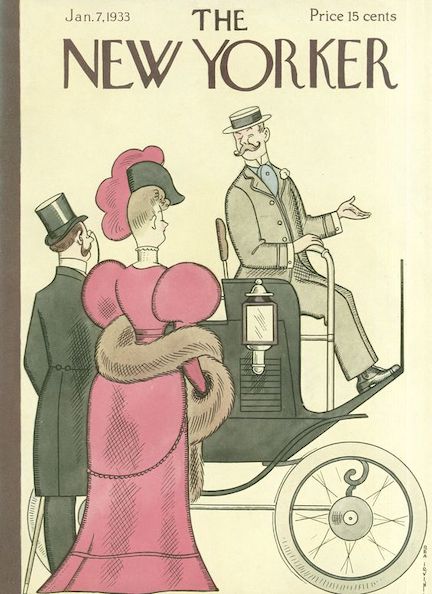
…speaking of ideal, imagine a movie featuring this trinity of actors: John, Ethel and Lionel BarrymoreJohn Mosher will give us his review in Jan. 7 issue…

…the Lyric Theatre saw its glory years during the 1920s when it hosted stage shows featuring such talents as The Marx Brothers, Fred and Adele Astaire and a young Cole Porter, who hit it big in 1929 with Fifty Million Frenchmen…the 1930s, however, saw the Lyric’s fortunes diminish and in another year it would be converted into a movie house…also note the influence of Italian Futurists in this ad for an Italian theater troupe…

…and there’s also a futuristic bent to this Garrett Price cartoon, which steers more in a Kandinsky direction…

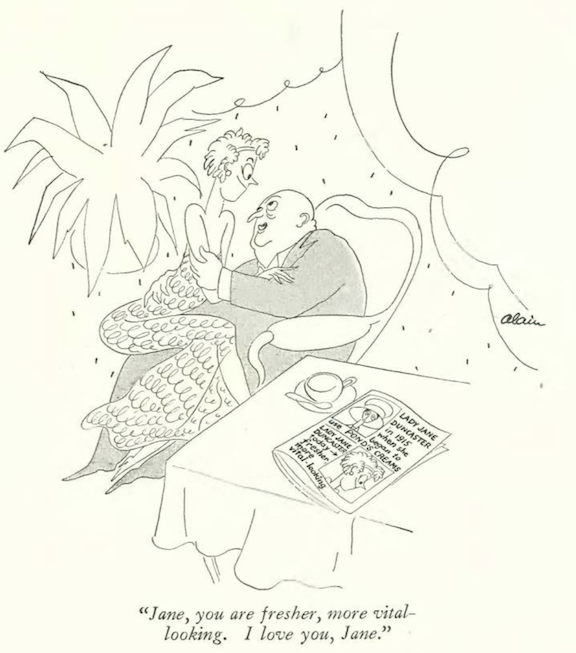
…cartoonists were also finding inspiration in the magazine’s advertising, Pond’s cold cream providing the spark for Alain (aka Daniel Brustlein)…

…for reference, a Pond’s ad from 1933 comparing Lady Diana Manners complexion to her former visage, circa 1924…

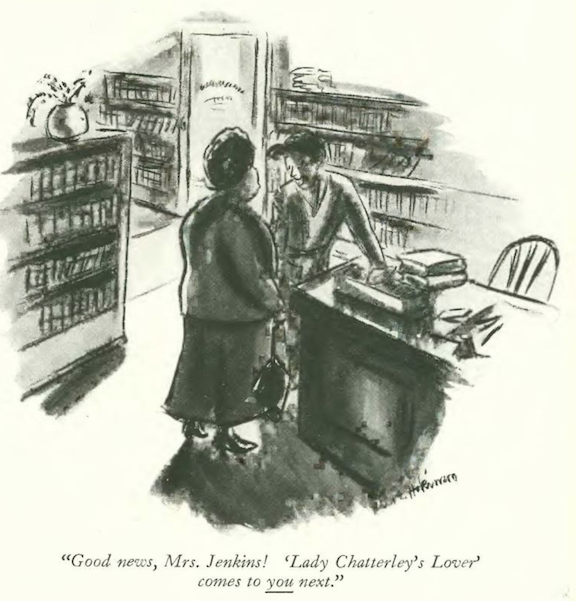
Lady Chatterley’s Lover, by D. H. Lawrence, was banned for obscenity in the United States in 1929, but Helen Hokinson’s enterprising librarian was still able to deliver the goods…

…on the other hand, it is doubtful George Price’s sales clerk will also deliver…

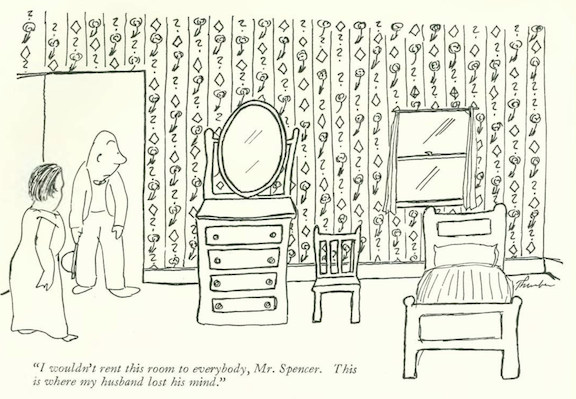
…a great one by James Thurber, with more detail than his usual spare line…

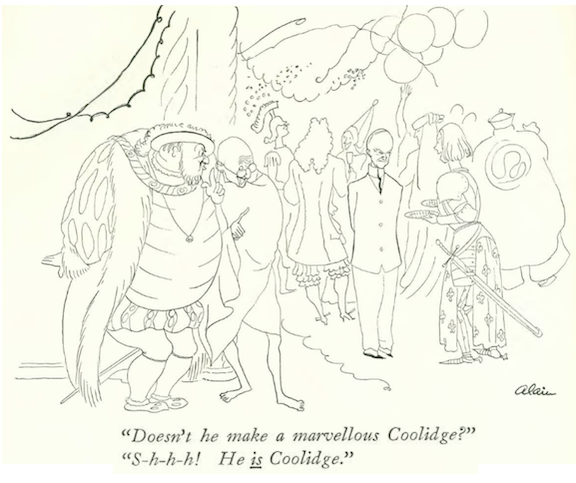
…and we say goodbye to 1932 with Alain, and a New Year’s Eve party with some familiar faces…

Next Time: Modernism Lite…

From Bad to Awful

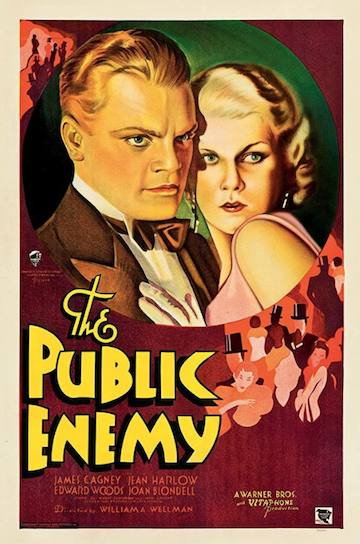
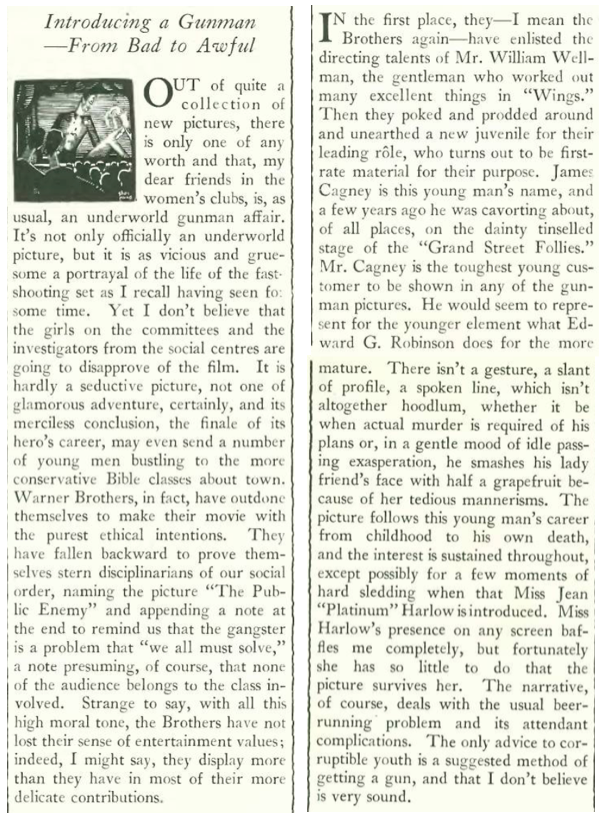
In the previous issue, New Yorker film critic John Mosher examined the morals of pre-code, “underworld films” such as Edward G. Robinson’s Little Caesar. Mosher didn’t seem all that impressed with these new gangster films, that is, until James Cagney lent his talents to The Public Enemy.

May 2, 1930 cover by Theodore Haupt.

Despite its violence (by yesterday’s standards), Mosher believed that even the preachers and various women’s committees who decried the sex and violence in pre-code movies would have little to gripe about with The Public Enemy, since it clearly depicted the wages of the sins of Tom Powers, a bootlegger on the rise portrayed by Cagney.

YOU AGAIN?…New Yorker film critic John Mosher thought very little of Jean Harlow’s acting, but Warner Brothers heavily promoted their new sex symbol, giving her equal billing even though she contributed little to the film. In the previous issue, Mosher had reviewed the film Iron Man, which also featured Harlow. He found it distressing that it was her “platinum blonde” status, rather than her acting, that landed her in that picture. (IMDB)

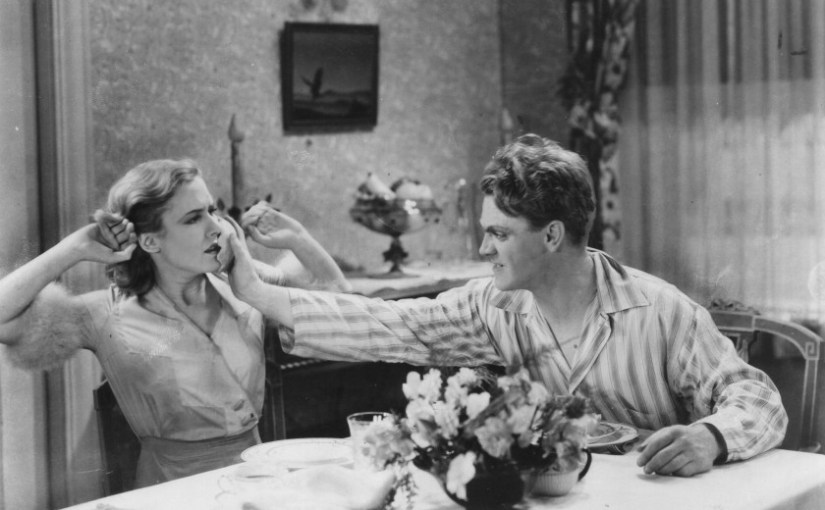
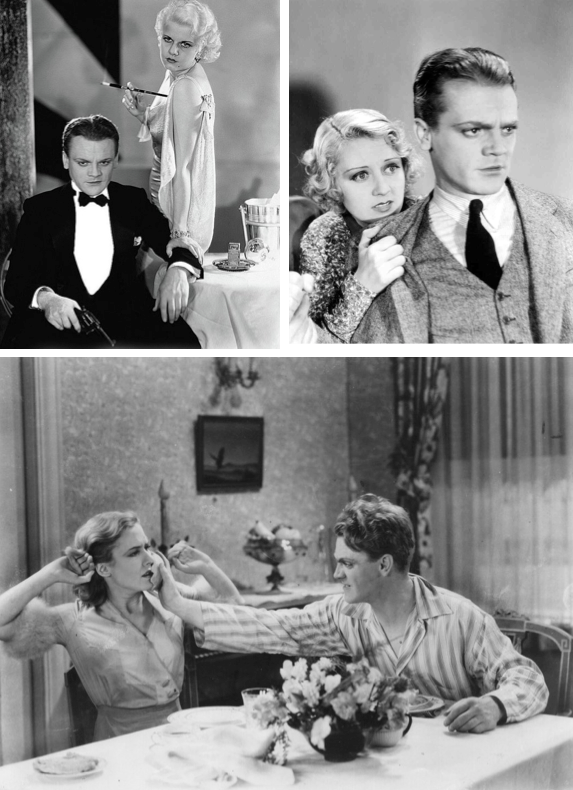
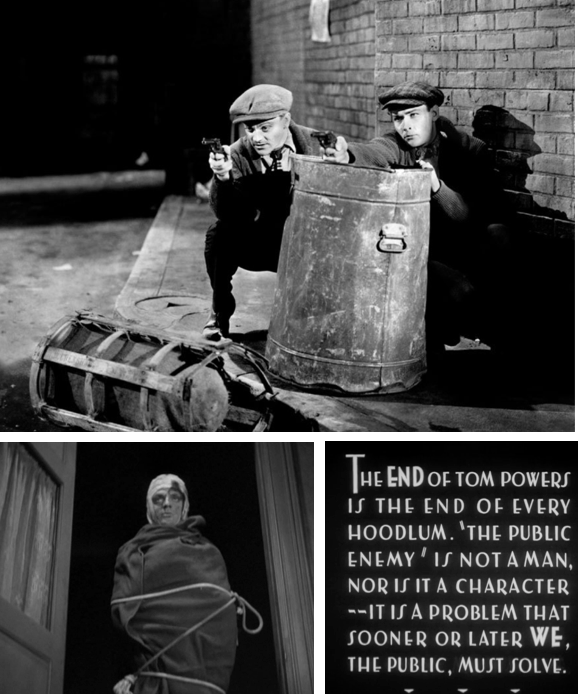
WOMEN IN HIS LIFE…James Cagney played a small-time bootlegger, Tom Powers, who rose in the criminal underworld in Public Enemy. Top left: Powers with Gwen Allen (Jean Harlow), a woman with a weakness for bad men. Top right: Joan Blondell portrayed Mamie, the girlfriend of Powers’ friend, Matt Doyle (Edward Woods). Blondell, one of the biggest stars of the 1930s, worked often with Cagney. In 1930 they were in Penny Arcade on Broadway and co-starred in the film Sinner’s Holiday. They would make several more films together after Public Enemy. Bottom photo: Tom smashes a grapefruit into the face of his first girlfriend, Kitty (Mae Clarke). Although this is one of Public Enemy’s most iconic scenes, Clarke was uncredited in the film. (IMDB)
WHAT HAPPENS WHEN YOU’RE NAUGHTY…Top, Tom Powers (Cagney) and his buddy, Matt Doyle (Woods) shoot it out in an alleyway. Bottom, the film ends with one of cinema’s greatest death scenes — awaiting the return of his brother to the family home, Mike Powers (Donald Cook) opens the door to be greeted by Tom’s corpse, which falls over the threshold. Just in case the audience didn’t get the message, Warner Brothers included this epilogue after the death scene. (IMDB/YouTube)

 *  *  *

Flag of a Father

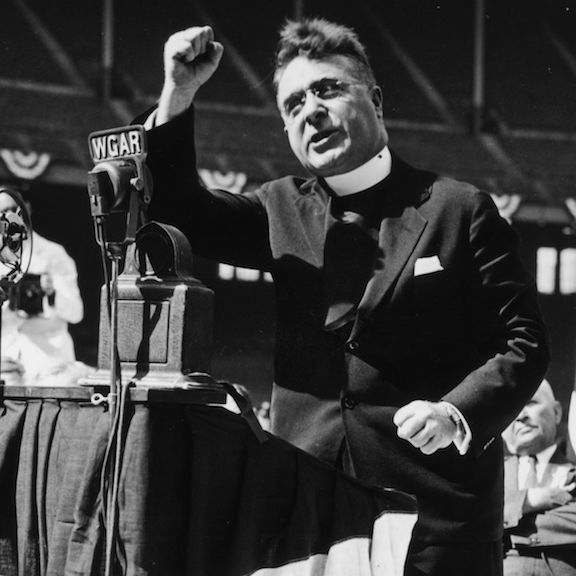
Speaking of morality, no voice was louder, or carried farther, than that of Charles Edward Coughlin (1891-1979), known familiarly as “Father Coughlin,” an enormously popular radio priest who had an estimated following of 30 million listeners in the 1930s. E.B White took notice of this phenomenon, and also the Father’s stand against “internationalism,” which in a few years would morph into a virulent nationalism and anti-semitism that would find the Father finding common cause with Hitler and Mussolini. Yes, those guys. But for now, we are still in 1931…

SAVING SOULS?…Fr. Charles Coughlin preached nationalism and anti-semitism in his widely broadcast radio show in the 1930s. He was one of the first demagogues to effectively use the mass media to his advantage. (Detail of Library of Congress photo)

 *  *  *

Paradise Lost

Far up the Henry Hudson Parkway, just before you cross Spuyten Duyvil Creek (Harlem River) into Younkers, is a park with a history that goes back to a Lenape tribe that occupied the site prior to European settlement. Inwood Hill Park is where, legend has it, Peter Minuit purchased Manhattan from the Lenape on behalf of the Dutch West India Company.

ORIGIN STORY…It was purportedly under this tulip tree that the Lenape tribe sold Manhattan to Peter Minuit in 1626. The tree was felled by a storm in 1933. A large stone (inset) marks the spot today. (Wikipedia)

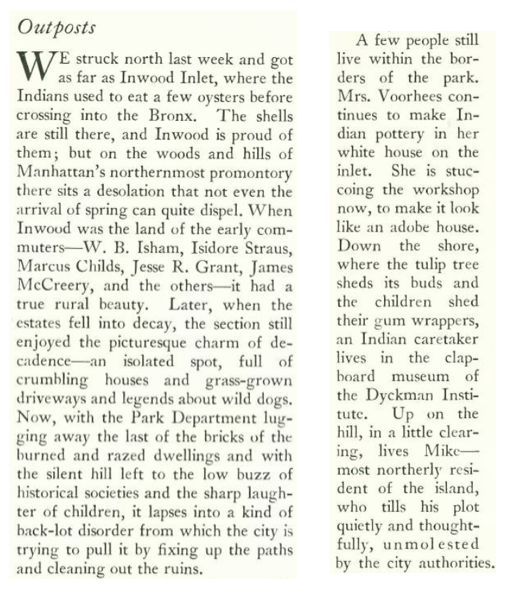
Inwood served as a location for a fort during the Revolutionary War, and was dotted with working farms including one owned by the Jan Dyckman family, established in 1661. In the 19th century a number of wealthy New Yorkers built country retreats around Inwood, which became a park in 1926. Squatters continued to live in abandoned estates around the edge of the park until Robert Moses came along in the 1930s and cleared them out. E.B. White, in “The Talk of the Town,” takes it from there.

WE CALL IT HOME…In 1931, Marie Naomie Boulerease Constantine Kennedy, an American Indian known as Princess Naomie (left) was a caretaker of the old Dyckman farm (below), which had fallen into disrepair by the late 1800s and was restored in 1916. At right, LePrince Voorhees and her husband, Harry Voorhees, at the door of their ramshackle Inwood Hill Pottery. (myinwood.net/MCNY)

The Dyckman farmhouse fell into disrepair by the late 1800s, seen here in 1892…

(myinwood.net)

…but it was restored in 1916, and still stands today at Broadway and 204th Street…

(myinwood.net)

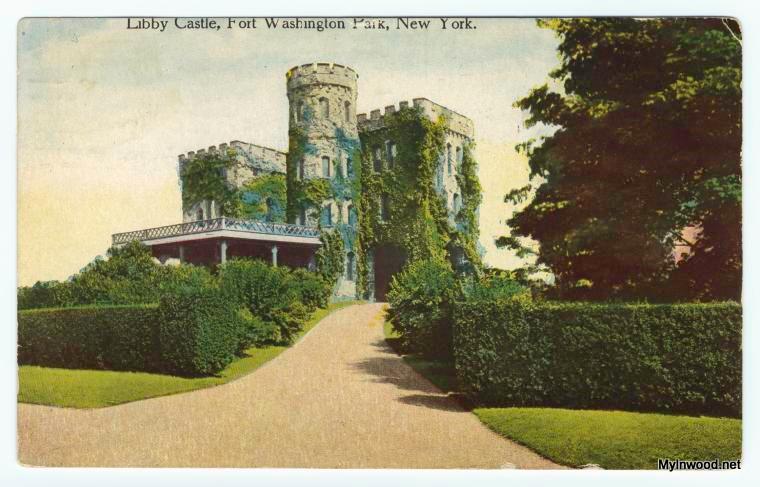
White wondered how Inwood would appear in ten years, now that parks workers were paving over the old Indian trails and landmarks like the Libby Castle were being torn down to make way for John D. Rockefeller’s Cloisters and Fort Tryon Park.

Built around 1855, Libby Castle was home to several New York bigwigs including William “Boss” Tweed of Tammany Hall fame. It was bulldozed in 1930-31 to make way for John D. Rockefeller’s Cloisters.

(myinwood.net)

Inwood contained the last remaining farms in Manhattan — below are cows grazing in 1900 at site today now occupied by Isham Park, located on the southeast edge of Inwood Park. The next photo, from 1895, identifies “the last field of grain on Manhattan Island.” In the background is the Seaman Mansion at Broadway and 216th Street…

(myinwood.net/MCNY)

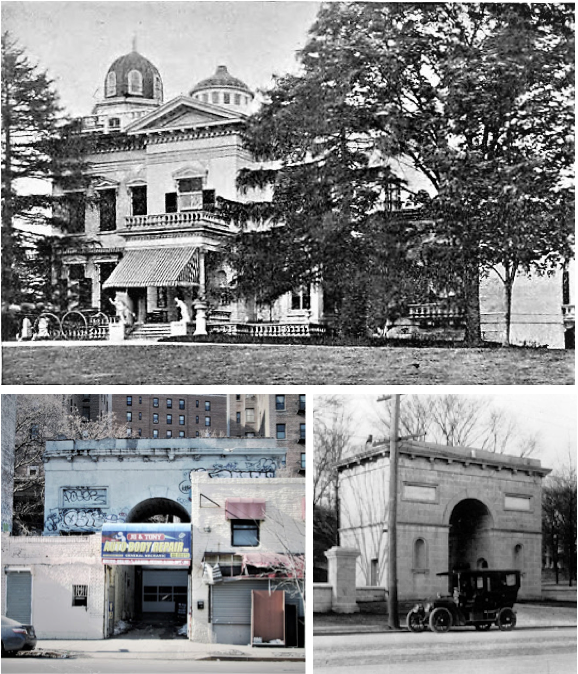
Below is a closer view of Seaman Mansion, a white marble, 30-room pile built around 1852. When this photo was taken in 1895, it had just become the new home of a riding club. Entry to the mansion was through a gatehouse, pictured below at right. The mansion was demolished in 1938 as the area around it filled up with cheap commercial buildings. Only the gatehouse remains, crumbling behind an auto body shop as seen in this 2015 image (bottom left):

(daytoninmanhattan.blogspot.com/Google Maps)

And here’s the latest view from Google maps. Note how the business is now renamed (ironically, yes) after the crumbling arch behind it…

But let’s be fair; there is still much beauty to be had at Inwood. Check out this lovely fall panorama…

(Wikipedia/Barry Solow, November 2010)

 *  *  *

Rub-a-Dub-Dub

One of the great British modernists of the 20th century — perhaps best known for his 1915 novel, The Good Soldier — Ford Madox Ford (1873 – 1939) led a complicated personal life filled with indecision and anxiety. It makes sense that a man, in search of some order in his life, imposed a strict routine on bath time (and also found time for a bit of humor). Here is an excerpt from Ford’s submission to the May 2, 1931 New Yorker:

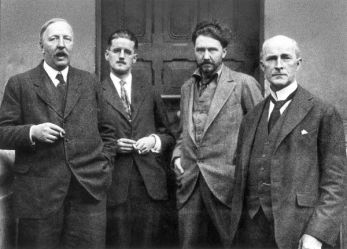
LITERARY LIONS…Ford Madox Ford (left) poses with other literary greats of the 20th century in a photo taken in Paris, November 1923. Next to Ford are James Joyce, Ezra Pound and John Quinn. (justewords.com)

 *  *  *

Tete-a-tete

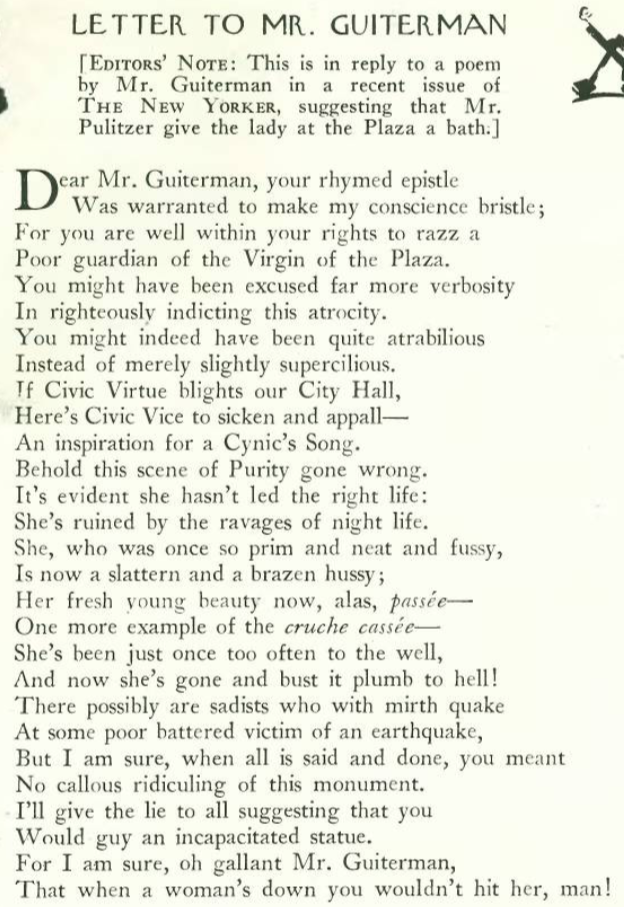
Humorist and poet Arthur Guiterman was a regular contributor of comic verse to The New Yorker from its first days in 1925 until his death in 1943. In the April 18, 1931 issue, he dashed off this poem to Ralph Pulitzer, imploring him to give his family’s namesake Plaza fountain, and its “goddess of abundance,” a much-needed scrubbing…

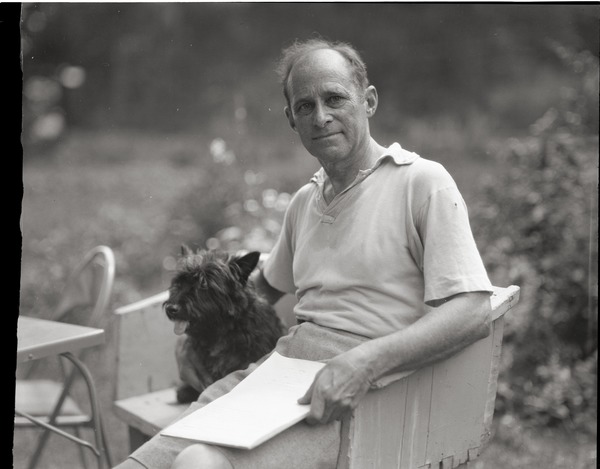
KEEP IT CLEAN, RALPH…Arthur Guiterman, shown here seated with his Scottish terrier in August 1931, asked Ralph Pulitzer to do a bit of scrubbing on the family’s namesake Grand Plaza fountain. (UMassAmherst)

No doubt to Guiterman’s delight, he received a reply in the May 3 issue, also in verse, from Ralph Pulitzer himself…

Well, Pulitizer was good for his word, and the fountain was cleaned and restored in 1933. There have been other restorations in 1971, 1985-90. Here is how it looks today:

(Central Park Conservancy)

 *  *  *

From Our Advertisers

The Empire State Building officially opened its doors for business, and to mark the occasion the building’s promoters ran this full page ad that said it all: we are the biggest. Period.

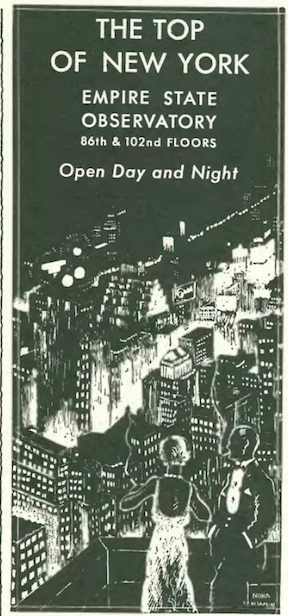
In the back pages another ad touted the amazing views one could afford from the highest spot in the city…note the couple in formal wear having a leisurely smoke as they gaze over the metropolis, their view unobstructed by fencing later added in 1947 to prevent suicidal leaps…

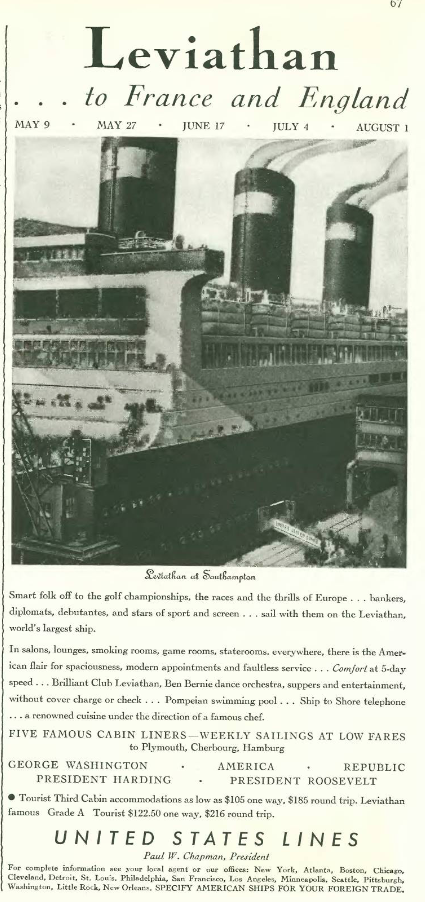
…speaking of large things, folks in the 19th and 20th centuries marveled at the gigantic scale of the man-made world—the Empire State Building, the Hindenburg, Hoover Dam, and ships with names like Titanic and Leviathan, the latter seen below in this ad from the United States Line…

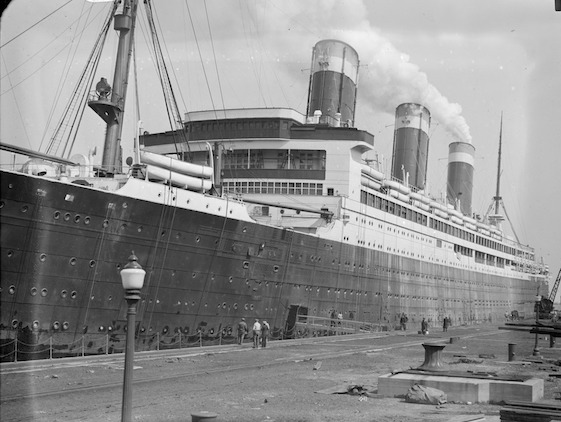
…one of the largest and most popular ocean liners of the 1920s, the U.S.S. Leviathan was actually built in 1914 for Germany’s Hamburg-American Line and christened the Vaterland. During World War I the American government seized the ship while it was docked in Hoboken, New Jersey and used it to transport troops. After the war, it was refurbished and re-christened Leviathan. It was scrapped in 1938…

The U.S.S. Leviathan at dry dock in Boston, 1930. (digitalcommonwealth.org)

…if you took the boat to Paris, you probably had enough money to make an overseas call back home…it would set you back almost $34 for three minutes of static-filled chat, about $550 in today’s dollars…

…and despite the Depression, the thrills of the modern world still abounded, such as GE’s “all-steel” electric refrigerator so artfully depicted in this ad…
…and check out these Chryslers, looking absolutely luxurious…
…as do these Dodge boats, their polished wooden hulls gliding effortlessly through placid waters…

…on to our cartoonists, we begin again with Ralph Barton’s “Hero of the Week”…

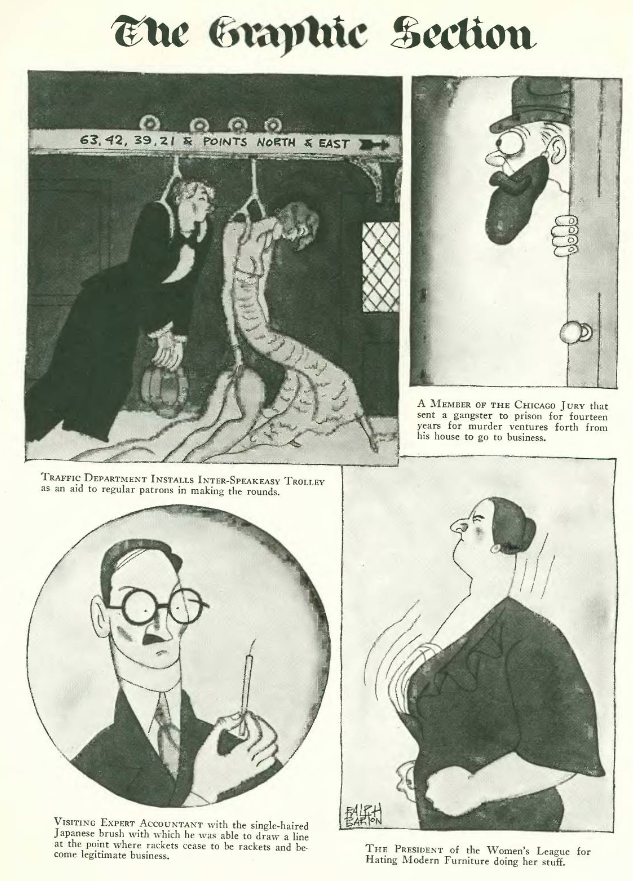
…and Barton’s graphic take on the week’s headlines…

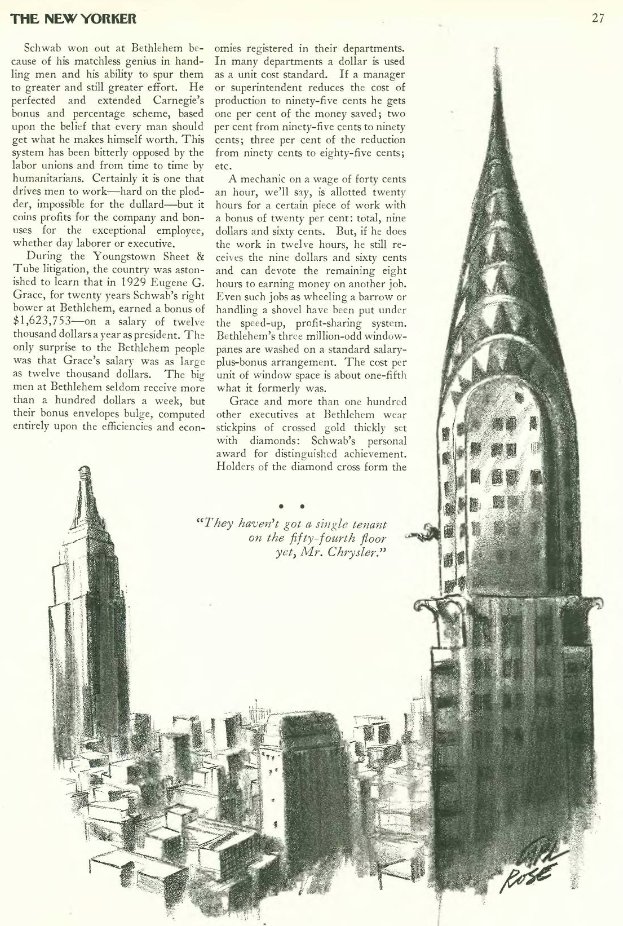
Carl Rose examined new heights in envy…

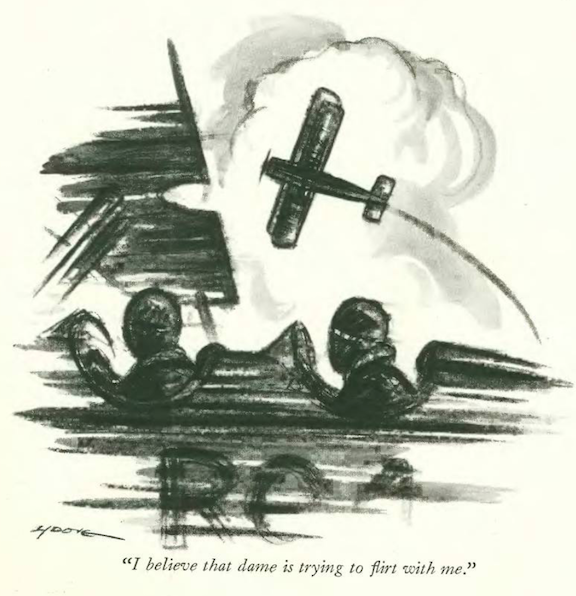
…or in the case of Leonard Dove, romance…

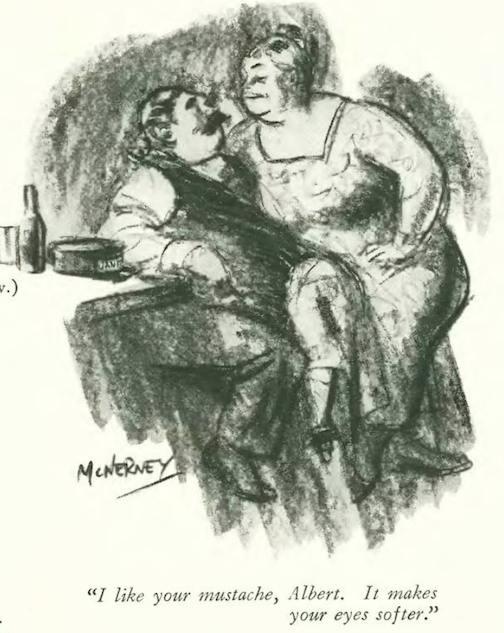
…back to earth, more romance from E. McNerney

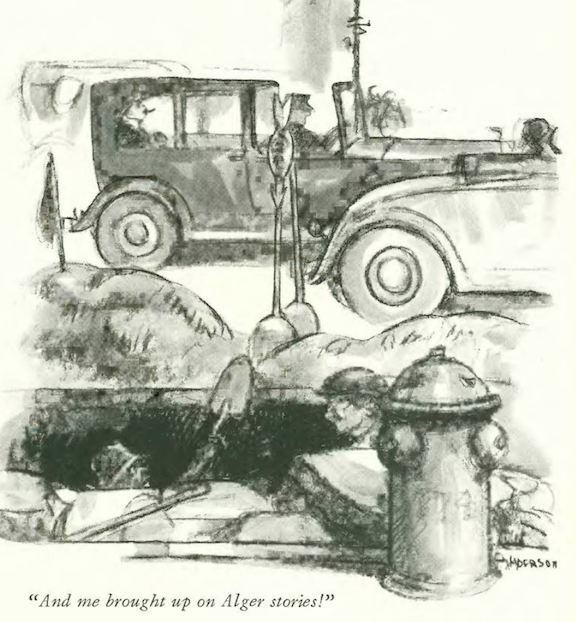
…and below ground, C.W. Anderson showed how romantic notions can go sour, in this case a man who felt duped by those rags-to-riches tales…

…and we end with Alan Dunn, and a little girl getting an education through the pages of a scandal rag…

Next Time: Through the Looking Glass…