The silent comedy-drama What Price Glory was a popular film during the final weeks of 1926. Directed by Raoul Walsh, it was based on a popular 1924 play by Maxwell Anderson and Laurence Stallings.
December 11, 1926 cover by Rea Irvin.
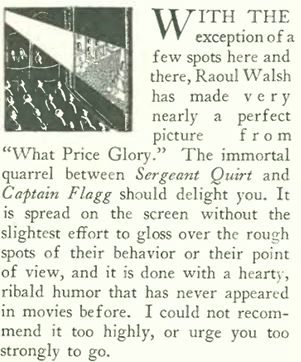
The film about World War I Marines who are rivals for the affections of a daughter of the local innkeeper proved to be a rare winner with the New Yorker film critic “OC” (anyone know his/her identity?), in a review published in the magazine’s previous issue (Dec. 4, 1926).
The film also gained fame from the fact that although it was silent, the characters could be seen speaking profanities that were not reflected in the title cards. The studio was flooded with calls and letters from enraged lip readers, including the deaf and hearing impaired, who found the profanity between Sergeant Quirt and Captain Flagg offensive.
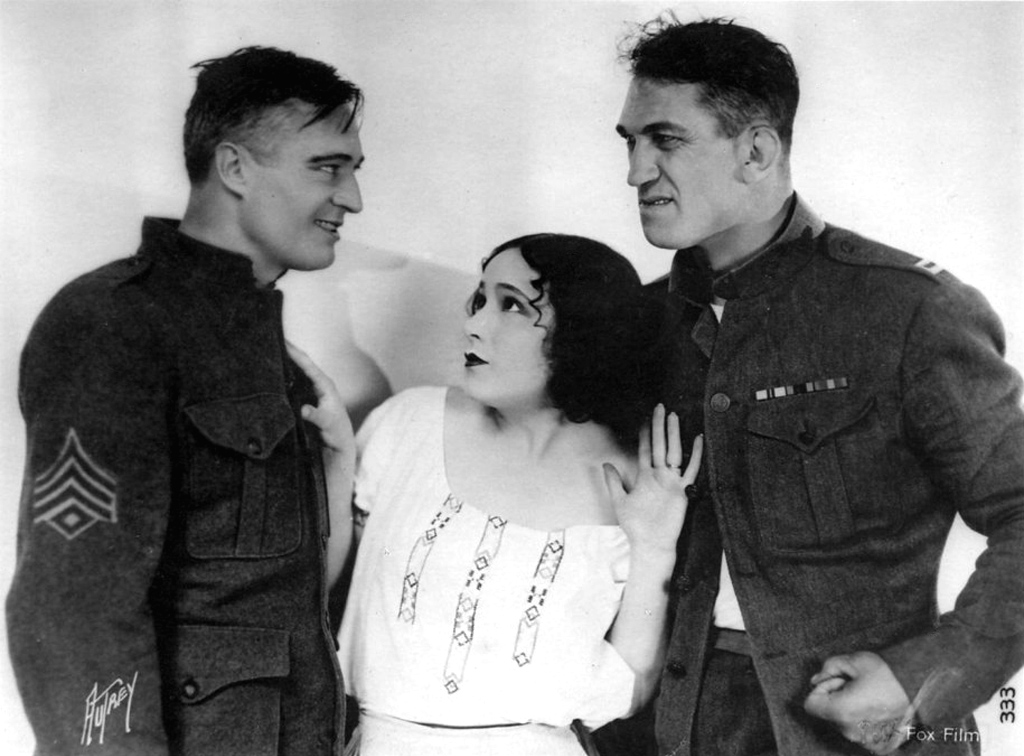
Edmund Lowe, Delores del Rio and Victor McLaglen in a publicity photo for What Price Glory? Lowe and McLaglen portrayed Sgt. Quirt and Cpt. Flagg, rivals for the affections of Charmaine de la Cognac (del Rio). (Fox Film Corporation)
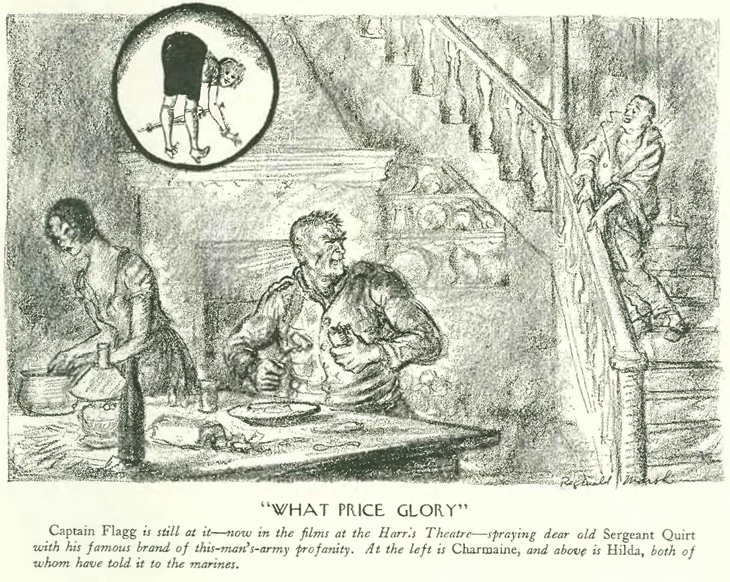
In the Dec. 11 issue, The New Yorker continued its publicity of the film with this drawing in the arts section by Reginald Marsh:
I like the curious little bubble image the artist included in his illustration (above), just in case we aren’t sure what the gentlemen are fighting over.
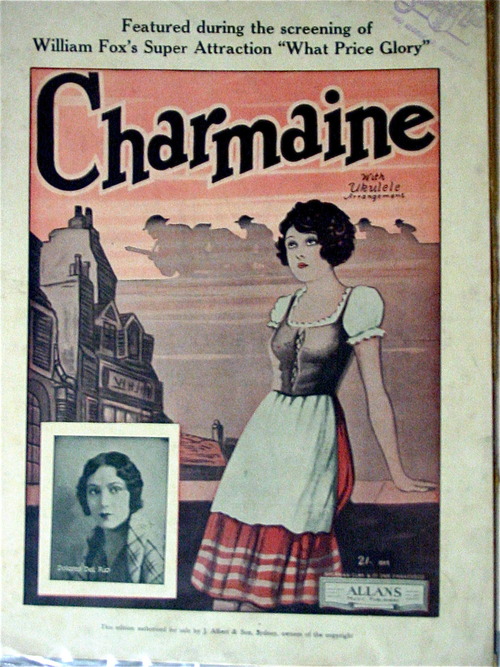
Delores del Rio’s Charmaine character on sheet music featuring the film’s theme song. The film would be rereleased in 1927 with synchronized Movietone sound effects and music. (Brooksies Silent Film Collection)
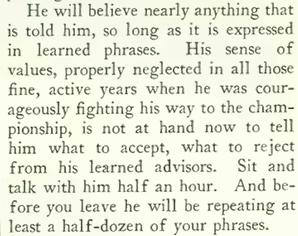
Other items in the Dec. 11 issue included Morris Markey’s “A Reporter at Large” piece on the newly crowned prizefighter Gene Tunney, who apparently was struggling with fame and wanted to be known for his smarts rather than his fists. Markey wasn’t buying it:
After a number of verbal jabs throughout the piece, Markey included this knockout punch:
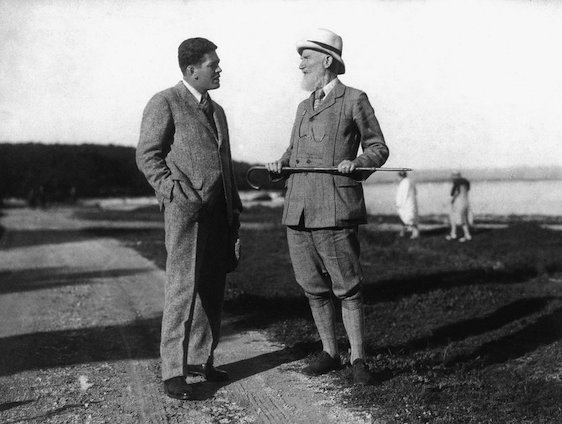
I COULDA BEEN A WRITER…Gene Tunney, left, and the writer George Bernard Shaw on a 1929 vacation to Brioni, Italy. (Associated Press)
We skip ahead to the Oct. 2, 1926 issue to look at one of the big events of that year–the Dempsey-Tunney heavyweight prize fight (I’m not skipping issues…Sept. 25 appears later in this blog).
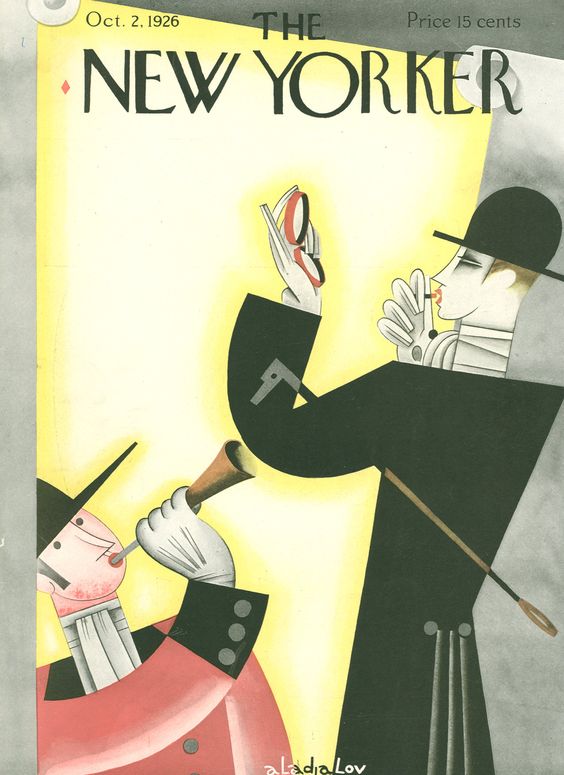
Oct. 2, 1926 – Issue # 85 – Cover by Constantin Alajalov. (Once again, note the ongoing comic reference to androgyny in 20’s fashion)
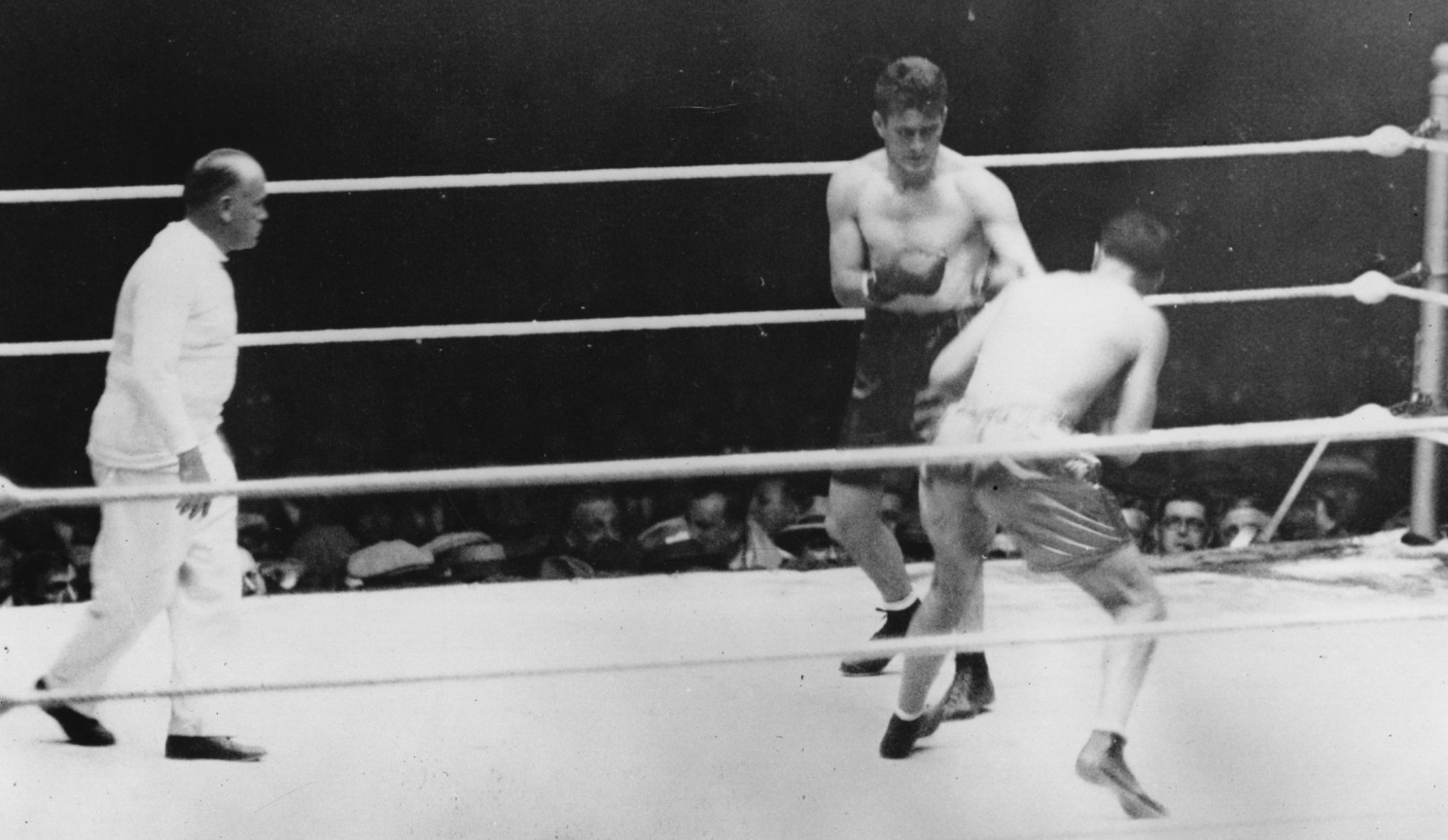
Heavyweight boxing was a big part of the American sports scene in the 1920s, and two giants of the sport, Jack Dempsey and Gene Tunney, dominated the headlines in the late 1920s thanks to much-heralded bouts in Philadelphia in 1926 and a rematch in Chicago the following year (which would include the famous “long count” incident).
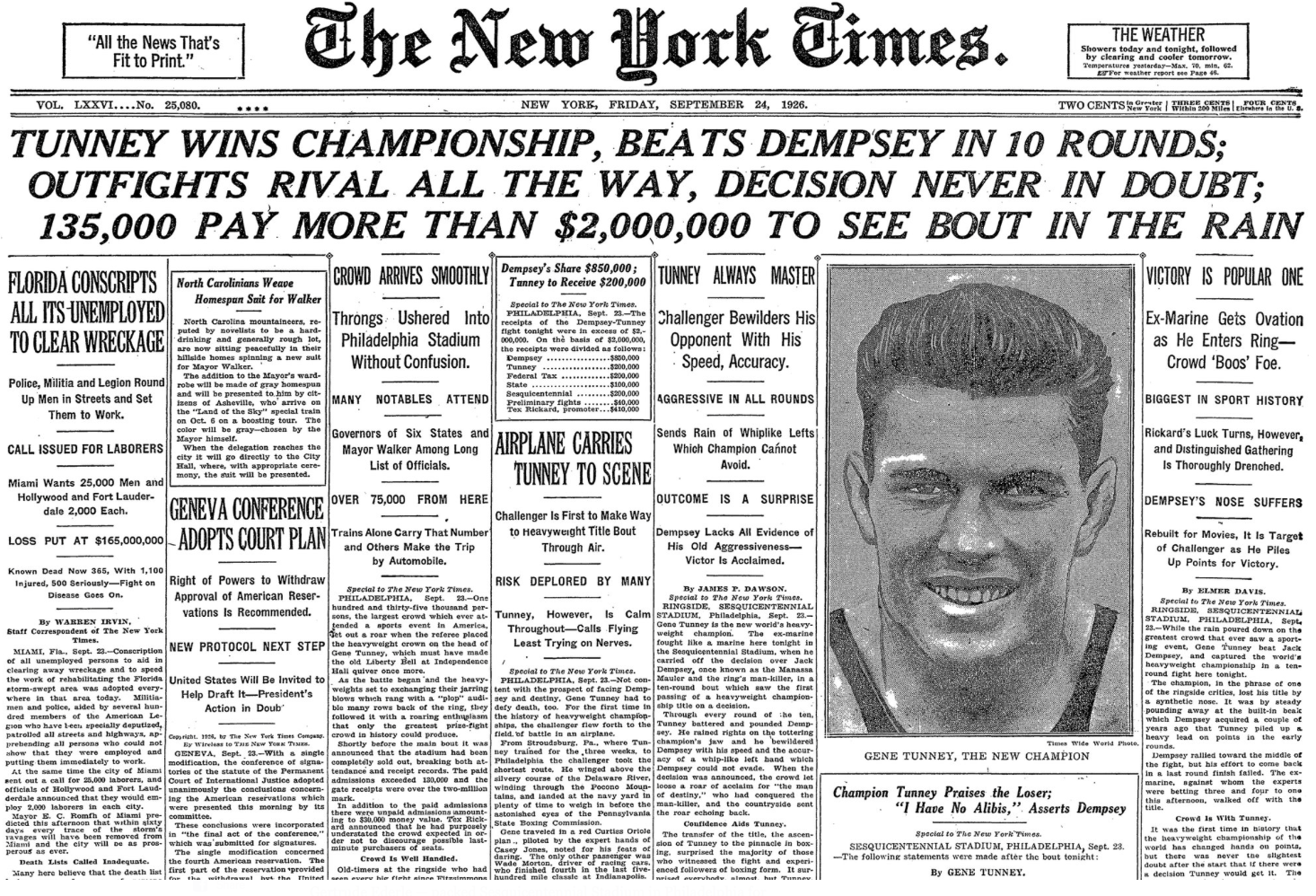
An estimated 135,000 fans packed Sesquicentennial Stadium in Philadelphia for the Dempsey-Tunney bout. (NYTimes)
The New Yorker joined in on the hoopla, publishing a lengthy account of the match by Waldo Frank (aka “Search-light”), who trained his jaded eye on the whole affair:
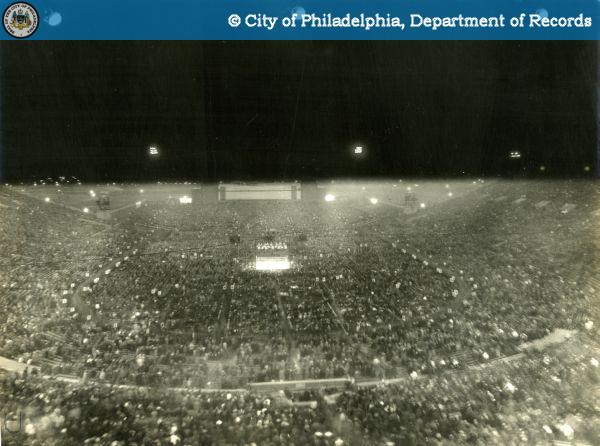
VIEW FROM THE CHEAP SEATS…a rain-soaked throng at the Dempsey-Tunney fight in Philadelphia. (City of Philadelphia)
According to the New York Times, the crowd included such notables as Charlie Chaplin, cowboy movie star Tom Mix and the English Channel swimmer Gertrude Ederle.
Coverage of Tunney’s victory by unanimous decision took up three-quarters of the front page of The New York Times, and also filled most of pages 2 through 7. (The New York Times)
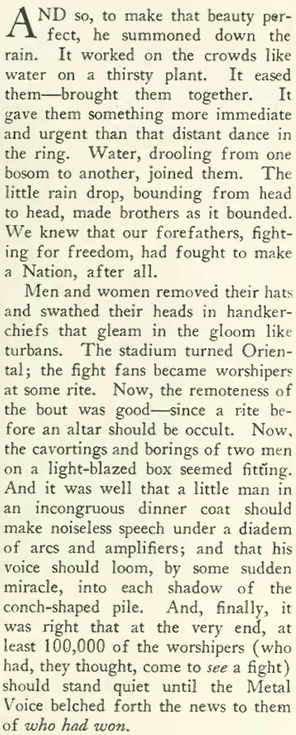
But in typical fashion, Waldo was less than dazzled, finding the rain an apt metaphor for a spectacle mostly unseen by those in attendance:
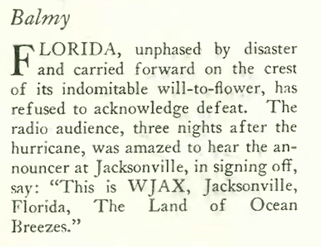
Never one to wallow in tragedy, the magazine made a brief (and oddly droll) reference in “The Talk of the Town” to a hurricane that hit Miami and its environs (it killed 372 people and injured more than 6,000):
Other items of note in the issue included this examination of country vs. city life by cartoonist Barbara Shermund…
…and this cartoon by Al Frueh commenting on the challenges of Manhattan’s rapidly changing cityscape:
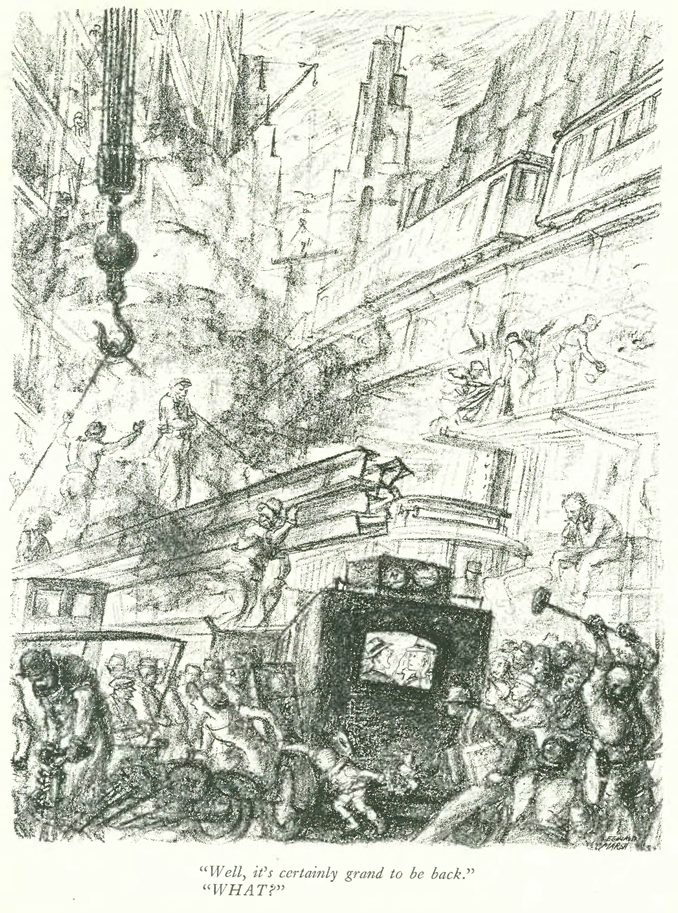
The changing city was also on the mind of Reginald Marsh in this illustration he contributed to the Sept. 25, 1926 issue of the magazine:
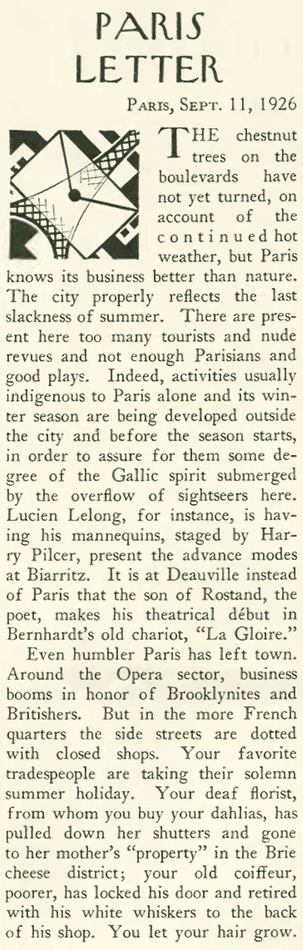
Back to the Sept. 25 issue, which featured an update from Paris correspondent Janet Flanner…
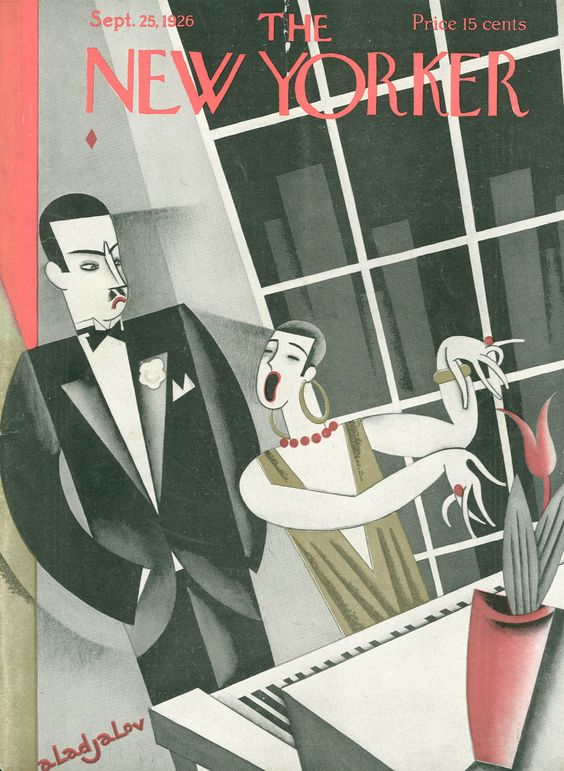
Sept. 25, 1926 – Issue # 84 – Cover by Constantin Alajalov.
…who commented on the large number of American tourists crowding the city just as the locals were fleeing for their long, late summer holidays:
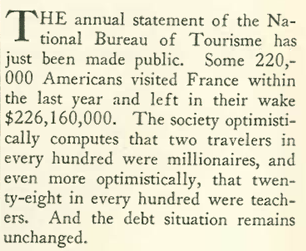
She offered some numbers to back up her observations:
Janet “Genêt” Flanner (right) and longtime companion Solita Solano (center) in Paris, 1921. Solano was a well-known writer and drama critic for the New York Tribune. (Vintage Everyday)
And finally, a cartoon by Rea Irvin exploring the trials of the idle rich:
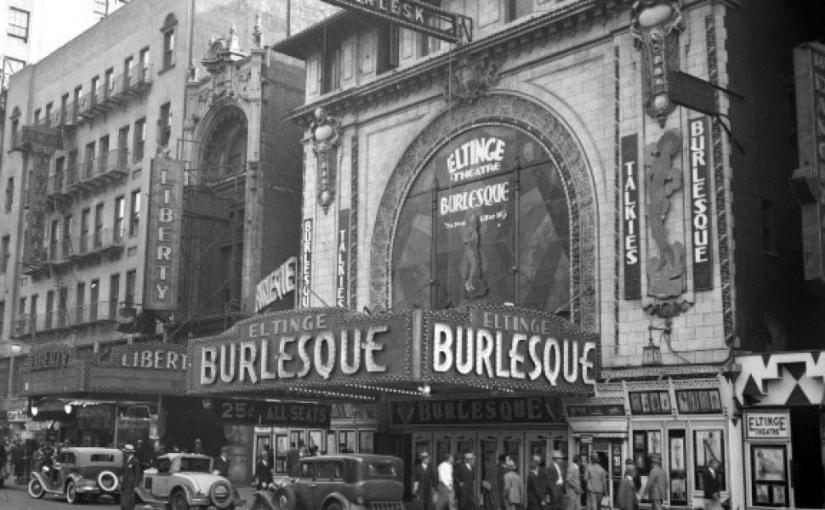
The critic Gilbert W. Gabriel was more than a bit appalled by the spectacle at the old Olympic Theatre, where a tired and “degenerated” cast of burlesque performers took turns shaking their ancient haunches in the direction of the former Julliard student.
Gilbert’s article in the August 22, 1925 New Yorker, “They Call It Burlesque,” described the performance at the Olympic on East Fourteenth Street as “on its last legs.” The once “honest animalistic, gorgeously orgiastic burlesque show of ten or twenty years ago” had “degenerated in decency,” he wrote.
Illustration in The New Yorker of the Olympic Burlesque by Reginald Marsh.
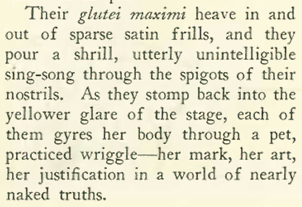
As the performers wiggled up and down the runways, Gilbert noted:
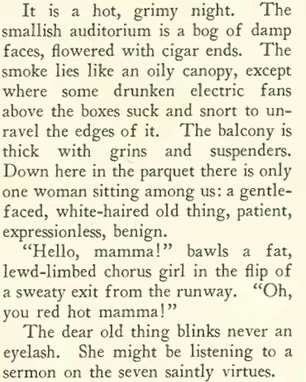
The audience was an equally sad lot:
There is some relief expressed when two comedians appeared, but they offer an unimaginative routine:
And then back to the dancers:
And still more…
Happier news over in “The Talk of the Town,” where jazz was getting some respect: “Jazz, successor to the outcast ragtime, each day is becoming acceptable. It is the young brother of the musical family, irresponsible and at time highly irritating, but, nevertheless, acknowledged.”
It was reported that even famed violinist Jascha Heifetz “dabbled” in jazz as an amusement, and writers of jazz were “no longer those products of East Side dives,” but rather included the likes of Buddy de Sylva, lyrist to Al Jolson, and George Gershwin, “high priest of jazz,” who was besieged by symphony conductors for his “Symphony in Blue” (better known today as Rhapsody In Blue).
“Talk” continued its lament of the changing face of Fifth Avenue:
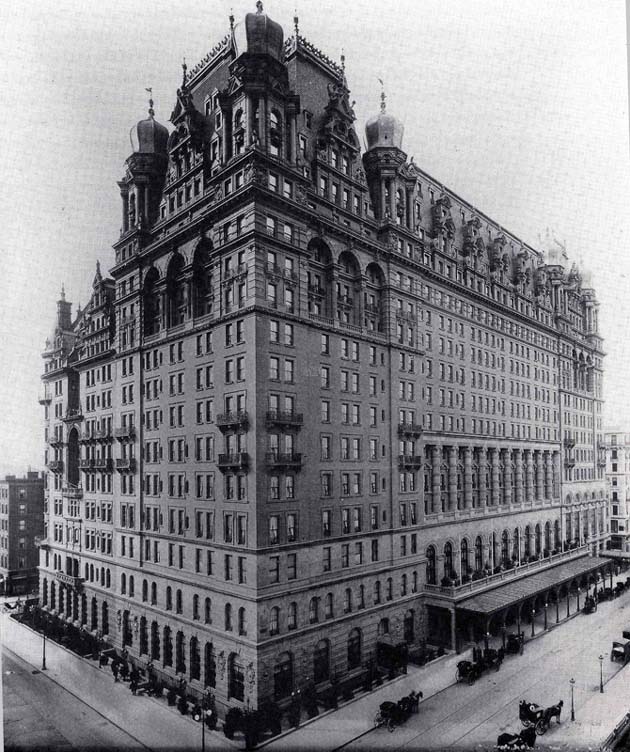
And the Waldorf Astoria was being remodeled in order to add shops on the ground floor along with “125 bathrooms,” giving the famed hotel “a bath for almost every room.” In just four years the old Waldorf would be torn down and replaced by the Empire State Building.
The old Waldorf Astoria was getting an upgrade, but it would fall to a wrecking ball in only four years. (nycago.org)
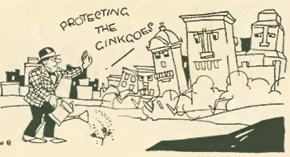
“Talk” also noted the planting of Ginkgo trees in the city:
Although prized today for their beauty and hardiness, not all New Yorkers are in love with the strong odor of its fruit. In the June 30, 2008 issue of The New Yorker, Lauren Collins examined the activities of the “Anti-Ginkgo Tolerance Group” in her article“Smelly Trees.”
“Talk” also offered a brief glimpse into the latest adventures of Pola Negri, noting in its “This Week” section that the actress had paid “$57,000 customs dues in seized jewels…”
Pola Negri liked nice things (Edward Steichen for Vanity Fair, 1925)
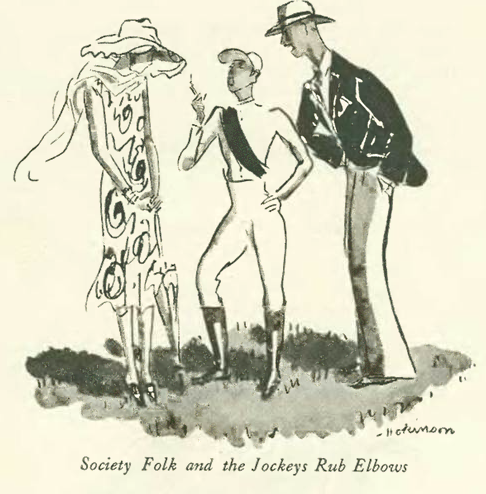
In other items, Helen Hokinson provided illustrations for an article on the horse races at Saratoga…
…John Tunis examined the life of tennis star Elizabeth “Bunny” Ryan in “Profiles” … and E.B. White and Alice Duer Miller offered their thoughts on why they liked New York:
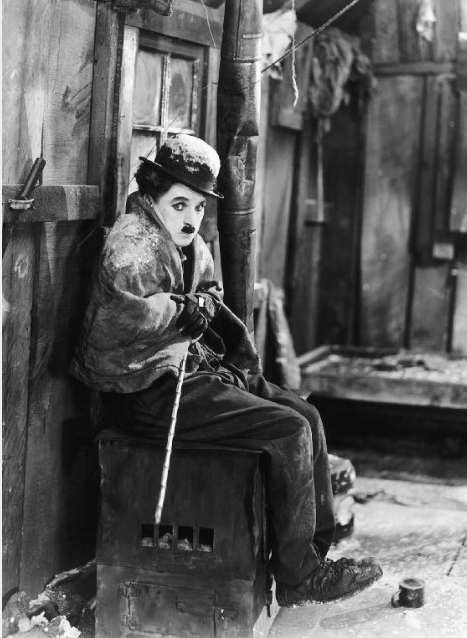
“Moving Pictures” featured a lengthy review of Charlie Chaplin’sThe Gold Rush. Theodore Shane (“T.S.”) wrote that the film’s opening night at the Strand attracted such celebrities as Will Rogers and Constance Bennett.
Cheer Up Charlie…Chaplin in The Gold Rush (1925) (United Artists)
Shane observed that this “dramatic comedy” was a “serviceable picture,” but perhaps Chaplin was getting “too metaphysical about his pathos” and could have used some old-fashioned pie-in-the-face slapstick.
As an example, in a scene in a typical Klondike town, Shane wrote that “one might be given to expect wonders of Gold Rush burlesque with the old Chaplin at the receiving end of the Klondike equivalent of a custard. But one is doomed to disappointment, for Chaplin has seen fit to turn on his onion juices in a Pierrot’s endeavor to draw your tears…We cannot help but recall with a tinge of sadness, the old days when custard was young.”
(Wikipedia)
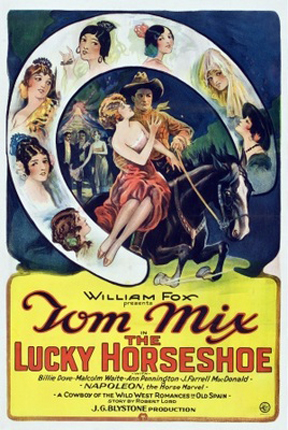
Shane went on to give short but favorable reviews to Rex Reach’sWinds of Chance (at the Piccadilly Theatre), the film’s chief props consisting of “string ties, wooden saloons, ½ dozen cold-blooded murders and the tenderfoot who conquers everything…Shane also noted that the “spiritual features” of Tom Mix in The Lucky Horseshoe (at the Rialto) lent themselves delightfully to “a lovely and sensitive drama of moyen age and modern machinations in the Fairbanks style.”
In “Books,” Harry Este Dounce (“Touchstone”) suggested readers take a look at Carl Van Vechten’sFirecrackers as a good introduction to the writer’s unique style, while J.D. Bereford’sThe Monkey Puzzle was deemed only “partly good” but worth reading.
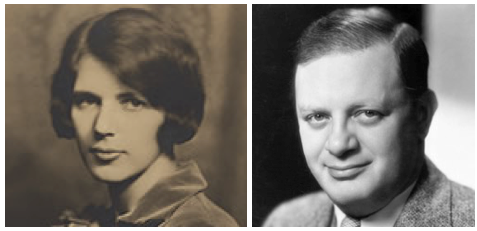
Lois “Lipstick” Long and Herman J. Mankiewicz. (PBS/Wikipedia)
In her regular nightlife review (“When Nights Are Young”), Lois Long (“Lipstick”) playfully sparred with her New Yorker colleague, theater critic Herman J. Mankiewicz:
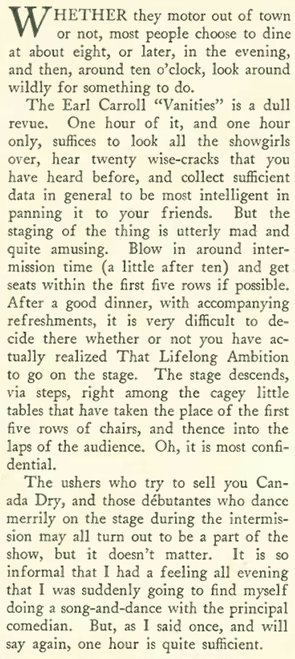
Long was referencing this Mankiewicz review in a previous issue (Aug. 8):
And it all started when Long offered this observation in her July 25 “When Nights Bold” column:
I hope you are fully sated. As a palate cleanser, I offer yet another droll observation of the world of old money by Gardner Rea:
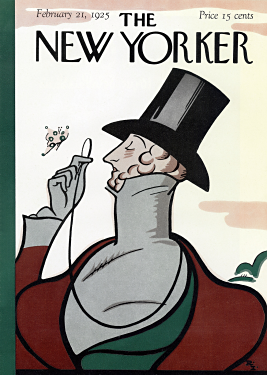
You need not read far into Issue #1 before you realize how utterly distant this world is from our own. Launched in the midst of the Jazz Age, the magazine assumed its readers to be bourgeois (judging from the ads), cosmopolitan, Anglo- and/or Francophile, Ivy- or private school-educated and with enough disposable income to strike the disinterested pose of the cover mascot, Eustace Tilley.
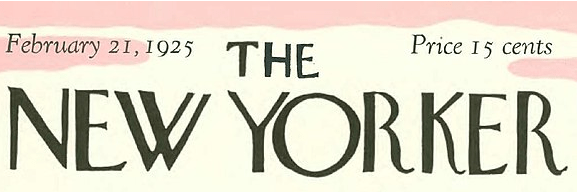
Issue 1, Feb. 21, 1925, cover by Rea Irvin
Issue No. 1, Feb. 21, 1925, opened with a section titled “Of All Things,” and these first words:
Right next door to the Follies, some young adventurer has opened a penny peep-show where you can see five hundred and fifty glorified young women for what Mr. Ziegfeld charges for his much smaller collection.
The section concluded with a manifesto by the magazine’s founder and editor-in-chief, Harold Ross, who famously proclaimed, “It has announced that it is not edited for the old lady in Dubuque.”
Harold Ross (theharlow.net)
There is scant advertising in the slim first issues (No. 1 is just 32 pages plus cover). In an article written for the 90th anniversary issue (Feb. 23, 2015), Ian Frazier explains how it was first funded:
After returning to the States, in 1919, he (Ross) edited a short-lived version of Stars & Stripes for veterans and became a New York night-life figure known for carrying around a dummy of his still unnamed magazine and talking about it endlessly. When he finally published the first issue of The New Yorker, ninety years ago, he paid for it partly himself. Nearly half the magazine’s original funding was a twenty-one-thousand-dollar stake put up by Ross and his wife, Jane Grant, and their friend Hawley Truax. Raoul Fleischmann, a baking heir and almost millionaire whom Ross had met through mutual friends, supplied another twenty-five thousand.
Ross’s involvement in World War I figured prominently in the origins of the New Yorker. It was during his time at Stars & Stripes that he met Alexander Woollcott, who was already an established New York theater critic.
Jane Grant (Wikipedia)
At this time Ross also met Jane Grant, who was serving in the YMCA entertainment corps and was a frequent visitor to the Star & Stripes offices. Although Ross’s name looms large in most accounts of the early New Yorker, Grant played a major role in its conception and launch.
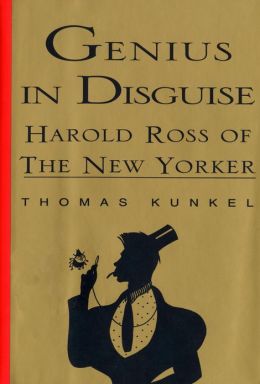
I highly recommend Thomas Kunkel’s Ross biography, Genius in Disguise, for a complete account of the magazine’s early days.
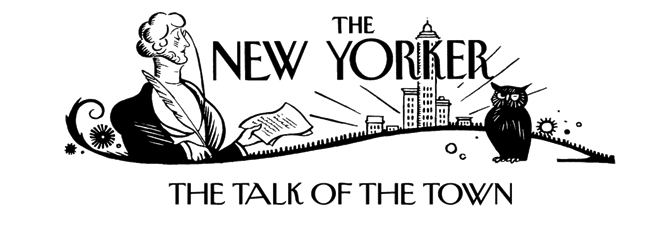
It took a few issues for the editors to sort out regular features and their order of appearance. The opening section of Issue No. 1 featured the famous Rea Irvin masthead—flanked by Eustace Tilley and the night owl—and Irvin’s distinctive typeface that would introduce “The Talk of Town” for many issues to come. However in Issue No. 1 “Of All Things” appeared under the masthead, followed by “Talk of the Town” which was (for the first and last time) under this banner:
The magazine’s second issue, Feb. 28, paired the Eustace Tilley masthead with “The Talk of the Town” for its opening section, but the March 7 issue paired it with “Behind the News” for the opening section.
With the March 14th issue, the editors decided to permanently install “The Talk of the Town” below the masthead in the lead section, relegating “Of All Things” and “Behind the News” to inside pages.
For the sake of comparison, here is the current 2015 version:
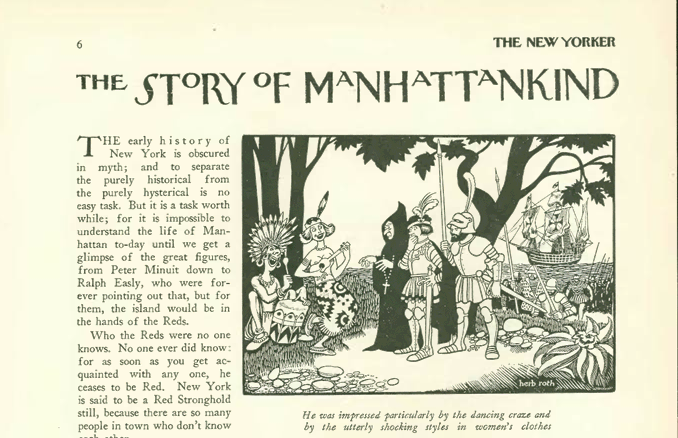
A number of short-lived regular features made their appearance in these early issues: “The Story of Manhattankind” offered drawings by Herb Roth and tongue-in-cheek accounts of early Manhattan life that featured cartoonish Indians and bumbling settlers. It is here where the magazine took its first of many shots at William Randolph Hearst, perceived rival and publisher of Cosmopolitan (more of a literary magazine in 1925, and not the sex tips and cleavage rag it is today).
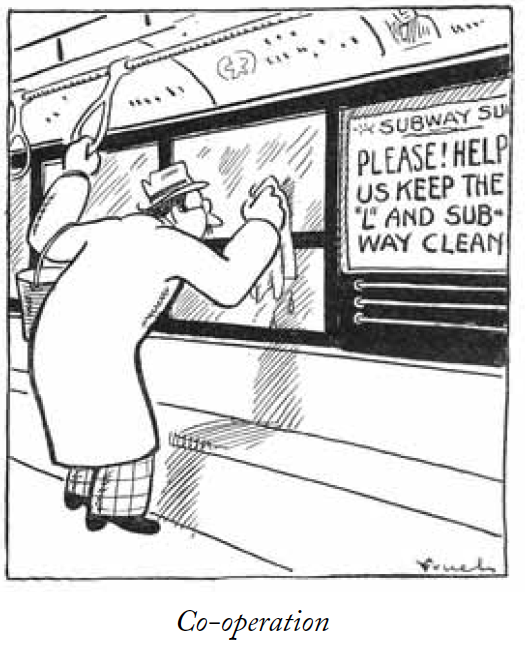
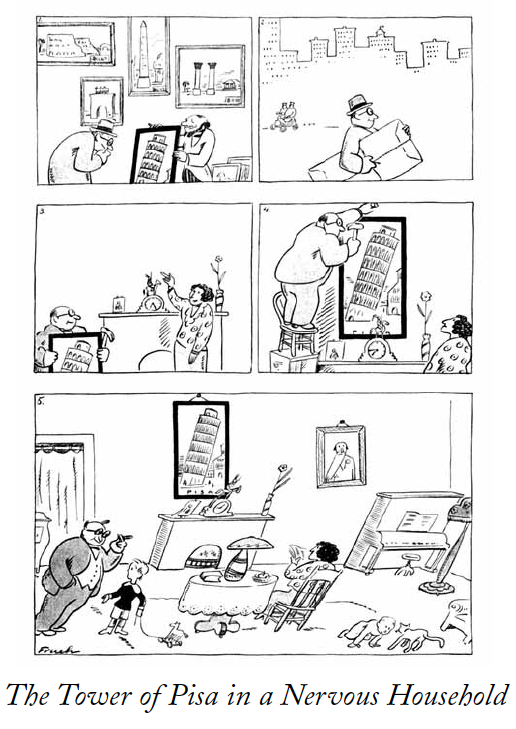
The first two cartoons ever featured in the New Yorker were by Al Frueh:
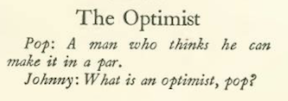
This recurring column filler, “The Optimist,” began in Issue No. 1, a tired joke featured repeatedly in the first issues until Katharine Angell came on board and put an end to such nonsense…
“Profiles” were established at the start, the first issue featuring opera maestro Giulo Gatti-Casazza, the second issue taking aim at “Princess” Alice Roosevelt Longworth, and the third issue probing New York Times managing editor Carr Vatell Van Anda. “In Our Midst” featured local celebrity sightings and gossip, such as actress Tallulah Bankhead and writer Edna Ferber in Issue 3 (March 7).
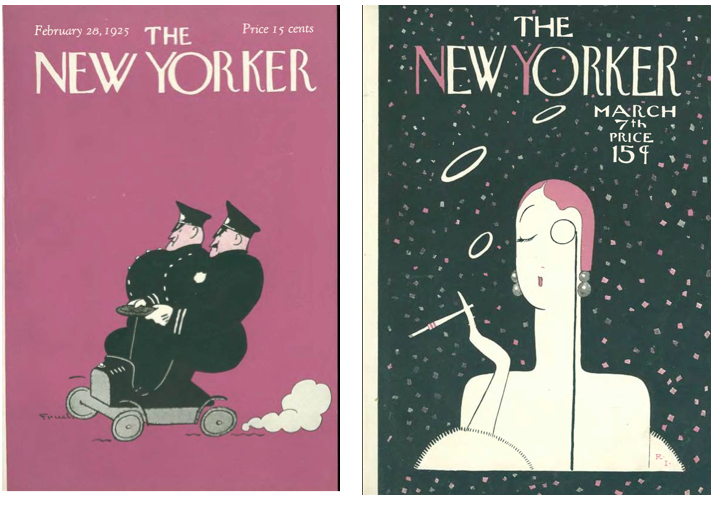
New Yorker Issues 2 & 3, Feb. 28 (cover by Al Frueh) and March 7 (cover by Rea Irvin), 1925.
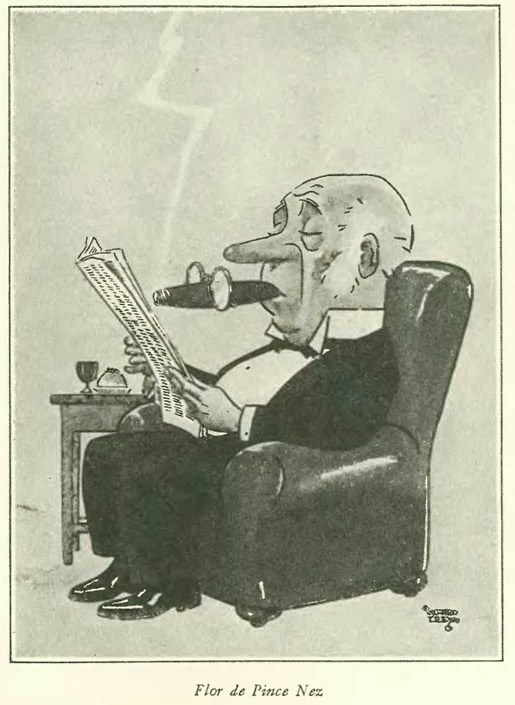
Most of the cartoons from the very beginning were famously droll, such as this illustration by British graphic artist Alfred Leete, who was a regular contributor to such British magazines as Punch, the Strand Magazine and Tatler.
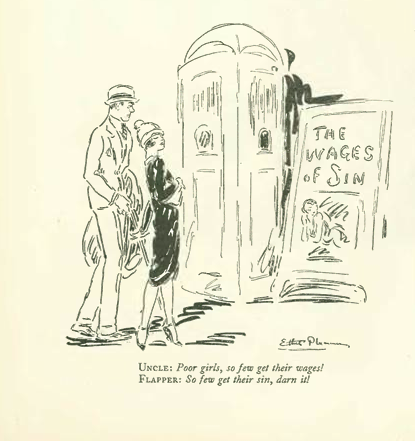
…but a few cartoons recall an earlier style in which the action is captioned (like old Punch cartoons) in a more formal manner. The first issue featured an Ethel Plummer cartoon of an “uncle” and a “flapper” looking at a theater bill for The Wages of Sin:
Uncle: Poor girls, so few get their wages.
Flapper: So few get their sin, darn it!
A section titled “The Hour Glass” offered short, casual accounts of various local personalities. “Lyrics from a Pekinese” was another recurring feature by writer Arthur Gutterman, who was known for his silly poems.
Music reviews in early issues were almost entirely devoted to classical, live performances. Fritz Kreisler’s violin mastery was featured prominently in the first issue, while it wasn’t until the third issue that jazz was briefly mentioned (it was becoming “respectable” in some concert halls). It was reported that violinist Damuel Dushkin ended his performance with selections from George Gershwin’sRhapsody in Blue.
The “Art” section featured an exhibition of British paintings at the Central Art Galleries, and a show by the Society of Independent Artists (paintings sell from 24 to 99 dollars), at the Waldorf Hotel (soon to be razed and replaced by the Empire State Building). Joseph Stella was at the Dudensing Galleries, described as a “gifted young American.”
Old Waldorf-Astoria, razed in 1929 to make way for the Empire State Building (nycago.org)
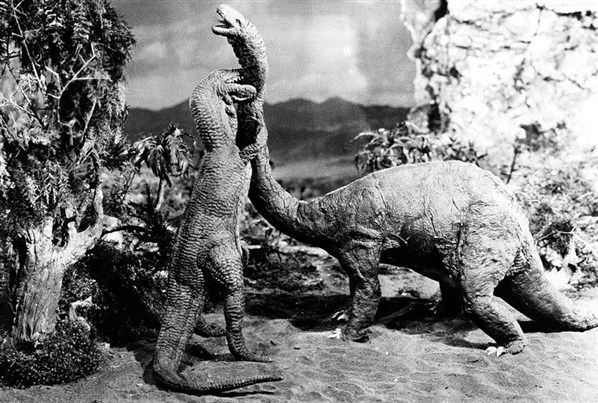
“Motion Pictures” looked at Greed (Frank Norris’sMcTeugue transferred to the screen), which was playing on the Loew Circuit; The Lost World at the Astor (“Through camera trickery, dinosaurs and other beasts of the prehistoric past live again. Interesting because it proves that the camera is a liar”); the “splendid” German-made The Last Laugh by Carl Mayer (of Dr. Caligari fame) and The Salvation Hunters by Josef Von Sternberg. The magazine called it “deadly monotonous”…”the characters just sit around and think.” German actor Emil Jannings was a favorite, and would be lauded in subsequent issues.
Still image from The Lost World, 1925 (Wikipedia)
The first issue closed with an ad from Royal Cord Balloon Tires. Later issues would depend heavily on advertising revenue from auto manufacturers.
The early issues also featured two-page-drawings that illustrated some event described in the opening section. The Feb. 28 issue (#2), mentioned that Ciro’s opened with the Mary Hay and Clifton Webb dancing team (illustration by Reginald Marsh)…
As this was the age of Prohibition, there was a notable absence of alcohol in ads and even in print articles, although references are made to “speakeasies” and later issues would report black market prices for liquor.
The second issue’s “Talk of the Town” further elaborated on the magazine’s manifesto:
And we won’t aim to please. If we happen to please we will not apologize, but we are not in the vast army of bores struggling frantically to give people what they want.
We may not do much for the magazine world. We don’t know that we’re aiming to. But of one thing we feel quite sure: if we ever run out of things to say, just for the fun of saying them, we expect to close up this little playhouse and go to work.
The “Theatre” section of Issue No. 2 featured James Joyce’sExiles at the Neighborhood Theatre, while a section titled “And They Do Say” featured the first (of the many subsequent references) to Eddie Cantor’s various comings and goings. It was reported Cantor left for Boston in his “Kid Boot” and that altercations between Cantor and veteran stage actress Jobyna Howland “kept 42nd Street nervous for weeks.”
Eddie Cantor and Jobyna Howland (Wikipedia, Travalanche)
“Books” featured a review of Ford Madox Ford’s “Some Do Not…” The reviewer Harry Este Dounce (under the nom de plume “Touchstone”) called it “as gratuitously black-biled a work of art as we ever saw.”
Under “Washington Notes” were the first of many humorous references to President Calvin Coolidge, his hayseed habits and his extreme frugality. Below, a drawing by Miguel Covarrubias (a regular contributor beginning with the first issue) in March 14 issue:
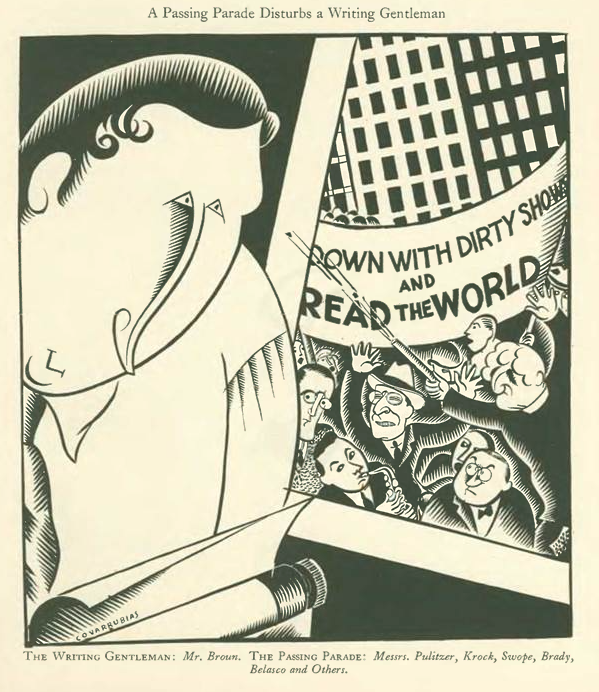
Another Covarrubias illustration in Issue # 3 (March 7) depicted journalist Heywood Broun (old Ross friend and Algonquin Round Table stalwart) hard at work on his column for the New York World:





























 A New Yorker State of Mind