Quite a Month

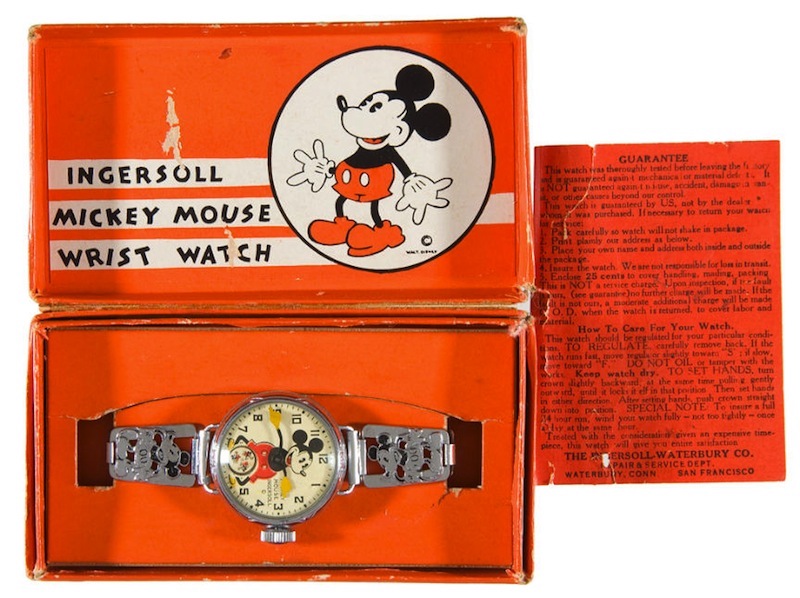
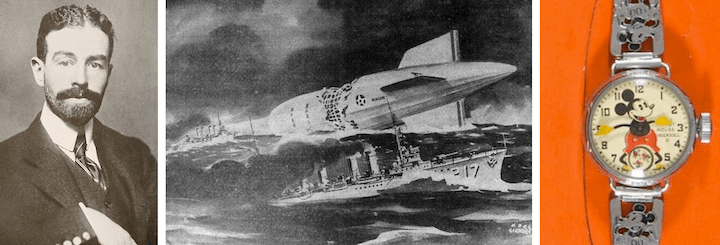
ABOVE: E.B. White presented us with a mixed bag of February happenings, from the comings and goings of Neily Vanderbilt to the Macon disaster and the economic power of Mickey Mouse.

The title for this entry comes from E.B. White’s “Notes and Comment” column, which kicked off the Feb. 23, 1935, issue with a quick rundown of February events.
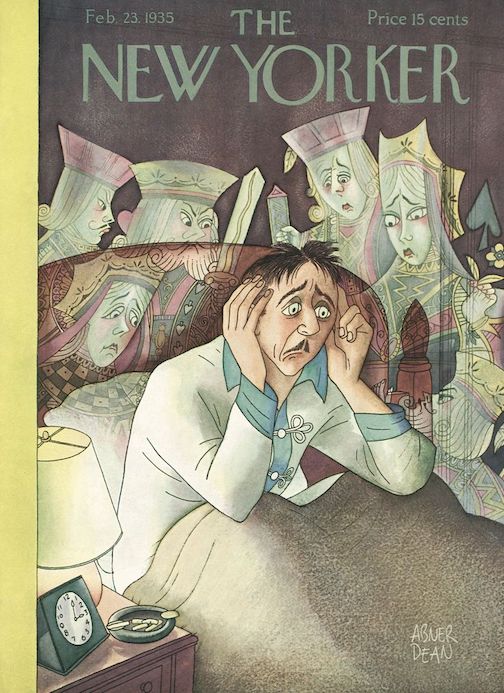
Feb. 23, 1935 cover by Abner Dean.

February notably marked the end of the Bruno Hauptmann trial. Convicted of the abduction and murder of the infant son of Charles and Anne Morrow Lindbergh, Hauptmann would go to the electric chair on April 3, 1936. White also noted the return of Admiral Richard Byrd from his second Antarctic expedition, the demise of the U.S. Navy airship U.S.S. Macon, and the economic miracle of the Mickey Mouse watch.

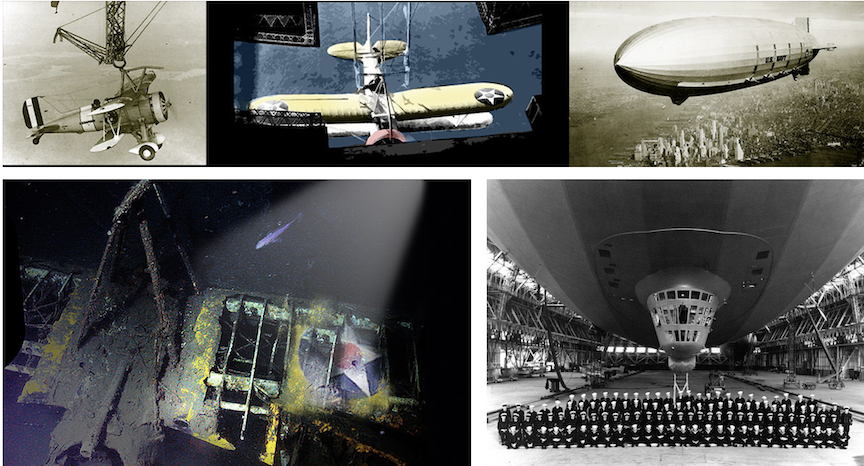
FLYING AIRCRAFT CARRIER…The US Navy’s 785-foot rigid airship USS Macon could launch and retrieve up to five airplanes in mid-flight. Known as “parasitic fighters, the Sparrowhawks were hung from a rail system inside the airship. On Feb. 12, 1935 the Macon crashed in a storm off the coast Point Sur, California. Only two of the 66 crew were lost. Photos above, clockwise from top left, show the deployment of a Sparrowhawk; the USS Macon over New York City in 1933; crew pose for a photo in the dirigible’s hanger; photo from the wreckage discovered in 2006—the pre-1941 pattern U.S. roundel emblem still recognizable. Sky-hook also visible. (sanctuaries.noaa.gov/macon/Sunnyvale Historical Society)
TIME WAS RUNNING OUT for the Ingersoll Waterbury Company (now known as Timex) during the Great Depression. It was saved from bankruptcy, in part, by the introduction of the Mickey Mouse watch. (connecticuthistory.org)

White also made note of the comings and goings of Cornelius “Neily” Vanderbilt III (1873–1942), who was saying farewell to Fifth Avenue (although he would return to live out his life there), while New Yorkers were apparently saying farewell to the Park Avenue Tunnel (aka Murray Hill Tunnel). After more than 190 years it is still there, now serving a single lane of northbound traffic from 33rd to 40th Street.

TUNNEL VISION…Park Avenue Tunnel in 1890 (top) and in 2013 during a Voice Tunnel art installation. The nearly two-century old tunnel was made open to pedestrians for the first time in coordination with the annual Summer Streets event which began in 2013. (viewing.nyc/Wikipedia)

 * * *

Getting An Earful

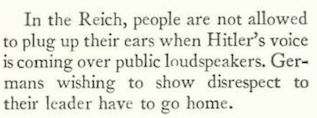
Howard Brubaker, in his column “Of All Things,” made this observation of deepening repression taking place in Nazi Germany…
 * * *

Try Our Knockout Cheesecake

Lois Long continued her chronicle of New York night life, in this excerpt making note of the celebrity gawkers at Jack Dempsey’s tavern/restaurant near Madison Square Garden. Apparently Dempsey’s place was renown for its cheesecake…

PLEASED AS PUNCH…Heavyweight boxing champ Jack Dempsey opened his restaurant at 50th Street and Eighth Avenue in 1935 (bottom photo) before moving to Broadway’s Brill Building in 1937 (top). According to Ephemeral New York, “In the restaurant’s early years, Dempsey was known to hold court at a table, a legendary figure greeting customers and glad-handling guests.” (Ephemeral New York)

 * * *

From Our Advertisers

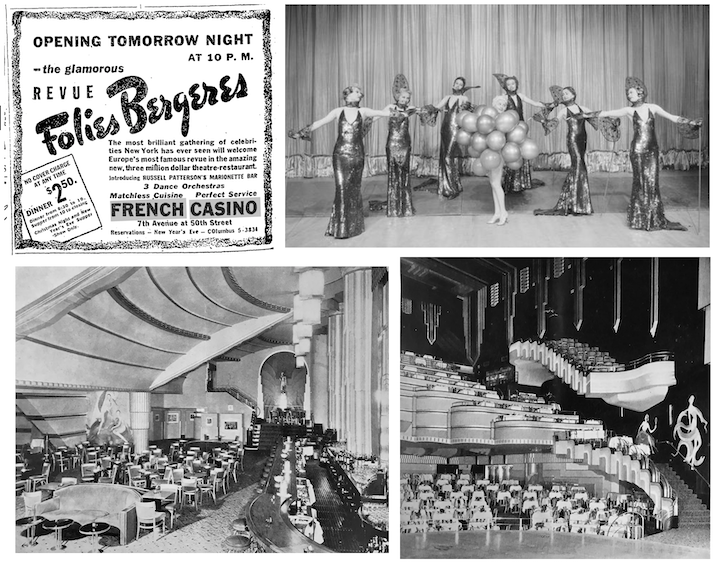
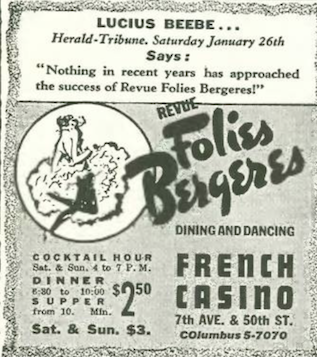
The refurbished Earl Carroll Theatre (7th Ave. and 50th St.) opened as the French Casino late in 1934. The art deco theatre’s first show was the Revue Folies Bergères, promoted here in this small ad on page 54 in the Feb. 23 issue…
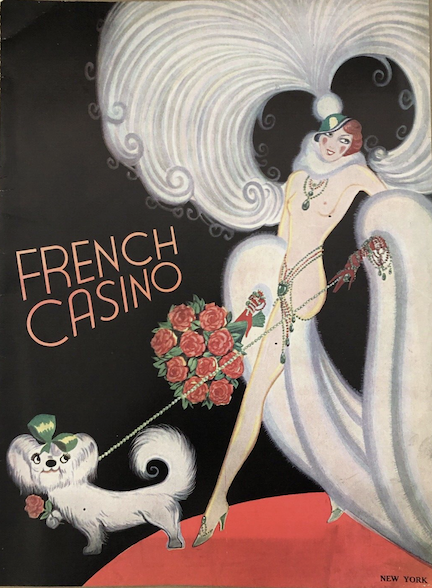
…the menu’s cover suggests patrons weren’t there for the cheesecake (yes, there is a pun, but I’m not touching it)…
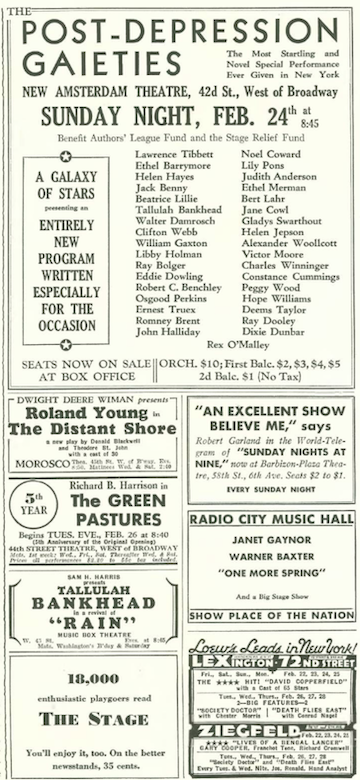
…another ad in the back pages touted the “Post-Depression Gaities” at the New Amsterdam Theatre with an impressive roster of stars including New Yorker notables Robert Benchley and Alexander Woollcott

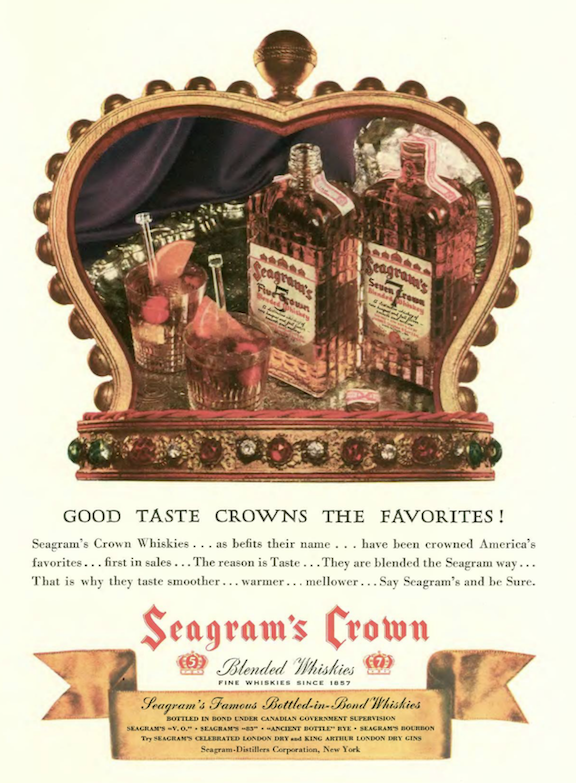
…following Prohibition, Seagram introduced two blended whiskies—5 Crown and 7 Crown. Seagram 5 Crown was discontinued in 1942, while Seagram 7 would go to become the first million case brand in U.S. history…
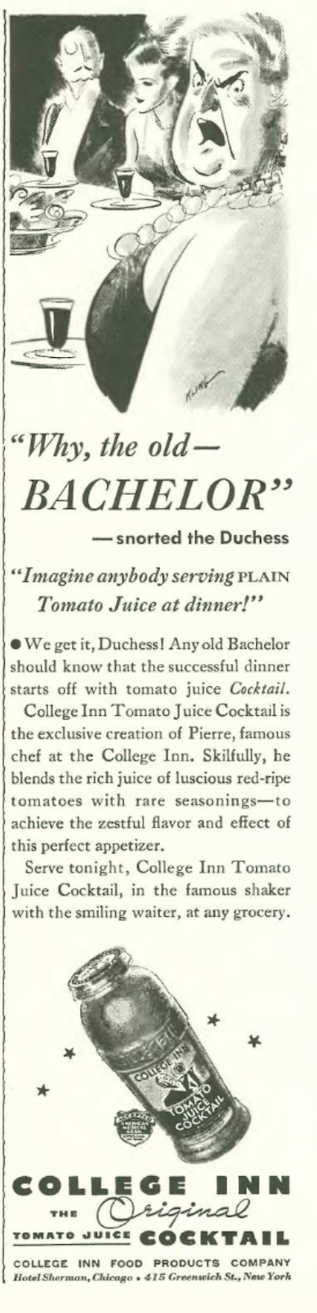
…this one-column ad caught my eye for the rendering of the stereotypic ill-tempered matron, here having a fit over tomato juice…
…coming from an old and influential New York family, it’s hard to believe Elizabeth West Post Van Rensselaer thought about Campbell’s soup when her daughter, Elizabeth, fell seriously ill…at any rate, something must have worked because her daughter lived until 2001…

…For a time “Chief Pontiac” served as a logo for the Pontiac line of automobiles, discontinued by GM in 2010…
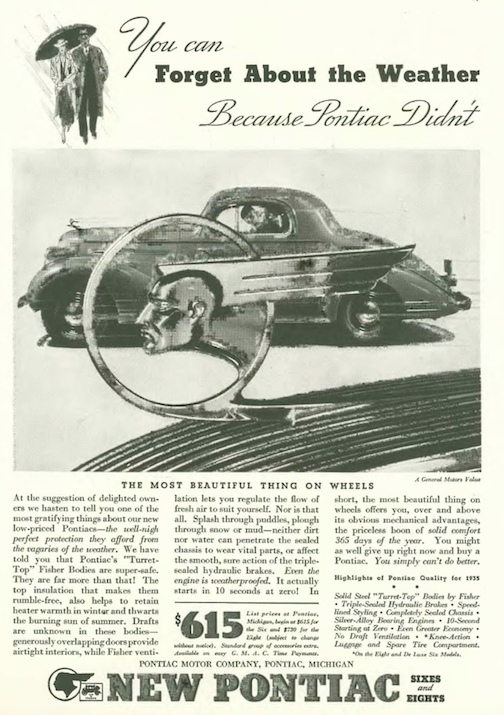
…many automobile advertisements of this era emphasized safety, none more prominent than the “Body by Fisher” ads that frequently featured happy little children…oddly, no one had yet considered seat belts, car seats or other safety measures we now take for granted…

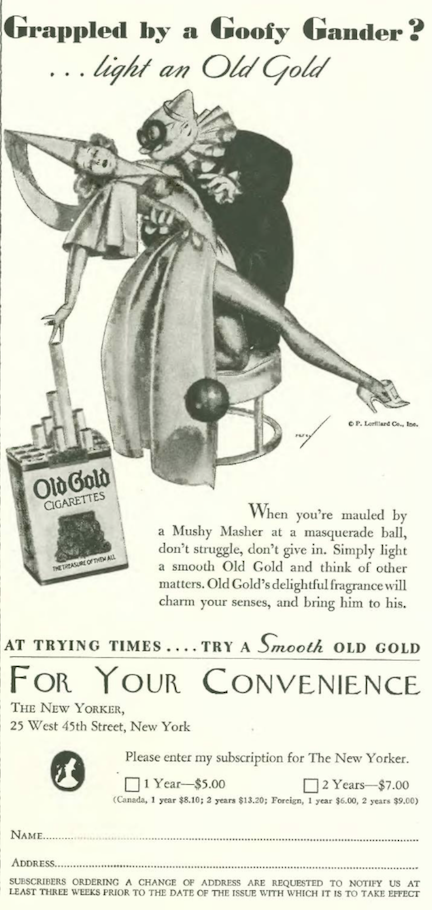
…the makers of Old Gold cigarettes (Lorillard) ran a series of ads featuring a sugar daddy and his leggy mistress…they were drawn by George Petty (1884–1975), famed for his “pin-up girls”…as an added bonus below the ad, you could renew your New Yorker subscription—two years for seven bucks…
…the makers of Camels kept it classy with their continuing series of society women enjoying their unfiltered “Turkish & Domestic” blend…
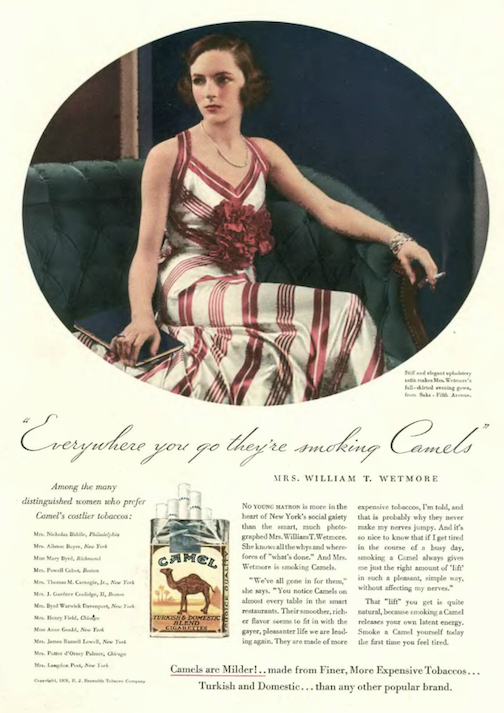
…the “young matron” in the ad, the Sydney, Australia-born Joan (Deery) Wetmore (1911-1989), was indeed “much-photographed,” and was a favorite of Vogue photographer Edward Steichen:

Detail from a Steichen photo of Joan Wetmore, taken in Rockefeller Center’s Rainbow Room, 1934. (Condé Nast)

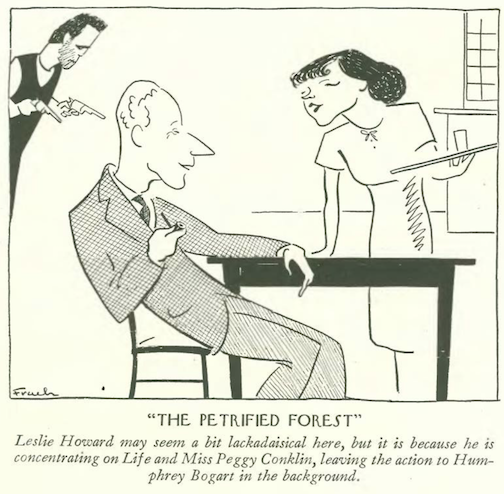
…on to our cartoonists, Al Frueh illustrated Humphrey Bogart as the coldblooded killer Duke Mantee in the 1935 play The Petrified Forest; the 1936 film adaptation would be Bogart’s breakout role in the movies…
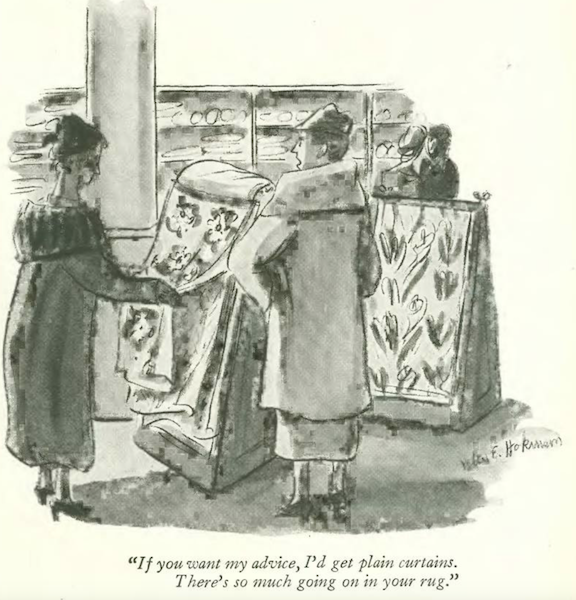
Helen Hokinson went shopping for drapes…
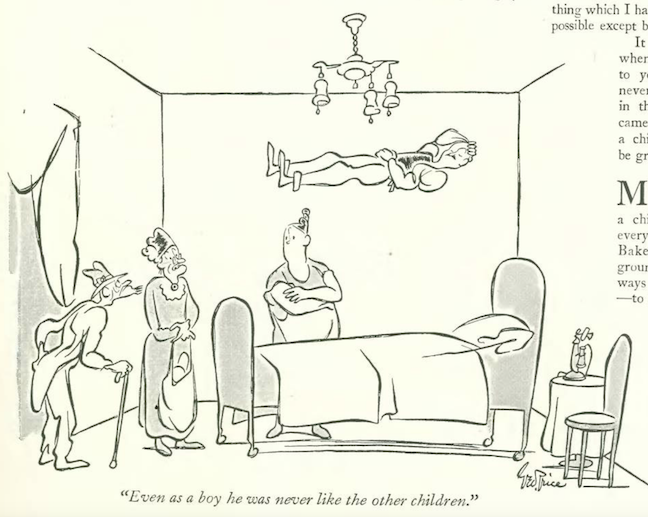
George Price was all tied in knots…

…and still up in the air…
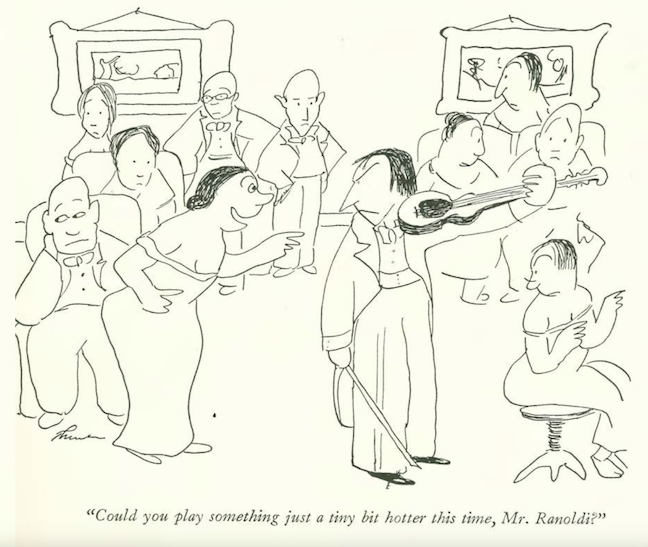
Barbara Shermund dreamed of Venice…

James Thurber gave us the life of the party…
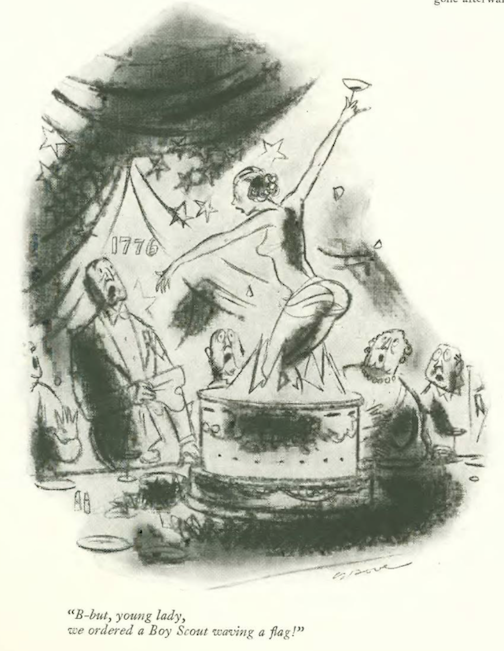
…and we close with Leonard Dove, and some unexpected party life…
Next Time: The Mouse Roars, In Color…
Everything’s Jake

Lois Long employed the Prohibition-era slang term “Everything’s Jake” (“it’s all good”) to headline her latest installment of “Tables for Two.” If you’ve been following the exploits of our nightlife correspondent in this blog, you might recall that for a time in the early thirties she found the New York club scene lackluster, without the daring and grit of the speakeasy era. Lately, however, she was finding some new adventures after dark.

Jan. 19, 1935 cover by Constantin Alajalov.

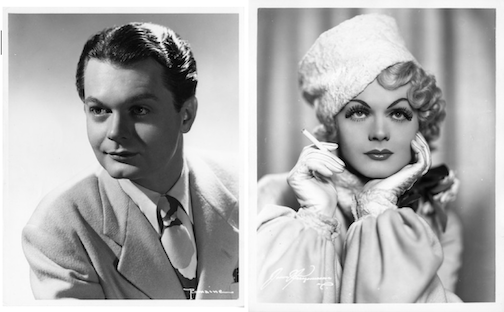
Long checked out the Revue Folies Bergère at the Earl Carroll Theatre, which had been renamed the French Casino, as well as the cavernous Flying Trapeze and the refurbished Hollywood Restaurant, headlined by crooner Rudy Vallée.

FROLIC AND FOLLY…Clockwise, from top left, a Dec. 24, 1934 Herald-Tribune advertisement for the Revue Folies Bergère, the show that opened the new French Casino; a bubble dance as part of the revue, circa 1936; the interior of the French Casino, view from the stage; interior view of former lounge underneath the balcony converted to a cocktail lounge for the French Casino. (Images from Chris Arena and Anthony L’Abbate via drivingfordeco.com/MCNY)
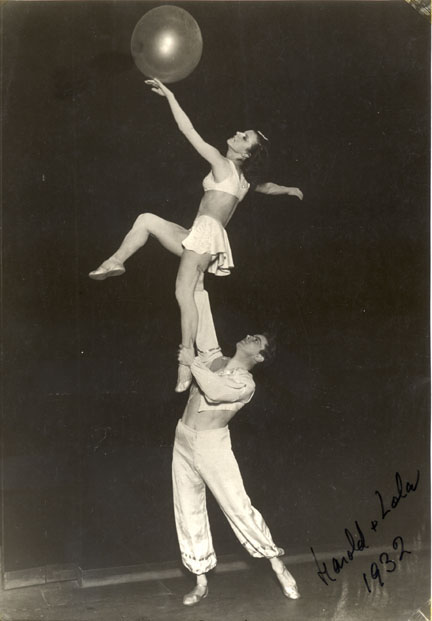
THE SERPENTINE WRITHINGS of dancers Harald and Lola (Harold Liebmann and Lola Werbesz) dazzled Lois Long during a Folies Bergère performance at the French Casino…They are seen here performing at New York’s Shubert Theatre during their first U.S. tour in 1932. (roosvt.com)
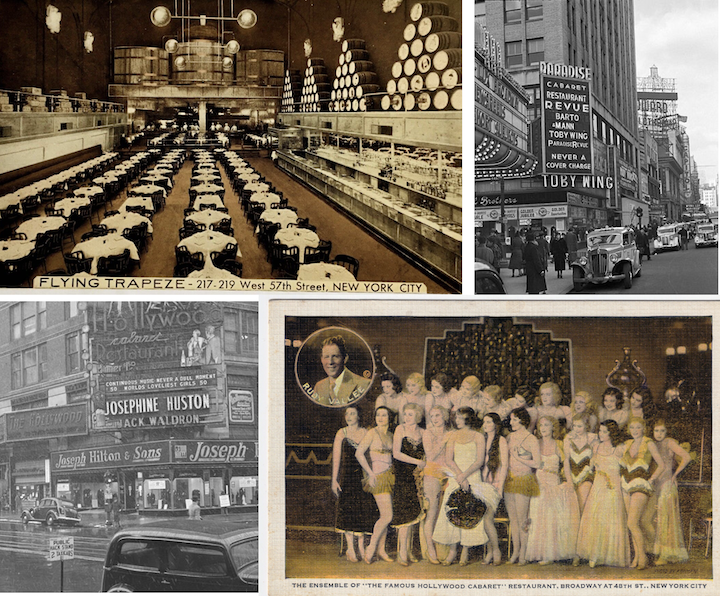
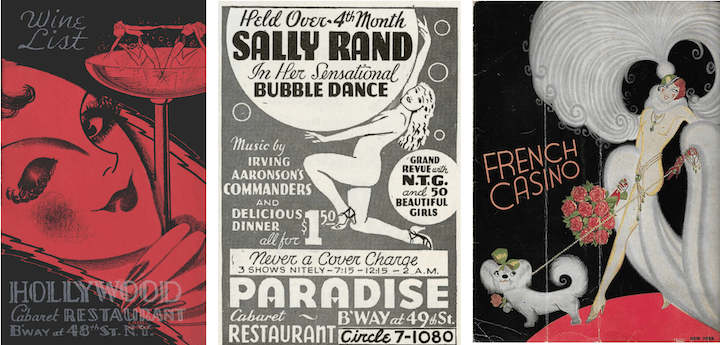
OTHER NIGHTLY DISTRACTIONS…Clockwise, from top left, postcard image of the cavernous Flying Trapeze Restaurant; Lois Long missed Sally Rand’s bubble dance at the Paradise, but she did catch a swell show at the Hollywood Cabaret at 48th and Broadway featuring Rudy Vallee, seen here on a 1935 postcard; exterior of the Hollywood Cabaret, circa 1935. (Pinterest)
NAUGHTY OR NICE…Lois Long was astonished by the female impersonators at the “naughty” Club Richmond…the club’s performers included Harvey Lee. (ualr.edu)

Long also checked out the “naughty” Club Richmond, and returned to the Central Park Casino, which was not long for the world.

 * * *

The Cost of Living

In 1934 Gloria Morgan Vanderbilt famously lost custody of her daughter, Gloria Laura Vanderbilt, to her sister-in-law Gertrude Vanderbilt Whitney. Granted limited parental rights, Gloria Morgan was allowed to see her daughter on weekends in New York, but the court had removed GMV as administrator of her daughter’s trust fund, her only source of support. Howard Brubaker had this to say in his column “Of All Things.”

WHAT’S A MOTHER TO DO? Gloria Morgan Vanderbilt in a 1933 photo. Inset, daughter Gloria Laura Vanderbilt in 1935. (Duke University)

 * * *

Too Much of a Good Thing

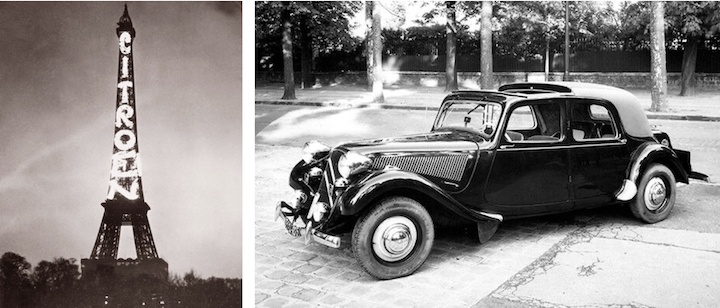
The French automaker Citroën established its reputation for innovation with the 1934 Traction Avant—the first car to be mass-produced with front-wheel drive, four-wheel independent suspension, and unibody construction. However, the cost of making all of these swell improvements—including the tearing down and rebuilding of company’s factory in just five months—led to the financial ruin of the company. After Citroën filed for bankruptcy in December 1934, its largest creditor, the tire-making giant Michelin, swept in to become the principal shareholder

Not only did Citroën lose control of its car company, it also lost its claim to the world’s largest advertising sign. Four nine years Citroën had its brand name emblazoned on the Eiffel Tower, but with bankruptcy (high electricity bills didn’t help) the company was forced to turn off the sign. Paris correspondent Janet Flanner had this observation:

CAN’T MISS IT…From 1925 to 1934, 125,000 glowing lights advertised the Citroën brand on the Eiffel Tower. At right, the company’s innovative 1934 Traction Avant. (Pinterest)

 * * *

From Our Advertisers

The National Motor Boat Show replaced the New York Auto Show as the main attraction at the Grand Central Palace…

…the folks at Pond’s found another Vanderbilt to shill for their cold cream, Muriel Vanderbilt, a socialite and noted thoroughbred racehorse owner…she is joined here by Washington Debutante Katrina McCormick, who was also a fancier of the horse circuit…

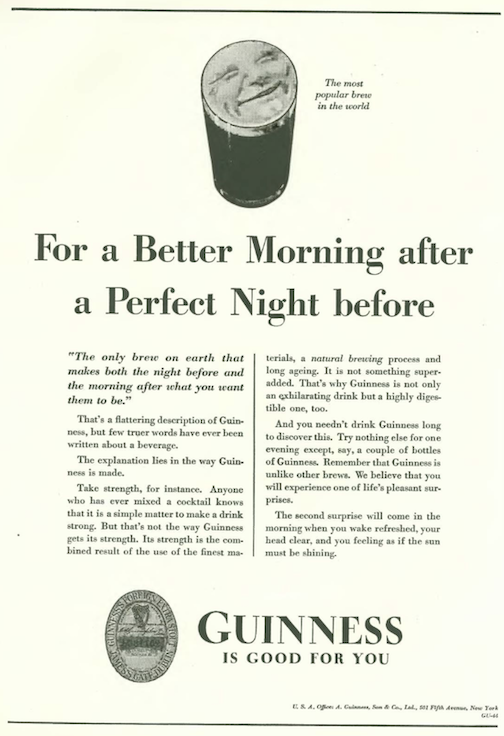
…the famed slogan Guinness is Good for You was launched in 1929, and apparently there is some truth to the claim (antioxidants, according to a University of Wisconsin study), and no doubt it was kinder to one’s morning head than other libations…

…if you preferred the stronger stuff, you could take the advice of cartoonist Peter Arno and Penn Maryland Whiskey, here making a play on words with the title of the 1925 novel (and Broadway play) Gentleman Prefer Blondes…

…here’s Arno again, with a touching moment among the upper crust…

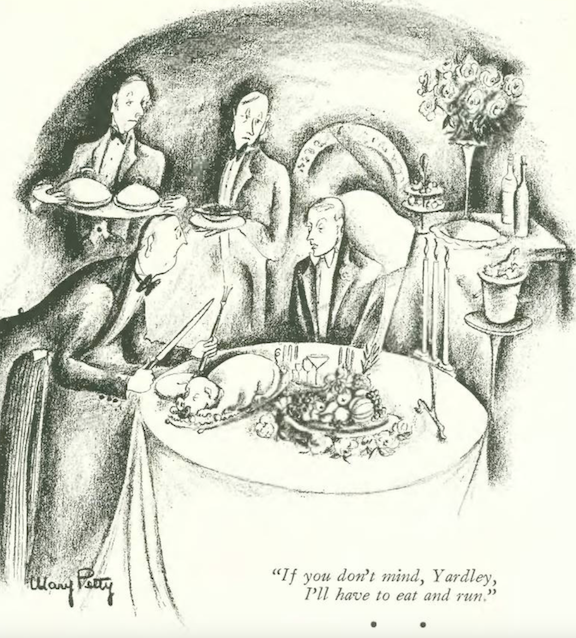
Mary Petty also looked in on the gilded set, and a callous young toff…

…but down in the lower classes, George Price found the youth quite engaging…

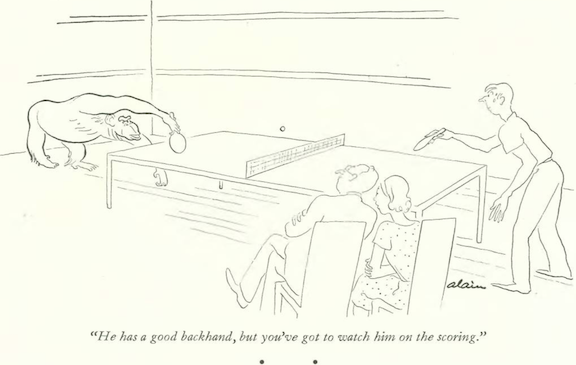
Alain looked in on a formidable ping-pong opponent…

Barbara Shermund was evesdropping backstage at a Broadway revue…

…and we close with James Thurber, and a polite suggestion…

Next Time: Mary Quite Contrary…