At Home With the Capones

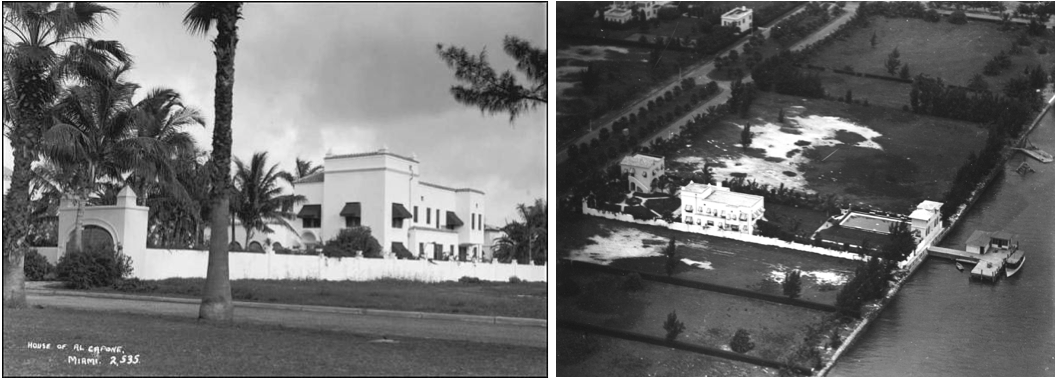
In 1928 Al Capone bought an estate on Miami’s Palm Island as a getaway from the hustle and bustle of Chicago gangster life. He was apparently basking in the Florida sun on Feb. 14, 1929 when four of his associates gunned down seven members of a rival Irish gang on Chicago’s North Side.
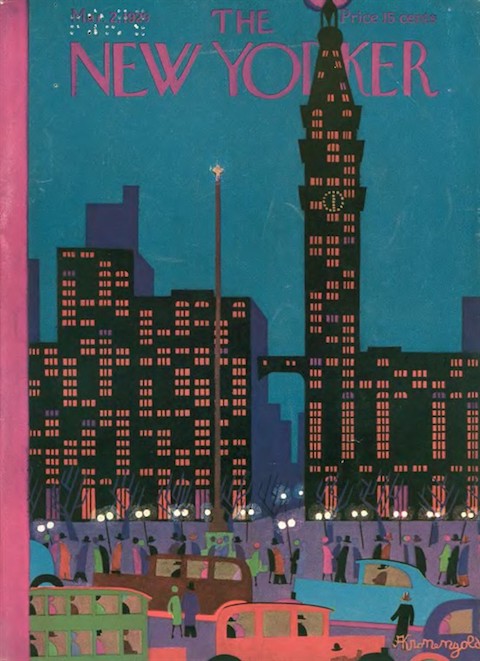
March 2, 1929 cover by Adolph K. Kronengold.
WINTER RETREAT…Al Capone’s estate on Miami’s Palm Island. (miami.curbed.com / sallyjling.org)

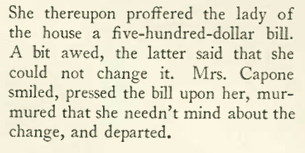
It is widely believed Capone ordered the killings, given that he dominated Chicago’s illegal bootlegging, gambling and prostitution trades and was known for his ruthless elimination of rivals. On the heels of the St. Valentine’s Day massacre, James Thurber contributed this item in the New Yorker’s “Talk of the Town” describing a more mundane side of gangster life:
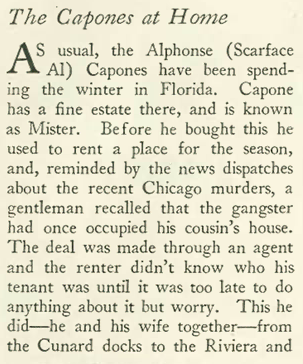
Shortly after Thurber’s article appeared in the March 2, 1929 New Yorker, Capone would be arrested in Chicago by FBI agents on a contempt of court charge and again in May 1929 on a weapons charge. The following March Capone would be referred to as “public enemy number one” by the Chicago Crime Commission, and a month later he would be arrested on vagrancy charges during a visit to Miami—the Florida governor wanted him out of the state. In 1932 Capone would be sent to Federal Prison for tax evasion.
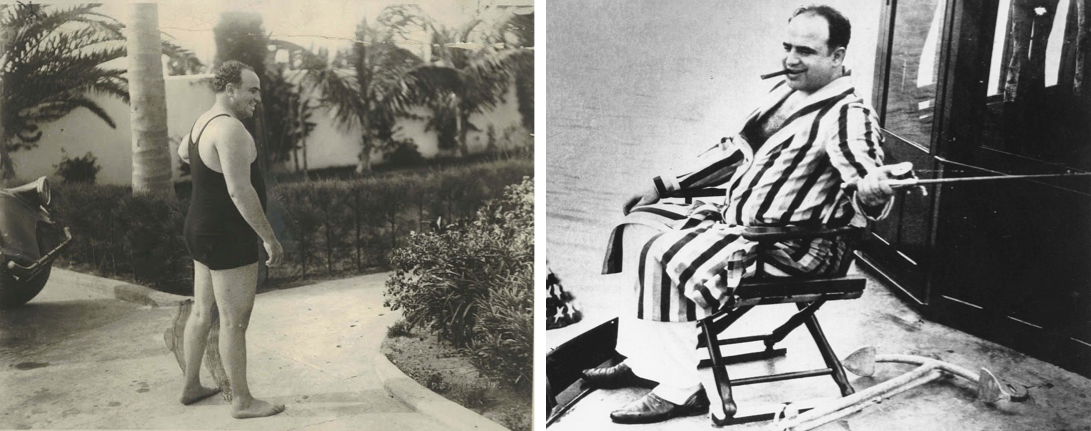
SNOW BIRD OF A DIFFERENT FEATHER…Al Capone relaxes at his Palm Island estate, left, and tries his hand at deep sea fishing off the Florida coast, circa 1929. (miami-history.com)
TEN YEARS LATER…Al Capone and his wife Mae (at right), with their son, Albert and their soon-to-be daughter-in-law Diana Ruth Casey. The photo was taken at Palm Island in 1940 after Al Capone’s release from prison. (Associated Press)

When Capone finally returned to Palm Island in 1940, he was a very different man. When he entered the U.S. Penitentiary in Atlanta in 1932 he was found to be suffering from both syphilis and gonorrhea, and when he was released seven years later his mental capacities were severely diminished due to late-stage syphilis. In 1946 a physician concluded Capone had the mentality of a 12-year-old child. He died on Jan. 25, 1947, having just turned 48 years old.

Another mention of the St. Valentine’s Day massacre could be found in Howard Brubaker’s column “Of All Things”…

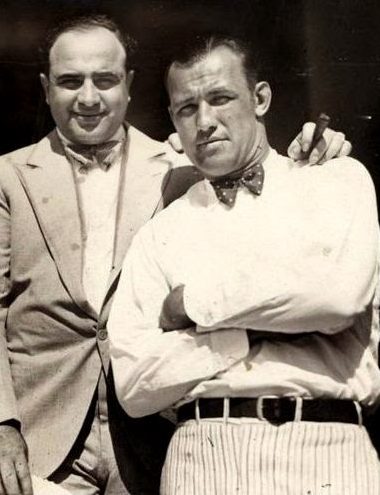
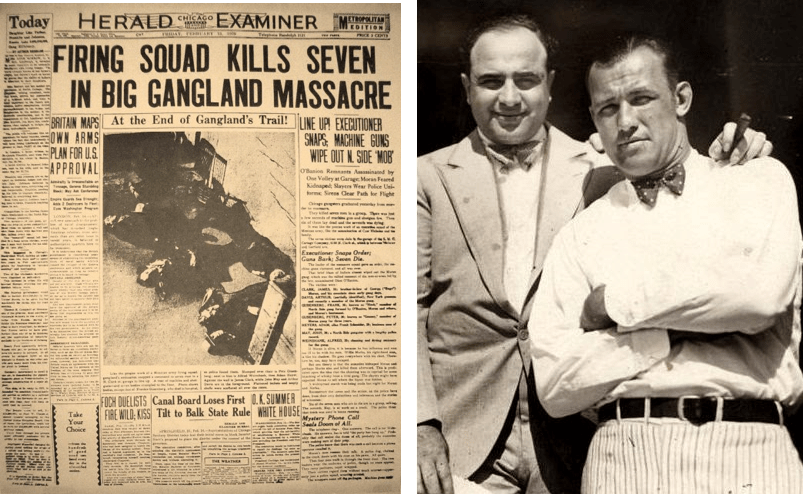
MY ALIBI…Al Capone poses with boxer Jack Sharkey in Miami on Feb 13, 1929, the day before the St. Valentine’s Day Massacre. Sharkey was in training for his bout with Young Stribling. (classicboxingsociety.blogspot.com)
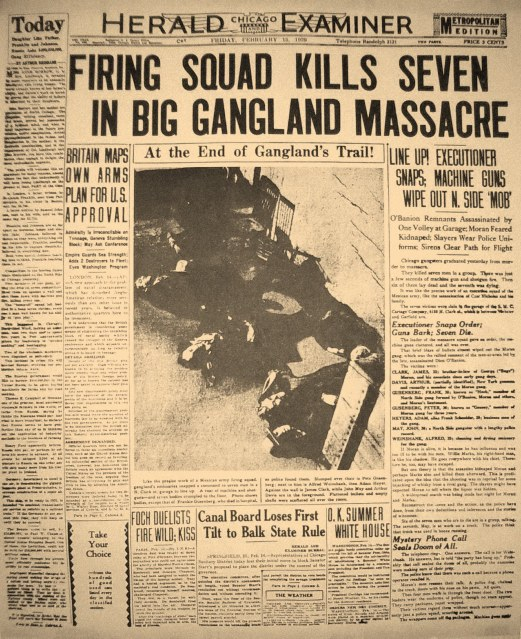
MEANWHILE IN THE WINDY CITY…The Chicago Herald-Examiner’s front page coverage of the St. Valentine’s Day Massacre. (Chicago Public Library)

*  *  *

Pierre’s Hotel

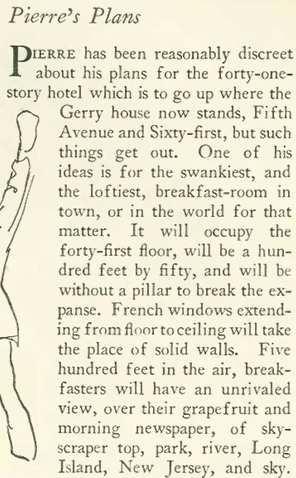
Back in New York, patrons of famed chef Charles Pierre Casalasco were abuzz over his plans for a luxury high-rise hotel. Writing in “Talk of the Town,” Leonard Ware made these observations about Pierre’s big plans:
A BUSBOY’S DREAM…Lloyd Morgan’s 1928 rendering of the Hotel Pierre (left), and the Hotel Pierre today, as viewed from Central Park. The hotel’s builder, Charles Pierre Casalasco, started out as a busboy in his father’s restaurant in Corsica. (Half Pudding Half Sauce / Wikimedia Commons)

Ware recounts how Pierre went from humble busboy to renowned haute cuisine restaurateur:

The Rotunda of the Hotel Pierre. (Wikimedia Commons)
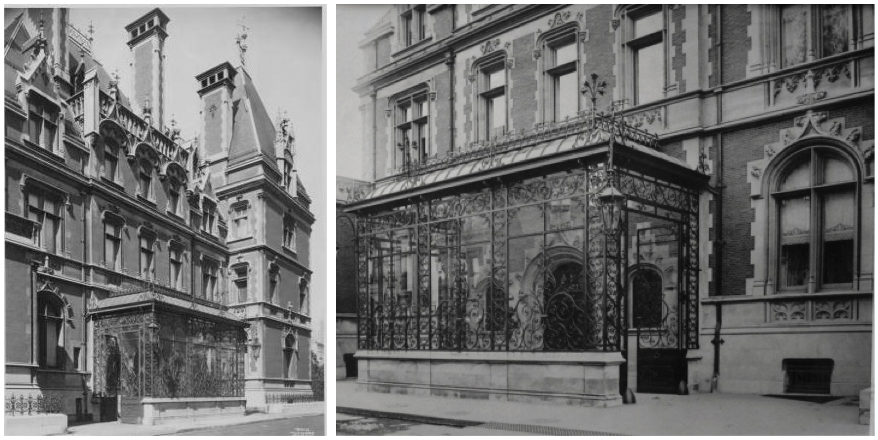
The 1897 Elbridge T. Gerry mansion, designed by Richard Morris Hunt, was torn down to make way for the Hotel Pierre. French artisans were hired to construct the elaborate wrought iron porte-cochere at the main entrance. (New York Public Library / American Architect & Building News)

 *  *  *

Famed Bluestocking

The New Yorker’s Paris correspondent, Janet Flanner, who wrote under the pen name Genêt, wrote under her own byline for the first time in a profile of the famed novelist Edith Wharton, featured in the March 2 issue. Although born a New Yorker, Wharton mostly lived in France after 1914. Below is a drawing of Wharton by Hugo Gellert that accompanied the profile, of which a few excerpts are included below:

VIVE LA FRANCE…Edith Wharton at her spring and winter home in France, Sainte-Claire du Chateau, circa 1930. She finished her novel, The Age of Innocence at Sainte-Claire. (Pinterest)

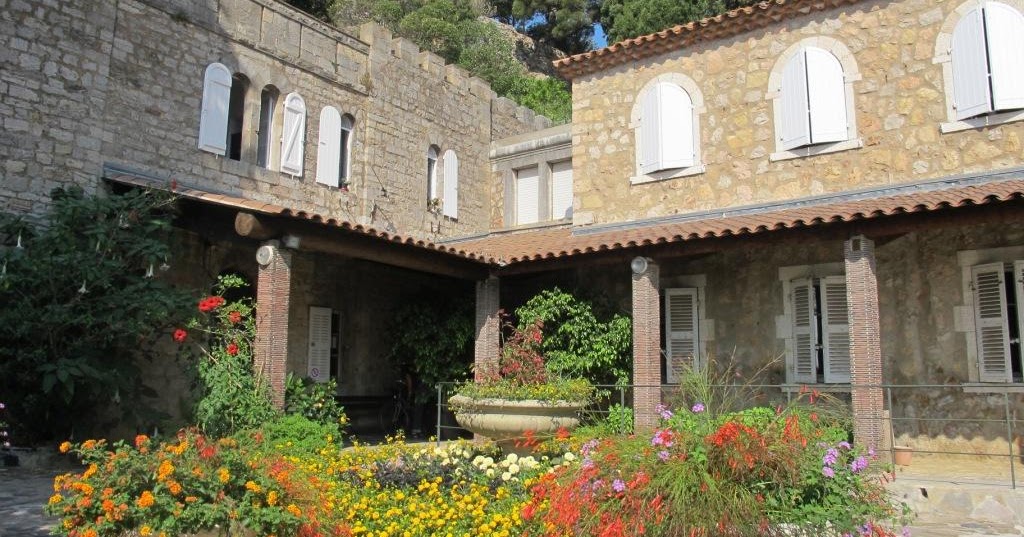
STILL LOVELY…Sainte-Claire du Chateau today. (sydneynearlydailyphot.blogspot.com)

GOLDEN YEARS…Edith Wharton in her garden at Sainte-Claire du Chateau, circa 1930.

 *  *  *

From Our Advertisers

Automobile manufacturers were keen to snob appeal even 90 years ago, as can be seen in this advertisement for Dodge cars—the company had been acquired the previous year by Walter Chrysler. Dodge cars were noted for dependability and value, but this ad suggested even blue bloods would find them appealing…
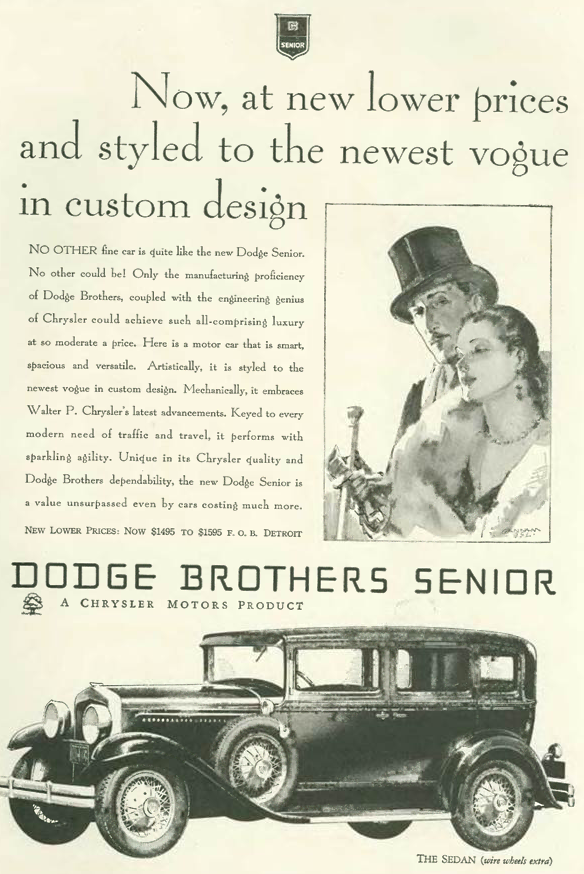
…Chrysler did however take a more direct aim at the top-hat set with a new model— Imperial—to compete with luxury carmakers such as Lincoln and Cadillac…

…just for kicks, this is what the Chrysler Imperial would look like just 30 years later…

(Kimballstock)

…not to be left out, Cadillac placed its downscale luxury model next to Mont-Saint-Michel in this illustrated advertisement. The LaSalle was comparable in price to the Imperial (around $2,500 to $3000) while top-of-the-line Caddies were priced up to $7000…

…and what do you put in your fine automobile to make it purr? Why gasoline mixed with tetraethyl lead, of course!

Speaking of mixing, I like this advertisement for Cliquot Club, whose manufacturers finally—and not so subtly—hint at how their product is to be enjoyed…

…and finally, this ad for the new Fuller Building, which touted gallery spaces for “superior merchandise” on its first six floors…

ART DECO GEM…The 1928-29 Fuller Building by Walker & Gillette at 41 East 57th St. The crown (at left), and a view of the entrance. The lower floors still serve as gallery spaces for art dealers such as Neuhoff and Emmerich. (nyc-architecture.com)

In the cartoon department, we have I. Klein’s take on recent activities associated with the inauguration of President Herbert Hoover

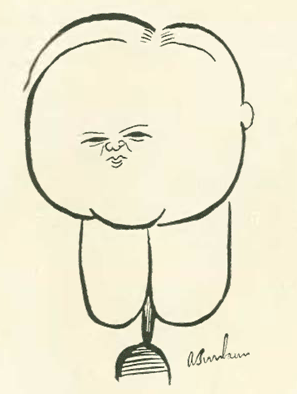
…and Abe Birnbaum, who provided this sketch of Hoover for the opening pages…
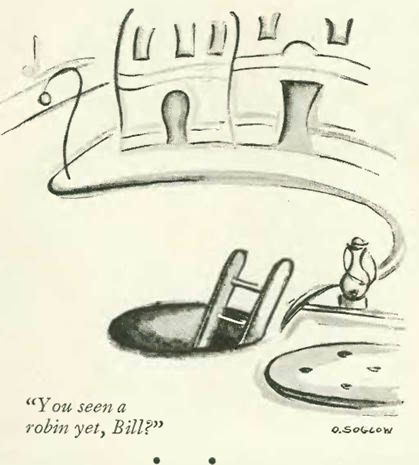
Otto Soglow’s manhole denizens looked for signs of spring…
…and finally, a comment on the diversification of drugstore wares, by a cartoonist signed as “Kinol.” I’ve had no luck tracing this name, so if anyone has the scoop on this artist, please drop me a note!

Next Time…Sky-High Fitness…

 

Modern English Usage

The fourth anniversary issue of the New Yorker gave every indication that the magazine had arrived as a cultural force.

Fourth anniversary cover, Feb. 23, 1929, by Rea Irvin.

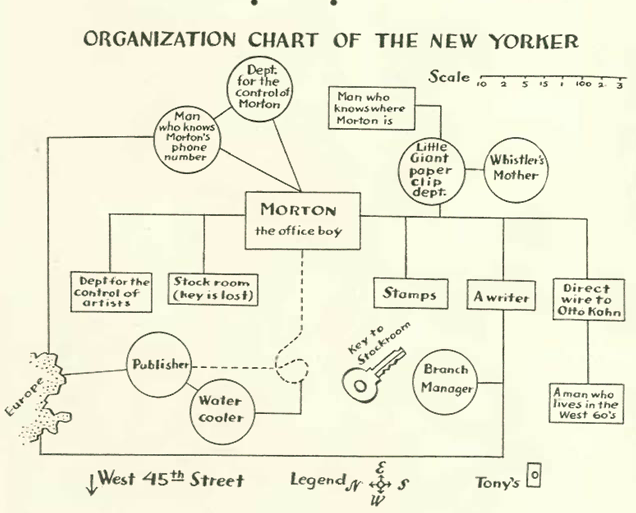
Rich in content, the issue’s offering’s ranged from the famed humorous short “You Were Perfectly Fine” by Dorothy Parker, a profile of famed maestro Arturo Toscanini, and various accounts on the romance between Charles Lindbergh and Anne Morrow. The issue also featured this “organization chart” drawn by Julian de Miskey:

The little door marked “Tony’s” in the bottom right-hand corner referred to a celebrated speakeasy operated by Tony Soma. It was a second home to many New Yorker staffers, and was patronized by hard-drinking actors and writers including Scott and Zelda Fitzgerald, Dorothy Parker and Robert Benchley, and also a young actor named Humphrey Bogart.

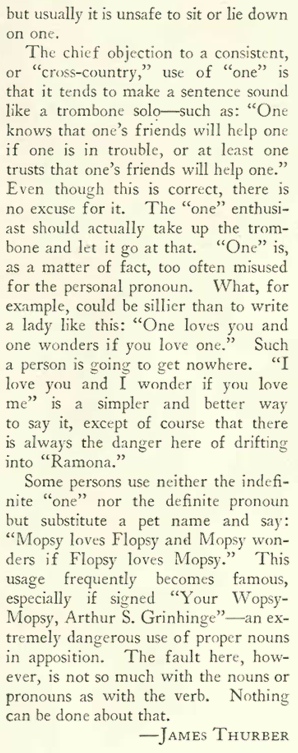
Another notable item in the Feb. 23 issue was this contribution by James Thurber in which he lampooned H.W. Fowler’s Modern English Usage, a handbook that New Yorker Editor-in-Chief Harold Ross considered to be the last word in matters of punctuation and grammar. Thurber would write a dozen entries in this series, including the following (click to enlarge):

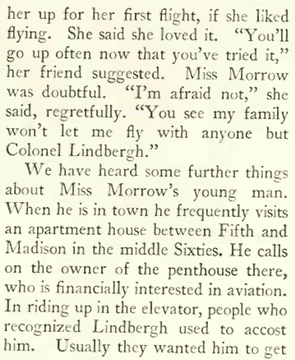
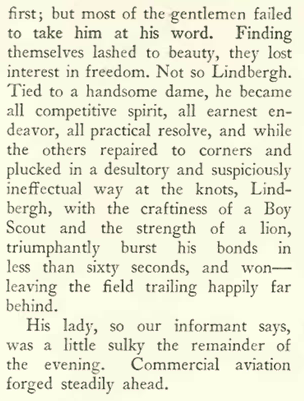
The New Yorker could never get enough of Charles Lindbergh, even though his personality was every bit as wooden as that of the former President Calvin Coolidge. The Feb. 23 “Talk of the Town” speculated on “Charlie’s” affections for Anne Morrow, and the woe that would befall anyone who challenged the famed flyboy for those affections:

COME FLY WITH ME…Anne Morrow Lindbergh and Charles Lindbergh shortly after their marriage in May 1929. (Bio.com)
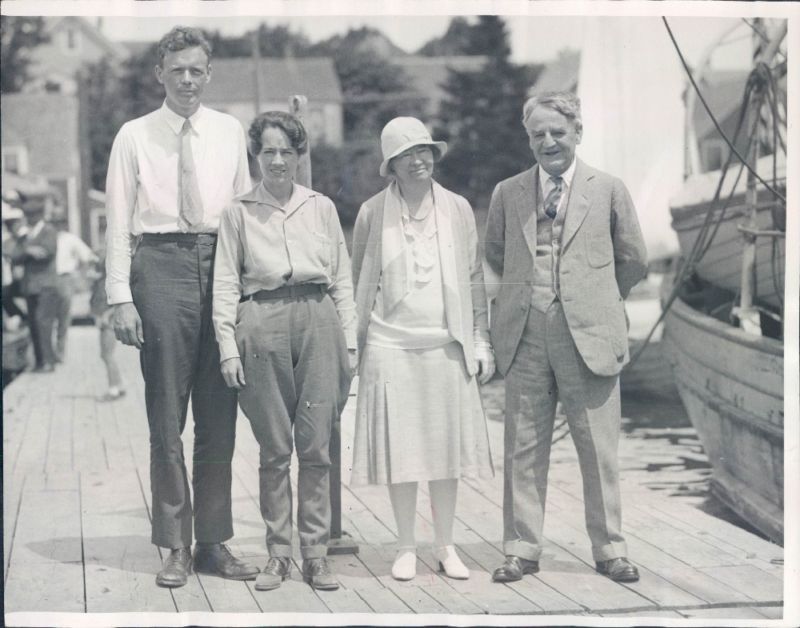
SON-IN-LAW…Charles and Anne visiting Anne’s parents, Elisabeth and Dwight Morrow, in 1931. Charles met Anne during a visit to Mexico when Dwight was served as ambassador to that country. (kaiology.wordpress.com)

A second item in the Feb. 23 “Talk” section took a closer look at Charles’ courtship habits, or lack thereof…

Even Howard Brubaker got in a word regarding the Lindbergh-Morrow courtship in his column, “Of All Things”…

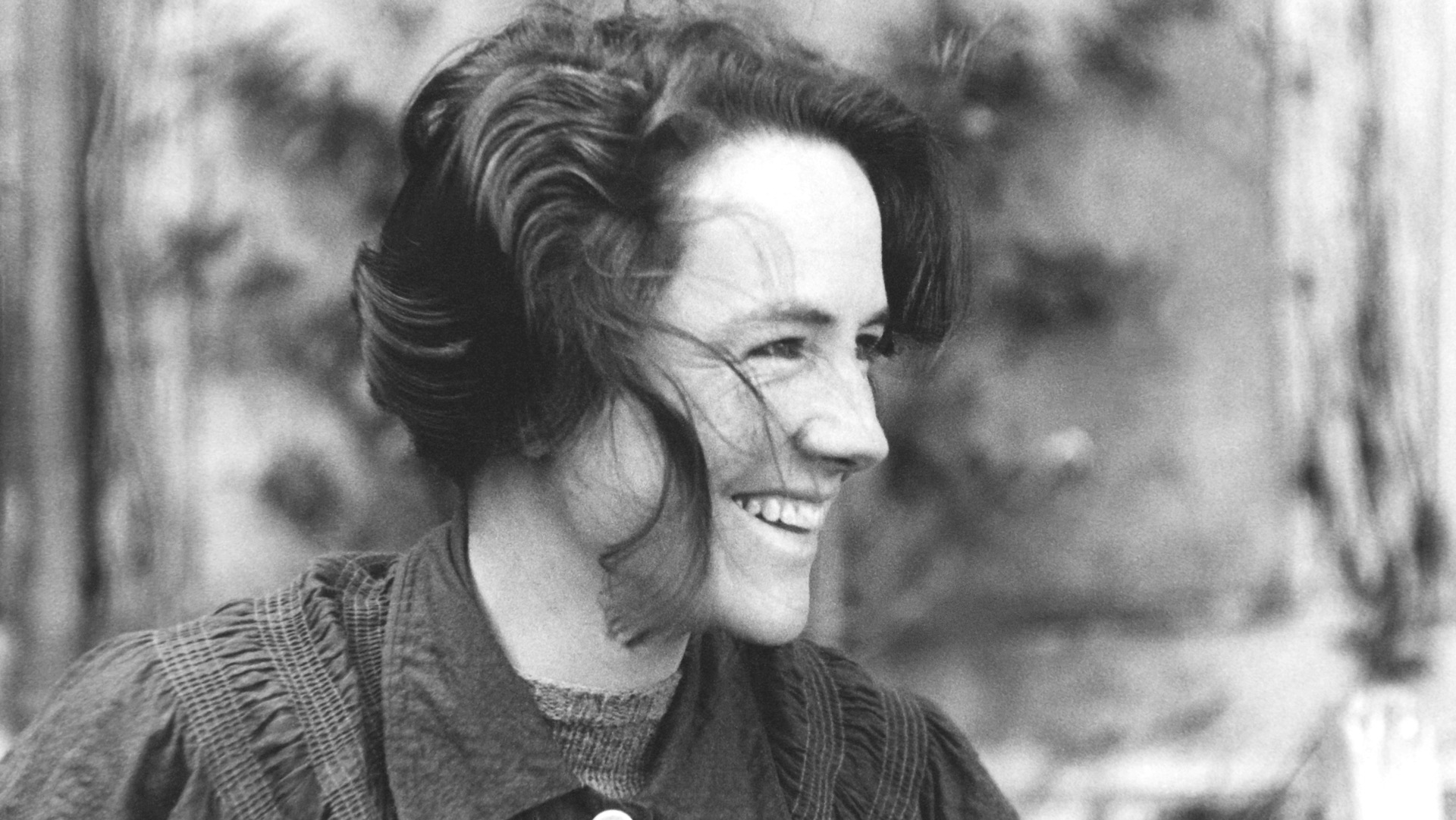
As we know, Brubaker had it wrong. Rather than pining away at home, Anne would become one of the 20th century’s most beloved writers, a leading feminist voice, and an accomplished aviator in her own right.

SORRY CHARLIE…As one for the most beloved writers of the 20th century, Anne Morrow Lindbergh would go on to match and even eclipse her husband’s fame. (PBS)

*  *  *

Little Yehudi

Yehudi Menuhin is known to classical music lovers as one of the greatest violinists of the 20th century. But as this “Talk” item suggests, he was once a little boy, more or less…
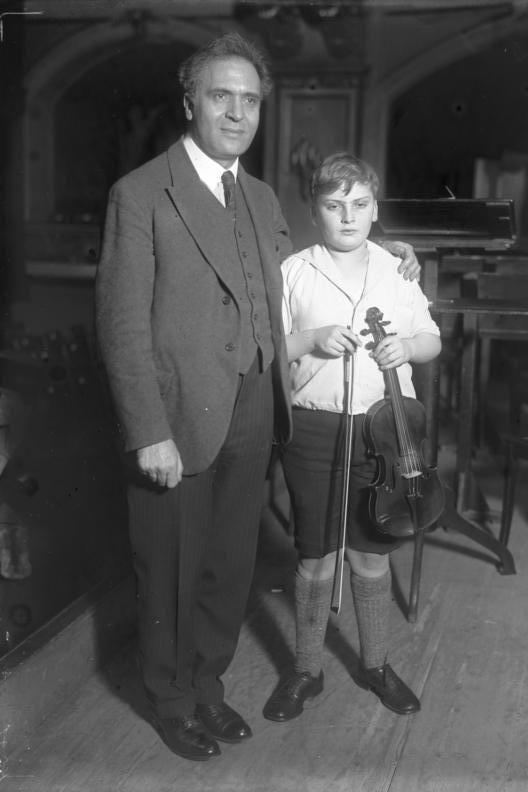
STILL IN SHORT PANTS…A young Yehudi Menuhin poses with conductor Bruno Walter in Berlin, 1931. Just two years after this photo was taken, Walter would flee Nazi Germany and eventually settle in the U.S. (Wikipedia)

 *  *  *

More Fun With Lois

Although Lois Long devoted most of her ink to her weekly fashion column, “On and Off the Avenue,” she continued to write her nightlife column, “Tables for Two,” though somewhat sporadically. Which makes sense because around this time Long was also either pregnant (she was married to New Yorker cartoonist Peter Arno) or was now the mother of a daughter, Patricia. The reason I’m not sure is that I have birth dates from both 1928 and 1929 for Patricia, depending on sources. At any rate, Long was taking in the nightlife in a big way, moving from club to club and assessing the quality of their various acts:

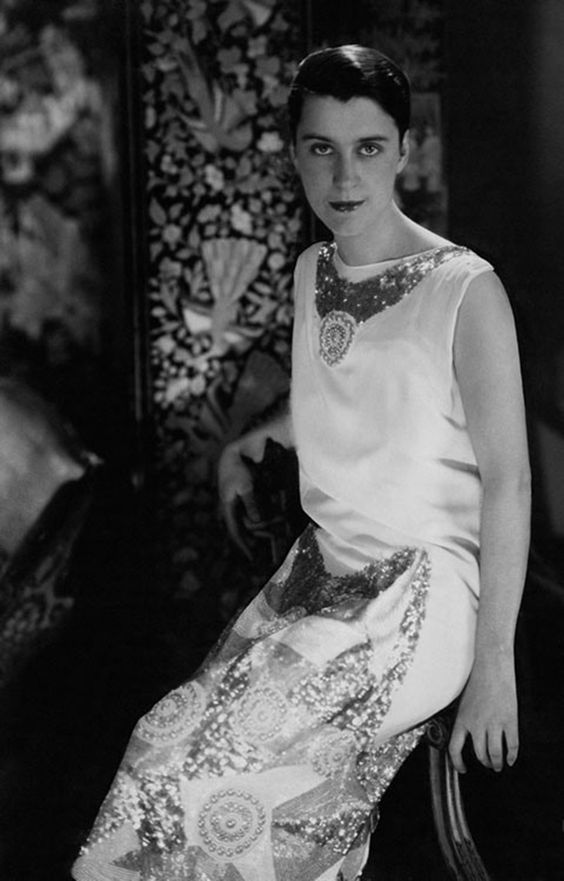
At the Lido, Beatrice Lillie sang “for the edification of devoted admirers”…

AT THE LIDO you could see British actress, singer and comedic performer Beatrice Lillie light up the stage. (vintag.es)

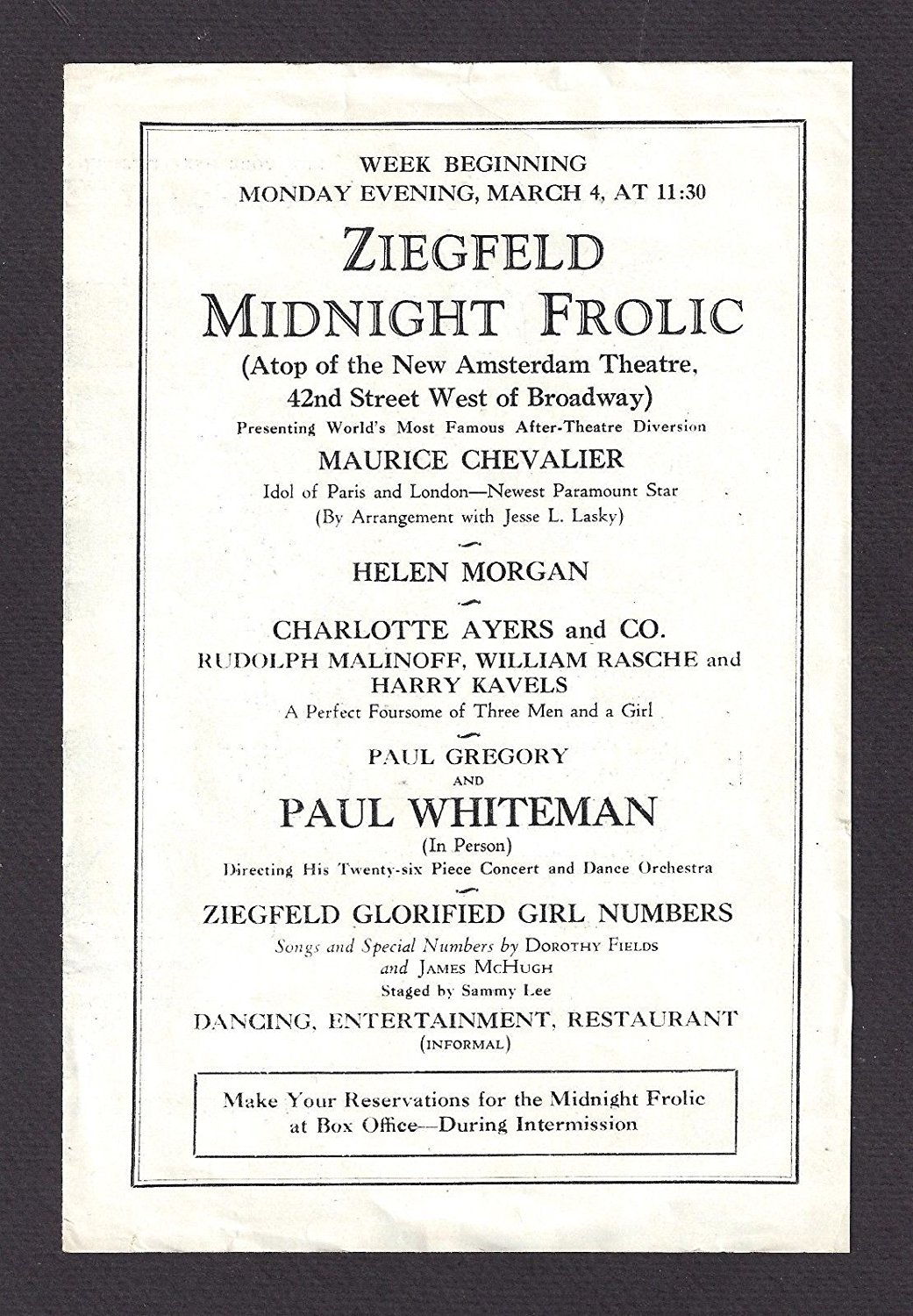
…Long also commented on the arrival of French entertainer Maurice Chevalier, who promised to inject some life into the Paul Whitman Orchestra performing at the Ziegfeld Midnight Frolic

Flyer announcing Maurice Chevalier’s upcoming performance at the Ziegfeld Midnight Frolic.
THANK HEAVEN…Maurice Chevalier in a 1929 publicity photo. He is mostly known today for his appearance in the 1958 film Gigi and his rendition of “Thank Heaven for Little Girls.” (thefamouspeople.com)

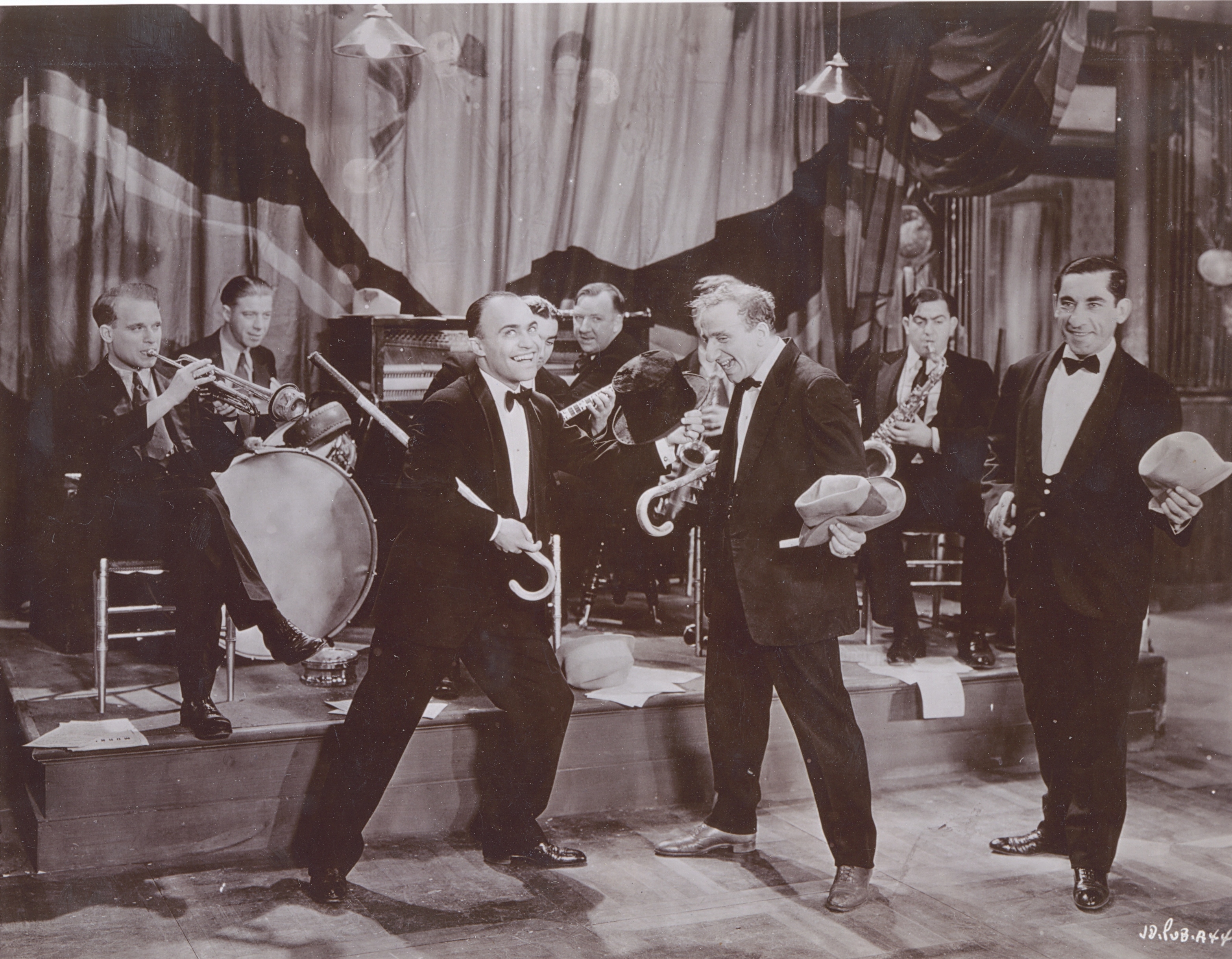
As for the rest of the New York nightlife, Long hoped that in the end it was all for fun, and that there was no “deep meaning” behind the frivolity:

SHALLOW WATERS…Eddie Jackson, Jimmy Durante, Lou Clayton performing their act in the motion picture Roadhouse Nights, 1930. (digitalcollections.nypl.org)

 *  *  *

Something In the Air

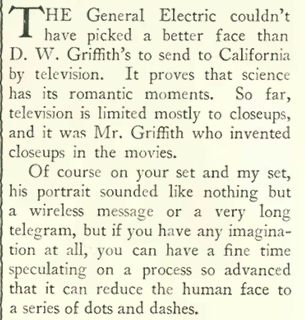
The “On The Air” column noted that NBC had made a brave attempt at rebroadcasting the music of the London Symphony Orchestra from Queen’s Hall and had “succeeded in coaxing a section of Rachmaninoff’s E Minor Symphony across the Atlantic.” It was also reported that the General Electric Company of Schenectady, in its ongoing research into television, had successful sent an image of famed film director D.W. Griffith across the country to California. In a separate item. “The Talk of the Town” also reported on the achievement…

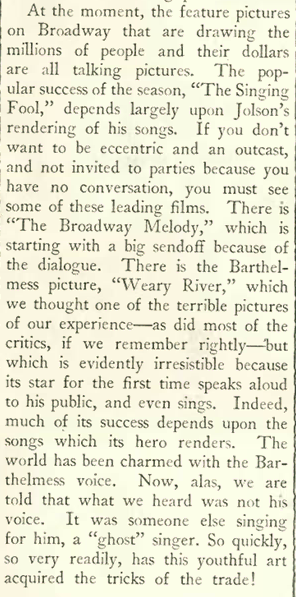
…and advances continued in motion pictures, the “talkies” quickly overtaking the silents and even resorting to such tricks as lip-syncing:

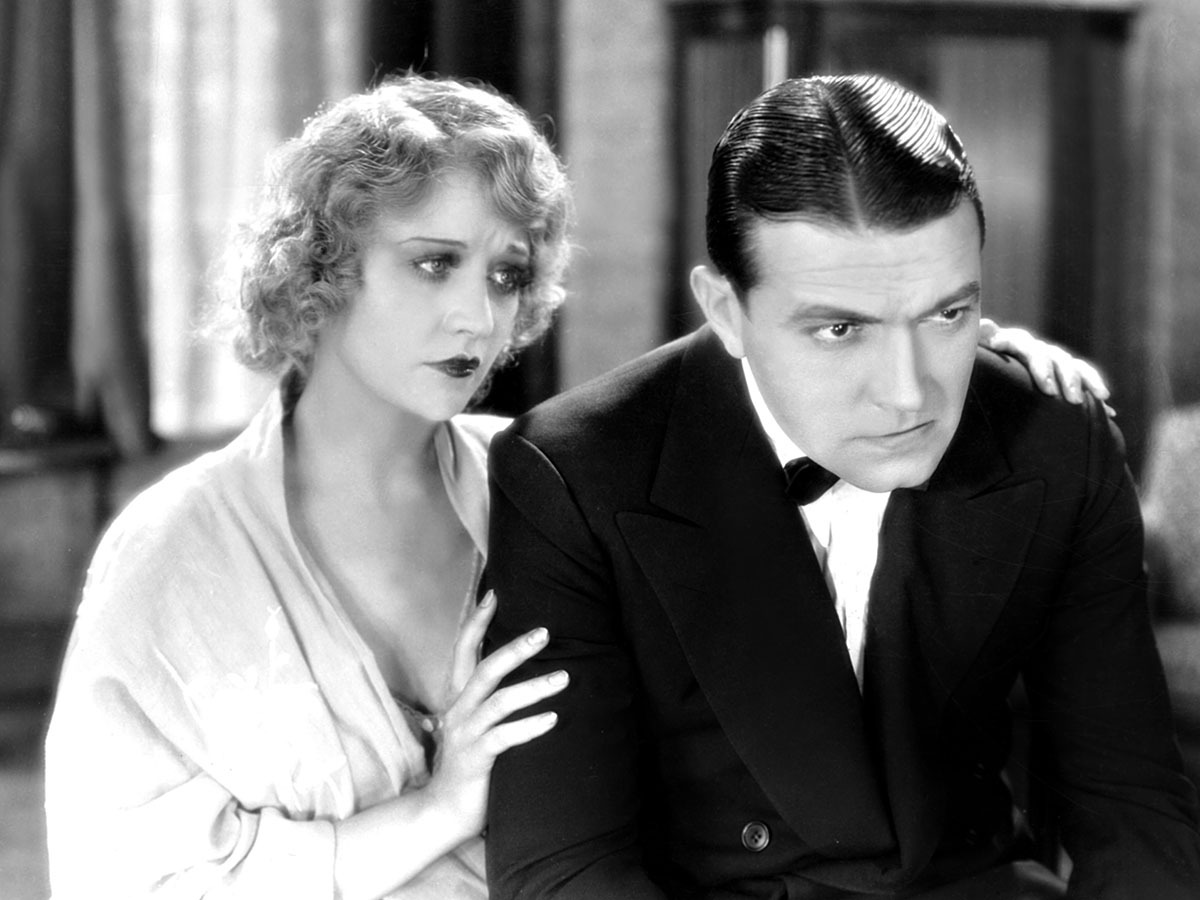
SORRY DEAR, YOU’VE BEEN DUBBED…Betty Compson with Richard Barthelmess in Weary River. While Barthelmess’s character sings and plays the piano throughout the film, Barthelmess himself did not sing or play the piano. Frank Churchill played the piano and Johnny Murray sang into a microphone far away from Barthelmess while he lip-synced and played a piano which had strings deadened with felt. (TCM)

*  *  *

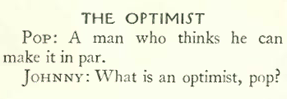
For the anniversary issue, and for old time’s sake, the New Yorker tossed in this little filler joke from its first issue, a joke that was repeated ad nauseam in subsequent issues:

This riddle, told backwards, appeared to be a mistake, but it was most likely an attack on two-liners found in humor magazines of the day like Judge and Punch.

From Our Advertisers

Advertising was booming for the New Yorker in 1929, the magazine recording nearly $2 million in ad sales that year (compared to just $36,000 in their first year, 1925). Now on to the ads…

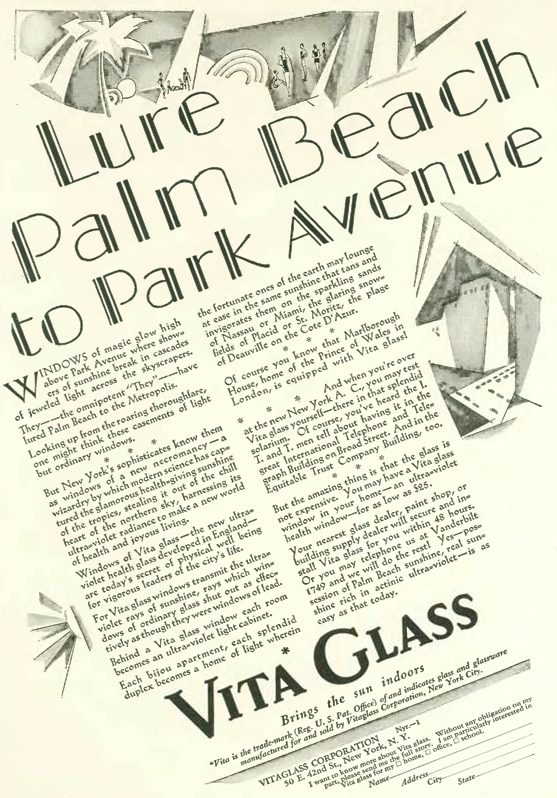
In a recent post we followed the mostly wealthy New York snowbirds down to Palm Beach, Florida, which during the 1920s grew from a quiet village to a resort for the rich and famous. For those who couldn’t make it, they could install “Vita Glass” and bring Palm Beach to Park Avenue…

…and as spring approached, one could catch a bit of nature’s breezes atop 730 Park Avenue…

…or live like a demi-god above the toiling masses at Fifth Avenue’s Lefcourt National…

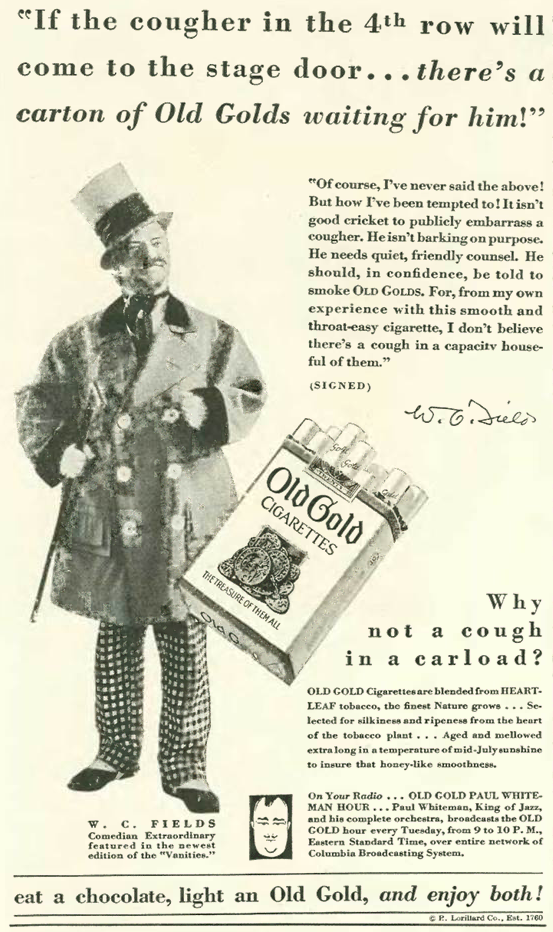
…back on terra firma, we find W.C. Fields the latest endorser of Old Golds…

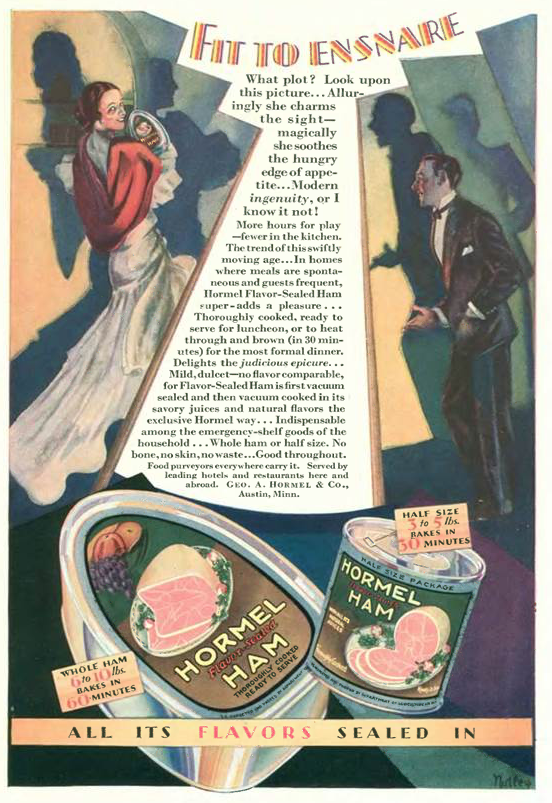
…this has to be the most audacious attempt to add sex appeal to canned ham…

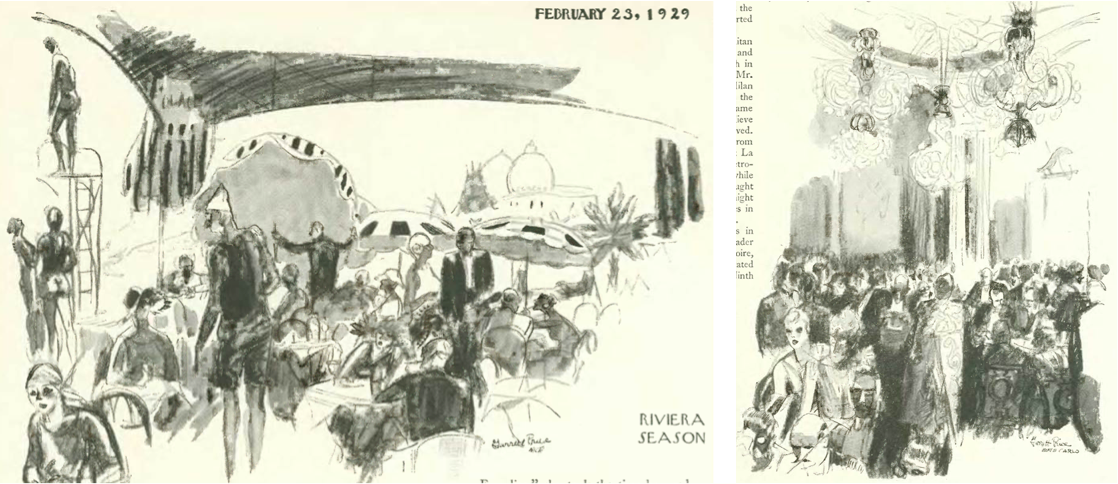
And finally, our illustrators…Garrett Price contributed some fine drawings of Nice and Monte Carlo…

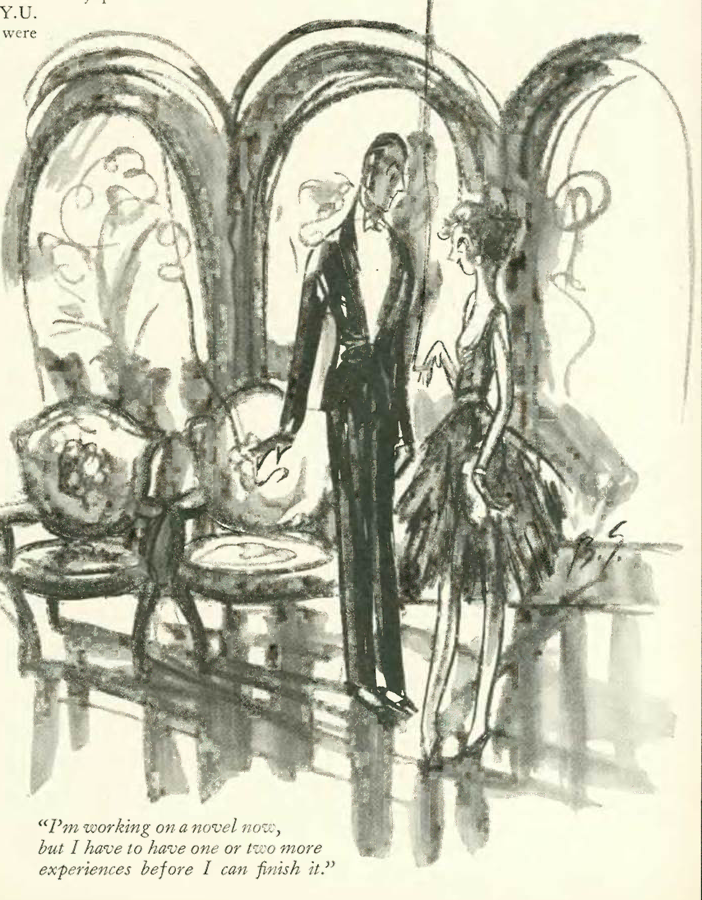
Barbara Shermund looked in on young toffs making idle chat…

…and Rea Irvin, finding everyone perplexed over Einstein’s unified field theory…

Next Time: The Capones at Home…