Despite The New Yorker’s taste for the finer things–polo, opera, classical music–its editors couldn’t resist the pull of popular culture as both spectacle and fodder for mockery of the hoi polloi.
Oct. 9, 1926 cover by Julian de Miskey.
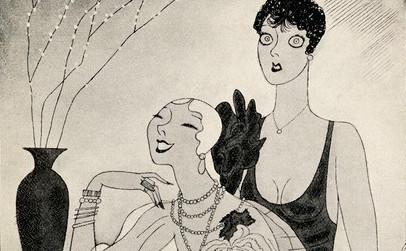
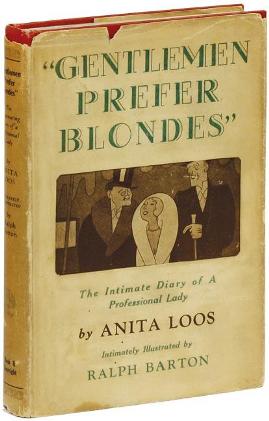
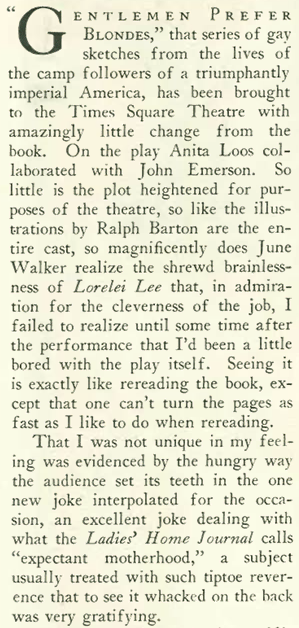
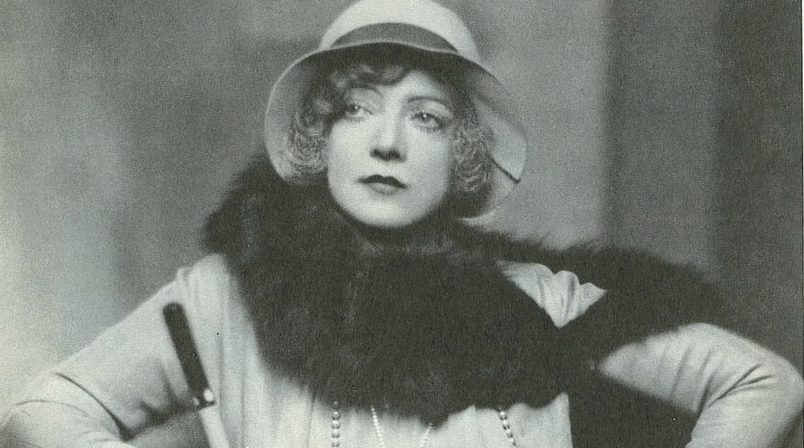
And so we have the Oct. 9, 1926 issue with a review of the much-anticipated Broadway play Gentlemen Prefer Blondes, which was based on a surprise bestselling novel by Anita Loos (and illustrated by The New Yorker’s own Ralph Barton). Despite garnering lukewarm reviews from critics, the public loved the adventures of gold-digging flapper Lorelei Lee.
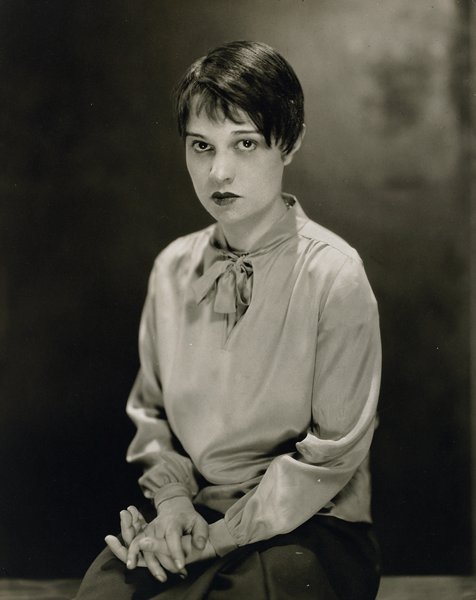
First edition of Gentlemen Prefer Blondes, by Anita Loos, illustrated by Ralph Barton (Wikipedia)Edward Steichen portrait of Anita Loos, 1926. The New Yorker would feature a lengthy, admiring “Profile” of Loos in its Nov. 6, 1926 issue. (Minneapolis Institute of Art)
According to Wikipedia, the book was one of several famous novels published in 1925 to chronicle the Jazz Age, including F. Scott Fitzgerald’sThe Great Gatsby (which ironically didn’t do so well) and Carl Van Vechten’sFirecrackers. Loos was inspired to write the book after watching a sexy blonde “turn intellectual H. L. Mencken into a lovestruck schoolboy.” Mencken, a close friend of Loos, actually enjoyed the work and saw to it that it was published.
Gold-digging flapper Lorelei Lee (June Walker, second from left), Henry Spofford (Frank Morgan, second from right), and the rest of the cast tussle in the stage production Gentlemen Prefer Blondes, Times Square Theatre, 1926. Another “blonde,” Marilyn Monroe, would famously portray Lorelei Lee in the 1953 Howard Hawks film. (New York Public Library)
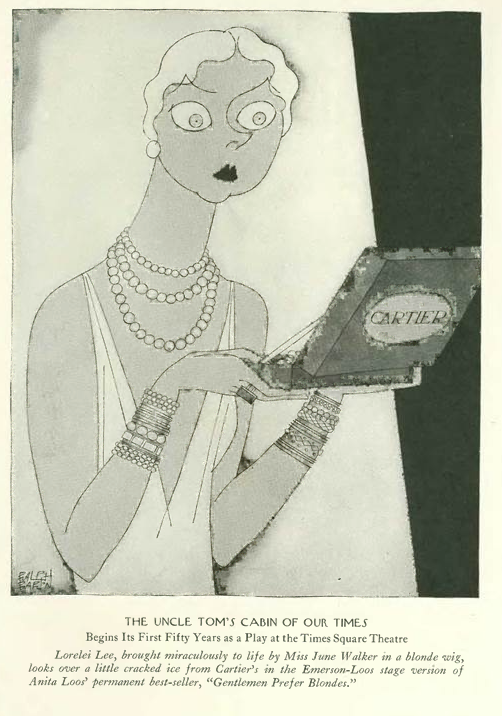
Ralph Barton contributed this drawing of June Walker for the magazine’s review:
And a bit of the review itself…
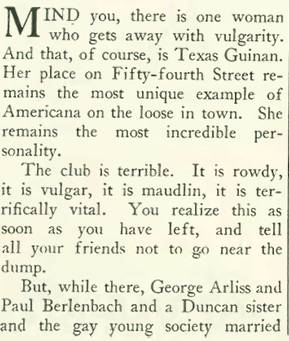
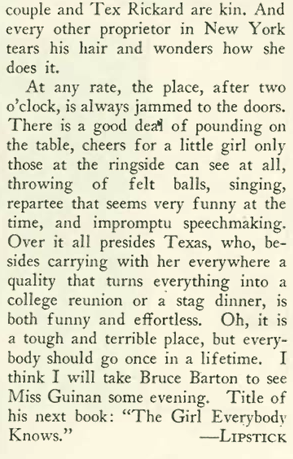
In other items, Lois Long paid a visit to Texas Guinan’s 300 Club on 54th Street, which apparently was still the place to go for a roaring good time:
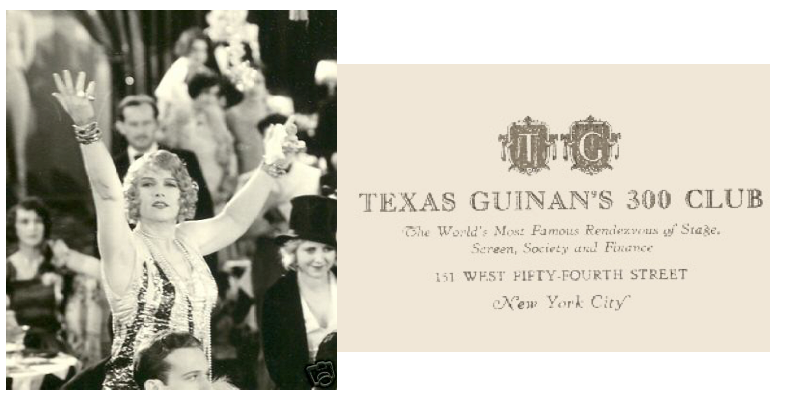
JUST HAVING FUN…According to the blog Ephemeral New York, Texas Guinan’s 300 Club at 151 West 54th Street hosted the likes of John Barrymore, George Gershwin, and Clara Bow. The club was targeted by prohibition officials, who were constantly padlocking the door and arresting Texas. Guinan’s clever rejoinder to the officials: The 300 Club’s patrons brought liquor with them, and because the place was so small, the showgirls were forced to dance close to customers. (Ephemeral New York)
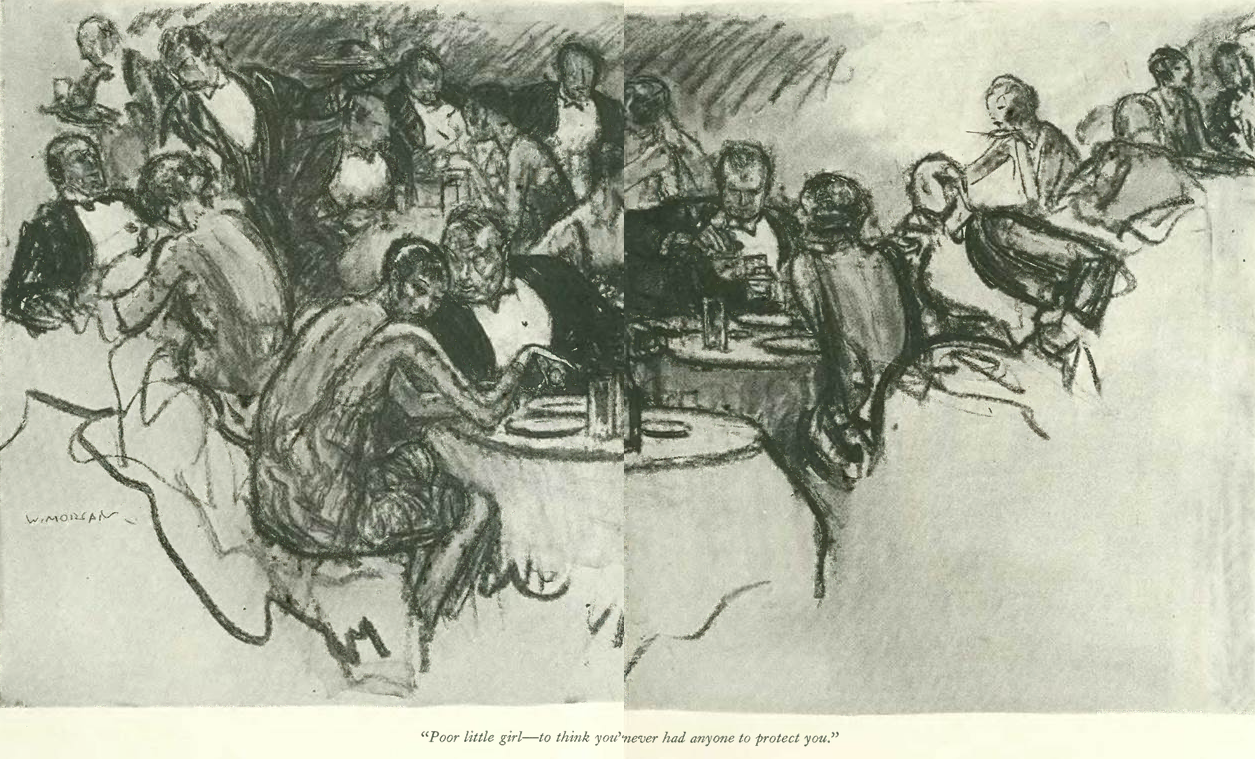
The magazine’s cartoons continued to mine the humor of rich old men out on the town with their young flapper mistresses. The one below was a center spread illustration by Wallace Morgan with the caption: “Poor little girl–to think you’ve never had anyone to protect you.”
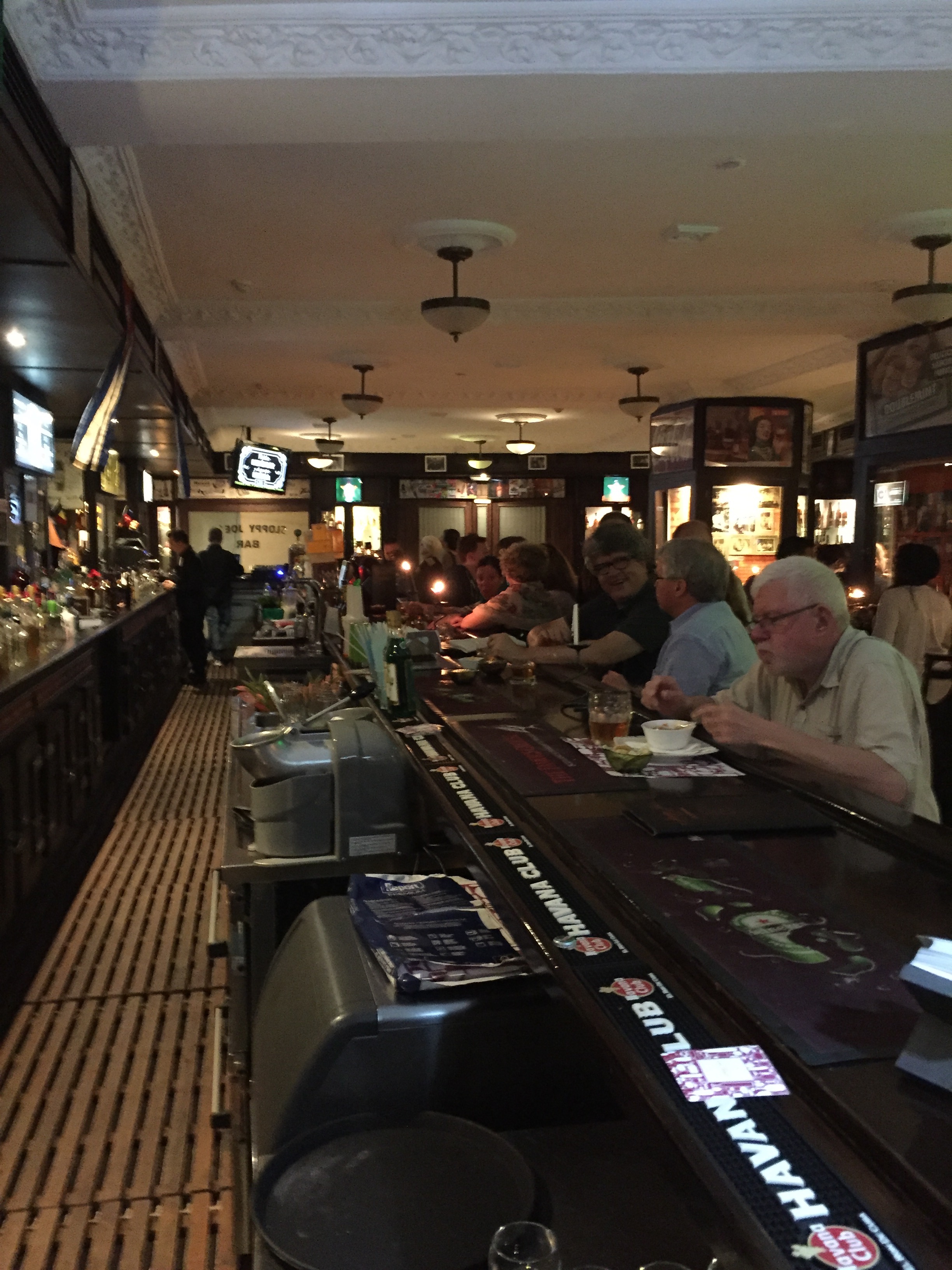
Finally, a look back at one of my earlier blog posts (Cuban Idyll) that featured Americans in Havana. I recently traveled to Cuba and visited some of the old haunts, including the famed Sloppy Joe’s:
In a previous post I briefly looked at the Algonquin Round Table–writers, critics, artists, some of them New Yorker contributors–who had been exchanging witticisms over lunch at the Algonquin Hotel since 1919.
Like so many things connected to The New Yorker, Alexander Woollcott was at the center of the famed table’s origin story. According to Wikipedia, the group that would become the Round Table began meeting as the result of a practical joke carried out by theatrical press agent John Peter Toohey, who was annoyed at Woollcott (a New York Times drama critic) for refusing to plug one of his clients (Eugene O’Neill) in his column. Toohey organized a luncheon supposedly to welcome Woollcott back from World War I, where he had been a correspondent for Stars and Stripes (and where Woollcott first met Harold Ross and Jane Grant). Instead Toohey used the occasion to poke fun at Woollcott on a number of fronts, including his long-winded war stories. Woollcott’s enjoyment of the joke and the success of the event prompted Toohey to suggest that the group meet every day at the Algonquin for lunch.
An illustrated feature by Ralph Barton in the August 29, 1925 issue (titled “The Enquiring Reporter”) thumbs its nose at critics of the Round Table who accused its members of “logrolling” (exchanging favorable plugs of one another’s works). Barton’s feature spoofs the man-on-the-street interviews that were popular in the 1920s. The persons chosen “at random” are none other than members of the Algonquin Round Table who take turns denying that any logrolling takes place at the famed gathering:
In fact, there was quite a bit of logrolling taking place in this “Vicious Circle.” As Thomas Kunkel writes in Genius in Disguise, in addition to New Yorker contributors, the Algonquin Round Table variously included representatives of the New York Times, the New York Tribune, Vanity Fair, Harpers Bazaar and Life.
“The wits cross-pollinated feverishly. Shrugging off charges of logrolling, they quoted one another in their columns, reviewed one another’s shows, publicized one another’s books. To be fair many of the glowing notices were deserved—and in any case not all the notices were glowing.”
The four writers featured in Barton’s fictitious “man on the street” feature. Clockwise, from top left: Alexander Woollcott, Heywood Broun, George Jean Nathan, and Franklin P. Adams. (reocities.com, Wikipedia, artsfuse.com, electronpencil.com)
Kunkel also observes, “By far the most powerful transmitter of Round Table wit was (Franklin) Adams (known to most as F.P.A.), whose column in the Tribune (and later the World), “The Conning Tower,” was scoured by tens of thousands of New Yorkers for its dollops of quippery and clever verse. Young writers conspired to break into the column, and the appearance of even a four-line snippet was regarded as a triumph…the Round Table supplied F.P.A. with a freshet of material, and he wasn’t bashful about using it. A particularly good line from Parker or Kaufman or Benchley might turn up in “The Conning Tower” within hours of its utterance.”
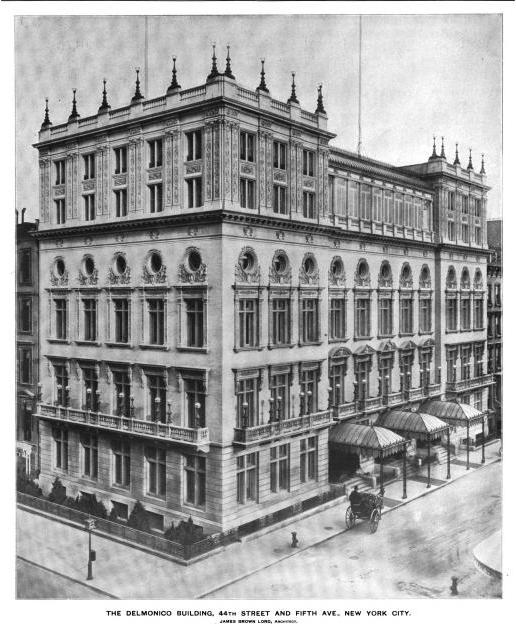
In other happenings, “The Talk of the Town” noted that the last meal served at Delmonico’s–which was fated for the wrecking ball–was less a cause for mourning and more one of scorn for the bad taste of the site’s owners:
The New Yorker bids a bitter farewell to Delmonico’s.
Among other items, O.H.P. Garrett penned a “Profile” about flamboyant mayoral candidate Jimmie Walker that seemed to anticipate the raucous career that would follow after his election.
Garrett observed that “his life is constructed of minutes and seconds. He can be clocked with a stop watch,” and that Walker’s main concerns seemed to be Sunday baseball, boxing and the repeal of movie censorship.
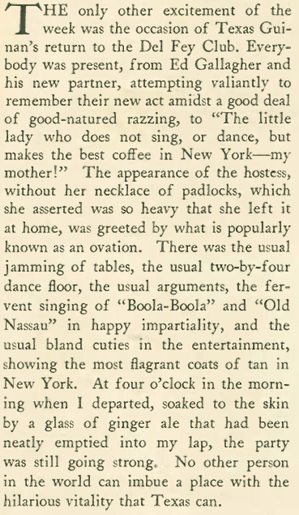
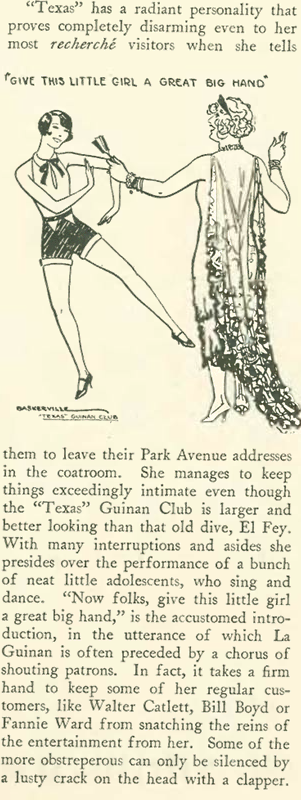
Lois Long seemed a bit bored with the week’s diversions in her column, “When Nights Are Bold,” but did welcome the reappearance of Texas Guinan after yet another club was threatened with padlocks by the Prohibition Authority:
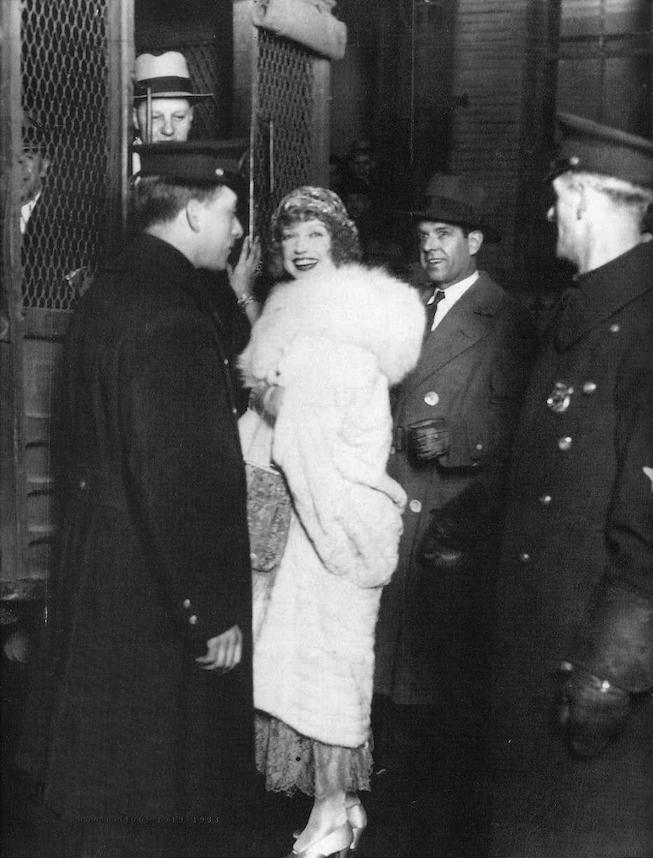
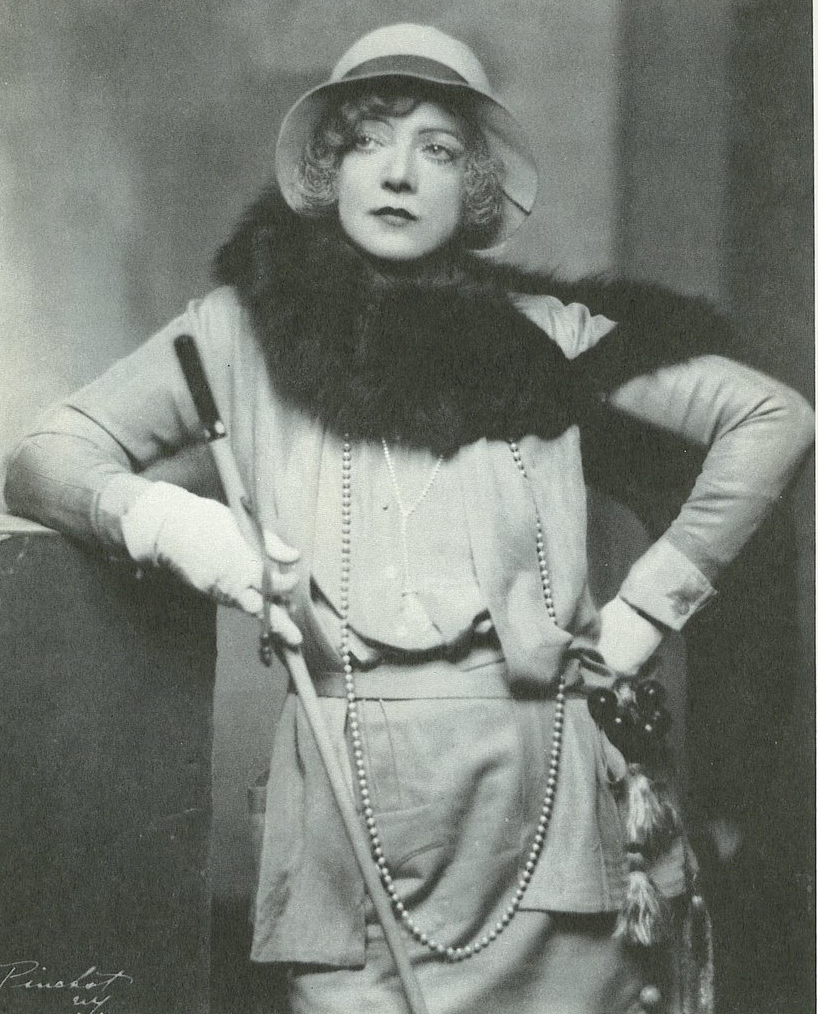
She just wants to have fun…Texas Guinan was well known to New Yorker writers and editors and was a frequent guest of the numerous parties hosted by Harold Ross and Jane Grant in the Hell’s Kitchen brownstone they shared with Alexander Woollcott and Hawley Truax. (texasguinan.blogspot)
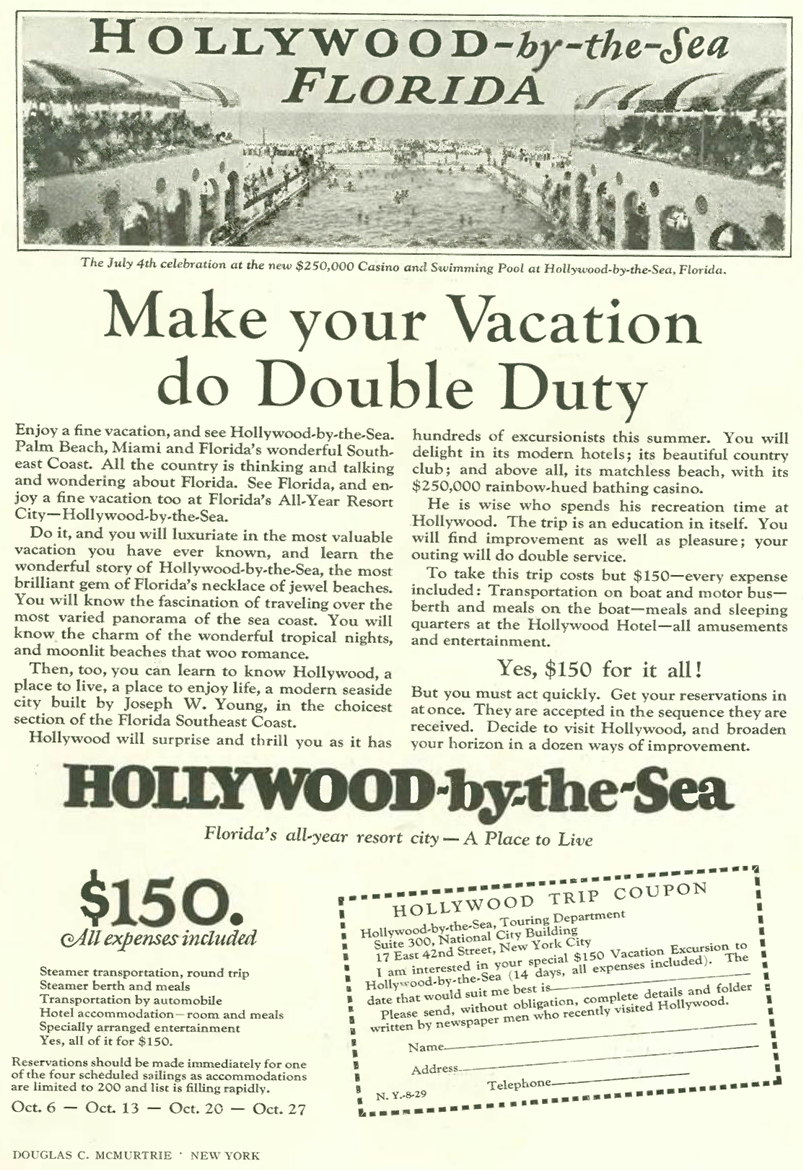
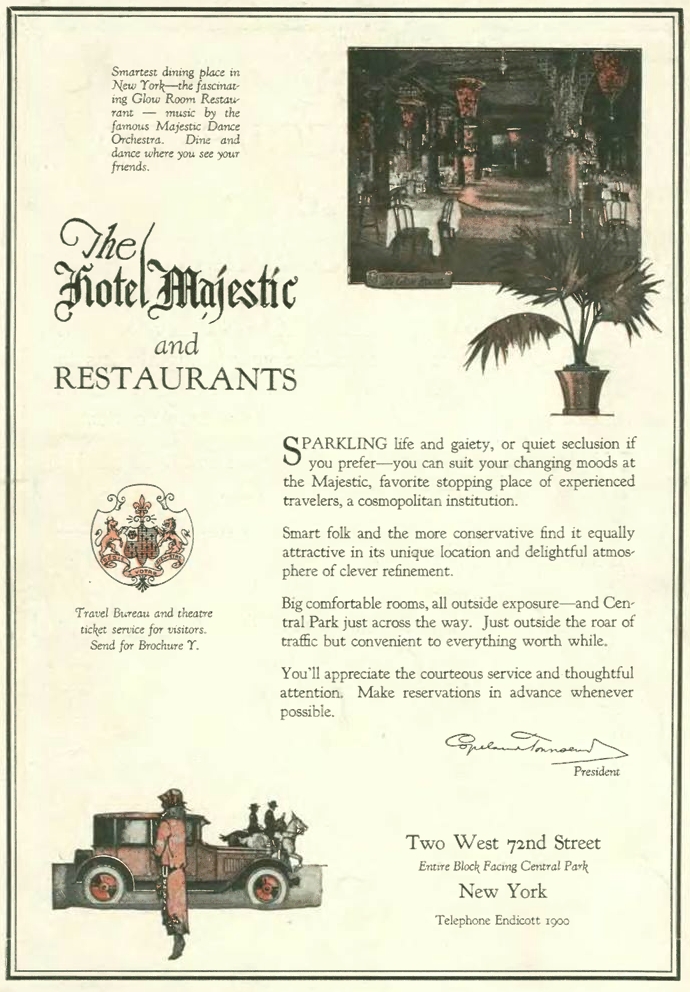
On the advertising front, the back inside cover and back cover were graced with paid advertising. As with most ads in The New Yorker, the target audience had some money to spend on travel:
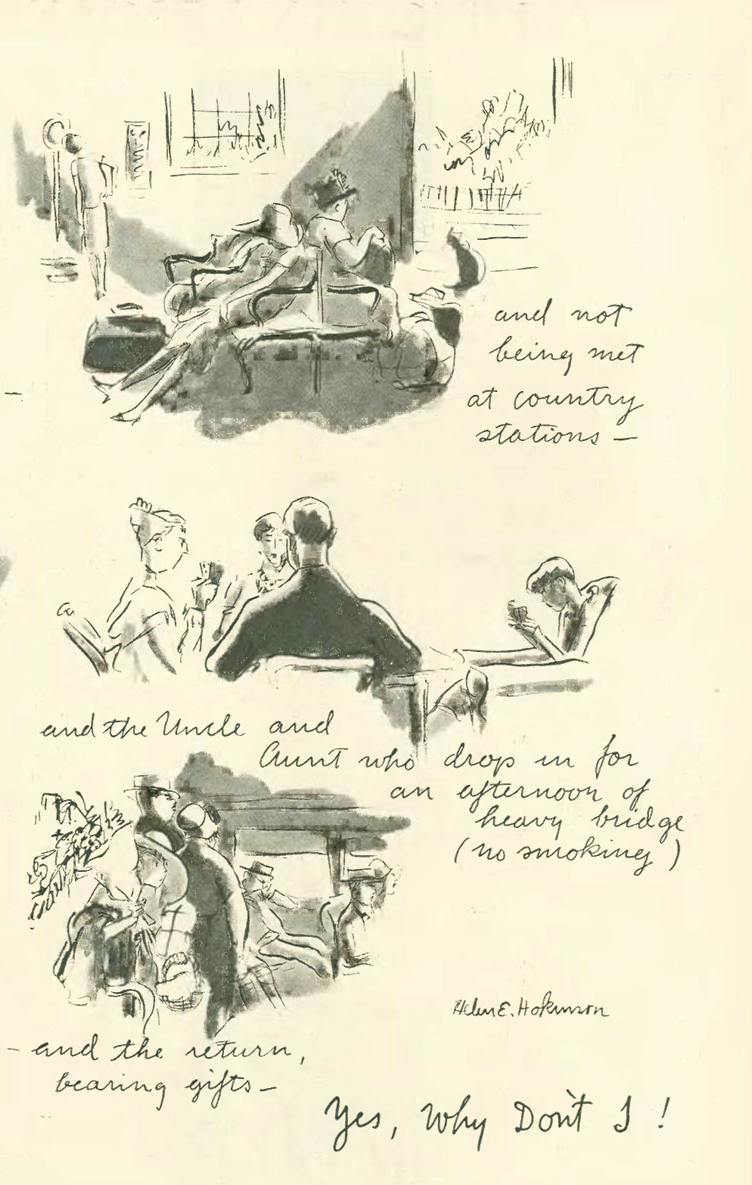
And we end with these weekend scenes from the magazine’s center spread, drawn by Helen Hokinson:
Leading up to the famous Tennessee “Monkey Trial” of John Scopes, the June 13 issue of The New Yorker continued its jabs at William Jennings Bryan.
June 13, 1925 cover by Barbara Shermund. (New Yorker Digital Archive)
Bryan had agreed to serve as prosecutor in the case against Scopes, who was charged on May 5, 1925, with teaching evolution from a chapter in Civic Biology, a textbook by George William Hunter that among other things described the theory of evolution. For the record, Scopes, who was merely a substitute high school teacher, wasn’t even sure if he’d actually taught evolution in his class, but purposely incriminated himself so the trial would proceed with a defendant. Just in case New Yorker readers needed more evidence that Bryan was an ignorant rube, “Talk of the Town” led off with an item on WJB’s visit to the Metropolitan Museum of Art:
(New Yorker Digital Archive)Bryan as depicted by Rea Irvin in June 7th’s “Talk of the Town”.
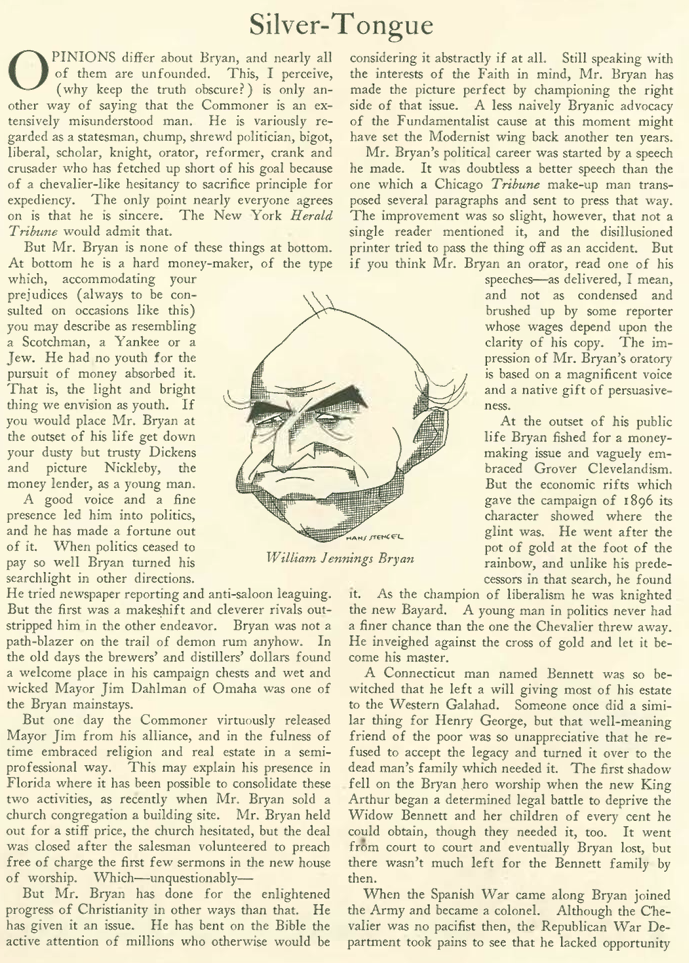
Bryan was also the subject of a “Profile” piece by Charles Willis Thompson, who wrote “the Commoner” is “an extensively misunderstood man.”
Thompson observed that Bryan “is variously regarded as a statesman, chump, shrewd politician, bigot, liberal, scholar, knight, orator, reformer, crank and crusader who has fetched up short of his goal because of a chevalier-like hesitancy to sacrifice principle for expediency.”
Here is the piece in its entirety (caricature by Hans Stengel)
(New Yorker Digital Archive)Macfadden at age 65 in the early 1930s (yousearch)
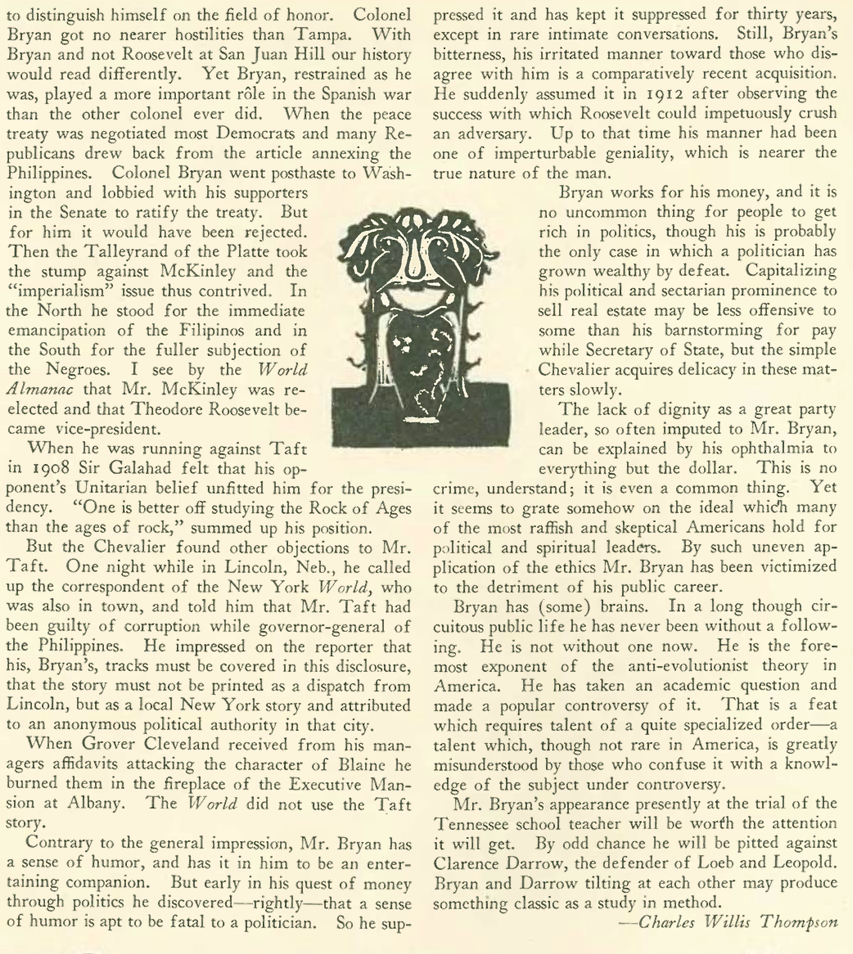
The New Yorker was barely afloat as it entered its first summer, but that didn’t dampen its wit as it fished for new subscribers through humorous full page ads regularly featured in the first issues.
The June 13 issue opened with one such ad that appears to be a parody of a Bernarr Macfadden health and fitness promotion (Macfadden was an influential predecessor to the likes of Charles Atlas and Jack Lalanne). The ad was accompanied by a strange drawing that appears to combine McFadden’s body with–for some reason–William Jennings Bryan’s head:
(New Yorker Digital Archive)
In addition to Mr. Bryan, “Talk of the Town” also offered these observations…Calvin Coolidge’s fondness for his battered felt hat…the modesty of the young golfing star Bobby Jones and his refusal to accept any money beyond barest expenses for an exhibition match at Harvard…an offer by the famed violinist Jascha Heifetz to deliver, upon his return trip from Paris, a Poiret-designed gown for opera singer Cobina Wright for her upcoming Bal Harbor engagement…and a minor money dispute between George Bernard Shaw and the Saturday Evening Post regarding the reprinting of a short story.
Sherwood Anderson (Chicago History Museum)
“Talk” also made hay about “Male Plumage” on display in the city, noting that the last time novelist Sherwood Anderson was in town (he is referred to as “the illustrious revealer of the Middle Western Subconscious”) he wore socks “of a particularly glowing brown bespread with diamond checks of an exceptionally vivid shade of green,” and he sported both brown and red feathers in his brown velour hat. It was noted, however, that this display was outdone by Rudolph Valentino, whose silk house pajamas (worn while receiving visitors at the Plaza in Paris) were of “the most vivid crimson ever accomplished.”
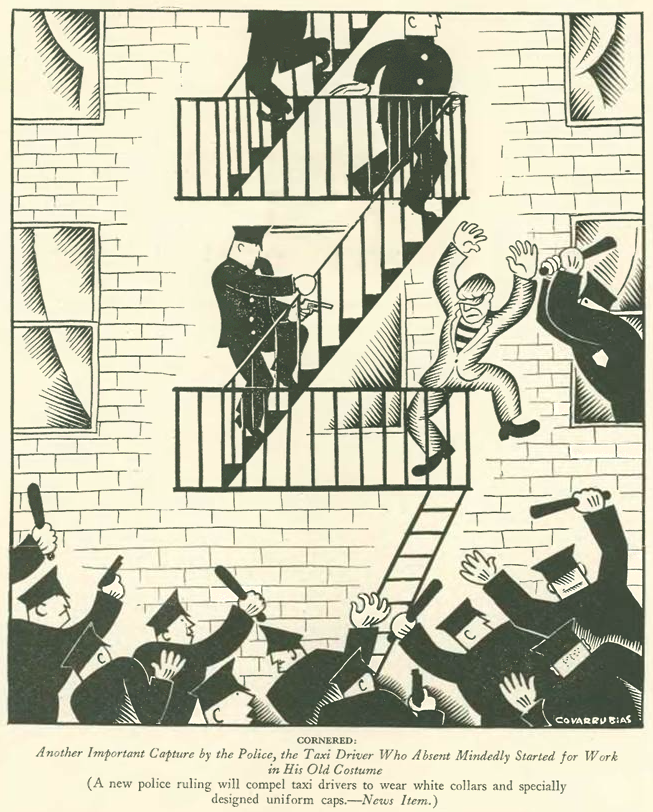
The New Yorker continued its assault on crooked cab drivers with this cartoon by Miguel Covarrubias:
(New Yorker Digital Archive)
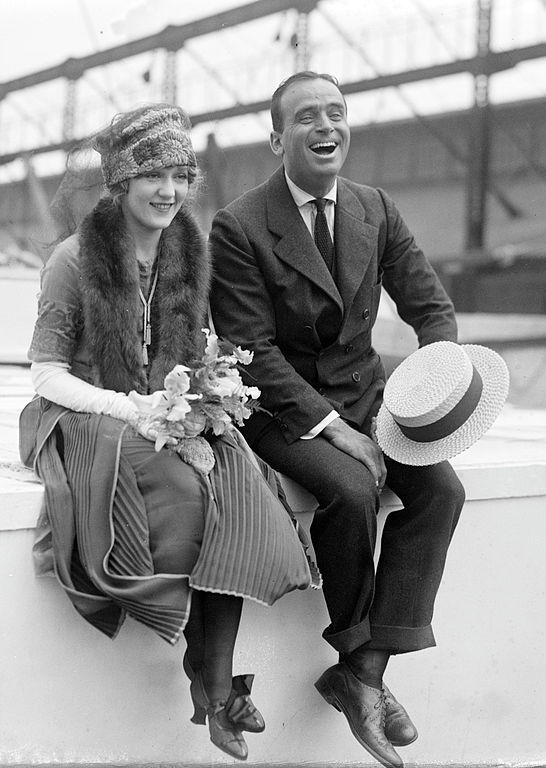
“Of All Things” (written by Howard Brubaker) noted that “The Queen of Rumania and the King of Swat (Babe Ruth) are both writing for the World, but fortunately for us constant readers, low-born newspaper men are still on the job.” It was also noted that silent film idol Mary Pickford “has fallen among bad characters or good press agents.” I have no idea what this refers to. Pickford was married to film star Douglas Fairbanks at the time, and their Hollywood mansion Pickfair was the center of the celebrity universe. The couple played host to heads of state and other dignitaries as well as notables in literature, the arts, and science (Albert Einstein once paid a call).
POWER COUPLE…Douglas Fairbanks and Mary Pickford in the mid 1920s. Pickford, a Canadian-American actress, was one of the 36 founding members of the Academy of Motion Picture Arts and Sciences, and a key figure in shaping today’s Hollywood. The couple formed the independent United Artists along with D.W. Griffith and Charlie Chaplin. (Wikimedia)
German cinema regularly drew favorable reviews in The New Yorker, however Fritz Lang’s Siegfried was called long and arty, “possessing many fine intervals of real beauty…that usually wins the critical adjectives. The average audience will probably be a bit bored at Siegfried’s quest. Tom Mix does this sort of thing with much more verve and snap.”
Colleen Moore in the silent film, The Desert Flower (1925) (IMDB)
And if you think the “Cinderella” story has been made and remade too many times, consider that in 1925 The New Yorker already found the theme wearing thin. A review of the The Desert Flower referred to the film as “just another variation of the Cinderella theme.” It told the story of a waif (Colleen Moore) in a railroad construction in camp who falls in love with the son of the railroad’s president. The reviewer wrote that “probably all of this will be popular. It always has been.”
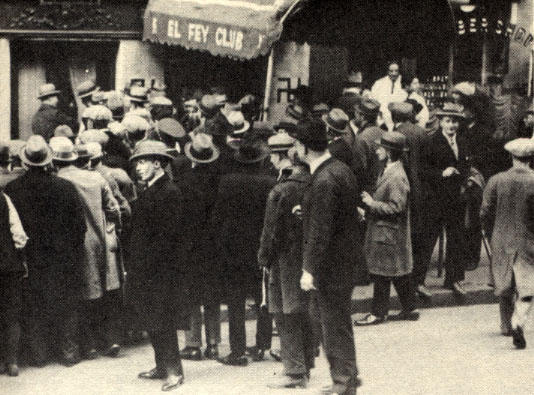
Texas Guinan’s new club proved a be hit, as reported in the feature “When Nights Are Bold.” I last reported on Texas Guinan in my March 18, 2015 post, “A Dry Manhattan,” when prohibition officials put a padlock on her old haunt, the El Fey Club. As we see, things are looking up for the leading lady of New York nightlife…
(New Yorker Digital Archive)
I am guessing this illustration by Covarrubias was an attempt to fill ad space and encourage readership. I guess we will find out soon enough:
(New Yorker Digital Archive)
The issue closes with a satirical piece that appears to poke fun at tenement life, or perhaps at the pretensions of art critics, or both. You be the judge:
Prohibition posed one the biggest challenges to the life of an urban sophisticate in the 1920s, but also provided opportunities for sophisticated behavior through the flaunting of the Volstead Act.
March 21, 1925 cover by Carl Fornaro (New Yorker Digital Archive)
“The Talk of the Town” for March 21, 1925 opens with an attack on the new U.S. Attorney for the Southern District of New York, Emory C. Buckner. He took office with the promise to “debunk” Prohibition enforcement by collecting evidence of liquor sales in nightclubs and speakeasies. Bypassing both the police and the Bureau of Prohibition, he would file injunctions in federal court and have the offending establishments padlocked for up to a year as a “public nuisance.”
(In “The Hour Glass” section of the same issue, the magazine observes that “Minister’s sons always go one way or the other, mostly the other.” It also notes that along with William Jennings Bryan, “Nebraska gave Emory Buckner to the Union.”)
According to the book Dry Manhattan: Prohibition in New York City, by Michael Lerner, Buckner hoped that his method would break the endless cycle of arrests, plea bargains and fines that had come to define prohibition. His approach took the focus off the city’s working class; rather than throwing bartenders into jail, he would threaten owners and landlords with financial losses and would “pinch the pocketbook of the man higher up.”
A crowd gathers at the padlocking of The El Fey Club, soon to reborn nearby as “The Del Fey Club.”
Lerner writes that Buckner targeted high-profile nightclubs and speakeasies in the upscale theater district rather than focusing on working class saloons that had been previously singled out by the dry lobby. The goal was to “hold the city’s more cosmopolitan social circles accountable for their drinking.”
In other words, this hit The New Yorker readership, and its writers and editors, right where they lived.
“The Talk of the Town” suggested that Buckner’s motivation was self-promotion, and predicted that his padlocking tactic would backfire, since previous attempts at padlocking actually lent “prestige” to the closed establishments.
That prediction would indeed become true. Instead of curtailing liquor consumption, Lerner writes that the padlocking actually increased the allure of nightclubs: “The leading lady of New York’s nightlife, Texas Guinan, went so far as to adopt the padlock as her personal trademark.”
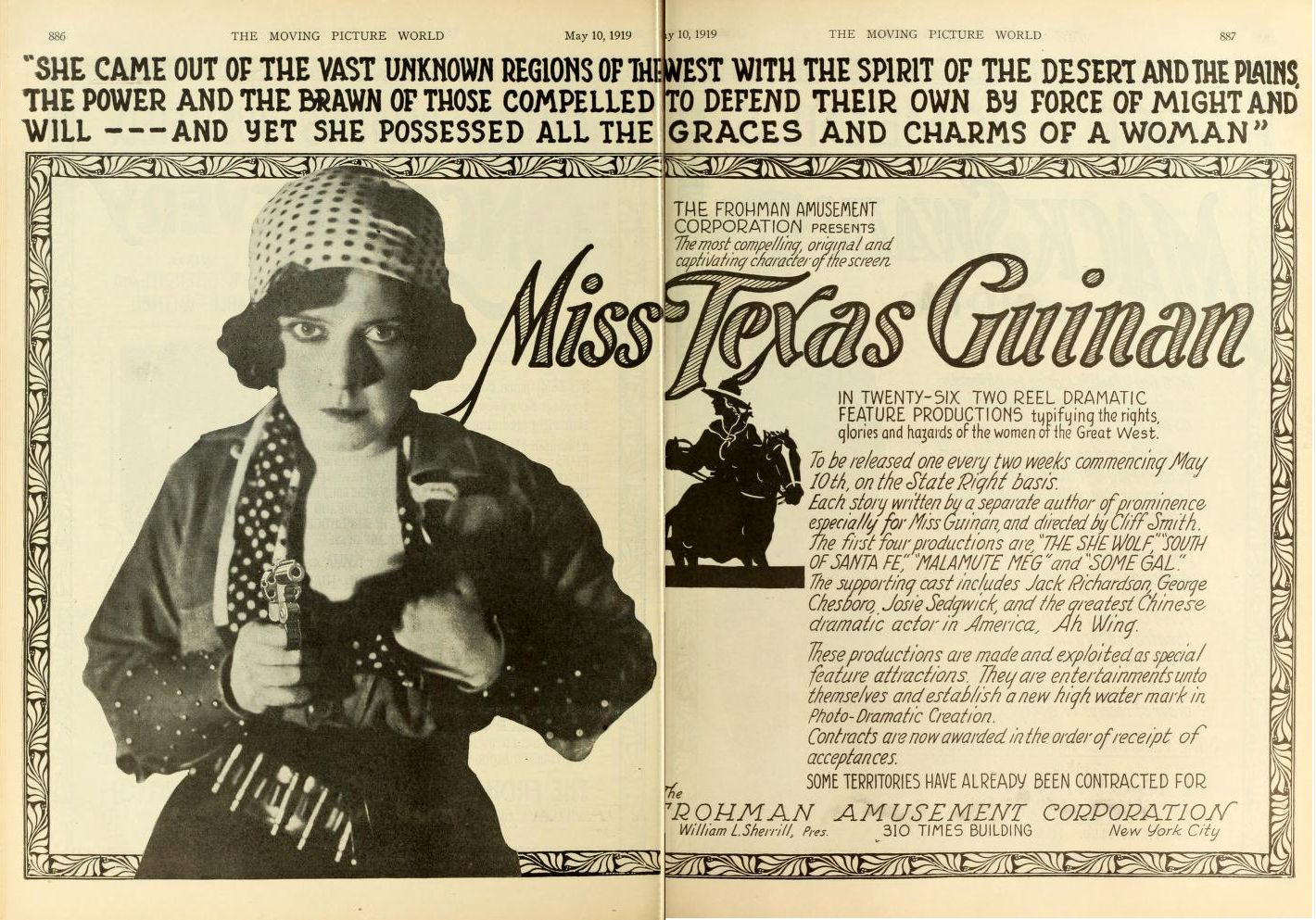
Texas Guinan’s 300 Club was a favorite of Broadway and Hollywood agents. Constantly raided by police, it closed in 1929.Advertisement from Moving Picture World, May 1919, for actress Texas Guinan’s films
Nevertheless, the “Talk of the Town” entry concluded with wistful remembrances of pre-Prohibition days, the Hoffman House taproom and the (Maxfield Parrish) Old King Cole mural above the Knickerbocker Bar, now “reposing disconsolately in the gloom of a warehouse.”
The writer would be happy to know that today the Maxfield Parrish mural (recently restored) graces The King Cole Bar at the St. Regis Hotel (if you are in NYC you should put on a nice jacket and grab an old school martini there).
A final tidbit from Gotham magazine regarding the mural: “John Jacob Astor IV originally opened the St. Regis Hotel in 1904. Two years later, he commissioned the Old King Cole mural for his Knickerbocker hotel. Apparently Parrish, a Quaker, was reluctant to accept the gig, until Astor upped the offer to $5,000. Astor was tragically lost aboard the Titanic in 1912. And the Parrish mural was installed at The King Cole Bar at the St. Regis in 1932.”
Gotham magazine also offers a secret about the mural revealed at an unveiling following the restoration: under his regal robe, King Cole is breaking wind, therefore the smirks of the jesters.
This is what I love about history—its endless digressions.
















 A New Yorker State of Mind