Some Pitiful Melodies

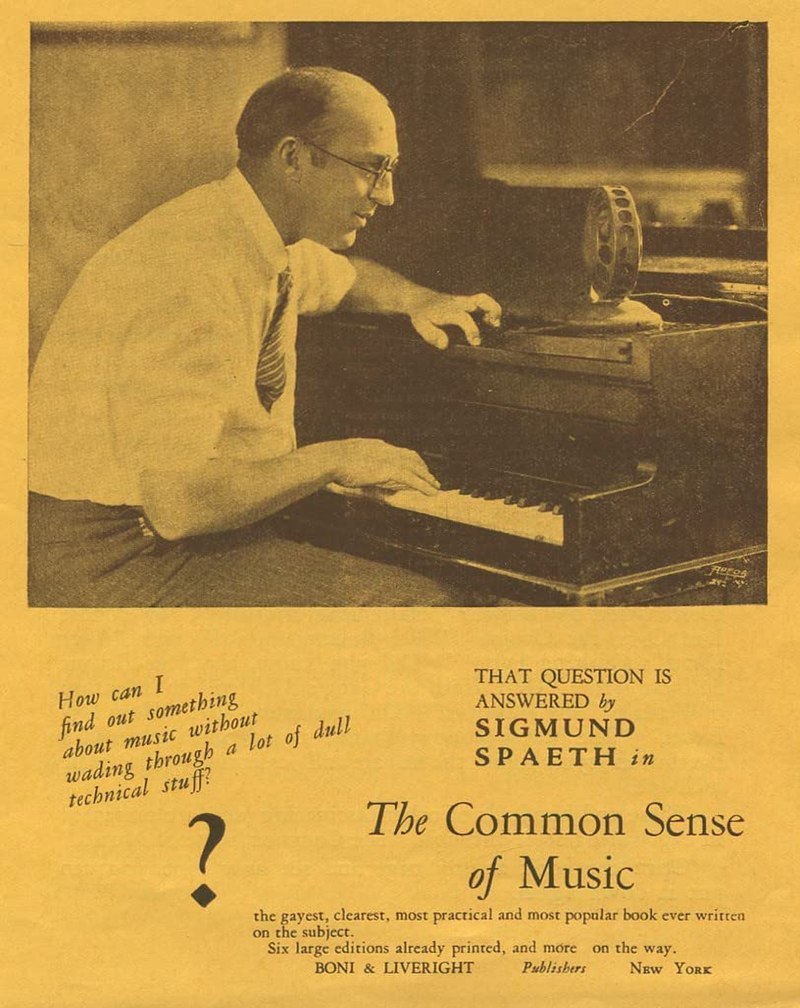
Sigmund Gottfried Spaeth (1885–1965) sought to popularize classical music and improve the musical tastes of the masses by meeting the public wherever he could find them, from vaudeville halls to national radio broadcasts.

September 1, 1934 cover by William Steig.

Born in a line of three generations of Lutheran clergymen, Spaeth chose a different path and became a musicologist who sought to de-mystify classical music, often demonstrating how popular melodies had origins in earlier music. He also had strong opinions about lyrics in popular music, demonstrating his distaste for “the lyric school of self-pity” in this “Onward and Upward” column. Excerpts:

BRINGING MUSIC AND LIGHT…Sigmund Spaeth found much to dislike in the world of popular music, but he was never stuffy in his approach to music appreciation. At right, Spaeth appeared in vaudeville-style shows (and for many years on the radio) as “The Tune Detective,” wearing a deerstalker cap, cape, and checked tweeds in imitation of Sherlock Holmes. He hoped to demonstrate to a wide audience that all music was essentially based on a set of simple principles. (sinfonia.org/wnyc.org)
HAVE NO FEAR…Spaeth wrote a popular syndicated newspaper column, “Music for Everybody,” and contributed articles to many periodicals during his career. With his first book in 1925, The Common Sense of Music, and others that followed, Spaeth sought to de-mystify music for a general audience. (Wikimedia Commons)
OH LIGHTEN UP…Spaeth detected a cynical note in Bing Crosby’s (left) sob song, “I Cried for You,” and noted Irving Berlin’s latest contribution to the “sob symposium,” “I Never Had a Chance.” (Wikipedia/digitalcommons.library.umaine.edu/britannica.com)

Spaeth noted that not all sad songs were dripping in artificial self-pity, citing Helen Morgan’s “Why Was I Born?” as an example of a song modeled on “the legitimate blues,” marked by “a sincerity of expression in everyday language”…
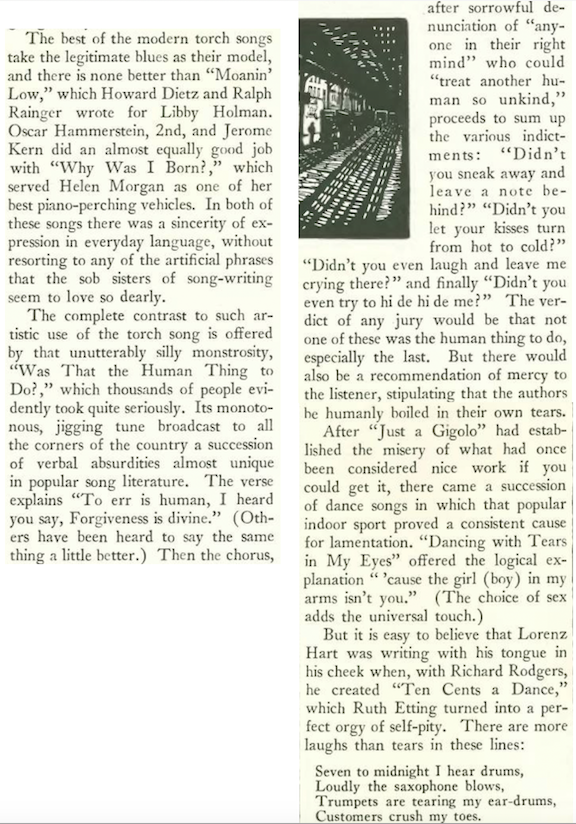
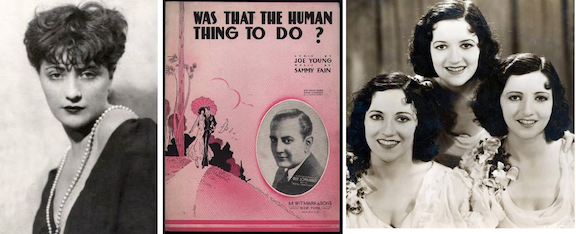
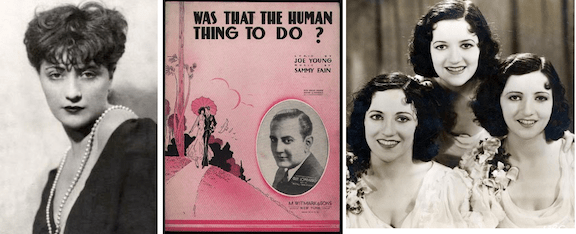
RIGHT AND WRONG…Spaeth acknowledged the “sincerity of expression” in Helen Morgan’s (left) torch songs, while at the other extreme he suggested that the authors of “Was That the Human Thing to Do?” (Sammy Fain and Joe Young) be boiled alive in their own tears. The song was popularized by The Boswell Sisters, a beloved New Orleans trio in the early 1930s. (findagrave.com/amazon.com/genius.com)

 * * *

Off to the Races

In his column, “Of All Things,” Howard Brubaker commented on the apparent competition and contrast between Alexander Woollcott’s book, While Rome Burns, and another with a rosier title, The Coming of the American Boom. It appears Woollcott’s book won out, at least in the long run, as I can find no trace of the Boom book, or its author.*

* One of our kind readers has identified the author: “The Coming American Boom” was written by Lawrence Lee Bazley Angas and published by Simon and Schuster in 1934. In 1939, Time noted that “Major Lawrence Lee Bazley (‘Boom’) Angas is a pink & white Britisher with a reputation for making daring predictions which have sometimes come true…. He won his nickname with a much-publicized booklet, The Coming American Boom, which heralded his arrival in the U.S. in 1934.”

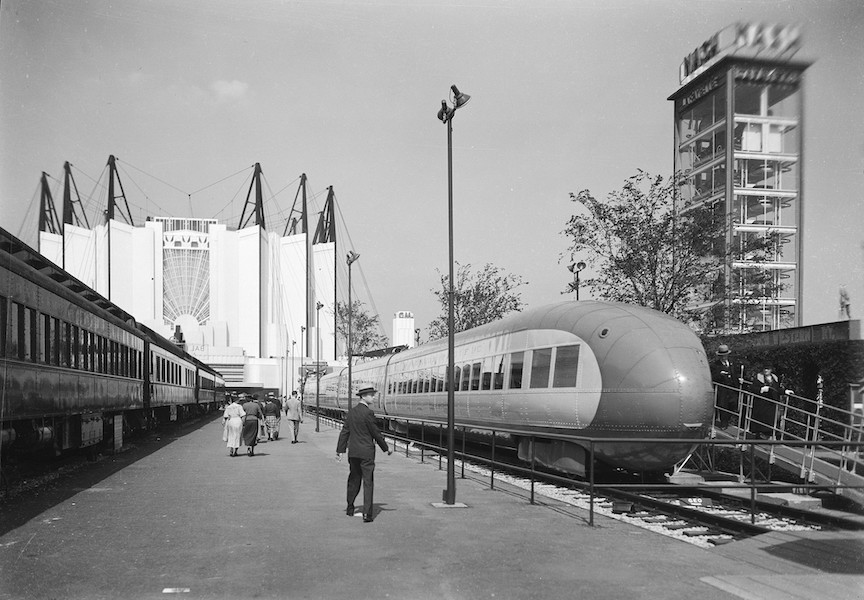
Speaking of rosy outlooks, E.B. White offered some parting thoughts on Chicago’s World’s Fair, called “A Century of Progress.” Rather than focus on the grandiose exhibits, White wryly noted other signs of progress at the fair, as recounted from a letter he received from his nephew.

The Chicago World’s Fair featured all sorts of modern wonders “dedicated to the ideal of scientific advance”…
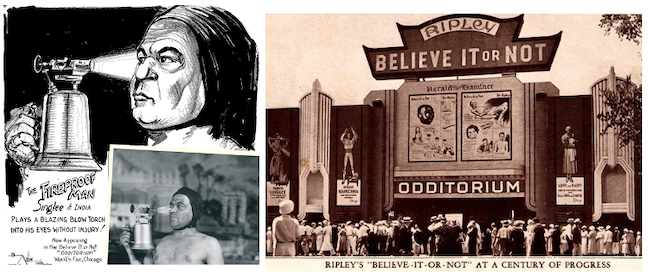
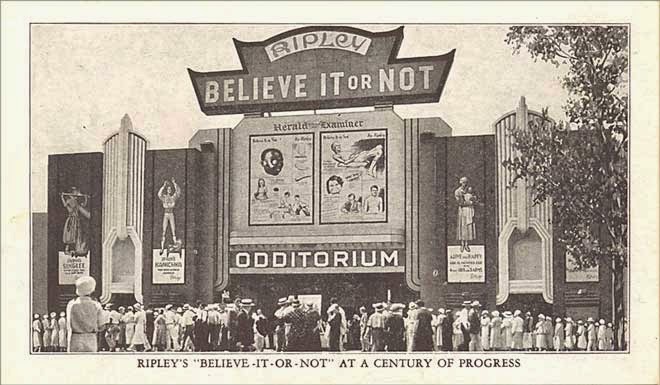
…but as with any World’s Fair, it also catered to the baser interests of the masses, with attractions such as Robert Ripley’s Believe It Or Not “Odditorium,” which was essentially a P.T. Barnum-style freak show…
…Ripley’s syndicated newspaper feature included these Odditorium attractions…
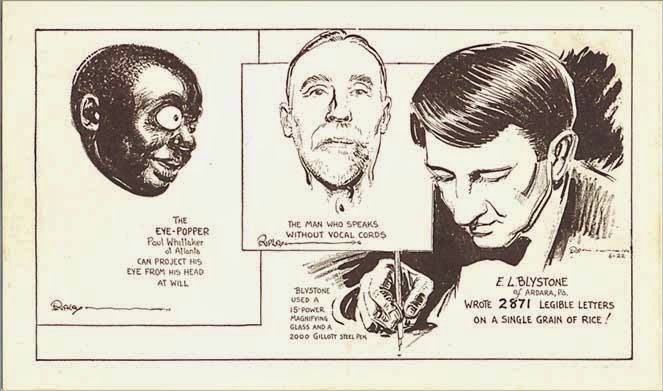
…White made light of exhibitions displaying such signs of progress as how to brush your teeth, and more examples of human freakdom…

…White’s nephew wrote of a man who could pull a wagon (containing his wife) with his eyelids, an apparently arthritic fellow who was “turning to stone,” and a man who could support heavy weights with his pierced breasts…
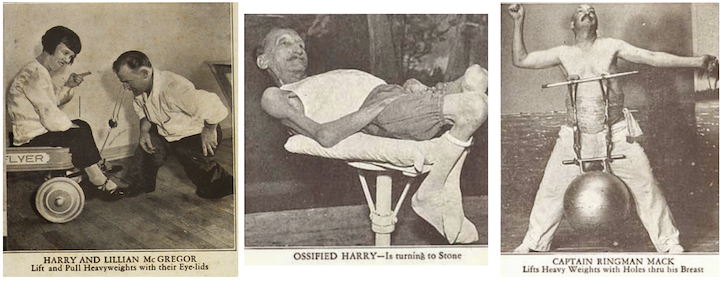
(all images courtesy postcardy.blogspot.com)

 * * *

Letter From Paris

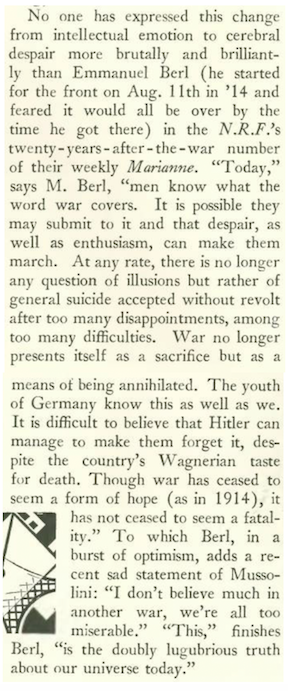
Paris correspondent Janet Flanner wrote that August 1934 was a “month of memories” as it marked the twentieth anniversary of the outbreak of the Great War, which we now call World War I. Flanner wrote about a new attitude that had arisen in those two decades, “a new attitude not only toward the last war but toward the next (which, ironically enough, seems increasingly inevitable to France since the death of the enemy warrior, von Hindenburg).” She continued with these observations made by French journalist and historian Emmanuel Berl (1892–1976), who wrote that as a result of the Great War, the youth in both France and Germany held few heroic illusions about war, seeing it not as a sacrifice but rather “as a means of being annihilated.”
SO MUCH FOR THE HEROICS…A refugee family returning to Amiens, France, looking at the ruins of a house on Sept. 17, 1918. Top right, Janet Flanner in 1940; below, Emmanuel Berl. (iwm.org.uk/Flanner photo copyright Estate of George Platt Lynes/Berl photo courtesy Joël Chirol)

 * * *

From Our Advertisers

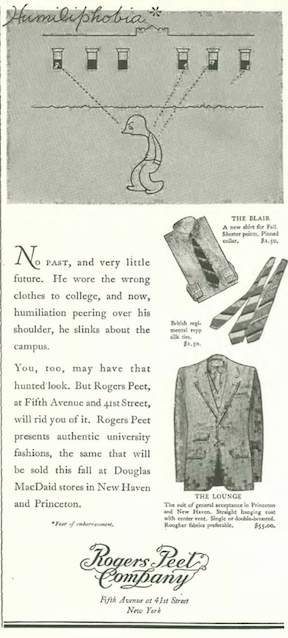
Clothing company Rogers Peet used the threat of humiliation to encourage young men to stock up on “authentic university fashions” before returning to campus…
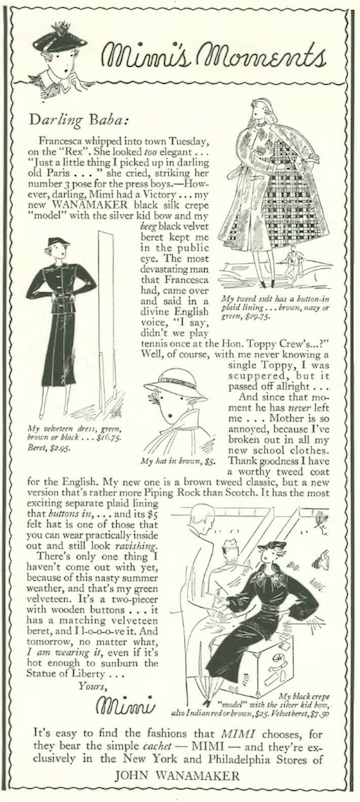
…the Wanamaker department store took a different approach, offering up new styles with a heavy English accent (I say, didn’t we play tennis once at the Hon. Toppy Crew’s?)…
…the makers of Goodyear tires offered up this disturbing image to boost sales…

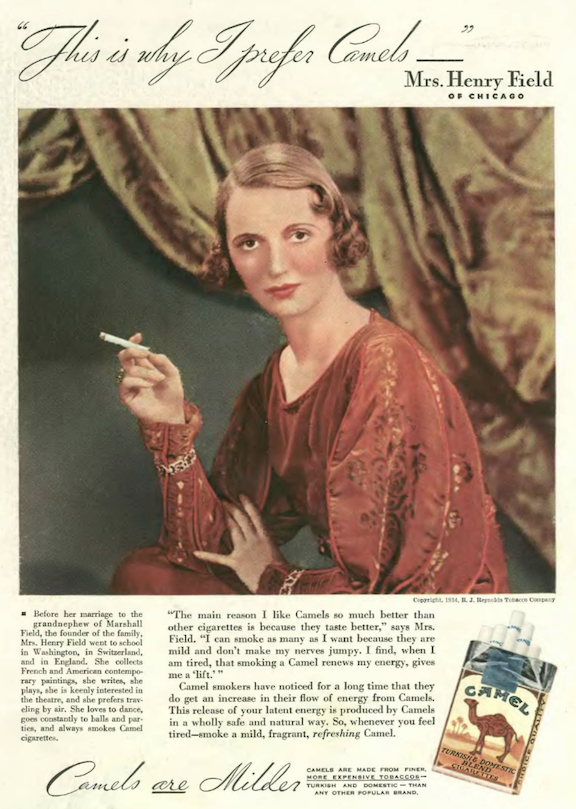
…this ad told us that “Mrs. Henry Field” collected fine art, loved to go to parties, and “always smoked Camel cigarettes”…I am unaware of the fate of Mrs. Henry Field, married to the grandnephew of Marshall Field, but this unseemly image suggests she was replaced by a wax figure before the photo was taken…
…on to our cartoons, we begin with spot illustrations from (clockwise, from top) Victor De Pauw, Abe Birnbaum, and an unidentified illustrator who offered this suggestion for beating the late summer heat…

…we move along to Alan Dunn and a record-seeking pooch…

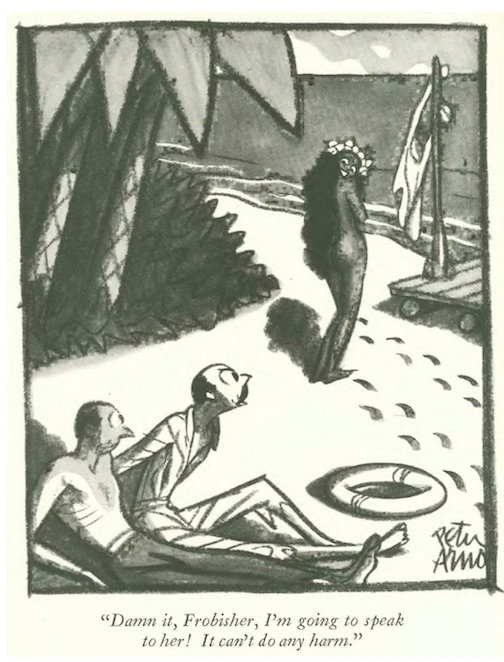
Peter Arno with a very Arno-esque take on the stranded island trope…
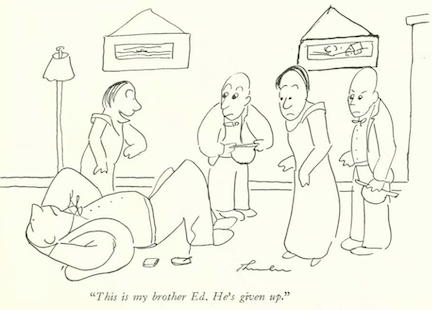
James Thurber gave us a man who was done making decisions…
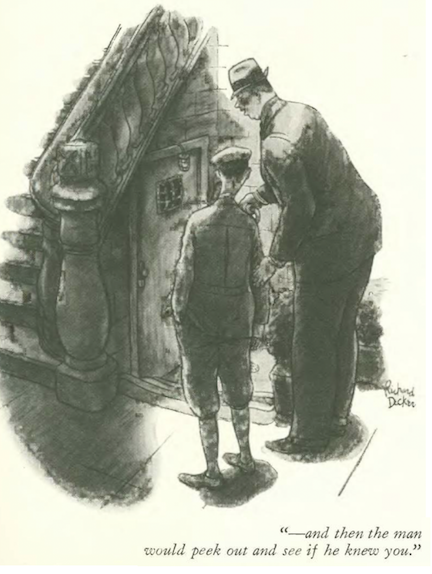
Richard Decker offered up this living history demonstration…
George Price gave us two tropes for the price of one…

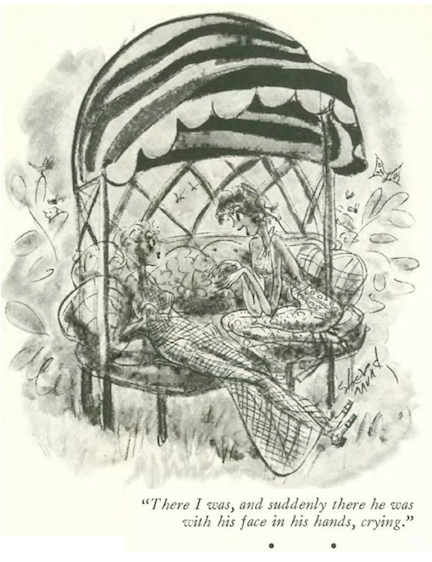
Barbara Shermund gave us another glimpse into the lives of modern women…
Rea Irvin continued his exploration of Manhattan’s fauna…

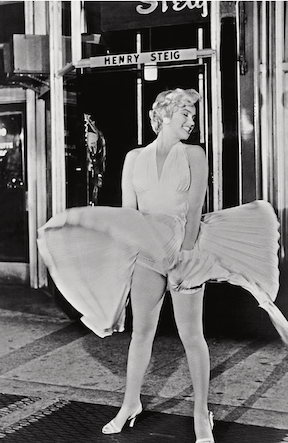
…our next cartoon is by Henry Steig, who used the pseudonym Henry Anton to avoid being confused with his brother, William Steig (featured on this issue’s cover)…unlike his brother, Henry was also a jazz musician, a sculptor and painter, a photographer, and a novelist…that is before he became a noted jeweler…

…Henry Steig’s jewelry shop at 590 Lexington Avenue can be glimpsed in the background of the famous subway vent scene from 1955’s The Seven Year Itch featuring Marilyn Monroe

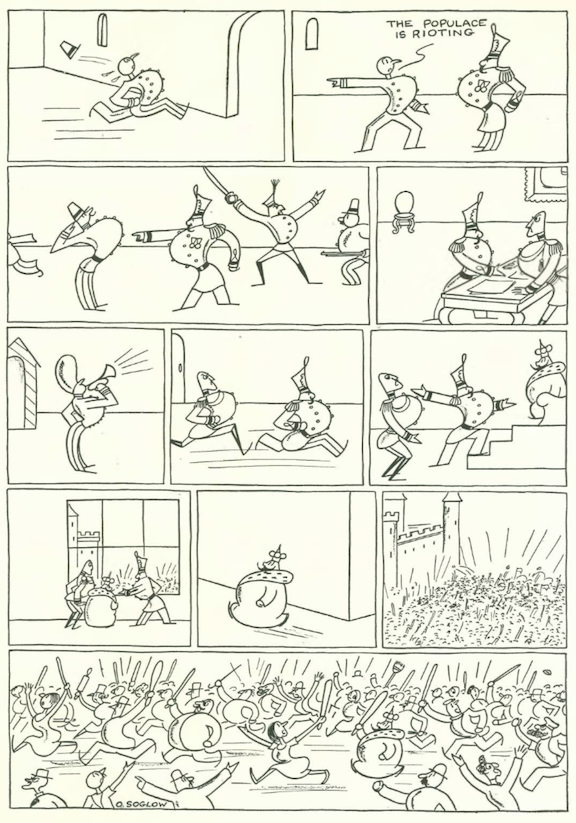
…and we close with Otto Soglow, and the last appearance his “Little King” in The New Yorker...William Randolph Hearst had lured Soglow away for his King Features Syndicate, debuting The Little King in his newspapers on September 9, 1934, where it would run until Soglow’s death in 1975…Soglow, however, would continue contributing cartoons of other themes to The New Yorker until 1974…
Next Time: Lunch at the Dog Wagon…

The Bombshell

Much like Marilyn Monroe in the 1950s, Jean Harlow occupied a brief period in Hollywood history, but her star shone long after her untimely death.

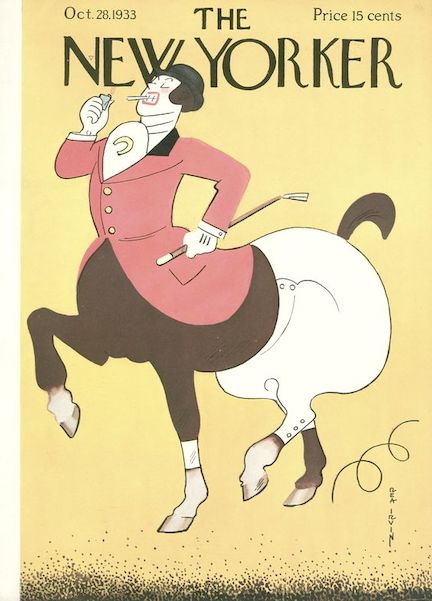
Oct. 28, 1933 cover by Rea Irvin.

Adam Victor’s The Marilyn Encyclopedia draws all sorts of weird parallels between the actresses: both raised by strict Christian Scientists, both married three times, both left school at sixteen to marry their first husbands, both acted opposite Clark Gable in the last film each ever made. Most importantly, Monroe idolized Harlow, so it was no coincidence that she sported her own version of “platinum blonde” hair.

ART IMITATES LIFE…In 1958 Marilyn Monroe posed as Jean Harlow for photographer Richard Avedon in a Life magazine feature. (Flickr)

The term “Bombshell” was affixed to the 22-year-old Harlow after the 1933 film’s release, and was later used to describe Monroe and other sex symbols of the 1950s and early 60s.

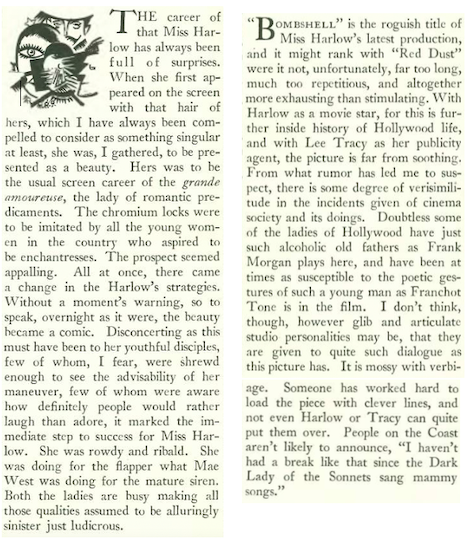
Harlow’s character in Bombshell, Lola Burns, satirized the stardom years of the silent era sex symbol Clara Bow, who was director Victor Fleming’s fiancée in 1926. Although critical reviews were mostly positive, New Yorker critic John Mosher found the film “mossy with verbiage.”

TAKE A BOW, CLARA…Bombshell satirized the stardom years of silent era sex symbol Clara Bow, who was director Victor Fleming’s fiancée in 1926 (photo at left is of the couple on the set of 1926’s Mantrap); in Bombshell Jean Harlow portrayed a sex symbol who, like Bow, wanted to live a normal life. In real life, Bow made her last film in 1933 and retired to a ranch at age 28. (IMDB)
A STAR IS BORED…In Bombshell, movie star Lola Burns (Jean Harlow) dislikes her sexy vamp image and wants to live a normal life, but her studio publicist E. J. “Space” Hanlon (Lee Tracy) insists on feeding the press endless provocative stories about her. Clockwise, from top left: Lee Tracy and Louise Beavers in a scene with Harlow; Harlow and Una Merkel, who portrayed Lola’s assistant, Mac; Harlow in a scene with Mary Forbes, C. Aubrey Smith, and Franchot Tone; Harlow in a scene with Ruth Warren and Frank Morgan—the latter portrayed Lola’s pretentious, drunken father. (IMDB)

Harlow would die at age 26 on June 7, 1937. Her heavy drinking didn’t help, but neither did the misdiagnosis she received as her kidneys were rapidly failing. While filming Saratoga with Clark Gable, Harlow was stricken with what she believed was the flu, and her persistent stomach pain was misdiagnosed as a swollen gallbladder. Just two days before her death another doctor finally diagnosed her kidney disease, but in 1937 nothing could be done—kidney dialysis would not be available for another decade, and transplants would not be an option until the mid-1950s.

 * * *

Second City Sanctimony

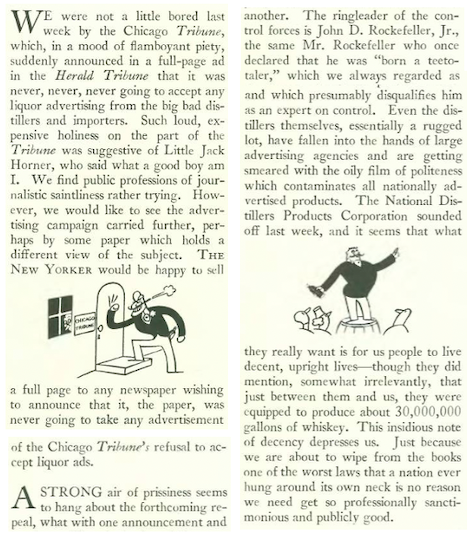
The New Yorker rarely missed an opportunity to take a dig at the square-toed ways of the Second City and its flagship newspaper, the Tribune. In his “Notes and Comment,” E.B. White (who enjoyed gin martinis) found the newspaper’s sanctimonious stance tedious:

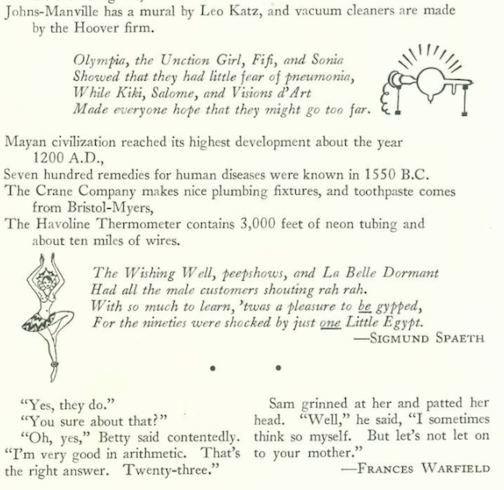
The 1933 Chicago World’s Fair, aka “A Century of Progress,” received scant attention from The New Yorker, unless it provided opportunities for parody. Musicologist Sigmund Spaeth (1885-1965), well-known in the 1930s and 40s for his NBC radio programs, offered this take on the Windy City’s exposition:

WONDERS NEVER CEASE…In addition to its more high-minded attractions, the Chicago World’s Fair also featured such sideshow attractions as Ripley’s Odditorium, which featured “The Fireproof Man” among other novelties. (pdxhistory.com)

 * * *

Big, Bad Earworm

It seems quaint that nearly 90 years ago one of the most popular songs in America was “Who’s Afraid of the Big Bad Wolf?” To Frank Sullivan, there was no escaping “that lilting tune”…

SIMPLER TIMES…”Who’s Afraid of the Big Bad Wolf?” was a huge hit during the second half of 1933. One of the most well-known Disney songs, it was covered by numerous artists and musical groups.

Sullivan concluded that a trip to Vladivostok might be the only way to escape the catchy melody…

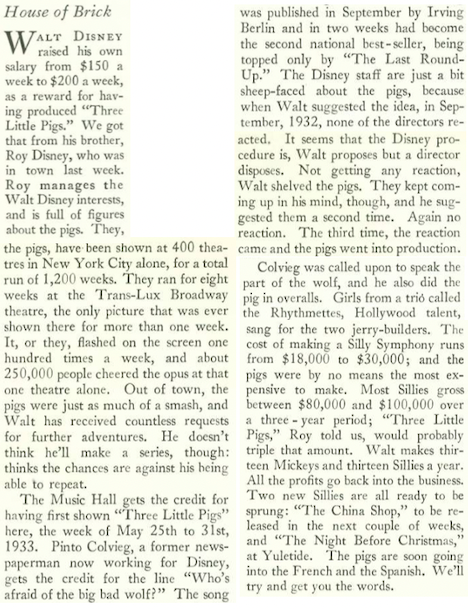
Briefly jumping to the Nov. 4 issue, “The Talk of Town” took a closer look at the song and the 1933 Disney Silly Symphonies cartoon in which it was featured—Three Little Pigs. Written by Frank Churchill and Ann Ronell, the song launched a market for future Disney tunes, with Irving Berlin securing the sheet music rights over Mickey Mouse and the Silly Symphonies. 

WE’RE IN THE MONEY…The 1933 Disney Silly Symphonies cartoon Three Little Pigs helped to launch the Disney juggernaut nearly 90 years ago.

 * * *

Polymath

Le Corbusier, aka Charles-Édouard Jeanneret (1887–1965), was known as a pioneer of modern architecture and design in the early and mid-20th century, but as this review by Lewis Mumford suggested, he was also a talented modernist painter.

WAYS OF SEEING…Le Corbusier’s early paintings followed the ideas of something he called “purism”—at left is an example from 1920, Still Life. Later on his work become more abstract, including Menace, at right, from 1938. The horse head in the painting seems to reference Pablo Picasso’s 1937 painting, Guernica. (Wikipedia/Art Basel)

 * * *

Dear Papa

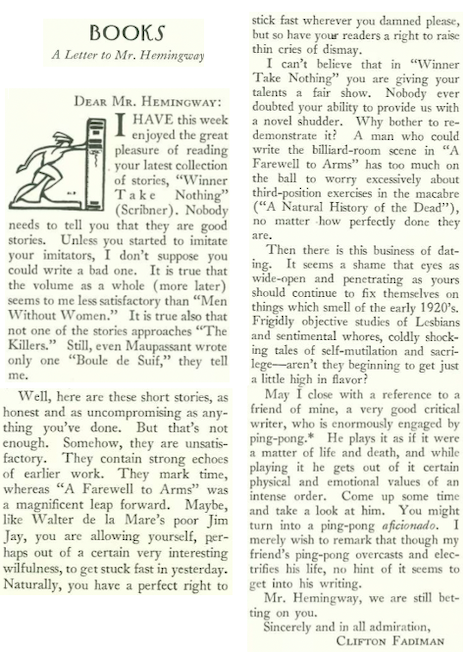
Following the high praise Ernest Hemingway received in 1926 for The Sun Also Rises, Dorothy Parker feared for the novelist’s next book: “You know how it is—as soon as they all start acclaiming a writer, that writer is just about to slip downward.” Seven years later Parker’s colleague Clifton Fadiman detected some slippage, finding Hemingway’s latest output a bit stale. Rather than pen a negative review, Fadiman shared his concerns by way of an open letter:

PHONING IT IN…Clifton Fadiman (right) found Ernest Hemingway’s Winner Take Nothing to be “stuck fast in yesterday.” (AP/Wikipedia/Pinterest)

 * * *

From Our Advertisers

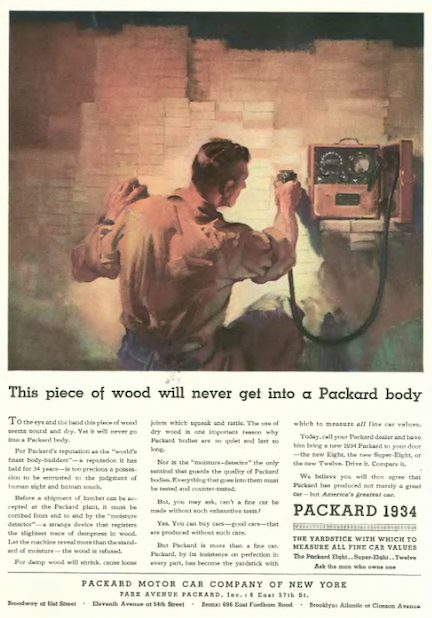
Until the 1920s all car bodies were framed in wood, preferably ash, but by the end of the 1930s all-steel car bodies became the standard…Packard made the switch beginning around 1938…

…ah, the good old days when you could smoke in the “rarefied atmosphere” of an airplane, the pilot so close by you could tap him on the shoulder…

…Brooklyn’s Hittleman-Goldenrod Brewery opened in late 1933 promising beer in the finest English tradition…sadly, it closed in 1937…

…the Waldorf-Astoria announced the re-opening of its Empire Room with entertainment by Xavier Cugat and his tango orchestra, featuring the dancer Margo…this was just the sort of “juvenile” entertainment Lois Long detested (see my previous post)…

…according to this ad, “His Lordship” drank a pot of decaf Sanka at midnight “and never winked an eye all night”…it doesn’t mention that he probably also wet the bed…

…on to our cartoons, we begin with Peter Arno and the woes of the monied classes…

…on to Helen Hokinson, and the charms of the precocious…

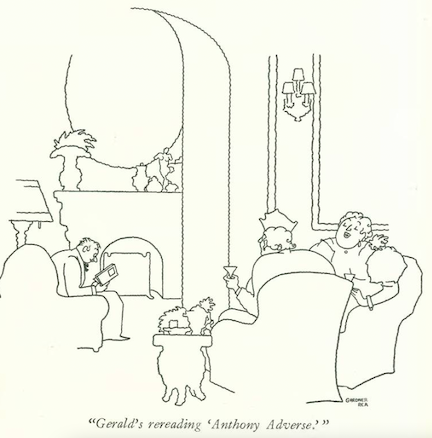
Gardner Rea gave us a toff absorbed in historical fiction…

Alain (aka Daniel Brustlein) offered up a flautist who found beauty in his routine life…

…and we close with Perry Barlow, and motherhood among the smart set…

Next Time: Radio City…