Strike Me Pink

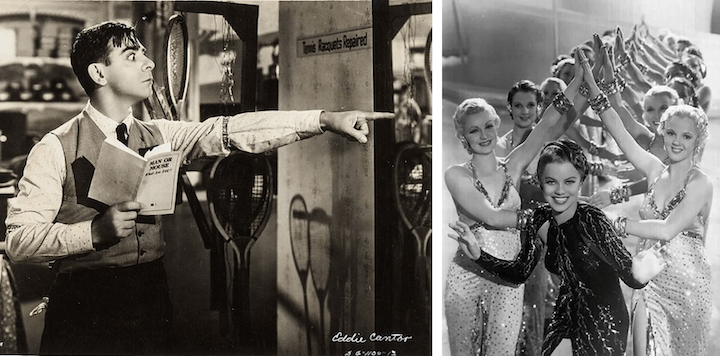
Above: Eddie Cantor (left) consulting his "confidence book" in Strike Me Pink; at right, Dona Drake and the “Goldwyn Girls” performing “The Lady Dances." (cometoverhollywood.com)

You don’t hear much about him today, but in 1936 Eddie Cantor was a household name, an entertainer who seemed to do it all—comedian, actor, dancer, singer, and songwriter were just a few of his trades.
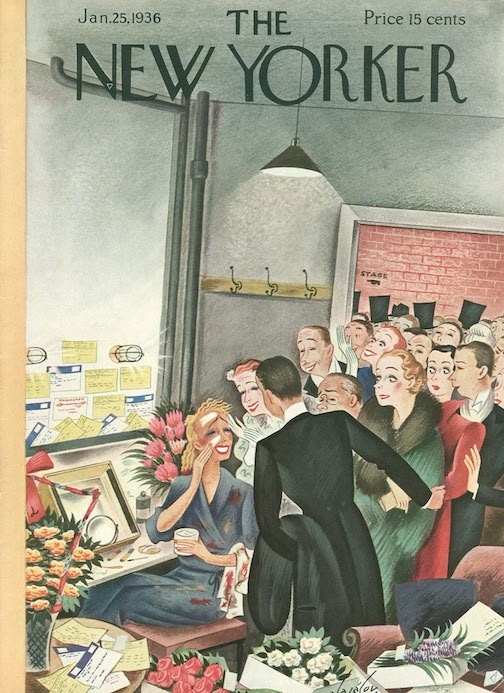
January 25, 1936 cover by Constantin Alajálov.

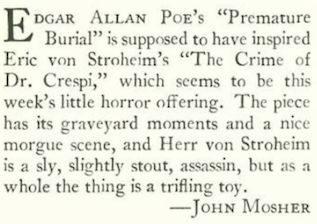
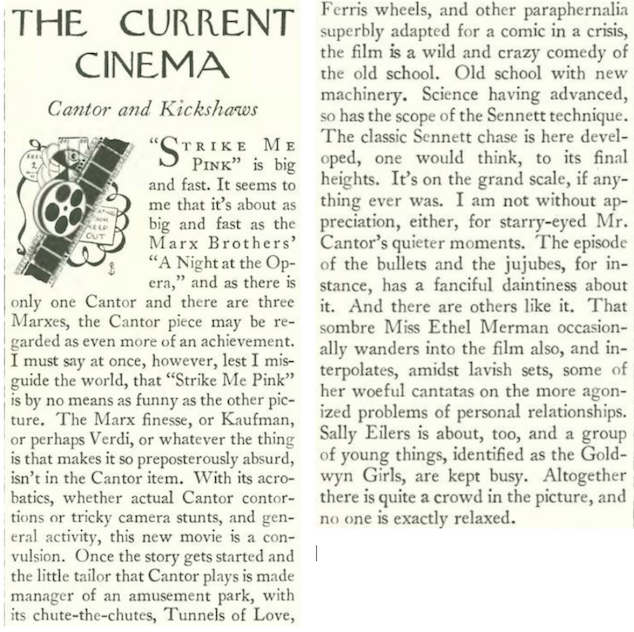
Critic John Mosher marveled at the energy Cantor (1892–1964) brought to his latest film, Strike Me Pink, in which Cantor played a mild-mannered manager of an amusement park infested with mobsters. The film was a “convulsion,” Mosher wrote, packed with action on “the grand scale” with occasional interludes by co-star Ethel Merman, who portrayed Cantor’s love interest.
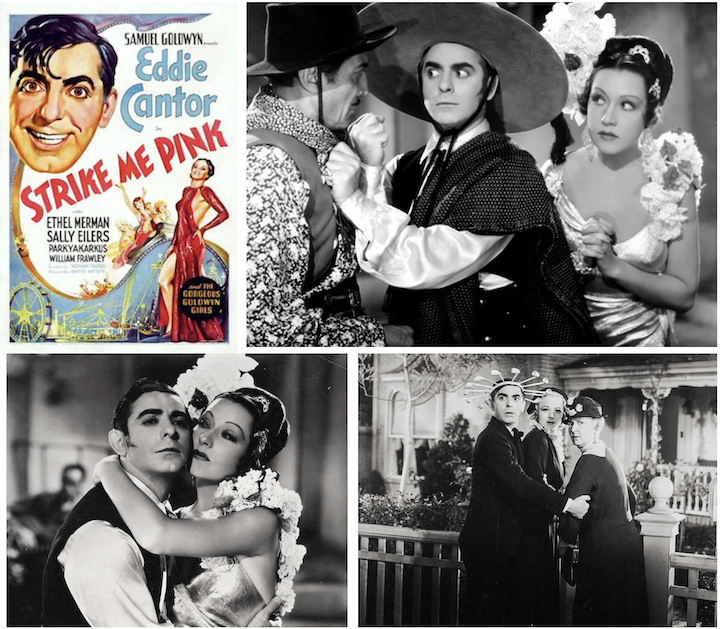
FINDING HIS MOJO…top and below left, Eddie Cantor and Ethel Merman in Strike Me Pink. Bottom right, Cantor, Sally Eilers and Helen Lowell in a scene from the film. (Wikipedia/tcm.com/imdb.com)

Bette Davis wasn’t the only Hollywood celeb known for her peepers. After artist Frederick J. Garner published a big-eyed caricature of Cantor in 1933, those “Banjo Eyes” became Cantor’s trademark.
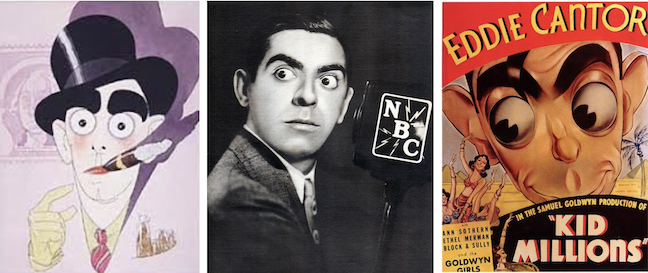
BANJO EYES…at left, Frederick J. Garner’s caricature of Cantor. After he published the drawing in 1933, other artists followed suit with their own interpretations of the “Banjo Eyes.” At right, movie poster for 1934’s Kid Millions. (npg.si.edu/laughterlog.com/imdb.com)

Cantor would pack a lot into his seventy-two years, a regular with the Ziegfeld Follies (he would repeat his routines in numerous films), he would also appear in other stage productions, on the radio, on television (hosting The Colgate Comedy Hour) and recording hit songs like “Makin’ Whoopee.” He wrote or co-wrote seven books, was the second president of the Screen Actors Guild, and a co-founder of the March of Dimes (Cantor came up with the name as well). He also appeared in numerous cartoons, and even wrote the Merrie Melodies/LooneyTunes theme song, “Merrily We Roll Along.”

DOWN AND OUT…Eddie Cantor was caricatured along with, from left, Al Jolson, Jack Benny and Bing Crosby in the 1950 Looney Toons short “What’s Up, Doc?” The scene depicts a low point in Bugs Bunny’s career when he spends the winter with fellow struggling actors in Central Park. (Warner Brothers)

In 1934 Cantor was depicted as a balloon in the Macy’s Thanksgiving Day Parade, the only full-size balloon to represent a real person.
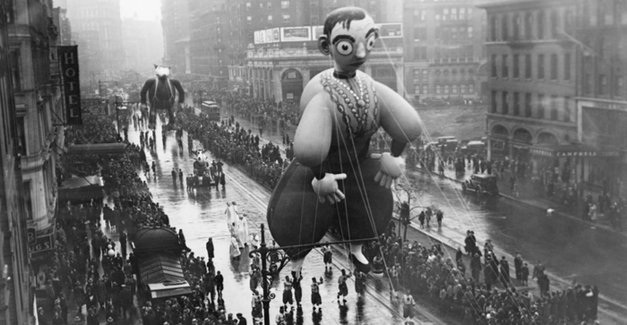
MY, WHAT BIG EYES YOU HAVE…Eddie Cantor looms over the Macy’s Thanksgiving Day Parade in 1934. (Ephemeral New York)

 * * *

Fishing For Buyers

The Thirty-first annual Motor Boat Show was on at the Grand Central Palace, featuring everything from yachts to tiny sailboats. Excerpts from a report by a correspondent who wrote under the name “Bosun.”
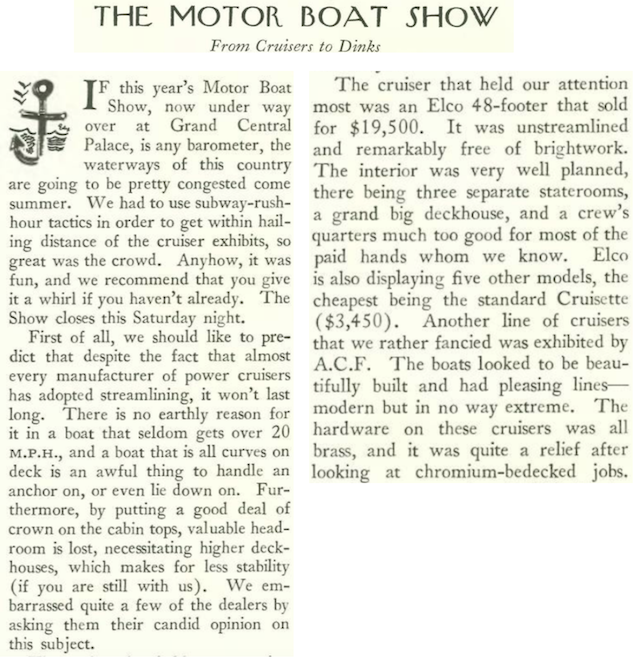
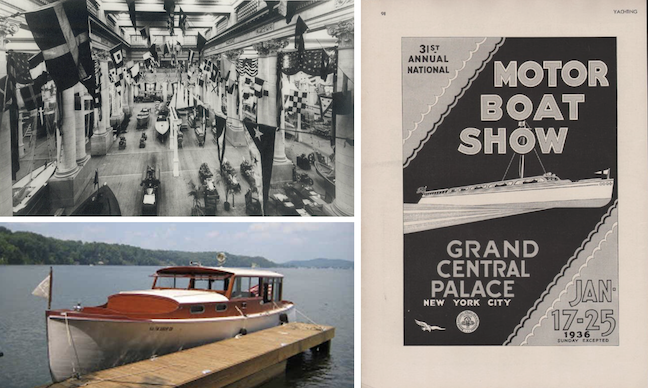
FOR LANDLUBBERS TOO…The New York Motor Boat Show began in 1905 at Madison Square Garden before moving to the resplendent surroundings of the Grand Central Palace. Clockwise from top left, undated photo from the Grand Central Palace; advertisement in Yachting magazine; a 1935 Elco Cruisette. (offthehookyachts.com/antiqueboatamerica.com)

 * * *

Cultured Congress

Hard to believe that ninety years ago the U.S. House of Representatives devoted considerable time and attention to a proposed bill for a “Department of Science, Art and Literature.” E.B. White covered the hearings in an extensive two-part report for “Onward & Upward With the Arts.” Here is a brief excerpt from part one.
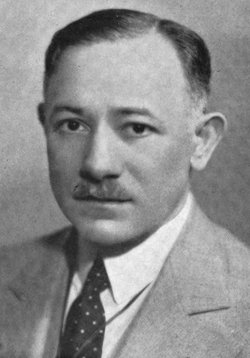
ARTS FANATIC is how E.B. White characterized New York Congressman William I. Sirovich (1882–1939), who proposed the establishment of a Department of Science, Art and Literature. (findagrave.com)

 * * *

A Really Big Show

“The Talk of the Town” paid a visit to the Adelphi Theatre to see how preparations were going for opera-oratorio The Eternal Road. Conceived by journalist and playwright Meyer Weisgal to alert the public to the persecution of Jews in Nazi Germany, it featured a score by Kurt Weill with libretto by Franz Werfel (translated into English by Ludwig Lewisohn).

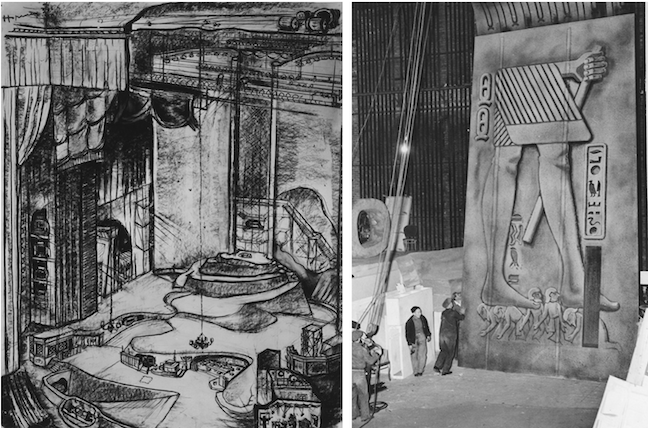
Directed by Max Reinhardt on an imposing set designed by Norman Bel GeddesThe Eternal Road would take time to produce, finally premiering at the Manhattan Opera House on Jan. 7, 1937. It ran for 153 performances.
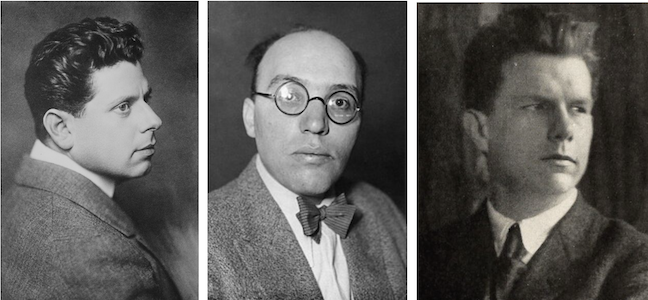
ON THE ROAD…Key figures in the production of The Eternal Road included, from left, director Max Reinhardt, composer Kurt Weill, and set designer Norman Bel Geddes (who here bears an uncanny resemblance to New Yorker founding editor Harold Ross). (weillproject.com)
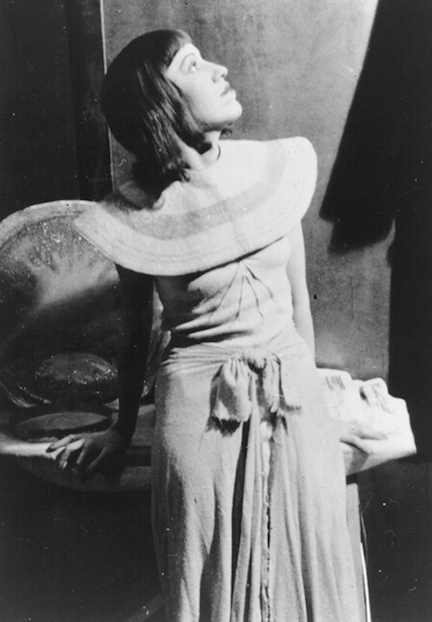
DRAMA QUEEN…Among the 245 actors in the production was Lotte Lenya, who portrayed Miriam. An acclaimed Austrian singer and actress, Lenya was also Kurt Weill’s ex-wife, and is probably best known today for her role as the sadistic Rosa Klebb in the 1963 James Bond film From Russia with Love.
MAKE NO LITTLE PLANS…At left, a sketch by Harry Horner of the The Eternal Road’s five-level set designed by Norman Bel Geddes for the Manhattan Opera House; at right, massive set piece from the production. (Kurt Weill Foundation kwf.org)

 * * *

Location, Location, Location

“Talk” also looked at property values in the city, noting that the site occupied by the Hell Gate power plant was assessed at nearly $57 million (roughly $1.3 billion today). Excerpt:
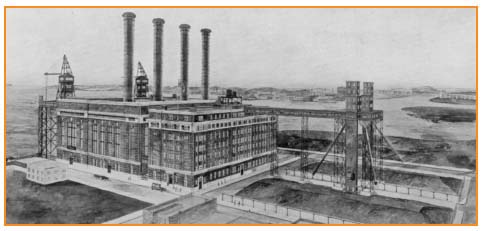
PRIME REAL ESTATE…Artist’s rendering of the Hell Gate generating station, circa 1922. (T.E. Murray, Power Stations 1922)

 * * *

A New, Improved Carmen

Music critic Robert Simon (writing for “Musical Events”) was delightfully surprised by the Met’s latest production of Carmen, and namely by the performance of Swedish mezzo-soprano Gertrud Pålson-Wettergren:
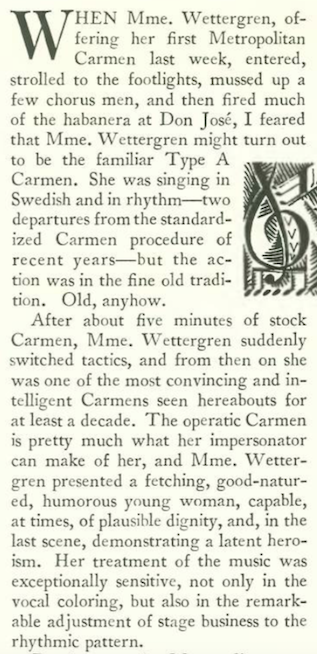
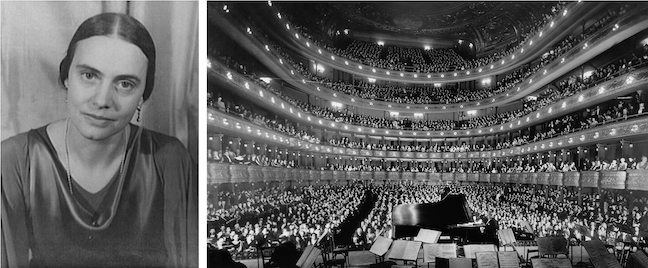
HUMOROUS AND HEROIC were just two for the adjectives Robert Simon used to describe an interpretation of Carmen by Swedish mezzo-soprano Gertrud Pålson-Wettergren (1897–1991). She made her Metropolitan Opera debut in December 1935. (Wikipedia)

 * * *

At the Movies

We rejoin critic John Mosher for a look at the rest of the cinema lineup, beginning with King of Burlesque, which featured Alice Faye and “everything but the kitchen stove.”
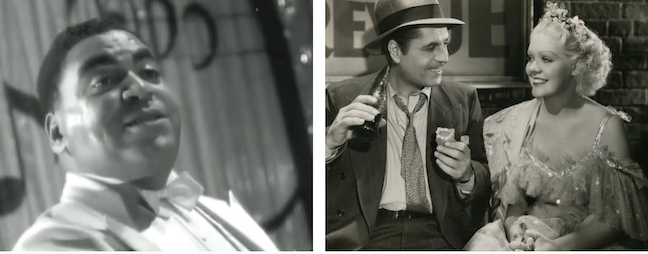
FACES IN THE CROWD…Mosher found a film crowded with talents in King of Burlesque, including Fats Waller (performing “I’ve Got My Fingers Crossed”), Warner Baxter, and Alice Faye. (YouTube.com/IMDb.com)

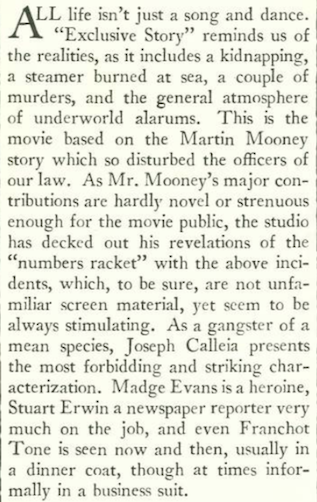
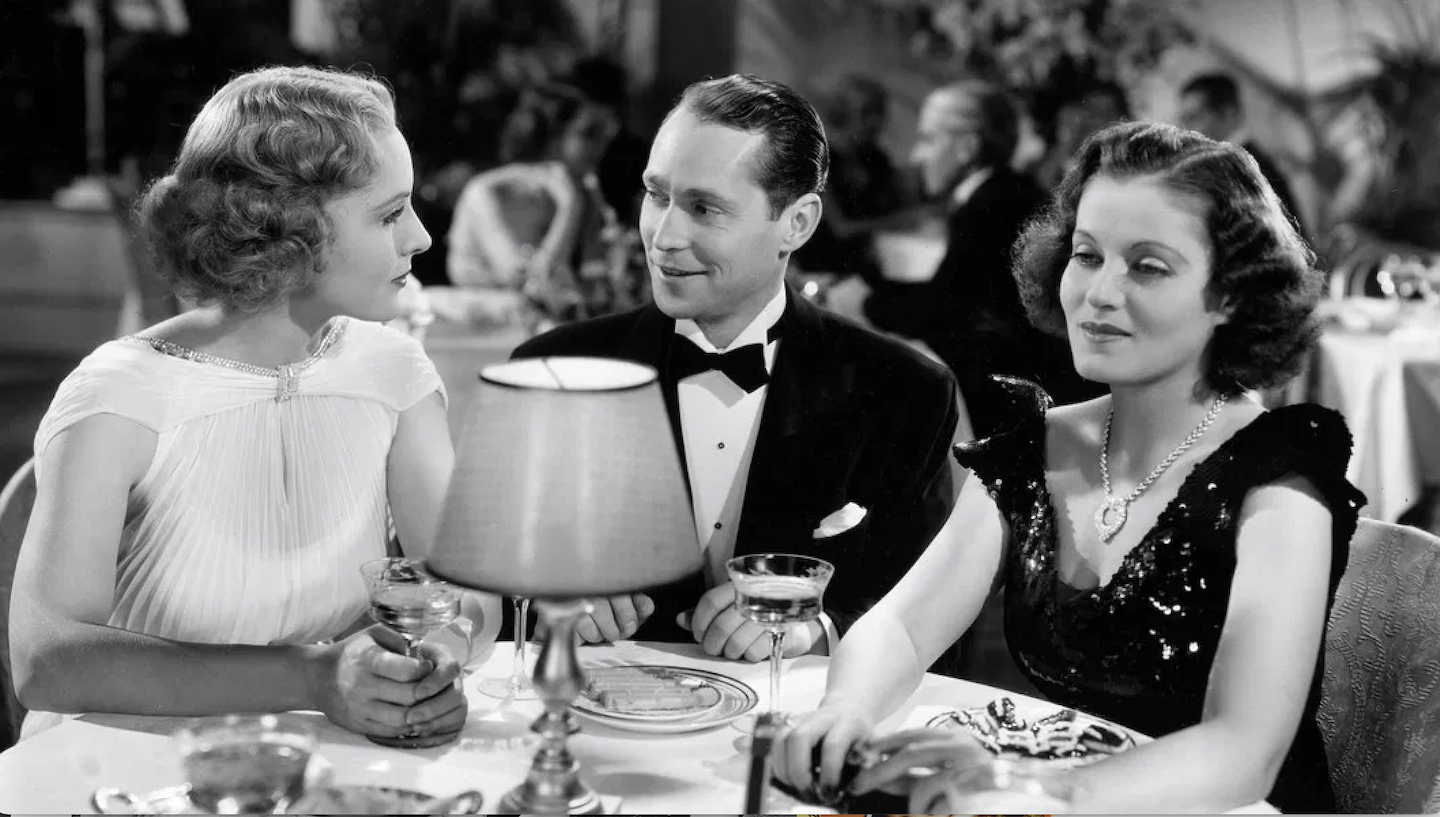
Mosher found a “stimulating” gangster flick in Exclusive Story

DRESSED TO THE NINES…Franchot Tone was clad in his usual Sunday best, here flanked by Madge Evans (left) and Louise Henry. (themovied.org)

…and a “trifling” horror movie, The Crime of Dr. Crespi

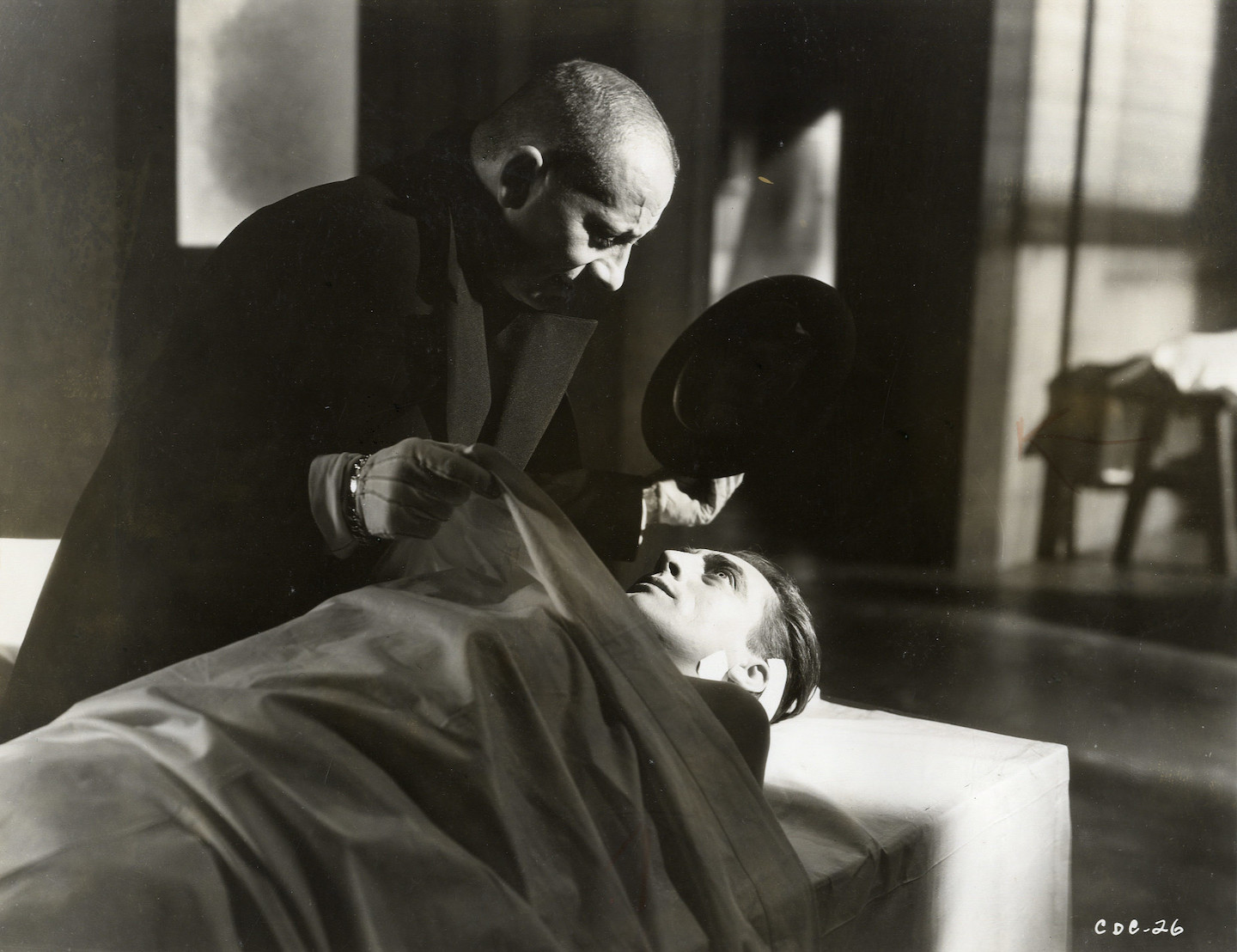
I’M NOT DEAD YET…Evil Dr. Crespi (Erich Von Stroheim) gives fellow doctor Stephen Ross (John Bohn) a drug that induces a state of apparent death in The Crime of Doctor Crespi. (moma.org)

 * * *

A Hot Hobby

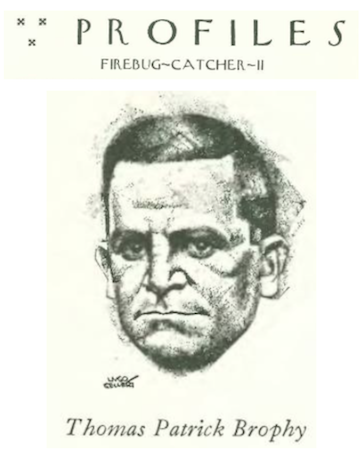
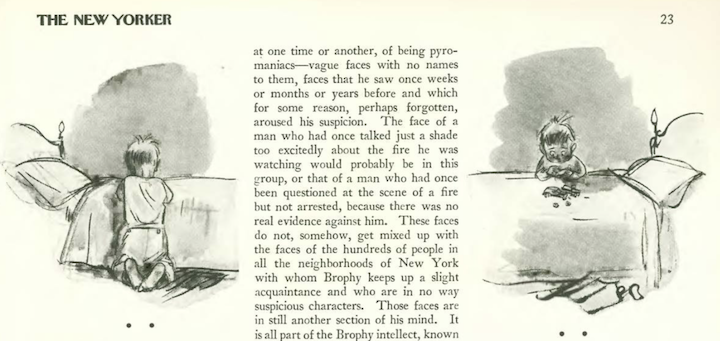
St. Clair McKelway filed the second of a two-part profile on New York’s Chief Fire Marshal Thomas P. Brophy (1880-1962). McKelway wrote, “How to stop a fire is the fire chief’s problem; how it got started, that of the fire marshal, Thomas Brophy…Brophy’s specialty, however, is pyromaniacs— it is almost his hobby.” Hugo Gellert supplied the drawing.
* * *

From Our Advertisers

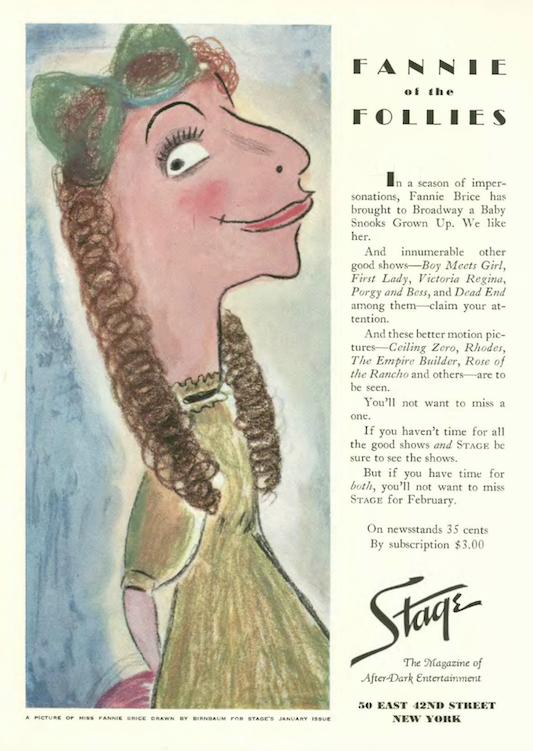
We begin with the inside front cover, and this colorful illustration of Fanny Brice by Abe Birnbaum for Stage magazine…
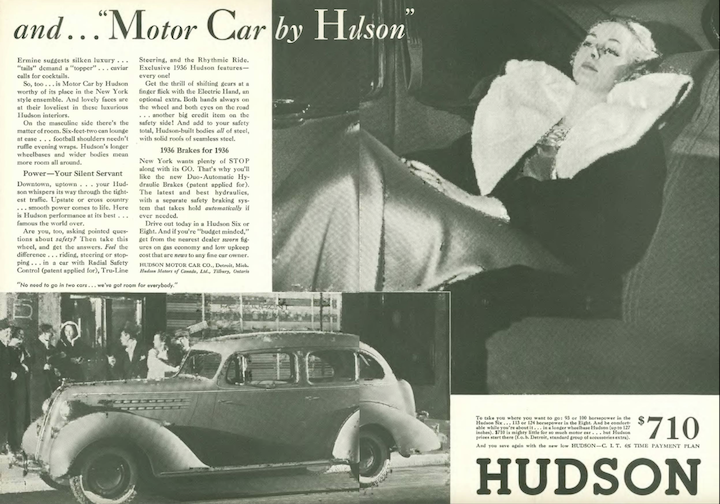
…the makers of budget automobiles such as Nash, Plymouth and Hudson were all on the same page when it came to marketing their automobiles, namely, that their products suggested luxury despite the bargain price…a “Motor Car by Hudson,” the ad proclaimed, is “worthy of its place in the New York style ensemble”…
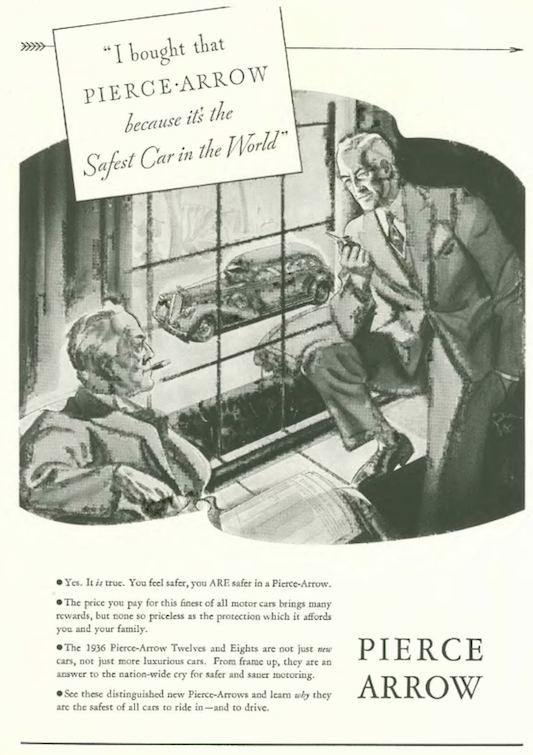
…the makers of Pierce Arrow had a solid reputation as the Rolls-Royce of American automobiles, so they took the safety angle in this understated, hyperbole-free advertisement…(however, cheaper cars like Hudson would survive the Depression, Pierce-Arrow would not)…
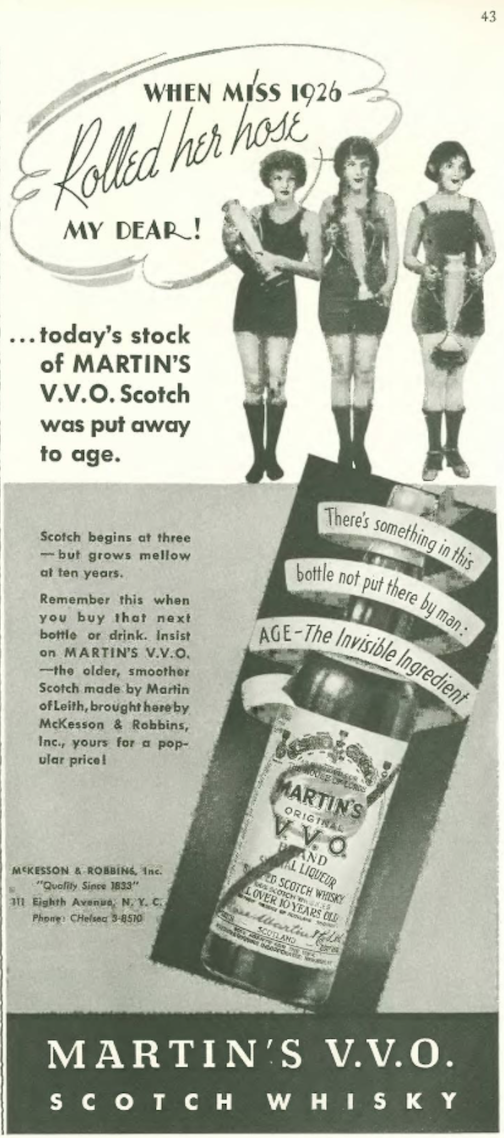
…this Scotch whisky ad recalled the days when “rolled hose” could create a scandal, underscoring how things can mellow after ten years, including whisky…
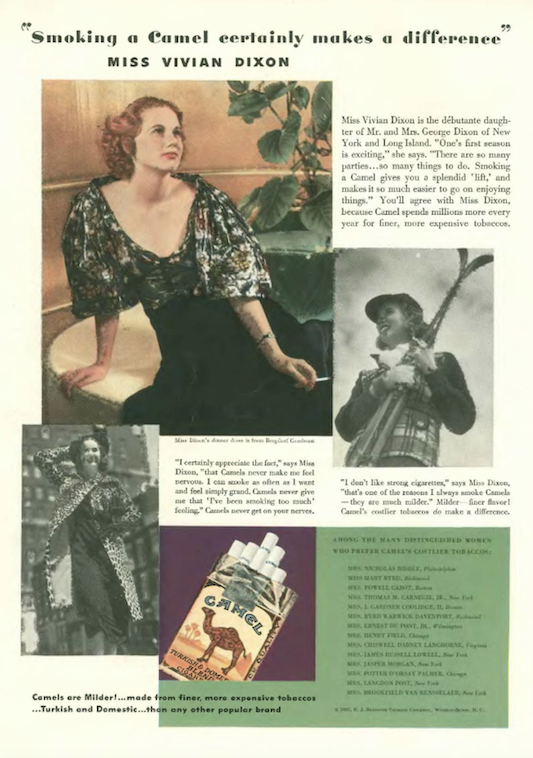
…in this back cover advertisement, Vivian Dixon (apparently just eighteen years old) was the latest New York debutante to invite young women to join her in smoking Camels…
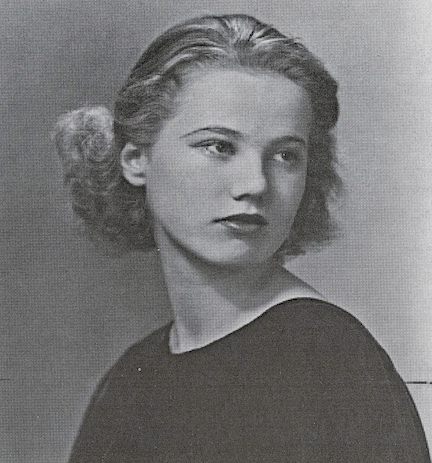
Vivian Dixon (1918-1974) circa 1940. You can read more about her here. (stoningtonboroughct.com)

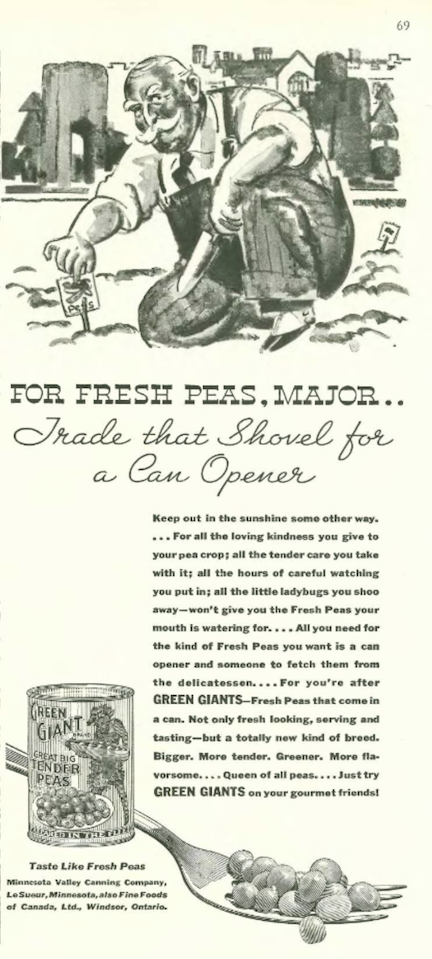
…the Major continued his quest for fresh peas in this ad from the Minnesota Valley Canning Company (aka Green Giant)…
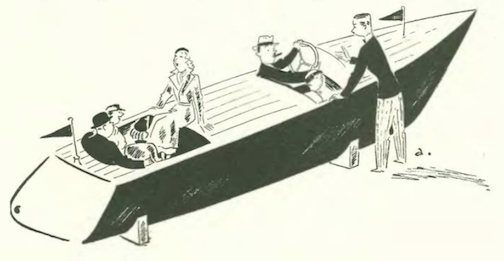
…on to our cartoonists, beginning with this spot drawing for the boat show by Constantin Alajálov

…this spot by Abe Birnbaum broke up the text for James Thurber’s “Nine Needles” short story…
Perry Barlow gave us a gentleman attempting to explain the subtleties of ice hockey…
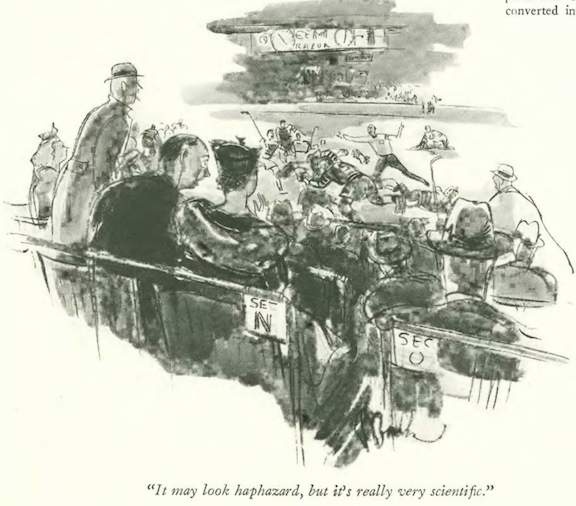
…Barlow again, where seeing is not necessarily believing…
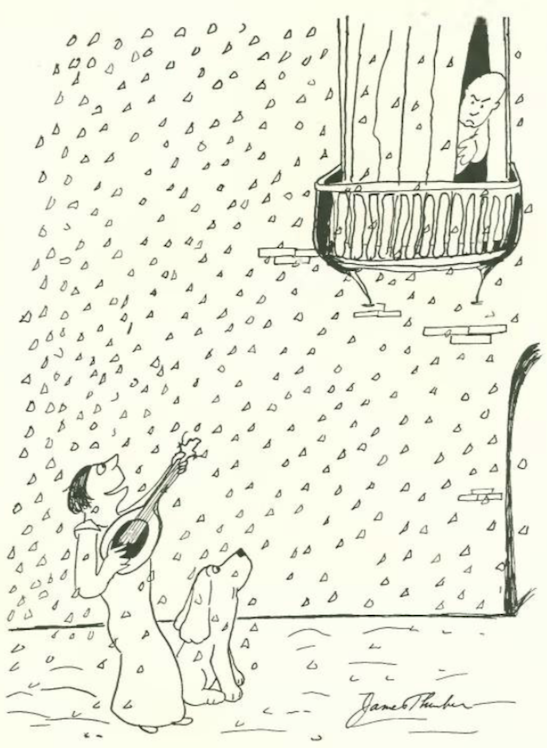
James Thurber contributed a serenade, accompanied by dog…
Peter Arno bid farewell to honeymooners destined for Niagara Falls and the Shredded Wheat factory…

…besides the falls, the Shredded Wheat factory was a big attraction in the early 20th century…
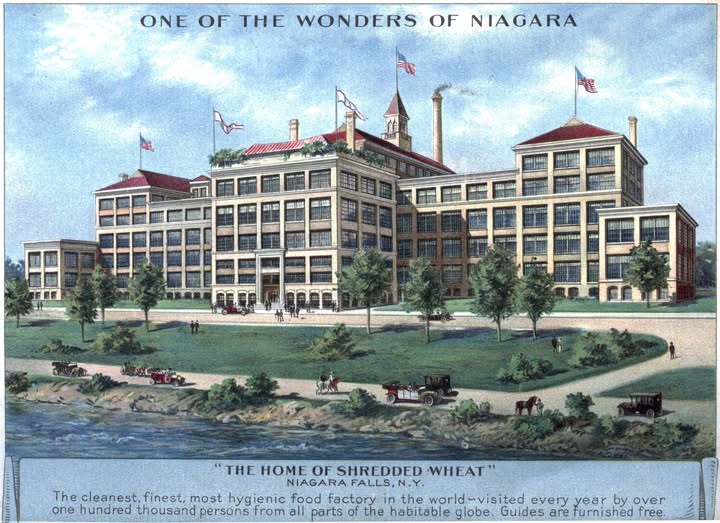
A 1905 postcard touting “One of the Wonders of Niagara.” (Niagara Falls Public Library)

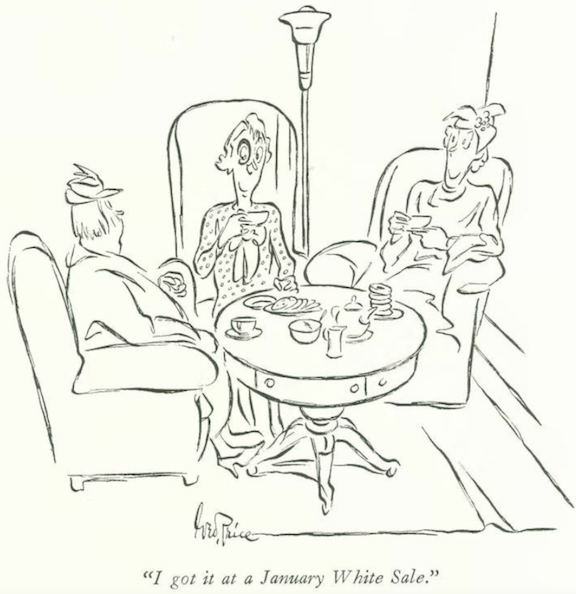
George Price illustrated the hazards of bargain shopping…
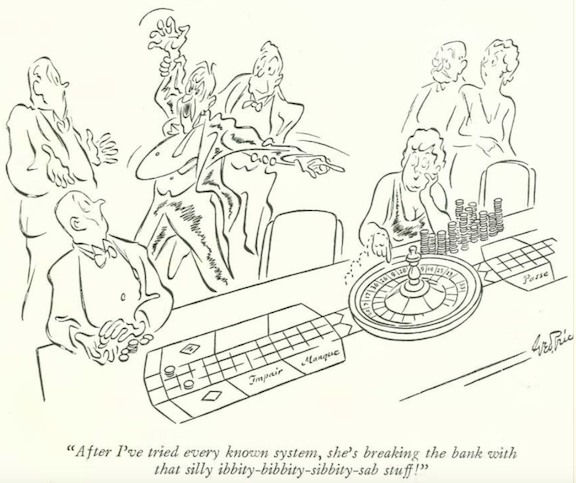
…and Price again, with a lucky streak in Atlantic City…
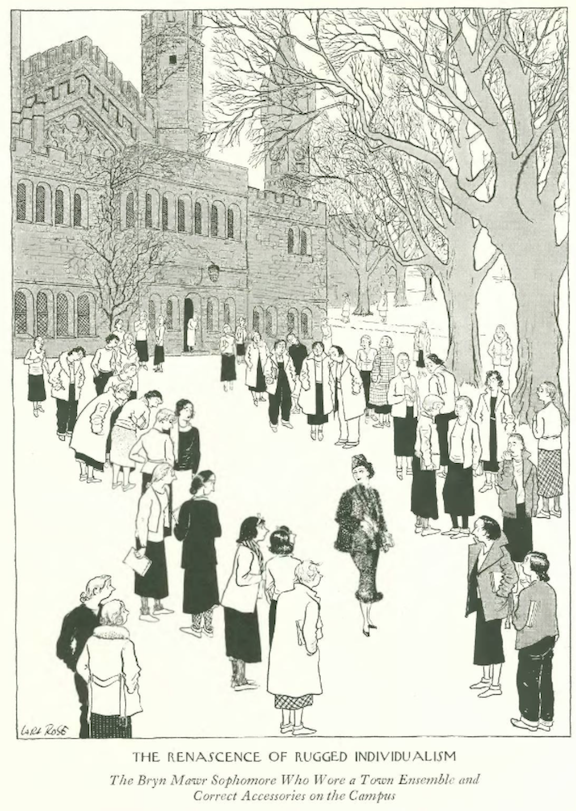
Carl Rose continued to offer examples of rugged individualism…
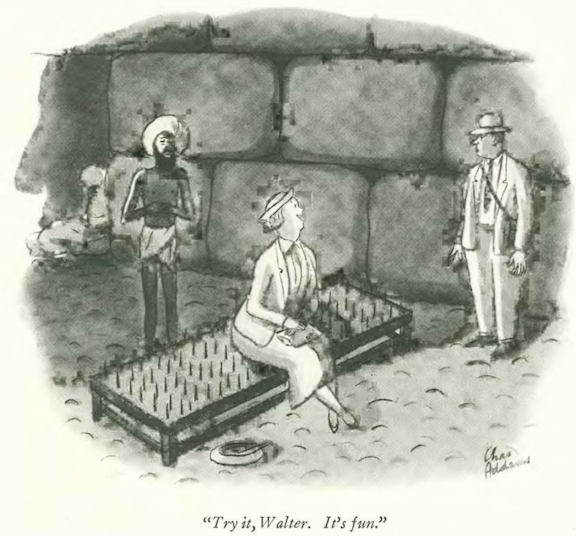
Charles Addams explored some exotic thrills…
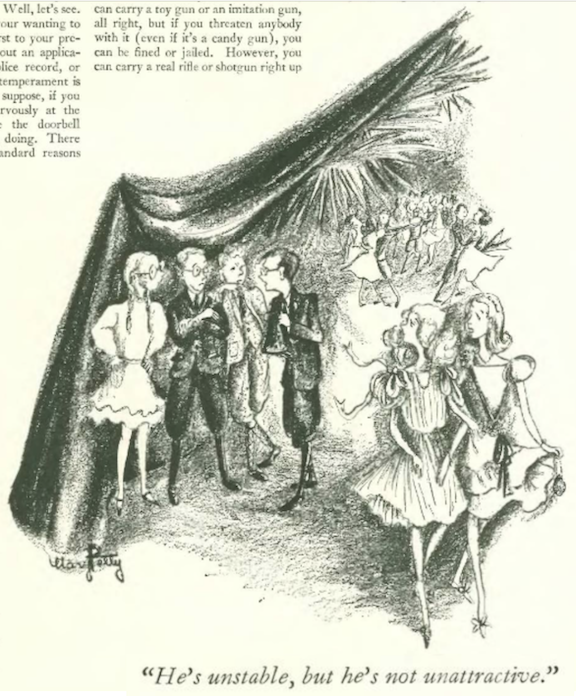
Mary Petty found nuance among youthful suitors…
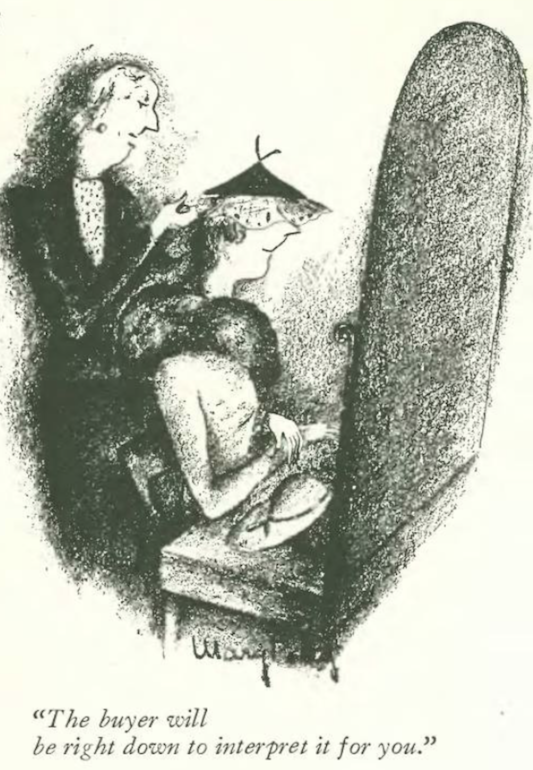
…and Petty again, and the complexities of hat shopping…
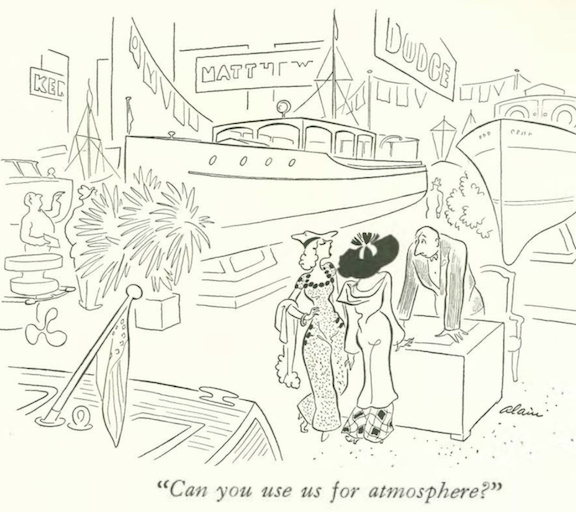
Alain paid a visit to the boat show…

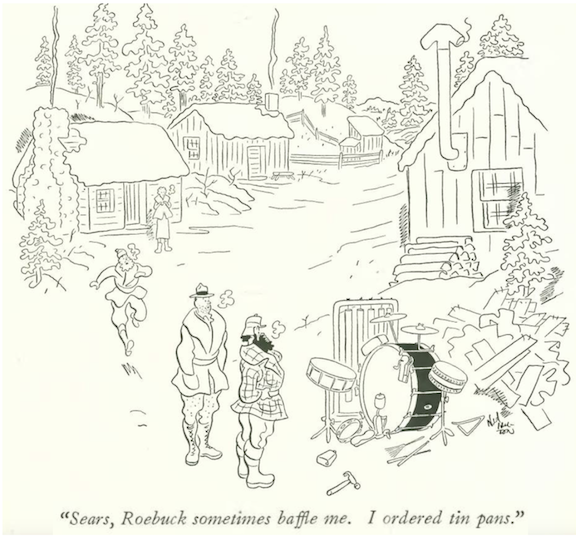
Ned Hilton drew up a mail-order mix-up…
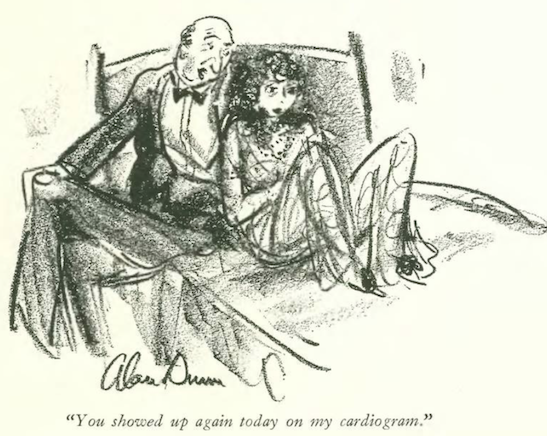
…and we close with Alan Dunn, and a matter of the heart…
Next Time: Having a Ball…

Down to Coney

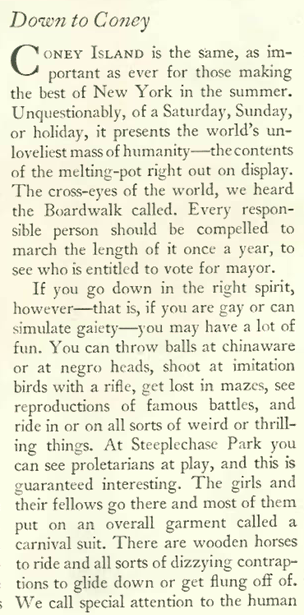
The New Yorker kicked off the summer season with a trip down to Coney Island. “The Talk of the Town” took in the various sights and amusements at the famed Steeplechase and Luna parks.

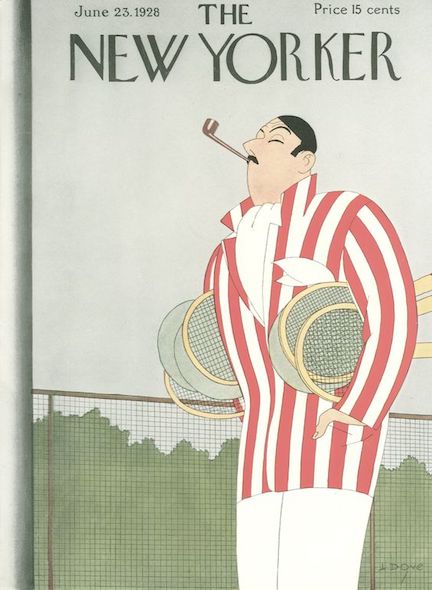
June 23, 1928 cover by Leonard Dove.

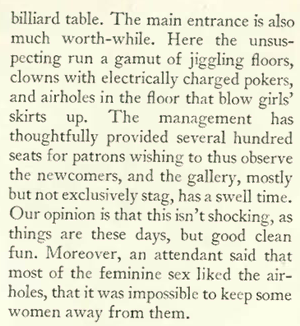
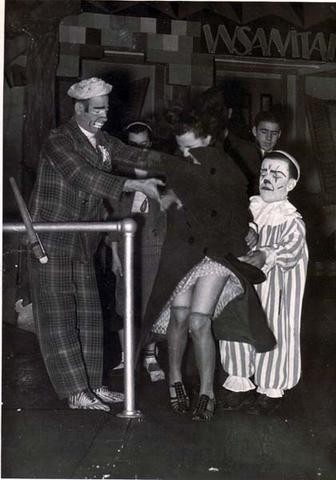
Attractions at Steeplechase Park included everything from racing wooden horses to a “human billiard table.” Less jolly diversions included air jets that blew up  women’s skirts and clowns who administered electric shocks to unsuspecting visitors (one more reason to fear them). And there was at least one racist game of skill…

FEAR THE CLOWN…A photo from the 1940s shows a pair of clowns “help” a woman through the entrance to Steeplechase Park’s Insanitarium and Blowhole Theatre. Located in the Pavilion of Fun, visitors were led through Comedy Lane, which featured jets of compressed air intended to lift skirts. Clowns spanked patrons and even zapped them with a cattle prod. (Worthpoint.com)
Clockwise, from upper left: A Steeplechase rider passes in front of the massive Pavilion of Fun; interior of the Pavilion of Fun; young women preparing to be spun around on the Human Billiard Table; scene from the 1928 Harold Lloyd movie Speedy filmed in the Pavilion of Fun (westland.net, CardCow, houseoftoomuchtrouble.tumblr.com, safetylast.tumblr.com) click to enlarge
OUT FOR A SPIN…Harold Lloyd and Ann Christy take a spin on the Pavilion of Fun’s Human Roulette Wheel in the 1928 film Speedy. (spellboundbymovies.com)
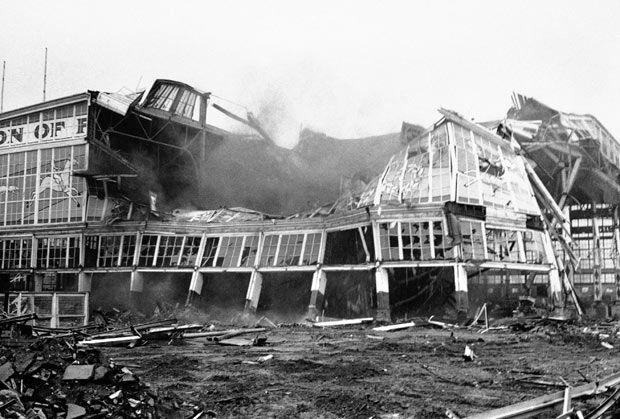
TRUMPED…Coney Island’s landmark Pavilion of Fun at Steeplechase Park was demolished in 1966 by developer Fred Trump, father of Donald Trump. The young Donald (19 at the time) was on hand for his father’s “Demolition Party,” which featured scantily clad models who paraded in front of the park and encouraged guests to throw bricks at the stained glass windows of the historic pavilion. Later that night Trump bulldozed the amusement park to the ground, thereby limiting any pending proceedings to declare the property a historic landmark. (Daily Telegraph/Untapped Cities)

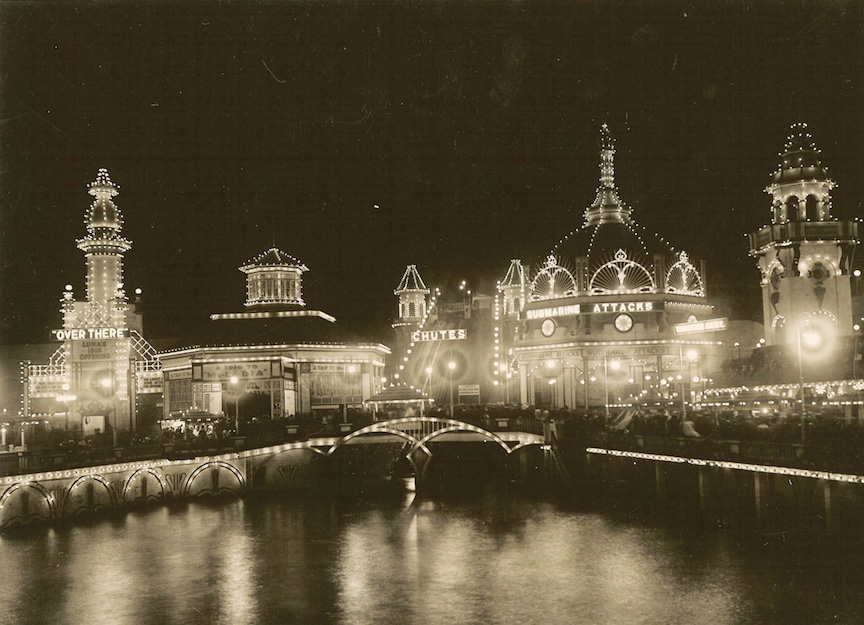
Over at Luna Park there were more air holes to blow up women’s skirts and assorted freak shows. More wholesome entertainments included the famed Cyclone rollercoaster, which celebrated its 90th year of operation in 2017.

DREAMLAND…Luna Park at night in the 1920s. (carouselhistory.com)

 *  *  *

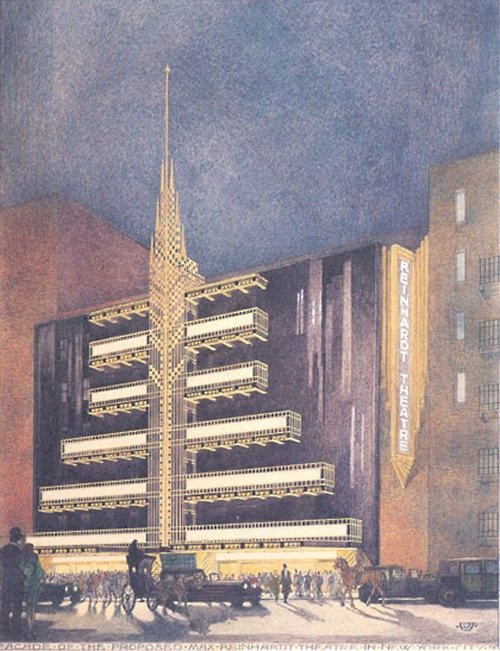
Writing for the June 23 “Talk of the Town,” Murdock Pemberton anticipated the construction of a new theatre to be developed by famed Austrian director/producer Max Reinhardt and designed by Austrian-American architect, illustrator and scenic designer Joseph Urban:

Unfortunately the market crash of 1929 put an end to the project, which would have looked like this had it been constructed:

DREAMLAND…Joseph Urban’s unbuilt Reinhardt Theatre. The innovative design incorporated the building’s fire escapes into its glimmering facade. (Columbia University)

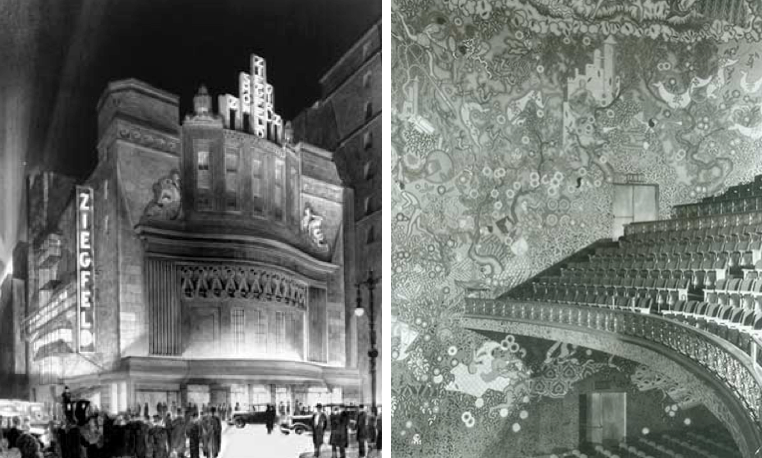
Urban designed innovative sets for clients ranging from the Metropolitan Opera to the Ziegfeld Follies (he also designed a theatre for Ziegfeld in 1927, see below). Although he is noted as one of the originators of American Art Deco, most of his architectural work in the United States has been demolished.

RARE REMNANT…Little remains of the work of Joseph Urban, one of the originators of American Art Deco. Fortunately the Tishman Auditorium at the New School still stands. (nycarchitecture.com)
ONLY A MEMORY…Most of Joseph Urban’s American work has been demolished, including his Ziegfield Theatre from 1927. (nyc-architecture.com)
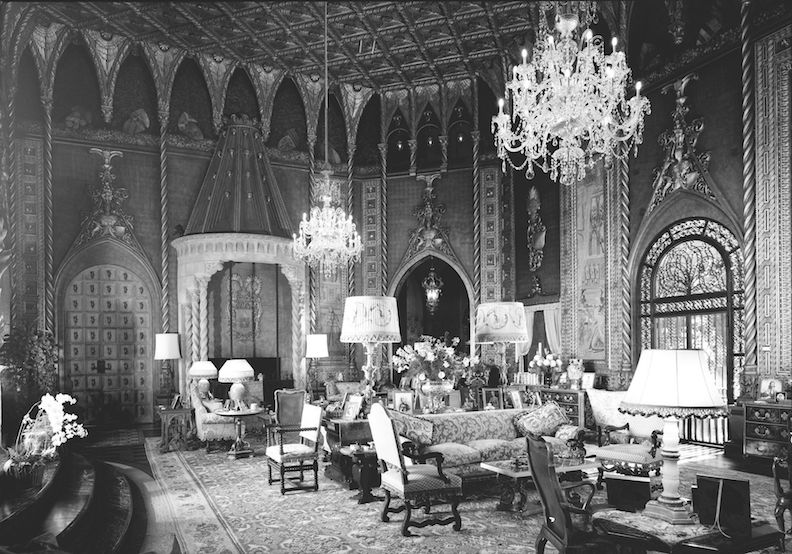
MAR-A-LAGO…Joseph Urban designed the interiors of one of America’s most famous mansions—Mar-a-Lago. Built from 1924 to 1927 by cereal heiress Marjorie Merriweather Post, it is now owned by Donald Trump and operated as a members-only club. (Wikipedia)

 *  *  *

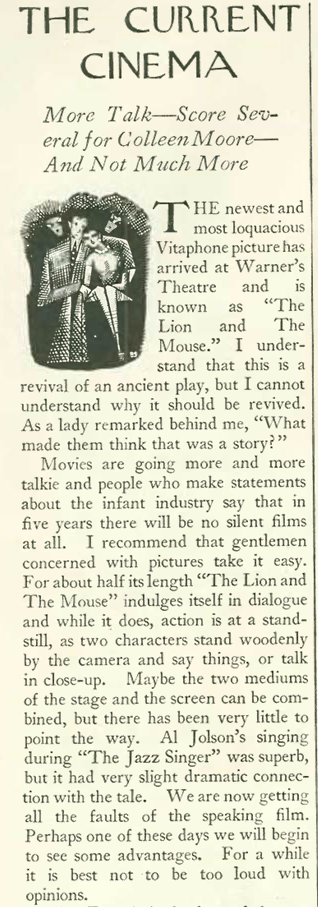
The New Yorker continued to struggle with the emergence of “talking pictures.” The critic “O.C.” found that the sound dialogue in The Lion and the Mouse did little to improve the picture:

The critic seemed to believe that sound pictures would take some time to catch on. Little did he know that Warner Brothers would announce later that summer (August 1928) that all of its films for the 1928-29 fiscal year would have sound. United Artists would make the same announcement in November 1928. In February 1929 Twentieth-Century Fox would make its final silent movie, and Columbia would release its last silent movie on April 1, 1929.

OH SHUT UP…Theatre card for The Lion and the Mouse. (Wikipedia)

The New Yorker still found happiness at the movies through the likes of actress Colleen Moore, who made a sweet little film called Happiness Ahead. 

A CASE OF THE HAPPIES…Colleen Moore strikes a contemplative pose in Happiness Ahead. (IMDB)

Colleen Moore was one of the most famous stars of the silent era who popularized the bobbed haircut and flapper style. Moore presented a more wholesome version of the flapper, in contrast to the more worldly Louise Brooks, another flapper icon of the Twenties.

VARIATIONS ON A THEME…Actresses Colleen Moore (left) and Louise Brooks defined flapper style in the 1920s. (dorineenvrac.wordpress.com / corvusnoir.com)

 *  *  *

From Our Advertisers

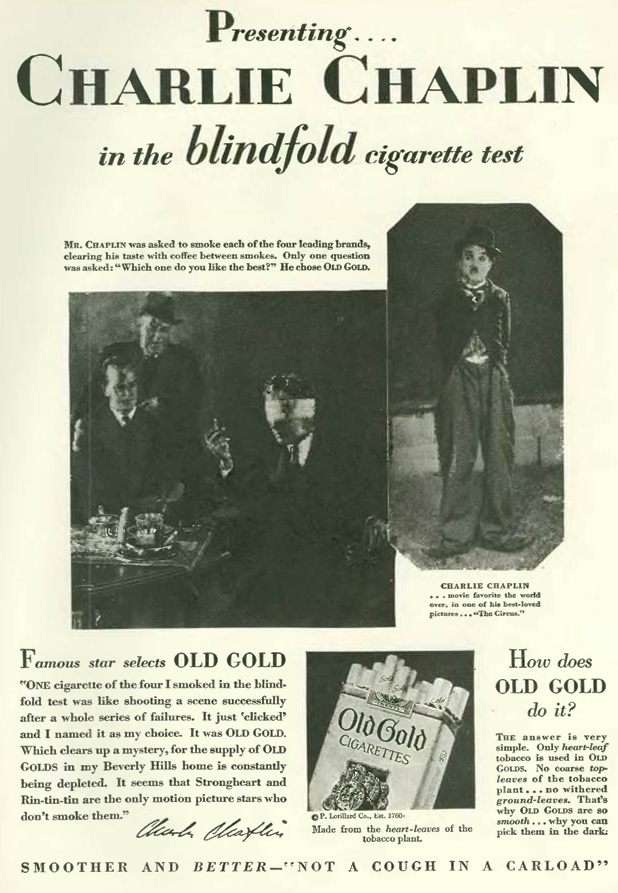
Continuing our series on celebrity endorsements of Old Gold cigarettes, none other than the Little Tramp stepped up to take the blindfold test (along with a pile of cash, no doubt):

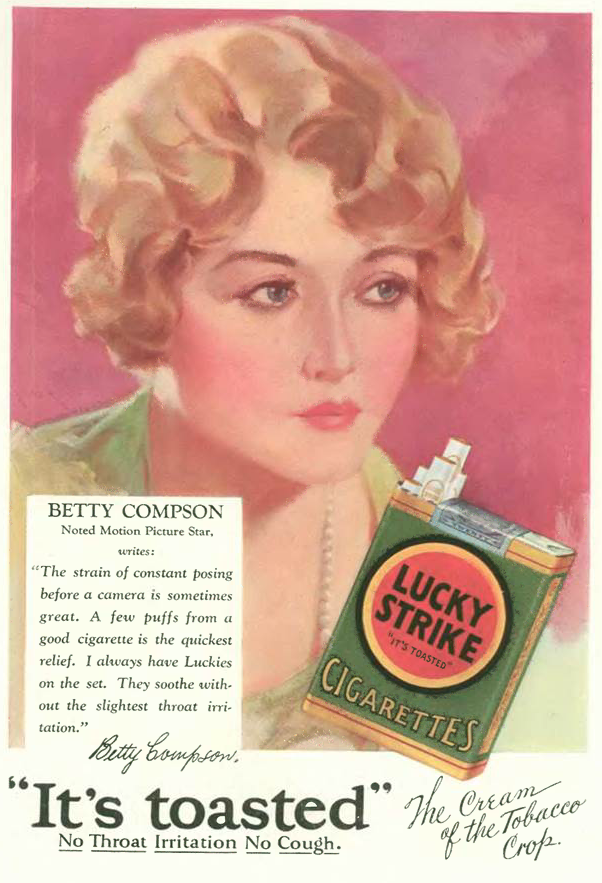
And if Old Gold is not to your taste, then why not enjoy the “toasted” pleasures of Lucky Strike? Actress Betty Compson found them indispensable when preparing for a big scene:

 *  *  *

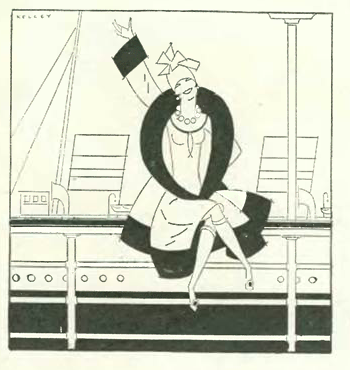
And now for something that caught my eye in the June 23 issue…a bit of filler art by Eldon Kelley that broke up some copy on page 34:

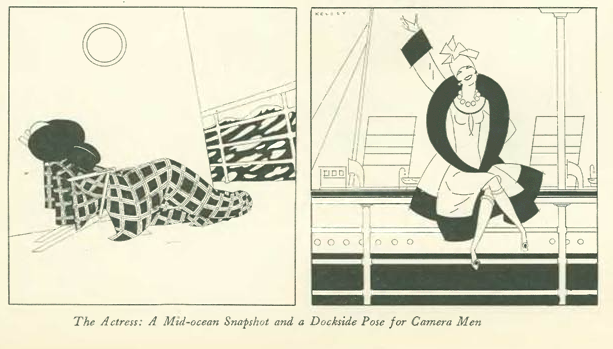
This particular illustration was also featured in one of The New Yorker’s earliest issues—March 21, 1925—in a two-part comic panel (below). I am puzzled why the magazine, flush with artistic talent by 1928, reused this Kelley illustration. Perhaps the layout editors figured since the readership was so small in March 1925, no one would notice.

Here’s an early contribution by Otto Soglow that is a far cry from his later minimalist cartoons…

And we leave with yet another look at some Jazz Age shenanigans, courtesy cartoonist Peter Arno:

Next Time: Summer Breeze…