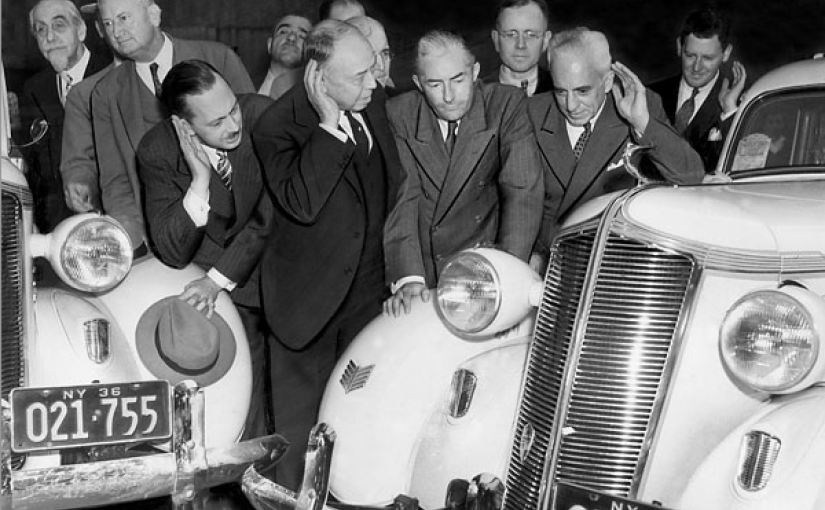
The Din and Bustle

City life is a noisy life, especially in places like Manhattan, one of the most densely populated places in the world.

August 24, 1935 cover by Rea Irvin.

In his “Notes and Comment” column, E.B. White described the occasional “intestinal stoppage” of traffic outside The New Yorker’s offices at West 45th Street, an entire block “laden with undischarged vehicles, the pangs of congestion increasing till every horn is going—a united, delirious scream of hate, every decibel charged with a tiny drop of poison.”
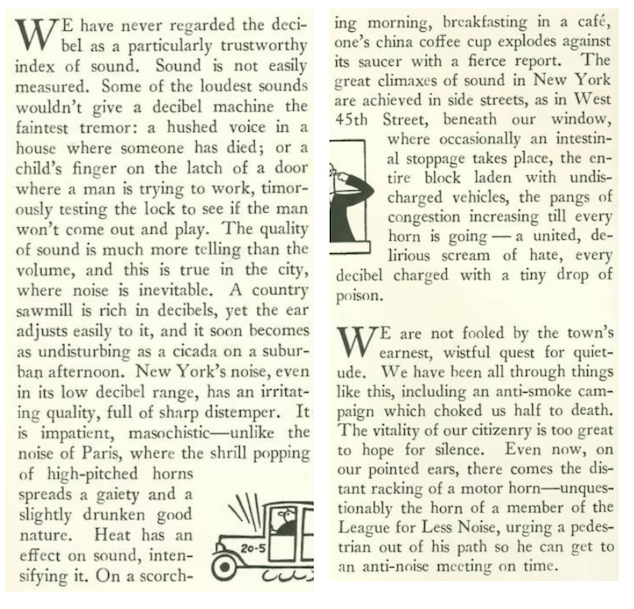
ABOVE THE FRAY…E.B. White with his pet dachshund Minnie at the West 45th Street offices of The New Yorker. (New York Times)
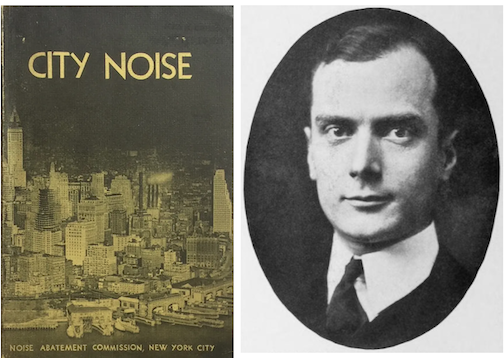
AND DON’T CALL ME SHIRLEY…New York City’s Commissioner of Health, Shirley Wynne (right), created a Noise Abatement Commission in 1929. After eight months of research the Commission published City Noise, which included recommendations for a quieter city. (Wikipedia/trevianbooks.com)

The city began addressing the problem in 1929, when New York City’s Commissioner of Health, Shirley Wynne (1882-1942), created a Noise Abatement Commission, likely the first such commission in the U.S. The Commission cited the “mounting roar and crash of traffic, building, manufacture and sundry other noises which have accompanied the growth of the city.” After eight months of research the Commission published City Noise, which included recommendations for a quieter city.
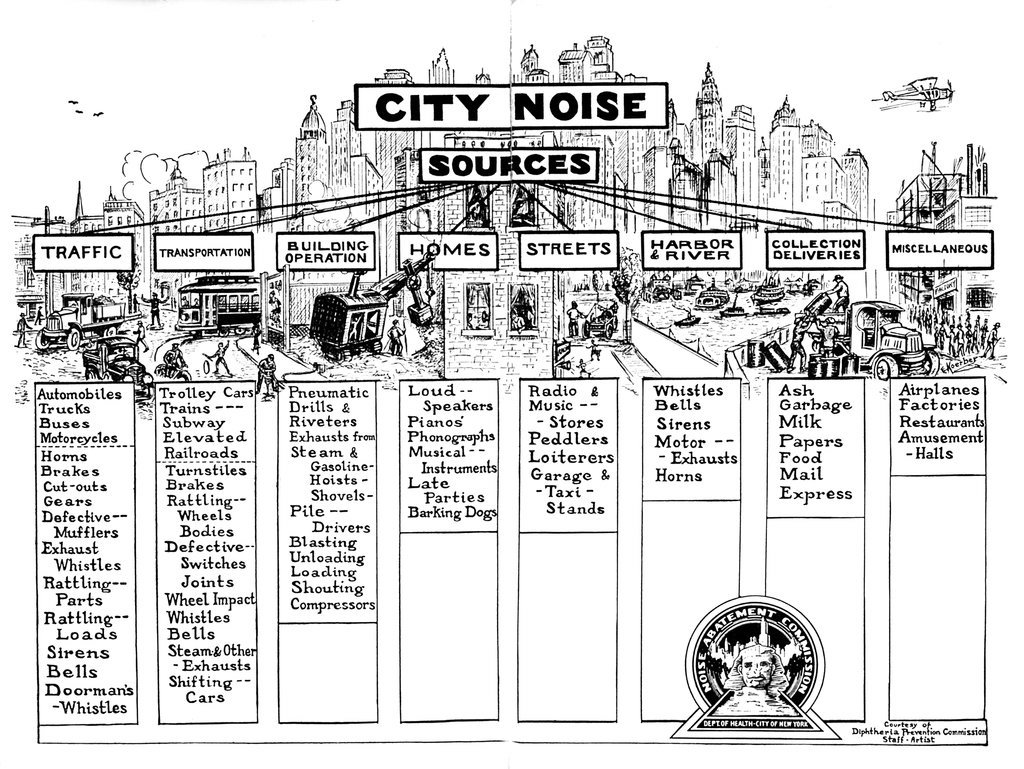
URBAN CHORUS…A chart featured in City Noise depicted some of sources of noise in New York City.
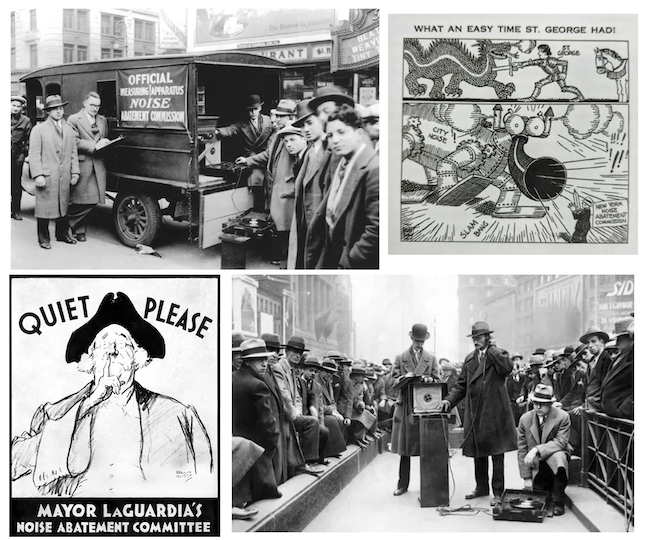
PIPE DOWN!…Clockwise, from top left: The Noise Abatement Commission took to the streets with a municipal acoustics-measuring truck in 1930; cartoon in the New York Herald Tribune illustrated the challenge ahead; Commission officials conducting noise tests in Times Square, circa 1930; poster circa 1936 promoted Mayor Fiorello La Guardia’s anti-noise drives. A 1936 noise code put sound restrictions on everything from radios to the “prolonged and unreasonable blowing of a horn.” A first offense cost $1; the second, if committed within the next year, $2. (hii-mag.com/Bloomberg.com/NYTimes.com)

Not one to leave a stone unturned, White also added this note about the noisy doors on Pullman train car toilets…

Here are the Otto Soglow spot drawings that accompanied the “Talk” piece:

Final note: A colorful exploration of sound can be found on the One Thousand Birds site, Hii Magazine. Check it out!

 * * *

Puff Pushers

Tobacco companies like Philip Morris have long been savvy in finding ways to expand their market, including taking their product directly to the consumer, as “The Talk of the Town” explained in this entry:
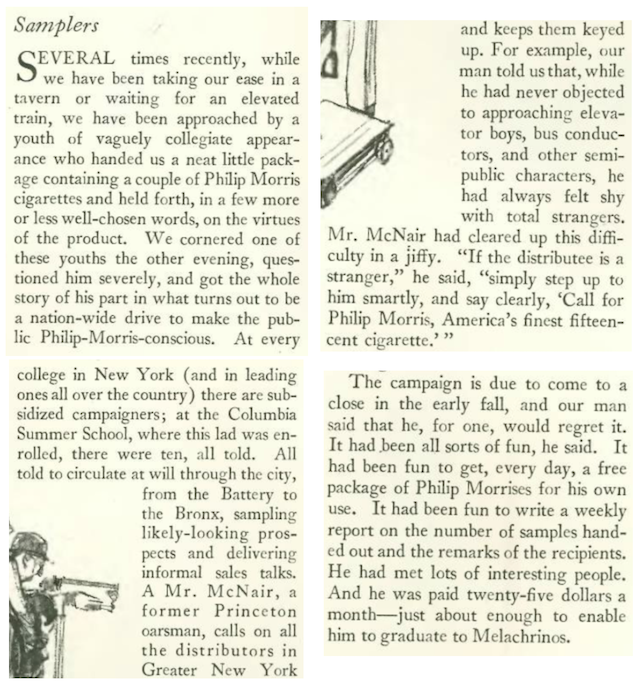
SMOKE FREE…Sample pack of Philip Morris cigarettes, circa 1930s. (Ebay)

 * * *

A Rare Glimpse

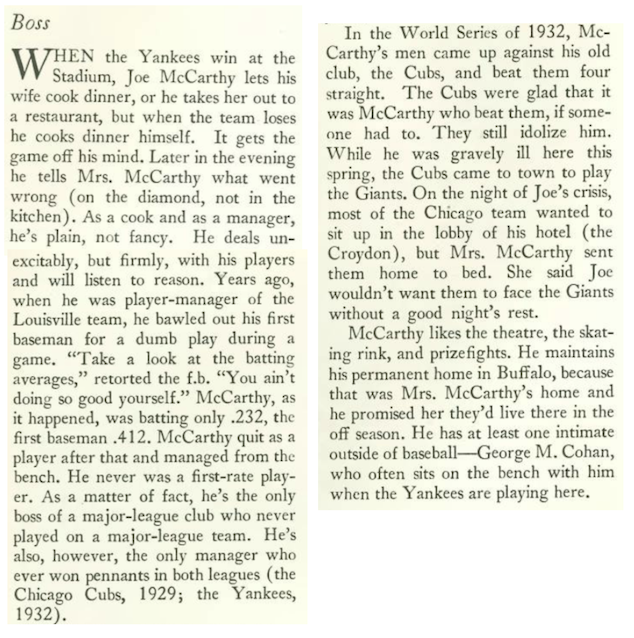
Before Roger Angell started writing about baseball in 1962, there wasn’t a whole lot written about the sport in the pages of The New Yorker. In the magazine’s early years, the game was probably perceived as too low-brow, while other athletic pursuits such as golf, tennis, and polo were more in line with the desired or perceived readership. Early contributors such as Ring Lardner had also soured on the sport, thanks to the Black Sox Scandal of 1919 and the greed of team owners. So here is a rare look at baseball, and Yankee coach Joe McCarthy (1887-1978), in “The Talk of the Town.” Excerpts:
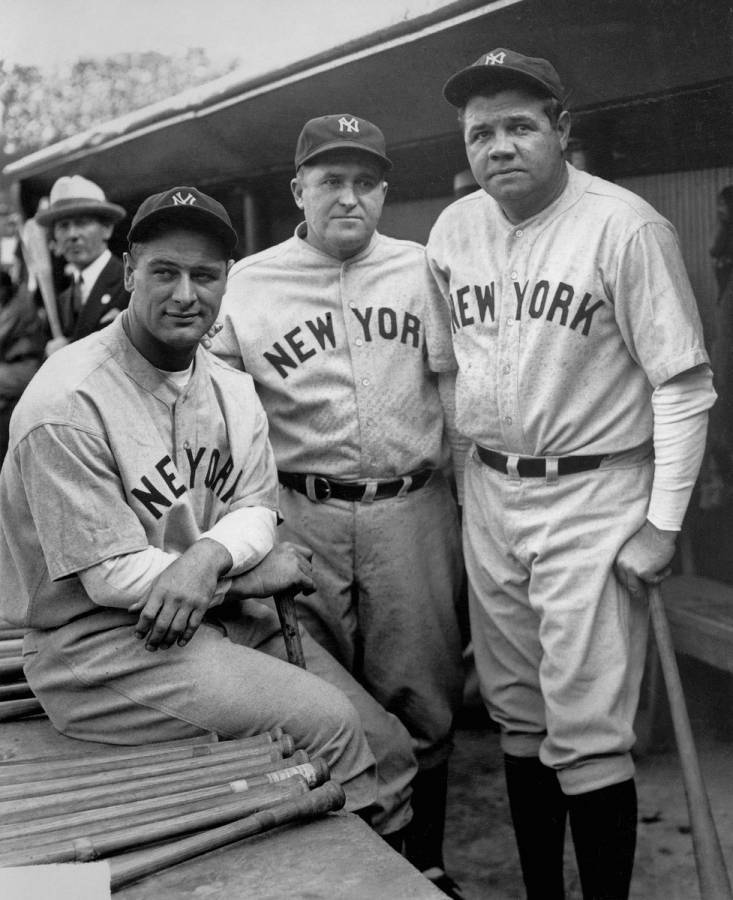
BRONX BOMBERS…Coach Joe McCarthy (center) with sluggers Lou Gehrig, left, and Babe Ruth during the 1932 World Series. The first manager to win pennants in both the National and American leagues, McCarthy’s teams would win a total nine league pennants and seven World Series championships. (CARLI Digital Collections)

 * * *

Music Under the Stars

The monumental Lewisohn Stadium was a popular classical music venue on the City College of New York campus until its unfortunate demolition in 1973. According to BBC Music Magazine, “for nearly half a century, Lewisohn Stadium gave people from all walks of life the chance to hear performances by the likes of violinist Fritz Kreisler, soprano Leontyne Price and clarinettist Benny Goodman for as little as 25 cents admission. The New Yorker paid a visit during eighteenth season of the Stadium Concerts. Excerpts:
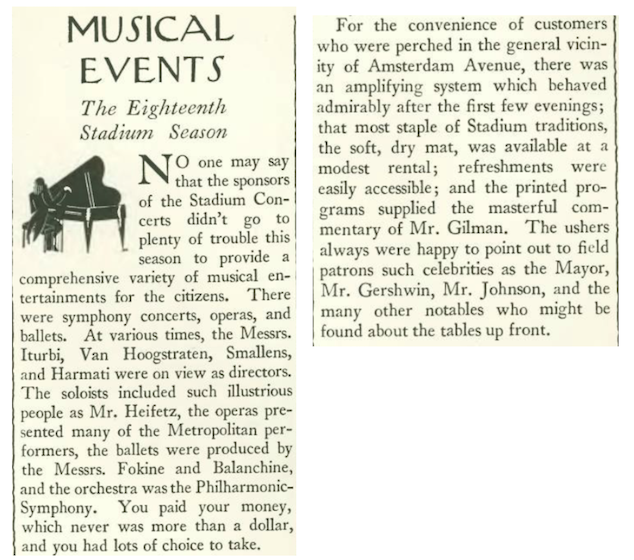
CLASSICAL MASSES…At left, cover of the 1935 Stadium Concerts Review; at right, Andre Kostelanetz conducts before a crowd of thousands at Lewisohn Stadium in 1939. The stadium was demolished in 1973 to make way for City College of New York’s North Academic Center. See The New York Philharmonic Archive for the complete digital version of the 1935 Stadium Concerts Review. (NY Philharmonic Archive/PressReader.com)

 * * *

At the Movies

Film critic John Mosher continued to search in vain for a film he could endorse, but he came away empty-handed after screening a star-studded screen adaptation of Jack London’s novel The Call of the Wild. Star power also fell short for Mosher in the screen version of Booth Tarkington’s Alice Adams. 
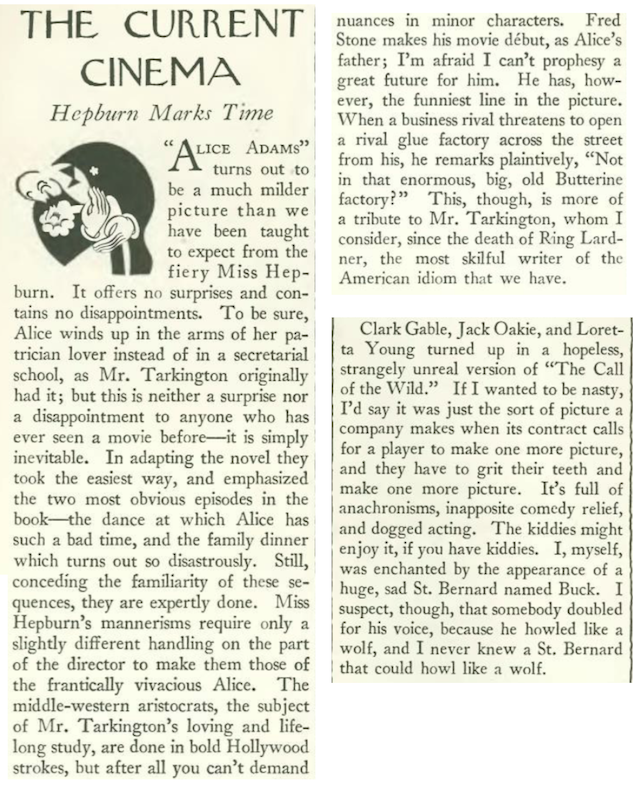
SMALL TALK…The film adaption of Booth Tarkington’s Alice Adams seemed to have all of the right elements in place, including director George Stevens and stars Katharine Hepburn and Fred MacMurray (left), but critic John Mosher found it somewhat average. In a 1991 retrospective review, however, The New Yorker’s Pauline Kael deemed the romantic comedy “a classic” and stated that “Hepburn gives one of her two or three finest performances.” At right, the character of Alice Adams was first portrayed on the silver screen by Florence Vidor in a 1923 silent film. (Toronto Film Society/Wikipedia)
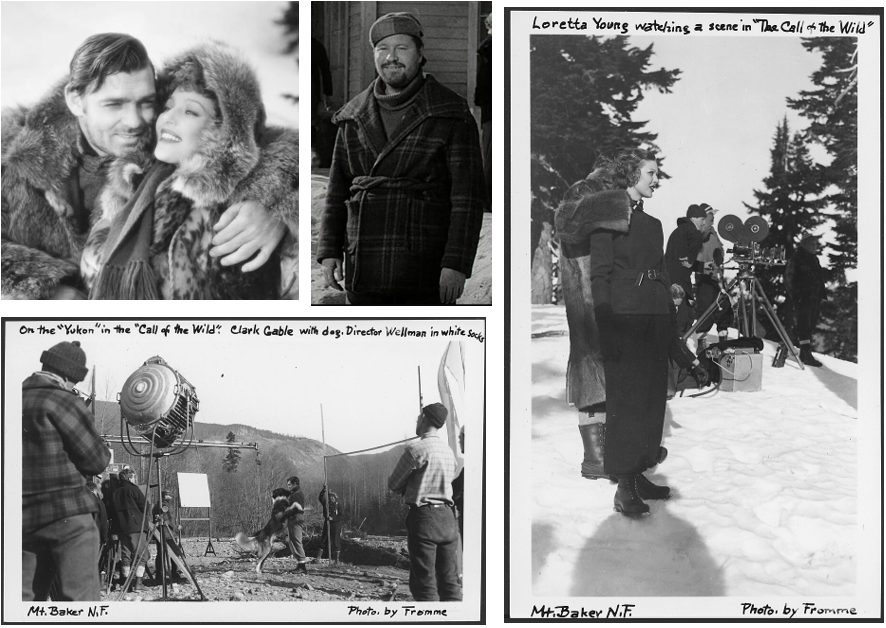
THE BIG CHILL…Clockwise, from top left, Clark Gable and Loretta Young brave the Yukon wilds (actually Washington State) in The Call of the Wild; Jack Oakie provided comic relief as Gable’s sidekick Shorty Hoolihan; Young watches the filming of a scene on location at Mt. Baker National Forest; Gable shoots a scene with the St. Bernard Buck. (IMDB/Wikimedia)
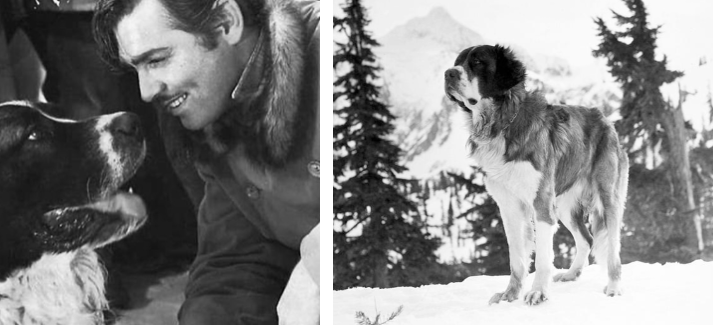
CLARK’S BEST FRIEND…Dog lover Clark Gable became very close with Buck during the filming of The Call of the Wild. Buck appeared in seven more films from 1935 to 1940, even receiving star billing as “Buck the Wonder Dog.” (Facebook/Pinterest)

 * * *

From Our Advertisers

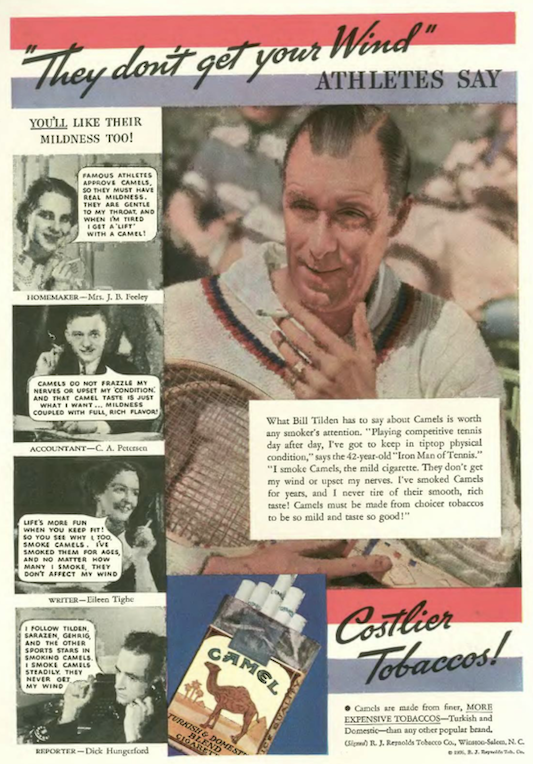
Colorful ads returned to the August 24 issue, featuring familiar sponsors who could afford full-page, full-color spots, namely tobacco and liquor producers…Camel was back with their athletic theme, however they might have chosen someone other than Bill Tilden, who looked perfectly ancient…
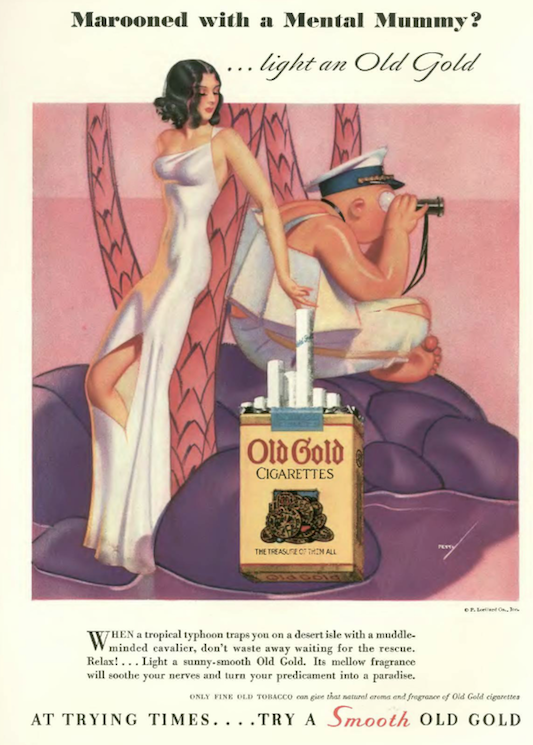
…Old Gold returned with another George Petty-illustrated ad…
…Courvoisier cognac took the back page spot…

…Powers Reproduction showed off their color printing expertise…I wonder if that is a Lucky she is smoking…
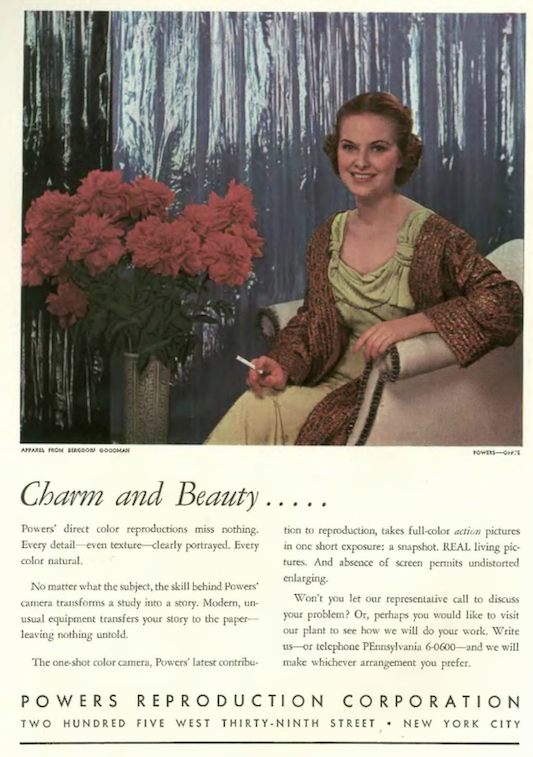
…because I believe she is the same woman who appeared in this ad from the July 27 issue:
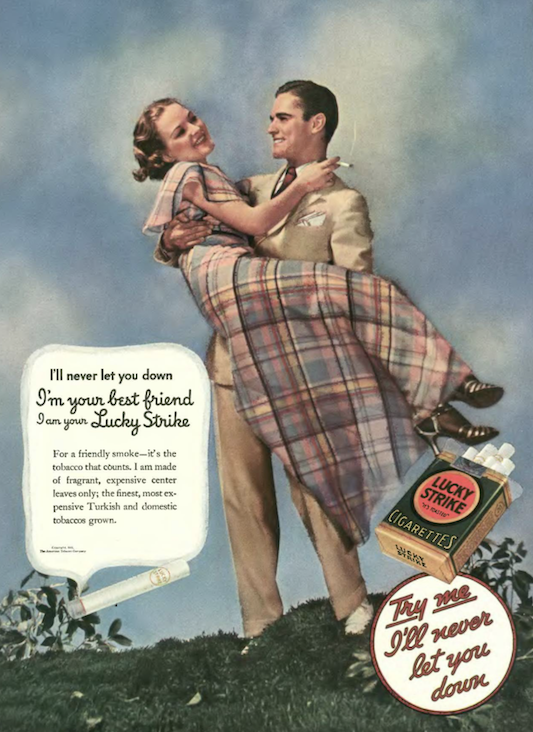
…back to August 24, where we were encouraged to enjoy a Johnny Walker highball to stave off the late summer heat…

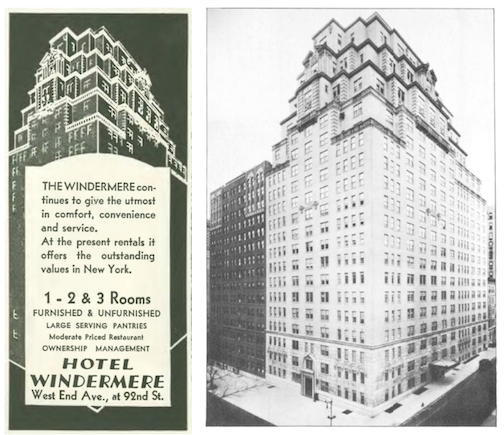
…the distinctive crown of Hotel Windemere on the Upper West Side was an eye-catcher even in this one-column ad from the back of the book…photo at right from around the time it was completed, 1927…
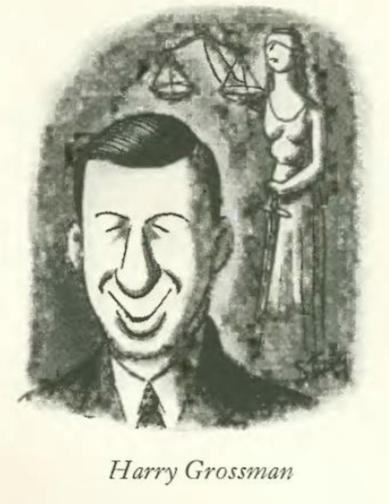
…on to our cartoonists, an unexpected profile caricature by William Steig (this two-part profile featured process-server Harry Grossman)…
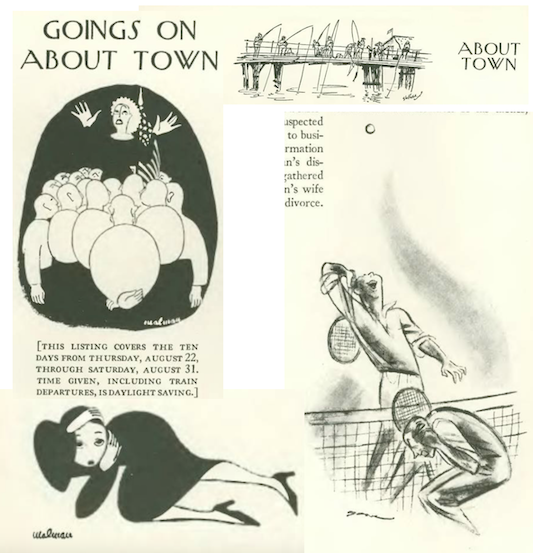
…interesting spot drawings by George Shellhase (top) and Leonard Dove (bottom right), and at left, two by Christina Malman

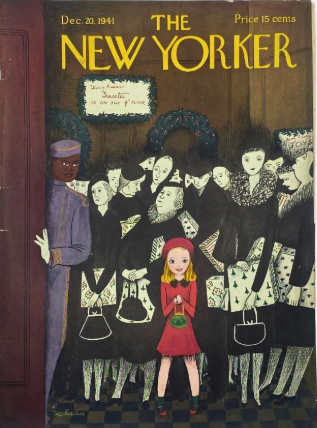
…Malman (1912-1959) produced at least two-dozen covers for The New Yorker between 1937 and 1956, including this gem from 1941:
…some baby names have real meaning, according to Alan Dunn…

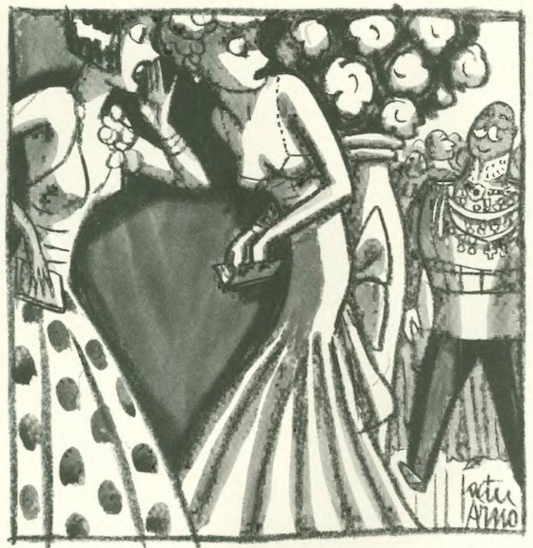
Peter Arno offered caution about dancing with a prickly Colonel…
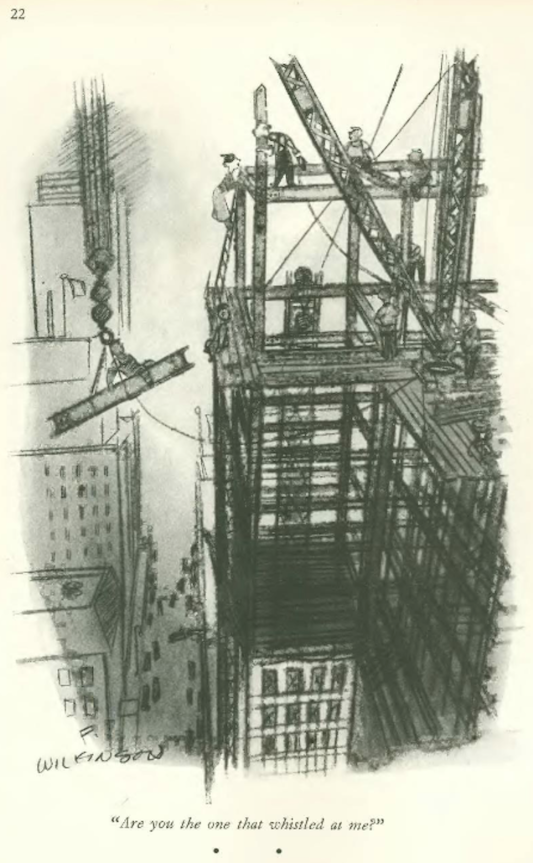
Fritz Wilkinson answered one cat call high above the city…
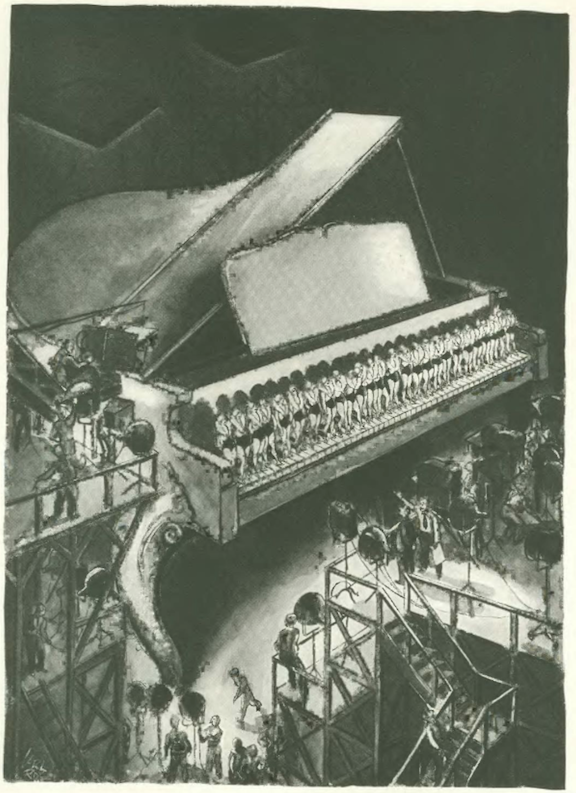
Franz Shubert met Busby Berkeley, via Carl Rose

George Price persisted in threading a needle…

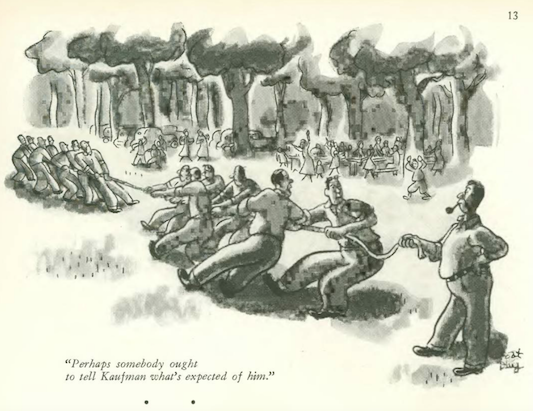
Robert Day gave us a pacifist of sorts in a game of tug-of-war…
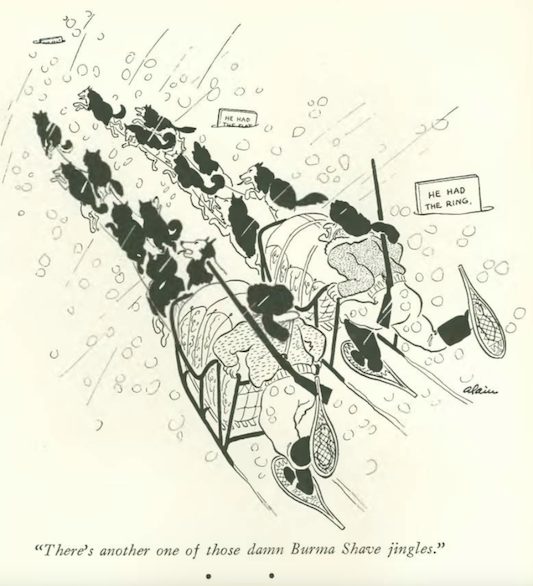
…Burma Shave jingles seemed to be everywhere in the 1930s, per Alain

…An example of replica Burma Shave signs along Route 66:
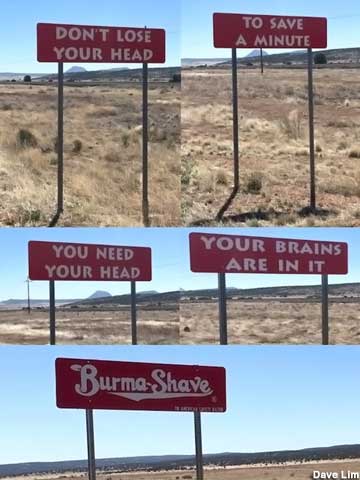
(roadsideamerica.com)

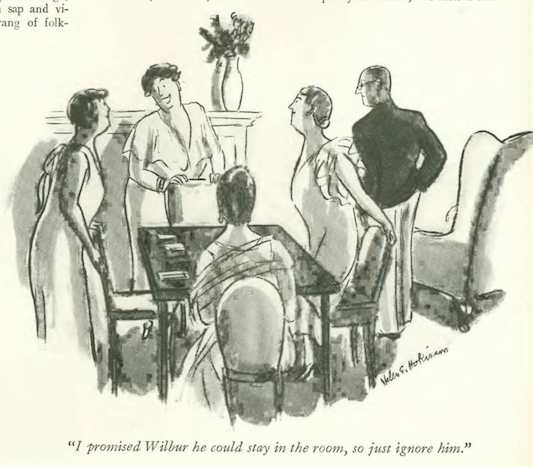
…some parenting tips came our way via Helen Hokinson

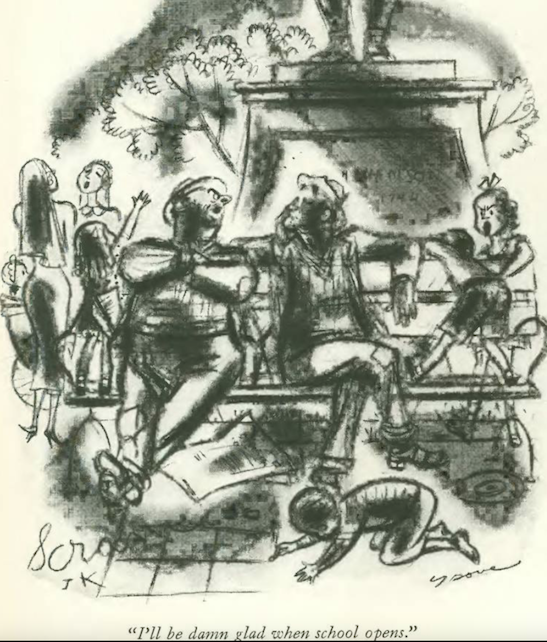
…and Leonard Dove took us back to school…finally…
Next Time: Down to Earth…
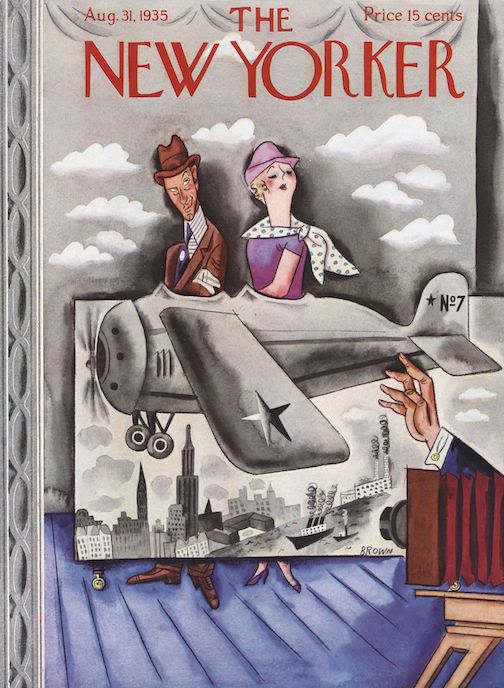
The Happy Warrior

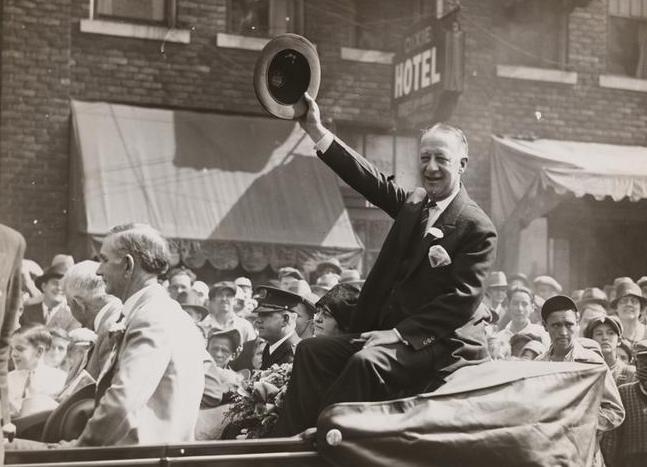
Above: Al Smith waving to crowds on arrival at Chattanooga, Tennessee during his presidential campaign in 1928. (Museum of the City of New York)

It’s hard to not like Al Smith, the governor of New York from 1923 to 1928, a man who avoided the temptations of political power and stayed true to his working class roots of the Lower East Side.

July 14, 1934 cover by Rea Irvin.

The son of Irish, Italian and German immigrants, Alfred Emanuel Smith (1873–1944) was raised in the Tammany Hall-dominated Fourth Ward, and although he was indebted to Tammany’s political machine throughout much of his professional life (including stints in the New York State Assembly and as York County Sheriff, President of the Board of Alderman, and finally Governor) he remained untarnished by corruption. Smith’s unsuccessful bid for the U.S. presidency in 1928 put an end to his political life, but there was still much to do, as “The Talk of the Town” explained:

HALL MONITORS…At left, Charles “Silent Charlie” Murphy with Al Smith in 1915. Murphy was the longest-serving head of Tammany Hall (1902 to 1924), and was known for transforming Tammany’s image from one of corruption to semi-respectability; at right, in 1929, Smith greets Franklin D. Roosevelt, who had just succeeded him as governor. (Library of Congress/Wikipedia)

Smith first sought the Democratic presidential nomination in 1924. According to historian Robert Slayton, Smith advanced the cause of civil liberty by decrying lynching and racial violence at the 1924 Democratic National Convention, where Franklin D. Roosevelt delivered the nominating speech for Smith and saluted him as “the Happy Warrior of the political battlefield.”

Following his 1928 presidential election loss to Herbert Hoover, Smith became president of Empire State, Inc., the corporation that built and also operated the Empire State Building, which was then the tallest building in the world. Smith was also known for his fondness of animals, and in 1934 Parks Commissioner Robert Moses made Smith “Honorary Night Zookeeper” of the renovated Central Park Zoo. Smith was given keys to the zoo and often took guests to see the animals after hours. According to Rebekah Burgess of the NYC Department of Parks and Recreation, “As a resident of 820 Fifth Avenue, directly across the street from the entrance of the Central Park Zoo, Smith was known to appear with snacks for the animals or to launch into impromptu lectures for visitors. Al Smith took his honorary title to heart. Throughout the rest of his life, Smith could often be found attending to the animals at the zookeepers’ sides during open hours. At night, Smith visited with guests, or more often, one-on-one with the animals.”

Smith was also a humanitarian, and in addition to advocating for the working class, he was an early critic of the Nazi regime in Germany, vigorously supporting the Anti-Nazi boycott of 1933. Here is another excerpt from the “Talk” piece:

LIFE OUTSIDE THE OFFICE…Scenes of post-political life, clockwise from top left: Al Smith fishing in 1933; with his family at the May 1, 1931 opening of the Empire State Building—Smith’s grandchildren cut the ribbon; golfing in 1930 with baseball great Babe Ruth in Coral Gables, Florida; with Rosie, the hippopotamus, at the Central Park Zoo, 1928. (Museum of the City of New York/Wikipedia)

 * * *

Culture Club

In the Nov. 9, 1929 issue of The New Yorker Murdock Pemberton hailed the opening of the Roerich Museum. For the July 14, 1934 issue, “The Talk of the Town” took another look. A brief excerpt:

MORE THAN A BUILDING…”The Talk of the Town” noted the changing shades of the art deco landmark Master Building on Riverside Drive (left, in 1929) which originally housed the Nicholas Roerich Museum. Today the Roerich is located in this brownstone at 319 West 107th. (Wikipedia)
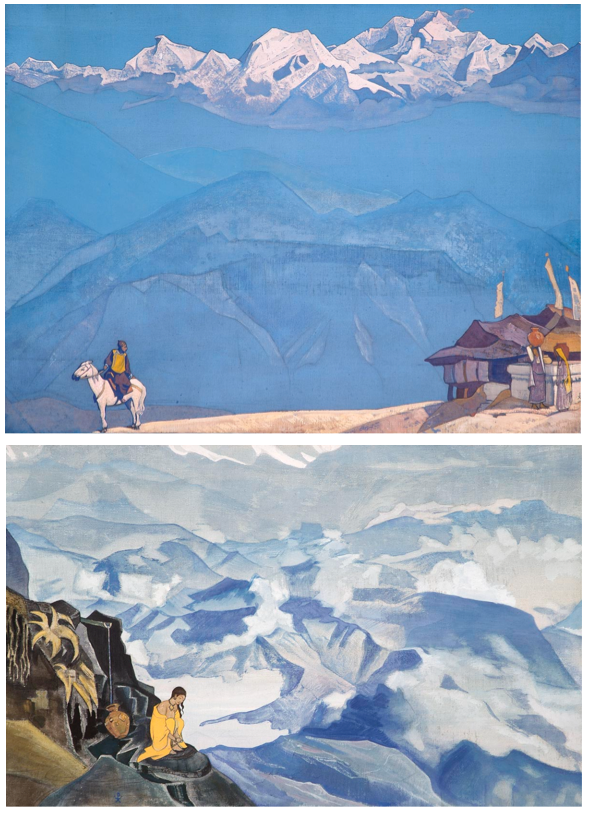
FOOTNOTES FROM A FULL LIFE…Two of Nicholas Roerich’s paintings from the 1920s: at top, Remember, 1924; below, Drops of Life, 1924. (roerich.org)

 * * *

Itinerant Showman

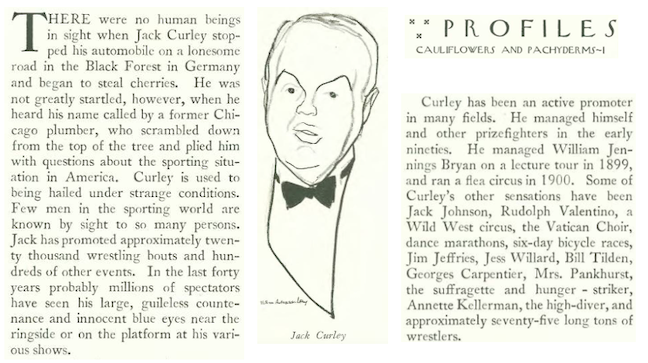
Alva Johnston filed the first installment of a three-part profile of famed sports promoter Jack Curley (1876–1937). A brief excerpt:

FIGHT CLUB…Sports promoter Jack Curley (left) with boxing manager Eddie Kane, circa 1920. (Library of Congress)

 * * *

Over There

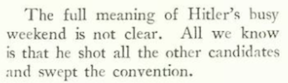
In his column “Of All Things,” Howard Brubaker made this brief mention of the “Night of the Long Knives;” on June 30, 1934 Adolf Hitler ordered SS guards to murder the leaders of the paramilitary SA along with hundreds of other perceived or imagined opponents.

Here is a clip from the front page of The New York Times, July 3, 1934:

(The New York Times)

 * * *

Pimm’s and Soda

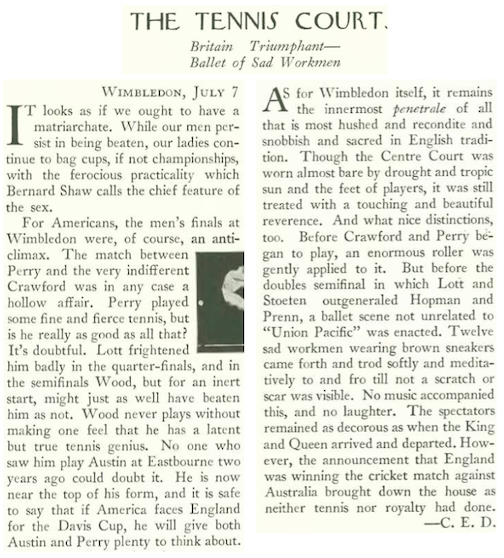
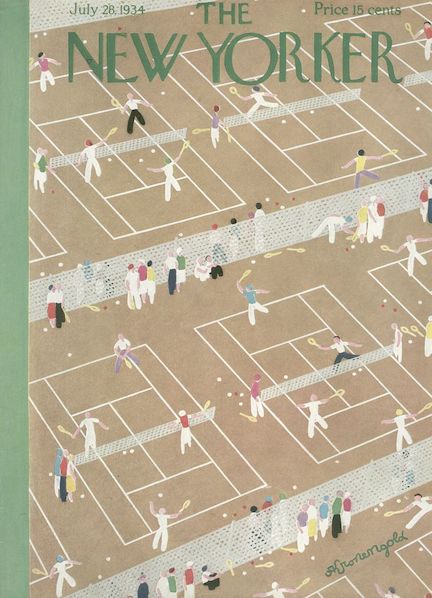
July in England meant Wimbledon, and The New Yorker was there to observe the “snobbish and sacred” rite…

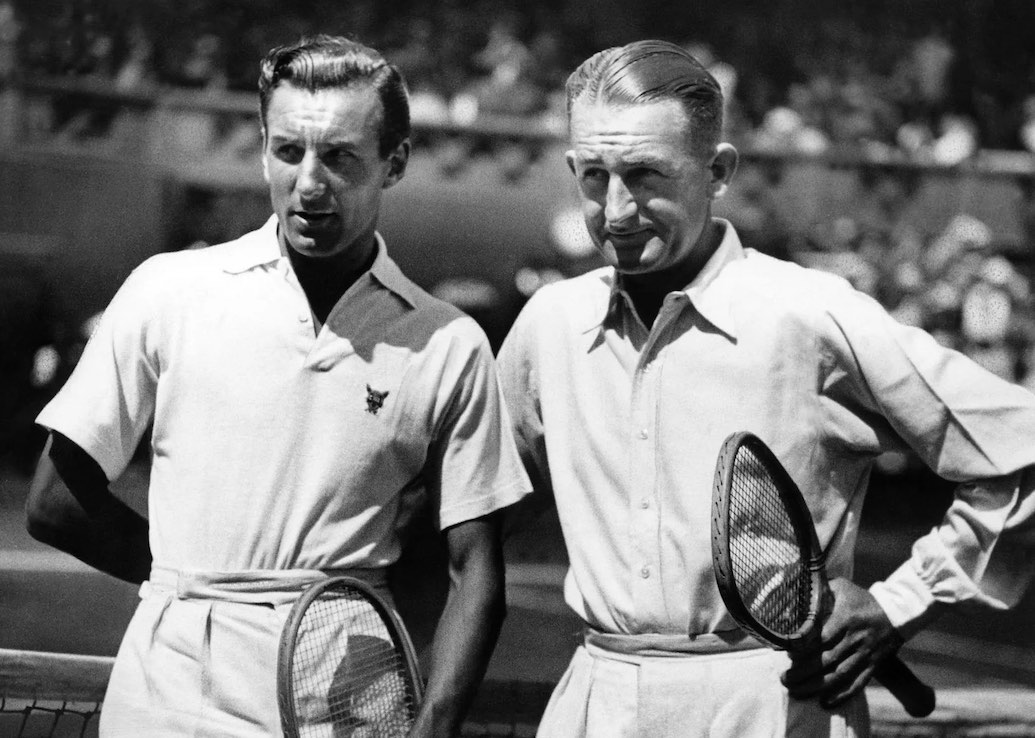
WATCH THE BOUNCING BALL…British tennis great Fred Perry (left) and Australian Jack Crawford before their men’s singles final at the 1934 Wimbledon tournament, which Perry won. Perry would claim three consecutive titles between 1934 and 1936. (Image: Mirrorpix)

 * * *

Midsummer Dreams

In the summertime (and before widespread use of air conditioning) stage entertainments such as theater and musical performances took to the outdoors during their off-season, seeking the evening cool of intimate rooftops or large, open venues such as Lewisohn Stadium, A brief excerpt describing a performance of Samson et Dalila:

EVENING SHADE: Andre Kostelanetz conducts at Lewisohn Stadium in 1939. The stadium was demolished in 1973 to make way for City College of New York’s North Academic Center. (PressReader.com)

 * * *

From Our Advertisers

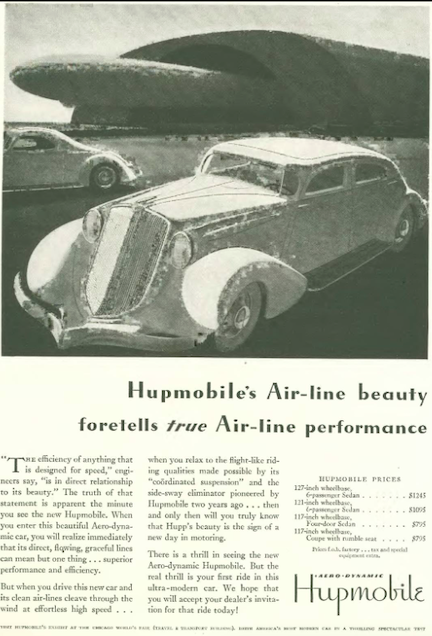
The folks at struggling carmaker Hupmobile took out this bold, full-page ad to tout their flashy “Aero-Dynamic” by noted designer Raymond Loewy

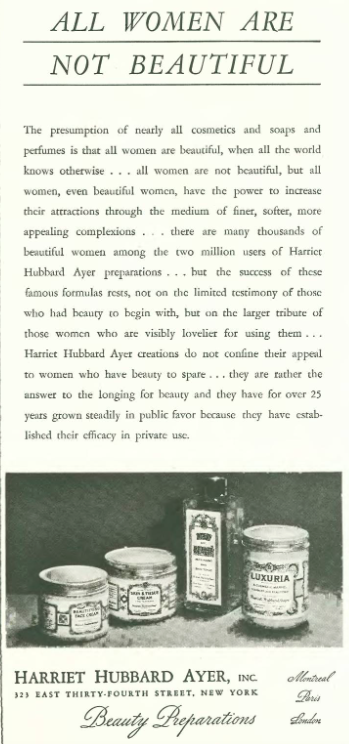
…this ad from Harriet Hubbard Ayer was bold in a very different way, essentially calling some women ugly unless they used the company’s “beauty preparations”…

…consommé, a clear soup that was particularly popular among the upper classes, offered up some keen competition between two food giants…here Heinz enlisted the help of William Steig to move their product…

…while the folks at Campbell’s offered up this lovely patio setting for their “invigorating” consommé…

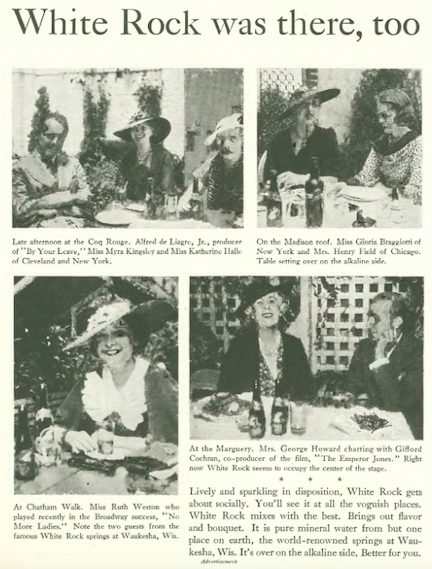
…meanwhile, White Rock mineral water could be found on patios all over Manhattan, as this ad attested…

…this is a reminder that most city folks had their milk and other dairy products delivered in the early part of the 20th century…by the early 1960s about 30 percent of consumers still had their milk delivered, dropping to 7 percent by 1975 and .4 percent by 2005…

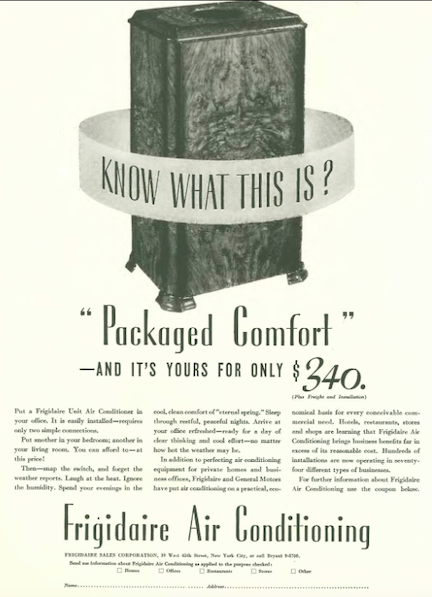
…affordable home air-conditioning wouldn’t be available to the masses until after World War II…this unit (designed for a single room) from Frigidaire retailed for $340 (a little less than $8,000 today)…

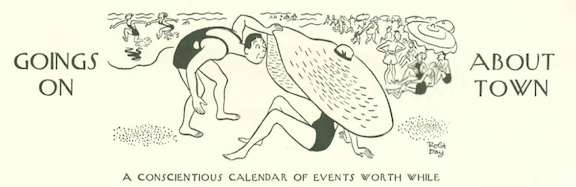
…on to our cartoonists, we begin with Robert Day in the “Goings On’ section…

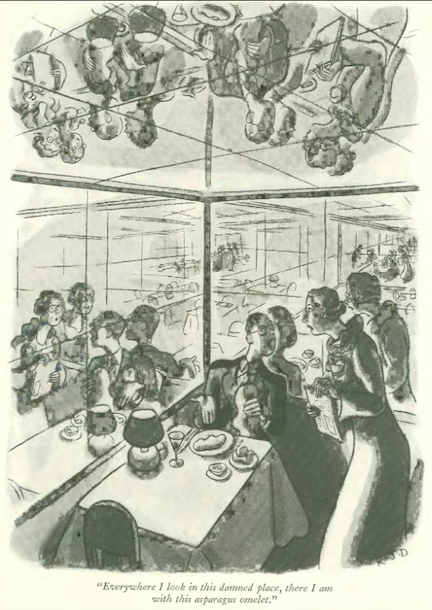
…Day again, exploring the baffling, glassy interiors of modern restaurants…

…the birdwatching continued with Rea Irvin

Alain (Daniel Brustlein) gave us a swimming somnambulist…

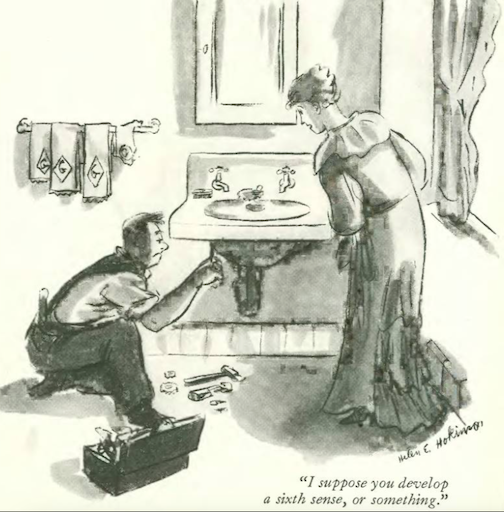
Helen Hokinson explored the paranormal, via domestic plumbing…

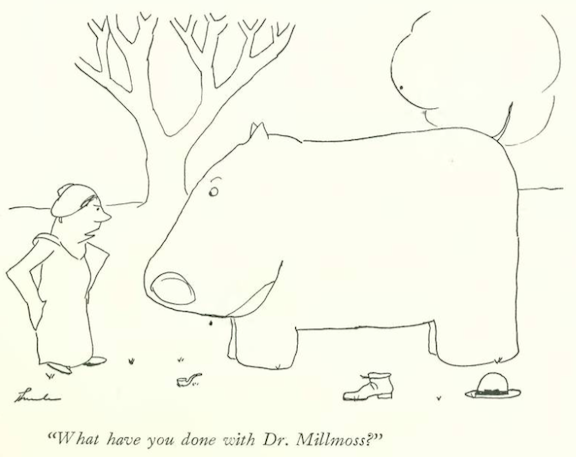
…and we close with James Thurber, and the missing Dr. Millmoss…

Next Time: His Five Cent’s Worth…

Markey’s Road Trip

With the explosion of car ownership in the 1920s and 30s came improved highways across America, but if one were to undertake a long-distance journey, like The New Yorker’s Morris Markey, you were bound to find a wide range of conditions, from concrete highways to muddy dirt roads.

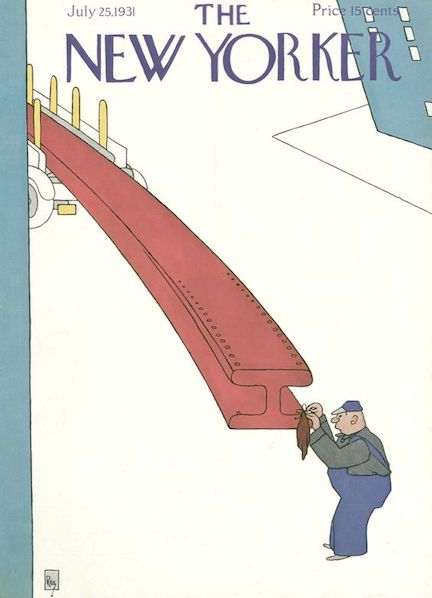
July 25, 1931 cover by Gardner Rea.

Markey wrote about his experience of driving from New York City to Atlanta for his “Reporter at Large” column, noting that stops at filling stations also offered opportunities to fill up on bootleg gin. Drunk driving, it seems, wasn’t a big concern in the early 1930s.

BLUE HIGHWAYS…Although the U.S. launched into major roadbuilding projects in the 1920s and 30s, rutted and muddy roads were still common in many areas of the country. Clockwise, from top left, Route 1 winds through Maryland in the 1920s; marker indicating the Mason and Dixon Line dividing Pennsylvania from Maryland, circa 1930; a 1930s dirt road in the Eastern U.S.; a policeman directs traffic in Richmond, Va., in the 1930s. (Library of Congress/fhwa.dot.gov/theshockoeexaminer.blogspot.com)
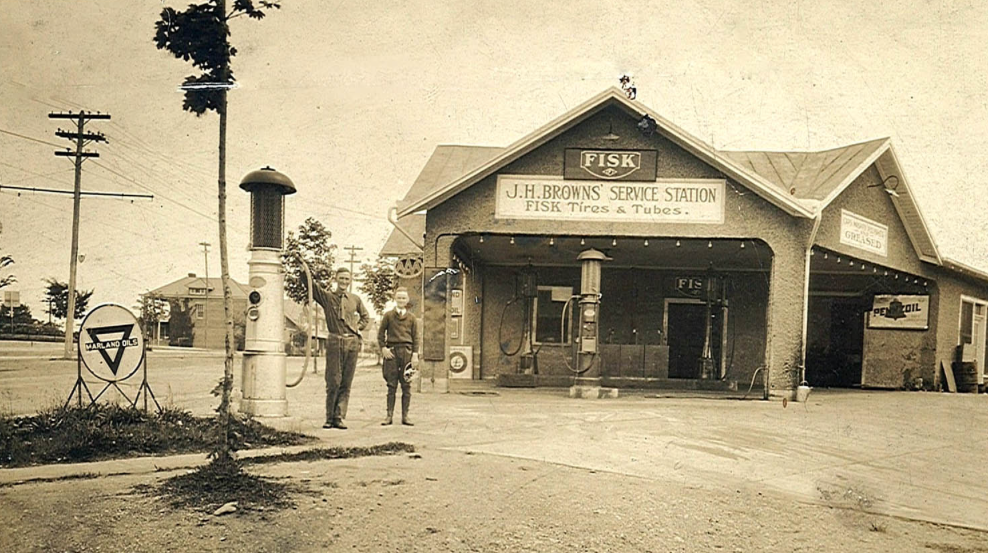
TIME TO GIN UP…James H. Brown (left), at the first of his four service stations in Richmond, Va., circa 1930. Some service stations offered Morris Markey bootleg gin during his journey to Atlanta. My use of this photo, however, does not imply that Mr. Brown offered the same service. (vintagerva.blogspot.com)

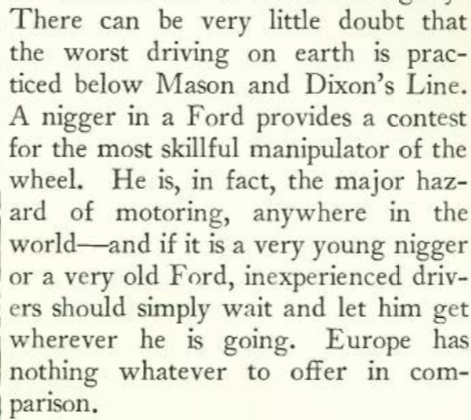
Unfortunately, Markey shared the sensibilities of many of his fellow Americans 89 years ago, and made this observation about drivers below the Mason and Dixon Line:

 *  *  *

Pale Riders

Since the mid-19th century Chelsea’s Tenth Avenue was known as “Death Avenue” due to the killing and maiming of hundreds who got in the way of freight trains that plowed through 10th and 11th Avenues in the service of warehouses and factories in the district. In the 1850s the freight line hired horsemen known as “West Side Cowboys” to warn wagons and pedestrians of oncoming trains, but even with this precaution nearly 450 people were killed by trains between 1852 and 1908, with almost 200 deaths occurring in the decade preceding 1908. Calls for an elevated railroad were finally answered with the opening of the High Line in 1934. “The Talk of the Town” looked in on the last of these urban cowboys:

WESTSIDE COWBOYS…Clockwise, from top left, a steam locomotive rumbles down 11th Avenue in the 1920s; a West Side Cowboy William Connolly rides ahead of a train to warn pedestrians in 1932; George Hayde led the final ride of the West Side cowboys up 10th Avenue on March 24, 1941; aerial view of the High Line from 18th Street heading north. Opened in 1934, the High Line lifted most train traffic 30 feet above the street. Today it serves only pedestrians, and is one of New York’s biggest tourist draws. (Forgotten NY/AP/NY Times/thehighline.org)

 *  *  *

Guys and Dolls

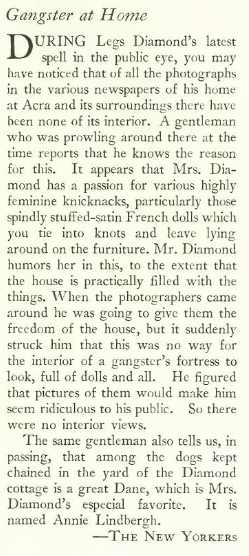
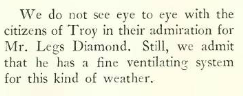
“The Talk of the Town” had some fun with a little-known aspect of a notorious gangster’s life; namely, the doll-filled house belonging to Jack “Legs” Diamond:

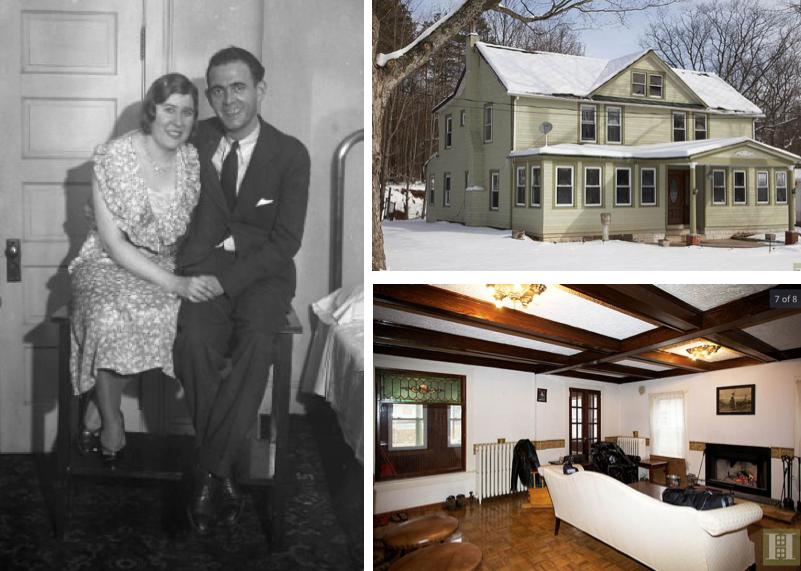
DOLL HOUSE…This house on Route 23 near Cairo, New York, once sheltered gangster Jack “Legs” Diamond, his wife, Alice, and her extensive collection of dolls and other knick-knacks. (nydailynews.com/Zillow)

“Talk” also made joking reference to the number of times Diamond had been shot and survived to tell about it.

Diamond’s luck would run out at the end of 1931 — Dec. 18, to be exact — when gunmen would break into his hotel room in Troy, NY, and put three bullets into his head.

 *  *  *

Ziggy’s Stardust

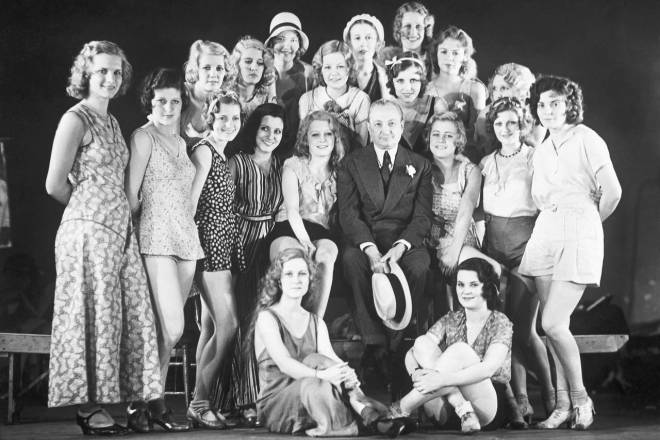
Florenz Ziegfeld (1867-1932) had a knack for show business, launching the careers of many entertainers through his Ziegfeld Follies, which got its start in 1907 during vaudeville’s heyday. The advent of sound movies signaled the end of the vaudeville era and of Ziegfeld himself, who would stage one final Follies before his death in 1932. Gilbert Seldes penned a two-part profile of Ziegfeld under the title “Glorifier” (caricature by the great Abe Birnbaum). An excerpt:

GO WITH THE FLO…Broadway impresario Florenz “Flo” Ziegfeld Jr with his Follies cast, 1931. It would prove to be his last Follies show. Revivals following his death in 1932 would prove to be much less successful. (Wall Street Journal)

 *  *  *

If Looks Could Kill

The New Yorker’s film critic John Mosher had a difficult time making sense of Murder by the Clock and its lead actress, Lilyan Tashman, who gave a tongue-in-cheek performance as the film’s femme fatale.

ARE YOU NUTS?…Irving Pichel and Lilyan Tashman in Murder by the Clock (1931). Tashman was known for her tongue-in-cheek portrayals of villainesses in films she made before her untimely death in 1934. (IMDB)

 *  *  *

Eine Kleine Nachtmusik

Open-air performances of classical music and opera were popular summertime diversions in the days before air-conditioning. In 1931 crowds gathered in Lewisohn Stadium to hear the New York Philharmonic perform under the direction of Willem van Hoogstraten, who conducted the Lewisohn summer concert series from 1922 to 1939. Here is a listing in The New Yorker’s “Goings On About Town” section:

MUSIC IN THE AIR…Cover of the 1931 program for concerts at Lewisohn Stadium, College of the City of New York. Bottom right, signed photo of Willem van Hoogstraten from 1930. (digitalcollections.nypl.org/ebay.com)

 *  *  *

From Our Advertisers

Flo Ziegfeld’s 1931 Follies were lavish productions, but his advertising in The New Yorker was anything but as evidenced in this tiny ad that appeared at the bottom of page 52…

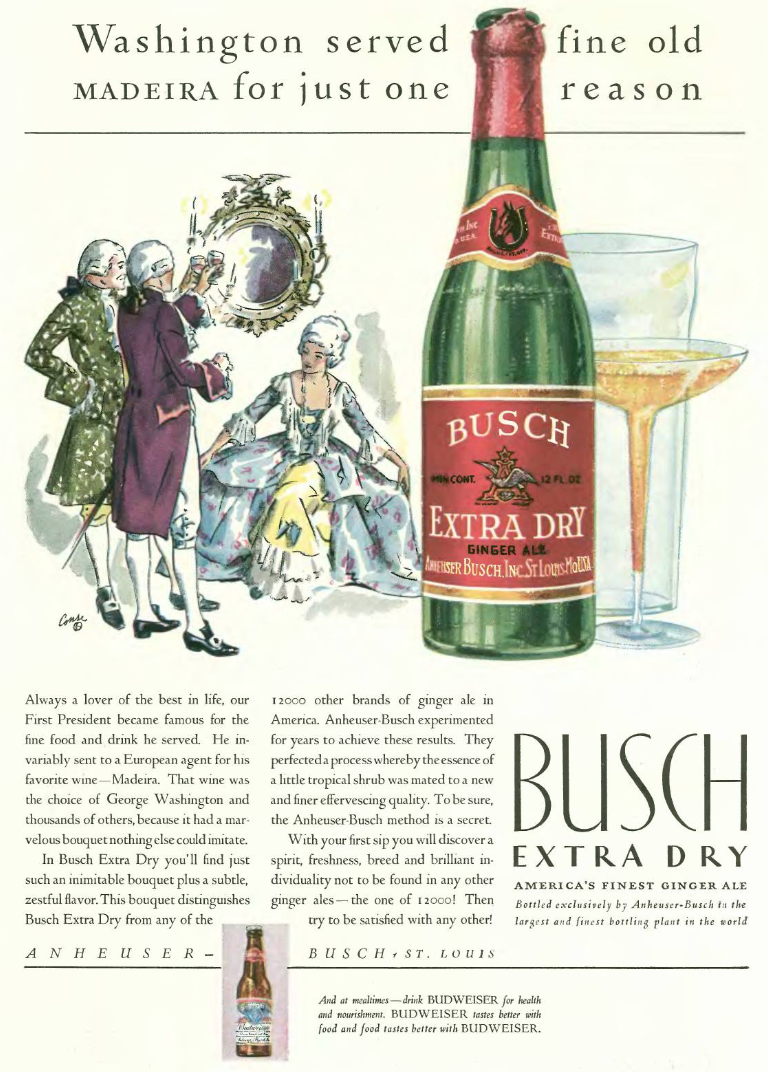
…no doubt anticipating the demise of Prohibition, the makers of Anheuser-Busch beverages ramped up the promotion of their non-alcoholic products to create associations with pre-Prohibition times…

…not to be outdone by the East Coast chocolates giant Schrafft’s, Whitman’s took out this full page ad to suggest how you might enjoy their product…

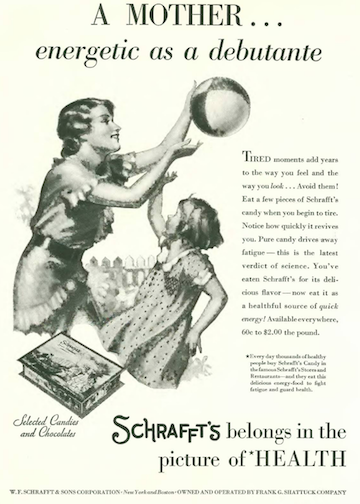
…which was in sharp contrast to the approach Schrafft’s took in this full-page ad featured in the April 25, 1931 New Yorker, which touted the health benefits of its candy…

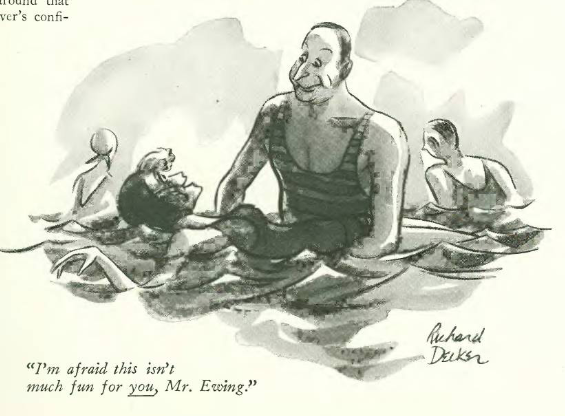
…on to our cartoons, Richard Decker took us swimming with a middle-aged man who was anything but bored…

Barbara Shermund went en plein air with a couple of her ditzy debs…

Garrett Price also went to the country to find a bit of humor…

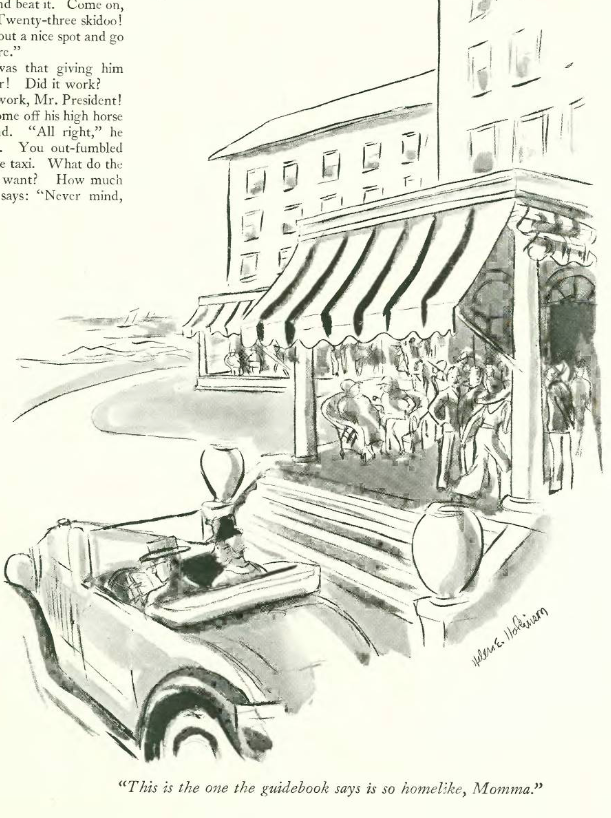
Helen Hokinson found a home away from home for a couple looking to take the sea air…

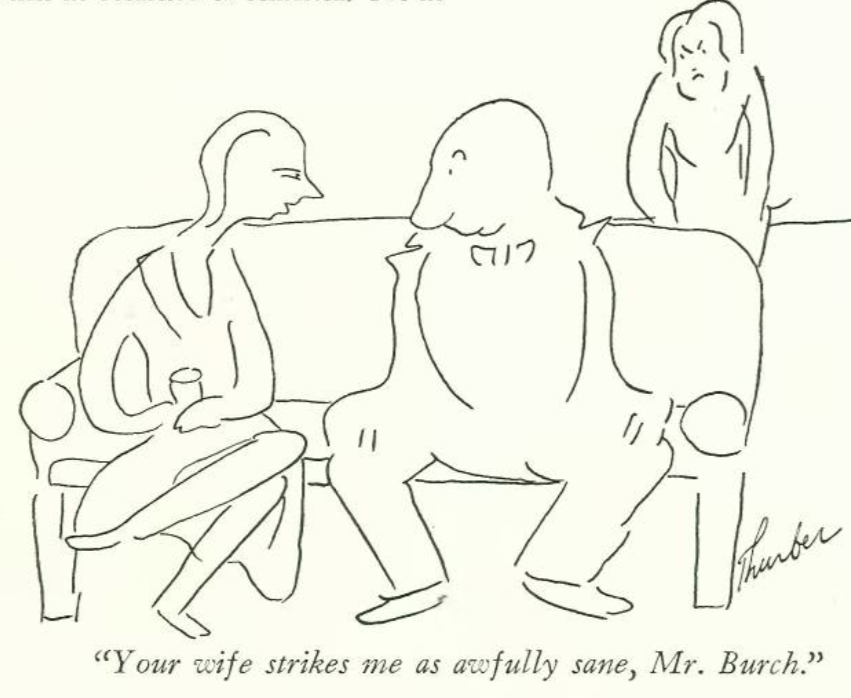
James Thurber continued to explore his brewing war between the sexes…

Harry Haenigsen gave us a novel approach to landing a trophy fish…
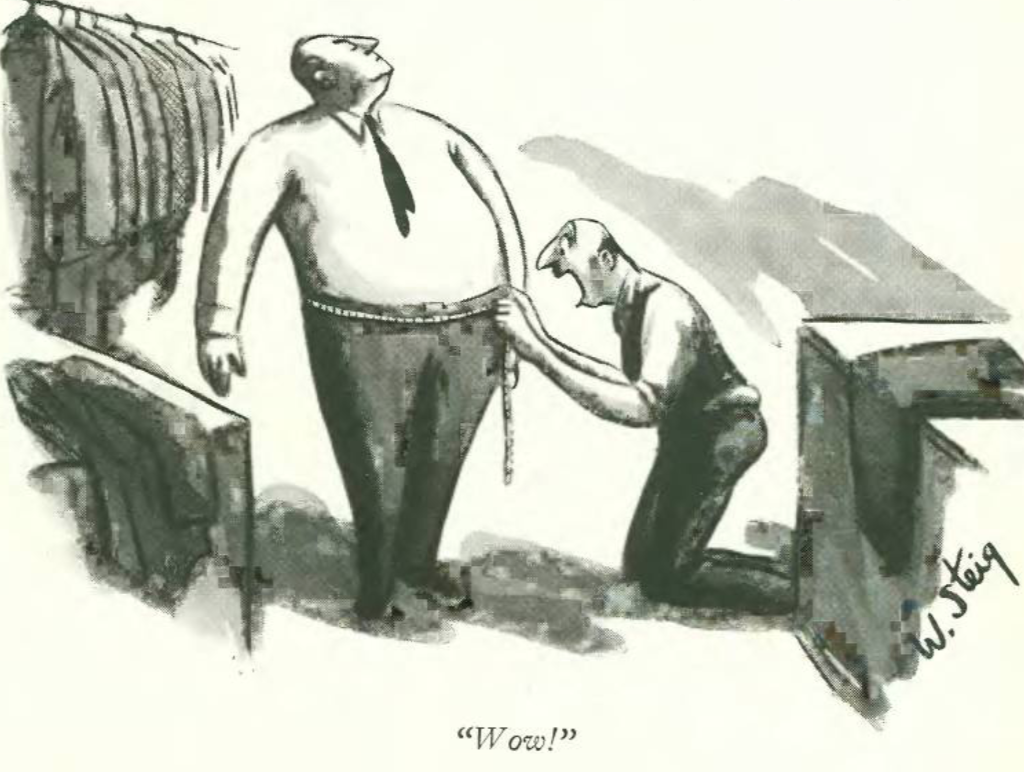
William Steig illustrated the wonders of the tailoring profession…
…and Alan Dunn aptly summed up the generation gap of the 1930s…
…on to the Aug. 1, 1931 issue…

August 1, 1931 cover by Rose Silver.

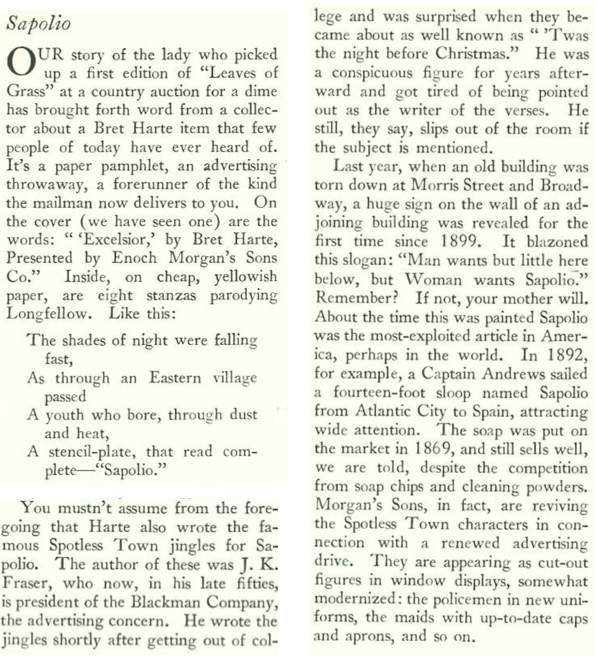
…”The Talk of the Town” mused about the advertising jingles made famous by the makers of Sapolio soap…

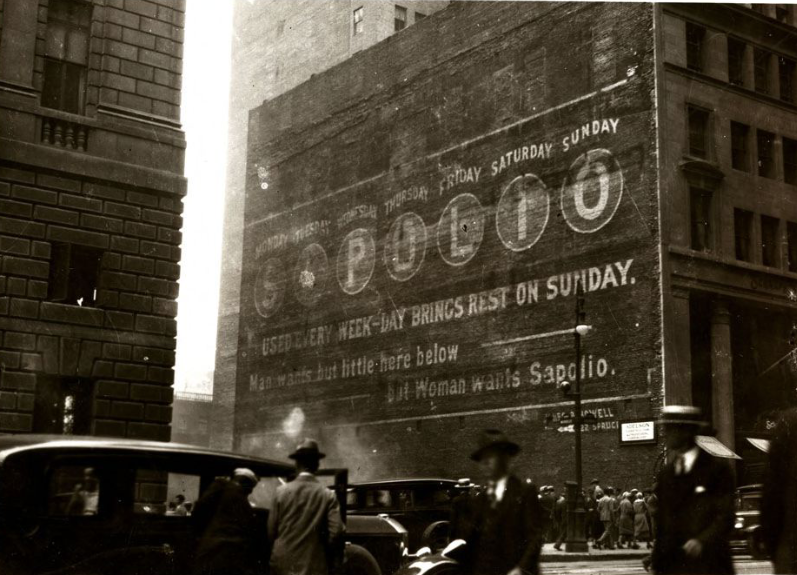
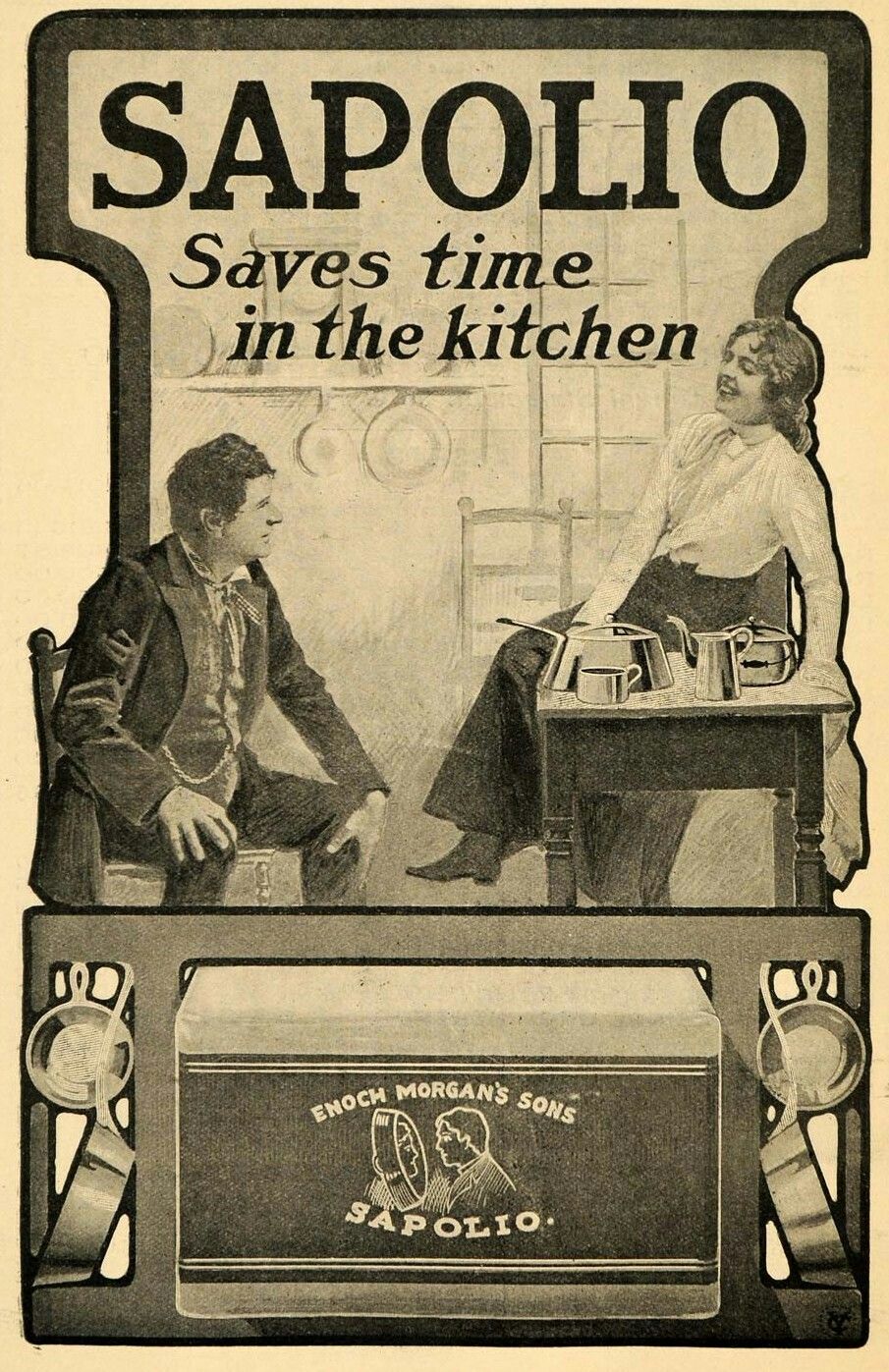
…Bret Harte actually did write jingles for the brand, once described by Time magazine as “probably the world’s best-advertised product” in its heyday. With a huge market share, Sapolio was so well known in the early 20th century that its owners decided they no longer needed to spend money on advertising. It was a poor decision, and by 1940 the product disappeared from the marketplace.

SEEING THE LIGHT OF DAY…A 19th century Sapolio sign on Broadway and Morris Street revealed after an adjoining building was demolished in 1930. (Museum of the City of New York)
MONEY WELL SPENT…Sapolio ad from its heyday in the early 20th century. (Pinterest)

 *  *  *

Tough Love

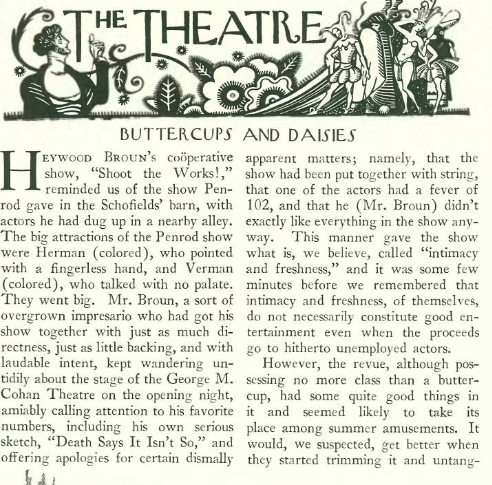
As a charter member of the famed Algonquin Round Table, Heywood Broun was a friend to many of the founding writers and editors of The New Yorker. And so it must have been quite a task to review his play, Shoot the Works, which The New Yorker found wanting in a number of aspects. And because he was so close to Broun himself, Robert Benchley left the review writing to someone who signed the column “S. Finny.” I can’t find any record of an S. Finny at The New Yorker, and I don’t believe this is a Benchley pseudonym (he used “Guy Fawkes” in The New Yorker). At any rate, here is an excerpt:

SHOOT GETS SHOT…The New Yorker wasn’t crazy about Heywood Broun’s play, which ran for 87 performances at George M. Cohan’s Theatre. (Playbill)

 *  *  *

From Our Advertisers

The makers of the “Flexo” ice cube tray continued to tout the wonders of their product with these Ripley-themed ads. This might appear rather mundane to modern eyes, but electric refrigerators with built-in freezers were still rather novel in 1931…

…another way to stay cool in the summer of 1931 was to take an excursion to the Northern climes…

…this ad for the New York American featured an illustration by Herbert Roese, whose early work strongly resembled that of Peter Arno’s

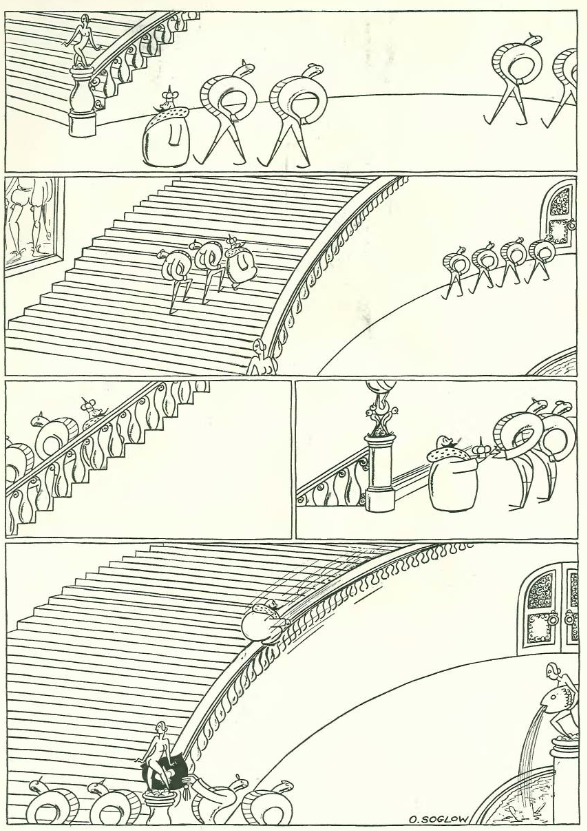
…on to our cartoons, we have the latest antics of the Little King courtesy Otto Soglow

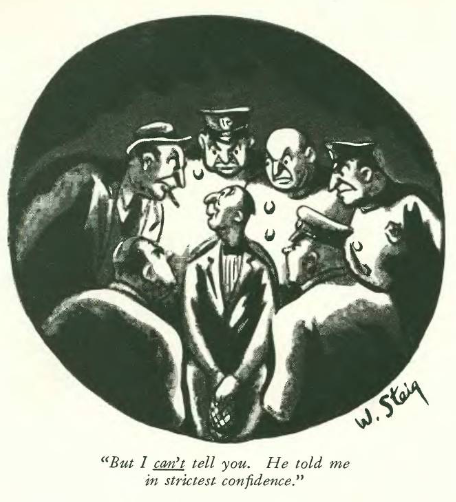
William Steig added levity to a heavy moment…

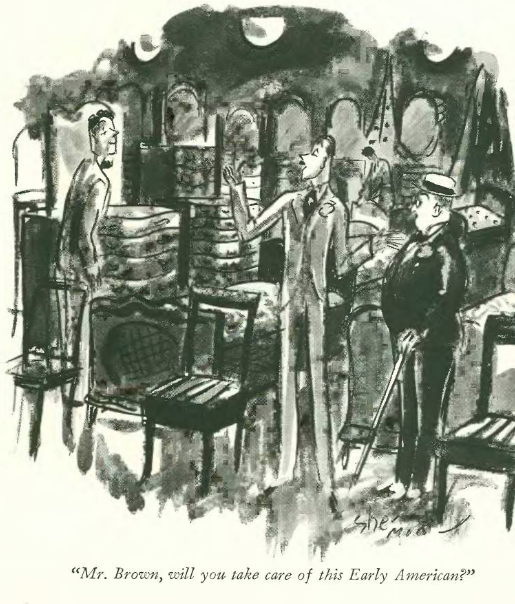
Barbara Shermund found humor at an antiques shop…

...John Held Jr continued his revels into our “naughty” Victorian past…

…and we end with Garrett Price, and a look at the ways of the modern family…

Next Time: An American Classic…


Summer in the City

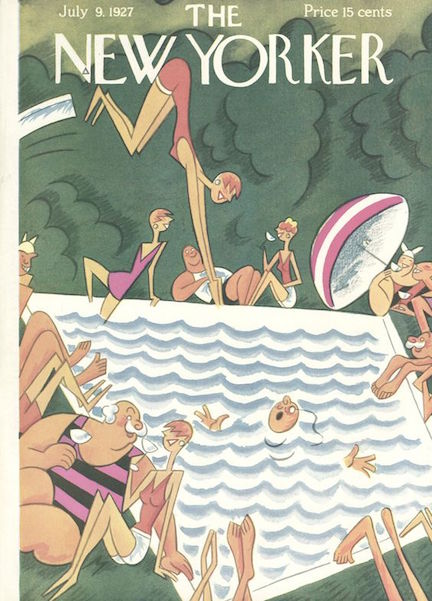
The July 1927 issues of the New Yorker were filled with news of yacht races, polo matches and golf tournaments as the city settled into the heart of the summer. The artist for the July 9 cover, Julian de Miskey, was in the summertime mood with this lively portrayal of Jazz Age bathers:

21b6fac0e9233b827d578cf6175dd79d
July 9, 1927 cover by Julian de Miskey. Born in Hungary in 1898, de Miskey emigrated to the United States in 1914.

Although Julian de Miskey (1898–1976) was was one of the most prolific of the first wave of New Yorker artists, his work seems to be little known or appreciated. But more than forty years after his death his influence is still felt in the magazine, particularly in the spot illustrations and overall decorative style that grace the pages of “The Talk of the Town.”

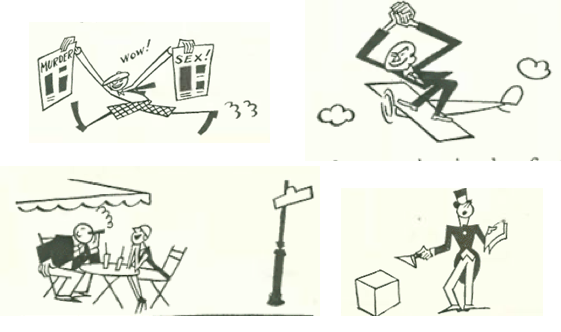
Here is a sampling of de Miskey’s spot illustrations for “Talk” in the July 9 and July 16, 1927 issues…

screen-shot-2016-10-28-at-1-39-59-pm

…and here are examples of spot illustrations for some recent (Aug-Sept. 2016) New Yorker “Talk” sections, as rendered by Antony Huchette (which also reference Otto Soglow’s spot work for The New Yorker)…

screen-shot-2016-10-28-at-1-40-11-pm

De Miskey did it all–spots, cartoons, and dozens of covers. A member of the Woodstock Art Association, de Miskey was well known in the New York art circles of his day, rubbing elbows in the Whitney Studio Club in Manhattan with artists including Edward Hopper, Guy Pene du Bois, Mabel Dwight and Leon Kroll. De Miskey also illustrated and designed covers for a number of books, studied sculpture and created stage sets and costume designs.

screen-shot-2016-10-28-at-11-18-07-am
PROLIFIC…Julian de Miskey illustrated a number of children’s books, including Chúcaro: Wild Pony of the Pampa (1958-Newbery winner); The Trouble with Jenny’s Ear (1960); and Piccolo (1968) which was both written and illustrated by de Miskey.

The June 9 issue also featured this cartoon by de Miskey:

screen-shot-2016-10-28-at-10-18-17-am

 *  *  *

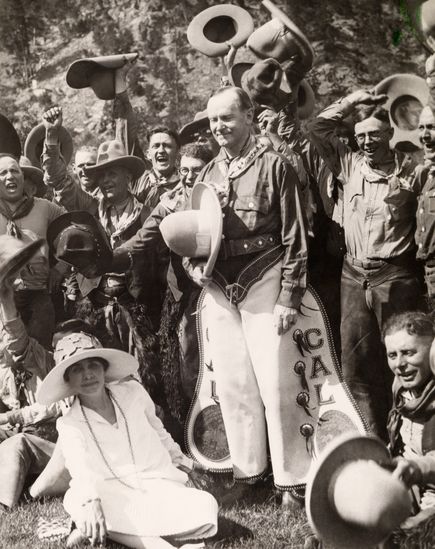
President Calvin Coolidge fled the bugs and heat of Washington, D.C. for cooler climes in the Black Hills of South Dakota. The New Yorker regularly mocked Coolidge’s dispatches from the Dakotas, including this item in “Of All Things”…

screen-shot-2016-10-28-at-10-16-24-am

02-calvin-coolidge-cowboy_69085_600x450
VAPID CITY…President Calvin Coolidge wears a cowboy hat and Western garb while on a two-month vacation in the Black Hills of South Dakota in 1927. (Library of Congress)

The magazine’s July 16 issue added this observation in “The Talk of the Town”…

screen-shot-2016-10-28-at-2-38-02-pm

Closer to home, M. Bohanan offered an urban sophisticate’s take on nature:

screen-shot-2016-10-28-at-10-16-49-am

For those who couldn’t flee the city, respite was sought in Central Park, as illustrated by Constantin Alajalov for “The Talk of the Town…”

screen-shot-2016-10-28-at-10-14-08-am
click to enlarge

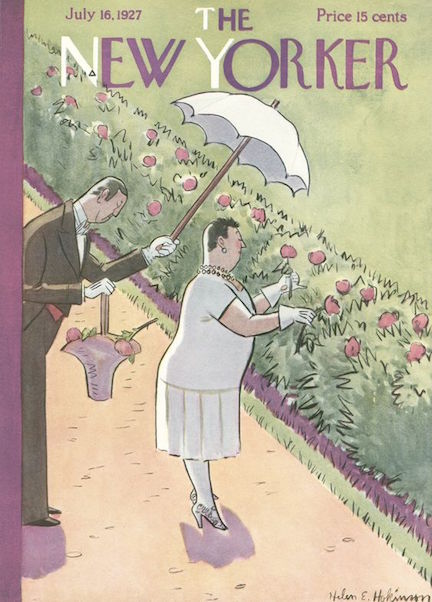
Summer themes continued with the July 16 issue, which featured a cover by Helen Hokinson depicting one of her favorite subjects–the plump society woman:

1f64e9e51d307bb03097744ebbb681f6
July 16, 1927 cover by Helen Hokinson.

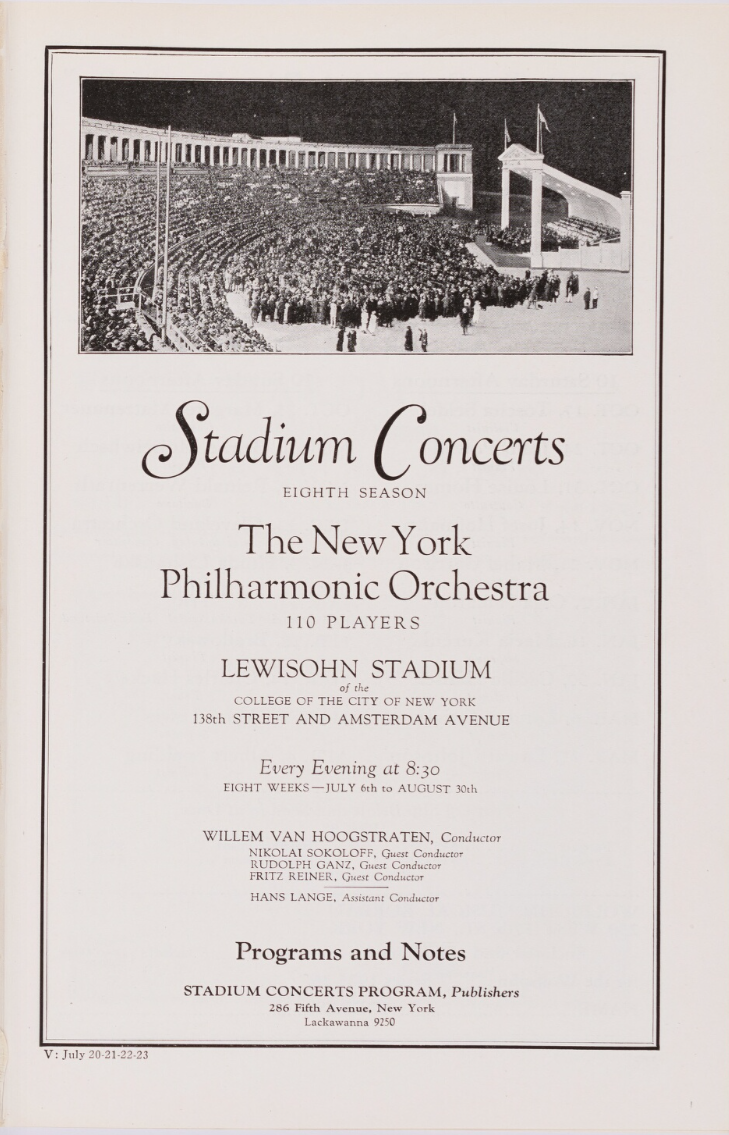
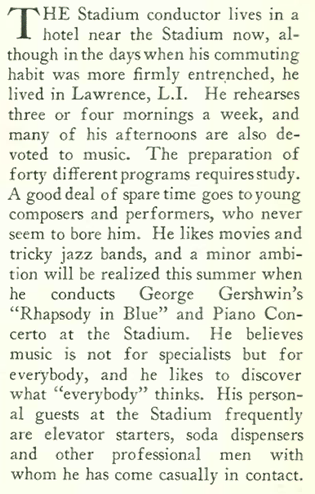
From 1918 to 1966, thousands of New Yorkers attended summer open-air concerts at Lewisohn Stadium, an amphitheater and athletic facility on the campus of the City College of New York. For many years Willem Van Hoogstraten conducted the nightly concerts, including the summer of 1927 when George Gershwin played his Rhapsody in Blue to adoring crowds.

summer-conerts
Performance at Lewisohn Stadium, located at 136th Street and Convent Avenue. (nyc-architecture.com)
1925
Program for the 1925 Stadium Concerts series.     (archives.nyphil.org)        Click to enlarge

screen-shot-2016-10-28-at-10-54-07-am

screen-shot-2016-10-28-at-10-54-40-am

serpico-1973
FINAL BOW…A still from the 1973 film Serpico, showing actors Al Pacino and Tony Roberts walking through the abandoned Lewisohn Stadium just before it was demolished. (YouTube)
110927-gon039-01
UGH…The Lewisohn Stadium site is now occupied by a City College of New York building with the inspiring name, “North Academic Center.” (nyc-architecture.com)

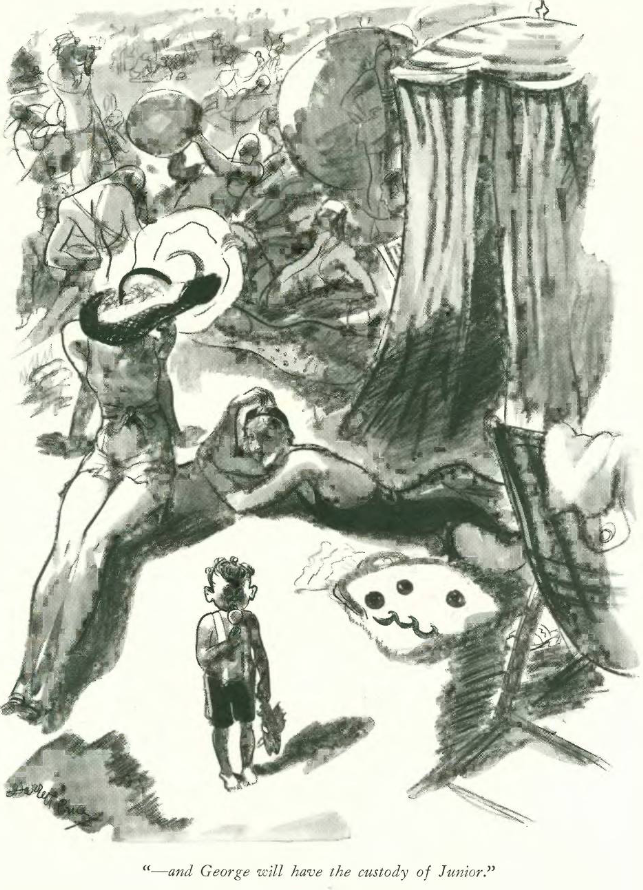
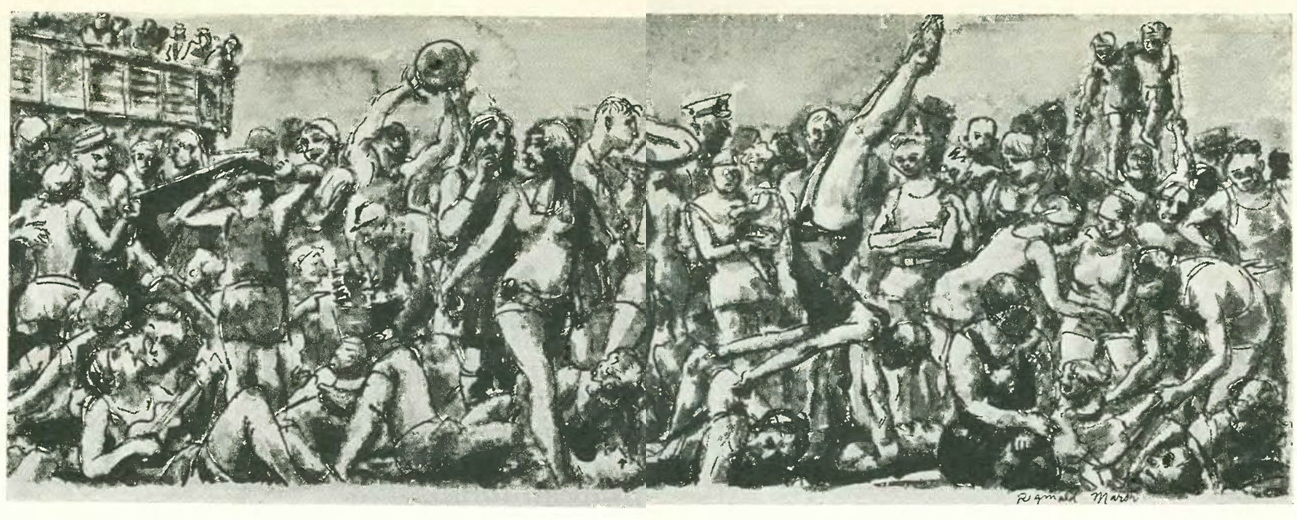
And finally, another illustration in the “Talk of the Town” of summer in the city, this a teeming Coney Island beach courtesy of Reginald Marsh

screen-shot-2016-10-28-at-10-24-00-am
click to enlarge

However, if you wanted to avoid the rabble at the beach, you could fly over them–in style, of course…

screen-shot-2016-10-28-at-10-23-20-am

Next Time: Picking on Charlie Chaplin…

5128947dc365cb603134bbb6e56f67aa