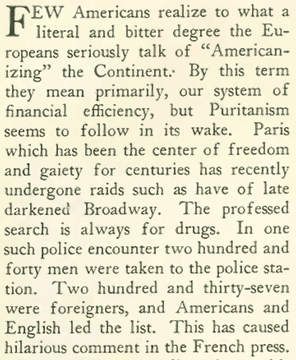
In her latest dispatch from Paris, correspondent Janet Flanner offered New Yorker readers a glimpse into the French mind, its fear of “Americanization” and its perception of America’s Puritanical attitudes behind Prohibition.
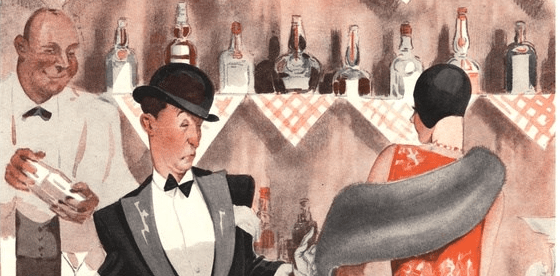
April 3, 1926 cover by Rea Irvin.
All the more reason the French were bemused by reports that American and English citizens led the lists of reported drug raids in the City of Light…
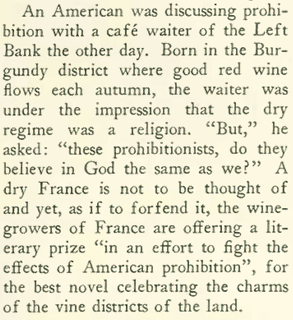
or that somehow Prohibition was a question of theological differences:
The April 3, 1926 issue also offered up some curious advertisements. Aiming square at the grasping Anglophilia of New Yorker readers, here’s a pitch for a used Rolls Royce:
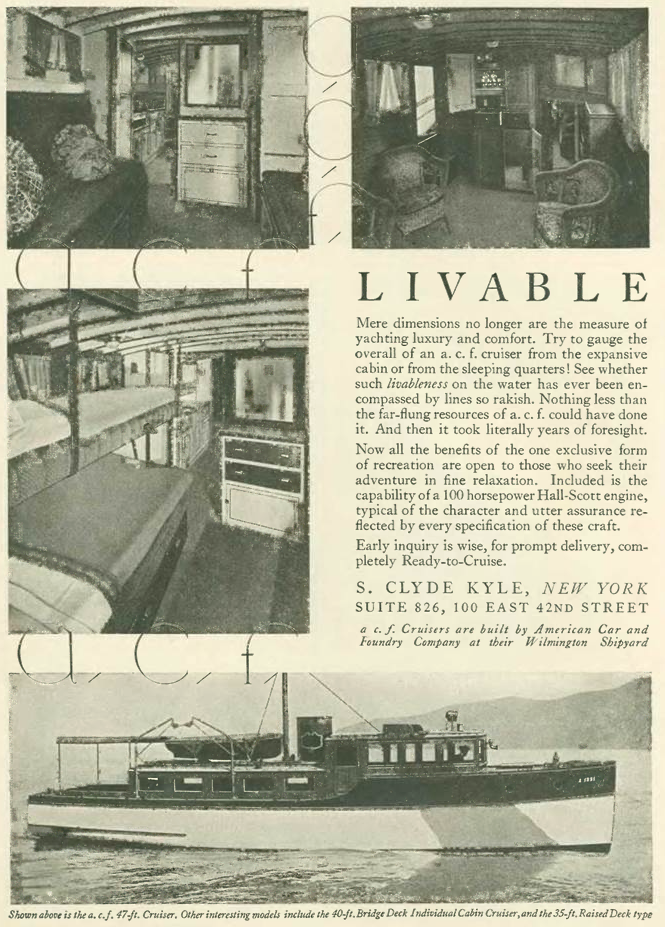
And with the money left over from your savings on the used Rolls, you could buy this 47-foot cruiser from the American Car and Foundry Company:
Moving along to the April 10, 1926 issue (cover designed by H.O. Hofman)…
April 10, 1926 cover by H.O. Hofman.
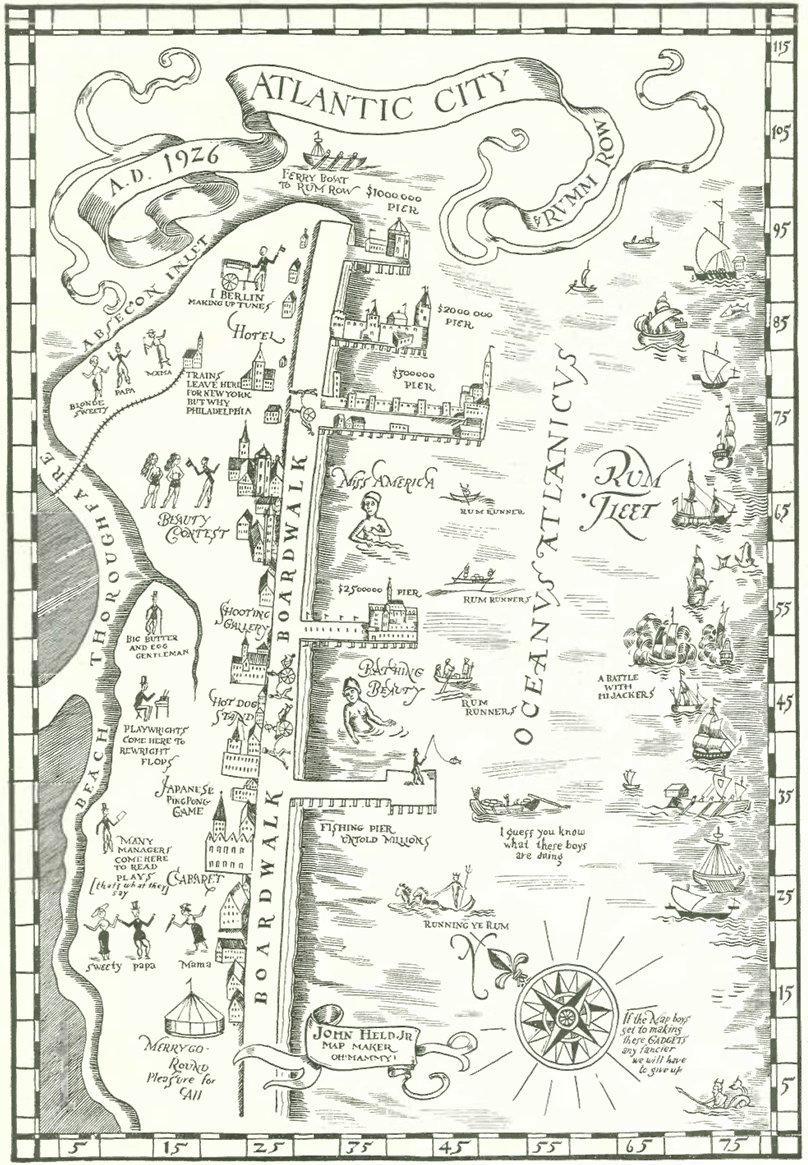
…I discovered this clever “map” by John Held Jr. For fans of “Boardwalk Empire” or other 1920s gangster-themed fare, Held’s map confirms it was no secret that Atlantic City was a major port for rum runners:
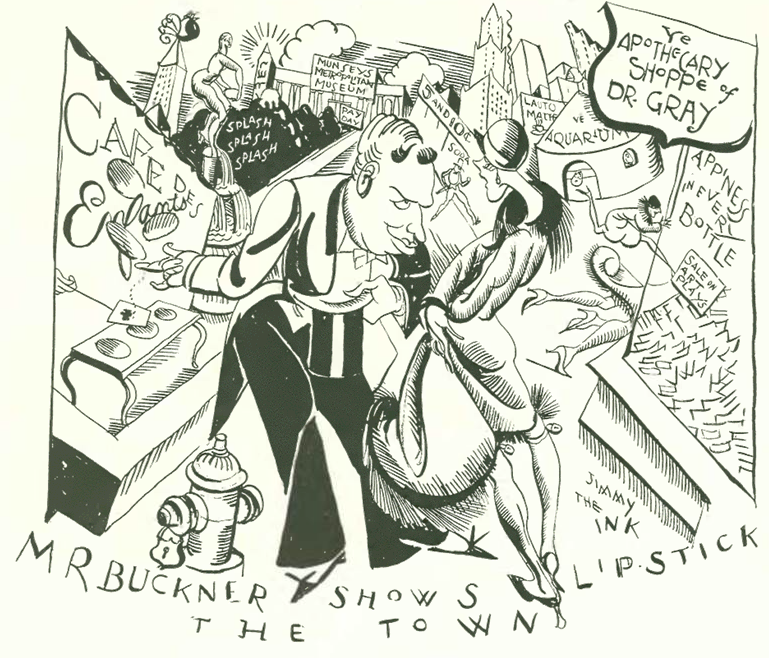
Also on the theme of Prohibition, cartoonist James Daugherty (Jimmy the Ink) had some fun with New Yorker colleague Lois Long (aka Lipstick) by pairing her with New York’s top Prohibition prosecutor Emory Buckner in this unlikely scenerio:
Note the lock on the fire hydrant. Padlocking restaurants and clubs suspected of selling alcohol was a favorite tactic of Buckner and his agents. Long famously took him task in her Oct. 31, 1925 “Tables for Two” column. You can read about it here in my previous post, “How Dry I Am.”
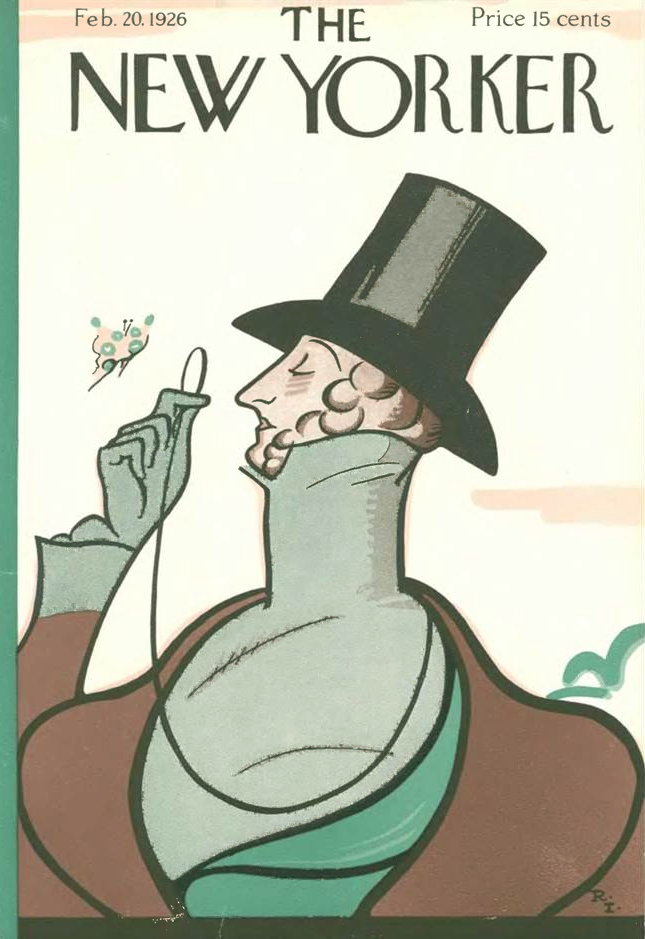
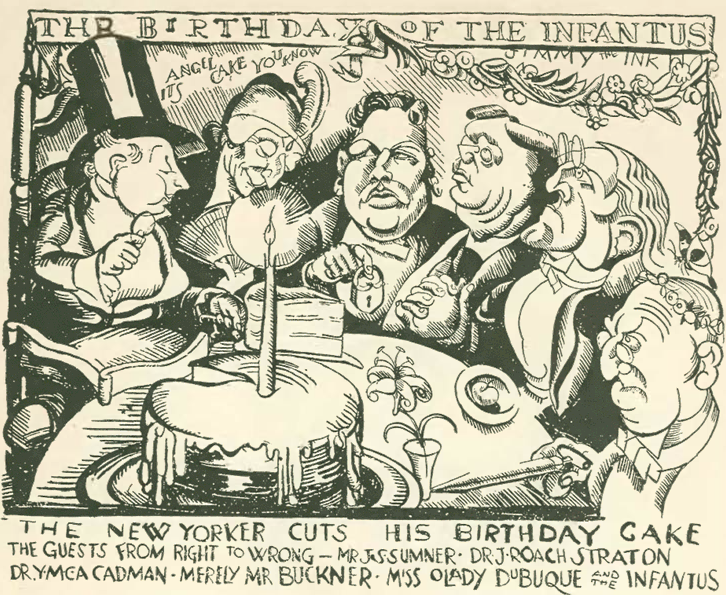
Now that I have your attention (at least the dog lovers anyway; and yes, there is a dog-related item if you read on), it is worth mentioning that the Feb. 20, 1926 issue of The New Yorker marked the first anniversary of the magazine, and in what would become an annual tradition, the magazine reprinted the original Rea Irvin cover from its first issue.
The magazine nearly went belly up during the summer of 1925, but a new marketing campaign, along with noticeably better content, put the magazine firmly in the black as it looked to its second year.
In “The Talk of the Town,” the editors couldn’t help but boast about their prosperity, albeit in a winking manner:
Jimmy the Ink (James Daugherty) marked the anniversary with this drawing…
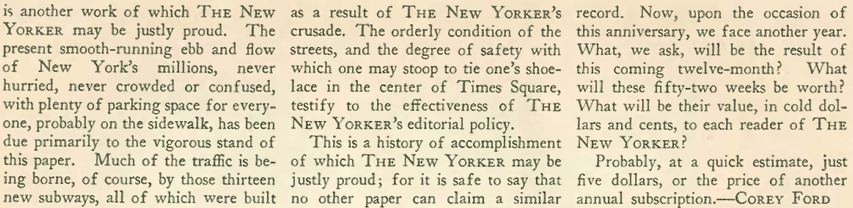
…and Corey Ford, who contributed more than twenty satirical house ads for the magazine under the title, “The Making of the Magazine,” returned to form in this issue with a recollection of the magazine’s imagined past (a device The Onion employs to great effect):
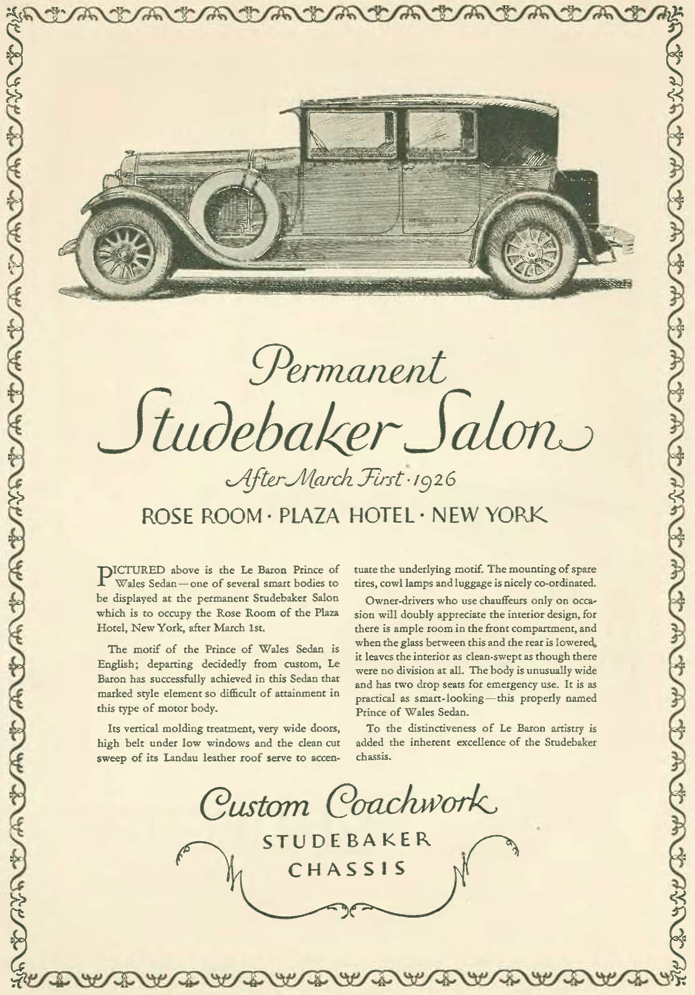
The magazine’s prosperity was evident not only in its talented stable of writers and illustrators, but also in its pages crammed with advertising. As I’ve noted before, much of the advertising is directed at the Anglo- and Franco-phile tastes of the magazine’s readers. For example, this ad from Studebaker suggesting a connection to British royalty:
Continuing on the theme of royalty, none other than Her Royal Highness, “La Princesse Genevieve” gave her nod to Produits Bertie skin cream (joining the ranks of other royal and society women who hawked moisturizers, cold creams and even cigarettes in those days…)
Royal endorsements were not limited to France and England, as none other than the Maharajah de Kapurthala put his seal of approval on Melachrino cigarettes in an ad featured on the inside back cover…
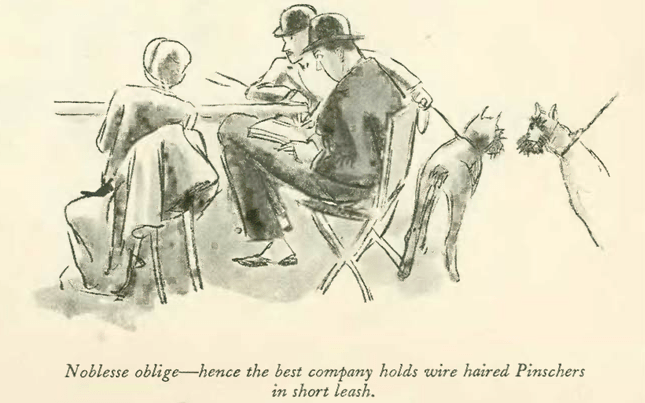
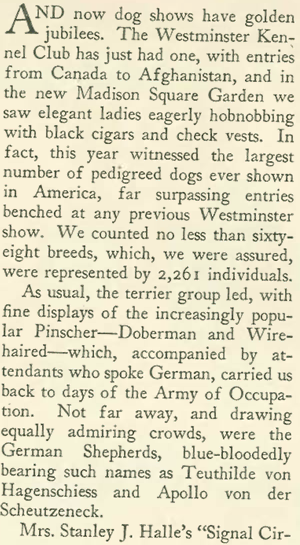
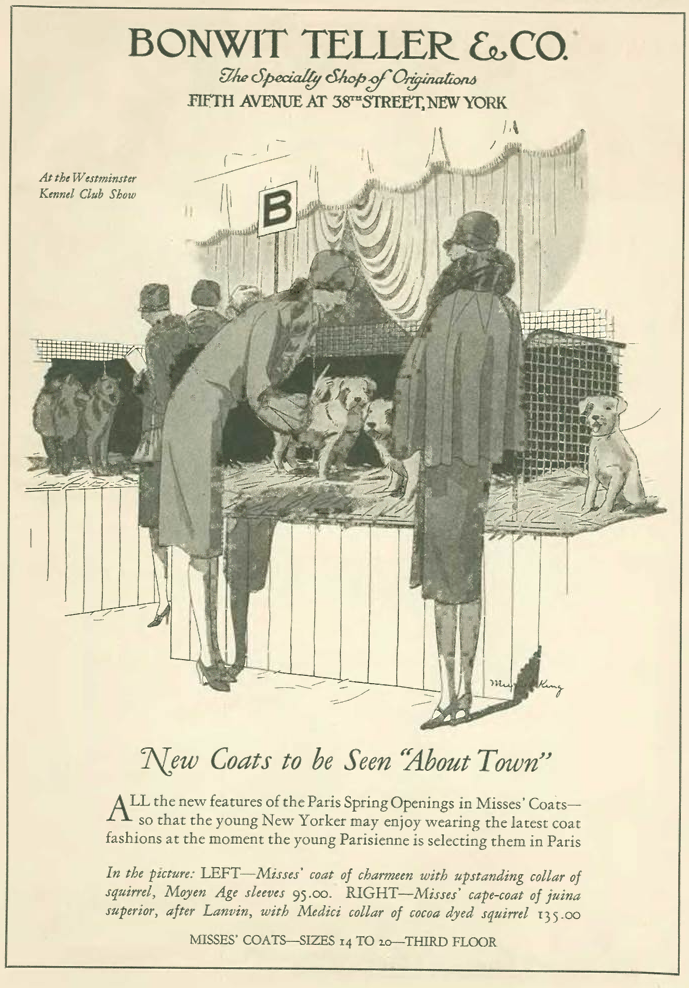
The issue was filled with car ads, appearing in the wake of January’s 26th Annual National Automobile Show at the Grand Central Palace. But the latest spectacle was the Westminster Kennel Club Dog Show at the new Madison Square Garden, with the Terrier Group once again taking the top prize. The “Talk” editors offered this observation on Westminster:
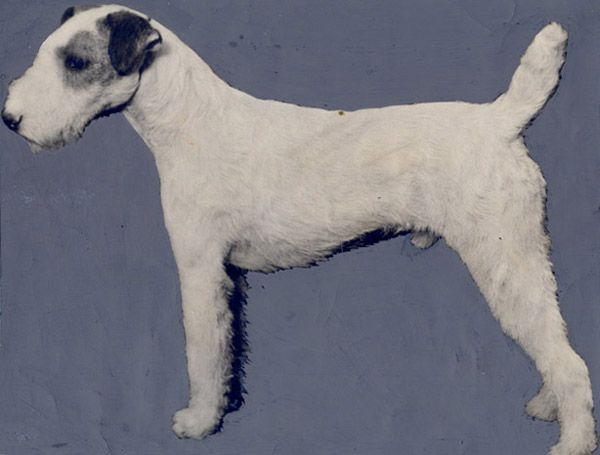
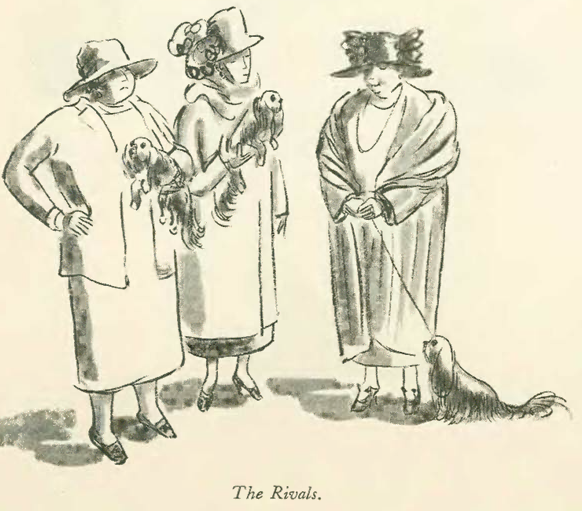
BEST IN SHOW 1926…Signal Circuit of Halleston was a Wire Fox Terrier and winner of the the 50th Westminster Kennel Club Dog Show in 1926. The fourth Fox Terrier to win best in show, Signal Circuit was one of 200 Fox Terriers present at the 1926 Westminster show. He was handled by Percy Roberts, who had imported the dog from England and had just stepped off the boat before the show. The dog was described as having “phenominal length of head and sound movement.” (WKC)The New Yorker’sHelen Hokinson offered this illustration to mark the event.
An advertisement from Bonwit Teller even got into the spirit of the thing…
From my How Times Have Changed department, this ad from Guaranty Trust:
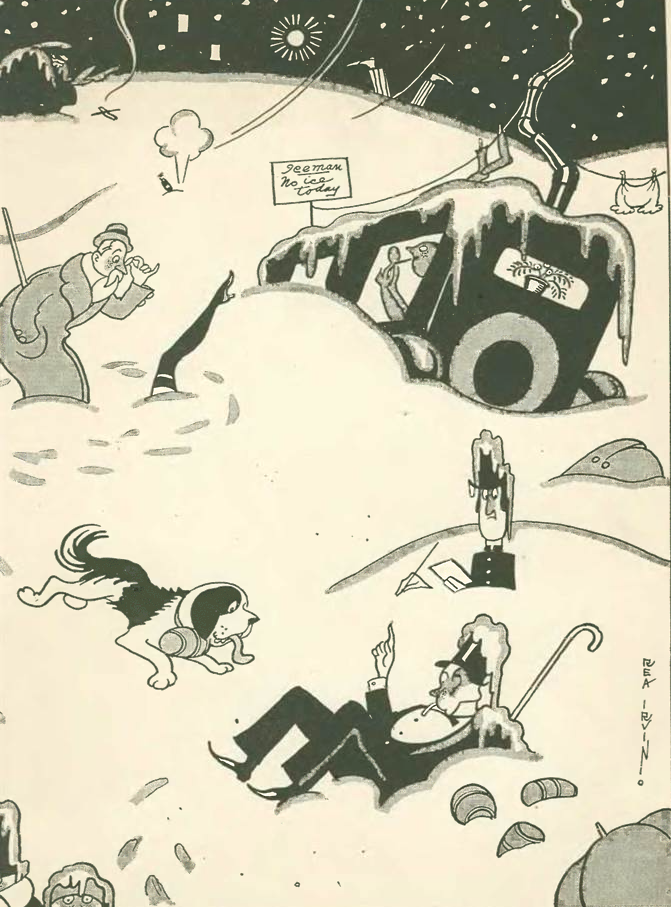
And finally, a detail from a center-page illustration by Rea Irvin depicting the result of a blizzard that blanketed the city in February 1926:
As if covering the nightclub scene and the fashion set wasn’t enough, Lois Long found the time to attend the National Automobile Show at the Grand Central Palace and offer her insights and criticisms on the latest in automotive design.
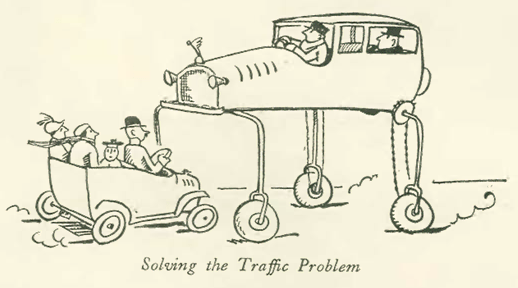
The show featured more than 500 new models, bigger and more powerful cars mounted on new-fangled balloon tires. There were also cheaper cars available–GM introduced the Pontiac line to appeal to the mass market, and other manufacturers lowered their prices in an effort to lure customers. Visitors packed the show despite the fact that the city streets were already hopelessly clogged with traffic and navigating them was difficult and often perilous. Al Frueh offered his take on the traffic situation with a little doodle in “The Talk of the Town” section (featured above).
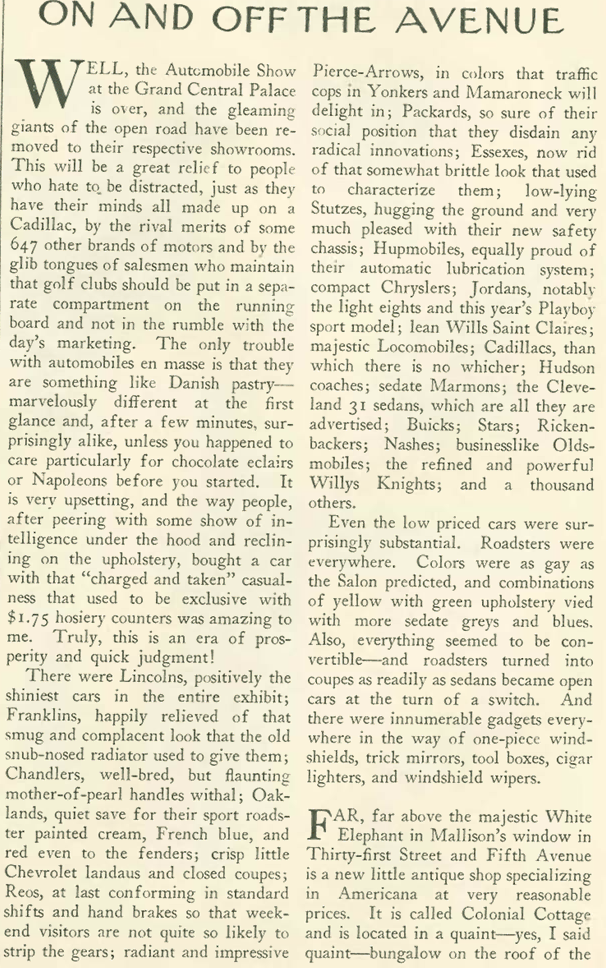
Long gave readers her usual straightforward assessment of the show (her Danish pastry metaphor in the first paragraph is spot on). Note her list of American car companies, many of which are long gone:
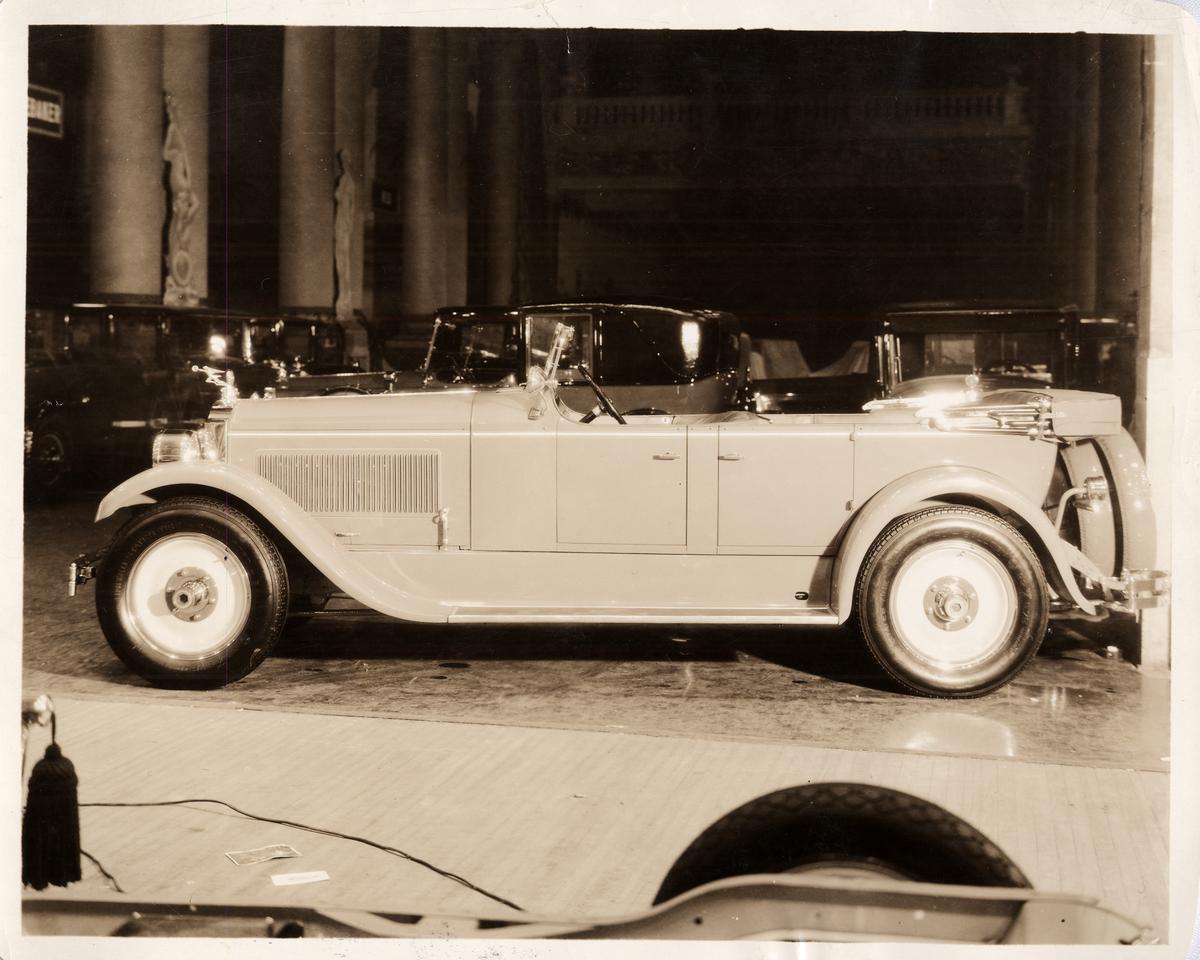
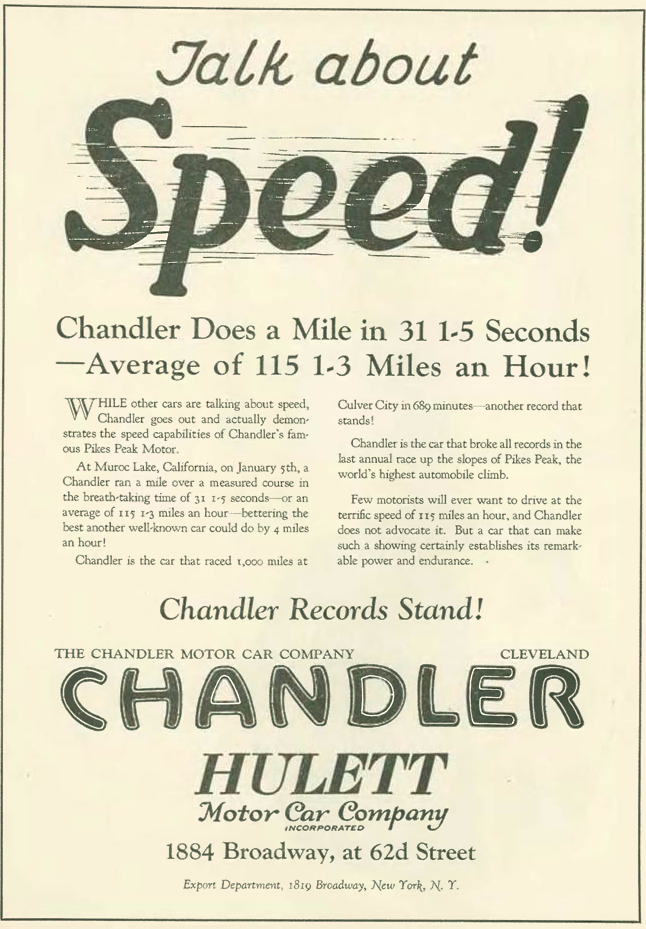
LOOK AT ME…No doubt Lois Long walked by this Packard special sport phaeton, prominently displayed at the 26th National Automobile show. (Wayne State University)GRAND INDEED…The 26th National Automobile Show was at the Grand Central Palace, which occupied the block of Lexington Avenue between 46th and 47th Streets. It was razed in 1963. A 44-story office tower, 245 Park Avenue, took its place. (New York Times)A Cleveland auto manufacturer, Chandler, took advantage of the moment by placing this ad in the Jan. 23 issue of The New Yorker.
***
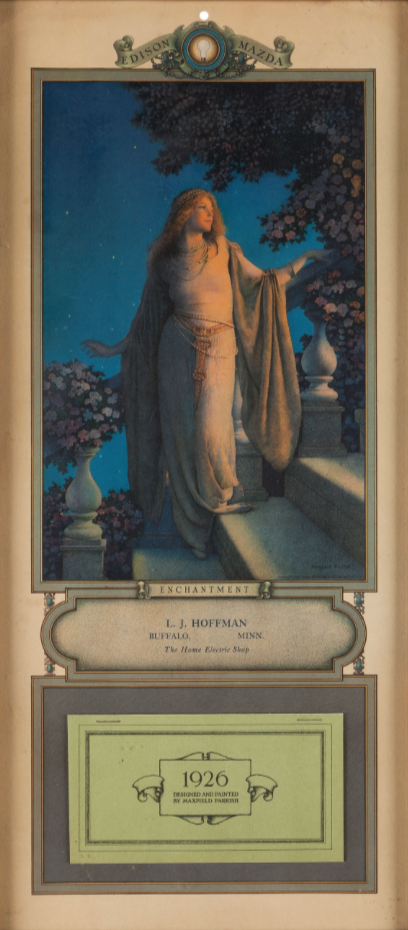
“The Talk of Town” editors were bemused over the news that artist Maxfield Parrish had received “a check in six figures” following his first-ever exhibition. It was reported that Parrish received $80,000 (roughly equivalent to $1 million today) for a single painting, which the editors suggested made him “the highest paid artist living.” They also wondered “if he gets amusement out of being the highest paid painter,” since Parrish was known for wanting to be left alone, and until recently was “not well off” because no one “could persuade him to the sell the pictures with which he lined his house.”
A 1926 Edison MAZDA calendar featuring artwork by Maxfield Parrish. (icollector.com)
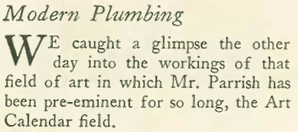
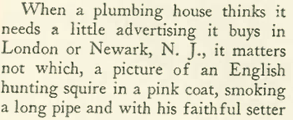
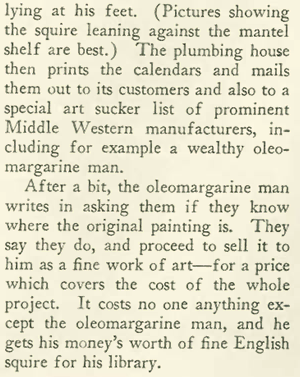
In a previous issue (Dec. 12, 1925), New Yorker art critic Murdock Pemberton wrote a dismissive critique of the young Parrish’s work and noted that the artist was largely glorified in American advertising and not in serious art circles. This was followed by another “Talk” item in which the editors sneered at the trade calendar market that fed the popularity of artists like Parrish:
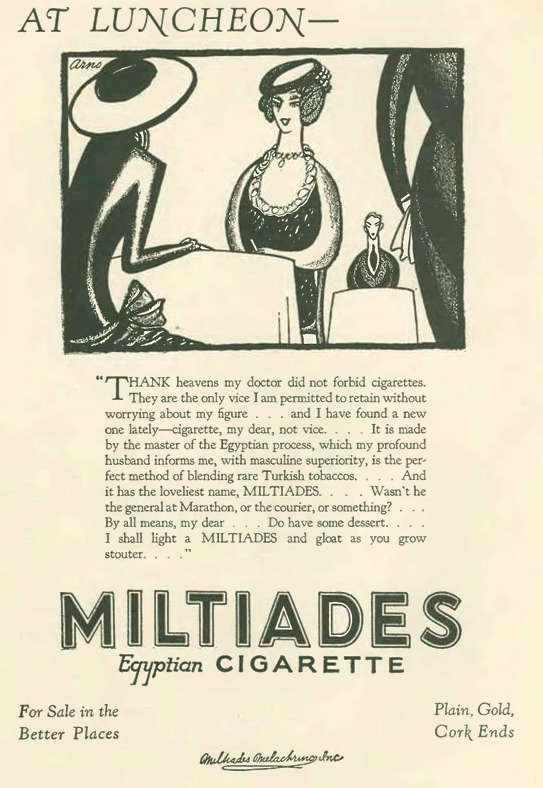
And to close, this message (illustrated by Peter Arno) from Miltiades Egyptian cigarettes. Apparently they empower you to call your non-smoking friend “fatso.”
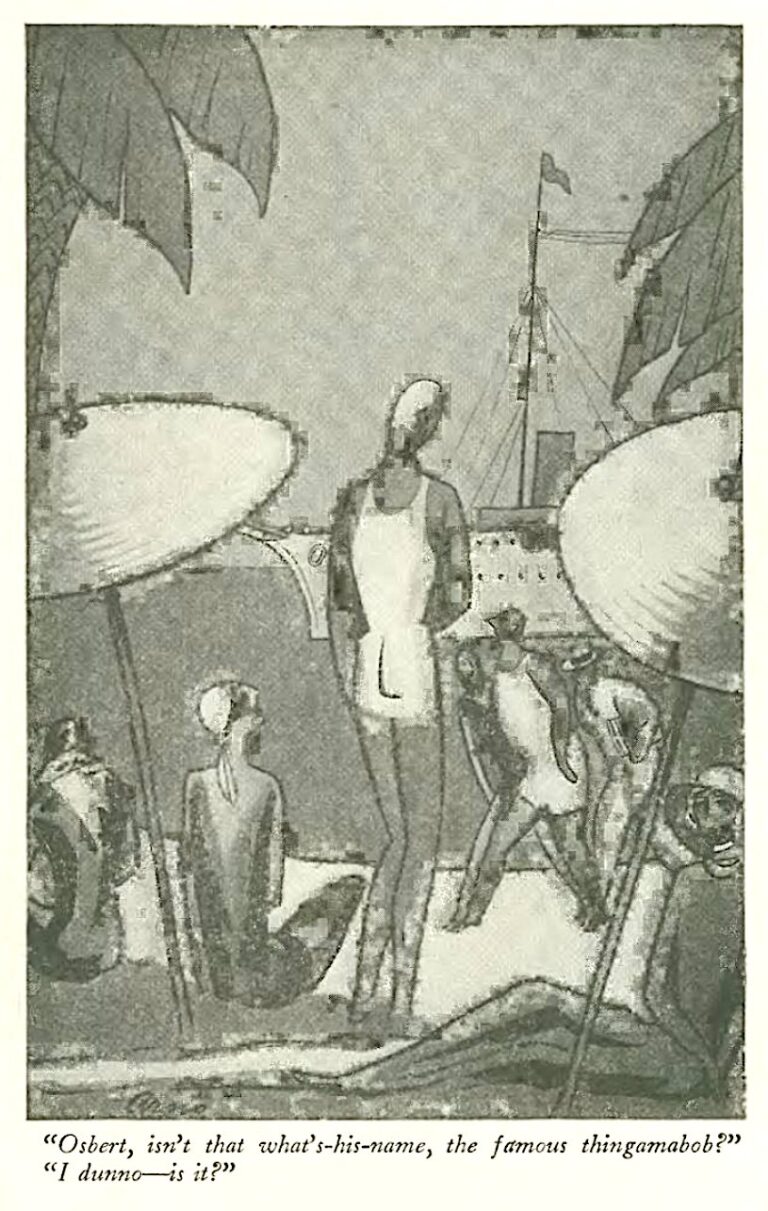
On the subject of Arno, there was only one drawing with a caption…by Arno…
MGM spent nearly $5 million (about $70 million today) to make the silent epic Ben-Hur, filming the movie on location in Egypt, Italy and the United States. The New Yorker’s film critic Theodore Shane was not impressed.
Shane wrote that $4,999,999.95 had been spent “on massive effects and the remaining $.05 on drama.”
He noted, however, that the original story, an 1880 novel by Lew Wallace (who was a Union general in the Civil War, among other things), was pretty lacking in drama to begin with, just a “piece of bric-à-brac romance (that was) nothing more than a super Rover Boys story touched up with a Biblical background.” Here’s Shane’s entire review of the film, which was released by MGM on December 30, 1925:
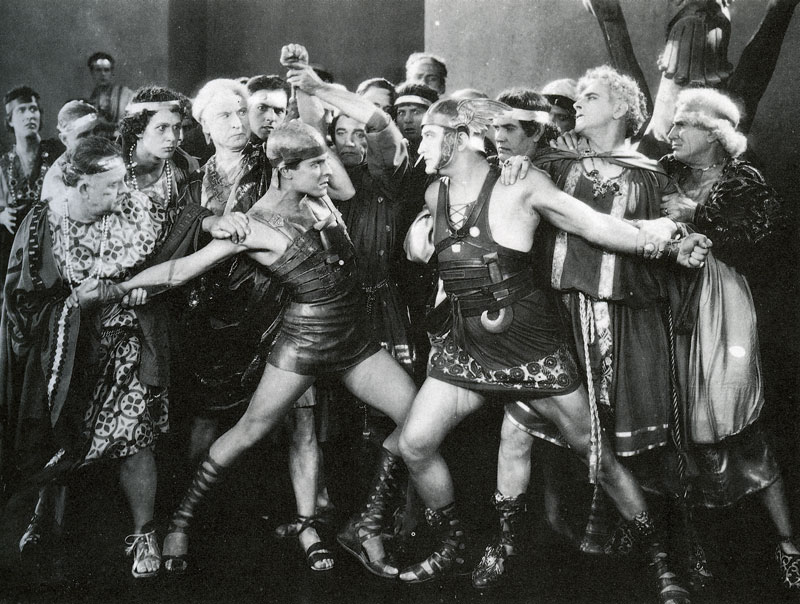
A Nickel’s Worth of Drama…Ramon Novarro (left) and Francis X. Bushman mix it up in Ben-Hur (1925) (Virtual History)
This was actually the second Ben Hur film. The first was made in 1907, a 15-minute silent costing $500 (and it really was made on the cheap; the producers stole some shots of a mock chariot race at a fireworks show at Sheepshead Bay, Brooklyn, and then added some interior shots to complete the picture).
For the 1925 Ben Hur, filming on location proved difficult from the start. Italy’s new leader, Benito Mussolini, was in an anti-American mood when production began, and labor disputes often delayed filming. By all accounts, conditions were miserable. Kevin Hagopian, in an essay for the New York State Writers Institute, observed “The worst agonies were reserved for the film’s climax, the chariot race. Legendary second unit director B. Reeves Eason’s nickname “Breezy” was certainly not earned by his work on the Ben-Hur set, for his merciless pace cost the lives of over a hundred horses. As [actor Francis X.] Bushman said sadly, “If it limped, they shot it.” A stunt man was killed in a chariot crash, and [actor Ramon] Navarro himself only narrowly escaped death.”
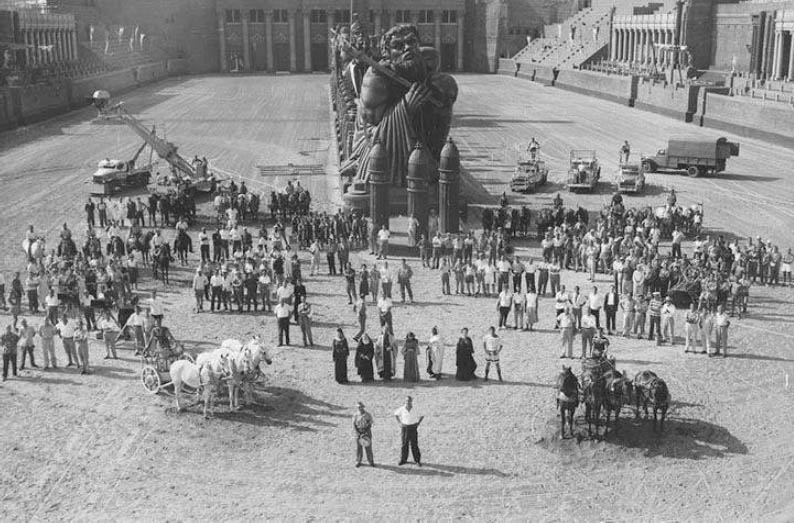
The troubled Italian set was eventually torn down and a new one built in Culver City, California. The crowd scenes and master shots for the race were done in a single day, with forty-two cameras covering the action.
The famed chariot race staged in Culver City, California, was shot with 42 cameras.
In “Profiles” Esther Carples looked at the life of Sergei Rachmaninoff, who was widely considered one of the great pianists of his day, and as a composer represented the last vestiges of Romanticism in Russian classical music. Carples painted a portrait of a brooding genius, a man with aristocratic bearing who lived in lonely exile from his native Russia.
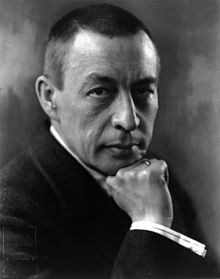
Sergei Rachmaninoff in 1921. (Library of Congress)
In 1921, Rachmaninoff bought a house on 33 Riverside Drive in New York City, where he lived until 1925. There he consciously recreated the atmosphere of Ivanovka (his beloved Russian summer house) entertaining Russian guests, employing Russian servants, and observing old Russian customs.
*****
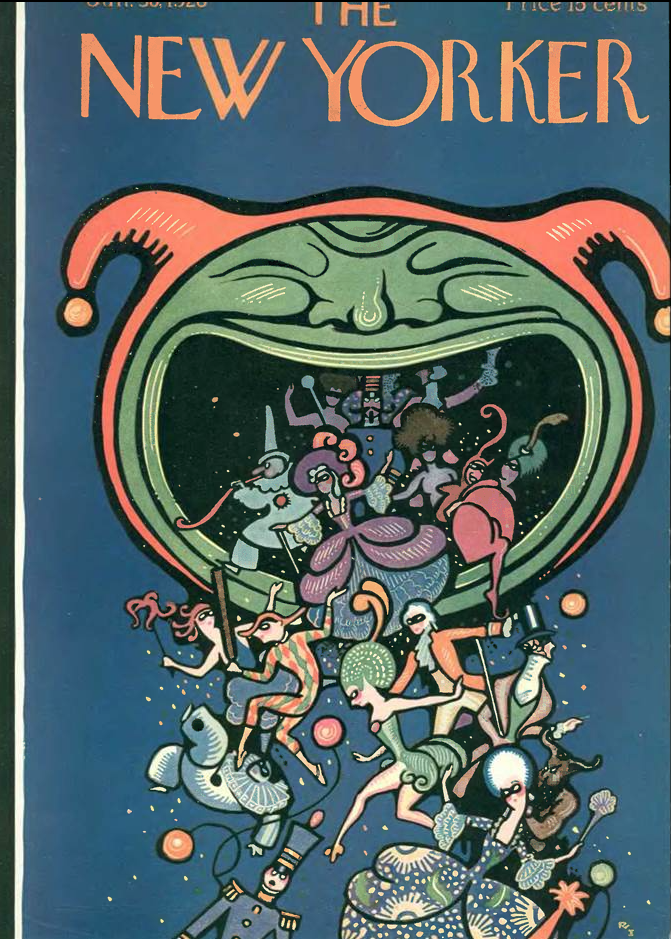
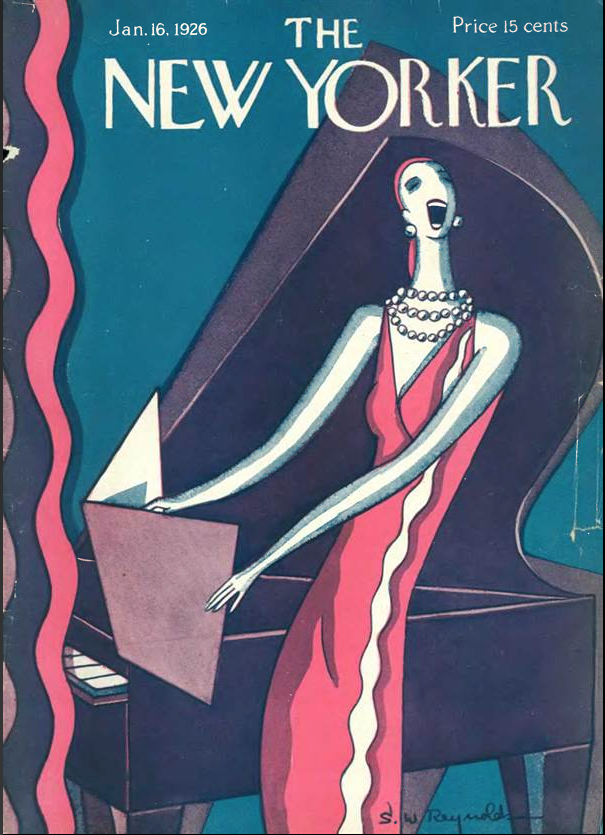
Jan. 16, 1926 cover by S.W. Reynolds.
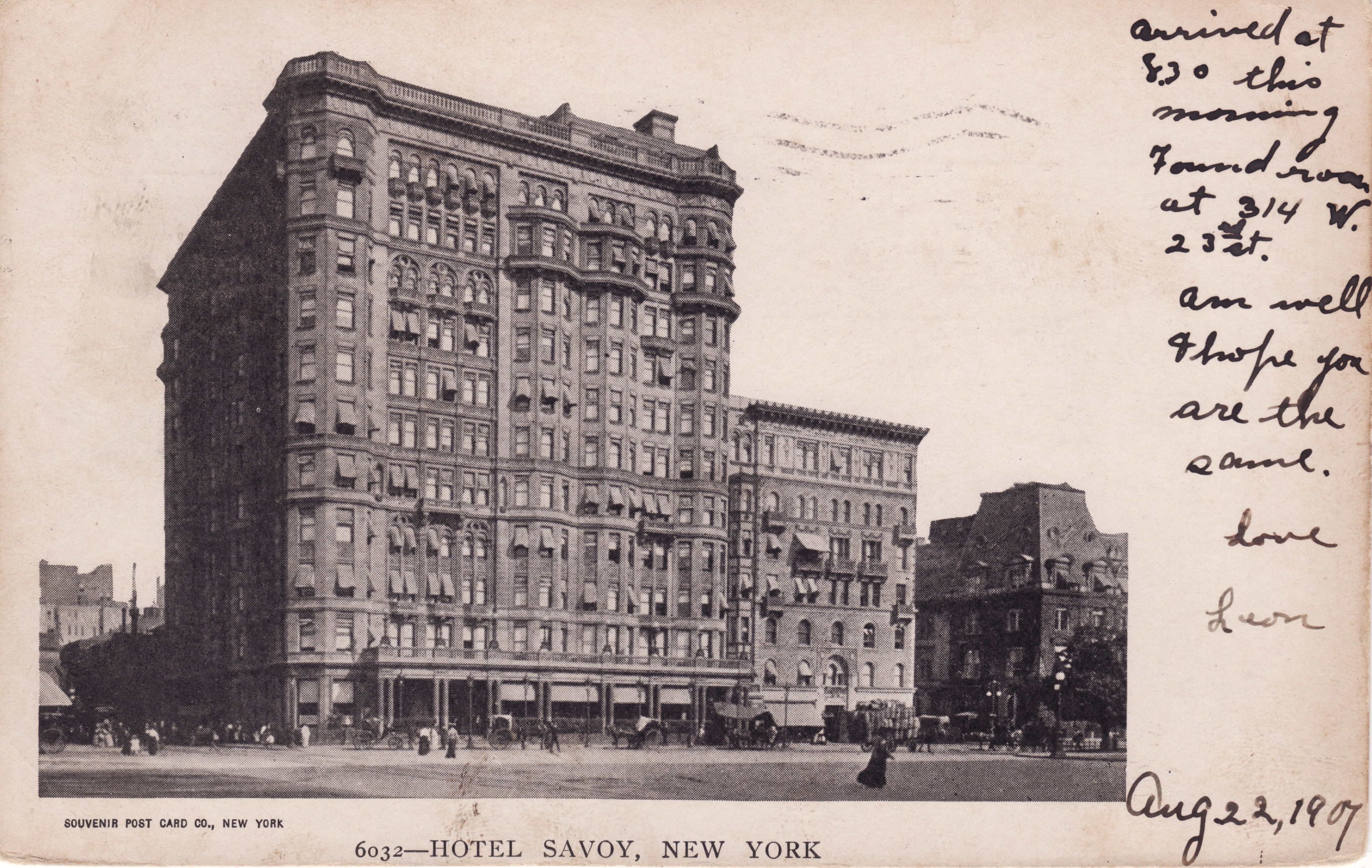
Let’s move on to the next issue, Jan. 16, 1926. “The Talk of the Town” noted another loss of a Fifth Avenue landmark with the Savoy Hotel was falling to the wrecking ball.
The Savoy, built in 1891-92, was slated to be replaced by The Savoy Plaza Hotel, which itself would be demolished in 1965-66 (amid significant public outcry and protest) to make way for the eastern headquarters building of General Motors.
It was observed that the new year would see a boon in construction of huge new buildings along the Avenue, and buildings only five years old (such as Heckscher Building) would be dwarfed by the new towers.
Another One Bites The Dust…The Savoy Hotel (stuffnobodycaresabout.com)
The New Yorker continued to have fun with actress Gloria Swanson‘s pretensions to royalty (she was married to the Marquis de La Coudraye at the time). This time it came from the pen of Jimmie the Ink (James Daugherty), part of his series of drawings that coupled famous people of the day in comic situations:
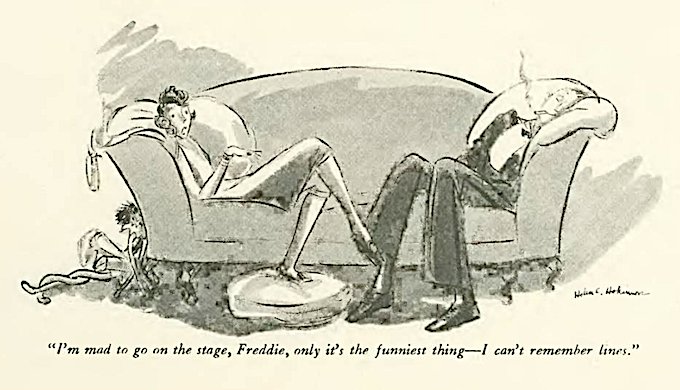
The issue also featured Helen Hokinson with a cartoon that seemed more in Barbara Shermund’s wheelhouse…
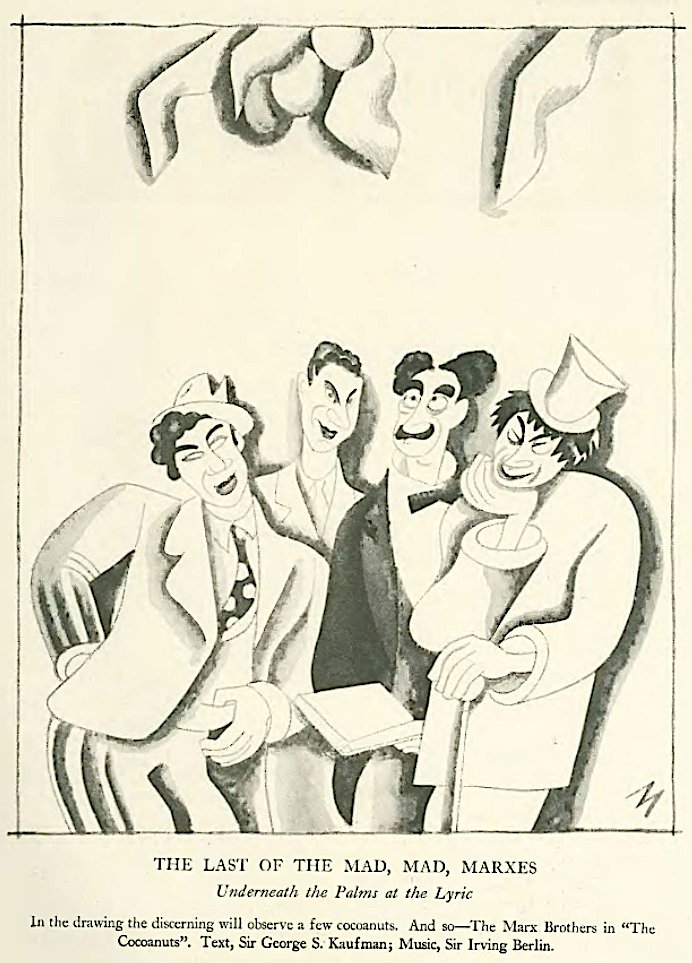
…a Julian de Miskey drawing for the theatre section…
…and a Peter Arno illustration…
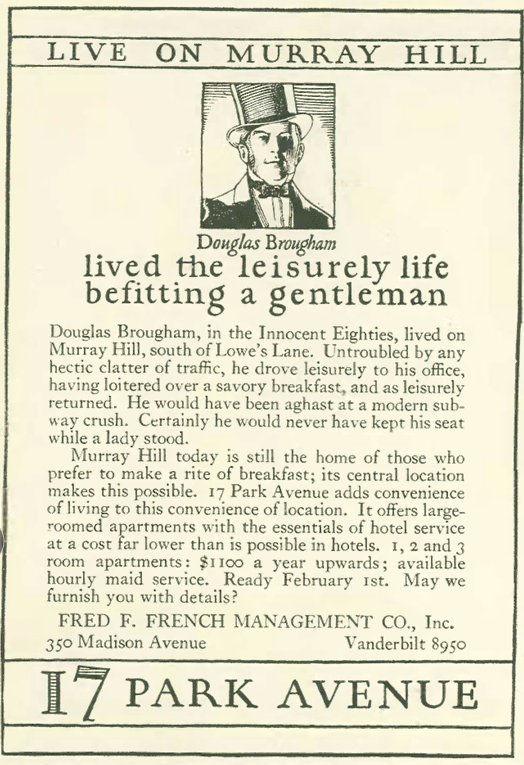
To close, two ads from the Jan. 16 issue, this one appealing to Anglophilic, aristocratic aspirations of certain readers…
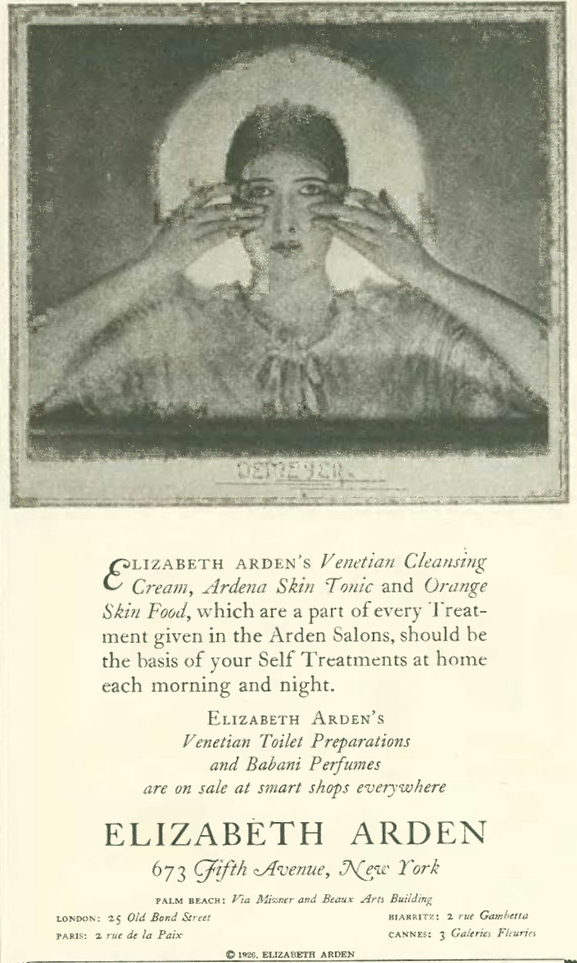
And this one from Elizabeth Arden, who will become a mainstay in the magazine with these ads featuring women with ghostly stares, usually with their heads wrapped tightly to combat sagging skin. Thanks to Hollywood, it was the age of the close-up, so wrinkles and blemishes be gone!
The writer Michael Arlen was back in pages of The New Yorker on the occasion of his second visit to the U.S. The magazine also heralded his first visit in March 1925, when he was liberally feted by various literary hangers-on and assorted socialites.
This time around Arlen was the guest of Charles Dillingham, “being at the moment deeply engaged in his host’s forthcoming presentation of Mr. Cyril Maude in “The Charming People.” And, between times, casting watchful eyes on “The Green Hat,” whose New York premiere next week comes just in the nick of time to save many of Mr. Arlen’s admirers from collapses fomented by anguished anticipation.”
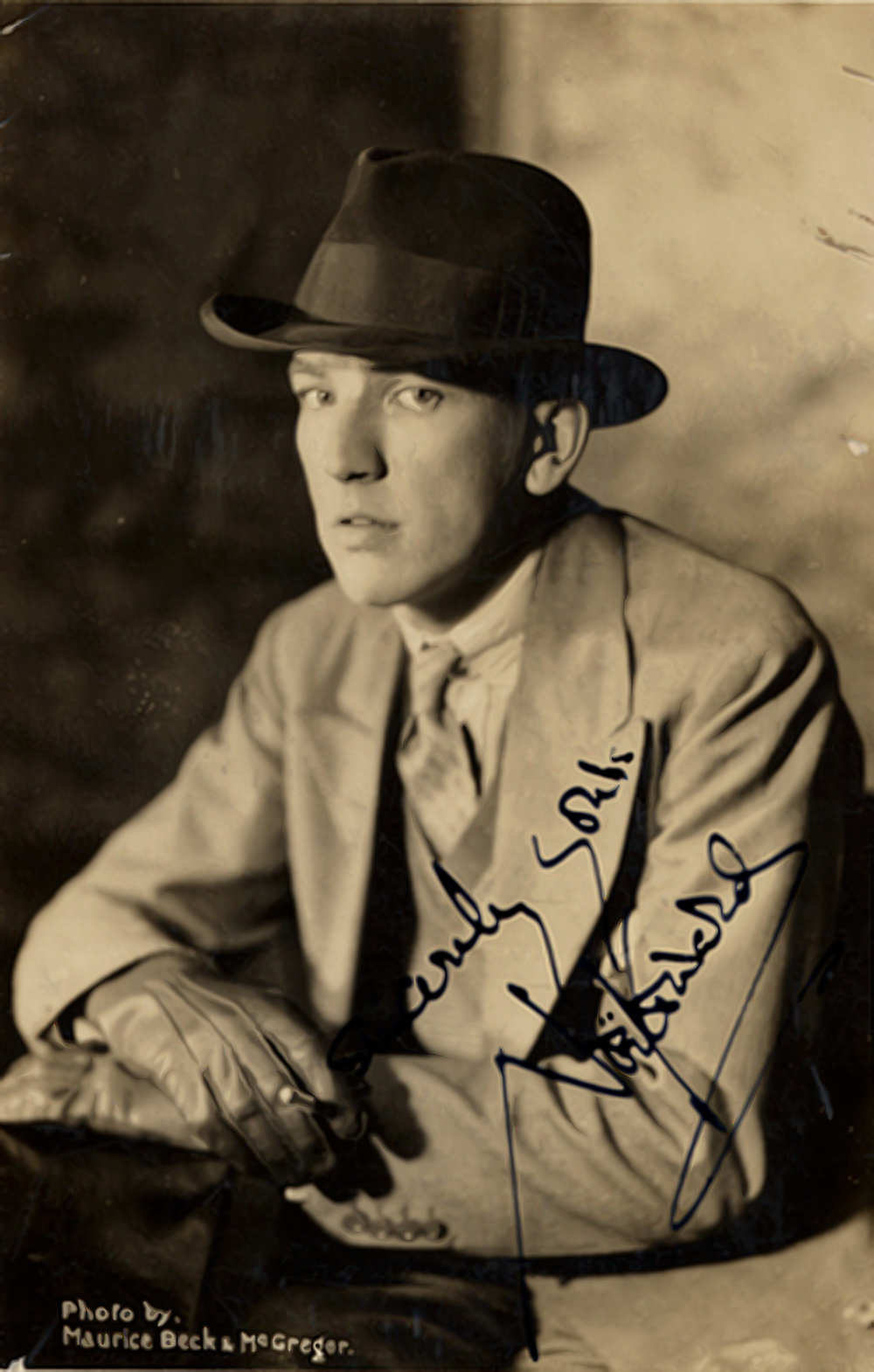
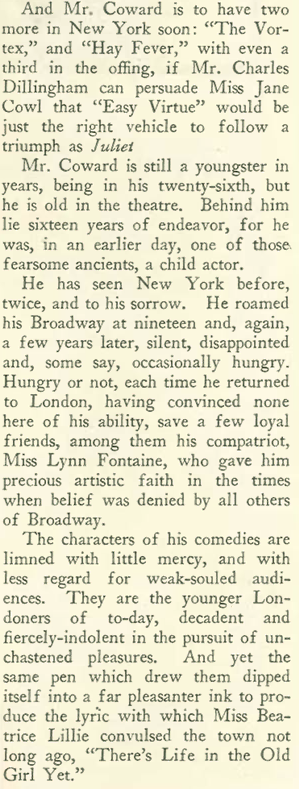
With Arlen’s return, and with new works by the “youngster” Noel Coward (he was 26), ‘The Talk of the Town” noted that the fall theater season “will have a distinctly British flavor.”
The young Noel Coward. (Victoria & Albert Museum)
“Talk” called Coward “the rage of the London dramatic season,” in anticipation of his upcoming New York presentations:
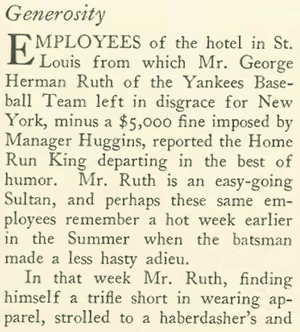
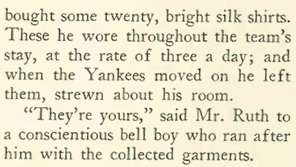
Babe Ruth also returned to “Talk” with another tale of mischief:
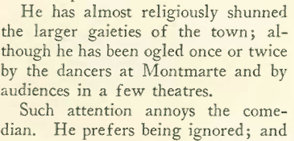
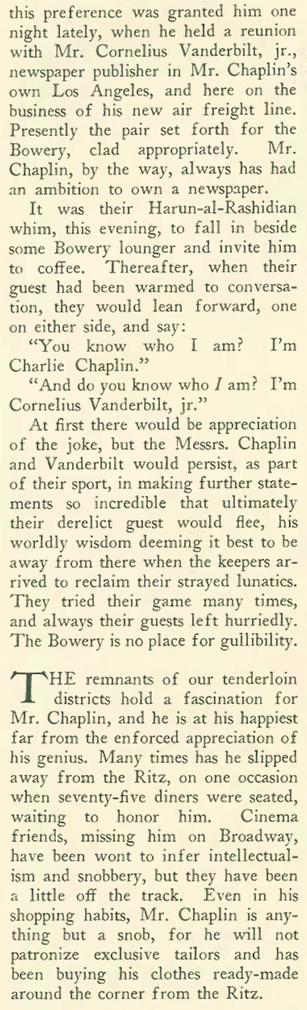
It was also reported that Charlie Chaplin was still playing the melancholy, holed up in his room at the Ritz with his telephone disconnected:
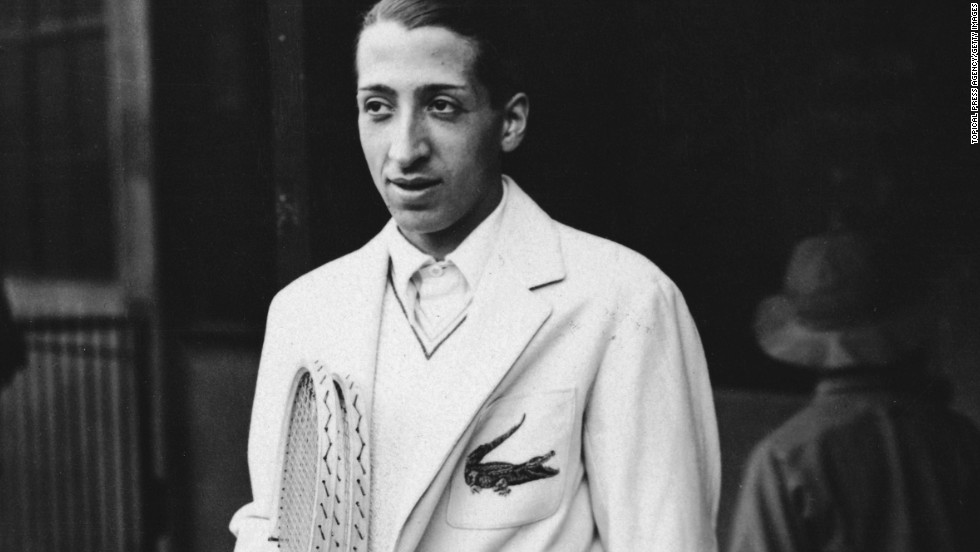
French tennis star Rene Lacoste was the subject in “Profiles.” John Tunis wrote, “The French are supposed to be a volatile people. Rene Lacoste us about as volatile as Swiss cheese. His is the most perfect self-control imaginable; both on the court and off, his is the demeanor of a real champion…he will go a very long way.”
Rene Lacoste was one of “The Four Musketeers” with Jean Borotra, Jacques Brugnon, and Henri Cochet, French tennis stars who dominated the game in the 1920s and early 1930s. He won seven Grand Slam singles titles at the French, American, and British championships, and was the World’s No. 1 player for both 1926 and 1927. Today he is still known worldwide as the creator of the Lacoste tennis shirt, which he introduced in 1929. (Biography.com)
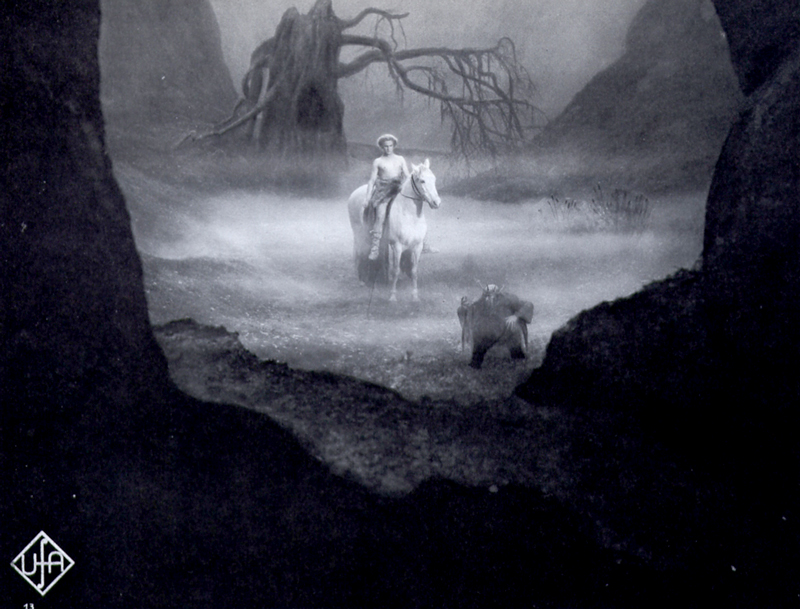
“Moving Pictures” announced the arrival of the German film Siegfried at the Century Theatre. An advertisement in the magazine proclaimed that a “Symphonic Orchestra of 60 musicians from the Metropolitan Opera Co. render a special score compiled with Wagner’s Immortal Music…”
Still from 1924’s Die Nibelungen: Siegfried (UFA)
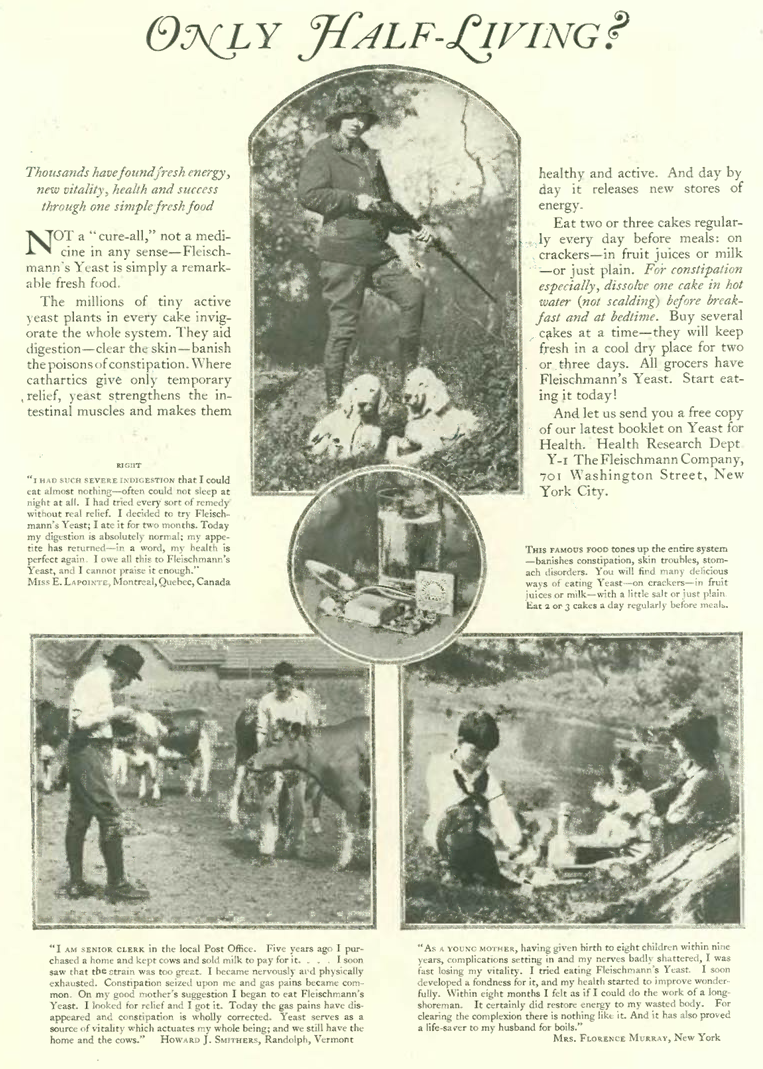
In my last post I wrote about Raoul Fleischmann’s investment in The New Yorker, and how his initial $25,000 led to subsequent infusions of hundreds of thousands of dollars. No doubt in an effort to recoup some of his investment, he started placing these full-page ads in the magazine that promoted health benefits of consuming his company’s product: yeast.



















 A New Yorker State of Mind