During the roughly thirteen years of Prohibition, many Americans had forgotten how to mix a decent cocktail; the concoctions they devised during those dry years were often created to mask the taste of bootleg liquor—sales of Coca-Cola steadily increased throughout the 1920s in part because it made ardent spirits such as rum and whisky a bit more palatable.
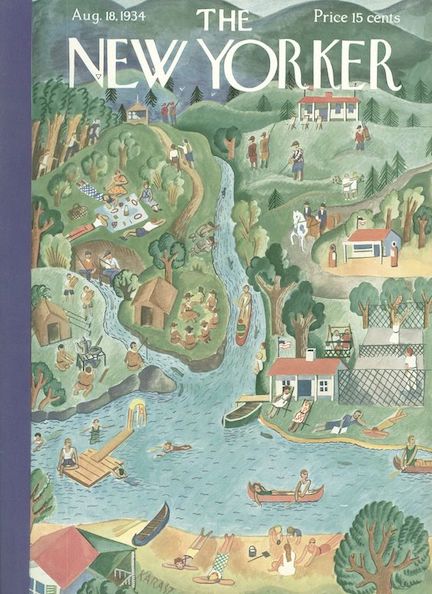
August 18, 1934 cover by Ilonka Karasz.
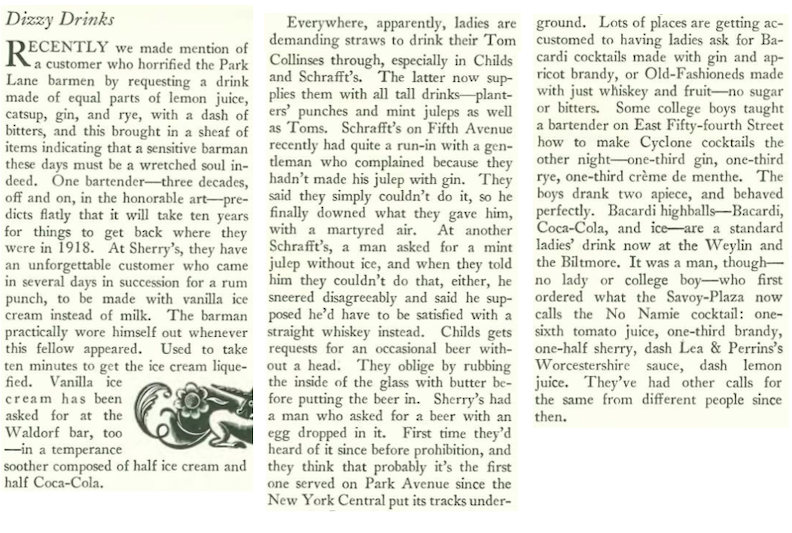
Donald Barr Chidsey examined the phenomenon in “The Talk of the Town,” visiting with traumatized bartenders around Manhattan:
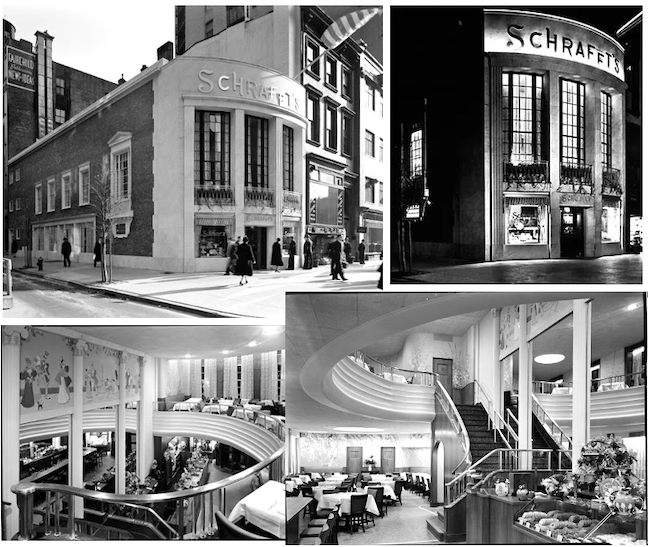
LOST ART…Donald Barr Chidsey relayed the horror of a customer at Sherry’s (top left, photo of the 300 Park Avenue entrance, c. 1925) who asked for ice cream in his rum punch; directly across the street from Sherry’s was the Waldorf Astoria (top right), where a customer asked for a drink of half ice cream, half Coca-Cola; bottom images are from Albert Crockett’sThe Old Waldorf-Astoria Bar Book—as to what one gathers from Chidsey’s account, more than a few people needed to check the “Glossarial” to get reacquainted with the spirit world. (Museum of the City of New York/kitchenartsandletters.com)CUBA LIBRE…According to Chidsey, the go-to for women patrons at the Hotel Weylin was a Barcardi and Coke; at left, Hotel Weylin in 1935; at right, lobby card featuring entertainment at the Weylin Bar, circa 1930s. (Museum of the City of New York/ebay)THE LAST STRAW…Chidsey wrote of an alarming trend among patrons at Schrafft’s who demanded straws in their Tom Collinses. The sleek, art moderne Schrafft’s at 61 Fifth Avenue was among more than two-dozen Schrafft’s locations in New York City in the 1930s. Known for cleanliness and home-style cooking, target clientele were middle-class women. (Architectural Record photos via daytoninmanhattan.blogspot.com)
* * *
From Our Advertisers
Speaking of Schrafft’s, here is their advertisement from the Aug. 18 issue, offering breakfasts ranging from 35 to 75 cents that apparently were the stuff of O. Henry’s dreams…
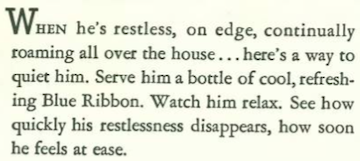
…what is a woman to do with a restless husband?…drawing on the wisdom of the ages, she hands him a beer and coaxes him into his easy chair…this ad encouraged women to “always keep a few bottles in your refrigerator”…in other words, keep ’em coming until he settles into a manageable stupor…
…and see just how easily he slips away, leaving you with a few moments to yourself…
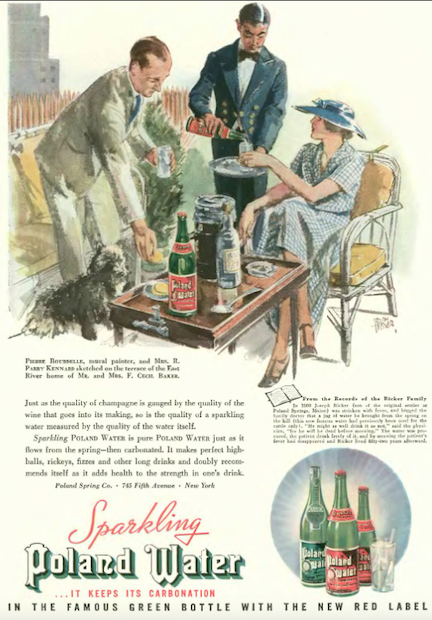
…if highballs were more to your taste, the folks at Poland Water stood ready to help…
…R.J. Reynolds claimed their Camels could solve all sorts of life challenges…we’ve seen ads claiming that Camels soothed “jangled nerves” and helped one relax, but apparently they also could give you energy and pep, at least that is what tennis star Ellsworth Vines, Jr claimed…
…lots of color in the ads for the Aug. 18 issue…here the folks at Buick featured a woman in a red dress serving as an exclamation point to their automobile, which was no ordinary motorcar, but rather a “congenial companion, alive with good-natured personality”…
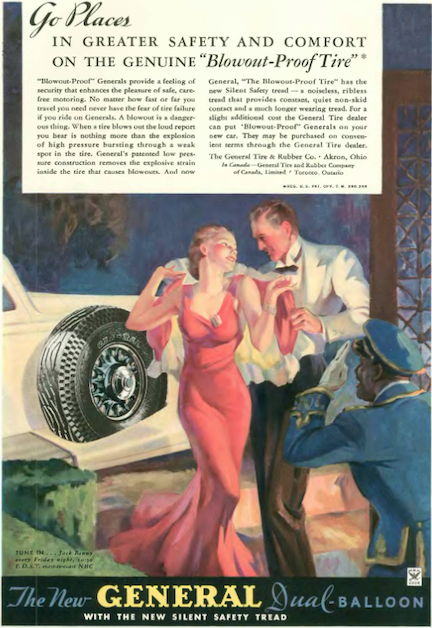
…the folks at General Tire went one better, making their tires the star attraction…those tires look so attractive it seems almost a shame to dirty them on the road…
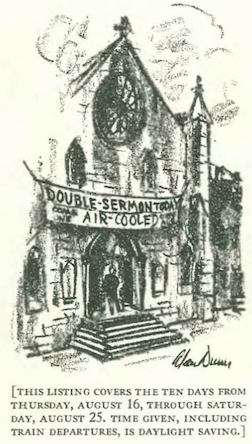
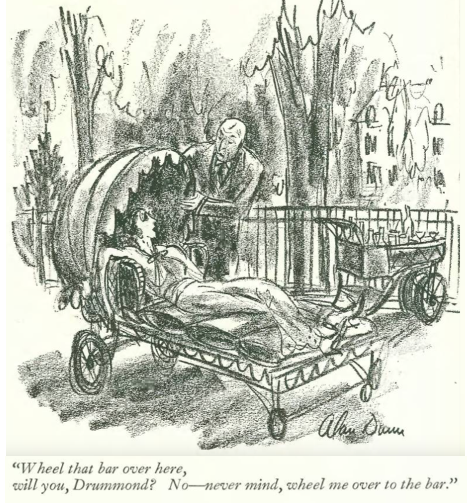
…on to our cartoons, we cool off with this spot in the opening pages by Alan Dunn…
…William Cotton contributed this caricature of New Deal Administrator Hugh Samuel Johnson that accompanied a three-part profile…
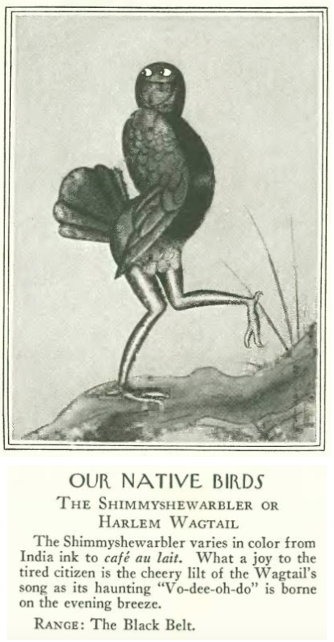
…Rea Irvin offered up a bird of a different feather…
…Robert Day gave us this master of understatement…
…Alan Dunn again, examining the trials and tribulations of the leisure classes…
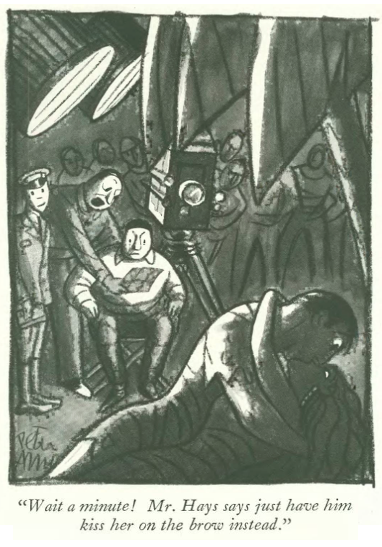
…Peter Arno offered this take on the Hays Code (after politician Will Hays), which was going into effect after the brief “Pre-Code” period (roughly 1930 to 1934) during which filmmakers felt freer to explore themes featuring sex and violence…
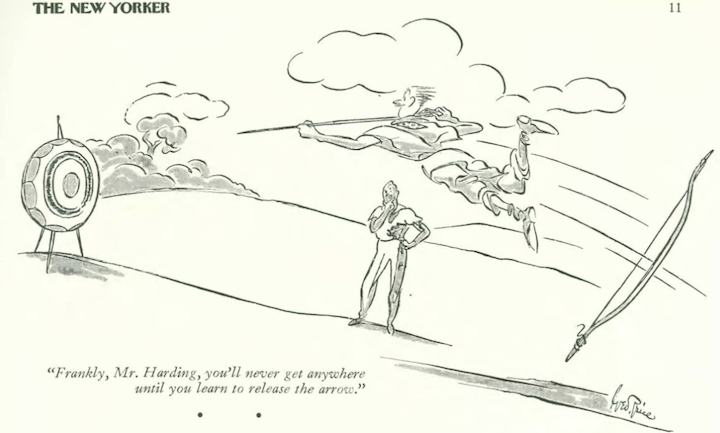
…George Price gave us a man have trouble hitting his mark…
…Alain (Daniel Brustlein) contributed a cartoon with a talking animal, common today but rare in the early New Yorker…
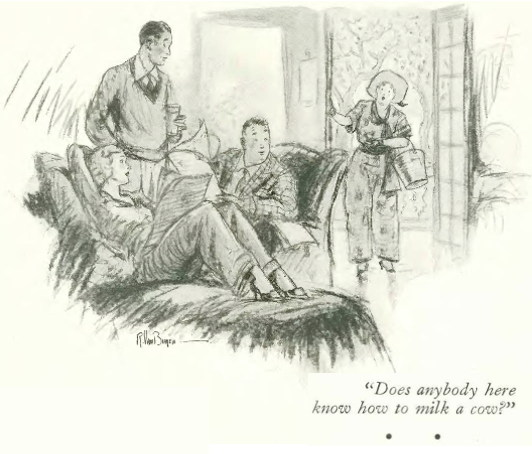
…Raeburn Van Buren was also down on the farm…I think we know the answer to this woman’s query…
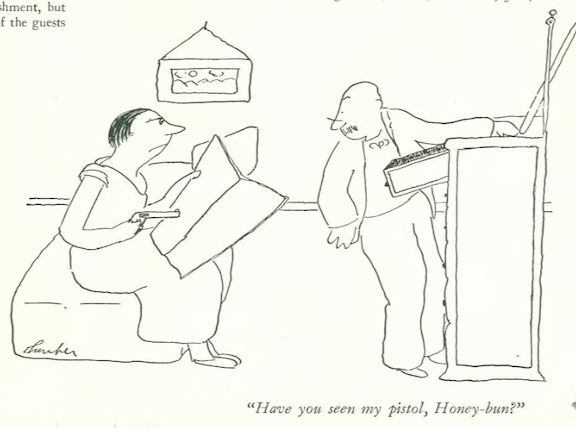
…and we close with James Thurber, where mixed doubles were naturally fraught with peril…
It’s hard to believe in this day and age that a theoretical physicist could enjoy rock star status, but then Albert Einstein wasn’t your everyday theoretical physicist.
Dec. 2, 1933 cover by Helen Hokinson.
A two-part profile of Einstein (1879–1955) by Alva Johnston (with terrific caricature by Al Frueh) examined the life and “idol” status of a man who would define the idea of genius in the 20th century. Although Einstein desired to live an almost reclusive existence at Princeton University, Johnston noted that he had become “fairly reconciled to the occupation of popular idol.”
Einstein was at Princeton thanks to the rise of Adolf Hitler, who came to power in Germany in early 1933 while Einstein was visiting the United States. Returning to Europe that March, Einstein knew he could not return to his home country (indeed, the Gestapo had raided his Berlin apartment and eventually seized all of his property), so when Einstein landed in Antwerp, Belgium on March 28, 1933, he immediately went to the German consulate and surrendered his passport, formally renouncing his German citizenship.
I’M OUTTA HERE…Albert Einstein with a Zionist delegation from France, Belgium, and England upon leaving the SS Belgenland in Antwerp, Belgium, 1933. (United States Holocaust Memorial Museum)
After some time in Europe and Great Britain, in October 1933 Einstein accepted an offer made earlier by from the Institute for Advanced Study in Princeton, New Jersey to serve as a resident scholar. When he arrived with his wife, Elsa, he said he would seclude himself at the Institute and focus on his teaching and research.
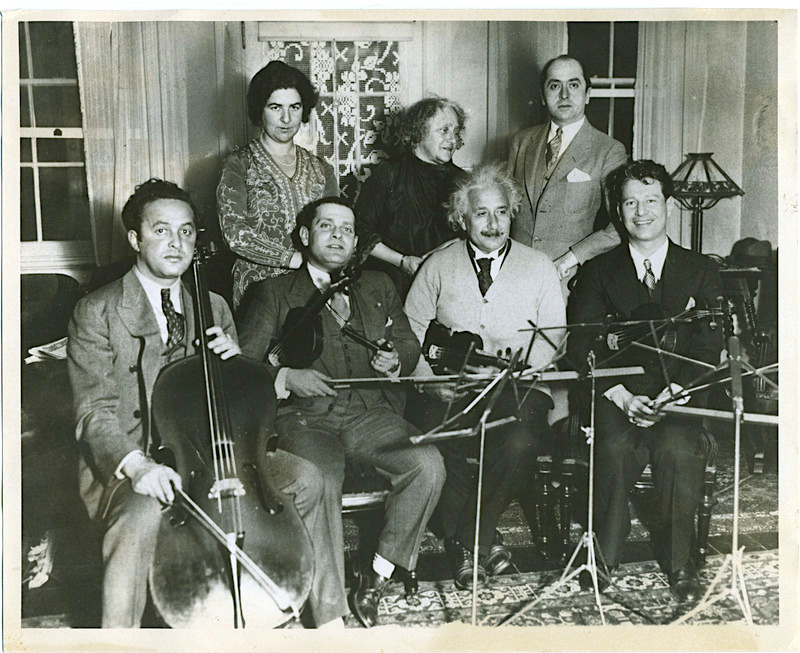
(NY Times, Oct. 18, 1933)EINSTEIN WASN’T FIDDLIN’ AROUND when he played his cherished violin—he once said that if he hadn’t been a scientist, he would have been a musician. This photo was taken at Einstein’s Princeton home in November 1933—he and fellow members of a string quartet were practicing for a December concert at the Waldorf-Astoria to raise money for German-Jewish refugees. From left to right, sitting: Arthur (Ossip) Giskin, Toscha Seidel, Albert Einstein, and Bernard Ocko; standing: Estelle Manheim (Seidel’s wife), Elsa Einstein and unidentified man. (Leo Baeck Institute)
* * *
Stop and Go
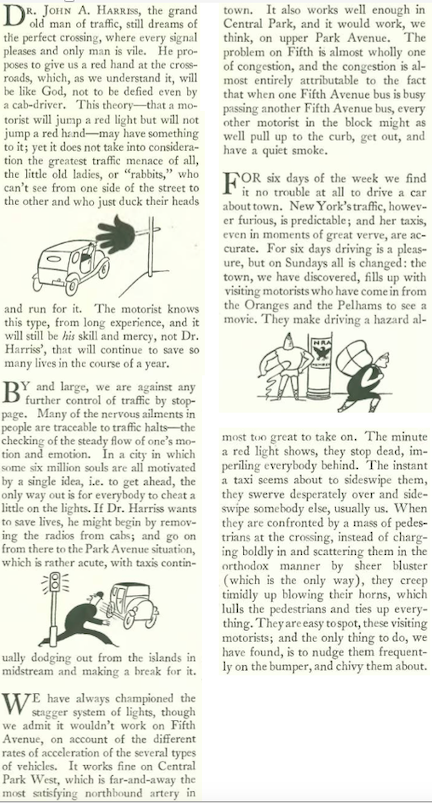
E.B. White devoted his “Notes and Comment” to Manhattan’s traffic situation, which he found manageable as long as tourists stayed out of the way…
White also noted the perils of Park Avenue, especially the taxi drivers (distracted by those newfangled radios) darting between the islands…
Park Avenue in the 1930s. (geographicguide.com)
…and then there was Fifth Avenue, notorious for traffic jams, made worse on weekends by the tourist traffic…
Fifth Avenue in 1932. (New York State Archives)
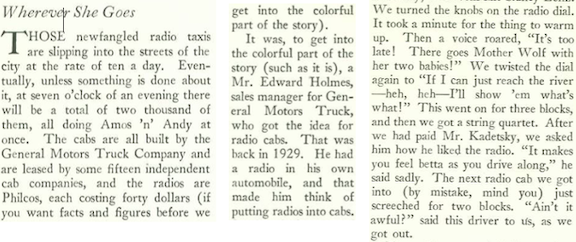
…later in “The Talk of the Town” White continued his thoughts on New York taxis, namely the introduction of coin-operated radios installed for use by passengers…
* * *
Fly Newark
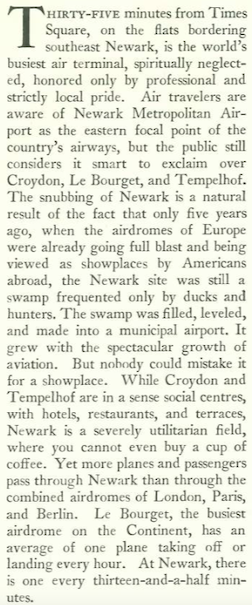
Albert L. Furth took us off the mean streets and into the air when he filed this account about the Newark Metropolitan Airport for “A Reporter at Large.” Furth seemed put off by the cachet of European airports and their many amenities, given that the Newark airport—although admittedly utilitarian—was the busiest in the world. An excerpt:
FREQUENT FLIER…Albert Furth noted that Newark Municipal Airport logged a landing or departure every thirteen-and-a-half minutes. Above, passengers boarding a Boston-bound American Airlines Condor at Newark Airport in 1930. In those simpler times, passengers just walked to the runway and climbed on board. The airport had opened two years earlier on 68 acres of reclaimed swampland along the Passaic River. It was the first major commercial airport in the New York metro area and the first anywhere with a paved runway. (njmonthly.com)
* * *
Goodnight, Speakeasy
Lois Long was an 17-year-old Vassar student when Prohibition went into effect in 1919, so when she started her career in New York in 1922 the only nightlife she knew revolved around speakeasies. Although she held Prohibition officers in disdain, she also believed that the repeal of the 18th Amendment would lower the quality of New York nightlife—the food, the “adroit service,” and the “genial din” of the speakeasy. Excerpts:
FROM LOUCHE TO LEGAL…Lois Long was saying a sad goodbye to her beloved speakeasies; perhaps the Algonquin Hotel (here, circa 1930) would offer some cheer. (Pinterest)
* * *
From Our Advertisers
Abercrombie & Fitch (then an outfitter for the elite outdoorsman) was offering holiday shoppers everything from multi-tool knives to cocktail shakers…
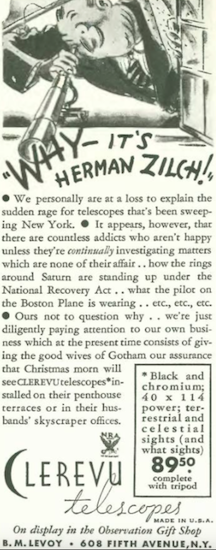
…while the folks at Clerevu telescopes found a growing market for folks who used their product for anything but stargazing…
…with Repeal just days away, the Pleasant Valley Wine Company of New York hoped folks would pop a few of their corks before the good stuff arrived from France…
…the British were coming to the rescue via the Berry Brothers, who were overseeing the importation of liquor from their offices at Rockefeller Center’s British Empire Building…
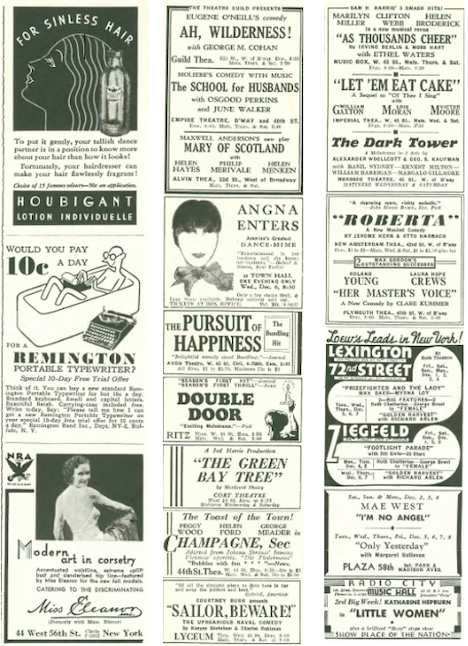
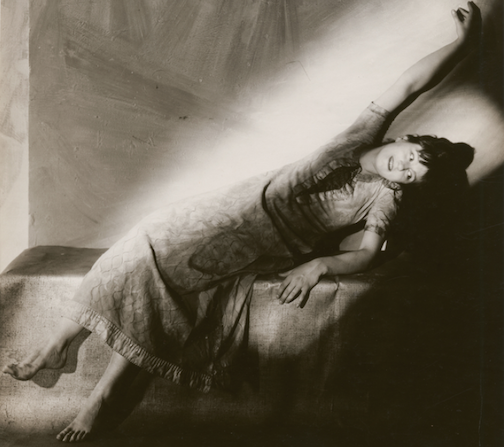
…let’s look at an assortment of one-column ads…the center strip features an ad promoting Angna Enters’ appearance for “one evening only” at The Town Hall (123 West 43rd Street)…Enters (1897–1989) was an American dancer, mime, painter and writer who likely performed her piece Moyen Age…
FEEL THAT STRETCH…Angna Enters performing Moyen Age, circa early 1930s. (NYPL)
…we begin our cartoons with Gardner Rea, and a dedicated bell ringer…
…Otto Soglow showed us a softer side of The Little King…
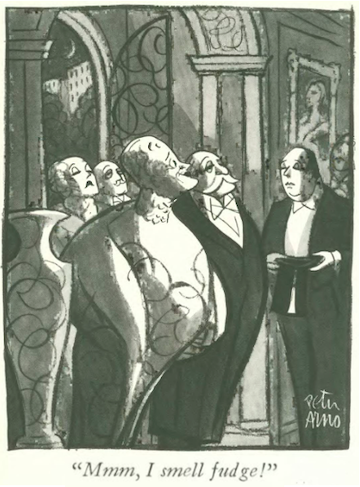
…Peter Arno revealed the human side of the posh set…
…and we close the Dec. 2 issue with this classic from James Thurber…
…on to Dec. 9, 1933, and a cover by an artist we haven’t seen in awhile, Ilonka Karasz…
Dec. 9, 1933 cover by Ilonka Karasz.
…and we open with this comment by E.B. White, who along with critic Lewis Mumford had once voiced displeasure over the massive Rockefeller Center project. However, while viewing the floodlit tower by night, he decided that he would have to eat his words, observing how “the whole thing swims up tremendously into the blue roxyspheres of the sky”…
MEA CULPA…E.B. White gained a new perspective on Rockefeller Center, pictured here in December 1933. (Wikipedia)
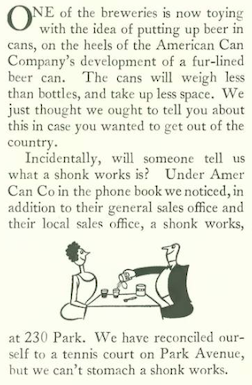
…we continue with White, who also offered his thoughts on something heretofore unthinkable—a proposal to start putting beer in cans…
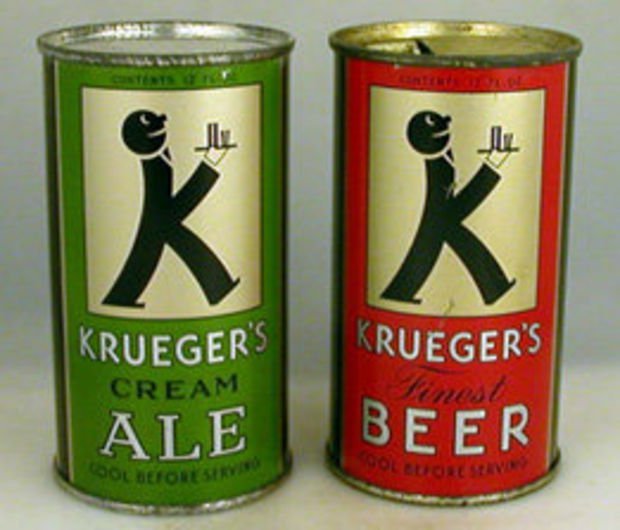
…it would happen about a year later…on Jan. 24, 1935, the Gottfried Krueger Brewing Company, in partnership with the American Can Company, delivered 2,000 cans of Krueger’s Finest Beer and Krueger’s Cream Ale to drinkers in Richmond, Virginia…
(seletyn.com)
…and despite White’s doubts, apparently ninety-one percent of the first drinkers of the product approved of the canned beer, although when Krueger’s launched their ad blitz they had to include instructions (and a new tool) to open the darn things…
(seletyn.com)
* * *
Dreamscapes
Critic Lewis Mumford offered his thoughts on a recent exhibit by a young surrealist named Salvador Dali…
MIDDLEBROW SURREALIST…The Triangular Hour by Salvador Dali, 1933. (wikiart.org)
…and we move along to moving pictures, where John Mosher was showing some appreciation for Joan Crawford (1906–1977) in the pre-Code film Dancing Lady…
SHE HAD IT ALL…Audiences and critics alike were wowed by Joan Crawford’s performance in Dancing Lady, which featured a star-studded and eclectic cast. Clockwise from top left, Clark Gable plays a Broadway director who becomes Crawford’s love interest; Crawford displays her dancing talent in a Broadway rehearsal; Dancing Lady featured an early film appearance by The Three Stooges, pictured here with Gable and the Stooges’ leader at the time, Ted Healy; Crawford with Stooge Larry Fine—in the original film, Fine completes his jigsaw puzzle only to discover (to his disgust) that it’s a picture of Adolf Hitler. The Hitler scene was removed by the Production Code; its enforcers claimed it insulted a foreign head of state. (IMDB)
In addition to Crawford, the star-studded cast included Clark Gable, Fred Astaire (in his film debut), Franchot Tone (who was married to Crawford from 1935-39 and made seven movies with her), The Three Stooges, Nelson Eddy, and Robert Benchley, who played a reporter in the film.
Dancing Lady was the film debut of Astaire, making Crawford the first on-screen dance partner of the famed hoofer…
(IMDB)
* * *
More From Our Advertisers
We begin with this full-page advertisement from Heinz, which went to great lengths and expense to make their ad appear to part of The New Yorker’s editorial content, even featuring a Perry Barlow cartoon of a boy making a mess with their product…
…another New Yorker contributor who occasionally went over to the advertising side was Alexander Woollcott, here shilling for Chrysler…
…Kayser, purveyor of women’s hosiery and underthings, was going for some humorous holiday cheer, but the effect is a bit unsettling…
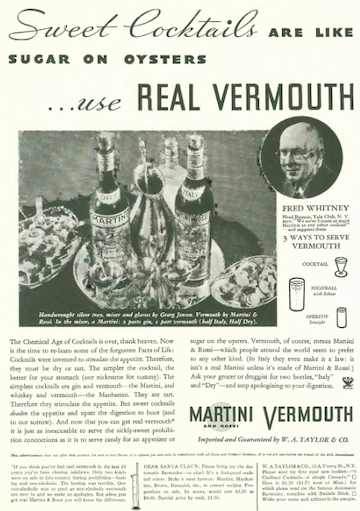
…liquor-related ads began to proliferate with the end of the Prohibition…this one from Martini & Rossi…
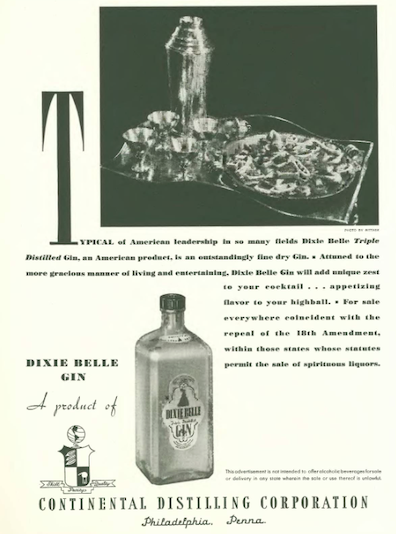
…Continental Distilling was hoping to grab its share of gin sales with its Dixie Belle American gin…
…from the same folks who brought us Fleishmann’s yeast (and kept The New Yorker afloat in its early lean years) came this American dry gin…
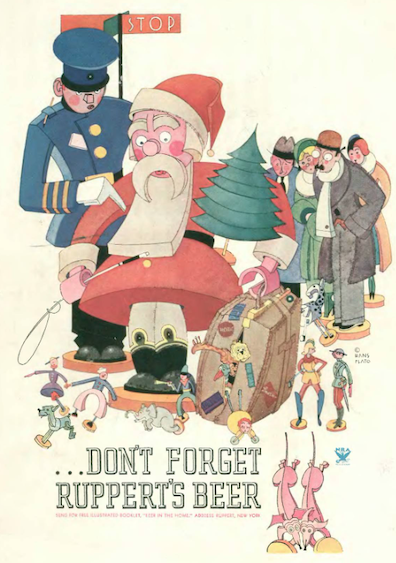
…Ruppert’s Beer was back with another full-page color ad by Hans Flato…
…on to our cartoons, and Santa again, this time besieged by an aggressive tot as rendered by Helen Hokinson…
…Carl Rose found an unlikely customer at a newsstand…
…here is the last of four cartoons Walter Schmidt published in the New Yorker between 1931 and 1933…
…Peter Arno left his glamorous world of nightclubs and high society parties to look in on life at a boarding house…
…and we close with the delightful Barbara Shermund…




























 A New Yorker State of Mind