Quite a Month

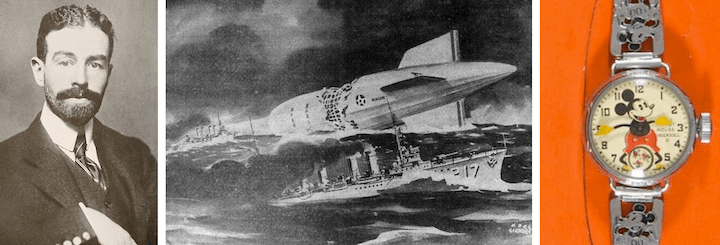
ABOVE: E.B. White presented us with a mixed bag of February happenings, from the comings and goings of Neily Vanderbilt to the Macon disaster and the economic power of Mickey Mouse.

The title for this entry comes from E.B. White’s “Notes and Comment” column, which kicked off the Feb. 23, 1935, issue with a quick rundown of February events.
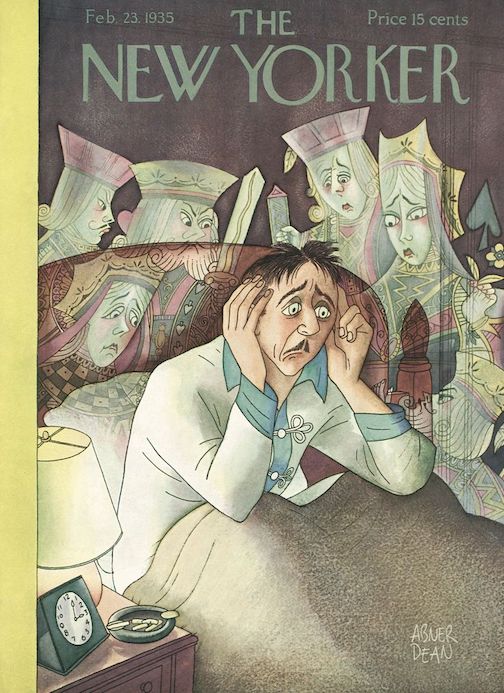
Feb. 23, 1935 cover by Abner Dean.

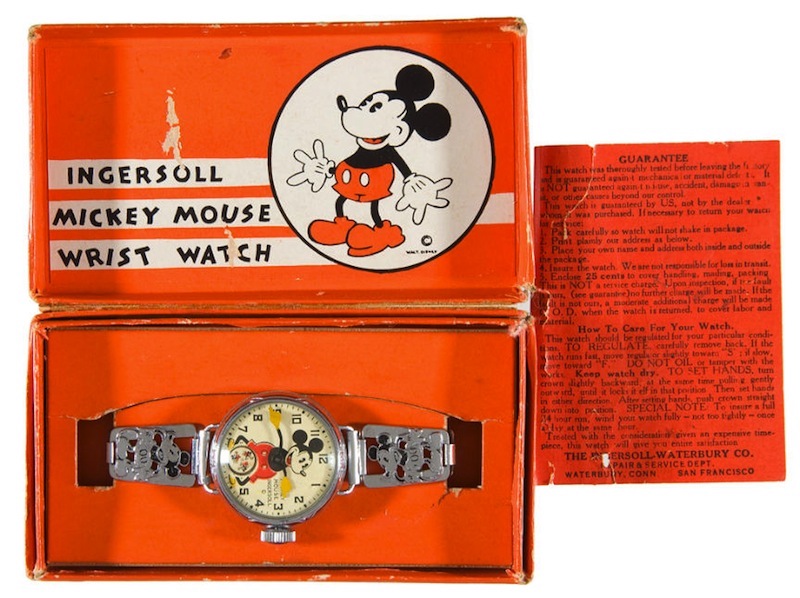
February notably marked the end of the Bruno Hauptmann trial. Convicted of the abduction and murder of the infant son of Charles and Anne Morrow Lindbergh, Hauptmann would go to the electric chair on April 3, 1936. White also noted the return of Admiral Richard Byrd from his second Antarctic expedition, the demise of the U.S. Navy airship U.S.S. Macon, and the economic miracle of the Mickey Mouse watch.


FLYING AIRCRAFT CARRIER…The US Navy’s 785-foot rigid airship USS Macon could launch and retrieve up to five airplanes in mid-flight. Known as “parasitic fighters, the Sparrowhawks were hung from a rail system inside the airship. On Feb. 12, 1935 the Macon crashed in a storm off the coast Point Sur, California. Only two of the 66 crew were lost. Photos above, clockwise from top left, show the deployment of a Sparrowhawk; the USS Macon over New York City in 1933; crew pose for a photo in the dirigible’s hanger; photo from the wreckage discovered in 2006—the pre-1941 pattern U.S. roundel emblem still recognizable. Sky-hook also visible. (sanctuaries.noaa.gov/macon/Sunnyvale Historical Society)
TIME WAS RUNNING OUT for the Ingersoll Waterbury Company (now known as Timex) during the Great Depression. It was saved from bankruptcy, in part, by the introduction of the Mickey Mouse watch. (connecticuthistory.org)

White also made note of the comings and goings of Cornelius “Neily” Vanderbilt III (1873–1942), who was saying farewell to Fifth Avenue (although he would return to live out his life there), while New Yorkers were apparently saying farewell to the Park Avenue Tunnel (aka Murray Hill Tunnel). After more than 190 years it is still there, now serving a single lane of northbound traffic from 33rd to 40th Street.

TUNNEL VISION…Park Avenue Tunnel in 1890 (top) and in 2013 during a Voice Tunnel art installation. The nearly two-century old tunnel was made open to pedestrians for the first time in coordination with the annual Summer Streets event which began in 2013. (viewing.nyc/Wikipedia)

 * * *

Getting An Earful

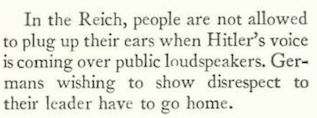
Howard Brubaker, in his column “Of All Things,” made this observation of deepening repression taking place in Nazi Germany…
 * * *

Try Our Knockout Cheesecake

Lois Long continued her chronicle of New York night life, in this excerpt making note of the celebrity gawkers at Jack Dempsey’s tavern/restaurant near Madison Square Garden. Apparently Dempsey’s place was renown for its cheesecake…

PLEASED AS PUNCH…Heavyweight boxing champ Jack Dempsey opened his restaurant at 50th Street and Eighth Avenue in 1935 (bottom photo) before moving to Broadway’s Brill Building in 1937 (top). According to Ephemeral New York, “In the restaurant’s early years, Dempsey was known to hold court at a table, a legendary figure greeting customers and glad-handling guests.” (Ephemeral New York)

 * * *

From Our Advertisers

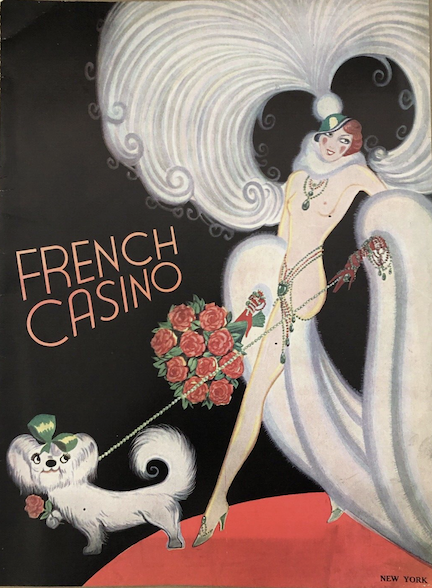
The refurbished Earl Carroll Theatre (7th Ave. and 50th St.) opened as the French Casino late in 1934. The art deco theatre’s first show was the Revue Folies Bergères, promoted here in this small ad on page 54 in the Feb. 23 issue…
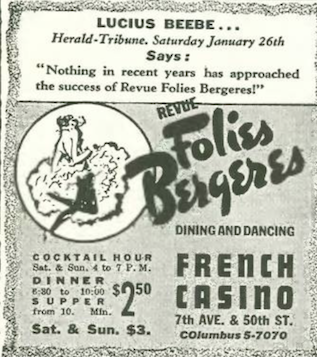
…the menu’s cover suggests patrons weren’t there for the cheesecake (yes, there is a pun, but I’m not touching it)…
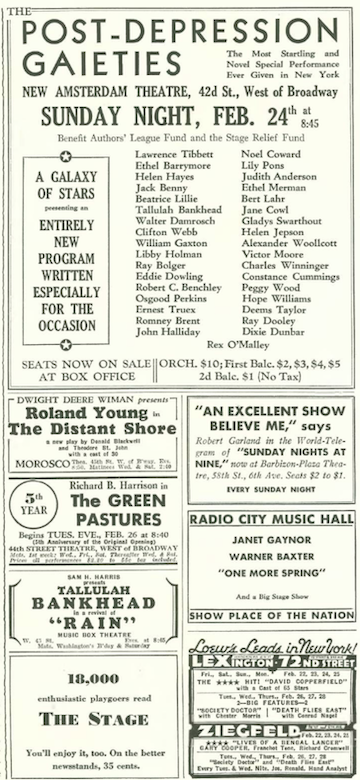
…another ad in the back pages touted the “Post-Depression Gaities” at the New Amsterdam Theatre with an impressive roster of stars including New Yorker notables Robert Benchley and Alexander Woollcott

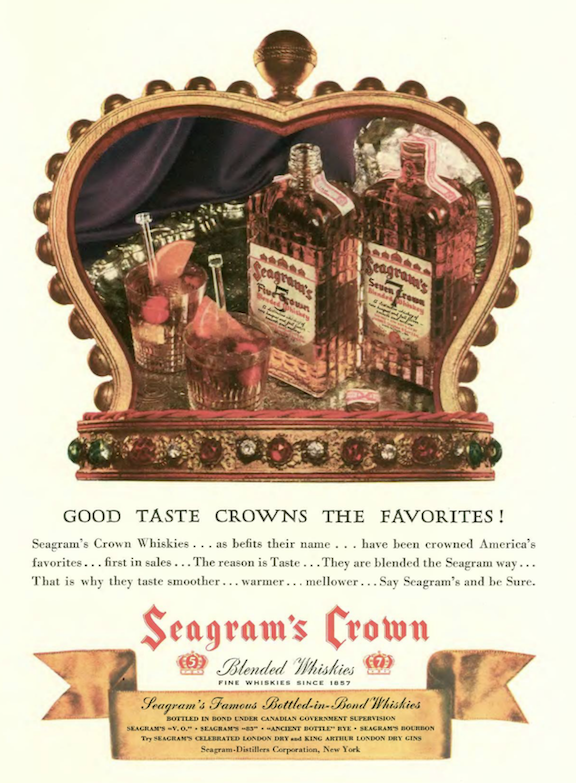
…following Prohibition, Seagram introduced two blended whiskies—5 Crown and 7 Crown. Seagram 5 Crown was discontinued in 1942, while Seagram 7 would go to become the first million case brand in U.S. history…
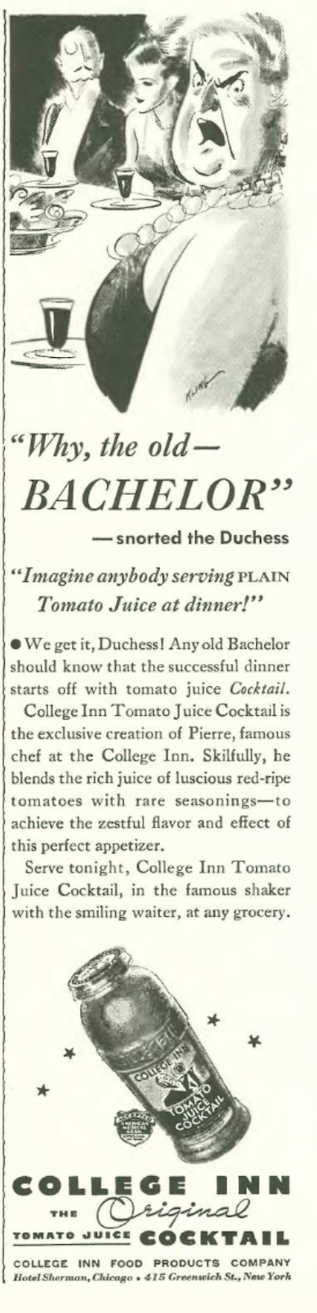
…this one-column ad caught my eye for the rendering of the stereotypic ill-tempered matron, here having a fit over tomato juice…
…coming from an old and influential New York family, it’s hard to believe Elizabeth West Post Van Rensselaer thought about Campbell’s soup when her daughter, Elizabeth, fell seriously ill…at any rate, something must have worked because her daughter lived until 2001…

…For a time “Chief Pontiac” served as a logo for the Pontiac line of automobiles, discontinued by GM in 2010…
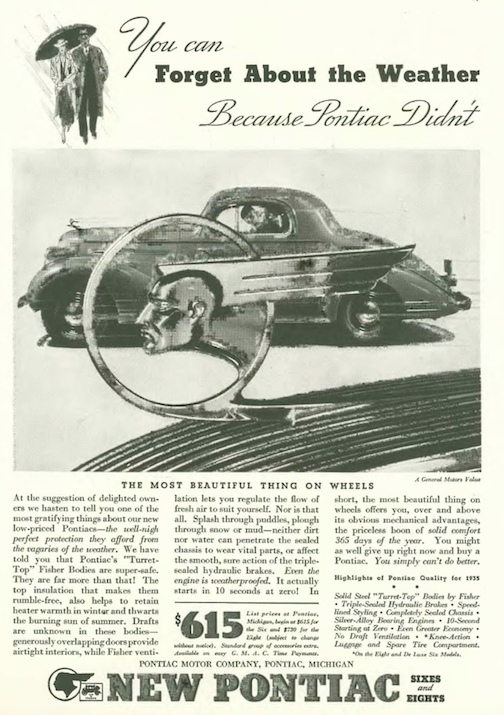
…many automobile advertisements of this era emphasized safety, none more prominent than the “Body by Fisher” ads that frequently featured happy little children…oddly, no one had yet considered seat belts, car seats or other safety measures we now take for granted…

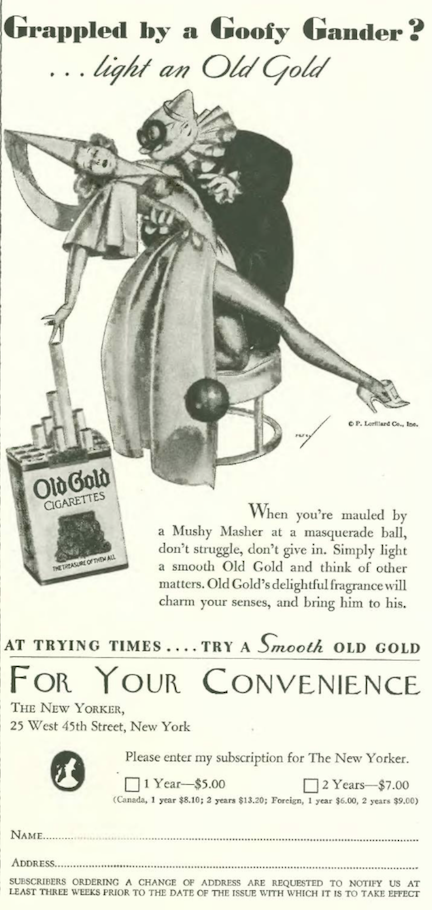
…the makers of Old Gold cigarettes (Lorillard) ran a series of ads featuring a sugar daddy and his leggy mistress…they were drawn by George Petty (1884–1975), famed for his “pin-up girls”…as an added bonus below the ad, you could renew your New Yorker subscription—two years for seven bucks…
…the makers of Camels kept it classy with their continuing series of society women enjoying their unfiltered “Turkish & Domestic” blend…
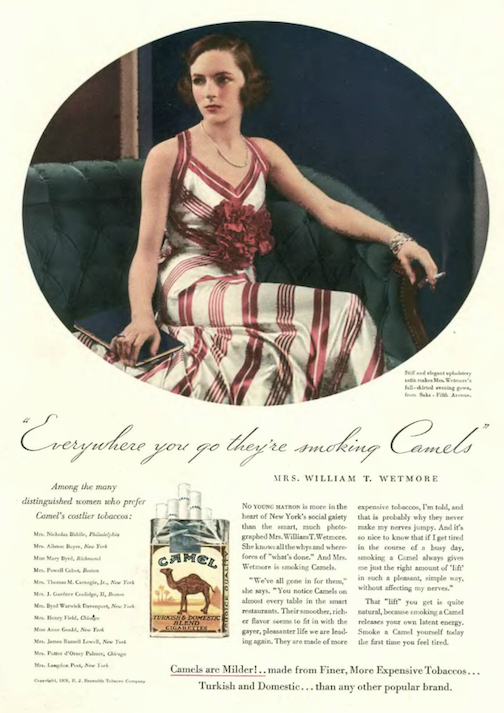
…the “young matron” in the ad, the Sydney, Australia-born Joan (Deery) Wetmore (1911-1989), was indeed “much-photographed,” and was a favorite of Vogue photographer Edward Steichen:

Detail from a Steichen photo of Joan Wetmore, taken in Rockefeller Center’s Rainbow Room, 1934. (Condé Nast)

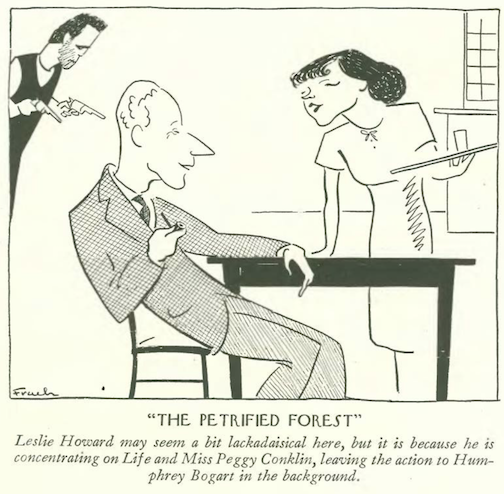
…on to our cartoonists, Al Frueh illustrated Humphrey Bogart as the coldblooded killer Duke Mantee in the 1935 play The Petrified Forest; the 1936 film adaptation would be Bogart’s breakout role in the movies…
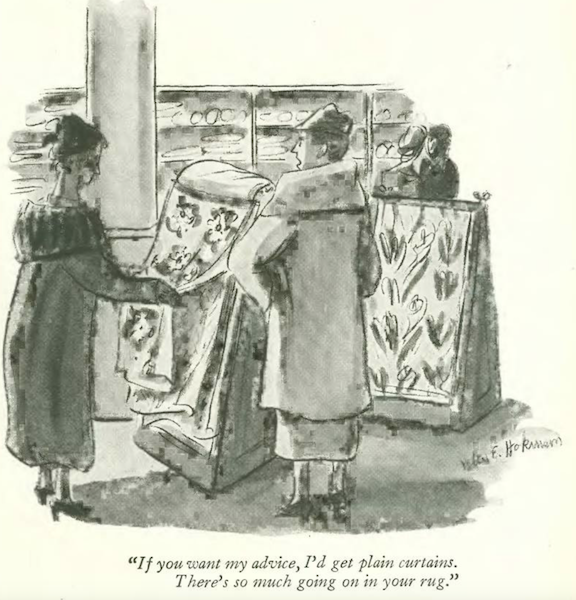
Helen Hokinson went shopping for drapes…
George Price was all tied in knots…

…and still up in the air…
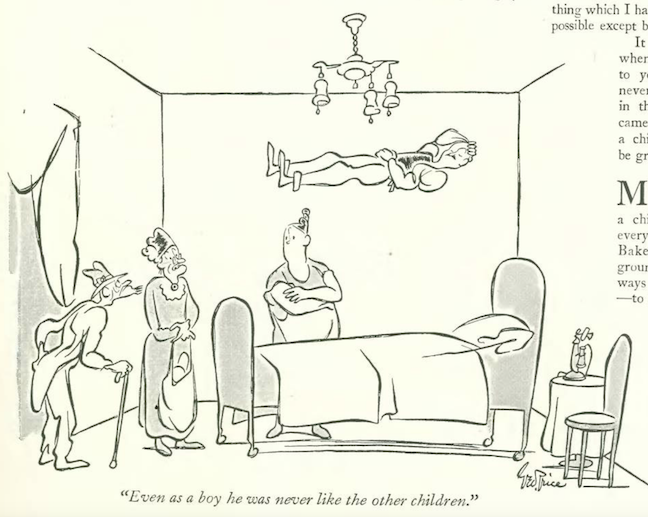
Barbara Shermund dreamed of Venice…

James Thurber gave us the life of the party…
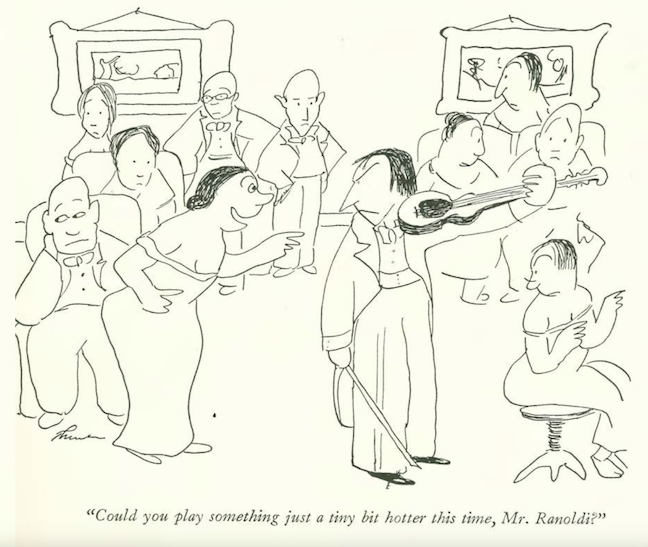
…and we close with Leonard Dove, and some unexpected party life…
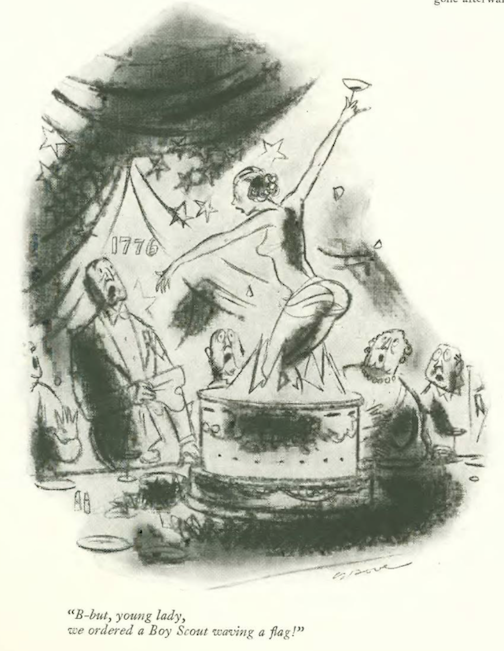
Next Time: The Mouse Roars, In Color…
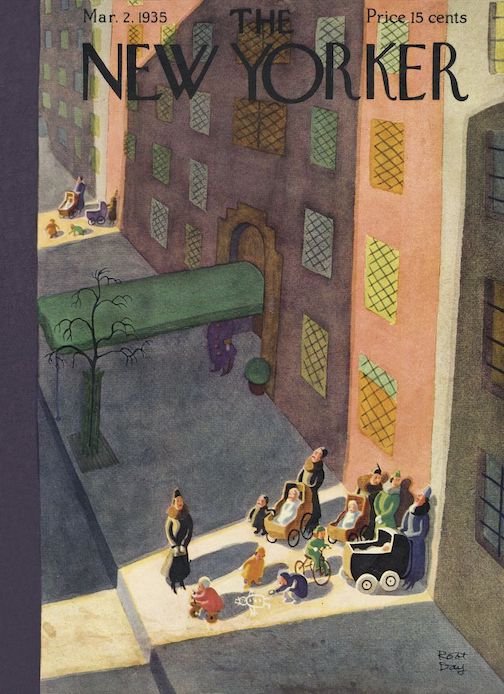
A Century and a Decade

Above: The first three issues of The New Yorker, an Al Frueh cover (#2) sandwiched between Rea Irvin covers.

The current team at The New Yorker has put together a great read (Feb. 17 & 24, 2025) to mark the magazine’s centennial. I’m still reading, but what I have seen so far is first rate, including Jill Lepore’s insightful “War of Words” (chronicling the battles between editors and writers over the years) and David Remnick’s look back at those first years of struggle in “The Talk of Town.”

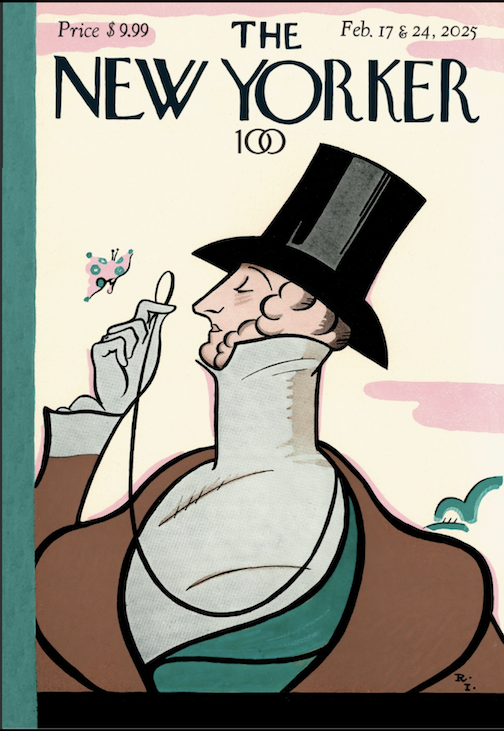
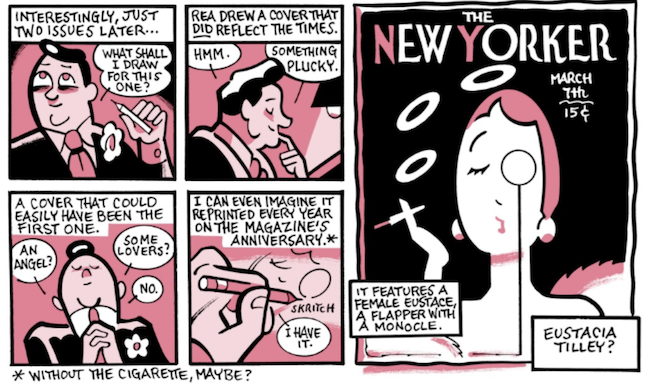
I was glad to see the return of the Rea Irvin cover (appended with the “100”), but was a bit disappointed to see “Talk” headed by the re-draw of Irvin’s original art. Oh well, you can’t have it all. However, Seth’s “Appreciation” of Irvin was wonderful. Here is a little clip:

DOUBLE TAKE…Seth’s “Appreciation” of Rea Irvin in the centennial issue notes the relationship between those first two Irvin covers. Bravo!

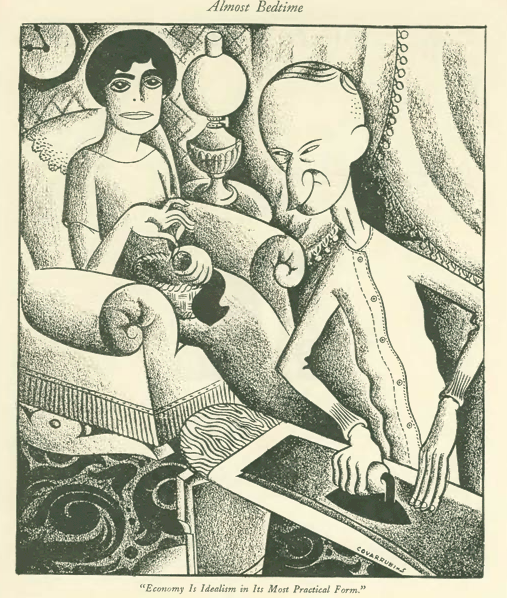
The joy of writing this blog is the vicarious pleasure found in the deep reading of every issue, as well as occasional historical insights into how we have arrived at our present day. It has also been rewarding to follow the maturation of the magazine from its first issue, which was a bit of a jumble (see my previous post). However, what we see in Issue #1 and in subsequent issues were subjects The New Yorker found worthy of attention in 1925, whether they were frequent potshots at publisher William Randolph Hearst or the many comic possibilities of President Calvin Coolidge, here rendered by Miguel Covarrubias in the March 14, 1925 issue…

Harold Ross cronies and various Algonquin Round Table stalwarts were also frequent subjects of the early magazine…Covarrubias again, with a rendering of Ross pal Heywood Broun in the March 7, 1925 issue (#3)…

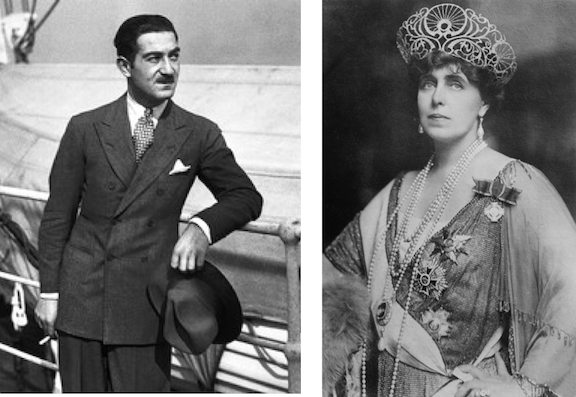
The first issues also featured frequent references to celebrities of the day, some still known to us while others have faded into the mists of time, such as the “literary lion” Michael Arlen (March 28, 1925) and Queen Marie of Rumania, the March 14, 1925 issue noting that New York was “agog” about her possible visit.

CELEBS OF THEIR DAY…Writer Michael Arlen (aka Dikran Kouyoumdjian) and Queen Marie of Rumania were prominent in the pages of the early New Yorker. 

The June 6, 1925 issue even featured the Queen in a Pond’s cold cream ad…

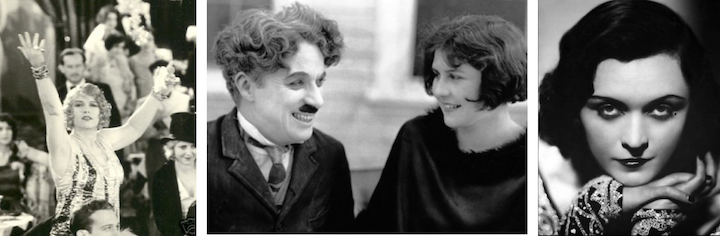
The leading lady of New York’s nightlife, Texas Guinan, was also prominent in those early issues. Her 300 Club, constantly raided by Prohibition-era police, was a favorite of Broadway and Hollywood agents. Another frequent subject was the life of Charlie Chaplin, mostly due to his scandalous marriage to sixteen-year-old Lita Grey when he was thirty-five. Then there was Pola Negri, Polish stage and screen star and headliner of gossip magazines that followed her series of love affairs that included Chaplin and Rudolph Valentino.

GOSSIP FODDER OF ’25…From left, Texas Guinan reigned supreme as Queen of the Speakeasies during Prohibition; Charlie Chaplin’s teen bride Lita Grey kept tongues wagging, as did the off-screen antics of the volatile Pola Negri.

The Scopes “Monkey Trial” was also big news at the time, and The New Yorker had a heyday with the populist firebrand William Jennings Bryan. Here Rea Irvin joined in on the fun:

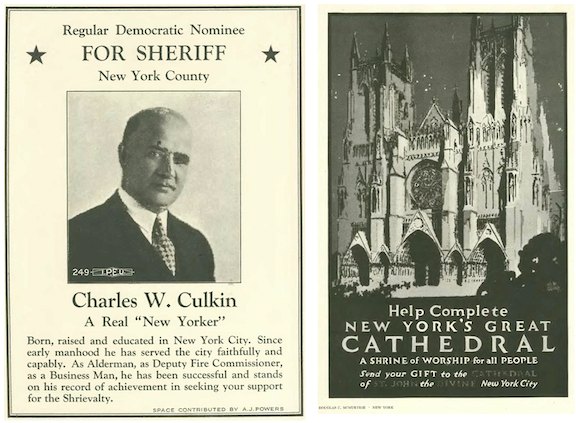
In those lean first months advertisers were hard to come by, and during this time we see a few oddballs…

From left, ads from Sept. 19, 1925 and April 18, 1925. Charles Culkin, a Tammany Hall politician, would serve as county sheriff from 1926 to 1929. He would also embezzle interest money from the sheriff’s office, part of the whole mess that would bring down Mayor Jimmy Walker.

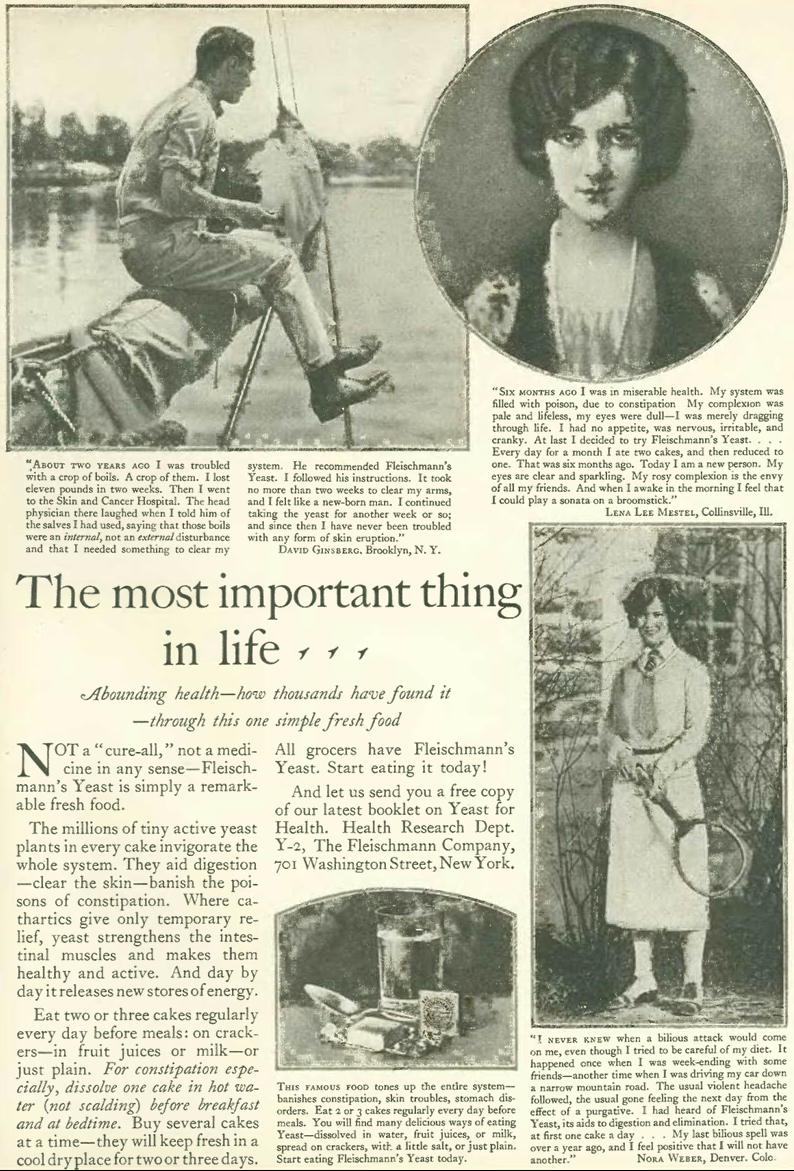
…there were regular ads for Fleischmann’s Yeast (this example from Sept. 19, 1925)…Raoul Fleischmann hated the family baking business but loved hanging out with the Algonquin Round Table gang. When the fledging magazine nearly went belly up in 1925, Fleischmann kicked in the money (and on a number of occasions thereafter) to keep it going. Hence the advertising for his yeast cakes, touted not as a baking aid, but rather as a cure for constipation and other intestinal turmoils…

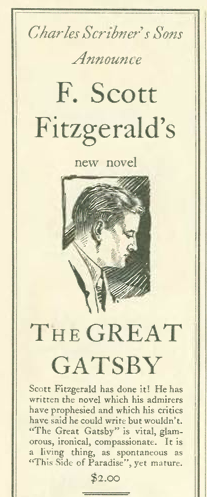
…and it’s a kick to see ads like this (from April 18, 1925), a modest little one-column spot for what some consider to be the Great American Novel… The Great Gatsby would receive a brief, lukewarm review from The New Yorker…

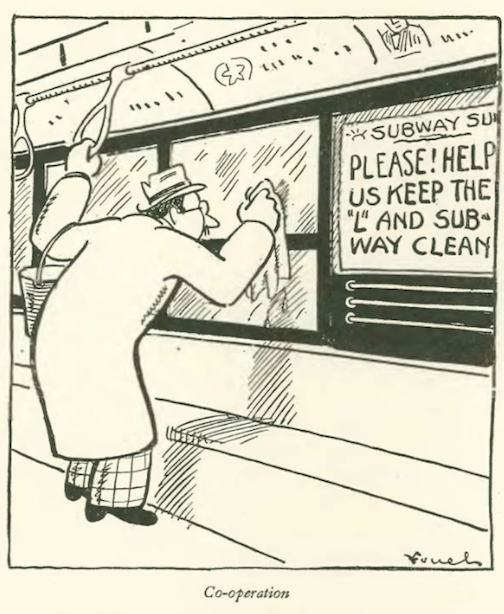
…and then there were those early cartoons and illustrators…as noted before, the very first was by Al Frueh

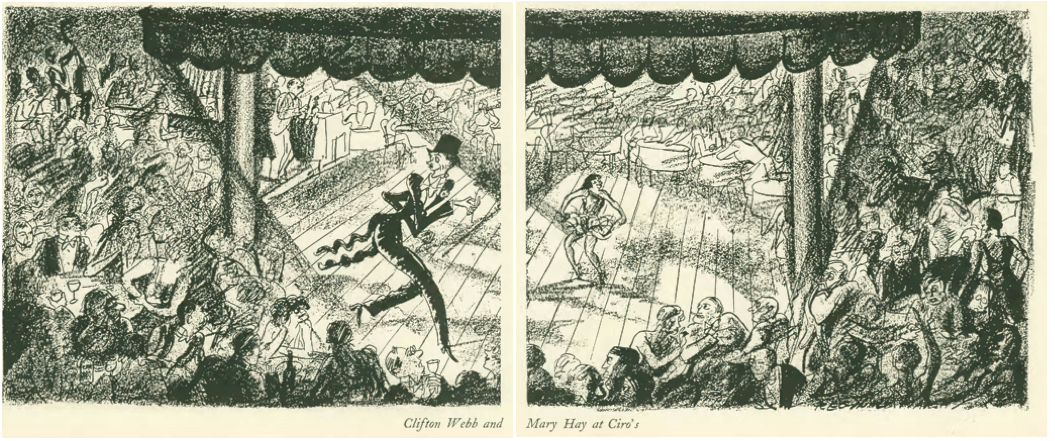
Reginald Marsh would make his first appearance in Issue #2…a social realist painter, Marsh was a prolific contributor to The New Yorker from 1925 to 1944…

…a number of the early cartoons resembled the captioning style of the British Punch…here is an April 4, 1925 contribution by the British illustrator Gilbert Wilkinson…

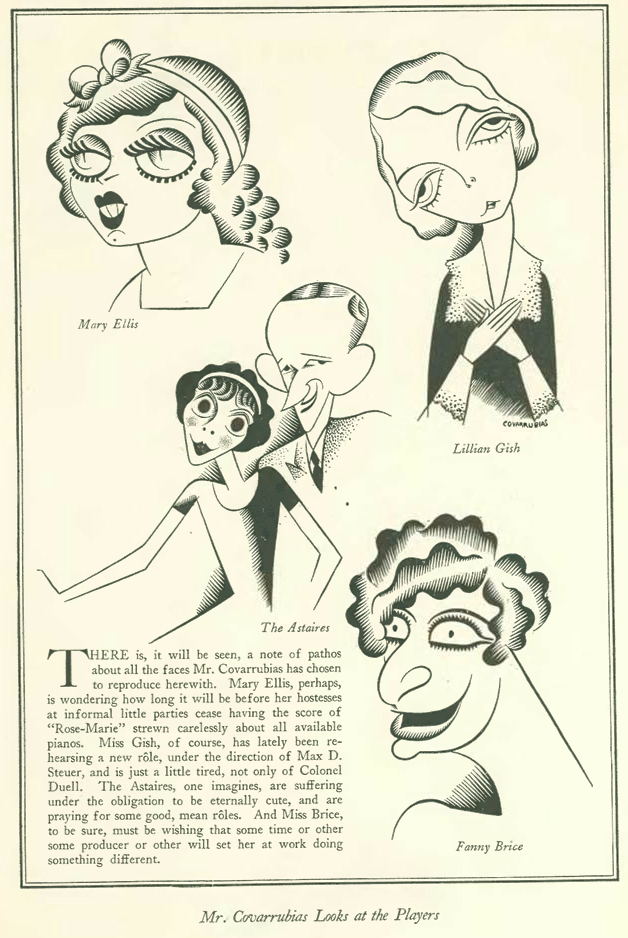
…In the April 11, 1925 issue, Miguel Covarrubias offered these caricatures of 1920s celebrities…

…another contributor from the April 11 issue, Hans Stengel…

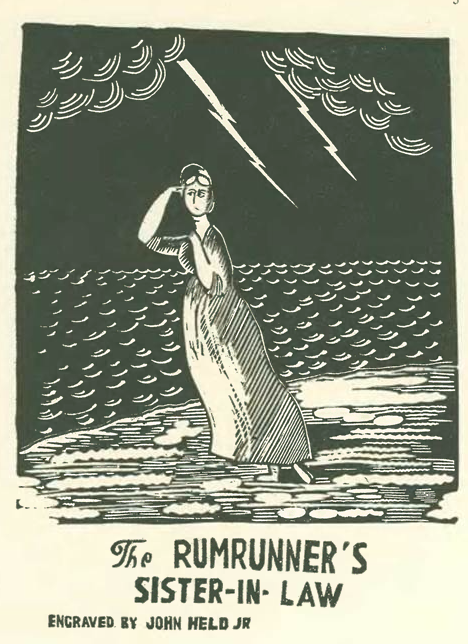
…and John Held Jr supplied the first of his many woodcuts in the April 11 issue…

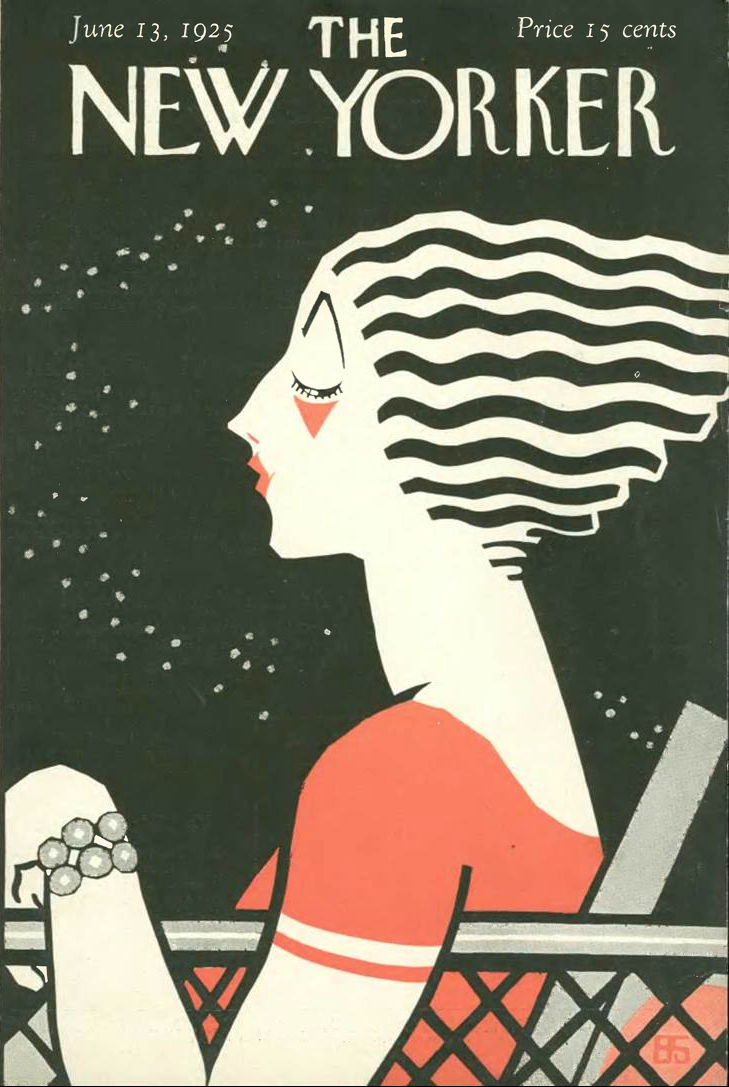
Barbara Shermund found her way onto the June 13, 1925 cover, the first of nine covers she would contribute to magazine, along with hundreds of cartoons…

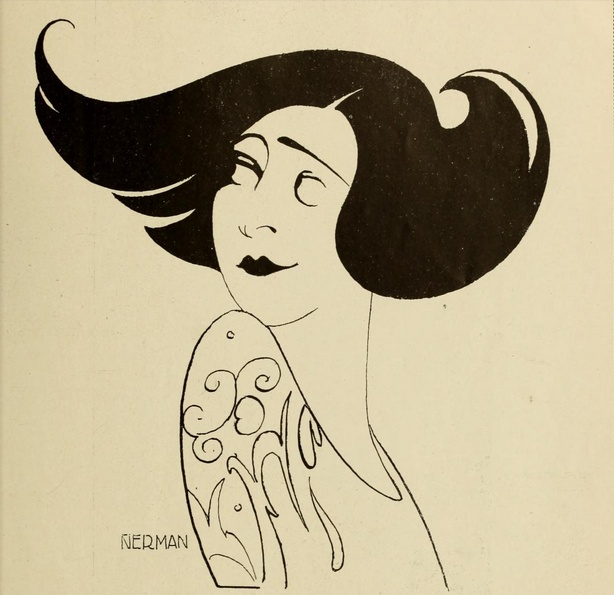
From the June 27, 1925 issue, this is one of my favorite illustrations. In The New Yorker’s “Critique” section, a terrific caricature of Russian-American actress Alla Nazimova, by Swedish artist Einar Nerman

…another early contributor, Johan Bull, was especially prolific in providing spots for sports columns. Here in the July 11, 1925 issue he contributed this rare multi-panel cartoon…

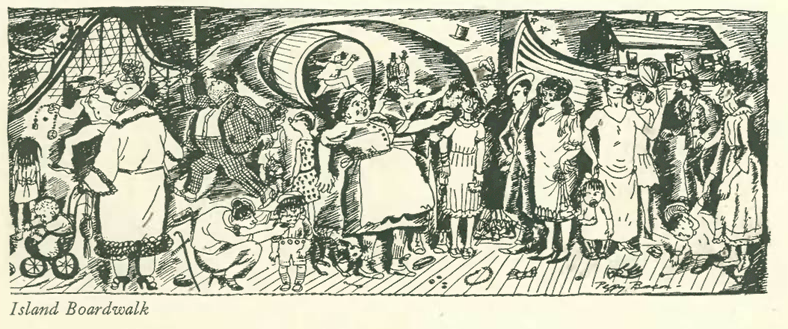
Peggy Bacon was another early contributor, here from July 18, 1925…

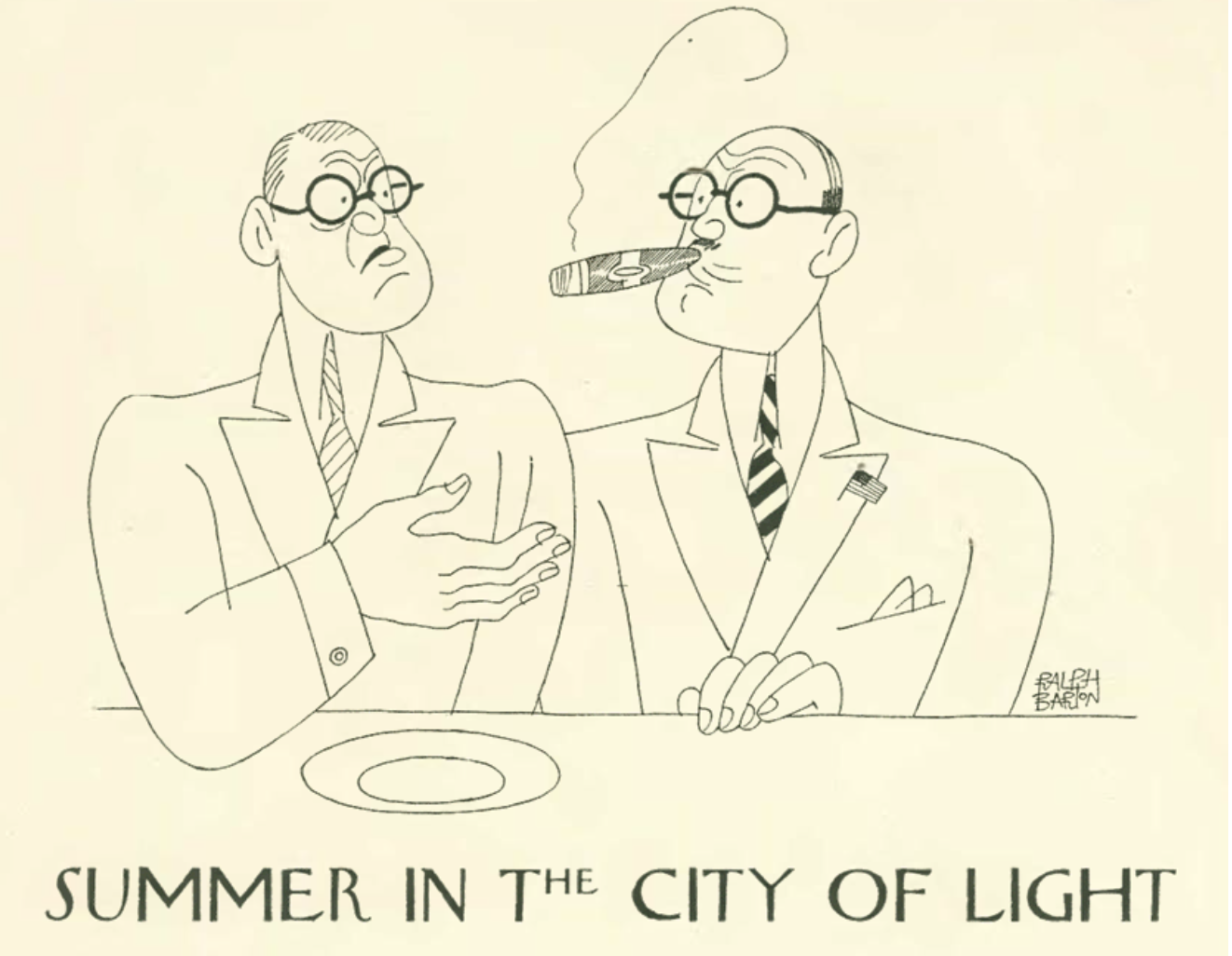
…and of course there was Ralph Barton, listed as one of The New Yorker’s original “Advisory Editors,” contributing several different features including “The Graphic Section,” a satiric take on new trends in photojournalism, and this July 4, 1925 feature on the various ways of Europeans, written and illustrated by Barton…here is a clip from that feature…

…I can’t include all of the first cartoonists who contributed to those critical first months, so I will end with dear Helen Hokinson, and her first New Yorker contribution, a spot illustration for “The Talk of the Town” in the July 4, 1925 issue…

Next Time: Quite a Month…

A Centennial to Remember

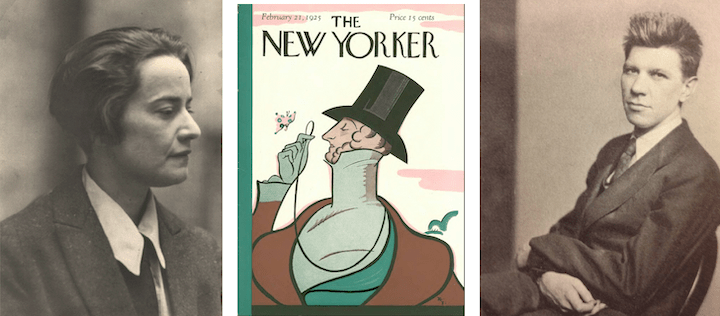
ABOVE: Although Harold Ross looms large in most accounts of the early New Yorker, his wife at the time, Jane Grant, played a major role in its conception and launch.

After a year hiatus, during which I changed jobs (yes, I’m still “hewing the wood and drawing the old wet stuff,” as Bertie Wooster would put it), I am returning to A New Yorker State of Mind, just in time for the 100th anniversary of the greatest magazine in the world.

Issue #1 cover by Rea Irvin, Feb. 21, 1925.

Before I continue where I left off—the tenth anniversary issue, Feb. 15, 1935—let us mark the magazine’s centennial year with a look back at the first issue, Feb. 21, 1925.

It is remarkable that after a century the magazine still retains its character, even if it is more serious these days, and more topical, and, most egregious, still fiddling with Rea Irvin’s original designs (for more on this issue, please consult Michael Maslin’s Ink Spill. In addition to being one of the magazine’s greatest cartoonists, Maslin offers a wealth of New Yorker insight and history, including his longstanding crusade to restore Irvin’s original artwork for “The Talk of the Town,” which was removed and replaced by a contemporary illustrator’s redraw in 2017).

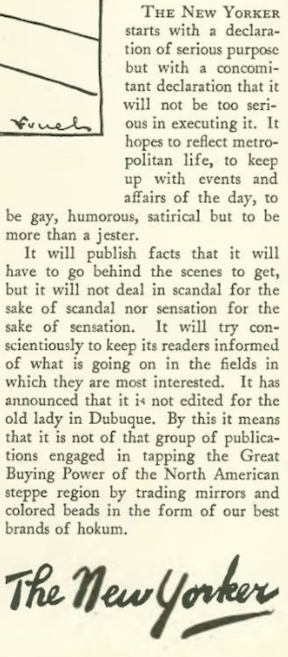
Although founder and editor-in-chief Harold Ross set the tone for the magazine in the first issue, famously proclaiming “that it is not edited for the old lady in Dubuque,” it was Irvin that gave the magazine a signature look that set it apart from other “smart set” periodicals of the day.

It took a few issues for the editors to sort out regular features and their order of appearance. The opening section of Issue No. 1 featured the Irvin masthead—flanked by Eustace Tilley and the night owl—and Irvin’s distinctive typeface that would introduce “The Talk of Town” for many issues to come. However, in that first issue, “Of All Things” appeared under the masthead, followed by “Talk of the Town” which was (for the first and last time) under this banner:

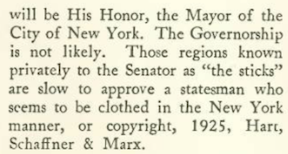
As for Ross’s manifesto, it appeared at the end of “Of All Things,”…

…and “Talk” ended with this signature…

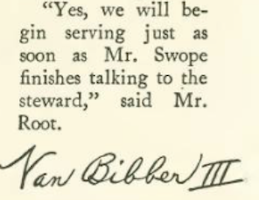
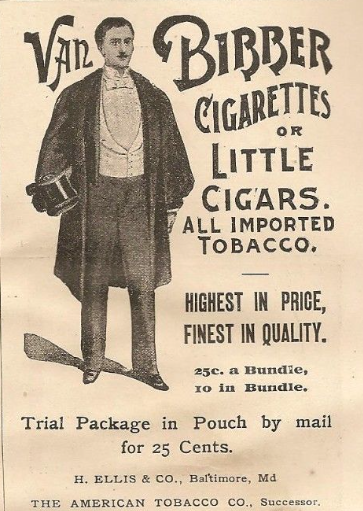
…In Defining New Yorker Humor, Judith Yaross Lee wrote that early readers of The New Yorker would have recognized the Van Bibber III persona “as a joke, a personification of Van Bibber cigarettes, whose ads targeted the devil-may-care, swagger young man about town all dressed up for the opening night. As an insiders view of the urban scene, Van Bibber’s accounts featured casual conversation—that is, talk.”

Van Bibber advertisement in Cosmopolitan, 1896.

The magazine’s very first cartoon was by Al Frueh

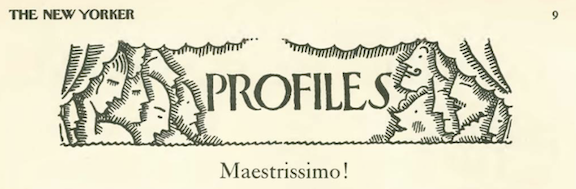
…and among the features that persisted through the years was “Profiles,” the first one featuring Giulio Gatti-Casazza (1869-1940), who served as Metropolitan Opera’s general manager for a record 27 seasons (1908-1935).

The profile featured this illustration by Miguel Covarrubias, the renowned Mexican painter, caricaturist, and illustrator, who was a frequent contributor to the early New Yorker.

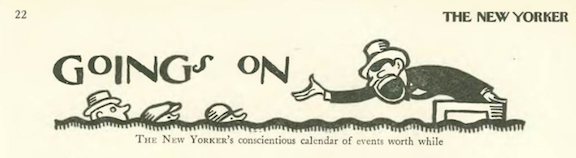
“Goings On” also persists, sans the original artwork…

…the same goes for these sections…

…still others disappeared altogether…

…some would hang around for awhile…

…others for just a few issues…”The Hour Glass” featured brief vignettes of local personalities…

…such as the ever-fascinating antics of Jimmy Walker, who would soon be elected mayor…
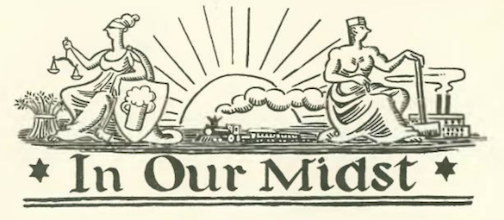
…while “In Our Midst” detailed the comings and goings of other locals…

…including The New Yorker’s own Al Frueh.

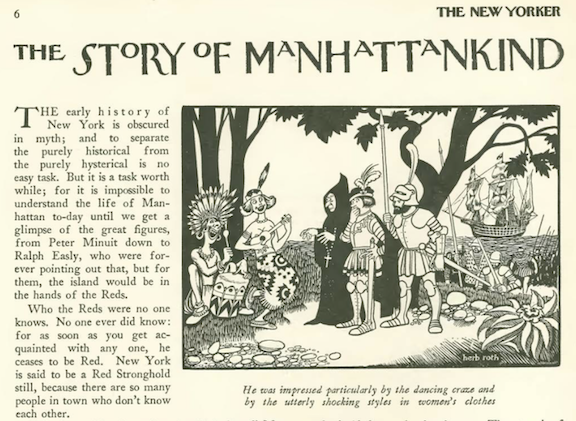
“The Story of Manhattankind” was another short-lived feature. It offered drawings by Herb Roth and tongue-in-cheek accounts of early Manhattan life replete with cartoonish Indians and bumbling settlers. It is here where the magazine took its first of many shots at William Randolph Hearst, the perceived rival and publisher of Cosmopolitan (which was more of a literary magazine in 1925).

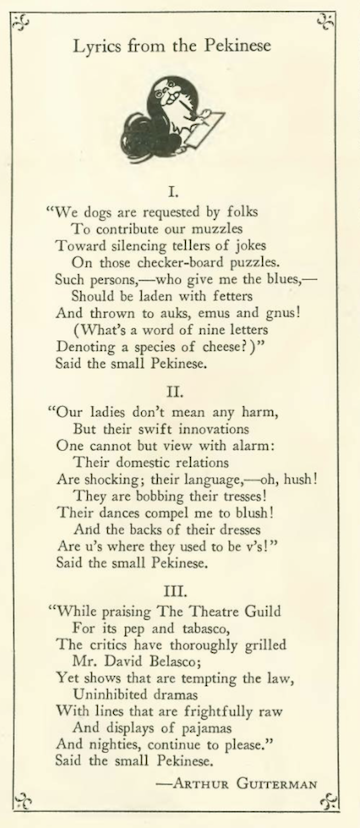
…other items that persisted through the early issues included “Lyrics from a Pekinese” by writer Arthur Gutterman, who was known for his silly poems…

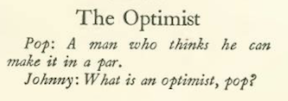
…and this recurring column filler, “The Optimist”…a tired joke featured repeatedly in the first issues until Katharine Angell came on board and put an end to such nonsense…

…in those lean first months there was little advertising, making this back page ad seem out of place…

…since many of the early ads were small, signature ads for theatre and other diversions…

…the magazine also leaned heavily on full-page house ads to fill space…

…the one thing that has persisted to this day is the prominence of cartoonists and illustrators, although in the early issues some of the cartoons resembled those found in Punch, including this one by British graphic artist Alfred Leete, who was a regular contributor to such British magazines including Punch, the Strand Magazine and Tatler.

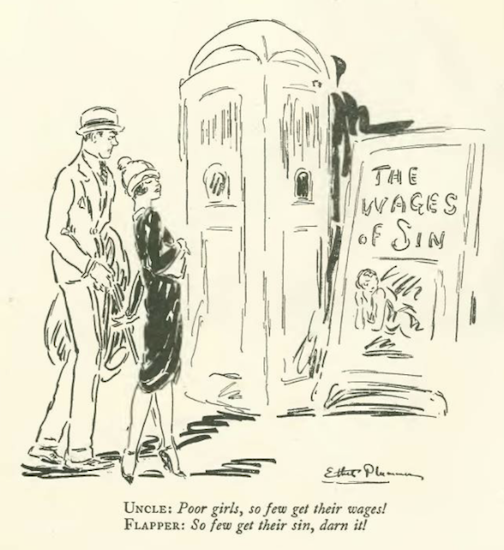
Also in the Punch style there were a number of “He-She” captioned cartoons, such as this Ethel Plummer cartoon of an “uncle” and a “flapper” looking at a theater bill for The Wages of Sin (most notably, Plummer was the first woman artist published in The New Yorker)…

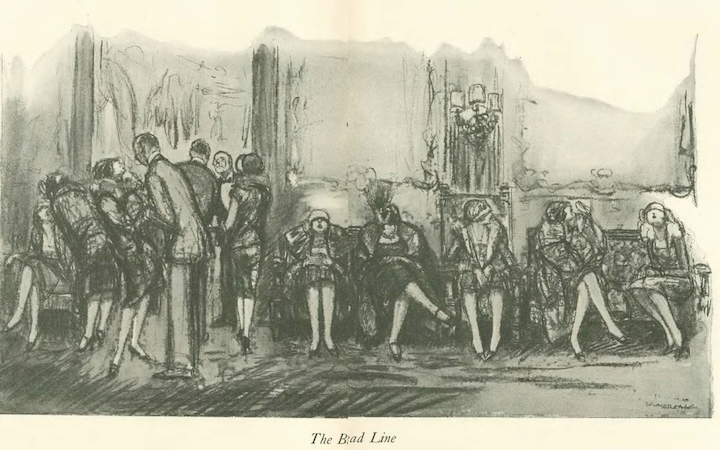
Plummer was a noted artist/illustrator in her day, as was Wallace Morgan, who contributed this two-page spread, “The Bread Line”…

…this illustration by Eldon Kelley is notable for what it lacks…namely, clothing. Early New Yorker lore has it that Ross was somewhat puritanical, and shied away from suggestions of sex or nudity, but here it is in the first issue, what Michael Maslin refers to as “The New Yorker’s First Nipples.” 

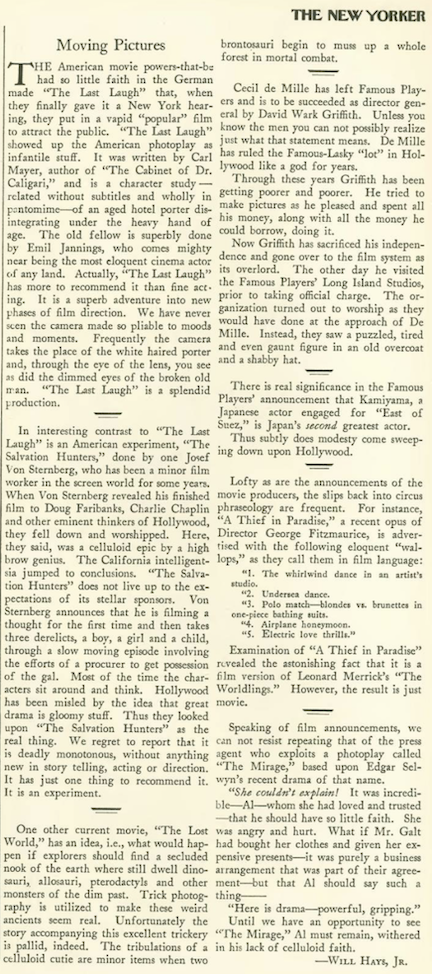
…and before I go, I am wondering about The New Yorker’s first film critic, who signed his review “Will Hays Jr.” Is this the same Hays as in the “Hays Code?” I will investigate.

Next Time: A Century and a Decade…