
Above: Newsreel cameramen perch on boards resting on a windowsill to get a birds-eye view of a passing parade, circa 1930. (Public Domain Image)
We marvel at, and sometimes decry, today’s instantaneous news coverage of wars, disasters and the like, but ninety years ago newsreel crews did a remarkable job of filming and delivering the latest news to thousands of theaters across the U.S. and around the world.
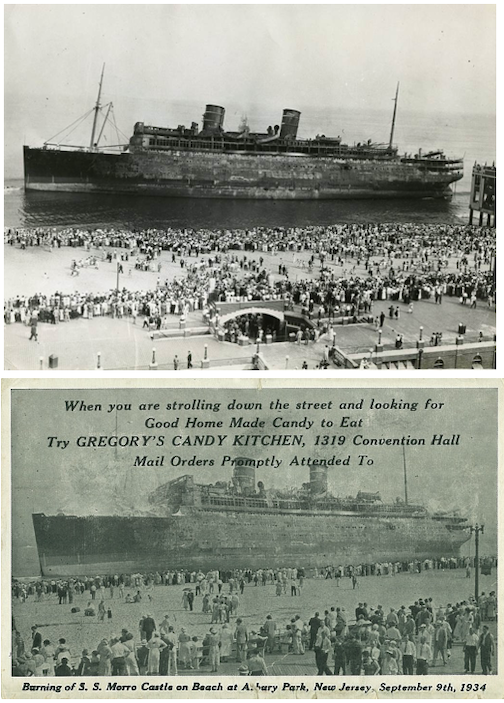
In his “A Reporter at Large” column, Morris Markey penned a lengthy account of Fox Movietone’s coverage of the SS Morro Castle disaster. En route from Havana to New York City on Sept. 8, 1934, the luxury liner caught fire near the New Jersey coast. Due to the ship’s design and the ineptitude of the crew, the blaze claimed 137 lives. Markey described how newsreel crews—with their bulky cameras and sound equipment—went into action, including a cameraman who “goaded” a pilot into taking him aloft through vicious weather conditions.
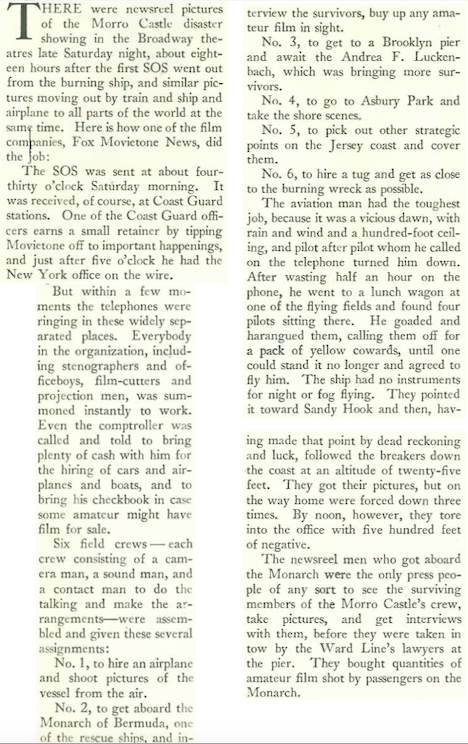
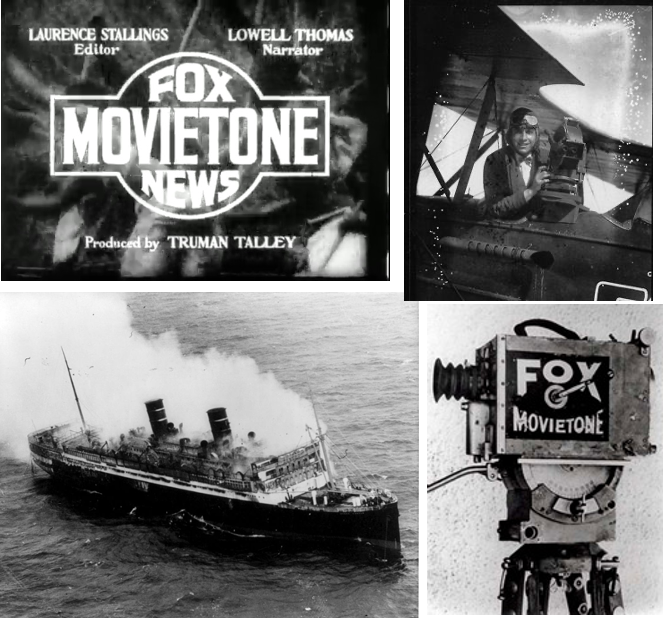
Somehow the cameraman aboard the airplane (which was forced down by weather three times) was able to get his footage to the Movietone office by noon, less than seven hours after the office first received word of the disaster. By three o’clock, five thousand feet of film from all sources was being developed.
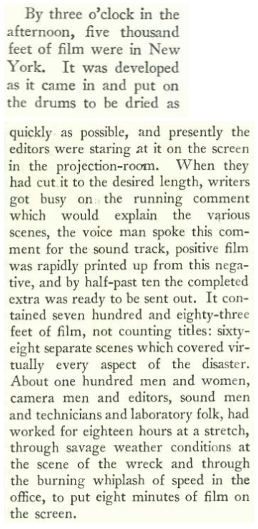

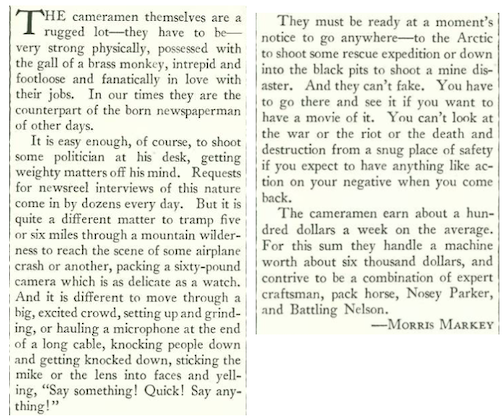
Markey concluded with this observation about the “rugged” and persistent newsreel cameramen:
In the aftermath of the Morro Castle disaster, a scene of enormous tragedy was turned into a tourist attraction…
Fox Movietone News produced sound newsreels from 1928 to 1963, and in the UK as British Movietone News…here is Movietone footage of the Morro Castle disaster, as presented by British Movietone in 1934:
* * *
Up In The Old Hotels
Last week “The Talk of the Town” looked in on one of Manhattan’s oldest saloons, McSorley’s. For the Sept. 22 “Talk” the subject was “Oldest Hotels,” two of which, The Cosmopolitan and The Grand, remarkably survive to this day.

* * *
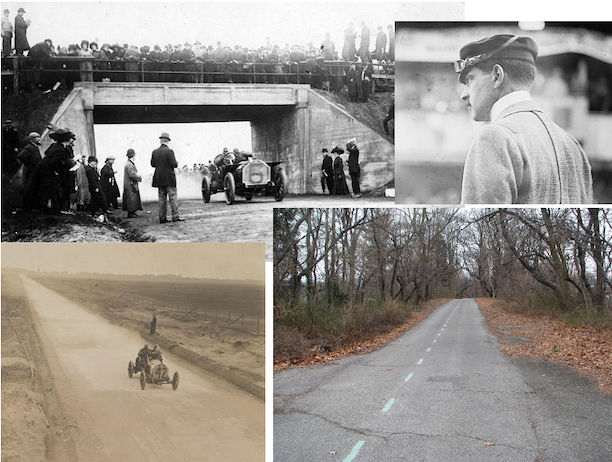
The Six-Million Dollar Road
The first roadway designed exclusively for automobile use was likely the Long Island Motor Parkway, privately built by William Kissam Vanderbilt II because he wanted a road suitable for auto racing. He established the Vanderbilt Cup races on local roads in 1904, but after two spectators were killed and many others injured, in 1908 he began building what would become a 45-mile (72 km) toll road from Queens to Lake Ronkonkoma. After two mechanics were killed in a 1910 race, the New York Legislature banned racing on the road, which the state took over in 1938.
* * *
From Our Advertisers
I have nothing against accordion music, despite years of exposure to Lawrence Welk during my youth, but I find it hard to believe that a Park Avenue socialite (identified here as Mrs. René Du Champ Bellinger) would contemplate tormenting her posh friends with a Hohner squeezebox…

…Esquire magazine was barely a year old when it posted this ad in The New Yorker…its appeal to men (and their anxieties) keeps it going today…

…it’s interesting how companies in the 19th century and on through the 1950s featured idealized, bird’s eye images of their factories in advertising, doubtless believing that consumers associated size (and smokestacks) with prosperity, and therefore a quality product…

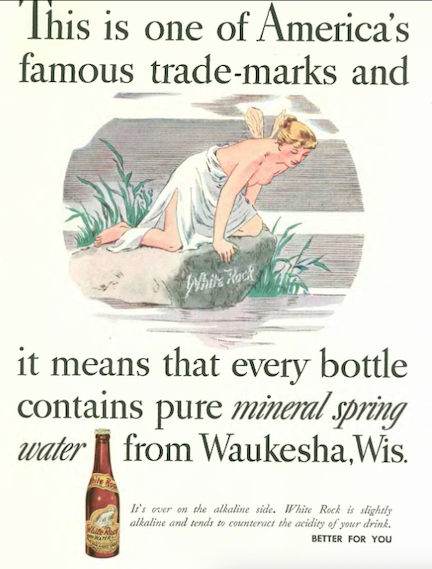
…White Rock, however, has used the image of the Greek goddess Psyche for more than a century to promote the purity of its spring water…
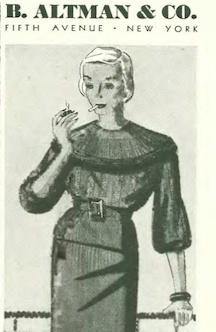
…purity was also the main point of this ad from Daggett & Ramsdell, who hawked their wares to the Park Avenue set…after more than 130 years D&G is still in the beauty business…

…this next ad is almost unbelievable…single rooms starting at $5, double rooms $7, and a whole suite for $10…at the Plaza…okay, $10 is roughly equivalent to $225 today, but half of that could get you a single…

…and yet another unlikely claim from R.J. Reynolds regarding the energizing qualities of their Camel cigarettes…it seems the last thing you would need while climbing a mountain is smoke in your already over-taxed lungs…

…however, let’s give proper due to Georgia Engelhard (1906–1986), who scandalized the mountaineering world by ditching the Victorian climbing skirt in favor of a pair of climbing pants. Engelhard was the first female climber to ascend many of the peaks in the Rockies…

…it seemed like nearly everyone smoked in the 1930s, even in ads that had nothing to do with tobacco companies (detail)…
…on to our cartoons, we begin with Richard Decker and some retail competition…

…George Price drew up a curiosity even Robert Ripley couldn’t believe…

…Robert Day examined advances in evolutionary science…

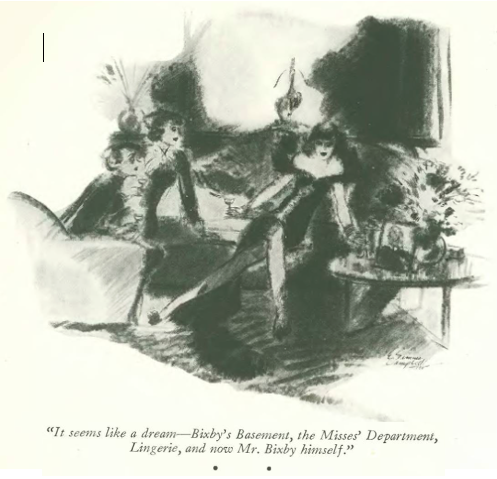
…E. Simms Campbell offered up this abbreviated love story…
…Peter Arno gave us a director with a god complex…

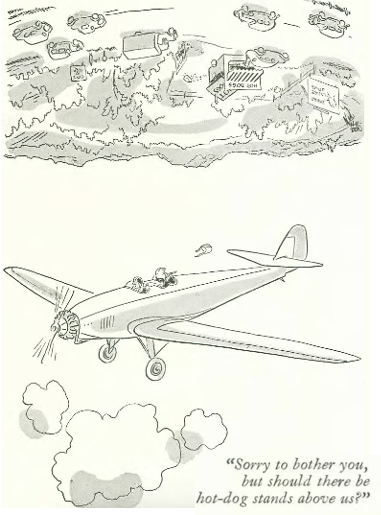
…and one from Ned Hilton, and a new perspective on flying…
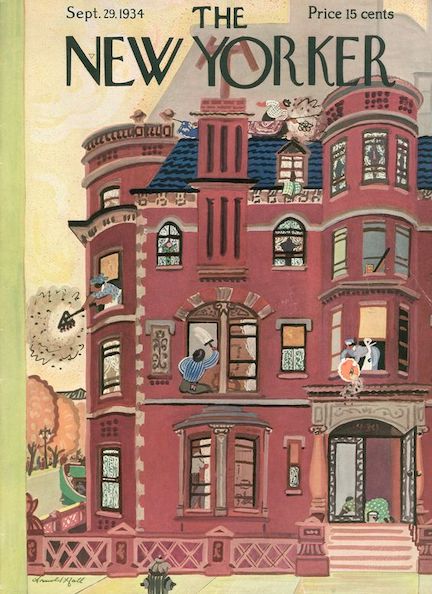
…on to Sept. 29, 1934, with a cover by Arnold Hall, who produced at least twelve covers for The New Yorker between 1933 and 1939…
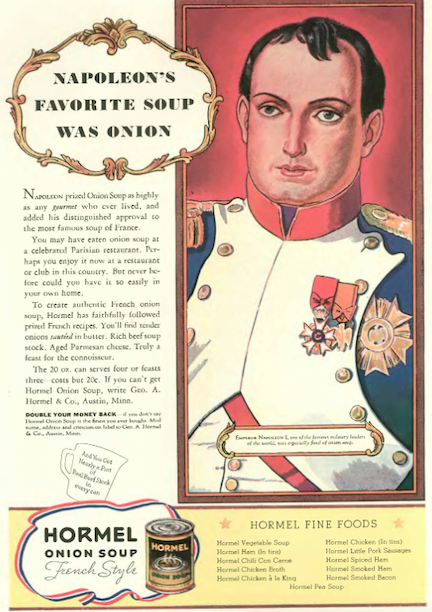
…and we go straight to ads, beginning with this alarming image that greeted readers on the inside cover…why would this prompt anyone to purchase a can of onion soup?…
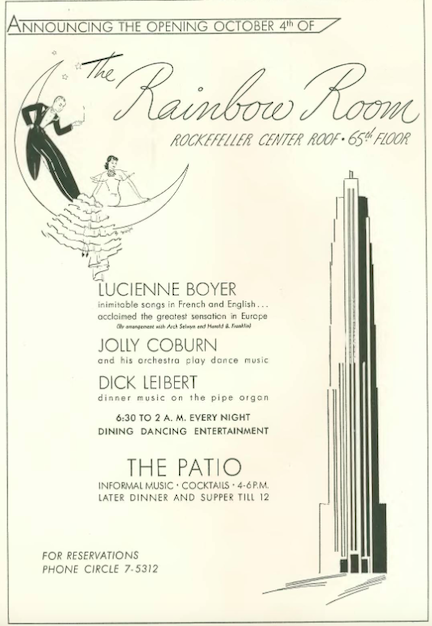
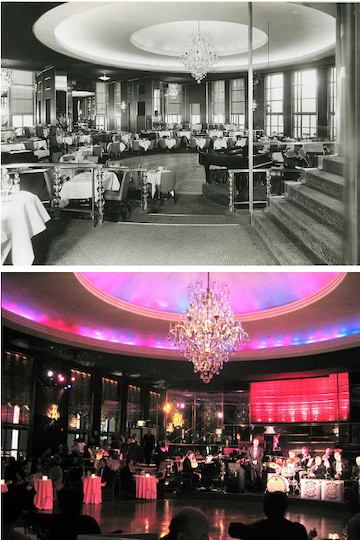
…the Rainbow Room on the 65th floor of Rockefeller Center opened in 1934, and it quickly became a focal point for the city’s elite…
…Lucky Strike continued its series of ads featuring fashionable women looking smart with their product…

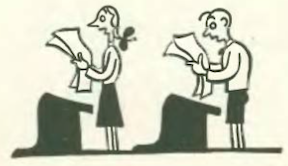
…our cartoons include this spot illustration by Otto Soglow, who did spots for The New Yorker for many years…although Soglow’s Little King moved to the Hearst newspapers, he continued to contribute cartoons to The New Yorker until 1974…
…George Price continued to explore life as a levitating man…

…the enforcement of the Hays Code had this teen in a “fix,” per James Thurber…

…Gluyas Williams continued his exploration of various crises, this time in the music world…

…Alan Dunn gave us a glimpse of civilization via the pharaonic sculptures that were emerging on the face of Mt. Rushmore…

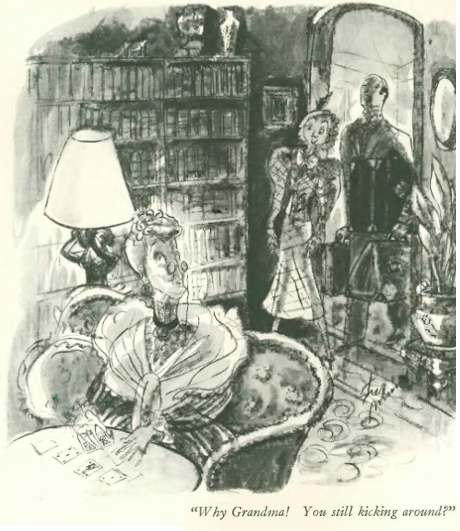
…and we close with the wonderful wit of Barbara Shermund…
Next Time: Bojangles…

 A New Yorker State of Mind