The Roaring Twenties were an age when many social norms were challenged, including gender roles. Stars such as Marlene Dietrich wore men’s clothing, and many women went to work (women in the workplace increased by 25 percent) and they smoked in public.
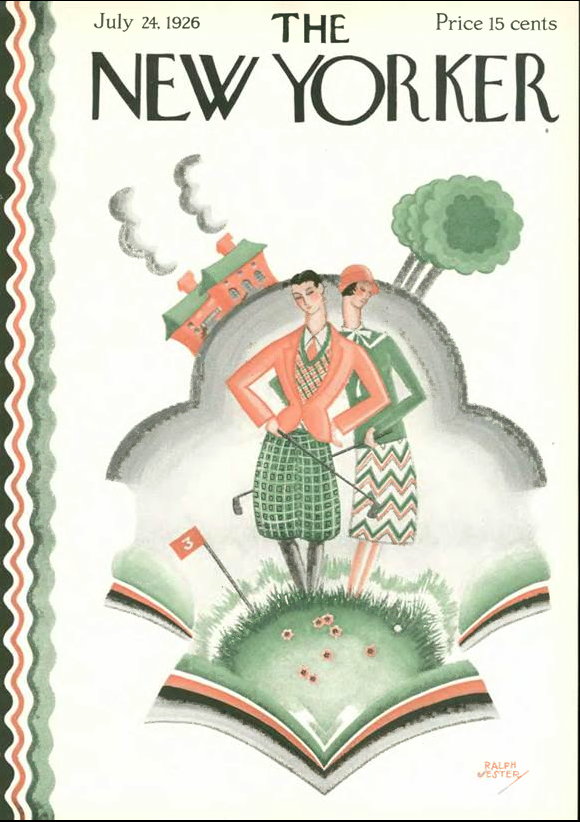
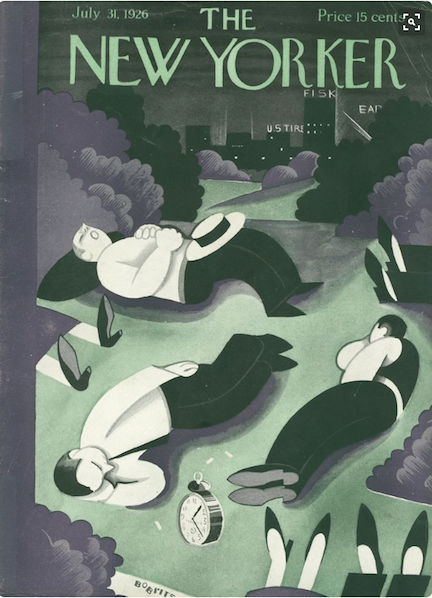
July 24, 1926 cover by Ralph Jester.
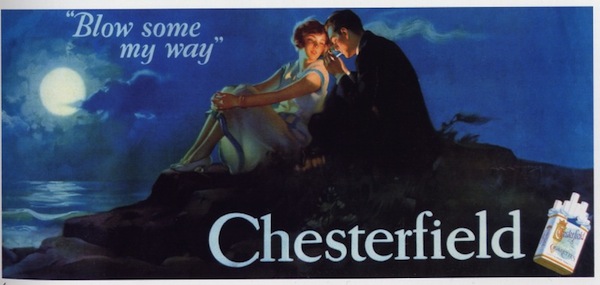
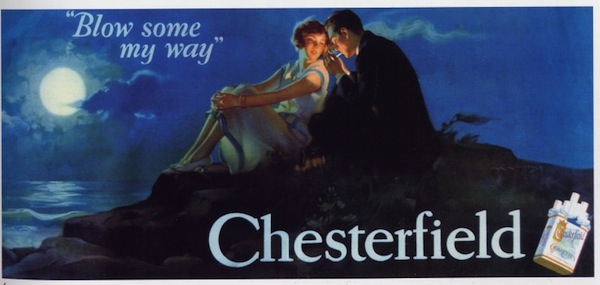
At first smoking in public was associated with the wild behavior of flappers, but thanks to American advertising know-how, things quickly changed. What helped spark that change was this controversial 1926 magazine and billboard advertisement:
Now we call it “second-hand smoke” (History News Network)
Naturally, the editors of “The Talk of the Town” had something to say about all the fuss:
Give dubious credit to Chesterfield for cracking a barrier. And thanks to mass marketing, what was rare and shocking quickly became commonplace. Subsequent cigarette ads featured women who didn’t need a man to blow them any smoke; they were independent, successful and famous:
This is among the earliest cigarette ads to feature endorsements from famous women. In 1927, Lucky Strike began collecting testimonials from female celebrity smokers, ranging from movie stars to celebrities. In this 1928 ad, Amelia Earhart endorses Lucky Strike. (Stanford School of Medicine)
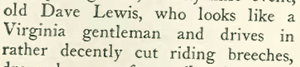
The editors of The New Yorker obviously loved cars and the advertising they attracted, so for the July 24 edition they dispatched a writer and an artist to the motor races at Atlantic City to record the momentous event. However, staff writer Eric Hatch seemed as interested in the attire of the drivers as in the race itself:
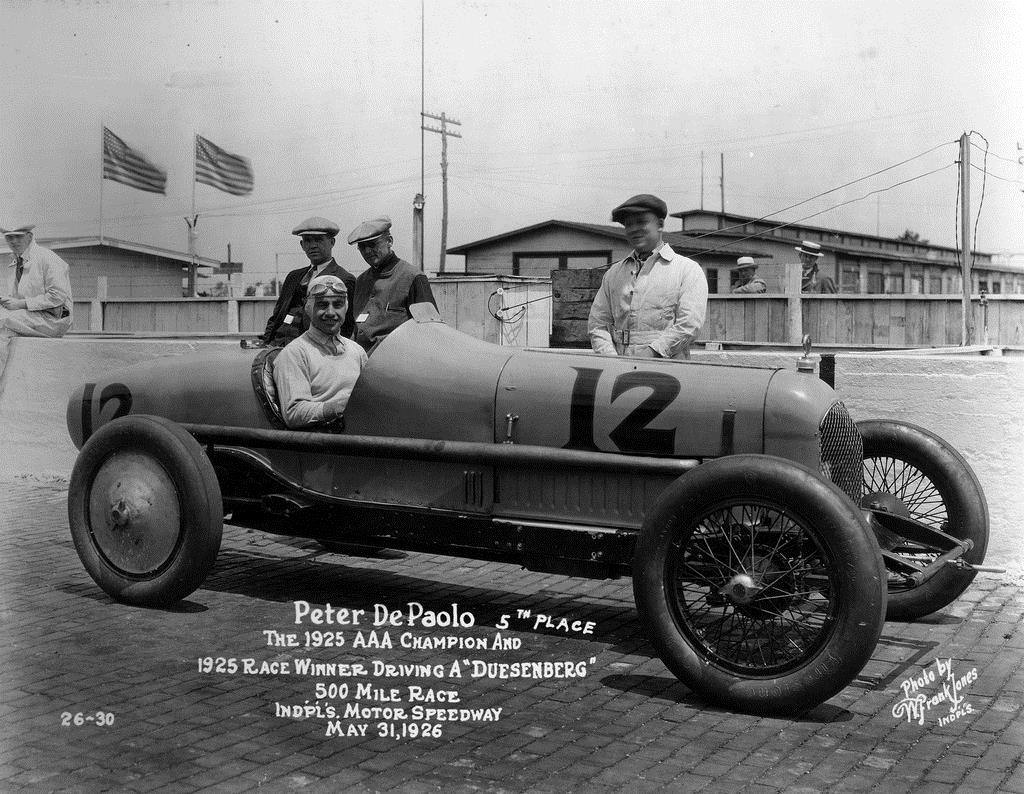
According to New Yorker writer Eric Hatch, Peter DePaolo wore a white sweater and bow tie in the Atlantic City race. Here he is seen earlier that year following his victory at the Indianapolis 500. He was the first driver to complete the 500 miles in under five hours, and have an average speed of more than 100 mph. Since 1989, nine Indy races have finished in under three hours. In 2013 Tony Kanaan’s average speed exceeded 187 mph. (flickr/clamshack)
And then there were Dave Lewis’s breeches…
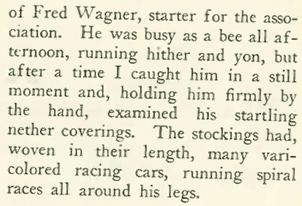
…and the wild stockings worn by the race’s starter, Fred Wagner:
Illustrator Johan Bull offered his own observation about Wagner’s stockings, among other things:
In a separate column in the magazine (simply titled “Motors”) Hatch marveled at the amazing new road to Jamaica (Queens) that featured four lanes, two in each direction, with drivers approaching breakneck speeds near 40 miles per hour:
As for speed, back then a basic car was a far cry from an Indy racer, and strained to do more than 45 mph. Luxury cars could go faster, but the quality of tires, brakes and roads were so poor that anyone exceeding 60 mph would likely blow a tire.
The glories of summertime filled the pages of the July 17, 1926 issue. The cover featured a stylish young couple enjoying a romantic evening on a moonlit lake, while the inside pages were filled with all sorts of outdoor activities ranging from dining and dancing to open air concerts and golf, lots of it.
There was a lengthy profile by Herbert Reed on golfing great Bobby Jones, a mere boy of 24 who competed as an amateur but often beat top pros such as Walter Hagen and Gene Sarazen (in a few years Jones would help design the Augusta National Golf Club and co-found the Masters Tournament).
Rending of Bobby Jones for the “Profile” by illustrator Miguel Covarrubias.
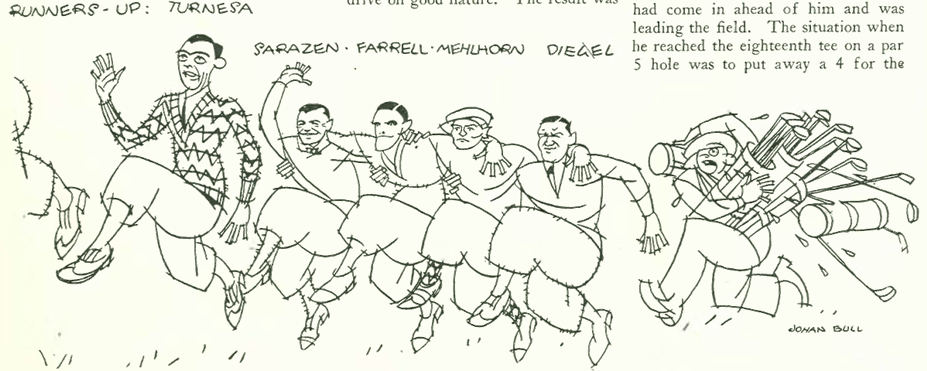
In “Sports of the Week,” Reed wrote about Jones’s second U.S. Open win, in Columbus, Ohio. Johan Bull offered this rendering of the runners-up:
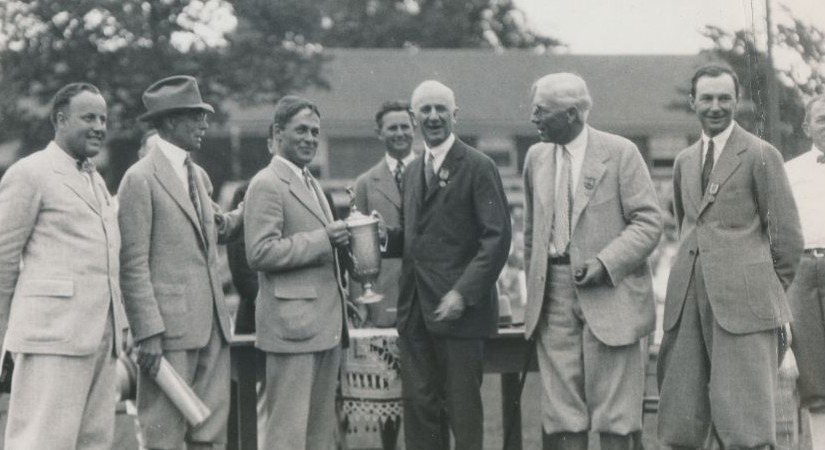
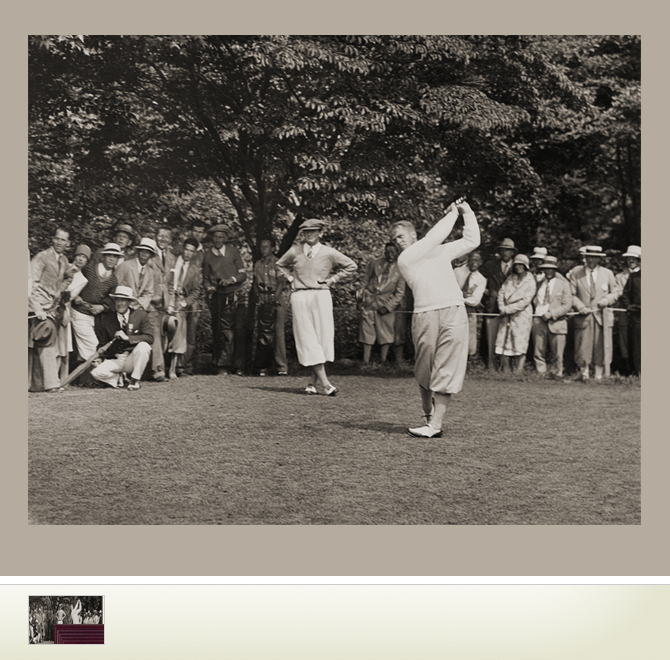
Bobby Jones at the 1926 U.S. Open (golfspast.com)
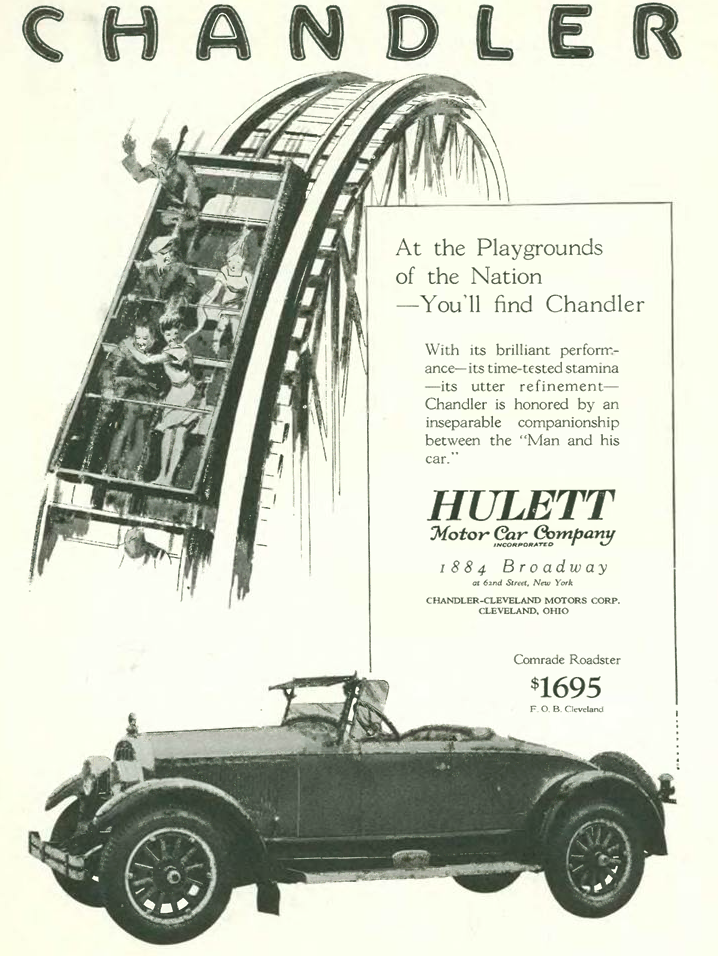
And with the warm weather the tops were open on automobiles for both the rich:
And the not-so-rich:
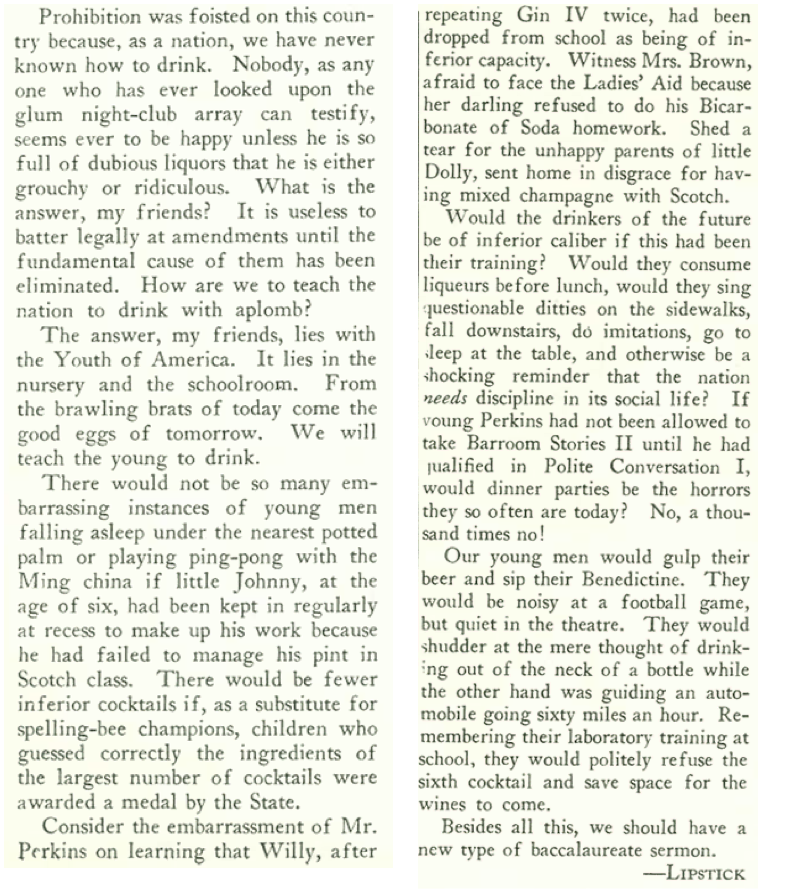
And finally, Lois Long, fed up with reviewing restaurants, fires off a column about the sad state of drinking in America:
In my previous post, I hinted that “social errors” would be the topic of this entry, and in a sense that title describes the stance New Yorker editors were taking toward the continued demolition and remodeling of old city landmarks.
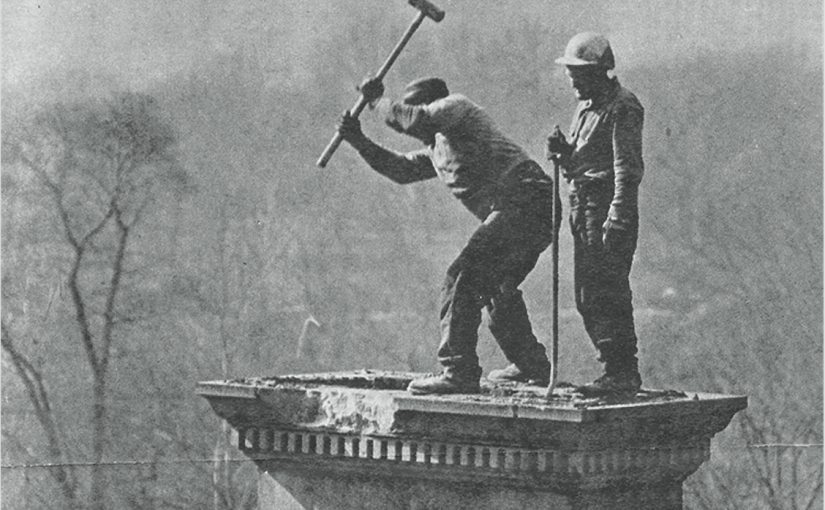
“The Talk of the Town” reported that two more Fifth Avenue mansions on “Millionaries Row” were soon to be demolished: the Brokaw and Yerkes mansions (the photo at the top of this entry depicts workmen taking a sledgehammer to a chimney atop the Brokaw house–not in 1925, but in 1965–more on that later).
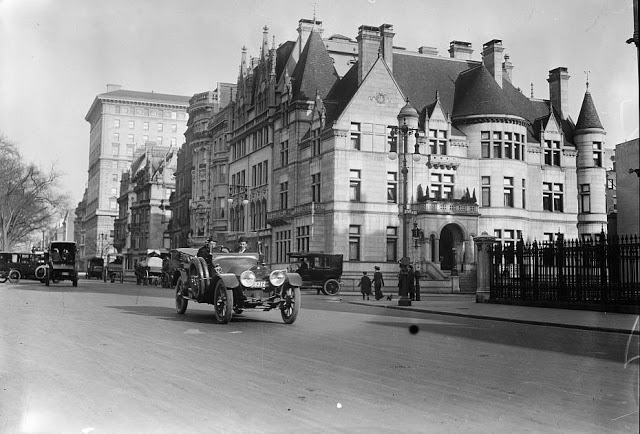
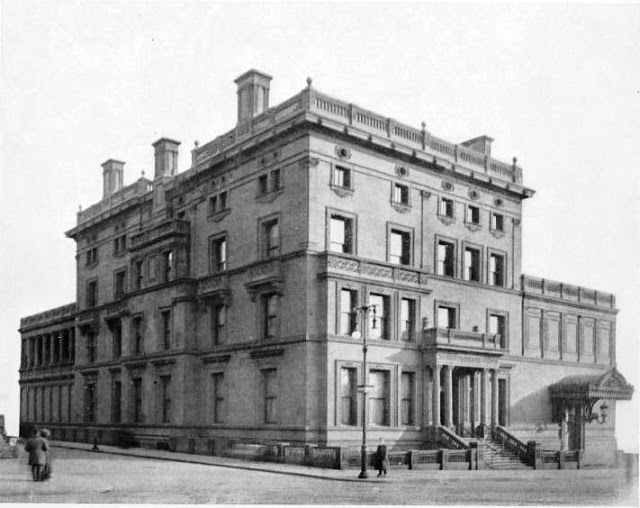
The Isaac Brokaw mansion at 79th and 5th Avenue, completed in 1890. Behind the mansion are the twin residences of two Brokaw sons, Howard and Irving. Daughter Elvira would also erect a residence next door. Although the Dec. 19, 1925 edition of The New Yorker lamented the imminent destruction of the house, it would actually stand another 40 years. (Library of Congress)The Yerkes Mansion, erected in 1896, would not be so fortunate…it would fall to the wrecking ball in 1926. (Collection of Charles T. Yerkes)
In his excellent blog site, Dayton in Manhattan, Tom Miller writes that the Isaac Brokaw mansion first faced the wrecking ball after Isaac’s eldest son, George, moved out in 1925. George “intensely disliked the house” because of its size and maintenance costs, and petitioned the courts to allow him to mortgage the property for $800,000 and use the money to demolish the mansion and erect a modern apartment house.
His brother, Howard, blocked the move. Three years later, the court ruled that the house could not be sold nor razed without the mutual agreement of all the Brokaw siblings, so George moved back in.
George died seven years later of a heart attack. His wife, Frances Ford Seymour would marry Henry Fonda a year later and have two children, Jane and Peter (George was married twice, the first time to Clare Boothe, who would later become Clare Boothe Luce).
The mansion was then occupied as offices for the Institute of Radio Engineers. When it was announced in 1965 that the mansion (and the adjacent mansions of the Brokaw children) were to be demolished to make way for a high-rise apartment building, there was an outcry from members of the city’s nascent Landmarks Preservation Commission, still stinging from the destruction of Penn Station. Miller writes that demolition workers were paid overtime to begin immediate destruction of the mansions in order to preclude the possibility of a court order to stop the work.
The Yerkes mansion, on the other hand, disappeared rather unceremoniously. According to Miller, a neighbor, Thomas Fortune Ryan, bought the house in 1925 and tore it down in order to enlarge his flower garden. In 1937 an apartment building was erected on the site. I recommend that you check out Miller’s entertaining and informative posts on both the Brokaw and Yerkes mansions.
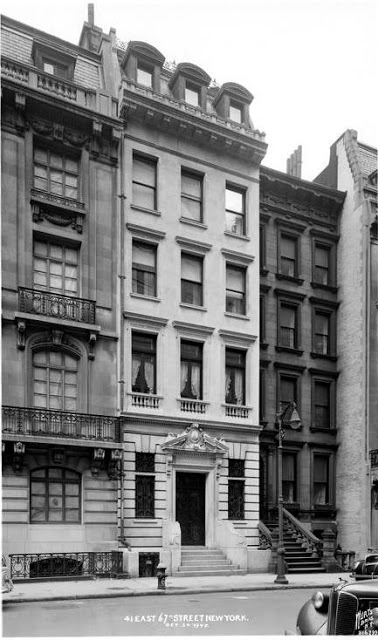
The Dec. 19 issue also featured a column by Gilbert Seldes titled “Complaint.” Seldes bemoaned the remodeling of “sober, decent” brownstones at Fiftieth Street and beyond (Beekman Place) into overly ornamented facades favored by the Babbitt set:
A remodeled brownstone at No. 41 E. 67th Street. Note the original brownstone next door. (Museum of the City of New York)
With the much-publicized signing of famed halfback Red Grange to the Chicago Bears (a $100,000 annual contract), the professionalization of football and the money attached to it were frequent topics in the magazine. Howard Brubaker, in “Of All Things,” noted:
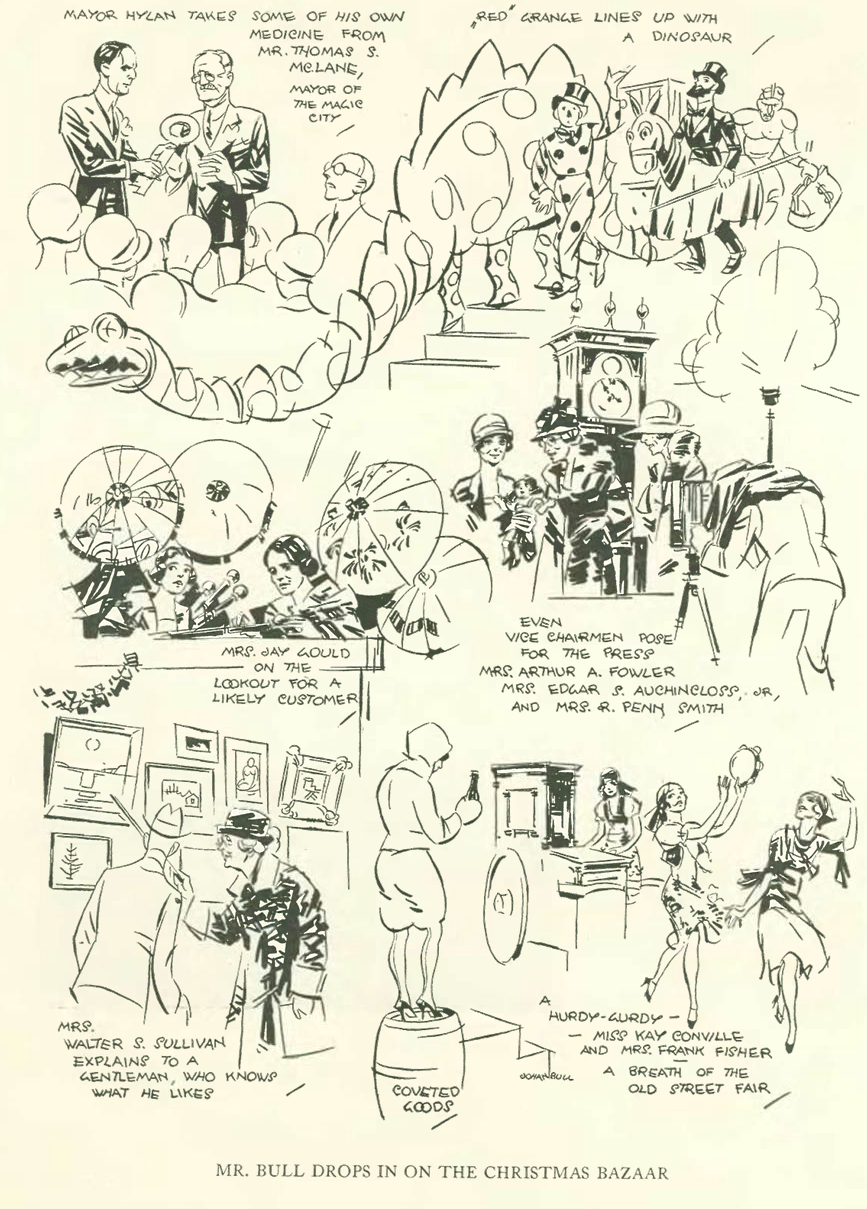
And in this illustration by Johan Bull, Grange is depicted carrying a large money bag at New York’s annual Christmas Bazaar:
“Profiles” looked at the life of pianist and composer Leo Ornstein, noted for performing and composing avant-garde works. Ornstein would have a long career, completing his eighth and final piano sonata at the age of 97. He died in 2002 at age 108.
The Marx Brothers’s broadway musical The Cocoanuts wowed audiences (and New Yorker theatre critic Herman J. Mankiewicz) at the Lyric Theatre:
In her Paris Letter, Janet Flanner announced the deaths of “two great servers of the French palate”—Emile Pruinier (famed for his Portuguese oysters) and Mother Soret of Lyons, who “died with a knife in her hand” and whose death was “solemnly listed in Comoedia as that of an artist.”
And to stay in the spirit of the holidays, this Christmas advertisement from the back cover:
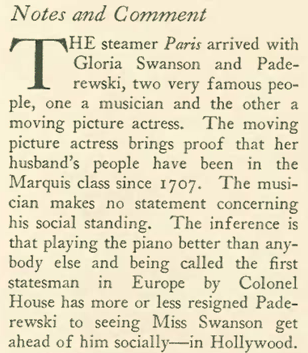
Silent film star (and sometime French “noble”) Gloria Swanson was back in the States after a summer sojourn at her Paris residence.
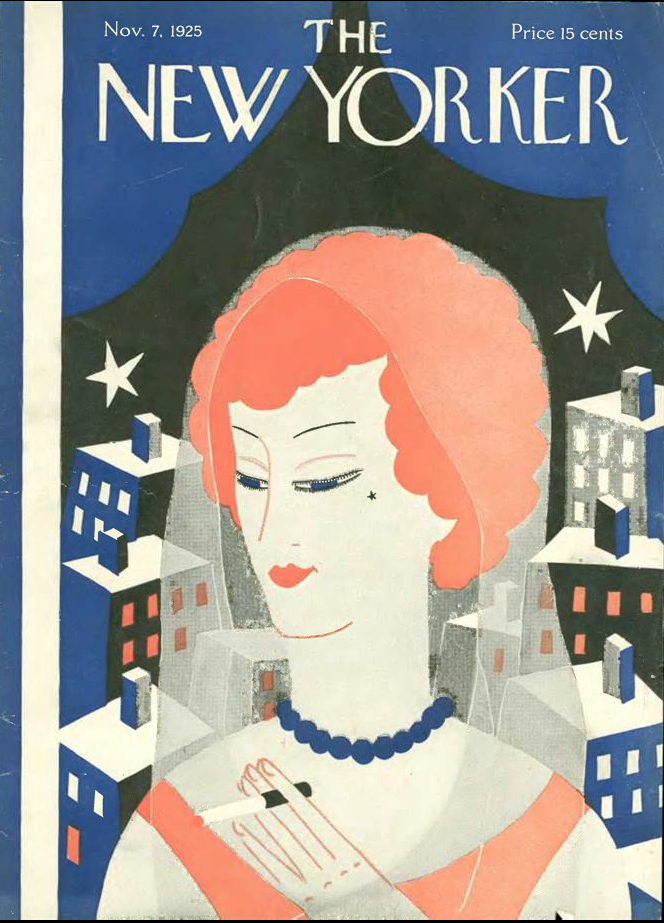
Nov. 14, 1925 cover by Joseph Fannel.
“The Talk of the Town” reported that she had arrived on the steamer Paris, with the great Polish pianist and statesman Jan Paderewski in tow…
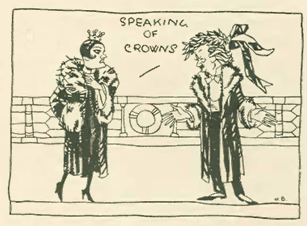
Johan Bull’s take on Swanson’s grand arrival with Paderewski, who was much decorated as both a statesman and artist:
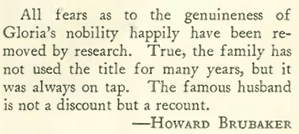
The New Yorker made light of the fact that Swanson assumed a rather regal bearing not only as a famous film star but also as the new wife of French aristocrat Henri, Marquis de la Falaise de la Coudraye, her third husband. In his column, “Of All Things,” Howard Brubaker added this swipe at the Swanson’s pretensions to royalty:
Although a marquis and member of the famous Hennessy Cognac family, Henri was not wealthy and worked for a living. He met Swanson when he was hired to be her assistant and interpreter during the filming of Madame Sans-Gêne (1925) in France. The match of a Hollywood star with European nobility made the marriage a global sensation.
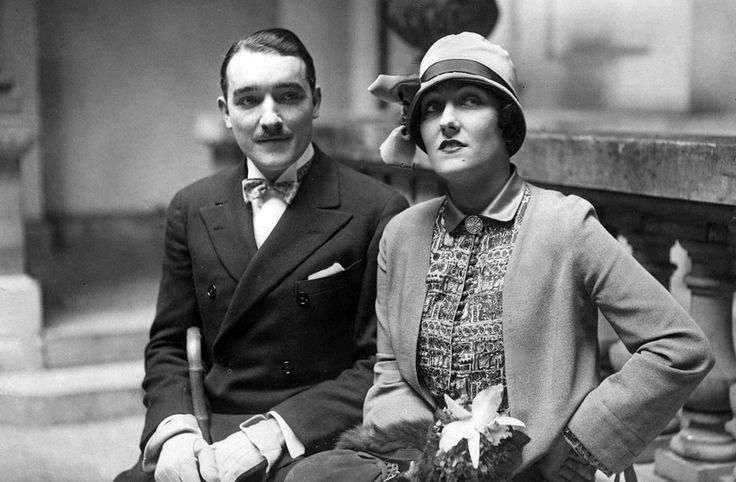
MON CHÉRI…Photo taken around the time of the wedding of Marquis Henri de la Falaise and Gloria Swanson, January 1925. (indypendent-thinking.tumblr.com)
The marriage ended in divorce in 1930. According to Wikipedia, (citing two books on the subject), Swanson had an affair with Joseph P. Kennedy Sr. for several years during her marriage to Henri:
Henri became a film executive representing Pathé (USA) in France through Joseph P. Kennedy, Sr., who was running the studio. Many now assume he was given the position, which kept him in France for ten months a year, to simply keep him (Henri) out of the way…(Kennedy) became her business partner and their relationship was an open secret in Hollywood. He took over all of her personal and business affairs and was supposed to make her millions. Unfortunately, Kennedy left her after the disastrous “Queen Kelly” and her finances were in worse shape than when he came into her life.
GOOD OLD DAYS…Life beneath the Sixth Avenue El (Wikipedia)
In another Talk item, the Sixth Avenue Elevated rail line continued to serve as a “blot” upon the city of New York (Johan Bull illustration):
According to a Wikipedia, the old Sixth Avenue El (constructed during the 1870s) was notoriously noisy, made buildings shake, and bombarded pedestrians underneath with dropping ash, oil, and cinders. Eventually, a coalition of commercial establishments and building owners would stage a successful campaign to have the El removed because it was hurting business and property values. It would be razed in 1939 and replaced by the underground IND Sixth Avenue Line.
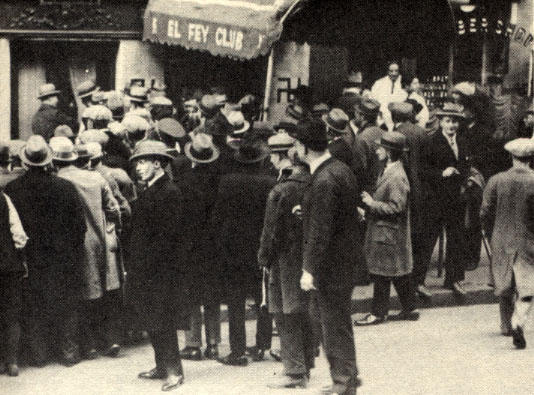
SPOIL SPORTS…Buckner’s agents padlock New York’s El Fey Club in 1925 before a gathering crowd.
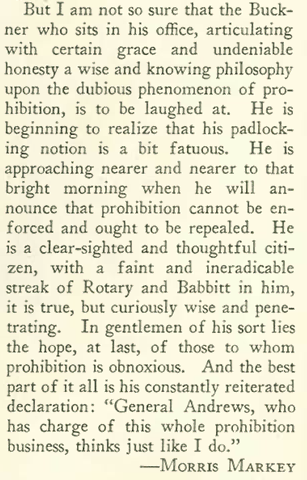
The New Yorker also featured a lengthy interview with Emory Buckner (conducted by Morris Markey), in which the New York District Attorney discussed his approach to Prohibition enforcement, including the padlocking of restaurants and clubs found to be serving alcohol. In a surprisingly frank interview, Buckner said his zealous crusade had nothing to do with moral conviction:
Buckner also admitted that the government wasn’t making a serious effort to enforce Prohibition (e.g. low salaries for agents), and if it wasn’t going to make the effort then the law should be repealed. Markey concluded his article with words of surprising admiration for a man who had been so thoroughly excoriated in previous issues of The New Yorker.
In other items, theatre critic Herman J. Mankiewicz stepped out of the “Critique” section to write about his experience travelling by train to a football game. He found the whole spectacle (especially the coonskin coat-clad fans) wanting.
No doubt Mankiewicz’s fellow travellers were clad in something similar to this. The ad appeared in the same issue as Mankiewicz’s article.
Waldo Frank contributed a profile of the popular poet Carl Sandburg, whom he described as moving “through the Machine of our world” with “a peasant’s mind.” Frank used the term not necessarily as a criticism but as a way to describe Sandburg’s Midwestern simplicity. However, a drawing by James House Jr. that accompanied the article depicted Sandburg not as a man of letters, but more like some dim-witted forebear of Homer Simpson:
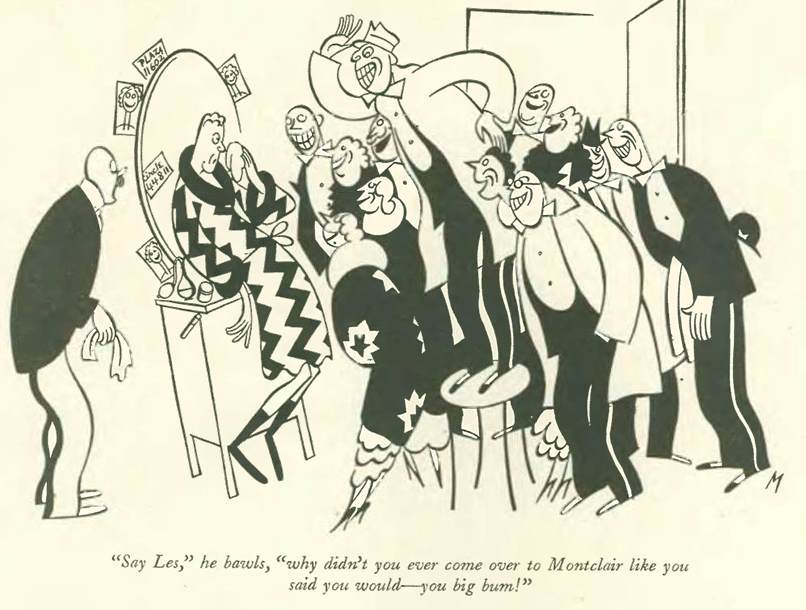
The actor Leslie Howard contributed another humorous piece to The New Yorker titled “Such is Fame,” accompanied by this Julian de Miskey illustration:
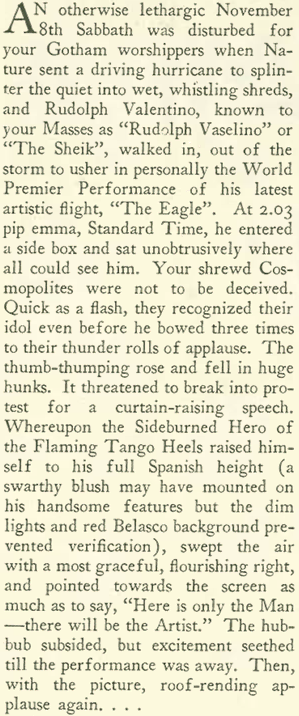
Theodore Shane reported in “Motion Pictures” that Rudolph Valentino appeared in person at the opening of his new film, The Eagle. Known for his aversion to public appearances, Valentino handled the occasion with a silent flourish:
Vilma Bánky and Rudolph Valentino in The Eagle. (Wikimedia Commons)
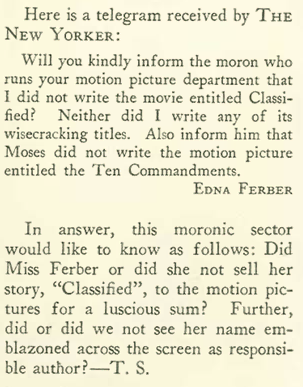
At the end of his column Shane included this exchange with novelist and playwright Edna Ferber, who was also one of the regular wits at the Algonquin Round Table:
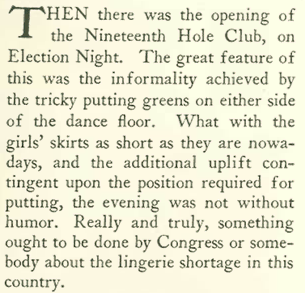
In “Tables for Two,” Lois Long wrote about the opening of the Nineteenth Hole Club at the Roosevelt Hotel, and noted that the putting greens on either side of the dance floor offered “additional uplift” to short skirts worn by some female patrons:
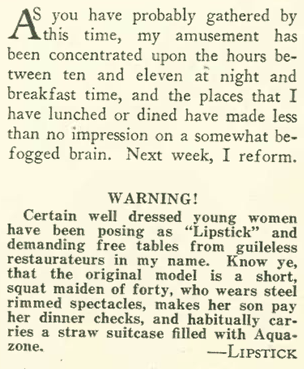
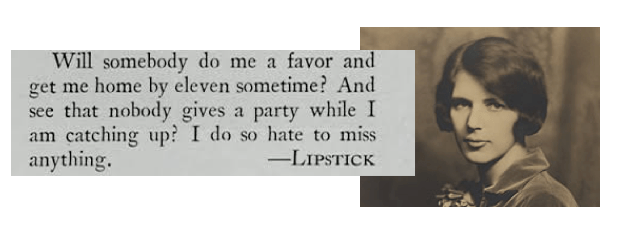
She closed her column with this observation and a “warning” about “Lipstick” imposters:
This was a familiar jest by Long in her “Tables for Two” column–describing herself as short and squat–since most readers did not know her true identity or appearance, which was quite the opposite.
In Long’s other column, “On And Off The Avenue,” she offered this advice to women who were fashion-conscious but also thrifty:
The woes of Prohibition were acutely felt by the readership of The New Yorker. The magazine responded in kind with its continued criticism of the law’s enforcement and particularly the tactics of Manhattan District Attorney Emory C. Buckner, whose agents continued to padlock restaurants and clubs suspected of selling alcohol.
The New Yorker previously called the padlocking tactic a “promotional stunt” that would ultimately backfire (I wrote about this in a previous blog post last March).
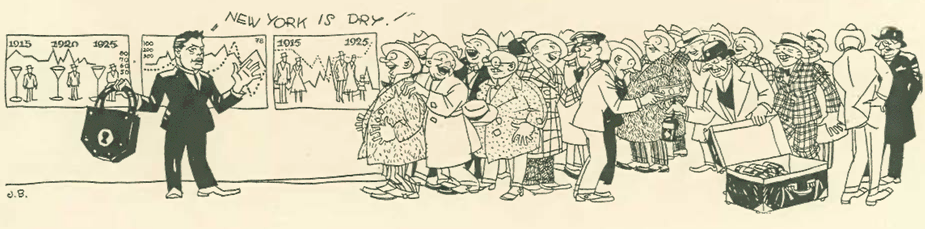
Both the “The Talk of the Town” and “Tables for Two” took aim at Buckner this time around. “Talk” led with this item, accompanied by the art of Johan Bull:
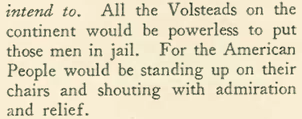
“Talk” also made a call to action by “men of virtue:”
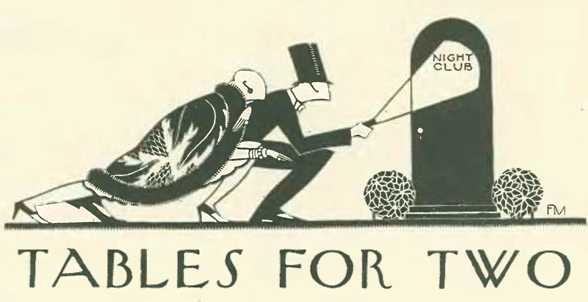
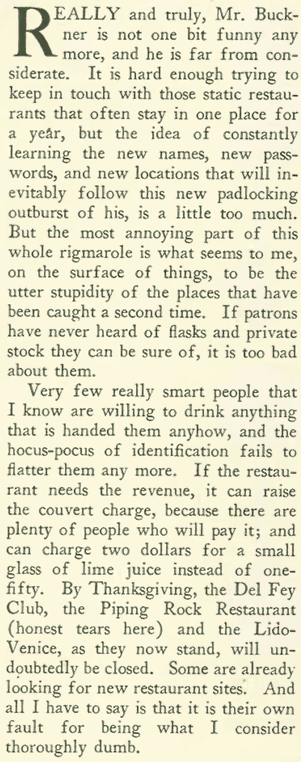
Heck with statements. Lois Long just wanted to have some fun, and led her column, “Tables for Two,” with her own attack on Buckner and on the “stupidity” of establishments that were closed by Buckner’s agents (I include art that accompanied the column by Frank McIntosh—at least that is what I think the “FM” stands for; if I am in error, someone please correct me!):
In a previous column (Oct. 17), Long pondered the popularity of a new dance, the “Charleston.” She closed her Oct. 31 column with “telegrams” from exemplary colleges in answer to the query: “Is the Charleston being done at college dances?”
W.J. Henderson wrote a lengthy article about the upcoming opera season at the Metropolitan Opera (it was opening with La Gioconda), and recalled the days after World War I when the once-popular German singers suddenly grew scarce on the American stage.
The old Metropolitan Opera House at 1411 Broadway. The “Old Met” opened in 1883 and was rebuilt after a fire in 1892. The interior, shown here, was redesigned in 1903. This photo depicts a recital by pianist Josef Hofmann on November 28, 1937. The old Met was torn down in 1967 and replaced by a 40-story office tower. (Wikipedia)Site of the old Metropolitan Opera House today.
According to Henderson, this led to a general falling off of quality in the performances, a situation made even worse by the absence of the late, great Enrico Caruso on the Metropolitan’s stage.
In other items, John Tunis wrote about Illinois All-American halfback Red Grange in “Profiles,” calling him “a presentable youth of twenty-two…well-groomed, he would pass anywhere—even in the movies—for a clean type of American manhood.”
Tunis also noted that Grange had been offered a “half a million” to star in movies, and that professional football was ready to offer him a sum “that would cause even the once-mighty Ruth to blanch.” Grange, known as “The Galloping Ghost,” would later join the Chicago Bears and help to legitimize the National Football League (NFL).
Howard (Real Photograph)
The young actor Leslie Howard, who was appearing on Broadway in Michael Arlen’sThe Green Hat, wrote a humorous account of theatre life in “The Intimate Diary of An Opening Night.”
It was one of seven articles on the acting life that Howard (perhaps best known for his role as Ashley Wilkes in Gone With the Wind) would write for The New Yorker between 1925 and 1927.
For the record, I include Howard’s first New Yorker article here (with Carl Rose cartoon):
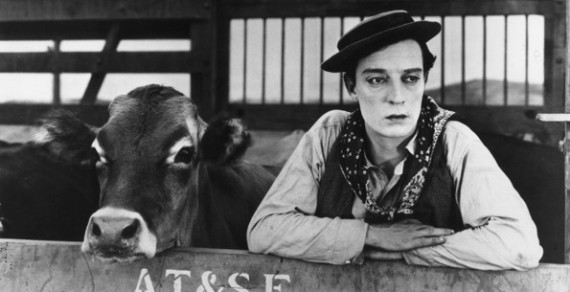
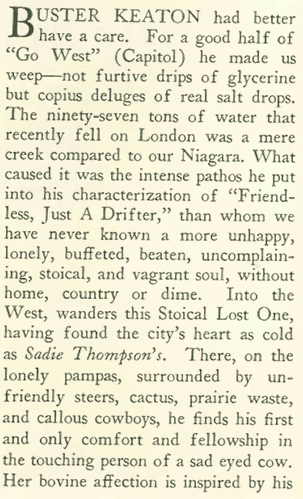
“Motion Pictures” looked at Buster Keaton’s new film, Go West…
Cow and Keaton in Go West (1925) (silentology.com)
Theodore Shane wrote that what at first seemed to be a real weeper…
…turned into a comic romp thanks to the introduction of the “sad-eyed cow…”
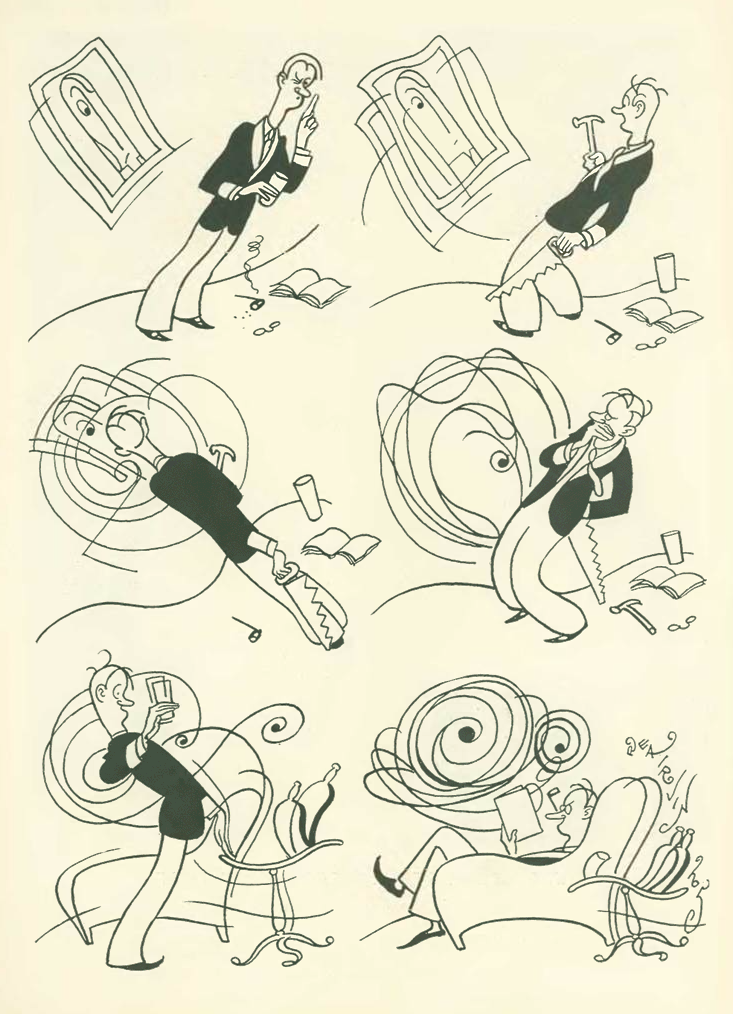
And finally, in keeping with the Prohibition theme, here is a center-spread cartoon by Rea Irvin that seemed to depict the results of consuming too much bootleg booze:
At an age when most students are barely out of college (23), Lois Long was emerging as one of The New Yorker’s most prolific contributors and a prominent voice of Roaring Twenties New York.
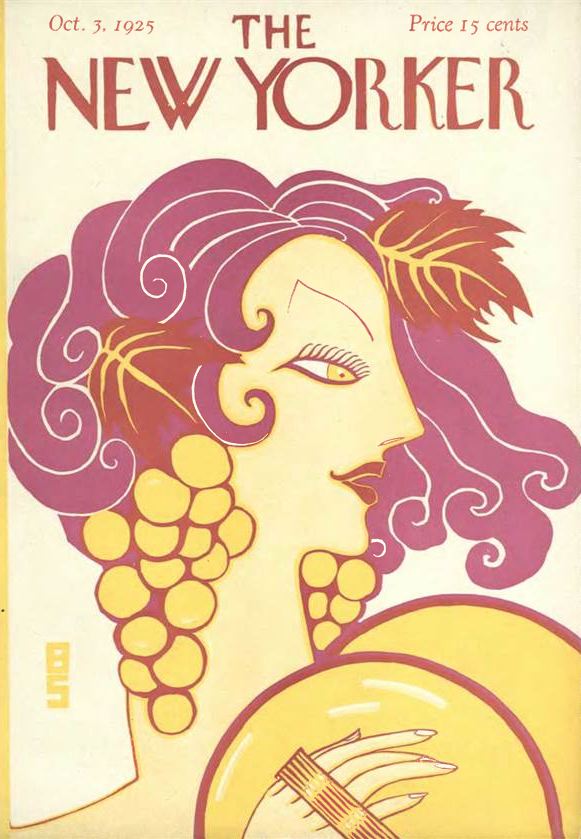
The Oct. 3, 1925 issue not only saw her continuing coverage of night life in “Tables for Two” (which she signed under the pen name “Lipstick”), but also the introduction of her column, “Fifth Avenue” (which she signed L.L.), that would further define her voice at the magazine for years to come.
And The New Yorker wasn’t even her first professional stint as a writer.
Beginning in 1922, Long wrote for both Vanity Fair and Vogue before she caught the eye of New Yorker editor Harold Ross, who hired her to take over the “When Nights Are Bold” column from Charles Baskerville. She later made it her own by changing the name to “Tables for Two.”
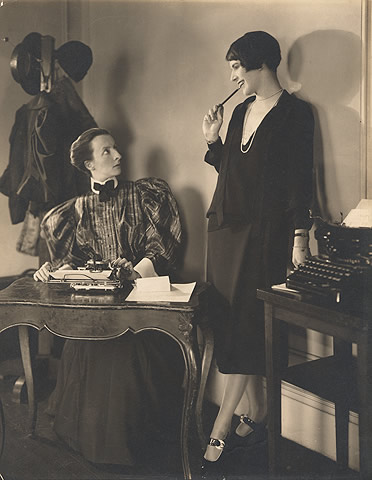
Lois Long in the 1920s. Photo from Andrea Long Bush. (Wikipedia)
With the Oct. 3 issue she doubled her workload as both an observer of night life and the fashion scene.
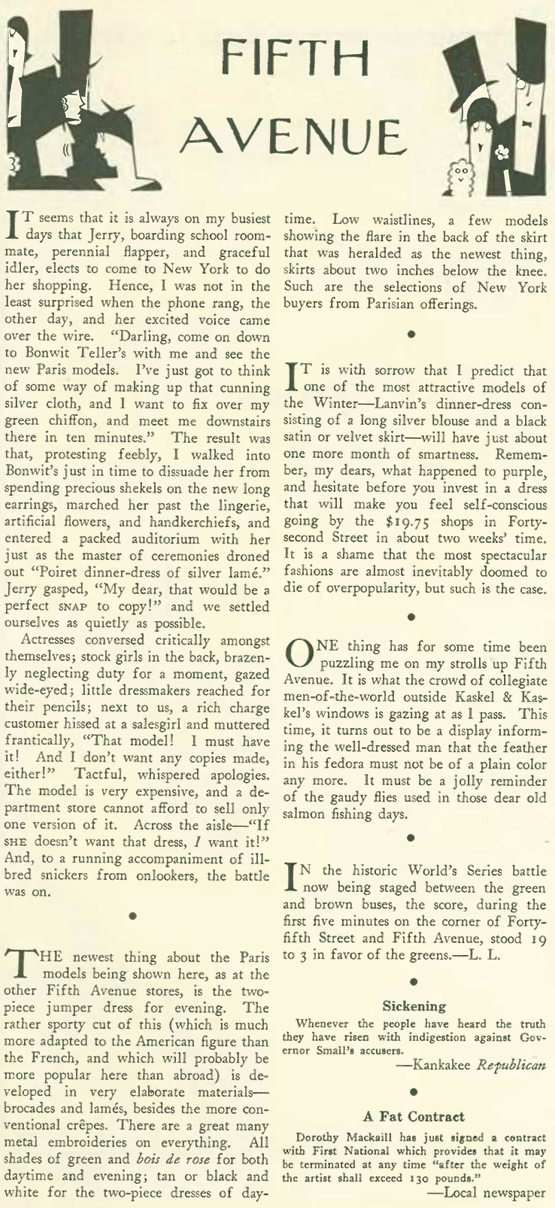
According to Judith Yaross Lee’sDefining New Yorker Humor, the “Fifth Avenue” column took a very different tack from the magazine’s original “Where to Shop” listings that were merely classified ads.
Yaross writes that Long’s first “Fifth Avenue” column relied on “the conceit of her friend Jerry, ‘boarding school roommate, perennial flapper, and graceful idler’ (evidently the department’s target reader)…”
The column would soon be renamed “On and Off the Avenue,” and Long would officially assume the title of fashion editor in 1927.
Her obituary in The New York Times (p. 36, July 31, 1974) quoted New Yorker editor William Shawn, who declared that “Lois Long invented fashion criticism,” and that Long “was the first American fashion critic to approach fashion as an art and to criticize women’s clothes with independence, intelligence, humor and literary style.” The article noted that her task was particularly challenging since The New Yorker did not publish photographs “and more than other writers she had to turn to words alone to describe clothes in detail.”
You can read Long’s first “Fifth Avenue” column, featuring her friend, “Jerry,” here in its entirety:
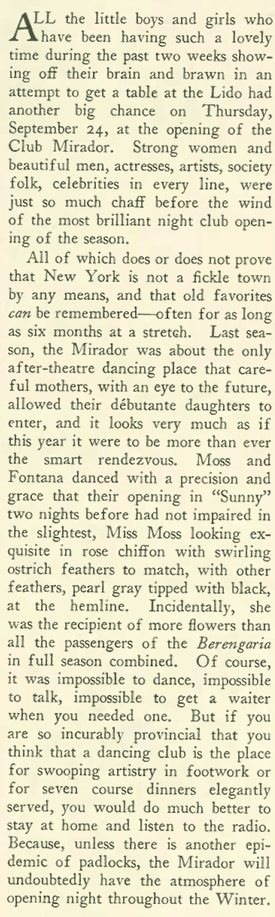
In the same issue, just three pages back, in “Tables for Two,” Long shared these insights on the opening of the Club Mirador:
And she pulled no punches in this erratum item that appeared below this Johan Bull illustration:
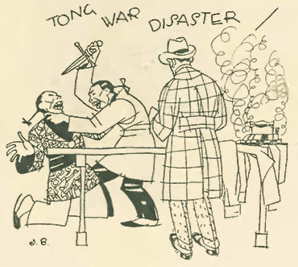
And in “The Talk of the Town,” Bull provided this illustration depicting the flare-up of Tong Wars among New York’s Chinese immigrant population. The main consequence of murderous assault seems to be a patron’s ruined shirt:
“Profiles” featured Reinald Werrenrath, “A New Yorker Who Sings.” Described by writer Clare Peeler as someone who “looks New York,” the baritone opera singer also recorded popular songs and was a regular on early radio broadcasts.
In “Critique” George S. Kaufman’s The Butter and Egg Man received a positive review by Herman J. Mankiewicz, who wrote that the play was “not for the artistically inclined,” but adds:
Gregory Kelly as Peter Jones in The Butter and Egg Man (1925). The Broadway play was a resounding success. Sadly, the beloved Kelly would die of a heart attack in 1927 (at age 36) while on tour with the play. (Museum of the City of New York)
By the way, the queen of New York nightlife, Texas Guinan, has been attributed as the source of the term “Butter and Egg Man” to generally describe generous souls (according to a “Talk” item in the Oct. 31 issue). At the movies, Theodore Shane found little to amuse as he panned The Tower of Lies (“colorless and loose-jointed”). Rather than capturing a Scandanavian setting, Shane wrote that the film “reeks of the studio scenario shops and the pleasant fields of Long Island.”
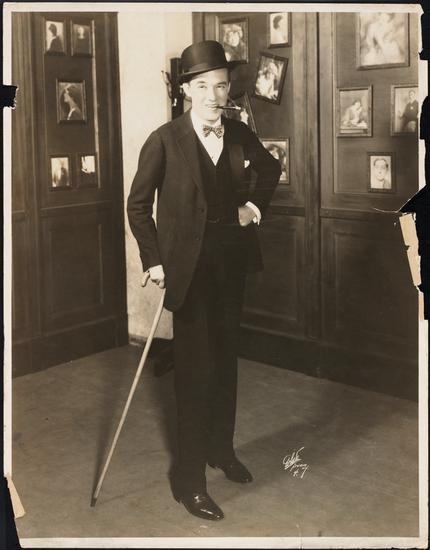
LITTLE TRAMP’S BIG BROTHER Sydney Chaplin performed in 37 films, including The Man on the Box (1925) with actress Alice Calhoun (above). He was Charlie Chaplin’s older brother and business manager. (Ohio State University)
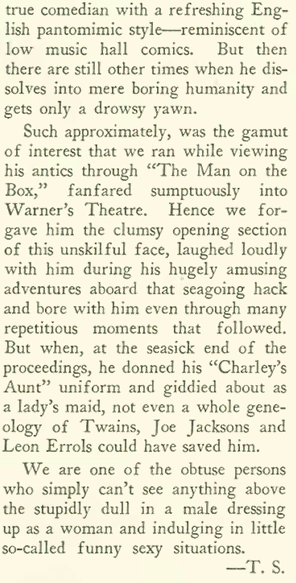
He also took Sydney Chaplin’s attempts at humor to task in the film, The Man on the Box, including his tired “male dressing up as a woman” gag.
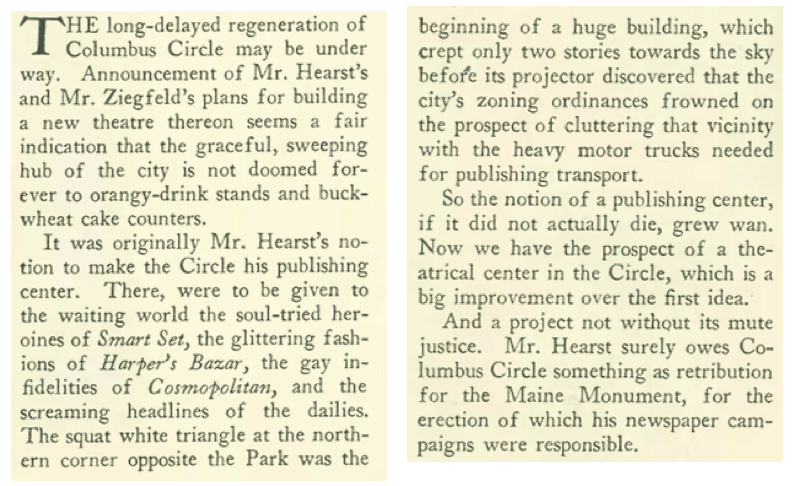
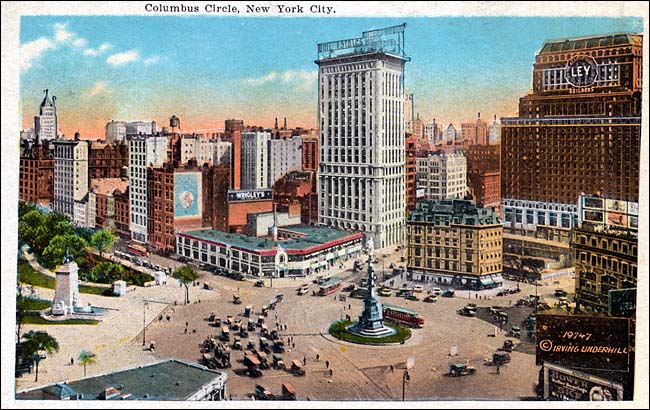
“Talk” also commented on changing face of New York City, including plans for a new Ziegfeld theatre as part of a “regeneration” of Columbus Circle:
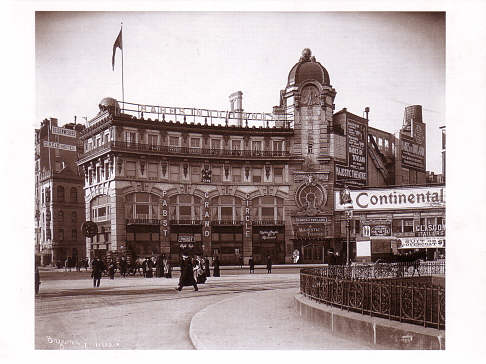
According to performingartsarchive.com, Florenz Ziegfeld took over Columbus Circle’s Cosmopolitan theatre in 1925 and updated the interior. The building originally opened in 1903 as the Majestic (where the first musical stage version of The Wizard of Oz and the play Pygmallian debuted). It was briefly a burlesque house in the early 1920s (Minksy’s Park Music Hall) until William Randolph Hearst acquired it as a main venue for his Cosmopolitan Pictures company.
Postcard image of Columbus Circle, circa 1925. The Cosmopolitan is at far lower right. (NYC Architecture)
Under Ziegfeld, the Cosmopolitan returned to “legitimate” theater, but in 1926 he gave it up to focus on the construction of his self-named theatre at Sixth Avenue and 54th Street. The Cosmopolitan (renamed the International in 1944) would continue to serve both as a venue for movies and live performances until 1949, when it was acquired by NBC as a television studio for the TV program Your Show of Shows, featuring Sid Caesar and Imogene Coca. NBC left the International in 1954, and not long afterwards, the former theatre, along with most of its neighbors on Columbus Circle, was razed to make way for the New York Convention Center.
The long-gone Majestic, later Cosmopolitan theatre on Columbus Circle. (performingartsarchive.com)
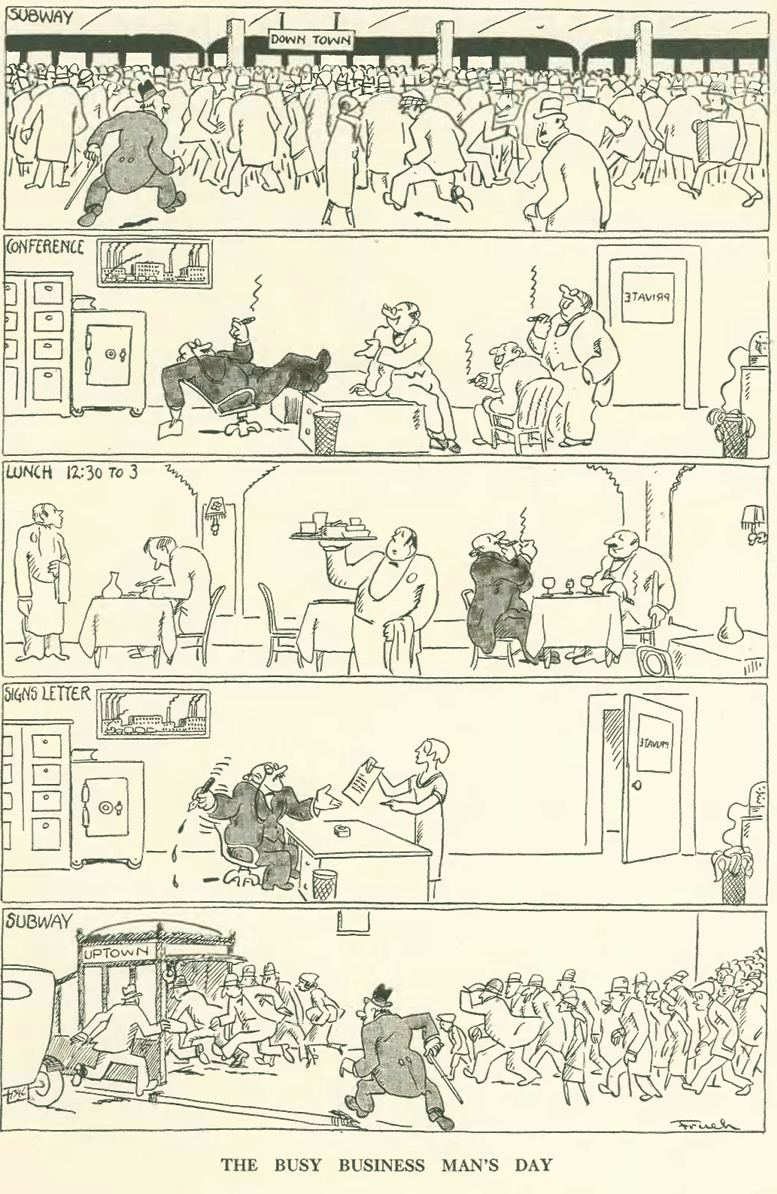
Also from this issue, Al Frueh’s take on a “Busy Business Man’s Day:”
Hans Stengel delivered “Sermons on Sin”…
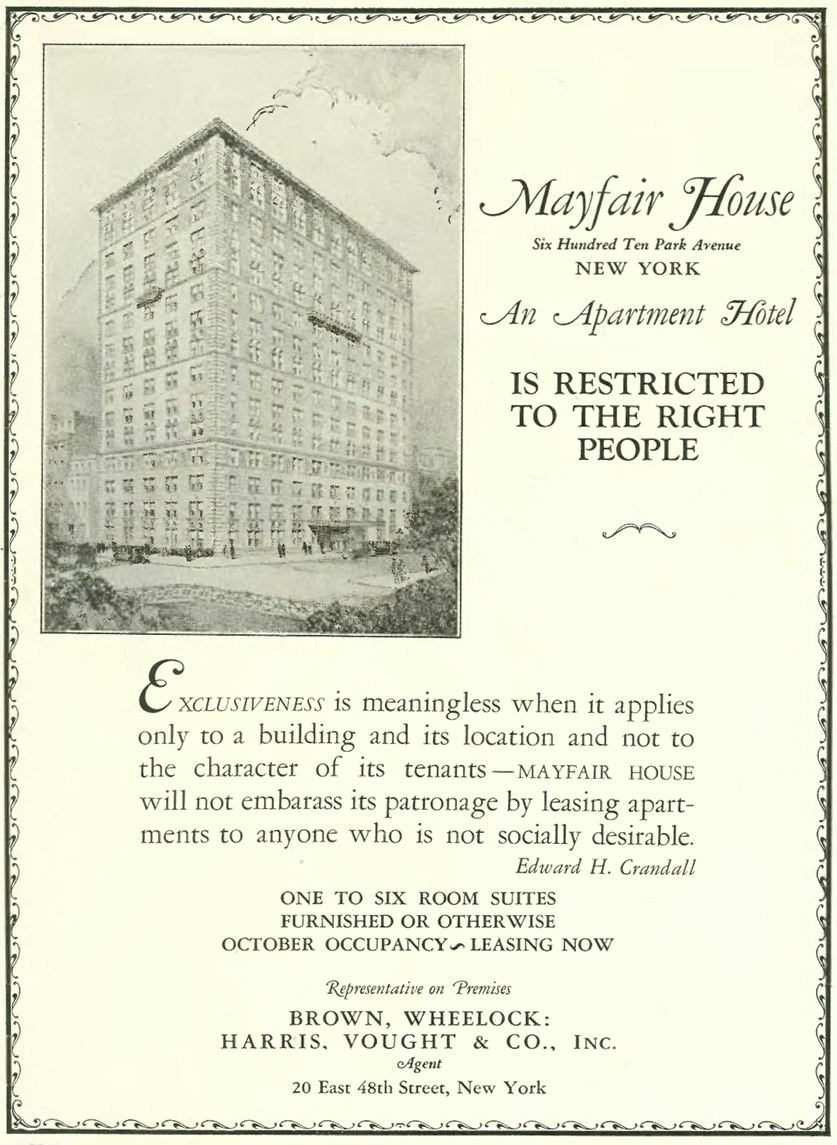
And lest we doubt the snob appeal of our fledgling magazine, check out this advertisement from the Mayfair House assuring that tenants will be kept a safe distance from the proles and other undesirables…
And to close, a back page ad for the Restaurant Crillon, featuring the unmistakable graphic innovation of Winold Reiss:
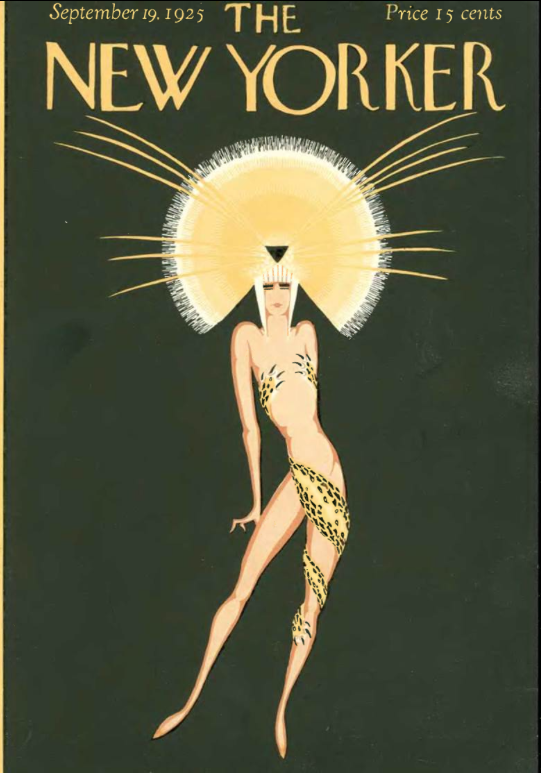
It was a busy week for the Sept. 19 issue of The New Yorker. “The Talk of the Town” reported that ‘amateur beauties” at the Atlantic City Beauty Pageant (known today as the Miss America Pageant) were “protesting against the presence of professional sisters in the contest.” Talk then posed this question:
“Is beauty, one wondered, ever amateur? Is it not the most professional of all professional matters? To a man it would seem so. But women may know better. And if there is a distinction—if we are to have amateur and professional beauties—why should not the Atlantic City promoters take a leaf from golf’s book and hold an open championship, wherein the two classes may meet?
Talk concluded:
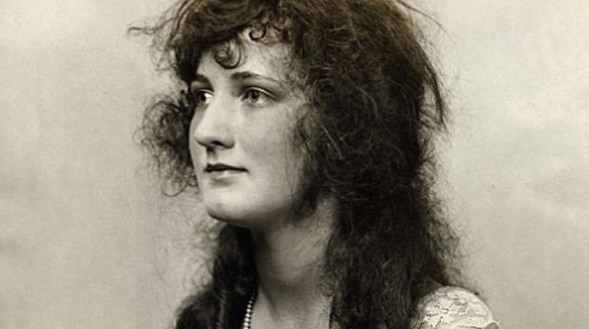
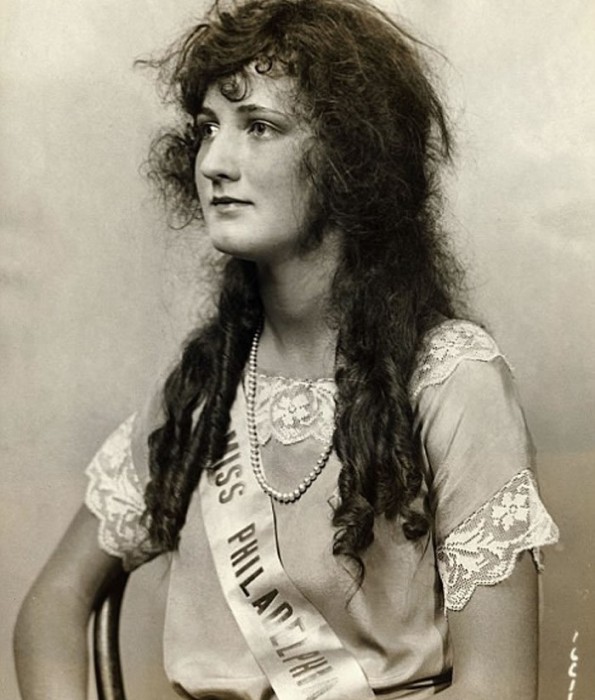
The winner of last year’s beauty contest, Miss Ruth Malcomson, tells how she won it in a recent issue of Liberty; and from these writings we leap hastily to the conclusion that the very beautiful are also very very simple.
Ruth Malcomson, Miss America 1924. (Vintage Everyday)
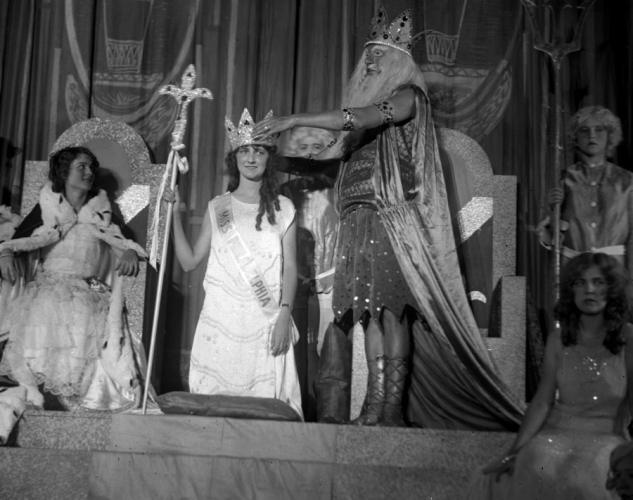
“Talk” was right about Ruth Malcomson, who was just 18 when she won the title. A native of Philadelphia, she defeated 85 fellow contestants including incumbent Mary Campbell, who was seeking her third consecutive crown. At the time the contest was only in its fourth year, and the winner was called “The Golden Mermaid.”
Malcomson crowned “The Golden Mermaid,” Miss America 1924
Malcomson was among the critics of the “professional” contestants. According to her obituary in the Philadelphia Inquirer (May 28, 1988) Malcomson stated in 1925 that “The pageant now has become nothing but a commercial proposition to exploit the beauties who make their living from their good looks. What chance has an ordinary girl, untrained, to win a contest in which girls who have been trained to make the most of their beauty are competing?”
Ninety-one years later…Miss New York Kira Kazantsev crowned Miss America 2015. (The Blaze)
In her Liberty Magazine interview, she also blasted women’s groups for berating her involvement in the competition.
Malcomson hinted that the women’s groups were exploiting her, not the pageant (yes, there is nothing new under the sun…).
True to her word, Malcomson married an unassuming Carl Schaubel in 1931 and returned to a quiet, simple life in suburban Philadelphia.
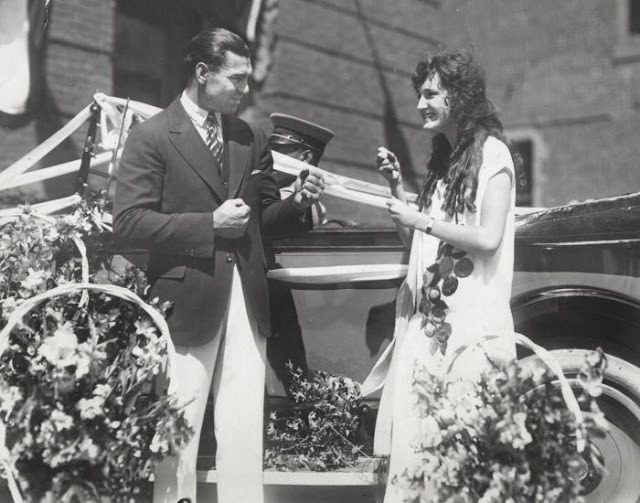
Standing next to the Rickenbacker car she won as Miss America in 1924, Ruth Malcomson playfully spars with World Heavyweight Champion boxer Jack Dempsey. (Vintage Everyday)
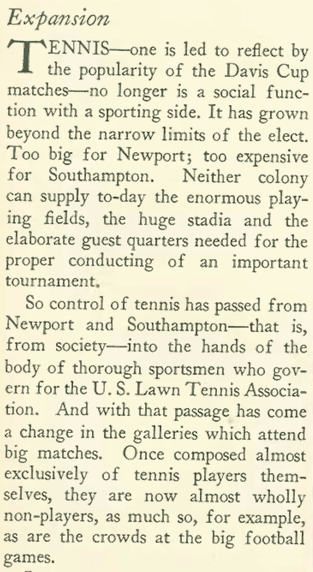
In other “Talk” items, the “No Smoking” rule at the public library was challenged, and arguments were made for special smoking rooms that could be reserved for writers. The column also offered comment on the growing popularity of tennis as a professional spectator sport, rather than merely a side activity for a society weekend:
“Profiles” turned its attention to bodybuilder and publisher Bernarr McFadden (featured in an earlier post in this blog). McFadden was always at the cutting-edge of scandal, whether for the nearly nude photos featured in his Physical Culture Magazine, or for the celebrity scandal and sensational crime reported in his Evening Graphic.
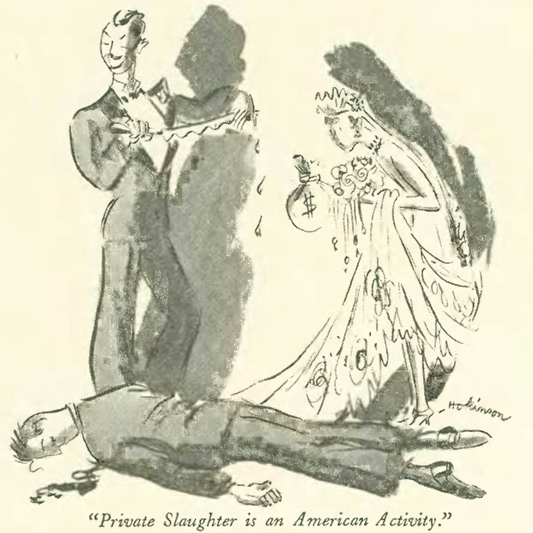
In his essay “Murder As Bad Art,” Waldo Frank pondered America’s high homicide rate, and suggested that murder is an expedient means toward an end for the impatient American. An excerpt, with artwork by Helen Hokinson:
Willa Cather (Nebraska History)
In “Books,” Harry Este Dounce offered a lengthy, thoughtful and positive review of Willa Cather’s latest novel, The Professor’s House, and likened its tone to an Ibsen play. Cather would continue to receive praise from New Yorker critics throughout the remainder of her career.
In “Sports Of The Week” John Tunis offered extensive coverage of the Davis Cup matches, and noted that American star Bill Tilden was hurt and was “far from the Tilden of old.” There were rumors that Tilden was determined to throw his match with French tennis champion Jean Borotra. Tunis wrote that he had his suspicions, but offered that perhaps Tilden was playing carelessly as he had done before “with other less celebrated opponents.”
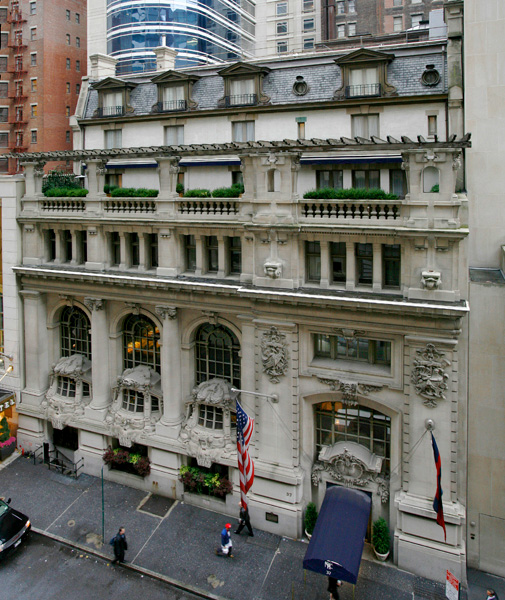
And Lois Long offered her frank opinions on two New York hotspots, the 45th Street Yacht Club and the Owl Club at 125 East 45th:
The Yacht Club building today (erbology.com)
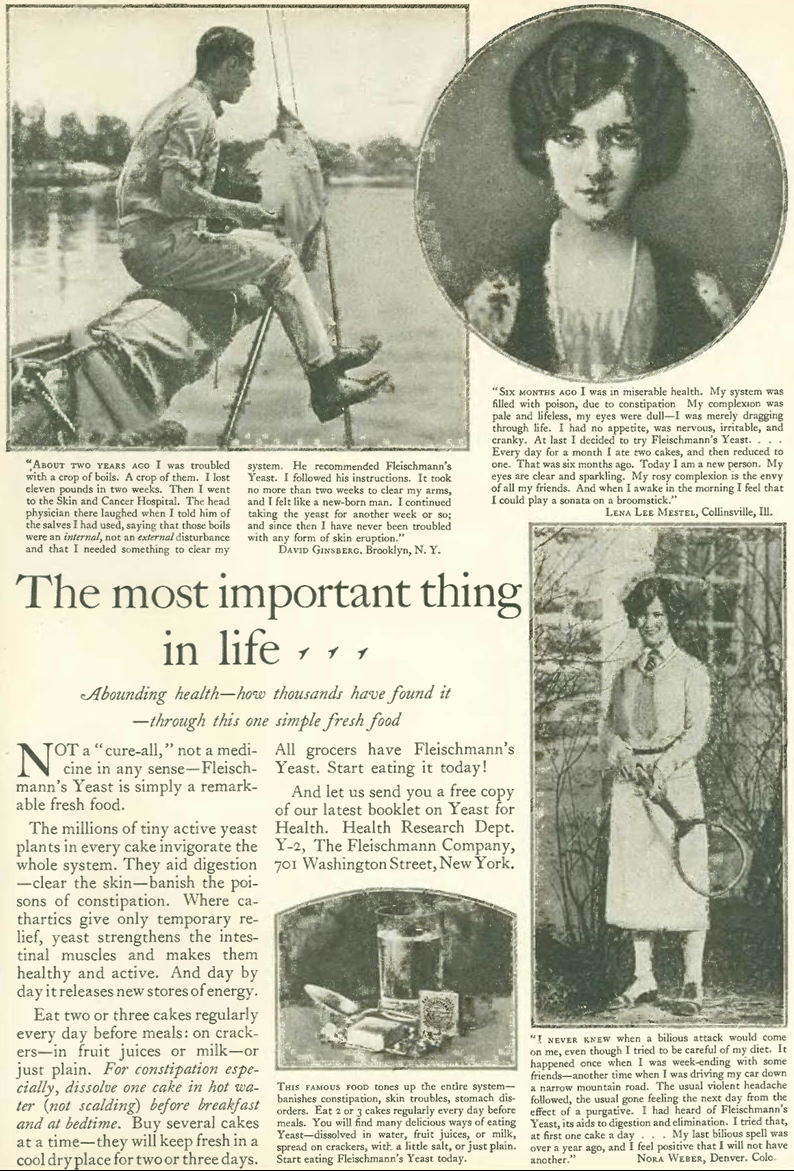
And another ad courtesy of Raoul Fleischmann, with testimonials from a man and two women who credit Fleischmann yeast with curing them of boils, constipation and “bilous” attacks:
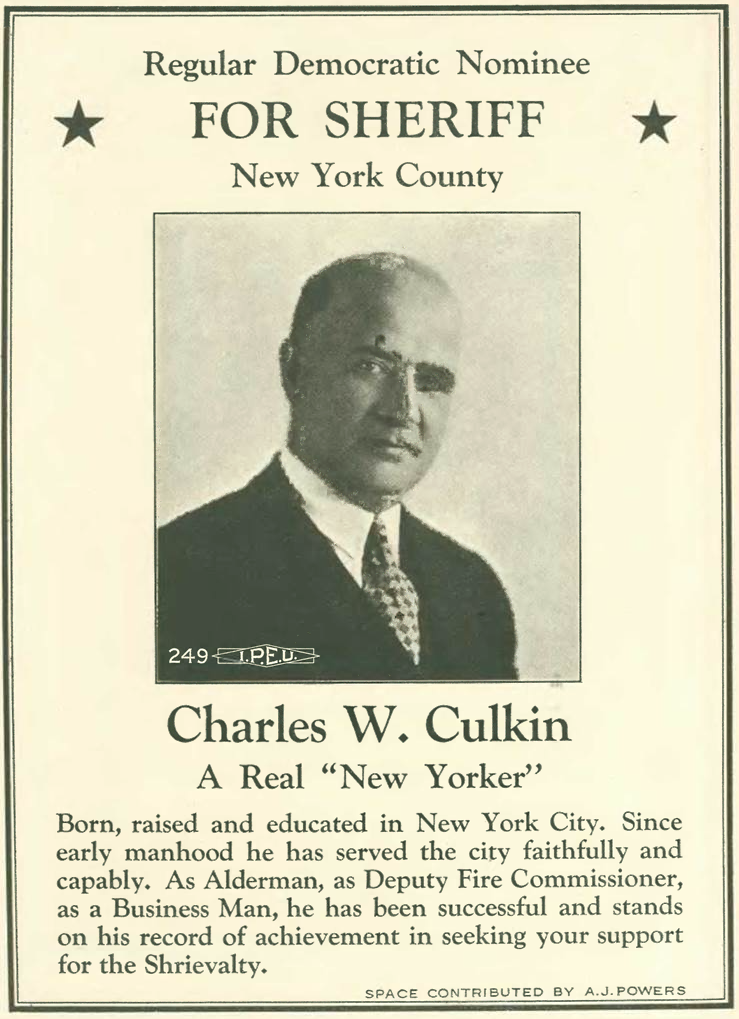
Well, at least advertising revenue is up, but this ad seems out of place in a magazine like The New Yorker:
Charles Culkin was a Tammany Hall politician who would serve as county sheriff from 1926 to 1929. He was later indicted for embezzling interest money from the sheriff’s office, part of the whole mess that brought down Mayor Jimmy Walker (we will explore that later, I am sure).
Now, for a couple of cartoons by Isadore Klein and Johann Bull, featured on facing pages, that illustrate two very different aspects of New York life in the 1920s:
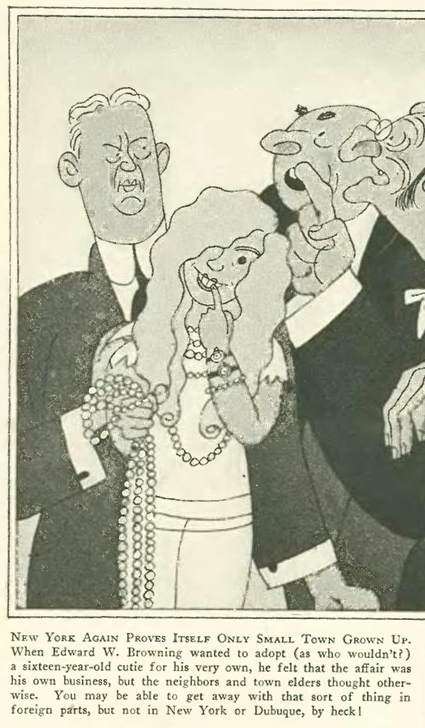
Ralph Barton’s “The Graphic Section” in the August 15, 1925 edition of The New Yorker gave readers their first whiff of one of the sensational scandals of the Roaring Twenties. Barton reported that wealthy, middle-aged bachelor Edward Browning (then 51 years old) wanted to “adopt” a “sixteen-year-old cutie for his very own.”
What Barton referenced in his comic illustration foreshadowed the “Peaches” scandal that would occur the following year.
According to an April 1, 2012 article by Dan Lee in New York Magazine (titled with the subhead, “She was 16, he was 52, what could go wrong?”), Browning was well known in New York City “as perhaps the most idiosyncratic of the city’s eligible bachelors…worth what would now be an estimated $300 million.”
Ralph Barton illustrates Edward Browning’s predicament in “adopting” Mary Louise Spas. (New Yorker Digital Archive)
Lee writes that Browning was already a tabloid fixture at age 40 when he married his first wife, Adele, a considerably younger file clerk. They adopted two daughters, Marjorie and “little Dorothy Sunshine,” Browning’s favorite. When Adele left him for a “28-year-old playboy dentist,” they split the girls between them. Browning, of course, chose “Sunshine,” and vowed never to marry again. Lee takes it from there:
In what the tabloids quickly helped morph into a Willy Wonka–style lottery, Daddy set about finding a sister for Sunshine: After personally reviewing 12,000 applications and interviewing scores of would-be daughters, he chose Mary Louise Spas of Queens, who, despite being 16 and therefore two years older than the cutoff, bore a charming gold tooth and stole his heart. A My Fair Lady transformation ensued, rapturously reported by the press, which continued trolling Spas’s past, ultimately uncovering revealing swimsuit photos that led to school records that led to the disclosure that Mary was actually 21 and not poor. Daddy moved to have the adoption annulled. Mary responded with a tabloid tell-all and lawsuit, alleging Daddy was a pervert.
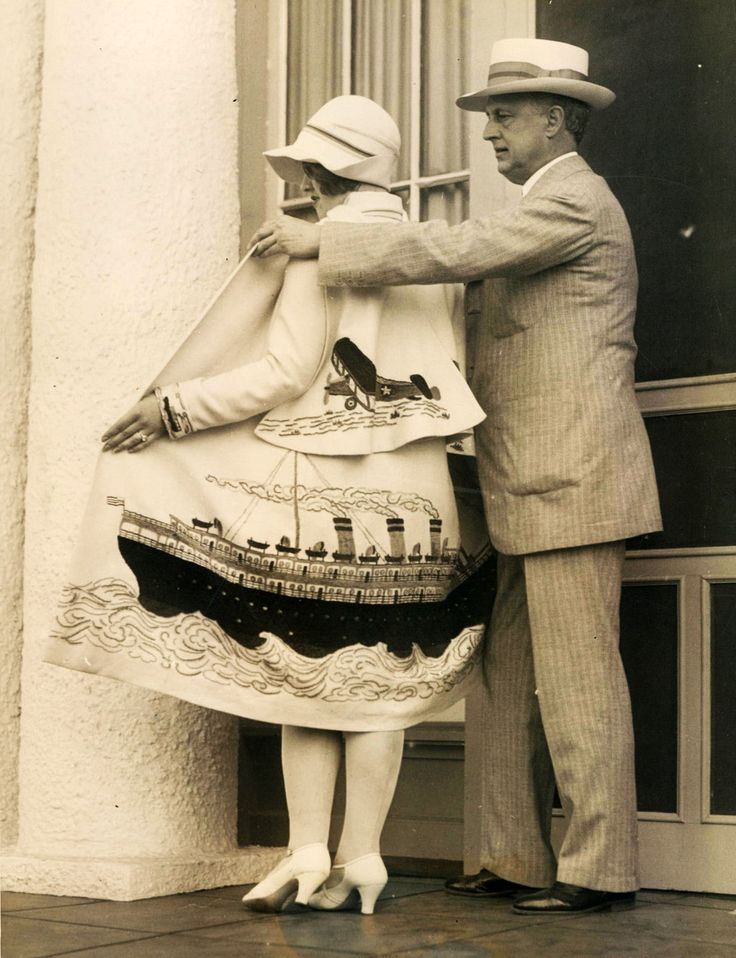
“Daddy” helps “Peaches” with her coat. If that is an image of the Titanic, the irony is just too rich…(Retronaut)
According to Lee, Browning then turned his attention to charity, “especially for a local chapter of the Phi Lambda Tau social sorority for high-school girls, of which he was the main benefactor.” Lee continues:
The sorority’s primary function was throwing dances across Manhattan for girls in scanty flapper dress, where Daddy, with his long, sagging face and steep W-collared dress shirts, smoked cigars and held court. And so it went that one night, inside the ballroom of the Hotel McAlpin on 34th and Broadway, Browning’s life intersected with Frances Heenan’s, whom the press would describe as a “chubby,” strawberry-blonde high-school dropout with “piano legs” but an inexplicably “magnetic” smile who worked as a shop clerk and lived with her single mother in Washington Heights. He likened her to peaches and cream, securing her lifelong nickname. Thirty-seven days later to thwart a child-protective-services investigation, they were married.
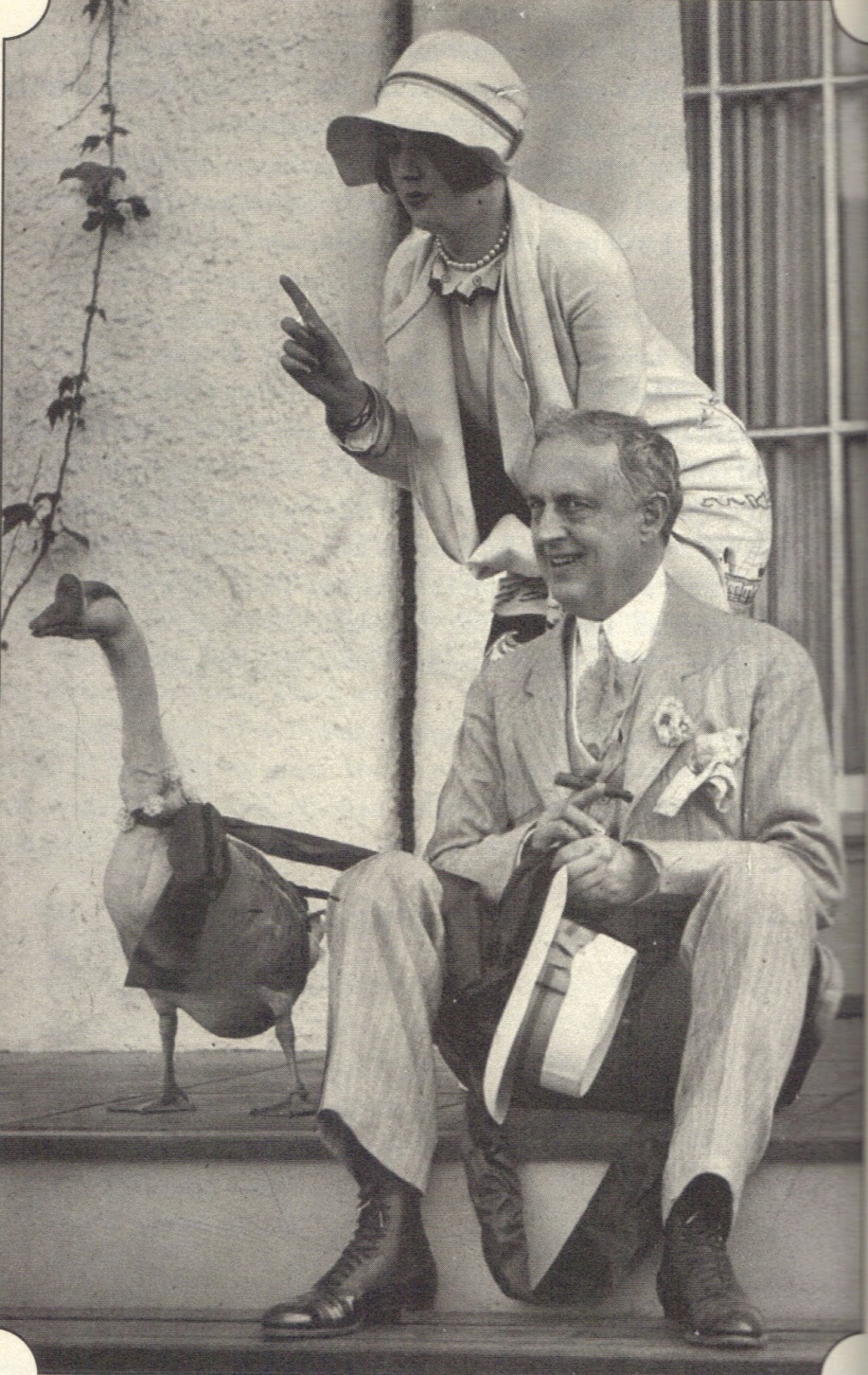
Peaches and Daddy with African goose. (brandypurdy.blogspot)
The wedding took place on June 23, 1926, Peaches’ 16th birthday, but later that year, Peaches would seek a divorce.
The divorce trial in White Plains, New York drew intense coverage by the tabloids including Bernarr McFadden’s notorious New York Graphic, which published “composographs” of the couple, including this one:
Composographs, forerunners of photo manipulation, were retouched photographic collages popularized by publisher and physical culture advocate Bernarr Macfadden in his New York Evening Graphic. The Graphic was dubbed “The Porno-Graphic” by critics of the time and has been called “one of the low points in the history of American journalism.” The images were cut and pasted together using the heads or faces of current celebrities, glued onto staged images created by employees in Macfadden’s in-house studio. (Image: dhtinshakerheights.blogspot.com, Text: Wikipedia)
The story was featured in newspapers across the country, including reports of Peaches’ testimony regarding her husband’s odd sexual behavior and the fact that he kept an African goose in their bedroom. According to Wikipedia, the phrase “Don’t be a goof,” which Browning allegedly used to insult Peaches, came into national vogue, and later turned up in the lyrics of the song “On Your Toes,” by Rodgers and Hart.
In the end, the judge ruled that Peaches had abandoned her husband without cause, and released Browning from the marriage. She was however awarded a $6,000 “widow’s portion” when Browning died in 1934.
Peaches in her vaudeville days. (travsd.wordpress.com)
According to Lee, Peaches pursued a successful career in vaudeville, “had an affair with Milton Berle,” would marry and divorce three more times, and would become an alcoholic. On August 23, 1956, her mother heard a crashing sound in the bathroom of their New York City apartment and found Peaches unconscious with a large contusion above her ear. She was dead at 46.
If you want to read more about this strange coupling, Michael Greenburg has written a book, Peaches and Daddy: A Story of the Roaring 20s, the Birth of Tabloid Media, and the Courtship that Captured the Hearts and Imaginations of the American Public.
And so on to the rest of the issue…
“Profiles” featured Theodore Dreiser, whom Waldo “Search-light” Frank dubbed “the martyr of the American Novel” and a “heroic warrior against legions of a commercial and Puritan world.”
“The Talk of the Town” offered this postscript on the “Scopes Monkey Trial,” observing that the small Tennessee town was suffering a bit of hangover (and attendant humiliation) from all of the trial publicity:
“Sports of the Week” covered the annual “Dog Show of the Consolidated Hamptons,” featuring illustrations by Johan Bull:
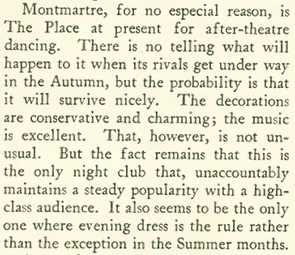
In her column, “When Nights Are Bold,” Lois Long offered the Montmartre as a venue for summer entertaining:
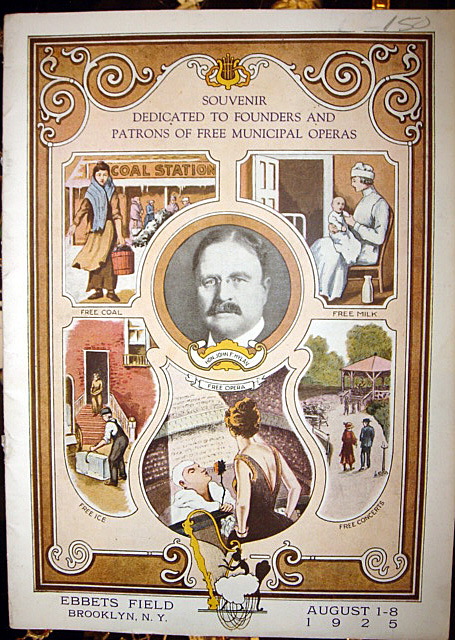
“Music” featured a brief review of Mayor John F. Hylan’s “free people’s concert,” Aida, at Ebbett’s Field, taking the usual shots at the mayor’s grasping attempts at publicity:
Program promoting Mayor Hylan’s public operas and other services from August 1925
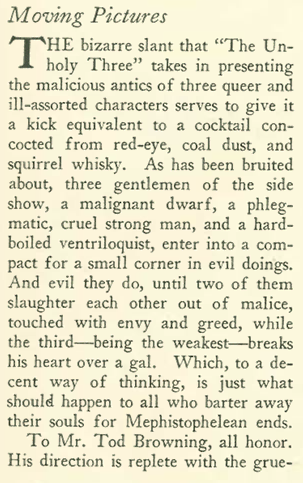
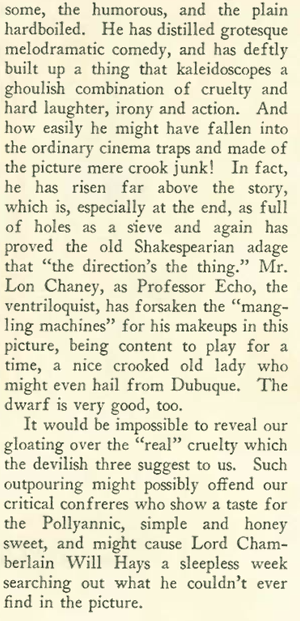
“Moving Pictures” peered between fingers at Tod Browning’s latest picture, The Unholy Three (the same Tod Browning who would go on to direct Dracula with Bela Lugosi in 1931 and the creepy 1932 cult classic, Freaks):
Lon Chaney and friend in The Unholy Three (1925) (Alamo Drafthouse)
Sweet dreams!
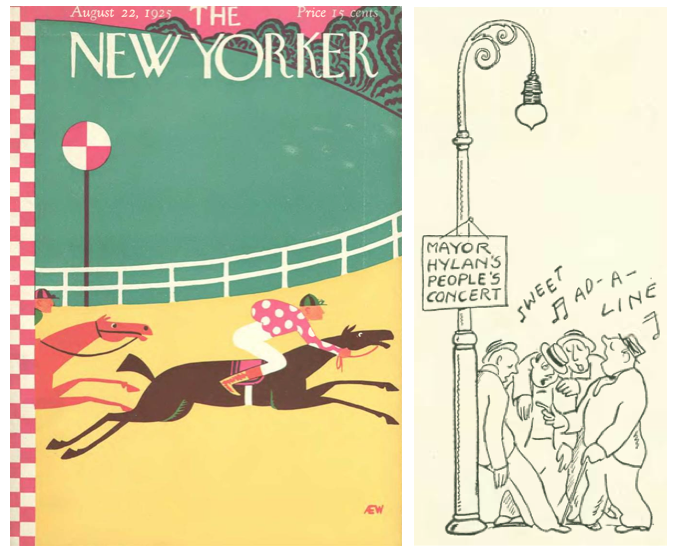
Next time, more horseplay, and another jab at the mayor:
The dog days of summer were ushered in by the news that “the buyers” had “invaded” the city.
The “buyers” in question were tourists (and no doubt some clothing store merchants) from across the country who had descended upon Gotham in search of the latest fashions that could be bundled off to the hinterlands.
“The Talk of the Town,” speaking through the fictional persona “Van Bibber III,” took a sneering view of this annual migration:
(New Yorker Digital Archive)
In the first issues of The New Yorker, the “Van Bibber III” signature appeared occasionally at the end of “Talk” or other items.
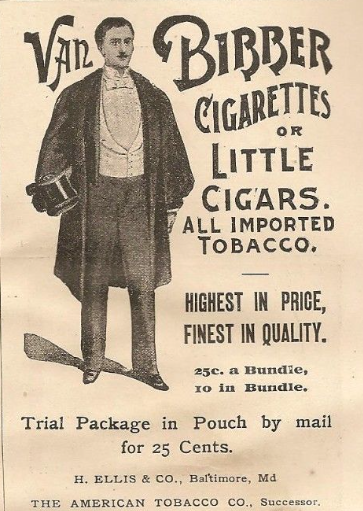
Van Bibber advertisement in Cosmopolitan, 1896
In her book, Defining New Yorker Humor, Judith Yaross Lee wrote that early readers of The New Yorker would have recognized the Van Bibber III persona “as a joke, a personification of Van Bibber cigarettes, whose ads targeted the devil-may-care, swagger young man about town all dressed up for the opening night. As an insiders view of the urban scene, Van Bibber’s accounts featured casual conversation—that is, talk.”
“Of All Things” offered this update on the activities of illusionist Harry Houdini:
Houdini, charged with disorderly conduct after smashing up an office, replied: They locked the door and I had to fight my way out.” Bang goes another illusion! We thought he could open anything but a car window.
Murdock Pemberton wrote about the life of poet Harry Kemp in “Profiles,” and cartoonist Al Frueh offered this twist on the uses of “hot air:”
(New Yorker Digital Archive)
And more art from Ralph Barton, this time along with his views on the play Artists and Models and the contrasts between life in New York and Paris:
(New Yorker Digital Archive)
“Moving Pictures” offered praise for Sally of the Sawdust, featuring W.C. Fields. Theodore Shane wrote that Fields had distinguished himself from other movie comedians through his act as a “snooty sort of superclown.”
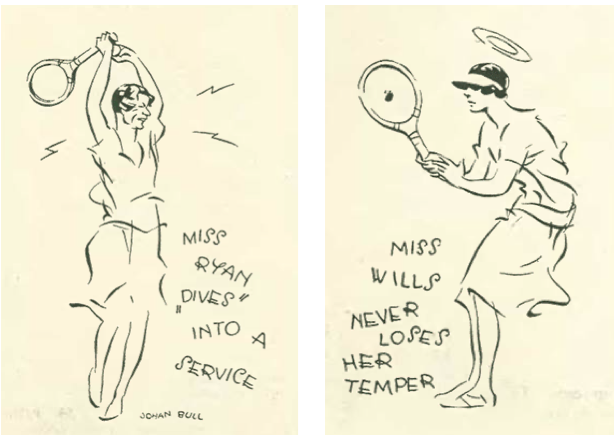
Art work by Johan Bull from “Sports of the Week.” In their careers, Elizabeth Ryan won 30 Grand Slam Titles, and Helen Wills won 31 (New Yorker Digital Archive).
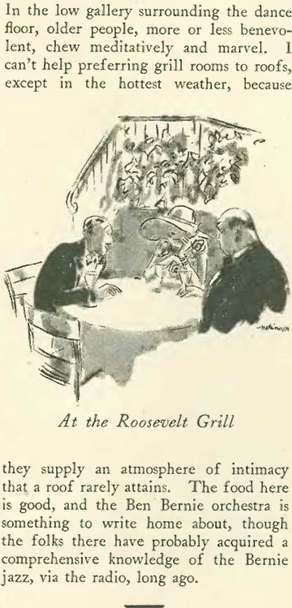
The tennis tournament at Seabright featuring Elizabeth Ryan and Helen Wills was the subject of “Sports of the Week,” and in “When Nights Are Bold,” Lois Long continued her look at nighttime entertainment venues to beat the summer heat:
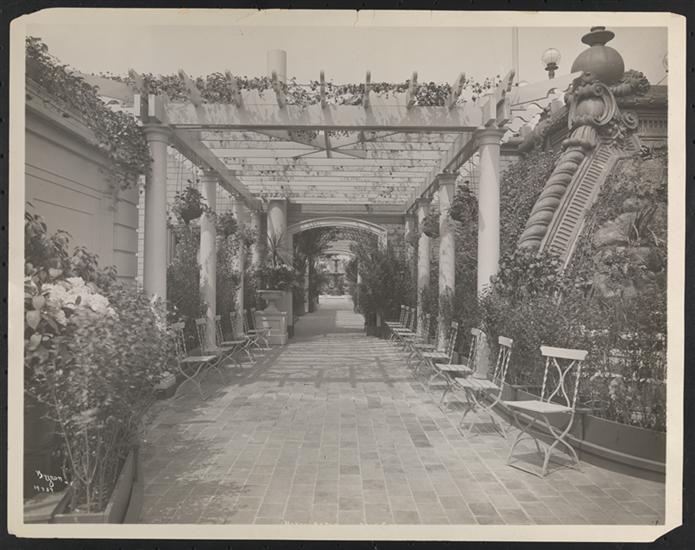
(New Yorker Digital Archive)Hotel Astor Roof Garden in 1905 (Museum of the City of New York)
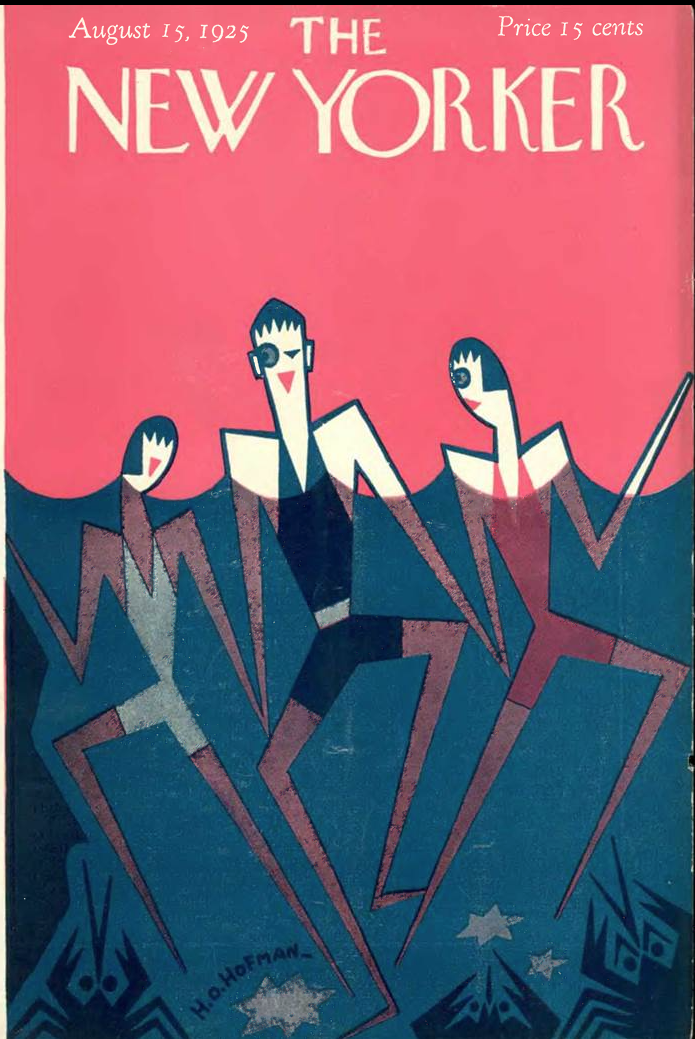
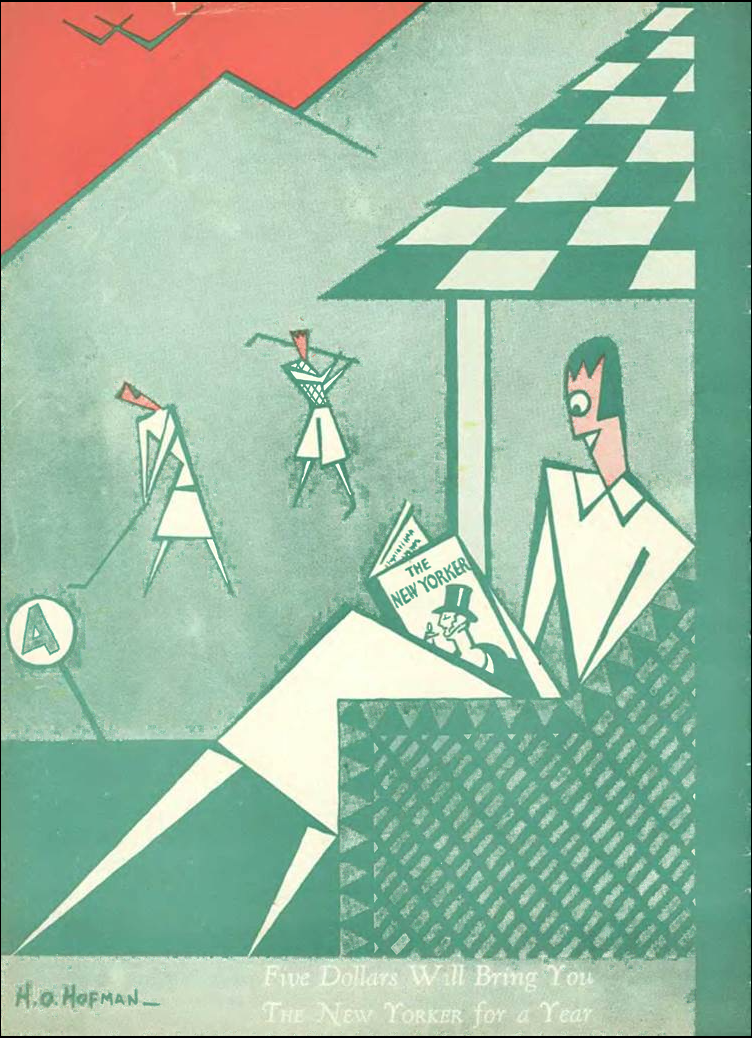
Advertising remained sparse in the pages of The New Yorker, with both inside front and inside back covers devoted to in-house ads promoting the magazine. In addition, the color back cover was also a house ad, featuring a rendering by H. O. Hofman:
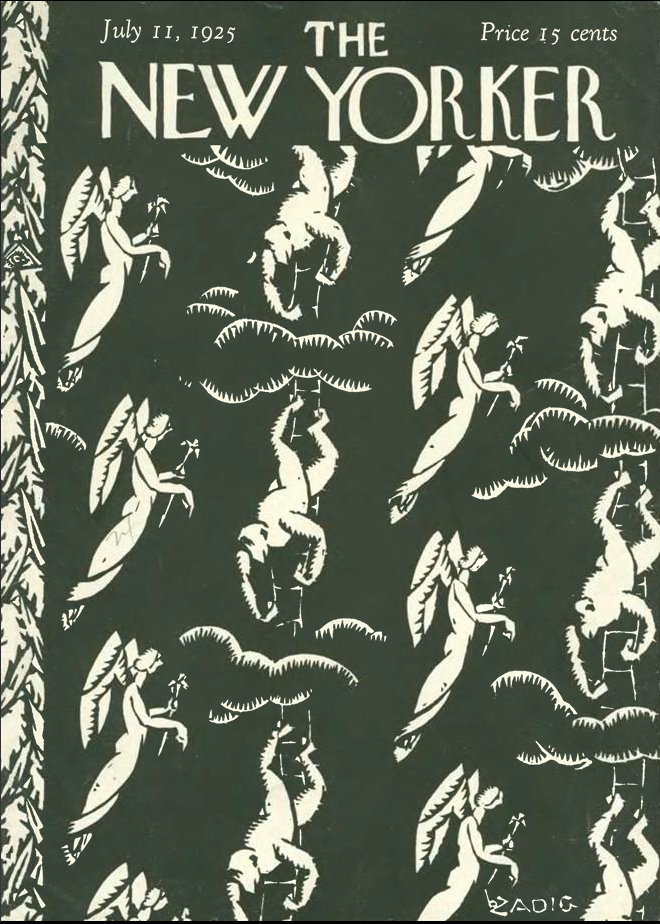
In its 21st issue (July 11, 1925) The New Yorker was back to taking swipes at William Jennings Bryan and the backward ways of Tennesseans as the Scopes “Monkey Trial” drew near.
Cover for July 11, 1925, by Bertrand Zadig. It was a low point for the fledging magazine–funds were so scarce that the cover was printed in black and white. (New Yorker Digital Archive)
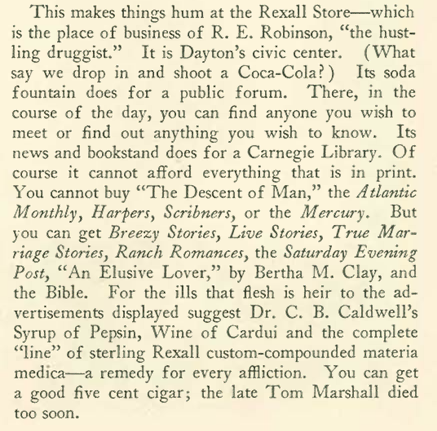
A four-page feature penned by Marquis James (the longest article to appear in The New Yorker since Issue #1), primarily focused on the trial’s setting—Dayton, Tennessee—and the habits and tastes of its countrified citizens:
Prosecutor and famed orator William Jennings Bryan had not yet arrived in Dayton, but the townsfolk were plenty enamored of the other star in their midst, attorney for the defense Clarence Darrow. James reported that the agnostic Darrow mixed surprisingly well with the locals:
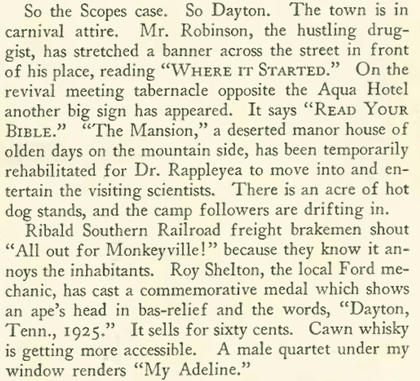
James concluded his piece with a description of the carnival atmosphere that gripped the tiny, formerly unknown town that was now the focus of the entire country:
(New Yorker Digital Archive)
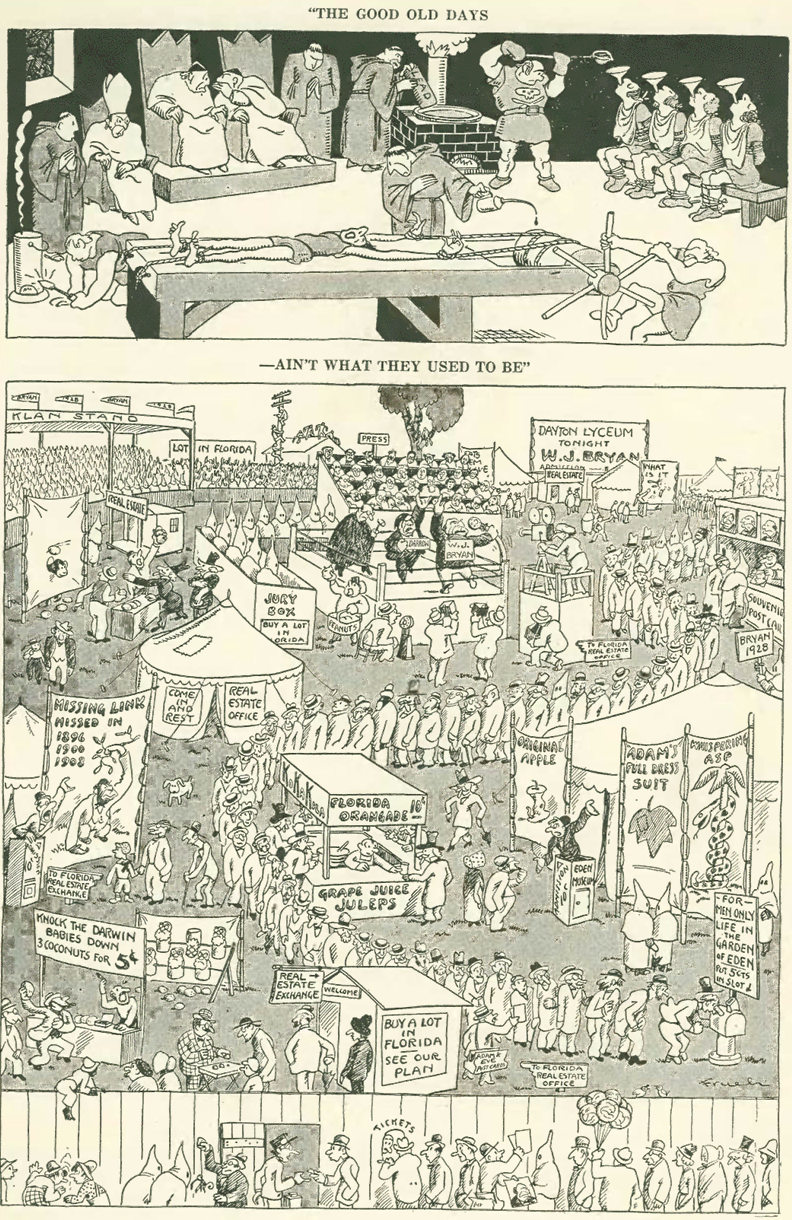
An illustration by Al Frueh that preceded James’s article makes hay of the “carnival atmosphere,” likening it to a modern-day version of the Inquisition:
(New Yorker Digital Archive)
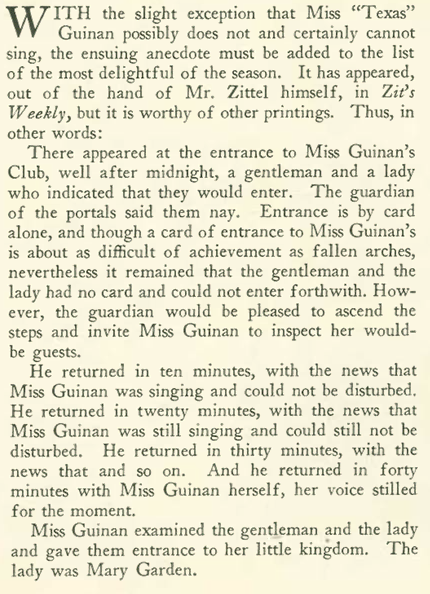
“The Talk of the Town” did its usual breezy wrap up of “The Week” (including the announcement of the birth of Charlie Chaplin’s son (by Lita Grey), and offered a somber note about the dampening effects of Prohibition on the restaurant trade. It also noted that David Belasco had marked 50 years in the theater business (though his influence was waning), and Texas Guinan personally opened the door of her nightclub to opera great Mary Garden after a bit of a misunderstanding:
(New Yorker Digital Archive)
“Profiles” looked at Clinton Peters, “The Daddy of Sunday Painters,” while “Moving Pictures” cheered Edmond Rostand’s “masterpiece,” Cyrano de Bergerac, starring French actor Pierre Magnier in a “magnificently well—seasoned interpretation.”
Pierre Magnier (left) starred in the hand-tinted color film, Cyrano de Bergerac. (Screen capture from YouTube)
The film was also “in color,” actually a cross between two-color technicolor and hand-coloring, sometimes using only one process or the other, sometimes both. According to IMDB:
Parts of the film were hand colored using the Pathécolor stencil process, in which groundstone glass is cut with a pantograph in the shape of an object to conform with what is on the 35mm print. A machine then passes a dye-soaked strip of velvet over the film with the glass stencil on top and the film is colored. Cutting the stencils (a stencil for every different color) was a very long and tedious process which delayed the release of the film by almost two years. The color style/scheme of the movie was to imitate the tone, color and feel of 17th Century Renaissance paintings.
In the review of another film, Paths to Paradise, the critic (TS) wrote that “Mr. Raymond Griffith establishes himself as a genuine comedian of the rank of Menjou and Chaplin.”
Raymond Griffith and Betty Compson in Paths to Paradise (1925) (travsd.wordpress.com)
The “Sports” section of these early issues of The New Yorker covered mostly polo, tennis, golf and yacht races and regattas, which I will explore more in future posts.
Fay Marbe on the cover of the June 28, 1924 issue of Movie Weekly.
In the section “When Nights Are Bold,” Charles Baskerville (signing as “Top Hat”) reviewed the tango dance performance by Fay Marbe at the Beaux Arts Restaurant: “She is easy on the eyes; and after her performance we were all patting her on the back, because it’s one of the most beautiful ones we have ever beheld.”
And now for the funnies: On the inside front cover, the musings of English cartoonist W. Heath Robinson, best known for his drawings of ridiculously complicated machines for achieving simple objectives:
(New Yorker Digital Archive)
And finally, this three-act performance by staff artist Johan Bull. In her book Defining New Yorker Humor, Judith Yaross Lee writes that Bull was a Norwegian immigrant who started out as a caricaturist for the sports department, but was pressed into greater service for his ability to mimic Rea Irvin’s style:




























































 A New Yorker State of Mind