Coney Island was famous for its side-show freak exhibits, but from 1925 to 1969 Hubert’s Dime Museum and Flea Circus in Times Square brought the show to the heart of Manhattan.
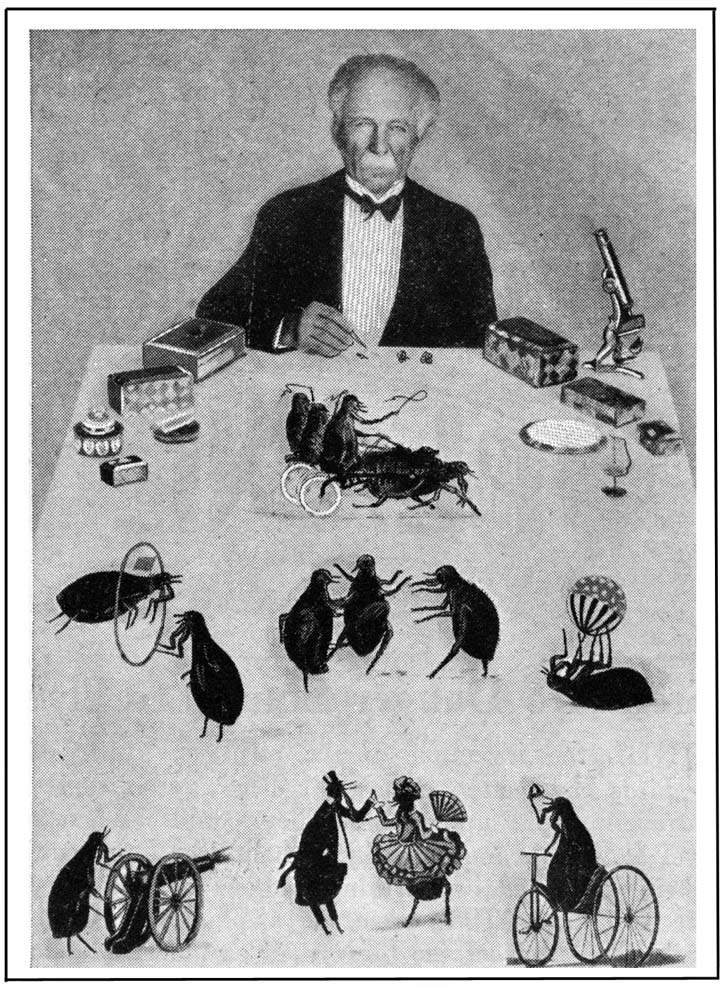
In addition to sword swallowers, tattooed ladies and other human oddities (the famous Zip the Pinhead did a short stint there), there was also Professor Heckler’s Flea Circus, which operated in the basement. It indeed featured real fleas attached by very thin wires to miniature chariots, merry-go-rounds and the like.
The New Yorker mentioned Hubert’s in this brief “Talk of the Town” item:
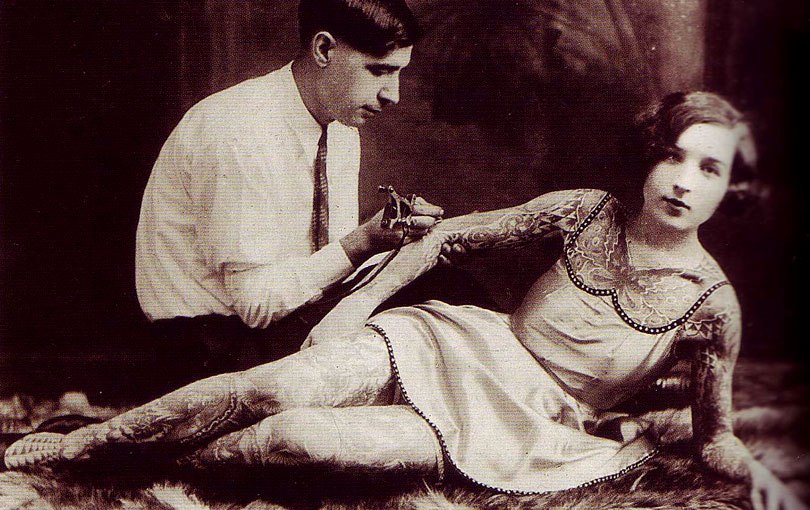
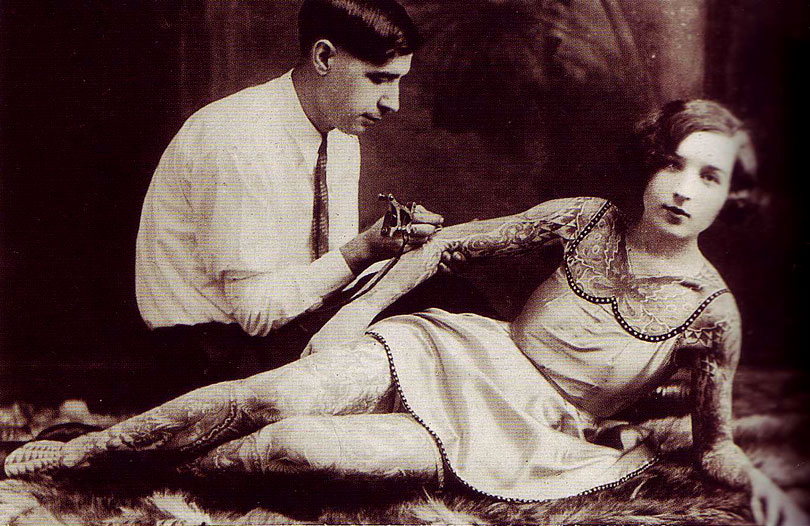
These days it seems a bit strange that women covered in tattoos were once considered sideshow oddities. Among the more famous was Stella Grassman, who worked as a “Tattooed Lady” in the late 1920’s in the Ringling Bros. Barnum & Bailey Circus and also appeared at Hubert’s. Stella and her husband, Deafy (pictured below) owned a tattoo shop on the Bowery.
Stella Grassman and her husband, Deafy (Tattoo Archive)
And then there was Professor Heckler’s Flea Circus, depicted below (the “fleas” enlarged 700 times, and obviously embellished) in a feature on Prof. Heckler in the March 1930 issue of Modern Mechanics:
(Sideshow World)
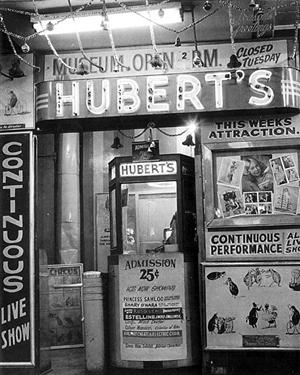
The entrance to Hubert’s, photo undated, but probably from the early 1950’s:
Entrance to Hubert’s Museum (Ephemeral New York)
After Hubert’s closed it became just another porno peep show, a ubiquitous sight on Times Square until the city began a “clean up” of the area in the 1990s.
* * *
Profiles examined the life and work of playwright Eugene O’Neill, and in the “Critique” section Gilbert W. Gabriel (who sometimes wrote under the pseudonym Golly-Wogg) gave a strong review of O’Neill’s The Great God Brown, writing that the play represented “some of the finest writing of his lifetime.”
Peter Arno’s rendering of Eugene O’Neill for “Profile.”
I should note here that Gabriel had replaced Herman J. Mankiewicz as drama critic following HJM’s firing by editor Harold Ross in January of 1926. Ross, miffed by Mankiewicz’s interest in Hollywood, famously fired “Mank” by telegram (Mankiewicz would go on to a successful career as a screenwriter on such films as Citizen Kane and The Wizard of Oz).
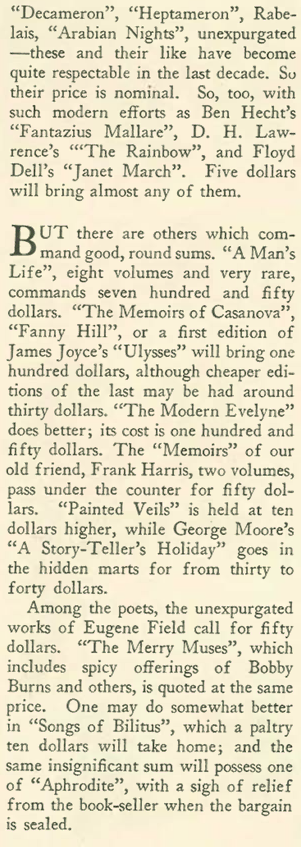
Finally, an interesting take in “Talk of the Town” on book censorship of the day:
“Talk” ended with this helpful advice on current cocktail recipes (remember we are in the midst of Prohibition). The “Titantic,” with six parts gin, seems deadly indeed:
What is “Nuxated Iron” you ask? It was sold as a performing enhancing iron supplement in the early 20th century, endorsed by such athletes as boxer Jack Dempsey and baseball’s Ty Cobb. The blog Peterboriana explains it thus:
“Nuxated Iron” pills, as endorsed by Dempsey, were, obviously, iron supplements. As for the “nuxated” part of it, that refers to nux vomica, a deadly substance better known as strychnine (i.e. rat poison). Fortunately, the stuff being hawked…actually contained very little strychnine, and not much iron either. It was comparatively useless as a performance-enhancing drug, but would not kill you unless you took a lot of it.
So if the Titanic’s six parts gin don’t get you first, maybe the Nuxated Iron will.
“The maddest week any of us remembers in the theatre,” observed “The Talk of the Town” for Sept. 26, 1925, as The Green Hat (the play based on Michael Arlen’s popular novel) was creating a riotous rush for tickets on The Great White Way.
Talk described The Green Hat as “a play so eagerly sought after that even in a week providing 12 openings, speculators were offering five hundred dollars for twenty tickets” ($500 then is roughly equivalent to $6,800 today).
It was noted that despite the openings of such plays as The Vortex and No, No Nanette, The Green Hat was consuming most of the attention, with the opening attracting “every bigwig of Broadway” including Irving Berlin.
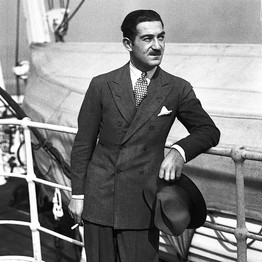
Michael Arlen in 1925 (Wall Street Journal)
One notable guest, however, did not arrive until after the second act: Michael Arlen himself. It was said that Arlen had never seen a complete performance of his play, due to “nervousness.”
Perhaps there was a good reason for his butterflies.
Later in the “Critique” section, Herman J. Mankiewicz (H.J.M.) pronounced The Green Hat as “unreal and consequently uninteresting…a grand sentimental debauch for the romantically inclined. It has no place at all in the discussion of the Higher Theatre…”
Mankiewicz observed that the acting itself was passable, with Katherine Cornell delivering an “excellent, though scarcely ideal portrayal of Iris March,” but she was “showing the strains of playing a role that has no more grasp on life than a little boy’s daydream that the Giants will, after all, snatch the pennant from Pittsburgh.”
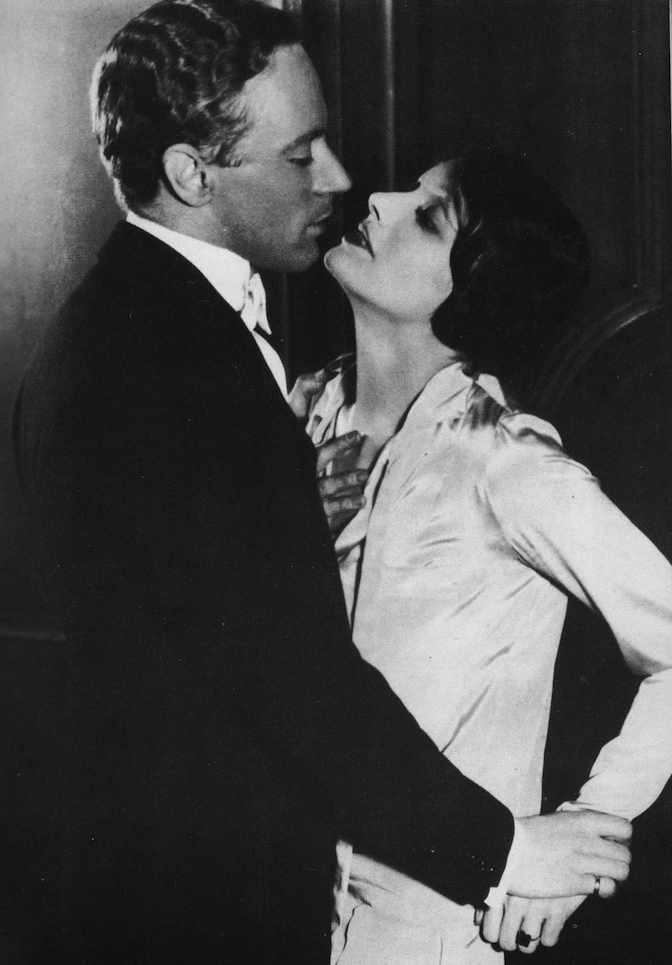
A publicity photo from the play:
Broadway newcomer Leslie Howard embraces Katherine Cornell in this publicity photo from The Green Hat. (inafferrabileleslie)
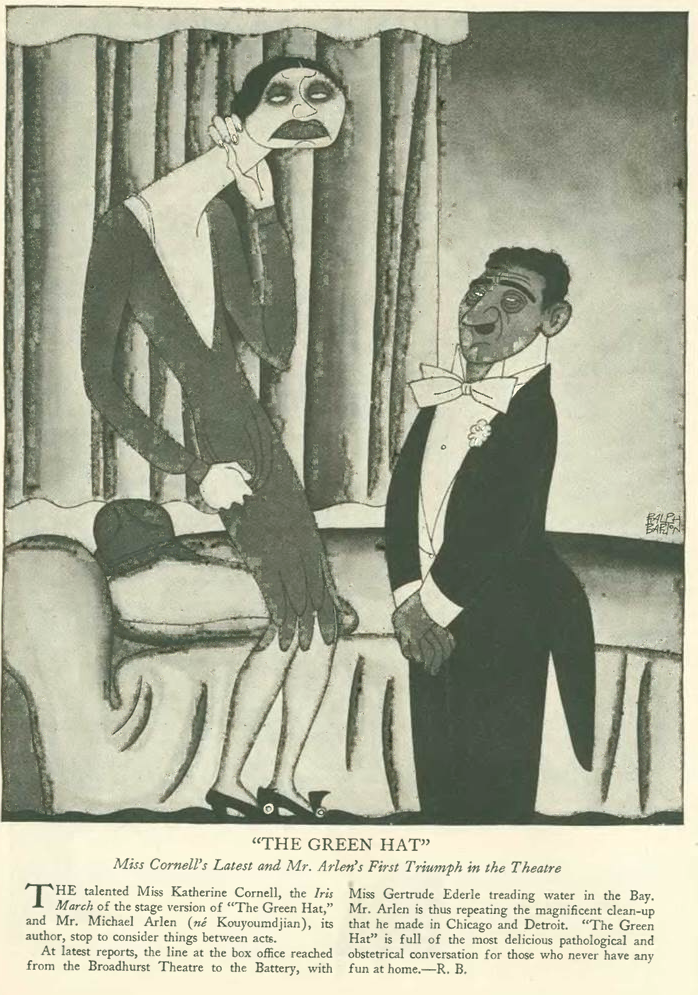
And Ralph Barton’s unique take on the whole thing:
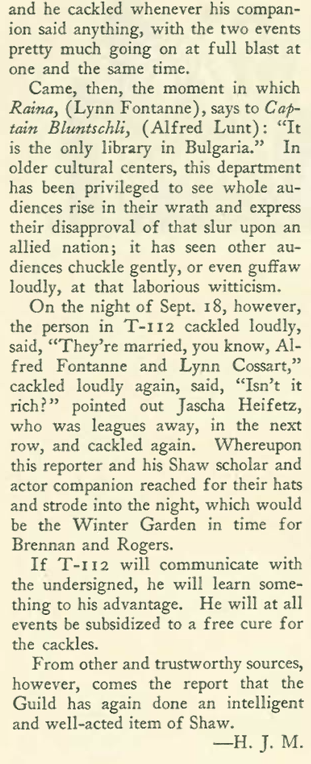
Mankiewicz also reviewed the play, Arms and the Man, but his focus was not the play but rather an annoying patron in seat T-112:
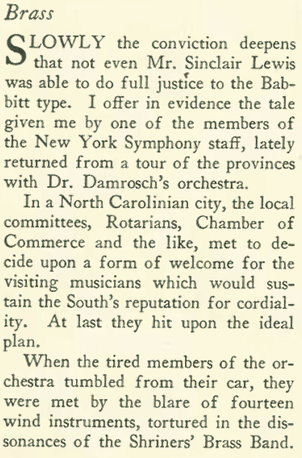
Although the Scopes Trial was long over, The New Yorker still found opportunities to take potshots at the backwardness and Babbittry of folks in the hinterlands:
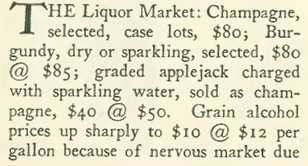
Talk also continued to help its readers with regular updates on the bootleg liquor trade:
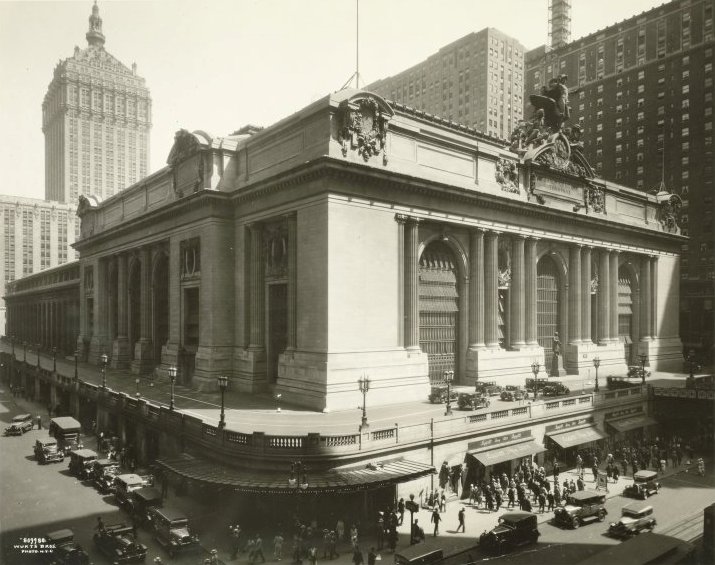
An article titled “Mid-Town” celebrated the 100th anniversary of 42nd Street. Henry Collins Brown wrote that 100 years had changed the street “from a dusty country lane to a self-contained metropolis. The brownstone of its middle age has given way to granite and marble. It has seen a railroad dynasty rise and has written its epitaph on a narrow, short avenue.”
A 42nd Street landmark: Grand Central Station in the 1920s. (wirednewyork)
Then Brown concluded with these prescient thoughts:
An illustrated tribute (by Rea Irvin) to 42nd Street appeared in the “Talk” section:
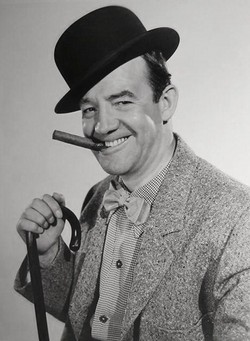
In “Profiles,” Jo Swerling looked at the life of comedian Louis Josephs, known to all as Joe Frisco, a mainstay on the vaudeville circuit in the 1920s and 1930s.
Swerling wrote admiringly that Frisco—who was from Dubuque, Iowa, of all places—was “the comedian’s comic.”
Joe Frisco (findagrave.com)
Considered one of the fastest wits in the history of comedy, Frisco was a famous stutterer but could recite his scripted dialogue unimpaired. According to Wikipedia, he was first known for his popular jazz dance act–called by some the “Jewish Charleston”– which was a choreographed series of shuffles, camel walks and turns. He usually danced in a derby hat with a king-sized cigar in his mouth, often performing in front of beautiful women “smoking” prop cigars.
His most famous line was uttered while in a New York hotel. A clerk learned that Frisco had a guest in a room that was only reserved for one occupant, so he called up to the room and said, “Mr. Frisco, we understand you have a young lady in your room.” Frisco replied, “T-t-t-then send up another G-g-gideon B-b-bible, please.”
With vaudeville in decline, in the 1940s Frisco moved to Hollywood and appeared in several low-budget movies. A compulsive gambler who was constantly in debt, he died penniless in Los Angeles in 1958.
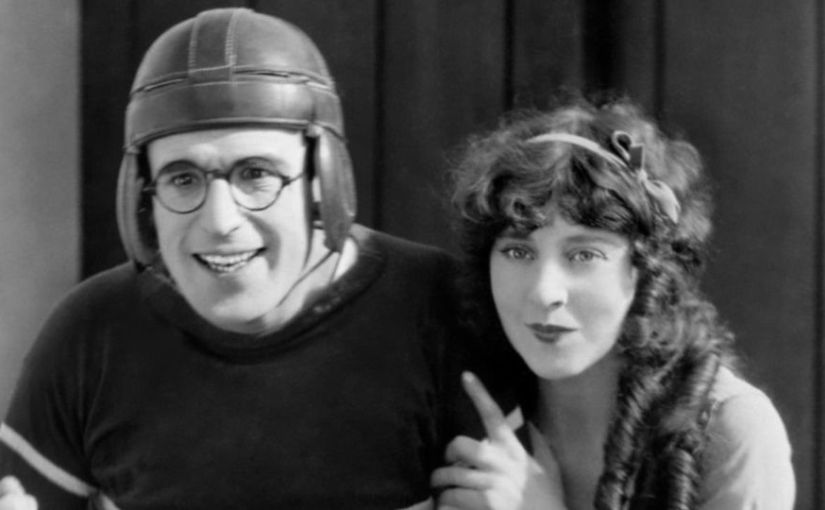
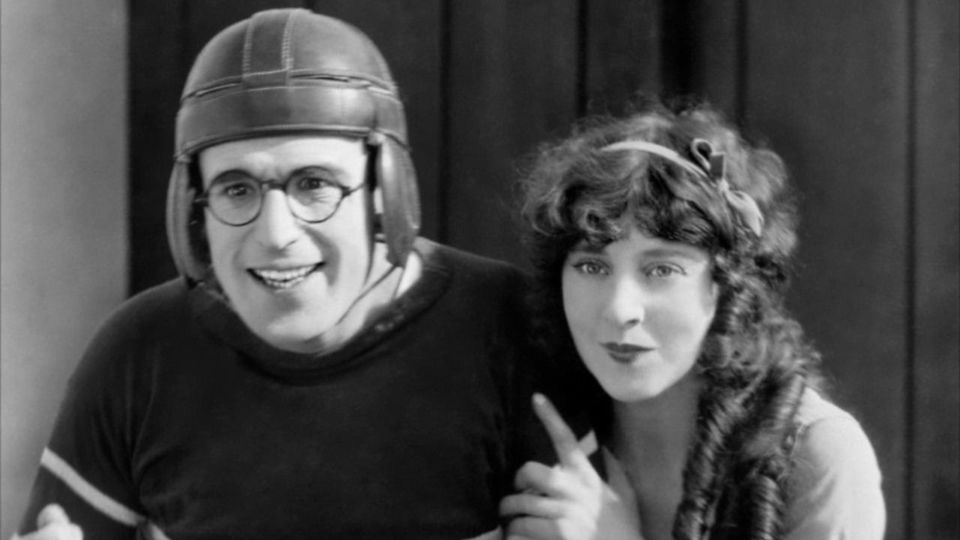
In “Motion Pictures,” Harold Lloyd’s “college comedy,” The Freshman, which Theodore Shane wrote was filled with “glorious laughter.” Shane also noted that another Rin Tin Tin picture was appearing at Warner’s Theatre (Below the Line), and “as usual our hound hero is enlisted on the side of virtue.”
FOLLIES OF YOUTH…Harold Lloyd and Jobyna Ralston in The Freshman. (avclub.com)
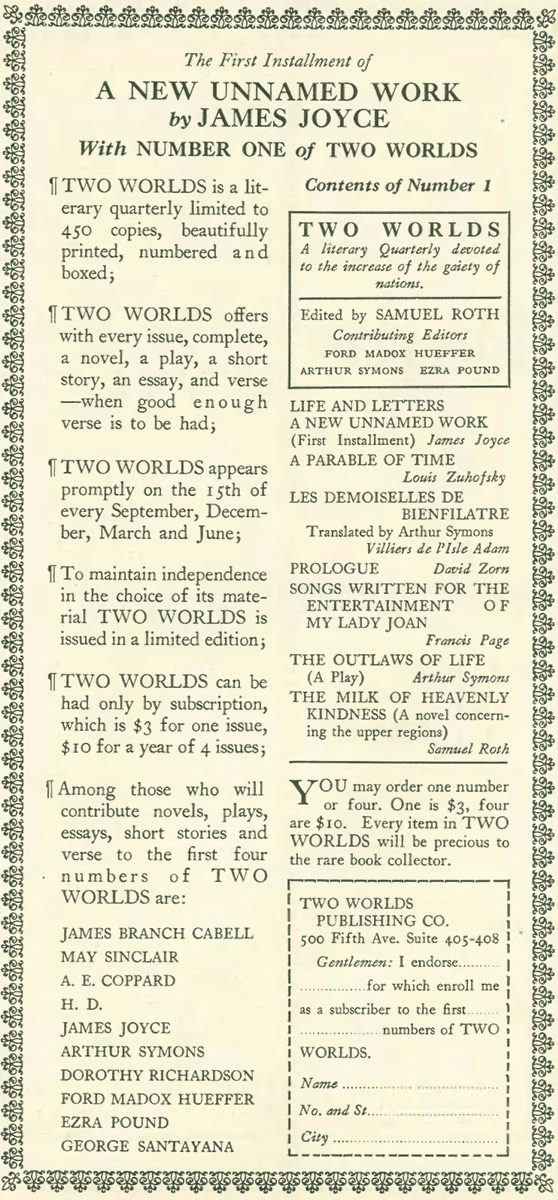
An interesting ad near the back of the magazine (and the book reviews) offered readers an opportunity to sample a new, unnamed work by James Joyce:
What this ad described was an avant-garde work by Joyce that would appear in serialized form until it was finally published in its entirety in 1939 as Finnegans Wake.
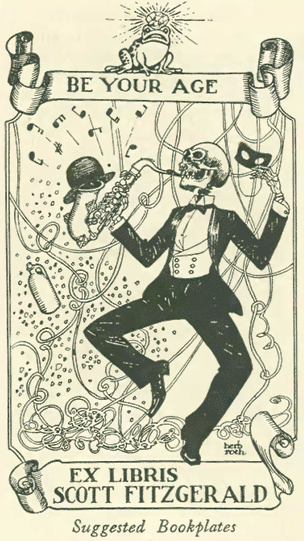
In other book-related matters, this illustration by Herb Roth appeared in the pages of the “Critique” section:
Anne Margaret Daniel wrote about this “Suggested Bookplate” in her May 1, 2013 blog for the Huffington Post, and made this observation:
“Be Your Age” shows how fully the magazine at the pulse of the Jazz Age registered both Fitzgerald’s personification of the decade, in many readers’ eyes, as well as the dangers he had foretold in The Beautiful and Damned, and again in Gatsby of decadence and of the coming Crash. It’s a very double-edged image of festivity and fatality, just like so many of the images of people at parties that end in disasters in Fitzgerald’s best-known, and best-loved, novel.
Charles Baskerville (Top Hat) continued to report from the City of Lights in his “Paris Letter,” mainly focusing on the doings of American tourists. No offense to the urbane and talented Baskerville (also a great illustrator), but I am looking forward to Janet Flanner’s (a.k.a. Genêt) take on Paris in future issues (Does anyone out there know if she wrote the unsigned “Paris Letter” in the Sept. 5 issue?).
The issue featured a rather faded-looking movie ad for the back cover:
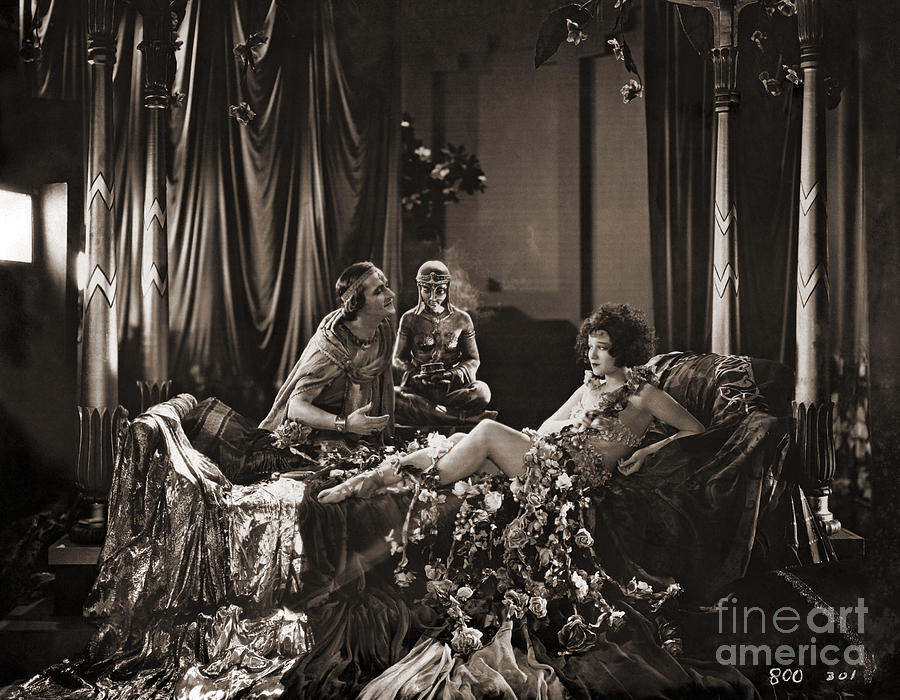
And a still from the film on which the drawing is no doubt based:
Tyrone Power Sr. and Greta Nissen in The Wanderer (1925) (Sad Hill Archive)
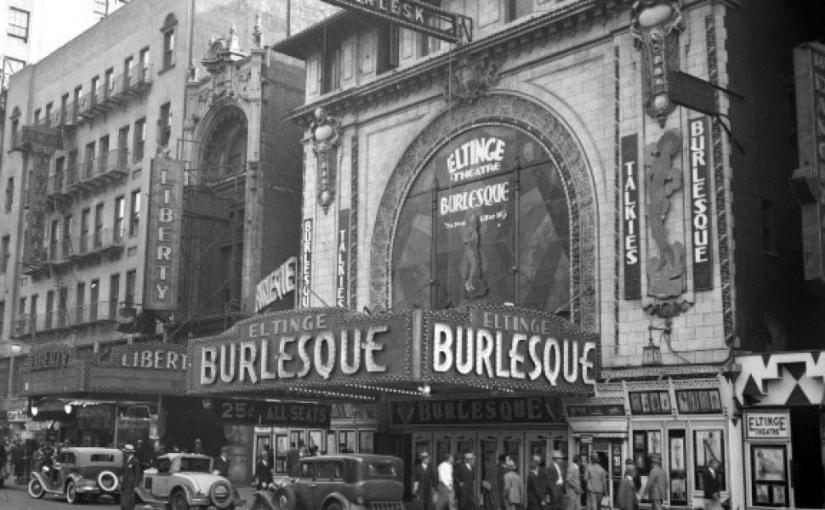
The critic Gilbert W. Gabriel was more than a bit appalled by the spectacle at the old Olympic Theatre, where a tired and “degenerated” cast of burlesque performers took turns shaking their ancient haunches in the direction of the former Julliard student.
Gilbert’s article in the August 22, 1925 New Yorker, “They Call It Burlesque,” described the performance at the Olympic on East Fourteenth Street as “on its last legs.” The once “honest animalistic, gorgeously orgiastic burlesque show of ten or twenty years ago” had “degenerated in decency,” he wrote.
Illustration in The New Yorker of the Olympic Burlesque by Reginald Marsh.
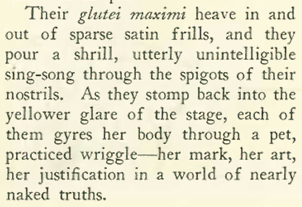
As the performers wiggled up and down the runways, Gilbert noted:
The audience was an equally sad lot:
There is some relief expressed when two comedians appeared, but they offer an unimaginative routine:
And then back to the dancers:
And still more…
Happier news over in “The Talk of the Town,” where jazz was getting some respect: “Jazz, successor to the outcast ragtime, each day is becoming acceptable. It is the young brother of the musical family, irresponsible and at time highly irritating, but, nevertheless, acknowledged.”
It was reported that even famed violinist Jascha Heifetz “dabbled” in jazz as an amusement, and writers of jazz were “no longer those products of East Side dives,” but rather included the likes of Buddy de Sylva, lyrist to Al Jolson, and George Gershwin, “high priest of jazz,” who was besieged by symphony conductors for his “Symphony in Blue” (better known today as Rhapsody In Blue).
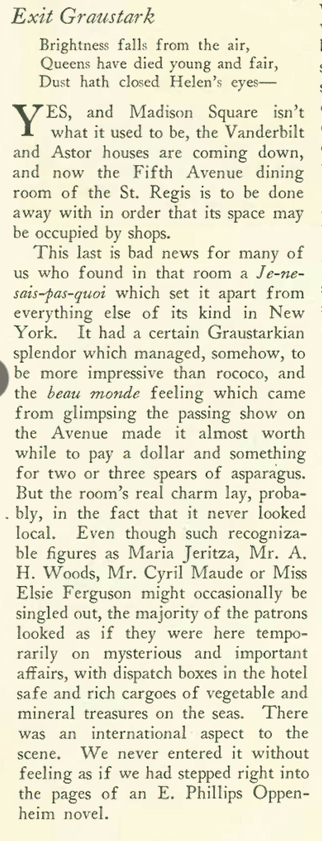
“Talk” continued its lament of the changing face of Fifth Avenue:
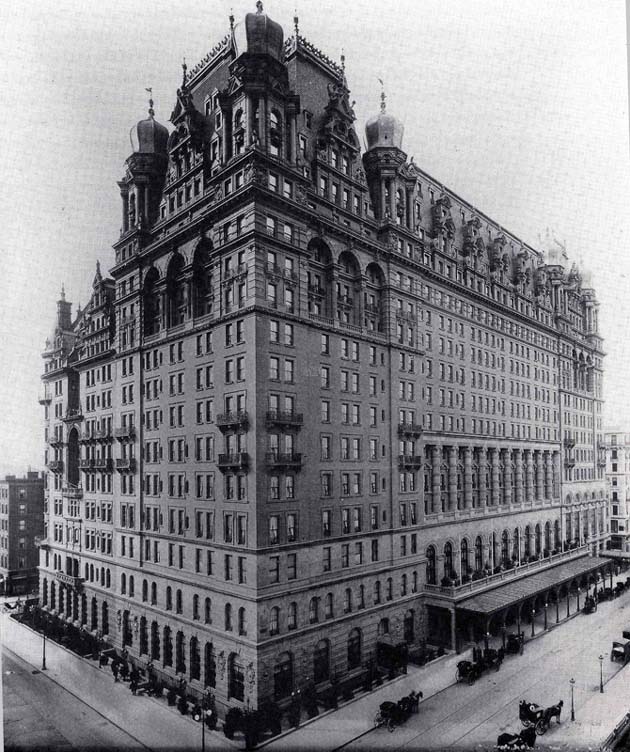
And the Waldorf Astoria was being remodeled in order to add shops on the ground floor along with “125 bathrooms,” giving the famed hotel “a bath for almost every room.” In just four years the old Waldorf would be torn down and replaced by the Empire State Building.
The old Waldorf Astoria was getting an upgrade, but it would fall to a wrecking ball in only four years. (nycago.org)
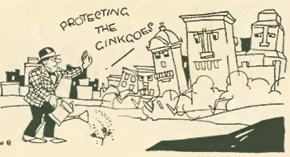
“Talk” also noted the planting of Ginkgo trees in the city:
Although prized today for their beauty and hardiness, not all New Yorkers are in love with the strong odor of its fruit. In the June 30, 2008 issue of The New Yorker, Lauren Collins examined the activities of the “Anti-Ginkgo Tolerance Group” in her article“Smelly Trees.”
“Talk” also offered a brief glimpse into the latest adventures of Pola Negri, noting in its “This Week” section that the actress had paid “$57,000 customs dues in seized jewels…”
Pola Negri liked nice things (Edward Steichen for Vanity Fair, 1925)
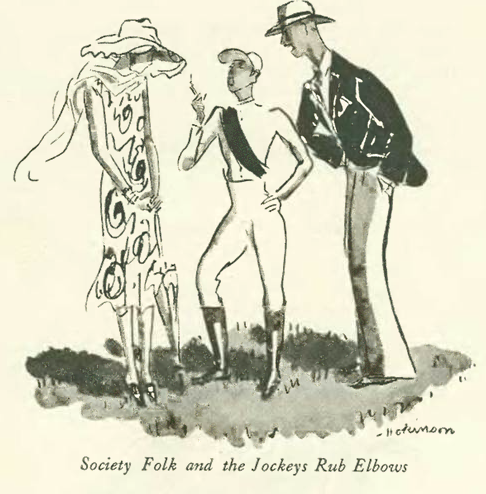
In other items, Helen Hokinson provided illustrations for an article on the horse races at Saratoga…
…John Tunis examined the life of tennis star Elizabeth “Bunny” Ryan in “Profiles” … and E.B. White and Alice Duer Miller offered their thoughts on why they liked New York:
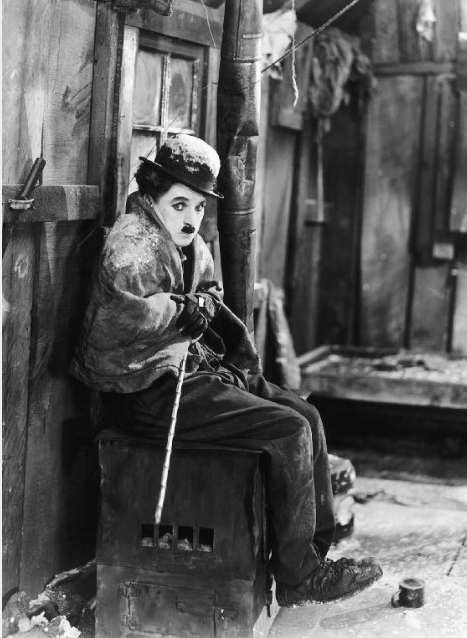
“Moving Pictures” featured a lengthy review of Charlie Chaplin’sThe Gold Rush. Theodore Shane (“T.S.”) wrote that the film’s opening night at the Strand attracted such celebrities as Will Rogers and Constance Bennett.
Cheer Up Charlie…Chaplin in The Gold Rush (1925) (United Artists)
Shane observed that this “dramatic comedy” was a “serviceable picture,” but perhaps Chaplin was getting “too metaphysical about his pathos” and could have used some old-fashioned pie-in-the-face slapstick.
As an example, in a scene in a typical Klondike town, Shane wrote that “one might be given to expect wonders of Gold Rush burlesque with the old Chaplin at the receiving end of the Klondike equivalent of a custard. But one is doomed to disappointment, for Chaplin has seen fit to turn on his onion juices in a Pierrot’s endeavor to draw your tears…We cannot help but recall with a tinge of sadness, the old days when custard was young.”
(Wikipedia)
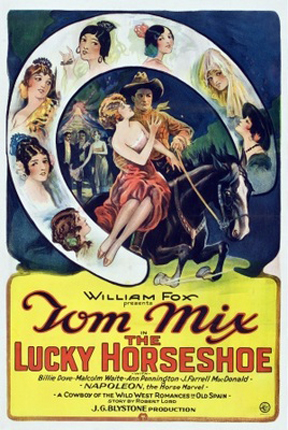
Shane went on to give short but favorable reviews to Rex Reach’sWinds of Chance (at the Piccadilly Theatre), the film’s chief props consisting of “string ties, wooden saloons, ½ dozen cold-blooded murders and the tenderfoot who conquers everything…Shane also noted that the “spiritual features” of Tom Mix in The Lucky Horseshoe (at the Rialto) lent themselves delightfully to “a lovely and sensitive drama of moyen age and modern machinations in the Fairbanks style.”
In “Books,” Harry Este Dounce (“Touchstone”) suggested readers take a look at Carl Van Vechten’sFirecrackers as a good introduction to the writer’s unique style, while J.D. Bereford’sThe Monkey Puzzle was deemed only “partly good” but worth reading.
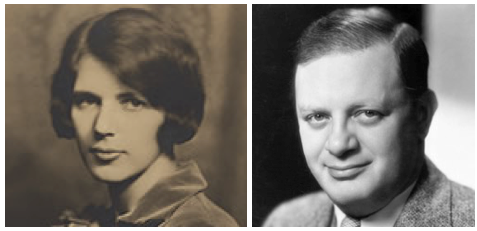
Lois “Lipstick” Long and Herman J. Mankiewicz. (PBS/Wikipedia)
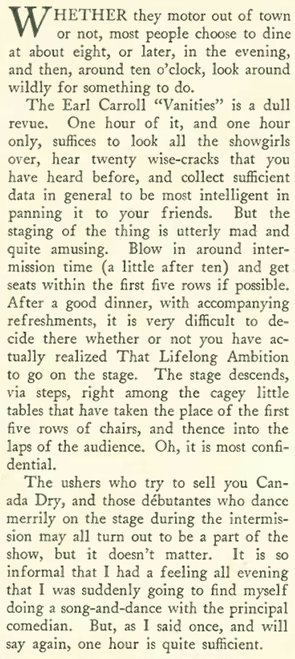
In her regular nightlife review (“When Nights Are Young”), Lois Long (“Lipstick”) playfully sparred with her New Yorker colleague, theater critic Herman J. Mankiewicz:
Long was referencing this Mankiewicz review in a previous issue (Aug. 8):
And it all started when Long offered this observation in her July 25 “When Nights Bold” column:
I hope you are fully sated. As a palate cleanser, I offer yet another droll observation of the world of old money by Gardner Rea:




















 A New Yorker State of Mind