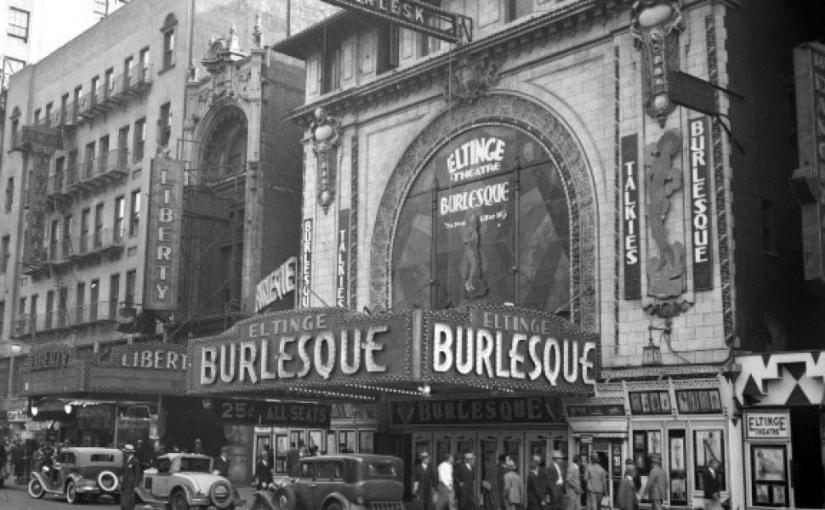
They Call It Burlesque

Screenshot 2015-06-09 14.01.58
August 22, 1925 cover by A.E. Wilson.

The critic Gilbert W. Gabriel was more than a bit appalled by the spectacle at the old Olympic Theatre, where a tired and “degenerated” cast of burlesque performers took turns shaking their ancient haunches in the direction of the former Julliard student.

Gilbert’s article in the August 22, 1925 New Yorker, “They Call It Burlesque,” described the performance at the Olympic on East Fourteenth Street as “on its last legs.” The once “honest animalistic, gorgeously orgiastic burlesque show of ten or twenty years ago” had “degenerated in decency,” he wrote.

Screenshot 2015-06-12 11.13.55
Illustration in The New Yorker of the Olympic Burlesque by Reginald Marsh.

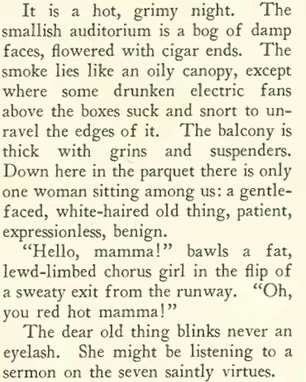
As the performers wiggled up and down the runways, Gilbert noted:
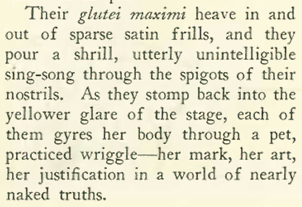
Screenshot 2015-06-12 11.06.57

The audience was an equally sad lot:

Screenshot 2015-06-12 11.08.02

There is some relief expressed when two comedians appeared, but they offer an unimaginative routine:
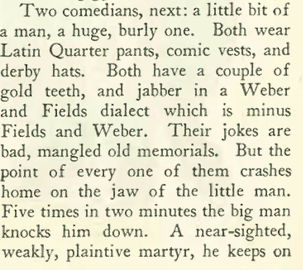
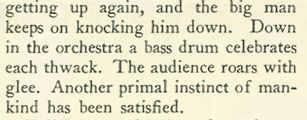
Screenshot 2015-06-12 11.10.25

Screenshot 2015-06-12 11.10.33

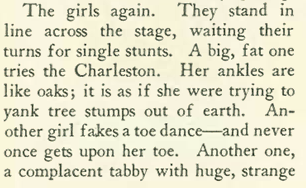
And then back to the dancers:

Screenshot 2015-06-12 11.11.03

Screenshot 2015-06-12 11.11.26

And still more…

Screenshot 2015-06-12 11.11.56

Happier news over in “The Talk of the Town,” where jazz was getting some respect: “Jazz, successor to the outcast ragtime, each day is becoming acceptable. It is the young brother of the musical family, irresponsible and at time highly irritating, but, nevertheless, acknowledged.”

It was reported that even famed violinist Jascha Heifetz “dabbled” in jazz as an amusement, and writers of jazz were “no longer those products of East Side dives,” but rather included the likes of Buddy de Sylva, lyrist to Al Jolson, and George Gershwin, “high priest of jazz,” who was besieged by symphony conductors for his “Symphony in Blue” (better known today as Rhapsody In Blue).

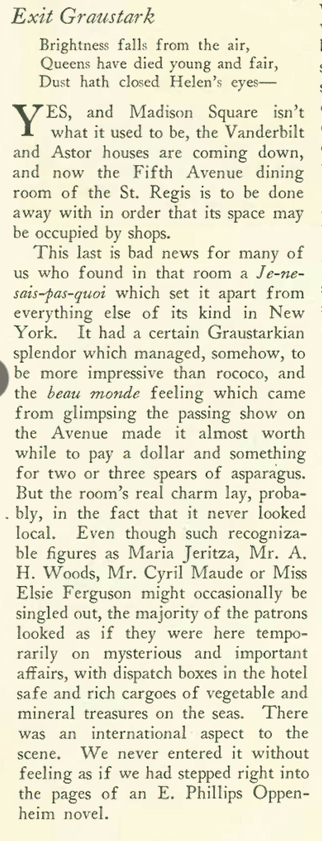
“Talk” continued its lament of the changing face of Fifth Avenue:
Screenshot 2015-06-12 14.20.34

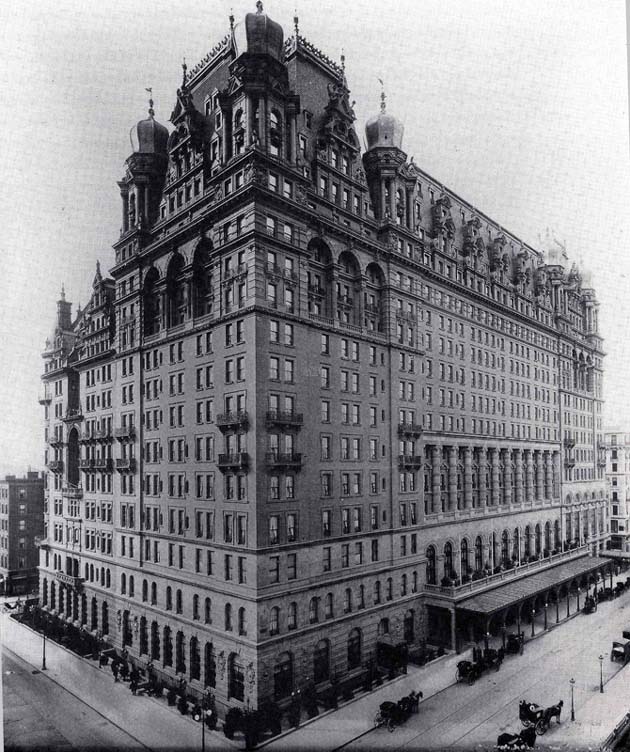
And the Waldorf Astoria was being remodeled in order to add shops on the ground floor along with “125 bathrooms,” giving the famed hotel “a bath for almost every room.” In just four years the old Waldorf would be torn down and replaced by the Empire State Building.
017- Waldorf Astoria
The old Waldorf Astoria was getting an upgrade, but it would fall to a wrecking ball in only four years. (nycago.org)

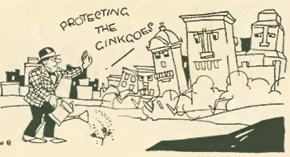
“Talk” also noted the planting of Ginkgo trees in the city:
Johan BullScreenshot 2015-06-10 16.20.44

Screenshot 2015-06-10 16.20.33

Although prized today for their beauty and hardiness, not all New Yorkers are in love with the strong odor of its fruit. In the June 30, 2008 issue of The New Yorker, Lauren Collins examined the activities of the “Anti-Ginkgo Tolerance Group” in her article “Smelly Trees.”

“Talk” also offered a brief glimpse into the latest adventures of Pola Negri, noting in its “This Week” section that the actress had paid “$57,000 customs dues in seized jewels…”

honey-kennedy-pola-negri-by-edward-steichen-vanity-fair-june-1925-02
Pola Negri liked nice things (Edward Steichen for Vanity Fair, 1925)

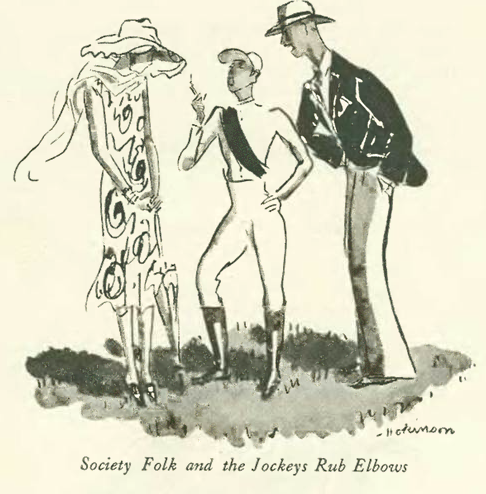
In other items, Helen Hokinson provided illustrations for an article on the horse races at Saratoga…
Screenshot 2015-06-12 14.24.41

John Tunis examined the life of tennis star Elizabeth “Bunny” Ryan in “Profiles” … and E.B. White and Alice Duer Miller offered their thoughts on why they liked New York:

Screenshot 2015-06-12 14.27.59

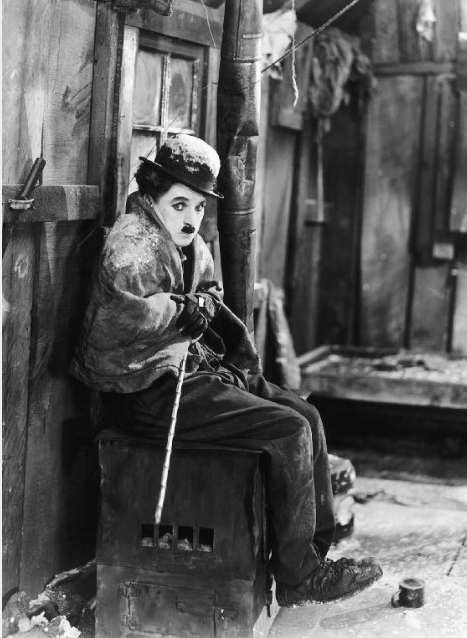
“Moving Pictures” featured a lengthy review of Charlie Chaplin’s The Gold Rush. Theodore Shane (“T.S.”) wrote that the film’s opening night at the Strand attracted such celebrities as Will Rogers and Constance Bennett.
Screenshot 2015-06-12 16.21.41
Cheer Up Charlie…Chaplin in The Gold Rush (1925) (United Artists)

Shane observed that this “dramatic comedy” was a “serviceable picture,” but perhaps Chaplin was getting “too metaphysical about his pathos” and could have used some old-fashioned pie-in-the-face slapstick.

As an example, in a scene in a typical Klondike town, Shane wrote that “one might be given to expect wonders of Gold Rush burlesque with the old Chaplin at the receiving end of the Klondike equivalent of a custard. But one is doomed to disappointment, for Chaplin has seen fit to turn on his onion juices in a Pierrot’s endeavor to draw your tears…We cannot help but recall with a tinge of sadness, the old days when custard was young.”
The_Lucky_Horseshoe_1925_Poster
(Wikipedia)

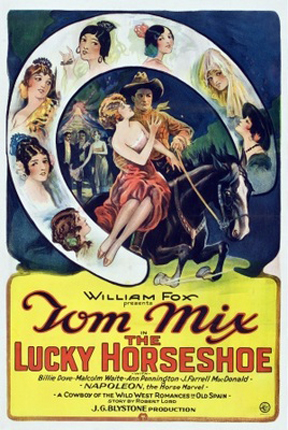
Shane went on to give short but favorable reviews to Rex Reach’s Winds of Chance (at the Piccadilly Theatre), the film’s chief props consisting of “string ties, wooden saloons, ½ dozen cold-blooded murders and the tenderfoot who conquers everything…Shane also noted that the “spiritual features” of Tom Mix in The Lucky Horseshoe (at the Rialto) lent themselves delightfully to “a lovely and sensitive drama of moyen age and modern machinations in the Fairbanks style.”

In “Books,” Harry Este Dounce (“Touchstone”) suggested readers take a look at Carl Van Vechten’s Firecrackers as a good introduction to the writer’s unique style, while J.D. Bereford’s The Monkey Puzzle was deemed only “partly good” but worth reading.
Screenshot 2015-06-12 16.35.08
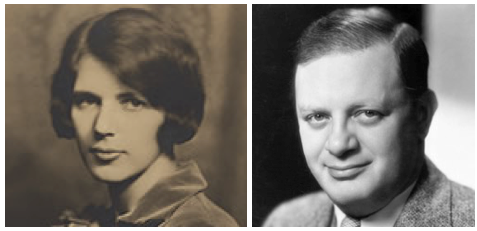
Lois “Lipstick” Long and Herman J. Mankiewicz. (PBS/Wikipedia)

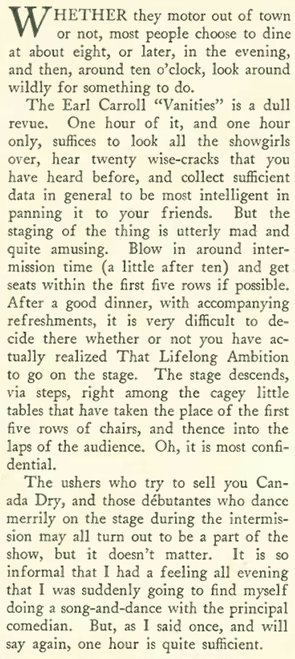
In her regular nightlife review (“When Nights Are Young”), Lois Long (“Lipstick”) playfully sparred with her New Yorker colleague, theater critic Herman J. Mankiewicz:

Screenshot 2015-06-12 14.58.10

Long was referencing this Mankiewicz review in a previous issue (Aug. 8):

Screenshot 2015-06-12 15.05.24

And it all started when Long offered this observation in her July 25 “When Nights Bold” column:
Screenshot 2015-06-12 15.11.51

I hope you are fully sated. As a palate cleanser, I offer yet another droll observation of the world of old money by Gardner Rea:

Screenshot 2015-06-12 14.30.06

Next time: The waning summer season…

Screenshot 2015-06-10 16.51.20

Chaplin’s Angst

A “Profile” piece by Frank Waldo (aka “Searchlight”) in the May 23, 1925 issue took a look at the 36-year-old Charlie Chaplin and his “magical popularity,” recounting how he was nearly “devoured” by an adoring crowd in Paris (Chaplin was decorated by the French government in 1921 for his film work and made Officer of the Légion d’Honneur in 1952). Chaplin dismissed the attention as “nothing,” and was reported to spend much of his time off-screen brooding and in despair.

Screenshot 2015-04-21 11.30.19
May 23, 1925 cover by Julian de Miskey (New Yorker Digital Archive)

Waldo wrote that the “pity” of Chaplin is that “he does not understand the adoration he receives, and therefore has become a self-doubting, melancholy, haunted man…caught in a vast machine he has created and which he does not run…he has created for himself a mask (that) has satisfied the world, from China to Paris. It has failed in but a single way—a cruel one: for it has failed to satisfy its maker.”

Chaplin004 copy.tif
Chaplin directs on the set of The Gold Rush (1925) in Truckee, California (Critics At Large)
Screenshot 2015-04-21 12.04.19
Conrado Massaguer’s “Profile” illustration

Waldo wrote that Chaplin seeks his answer wistfully through women or through association with intellectuals, leaving him “as will-less as a Russian romantic, in the quicksands of Los Angeles: lost in a world of which he is the king, and which he does not love and which distrusts him, knowing him different from it.”

William Jennings Bryan, “The Great Commoner,” was a frequent target of the early New Yorker. “Talk of the Town” reported that he denied making a million dollars on a Florida land deal (“it was only five hundred thousand dollars, Mr. Bryan indignantly averred”).

rc0-266
Villa Serena, the Miami winter home of Nebraska statesman William Jennings Bryan (State Archives of Florida)

Apparently Bryan, “the great statesman and religionist,” also controlled a choice site in Miami, toward which “a certain church cast longing glances.” The church pleaded poverty, but Bryan wouldn’t budge on the price. Instead, he said if the church bought the plot at said price and built on the site he would agree to preach eight sermons there, which, the “Talk” writer observed, “would unquestionably attract many casual worshippers, so swelling the collections.”

Screenshot 2015-04-22 17.33.17
Cosmopolitan, June 1925

“Talk” also reported on the wedding of Mrs. David Meriwether Milton, nee Abby Rockefeller. Guests included New York Governor Alfred Smith and Mayor John Hylan. The New Yorker also reported receiving a letter from writer Michael Arlen prior to his departure for England. Referring to a previous issue that pondered what impressions of America he would relate to England, he wrote “I shall say that I found America charming. And Oh, I have!” The New Yorker dryly observed that Arlen, before boarding his ship, “made an arrangement with one of our monthly periodicals; that is to say, The Cosmopolitan.” It was reported that this rival Hearst publication was paying Arlen the princely sum of $3,500 for each short story delivered. No doubt a pang of jealousy was felt at the fledgling New Yorker.

A feature by “Susan Simple, Spinster” titled “Husbands, An Appreciation,” described various types of husbands including those who are acrobatic, helpless, doggy (“so friendly and believing”) and those who have no time for their wives (“the Metered One”).

Screenshot 2015-04-21 12.04.10
(New Yorker Digital Archive)
40
Scribner’s 1925 edition of The Great Gatsby.

“Books noted the passing of Amy Lowell, and briefly reviews F. Scott Fitzgerald’s latest novel The Great Gatsby; the reviewer writes that the novel “revives our interest” in Fitzgerald, though the book is “not in a Byronic promise he probably never had. He still reveres and pities romantic constancy, but with detachment. Gatsby, its heroic victim, is otherwise a good deal of a nut…Parts are solidly good, all has to be read, The young man is not petering out.”

History would not be kind to Fitzgerald, who received similar mixed reviews from other publications. The book sold only 20,000 copies in its first year, and when the writer died in 1940, he believed himself to be a failure and his work forgotten. Little did he know that he had written what many still believe to be “The Great American Novel.”

Mr. and Mrs. Little Tramp

Screenshot 2015-03-17 12.29.14
March 21, 1925 cover by Carl Fornaro.

Charlie Chaplin is in trouble again.” So began the next item in “The Talk of the Town” for the March 21 issue.

Over his head hangs a sword that was forged in the Californian sunshine of the cold metal that entered the souls of the native sons when they lived in Kansas, Iowa and Nebraska. It is the sword of righteousness, the flaming blade of moral indignation.

The New Yorker, in its modesty of the times, refers to the “trouble” as Chaplin’s home life, which “has been a trifle irregular.” The magazine was referring to his sudden and secretive marriage to a much younger woman, Lillita McMurray.

Charlie-Chaplin-and-Lita-Grey
Charlie Chaplin and Lita Grey (The Artifice)

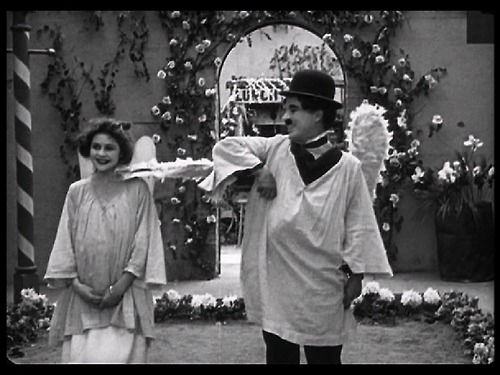
According to the website The Artifice, Lillita McMurray was Chaplin’s second and youngest wife (he had four in all). In 1920 McMurray landed a small role as a “flirting angel” in Chaplin’s The Kid. When she landed another small role in The Gold Rush four years later (changing her name to Lita Grey) a serious relationship between Grey and Chaplin developed. Grey, just barely 16, soon became pregnant, and Chaplin, seeking to prevent scandal (and possible criminal charges), secretly married Grey in Mexico (She gave birth soon after to Charles Chaplin Jr. on May 5, 1925).

Not surprisingly, Chaplin was uncooperative with the story-hungry media, which The New Yorker noted took revenge by casting Grey as a innocent victim of a “rapacious roué.”

lita-charlie-flirtatious-angel
The 12-year old Lillita McMurray (later Lita Grey) in The Kid (1921) (Image from the flickchick1953 blog A Person in the Dark)

The The New Yorker noted that the California Women’s Clubs called for a boycott of Chaplin films, and even the famed L.A. theatre proprietor Sid Graumann bowed to their pressure and cancelled his booking for The Gold Rush (which the “Talk” writer calls an “extraordinarily good comedy”).

The magazine observed that it was the goal of Chaplin’s detractors to drive him out of the movies—“That way lies Fatty Arbuckle” (alluding to sex scandal that destroyed the career of one of the most beloved silent film stars three years earlier).

A footnote: Chaplin’s marriage to Grey soon crumbled, and a divorce was granted August 22, 1927. According to The Artifice, it was a bitter, public ordeal with rumors of affairs and sexual misconduct clouding Chaplin’s fame and reputation. In the end, Grey was awarded a massive $600,000 settlement and $100,000 for each child. After the scandal Grey became reclusive and was featured in only a few small films before her death on Dec. 29, 1995.

Another item of note in the March 21 issue: a review of Arrowsmith by Sinclair Lewis (“good, but not as good as Babbitt”).

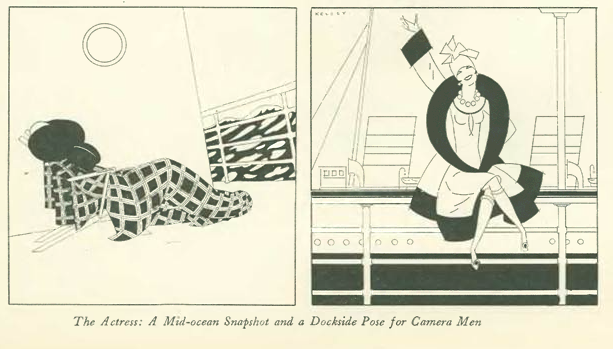
And how about a cartoon by Eldon Kelley to end our segment on the March 21, 1925 issue:

Screenshot 2015-03-18 12.42.14
(New Yorker Digital Archive)