They Call It Burlesque

Screenshot 2015-06-09 14.01.58
August 22, 1925 cover by A.E. Wilson.

The critic Gilbert W. Gabriel was more than a bit appalled by the spectacle at the old Olympic Theatre, where a tired and “degenerated” cast of burlesque performers took turns shaking their ancient haunches in the direction of the former Julliard student.

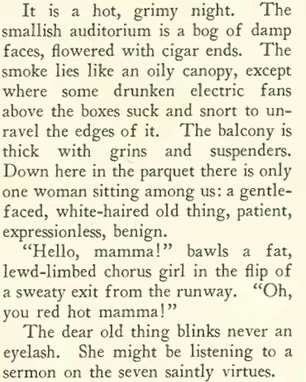
Gilbert’s article in the August 22, 1925 New Yorker, “They Call It Burlesque,” described the performance at the Olympic on East Fourteenth Street as “on its last legs.” The once “honest animalistic, gorgeously orgiastic burlesque show of ten or twenty years ago” had “degenerated in decency,” he wrote.

Screenshot 2015-06-12 11.13.55
Illustration in The New Yorker of the Olympic Burlesque by Reginald Marsh.

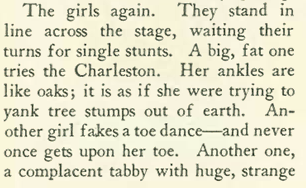
As the performers wiggled up and down the runways, Gilbert noted:
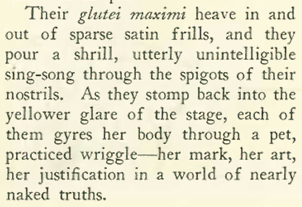
Screenshot 2015-06-12 11.06.57

The audience was an equally sad lot:

Screenshot 2015-06-12 11.08.02

There is some relief expressed when two comedians appeared, but they offer an unimaginative routine:
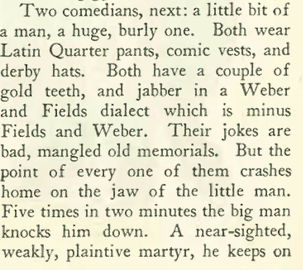
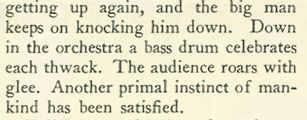
Screenshot 2015-06-12 11.10.25

Screenshot 2015-06-12 11.10.33

And then back to the dancers:

Screenshot 2015-06-12 11.11.03

Screenshot 2015-06-12 11.11.26

And still more…

Screenshot 2015-06-12 11.11.56

Happier news over in “The Talk of the Town,” where jazz was getting some respect: “Jazz, successor to the outcast ragtime, each day is becoming acceptable. It is the young brother of the musical family, irresponsible and at time highly irritating, but, nevertheless, acknowledged.”

It was reported that even famed violinist Jascha Heifetz “dabbled” in jazz as an amusement, and writers of jazz were “no longer those products of East Side dives,” but rather included the likes of Buddy de Sylva, lyrist to Al Jolson, and George Gershwin, “high priest of jazz,” who was besieged by symphony conductors for his “Symphony in Blue” (better known today as Rhapsody In Blue).

“Talk” continued its lament of the changing face of Fifth Avenue:
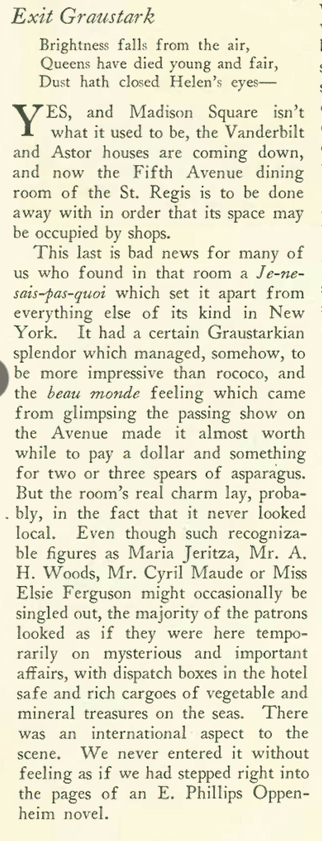
Screenshot 2015-06-12 14.20.34

And the Waldorf Astoria was being remodeled in order to add shops on the ground floor along with “125 bathrooms,” giving the famed hotel “a bath for almost every room.” In just four years the old Waldorf would be torn down and replaced by the Empire State Building.
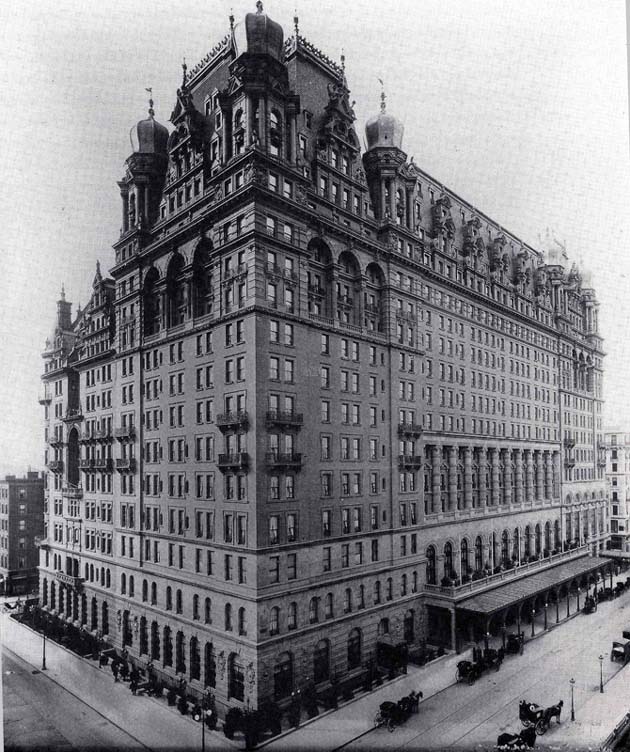
017- Waldorf Astoria
The old Waldorf Astoria was getting an upgrade, but it would fall to a wrecking ball in only four years. (nycago.org)

“Talk” also noted the planting of Ginkgo trees in the city:
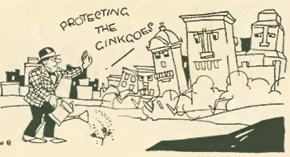
Johan BullScreenshot 2015-06-10 16.20.44

Screenshot 2015-06-10 16.20.33

Although prized today for their beauty and hardiness, not all New Yorkers are in love with the strong odor of its fruit. In the June 30, 2008 issue of The New Yorker, Lauren Collins examined the activities of the “Anti-Ginkgo Tolerance Group” in her article “Smelly Trees.”

“Talk” also offered a brief glimpse into the latest adventures of Pola Negri, noting in its “This Week” section that the actress had paid “$57,000 customs dues in seized jewels…”

honey-kennedy-pola-negri-by-edward-steichen-vanity-fair-june-1925-02
Pola Negri liked nice things (Edward Steichen for Vanity Fair, 1925)

In other items, Helen Hokinson provided illustrations for an article on the horse races at Saratoga…
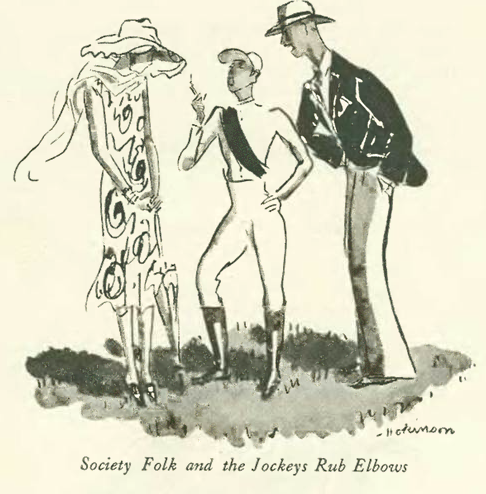
Screenshot 2015-06-12 14.24.41

John Tunis examined the life of tennis star Elizabeth “Bunny” Ryan in “Profiles” … and E.B. White and Alice Duer Miller offered their thoughts on why they liked New York:

Screenshot 2015-06-12 14.27.59

“Moving Pictures” featured a lengthy review of Charlie Chaplin’s The Gold Rush. Theodore Shane (“T.S.”) wrote that the film’s opening night at the Strand attracted such celebrities as Will Rogers and Constance Bennett.
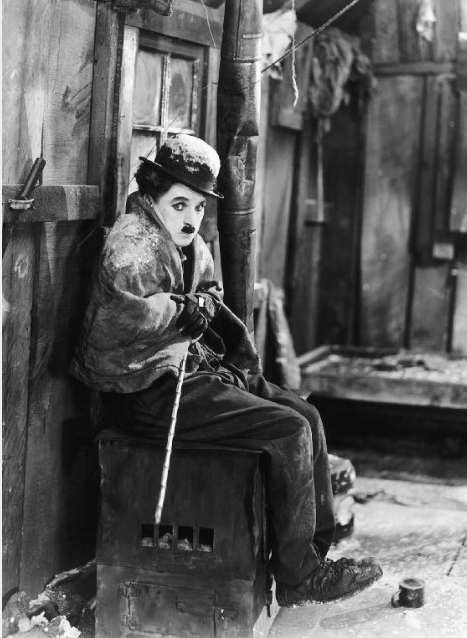
Screenshot 2015-06-12 16.21.41
Cheer Up Charlie…Chaplin in The Gold Rush (1925) (United Artists)

Shane observed that this “dramatic comedy” was a “serviceable picture,” but perhaps Chaplin was getting “too metaphysical about his pathos” and could have used some old-fashioned pie-in-the-face slapstick.

As an example, in a scene in a typical Klondike town, Shane wrote that “one might be given to expect wonders of Gold Rush burlesque with the old Chaplin at the receiving end of the Klondike equivalent of a custard. But one is doomed to disappointment, for Chaplin has seen fit to turn on his onion juices in a Pierrot’s endeavor to draw your tears…We cannot help but recall with a tinge of sadness, the old days when custard was young.”
The_Lucky_Horseshoe_1925_Poster
(Wikipedia)

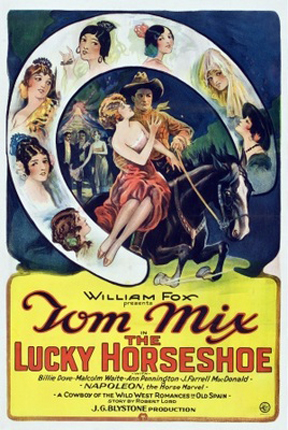
Shane went on to give short but favorable reviews to Rex Reach’s Winds of Chance (at the Piccadilly Theatre), the film’s chief props consisting of “string ties, wooden saloons, ½ dozen cold-blooded murders and the tenderfoot who conquers everything…Shane also noted that the “spiritual features” of Tom Mix in The Lucky Horseshoe (at the Rialto) lent themselves delightfully to “a lovely and sensitive drama of moyen age and modern machinations in the Fairbanks style.”

In “Books,” Harry Este Dounce (“Touchstone”) suggested readers take a look at Carl Van Vechten’s Firecrackers as a good introduction to the writer’s unique style, while J.D. Bereford’s The Monkey Puzzle was deemed only “partly good” but worth reading.
Screenshot 2015-06-12 16.35.08
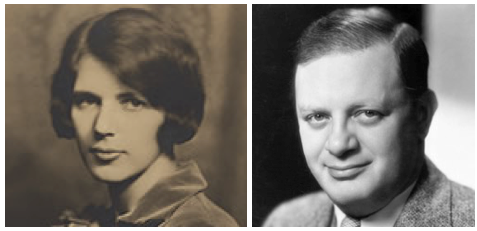
Lois “Lipstick” Long and Herman J. Mankiewicz. (PBS/Wikipedia)

In her regular nightlife review (“When Nights Are Young”), Lois Long (“Lipstick”) playfully sparred with her New Yorker colleague, theater critic Herman J. Mankiewicz:

Screenshot 2015-06-12 14.58.10

Long was referencing this Mankiewicz review in a previous issue (Aug. 8):

Screenshot 2015-06-12 15.05.24

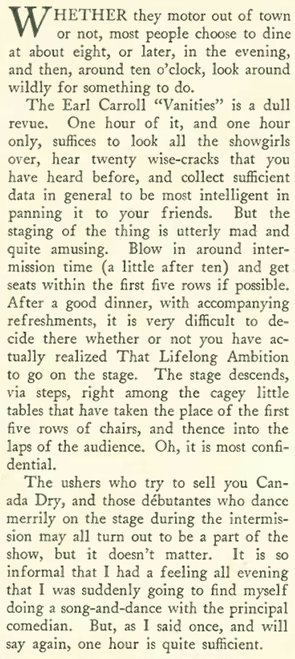
And it all started when Long offered this observation in her July 25 “When Nights Bold” column:
Screenshot 2015-06-12 15.11.51

I hope you are fully sated. As a palate cleanser, I offer yet another droll observation of the world of old money by Gardner Rea:

Screenshot 2015-06-12 14.30.06

Next time: The waning summer season…

Screenshot 2015-06-10 16.51.20

The “Countess” Pola Negri

Screenshot 2015-04-20 16.42.34
May 16, 1925 cover by A.E. Wilson

The antics of Polish actress Pola Negri were once again in The New Yorker’s spotlight in the May 16, 1925 issue. In the early issues of magazine, Negri was among the most watched celebrities including Gloria Swanson and Charlie Chaplin.

Negri’s latest activities were recounted in a “Talk of the Town” segment that began with an account of the English tenor John Coates. Upon his arrival in the U.S., it was reported that Coates “frankly noted upon his Customs’ declaration possession of two quarts of truly excellent Scotch; quite a different procedure from that followed by Pola Negri who has found it necessary, since inspectors discovered some alcoholic beverages among her baggage to (1) fail to remember their presence, (2) attribute ownership to her maid, and (3) recall that there were mild wines for medicinal use only.”

Screenshot 2015-04-22 09.04.52
(San Francisco Sentinel, left; rag piano.com, right)

“Talk” continued with a report on Negri’s recent behavior in Paris, where “Madame, the Countess” created a traffic jam when she demanded that her driver stop to serve her “a golden drink in a beautiful goblet,” and later at the Ritz-Carlton “she engaged for herself an entire floor.” When informed that singer/actress Nora Bayes “and her latest husband” already occupied two rooms on the floor, Negri replied that they would understand that “she could not possibly live in less than an entire floor.” Then Negri herself knocked on Bayes’ door and asked the couple to move off the floor. It was not reported if they complied, but the magazine did note that “after the clinch there was a grand and most friendly party that evening.”

Screenshot 2015-04-21 13.15.21
Article from Motion Picture magazine, April 1925 (page scan)

“Talk” also commented on “The Craze for Royalty” with the observation that “No social set feels satisfied with its activities these democratic days unless it is entertaining, has entertained, or is planning to entertain royalty. There were rumors that “Even that secluded section of our native aristocracy which is descended wholly from Colonial governors, and which hitherto has treated mere kings and princes with formal politeness proper for acknowledging the presence of inferiors, has succumbed to the craze” with a “discreet inquiry as to whether Wilhelmina, Queen of the Netherlands, would accept an invitation to visit New York in 1926.”

The royal visit was sought in conjunction with a planned celebration by the descendants of the original “New Netherlanders” of that “famous real estate deal three hundred years ago, when Manhattan Island was purchased from the Indians for some rum and a few trinkets.”

“Talk” noted previous visits by royalty, such as the “kidnapping” of the King and Queen of Belgium by the “Social Old Guard,” or the “Knickerbocker dowagers” observing “the strange preferences of His Royal Highness, the Prince of Wales,” during his visit the previous year. “Talk” also referred to the upcoming visit by “Her Majesty of Rumania” and her “shrewd plans for a matrimonial alliance.”

Screenshot 2015-04-10 16.49.43
(New Yorker Digital Archive)

The magazine also made note of an illustration in the previous issue – a self-portrait by the famous American portrait painter George Luks, who as a joke signed his drawing “Gene Tunney.” The champion boxer was reportedly a friend of Luks.

“Talk” reported that the actor John Barrymore was back from a London season of Hamlet and was once again contemplating a movie role. It was noted that he was wearing “Le Valentino medal,” an award given him for best screen acting of the year (I’m not sure if “Le Valentino” was a real award or some joke about Rudolph Valentino, but it is worth noting that the first Academy Awards ceremony was still four years into the future). Among those traveling abroad were playwright Marc Connelly, New York Times publisher Adolph Ochs, and “Mr. Asa Yoelson,” who “booked passage as Al Jolson.” The violinist Jascha Heifitz became an American citizen, “Squire Heywood Broun” was “enjoying a nervous breakdown,” and cartoonist Jay Darling (known as “Ding”) was “convalescing under sunny Iowan skies.”

Seems_as_if_five_years_ought_to_be_enough_to_do_the_trick_in_even_if_they_didnt_know_how_in_the_beginning
Political cartoon by Jay “Ding” Darling featuring Russian Communist leaders Lenin and Trotsky, originally published in March 1925. The caption read: “Seems as if five years ought to be enough to do the trick in even if they didn’t know how in the beginning.” Originally from Iowa, Ding worked at the New York Globe and Herald Tribune, but in 1919 he returned to Iowa to work at the Des Moines Register. He won the Pulitzer Prize for editorial cartooning in 1924 and again in 1943. (Image: Iowa Digital Library)

In a feature titled “A Mob and a Machine,” novelist and social critic Waldo Frank (writing under the pen name “Searchlight”) penned a sour account of an opening day baseball game at the Polo Grounds between the New York Giants and the Boston Braves.

Waldo Frank, 1923
Waldo Frank, circa 1923 (photo by Alfred Stieglitz/Wikipedia)

Frank wrote of the “abyss” that separated the game “from the vast crowds that watch it” and the specialized play of the game where “Batsman and fielder mechanically carry out motions whose plan and purpose are established for them.”

That is why, observed Frank, that Babe Ruth…

…ignoble, fat fellow that he is—deserves his vogue…It is such as he who enable the wistful mob to have some sort of contact with the game. For baseball is only clockwork; but the Bab is a boy—moody, clever, tangible and human…The Babe’s home run is an effort on the part of the machine to connect with the crowd. When the ball reaches the bleachers, contact is established.

Frank wrote that after the game is ended, “we can pack ourselves like grains of sand into a stifled elevated train, and read in the headlines of the paper we have just bought, what a significant national event we have just witnessed.”

Lamenting the loss of the “old-fashioned, humble game,” Frank wrote that like everything else in America “the Game’s gotten bigger—and that means better…It used to be a enjoyable means of moving our bodies. Not any more. Now, there’s a machine that does the moving, while our forty thousand bodies sit packed and rancid in the grandstands.”

Polo_Grounds_1923
The Polo Grounds in 1923 (Wikipedia)

“The Theatre” section reported that Oscar Hammerstein (later to become half of the famed Rodgers and Hammerstein Broadway musical juggernaut) had engaged “two girls” for a performance at his Victoria Theatre. The “girls,” who had been arrested, tried and acquitted of shooting a W.E. Stokes in the ankle, were identified as Ethel Conrad and Lillian Graham. Their subsequent notoriety led to their hiring by Hammerstein for a singing act that The New Yorker described as “a terrible frost;” the duo reportedly left the stage after their debut performance “without a ripple of applause from the audience.” The girls’ act was arranged by Loney Haskell, who after the performance asked the opinion of song writer Jim Thornton. Thornton replied: “By golly, they’ll have to shoot a couple of men to get in next week.”

Paul_Robeson1
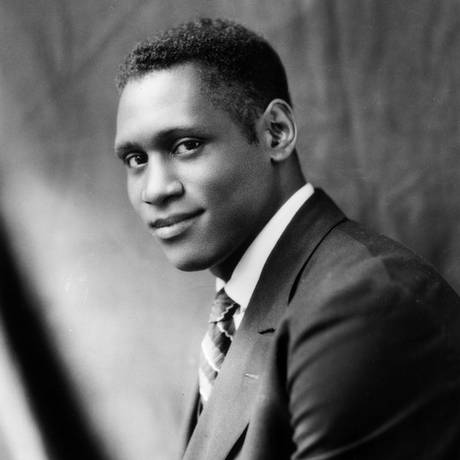
Paul Robeson in 1925 (rutgers.edu)

“Profiles” featured Max Steuer, a famed American trial attorney, while the “Music” section mentioned Paul Robeson’s “recital of negro spirituals” at the Greenwich Village Theatre, noting that “there are few artists who can equal him in getting inside a song and becoming part of it.”

“Of All Things” reports that “the Babeless New York” was in sixth place in the American League and “hobnobbing with such shady characters as Boston and Detroit. The Yanks are slumming.”