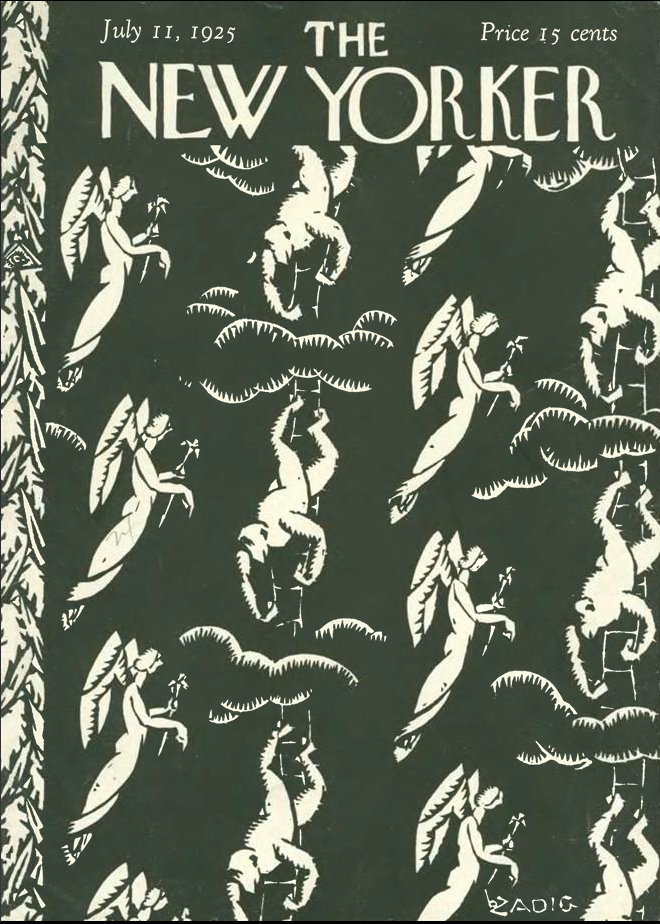
In its 21st issue (July 11, 1925) The New Yorker was back to taking swipes at William Jennings Bryan and the backward ways of Tennesseans as the Scopes “Monkey Trial” drew near.
Cover for July 11, 1925, by Bertrand Zadig. It was a low point for the fledging magazine–funds were so scarce that the cover was printed in black and white. (New Yorker Digital Archive)
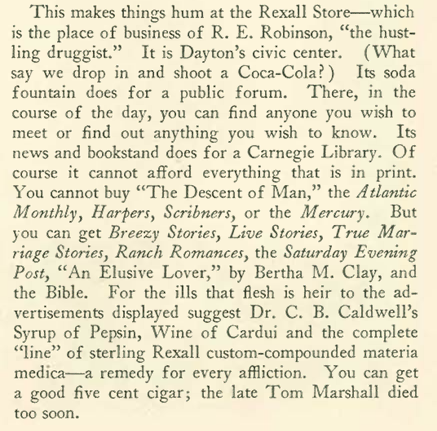
A four-page feature penned by Marquis James (the longest article to appear in The New Yorker since Issue #1), primarily focused on the trial’s setting—Dayton, Tennessee—and the habits and tastes of its countrified citizens:
Prosecutor and famed orator William Jennings Bryan had not yet arrived in Dayton, but the townsfolk were plenty enamored of the other star in their midst, attorney for the defense Clarence Darrow. James reported that the agnostic Darrow mixed surprisingly well with the locals:
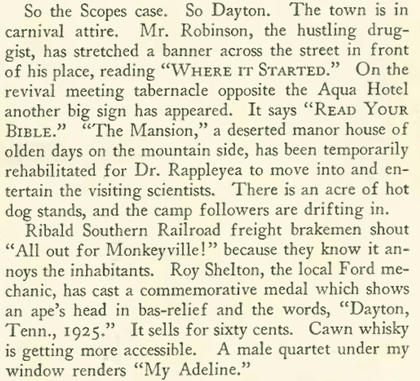
James concluded his piece with a description of the carnival atmosphere that gripped the tiny, formerly unknown town that was now the focus of the entire country:
(New Yorker Digital Archive)
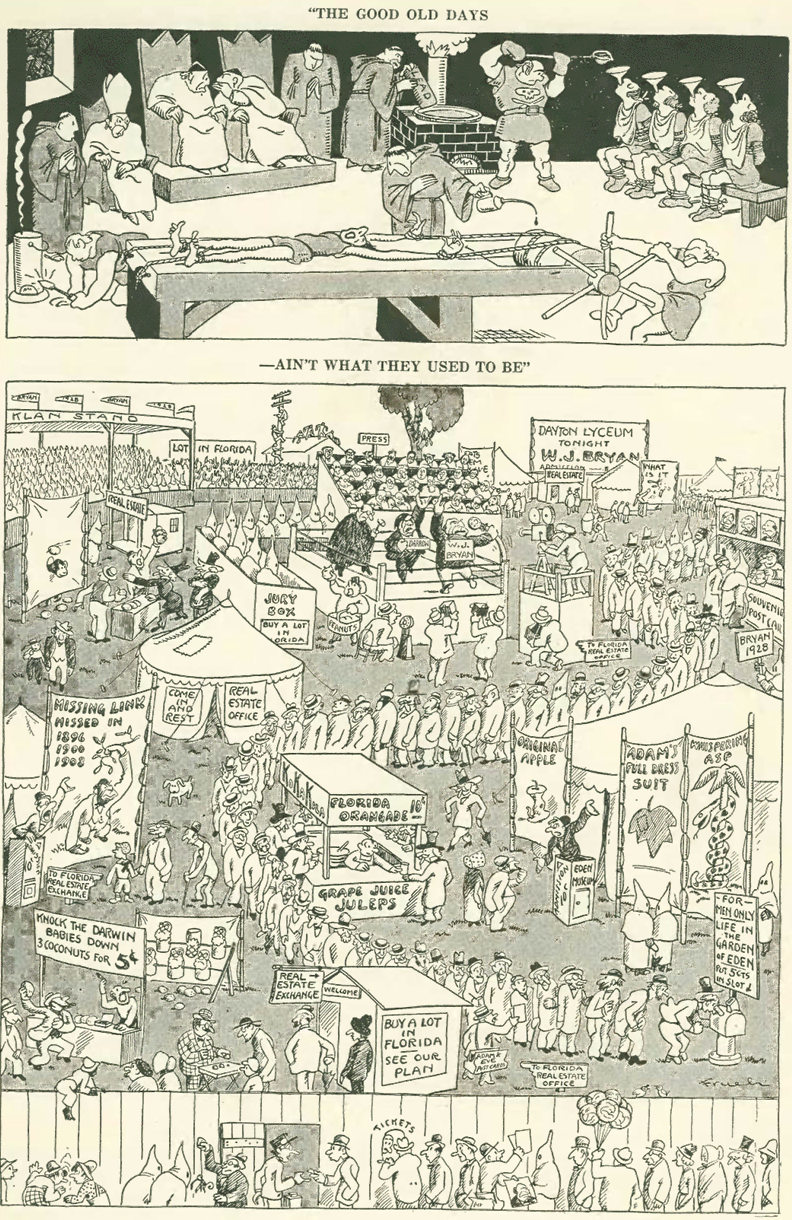
An illustration by Al Frueh that preceded James’s article makes hay of the “carnival atmosphere,” likening it to a modern-day version of the Inquisition:
(New Yorker Digital Archive)
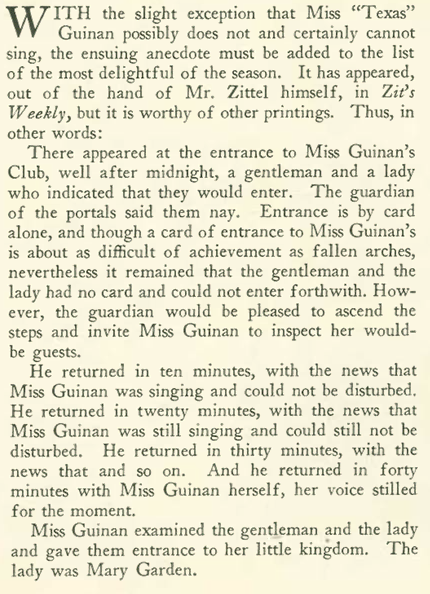
“The Talk of the Town” did its usual breezy wrap up of “The Week” (including the announcement of the birth of Charlie Chaplin’s son (by Lita Grey), and offered a somber note about the dampening effects of Prohibition on the restaurant trade. It also noted that David Belasco had marked 50 years in the theater business (though his influence was waning), and Texas Guinan personally opened the door of her nightclub to opera great Mary Garden after a bit of a misunderstanding:
(New Yorker Digital Archive)
“Profiles” looked at Clinton Peters, “The Daddy of Sunday Painters,” while “Moving Pictures” cheered Edmond Rostand’s “masterpiece,” Cyrano de Bergerac, starring French actor Pierre Magnier in a “magnificently well—seasoned interpretation.”
Pierre Magnier (left) starred in the hand-tinted color film, Cyrano de Bergerac. (Screen capture from YouTube)
The film was also “in color,” actually a cross between two-color technicolor and hand-coloring, sometimes using only one process or the other, sometimes both. According to IMDB:
Parts of the film were hand colored using the Pathécolor stencil process, in which groundstone glass is cut with a pantograph in the shape of an object to conform with what is on the 35mm print. A machine then passes a dye-soaked strip of velvet over the film with the glass stencil on top and the film is colored. Cutting the stencils (a stencil for every different color) was a very long and tedious process which delayed the release of the film by almost two years. The color style/scheme of the movie was to imitate the tone, color and feel of 17th Century Renaissance paintings.
In the review of another film, Paths to Paradise, the critic (TS) wrote that “Mr. Raymond Griffith establishes himself as a genuine comedian of the rank of Menjou and Chaplin.”
Raymond Griffith and Betty Compson in Paths to Paradise (1925) (travsd.wordpress.com)
The “Sports” section of these early issues of The New Yorker covered mostly polo, tennis, golf and yacht races and regattas, which I will explore more in future posts.
Fay Marbe on the cover of the June 28, 1924 issue of Movie Weekly.
In the section “When Nights Are Bold,” Charles Baskerville (signing as “Top Hat”) reviewed the tango dance performance by Fay Marbe at the Beaux Arts Restaurant: “She is easy on the eyes; and after her performance we were all patting her on the back, because it’s one of the most beautiful ones we have ever beheld.”
And now for the funnies: On the inside front cover, the musings of English cartoonist W. Heath Robinson, best known for his drawings of ridiculously complicated machines for achieving simple objectives:
(New Yorker Digital Archive)
And finally, this three-act performance by staff artist Johan Bull. In her book Defining New Yorker Humor, Judith Yaross Lee writes that Bull was a Norwegian immigrant who started out as a caricaturist for the sports department, but was pressed into greater service for his ability to mimic Rea Irvin’s style:
Anticipation of the upcoming Scopes “Monkey Trial” continued to fill the pages of The New Yorker. In the June 20, 1925 issue, “The Talk of the Town” led with an account (titled “Martyr de Jour”) of trial defendant John T. Scopes’s visit to New York City.
The “Talk” author wrote admiringly of Scopes, if not also with a degree of condescension, noting that the Tennessee schoolteacher was “introduced in circles with which, hitherto, he had been acquainted only through his love for books and periodicals…He was fêted and lionized, this back-country school-teacher, a shrewd, slow-speaking, slow-moving individual such as novelists have misrepresented as being typical of our agricultural regions. He was lionized socially, that is. Although, of course, there was that rather distressful incident of entertainment when Mr. Scopes and Dr. George W. Rappleyea, his devoted friend, attended the “Follies” by invitation of the late press agent for the American Civil Liberties Union, and found, on arrival that while guests they were expected to pay for their own tickets.”
Rappleyea and Scopes in 1925 (Smithsonian Institution)
Scopes and Rappleyea were in town to find scientists who would be willing to testify in Scopes’ legal case. “Talk” noted that despite its humble description of the teacher, Scopes was no meek country boy; indeed he had complained to the press that his importance had been minimized by all the attention paid to the prosecuting and defending attorneys, Clarence Darrow and William Jennings Bryan.
For the record, George Rappleyea was a metallurgical engineer and manager of the Cumberland Coal and Iron Company in Dayton, Tennessee, which was the site of Scopes Trial. It was Rappleyea who convinced a group of Dayton businessmen to sponsor a test case of the Butler Act (which prohibited the teaching of evolution in state schools) and also convinced Scopes to serve as defendant.
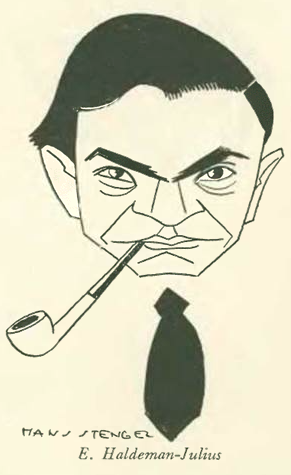
The trial would attract many public figures, including E. Haldeman-Julius, who was coincidentally featured in the issue’s “Profiles” section.
Hans Stengel’s “pen portrait” of E. Haldeman-Julius
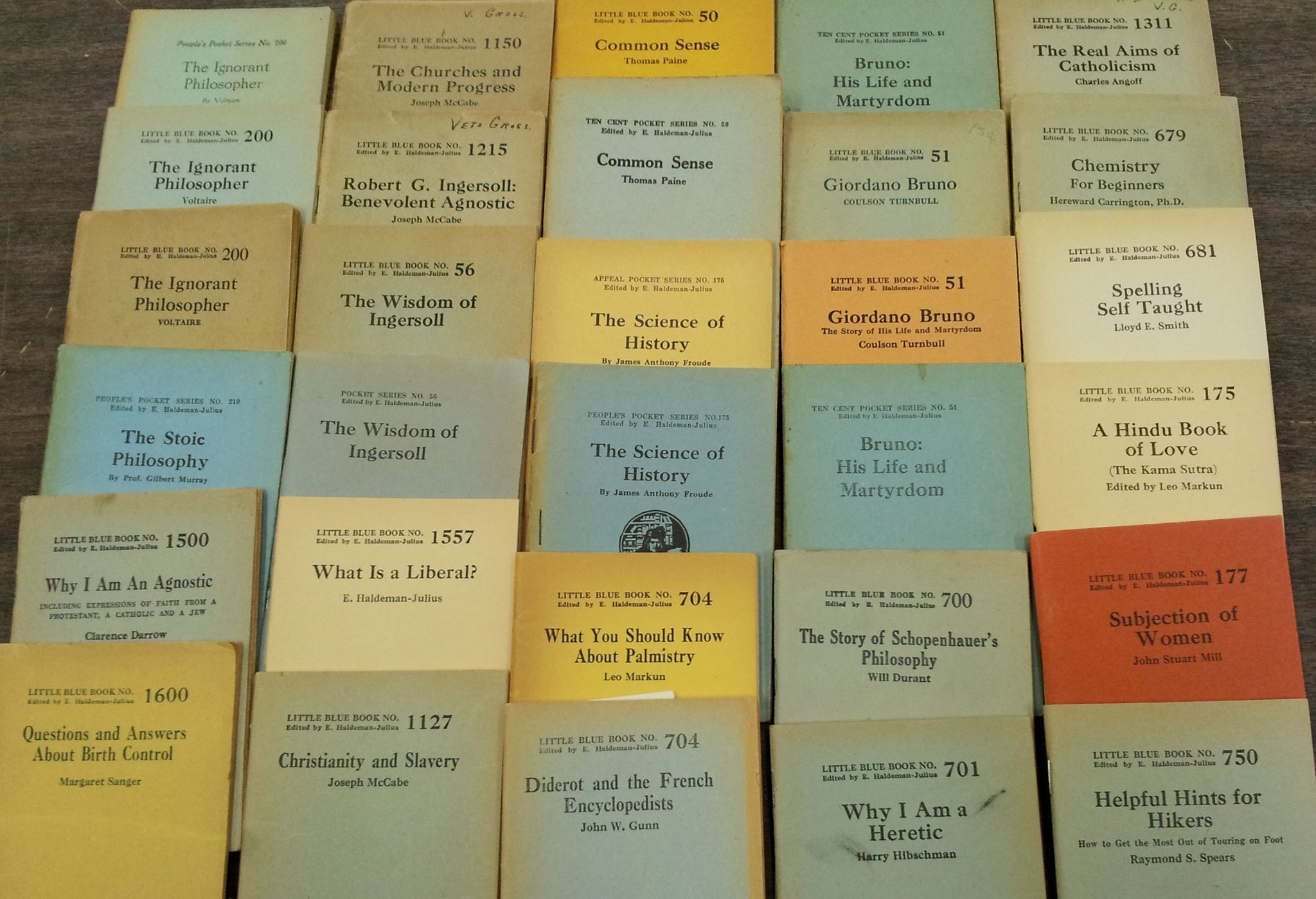
Haldeman-Julius was a socialist reformer and creator of a series of small, staple-bound booklets known as “Little Blue Books,” which featured various writings on social issues and abridged reprints of classic literature.
If a book sold less than 10,000 copies in one year, Haldeman-Julius would remove it from his line. But first he would try out a lurid title for the book, and sometimes the tactic would revive sales. For example, The Tallow Ball by Guy de Maupassant sold 15,000 copies one year, but nearly 55,000 the next year after the title was changed to A French Prostitute’s Sacrifice.
A sampling of Little Blue Books (image: centerforinquiry.net)
The writer of the profile, Alexander Woollcott, noted that 75 million Little Blue Books had been published to date (according to Haldeman-Julius), and one might conclude that the famous socialist pamphleteer had “sold out to Mammon” because of the wealth generated from the sales, but Woollcott concluded that Haldeman-Julius and his wife, Marcet, were accomplished authors themselves (including their 1921 novel Dust) and even a socialist crusader would feel pride at the sight of a workman on a subway train, settling back with “his Little Blue Book.”
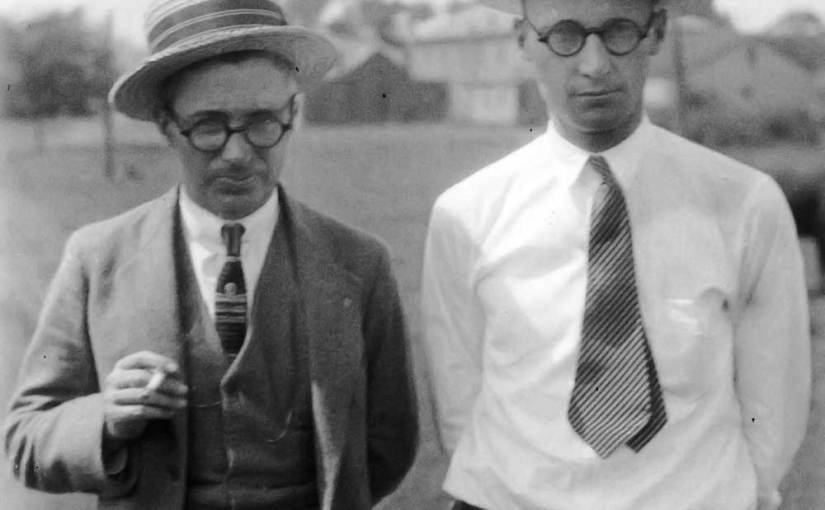
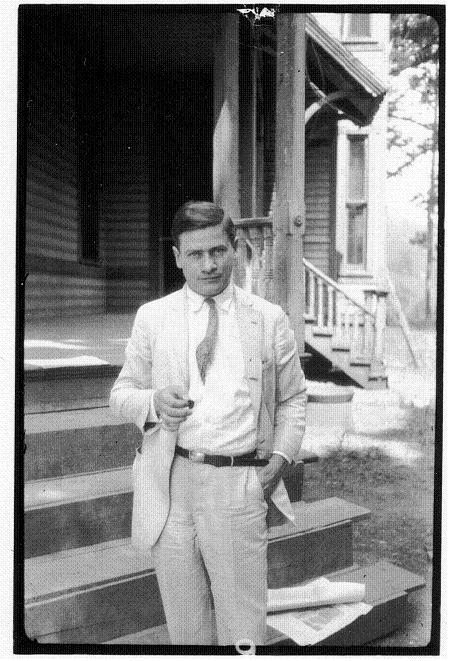
It should be no surprise that Haldeman-Julius was also present in Dayton for the Scopes Monkey Trial. According to the Smithsonian, he and his wife Marcet drove 200 miles from their home in Kansas to observe the trial. In this photo he is shown on the steps of “Defense Mansion,” an old Victorian house owned by Rappleyea’s coal and iron company, which had been quickly restored by Rappleyea to accommodate the defense team and their scientific witnesses. (Smithsonian Institution)
The “Critique” section offered this observation about a new show at the Colonial, featuring Johnny Hudgins (Hudgins was featured in my April 8 blog, Knickerbocker Junction:
(New Yorker Digital Archive)
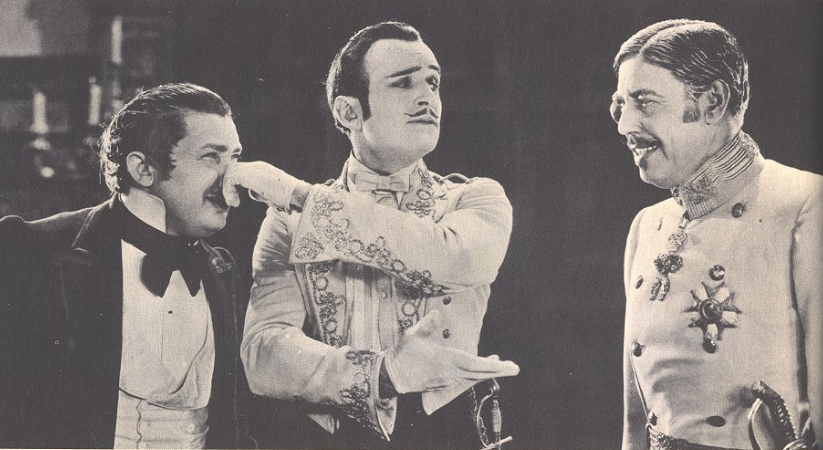
There was also an item about Don Q, Son of Zorro, a film starring Douglas Fairbanks that made its debut at Broadway’s Globe Theatre. The review noted that the movie is full of Fairbanks acrobatics, and “Doug does everything except play the saxophone.”
Don Q (Douglas Fairbanks) tweaks the nose of Don Fabrique (Jean Hersholt), much to the amusement of The Archduke (Warner Oland). (Scan from Jean Hersholt’s Album Of Hollywood Stars, a promotional booklet sponsored by the makers of Vaseline)
It was noted, however, that the best performance of the picture was by Warner Oland, who played a dimwitted archduke. The Swedish actor Oland would gain fame for playing “oriental” characters, most notably Dr. Fu Manchu in the late 20s and early 30s, and the detective Charlie Chan in more than a dozen movies in the 1930s. He also played the role of “The Cantor” in 1927’s The Jazz Singer, one of the first of the “talkies.”
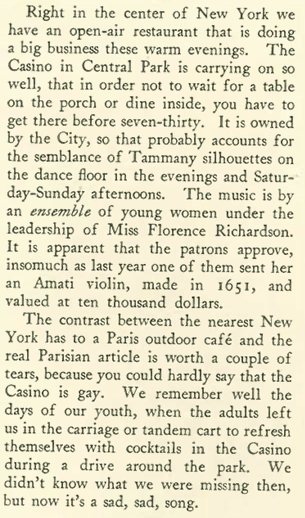
“When Nights Are Bold” featured, among other items, this bit about the growing popularity of an open-air restaurant in Central Park called “The Casino”:
(New Yorker Digital Archive)
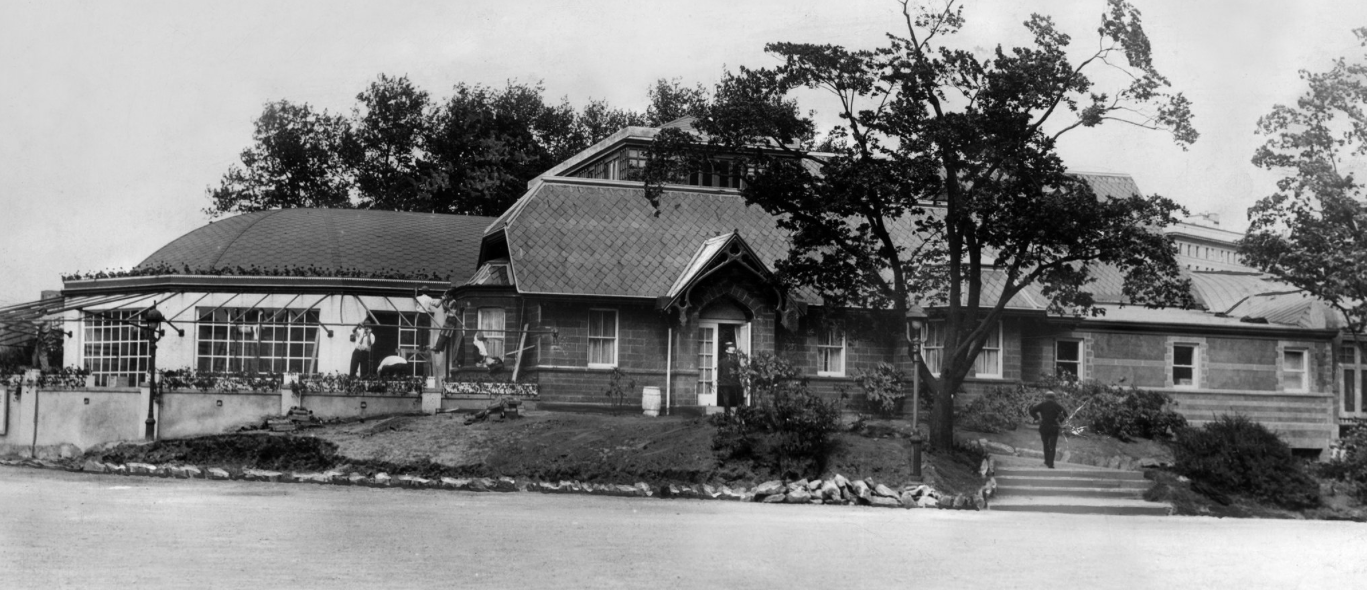
The Museum of the City of New York blog notes that the Central Park Casino began in 1864 as the Ladies’ Refreshment Salon. About 20 years later the salon “morphed into a far pricier destination, called The Casino, and was open to both sexes. The name was used to invoke the Italian translation of “little house” rather than denoting a gambling joint.” Because of its park location and then rare outdoor seating option, it was the place to see and be seen. By the early 1920s it had declined into “a somewhat dumpy night-club,” but when flamboyant Mayor Jimmy Walker took office in 1926 he personally revived the Casino (through “a series of somewhat sketchy maneuvers”) and turned it into an exclusive nightclub for high society. The good times quickly ended with the 1929 market crash.
Central Park Casino (The New York Times)
According to centralparkhistory.com, on opening night, June 4, 1929, “a good deal of cynical talk was bandied about among the crowd who watched the socialites arrive. In the fall mayoral campaign Fiorello La Guardia had attacked Walker for leasing the “whoopee joint” in the park to his close friends for a ridiculously low rent — friends who, in turn, obtained some of their financing from gangster Arnold Rothstein (the man who reputedly fixed the 1919 World Series). The stock market crashed that same fall and federal prohibition agents raided the Casino. The elegant playground of the rich had become a symbol of decadence and corruption.” Parks commissioner Robert Moses later replaced the Casino with the Rumsey Playground, which in turn was replaced by the park’s current SummerStage.
Finally we close with some illustrations from the issue. In her book, Defining New Yorker Humor,Judith Yaross Lee writes that the magazine’s “signature caricaturists established the New Yorker’s high sense of humor and gave comic character to the texts…The New Yorker attracted first-rate artists despite its comparatively low rates because photojournalism was restructuring their work, and because art editor Rea Irvin gave it attractive layouts.”
On the inside front cover, this illustration by W. Heath Robinson takes aim at upper-class vanities:
(New Yorker Digital Archive)
And here are some comic trifles; these were usually found in the center pages, sort of a “joke section” for the smart set. Note the ubiquitous “The Optimist” filler, a tired joke featured repeatedly in the first issues until Katharine (Angell) White came on board later that year and put an end to such nonsense. Also note that the second item is contributed by Julius H. Marx, better known as Groucho:
(New Yorker Digital Archive)
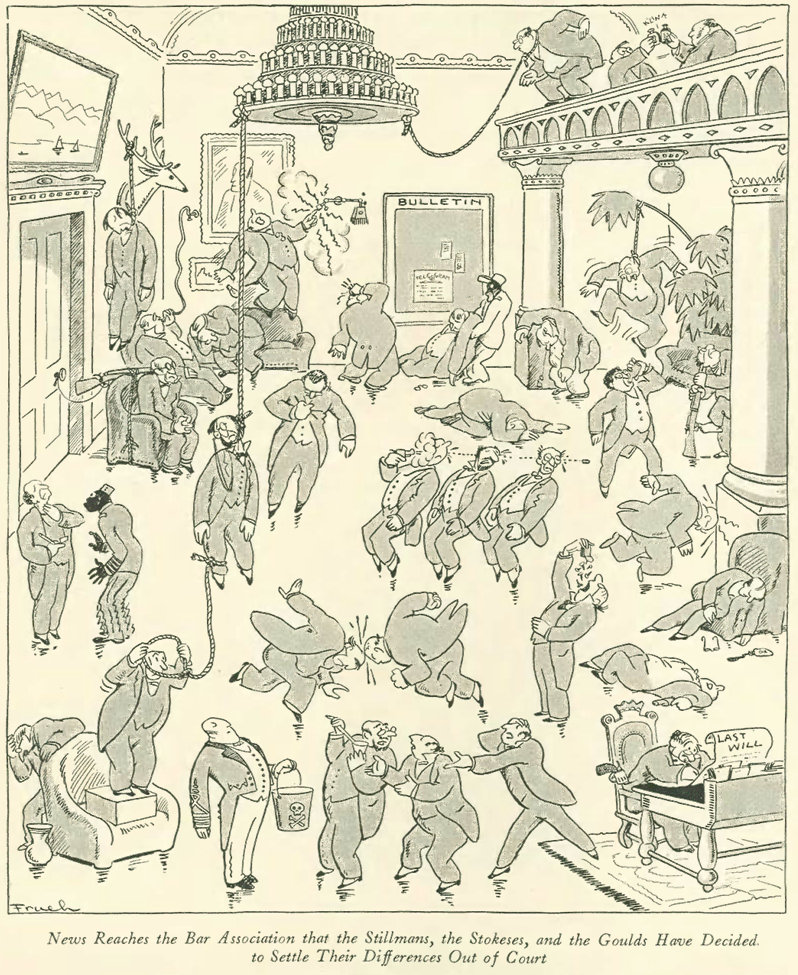
A good example here of how another artist, Al Frueh, finds humor in how the professional elites and the moneyed classes overreact to seemingly minor incidents. In just four years this wouldn’t be so funny:
(New Yorker Digital Archive)
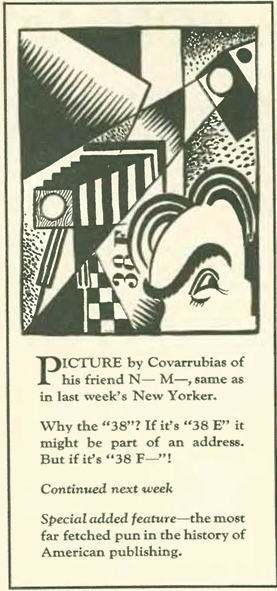
Again we get the mysterious Covarrubias drawing, also featured in my previous post, Bryan’s Planet of the Apes:
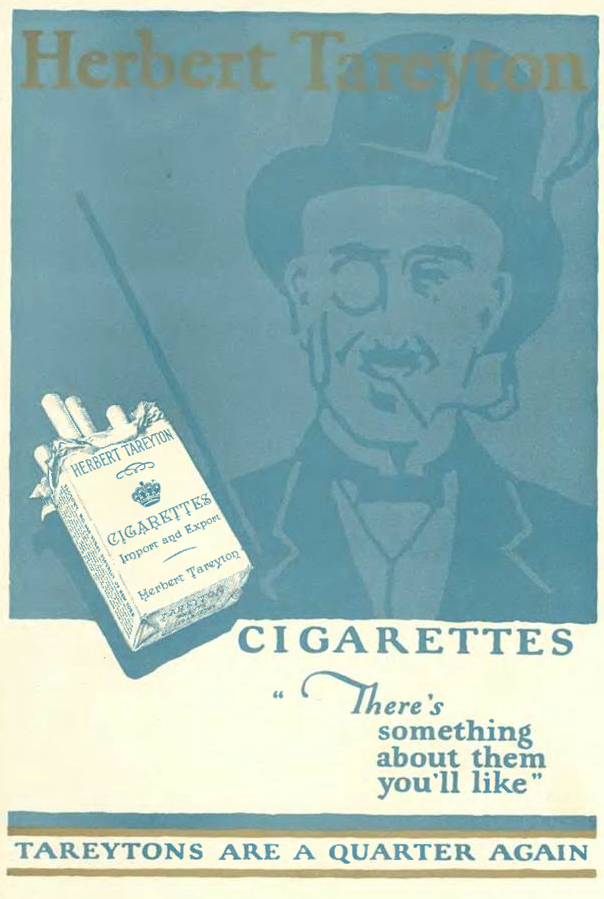
And finally, an advertisement for “Herbert” Tareyton cigarettes. Not exactly the most the persuasive tagline:









 A New Yorker State of Mind