
The penitentiary on Blackwell's Island, later named Welfare Island, in the 1910s. Today it is known as Roosevelt Island. (NYC Municipal Archives)
Until the reform Mayor Fiorello La Guardia took up the reigns at City Hall in 1934, weak or non-existent leadership in city government, coupled with Tammany graft and corruption, had allowed all sorts of institutions to go off the rails.
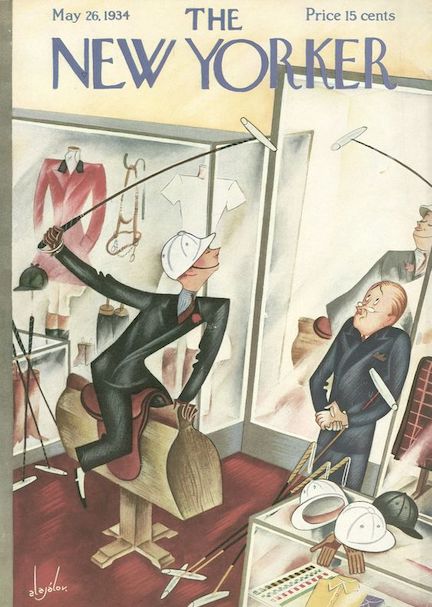
The New York City Department of Corrections was a prime example, so La Guardia tapped the no-nonsense assistant director of the Federal Bureau of Prisons, Austin H. MacCormick (1893–1979) to clean up Corrections, and MacCormick didn’t waste any time going after the No. 1 target: Welfare Island. Previously known as the notorious Blackwell’s Island, MacCormick described its cellblocks as a “vicious circle of depravity” unfit for humans, a place where some inmates lacked basic food and shelter while others, including a pack of gangsters and thugs who essentially ran the place, lived in grand style.
In late January, 1934, MacCormick led a well-organized raid on Welfare Island, finding littered cells full of drug addicts and large caches of weapons. According to an account in Time (Feb. 5, 1934), sixty-eight prisoners virtually ran the place. “They cowed their guards through outside political influence. They sold to some 500 inmates the best of vegetables and meats. Star boarders prepared this food in their own cells, and the prison library of more than 1,000 volumes had entirely vanished as cooking fuel. Since the food was looted from the prison commissary, the other 1,200 prisoners virtually starved on greasy cold stews.”
In his profile of the “The Four-Eyed Kid,” Arthur C. Bartlett attempted to shed some light on what made this stubborn Scotsman tick. Excerpts:


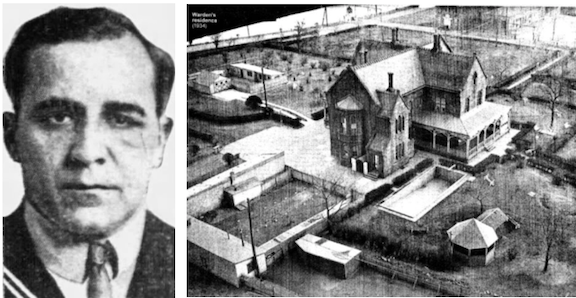

MacCormick literally wrote the book on prison reform. His The Education of Adult Prisoners (1931) called for the introduction of fundamental academic education in prison systems that would provide inmates with the intellectual tools needed for everyday life. His “four goals” included vocational, health, cultural and social education.
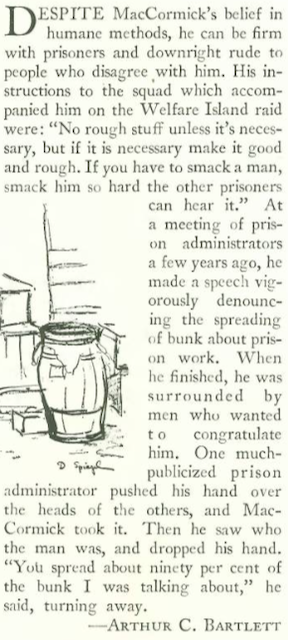
MacCormick broke up the gangster ring at Welfare Island and eventually transported its remaining inmates to the newly built prison at Rikers Island. The Welfare Island prison was torn down and replaced by Goldwater Hospital, today the Coler Specialty Hospital on Roosevelt Island. For a little more insight into MacCormick’s tactics, here is the conclusion to Bartlett’s profile:

* * *
You’re Next
Last week we looked at Robert Moses’s plans for Riverview Park, which would quickly sweep away the yacht clubs on the Hudson. Another playground for the rich, the Central Park Casino, would soon be next, as E.B. White correctly surmised.


* * *
Schenck’s Schlock
In the 1920s and 30s documentary and docudrama filmmaking was still in its infancy, and for every Nanook of the North (1922)—still considered one of the best documentary films of all time—there were dozens of schlocky films like Harry Schenck’s Beyond Bengal, reviewed here by John Mosher for the New Yorker.

The film must have made quite an impression around the New Yorker’s offices, or at least one particular scene that depicted a British scientist, a “Miss Joan Baldwin,” coming down with a fever, rather unconvincingly. Both Mosher and E.B. White (below) found her performance intriguing:


* * *
From Our Advertisers
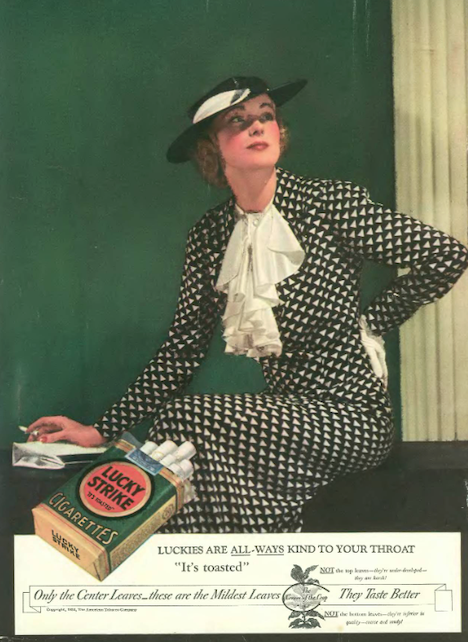
We kick off with the latest installment from Lucky Strike, and another smartly dressed customer…
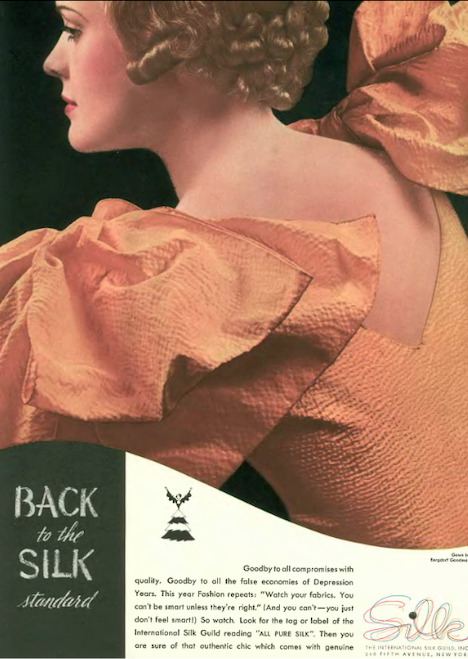
…the silk merchants struck back against the synthetics with this splash of color…
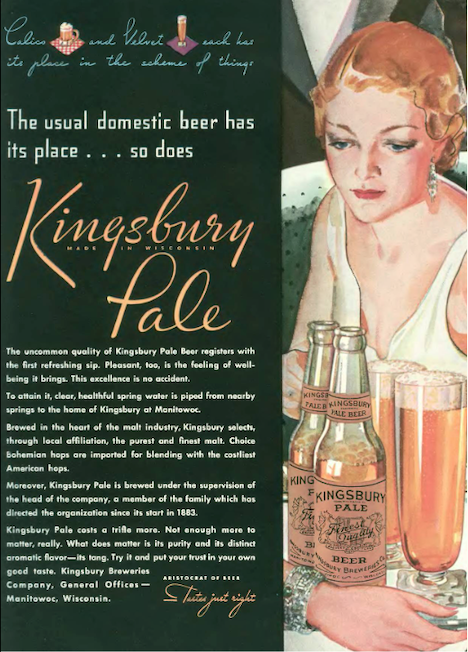
…the makers of Kingsbury Pale offered up some color of their own, although the illustration itself is a bit strange, what with the molten bubbles in the beer bottles, the bejeweled, disembodied arm that somehow supports them, and the woman who isn’t even looking at the beer…perhaps she was hoping for a cocktail or Champagne…
…there’s no doubting this fellow’s enthusiasm for a glass of Rheingold…

…Wamsutta Mills enlisted the aid of a “fat man” to prove the durability of their sheets…

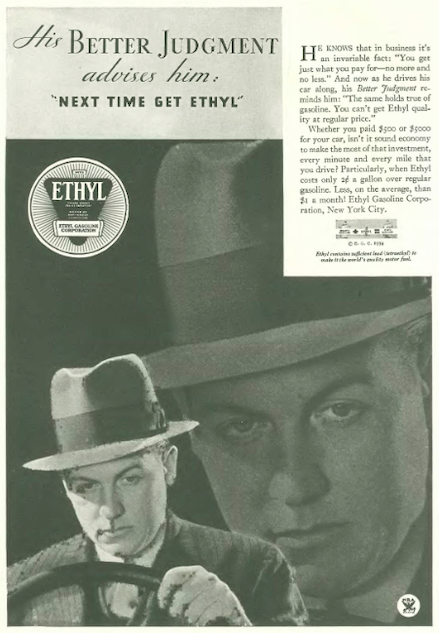
…and what drives a man to commit murder? In this case, neglecting to pay the extra two cents for leaded gasoline…
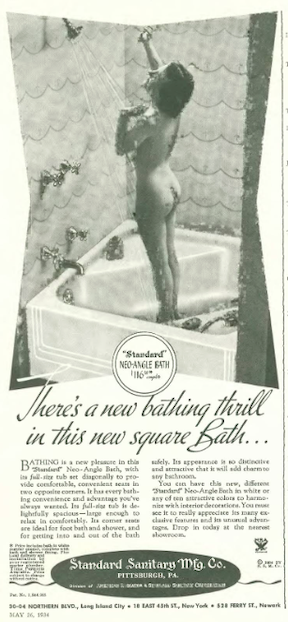
…I wonder if the Hays Code extended to advertising…looks like the new “Neo-Angle Bath” caused the folks at Standard Sanitary Manufacturing to lose their inhibitions…
 …on to our cartoonists, we begin with some spot art by Doris Spiegel (1901-1996), who was especially known for her depictions of street life…
…George Price supplied this bit of merriment for the event listings…

as did James Thurber…
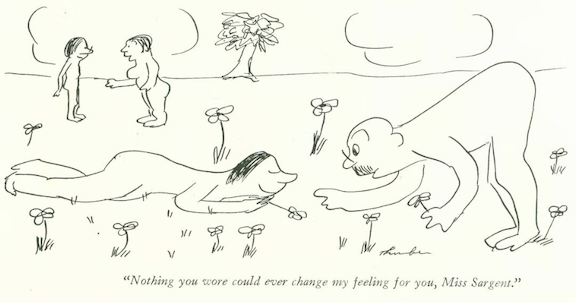
…Thurber again, this time baring it all…
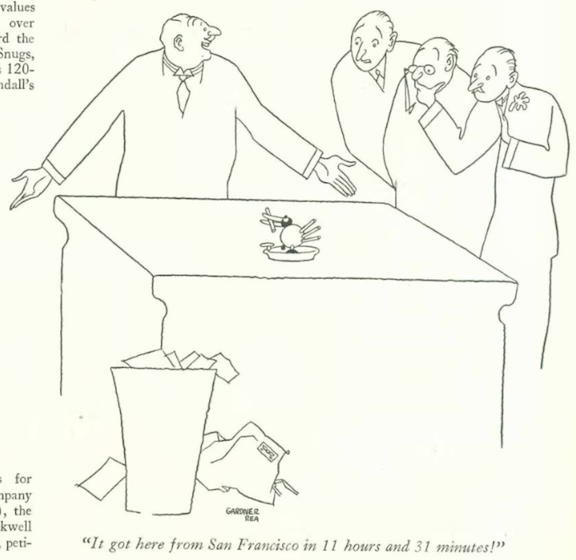
…it appears that same day delivery, for even a mere trifle, is nothing new…per Gardner Rea…
…Alain (Daniel Brustlein) gave us a film editor with the sad task of censoring Joan Blondell…

…tame by today’s standards, this 1932 promotional photo of Blondell for the film Three on a Match was later banned by the Motion Picture Production Code…

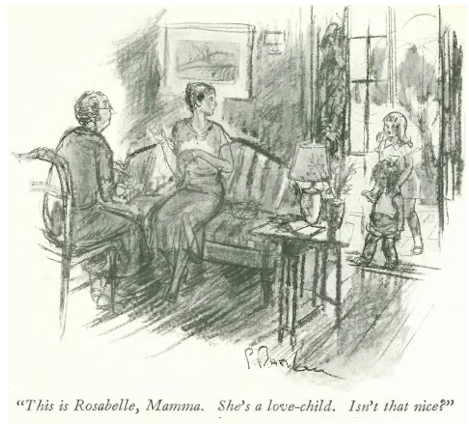
…and we close with Perry Barlow, and more wisdom from the mouth of babes…
Next Time: The High Life…


 A New Yorker State of Mind