They Call It Burlesque

Screenshot 2015-06-09 14.01.58
August 22, 1925 cover by A.E. Wilson.

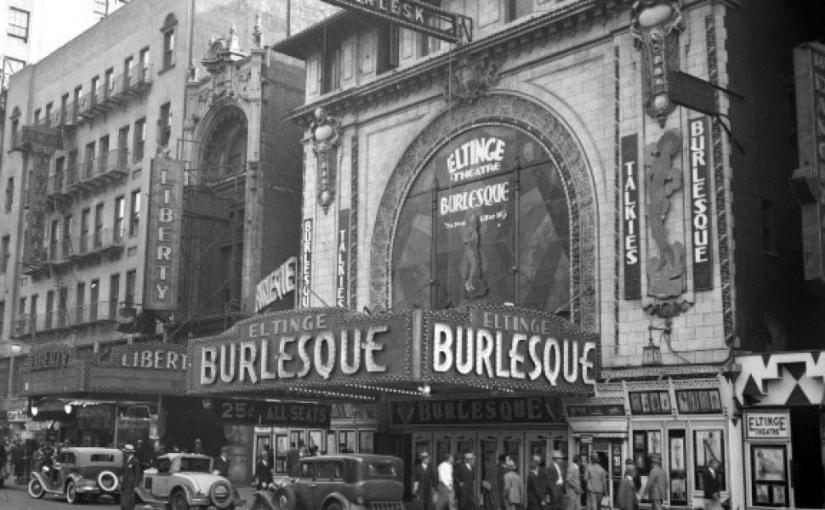
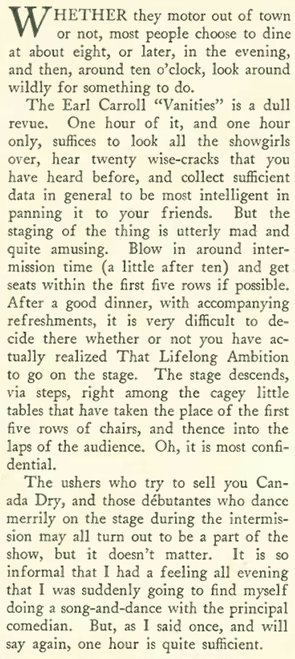
The critic Gilbert W. Gabriel was more than a bit appalled by the spectacle at the old Olympic Theatre, where a tired and “degenerated” cast of burlesque performers took turns shaking their ancient haunches in the direction of the former Julliard student.

Gilbert’s article in the August 22, 1925 New Yorker, “They Call It Burlesque,” described the performance at the Olympic on East Fourteenth Street as “on its last legs.” The once “honest animalistic, gorgeously orgiastic burlesque show of ten or twenty years ago” had “degenerated in decency,” he wrote.

Screenshot 2015-06-12 11.13.55
Illustration in The New Yorker of the Olympic Burlesque by Reginald Marsh.

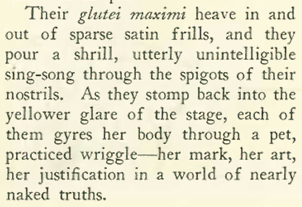
As the performers wiggled up and down the runways, Gilbert noted:

Screenshot 2015-06-12 11.06.57

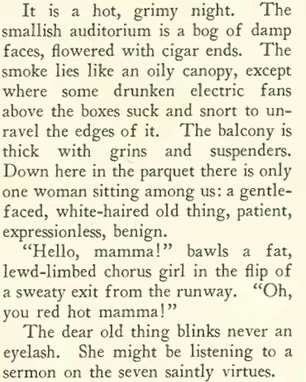
The audience was an equally sad lot:

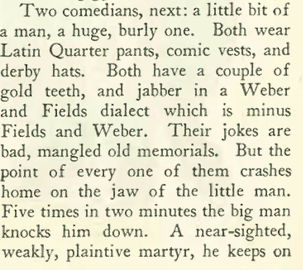
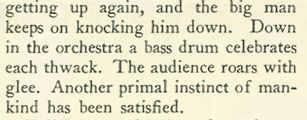
Screenshot 2015-06-12 11.08.02

There is some relief expressed when two comedians appeared, but they offer an unimaginative routine:

Screenshot 2015-06-12 11.10.25

Screenshot 2015-06-12 11.10.33

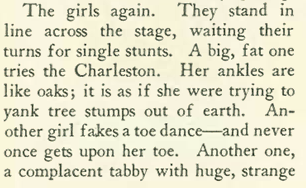
And then back to the dancers:

Screenshot 2015-06-12 11.11.03

Screenshot 2015-06-12 11.11.26

And still more…

Screenshot 2015-06-12 11.11.56

Happier news over in “The Talk of the Town,” where jazz was getting some respect: “Jazz, successor to the outcast ragtime, each day is becoming acceptable. It is the young brother of the musical family, irresponsible and at time highly irritating, but, nevertheless, acknowledged.”

It was reported that even famed violinist Jascha Heifetz “dabbled” in jazz as an amusement, and writers of jazz were “no longer those products of East Side dives,” but rather included the likes of Buddy de Sylva, lyrist to Al Jolson, and George Gershwin, “high priest of jazz,” who was besieged by symphony conductors for his “Symphony in Blue” (better known today as Rhapsody In Blue).

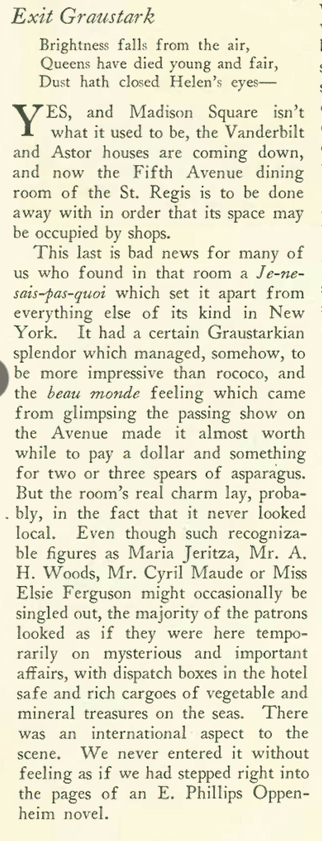
“Talk” continued its lament of the changing face of Fifth Avenue:

Screenshot 2015-06-12 14.20.34

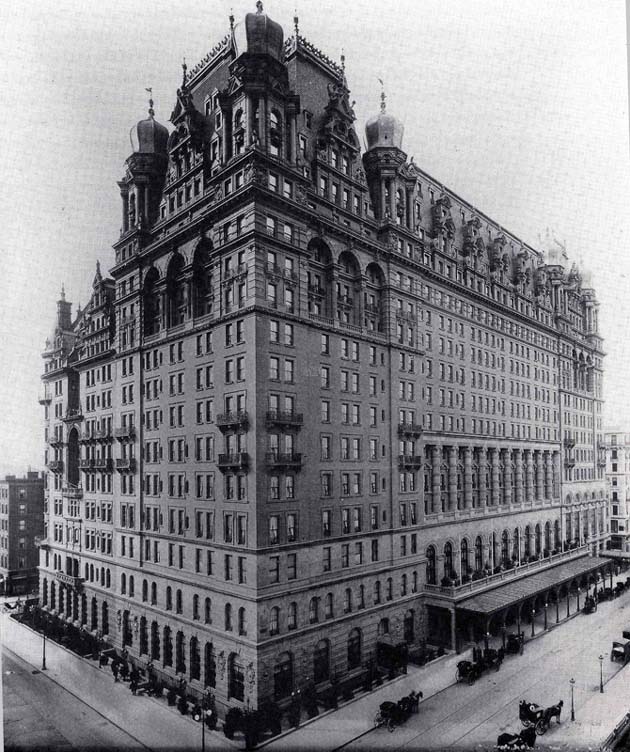
And the Waldorf Astoria was being remodeled in order to add shops on the ground floor along with “125 bathrooms,” giving the famed hotel “a bath for almost every room.” In just four years the old Waldorf would be torn down and replaced by the Empire State Building.

017- Waldorf Astoria
The old Waldorf Astoria was getting an upgrade, but it would fall to a wrecking ball in only four years. (nycago.org)

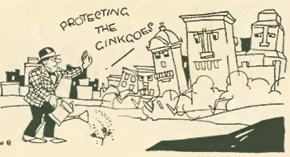
“Talk” also noted the planting of Ginkgo trees in the city:

Johan BullScreenshot 2015-06-10 16.20.44

Screenshot 2015-06-10 16.20.33

Although prized today for their beauty and hardiness, not all New Yorkers are in love with the strong odor of its fruit. In the June 30, 2008 issue of The New Yorker, Lauren Collins examined the activities of the “Anti-Ginkgo Tolerance Group” in her article “Smelly Trees.”

“Talk” also offered a brief glimpse into the latest adventures of Pola Negri, noting in its “This Week” section that the actress had paid “$57,000 customs dues in seized jewels…”

honey-kennedy-pola-negri-by-edward-steichen-vanity-fair-june-1925-02
Pola Negri liked nice things (Edward Steichen for Vanity Fair, 1925)

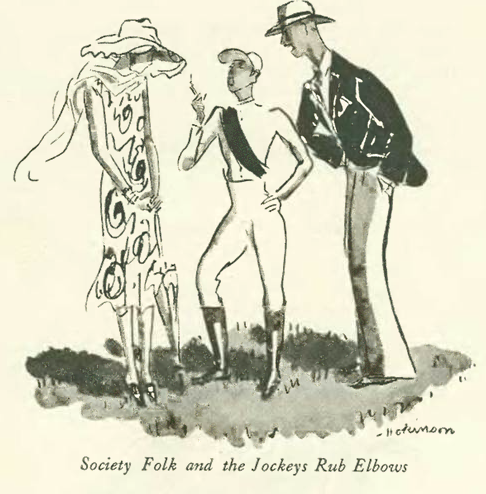
In other items, Helen Hokinson provided illustrations for an article on the horse races at Saratoga…

Screenshot 2015-06-12 14.24.41

John Tunis examined the life of tennis star Elizabeth “Bunny” Ryan in “Profiles” … and E.B. White and Alice Duer Miller offered their thoughts on why they liked New York:

Screenshot 2015-06-12 14.27.59

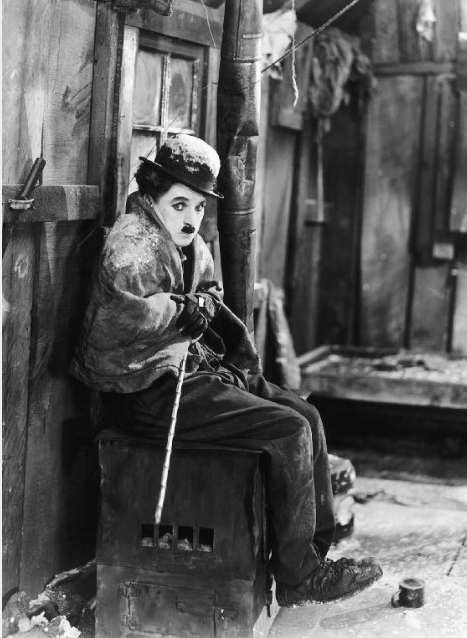
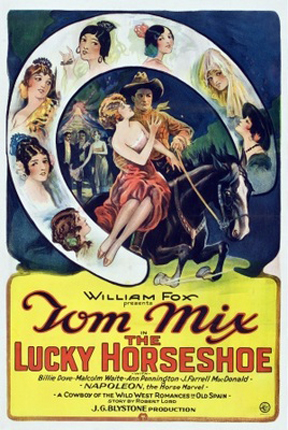
“Moving Pictures” featured a lengthy review of Charlie Chaplin’s The Gold Rush. Theodore Shane (“T.S.”) wrote that the film’s opening night at the Strand attracted such celebrities as Will Rogers and Constance Bennett.

Screenshot 2015-06-12 16.21.41
Cheer Up Charlie…Chaplin in The Gold Rush (1925) (United Artists)

Shane observed that this “dramatic comedy” was a “serviceable picture,” but perhaps Chaplin was getting “too metaphysical about his pathos” and could have used some old-fashioned pie-in-the-face slapstick.

As an example, in a scene in a typical Klondike town, Shane wrote that “one might be given to expect wonders of Gold Rush burlesque with the old Chaplin at the receiving end of the Klondike equivalent of a custard. But one is doomed to disappointment, for Chaplin has seen fit to turn on his onion juices in a Pierrot’s endeavor to draw your tears…We cannot help but recall with a tinge of sadness, the old days when custard was young.”

The_Lucky_Horseshoe_1925_Poster
(Wikipedia)

Shane went on to give short but favorable reviews to Rex Reach’s Winds of Chance (at the Piccadilly Theatre), the film’s chief props consisting of “string ties, wooden saloons, ½ dozen cold-blooded murders and the tenderfoot who conquers everything…Shane also noted that the “spiritual features” of Tom Mix in The Lucky Horseshoe (at the Rialto) lent themselves delightfully to “a lovely and sensitive drama of moyen age and modern machinations in the Fairbanks style.”

In “Books,” Harry Este Dounce (“Touchstone”) suggested readers take a look at Carl Van Vechten’s Firecrackers as a good introduction to the writer’s unique style, while J.D. Bereford’s The Monkey Puzzle was deemed only “partly good” but worth reading.

Screenshot 2015-06-12 16.35.08
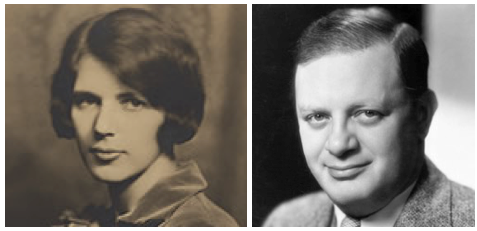
Lois “Lipstick” Long and Herman J. Mankiewicz. (PBS/Wikipedia)

In her regular nightlife review (“When Nights Are Young”), Lois Long (“Lipstick”) playfully sparred with her New Yorker colleague, theater critic Herman J. Mankiewicz:

Screenshot 2015-06-12 14.58.10

Long was referencing this Mankiewicz review in a previous issue (Aug. 8):

Screenshot 2015-06-12 15.05.24

And it all started when Long offered this observation in her July 25 “When Nights Bold” column:

Screenshot 2015-06-12 15.11.51

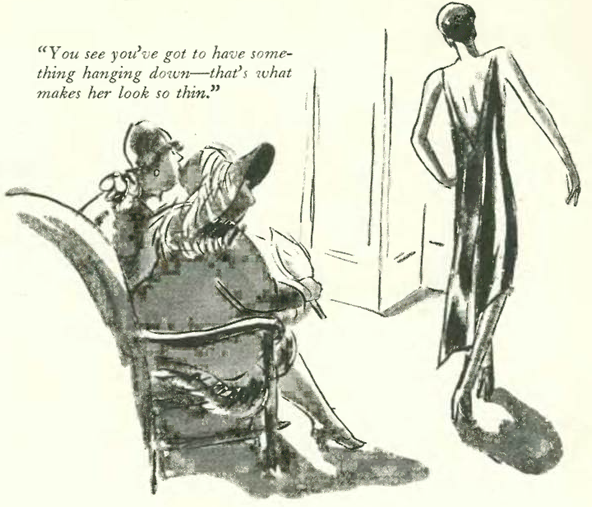
I hope you are fully sated. As a palate cleanser, I offer yet another droll observation of the world of old money by Gardner Rea:

Screenshot 2015-06-12 14.30.06

Next time: The waning summer season…

Screenshot 2015-06-10 16.51.20

The Vicious Circle

Screenshot 2015-05-08 15.49.29
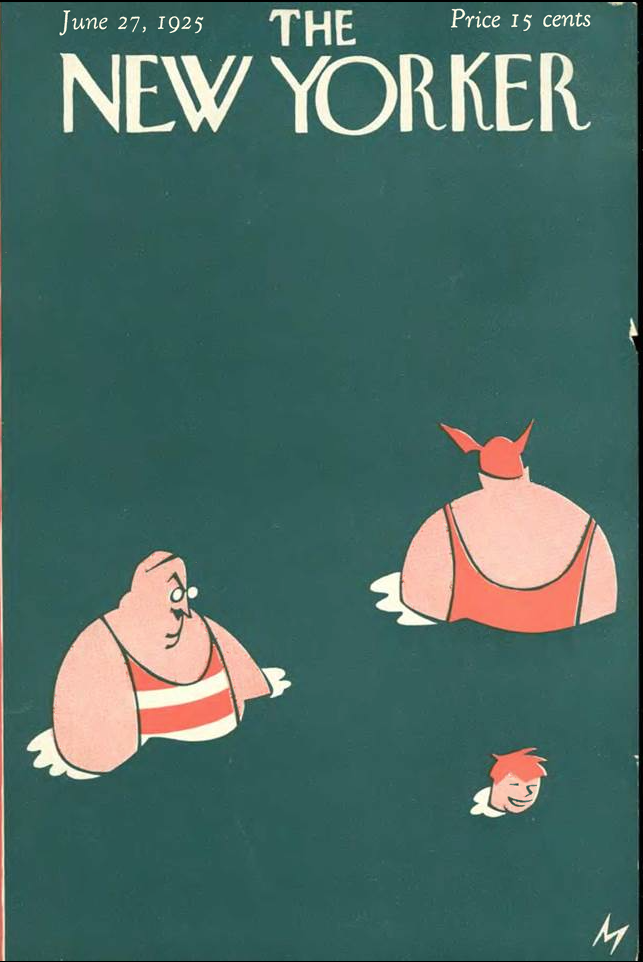
June 27, 1925, cover by Julian de Miskey (New Yorker digital archive)

With a lull in the news from the Scopes Trial, the June 27, 1925 is another hodgepodge of seemingly random bits. Perhaps this is a good time to look at  some of the magazine’s early artists, editors and writers.

The masthead of the very first issue listed these founding (ceremonial) Advisory Editors: Ralph Barton, Marc Connelly, Rea Irvin, George S. Kaufman, Alice Doerr Miller, Dorothy Parker and Alexander Woollcott. Not listed was founding editor Harold Ross.

The list remained the same for the June 27 issue, minus Ralph Barton. His story is rather sad.

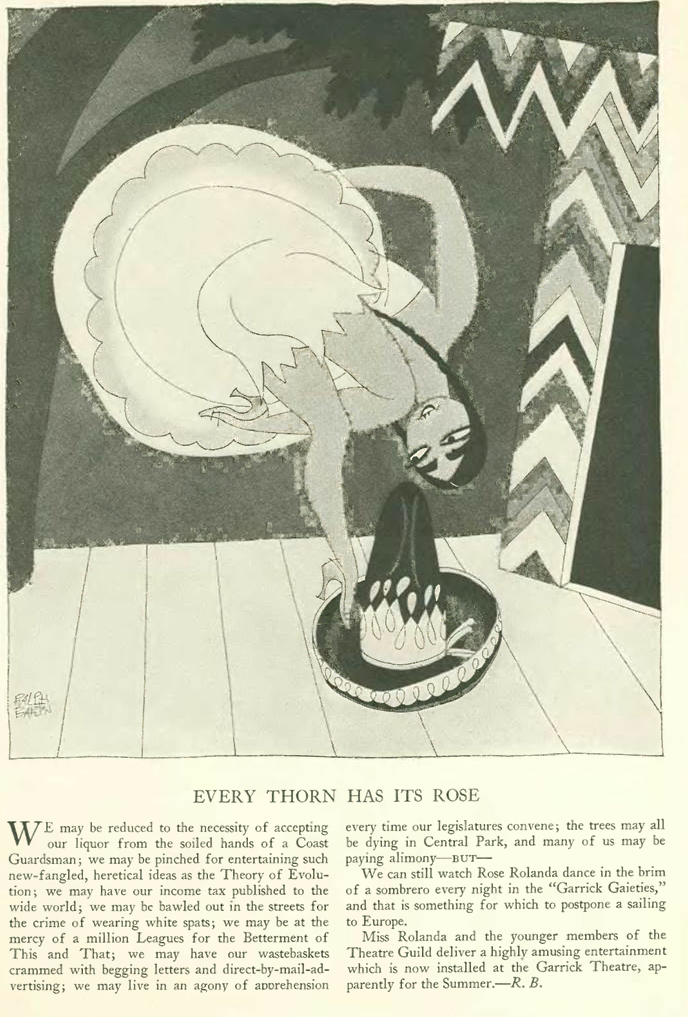
In his day, Barton was well known for his celebrity caricatures, the most famous being his group drawings. He was also a regular early contributor to The New Yorker of brief theater reviews that were accompanied by a large illustration:

Screenshot 2015-05-11 10.47.29
(New Yorker digital archive)

Despite his short stint as a ceremonial advisory editor, the Kansas City native contributed often to the magazine during its first years. Barton also contributed drawings to such publications as Collier’s, Vanity Fair and Harper’s Bazaar.

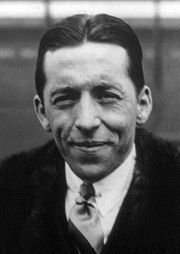
180px-Ralph_Barton_1926
Ralph Barton in 1926 (Wikipedia)

Although his work earned him an impressive income, Barton was a manic-depressive with four failed marriages. In May 1931 he shot himself through the right temple in his East Midtown penthouse. He was only 39.

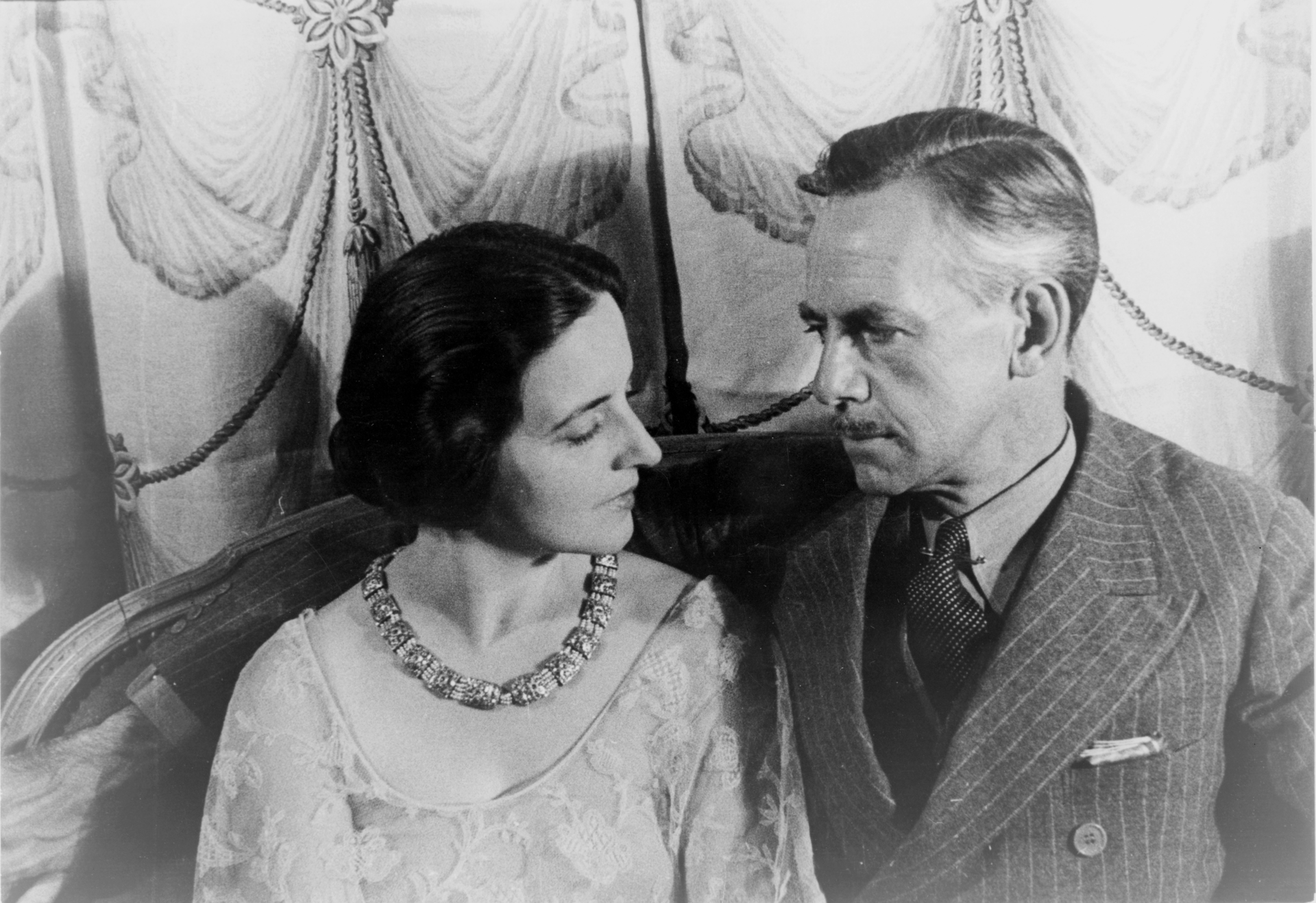
According to Wikipedia, Barton wrote in a suicide note that he had irrevocably “lost the only woman I ever loved” (the actress Carlotta Monterey, who divorced Barton in 1926 and married playwright Eugene O’Neill in 1929), and that he feared his worsening manic-depression was approaching insanity.

Portrait_of_Eugene_O'Neill_and_Carlotta_Monterey_O'Neill
Carl Van Vechten photograph of Carlotta Monterey and Eugene O’Neill, 1933 (Library of Congress)

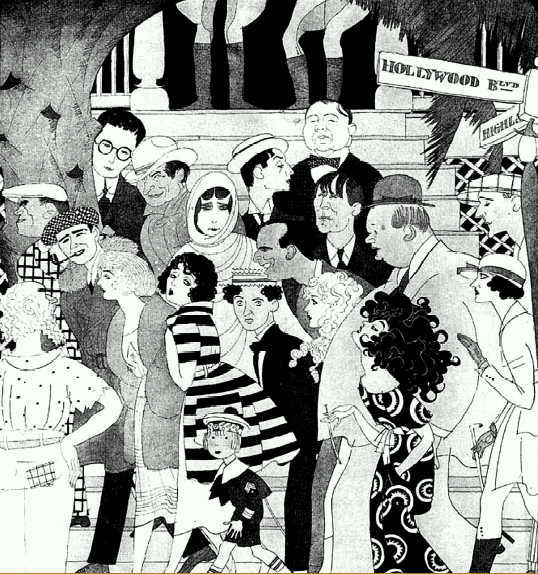
Following his death, Barton’s artistic reputation quickly dropped from sight, due not only to his demise but also to the waning of the Jazz Age subjects he drew with such verve:

RalphBartonExtract
A 1921 Vanity Fair Hollywood caricature by Ralph Barton. (Wikipedia)

A 1928 letter from Harold Ross to Barton (posted on The American Reader website) seems to be an attempt by Ross to cheer up the artist:

Wednesday 27 June 1928

Dear Ralph,

I was on the brink of writing you when your letter came—this morning—telling me about your latest predicament. I knew, of course, that you had reached some conclusion as this. You are a creative soul and therefore a restless soul; therefore, a damn fool. I would leave this to any fair-minded banker. I wish I were a banker. I also wish I were Henry Ford or anybody who can accept the church, the government, conventions, and all those things.

I also had house trouble. I am thinking of burning the damn thing down. The insurance would net a tidy bit of cash and would enable me to get a room somewhere and fit up what I really ought to have. I am not competent to manage more space than this. I would be if I were a fairy. Fairies are the happiest people there are. All editors ought to be fairies. I fuss around with commas, semi-colons, dictionaries, and wordings, and it drives me crazy. I am too virile. I ought to be building subways. I was thinking of going to the North Pole with the Byrd expedition but that would take a year or two and I can spare, at most, only two months. It probably would be a bore anyhow. All life is a bore if you think at all…

As ever,

Ross

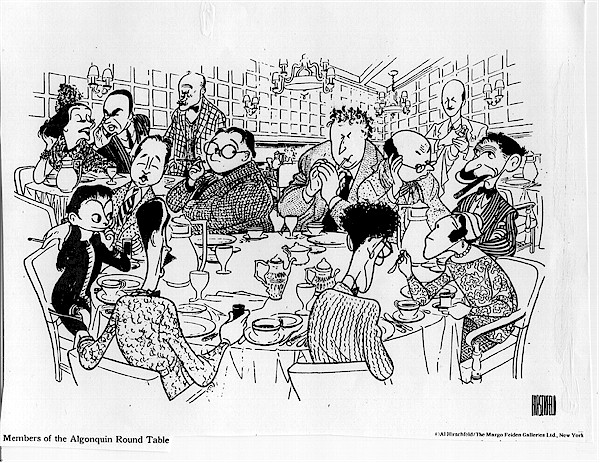
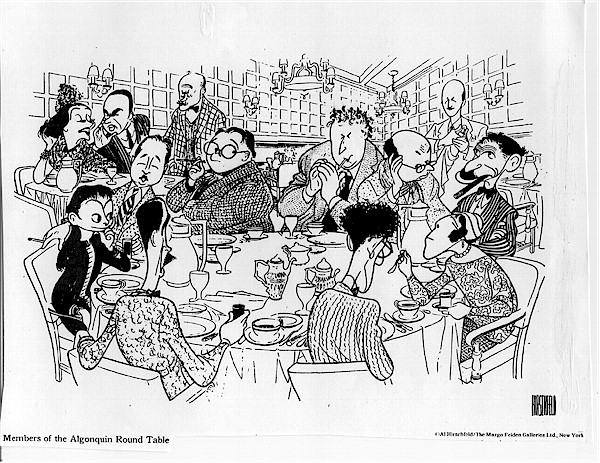
Others listed on The New Yorker masthead were associated with legendary Algonquin Round Table, including the playwrights Marc Connelly and George S. Kaufman and writers Dorothy Parker and Alexander Woollcott—all charter members. The writer Alice Duer Miller was also an occasional guest of this “Vicious Circle,” as they called themselves. From roughly 1919 to 1929, they met every day for lunch at the Algonquin Hotel.

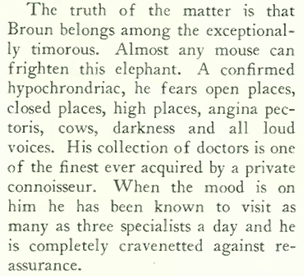
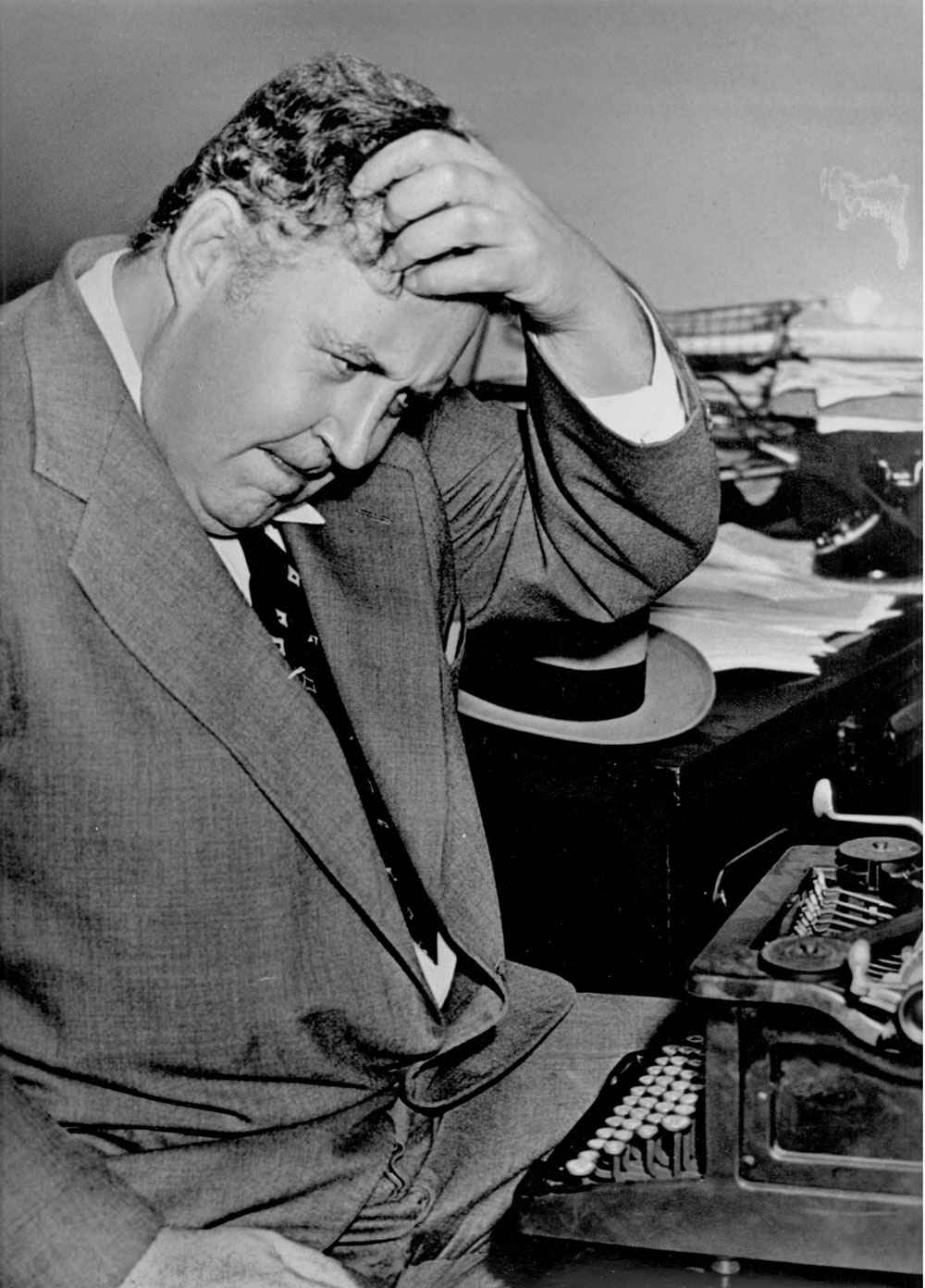
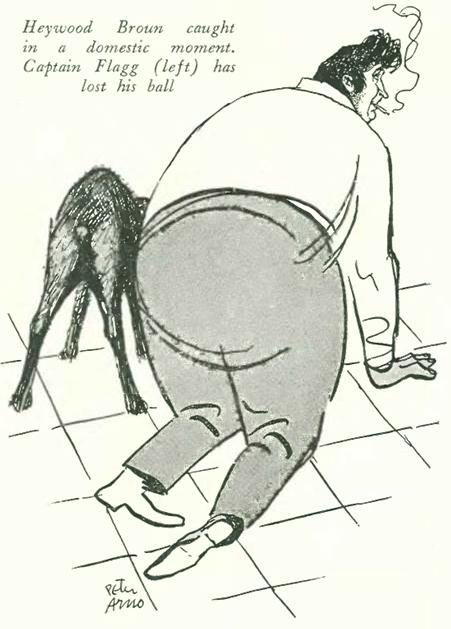
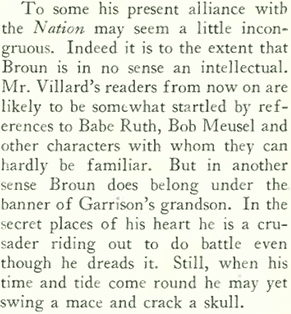
Other regular Round Table members included Harold Ross, Franklin Pierce Adams, (best known for his newspaper column, “The Conning Tower”), New Yorker humorist Robert Benchley, husband-wife writers Heywood Broun and Ruth Hale, broadway producer Brock Pemberton, playwright Robert Sherwood and broadway publicist John Peter Toohey.

Those who moved in and out of the circle included feminist writer Jane Grant (who with her first husband Harold Ross co-founded The New Yorker), vaudeville comedian and later film star Harpo Marx, actresses Peggy Wood, Tallulah Bankhead, Lynn Fontanne and Margolo Gillmore, actor and director Alfred Lunt, playwrights Edna Ferber and David Ogden Stewart, humorist Frank Sullivan, writers Margaret Leech and Frank Crowninshield, illustrator Neysa McMein, playwright Beatrice Kaufman (George’s wife) and composer Deems Taylor.

It is important to make note of these various players in the “Vicious Circle,” since they figure prominently both as contributors and subjects in the early issues of The New Yorker.

table
Famed Al Hirschfeld illustration from 1962 of the Algonquin Round Table includes (counterclockwise, from far left) Dorothy Parker, Robert Sherwood, George S. Kaufman, Edna Ferber, Franklin P. Adams, Marc Connelly, Heywood Broun, Alexander Woollcott, and Robert Benchley. Rounding out the back row are, from left, Lynn Fontanne, Alfred Lunt, Frank Crowninshield and hotel manager Frank Case. (Al Hirschfeld Foundation)

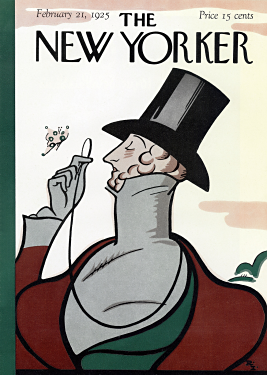
A prominent name on The New Yorker’s masthead absent from the Round Table is graphic artist Rea Irvin, creator of the magazine’s distinctive look and its mascot, Eustace Tilley.

Original_New_Yorker_cover
Rea Irvin’s Eustace Tilley on Issue #1 (New Yorker Digital Archive)

Irvin signed on as an advisory editor with the assumption that the magazine would fold after a few issues. Little did he realize that his illustrations, department headings, caricatures, and cartoons would grace the pages of The New Yorker for many years; that he would go on to illustrate 169 covers between 1925 and 1958; and that his distinctive typeface and mascot would continue to serve the magazine to this very day (Irvin died in 1972 at age 90).

Not to give the June 27 issue short shrift, “The Talk of the Town” reported Roald Amundsen had returned from his North Pole flight; “Profiles” looked at the life of theatrical producer Morris Gest; and “Books” offered a brief and somewhat mixed review of D.H. Lawrence’s new book, St. Mawr.

nazimova-nerman-caricature
In The New Yorker’s “Critique” section, a terrific caricature of Russian-American actress Alla Nazimova, by Swedish artist Einar Nerman. (New Yorker Digital Archive)

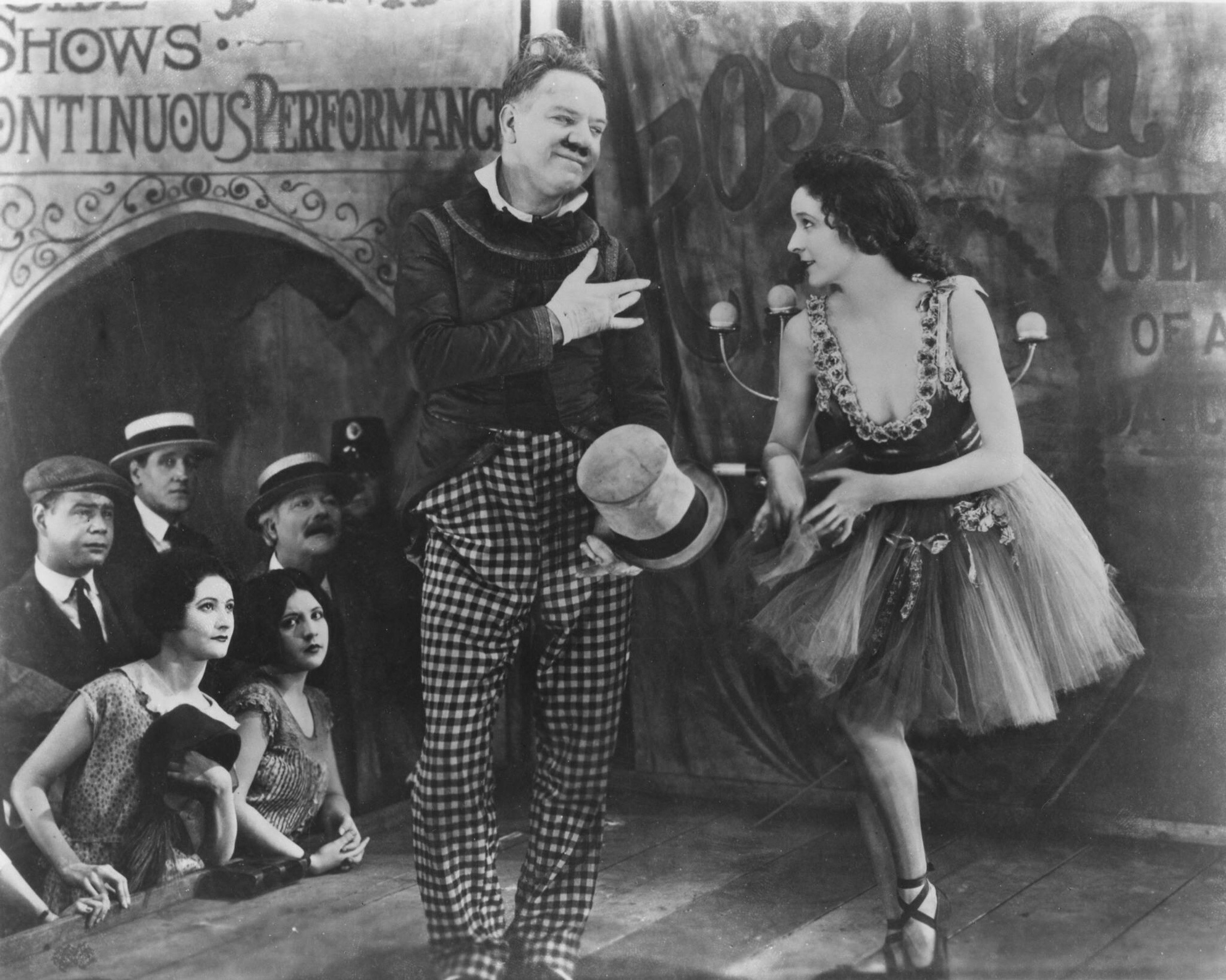
In “The Theatre,” W.C. Fields continued to impress in his performances with the Ziegfeld Follies. The New Yorker noted that Fields was becoming a “talking comedian” comparatively late in life, and that after 26 years “as a straight and comic juggler,” he has become “ever so many people’s favorite comedian.” Under “Moving Pictures” it was also observed that D. W. Griffith’s Sally of the Sawdust was going to “put W.C. Fields across as a big screen comedian. Wait and see!”

image
Sideshow “Professor” Eustace McGargle (W.C. Fields) and his ward, Sally (Carole Dempster, who was director D.W. Griffith’s real-life lover and protégée) are circus carnies in Sally of the Sawdust (1925). The movie was based on Fields’ stage hit Poppy, and featured stage legend Alfred Lunt in a rare film role. (Film Forum)

The June 27 issue offered yet another full page cartoon, this time by Gardner Rea, taking aim at the droll antics of the moneyed classes:

Screenshot 2015-05-11 10.46.19
(New Yorker Digital Archive)

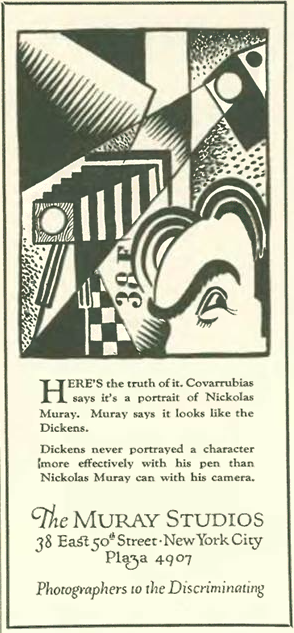
And finally, we are shown the answer to the mystery drawing by Covarrubias–ahem–an advertisement for a photography studio:

Screenshot 2015-05-11 10.58.43
(New Yorker Digital Archive)