Summertime Blues

Screenshot 2015-05-15 20.07.47
July 18, 1925 cover by H.O. Hofman.

“The Talk of the Town” welcomed midsummer by noting the changes in the “new Summer Social Register…A long, slow swing of the same pendulum-like power which shifts the vogue in night clubs and restaurants is the migration to inland resorts…The Hamptons have fallen off, Newport has weakened and of the coasts only New England, boasting ‘the prestige of the Summer White House,’ has held its own.”

It was thought that perhaps financial pressures on waterfront acreage “had added zeros to the 400” and “The fragments of our battered conservatives turn and twist uneasily, seeking readjustment, new barriers (translation: old money responds to the invasion of new money).
Vintage Swimwear, 1920s (2)
There goes the neighborhood…

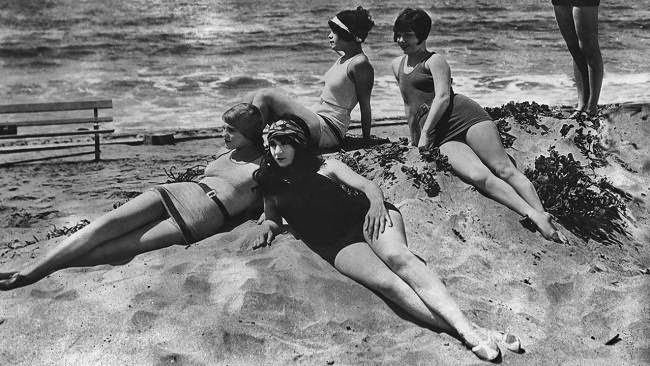
This siege on the sanctity of “the 400” – a reference to the number limited to Mrs. John Jacob Astor’s social circle  – included the appearance of “scanty” bathing suits on Southampton beaches:
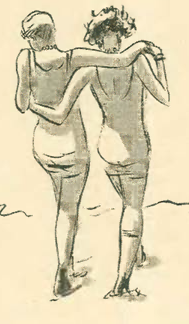
Screenshot 2015-05-18 09.40.58Corroborative evidence of the storming of the conservative fortresses by Undesirables comes with Southampton’s latest protest against scanty bathing costumes, “usually worn by strangers.”

Just what these costumes were or were not, the Southampton Bathing Corporation did not say, but they ruled that stockings and cape must be worn “while walking down to the water.” This ordinance to apply “especially at week-ends and during tennis week.

M3Y43659
Arrowhead Inn Dining Terrace (Museum of the City of New York)

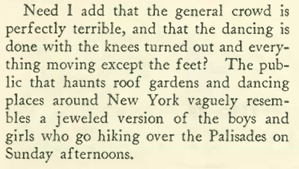
Beginning with this issue, the “When Nights Are Bold” feature was passed from Charles Baskerville (pen name “Top Hat”) to the newly hired Lois Long (pen name “Lipstick”). In her first column for The New Yorker, Long suggested that for those “who can get out of town at will,” the Arrowhead Inn “up Riverdale way” and high on a bluff above the Hudson, was a popular destination for dining and dancing, even if the dancing crowd left something to be desired:
Screenshot 2015-07-14 09.32.08

Another recommended Hudson River location was the Claremont (but alas, no dancing!), while for those staying in the city, Long recommended the Embassy Club at 695 Fifth Avenue.
Lois_Long_in_her_office_at_the_New_Yorker
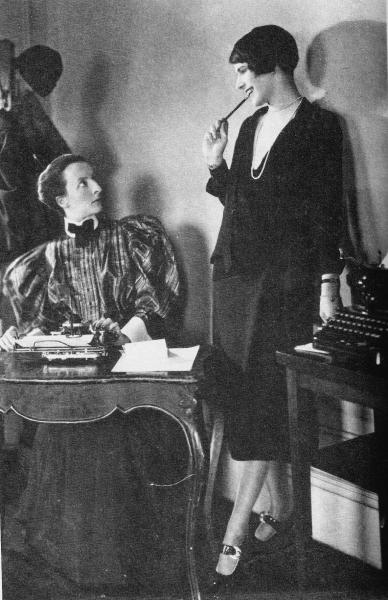
Lois Long at work in the 1920s (Wikipedia)

According to Here At The New Yorker by Brendan Gill, Long chronicled nightly escapades of drinking, dining, and dancing for The New Yorker, and because her readers did not know who she was, she often jested in her columns about being a “short squat maiden of forty” or a “kindly, old, bearded gentleman.” However, in the announcement of her marriage to The New Yorker cartoonist Peter Arno, she revealed her true identity.

Harold Ross hired Long in the summer of 1925 as part of a group of “saviors” he hoped would help boost his struggling magazine. The group included Arno, Katharine Angell, managing editor Ralph Ingersoll, and cartoonist Helen Hokinson.

Although she was a favorite of Ross’s, the two couldn’t be more different, as historian Joshua Zeitz explains in Flapper: A Madcap Story of Sex, Style, Celebrity, and the Women Who Made America Modern (2006), Long knew just how to embarrass the girl-shy editor, and loved to do it:

(Ross) was a staid and proper Midwesterner, and she was absolutely a wild woman. She would come into the office at four in the morning, usually inebriated, still in an evening dress and she would, having forgotten the key to her cubicle, she would normally prop herself up on a chair and try to, you know, in stocking feet, jump over the cubicle usually in a dress that was too immodest for Harold Ross’ liking. She was in every sense of the word, both in public and private, the embodiment of the 1920s flapper. And her readers really loved her.
Julia_Hoyt_-_Mar_1922_Tatler
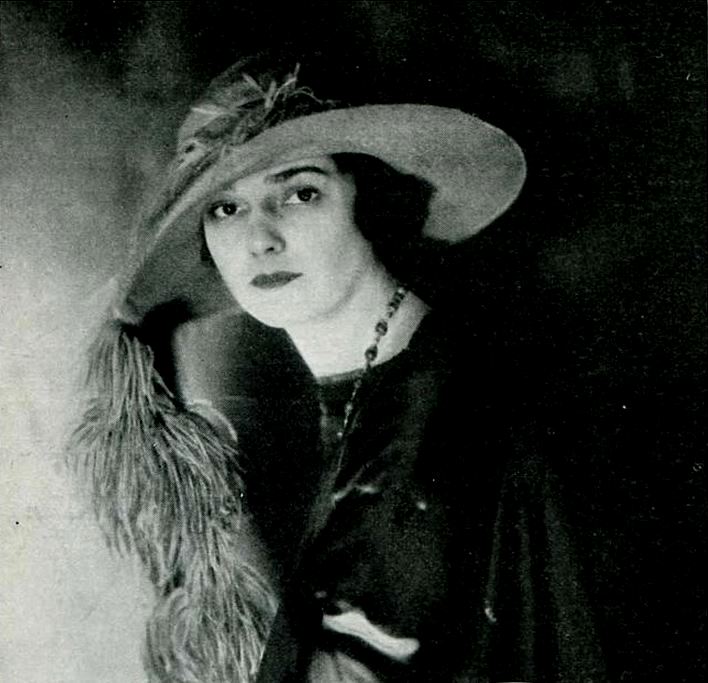
Julia Lydig Hoyt in 1922 (Wikimedia Commons)

“Talk” also reported that Mrs. (Julia Lydig) Hoyt had “very nearly arrived,” and was capitalizing on her stage career through endorsements for cold creams and articles on social etiquette. “The motion picture industry and stage know her and now she is a designer at highest salary ever paid to an American.”
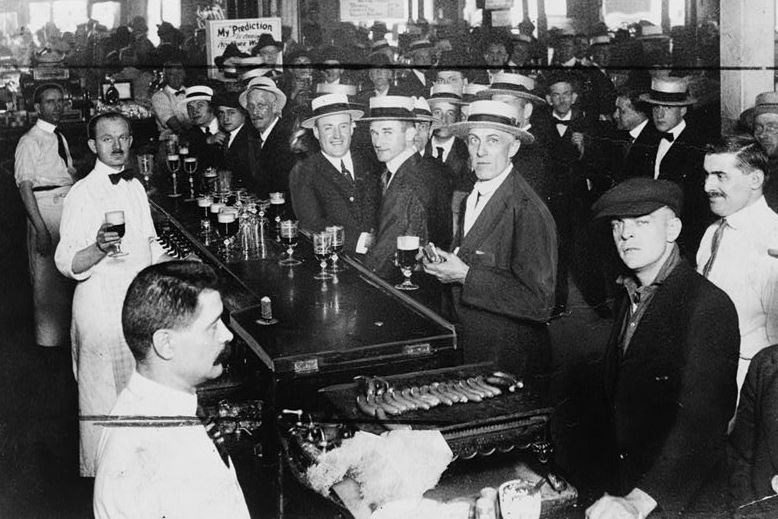
Interior-of-a-crowded-bar-moments-before-midnight-June-30-1919-when-wartime-prohibition-went-into-effect-New-York-City
Last Call…A rather dour-looking crowd at a New York City bar moments before midnight, June 30, 1919, when Prohibition went into effect. (Library of Congress Archives)

Prohibition continued to dampen the spirits (pun intended) of New Yorkers, particularly during the summer season. The editors noted that of 36 random summer reminiscences submitted to the magazine, eighteen were “direct references to alcoholic concoctions and all but a few theatrical recollections directly suggested indulgence. Then the editors offered their own wistful recollections:

Of course we remember “The Doctor’s cocktails” mixed by the “Commissioner” at the Astor…the highball sign at Forty-second and Broadway…the “Old Virginia Mountain” between the acts under the smile of Old King Cole…the Sunday afternoon absinthe drips at the Lafayette…Champagne at the Claremont on a June night…the Manhattan bar at cocktail time…the Ancient and Honorables in the Buckingham bar….the Navy in mufti at Shanley’s…the horseshoe bar at the Waldorf…the blue dawn of the West Forties…

Of course…but why bring that up again? It’s merely driving us down the street to that place that gave us the card last week and the rumor has just reached us that they are back serving Scotch in teacups, accompanied by a large earthenware teapot filled with soda.

Screenshot 2015-05-18 13.19.10
Left, Delmonico Building at Fifth Avenue and 44th Street (photo from The Brickbuilder, 1899), razed in 1925 and replaced by the building at right (Google Maps screen image)

Also lamented was the loss of renown restaurant Delmonico’s, which had been closed for some time (due mostly to alcohol sales lost to Prohibition; its famous rival across the street, Sherry’s, closed in 1919 for the same reason) but was now yielding to the wrecking ball: “Possibly, Delmonico’s might have been saved as a tradition, but finances and the changes of Fifth Avenue’s complexion forbade…Now we are to see yet another skyscraper, this one on the site where once they dined; where once they danced; across the street from old Sherry’s, long since a bank; orchestraed only by adding machines.”

“The Talk of the Town” concluded with a price list for various bootleg spirits, a feature that would continue through the Prohibition:

Screenshot 2015-05-18 10.14.56

Fresh off his dismantling of those clod-kickers in Chicago, Ben Hecht continued his dyspeptic tirade on the America that lay beyond Gotham, specifically attacking its love of the “Pollyanna twaddle flow” of entertainment from Hollywood:
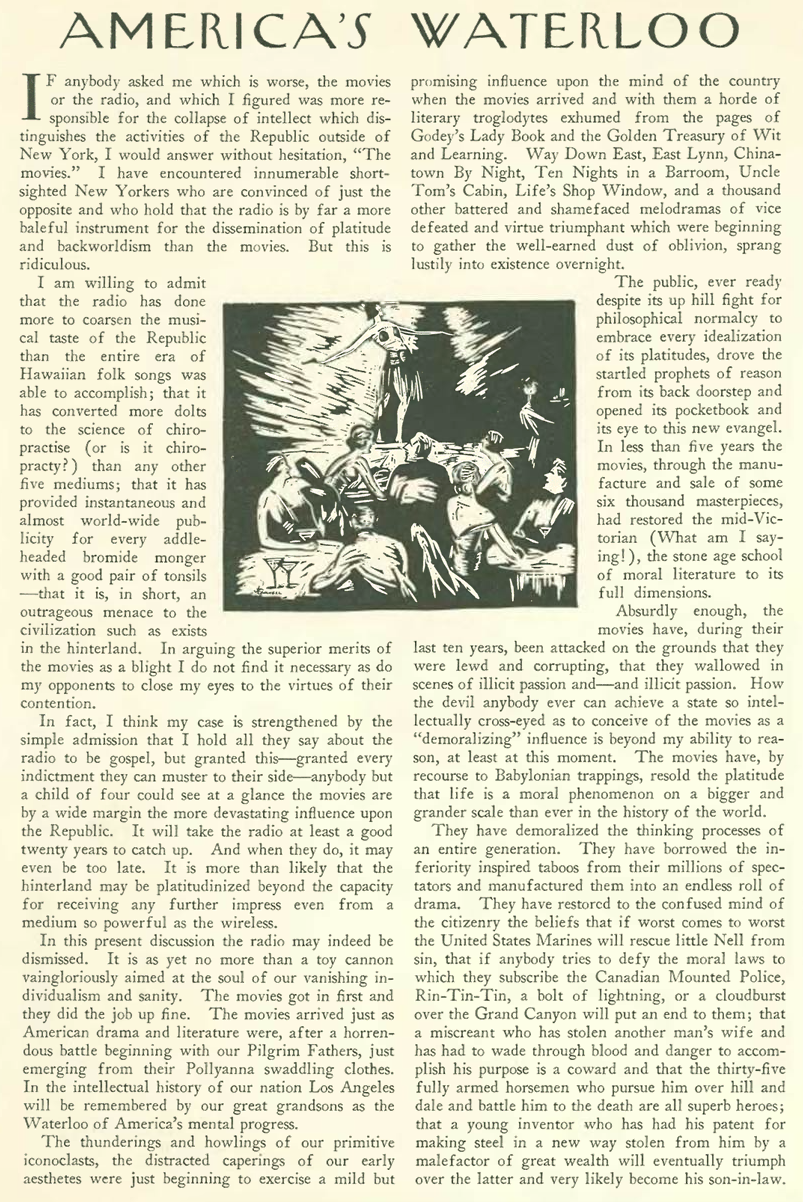
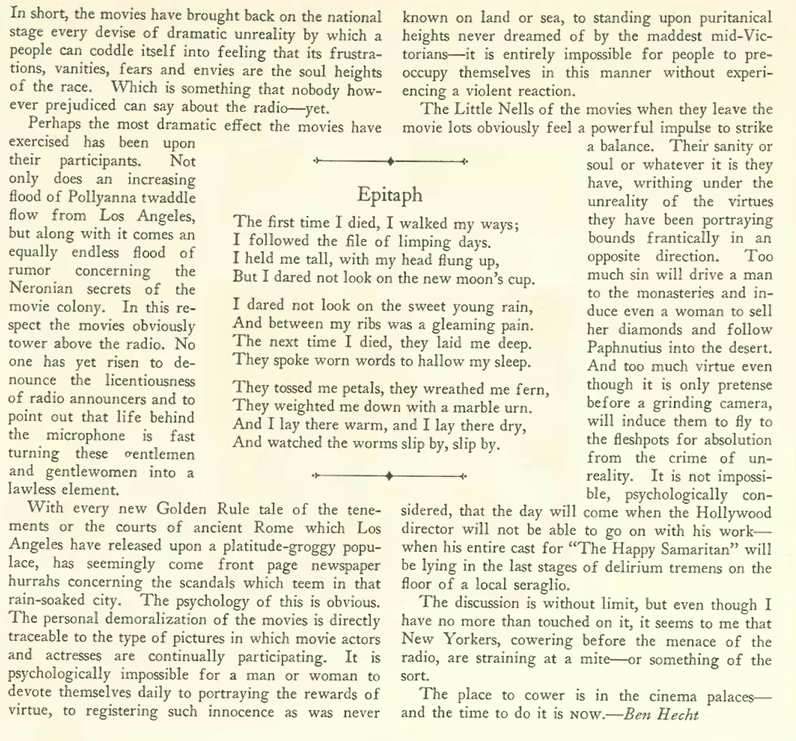
Screenshot 2015-05-18 10.27.51

Screenshot 2015-05-18 10.28.00
(New Yorker Digital Archive)

Ralph Barton, on the other hand, offered of a view of the entire earth, from the vantage point of a Martian observer:
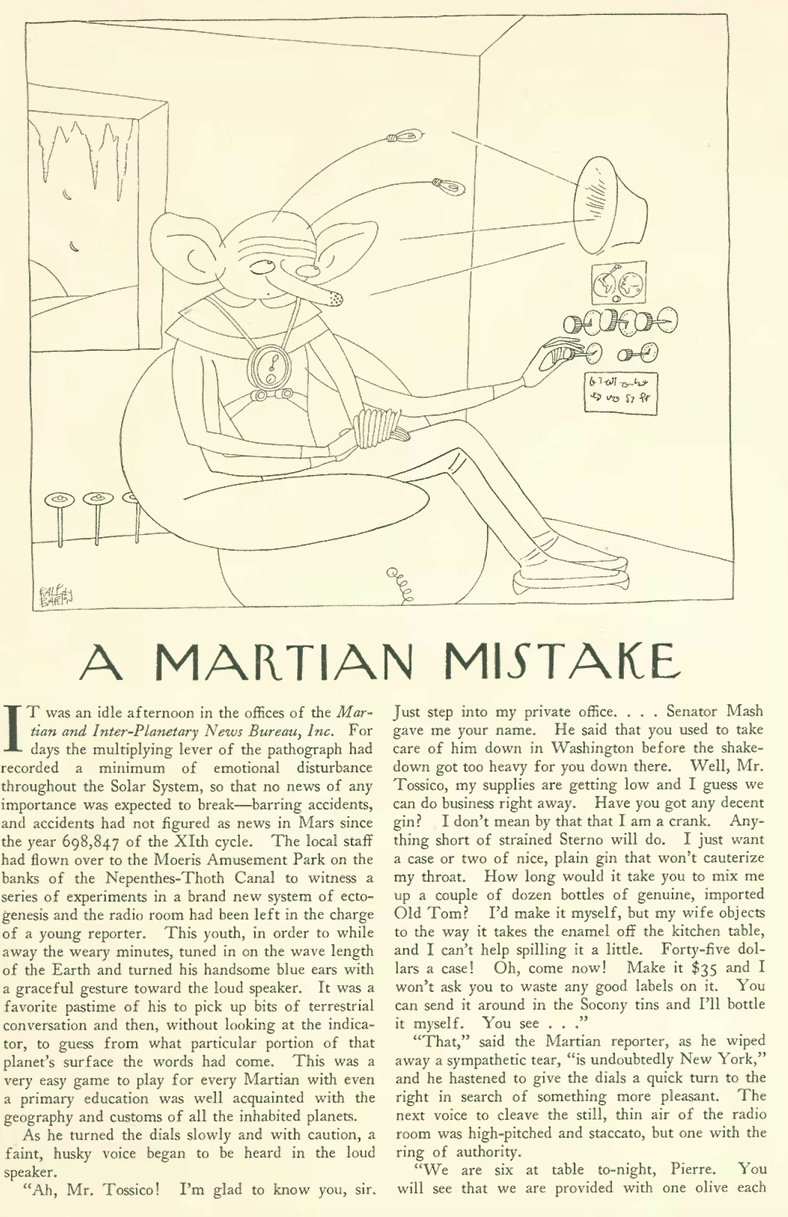
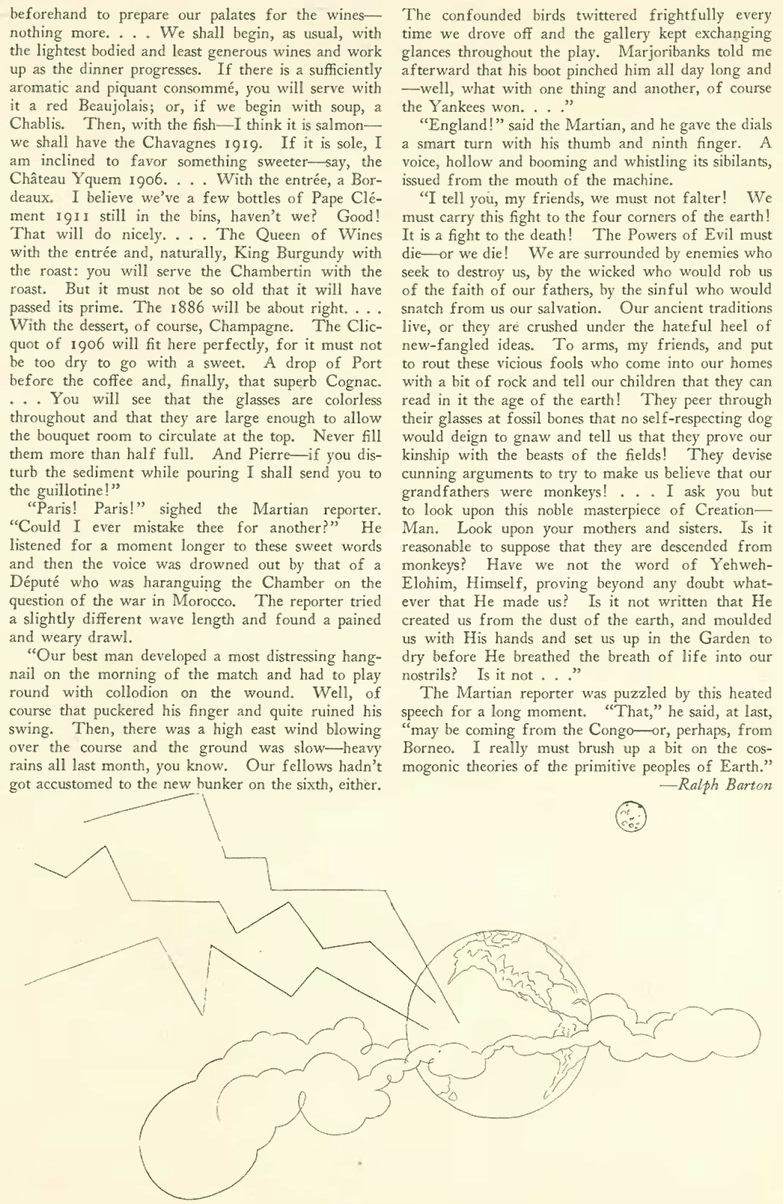
Screenshot 2015-05-18 10.31.58

Screenshot 2015-05-18 10.32.10
(New Yorker Digital Archive)

In “Profiles,” Waldo Frank (writing under the pen-name “Searchlight”) looked askance at the life and work of writer Sinclair Lewis.

Screenshot 2015-05-18 10.35.12Frank offered these observations: “Once upon a time, America created a man-child in her own image…

There’s a strange thing about America. She is passionately in love with herself, and is ashamed of herself…Here was a dilemma, Could not her self be served up to America in such a way that she could love herself—and save her shame? Sinclair Lewis, true American son, was elect to solve it.”

And for those rising young men who did not wish to mix with the unwashed during the summer social season, membership to the Allerton Club Residences was recommended in this back page advertisement:

Screenshot 2015-05-18 10.51.24
(New Yorker Digital Archive)

And yes, the Scopes Monkey Trial is still on the minds of the editors:
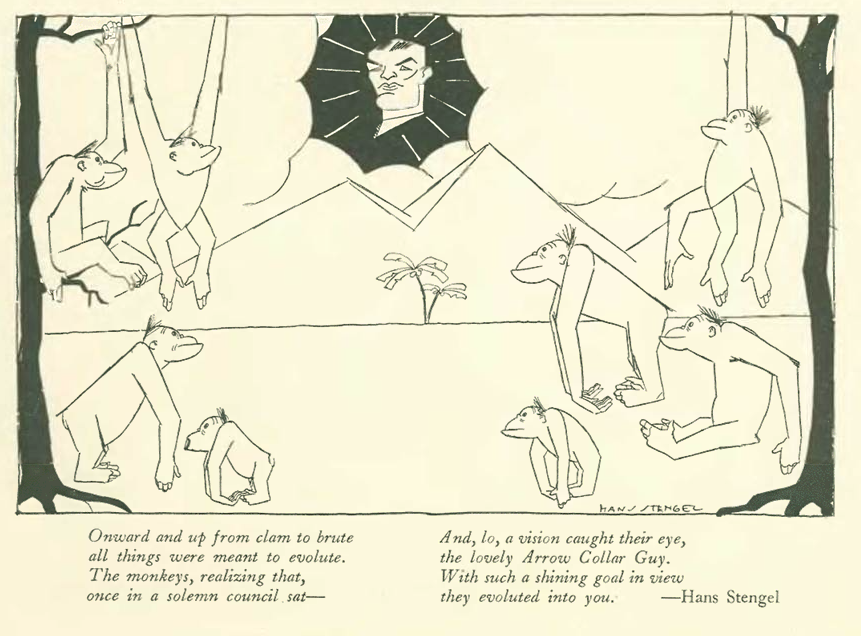
Screenshot 2015-05-18 10.15.07
(New Yorker Digital Archive)

And finally, to close out with a beach theme, a two-page illustration from “The Talk of the Town” section, an early work by illustrator Peggy Bacon:
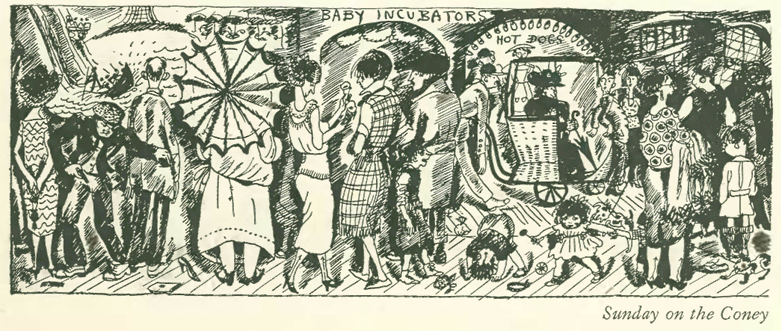
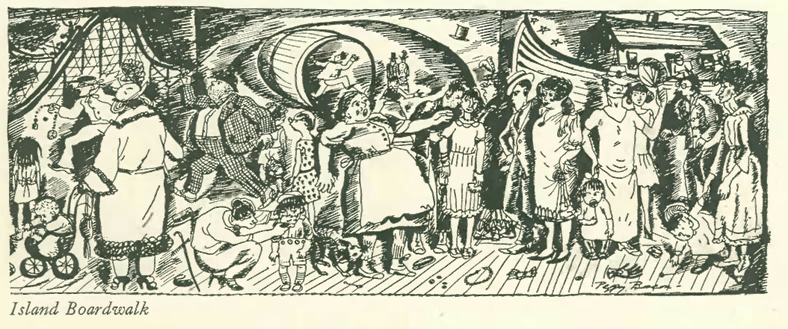
Screenshot 2015-05-18 09.42.52

Screenshot 2015-05-18 09.42.59
(New Yorker Digital Archive)

Next time, lots of horseplay:
Screenshot 2015-05-18 16.54.57

Bearish on the Second City

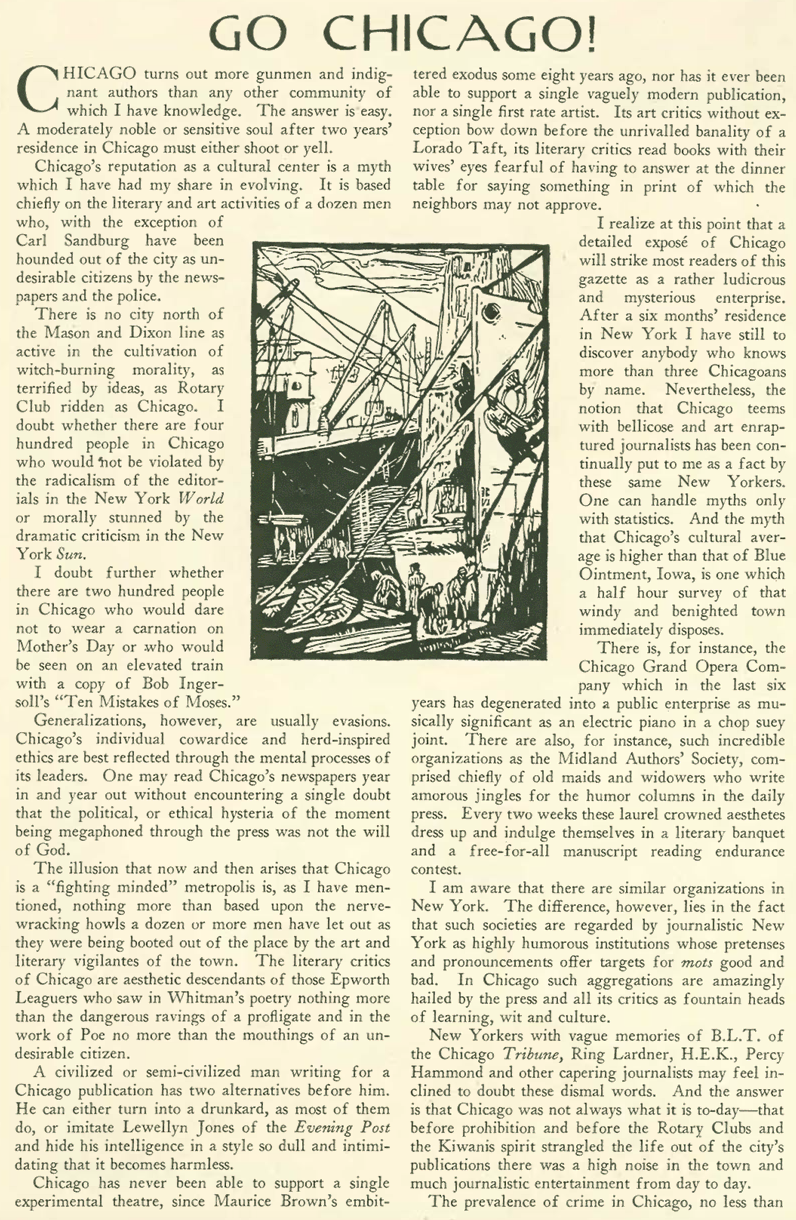
The New Yorker rarely missed an opportunity to take potshots at rival cities such as Philadelphia or Boston, but Chicago was a special target in the magazine’s crosshairs as a notorious Midwestern backwater. The July 4, 1925 issue included a feature titled “Go Chicago,” in which Ben Hecht parodies the city’s pretensions and acts of boosterism.

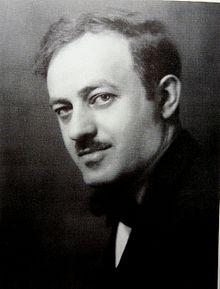
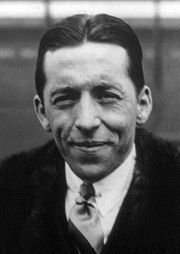
Ben Hecht in 1919. (Wikipedia)

Among Hecht’s observations:

There is no city north of the Mason and Dixon line as active in the cultivation of witch-burning morality, as terrified by ideas, as Rotary Club ridden as Chicago.

I include below the entire piece for the full effect of Ben’s acid-tipped pen:

Screenshot 2015-05-14 09.37.36

Screenshot 2015-05-14 09.37.57
(New Yorker Digital Archive)

A note on Hecht: According to IMDB, he is considered one of Hollywood’s and Broadway’s greatest writers. He won an Oscar for best original story for Underworld (1927) at the first Academy Awards in 1929 and had a hand in the writing of many classic plays and films, including the play The Front Page and the film Notorious. Although he received no credit, Hecht was paid $10,000 by David O. Selznick to perform a “fast doctoring” on the script for Gone With The Wind.

The New Yorker celebrated its first Fourth of July with a busy, two-color cover depicting Coney Island’s famous Luna Park:

Screenshot 2015-05-13 16.18.24
July 4, 1925 cover by Ilonka Karasz. (New Yorker Digital Archive)

One wonders if the cover art was part of an arrangement for advertising revenue, given that this ad appeared on the back cover of the same issue:

Screenshot 2015-05-14 09.44.34
(New Yorker Digital Archive)

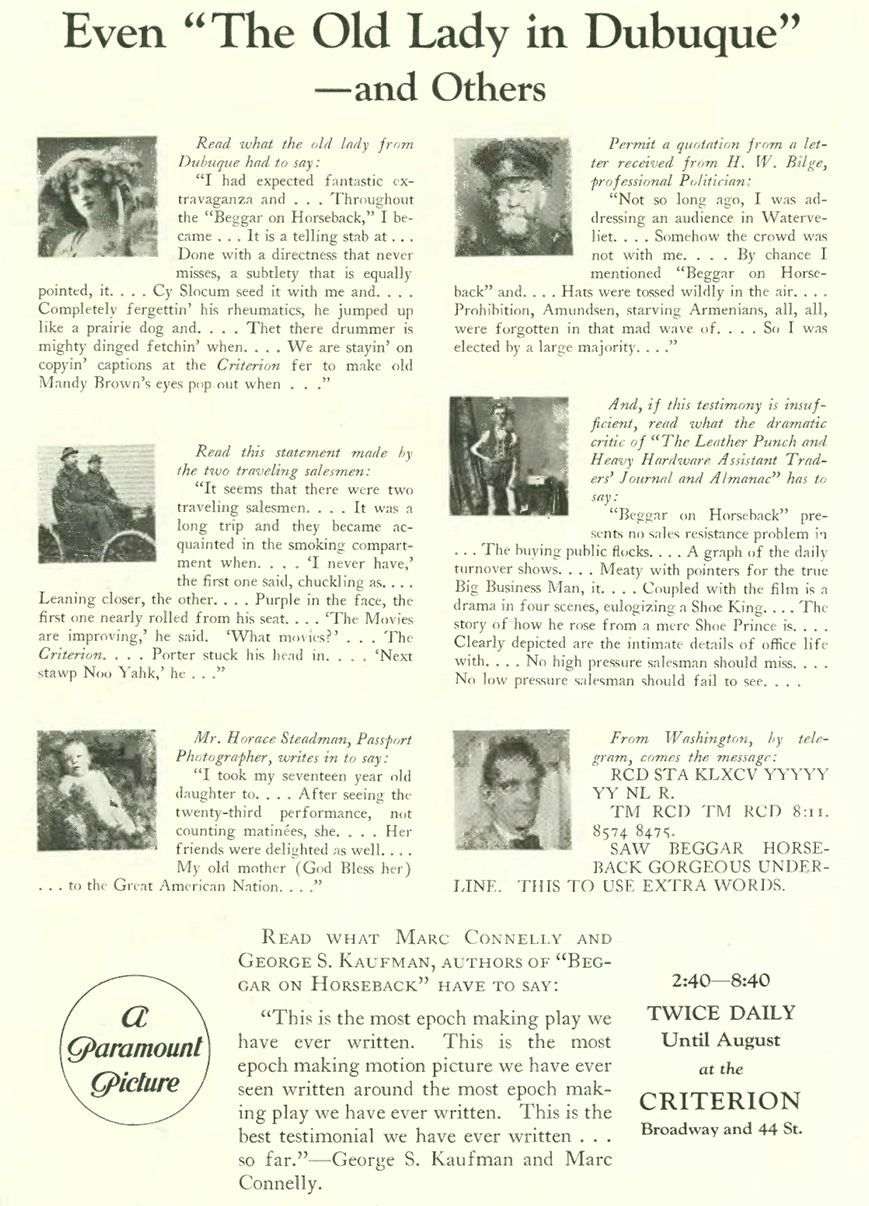
The inside front cover of the issue featured a full-page ad for the Paramount film, Beggar on Horseback, complete with joke reviews from the “Old Lady in Dubuque” and others including the film’s two writers, Marc Connelly and George S. Kaufman, who were also advisory editors of The New Yorker:

Screenshot 2015-05-13 16.19.54
(New Yorker Digital Archive)

“Talk of the Town” commented on how modern artists such as Henri Matisse, Marsden Hartley, Charles Demuth and Constantin Brancusi were influencing contemporary fashion: “To-day sees the dress houses and even the Fifth Avenue department stores displaying “Cubist fashions”—scarves patterned like composite photographs of all the abstruse countenances in Euclid’s book of open curves, gowns that are marked with subtle diagrams on the variation of the triangle…sports blouses done in bands of gradated color and roundish forms which proclaim their nepotal relation to Cezanne…”

Screenshot 2015-05-14 10.27.35
Dress at left “suggests the fractured and splintered paintings of George Braque, Marcel Duchamp and the early cubist paintings by Picasso. In both art and fashion, Cubism was the modern style” (description and image from Smith College Historic Clothing). At right, a dress from 1924 designed by Paul Poiret (Thierry de Maigret).

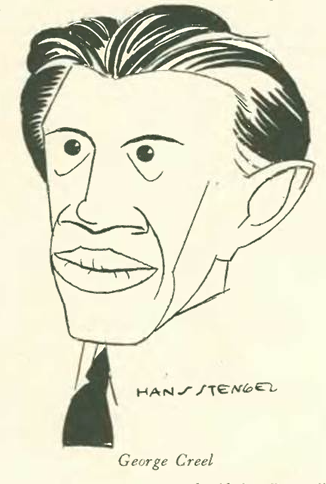
“Profiles” featured George Creel, an investigative journalist and politician who headed President Woodrow Wilson’s propaganda arm, the Committee on Public Information, during World War I. The profile’s author, Harvey O’Higgins, wrote that “The Incredible Mr. Creel” was often unpopular with the press as a war-time propagandist, but Creel himself was not a censor but rather a good-humored, honest man with “the ideals of an adolescent.”

Screenshot 2015-05-13 16.27.37
Hans Stengel rendering of George Creel in “Profiles” (New Yorker Digital Archive)

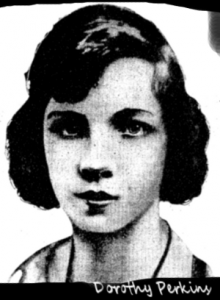
In the “Of All Things” section, Howard Brubaker wryly observed: “Now that Dorothy Perkins has been sentenced to three years in prison we hope that ladies will think twice before killing gentlemen unless they are actually annoying.”

At the time, Perkins was the youngest woman ever charged with murder in New York. She was just 15 when she met 35-year-old Mickey Connors, described by blogger Mark Gribben in The Malefactor’s Register as a “truck driver and spouse-abusing divorced felon.”

Gribben writes that “Connors and Dorothy apparently met in June 1924 when he wed the mother of one of Dorothy’s girlfriends. After that marriage, Connors moved away from Greenwich Village, but kept in contact with Dorothy on the sly.”

According to Gribben, on Valentine’s Day 1925, a rival suitor for Dorothy, 26-year-old Tommy Templeton (who served with Dorothy’s father, Rudolph, in World War I), attended a birthday party for Rudolph at his Greenwich Village house. During the party, the drunken Rudolph apparently asked Dorothy, “Why do you want a bum like Connors when you can have a nice fellow like Tommy?” At some point Dorothy went to her room to fetch a .22-caliber revolver she had stolen from an aunt in Connecticut.

dorothyperkins-220x300
Dorothy Perkins (The Malefactor’s Register)

What ensued was related by the family minister, Rev. Truman A. Kilborne, in testimony to the court. Rev. Kilborne said the family told him that when Rudolph attempted to take the revolver from his daughter, she resisted and in the struggle the revolver went off. Templeton, who was standing nearby, was shot through the heart.

During her trial, Dorothy claimed that her standoffish treatment of Tommy (and being seen with Conners) was an attempt to make “(Tommy) jealous by flirting with someone else.”

On June 17, 1925, the jury rejected the state’s case that the shooting was murder and convicted Dorothy of manslaughter.

Contrary to The New Yorker account, Dorothy was sentenced to 5 to 15 years in the women’s prison at Auburn, but ended up serving just four years of the sentence, during which time she was trained as a stenographer. She was released in January 1929 for good behavior. Mickey Connors served a few months in the Tombs prison for contributing to the delinquency of a minor.

You can read Gribben’s full account in The Malefactor’s Register.

180px-Ralph_Barton_1926
Ralph Barton (Wikipedia)

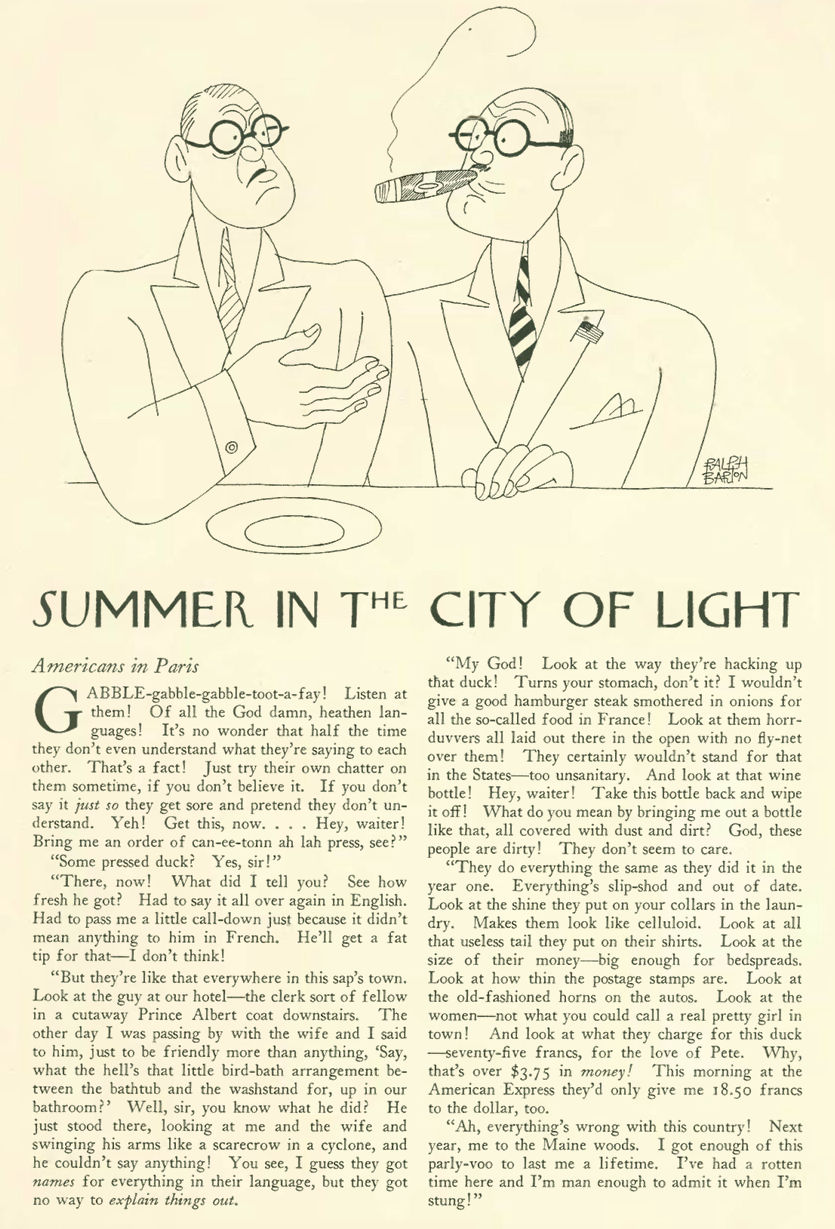
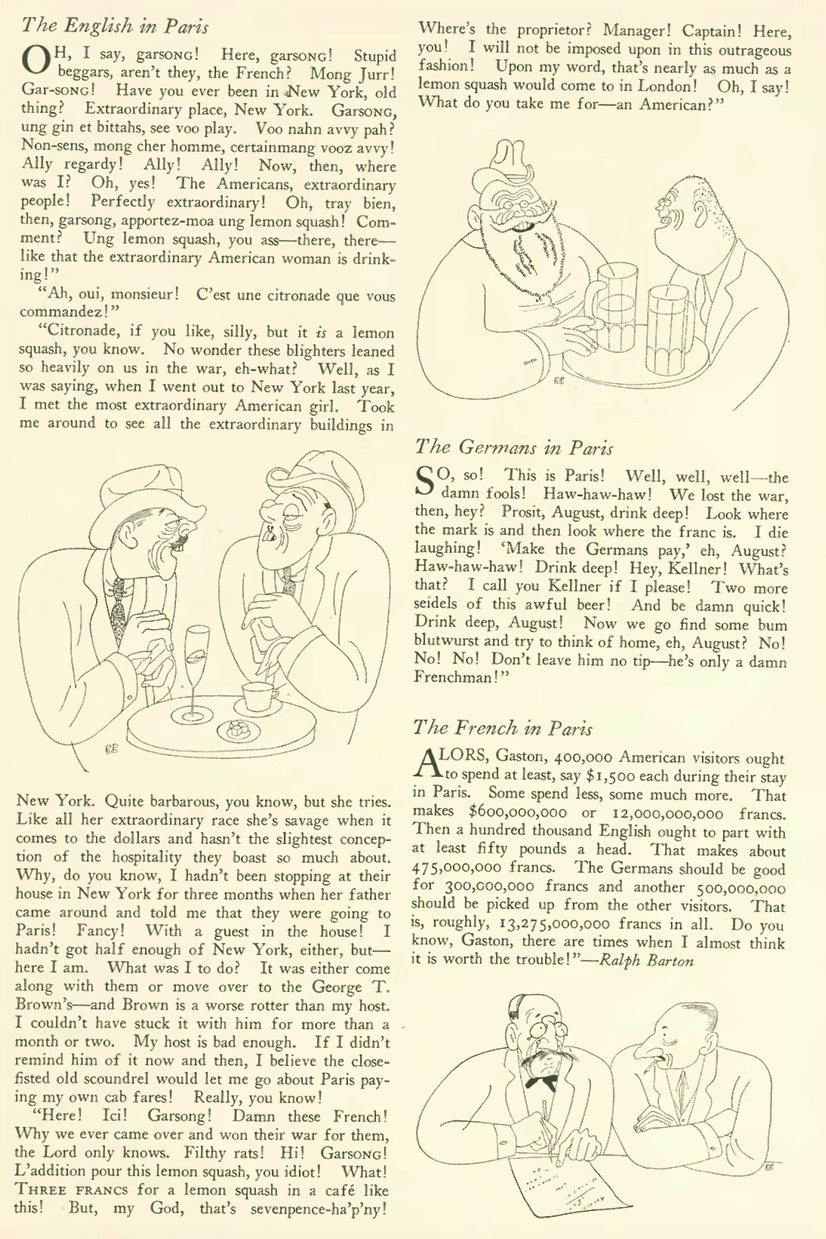
The issue also included this wonderful two-page illustrated feature by Ralph Barton, a subject in my previous blog post, The Vicious Circle. Barton was very familiar with French life and customs. According to Wikipedia, in 1915 Puck magazine “sent Barton to France to sketch scenes of World War I. It was then that Barton developed a great love of all things French, and throughout his life he would return to Paris to live for periods of time. In 1927 the French government awarded Barton the Legion of Honour.” 

Screenshot 2015-05-14 09.41.08

Screenshot 2015-05-14 09.41.24
(New Yorker Digital Archive)

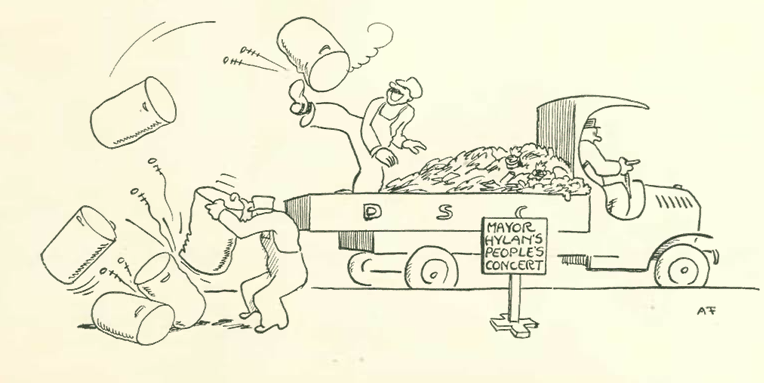
And finally, a cartoon from the issue that takes aim at New York City Mayor John F. Hylan. From the very first issue of The New Yorker (Feb. 21, 1925), the mayor (comically referred to as “Jonef Hylan”) was a frequent target:

The next great figure in the early legends of New York is that of Jonef Hylan. Hylan, in all probability, was not a real person; but it is impossible to understand New York without giving careful study to the Hylan myth. In many respects, it resembles the Sun Myth of other great civilizations; for his head was as a head of flame, and he rose early each morning from beyond the East River, bringing light into all the dark places and heat into the sessions of the Board of Estimate. The populace called their Sun God “Red Mike”; but in the frenzy of their devotions, they simply yelled “Ra! Ra!

Screenshot 2015-05-14 09.40.23
Cartoon by Al Frueh from the July 4, 1925 issue (New Yorker Digital Archive)


The Vicious Circle

Screenshot 2015-05-08 15.49.29
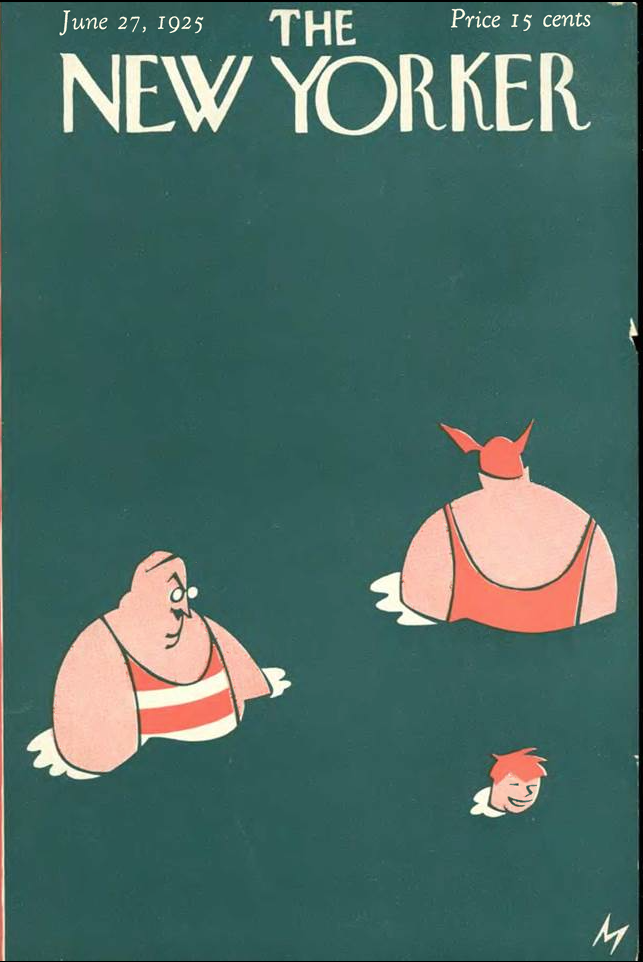
June 27, 1925, cover by Julian de Miskey (New Yorker digital archive)

With a lull in the news from the Scopes Trial, the June 27, 1925 is another hodgepodge of seemingly random bits. Perhaps this is a good time to look at  some of the magazine’s early artists, editors and writers.

The masthead of the very first issue listed these founding (ceremonial) Advisory Editors: Ralph Barton, Marc Connelly, Rea Irvin, George S. Kaufman, Alice Doerr Miller, Dorothy Parker and Alexander Woollcott. Not listed was founding editor Harold Ross.

The list remained the same for the June 27 issue, minus Ralph Barton. His story is rather sad.

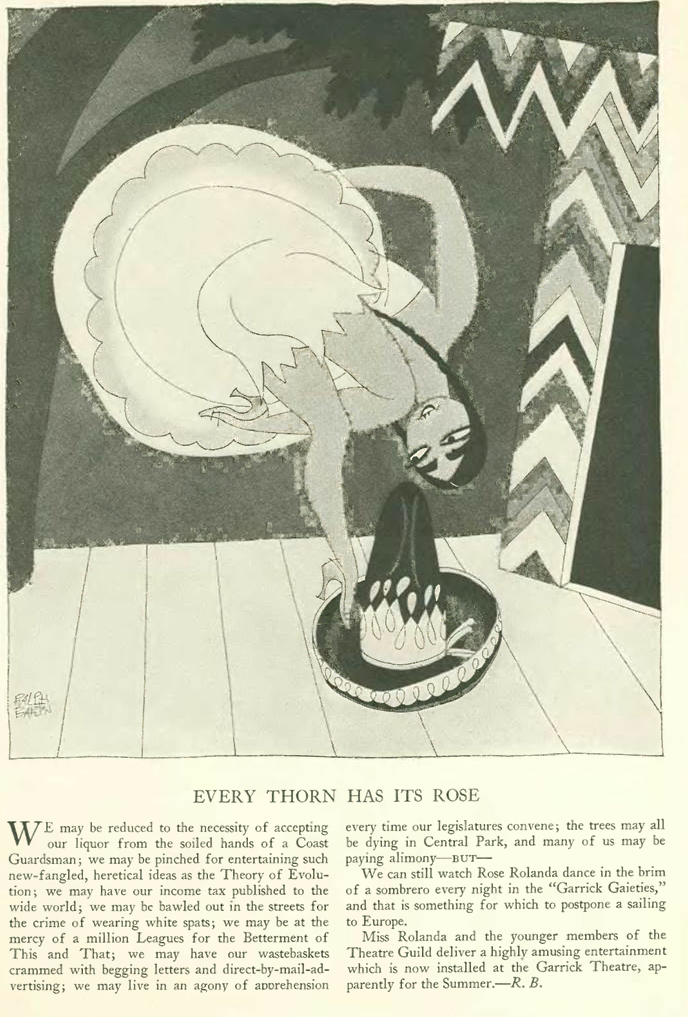
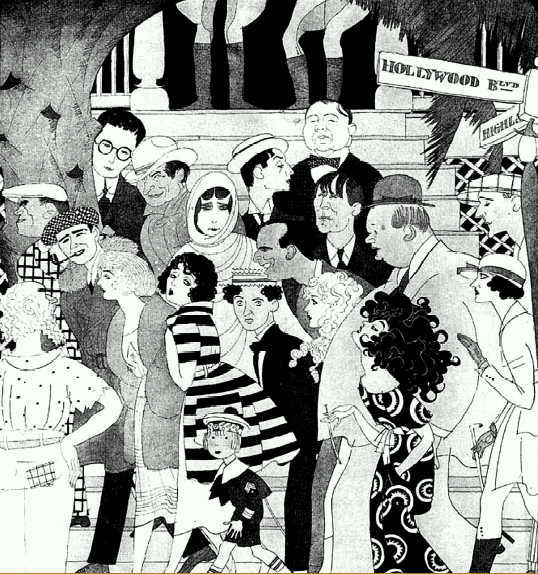
In his day, Barton was well known for his celebrity caricatures, the most famous being his group drawings. He was also a regular early contributor to The New Yorker of brief theater reviews that were accompanied by a large illustration:

Screenshot 2015-05-11 10.47.29
(New Yorker digital archive)

Despite his short stint as a ceremonial advisory editor, the Kansas City native contributed often to the magazine during its first years. Barton also contributed drawings to such publications as Collier’s, Vanity Fair and Harper’s Bazaar.

180px-Ralph_Barton_1926
Ralph Barton in 1926 (Wikipedia)

Although his work earned him an impressive income, Barton was a manic-depressive with four failed marriages. In May 1931 he shot himself through the right temple in his East Midtown penthouse. He was only 39.

According to Wikipedia, Barton wrote in a suicide note that he had irrevocably “lost the only woman I ever loved” (the actress Carlotta Monterey, who divorced Barton in 1926 and married playwright Eugene O’Neill in 1929), and that he feared his worsening manic-depression was approaching insanity.

Portrait_of_Eugene_O'Neill_and_Carlotta_Monterey_O'Neill
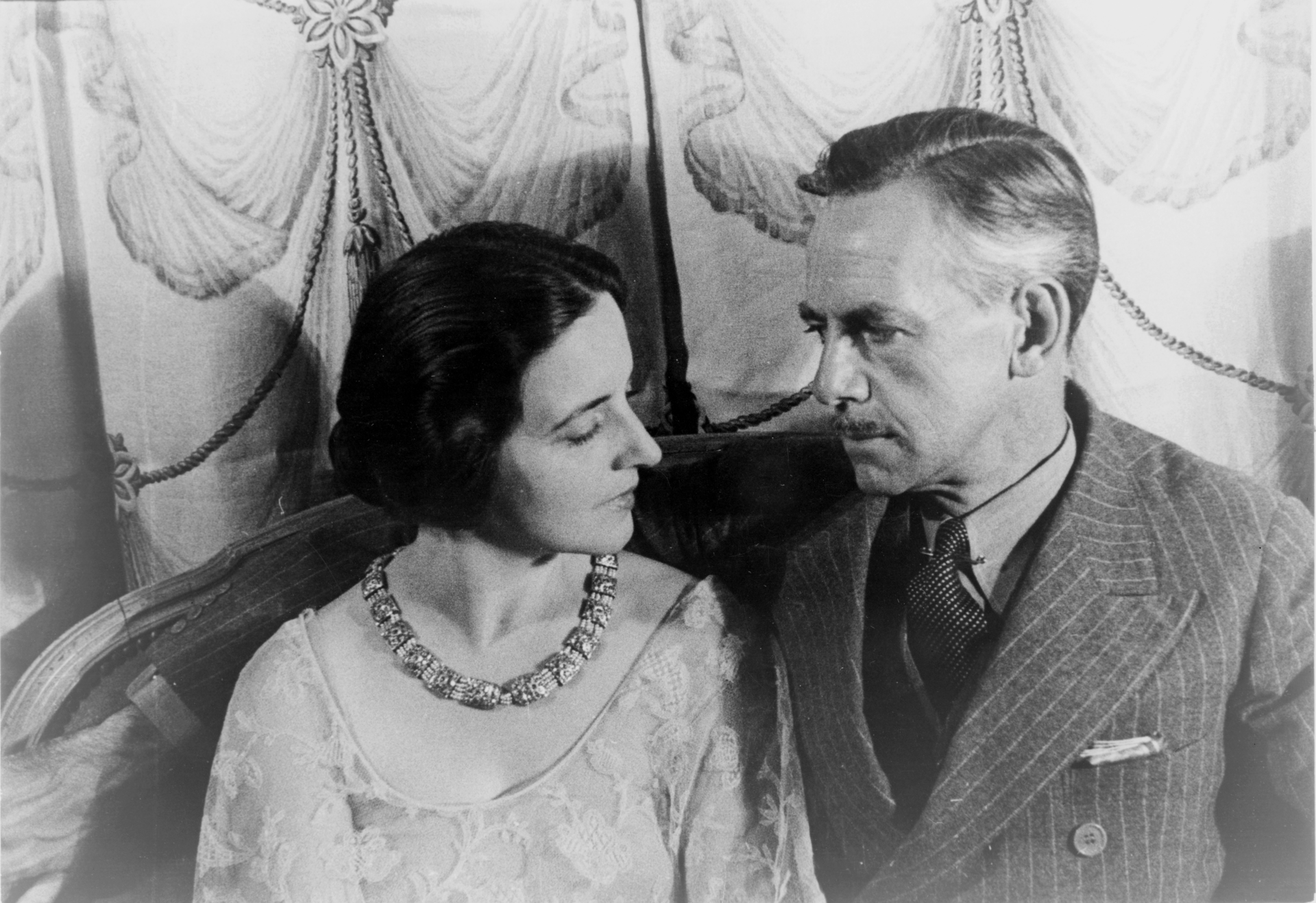
Carl Van Vechten photograph of Carlotta Monterey and Eugene O’Neill, 1933 (Library of Congress)

Following his death, Barton’s artistic reputation quickly dropped from sight, due not only to his demise but also to the waning of the Jazz Age subjects he drew with such verve:

RalphBartonExtract
A 1921 Vanity Fair Hollywood caricature by Ralph Barton. (Wikipedia)

A 1928 letter from Harold Ross to Barton (posted on The American Reader website) seems to be an attempt by Ross to cheer up the artist:

Wednesday 27 June 1928

Dear Ralph,

I was on the brink of writing you when your letter came—this morning—telling me about your latest predicament. I knew, of course, that you had reached some conclusion as this. You are a creative soul and therefore a restless soul; therefore, a damn fool. I would leave this to any fair-minded banker. I wish I were a banker. I also wish I were Henry Ford or anybody who can accept the church, the government, conventions, and all those things.

I also had house trouble. I am thinking of burning the damn thing down. The insurance would net a tidy bit of cash and would enable me to get a room somewhere and fit up what I really ought to have. I am not competent to manage more space than this. I would be if I were a fairy. Fairies are the happiest people there are. All editors ought to be fairies. I fuss around with commas, semi-colons, dictionaries, and wordings, and it drives me crazy. I am too virile. I ought to be building subways. I was thinking of going to the North Pole with the Byrd expedition but that would take a year or two and I can spare, at most, only two months. It probably would be a bore anyhow. All life is a bore if you think at all…

As ever,

Ross

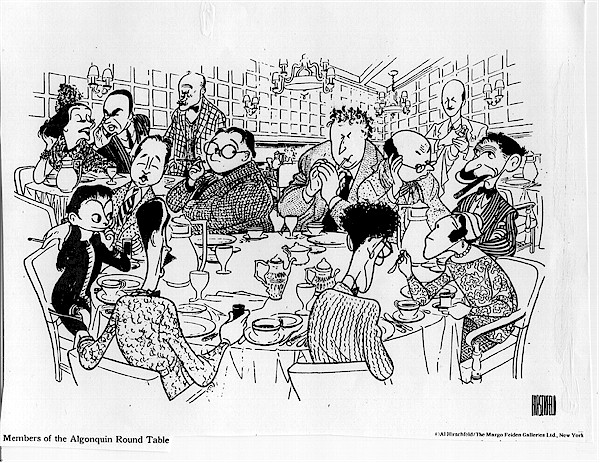
Others listed on The New Yorker masthead were associated with legendary Algonquin Round Table, including the playwrights Marc Connelly and George S. Kaufman and writers Dorothy Parker and Alexander Woollcott—all charter members. The writer Alice Duer Miller was also an occasional guest of this “Vicious Circle,” as they called themselves. From roughly 1919 to 1929, they met every day for lunch at the Algonquin Hotel.

Other regular Round Table members included Harold Ross, Franklin Pierce Adams, (best known for his newspaper column, “The Conning Tower”), New Yorker humorist Robert Benchley, husband-wife writers Heywood Broun and Ruth Hale, broadway producer Brock Pemberton, playwright Robert Sherwood and broadway publicist John Peter Toohey.

Those who moved in and out of the circle included feminist writer Jane Grant (who with her first husband Harold Ross co-founded The New Yorker), vaudeville comedian and later film star Harpo Marx, actresses Peggy Wood, Tallulah Bankhead, Lynn Fontanne and Margolo Gillmore, actor and director Alfred Lunt, playwrights Edna Ferber and David Ogden Stewart, humorist Frank Sullivan, writers Margaret Leech and Frank Crowninshield, illustrator Neysa McMein, playwright Beatrice Kaufman (George’s wife) and composer Deems Taylor.

It is important to make note of these various players in the “Vicious Circle,” since they figure prominently both as contributors and subjects in the early issues of The New Yorker.

table
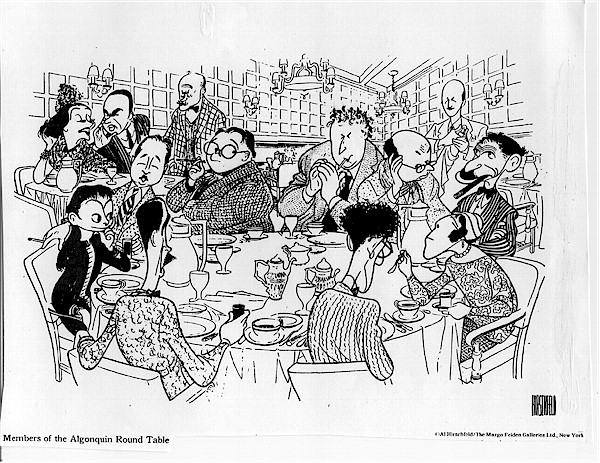
Famed Al Hirschfeld illustration from 1962 of the Algonquin Round Table includes (counterclockwise, from far left) Dorothy Parker, Robert Sherwood, George S. Kaufman, Edna Ferber, Franklin P. Adams, Marc Connelly, Heywood Broun, Alexander Woollcott, and Robert Benchley. Rounding out the back row are, from left, Lynn Fontanne, Alfred Lunt, Frank Crowninshield and hotel manager Frank Case. (Al Hirschfeld Foundation)

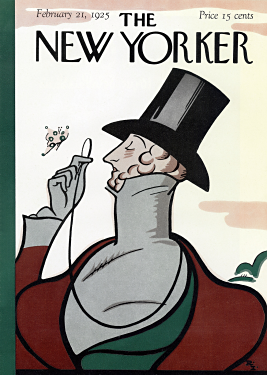
A prominent name on The New Yorker’s masthead absent from the Round Table is graphic artist Rea Irvin, creator of the magazine’s distinctive look and its mascot, Eustace Tilley.

Original_New_Yorker_cover
Rea Irvin’s Eustace Tilley on Issue #1 (New Yorker Digital Archive)

Irvin signed on as an advisory editor with the assumption that the magazine would fold after a few issues. Little did he realize that his illustrations, department headings, caricatures, and cartoons would grace the pages of The New Yorker for many years; that he would go on to illustrate 169 covers between 1925 and 1958; and that his distinctive typeface and mascot would continue to serve the magazine to this very day (Irvin died in 1972 at age 90).

Not to give the June 27 issue short shrift, “The Talk of the Town” reported Roald Amundsen had returned from his North Pole flight; “Profiles” looked at the life of theatrical producer Morris Gest; and “Books” offered a brief and somewhat mixed review of D.H. Lawrence’s new book, St. Mawr.

nazimova-nerman-caricature
In The New Yorker’s “Critique” section, a terrific caricature of Russian-American actress Alla Nazimova, by Swedish artist Einar Nerman. (New Yorker Digital Archive)

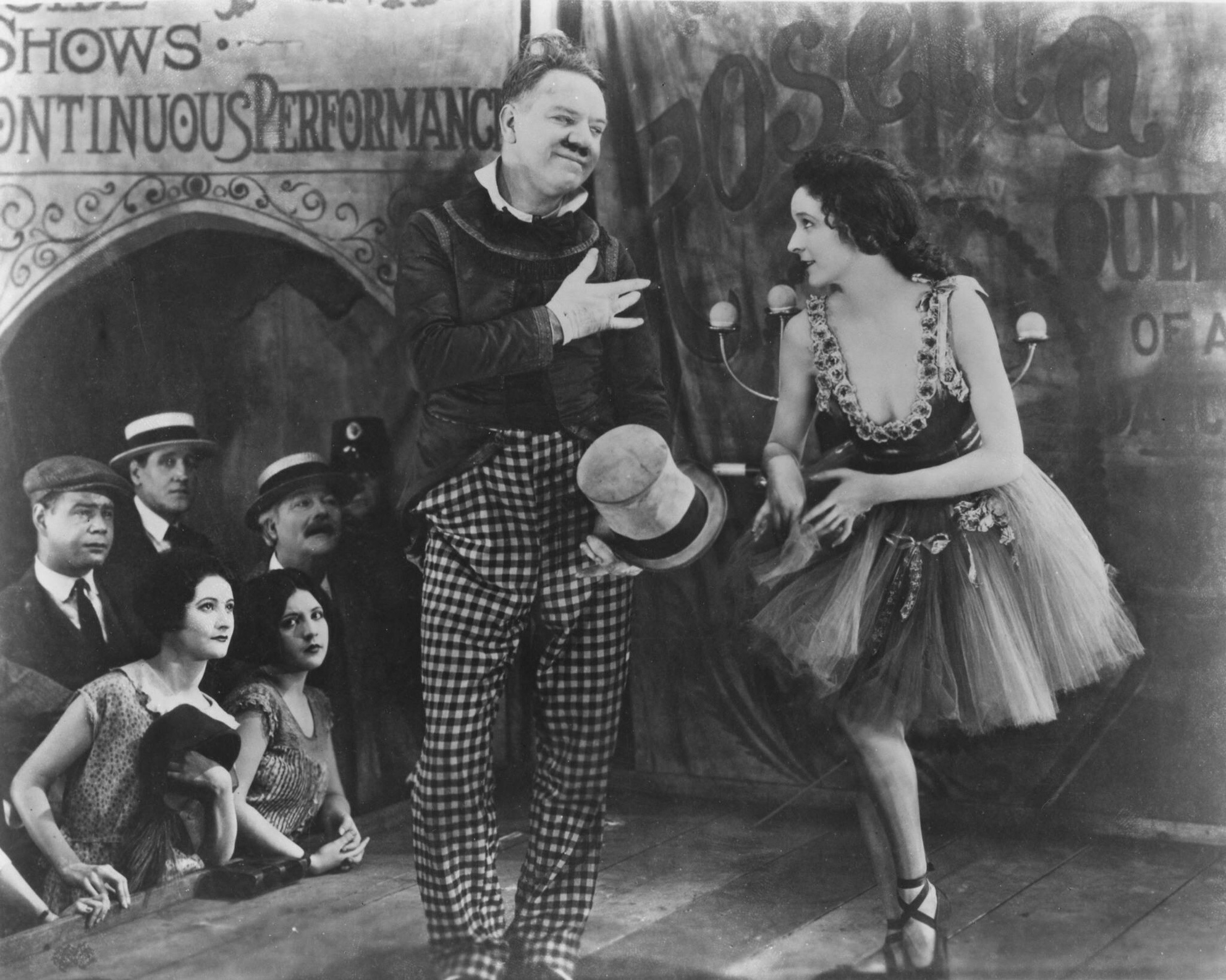
In “The Theatre,” W.C. Fields continued to impress in his performances with the Ziegfeld Follies. The New Yorker noted that Fields was becoming a “talking comedian” comparatively late in life, and that after 26 years “as a straight and comic juggler,” he has become “ever so many people’s favorite comedian.” Under “Moving Pictures” it was also observed that D. W. Griffith’s Sally of the Sawdust was going to “put W.C. Fields across as a big screen comedian. Wait and see!”

image
Sideshow “Professor” Eustace McGargle (W.C. Fields) and his ward, Sally (Carole Dempster, who was director D.W. Griffith’s real-life lover and protégée) are circus carnies in Sally of the Sawdust (1925). The movie was based on Fields’ stage hit Poppy, and featured stage legend Alfred Lunt in a rare film role. (Film Forum)

The June 27 issue offered yet another full page cartoon, this time by Gardner Rea, taking aim at the droll antics of the moneyed classes:

Screenshot 2015-05-11 10.46.19
(New Yorker Digital Archive)

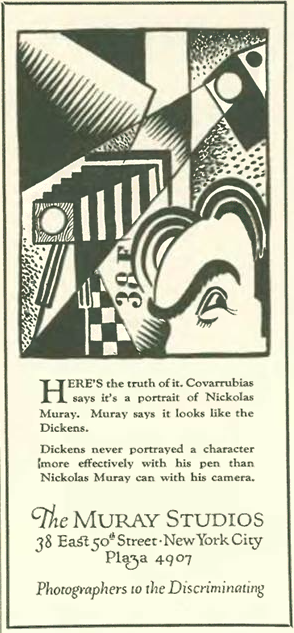
And finally, we are shown the answer to the mystery drawing by Covarrubias–ahem–an advertisement for a photography studio:

Screenshot 2015-05-11 10.58.43
(New Yorker Digital Archive)


The Queen of Romania

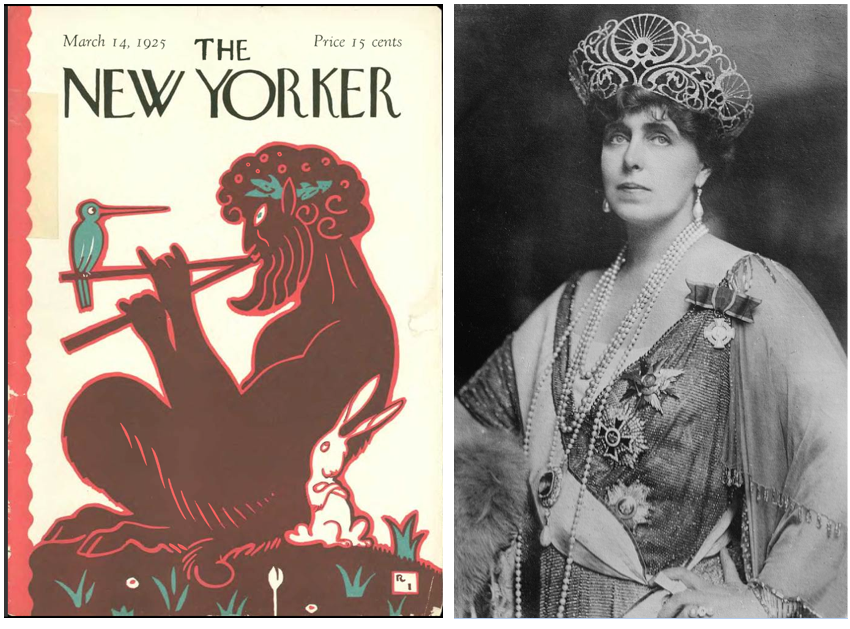
Issue #4, March 14, 1925 opened with “The Talk of the Town,” the lead item noting that  New York was “agog about the possible visit of Queen Marie of Rumania,” and that the queen was supposedly offered a contract by a newspaper to write her impressions of the United States.

Screenshot 2015-03-13 11.20.57
The New Yorker, Issue #4, (cover by Rea Irvin) March 14, 1925 / Queen Marie of Romania (left, New Yorker Digital Archive; right, Wikipedia)

Born into the British royal family, Queen Marie was titled Princess Marie of Edinburgh at birth. After refusing a proposal from her cousin, the future King George V, she was chosen as the future wife of Crown Prince Ferdinand of Romania, the heir apparent of King Carol I, in 1892 (she was the last Queen consort of Romania, and her trip to the U.S. would prove to be the last months of her reign).

An account in the Frontier Times in 1968 describes the visit this way:

When Queen Marie first announced her intention of making a trip to America, she stated that her general purpose was a sort of educational good will tour; but that her specific purpose was to dedicate a museum at Maryhill, Washington…She sailed from Cherbourg (France) on October 12, 1926, on the Leviathan, accompanied by her son, Nicholas, and her daughter, Ileana; her special aide, Major Stanley Washburn; her close friend, Loie Fuller, the ballet dancer; six personal attendants; several European dignitaries; about one hundred pieces of baggage—and her dog.

For publicity, the timing was perfect. Front page news was scarce, and the Queen’s visit was “manna from heaven” for the newspapers, and a field day for the reporters—who played up the trip in great style.

Queen Marie had contracted with the North American Newspaper Alliance to write a series of articles ranging from “Why I Came to America” to “My Impressions of America.” About six of such articles were published; and as they ran 2,000 words each, one suspects she must have had a ghost writer—and there was one such in her party.

page04
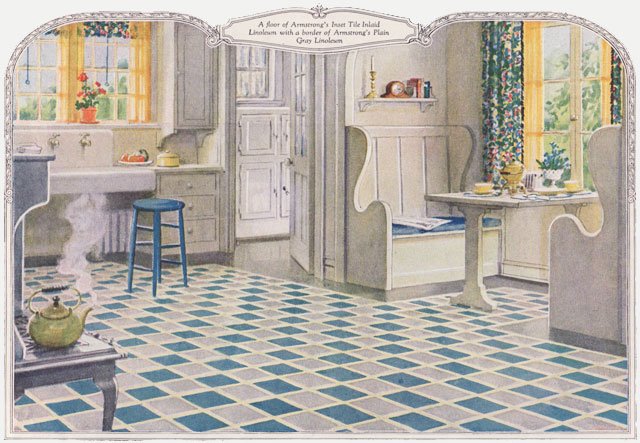
FIT FOR A QUEEN…Perhaps the Queen of Romania saw this 1924 advertisement for Armstrong linoleum. (Antique Home Style)

In her syndicated articles she gave a variety of reasons why she came to America—which might have been condensed into a desire to see the country first-hand, and find out how its people lived. She wanted to see almost every object of interest—Pikes Peak, the Everglades, farmers, Indians, washing machines and rodeos; and wanted to ride a horse. She spoke of steel mills, skyscrapers, big trees and tombs of famous men. Particularly she wanted to see American kitchens, and find out if the occupants were as good looking as they appeared to be in linoleum advertisements…

However, the reasons advanced by some who clearly were not in sympathy with the Queen’s visit, were not so altruistic. One newspaper was of the opinion that the real purpose of the trip was to find a rich American husband for Ileana…

“The Talk of the Town” also featured a brief item on “vaudeville headliner” Harry Houdini and his “denunciations of Marjorie.”

This is in reference to a rivalry between a Bostonian, Mina Crandon (known as “Margery the Medium”) and Houdini, who called himself “the scourge of spirit mediums.”

Screenshot 2015-03-13 11.35.54
Harry Houdini and Mina (Margery) Crandon (left image, PBS; right, FORTEAN PICTURE LIBRARY)

The 1920’s marked the height of America’s obsession with the paranormal—the “spirit world”–and Margery was a rock star among the many competing spiritualists of the day. The most famous of her followers was Sir Arthur Conan Doyle, author of Sherlock Holmes mysteries. Doyle was so convinced of her powers that he recommended her to the editors of Scientific American. The magazine was offering a $2,500 prize to the first medium who could verifiably demonstrate (to an investigative committee) a “visual psychic manifestation.”

When the committee reported it found no trickery in Margery’s methods, the outraged Houdini cancelled his upcoming shows and headed to Boston with the aim of personally debunking the medium at a seance.

In an article by Robert Love posted on Mental Floss, he relates what happened next when Houdini arrived at her Lime Street apartment:

Margery greeted the panel and took her seat within a three-sided Chinese screen, the lights dimmed. Soon enough, an eerie whistling filled the room. On cue, the spirit of Walter (Margery’s dead brother) whispered his arrival, even touching Houdini on the inside of his right leg. After a break, he ordered an electric bell enclosed in a wooden box brought to Houdini’s feet. Then Walter levitated a megaphone and boomed: “Have Houdini tell me where to throw it.”

“Toward me,” Houdini said, and the megaphone flew through the air and crashed in front of him. That was just the beginning. Throughout the evening, Walter produced a sequence of metaphysical spectacles, ringing the bell box on command and tipping over the wooden screen.

Houdini had done his homework. He knew that Dr. Le Roi Crandon, Margery’s husband, always sat on her right. (A Harvard-educated surgeon, Crandon was her greatest promoter, often showing visitors nude photographs of his wife in séance delicté). Houdini also guessed correctly that he would be seated at her left in the circle, with hands joined, feet and legs touching. In preparation for the evening, Houdini wore a tight bandage under his right knee all day; it was so painful it made his skin tender to even the slightest touch. The heightened sensitivity paid off. He could feel Margery twist and flex in the dark as she moved her left ankle slightly to get to the bell box under the table. Later, he felt her shift again to tip the Chinese screen with her foot. The flying megaphone stumped Houdini for a few hours, but he eventually figured out that Margery had placed it on her head, dunce-cap-style, with a momentarily free hand. She then jerked her head in his direction to send it crashing to the floor.

“I’ve got her,” he said when the evening was over. “All fraud. Every bit of it. One more sitting and I will be ready to expose everything.”

A second séance at a Boston hotel featured a levitating table. Houdini reached out in the dark and found Margery’s head lifting the table from beneath. He again felt her legs move as she reached to ring the bell box. “The slickest ruse I ever detected,” Houdini said later, in something close to admiration.

Read Love’s full account here.

Other celebrities of the time are found in the issue’s pages. The section “In Our Midst” tells of F. Scott Fitzgerald and Zelda Fitzgerald visiting Rome, and that the author was nearly finished with a novel called “The Great Braxton” (which would actually be titled “The Great Gatsby”). Another item noted that Eugene O’Neill was vacationing in Bermuda.

tumblr_mzdi2d2KG71rp8uyqo1_1280
Zelda, Scottie and F. Scott Fitzgerald in Rome, 1925 (London Times)

The “Profile” featured boxer Jack Dempsey, and “Books” announced the publication of A. A. Milne’s When We Were Very Young.

The “Hourglass” mentions the antics of Gutzon Borglum, who had been sculpting a tribute to the Confederacy on Georgia’s Stone Mountain.

68552424
This is as far as Borglum got when he began feuding with his backers and abandoned the Stone Mountain project. It wasn’t completed until 1972. (Detail from postcard image depicting the monument in progress)

The “antics,” specifically, concerned Borglum’s famed temper and his penchant for smashing completed sculptures in fits of rage. He would later go on to sculpt the monument at Mt. Rushmore.

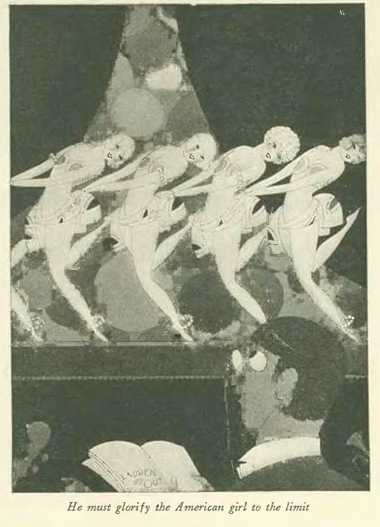
Then there’s an article by “The Professor” on the Ziegfeld Follies that features this illustration by Ralph Barton:

Screenshot 2015-03-13 14.04.16

The author concludes, “I forget whether it was a good show or not, but as a barometer of New York, it can’t be excelled.”

The “Motion Pictures” section featured a brief mention of “Mr. Hay’s” moral crusade against plays and movies. Hays would later lend his name to the The Production Code of 1930, known to most as the “Hays Code.”

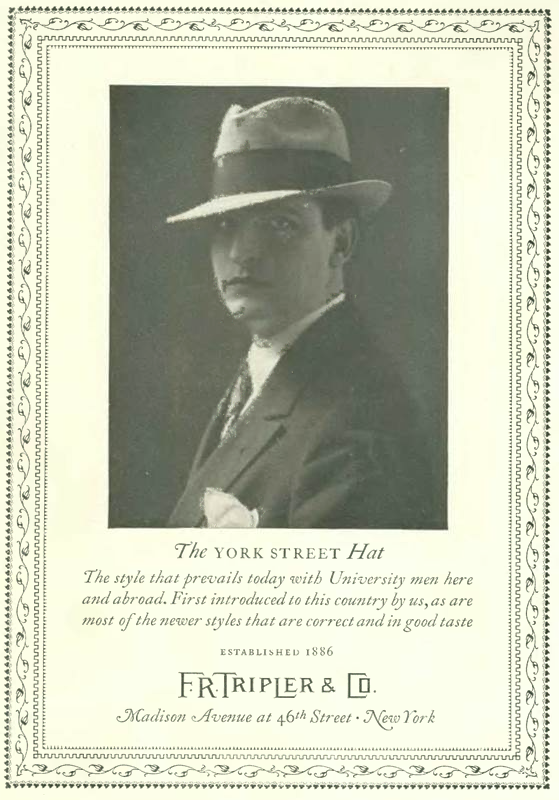
Finally, if you really want to get a sense of how times have changed, check out the issue’s back page ad, and the suggested look for a “University man:”

Screenshot 2015-03-13 14.18.41