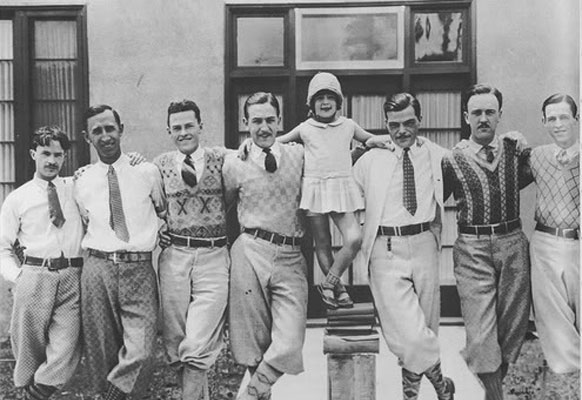
Photo above circa 1930 via mensfashionmagazine.com.
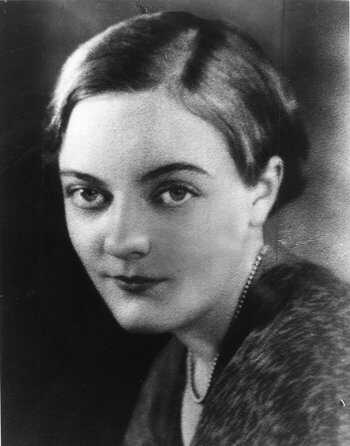
Lois Long took a break from reviewing the latest fashions to offer some thoughts on the relations between men and women, and more specifically, what was expected of women if they ever hoped to land the type of man who represented a “potential Future” for them.

Based on what we know about Long, this column has a strong “tongue-in-cheek” quality. It should also be noted that the 32-year-old Long had been divorced from cartoonist Peter Arno for three years, and was possibly contemplating the dating scene (she would marry newspaper ad man Donaldson Thorburn in 1938). In this excerpt, Long dispelled the notion that “the brutes” never notice a woman’s appearance:
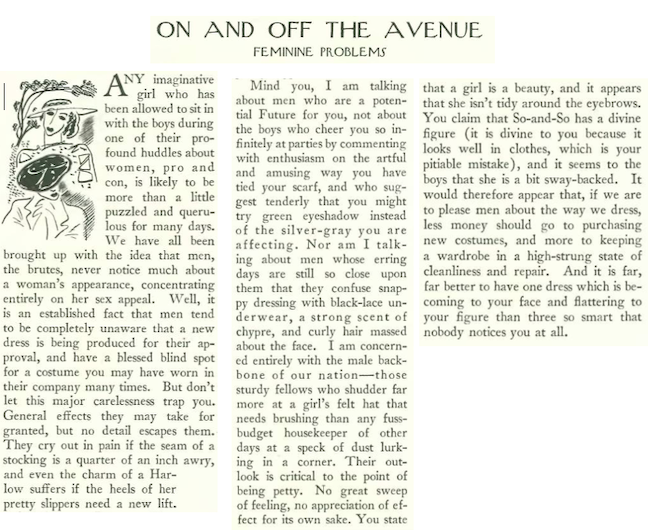

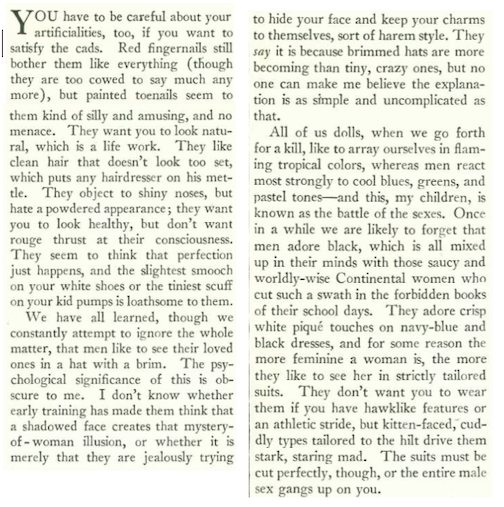


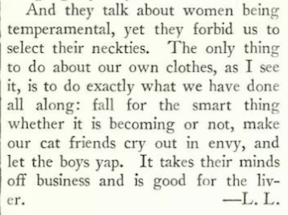
Long concluded that in the end, it didn’t matter what men thought about women’s clothes, but letting them “yap” about such things was a good way for them to blow off some steam.
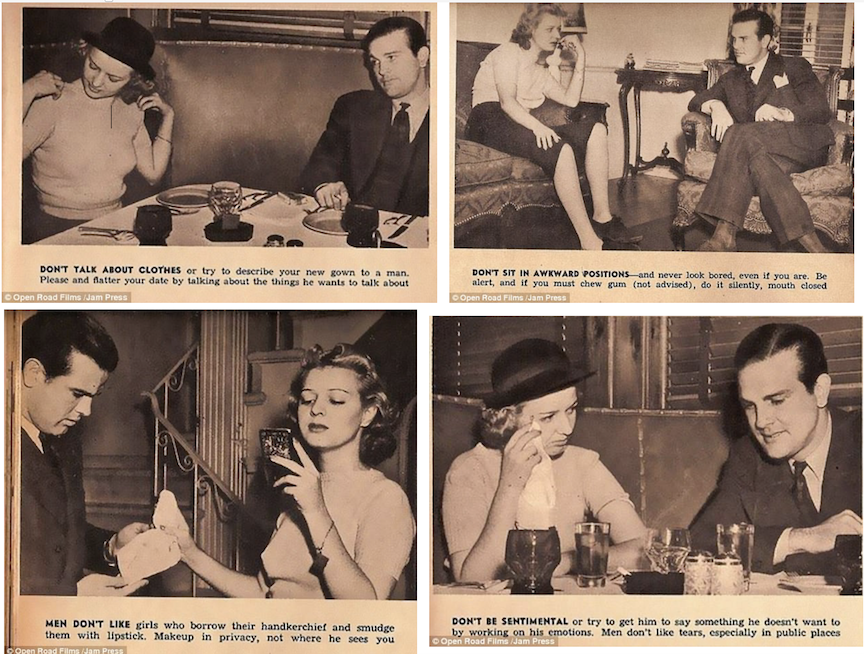
Check out these patronizing examples from an illustrated guide for women published in 1938 by Click Parade magazine. It gives us some idea of what Long, and millions of other women, were up against…
* * *
Fifth Avenue Remnant
The first years of The New Yorker coincided with some of the most transformational years in Manhattan’s urban fabric, including the replacement of Gilded Age mansions with upscale commercial buildings. One of the last remaining mansions was the Wendel house, featured in “The Talk of the Town.”
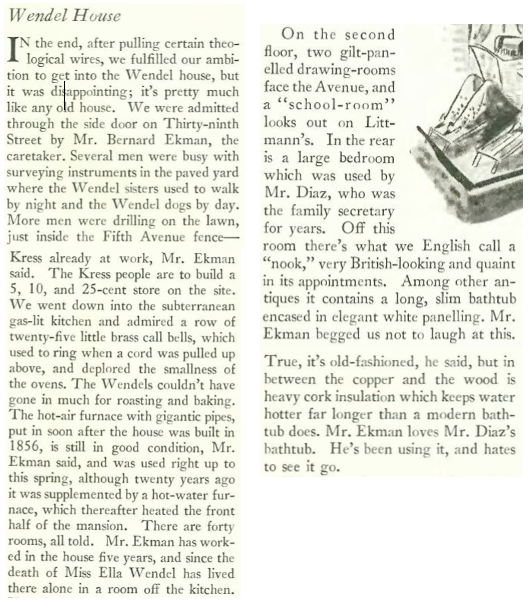
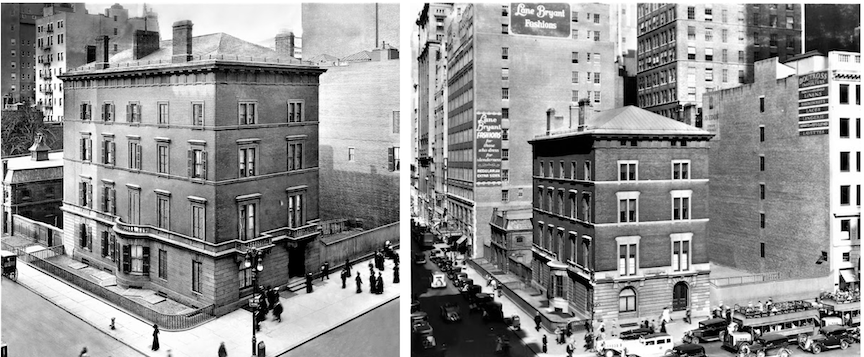
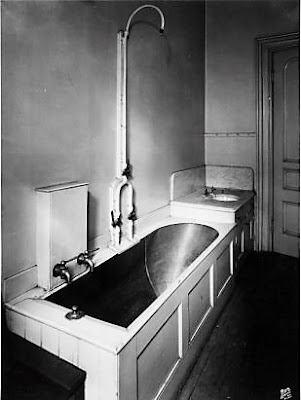

See Daytonian in Manhattan for more on the fascinating story of the Wendel mansion.
* * *
Damned Lies
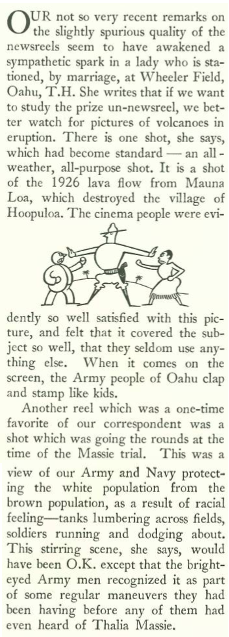
In his “Notes and Comment,” E.B. White noted the spurious nature of cinema newsreels, including one featuring the case of Thalia Massie, a navy wife stationed in Hawaii whose immature behavior and trail of lies would implicate five men in a crime they could not have committed (one would even be killed by vigilantes) and would cast Hawaii into a state of racial turmoil. (You can read more about it at the PBS site for American Experience.
* * *
Blunders, Part II
Howard Brubaker commented on the twentieth anniversary of the outbreak of the Great War. Today we call it World War I, and as we know, the blunders did not cease with the Armistice.
* * *
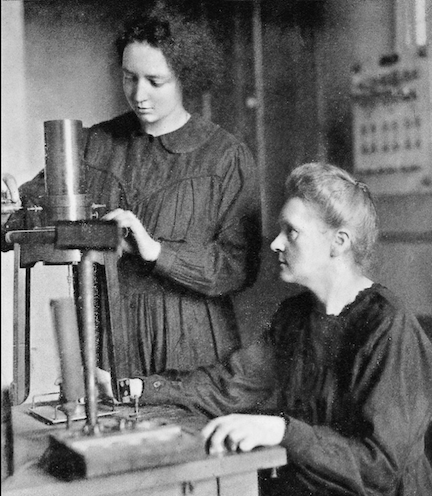
RIP Madame Curie
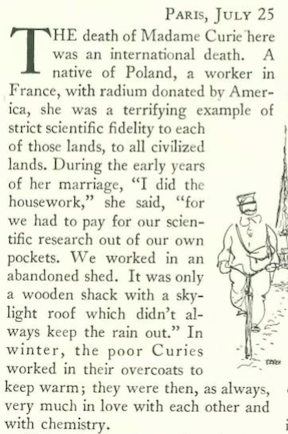
Janet Flanner, Paris correspondent for The New Yorker, noted the passing of Marie Curie, a pioneer in field of radioactivity.
* * *
From Our Advertisers
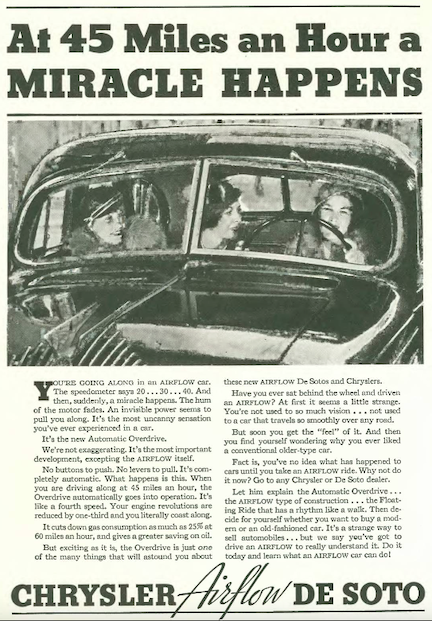
The folks at Chrysler were trying every angle to get car buyers interested in the Airflow—although the car offered a number of advanced features, consumers just weren’t ready for its radical aerodynamic design…note how the ad downplays the car’s sweeping curves…
…and we have more deception from the cigarette industry, including claims that cigarettes gave you more energy and improved the performance of top athletes…

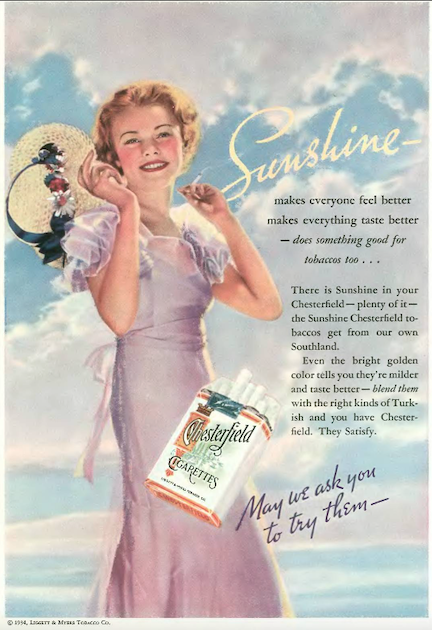
…the makers of Chesterfields gave us this sunny picture of health…indeed, there was sunshine in every pack…
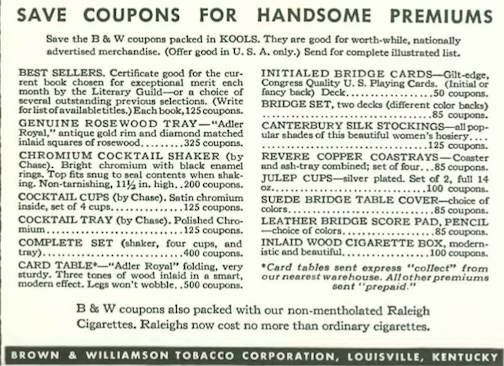
…The Brown & Williamson Tobacco Company launched KOOL cigarettes in 1933 as the sole competitor to the other menthol brand, Spud, which was a big advertiser in the early New Yorker. Maybe it was the coupons, or the modern brand name, that helped KOOL knock Spud from the market by the 1940s. As for those coupons, it appears each pack contained only one of them…

…so you would have to smoke a ton of those things to get one of these swell prizes…
…early Budweiser ads often featured images of the Old South…here they conjured up the ghost of Mark Twain (who had been dead only 24 years), putting the great humorist and writer on par with their bottled beer…

…Canada Dry didn’t have Mark Twain, but what they did have was a beer (Hupfel’s) lacking “that queer yeasty taste that beer usually has”…

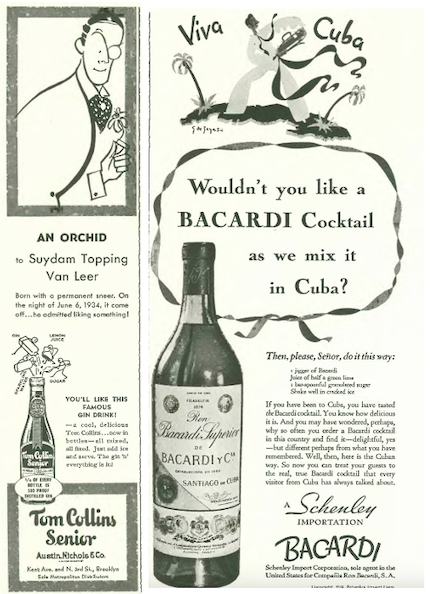
…a couple of ads from the back pages featured, at left, an ad for a pre-mixed Tom Collins, which must have been awful, and at right, a spot for Bacardi rum, which was actually made in Cuba before the revolution…
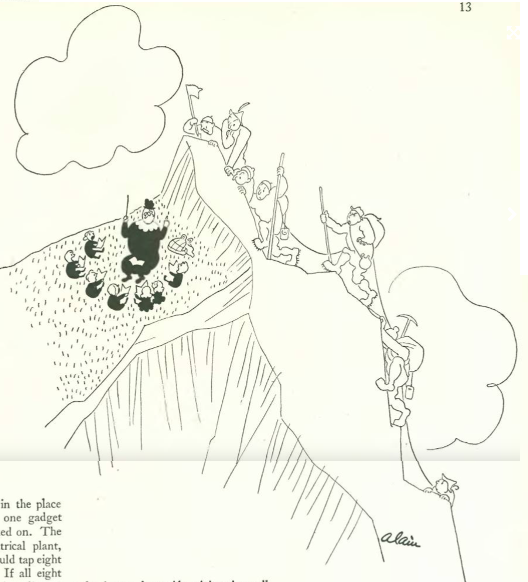
…on to our cartoons, we begin with Alain (Daniel Brustlein) and some not-so-intrepid mountain climbers…
…Otto Soglow’s Little King sought a glimpse of the street life…

…William Steig took a dip with his Small Fry…

…Isadore Klein gave us a glimpse of sensationalist radio reporting…

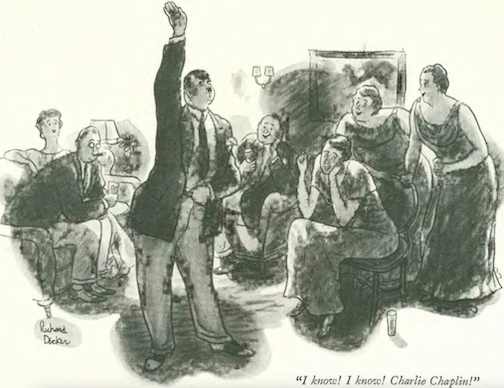
…and we close with Richard Decker, and a game of charades…
Next Time: Up in the Air…

 A New Yorker State of Mind