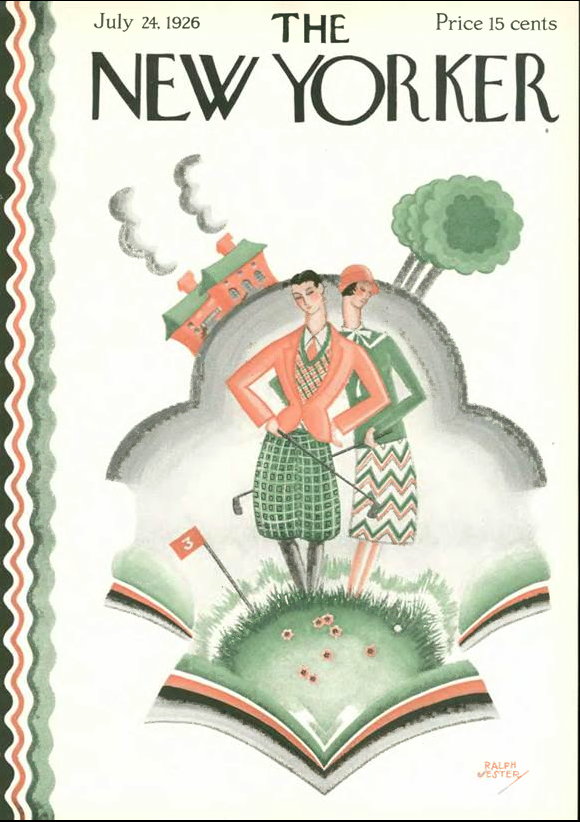
The glories of summertime filled the pages of the July 17, 1926 issue. The cover featured a stylish young couple enjoying a romantic evening on a moonlit lake, while the inside pages were filled with all sorts of outdoor activities ranging from dining and dancing to open air concerts and golf, lots of it.
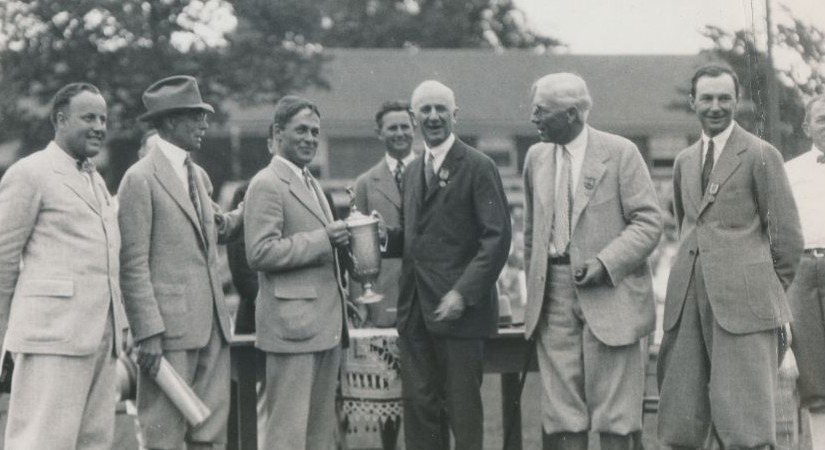
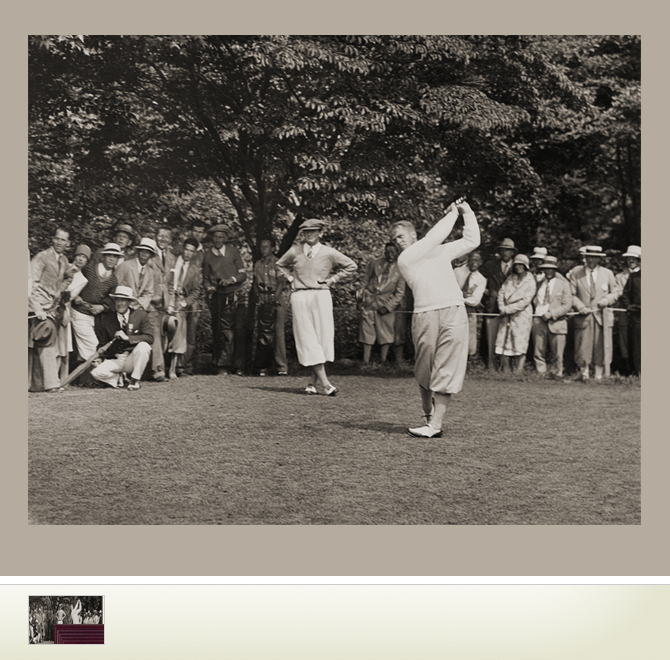
There was a lengthy profile by Herbert Reed on golfing great Bobby Jones, a mere boy of 24 who competed as an amateur but often beat top pros such as Walter Hagen and Gene Sarazen (in a few years Jones would help design the Augusta National Golf Club and co-found the Masters Tournament).
Rending of Bobby Jones for the “Profile” by illustrator Miguel Covarrubias.
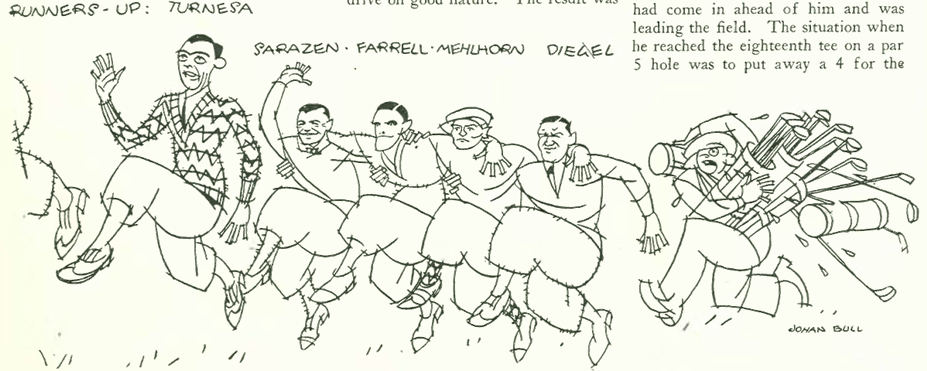
In “Sports of the Week,” Reed wrote about Jones’s second U.S. Open win, in Columbus, Ohio. Johan Bull offered this rendering of the runners-up:
Bobby Jones at the 1926 U.S. Open (golfspast.com)
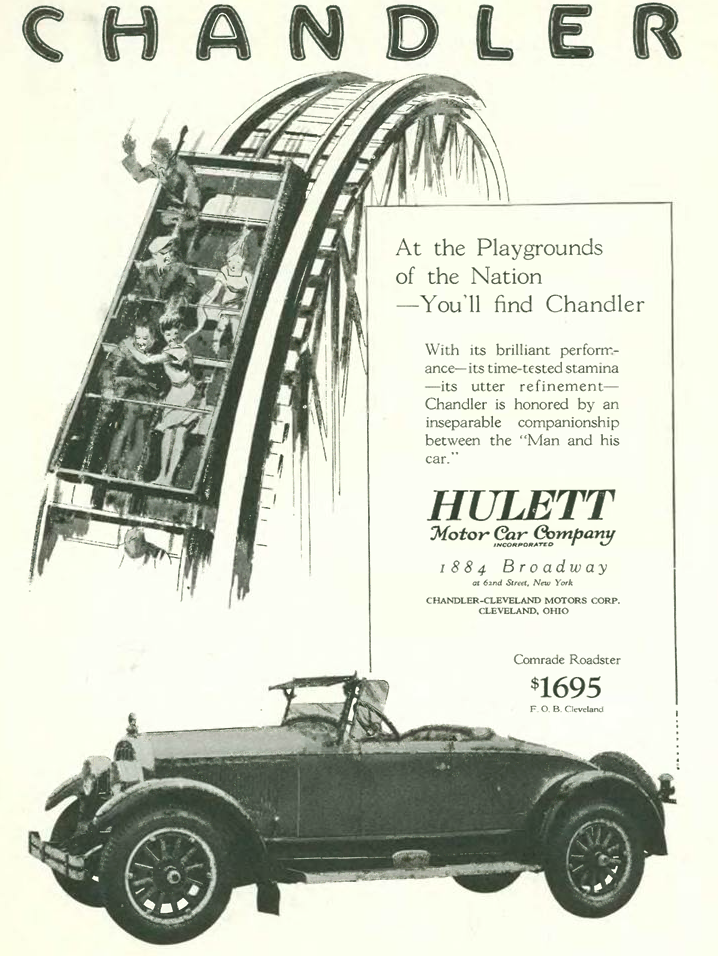
And with the warm weather the tops were open on automobiles for both the rich:
And the not-so-rich:
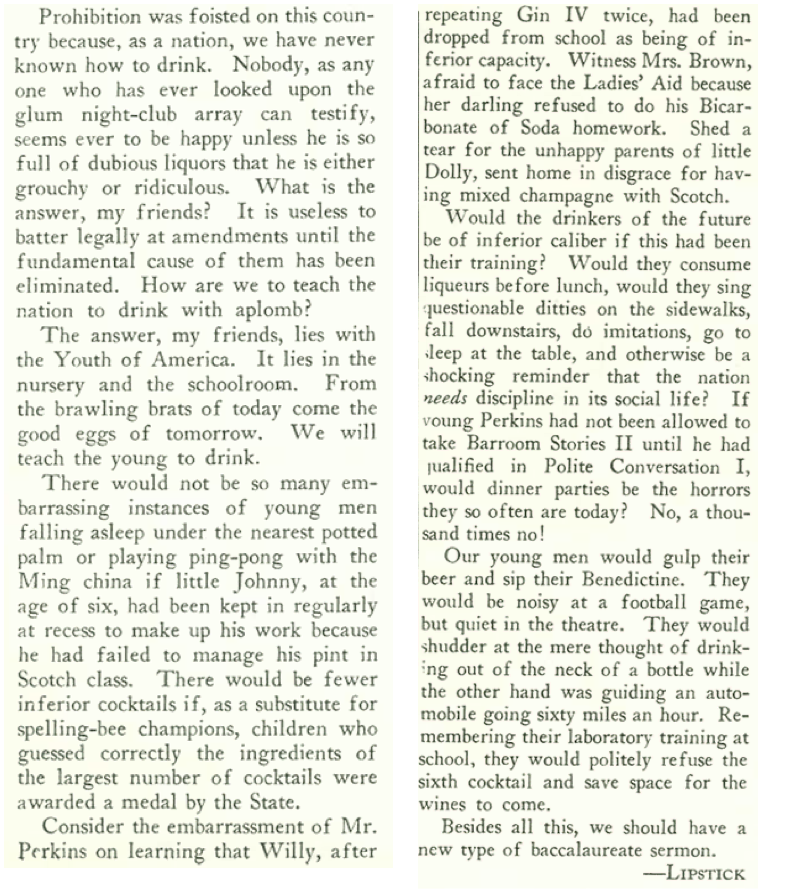
And finally, Lois Long, fed up with reviewing restaurants, fires off a column about the sad state of drinking in America:
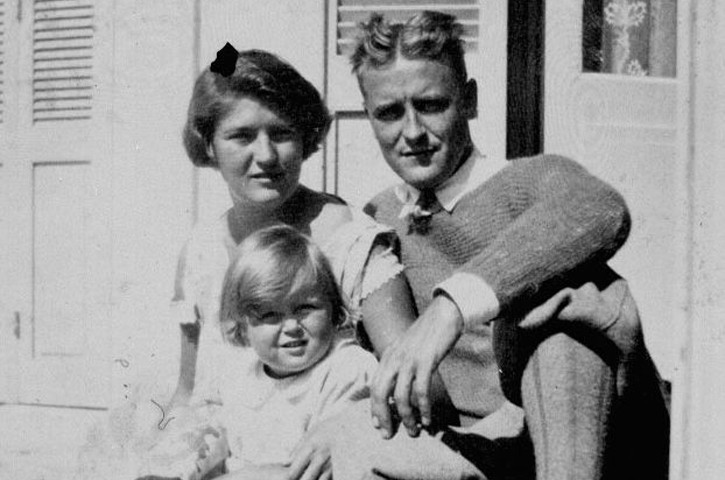
The “sad young man” in question was none other than F. Scott Fitzgerald, who was profiled by John Mosher (who would succeed Theodore Shane as film critic) in the April 17, 1926 issue of The New Yorker.
April 17, 1926 cover by Clayton Knight.
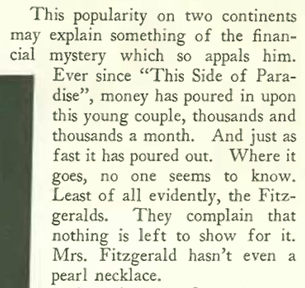
Mosher wrote that Scott believed he was “getting on in years,” even though he was only 29 years old and had recently published The Great Gatsby (which had received a brief, lukewarm review from The New Yorker in 1925). Mosher observed that the novelist and his wife, Zelda, famous on two continents and with money pouring in from the publication of This Side of Paradise, nevertheless complained of being broke:
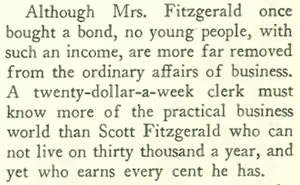
It was noted however that the couple had little financial sense:
Mosher found Fitzgerald to be a grave, hardworking man, and seemed to sense the melancholy that would lead to madness (in Zelda’s case), alcoholism and an early grave (Fitzgerald would be dead in 14 years).
Illustration of Fitzgerald by Victor De Pauw for the April 17 “Profile.”
In this issue we were also introduced to Peter Arno’s “Whoops Sisters,” although they are not yet identified here by that title:
According to New Yorker cartoonist Michael Maslin, “in 1925, The New Yorker published nine Arno drawings. In 1926, it ran seventy-two. The enormous jump was due to the wild success of two cartoon sisters Arno created: Pansy Smiff and Mrs. Abagail Flusser, otherwise known as The Whoops Sisters. The Sisters were not sweet little old ladies — they were naughty boisterous grinning “wink wink, nudge nudge” sweet little old ladies, their language laced with double entendres.”
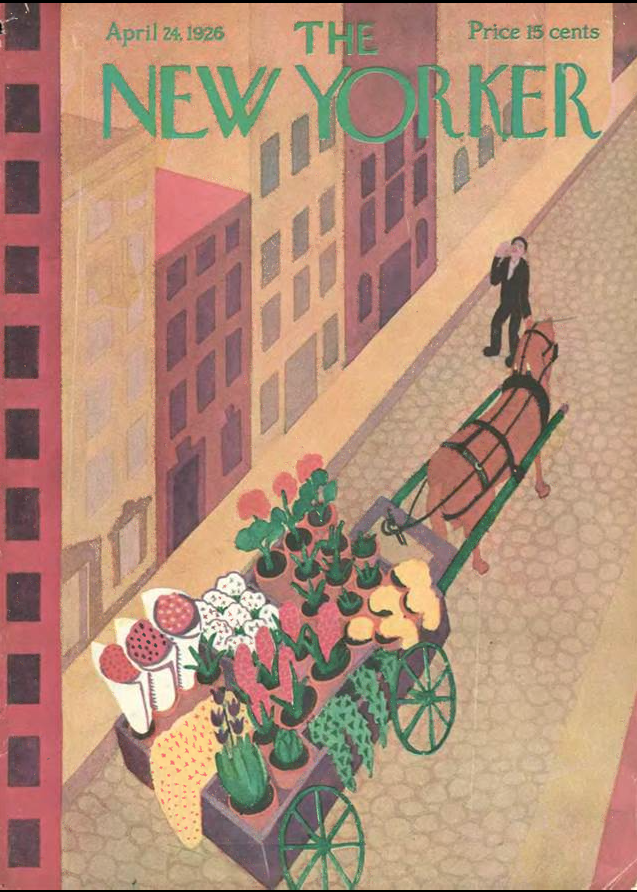
April 24, 1926 cover by Ilonka Karasz.
In the April 24, 1926 issue, the dyspeptic film critic Theodore Shane took aim at Cecil B. DeMille’sThe Volga Boatman:
VOLGA HOKUM…Elinor Fair and Victor Varconi in The Volga Boatman. (Virtual History)
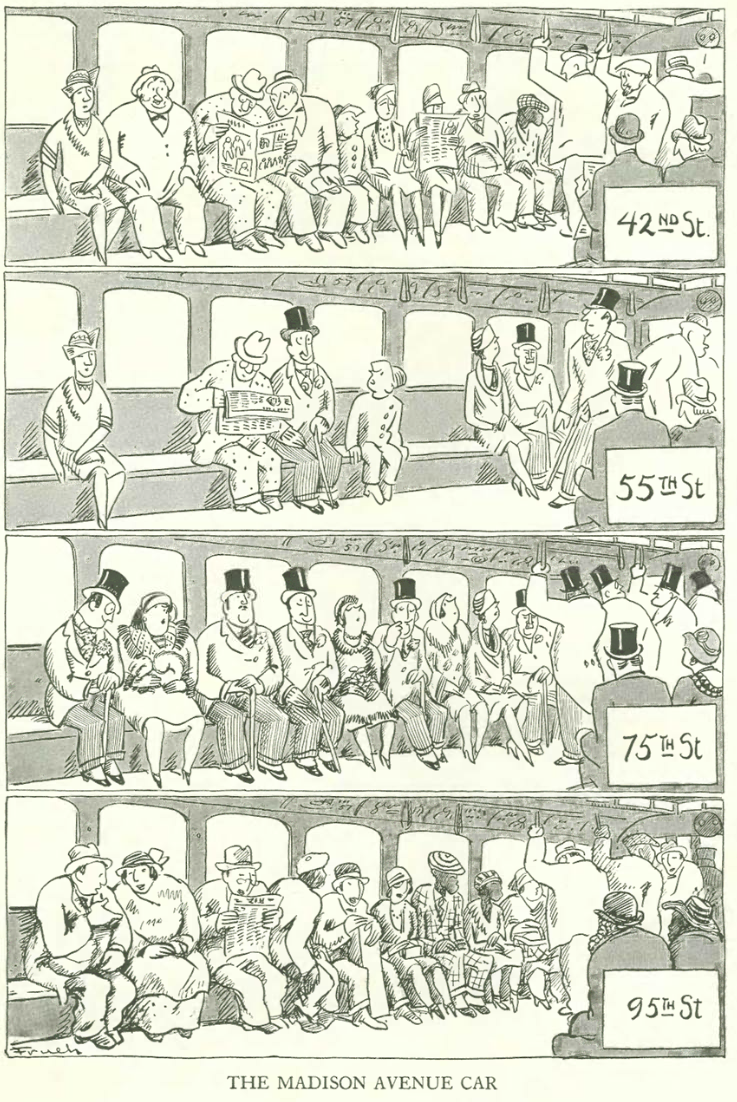
Also in this issue, Al Frueh’s interpretation of New York’s social strata via the city’s Madison Avenue train stops:
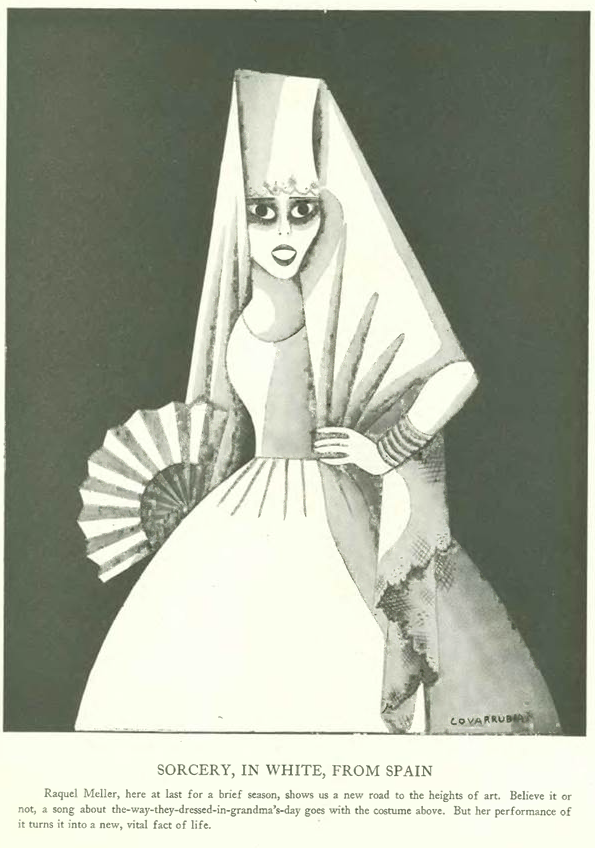
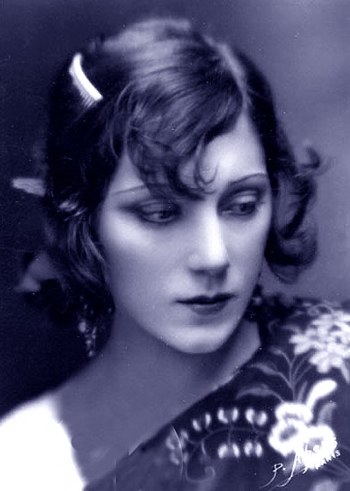
Near the theatre section, this illustration of famed Spanish singer and actress Raquel Meller, as rendered by Miguel Covarrubias:
And a photo of Meller from the 1920s that looks like it could have been taken yesterday:
(rameller.tripod.com)
An international star in the 1920s and 1930s, Meller appeared in several films and sang the original version of the well known song La Violetera.
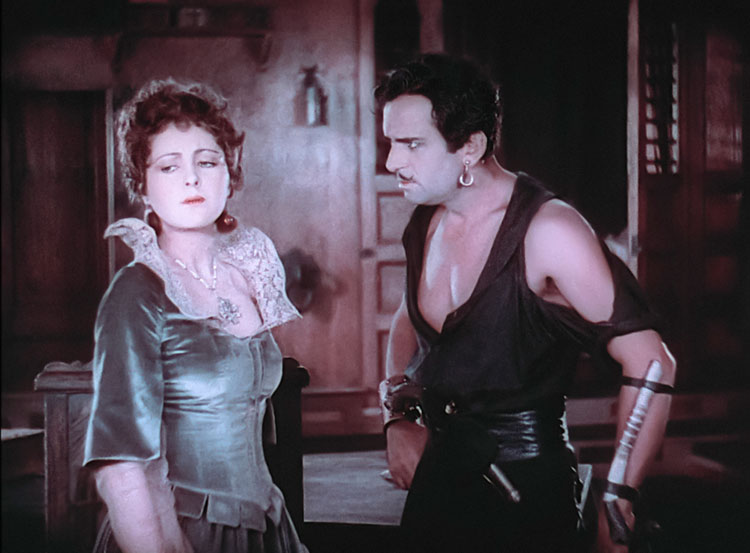
Although the trade name “Technicolor” conjures up images of mid-century Hollywood, the process was actually invented in 1916 and developed over subsequent decades.
Early Technicolor was a complicated process, using a prism beam-splitter behind the camera lens to simultaneously expose two consecutive frames of a single strip of black-and-white negative–one behind a red filter, the other behind a green filter. A projectionist had to be highly skilled to keep the film aligned during its showing. The Black Pirate, however, used a later technique that cemented the two prints together, making for a thick film that was prone to bulging and distortion.
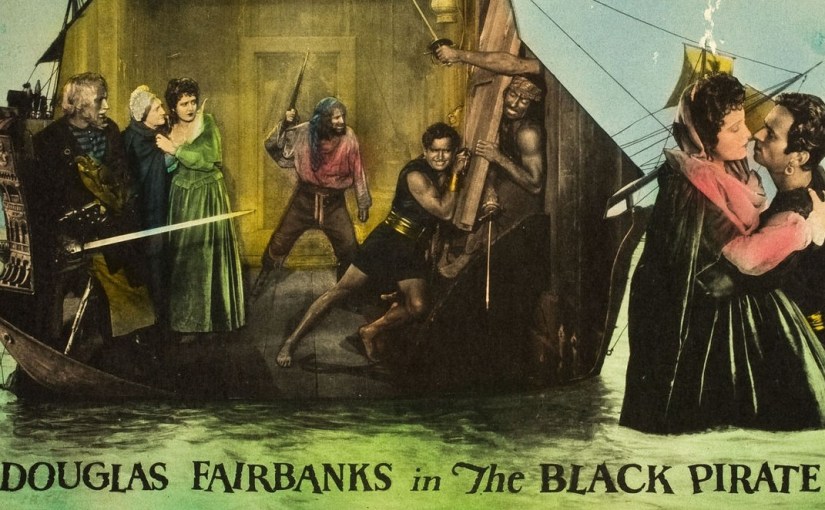
When the New Yorker’sTheodore Shane reviewed Douglas Fairbanks’ latest swashbuckler film, The Black Pirate, in the March 13, 1926 issue, it appeared that after ten years of development the Technicolor process had a long way to go:
DEAR, YOU LOOK A BIT PEAKY…Billy Dove and Douglas Fairbanks rendered in early Technicolor in The Black Pirate. (MovieMail.com)
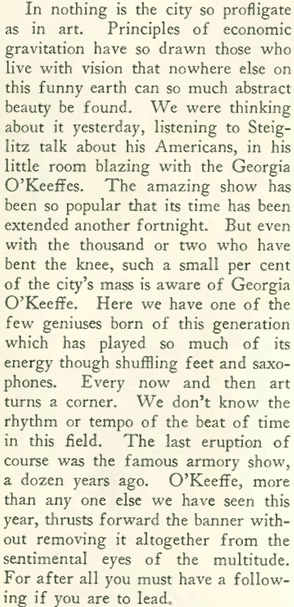
Art critic Murdock Pemberton wrote about the genius of the young artist Georgia O’Keeffe, whose work was on display at husband Alfred Stieglitz’s new exhibition space, the Intimate Gallery:
Georgia O’Keeffe’sBlack Iris, 1926. (Metropolitan Museum of Art)
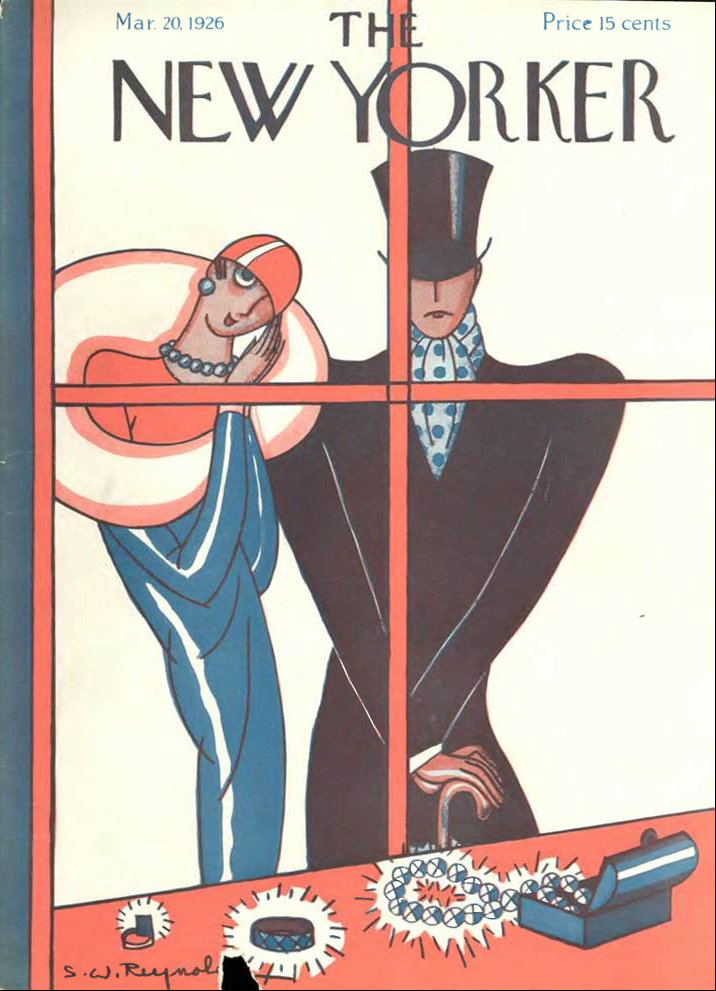
On to the March 20 issue, boldly illustrated by S.W. Reynolds, who contributed a number of deco-themed covers for the magazine:
March 20, 1926 cover by S.W. Reynolds.
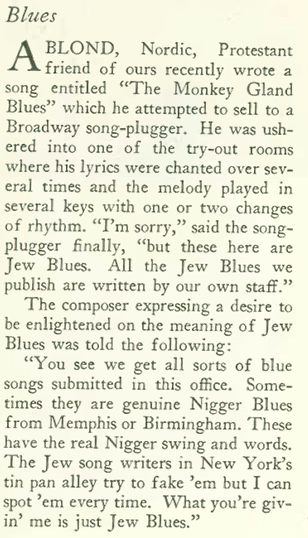
For all The New Yorker’s progressive wit and style, you are occasionally reminded that some of its sensibilities were still very much mired in those times. For example, this bit from the issue’s “The Talk of the Town” segment:
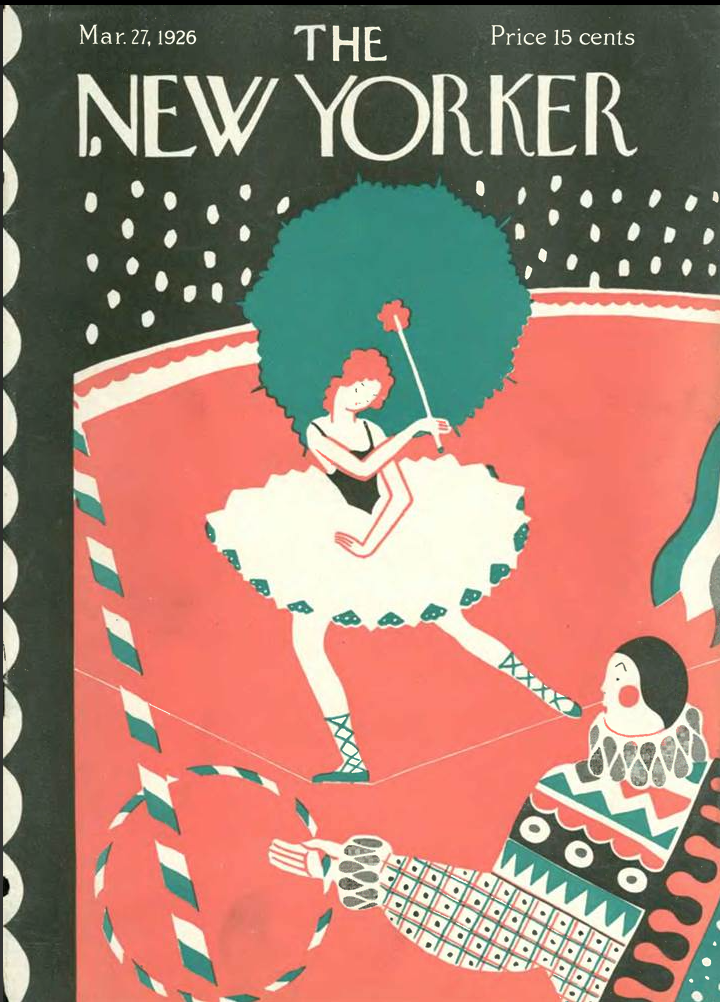
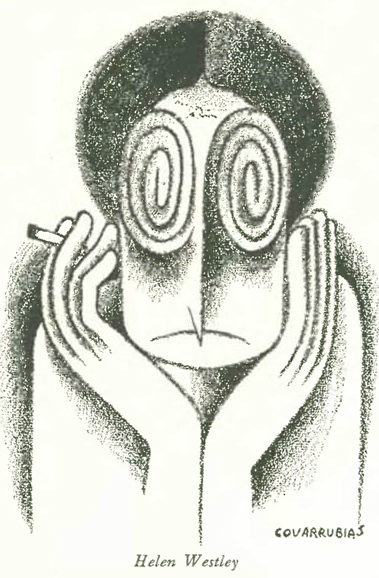
The March 27 issue offered a profile of actress Helen Westley, who was described by writer Waldo Frank (pen name “Search-light”) as “a goddess of our city” whose “true value and her art (was) her personal life.”
March 27 cover by Ilonka Karasz.
Wesley often played a stern, indomitable character who wore a hawk-like glare, and in her later years portrayed dour dowagers and no-nonsense matrons. Frank wrote that while Wesley was not a particularly good actress, she lived her life with a spirit for adventure and a need to plunge her fine-born, gracious manner into the “frowsy” world of Broadway.
A Miguel Covarrubias rendering of Helen Wesley for the “Profiles” piece.
And to close, Al Frueh’s take on a day in the life of a doorman:
Leading up to the famous Tennessee “Monkey Trial” of John Scopes, the June 13 issue of The New Yorker continued its jabs at William Jennings Bryan.
June 13, 1925 cover by Barbara Shermund. (New Yorker Digital Archive)
Bryan had agreed to serve as prosecutor in the case against Scopes, who was charged on May 5, 1925, with teaching evolution from a chapter in Civic Biology, a textbook by George William Hunter that among other things described the theory of evolution. For the record, Scopes, who was merely a substitute high school teacher, wasn’t even sure if he’d actually taught evolution in his class, but purposely incriminated himself so the trial would proceed with a defendant. Just in case New Yorker readers needed more evidence that Bryan was an ignorant rube, “Talk of the Town” led off with an item on WJB’s visit to the Metropolitan Museum of Art:
(New Yorker Digital Archive)Bryan as depicted by Rea Irvin in June 7th’s “Talk of the Town”.
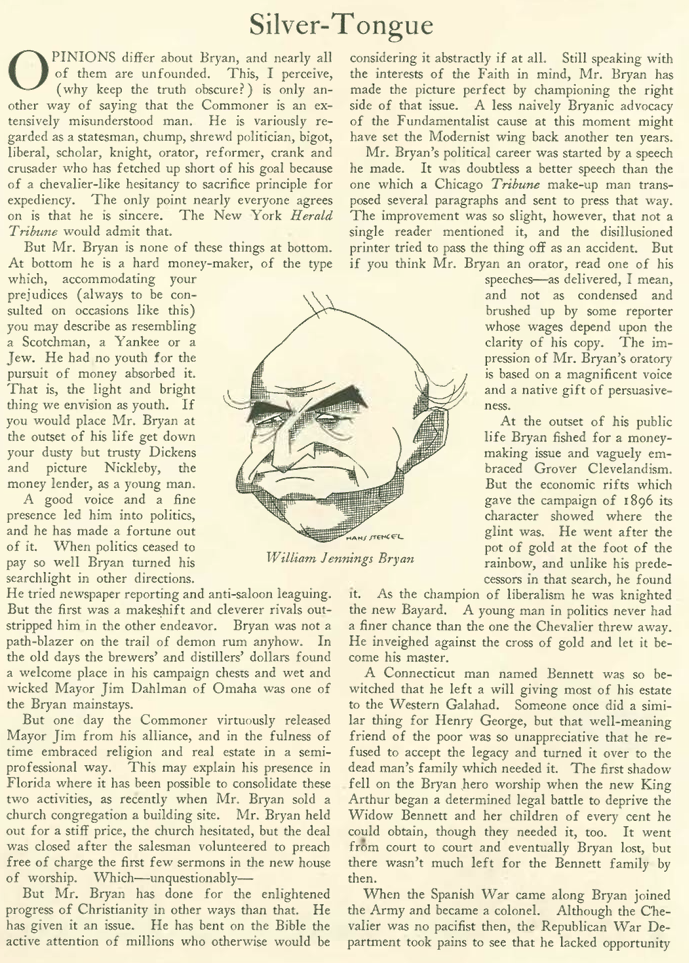
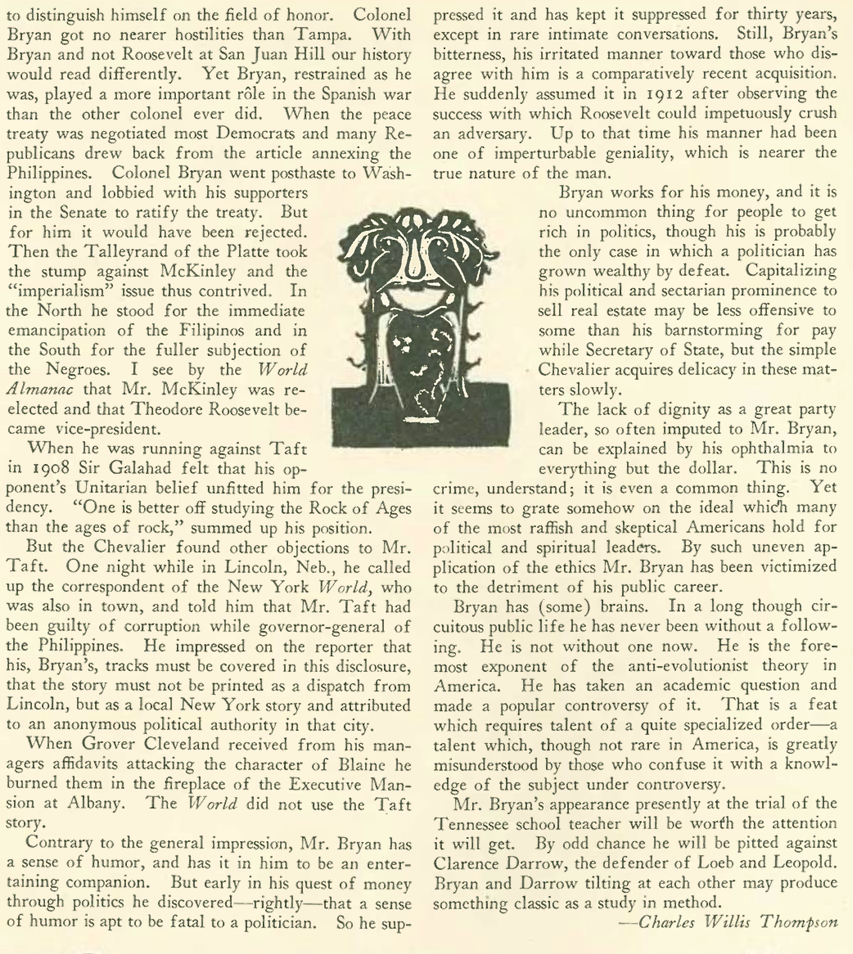
Bryan was also the subject of a “Profile” piece by Charles Willis Thompson, who wrote “the Commoner” is “an extensively misunderstood man.”
Thompson observed that Bryan “is variously regarded as a statesman, chump, shrewd politician, bigot, liberal, scholar, knight, orator, reformer, crank and crusader who has fetched up short of his goal because of a chevalier-like hesitancy to sacrifice principle for expediency.”
Here is the piece in its entirety (caricature by Hans Stengel)
(New Yorker Digital Archive)Macfadden at age 65 in the early 1930s (yousearch)
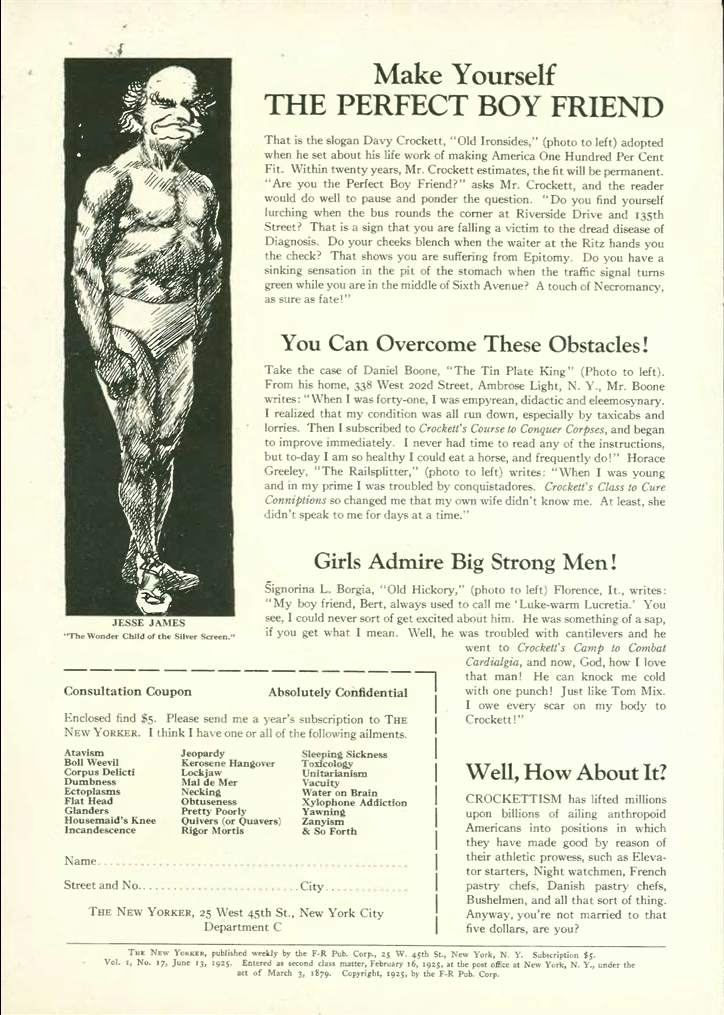
The New Yorker was barely afloat as it entered its first summer, but that didn’t dampen its wit as it fished for new subscribers through humorous full page ads regularly featured in the first issues.
The June 13 issue opened with one such ad that appears to be a parody of a Bernarr Macfadden health and fitness promotion (Macfadden was an influential predecessor to the likes of Charles Atlas and Jack Lalanne). The ad was accompanied by a strange drawing that appears to combine McFadden’s body with–for some reason–William Jennings Bryan’s head:
(New Yorker Digital Archive)
In addition to Mr. Bryan, “Talk of the Town” also offered these observations…Calvin Coolidge’s fondness for his battered felt hat…the modesty of the young golfing star Bobby Jones and his refusal to accept any money beyond barest expenses for an exhibition match at Harvard…an offer by the famed violinist Jascha Heifetz to deliver, upon his return trip from Paris, a Poiret-designed gown for opera singer Cobina Wright for her upcoming Bal Harbor engagement…and a minor money dispute between George Bernard Shaw and the Saturday Evening Post regarding the reprinting of a short story.
Sherwood Anderson (Chicago History Museum)
“Talk” also made hay about “Male Plumage” on display in the city, noting that the last time novelist Sherwood Anderson was in town (he is referred to as “the illustrious revealer of the Middle Western Subconscious”) he wore socks “of a particularly glowing brown bespread with diamond checks of an exceptionally vivid shade of green,” and he sported both brown and red feathers in his brown velour hat. It was noted, however, that this display was outdone by Rudolph Valentino, whose silk house pajamas (worn while receiving visitors at the Plaza in Paris) were of “the most vivid crimson ever accomplished.”
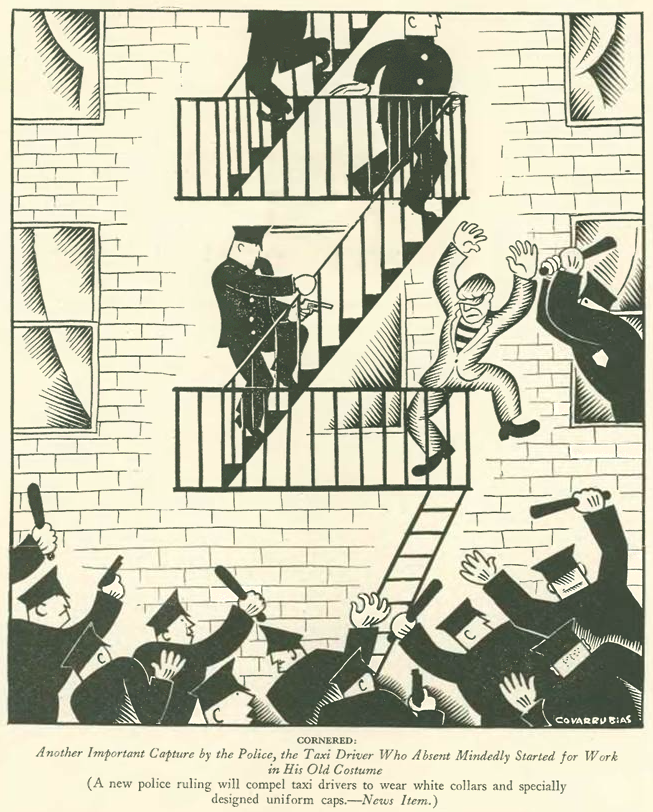
The New Yorker continued its assault on crooked cab drivers with this cartoon by Miguel Covarrubias:
(New Yorker Digital Archive)
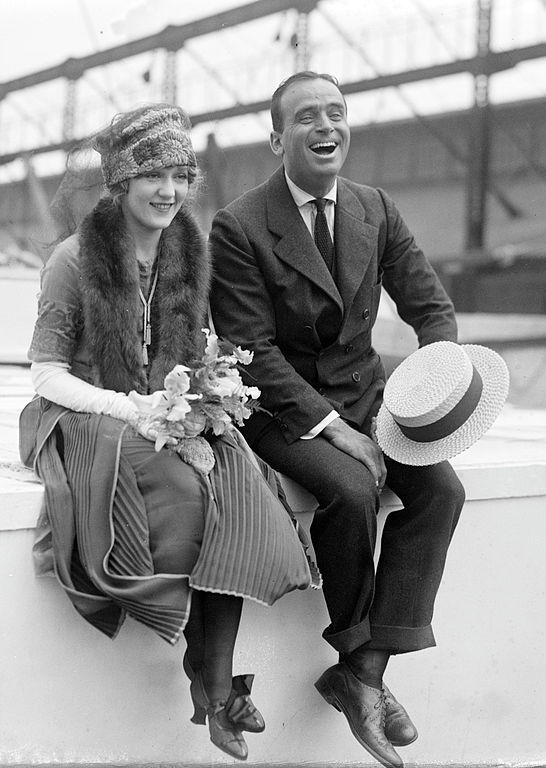
“Of All Things” (written by Howard Brubaker) noted that “The Queen of Rumania and the King of Swat (Babe Ruth) are both writing for the World, but fortunately for us constant readers, low-born newspaper men are still on the job.” It was also noted that silent film idol Mary Pickford “has fallen among bad characters or good press agents.” I have no idea what this refers to. Pickford was married to film star Douglas Fairbanks at the time, and their Hollywood mansion Pickfair was the center of the celebrity universe. The couple played host to heads of state and other dignitaries as well as notables in literature, the arts, and science (Albert Einstein once paid a call).
POWER COUPLE…Douglas Fairbanks and Mary Pickford in the mid 1920s. Pickford, a Canadian-American actress, was one of the 36 founding members of the Academy of Motion Picture Arts and Sciences, and a key figure in shaping today’s Hollywood. The couple formed the independent United Artists along with D.W. Griffith and Charlie Chaplin. (Wikimedia)
German cinema regularly drew favorable reviews in The New Yorker, however Fritz Lang’s Siegfried was called long and arty, “possessing many fine intervals of real beauty…that usually wins the critical adjectives. The average audience will probably be a bit bored at Siegfried’s quest. Tom Mix does this sort of thing with much more verve and snap.”
Colleen Moore in the silent film, The Desert Flower (1925) (IMDB)
And if you think the “Cinderella” story has been made and remade too many times, consider that in 1925 The New Yorker already found the theme wearing thin. A review of the The Desert Flower referred to the film as “just another variation of the Cinderella theme.” It told the story of a waif (Colleen Moore) in a railroad construction in camp who falls in love with the son of the railroad’s president. The reviewer wrote that “probably all of this will be popular. It always has been.”
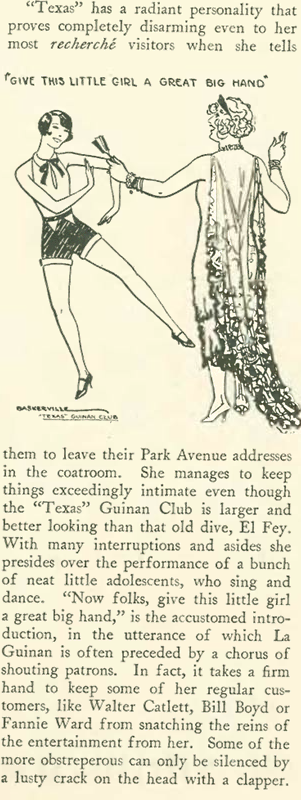
Texas Guinan’s new club proved a be hit, as reported in the feature “When Nights Are Bold.” I last reported on Texas Guinan in my March 18, 2015 post, “A Dry Manhattan,” when prohibition officials put a padlock on her old haunt, the El Fey Club. As we see, things are looking up for the leading lady of New York nightlife…
(New Yorker Digital Archive)
I am guessing this illustration by Covarrubias was an attempt to fill ad space and encourage readership. I guess we will find out soon enough:
(New Yorker Digital Archive)
The issue closes with a satirical piece that appears to poke fun at tenement life, or perhaps at the pretensions of art critics, or both. You be the judge:
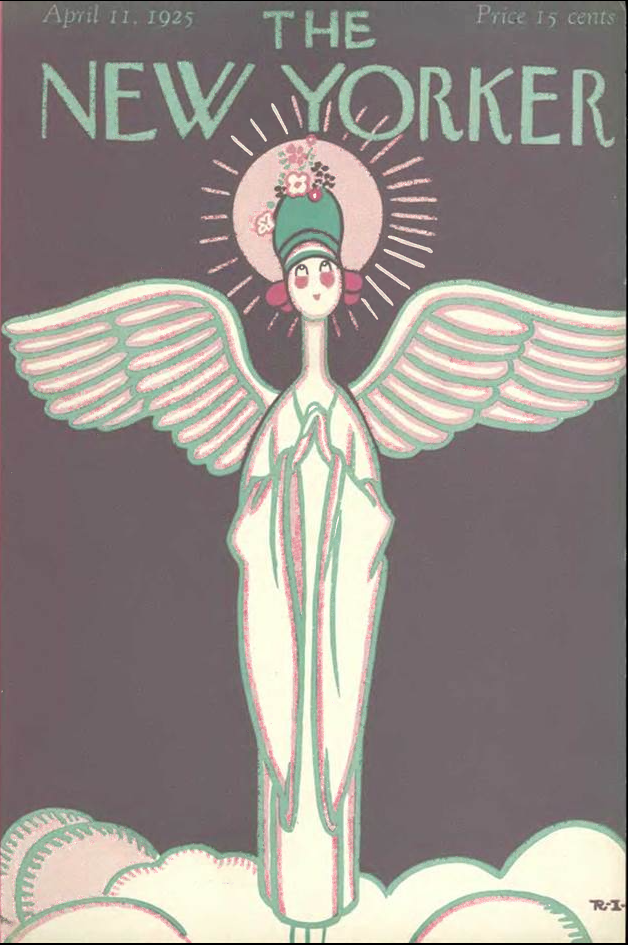
The April 11, 1925 issue of The New Yorker is a bit of a hodgepodge, which is true of most of the early issues that are pretty spotty in terms of content. Much of the writing is heavily embellished with cheeky asides, wordplay and the like.
I should note at this point that although I am reading every page of every issue, including ads, what I represent here is what catches my eye and appeals to my particular sensibilities. It is by no means a comprehensive survey. Nevertheless, I hope that my selections give you a good sense of the content of the magazine, and the context of the times and places where the action occurs.
April 11, 1925 cover by Rea Irvin (New Yorker Digital Archive)
“Talk of Town” opened with rumors of a baby at the Coolidge White House, which proved unfounded. There was also a brief item noting that silent film star Gloria Swanson (who will be prominent in the early issues) was back in the states with her husband, the Marquis de la Falaise de la Coudraie (the marriage ended in 1931, when the Marquis married actress Constance Bennett).
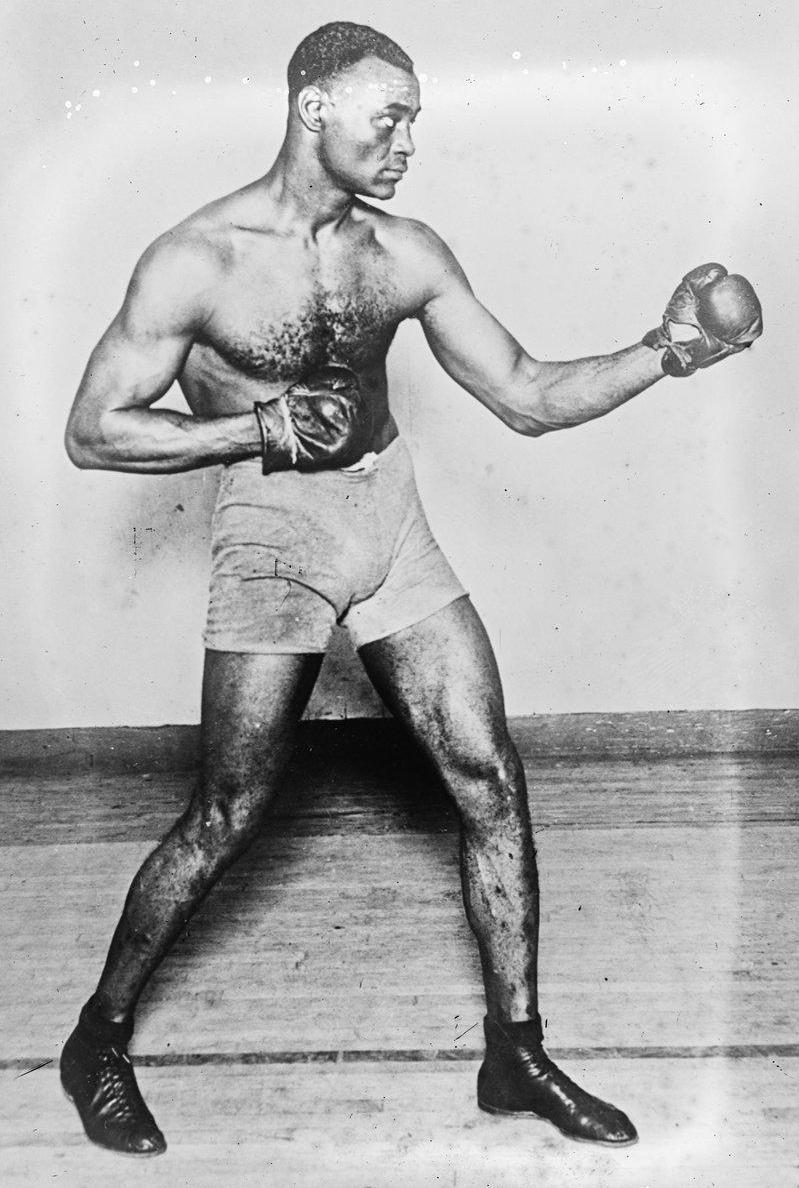
“Talk” also mentioned that a long anticipated boxing match between Harry Wills and Jack Dempsey had hit a snag with the state athletic commissioner.
Harry Wills in 1920 (Wikipedia)
Boxing historians consider Wills one of the most egregious victims of the “color line” drawn by white heavyweight champions. Wills fought for more than twenty years (1911–1932), was ranked a No. 1 challenger for the throne, but was denied the opportunity to vie for the title. He spent six years (1920–1926) trying to land a title fight with Dempsey, who was willing to fight Wills but backed out when he did not receive a $100,000 guarantee from a boxing promoter. Wills filed suit for breach of contract, leading the athletic commissioner to bar Dempsey from competing in the state (Dempsey would later lose in points to Gene Tunney in a Philadelphia bout).
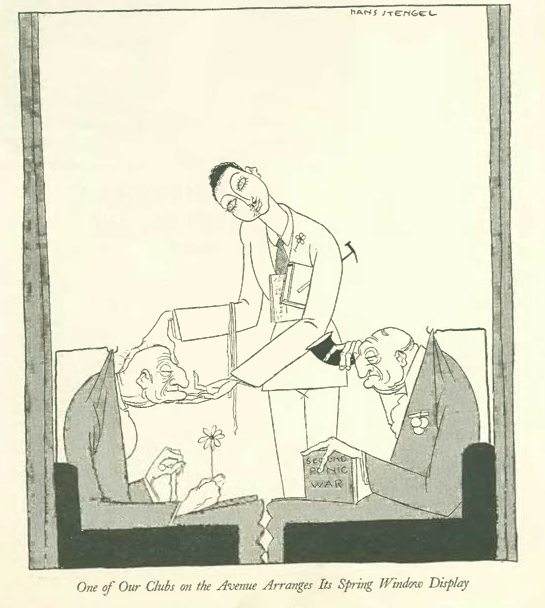
Cartoonist Hans Stengel’s take on upper crust society. The old guard will prove to be a frequent target of subtle jests from the brash young magazine. (New Yorker Digital Archive)
“Talk” offered a brief item on a “new religion” making the rounds, run by A. E. Orage. It noted that he was a disciple of Gurdjieff (and I should add both are offspring of Madame Blatavsky’s Theosophical Society) who “took New York by storm” the previous year. “Talk” said Orage offered classes “in which he intensifies the soul for $10 a month.”
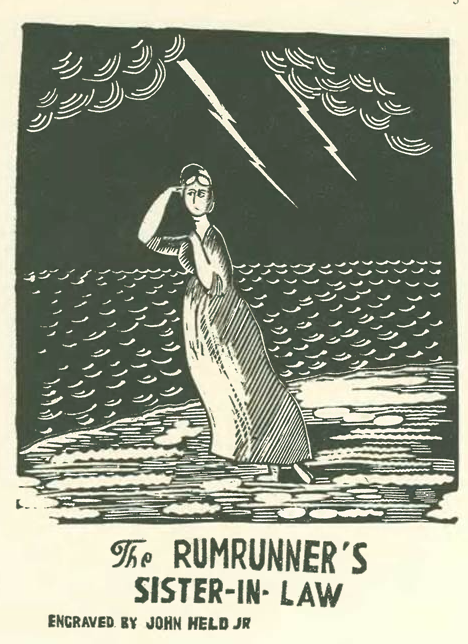
John Held Jr. woodcut in the April 18, 1925 issue. Held was a high school classmate of New Yorker founder Harold Ross when both lived in Salt Lake City. (New Yorker Digital Archive)
The issue also marked the first appearance of darkly-themed woodcuts on various Victorian subjects by John Held Jr. He is perhaps even more famous for his variety of illustrations throughout the 1920s that captured the flapper era, and no doubt why he is still known for his work today.
John Held Jr. cover art for a 1922 short story collection by F. Scott Fitzgerald. (Wikipedia)
“Profile” featured famed birth control rights advocate Margaret Sanger in a piece titled “The Child Who Was Mother to a Woman.” Although “Profile” mentioned her great cause, it was largely focused on her defiance of authority, her championing of free speech (which she inherited from her father, a carver of tombstones), and of her ability as a small, timid woman to overcome the fear of speaking in public.
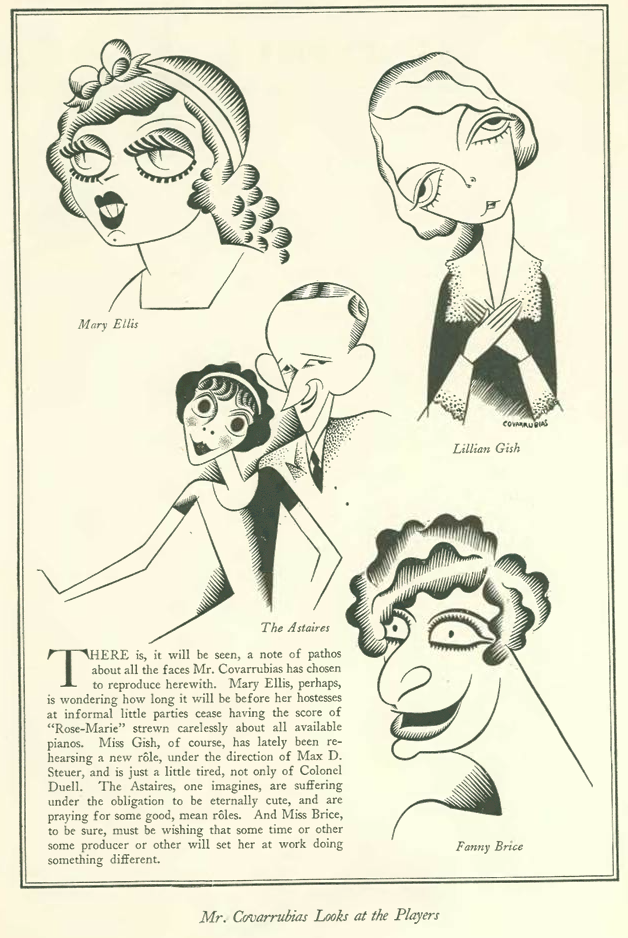
In this issue we are treated to Miguel Covarrubias drawings of contemporary celebrities:
(New Yorker Digital Archive)
The “Motion Pictures” section noted the following: “Texas Guinan, Hard Hearted Hannah and the gals of the El Fey Club (recently padlocked, see my entry “A Dry Manhattan”) moved over to the Famous Players Astoria studios the other day to lend the right color to Allan Dwan’s production, “Night Life in New York.”…unless the censors cut the scenes, Kansas, Iowa and other inland points can glimpse how Manhattan spends its evenings when it isn’t trying to get Havana or Oakland on the radio.”
Famous Players Astoria studios (originally Famous Players-Lasky) was located near the Broadway theatre district. Two Marx Brothers films–The Cocoanuts (1929) and Animal Crackers (1930)–were filmed there. Although Lasky’s Paramount moved the studio operations to California in 1932, the Astoria location continued to thrive, used first by the U.S. Army (beginning in 1942) to make indoctrination films and later by other studios and networks to make everything from music videos, to films (Goodfellas) to television programs (Sesame Street).
The Lasky Players Studio in Astoria, now home to the Museum of the Moving Image. (Museum of the Moving Image)
The “Motion Pictures” section also mentioned that German director F. W. Murnau (perhaps most famous today for the original 1922 Nosferatu) was coming over to direct. The New Yorker observed that “he the most distinguished screen newcomer since Ernst Lubitsch came over.”
German actors and directors featured prominently in early New Yorker reviews. They were drawn to America by artistic opportunity, however. Later actors and directors (and other artists) would come over to flee Nazi persecution.
But then again, readers of the April 11, 1925 issue don’t know that yet.
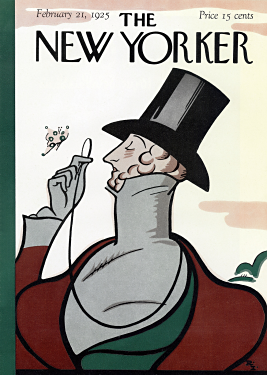
You need not read far into Issue #1 before you realize how utterly distant this world is from our own. Launched in the midst of the Jazz Age, the magazine assumed its readers to be bourgeois (judging from the ads), cosmopolitan, Anglo- and/or Francophile, Ivy- or private school-educated and with enough disposable income to strike the disinterested pose of the cover mascot, Eustace Tilley.
Issue 1, Feb. 21, 1925, cover by Rea Irvin
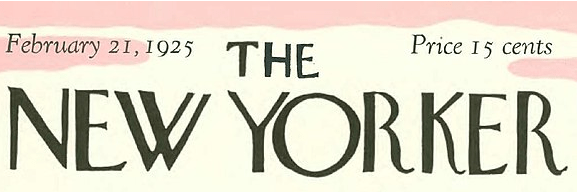
Issue No. 1, Feb. 21, 1925, opened with a section titled “Of All Things,” and these first words:
Right next door to the Follies, some young adventurer has opened a penny peep-show where you can see five hundred and fifty glorified young women for what Mr. Ziegfeld charges for his much smaller collection.
The section concluded with a manifesto by the magazine’s founder and editor-in-chief, Harold Ross, who famously proclaimed, “It has announced that it is not edited for the old lady in Dubuque.”
Harold Ross (theharlow.net)
There is scant advertising in the slim first issues (No. 1 is just 32 pages plus cover). In an article written for the 90th anniversary issue (Feb. 23, 2015), Ian Frazier explains how it was first funded:
After returning to the States, in 1919, he (Ross) edited a short-lived version of Stars & Stripes for veterans and became a New York night-life figure known for carrying around a dummy of his still unnamed magazine and talking about it endlessly. When he finally published the first issue of The New Yorker, ninety years ago, he paid for it partly himself. Nearly half the magazine’s original funding was a twenty-one-thousand-dollar stake put up by Ross and his wife, Jane Grant, and their friend Hawley Truax. Raoul Fleischmann, a baking heir and almost millionaire whom Ross had met through mutual friends, supplied another twenty-five thousand.
Ross’s involvement in World War I figured prominently in the origins of the New Yorker. It was during his time at Stars & Stripes that he met Alexander Woollcott, who was already an established New York theater critic.
Jane Grant (Wikipedia)
At this time Ross also met Jane Grant, who was serving in the YMCA entertainment corps and was a frequent visitor to the Star & Stripes offices. Although Ross’s name looms large in most accounts of the early New Yorker, Grant played a major role in its conception and launch.
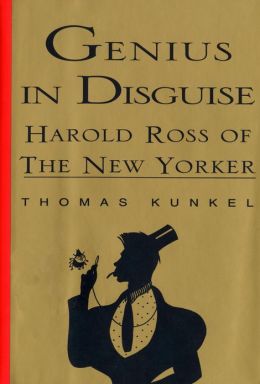
I highly recommend Thomas Kunkel’s Ross biography, Genius in Disguise, for a complete account of the magazine’s early days.
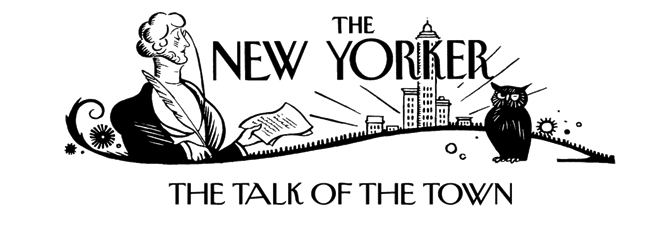
It took a few issues for the editors to sort out regular features and their order of appearance. The opening section of Issue No. 1 featured the famous Rea Irvin masthead—flanked by Eustace Tilley and the night owl—and Irvin’s distinctive typeface that would introduce “The Talk of Town” for many issues to come. However in Issue No. 1 “Of All Things” appeared under the masthead, followed by “Talk of the Town” which was (for the first and last time) under this banner:
The magazine’s second issue, Feb. 28, paired the Eustace Tilley masthead with “The Talk of the Town” for its opening section, but the March 7 issue paired it with “Behind the News” for the opening section.
With the March 14th issue, the editors decided to permanently install “The Talk of the Town” below the masthead in the lead section, relegating “Of All Things” and “Behind the News” to inside pages.
For the sake of comparison, here is the current 2015 version:
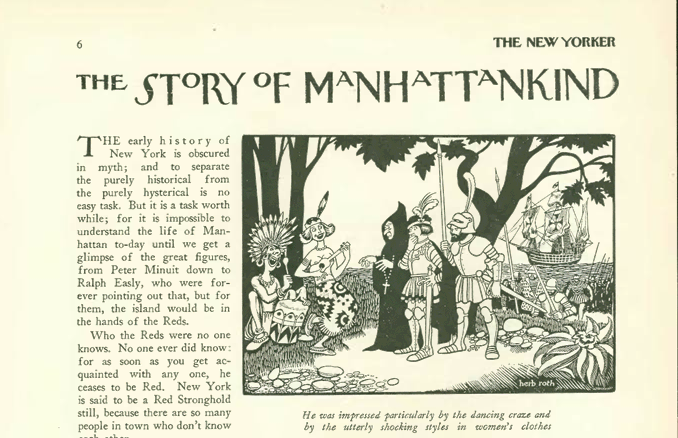
A number of short-lived regular features made their appearance in these early issues: “The Story of Manhattankind” offered drawings by Herb Roth and tongue-in-cheek accounts of early Manhattan life that featured cartoonish Indians and bumbling settlers. It is here where the magazine took its first of many shots at William Randolph Hearst, perceived rival and publisher of Cosmopolitan (more of a literary magazine in 1925, and not the sex tips and cleavage rag it is today).
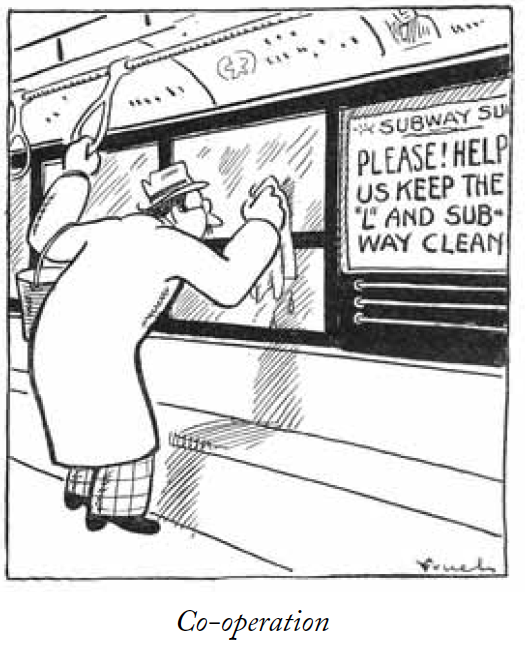
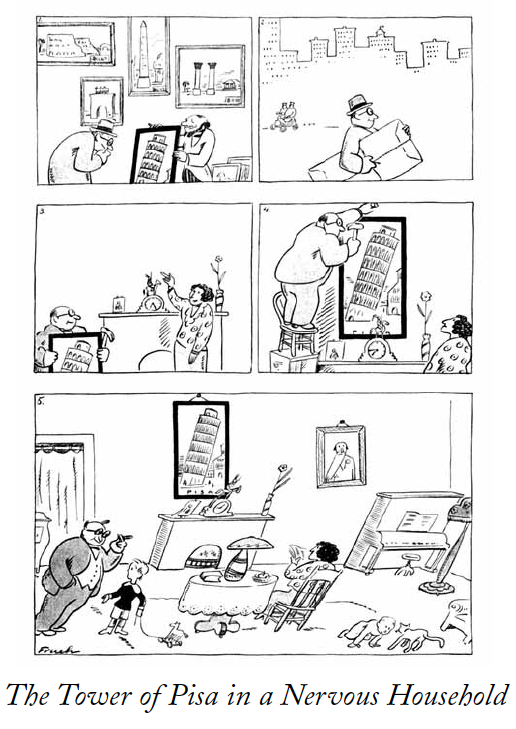
The first two cartoons ever featured in the New Yorker were by Al Frueh:
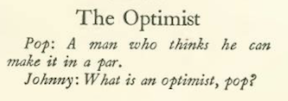
This recurring column filler, “The Optimist,” began in Issue No. 1, a tired joke featured repeatedly in the first issues until Katharine Angell came on board and put an end to such nonsense…
“Profiles” were established at the start, the first issue featuring opera maestro Giulo Gatti-Casazza, the second issue taking aim at “Princess” Alice Roosevelt Longworth, and the third issue probing New York Times managing editor Carr Vatell Van Anda. “In Our Midst” featured local celebrity sightings and gossip, such as actress Tallulah Bankhead and writer Edna Ferber in Issue 3 (March 7).
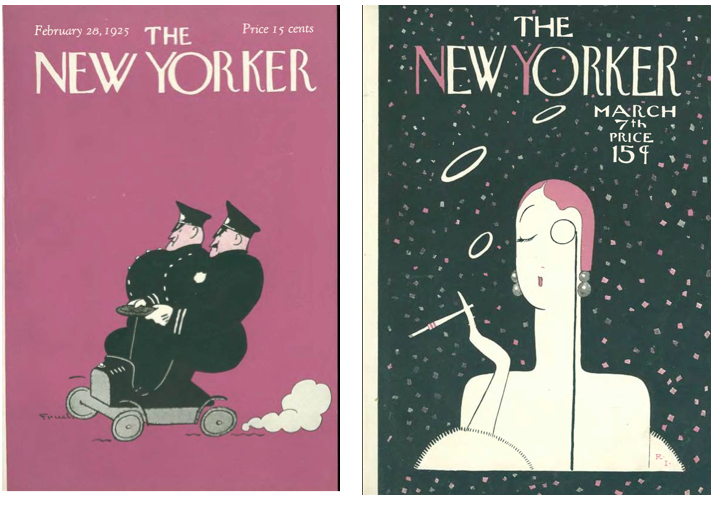
New Yorker Issues 2 & 3, Feb. 28 (cover by Al Frueh) and March 7 (cover by Rea Irvin), 1925.
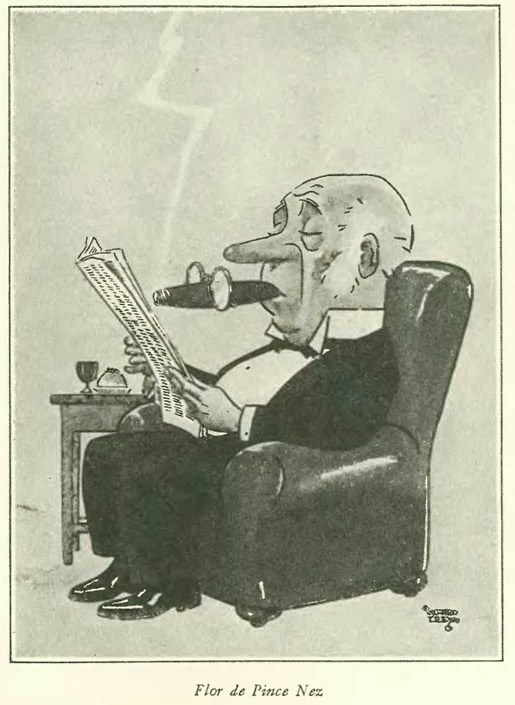
Most of the cartoons from the very beginning were famously droll, such as this illustration by British graphic artist Alfred Leete, who was a regular contributor to such British magazines as Punch, the Strand Magazine and Tatler.
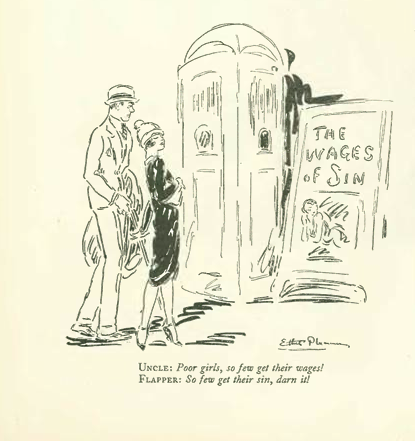
…but a few cartoons recall an earlier style in which the action is captioned (like old Punch cartoons) in a more formal manner. The first issue featured an Ethel Plummer cartoon of an “uncle” and a “flapper” looking at a theater bill for The Wages of Sin:
Uncle: Poor girls, so few get their wages.
Flapper: So few get their sin, darn it!
A section titled “The Hour Glass” offered short, casual accounts of various local personalities. “Lyrics from a Pekinese” was another recurring feature by writer Arthur Gutterman, who was known for his silly poems.
Music reviews in early issues were almost entirely devoted to classical, live performances. Fritz Kreisler’s violin mastery was featured prominently in the first issue, while it wasn’t until the third issue that jazz was briefly mentioned (it was becoming “respectable” in some concert halls). It was reported that violinist Damuel Dushkin ended his performance with selections from George Gershwin’sRhapsody in Blue.
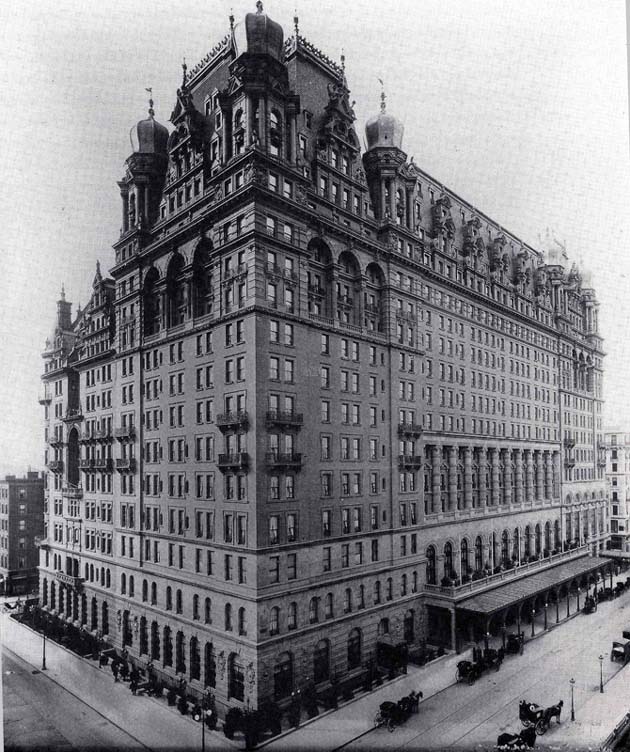
The “Art” section featured an exhibition of British paintings at the Central Art Galleries, and a show by the Society of Independent Artists (paintings sell from 24 to 99 dollars), at the Waldorf Hotel (soon to be razed and replaced by the Empire State Building). Joseph Stella was at the Dudensing Galleries, described as a “gifted young American.”
Old Waldorf-Astoria, razed in 1929 to make way for the Empire State Building (nycago.org)
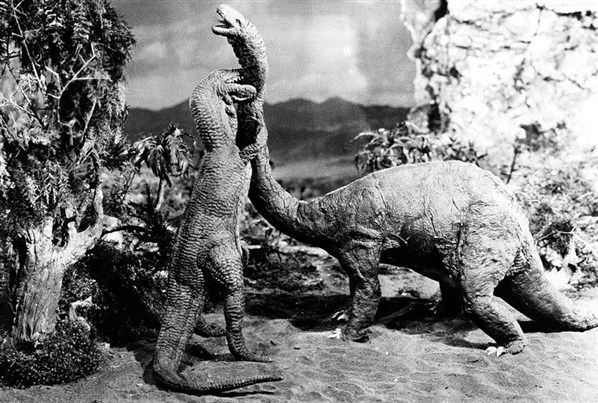
“Motion Pictures” looked at Greed (Frank Norris’sMcTeugue transferred to the screen), which was playing on the Loew Circuit; The Lost World at the Astor (“Through camera trickery, dinosaurs and other beasts of the prehistoric past live again. Interesting because it proves that the camera is a liar”); the “splendid” German-made The Last Laugh by Carl Mayer (of Dr. Caligari fame) and The Salvation Hunters by Josef Von Sternberg. The magazine called it “deadly monotonous”…”the characters just sit around and think.” German actor Emil Jannings was a favorite, and would be lauded in subsequent issues.
Still image from The Lost World, 1925 (Wikipedia)
The first issue closed with an ad from Royal Cord Balloon Tires. Later issues would depend heavily on advertising revenue from auto manufacturers.
The early issues also featured two-page-drawings that illustrated some event described in the opening section. The Feb. 28 issue (#2), mentioned that Ciro’s opened with the Mary Hay and Clifton Webb dancing team (illustration by Reginald Marsh)…
As this was the age of Prohibition, there was a notable absence of alcohol in ads and even in print articles, although references are made to “speakeasies” and later issues would report black market prices for liquor.
The second issue’s “Talk of the Town” further elaborated on the magazine’s manifesto:
And we won’t aim to please. If we happen to please we will not apologize, but we are not in the vast army of bores struggling frantically to give people what they want.
We may not do much for the magazine world. We don’t know that we’re aiming to. But of one thing we feel quite sure: if we ever run out of things to say, just for the fun of saying them, we expect to close up this little playhouse and go to work.
The “Theatre” section of Issue No. 2 featured James Joyce’sExiles at the Neighborhood Theatre, while a section titled “And They Do Say” featured the first (of the many subsequent references) to Eddie Cantor’s various comings and goings. It was reported Cantor left for Boston in his “Kid Boot” and that altercations between Cantor and veteran stage actress Jobyna Howland “kept 42nd Street nervous for weeks.”
Eddie Cantor and Jobyna Howland (Wikipedia, Travalanche)
“Books” featured a review of Ford Madox Ford’s “Some Do Not…” The reviewer Harry Este Dounce (under the nom de plume “Touchstone”) called it “as gratuitously black-biled a work of art as we ever saw.”
Under “Washington Notes” were the first of many humorous references to President Calvin Coolidge, his hayseed habits and his extreme frugality. Below, a drawing by Miguel Covarrubias (a regular contributor beginning with the first issue) in March 14 issue:
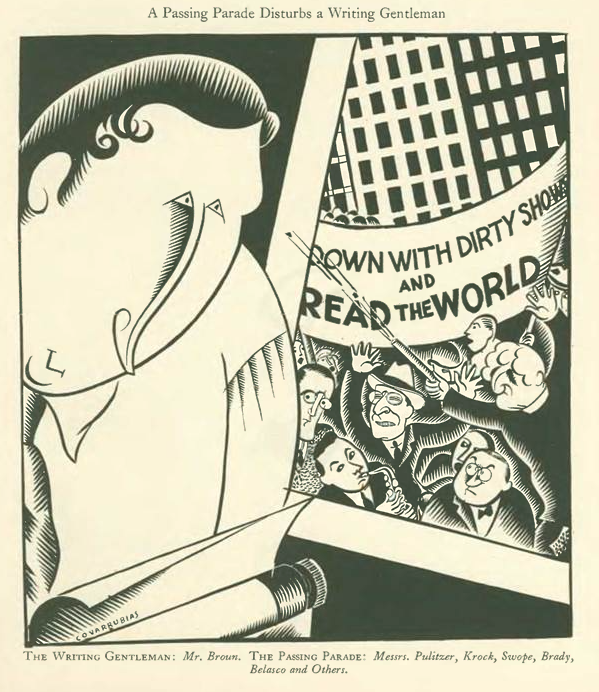
Another Covarrubias illustration in Issue # 3 (March 7) depicted journalist Heywood Broun (old Ross friend and Algonquin Round Table stalwart) hard at work on his column for the New York World:



























 A New Yorker State of Mind