The Last Laugh

Screen Shot 2015-09-06 at 12.02.47 PM
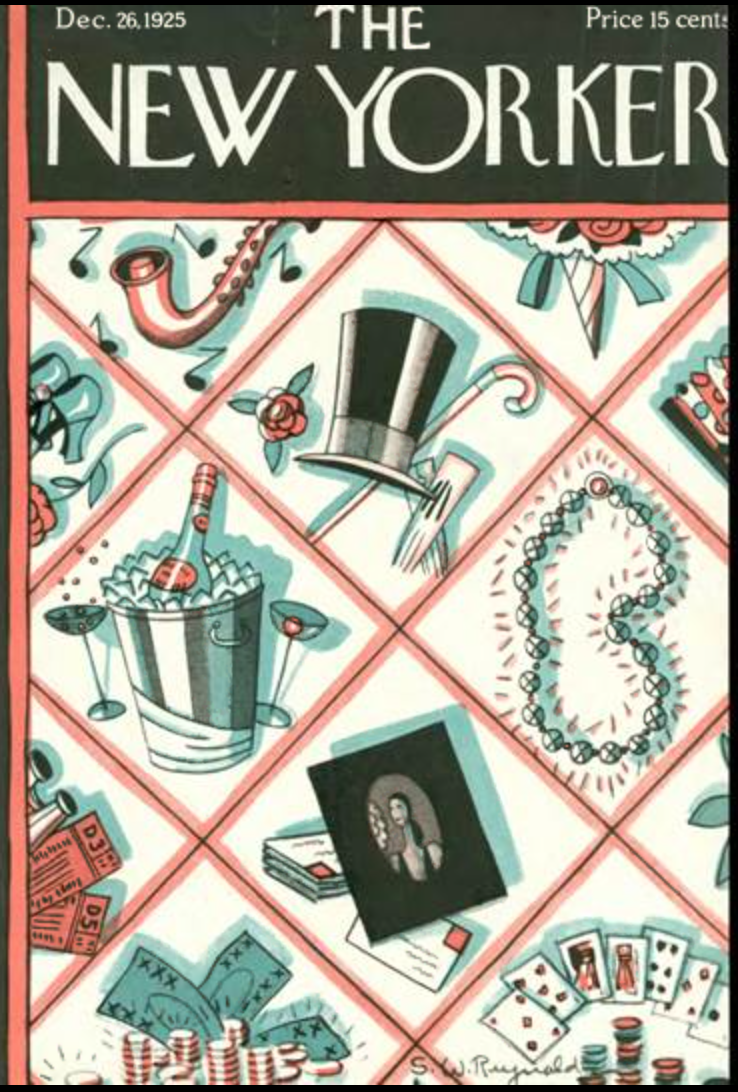
Dec. 26, 1925 cover by S.W. Reynolds

We close out The New Yorker’s first year with the magazine on firmer footing and many of its mainstay writers and artists firmly in place.

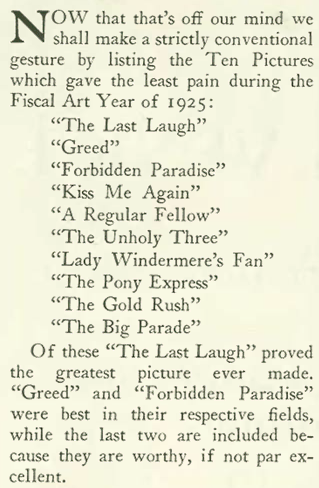
The Dec. 26, 1925 issue was the usual hodgepodge, but some writers did give a nod to the end of the year, including film critic Theodore Shane, who offered his list of the best ten moving pictures of 1925.

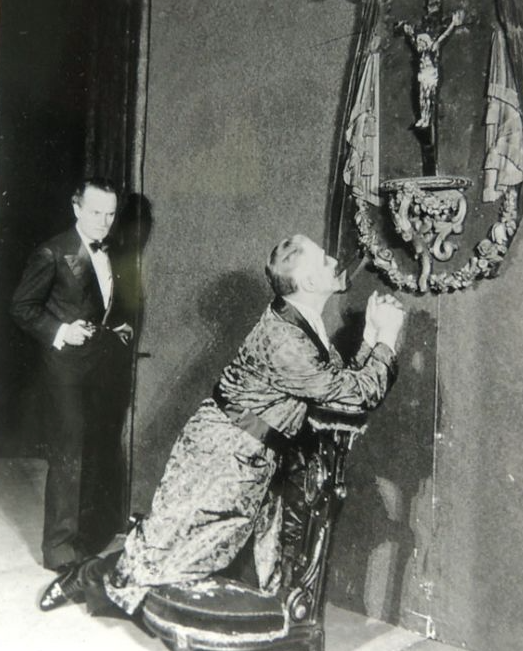
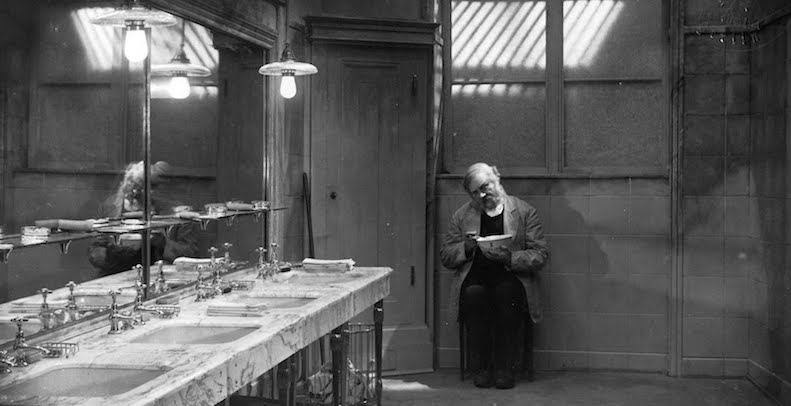
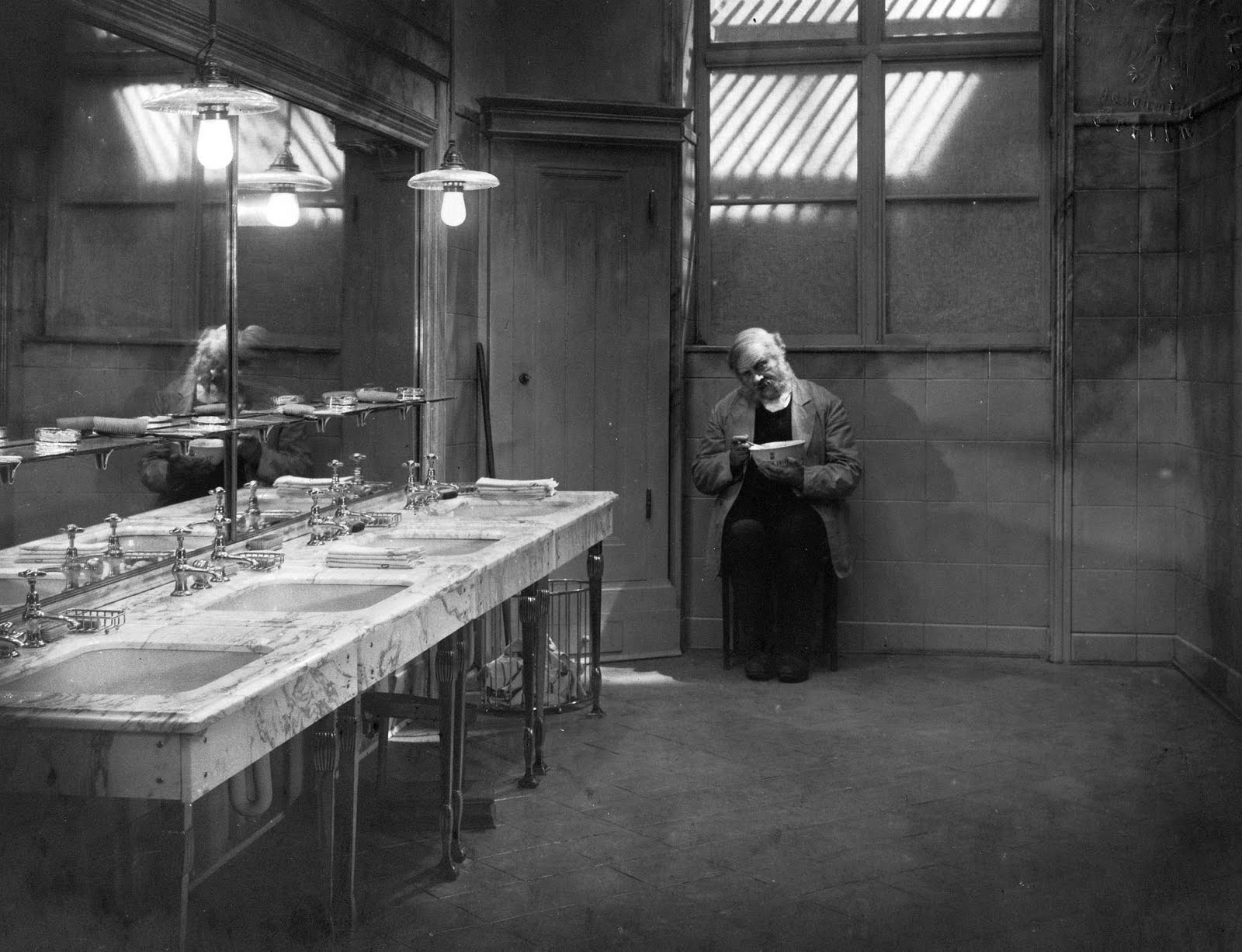
Shane’s favorite film by far was The Last Laugh, (the German title was Der letzte Mann, or The Last Man) a 1924 German film directed by F.W. Murnau and starring Emil Jannings (who would later win the first Academy Award for Best Actor in 1929). Shane referred to it as “the greatest picture ever made.” Released in the U.S. in 1925, the film was about a proud doorman who loses his job and tries to hide the fact from his friends and family. Shane usually reserved his highest praise for German cinema in his columns.
derletztemann2
Scene from The Last Laugh (1924) starring Emil Jannings. (Roger Ebert)

Shane’s complete list of the ten best movies of 1925:
Screen Shot 2015-09-09 at 12.26.59 PM

For the worst films of the year, Shane suggested a tie between Drusilla With a Million, Lord Jim, Joanna, the Million Dollar Girl or Stella Dallas.

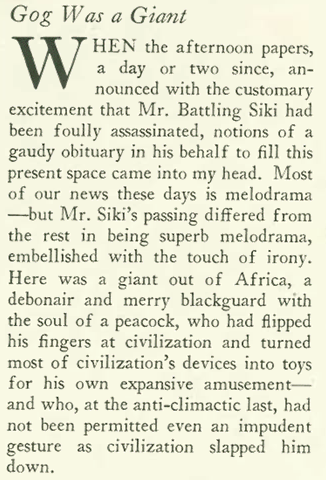
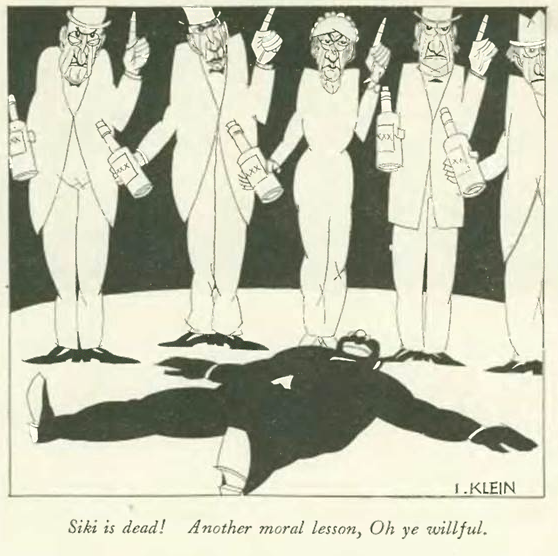
The New Yorker also commented on the murder of the irrepressible boxer Louis Mbarick Fall, popularly known as “Battling Siki.”

BattlingSiki
“Battling Siki” in his heyday. (Wikipedia)

Born in Senegal, he was a light heavyweight boxer from 1912–1925, and briefly reigned as a light heavyweight champion. Known for his heavy drinking and carousing, on the night of Dec. 15, 1925, he was found dead near his 42nd Street apartment. He had been shot twice in the back at close range. He was 28.

In his column, “A Reporter at Large,” Morris Markey offered this observation on Battling Siki’s passing:
Screen Shot 2015-09-09 at 12.47.15 PM

The cartoonist Isadore Klein, on the other hand, contributed this strange stand-alone illustration for “The Talk of the Town” section:
Screen Shot 2015-09-08 at 11.50.02 AM

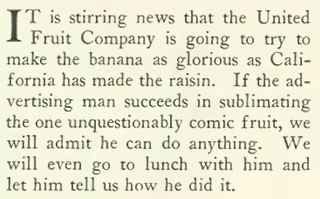
Also in “Talk” was this brief item about the United Fruit Company:
Screen Shot 2015-09-08 at 11.40.53 AM

United Fruit would be no laughing matter three years later with the Banana Massacre, which would claim the lives of an unknown number of workers who were striking for better working conditions in Columbia.

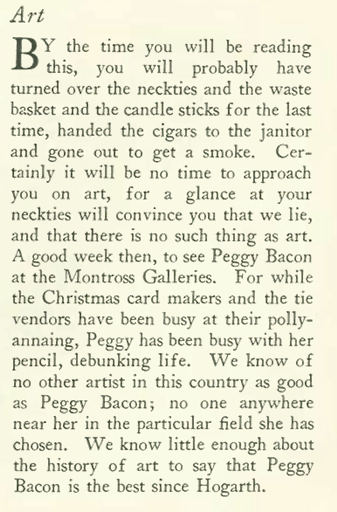
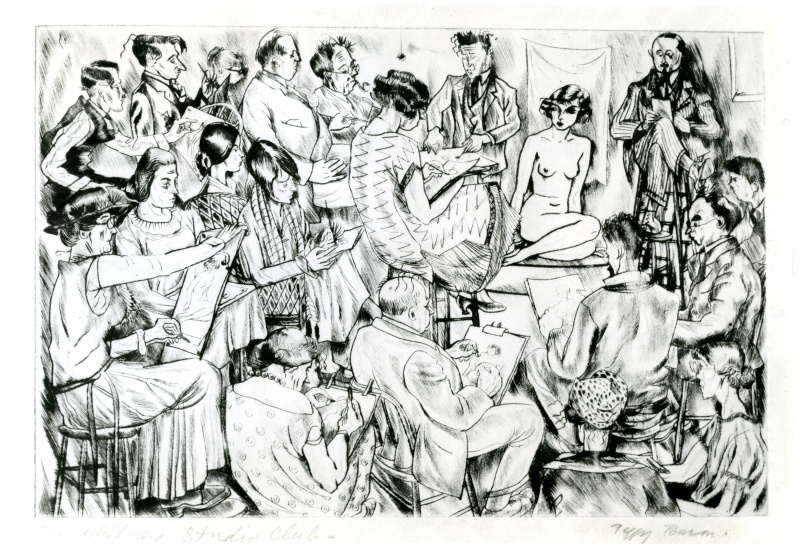
Art critic Murdock Pemberton offered a glowing review of an exhibit at the Montross Galleries by frequent New Yorker contributor Peggy Bacon:
Screen Shot 2015-09-09 at 12.19.40 PM

cc2_1540
Peggy Bacon, The Whitney Studio Club, 1925. (Whitney Museum of American Art)
Peggy_Bacon,_American_painter,_illustrator_and_printmaker,_1895-1987
Peggy Bacon (Smithsonian)

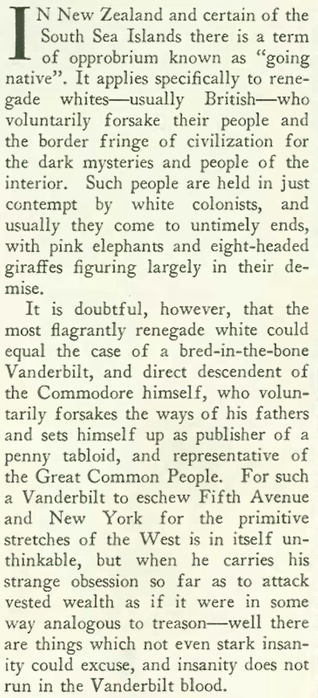
“Profiles” looked at Cornelius Vanderbilt Jr, “The Fifth Avenue Maverick.” William Boardman Knox wrote that the young Vanderbilt “is as alien to his blood as a marmoset to a gorilla.”
Screen Shot 2015-09-09 at 12.45.35 PM

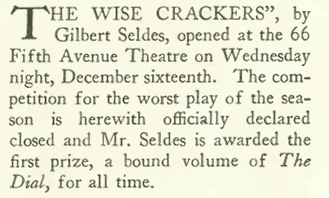
In the “The Theatre,” critic Herman J. Mankiewicz pulled no punches when he declared Gilbert Seldes’ play The Wise Crackers “the worst play of the season” (Seldes was himself a noted critic and sometime New Yorker contributor):
Screen Shot 2015-09-09 at 12.15.09 PM

What’s more, the play was about a group of literate New Yorkers who gather to exchange witty barbs and sarcastically comment on the doings of the day. In other words, it was inspired by the Algonquin Round Table, which famously included Mankiewicz as a member.

Another Round Table notable was Robert Benchley, who contributed this piece for the last issue of the year:

Screen Shot 2015-09-09 at 12.39.48 PM

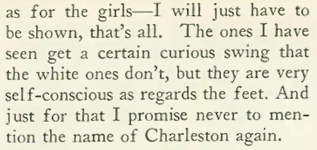
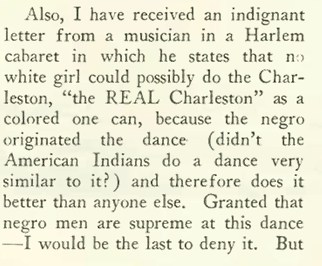
Lois Long offered her regrets for ever bringing up the subject of “The Charleston:”
Screen Shot 2015-09-21 at 6.19.44 PM

Screen Shot 2015-09-21 at 6.20.17 PM

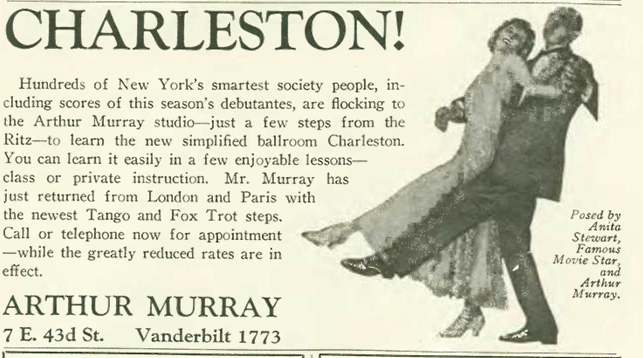
And just a few pages over, lessons were advertised for…The Charleston!
Screen Shot 2015-09-09 at 12.34.19 PM

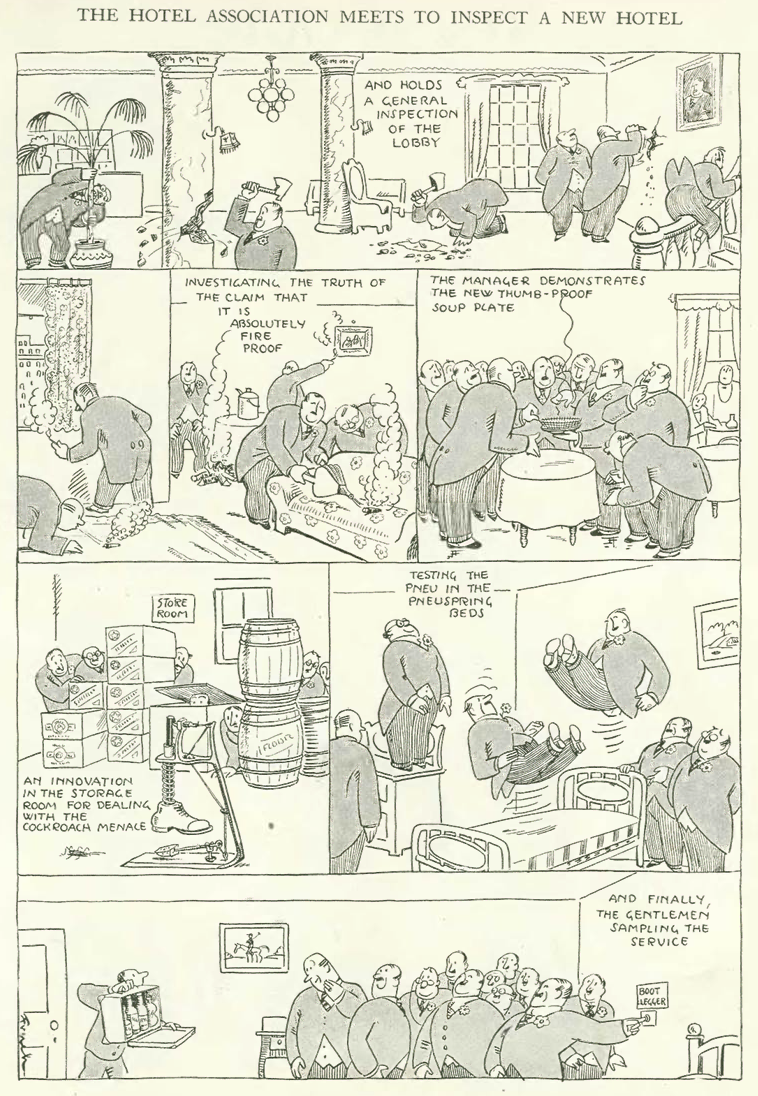
And to close, here’s a little fun with hotel inspectors, courtesy of Al Frueh:
Screen Shot 2015-09-21 at 12.52.41 PM

Next Time: Fun in the Sun…
Screen Shot 2015-09-09 at 12.47.57 PM

Party With Gentleman Jimmy

Screen Shot 2015-07-23 at 12.08.59 PM
Nov. 21, 1925 cover by Stanley W. Reynolds.

Mayor Jimmy Walker wasn’t known for being cerebral. But as the voters’ choice to lead the City of New York, he could not have been more well-suited (pun intended) to the zeitgeist of the final, dizzying, roaring years of The Jazz Age.

Walker was a flamboyant man-about-town, a clothes horse who was no stranger to speakeasies or the backroom politics of Tammany Hall.

As Jonathan Mahler wrote in New York magazine (April 1, 2012), Gentleman Jimmy “perfectly embodied that moment of indulgence: the public servant who favored short workdays and long afternoons at Yankee Stadium, who was loath to miss a big prizefight or Broadway premiere, who left his wife and Greenwich Village apartment for a chorus girl and a suite at the Ritz-Carlton.”

Not that there weren’t some concerns. “The Talk of the Town” offered this early observation of the incoming mayor:

Screen Shot 2015-07-24 at 9.38.52 AM

Screen Shot 2015-07-24 at 1.01.10 PM
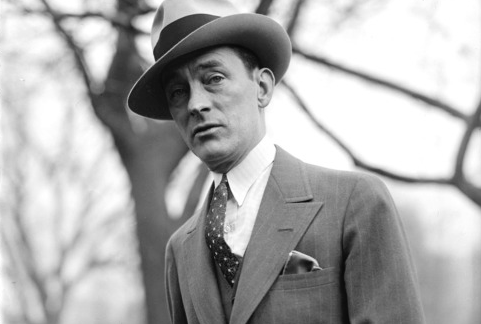
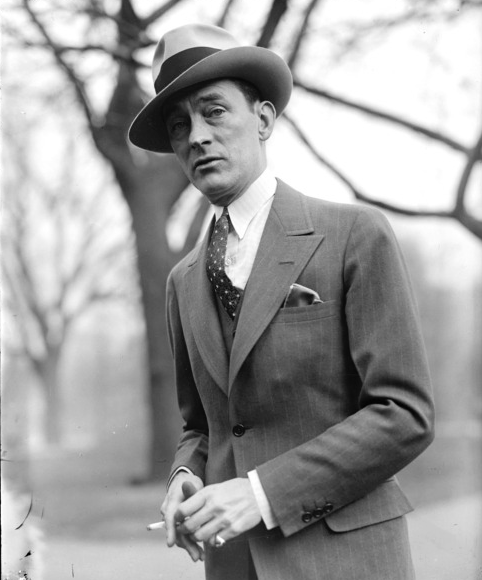
New York City Mayor Jimmy Walker during a visit to Boston. (Boston Public Library)

Mahler quoted a columnist from Walker’s time, who noted that “No man could hold life so carelessly without falling down a manhole before he is done.” And Walker would fall to scandal by 1932. But we will get to that. For now, it’s party time in Gotham.

The New Yorker continued to have fun with President Calvin Coolidge, publishing this cartoon by Isadore Klein that took a poke at Coolidge’s Thanksgiving Day Proclamation, in which Coolidge spoke at length about the nation’s abundance:

Screen Shot 2015-07-24 at 9.51.44 AM

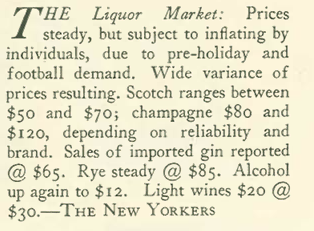
Talk also reported the latest bootleg prices in “The Liquor Market…”

Screen Shot 2015-07-24 at 9.52.59 AM

“Profiles” examined the life of New York Times owner Adolph Ochs. The writer Elmer Davis observed that “More than any other newspaper owner, he is his paper, and his paper is himself…”

Screen Shot 2015-07-24 at 12.23.11 PM
Detail from a lantern slide depicting Basil Sydney as Hamlet and Charles Waldron as Claudius in the Booth Theatre’s 1925 production of Hamlet in “modern dress.” (Graphic Arts Collection, Princeton)

In “The Theatre,” critic Herman J. Mankiewicz addressed criticisms of the Booth Theatre’s new approach to Hamlet, which was presented “in modern dress.” Mankiewicz wrote that the departure from traditional Elizabethan costumes had brought the play “into the open,” and that Basil Sydney was a “splendid” Hamlet.

In “Books,” reviewer Harry Este Dounce recommended Ford Madox Ford’s No More Parades (“a fine display of virtuoso writing”) and Arthur Schnitzler’s Fraulein Else (“a scintillant little firework”).

tumblr_mqej7s8XOl1qzx4bjo1_1280
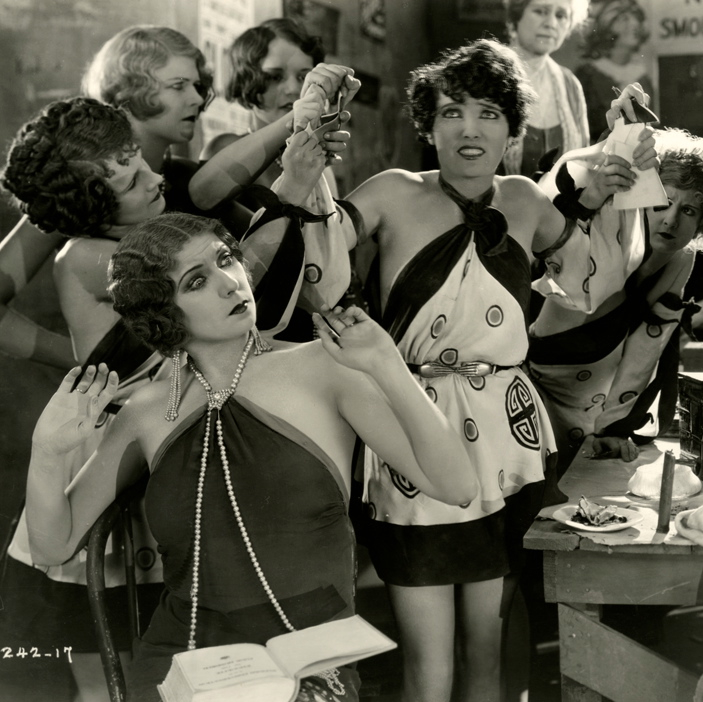
Lilyan Tashman, left, and Pauline Starke in Robert Z. Leonard’s Bright Lights, 1925 (Tumblr)

In “Motion Pictures,” Theodore Shane panned the movie Lord Jim (based on the Joseph Conrad novel), but he enjoyed the “simple hokum tale” of Bright Lights and the “restrained” performance of Pauline Starke, “a perfect miniature Gloria Swanson.”

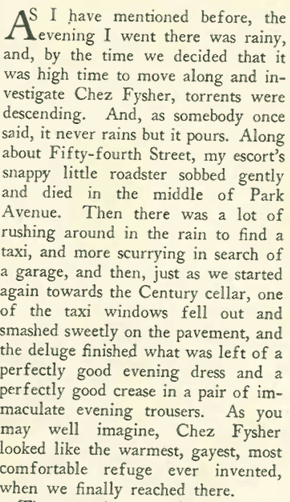
In “Tables for Two,” Lois Long despaired of finding a decent “swank dinner” on a rainy autumn evening, and finally headed to a Viennese restaurant (Frau Greta’s) for some German comfort food. The rain turned to torrents as she then headed out for some nightlife:

Screen Shot 2015-07-24 at 10.19.47 AM

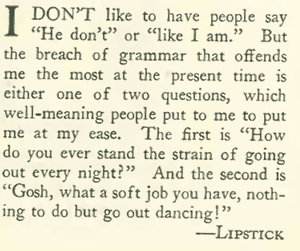
Long concluded her “Tables” column with this peevish note on “grammar:”

Screen Shot 2015-07-24 at 10.21.43 AM

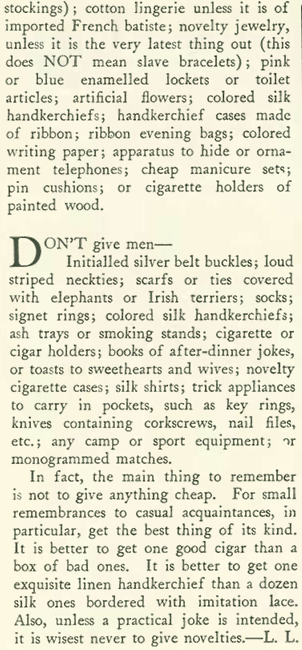
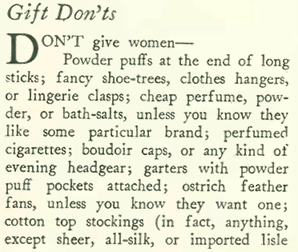
In her other column, “On And Off The Avenue,” Long wrote about the increasing popularity of New Yorkers traveling to Florida for the winter, and in anticipation of the Christmas holiday, offered this advice on what not to give as gifts:

Screen Shot 2015-07-24 at 10.27.34 AM

Screen Shot 2015-07-24 at 10.27.47 AM

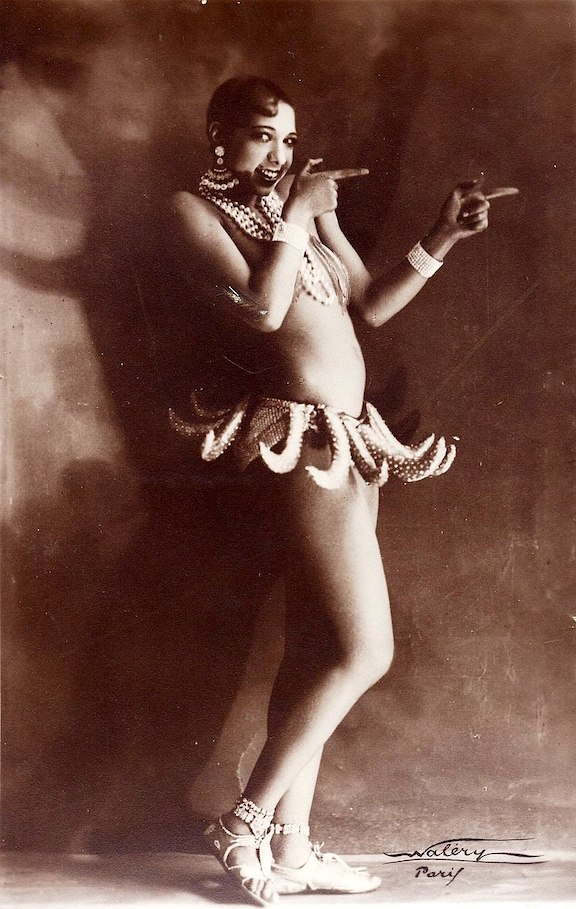
In her report from Paris, Janet Flanner commented on the popularity of Josephine Baker at the Champs Elysees Theater:

Screen Shot 2015-07-24 at 12.09.00 PM

Josephine Baker in 1927. (Wikimedia Commons)

Flanner also commented on the growing appreciation of paintings by Henri Rousseau, who just a decade or so earlier was considered something of a joke among art circles:

Screen Shot 2015-07-24 at 12.09.43 PM

60.1583
Henri Rousseau’s The Football Players, 1908. Today even Rosseau’s lesser-known works are valued in the millions (Wikimedia)

And finally, Julian de Miskey’s take on The Big Game:

Screen Shot 2015-07-24 at 9.58.04 AM

Next Time: A Debutante’s Diatribe…

Screen Shot 2015-07-24 at 9.36.48 AM


Amateur Beauty

Screenshot 2015-06-24 16.52.50
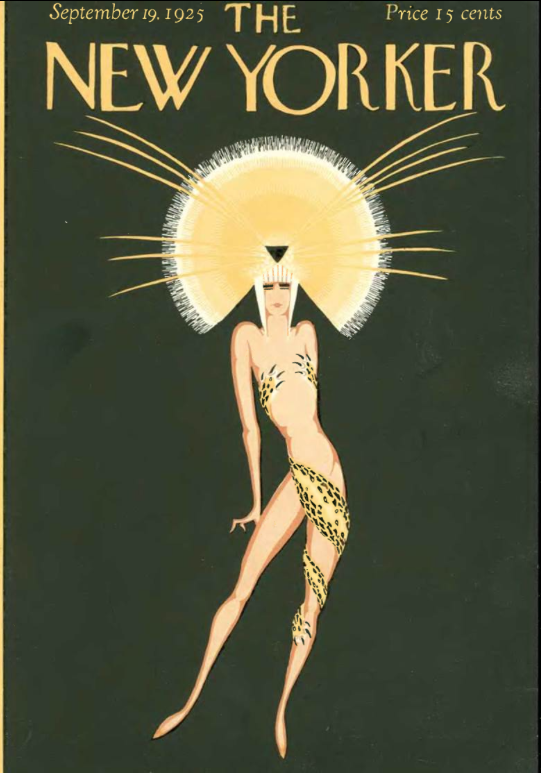
Cover for Sept. 19 by Max Ree.

It was a busy week for the Sept. 19 issue of The New Yorker. “The Talk of the Town” reported that ‘amateur beauties” at the Atlantic City Beauty Pageant (known today as the Miss America Pageant) were “protesting against the presence of professional sisters in the contest.” Talk then posed this question:

“Is beauty, one wondered, ever amateur? Is it not the most professional of all professional matters? To a man it would seem so. But women may know better. And if there is a distinction—if we are to have amateur and professional beauties—why should not the Atlantic City promoters take a leaf from golf’s book and hold an open championship, wherein the two classes may meet?

Talk concluded:

The winner of last year’s beauty contest, Miss Ruth Malcomson, tells how she won it in a recent issue of Liberty; and from these writings we leap hastily to the conclusion that the very beautiful are also very very simple.

Miss America 1924 - Ruth Malcomson (1)
Ruth Malcomson, Miss America 1924. (Vintage Everyday)

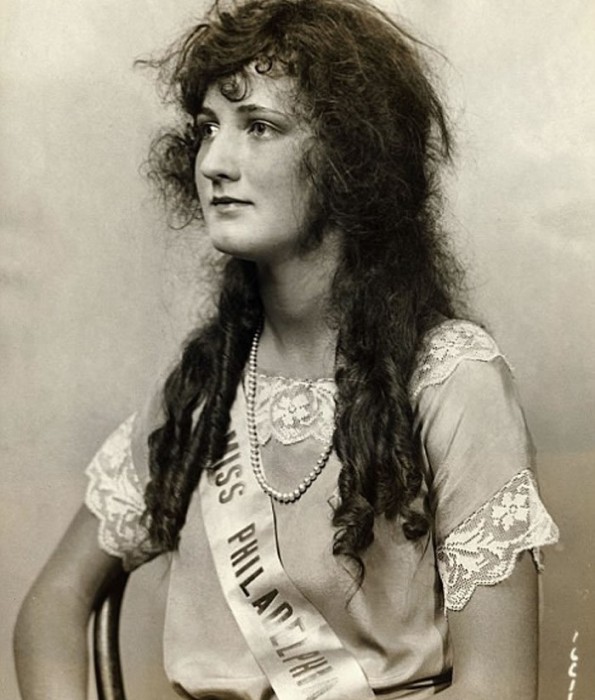
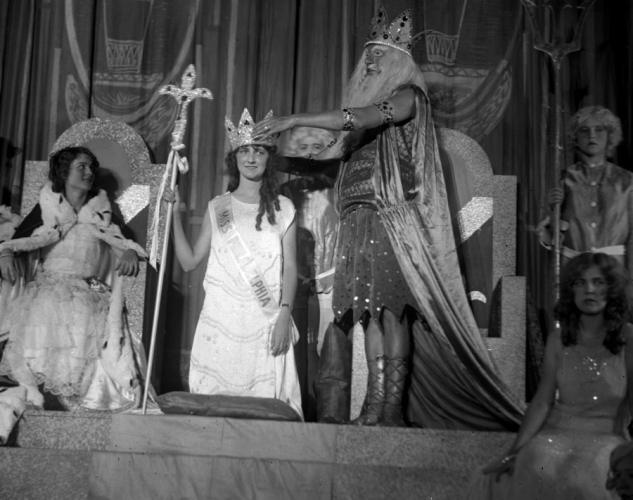
“Talk” was right about Ruth Malcomson, who was just 18 when she won the title. A native of Philadelphia, she defeated 85 fellow contestants including incumbent Mary Campbell, who was seeking her third consecutive crown. At the time the contest was only in its fourth year, and the winner was called “The Golden Mermaid.”

Miss America 1924 - Ruth Malcomson (3)
Malcomson crowned “The Golden Mermaid,” Miss America 1924

Malcomson was among the critics of the “professional” contestants. According to her obituary in the Philadelphia Inquirer (May 28, 1988) Malcomson stated in 1925 that “The pageant now has become nothing but a commercial proposition to exploit the beauties who make their living from their good looks. What chance has an ordinary girl, untrained, to win a contest in which girls who have been trained to make the most of their beauty are competing?”

miss-america-e1410754333210
Ninety-one years later…Miss New York Kira Kazantsev crowned Miss America 2015. (The Blaze)

In her Liberty Magazine interview, she also blasted women’s groups for berating her involvement in the competition.

Malcomson hinted that the women’s groups were exploiting her, not the pageant (yes, there is nothing new under the sun…).

True to her word, Malcomson married an unassuming Carl Schaubel in 1931 and returned to a quiet, simple life in suburban Philadelphia.

Miss America 1924 - Ruth Malcomson (5)
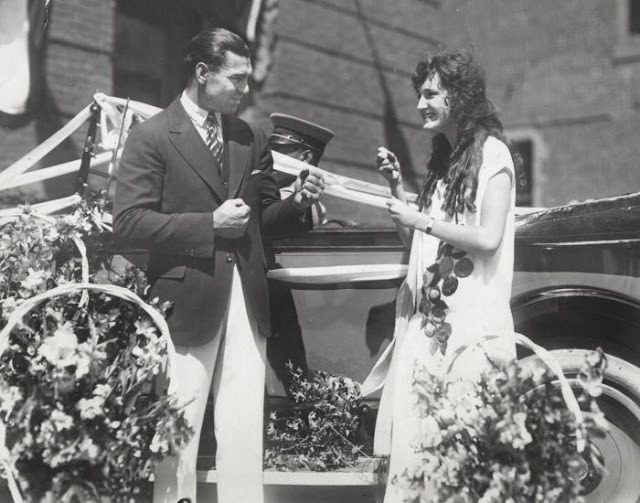
Standing next to the Rickenbacker car she won as Miss America in 1924, Ruth Malcomson playfully spars with World Heavyweight Champion boxer Jack Dempsey. (Vintage Everyday)

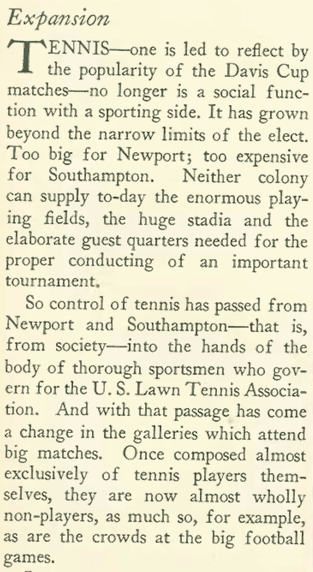
In other “Talk” items, the “No Smoking” rule at the public library was challenged, and arguments were made for special smoking rooms that could be reserved for writers. The column also offered comment on the growing popularity of tennis as a professional spectator sport, rather than merely a side activity for a society weekend:

Screenshot 2015-06-26 13.45.06

“Profiles” turned its attention to bodybuilder and publisher Bernarr McFadden (featured in an earlier post in this blog). McFadden was always at the cutting-edge of scandal, whether for the nearly nude photos featured in his Physical Culture Magazine, or for the celebrity scandal and sensational crime reported in his Evening Graphic.

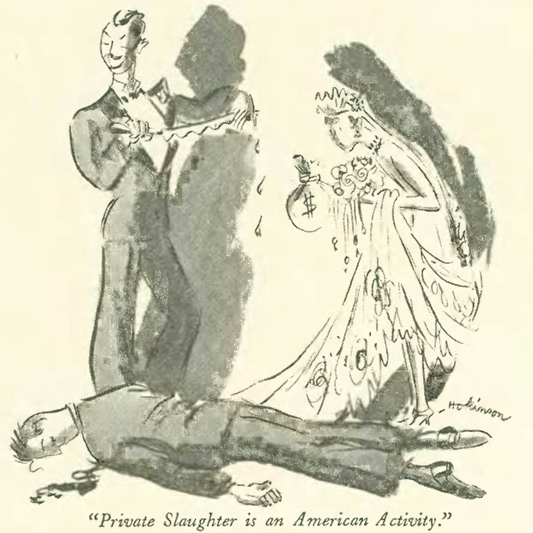
In his essay “Murder As Bad Art,” Waldo Frank pondered America’s high homicide rate, and suggested that murder is an expedient means toward an end for the impatient American. An excerpt, with artwork by Helen Hokinson:

Screenshot 2015-06-26 13.59.42

Screenshot 2015-06-26 13.59.13

Screenshot 2015-06-26 13.59.22

cather
Willa Cather (Nebraska History)

In “Books,” Harry Este Dounce offered a lengthy, thoughtful and positive review of Willa Cather’s latest novel, The Professor’s House, and likened its tone to an Ibsen play. Cather would continue to receive praise from New Yorker critics throughout the remainder of her career.

In “Sports Of The Week” John Tunis offered extensive coverage of the Davis Cup matches, and noted that American star Bill Tilden was hurt and was “far from the Tilden of old.” There were rumors that Tilden was determined to throw his match with French tennis champion Jean Borotra. Tunis wrote that he had his suspicions, but offered that perhaps Tilden was playing carelessly as he had done before “with other less celebrated opponents.”

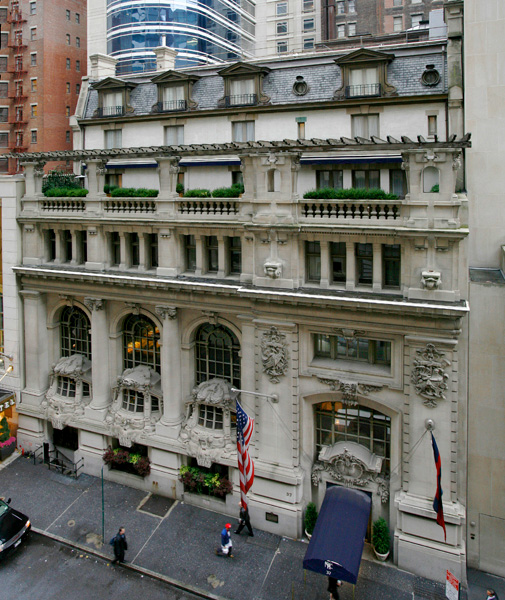
And Lois Long offered her frank opinions on two New York hotspots, the 45th Street Yacht Club and the Owl Club at 125 East 45th:

new-york-city-yacht-club-jeffrey-erb1
The Yacht Club building today (erbology.com)

Screenshot 2015-06-26 14.32.35

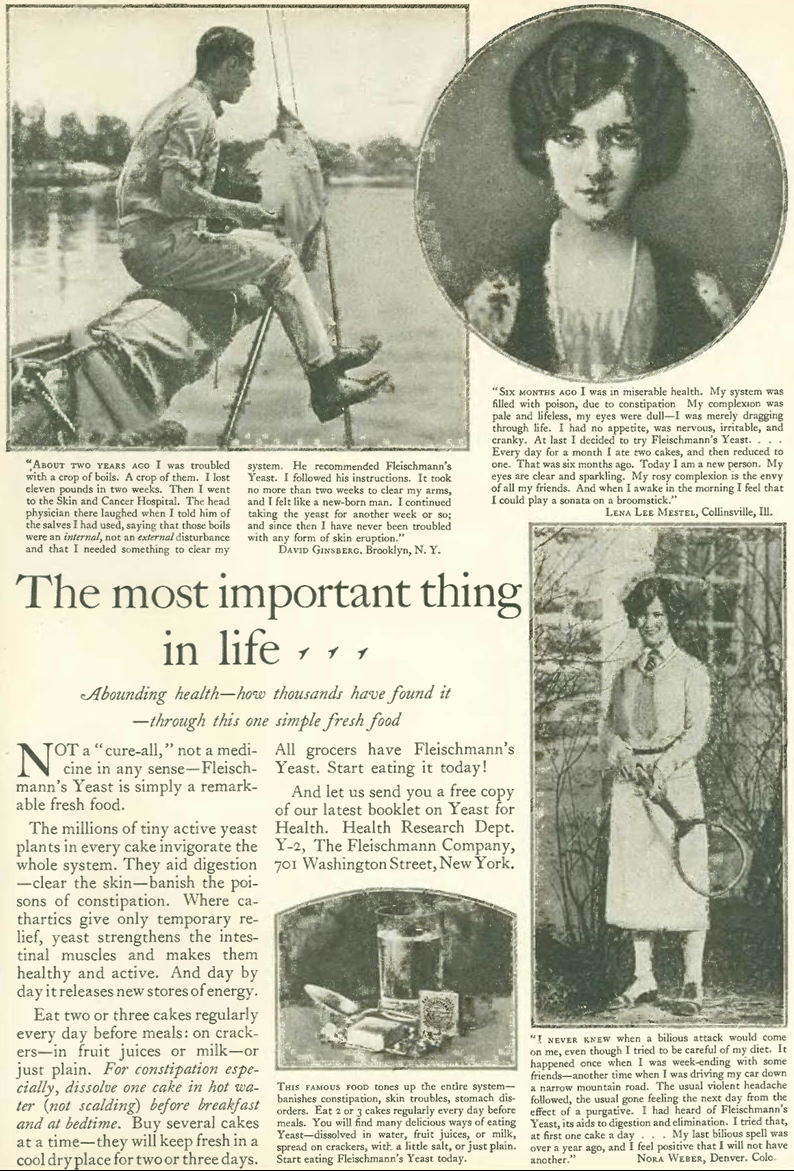
And another ad courtesy of Raoul Fleischmann, with testimonials from a man and two women who credit Fleischmann yeast with curing them of boils, constipation and “bilous” attacks:

Screenshot 2015-06-26 14.36.08

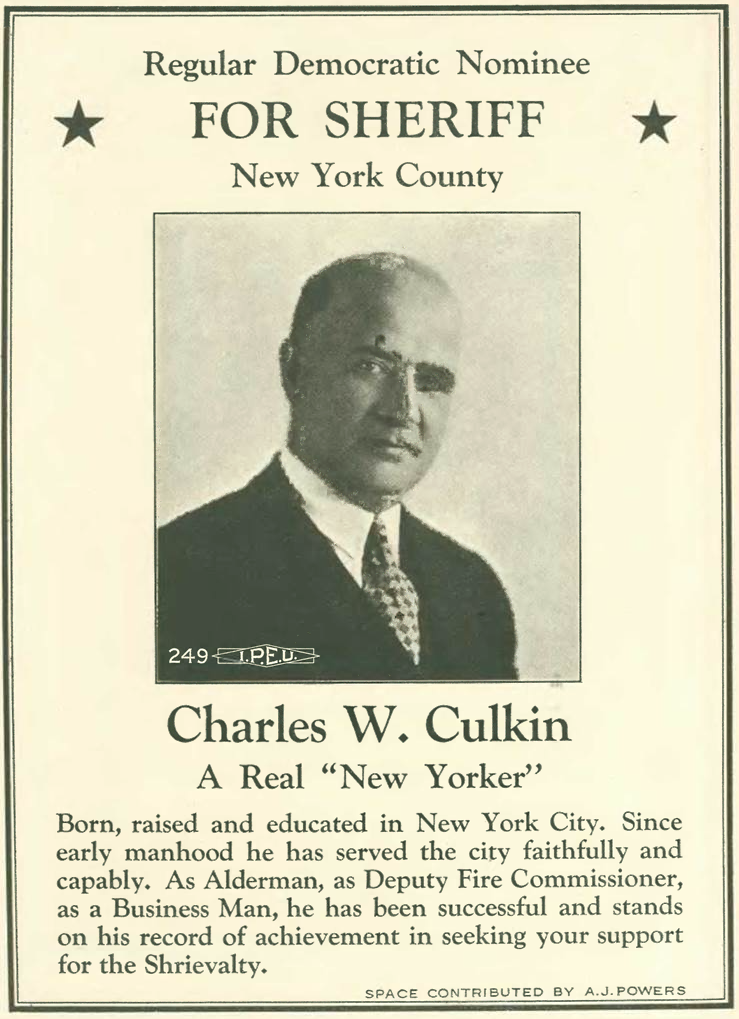
Well, at least advertising revenue is up, but this ad seems out of place in a magazine like The New Yorker:

Screenshot 2015-06-26 14.37.04

Charles Culkin was a Tammany Hall politician who would serve as county sheriff from 1926 to 1929. He was later indicted for embezzling interest money from the sheriff’s office, part of the whole mess that brought down Mayor Jimmy Walker (we will explore that later, I am sure).

Now, for a couple of cartoons by Isadore Klein and Johann Bull, featured on facing pages, that illustrate two very different aspects of New York life in the 1920s:

Screenshot 2015-06-26 14.04.38

Screenshot 2015-06-26 14.04.55

Next time: Fall fashions!

Screenshot 2015-06-26 15.03.49