A Centennial to Remember

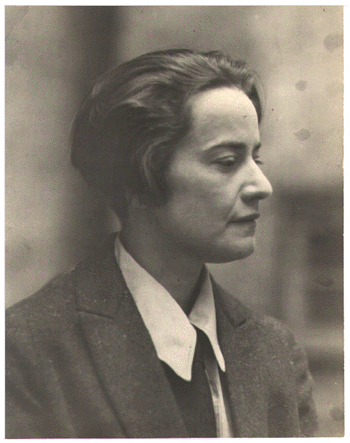
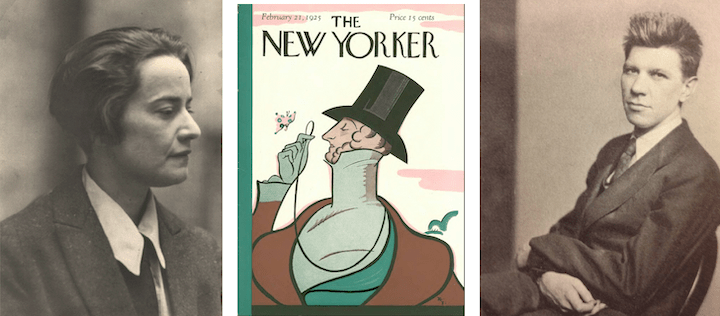
ABOVE: Although Harold Ross looms large in most accounts of the early New Yorker, his wife at the time, Jane Grant, played a major role in its conception and launch.

After a year hiatus, during which I changed jobs (yes, I’m still “hewing the wood and drawing the old wet stuff,” as Bertie Wooster would put it), I am returning to A New Yorker State of Mind, just in time for the 100th anniversary of the greatest magazine in the world.

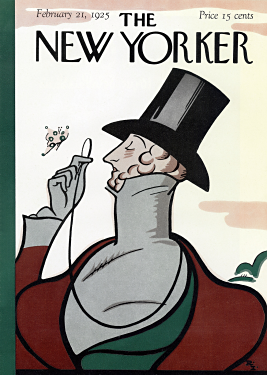
Issue #1 cover by Rea Irvin, Feb. 21, 1925.

Before I continue where I left off—the tenth anniversary issue, Feb. 15, 1935—let us mark the magazine’s centennial year with a look back at the first issue, Feb. 21, 1925.

It is remarkable that after a century the magazine still retains its character, even if it is more serious these days, and more topical, and, most egregious, still fiddling with Rea Irvin’s original designs (for more on this issue, please consult Michael Maslin’s Ink Spill. In addition to being one of the magazine’s greatest cartoonists, Maslin offers a wealth of New Yorker insight and history, including his longstanding crusade to restore Irvin’s original artwork for “The Talk of the Town,” which was removed and replaced by a contemporary illustrator’s redraw in 2017).

Although founder and editor-in-chief Harold Ross set the tone for the magazine in the first issue, famously proclaiming “that it is not edited for the old lady in Dubuque,” it was Irvin that gave the magazine a signature look that set it apart from other “smart set” periodicals of the day.

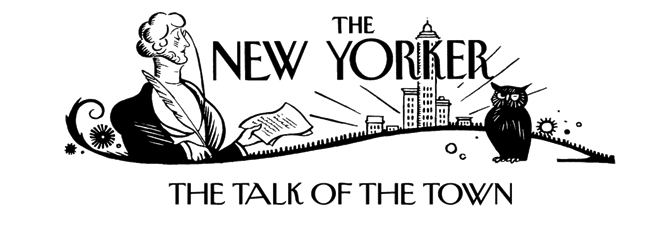
It took a few issues for the editors to sort out regular features and their order of appearance. The opening section of Issue No. 1 featured the Irvin masthead—flanked by Eustace Tilley and the night owl—and Irvin’s distinctive typeface that would introduce “The Talk of Town” for many issues to come. However, in that first issue, “Of All Things” appeared under the masthead, followed by “Talk of the Town” which was (for the first and last time) under this banner:

As for Ross’s manifesto, it appeared at the end of “Of All Things,”…
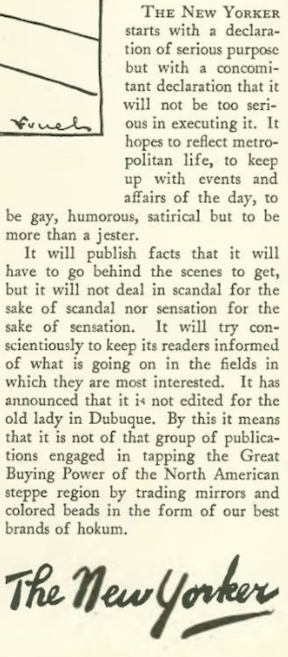
…and “Talk” ended with this signature…
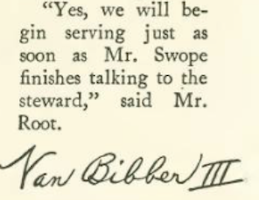
…In Defining New Yorker Humor, Judith Yaross Lee wrote that early readers of The New Yorker would have recognized the Van Bibber III persona “as a joke, a personification of Van Bibber cigarettes, whose ads targeted the devil-may-care, swagger young man about town all dressed up for the opening night. As an insiders view of the urban scene, Van Bibber’s accounts featured casual conversation—that is, talk.”
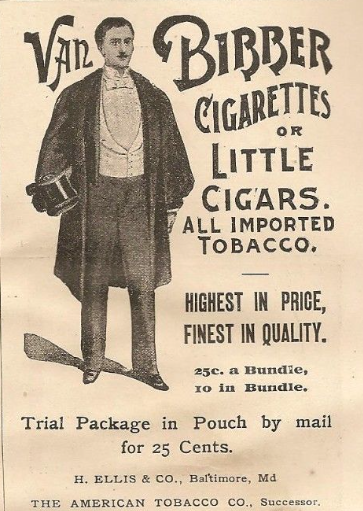
Van Bibber advertisement in Cosmopolitan, 1896.

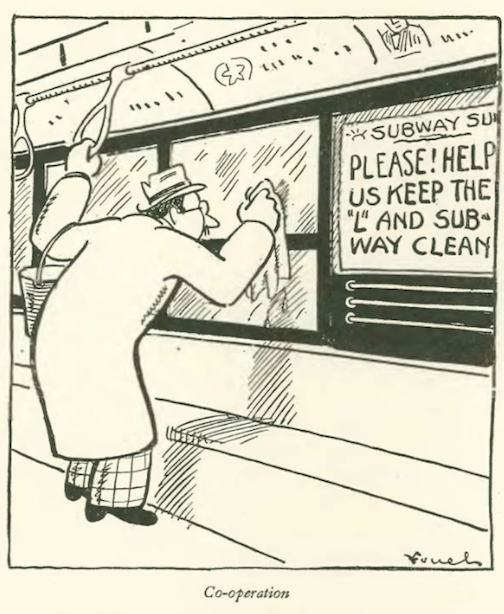
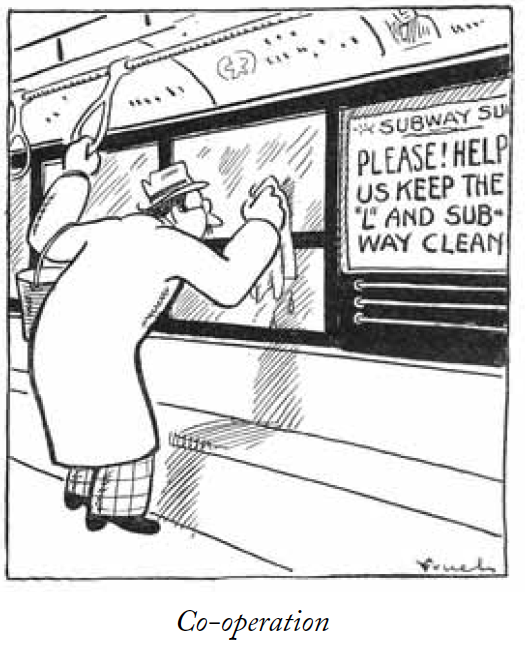
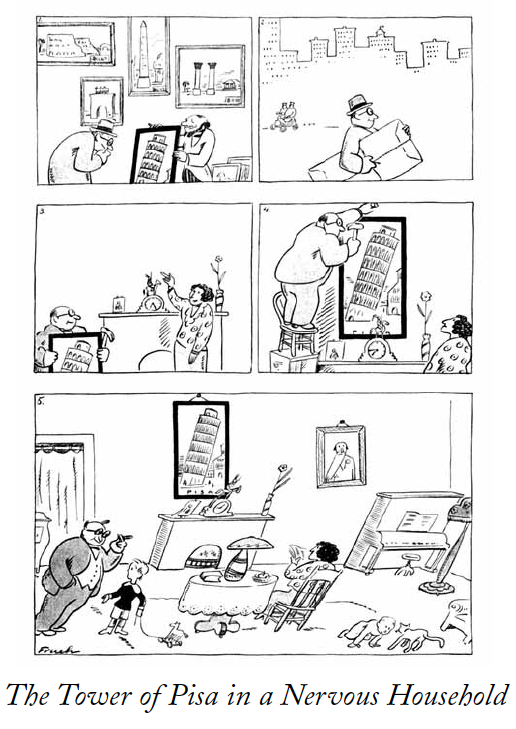
The magazine’s very first cartoon was by Al Frueh

…and among the features that persisted through the years was “Profiles,” the first one featuring Giulio Gatti-Casazza (1869-1940), who served as Metropolitan Opera’s general manager for a record 27 seasons (1908-1935).
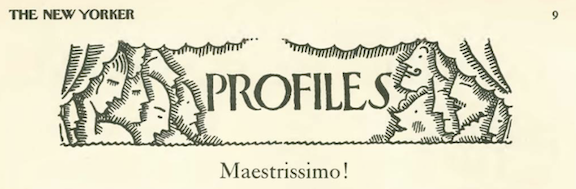
The profile featured this illustration by Miguel Covarrubias, the renowned Mexican painter, caricaturist, and illustrator, who was a frequent contributor to the early New Yorker.

“Goings On” also persists, sans the original artwork…
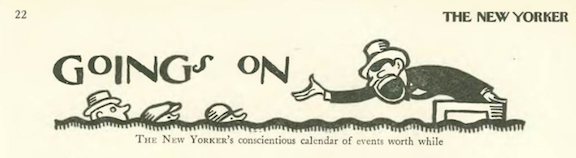
…the same goes for these sections…
…still others disappeared altogether…

…some would hang around for awhile…
…others for just a few issues…”The Hour Glass” featured brief vignettes of local personalities…
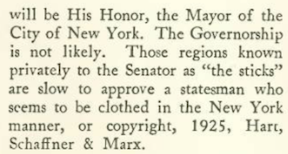
…such as the ever-fascinating antics of Jimmy Walker, who would soon be elected mayor…

…while “In Our Midst” detailed the comings and goings of other locals…
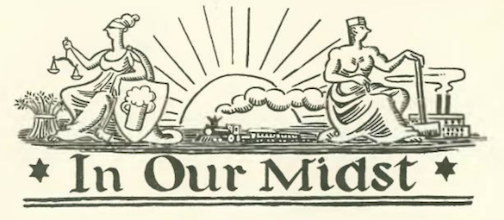
…including The New Yorker’s own Al Frueh.

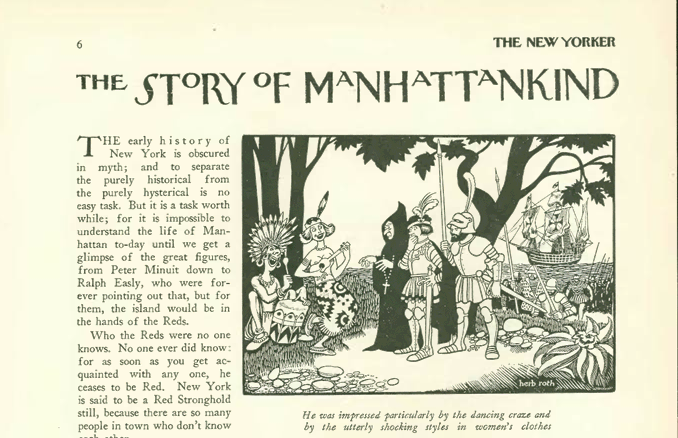
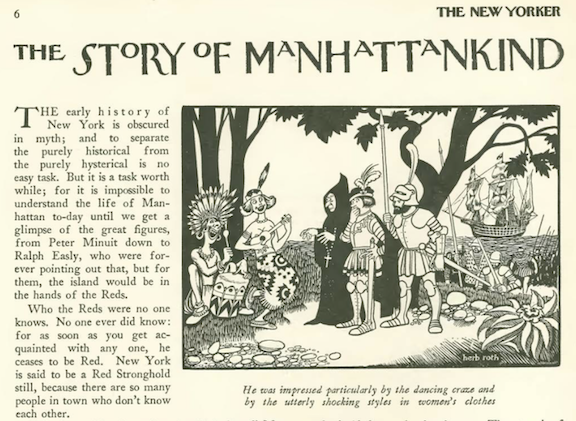
“The Story of Manhattankind” was another short-lived feature. It offered drawings by Herb Roth and tongue-in-cheek accounts of early Manhattan life replete with cartoonish Indians and bumbling settlers. It is here where the magazine took its first of many shots at William Randolph Hearst, the perceived rival and publisher of Cosmopolitan (which was more of a literary magazine in 1925).
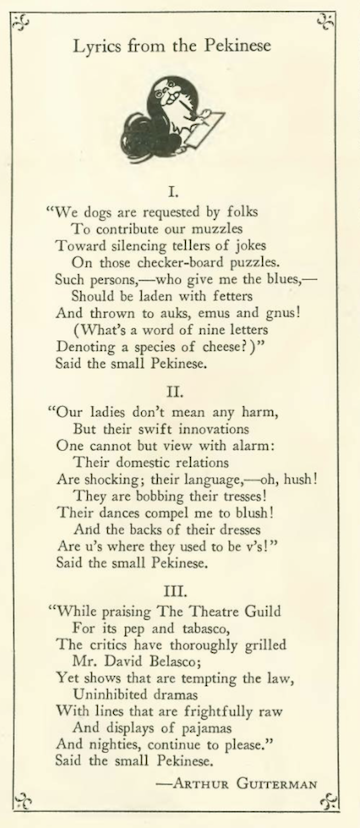
…other items that persisted through the early issues included “Lyrics from a Pekinese” by writer Arthur Gutterman, who was known for his silly poems…
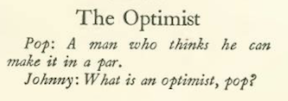
…and this recurring column filler, “The Optimist”…a tired joke featured repeatedly in the first issues until Katharine Angell came on board and put an end to such nonsense…
…in those lean first months there was little advertising, making this back page ad seem out of place…

…since many of the early ads were small, signature ads for theatre and other diversions…

…the magazine also leaned heavily on full-page house ads to fill space…

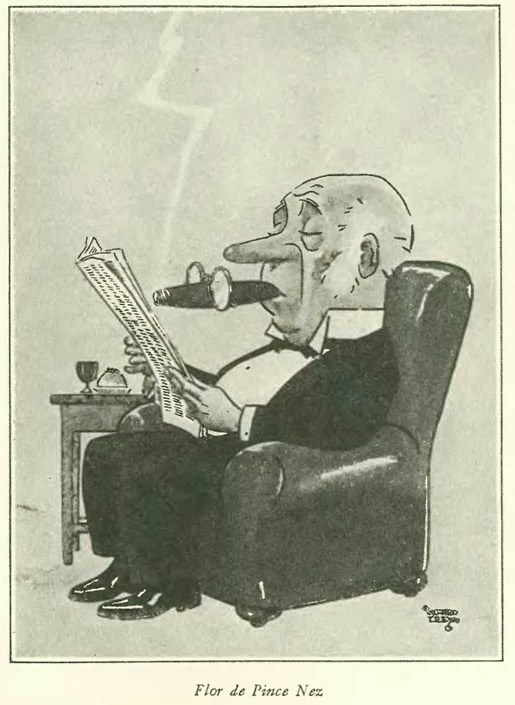
…the one thing that has persisted to this day is the prominence of cartoonists and illustrators, although in the early issues some of the cartoons resembled those found in Punch, including this one by British graphic artist Alfred Leete, who was a regular contributor to such British magazines including Punch, the Strand Magazine and Tatler.

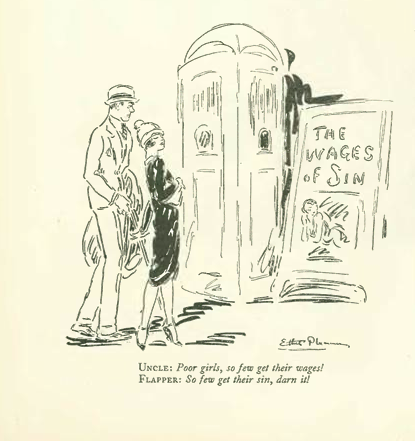
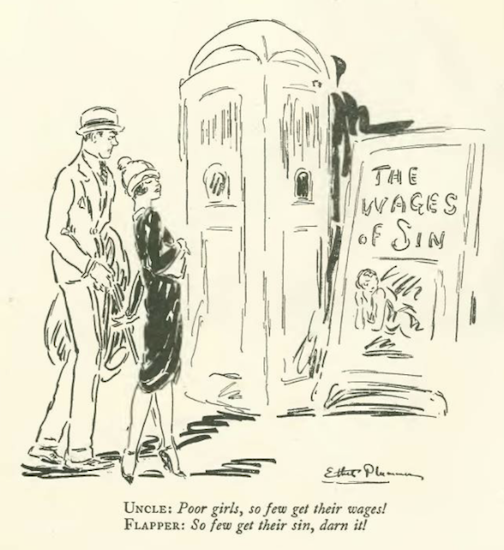
Also in the Punch style there were a number of “He-She” captioned cartoons, such as this Ethel Plummer cartoon of an “uncle” and a “flapper” looking at a theater bill for The Wages of Sin (most notably, Plummer was the first woman artist published in The New Yorker)…
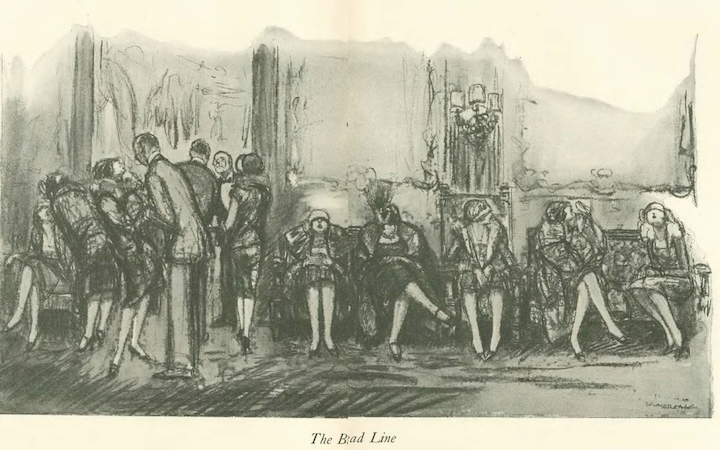
Plummer was a noted artist/illustrator in her day, as was Wallace Morgan, who contributed this two-page spread, “The Bread Line”…
…this illustration by Eldon Kelley is notable for what it lacks…namely, clothing. Early New Yorker lore has it that Ross was somewhat puritanical, and shied away from suggestions of sex or nudity, but here it is in the first issue, what Michael Maslin refers to as “The New Yorker’s First Nipples.” 

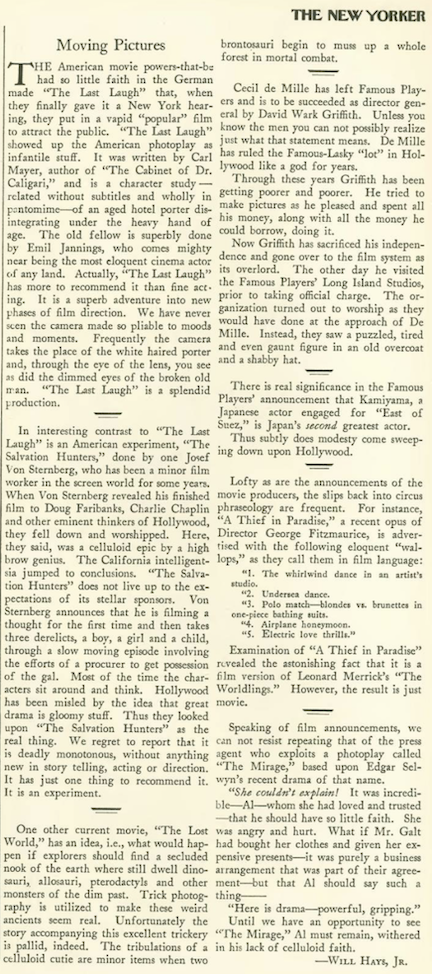
…and before I go, I am wondering about The New Yorker’s first film critic, who signed his review “Will Hays Jr.” Is this the same Hays as in the “Hays Code?” I will investigate.
Next Time: A Century and a Decade…

 

Roll the Presses

You need not read far into Issue #1 before you realize how utterly distant this world is from our own. Launched in the midst of the Jazz Age, the magazine assumed its readers to be bourgeois (judging from the ads), cosmopolitan, Anglo- and/or Francophile, Ivy- or private school-educated and with enough disposable income to strike the disinterested pose of the cover mascot, Eustace Tilley.

Original_New_Yorker_cover
Issue 1, Feb. 21, 1925, cover by Rea Irvin

Issue No. 1, Feb. 21, 1925, opened with a section titled “Of All Things,” and these first words:

Right next door to the Follies, some young adventurer has opened a penny peep-show where you can see five hundred and fifty glorified young women for what Mr. Ziegfeld charges for his much smaller collection.

The section concluded with a manifesto by the magazine’s founder and editor-in-chief, Harold Ross, who famously proclaimed, “It has announced that it is not edited for the old lady in Dubuque.”

foto-670x920
Harold Ross (theharlow.net)

There is scant advertising in the slim first issues (No. 1 is just 32 pages plus cover). In an article written for the 90th anniversary issue (Feb. 23, 2015), Ian Frazier explains how it was first funded:

After returning to the States, in 1919, he (Ross) edited a short-lived version of Stars & Stripes for veterans and became a New York night-life figure known for carrying around a dummy of his still unnamed magazine and talking about it endlessly. When he finally published the first issue of The New Yorker, ninety years ago, he paid for it partly himself. Nearly half the magazine’s original funding was a twenty-one-thousand-dollar stake put up by Ross and his wife, Jane Grant, and their friend Hawley Truax. Raoul Fleischmann, a baking heir and almost millionaire whom Ross had met through mutual friends, supplied another twenty-five thousand.

9780307829412_p0_v1_s260x420Ross’s involvement in World War I figured prominently in the origins of the New Yorker. It was during his time at Stars & Stripes that he met Alexander Woollcott, who was already an established New York theater critic.

Jane_Grant
Jane Grant (Wikipedia)

At this time Ross also met Jane Grant, who was serving in the YMCA entertainment corps and was a frequent visitor to the Star & Stripes offices. Although Ross’s name looms large in most accounts of the early New Yorker, Grant played a major role in its conception and launch.

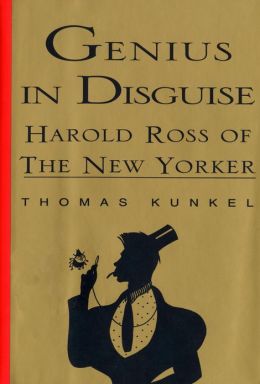
I highly recommend Thomas Kunkel’s Ross biography, Genius in Disguise, for a complete account of the magazine’s early days.

Screenshot 2015-03-09 16.39.40

It took a few issues for the editors to sort out regular features and their order of appearance. The opening section of Issue No. 1 featured the famous Rea Irvin masthead—flanked by Eustace Tilley and the night owl—and Irvin’s distinctive typeface that would introduce “The Talk of Town” for many issues to come. However in Issue No. 1 “Of All Things” appeared under the masthead, followed by “Talk of the Town” which was (for the first and last time) under this banner:

Screenshot 2015-03-09 16.39.54

The magazine’s second issue, Feb. 28, paired the Eustace Tilley masthead with “The Talk of the Town” for its opening section, but the March 7 issue paired it with “Behind the News” for the opening section.

With the March 14th issue, the editors decided to permanently install “The Talk of the Town” below the masthead in the lead section, relegating “Of All Things” and “Behind the News” to inside pages.

Screenshot 2015-03-11 14.14.34

For the sake of comparison, here is the current 2015 version:

Screenshot 2015-03-16 16.48.45

A number of short-lived regular features made their appearance in these early issues: “The Story of Manhattankind” offered drawings by Herb Roth and tongue-in-cheek accounts of early Manhattan life that featured cartoonish Indians and bumbling settlers. It is here where the magazine took its first of many shots at William Randolph Hearst, perceived rival and publisher of Cosmopolitan (more of a literary magazine in 1925, and not the sex tips and cleavage rag it is today).

Screen Shot 2015-02-22 at 5.53.40 PM

The first two cartoons ever featured in the New Yorker were by Al Frueh:

This recurring column filler, “The Optimist,” began in Issue No. 1, a tired joke featured repeatedly in the first issues until Katharine Angell came on board and put an end to such nonsense…

“Profiles” were established at the start, the first issue featuring opera maestro Giulo Gatti-Casazza, the second issue taking aim at “Princess” Alice Roosevelt Longworth, and the third issue probing New York Times managing editor Carr Vatell Van Anda. “In Our Midst” featured local celebrity sightings and gossip, such as actress Tallulah Bankhead and writer Edna Ferber in Issue 3 (March 7).

Screenshot 2015-03-12 10.57.25
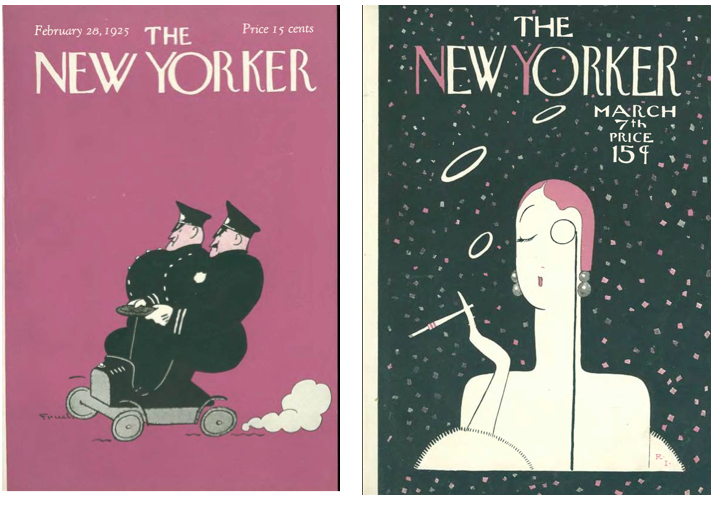
New Yorker Issues 2 & 3, Feb. 28 (cover by Al Frueh) and March 7 (cover by Rea Irvin), 1925.

Most of the cartoons from the very beginning were famously droll, such as this illustration by British graphic artist Alfred Leete, who was a regular contributor to such British magazines as Punch, the Strand Magazine and Tatler.

Screenshot 2015-05-12 13.33.10

…but a few cartoons recall an earlier style in which the action is captioned (like old Punch cartoons) in a more formal manner. The first issue featured an Ethel Plummer cartoon of an “uncle” and a “flapper” looking at a theater bill for The Wages of Sin:

Uncle: Poor girls, so few get their wages.

Flapper: So few get their sin, darn it!

Screen Shot 2015-02-22 at 5.58.48 PM

A section titled “The Hour Glass” offered short, casual accounts of various local personalities. “Lyrics from a Pekinese” was another recurring feature by writer Arthur Gutterman, who was known for his silly poems.

Music reviews in early issues were almost entirely devoted to classical, live performances. Fritz Kreisler’s violin mastery was featured prominently in the first issue, while it wasn’t until the third issue that jazz was briefly mentioned (it was becoming “respectable” in some concert halls). It was reported that violinist Damuel Dushkin ended his performance with selections from George Gershwin’s Rhapsody in Blue.

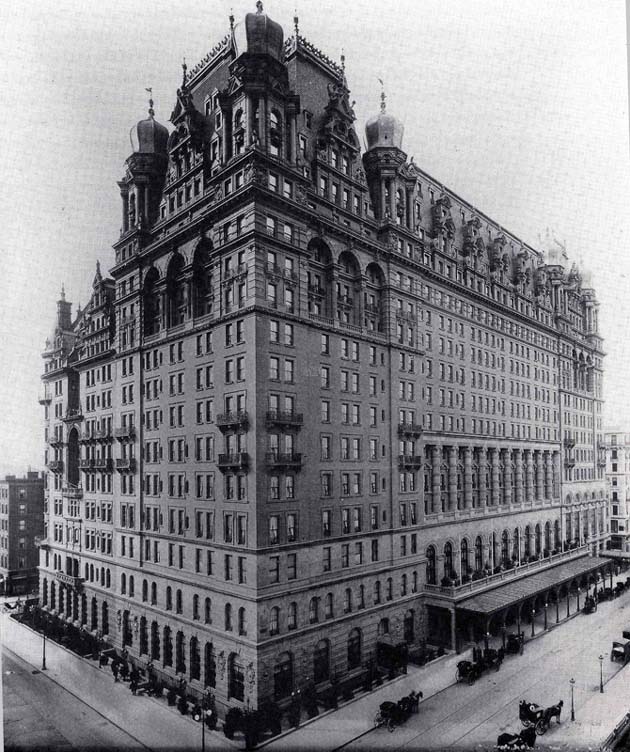
The “Art” section featured an exhibition of British paintings at the Central Art Galleries, and a show by the Society of Independent Artists (paintings sell from 24 to 99 dollars), at the Waldorf Hotel (soon to be razed and replaced by the Empire State Building). Joseph Stella was at the Dudensing Galleries, described as a “gifted young American.”

017- Waldorf Astoria
Old Waldorf-Astoria, razed in 1929 to make way for the Empire State Building (nycago.org)

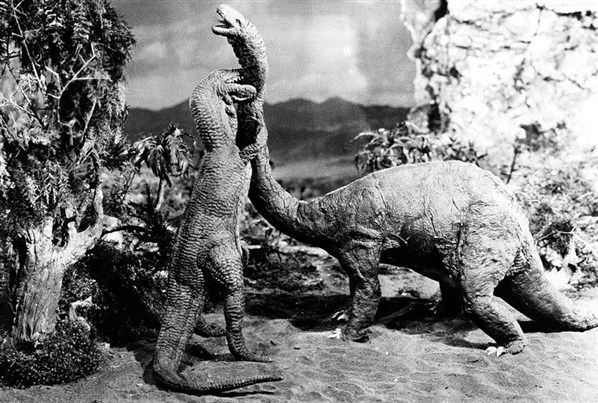
“Motion Pictures” looked at Greed (Frank Norris’s McTeugue transferred to the screen), which was playing on the Loew Circuit; The Lost World at the Astor (“Through camera trickery, dinosaurs and other beasts of the prehistoric past live again. Interesting because it proves that the camera is a liar”); the “splendid” German-made The Last Laugh by Carl Mayer (of Dr. Caligari fame) and The Salvation Hunters by Josef Von Sternberg. The magazine called it “deadly monotonous”…”the characters just sit around and think.” German actor Emil Jannings was a favorite, and would be lauded in subsequent issues.

The-Lost-World-poster-still-2
Still image from The Lost World, 1925 (Wikipedia)

The first issue closed with an ad from Royal Cord Balloon Tires. Later issues would depend heavily on advertising revenue from auto manufacturers.

Screenshot 2015-03-12 10.04.15

The early issues also featured two-page-drawings that illustrated some event described in the opening section. The Feb. 28 issue (#2), mentioned that Ciro’s opened with the Mary Hay and Clifton Webb dancing team (illustration by Reginald Marsh)…

Screenshot 2015-03-09 16.46.34

As this was the age of Prohibition, there was a notable absence of alcohol in ads and even in print articles, although references are made to “speakeasies” and later issues would report black market prices for liquor.

The second issue’s “Talk of the Town” further elaborated on the magazine’s manifesto:

And we won’t aim to please. If we happen to please we will not apologize, but we are not in the vast army of bores struggling frantically to give people what they want.

We may not do much for the magazine world. We don’t know that we’re aiming to. But of one thing we feel quite sure: if we ever run out of things to say, just for the fun of saying them, we expect to close up this little playhouse and go to work.

The “Theatre” section of Issue No. 2 featured James Joyce’s Exiles at the Neighborhood Theatre, while a section titled “And They Do Say” featured the first (of the many subsequent references) to Eddie Cantor’s various comings and goings. It was reported Cantor left for Boston in his “Kid Boot” and that altercations between Cantor and veteran stage actress Jobyna Howland “kept 42nd Street nervous for weeks.”

Screenshot 2015-06-30 15.01.06
Eddie Cantor and Jobyna Howland (Wikipedia, Travalanche)

“Books” featured a review of Ford Madox Ford’s “Some Do Not…” The reviewer Harry Este Dounce (under the nom de plume “Touchstone”) called it “as gratuitously black-biled a work of art as we ever saw.”

Under “Washington Notes” were the first of many humorous references to President Calvin Coolidge, his hayseed habits and his extreme frugality. Below, a drawing by Miguel Covarrubias (a regular contributor beginning with the first issue) in March 14 issue:

Screenshot 2015-03-11 12.37.23

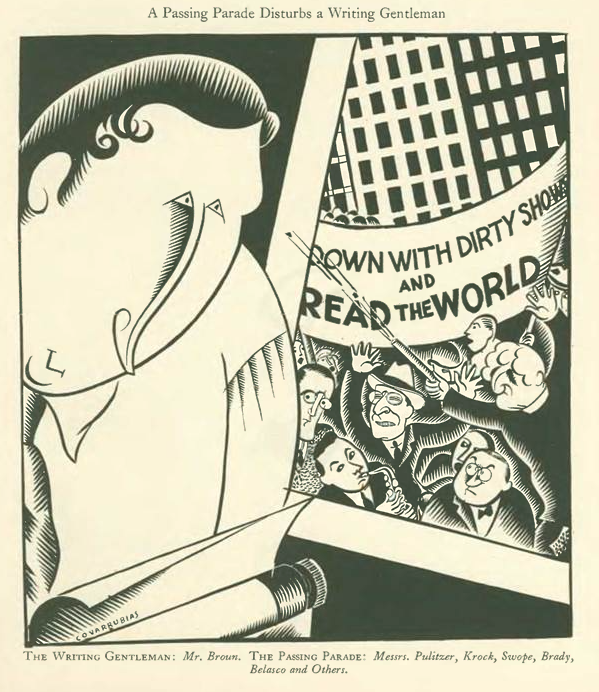
Another Covarrubias illustration in Issue # 3 (March 7) depicted journalist Heywood Broun (old Ross friend and Algonquin Round Table stalwart) hard at work on his column for the New York World:

Screenshot 2015-05-12 13.40.24

Next Time: The Queen of Romania…